




Abstract
This study examined demographic similarity/difference between leaders and followers and level of intercultural sensitivity of leaders as predictors of followers’ ratings of leader–member exchange (LMX) in a U.S. higher education environment. A significant positive relationship was found between leaders’ levels of intercultural sensitivity and followers’ ratings of LMX. Specifically, as leaders’ levels of intercultural sensitivity increased, followers’ rating of LMX also increased. Demographic similarity/difference did not have a predictive relationship with followers’ ratings of LMX.
Keywords
Introduction
Leader–member exchange (LMX) asserts that leadership is a process that is centered on the interaction between leaders and followers. According to LMX, supervisors do not treat or evaluate all their subordinates in the same way (Graen, 1976). Subordinates in relationships with high-quality exchanges receive a greater amount of attention as well as higher performance evaluations. These employees typically have lower turnover rates and are generally more satisfied with their supervisor (Gerstner & Day, 1997). Research has indicated that quality of leader–member exchanges (LMXs) has affected subordinates’ workplace experiences (Vecchio & Gobdel, 1984). Many positive organizational outcomes are predicted by high LMX; however, the research on these relationships in diverse environments is mixed.
Leadership research, in general, has assumed a homogenous population and has not often addressed demographic issues except in very limited ways (Hooijberg & DiTomaso, 1996). Chen and Starosta (1996) specified five trends that have led our world into a more global society in which intercultural sensitivity and culturally competent skills are increasingly important: (a) the development of communication and technology that links people from all parts of the world; (b) employees in multinational corporations must increasingly communicate effectively with people in other parts of the world to remain competitive in a global market; (c) the U.S. domestic workforce has witnessed dramatic shifts as populations have migrated across borders to seek jobs; (d) the new workforce will be composed of persons who are diverse in age, race, culture, and language; and (e) the de-emphasis of nation-state has led nations to form regional alliances and people to reassert ethnic and gender differences within the nation. However, little attention is given to the effect high LMX relationships have on diverse populations in our workplaces (Nishii & Mayer, 2009), despite decades of research seeking to understand the nature and consequences of work relationships between employees and supervisors (Restubog, Bordia, Tang, & Krebs, 2010).
This study seeks to address this by examining demographic similarity/difference between leaders and followers and the quality of the leader/employee relationship using LMX theory. Additionally, the relationship between leaders’ levels of intercultural sensitivity and followers’ perceptions of LMX will be tested after controlling for demographic similarity/difference. We will begin with a brief description and overview of LMX research and intercultural sensitivity.
Leader–Member Exchange
Graen and Uhl-Bien (1995) described a leadership taxonomy claiming that research exploring the concept of leadership is incomplete if it focuses solely on the attributes of a leader. Rather, the construct of leadership encompasses three domains: the leader, the follower, and the relationship between them. Research supports these three domains of leadership within organizations. Basu (1991) found that three combined variables (the three domains of leadership) accounted for significant variation in leadership outcomes (innovative behavior). Studies exploring multiple domains of leadership are likely to continue to offer rich insights into the dynamics of leadership.
Researchers have examined the role of various leader characteristics, attitudes, and perceptions as predictors of quality LMXs. For instance, leaders’ reported leadership efficacy and optimism did not predict quality LMX (Murphy & Ensher, 1999); however, leaders’ reports of member attributes were significantly related to “in-group” status (Heneman, Greenberger, & Anonyuo, 1989). Leaders reporting high-quality exchanges with direct reports were more likely to attribute direct report performance effectiveness to internal attributes such as effort and ability. Other research investigating predictors of LMXs have examined the role of various member characteristics, attitudes, and behaviors including extraversion (e.g., Phillips & Bedeian, 1994), internal locus of control (Kinicki & Vecchio, 1994), liking of the leader (Liden & Maslyn, 1998), in-role behaviors (Basu & Graen, 1995), and ingratiation (Wayne, Liden, & Sparrowe, 1994). Additionally, some research has investigated organizational contexts as predictive of quality LMXs. For instance, Kinicki and Vecchio (1994) indicated that time pressure may have a stimulating effect on quality LMXs. Green, Anderson, and Shivers (1996) found that unit size and workload have inverse relationships with the quality of LMX.
Intercultural Sensitivity
One of the earliest studies dealing with sensitivity as a concept was by Bronfenbrenner, Harding, and Gallwey (1958). They proposed two types of sensitivity: sensitivity to the generalized other (sensitivity to the norms of one’s own group) and sensitivity to individual differences (the ability to distinguish how others differ in their behavior, perceptions, or feelings). Hart and Burks (1972) as well as Hart, Carlson, and Eadie (1980) suggested sensitivity as a mindset, which is applied in one’s everyday life. They propose that sensitive people should be able to accept personal complexity, avoid communication inflexibility, be conscious in interactions, appreciate idea exchanges, and tolerate ambiguity.
According to Chen (1997), intercultural sensitivity implies a level of personal motivation to produce a positive outcome for intercultural interactions. Bhawuk and Brislin (1992) define intercultural sensitivity as the “sensitivity to the importance of cultural difference and to the points of view of people in other cultures” (p. 414).
Research conducted on cross-cultural adaptation, intercultural effectiveness, and job performance during international assignments and other forms of intercultural contact (e.g., tourism, immigration, and refugee resettlement) clearly identify intercultural sensitivity as a key component for working and living with people from various cultures (Bhawuk & Brislin, 1992). Intercultural sensitivity can also be seen as an important capability for overcoming barriers to effectively working with people across cultural boundaries both internationally and domestically (M. J. Bennett, 1993).
Current Models of Intercultural Sensitivity
The Developmental Model of Intercultural Sensitivity (DMIS) is a stage model of cognitive development based on personal construct theory (Kelly, 1963) and its extension, radical constructivism (Watzlawick, 1984).
Other researchers have offered stage models as well. Gudykunst and Hammer’s (1983) intercultural training model suggests the sequencing of three stages: perspective taking, interaction training, and context-specific training. The authors seek to develop a “third-culture perspective” in learners. Although this model has some merit, it focuses on the types of training and not the learner’s developmental experience. Hoopes’s (1981) intercultural learning model consists of ethnocentrism, awareness, understanding, acceptance/respect, appreciation/valuing, selective adoption, and finally assimilation/adaptation/biculturalism/multiculturalism.
M. J. Bennett (1984) created the DMIS as phenomenological model that assumes intercultural sensitivity to be a developmental process in which one is able to transform oneself cognitively, affectively, and behaviorally to higher levels of intercultural sensitivity. In essence, it combines the concepts of intercultural awareness, intercultural sensitivity, and (with individual motivation) intercultural competence. This model is built on the prevailing concepts of the field of intercultural communication (M. J. Bennett, 1993) and goes beyond earlier attempts to conceptualize underlying assumptions and delineate stages by allowing learners and trainers to develop stage-appropriate learning activities to encourage development toward increasingly sensitive levels. It takes as paramount the meaning that is attached by people to phenomena (Pilotta, 1983) and provides one of the few nonjudgmental approaches. By not offering the “ideal” stage of development, but rather allowing learners to examine experiences and the interpretations of those experiences, they gain insights that could be used to increase their own level of sensitivity.
Developmental Model of Intercultural Sensitivity
The early stages of the DMIS correspond with the concept of ethnocentrism, which is used widely in the intercultural literature to illustrate one’s own culture being central to reality in some way. The latter stages correspond with the concept of ethnorelativism, which is represented in works such as Adler’s (1977) “multicultural man,” Bochner’s (1979) “meditating person,” and Heath’s (1977) “maturity.”
It is important to note that although the field of intercultural communication is frequently associated with international cultural differences, this model also takes into consideration domestic diversity issues such as gender, class, race, and sexual orientation. The authors note, however, that two important differences may exist. First, the cultural identities of traditionally oppressed people are devalued in the media and often in society in general. Second, the dominant cultural group may demand conformity or segregation, which forces minorities who desire both inclusion and unique identification into a “fight or flight” mode (M. J. Bennett, 1986). For these reasons, oppressed people may navigate the stages of development differently than those in dominant groups.
The ethnocentric stages
The first ethnocentric stage is termed denial. A denial of difference is the purest form of ethnocentrism (M. J. Bennett, 1986). People in this stage simply do not consider the existence of cultural differences. At its most basic level, this may be seen as a simple “disinterest” in cultural differences. The second ethnocentric stage is “defense.” This refers to a more explicit recognition of difference and is used to counter the impact of cultural differences seen as threatening. The threat is to one’s own sense of reality and thus to one’s own identity (M. J. Bennett, 1986). An alternate level of defense occurs for some learners as a strategy that may occur when they are exposed to certain experiences at an inappropriate stage of their own development. This level, termed reversal, is often referred to as the “Peace Corps syndrome” (M. J. Bennett, 1986), where learners experience the hardships of another culture and deem their own culture to be at fault for these hardships. Although this level may initially be interpreted as a higher level of sensitivity, it is in actuality simply a reversal of the ethnocentric stance that one culture is superior to another.
“Minimization” is the third and final stage of ethnocentrism. It is the most complex strategy for avoiding cultural differences. This stage can sometimes be viewed as an “ideal end state,” as many models of sensitive interpersonal communication are based on the discovery or creation of similarity between people (e.g., Crable, 1981; DeVito 1980). Many world peace organizations operate from the minimization stage as well (Rosenberg, 1989). What makes this stage ethnocentric is that the assumed universal characteristics are usually derived from learners’ own cultural perspectives. Although minimization represents a developmental advance from denial and defense, it is, nonetheless, still ethnocentric.
The ethnorelative stages
For the development of intercultural sensitivity, ethnorelativism represents a major shift in the meaning attributed to difference. In phenomenological terms, the experience of difference is substantially altered since difference is no longer seen as a threat. Fundamental to ethnorelativism is the assumption that cultures can only be understood relative to one another and that any particular behavior can only be understood within its cultural context.
The first stage of ethnorelativism, “acceptance,” is seen when learners both acknowledge and respect cultural differences. The next stage of ethnorelativism is “adaptation.” This occurs when we need to think outside of our own particular cultural context (J. M. Bennett & Bennett, 2004). At this stage, skills for relating to and communicating with people of other cultures are enhanced. The term adaptation is intended specifically to exclude the concept of assimilation wherein learners’ identities are absorbed by a new culture (Prosser, 1978). At best, assimilation is a manifestation of minimization and may signal reversal when people lose their own culture to another. In adaptation, new skills are in an additive process (rather than replacing current cultural skills). The assumption is that culture is a process: “One does not have a culture, one engages in it” (M. J. Bennett, 1986, p. 32).
The final stage of ethnorelativism is “integration.” This describes the learner’s efforts to “integrate disparate aspects of one’s cultural journey into one whole” (Hammer & Bennett, 1998, p. 16). The goal of this integration is not to reaffiliate with one’s own culture but rather to understand that identity emerges from the act of defining identity itself (M. J. Bennett, 1986).
Hypotheses
In this study, it is predicted that higher levels of leader intercultural sensitivity will result in higher quality relationships between leaders and followers (as measured by follower ratings of LMX). Additionally, it is predicted that demographic similarity/differences will affect LMX ratings—specifically that demographic similarity will produce higher LMX than will demographic differences in three categories (sex difference, sexual orientation differences, and race differences). A multilevel analysis will be used to test these hypotheses.
Method
Population
Participants were 72 leaders and 255 followers in higher education institutions. Leaders were identified by department heads or directors as supervisors of at least two permanent staff or faculty. An attempt was made to eliminate departments where clear reporting relationships were not found. For example, some academic departments did not identify traditional supervisor relationships between faculty and department heads and thus were not used in the study. E-mails were sent from the researcher directly to participants asking for their voluntary participation. A link was provided in the e-mail to the SurveyMonkey website if the participant decided to participate.
Return rates were calculated as the actual number of surveys returned. Because of the need to match leaders and followers in the data analysis, leaders with no corresponding followers, and followers with no corresponding leaders, had to be eliminated from the study. Of the 529 follower surveys distributed, 334 were returned (63%), resulting in 255 usable surveys. Of the 123 leader surveys distributed, 95 were returned (77%), resulting in 72 usable surveys. Leaders had an average of four followers each.
Participant demographics can be found in Table 1. All participants were current faculty, staff, or administrators at 4-year higher education institutions.
Participant Demographics

NOTE: N = 327 (72 leaders and 255 followers).
Measures
The LMX-7 (Scandura & Graen, 1984) was used to measure LMX quality. The LMX-7 has been the most frequently used instrument in LMX research (Gerstner & Day, 1997) and is reported to have high reliability and freedom from social desirability (Liden & Maslyn, 1998). The 7-item measure of member LMX has consistently shown criterion-related validity (Liden, Wayne, & Stilwell, 1993).
The Intercultural Development Inventory (IDI) was used to assess leaders’ levels of intercultural sensitivity. The IDI is a 50-item instrument that empirically measures five orientations toward cultural differences. This instrument is based on M. J. Bennett’s (1986, 1993) DMIS and offers a valid and reliable empirical measure of the concepts defined by the DMIS.
Results
Simple Statistics and Correlations
Variable means, standard deviations, and correlations are shown in Table 2. A significance level of .05 (p <; .05) was used in the data analysis.
Descriptive Statistics and Correlation Matrix for LMX-7 and IDI
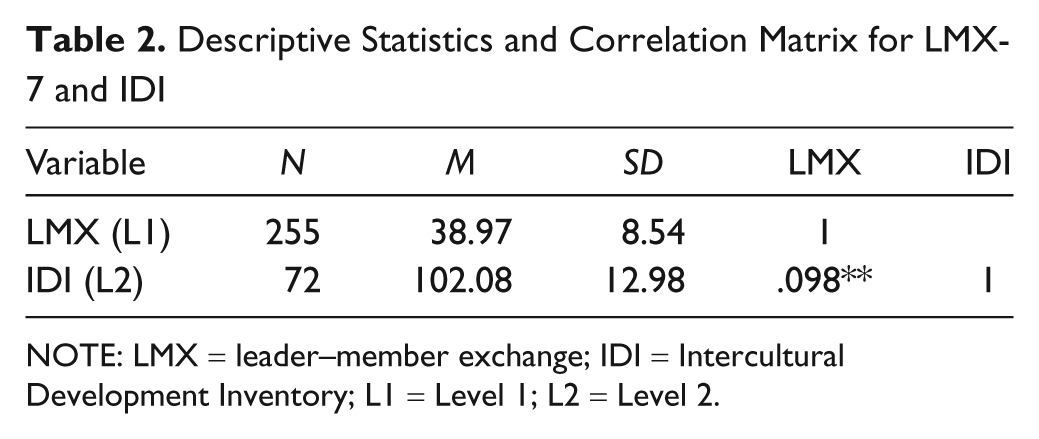
NOTE: LMX = leader–member exchange; IDI = Intercultural Development Inventory; L1 = Level 1; L2 = Level 2.
Scale reliabilities were acceptable per Nunnally’s (1978) conclusion that minimum reliability (Cronbach’s α) measures should be at .70. The LMX-7 (α = .93) and IDI (α = .80) both met this requirement.
Hierarchical linear modeling (HLM) was used to test the hypotheses. HLM adopts a two-level approach to cross-level investigations where the Level 1 model is estimated separately for each group. This model took the form of a regression-based model and is expressed as follows:

where Y ij is the outcome measure for individual i in group j, X is the value on the predictor variables (difference in gender, difference in sexual orientation, and difference in race) for individual i in group j, β 0j and β 1j are intercepts and slopes estimated separately for each group (as noted by the subscript j), and r ij is the residual.
The Level 2 equation is expressed as the following:

where G j is the group-level variable (IDI), γ00 is the second-stage intercept term, and γ01 is the slope relating G j to the intercept and slope terms from the Level 1 equation, and U 1j is the Level 2 residual.
Recent work using multilevel frameworks has also found within- and between-group effects using aggregation statistics and random coefficient models, commonly referred to as HLM (Kreft & De Leeuw, 2004; Raudenbush & Bryk, 2002; Snijders & Bosker, 1999). HLM is currently regarded as the more rigorous and advanced technique, allowing researchers to use appropriate standard errors and degrees of freedom and to avoid potentially important violations of statistical assumptions of independence (Klein & Kozlowksi, 2000). HLM is conducted as a simultaneous two-stage process (Hofmann, Griffin, & Gavin, 2000). In the first stage, HLM estimates separate regression equations within units. This summarizes the relationships between units (intercepts and slopes). In Stage 2, HLM uses these summaries for the within-unit relationships as outcome variables regressing them on Level 2 characteristics. Therefore, one can model both individual- and group-level variance in individual outcomes while using individual predictors at the individual level and group predictors at the group level. Both within- and between-group variance can be modeled (without losing potentially meaningful within-group variance) while investigating the influence of higher-level units on lower-level outcomes at the appropriate levels of analysis.
The model was tested using Mplus software (Muthén & Muthén, 1998-2001). Demographic similarity/difference variables were entered as the first-level predictor variables using a 0 to indicate demographic similarity and a 1 to indicate difference. LMX was entered as the first-level outcome variables. Questions were rated on a scale of 1 to 7, with 1 indicating the lowest level of LMX and 7 being the highest rating. Items on each scale were added together to create a summative score. IDI scores were entered as the Level 2 predictor variable. These scores were obtained by entering leader responses to the 50 IDI items into the IDI–XP-v2 software program. This program uses a proprietary process to produce a score that adjusts for inconsistencies in answers. Adjusted LMX and scores (using means and variance from first-level scores) were used as Level 2 outcome variables.
The coefficient of intraclass correlation (ICC) is an ANOVA-based type of correlation that measures the relative similarity within groups in ratio to the total variation. It is often used in assessing interrater reliability. In HLM, ICC is used to test the appropriateness of using a multilevel model. ICC is large and positive when there is no variation within the groups, but group means differ. It will be at its largest negative value when group means are the same but there is great variation within groups. Its maximum positive value is 1.0, but its maximum negative value is (−1/[n − 1]). The ICC in the current model is r = .127. This indicated that 12.7% of the variability in the model occurred at the group level (Level 2) and was a positive indicator of the need to employ multilevel modeling in this study.
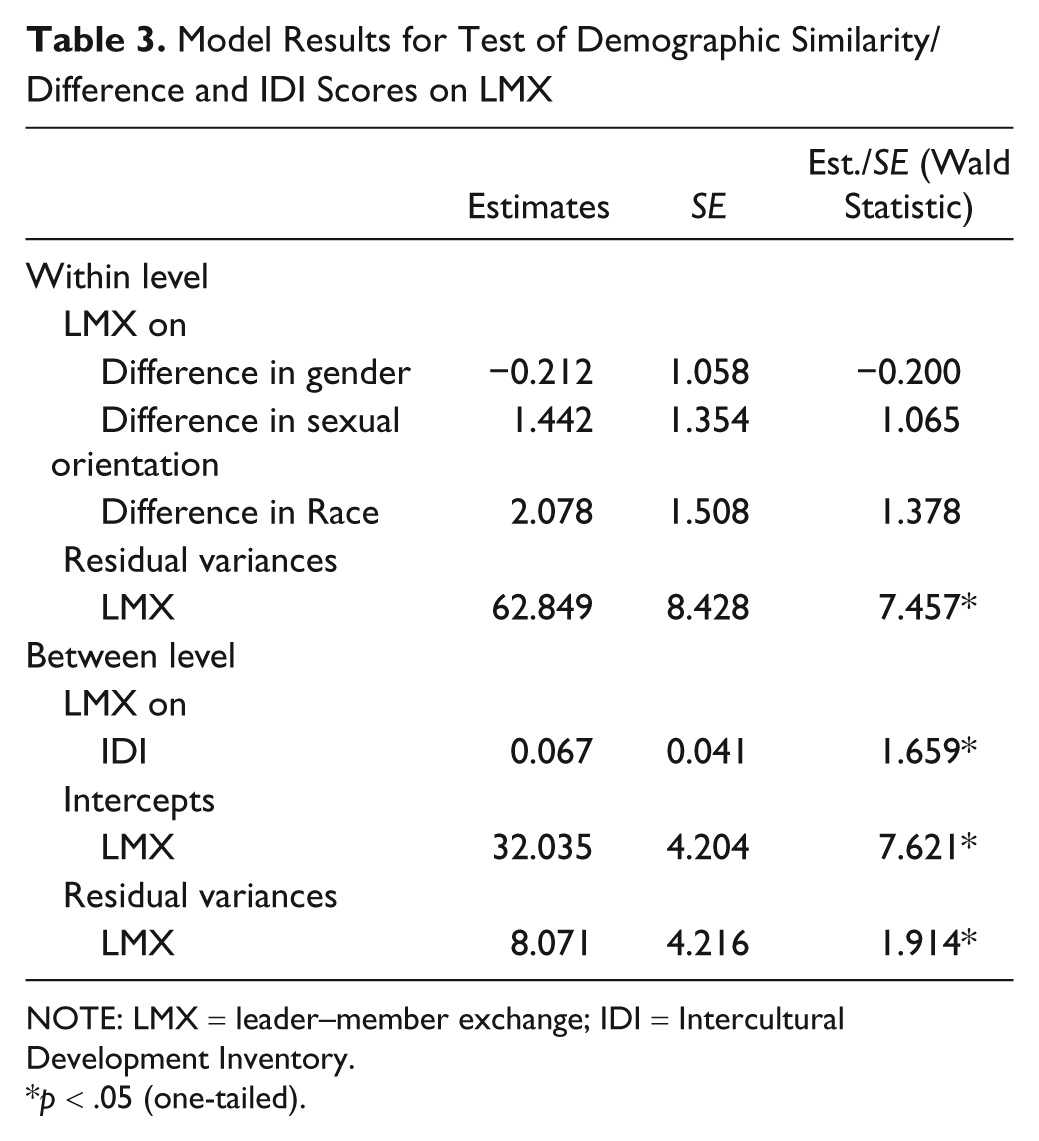
The significance of the variables is tested using a Wald statistic, which is the ratio of the coefficient to its standard error resulting in a Z value. To reach significance in a one-tailed test, values must be at least 1.654 for a .05 significance level.
The results of this model show that the demographic similarity/difference variables are not statistically significant as predictors of LMX (Dif in Sex = −0.212; Dif in Sex Orien = 1.065; Dif in Race = 1.378; see Table 3). We can extrapolate from the ICC (.127) that the remaining 87.3% of the variability in the model occurs at Level 1, and the three demographic variables only account for 1.1% of the Level 1 variation.
Model Results for Test of Demographic Similarity/Difference and IDI Scores on LMX
NOTE: LMX = leader–member exchange; IDI = Intercultural Development Inventory.
p <; .05 (one-tailed).
The results of the Level 1 analysis showed that in this study demographic similarity/difference did not predict follower ratings of LMX. This finding was consistent for demographic similarity/difference in race, gender, and sexual orientation.
At Level 2, the HLM model used the adjusted LMX value (mean and variance) and tested to see if IDI scores significantly predicted LMX scores. The Wald statistic (see Table 3) indicates a value of 1.659, which exceeds the required 1.654 for significance at the .05 level (one-tailed). The R2 value for between LMX is .110, indicating that 11% of the 12.7% variability at Level 2 is accounted for by the IDI. Higher IDI scores significantly predicted higher LMX scores, accounting for 86.6% of the Level 2 variability. The final research model is provided in Figure 1.
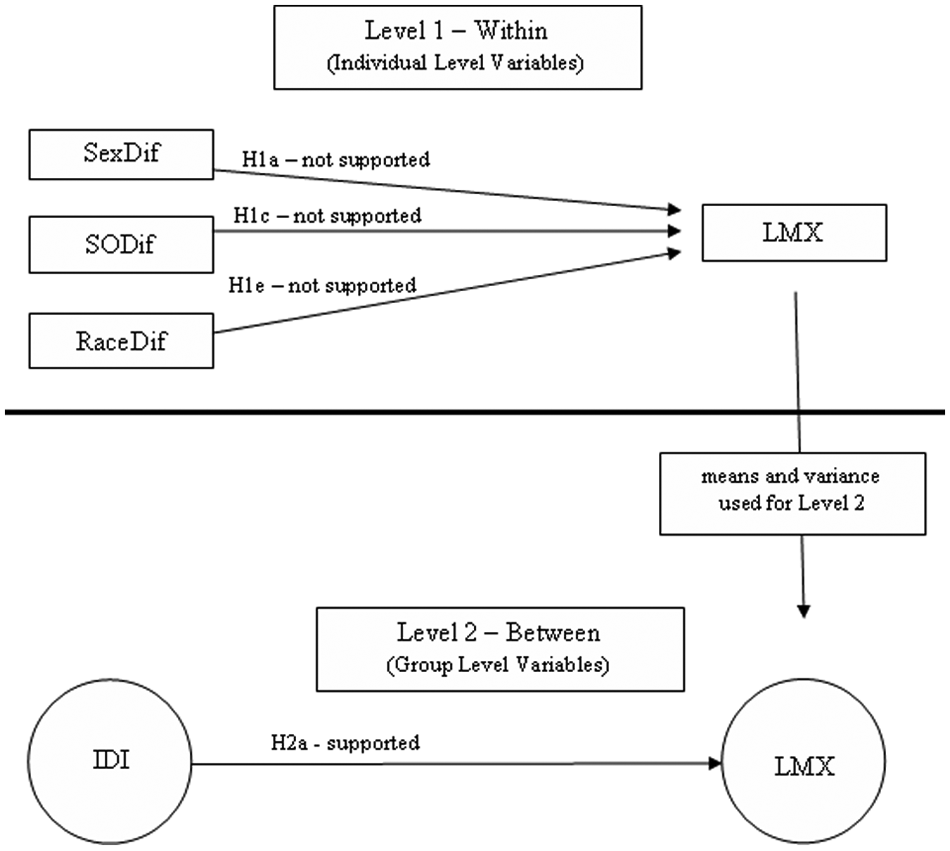
Final model after testing
Discussion
This article examined the relationships between demographic differences, intercultural sensitivity, and LMX quality. It was found that demographic similarity/difference did not predict followers’ perceptions of LMX. The three demographic variables combined accounted for only 1% of the 87.3% variability that occurred in Level 1 (individual level) of the model. Leaders’ levels of intercultural sensitivity were a significant predictor of followers’ ratings of LMX at Level 2 (group level), accounting for 11% of the 12.7% variability that occurred at Level 2.
Minsky (2002) found no support for the relationship between demographic similarity/difference (age, race, tenure, and work values) and LMX. Furthermore, no relationship was found between perceived similarities between the leader and follower. Graen, Novak, and Sommerkamp (1982) found positive associations between gender similarity and race similarity and positive ratings of LMX. The current study found no support for demographic similarity predicting higher levels of LMX. This finding, although it does not support the hypothesized relationship, is positive in that it indicates a lack of perception of differential treatment from supervisors based on race, gender, or sexual orientation.
A number of factors could account for this finding. First, the higher education setting could provide a unique environment where demographic diversity is not only discussed but also encouraged (sometimes mandated). This increased awareness may have affected the way supervisors interact with employees who are different from them demographically. Additionally, the sample size may have affected this finding.
Overall sample size was relatively small for a multilevel analysis; however, the model did converge. Additionally, only 24 of the 255 dyads were found to be demographically different by race and 28 by sexual orientation. Gender differences were higher with 95 of the 255 dyads reporting gender difference. Another complication may be the use of actual self-reports of sexual orientation to determine the difference rating. Since people who are gay, lesbian, or bisexual are sometimes called an “invisible minority” (meaning it is not known that they are a minority unless they decide to reveal it), the actual difference score may reveal a different finding than a perceptive difference score. It may have been more telling to ask both supervisors and employees if they perceive their sexual orientation to be the same or different from their supervisor or employee. Collecting the data in this way may have given a better indication of LMX relationships based on perceived sexual orientation difference.
Demographic similarity/difference accounted for only 1% of the variability at the individual level of analysis (Level 1). Overall, 87% of the variability in the model occurred at Level 1, indicating that this model was not successful in predicting the Level 1 variables that predict LMX.
Although the findings in this study need to be confirmed with a larger and more diverse sample, they do present some interesting potential implications for the workplace. Two areas of note are personnel selection and training.
Personnel Selection
As organizations increase their commitment to creating and sustaining a diverse workforce, there may be a corresponding shift toward seeking to hire a more interculturally sensitive workforce. In theory, this seems to be a positive step toward a climate that will create and sustain a diverse workforce. Hammer, Bennett, and Wiseman (2003) suggest that the IDI may be useful in “contributing to personnel selection” (p. 441). Several cautions are in order, however, when considering the IDI is a personnel selection tool. First, the IDI measures a “worldview” that is not stable. Life experiences can alter a learner’s IDI score, moving them either forward or backward on the scale. Thus, a person who was more interculturally sensitive may have experienced an event that caused a shift to a previous state. According to intercultural theory, this same person may move forward once again after this temporary “setback.” Second, the IDI does not measure skills or abilities. Typically, personnel selection is based on a specific set of skills and abilities necessary to accomplish the job. Optimally, cultural competency skills and intercultural communication abilities may be among those needed. The IDI does not directly measure these skills and abilities. Research would need to be conducted to determine if the IDI is a reliable predictor of such skills and abilities. Third, as with any assessment tool, the IDI does not tell the whole story. One may score very high on the IDI scale but not possess the experiences relevant to the organizational culture to be effective in that a particular position or setting.
Having noted these cautions, the IDI could be used as a part of a set of interview tools to help determine an applicant’s qualifications for a position or organization. Given the presence of other relevant hiring tools, the IDI could provide additional insights into a candidate’s qualifications that could be further explored with specific questions or experiences to test how intercultural sensitivity level translates into specific skills that would be useful in a particular position or setting.
Training Implications
Using M. J. Bennett’s (1986) model of intercultural sensitivity, we could begin to identify conceptual shifts that needed to be made to advance to higher levels of intercultural sensitivity. According to DMIS theory, there are specific shifts that can be measured using the IDI. J. M. Bennett and Bennett (2004) provide examples of specific experiences and activities to help move learners from one level to the next according to the DMIS model (see Table 4).
Conceptual Shifts Needed to Move to Higher Levels of Intercultural Sensitivity

They emphasize “stage-appropriate” interventions and warn that presenting learners with activities or experiences for which they are not prepared could potentially cause them to “backslide” to a previous stage. For example, many organizational diversity initiatives emphasize self-awareness and acknowledgement of differences in power issues. These efforts will rarely succeed if a level of minimization or acceptance/adaptation has not been reached. A clear understanding of recruitment, interviewing, hiring, retaining, and coaching issues require ethnorelative individuals to navigate successfully (J. M. Bennett & Bennett, 2004). Given this premise, it may benefit organizations to understand intercultural sensitivity levels within their organizations—and more specifically, among their leadership, and create organizational efforts that are consistent with those levels. At the same time, organizations could provide experiences, activities, and trainings to help move learners to the next level in a stage-appropriate manner.
Conclusion
The major strength of this study was that it is the first study known to examine the role of supervisors’ levels of intercultural sensitivity in predicting followers’ perceptions of LMX. The confirmation of this finding is significant in that intercultural sensitivity is a developmental construct and, with proper motivation, can be improved. Trainings and structured experiences for supervisors may provide means to increase levels of intercultural sensitivity and help overcome some of the past barriers to recruitment and retention of a diverse workforce in higher education.
An additional strength is the absence of perceptions of differential treatment by supervisors based on demographic similarity or difference. This finding, taken in combination with the previous finding, creates the possibility that leaders with higher levels of intercultural sensitivity can create higher LMX relationships with all employees regardless of their demographic similarity or difference.
Future research is needed to confirm these findings with larger and more diverse sample sizes in a variety of settings. Additionally, testing other outcomes such as organizational citizenship behaviors (Organ, 1988), perceived organizational support (Eisenberger, Huntington, Huntington, & Sowa 1986), and psychological capital (Luthans, Avolio, Avey, & Normann, 2007) could reveal even greater insights into the importance of leader/follower relationships in diverse work settings.
Footnotes
Declaration of Conflicting Interests
The authors declared no potential conflicts of interest with respect to the research, authorship, and/or publication of this article.
Funding
The authors received no financial support for the research, authorship, and/or publication of this article.