




Abstract
This conceptual article reviews relevant literature to develop propositions forming a model of multicultural shared leadership. First, an examination of the definitions of culture finds consensus on culture as a system. Second, a review of the developmental model of intercultural sensitivity introduces the concept of intercultural competence. Third, an exploration into the theoretical foundations of vertical and shared leadership develops primary themes. Finally, the formation of propositions and a conceptual model invites researchers to study the moderating impact of intercultural competence on culturally diverse teams and shared leadership. Theoretical and practical implications, limitations, and recommendations are discussed.
Keywords
In an effort to meet the modern challenges of increasing globalization and high-velocity environments (Eisenhardt, 1989; Ensley, Pearce, & Hmieleski, 2006; Hofstede, Hofstede, & Minkov, 2010), organizations have flattened hierarchical structures, enabling people to achieve more collaboratively in teams than acting alone (Hansen & Nohria, 2004). As with the employment of self-managed teams (Manz & Sims, 1987; Manz & Sims, 1993), members rarely rely solely on the downward influence process of vertical leadership; rather, they may follow the person with the best knowledge for each situation to meet common objectives (Bathurst & Monin, 2010; Follett, 1924). This phenomenon characterizes an antecedent of shared leadership: A dynamic, interactive influence process among individuals in groups where members lead one another to achieve organizational objectives (Pearce & Conger, 2003). Rather than focusing on downward influence, team members influence others in all directions (lateral, downward, and upward) through the decentralization and distribution of leadership (Carson, Tesluk, & Marrone, 2007; Pearce & Sims, 2002).
Now a decade-old theory, the evolution of shared leadership research has followed the Reichers and Schneider (1990) historical framework for the development of scientific constructs as used by Hunt (1999) to characterize the development of early leadership theories. During the concept introduction/elaboration phase of development (Reichers & Schneider, 1990), shared leadership research has focused on introducing primary themes and legitimizing concepts. Studies during this phase have demonstrated shared leadership’s positive contribution to team performance and leadership effectiveness (Hoch, Pearce, & Welzel, 2010; Pearce, Manz, & Sims, 2009; Pearce & Sims, 2002). As shared leadership transitions into the concept augmentation/evaluation phase of evolution (Reichers & Schneider, 1990), the research focus has shifted toward the examination of mediating and moderating models to augment earlier findings.
Recent calls by Avolio (2007) and Eagly and Chin (2010) to increase cross-cultural and multicultural contextual leadership research presents an opportunity for shared leadership studies to contribute more than theory augmentation to the field of management. Pearce and Conger (2003) have called for studies into the dimensions of diversity facilitating or hindering shared leadership and its impact on team effectiveness. To date, little research in the concept augmentation/evaluation phase has examined the impact of cultural diversity on shared leadership (Muethel & Hoegl, 2010; Pearce & Conger, 2003). With multicultural teams possibly presenting a roadblock to the relational antecedents of shared leadership (Pearce & Conger, 2003), what moderating impact may high levels of intercultural competence (M. Bennett, 1986; M. Bennett, 2004; Connerley & Pedersen, 2005) have on the relationship between cultural diversity in teams and shared leadership? This question represents a theoretical gap in the new phase of shared leadership research. As both multicultural team and shared leadership organizational practices increase in popularity, an opportunity exists for the development of empirical research and practical guidance concerning the formation and application of shared leadership in multicultural teams.
In an effort to stimulate studies to investigate multicultural leadership and to bridge the shared leadership research gap, this conceptual article reviews past and present literature to develop conceptual propositions forming a multicultural model of shared leadership. First, an examination of the definitions of culture finds consensus on culture as a dynamic system. Second, a review of the developmental model of intercultural sensitivity (DMIS) introduces the concept of intercultural competence and its possible moderating impact on shared leadership in multicultural environments. Third, an exploration into the theoretical foundations of vertical and shared leadership develops primary themes. Finally, the formation of propositions and a conceptual model invites researchers to study the moderating impact of intercultural competence on the relationship between culturally diverse team composition and the formation, practice, and effectiveness of shared leadership. These theoretical contributions may stimulate multicultural team and shared leadership research, providing cultural diverse organizations with practical guidance to form and use shared leadership to achieve objectives.
Literature Review
Culture
Similar to the debate concerning a single definition of leadership (Yukl, 2010), the definition of culture varies among researchers (Ayman & Korabik, 2010). The wide variety of research disciplines and lenses—such as organizational behavior, anthropology, sociology, and organizational communication—examining culture contributes to the variance in the core understanding of the construct (Schein, 1985). Early conceptualizations of culture have defined the phenomenon as a bounded, reified entity exerting strong influence on an individual’s behavior (Moosmüller & Schönhuth, 2009). These sources of influence originate from shared patterns of behavior, meaning, and feelings—acquired and transmitted by symbols—constituting the distinctive achievement of human groups and artifacts (Kluckhohn, 1951; Kroeber & Kluckhohn, 1963). This represents a view of culture as a system where individuals learn, internalize, and pass onto others information, values, and beliefs. The system of culture shapes individual and group identity (Geertz, 1973); individuals both learn culture and pass culture onto others (Scarborough, 1998). Sustainment of the cultural system stems from individuals’ ongoing actions and behaviors (Spitzberg & Changnon, 2009).
Hofstede (2001) has argued culture represents a collective programming of the mind, distinguishing members of one category from people from another. Hofstede et al. (2010) have found geopolitical boundaries contain culture at national or regional levels, where different dimensions of culture (power distance index, individualism, masculinity, uncertainty avoidance index, and long-term orientation vs. short-term orientation) are country or area specific. Others have contested this view of geographic-dimensional culture containment, arguing any group of individuals may develop a cultural system (Scarborough, 1998). Connerley and Pedersen (2005) have proposed culture encompasses socially constructed ethnographic, demographic, status, and affiliation characteristics. Additionally, Moosmüller and Schönhuth (2009) have proposed modern culture has evolved from bounded systems to unbounded, fluid structures with strong relational dimensions. These dynamic and complex views of culture preserve the concept of the cultural system and hold the construct as having multiple sources of identity and difference.
Cultural orientations are often described in normative categories such as nationality, race, ethnicity, tribe, religion, region, physical characteristics, affiliation, economic status, or organization (Ayman & Korabik, 2010; Chin & Sanchez-Hucles, 2007; Schein, 1985; Spitzberg & Changnon, 2009). These normative categories are socially constructed and imbued with meaning (Chin & Sanchez-Hucles, 2007). As individuals from culturally normative groups interact with each other, the interaction forms an intercultural influence process (Spitzberg & Changnon, 2009). Individuals lacking experience operating in the intercultural influence process may encounter miscommunication, misunderstanding, and misinterpretation (Chin & Sanchez-Hucles, 2007). Possible negative outcomes from these effects may include team or organizational conflict (Ting-Toomey & Oetzel, 2001) and poor performance (Scarborough, 1998). As the global nature of work (Earley & Gibson, 2002) and diversity in teams (Van Knippenberg, De Dreu, & Homan, 2004; Van Knippenberg & Schippers, 2007) increases for organizations, the requirement for individuals and teams to effectively operate with cultural difference has seen increasing urgency (Spitzberg & Changnon, 2009).
Negotiating Cultural Difference
Cultural knowledge describes an individual’s awareness, understanding, and appreciation of a specific group’s culture or dimension of culture (Hamilton, Richardson, & Shuford, 1998). Cultural knowledge represents an important element of successful intercultural interaction; however, cultural knowledge alone does not enable people to effectively operate in multicultural contexts (J. Bennett, 2009). Individuals may be highly knowledgeable of a specific culture; nevertheless, they may lack the attitudes, skills, and abilities to effectively employ the knowledge in a multicultural context (Earley & Ang, 2003). Scholars have recently proposed models to effectively operate in culturally diverse settings beyond the acumination of cultural knowledge. For example, the multifactor construct of cultural intelligence maintains individuals effectively operate in multicultural contexts using cognitive, metacognitive, behavioural, and motivational components (Berry & Ward, 2006; Earley, 2002; Earley & Ang, 2003; Sternberg & Grigorenko, 2006; Templer, Tay, & Chandrasekar, 2006). Individuals possessing cultural intelligence use cognitive processes and behaviors stimulating openness to experiencing and forming high-quality relationships in culturally diverse environments (Ang, Van Dyne, & Koh, 2006). Research on the factors forming cultural intelligence has found the construct related to positive performance and outcomes (Chen, Liu, & Portnoy, 2012; Sternberg & Grigorenko, 2006).
Intercultural competence, in contrast to cultural intelligence, focuses on negotiating cultural difference through effective awareness, communication, and interaction. Intercultural competence defines an individual’s or group’s ability to negotiate cultural meanings, beliefs, and values while executing appropriately effective communication behaviors (Lustig & Koester, 1999; Miller, 1994; Redmond & Bunyi, 1993). Intercultural competence enables effective functioning under cultural difference (M. Bennett, 1998), where people recognize their multiple identities in a multicultural environment. Interculturally competent individuals appropriately and effectively manage their interaction between people representing different or divergent affective, cognitive, and behavioral orientations (Spitzberg & Changnon, 2009). High intercultural competence components include an understanding of others’ world views, cultural self-awareness and capacity for self-assessment, adaptability and adjustment to new cultural environments, listening and observation, a general openness toward intercultural learning and to people from other cultures, and adaptation to varying intercultural communication and learning styles (Deardorff, 2006). These examples of knowledge, skills, and attitudes for cultural difference enable people to prevent cultural conflict through greater awareness and understanding of other cultures (Byram, Nichols, & Stevens, 2001).
Several intercultural competence models provide individuals and teams with frameworks for operating with cultural difference, including compositional, co-orientational, adaptive, causal process, and developmental constructs (Spitzberg & Changnon, 2009). Compositional models (Deardorff, 2006; Hamilton et al., 1998; Ting-Toomey & Kurogi, 1998) offer typologies of components (attitudes, characteristics, and skills) facilitating effective interaction with cultural difference (Spitzberg & Changnon, 2009). Co-orientational constructs (Byram, 1997; Fantini, 1995; Rathje, 2007) focus on establishing comprehension of communicative mutuality and shared meanings (Spitzberg & Changnon, 2009). Adaptive frameworks (Arasaratnam, 2007) provide a dyadic approach to compositional models, encouraging mutual adaptation to achieve competence (Spitzberg & Changnon, 2009). Causal process models (Griffith & Harvey, 2000) provide paths to concepts for individuals to achieve intercultural competence outcomes (Spitzberg & Changnon, 2009). Though many of these models are effective in defining the scope, comprehension, processes, and outcomes of intercultural competence, they generally fail to account for time and experience of difference.
Developmental models of intercultural competence focus on the evolutionary disposition of social interaction and relationships (Spitzberg & Changnon, 2009). M. Bennett (1993) has created the DMIS to explain how individuals or groups develop skills over time to transcend cultural difference and achieve intercultural competence (see Figure 1). M. Bennett (1986) has argued increasing sophistication in experiencing cultural difference develops individuals or groups from a state of ethnocentrism (little recognition or acceptance of difference) to a status of ethnorelativism (greater recognition and acceptance of difference). Operating in ethnocentric stages of the model, an individual may exhibit denial (isolation and separation), defense (degradation and superiority), and minimization (universalism of values; M. Bennett, 1993). In the ethnorelative stages, people may experience acceptance (respect for values and difference), adaptation (empathy and pluralism), and integration (a true multicultural person). Although progressing through each stage, individuals or teams become more fully aware of their own culture and possess the capabilities to assess the cultural positions of others (J. Bennett, 2009). Additionally, they develop cognitive, affective, and behavioral skills enabling them to interact effectively in varying cultural context (M. Bennett, 2008). Analogized to a global positioning system (GPS) location theory, people orient themselves and operate in multicultural environments by (a) achieving motivation to learn more about others, (b) discovering knowledge concerning personal and others’ culture, (c) assessing challenges and supporting factors impacting adaptation, and (d) developing skills enabling effective and appropriate intercultural interaction (J. Bennett, 2009). Through this transformation from ethnocentric to ethnorelative, interculturally competent individuals possess the potential to be successful in challenging, multicultural contexts.

Visual depiction of the developmental model of intercultural sensitivity
Multibehavior Leadership Typology
Doty and Glick (1994) have argued typologies represent conceptually derived interrelated sets of ideal types, each representing a unique combination of the organizational attributes determining relevant outcomes. Typologies intend to predict the variance in a dependent variable, for organizational types within typologies develop with respect to organizational outcomes. Using this theoretical framework, Pearce et al. (2003) have expanded the range of leadership through the identification and testing of a leadership typology containing four behaviors: directive, transactional, transformational, and empowerment. Aversive leadership represents a distinct departure from directive behaviors and characterizes a fifth behavior within the leadership typology (Pearce et al., 2003; Pearce & Sims, 2002). This grouping of five leader behaviors has pushed subsequent leadership research away from narrow, two-factor, and mutually exclusive models of leadership behavior. Though these behaviors have empirically demonstrated distinction, they also maintain strong interrelationships (Pearce et al., 2003). The five-behavior typology model has enabled researchers to investigate the use of multiple leadership behaviors within distinct leadership processes: vertical and shared leadership (Ensley, Hmieleski, & Pearce, 2006; Pearce, 2004; Pearce & Sims, 2002; Perry, Pearce, & Sims, 1999). Leaders, rather than choosing to employ a single behavior, have the option of using multiple behaviors within a distinct influence process (vertical or shared) to meet individual, team, and organizational objectives.
Vertical Leadership
Originating from scientific management theory (Locke, 1982; Taylor, 1911), vertical leadership represents a hierarchal leadership influence process, focusing on a formal leader’s role and downward authority to subordinates (see Figure 2). Vertical leadership supports an organizational landscape structurally distinguishing formal leaders from followers. With an organization’s structure as the driving force behind the leadership influence process, vertical leaders represent the central point of command (tasking, vision, inspiration, responsibility, etc.). The organization depends on the experience, skills, and wisdom of individual leaders and rarely includes followers in decision-making processes (Ensley et al., 2006). Through downward influence, vertical leaders affect organizational performance by affecting the behaviors of followers (Bass & Bass, 2008). The vertical leadership process lacks upward influence and lateral distribution of leadership (direction and responsibility) within the organizational hierarchy; formal leaders represent the sole accountable element of the organization. Though the vertical leadership influence process centers on an organization’s management hierarchy, vertical leaders employ multiple leadership behaviors (directive, aversive, transactional, transformational, and empowering) to direct, drive, and account for performance (Ensley et al., 2006; Pearce, 2004; Pearce & Sims, 2002; Pearce et al., 2003; Perry et al., 1999). Leaders manage followers using behaviors supporting their central command structure requirements. Where a top management team leader may employ transformational leadership behaviors to affect subordinates during new venture performance under dynamic environmental conditions, the same leader may use transactional leadership behaviors during periods of stable environmental conditions to achieve success (Ensley, Pearce, & Hmieleski 2006).

Visual depiction of the vertical leadership downward influence process
Shared Leadership
Beginning from Follet’s (1924) law of the situation prescribing members to follow the person with the best knowledge for each situation rather than the hierarchal leader (Pearce & Conger, 2003), shared leadership has seen increasing attention as a viable complement to vertical leadership. By broadly sharing power and influence among a team of individuals, shared leadership distinguishes itself from vertical leadership’s process of centralizing power and influence onto a single, dominant superior (Pearce et al., 2009). Pearce and Conger (2003) have defined shared leadership as a dynamic, interactive influence process among individuals in groups where members lead one another to achieve organizational objectives. Rather than focusing solely on downward influence, members influence others in all directions (as depicted in Figure 3) through the decentralization and distribution of leadership (Locke, 2003). Additionally, as depicted in Figure 4, shared leadership may act as a compliment to vertical leadership. Organizations employing high performing teams may direct a single team member to be accountable for the team’s conduct and performance; however, the conditions still remain for team members to influence (lateral, downward, and upward) and lead one another to common objectives.

Visual depiction of the shared leadership influence process in teams
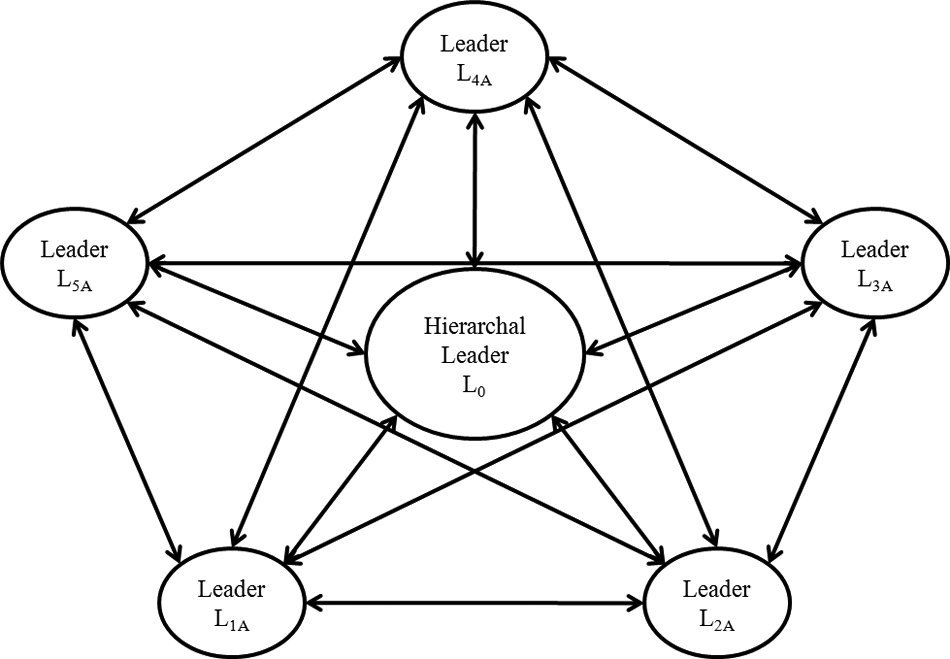
Visual depiction of an integrated vertical and shared leadership influence process in teams with a designated individual accountable for team conduct and performance
Shared leadership, as a social process, enables subordinates to both exhibit leadership behaviors (directive, aversive, transactional, transformational, and empowering) and act in the role of follower to support other leaders’ leadership contributions (Ensley, Hmieleski, & Pearce, 2006; Pearce, 2004; Pearce & Conger, 2003; Pearce & Sims, 2002; Pearce et al., 2003; Perry et al., 1999). Shared leadership may emerge because of situational factors such as team member knowledge, skills, abilities, and environmental complexity (Pearce & Conger, 2003) and is developed or enhanced by organizational design (Pearce et al., 2009). Shared leadership provides an element of adaptability enabling members to lead and follow as the situation dictates. This aspect of shared leadership enables the model to complement or augment organizations primarily subscribing to the vertical leadership process (Ensley et al., 2006; Pearce & Sims, 2002; Shamir & Lapidot, 2003).
Multiple studies have found positive links between shared leadership and effectiveness. In comparison to vertical leadership, shared leadership has induced significant team effectiveness in change management teams (Pearce & Sims, 2002), virtual teams (Pearce, Yoo, & Alavi, 2004), business consulting teams (Carson et al., 2007), trauma center resuscitation teams (Klein, Ziegert, Knight, & Xiao, 2006), and new venture top management teams (Ensley et al., 2006). Shared leadership has predicted positive organizational performance at multiple firms with coleader chief executive officers (O’Toole, Galbraith, & Lawler, 2003), airline corporations (Pearce et al., 2009), and entrepreneurial firms (Ensley et al., 2006). Shared leadership has the potential to enable organizations employing teams, even inside a hierarchical structure, to be effective.
Propositions
Cultural Diversity in Teams and Shared Leadership
The formation and practice of shared leadership depends on individuals within a team to extend and accept lateral influence (Pearce & Conger, 2003). Without this set condition, it is difficult for group members to collaborate and share leadership. Culturally diverse teams contain individuals with distinctly different affiliations of cultural significance (T. Cox, 1994). Team diversity has strong impacts on performance, specifically with regard to cohesion, agreeableness, openness to experience, collectivism, and preference for teamwork (Bell, 2007). Multicultural teams may face relational and social challenges because of internal conflict (Pfeffer, 1985), diminished cohesion (Elron, 1997; Shaw, 1981), and poor communication (Ancona & Caldwell, 1992). These challenges of diversity in teams represent potential interpersonal barriers to shared leadership (J. Cox, Pearce, & Perry, 2003).

Visual depiction of the propositions and variables forming a conceptual model of multicultural shared leadership
Unfortunately, the field of study lacks a significant body of cultural diversity research in teams for drawing significant conclusions on the relationship between team cultural diversity and shared leadership. However, recent research in other forms of team diversity, such as job, task, or skill orientation, presents some insight into the possible complex nature of culturally diverse teams and other outcomes. Webber and Donahue’s (2001) meta-analysis regarding job-relation diversity, team cohesion, and team performance has found a negative to no meaningful relationship. In the case of biodemographic diversity (age, gender, and race/ethnicity) and team performance, Horwitz and Horwitz (2007) have found a slightly negative to no meaningful relationship. Additionally, Greer, Homan, De Hoogh, and Den Hartog (2012) have discovered ethnic diversity in teams maintains a negative relationship with team communication and performance when leaders show high levels of visionary behavior and categorize team members into subgroups. The results from these studies indicate team diversity may impede or fail to affect team cohesion, social interaction, and performance. In contrast, increasing cohesion (Jackson and Associates, 1992; Zenger & Lawrence, 1989) and social interaction (Smith, Peterson, & Misumi, 1994) have emerged as positive outcomes from homogenous teams. Both social interaction and the potential for team members to provide and respond to influence represent critical factors for shared leadership (J. Cox et al., 2003). Inversely, the possible negative social and relational characteristics of culturally diverse teams may limit or prevent team cohesion, lateral influence among team members to emerge, and the practice of shared leadership (see Figure 5).
Proposition 1: Cultural diversity in teams is negatively related to shared leadership.
Intercultural Competence as a Moderator
Watson, Kumar, and Michaelsen (1993) and Harrison, Price, and Bell (1998) have found the negative characteristics of diversity in teams appear on initial team formation but do not remain in the long run. However, variables other than time may enable culturally diverse teams to develop positive characteristics, such as cohesion and positive social interaction, in an expeditious manner. In diverse teams, cultural minorities may not initially perceive themselves as leaders (Seers, Keller, & Wilkerson, 2003). However, by effectively navigating through their differences, multicultural team members with high intercultural competence may accept and employ a variety of world views and skills (Maznevski, 1994). These effects may set the conditions for team members to accept and provide reciprocal influence (Graen & Uhl-Bien, 1995), fostering cohesion and enabling the development of more creative approaches to solve problems (Marquardt & Horvath, 2001).
Adler (2002) has argued cultural difference remains an asset to multicultural teams, especially when leaders see past cultural difference, such as the case with highly interculturally competent individuals. As depicted in Figure 6, as leaders ignore or suppress cultural difference, team performance in creative tasks decreases. Conversely, effectiveness in creative tasks increases in culturally diverse teams as leaders acknowledge and support cultural difference. Highly interculturally competent team members foster creativity and stimulate flow, a unified structure of consciousness with orderly invested psychic energy (Csikszentmihalyi, 1988). Flow stimulates increasing intrinsic motivation, interest, and social meaning in teams and the formation and practice of shared leadership (Hooker & Csikszentmihalyi, 2003). In contrast, team members lacking intercultural competence fail to facilitate an environment of creativity and flow, suppressing the conditions for shared leadership.
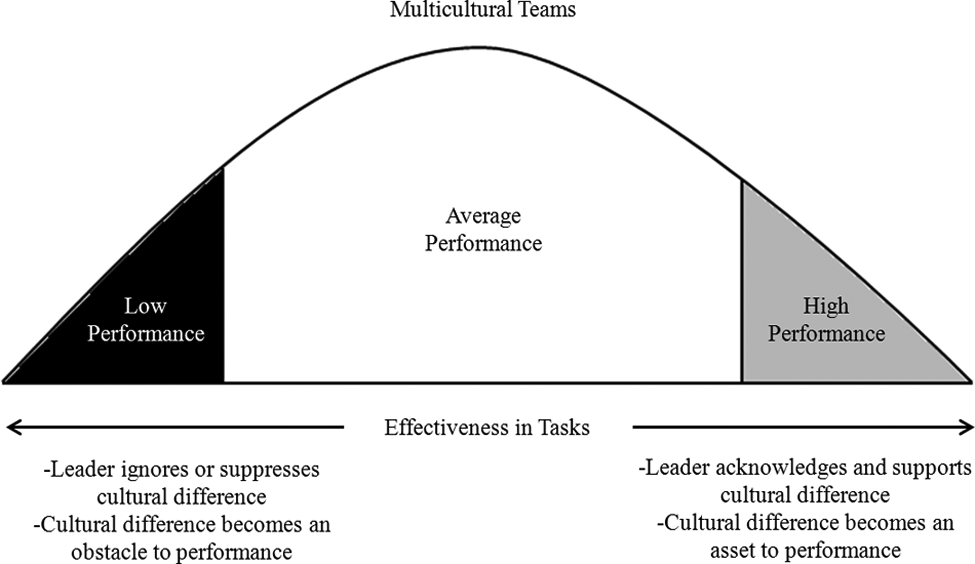
Visual depiction of the effectiveness in tasks, multicultural teams, and leader cultural awareness
Possessing the ability to recognize and operate under multiple identities in a multicultural environment, team members with high intercultural competence meet the challenges of cultural difference and stimulate positive multicultural team performance (M. Bennett, 1998; Deardorff, 2006). Multicultural team members, characterized by high intercultural competence, may overcome the social and relational challenges to facilitate creative thinking and distributed influence. By seamlessly transcending cultural difference in teams, individuals with high intercultural competence eliminate barriers to shared leadership and facilitate distributed influence. Conversely, individuals with low intercultural competence are unable to effectively negotiate cultural difference in teams; the lack of cohesion, creativity, and flow prevents these teams of sharing leadership.
Proposition 2a: High intercultural competence positively moderates the relationship between cultural diversity in teams and shared leadership.
Proposition 2b: Low intercultural competence negatively moderates the relationship between cultural diversity in teams and shared leadership.
Discussion
Theoretical and Practical Implications
Answering the calls from Avolio (2007) and Eagly and Chin (2010) to increase leadership research in multicultural contexts, and Pearce and Conger’s (2003) call for studies into the dimensions of diversity facilitating or hindering shared leadership and its impact on team effectiveness, the development of the conceptual model of multicultural shared leadership has contributed to study and practice of management and leadership. The conceptual model of multicultural shared leadership, taking a multidisciplinary approach, has incorporated the developmental model of intercultural sensitivity from the field of communications to meet the challenges stemming from the employment of culturally diverse teams in the workplace. The integration of the DMIS into the model of shared leadership enhances the framework to function effectively in previously unexplored contexts. This effort bridges the theoretical gap in multicultural context and shared leadership research.
Additionally, the conceptual model of multicultural shared leadership, following empirical testing, may present a viable framework for the practice of management and leadership. As globalization and diversity demographics of the United States continue to increase (Shrestha & Heisler, 2011), organizations shall structure their workforces with multinational work teams to achieve complex objectives requiring interaction and interdependence (Early & Gibson, 2002). With shared leadership offering the potential of higher levels of performance in comparison to vertical leadership processes, organizations may consider selecting or developing team members with high levels of intercultural competence in order to facilitate the shared leadership process and achieve effectiveness. Similar practices may be appropriate for companies executing mergers with organizations displaying different corporate cultures, military teams composed of members from different divisions of the armed forces, governmental organizations operating teams inside other nations, law enforcement task forces in other countries, and so on. The conceptual model of multicultural shared leadership may enable organizations to execute distributed leadership practices in cultural contexts previously ignored.
Limitations
The multicultural shared leadership model largely neglects to investigate the relationship between multicultural teams, intercultural competence, and vertical leadership. It may provide more value to the overall study of multicultural leadership to assess the impact on the vertical leadership processes in addition to shared leadership processes. This may also provide an opportunity to evaluate the different degrees of effectiveness between multicultural shared and vertical processes. The conceptual model of multicultural shared leadership also neglects the comprehensive integration of other intercultural competence models, such as compositional, co-orientational, adaptive, and causal process frameworks. Relying solely on M. Bennett’s (1993) DMIS may prevent the multicultural shared leadership model from determining the specific components and processes beyond experience of difference contributing to the display and use of shared leadership in culturally diverse teams. Finally, the model does not attempt to account for other dimensions of diversity, to include age (generations), gender, sexual orientation, and so on. Extending the model to account for these differences may enable it to be more useful for a wider variety of organizations experiencing the challenges of diversity.
The small number of individuals operating in the ethnorelative stages of the DMIS may present practical challenges to organizations using the conceptual model of multicultural shared leadership. Recent studies have found a majority of their participants to function in the ethnocentric stages of the DMIS (Fabregas, Kelsey, & Robinson, 2011; Yuen, 2010; Yuen & Grossman, 2009). This evidence may imply a smaller population of potentially ethnorelative employees exists for service inside organizations using culturally diverse teams under a model of shared leadership. Ethnorelative individuals may represent a competitive advantage in this environment, pushing organizations to recruit and select workers with the ability to effectively operate in teams with significant cultural difference. However, organizations may overcome the challenges of finding ethnorelative workers by internally developing individuals through training, education, and exposure to cultural difference. Research has found cross-cultural training and education programs as well as increasing opportunities for people to experience cultural difference stimulates growth within the DMIS, effectively developing individuals with intercultural sensitivity (Altshuler, Sussman, & Kachur, 2003; Engle & Engle, 2004). Organizations may effectively assist individuals in the transition from ethnocentric to ethnorelative awareness by assessing workers’ stages of the DMIS. Organizations may then construct intercultural training and education with an integrative approach of somatic, cognitive, attitudinal, and social behavior methods focusing on exposing workers to intercultural simulations and situations (M. Bennett & Castiglioni, 2004). These types of training and education programs may progressively stimulate the intercultural development of employees, setting the conditions for the use of shared leadership in a culturally diverse team context.
Recommendations
Future empirical studies of this model may find an opportunity to compare the intercultural competence and shared leadership scores between multicultural and monocultural teams. This type of study may be able to determine which team composition type facilitated the highest degree of shared leadership and effectiveness for a given set of tasks or objectives. Possible research contexts of interest may include virtual teams from multinational corporations, embedded training teams employed by the U.S. military to train soldiers from other countries, multinational law enforcement task forces, high performing teams with members from diverse corporate culture, and so on.
When developing empirical multicultural shared leadership studies, researchers should attempt to employ reliable measures for team multicultural levels, intercultural competence, shared leadership, and effectiveness. These may include, but are not limited to, the Intercultural Development Inventory (IDI) for intercultural competence levels (Hammer, 1999; Hammer, Bennett, & Wiseman, 2003), Shared Leadership Questionnaire (SLQ; Pearce & Sims, 2002), social network measure of shared leadership (Mayo, Meindl, & Pastor, 2003), and all third-party observation, objective, and nonperception effectiveness assessments. The IDI has demonstrated excellent reliability and validity across cultures (Hammer, 2008; Hammer, 2010; Hammer et al., 2003); however, the measure is proprietary and the financial costs for using the scale may not be practical for all research projects. The Pearce and Sims (2002) SLQ has also proven to be reliable. However, with greater than 70 items, the measure may not be practical for samples requiring minimal impact due to research demands. An improved version of the SLQ, reducing the number of items to 26 and demonstrating excellent measurement quality (Hoch, Dulebohn, & Pearce, 2010), may be more appropriate for future empirical studies. The Mayo et al. (2003) Social Network Measure of Shared Leadership examines density of the total amount of leadership displayed by team members as perceived by others on a team (Carson et. al, 2007); this measure is reliable, but may not be practical for use with larger size teams. Effectiveness measures may be dependent on the context of the study. For example, Ensley et al. (2006) scaled multiple factors in new venture performance (firm growth, employee growth, and revenue growth) to provide an objective measure of effectiveness. Future studies should attempt to design similar objective measures for effectiveness.
Conclusion
Understanding the relationship between multicultural teams and shared leadership represents important progress for both multicultural and shared leadership theory and practice. Previous conceptual models of shared leadership have argued cultural diversity in teams represents a challenge to shared leadership (J. Cox et al., 2003; Seers et al., 2003). However, these models did not account for the possible moderating impact of intercultural competence to enable multicultural team members to form and maintain the relational and social bonds facilitating the practice of shared leadership. The conceptual development of the multicultural shared leadership model has contributed to the advancement of the fields of management and leadership by setting the conditions for future empirical research. Additionally, the model may provide organizations with guidance to form, develop, and use multicultural teams sharing leadership to achieve objectives. The potential for the exploration of this line of inquiry is high, and the opportunities to locate contextual samples are expanding as organizations continue to experience globalization and exchanges of cultural difference.
Footnotes
Declaration of Conflicting Interests
The authors declared no potential conflicts of interest with respect to the research, authorship, and/or publication of this article.
Funding
The authors received no financial support for the research, authorship, and/or publication of this article.