



Abstract
The primary purpose of this study was to examine the impact of an organization’s procedural justice and transformational leadership on employees’ citizenship behaviors and the mediating effect of the transformational leadership in Korean for-profit business firms. A total of 202 cases were collected from one of the three major conglomerates in Korea and a total of 182 responses were used for data analysis after the data screening process. The structural equation modeling approach was mainly used based on the model comparison between the full research model and the controlled model. The results indicate that an organization’s procedural justice positively affects both variables of transformational leadership and employees’ citizenship behaviors whereas the transformational leadership also positively affects employees’ citizenship behaviors. The model comparison based on chi-square differences indicates that transformational leadership plays the role of a partial mediating variable to explain the relationship between the organization’s procedural justice and employees’ citizenship behaviors. Conclusions are presented, followed by limitations and further research recommendations.
To date, many studies have been conducted to measure individual performance levels such as job satisfaction, employee engagement, and employee citizenship behaviors as the potential outcomes of organizational performance (e.g., Bakker & Bal, 2010; Harter, Schmidt, & Hayes, 2002; Ostroff, 1992; Podsakoff, Ahearne, & MacKenzie, 1997; Podsakoff & MacKenzie, 1997; Ryan, Schmit, & Johnson, 1996). However, many of the empirical findings historically offered little evidence to support the positive impact of simple worker job satisfaction on the productivity in the organization (Organ, Podsakoff, & MacKenzie, 2006). Among those potential individual performance indicators, the concept of organizational citizenship behaviors (OCBs) has been considered one of the most influential factors for a firm’s overall performance improvement based on individual performance and attitude in the workplace (Organ et al., 2006).
From a more applied standpoint, supportive leadership and organizational structure have been perceived as effective variables to increase the level of OCB positively in the workplace. According to Schnake, Cochran, and Dumler (1995), supportive and instrumental leader behaviors positively influence OCB in that they are likely to be perceived by employees as helping behaviors on the part of the leader that the employees would feel obligated to reciprocate. More specifically, the core characteristics of supportive leadership and instrumental leadership include caring about employees for performing given tasks, being concerned about employees’ welfare in their work-life, and providing clear directions to reduce the uncertainty in doing their given job. These characteristics have many similarities with the core behaviors of transformational leadership in terms of emotionally caring about employees, motivating employees, and helping employees in performing their tasks by providing clear directions and minimizing task-related uncertainty.
In addition, according to Organ et al. (2006), another major variable that affects OCB is organizational factors, which includes organizational fairness, justice, and organizational support. As Organ et al. (2006) defined the organizational formalization as “the extent to which an organization clearly specifies rules and procedures for dealing with various contingencies” (p. 122). Organizational formalization could keep task-related procedures fair and this would help employees focus on their given tasks by enhancing perceptions of fairness and procedural justice because formal rules make an organization’s expectations clear. Furthermore, supportive and fair-oriented organizational characteristics promote more employee participatory behaviors, which ultimately lead to positive OCB.
In summary, OCB, as one of the behavior-related indicators for performance improvement in the workplace, would be affected by supportive leadership and more critically by a fair-oriented, supportive firm’s characteristics. Based on these theoretical assumptions, the three primary research objectives of this research were to examine (a) the relationship between a fair-oriented organization’s procedural justice and OCB, (b) the relationship between an organization’s procedural justice and transformational leadership, and (c) the mediating role of transformational leadership in the relationship between an organization’s procedural justice and OCB.
Literature Review
An Organization’s Procedural Justice and OCB
From a historical view, although the study of fairness began with distributive fairness (Adams, 1965), the research focus on fairness has shifted to procedural justice developing the area of distributive justice (Cohen-Charash & Spector, 2001). The concept of procedural justice was first introduced by Thibaut and Walker (1975), mainly focusing on the legal process, and then Leventhal, Karuza, and Fry (1980), extending the area of procedural justice into other contexts such as organizational settings (Colquitt, Conlon, Wesson, Porter, & Ng, 2001). An organization’s procedural justice is defined as “the perceived fairness of the process by which outcomes were achieved” (Cohen-Charash & Spector, 2001, p. 280). One of the primary findings from the research on an organization’s procedural justice shows that procedural justice positively affects individuals’ attitudes or behaviors in an organization (W. C. Kim & Mauborgne, 1998). In other words, when individuals perceive their institutions as fair, they are willing to act in a voluntary and collaborative manner for their institutions. Therefore, it is expected that procedural justice plays an important role in influencing organizational attitudes and behaviors (Lind & Tyler, 1988).
OCB is thought of as one of the most studied variables of organizational fairness, including procedural justice (Cohen-Charash & Spector, 2001). Organ (1988) defines OCB as “individual behavior that is discretionary, not directly or explicitly recognized by the formal reward system, and that in the aggregate promotes the effective functioning of the organization” (p. 4). In this sense, organizational members who work in a voluntary manner (i.e., OCB) may perform better than those who do only work recognized in the organization’s formal system, because they are self-motivated in doing their work. Research on OCB has been primarily focused on the relationship between OCB and job satisfaction and it has demonstrated a positive relationship between them (Eskew, 1993; K. Lee & Allen, 2002). Organ (1988) emphasized that the role of perceptions of fairness is closely related to OCB in that employees who perceive that they receive equal treatment are willing to actively participate in OCB whereas those who perceive that they do not have equal treatment are reluctant to engage in OCB. Therefore, procedural justice is the key determinant of OCB.
Many empirical studies have been conducted to identify the relationship between procedural justice and OCB (Moorman, 1991; Moorman, Blakely, & Niehoff, 1998; Tansky, 1993; Williams, Pitre, & Zainuba, 2002). Moorman (1991) investigated the relationship between perceptions of procedural justice and the five dimensions of OCB (e.g., altruism, courtesy, sportsmanship, conscientiousness, and civic virtue) in the context of the United States. The results indicated that perceptions of procedural justice are positively related to four of the five dimensions of OCB—excluding civic virtue—whereas perceptions of distributive justice are not. Tansky (1993) conducted a study that identifies the relationship between perceived fairness, OCB, employee attitudes, and the quality of supervisory/subordinate relationships. In Moorman’s (1991) study, the relationships between the perceptions of overall fairness and the five dimensions of OCB were examined. The results indicated that overall fairness is only related to altruism and not the other four. Along with this research trend, Moorman et al. (1998) investigated the mediating effect of procedural justice on the relationship between four OCB dimensions (interpersonal helping, individual initiative, personal industry, and loyal boosterism) and perceived organizational support (POS). Results supported the relationship between POS and three of the four OCB dimensions (interpersonal helping, personal industry, and loyal boosterism) and the mediating effect of procedural justice on OCB. More recently, Williams et al. (2002) examined the impact of fairness, distributive and procedural justice, on the intention of organizational members to implement OCB. The purpose of this study was to test a hypothesis that the OCB tendency of employees increases when their perceived interactional justice, one of the aspects of procedural justice, is more positive. The results supported the hypothesis. Overall, the results of the previous studies provide convincing evidence of a positive relationship between procedural justice and OCB dimensions.
An Organization’s Procedural Justice and Transformational Leadership
The concept of transformational leadership was first introduced in the late 1970s (Burns, 1978) and extended by Bass (1985). According to Yukl (2002), transformational leaders can motivate followers with feelings of trust, admiration, loyalty, and respect so that the followers work voluntarily toward the organization’s goal rather than their own interests. Consequently, the followers are motivated to work more than what they are expected to perform. These leaders also put their efforts into influencing their followers to take on the leader’s vision as their own (Bryman, 1992).
Transformation leadership can be divided into four components: idealized influence, inspirational motivation, intellectual stimulation, and individualized consideration (Bass, 1985; Bass & Avolio, 1993a; Bass, 1998; Bass & Steidlmeier, 1999). Idealized influence produces trust, admiration, loyalty, and respect among followers through charismatic vision and behavior. The transformational leader inspires followers to the goals or visions of an organization through inspirational motivation. Transformational leaders encourage followers to be creative, and challenge beliefs and values of their own or even the organization. This is a characteristic of intellectual stimulation. Finally, individualized consideration refers to the characteristic that a transformational leader treats followers as individuals rather than employees and helps them individually to reach higher levels of accomplishments.
According to the existing literature, an interaction between procedural justice and transformational leadership could be expected. Burns (1978) proposed that transformational leaders inspire followers to concentrate on higher level needs and moral values, such as justice, equality, and respect. Moreover, Pillai and Williams (1996) discovered that procedural justice and transformational leadership were correlated in regard to influencing trust and job satisfaction. Several recent empirical studies including those done in the Korean context (e.g., Avolio, Zhu, Kho, & Puja, 2004; Ehrhart, 2004; J. Kim, Kim, & Kwon, 2010; Pillai, Schriesheim, & Williams, 1999; Walumbwa & Lawler, 2003; Zhu, Chew, & Spangler, 2005) also support that procedural justice plays an important role for transformational leaders. Having a different point of view from this study, previous research (Avolio et al., 2004; Ehrhart, 2004; J. Kim et al., 2010; Pillai et al., 1999; Walumbwa & Lawler, 2003; Zhu et al., 2005) identified transformational leadership as a factor, which influenced justice. However, Schein (1992) examined that organizational culture, in terms of climate and structure, and leadership influenced each other. Moreover, Chen (2004) found the moderating and mediating role of transformational leadership between organizational culture and commitment. Therefore, the reverse relationship could be expected as well.
The Mediating Effect of Transformational Leadership
Effects of transformational leadership are studied frequently with regard to its link to positive job behavior. Transformational leaders inspire and motivate their followers to consider organizational goals first rather than individuals’ interests. Those inspired followers tend not to expect tangible and individual benefits first but to perform activities beneficial for a collective vision. Their contributions are based on self-worth and self-confidence. Consequently, these voluntary activities can be considered as OCB (Wang, Law, Hackett, Wang, & Chen, 2005).
According to Smith, Organ, and Near (1983), transformational leaders not only help followers to be effective on their tasks but also encourage OCB, which is very beneficial for an organization while not recognized by a traditional reward system. In other words, transformational leaders provide the environment for followers to balance out between followers’ success and organizations’ values and goals (Podsakoff, MacKenzie, Moorman, & Fetter, 1990). Multiple empirical studies also support the positive relationship between transformational leadership and OCB (Fuller, Patterson, Hester, & Stringer, 1996; Judge & Piccolo, 2004). This relationship was also supported in the Korean business context (S. Lee, 2010; J. Kim, 2008). Based on the literatures reviewed, the role of transformational leadership as a mediator between procedural justice and OCB can be supported with the links between procedural justice and OCB, procedural justice and transformational leadership, and transformational leadership and OCB.
Summary of Literature Review
OCB is defined as a behavior that promotes the effectiveness of the organizational functions without being directly recognized by the formal reward system (Organ, 1988). An organization’s procedural justice, which is the fairness of the processes that lead to results (Cohen-Charash & Spector, 2001), is one of the key determinants of OCB, and influences OCB positively (Moorman, 1991; Moorman et al., 1998; Tansky, 1993; Williams et al., 2002). Thus, Hypothesis 1 proposed that an organization’s procedural justice positively influences OCB.
Transformational leaders can motivate followers to put their efforts toward the organization’s goal and can encourage them to do more work than expected. Transformational leaders inspire their followers to be moral and ethical (Burns, 1978). Empirical research (Avolio et al., 2004; Pillai et al., 1999; Pillai & Williams, 1996; Walumbwa & Lawler, 2003; Zhu et al., 2005) supports the notion that there can be positive relationships between procedural justice and transformational leadership as well. Therefore, Hypothesis 2 posited that an organization’s procedural justice positively influences transformational leadership.
Last, transformational leadership is positively correlated with OCB (Fuller et al., 1996; Judge & Piccolo, 2004). Thus, a mediating role of transformational leadership between procedural justice and OCB can be explained through the links between procedural justice and OCB, procedural justice and transformational leadership, and transformational leadership and OCB (Hypothesis 3). Table 1 provides a summary of the hypotheses.
Summary of Hypotheses

Theoretical Foundations and Research Framework
To provide a theoretical rationale for the current research, several theoretical foundations were examined to support the developed research objectives, including leadership theories and organizational theories based on the comprehensive literature review. Through this review of several theories, the multitheory-based integrative views provided solid and synthesized rationales for developing the conceptual framework of the current research.
The critical determinant of OCB is the motivation of the employees to engage in their given task. To increase employees’ motivational engagement for positive OCB, the roles of the leader are decisive. According to the path–goal theory of leadership, leaders motivate subordinates by clarifying the path so that the subordinates can reach their goals and increase individual performance. Although the concept of OCB is not part of the original path–goal theory of leadership, from the applied theoretical viewpoint, Schnake et al. (1995) suggested that supportive leadership behaviors which motivate and encourage subordinates by providing clear directions along with emotional care affect performance-oriented OCB positively based on the concept of the reciprocal effect between leaders and subordinates.
In addition, leadership empowerment theory may expect that OCB can be influenced by empowering subordinates by encouraging them to perceive themselves as more “potent” and “autonomous” in their task process. Furthermore, considering the work of Conger and Kanungo (1998), leadership empowerment could enhance the meaningfulness of the task, foster the participation of subordinates in decision making, and encourage self-efficacy in high performance, which are the basic supportive contents for positive OCB of subordinates.
Furthermore, the leader–member exchange theory, based on social exchange theory, could support the positive relationship between leadership and OCB. The high-quality exchange relationship involves mutual trust, support, and loyalty between the leader and subordinates, enhanced levels of interpersonal attraction, and bidirectional influence, which create a sense of obligation on the part of the subordinates to reciprocate in terms of behaviors valued by the leader. The highly trust-based social exchange relationship between the leader and subordinates encourages subordinates to engage in OCB and perform at a high level to reciprocate for support provided by the leader to maintain a balanced or equitable social exchange with the leader (Wayne, Shore, Bommer, & Tetrick, 2002). From the view of the relationship between an organization’s procedural justice and OCB, according to Organ (1988), the employees’ level of fairness perception influences OCB by prompting employees to define their relationship with the organization as one of social exchange (Moorman, 1991). Historically and empirically, several researchers examined this social exchange theory–based relationship between organizational fairness and OCB by focusing on the issues of job equity and procedural equity (e.g., Dittrich & Carrell, 1979; Scholl, Cooper, & McKenna, 1987).
Finally, from the organizational characteristic standpoint, equity theory grounded in organizational support theory could be considered as one of the most critical theoretical bases of the current research, enhancing sounder OCB of subordinates along with a fairness-oriented organizational climate and a supportive organizational environment (e.g., the concept of POS by Eisenberger, Huntington, Hutchison, & Sowa, 1986; Rhoades & Eisenberger, 2002).
Based on the synthesized theoretical assumption, the following research framework was developed. In this research, as the input level of the construct, an organization’s procedural justice was considered as one of the organizational supportive characteristics, and as the outcome construct, OCB was considered to measure the individual performance level. Furthermore, transformational leadership is related to supportive leaders’ behaviors such as caring about their subordinates’ emotions and encouraging task-related engagement by providing clear direction and diminishing uncertainty in task performance. All these conceptual relationships are illustrated in Figure 1. The research hypotheses are described in the “Literature Review” section based on the developed conceptual framework detailing the theoretical and empirical relationships among the proposed research constructs.

Theory-based research conceptual framework
Research Design
In this section, several research design issues, including data collection, instruments, and data analysis strategies are described.
Sampling and Data Collection
A total of 202 cases were collected from one of the three major conglomerates in Korea. With regard to survey design, instead of the self-rating approach, in order to increase the general subjectivity and overall reliability of the collected data set, the dyadic cross-rating approach was applied by using the online e-mailing recruiting process and paper-and-pencil on-site data collection approach. Supervisors and managers measured the level of team members’ OCBs, and team members measured transformational leadership style and the perceived organization’s procedural justice level. For survey distribution, three of the human resources (HR) directors (general managers) in the three subsidiary organizations in our target conglomerate were contacted and, with their permission, randomly assigned dyadic participants were encouraged to participate in the survey. Approximately 450 initial informative survey invitation e-mails were sent out through the corporate intranet server, and paper-and-pencil data collection was performed at five division sites of the three subsidiary organizations including electronics, manufacturing, and construction. Regarding the demographic profile, 32% were female and 68% were male. Regarding the types of tasks, 29.1% worked in the human resources and management support division, 42% in the R&D and manufacturing division, 13.7% in the IT management and support division, and 51% in the marketing division. In terms of job position, 18.7% were general employees, 29.1% associate manager-level employees, 40.1% general manager-level employees, and 7.7% executive-level managers. Regarding their education level, 6% had a high school diploma, 18% were associate college graduates, 69.2% were 4-year university graduates, and 14.8% had master’s or doctoral degrees.
Instruments
All survey items were measured using a 5-point Likert-type scale (1 = strongly disagree and 5 = strongly agree). In the current research, the three instruments described below were used to measure the three proposed research constructs. All instruments were validated in several contexts, including the research target context—the Korean business context.
First of all, to measure OCB), five dimensions of the OCB—altruism, conscientiousness, sportsmanship, civic virtue, and courtesy—were used (Podsakoff et al., 1990). These dimensions of OCB were developed based on Organ’s concept, which described the OCB as the employees’ “behaviors of discretionary nature that are not part of employees’ formal requirement, but nevertheless promote the effective functioning of the organization” (Organ, 1988, p. 4). The measure has been validated in several studies in terms of internal construct validity and convergent validity with several organizational effectiveness-related variables, including transformational leadership, organizational performance, employees’ trust, and team effectiveness (Organ, 1988; Podsakoff et al., 1990). In this research, a total of 19 items were used for measuring the five domains mentioned above. Briefly, the first construct of OCB is altruism, which means discretionary behaviors that have the effect of helping other team members with a given task and job. The second construct, the concept of conscientiousness, includes the basic performance of employees’ behaviors in the areas of attendance, obeying rules, and regulations (Organ, 1988). The third construct, sportsmanship, means “the willingness of the employee to tolerate less than ideal circumstances without complaining” (Podsakoff et al., 1990, p. 115). The fourth concept, courtesy, indicates that discretionary behavior on the part of an individual is aimed at preventing work-related issues with team members from occurring. Finally, the concept of civic virtue includes the individual’s responsible behavior “on the part of an individual that indicates that he/she participated in, is involved in, or is concerned about the life of the organization” (Podsakoff et al., 1990, p.115).
Podsakoff et al. (1990) reported reliabilities of the OCB measure ranging from .70 to .85 for each of the five dimensions. Later, MacKenzie, Podsakoff, and Fetter (1991) confirmed similar reliabilities (.70 to .84). Several recent studies had similar results in regard to Cronbach’s alpha values of the scales. In Neuman and KickulSource’s (1998) study, the internal consistency reliabilities (Cronbach’s alphas) for all the scales ranged from .70 to .85 whereas Madhu and Krishnan (2005) reported Cronbach’s alphas for the five factors of OCB ranging from .67 to .91. These results indicate that the measure of OCB was empirically validated in some studies in regard to its reliability. Moreover, reliabilities of the OCB measure were also confirmed in the Korean context (Y. Lee & Choi, 2002). For example, Y. Lee and Choi (2002) studied relationships between organizational culture, organizational commitment, and OCB in Korean hospitals, and all five factors of OCB had Cronbach’s alphas at least greater than .60 in their study. These results indicate that the measure of OCB was not only empirically validated in several studies with regard to its reliability but was also applicable in the Korean context.
Second, to examine transformational leadership, 4 dimensions and 12 items were used from the previous literature (Bass & Avolio, 1993a; Bass & Riggio, 2010). The four subdimensions include the concepts of idealized influence, inspirational motivation, intellectual stimulus, and individualized consideration. This four-dimensional transformational leadership measurement was empirically validated in various contexts in terms of general scale reliability and convergent and discriminant validity (e.g., Den Hartog, Van Muijen, & Koopman, 1997; Lievens, Van Geit, & Coetsier, 1997; Sivanathan & Fekken, 2002). For example, in the research of Den Hartog et al. (1997), Cronbach’s alpha of the transformation leadership was .95; and the interconstruct correlation among the four subdomains of the transformation leadership measure was high (>.74), indicating that the four domains of the leadership measure were converged into one single factor (Lievens et al., 1997). The following are sample items: “Leaders help us find meaning in our work,” “Leaders provide appealing images about what we can do,” and “Leaders help us develop ourselves.” The four domains of the leadership measure were also applied to several Korean settings and were found to be valid as well (e.g., Y. Lee & Kim, 2008; Shin & Zhou, 2003; Shin & Zhou, 2007). For instance, Cronbach’s αs in both Shin and Zhou’s (2003) and Shin and Zhou’s (2007) studies conducted in the Korean context were .93. Moreover, in Y. Lee and Kim’s (2008) study, Cronbach’s alphas for the four factors of OCB ranged from .90 to .95.
Finally, to measure the organization’s procedural justice concept, seven items of the organization’s procedural justice from the work of Moorman (1991) were used. Although Moorman suggested two dimensions of organizational justice, procedural justice and interpersonal justice, in accordance with the focus of the current research, seven items of the procedural justice concept were used. Furthermore, the key theme of interpersonal justice focuses on the relationship between leader behavior and subordinates, which is a concept similar to one of the research constructs, transformational leadership. Thus, to avoid any possible multicollinearity issue among the constructs, the organization’s procedural justice items were considered. The measure of the organization’s procedural justice was designed to measure the degree to which fair procedures are used in the workplace, focusing on decision making and the usage of agreed decisions (Moorman, 1991); this concept was originally developed based on the rules of procedural justice of Leventhal, Karuza, and Fry (1980). The rules of procedural justice included the concepts of consistency, bias suppression, accuracy, correctability, representativeness, and ethicality. This procedural justice scale developed by Moorman (1991) was empirically validated in several studies concerning the relationship between procedural justice and work-related activities such as OCB (e.g., Moorman et al., 1998; Moorman, Niehoff, & Organ, 1993; Tepper & Taylor, 2003; Williams et al., 2002). For instance, in a study that measured the perceptions of procedural justice as a predictor of OCB, Moorman et al. (1993) used the scale developed by Moorman (1991), and the coefficient alpha for the procedural justice scale was .93. In addition, Moorman et al. (1998) showed the full mediating effect of procedural justice on OCB using Moorman’s (1991) measure of procedural justice with the coefficient alpha of .98. Another example is a study that investigated the effect of distributive justice and procedural justice on OCB (Williams et al., 2002). In this study, the coefficient alpha for procedural justice was .90. The following are sample items: “Procedures designed to collect accurate information necessary for making decisions,” “Procedures designed to provide opportunities to appeal or challenge the decision,” and “Procedures designed to generate standards so that decisions could be made with consistency” (Moorman, 1991).
Analysis Strategies
Several multivariate data analyses were used to examine the three developed hypotheses. Prior to data analyses, the basic assumptions of multivariate analysis were checked including outlier detection and a normal distribution test along with descriptive analysis and zero-order correlation coefficient estimates.
To increase the general reliability of the data analyses, the item internal consistency estimates were considered to measure the reliability of the observed items. Furthermore, confirmatory factor analysis (CFA) was performed to examine the systematic construct validity of the measurement model. Since all used measures were already validated in the Korean context, the exploratory factor analysis step was not considered (e.g., Chung & Kang, 2007; Hwang & Choi, 2003; Im & Kim, 2003; K. H. Lee & Lee, 2003; Y. Lee & Choi, 2002; Y. Lee & Kim, 2008; Shin & Zhou, 2003; Shin & Zhou, 2007).
To investigate the relationships among the research constructs based on the hypotheses, the structural equation modeling (SEM) approach was used to measure the magnitude of the impacts among the research constructs based on the designed paths. In addition, to examine the third hypothesis—the mediating effect of the transformational leader to explain the relationships between the organization’s procedural justice and OCB—model comparison was considered based on the comparisons of chi-square differences and model-fit indices between the full research model and the controlled research model.
Results
Preliminary Process
Prior to performing multivariate data analyses, data screening processes were considered including listwise data cleaning and the Mahalanobis D2 outlier detection technique (Kline, 2005; Schumacker & Lomax, 2010). According to the listwise method, a total of 14 missing values were deleted, and based on the Mahalanobis D2 criteria, 6 extreme outliers were detected. Through these initial processes, a total of 182 responses were obtained to be used for further data analyses. In addition, the normal distribution issue, one of the required assumptions of the multivariate analysis, was assumed based on the central limit theorem (Hair, Black, Babin, Anderson, & Tatham, 2006; Urdan, 2005).
Descriptive Analysis Process
In this phase, several analyses were performed including basic descriptive analyses, item internal consistency estimates, and zero-order correlation coefficient estimates among the research constructs. Along with these techniques, basic reliability of the observed items and adequate level of correlated relationships among the research constructs were confirmed. Table 2 summarizes the descriptive analyses along with correlation coefficient and item internal consistency estimates of the measurements and research constructs.
Descriptive Analyses, Scale Reliability, and Correlation Coefficient Estimates

NOTE: Scale reliability estimates are given in parentheses.
p < .001.
As shown in Table 2, the three research constructs show preferable ranges of correlation coefficients at a moderate level of correlation (r ranges from .377 to .443) at the significance level of p < .001, which supports a lower chance of a multicollinearity issue for multivariate analyses. In accordance with the scale reliability issue, all research measurements appeared as reliable research items in terms of internal consistency coefficient estimates of the observed items (alpha ranges from .919 to .936). Although there was a lower chance of the multicollinearity and autocorrelation issues, to maintain the sound condition of the research data set, those issues were empirically tested by using tolerance values and variance inflation factor (VIF) values for further multivariate data analyses. The results support that no violation of the multicollinearity issue (tolerance value = .804/VIF = 1.244) and auto (serial) correlation violation (Durbin–Watson value = 2.024) were found (Kutner, Nachtsheim, & Neter, 2004).
Measurement Model Validation Process
All research measures for the three research constructs have been validated in several research studies, which support the well-defined measurement model in terms of construct validity. However, to apply this model to another context, construct validity should be reexamined to insure the overall validity issue of the research results. All measures were developed in the Western context; thus, to apply them to the current research context, the Korean industry, CFA was performed to check the basic validity of the measurement model in terms of the psychometric properties between the latent variables and the observed items of each latent variable. In this CFA, several criteria were examined, including Jöreskog and Sörbom’s (2001) goodness-of-fit index (GFI), Bentler’s (1990) comparative fit index (CFI), Steiger’s (1990) root mean square error of approximation (RMSEA), and Jöreskog and Sörbom’s (2001) root mean square residual (RMR), along with general chi-square (χ2) estimates.
The results of the CFA analysis support the measurement validity of the proposed research measurement model in terms of construct validity. The general chi-square was statistically significant, χ2 (101) = 109.19, χ2/df = 1.08, indicating significant differences between the measurement model and collected responses. However, according to the GFI, approximately 93% of the variance and covariance of the measurement model could be explained by the research responses (GFI = .93). In addition, CFIs also supported a well-defined measurement model (CFI = .997). Furthermore, two error-term (residual) detectors supported lower values of error variance between the proposed measurement model and collected responses (RMSEA = .021, RMR = .027). According to the CFA results, it was concluded that the proposed measurement model was a valid concept to be applied in the Korean business context.
Structural Model Analysis
To test the developed hypotheses, the SEM approach was used because of the nonlinear structure of the proposed research framework. In addition, model comparison was conducted to test the third hypothesis—the mediating effect of the transformational leadership in the relationship between organization’s procedural justice and employees’ OCBs. Overall SEM results are illustrated in Figure 2 along with standardized path coefficient (SPC) estimates among the research constructs.

Structural equation modeling results
As shown in Figure 2, overall SPCs among the research constructs were found to be statistically significant based on t-value criteria of |1.96|. In more detail, the direct path between the organization’s procedural justice and transformational leadership and OCB showed significant path coefficients (SPC = .52, t = 6.35 and SPC = .25, t = 2.72, respectively). In addition, the relationship between the two endogenous constructs was also found to be significant (SPC = .30, t = 3.20). Furthermore, all factor loadings of the observed items on each assigned latent construct were all acceptable (the organization’s procedural justice, jc31 to jc37, ranges from .72 to .84; transformational leadership, tle1 to tle4, ranges from .83 to .93; and OCB, ocb1 to ocb5, ranges from .52 to .81).
Model Comparison and Hypothesis Tests
To examine the mediating effect of transformational leadership, several models were compared in terms of the differences of the error values, model–data fit indices, and chi-square estimates. The following models were compared and the results of the model comparison are described in Table 3:
Model 1: Direct path model (organization’s procedural justice and OCB)
Model 2: Controlled model (controlling direct path between organization’s procedural justice and OCB)
Model 3: Full research model
Model Comparison Results

NOTE: GFI = goodness-of-fit index; CFI = comparative fit index; RMSEA = root mean square error of approximation; RMR = root mean square residual.
As shown in Table 3, all models were found to be significant in terms of model–data fit. In addition, according to the significant correlation coefficient estimates among the research constructs at the moderate level based on the results of the correlation (see Table 2), the basic assumption of the model comparison was met (Kline, 2005). In more detail, the direct path between the input variable (organization’s procedural justice) and the outcome variable (OCB) without considering the proposed mediating variable (transformational leadership) was found to be significant (SPC = .41, t = 4.70). Furthermore, the comparison of the model–data fit indices including error value estimates between the controlled model (Model 2) and the full model (Model 3) were found to be almost identical. Finally, the chi-square difference between the controlled and full models was greater than 3.96, which indicates that the proposed mediating variable played a partial mediating role in clarifying the nature of the relationship between the organization’s procedural justice and the OCB in the Korean business context. According to all data analysis results, the proposed research hypotheses were examined as described in Table 4.
Hypothesis Tests
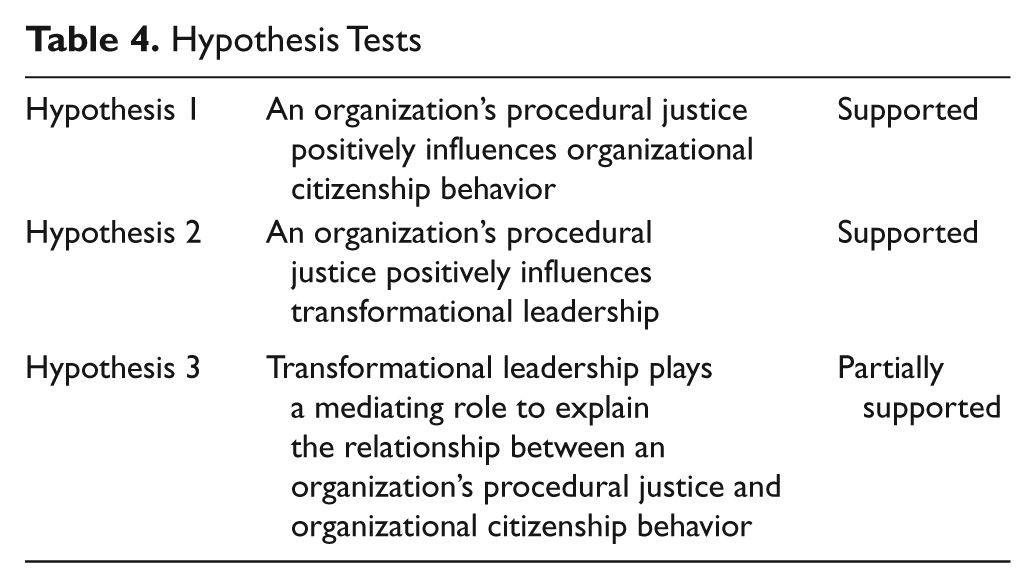
According to the results of the data analysis, as shown in Table 4, all three proposed research hypotheses were positively supported. The direct relationship between the organization’s procedural justice and OCB (Hypothesis 1) and the relationship between organizational procedural justice and transformational leadership (Hypothesis 2) were positively supported, whereas the mediating role of transformational leadership was partially supported in a positive way. Although Hypothesis 3 was partially supported, based on the chi-square differences of the model comparisons, transformational leadership played a strong mediating role (based on comparison of the path coefficients) to explain the relationship between the organization’s procedural justice and OCB in the Korean context.
Discussion
In this discussion section, theoretical and practical implications are discussed, followed by research limitations and recommendations for further research.
Conclusion
The purpose of this study was to explore the relationship among the three research variables (an organization’s procedural justice, transformational leadership, and OCB) and to investigate the mediating effect of transformational leadership in the relationship between procedural justice and OCB. First, previous studies have reported that OCB is predicted by an organization’s procedural justice (Moorman, 1991; Moorman et al., 1998; Williams et al., 2002) and transformational leadership (Avolio et al., 2004; Pillai et al., 1999; Walumbwa & Lawler, 2003; Zhu et al., 2005). Those studies indicated that both procedural justice and transformational leadership are critical factors in encouraging employees’ citizenship behaviors. Along with the results of this previous research, our study also provides empirical evidence of a positive relationship between an organization’s procedural justice and OCB and between transformational leadership and OCB.
Second, our study developed a research framework to examine the mediating effect of transformational leadership on the relationship between an organization’s procedural justice and OCB (Fuller et al., 1996; Judge & Piccolo, 2004). Using the SEM technique, we found that an organization’s procedural justice positively affects OCB. However, when transformational leadership plays a mediating role, the direct relationship between an organization’s procedural justice and OCB will be reduced. This implies that transformational leadership plays a partial role as a mediator to explicate the relationship between an organization’s procedural justice and OCB. In other words, an organization has to promote a favorable organizational climate for the organization’s procedural justice through developing transformational leaders who are willing to encourage employees, leading to OCB.
Last, from a cross-cultural perspective, although most of the studies on procedural justice, transformational leadership, and OCB have been conducted in Western cultures, our research adds empirical evidence of the effect of the proposed research model for the research constructs within the Korean context. This indicates that an organization’s procedural justice directly or indirectly can affect OCB through transformational leadership within multicultural contexts.
Implications for Theory and Practice
Lynham (2000) emphasized the importance of theory building to improve professionalism, to reduce the gap between research and practice, and to create applicable research methods in the workplace. Our study provides a theoretical research framework for theory building concerning the relationship of organizational structure, leaders’ behaviors, and employees’ performance. This study began with the assumption that OCB is one of the most powerful factors to improve organizational performance (Organ et al., 2006). The findings of the study indicated that an organizational structural variable (the organization’s procedural justice) and leaders’ behaviors (transformational leadership) positively encourage employees’ active and voluntary OCB in the workplace. From the findings, it is evident that an organization with organizational procedural justice and transformational leaders can promote OCB, which in turn directly affects organizational performance improvement. Podsakoff and MacKenzie (1997) suggest that OCB increases the productivity of an organization by increasing the productivity of employees. Volunteered employees, for instance, are willing to help their coworkers and thus those who receive help become more productive. This helping behavior may increase collaboration with each other and enhance employee morale, thereby enhancing an organization’s performance. Therefore, the theoretical framework proposed in this study can be an initial stage of a more advanced model for creating an organizational environment and cultivating transformational leaders, which lead to OCB and organizational performance improvement.
On the other hand, from the organization development perspective, it is important to create an organizational climate or culture for procedural justice and transformational leadership in which employees have a positive feeling about their organization. According to Organ’s (1988) definition, OCB is thought of as individuals’ discretionary or voluntary behaviors regardless of the organization’s reward system. With regard to procedural justice climate, Colquitt, Noe, and Jackson (2002) discuss the procedural justice climate at the team level. Many studies on procedural justice have focused on individual perceptions of the procedural justice climate. As the role of teams has become increasingly important for sustainable competitiveness, an expansion of climate level can be helpful for strengthening procedural justice culture in an organization, which in turn will improve organizational performance. In addition, in order to build a transformational culture, Bass and Avolio (1993b) emphasize the role of transformational leaders who serve as mentors, coaches, or role models, leading employees to the transformational culture. For example, a mentoring or coaching system in an organization can be helpful for promoting a transformational culture. Cultivating this transformational culture can encourage employees to become actively involved in OCB.
In terms of leadership development, an organization can nurture transformational leaders in the workplace to make a stronger connection between organizational procedural justice and OCB. Based on the findings of this study, it is evident that transformational leadership plays a partially mediating role between procedural justice and OCB. An organization can establish several strategies for cultivating transformational leaders. Eid, Johnsen, Bartone, and Nissestad (2008) highlight various transformational leaders’ experiences such as new challenging tasks and commitments in the development of transformational leaders. In so doing, Eid et al. suggest an action-learning approach in which leaders can have the opportunities to solve new challenging problems or tasks through individual and group reflection on their action and learning. Conger and Toegel (2003) indicate that action learning is a useful intervention tool for leadership development. Adopting an action-learning approach can be helpful for the development of transformational leadership, which in turn improves OCB in an organization.
Limitations and Further Research
To sustain the objectivity and reliability of the survey results, cross-evaluation oriented data collection was used in the current research instead of self-evaluated survey response. However, other issues concerning data collection and sample variety need to be acknowledged.
First, the majority of the samples were collected from a large-size Korean conglomerate, thereby limiting the generalization of the research results. All these organizational behavioral issues are equally important in the small-/medium-size organizations although the approach of the interventions and treatments should be different because of differences in the structural characteristics of the organizations, environmental factors, and mainstream of the business areas. Thus, including various sizes of organizations in the future research could lead to more meaningful and interesting implications through the multifactor cross comparisons among the different sizes of the organizations.
Second, from a more performance-oriented standpoint, focusing on human resource development (HRD) practitioners could be considered in terms of the research sample. Of course, addressing general management issues from the voices of general employees would provide meaningful implications to scholars and practitioners who are interested in organizational studies. However, listening to the views of the HRD practitioners directly on the organizational behavioral constructs to capture how they perceive them would be worthwhile to extract more specific and critical implications for improving HRD practices, along with the theoretical richness of HRD disciplines. Furthermore, comparing the views of HRD practitioners and general employees on the same subjects could provide interesting results to capture critical gaps between the two groups from the customer–provider view in the organizations. These applied HRD-oriented research efforts could strengthen the theoretical foundation of the practice-oriented HRD discipline.
In sum, further research should take into account both diverse characteristics of organizations accompanied by sizes, structural features, and environmental factors, and HRD practitioners’ perspectives. This would be helpful in developing a more comprehensive theoretical framework and in leading to more meaningful impacts on HRD practices.
Footnotes
Declaration of Conflicting Interests
The authors declared no potential conflicts of interest with respect to the research, authorship, and/or publication of this article.
Funding
The authors received no financial support for the research, authorship, and/or publication of this article.