



Abstract
Prior research has revealed as many as 12 leadership constructs that influence employee creativity by affecting intrinsic motivation. However, little research has explored how leaders might improve employee creativity by directly enhancing creative ability. In this article, we explore the confluence of three streams of research to establish theory supporting leader heuristic transfer (LHT) as a potential influence on employee creativity. LHT is defined as the conveyance of a leader’s experience-based processes for pattern recognition, discovery, and problem solving—rules of thumb employees’ may adapt for their own creative application. Using a sample of 289 employee–supervisor–coworker survey triads, results indicate that LHT has a positive relationship with employee creativity, even when controlling for established creativity-enhancing factors. Furthermore, structural equation modeling shows that LHT’s influence on creativity exceeds the intrinsic motivation hypothesis central to existing constructs. Where the existing constructs focus on increasing employee intrinsic motivation in the hope that creativity occurs as a by-product, it appears that LHT boosts creativity directly, with intrinsic motivation as a positive by-product of a more capable employee.
In economic environments characterized by diverse competition and rapidly evolving technology, employee creativity is heralded as a means by which organizations can maintain relevance and gain advantage in the marketplace. Indeed, Porter (1991) noted that creative choices lie at the foundation of firm-level strategies driving skills and market position. The Strategic Management Society (SMS, 2010) also recognized the importance of creativity, naming it one of 10 core research themes for SMS’ Strategic Entrepreneurship Journal. Defined as the production of novel and useful ideas (Amabile, Barsade, Mueller, & Staw, 2005), creativity offers a point of departure from existing routines (Ford, 1996; Shalley, Gilson, & Blum, 2000); a point from which entrepreneurial action may prompt innovations to existing processes, products, and services or the development of new ones (Alvarez & Barney, 2007).
Individual cognitive processes, such as divergent thinking, and personality attributes, such as openness to experience, have long been associated with employee creativity (Barron & Harrington, 1981; McCrae, 1987). Organizational factors can also enable or inhibit creativity of “individuals working together in a complex social system” (Woodman, Sawyer, & Griffen, 1993, p. 293). This “organizational creativity” has been explored as a function of various factors, including the coworkers surrounding an employee (Amabile, Conti, Coon, Lazenby, & Herron, 1996), organizational goal-setting (Shalley, 1995), employee rewards (Carson, Carson, & Roe, 1993), and job characteristics (Shalley, Zhou, & Oldham, 2004). Finally, interactions between these and other individual and organizational factors are also believed to affect creativity outcomes (e.g., Hargadon & Bechky, 2006).
A frequently studied contextual feature thought to affect employee creativity involves the behaviors and attributes of leaders. Research on this relationship has investigated at least 12 distinct leader constructs purported to effect employee creativity. Leader–member exchange (LMX; Scott & Bruce, 1994) and transformational leadership (Bass & Avolio, 1990) are perhaps the most widely investigated influences. Other leadership constructs studied for effects on employee creativity include unconventional leader behavior (Jaussi & Dionne, 2003), empowering leadership (Zhang & Bartol, 2010), benevolent leadership (Niu, Wang, & Cheng, 2009), and servant leadership (Neubert, Kacmar, Carlson, Chonko, & Roberts, 2008). In aggregate, these and other studies have found consistent empirical support for a leadership–employee creativity relationship.
Across all of these existing leadership constructs, however, there is but one causal mechanism proposed to explain how leadership affects employee creativity; leaders affect employees’ creativity by enhancing their intrinsic motivation (through goals, regulatory beliefs, engagement, and autonomy). Intrinsic motivation refers to the motivational state in which employees are attracted to and energized by a task itself, instead of merely by the external outcomes doing the task might yield (Deci & Ryan, 1985). For example, Shin and Zhou (2003) stated that transformational leadership’s positive effect on creativity exists “because it can boost intrinsic motivation” (p. 705). Scott and Bruce (1994, p. 584) wrote that high LMX (Graen & Scandura, 1987) prompts creativity because “subordinates are allowed greater autonomy and decision latitude, both of which have been shown to be essential to innovative behavior.” Similarly, Zhang and Bartol (2010) described empowering leadership as “sharing power with a view toward enhancing motivation and investment in work” (p. 107) that prompts employee engagement and, subsequently, prompts creativity.
This prior research has established that leadership processes supportive of intrinsic motivation are positively associated with employee creativity. However, performance is a product of effort and ability (Kanfer & Ackerman, 1989). Creative performance is no exception (Amabile, 1988; Ford & Kuenzi, 2008). Yet consideration of leader impact on employee creative ability has been scarce. Tierney’s (2008) review of creativity research not only revealed great progress in the field but it also indicated that the only studies not related to boosting employee intrinsic motivation involved individual intelligence and personality traits (e.g., Halbesleben, Novicevic, Harvey, & Buckley, 2003) or leader behaviors aimed at providing employees clear directions for complex tasks (Redmond, Mumford, & Teach, 1993).
This lack of emphasis on leaders’ potential to improve employee ability to be creative has been noted previously. Zhang and Bartol (2010) concluded that creative work involve[s] complicated, ill-defined problems from which novel and useful solutions are far from obvious. As a result, leaders cannot rely on predefined structures that spell out means or even precise ends. Instead, they must encourage employee motivation and yet encourage considerable employee latitude. (p. 109)
Such sentiment suggests that leaders’ efforts to improve creativity are best directed toward enhancing intrinsic motivation rather than enhancing ability. Challenging this notion, the present study argues that the confluence of three streams of research suggest that there is a theoretical rationale for leadership directly improving employee’s ability to be creative.
First, evidence of individual skills and processes associated with the ability to be creative has been a focus of research for decades. Among others, opportunity recognition (Kirzner, 1979; Shane, 2003) and Baron’s (2006) “connecting the dots,” linking unassociated ideas, products, or services, have been described as integral to creative production. Second, organizational creativity research has shown that heuristics linked to creativity (a) can be enhanced through general interaction of individuals via knowledge transfer (Argote, McEvily, & Reagans, 2003; Reagans & Zuckerman, 2001) and (b) can be enhanced specifically with deliberate creativity training (Basadur, 2001). Finally, behavioral research suggests that leaders are able to shape the needs, goals, and framing of organizational situations for employees (Fleishman, 1973) and commonly have experience greater than those they manage. Taking these inputs together, we hypothesized that leaders have the unique potential to increase employee creativity by providing useful cognitive frameworks to their employees through leader heuristic transfer (LHT).
LHT is the conveyance of a leader’s heuristics, or experience-based “rules of thumb.” Whereas knowledge transfer is described broadly as “evident when experience acquired in one unit affects another” (Argote et al., 2003, p. 572), LHT involves a leader’s articulation of heuristics they use for pattern recognition, discovery, and problem solving that can be generalized across settings and decision contexts. Drawing from practice and research, the purpose of this article is to develop a theory for LHT, construct and establish an LHT measure, and examine its contribution to employee creativity. Empirical tests provide two additional contributions. First, it was hypothesized that a positive relationship exists between LHT and employee creativity even when controlling for established creativity-enhancing constructs. Second, departing from leadership constructs emphasizing intrinsic motivation as an indirect means to increased employee creativity, it was hypothesized that LHT boosts creativity directly, with intrinsic motivation as a welcome by-product of increased employee ability.
Background and Hypotheses
The remainder of this study will proceed as follows. First, an example from practice is used to illustrate the potential for LHT. Second, Hargadon and Fanelli’s (2002) research is invoked to suggest the presence of heuristics and fortify the notion that individuals develop and transfer their own heuristics from one situation to another. In turn, other studies show that individuals exposed to others can improve their capabilities through knowledge transfer. Next, the literature on creativity training is cited to suggest that certain creativity-related heuristics can be acquired by individuals. Last, leadership theory is juxtaposed on the concept of heuristics and creativity training to introduce and test LHT.
An Illustration of Leader Heuristic Transfer
In 1984, billionaire investor Warren Buffett publicly debated Michael Jensen, professor at the University of Rochester. Jensen, and three Nobel Laureates, all believed Buffet’s wildly successful record of selecting investments was simply a “three sigma event”—a statistical aberration of chance. However, Price and Kelly (2004) subsequently showed that Buffet’s abilities likely go beyond “luck of the draw.” They estimated the probability of Buffet’s record as the result of blind chance to be one in 100 billion. Buffet’s response to Jensen was equally illuminating. Buffet pointed out that eight other successful investors were beneficiaries of the same set of insights. All nine had been students or protégés of Benjamin Graham, the Columbia professor of finance. Although each of these individuals was intelligent, educated, and considered Graham an inspiration, they specifically credited Graham’s cognitive “framework” and “insights” as critical to their success in determining optimal investments in a complex landscape. Long after exposure to Graham, they used his heuristics to create success in separate firms, via distinct investments, over different periods of time.
Heuristics
So, what is an example of an actual heuristic? One such rule of thumb ascribed to Benjamin Graham succinctly states that the stock market is a “voting mechanism” in the short term, and a “weighing mechanism” over the long term (Dodd & Graham, 1934). Although brief and nontechnical, Graham’s followers indicated that this heuristic served as a guideline for applying Graham’s value investing strategy to their investment decisions. In essence, it indicates that short-term data-points, news stories, expectations of company earnings, and other variables should be considered through a different “lens” than evidence provided by their longer term counterparts. Stated another way, the classification of information as subjective in nature (polling) rather than as an objective estimate of a company’s stock value (weighing) could be expected to have implications on investment decisions using that information.
Bingham, Eisenhardt, and Furr (2007) empirically demonstrated the processes and effects of other specific heuristics. They designated heuristics by the ability to focus attention, save time, be flexible, and limit errors. Bingham et al. proposed that heuristics are rough plans for how one should act in future situations, which decreases the time, resources, and mistakes inherent in trial and error (Eysenck & Keane, 1995). In a study of entrepreneurial firms’ internationalization strategy, they gathered interview data to review elements associated with selection, procedural, temporal, and priority heuristics. Selection heuristics, for example, were informal guidelines for determining which countries the firm would enter (one firm focused on English-speaking countries), and which customers to target (one firm focused on large original device manufacturers). Temporal heuristics involved consistencies regarding elements such as the pace or sequence by which a firm internationalized. Their study indicated that the increased presence of these heuristic “tools” had a positive relationship with internationalization performance which in turn was more significant than firm experience alone.
Hargadon and Fanelli (2002) studied the ongoing interaction of empirical and latent knowledge: knowledge as action and knowledge as possibility. In fact, they used a “tool” analogy to describe latent knowledge transfer across different situations by creative design consulting firms such as IDEO. In one case study, IDEO was tasked with developing an innovative water bottle for a bicycle company. Engineers focused on a bistable valve design (one that would allow the bottle to stay closed in normal use but open when squeezed) because a designer had used a similar valve for a shampoo bottle years before. As it turns out, the valve idea for the shampoo bottle had itself come from an unrelated project involving the same premise for designing an artificial heart valve. In describing these links, Hargadon and Fanelli (2002) recounted an IDEO designer who said his “diverse experiences made his memory ‘one big pile of tools’” and while “each industry has its own set of tools, I only remember the tools, not where they came from” (p. 298).
These examples suggest support for heuristics in facilitating various outcomes, including investment performance, international firm growth, and product design. Though these and other outcomes may or may not involve creativity, heuristic “tools” have been an important focus of creativity research for many years. Gordon (1961) wrote about a process for making the familiar strange, and vice versa, to develop new perspectives. Thomas Edison famously said creativity is “one percent inspiration and 99 percent perspiration” (Hargadon, 2008). Simonton (1999) proposed that new variations were not necessarily serendipitous. They could be guided by existence of knowledge elements in new combinations (Sternberg, 1999). Hogarth (1987) discussed four components of causal reasoning relevant to creativity: (a) a causal field which provides the context in which judgments are made, (b) cues-to-causality, imperfect indicators of the presence or absence of causal relations, (c) judgmental strategies for combining the field and cues in the assessment of cause, and (d) the role of alternative explanations. Finally, in their work on developing computer programs, Pirolli and Anderson (1985) found that most students created new programs via analogy. Their success relied on how well they understood why the analogies worked. In all these examples, specific creative applications for unique situations were rooted in less-specific rules of thumb that facilitated their development.
Heuristic Transfer
In the same manner that an individual might develop heuristics as a result of their own experience with different environments and situations, interaction with other individuals may result in the transfer of heuristics as well. Several studies have identified a phenomenon in which employees exposed to each other have an opportunity for unique combinations of knowledge, and that this opportunity is increased in cases where the individuals are diverse in background, expertise, education, and other factors (Burt, 1992; Reagans & Zuckerman, 2001). In their analysis of leadership and creativity, Reiter-Palmon and Illies (2004) suggested that a leader can prompt creative activity in their employees by intentionally establishing groups that are diverse in their makeup or exposing individuals and groups to diverse experiences in an effort to increase knowledge transfer and enhance capabilities. Burke, Fournier, and Prasad’s (2007) study of medical innovations showed that nonstar scientist exposure to highly prolific “star” scientists resulted in higher subsequent rates of production by the nonstar scientists.
These examples suggest evidence that mixing personnel according to experiences and across projects should produce novel combinations commensurate with knowledge transfer. Yet they do not clarify whether individuals internalize heuristics from one another or simply apply their respective skills in a collaborative manner. This question has been explored in other aspects of the literature on creativity. Basadur, Graen, and Green (1982) showed that training in divergent thinking, a creativity-related process like homospatial thinking (Rothenberg & Sobel, 1981) involving the active consideration of multiple alternative solutions for a given challenge, improves employee creativity.
Basadur and colleagues also showed that Creative Personality Scale (CPS) training significantly improves skills such as generating original solutions to problems (Basadur, Runco, & Vega, 2000), accuracy in evaluating original ideas (Basadur et al., 2000; Runco & Basadur, 1993), fluency in generating solutions to problems (Runco & Basadur, 1993), and enhanced ideation in problem finding (Basadur et al., 1982). Additionally, Kabanoff and Bottger (1991) tested the extent to which CPS training increased ideational fluency as well as flexibility and originality among MBA students with 5 years of work experience. Kabanoff and Bottger interpreted the training effects in the following way: “The main difference between trained and untrained persons is the formers’ willingness and capacity to defer judgment and not to exclude apparently strange, but original and potentially valuable ideas” (p. 243).
Leader Heuristic Transfer and Creativity
In summary, evidence suggests that individuals garner and use their own heuristics to aid in creative production. It is also suggested that tools used or demonstrated by one individual may be adopted by another individual, even if used in a different manner or for different challenges from the first. So, how might leadership factor into the transfer of heuristics? Leaders can shape and articulate the means and goals by which employees assess and engage problems, situations, perspectives, and solutions (e.g., Bono & Judge, 2003; Burns, 1978; Foldy, Goldman, & Ospina, 2008; Podsakoff, Bommer, Podsakoff, & MacKenzie, 2006). Research indicates that leader behaviors and attributes also have an impact on everything from employee turnover (Ferris, 1985), to satisfaction (Judge & Piccolo, 2004), productivity (Tepper, Duffy, Henle, & Lambert, 2006), deviance (Mayer, Kuenzi, Greenbaum, Bardes, & Salvador, 2009), organizational citizenship behavior (Organ, 1988) and, of course, creativity. It could be expected, then, that a leader’s unique experiences embodied in their own heuristics may also affect employees. In fact, it is typical for leaders to have higher levels of expertise (Borgatti & Cross, 2003) and status (Sine, Shane, & Di Gregorio, 2003) than their employees, both of which are believed to predict knowledge transfer across individuals.
The theory developed in this article is built on the premise that the transfer of heuristics found to be useful for one person in one set of circumstances assists another person in new and yet unanticipated situations. Specifically, the theory states that a leader high in LHT enhances the cognitive framework (Baron & Ensley, 2006), the capabilities, of employees. The result is employee production that is novel and useful (i.e., creative). As such, the following hypothesis was tested:
Hypothesis 1: Leader heuristic transfer is positively related to employee creativity.
Leader Heuristic Transfer as a Distinct Leadership Construct
To fully depict LHT, it is important to clarify its distinctions from existing leadership constructs that influence creativity. LMX (Scott & Bruce, 1994) is described as a function of close leader–employee relations that are expected to result in employee autonomy and feelings of support which, subsequently, allows the employee the freedom and comfort to try new ideas. Benevolent leadership (Niu et al., 2009) and servant leadership (Neubert et al., 2008) involve individualized consideration of the follower that, similar to LMX, is expected to prompt consideration of ideas outside organizational norms. These constructs, and the extant creativity-related leadership constructs in the literature, differ from LHT in that they focus on enhancing intrinsic motivation (e.g., leader inspirational motivation: Hirst, van Dick, & van Knippenberg, 2009; leader encouragement of creativity: Scott & Bruce, 1994; participative/directive leadership: Somech, 2006; leader promotion focus: Wu, McMullen, Neubert, & Yi, 2008; empowering leadership: Zhang & Bartol, 2010; supervisor developmental feedback: Zhou, 2003). Alternatively, LHT likely improves creativity primarily by arming employees with greater skills for pattern recognition, discovery, and problem solving.
To be sure, a leader such as Benjamin Graham might have ranked high in LHT, and high also in LMX, benevolence, or other leadership behaviors and attributes. In contrast, high LHT might also be illustrated by an exemplary, but gruff drill sergeant; a brilliant, but absent-minded professor; or an outstanding, but narcissistic chief executive officer. Each might lack elements critical to inspirational or motivational leadership constructs, yet still be exceptional examples of leadership in terms of outcomes such as employee creativity. These illustrations distinguish LHT from other leadership constructs previously associated with employee creativity. In short, LHT may or may not accompany, but is not focused on emotional or personal support, charisma, idealized image, or inspirational interaction.
The leadership construct conceptually closest to LHT comes from Bass’ Transformational Leadership. Bass states, “Transformational leadership refers to the leader moving the follower beyond immediate self-interests through idealized influence (charisma), inspiration, intellectual stimulation, or individualized consideration” (Bass, 1999, p. 11) Though this and other depictions of transformational leadership (Bass & Avolio, 1990; Shin & Zhou, 2003) have a central focus on intrinsic motivation, Bycio, Hackett, and Allen (1995) emphasized leaders developing followers and stimulating thinking. This particular emphasis appears to reside in a dimension of transformational leadership called “intellectual stimulation.”
Avolio, Bass, and Jung (1999) described intellectual stimulation as getting followers to question the typical ways of solving problems, and encouraging them to question the methods they use to improve on them. Alternatively, LHT assesses the degree to which employees believe that their supervisor conveys heuristics that assist them in pattern recognition, discovery, and problem solving. Although intellectual stimulation clearly involves the interpersonal encouragement of effort, its attention to problem solving makes intellectual stimulation the closest cousin to LHT. Because LHT directly addresses leader attempts to improve employee abilities, we believe that LHT should have a distinct effect on employee creativity even in the presence of intellectual stimulation. As such, the second hypothesis tested was
Hypothesis 2: Leader heuristic transfer is positively related to employee creativity, while controlling for leader intellectual stimulation.
As indicated in the reports of admiration and inspiration by the followers of Benjamin Graham, boosts to intrinsic motivation likely accompanied Graham’s transfer of heuristics. At a general level, a leader who takes an interest in the improvement of his or her employees’ well-being or potential (e.g., servant leadership: Greenleaf, 1977; supervisor developmental feedback: Zhou, 2003) could be expected to increase the intrinsic motivation of those employees even if they are not charismatic in doing so. As stated previously, intrinsic motivation is higher the more employees are attracted to and energized by a task itself, rather than working on a task only in exchange for extrinsic outcomes (Deci & Ryan, 1985). Intrinsically motivated employees tend to be cognitively flexible and persevering (McGraw & Fiala, 1982; McGraw & McCullers, 1979). Therefore, they are likely to find alternative means of solving problems, use nontraditional approaches, and be persistent in their efforts. All these behaviors suggest that an intrinsically motivated individual is likely to exhibit a high level of creativity.
Although not intrinsic to LHT, a leader ranking high in LHT might prompt increases in his or her employee’s intrinsic motivation. This would indicate that intrinsic motivation plays a partial role in the relationship between LHT and employee creativity. Thus, the following hypothesis:
Hypothesis 3a: The relationship between leader heuristic transfer and employee creativity is partially mediated by employee intrinsic motivation.
Like the other creativity-related leadership constructs described above, transformational leadership is thought to increase employee creativity primarily by increasing employee intrinsic motivation. Indeed, Shin and Zhou (2003) stated that intrinsic motivation “is often considered the mechanism by which situational factors such as leadership contribute to creativity” (p. 704). They found that transformational leadership had a positive relationship with employee creativity, but that this relationship was partially mediated by intrinsic motivation. Given prior theory and empirical evidence, it was hypothesized that
Hypothesis 3b: The relationship between leader intellectual stimulation and employee creativity is partially mediated by employee intrinsic motivation.
LHT is distinct from intellectual stimulation and other motivation-based leadership constructs in one critical regard. As implied by the term stimulation, motivation-based leadership constructs such as intellectual stimulation influence creativity primarily through increasing employee intrinsic motivation. Instead of intrinsic motivation as the primary theoretical mechanism in prompting creativity, the role of intrinsic motivation between LHT and employee creative performance is likely secondary. Increased intrinsic motivation and its subsequent benefits, from job involvement (Deci, 1975) to further creativity, are appreciated by-products of LHT, but they are not the means to an end. Leader knowledge transfer that enhances the heuristic toolset of employees should directly result in improved ability to be creative and, as a result, be less affected by intrinsic motivation than motivation-based measures such as leader intellectual stimulation. Thus, the following hypothesis was tested:
Hypothesis 3c: The mediating role of employee intrinsic motivation is greater between leader intellectual stimulation and employee creativity than between leader heuristic transfer and employee creativity.
Method
Scale Development
The initial LHT measure was developed deductively through utilization of a classification schema prior to data collection (Hinkin, 1995). Nuanced heuristics used across a distinct array of industries and occupations would be exceedingly difficult to identify and define for use in a generalizable measure. In contrast, employees can likely recognize a more general difference between leaders providing motivational support and those imparting heuristics that enhance employee capabilities. Based on this assumption, item creation was guided by the definition of the LHT construct (Schwab, 1980), terminology stated in research by Hogarth (1987) and others, and terms gleaned from investors’ depictions of Benjamin Graham’s leadership. Items were revised to avoid technical terms unfamiliar to the general population (e.g., “heuristics”). Items were also revised to use words such as “teach” and “instill” rather than “share” and “help” to avoid a nomological bias toward emotional bonding and instead emphasize objective knowledge transfer. Eleven items were generated for testing.
Pilot study research setting, sample, and procedures
A pilot study was conducted to establish a valid measure of LHT before testing the hypotheses. Data for this study were collected via voluntary student participation in the research laboratory at a large university in the United States. Students enrolled in business school courses were offered an opportunity to earn extra credit in exchange for participation in behavioral science research. Students went to the research laboratory during a 4-hour window on any of three available days to complete various Internet and paper-and-pencil studies, one of which was the pilot study for this analysis.
This pilot study was completed by 75 students. The average age of respondents to the pilot study was 22 years, while the percentage of males participating was 47%. Sixty-four of the 75 participants indicated having a year or more of work experience, while the average tenure work experience was 3 years. Participants reflected a Caucasian majority of 67%, with 16% Hispanic/Latino representation, and all other ethnicities represented at less than 5% each.
Pilot study results
As observed by Hinkin (1995), sufficiently large samples produce increased confidence that observed factor loadings appropriately reflect true population attributes. Recommendations for item-to-response ratios range from 1:4 to 1:10 (Schwab, 1980) for each set of scales analyzed. With an item-to-response ratio of roughly 1:7, the pilot sample was sufficient for validation. Reliability was assessed via Cronbach’s alpha and exploratory factor analysis, respectively. Cronbach’s alpha was .94, well above acceptable limits.
Exploratory factor analysis produced one factor for the eight regularly coded items, and a second factor for the three reverse-coded items. Because reverse-scoring items may produce an artificial response factor tied to “negatively worded” items and have been found to reduce the validity of questionnaire responses (Schriesheim & Hill, 1981), the three reverse-coded items were removed. The remaining eight items were then distributed to six faculty members with a description of the LHT construct to assess face validity. Per faculty response, three additional items were removed because of lack of congruence with LHT or perceived overlap with existing leadership constructs. The remaining five-item scale is in the appendix.
Research Setting, Sample, and Procedures
Data for this study were collected via a “triad” electronic survey process. Instead of gathering survey responses from one respondent, initial survey respondents also electronically forwarded unique, confidential surveys to their supervisor and a coworker at their place of employment to establish three perspectives on the same subject matter. Data were only used if all three members of each employee–supervisor–coworker triad completed and submitted a survey. Measures within each survey were only used if more than half of each measure’s items had been completed by the participant.
Business school students were offered an opportunity to earn extra credit for a business class if they successfully gathered completed survey triads. Students in the class were e-mailed survey directions and links to electronic surveys to be provided to an employee, that employee’s supervisor, and a coworker. Employees were required to be employed at least 20 hours per week to participate in the survey. For the 750 students to whom these survey items were offered, 460 students registered with the intent to gather data from an employee, supervisor, and coworker. This represented an initial response rate of 61%. At the close of the study period, an identifying code number was used to associate employee–coworker–supervisor surveys with each other. Triads were eliminated if one or more of the three required participants failed to submit a survey, and if data responses were insufficient for analysis. This resulted in 289 complete survey triads in the final sample for a response rate of 39%.
Participants in the sample worked in a wide variety of businesses including aerospace, manufacturing, recycling, government, design and construction, legal, distribution, grocery, hotels, banking, and retail. In terms of occupation, marketing/sales/service and hospitality/ tourism each constituted roughly 20% of the respondents, with management/administration and finance constituting approximately 10% and 9%, respectively. Other areas included education and training, health science, architecture and construction, agriculture, transportation, and information technology. The average age of employees, supervisors, and coworkers was 27, 40, and 30 years old, respectively, while the percentage of males was 55%, 54%, and 42%. The average tenure in the current job for respondents, supervisors, and coworkers was 3 years, 7 years, and 4 years, respectively. All participant categories reflected a Caucasian majority of 59% to 66%, followed by a mix of minority respondents of Hispanic/Latino (16% to 18%), African American (5% to 8%), Asian American (5% to 9%), and other ethnicities. The percentage of participants working full-time was 48%, 97%, and 61%, respectively.
Measures
Unless indicated otherwise, the scales used a 7-point Likert-type scale, from 1 = strongly disagree to 7 = strongly agree. To avoid measurement error resulting from same source response bias (Podsakoff & Organ, 1986), ratings of perceptions of leadership and job characteristics used coworker responses, ratings pertaining to personal measures used employee responses, and ratings pertaining to employee creativity used supervisor responses.
Leader heuristic transfer
The five-item measure developed for this study assesses the degree to which employees believe that their supervisor conveys heuristics that assist them in pattern recognition, discovery, and problem solving. Coworkers rated their supervisor’s LHT by responding to items including, “My supervisor offers me input that enables me to better recognize risks and opportunities” and “My supervisor teaches me processes that I can apply to tasks I encounter.” The appendix contains all five items. Cronbach’s alpha was .94.
Leader intellectual stimulation
This measure is one of four dimensions of the Multifactor Leadership Questionnaire for assessing transformation leadership developed by Bass and Avolio (1990). This four-item dimension, described as getting followers to question the typical ways of solving problems, and encouraging them to question the methods they use to improve on them, was the most pertinent comparison with LHT for testing predictive validity. Coworkers rated leaders by responding to the following: “My supervisor seeks differing perspectives when solving problems,” “My supervisor suggests new ways of looking at how to complete assignments,” “My supervisor re-examines critical assumptions to question whether they are appropriate,” and “My supervisor gets me to look at problems from many different angles.” Cronbach’s alpha was .87.
Employee intrinsic motivation
A four-item measure from Grant (2008) was used to assess employee intrinsic motivation. Employees rated their own intrinsic motivation. The scale opens with the question: “Why are you motivated to do your work?” It includes items such as “because I enjoy the work itself” and “because it’s fun.” Cronbach’s alpha was .93.
Employee creativity
This study used a 10-item measure, adjusted from Farmer, Tierney, and Kung-McIntyre (2003) and George and Zhou (2001), to measure employee creativity. Supervisors rated each of their direct reports’ creative behavior by responding to items including “This employee seeks new ideas and ways to solve problems” and “This employee is a good source of creative ideas.” Cronbach’s alpha was .95.
Control variables
Because of evidence suggesting that increased age may negatively affect creative processing (Lehman, 1953), employee age was a control variable (Gong, Huang, & Farh, 2009; Shalley et al., 2000; Wu et al., 2008). Because of concerns that supervisor ratings of employee creativity may be a function of the education level of the employee, or be biased by the length of interaction between the employee and supervisor, employee education level (Gong et al., 2009; Shalley et al., 2000; Zhang & Bartol, 2010; Zhou, 2003) and tenure (in years) with the supervisor (Shin & Zhou, 2003) were also control variables.
We also controlled for two additional factors, employee openness to experience and innovation as a job requirement, to assess the relative usefulness of LHT. Using what is now widely known as the NEO Personality Inventory (Costa & McCrae, 1985), McCrae indicated that openness to experience, unlike the other four major personality domains, had a positive relationship with five out of six divergent thinking factors related to Gough’s CPS, and also related directly to the CPS. Feist’s (1998) meta-analysis of studies involving the five personality domains and creativity fortified evidence of the strength of this relationship, while George and Zhou (2001) demonstrated the measure’s relationship with creativity when interacted with other contextual factors. George and Zhou described the employee openness to experience–creativity relationship in terms of “heuristic” as opposed to “algorithmic” tasks (Amabile, 1996) thus making it particularly appropriate for testing the relationship between heuristics and employee creativity in the present model.
A 10-item measure by Costa and McCrae (1992) and Goldberg (1992) was used to rate employee perception of their own openness to experience. Employee respondents rated themselves by responding to items including “I enjoy hearing new ideas” and “I am not interested in abstract ideas” (negatively keyed). Cronbach’s alpha was .73.
The final control was “innovation as a job requirement.” Kanter (1988) indicated that the activation of innovativeness can be the result of the obligations of an employee’s job characteristics (Oldham & Cummings, 1996). Yuan and Woodman (2010) developed a related measure that assessed whether the attributes of a job required “introducing new ideas” or “trying out new approaches to problems.” Their five-item measure was used to assess innovation as a job requirement. Coworker respondents rated the job by responding on a 5-point Likert-type scale ranging from 1 = strongly disagree to 5 = strongly agree. Items include “Introducing new ideas into the organization is part of my job” and “My job requires me to try out new approaches to problems.” Cronbach’s alpha was .86. Coupled with the individual measure “openness to experience,” and the interpersonal measure “intellectual stimulation” (and the three demographic variables), inclusion of an objective measure such as innovation as a job requirement constitutes a considerable test for the distinct influence of LHT.
Results
Table 1 displays the means, standard deviations, and correlations of all measures. As reflected in the table, all of the internal consistency estimates are above the commonly accepted .70 threshold (Nunnally & Bernstein, 1994).
Means, Standard Deviations, Correlations, and Reliabilities of All Measures
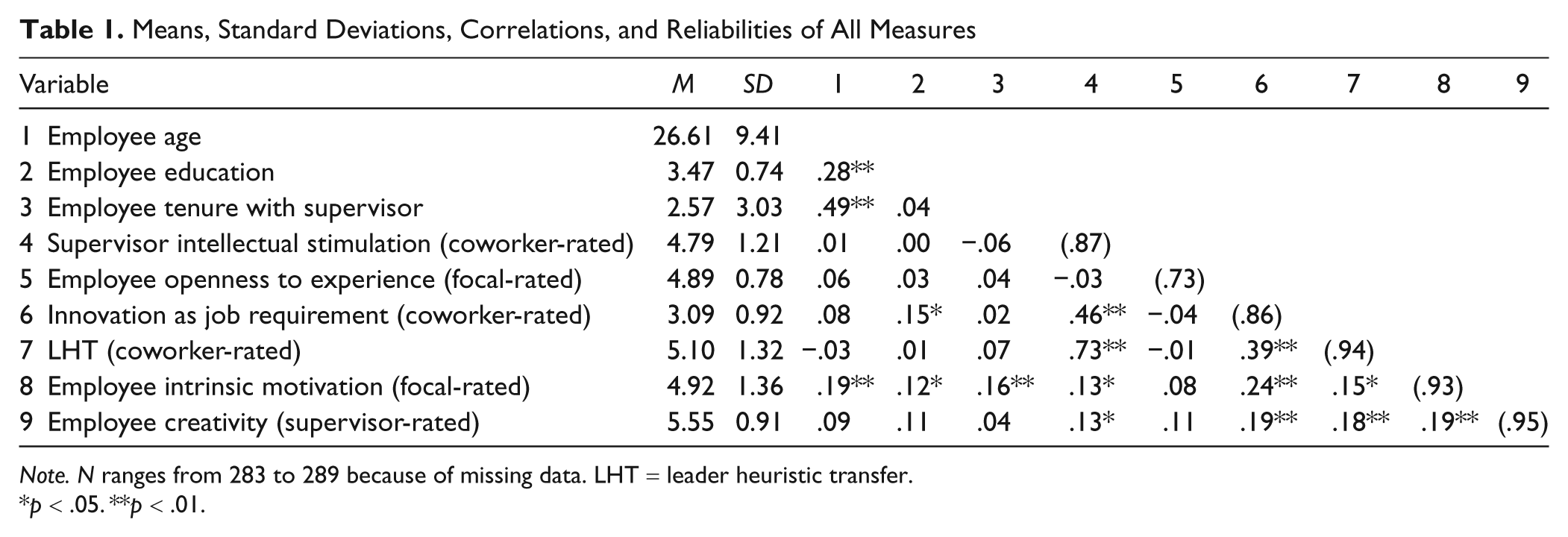
Note. N ranges from 283 to 289 because of missing data. LHT = leader heuristic transfer.
p < .05. **p < .01.
A confirmatory factor analysis was conducted of the items constituting measures of LHT, intellectual stimulation, and innovation as job requirement. To avoid artificial loadings among the factors due to different respondents, these three measures were chosen because all employed coworker responses. Demonstrating discriminate validity, a three-factor model delineating each measure represented a proper fit (goodness-of-fit index [GFI] = .94, comparative fit index [CFI] = .98, root mean square of approximation [RMSEA] = .05) to the data. Furthermore, the three-factor model was a better fit to data than a two-factor model combining both leadership measures, and a one-factor model combining all three measures. Neither of these alternative models were a statistically sufficient fit to the data.
To test Hypothesis 1, regression analysis was conducted for two models. The results are shown in Table 2. In Step 1 of the first model, supervisor-rated employee creativity was regressed on demographic control variables employee age, education level, and tenure with one’s supervisor. LHT was added in Step 2 of this model. Indicating initial support for Hypothesis 1, LHT had a positive relationship with employee creativity (β = .19, p < .01).
Regression Analysis
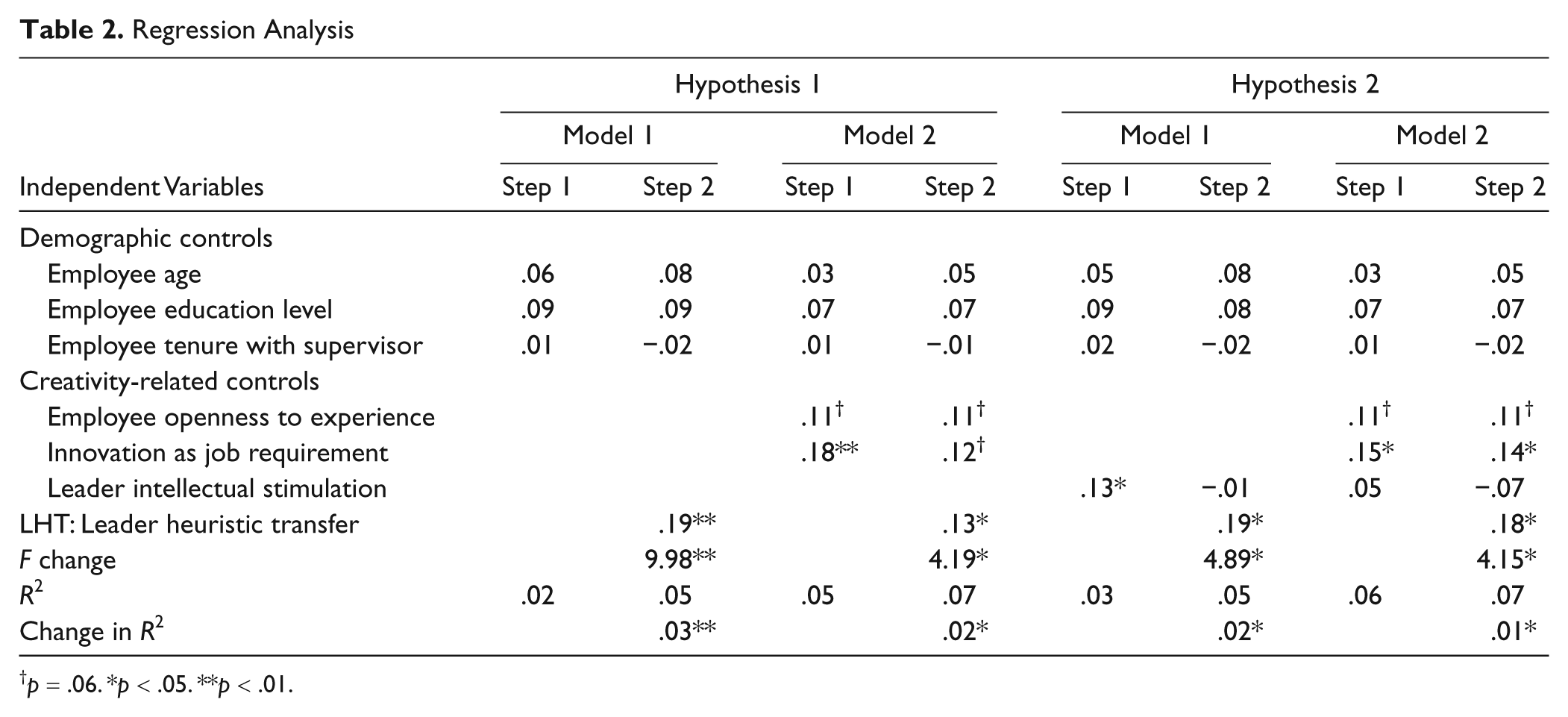
p = .06. *p < .05. **p < .01.
In Step 1 of the second model testing Hypothesis 1, employee creativity was regressed on creativity-related controls representing employee openness to experience, innovation as a job requirement, and the three demographic control variables. Consistent with previous research, innovation as a job requirement had a significant relationship with employee creativity (β = .18, p < .01), while openness to experience approached the threshold for statistical significance (β = .11, p = .06). LHT was added in Step 2 and was found to have a significant relationship with employee creativity (β = .13, p < .05). In summary, the data support Hypothesis 1.
Hypothesis 2 was also tested with regression analysis in two models. In the first model, employee creativity was regressed on employee age, education, tenure with supervisor, and leader intellectual stimulation. Consistent with extant research on the relationship between transformational leadership and employee creativity, intellectual stimulation had a positive relationship with employee creativity (β = .13, p < .05). LHT was added in Step 2 of this model. When in the presence of LHT, intellectual stimulation no longer had a relationship with employee creativity, while LHT did have a positive relationship (β = .19, p < .05).
In the second model testing Hypothesis 2, Step 1 regressed employee creativity on the demographic controls and all three creativity-related controls. Step 2 added LHT. In this model, LHT (β = .18, p < .05) and innovation as a job requirement (β = .14, p < .05) were significant. Openness to experience was close to the threshold for significance (β = .11, p = .06), whereas leader intellectual stimulation was not related to employee creativity. Thus, Hypothesis 2 is supported.
Figure 1 shows the results for tests of Hypotheses 3a to 3c. These hypotheses involve distinguishing the role intrinsic motivation plays in the relationship between intellectual stimulation and creativity from the role intrinsic motivation plays in the relationship between LHT and creativity. Thus, mediation analysis was conducted independently for each hypothesized relationship (Hypotheses 3a & 3b). Structural equation modeling (SEM) in SAS was used.
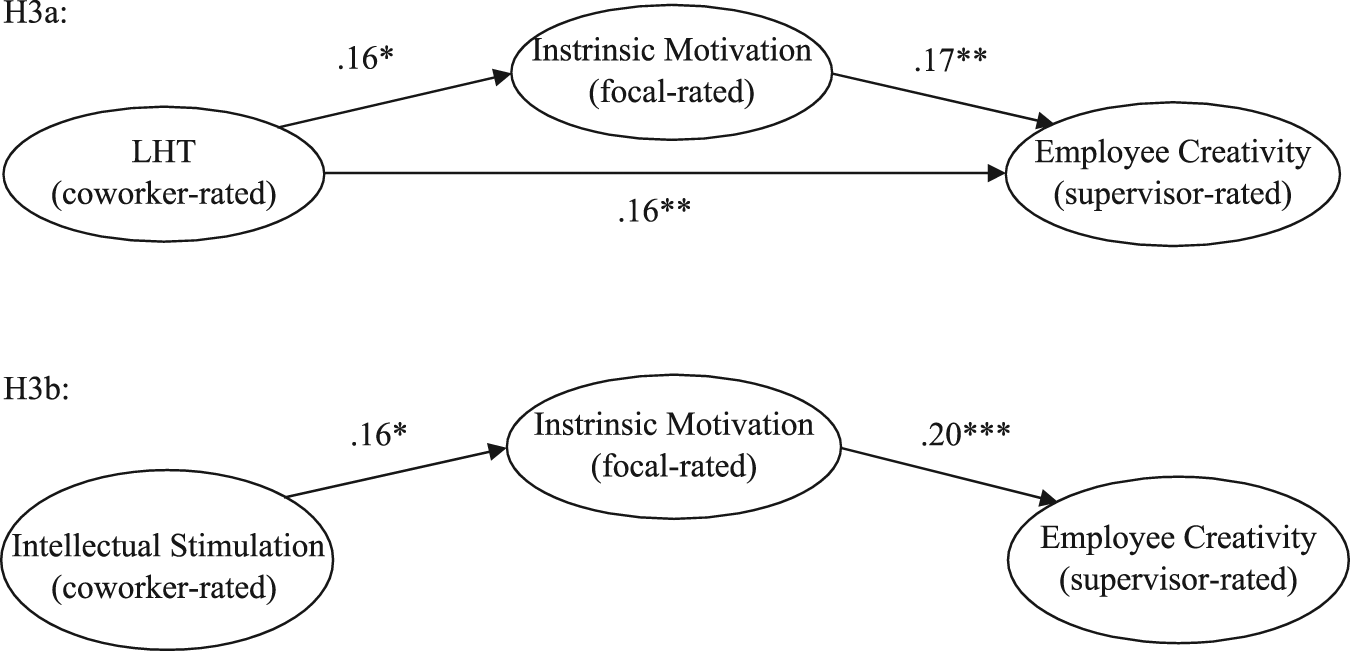
Structural equation modeling: Mediation testing
Pursuant to Hypothesis 3a, SEM was completed to assess the model fit of intrinsic motivation as a partial mediator of the relationship between LHT and employee creativity. The results of SEM indicate that the model is a good fit to the data (GFI = .91, CFI = .98, RMSEA = .05). Furthermore, all path coefficients were significant. LHT was related to intrinsic motivation (β = .16, p < .05), intrinsic motivation was related to employee creativity (β = .17, p < .01), and LHT was related to employee creativity (β = .16, p < .01). In a comparative test, a fully mediated model offers no advantages in terms of fit. These data indicate partial mediation and thus support Hypothesis 3a.
Pursuant to Hypothesis 3b, SEM assessed the model fit of intrinsic motivation as a partial mediator of the relationship between leader intellectual stimulation and employee creativity. The results of SEM indicate that the model is a good fit to the data (GFI = .92, CFI = .98, RMSEA = .05). On inspection of the paths, however, not all the coefficients were significant. Leader intellectual stimulation was related to intrinsic motivation (β = .16, p < .05), and intrinsic motivation was related to employee creativity (β = .18, p < .01), but the direct relationship between leader intellectual stimulation and employee creativity was not significant. As a result, SEM was used to assess the model fit of intrinsic motivation as a full mediator of the relationship between leader intellectual stimulation and employee creativity. The results indicate that the full mediation model had the same fit to the data (GFI = .92, CFI = .98, RMSEA = .05), and all path coefficients were significant. Leader intellectual stimulation was related to intrinsic motivation (β = .16, p < .05). Intrinsic motivation was related to employee creativity (β = .20, p < .001). These data suggest full mediation and, as a result, do not support Hypothesis 3b.
Hypothesis 3c stated that the mediating role of intrinsic motivation would be greater in the relationship between supervisor intellectual stimulation and employee creativity than in the relationship between LHT and employee creativity. This hypothesis is supported by the partial mediation results for Hypothesis 3a and full mediation for Hypothesis 3b.
Discussion
The contribution of this study to the literature is at least threefold. First, a theoretical rationale was established for LHT, the conveyance of a leader’s experience-based processes for pattern recognition, discovery, and problem solving—rules of thumb that employees’ may adapt for their own creative application. Second, this study demonstrates LHT’s predictive validity for employee creativity. Third, LHT’s relationship with creativity was found to be theoretically and empirically distinct from leadership constructs affecting employee effort primarily through intrinsic motivation.
The theoretical foundation for LHT integrates three streams of research that indicate leadership is not limited to effecting creativity by effecting motivation. LHT directly improves employees’ ability to be creative. First, psychology research demonstrates that individual heuristics associated with creativity are well founded. Be it divergent thinking skills (e.g., Barron & Harrington, 1981), Hogarth’s (1987) causal reasoning relevant to creativity, or Hargadon and Fanelli’s (2002) designer carrying mental “tools” from one project to the next, research indicates that individuals can hone nonspecific processes for specific creative action.
Next, strategy and organizational behavior research show that creativity outcomes can be increased through the interaction of diverse individuals (Reagans & Zuckerman, 2001; Reiter-Palmon & Illies, 2004), by managing contextual factors such as job characteristics (Shalley et al., 2004) and through deliberate creativity training (Basadur, 2001). Finally, behavioral research demonstrates that leaders are in a unique position to guide and frame their employees’ experience (e.g., Zhou, 2003). If individuals can develop useful heuristics, and also transfer knowledge to others, then a leader’s experience-based rules of thumb can be transferred to employees to enhance their creativity ability.
The findings from this study suggest that leaders should consider transferring what they have gleaned from their experiences, as the application of their heuristics by employees may result in a creative whole greater than the sum of its parts. A leader may have useful heuristics but be unaware of, or not tasked with, novel challenges for which they could be put to use. Likewise, a leader’s employee may be aware of the novel situation they are facing, but not have the heuristics by which to engage it unless, or until, the leader transfers the experience. Given the present theoretical foundation, there may be opportunities beyond the leader–employee dyad to explore scenarios of heuristic transfer among coworkers, between employees and customers (e.g., user-generated innovations, von Hippel & Katz, 2002), and between organizational routines and employees who interact with them.
As described earlier, none of the existing leadership measures reviewed for this study emphasize processes where leaders might deliberately and directly enhance followers’ creativity ability. More broadly, the extant research often treats all nondescript knowledge transfer as quasi-automatic tacit accumulation of experience (Zollo & Winter, 2002), or leaves the micro processes that might be involved in knowledge transfer unspecified. For example, Bingham et al.’s (2007) study on firm internationalization considered an articulated heuristic to be two or more employees independently recounting the same rule of thumb. Their study was not concerned with how the employees came to share the same heuristic.
Indeed, research in strategy and entrepreneurship reflect some of the same doubts about purposefully enhancing ability as the leadership-creativity literature we explored at the beginning of this paper. Specifically, Zhang and Bartol’s (2010) suggestion that creative work has “no predefined structures that spell out means or even precise ends” (p. 109) is mirrored by Winter’s (2003) comments about dynamic capabilities, a firm’s ability to build, integrate, and reconfigure internal and external competences to address rapidly changing environments (Teece, Pisano, & Schuen, 1997). Winter (2003) points out that many strategy scholars believe that firm dynamic capabilities “are ‘born, not made’, i.e., they doubt that deliberate efforts to strengthen such capabilities are a genuine option for managers” (p. 991). Alternatively, Eckhardt and Shane (2003) describe entrepreneurship as “episodic,” and that it is difficult to reduce entrepreneurial activity to influences on human action that occur in the same way all the time (Carroll & Mosakowski, 1987).
The process behind each of these domains is indeed complex, be it for creativity in the leader–employee dyad, firm dynamic capabilities, or entrepreneurial action. Nonetheless, heuristic transfer represents too great an opportunity for knowledge creation and idea generation to disregard. In the same way that individual creativity can ultimately influence firm-level outcomes, the theoretical development and empirical results of the present study suggest that heuristic transfer is an observable, generalizable process that may relate to organizational learning generally and to dynamic capabilities specifically.
Zollo and Winter (2002) noted that but a small fraction of knowledge that could be articulated is actually articulated, and that firms differ greatly in the extent to which they transform such knowledge into articulated statements (Cowan, David, & Foray, 2000; Kogut & Zander, 1992). Thus, there is an opportunity for innovation trapped in this knowledge. Heuristics, with their ability to focus attention, save time, be flexible, and limit error, may offer an efficient means to release this latent potential. Zollo and Winter pointed out that knowledge articulation can result in improved comprehension of new and changing “action-performance links” and prompt refinements to existing routines. This ability to refine and reevaluate existing routines and processes is the core of creativity. LHT transfer may be a catalyst for such creative action. It would be informative to know the extent to which other types of heuristic transfer play a direct role in creativity and other important outcomes.
With a theoretical basis for LHT in place, the second and third contribution of this study involves the testing and results demonstrating LHT’s enhancement of employee creativity. We not only regressed employee creativity on LHT but also incorporated its most theoretically similar “cousin,” leader intellectual stimulation, to ensure a rigorous test of predictive validity. As it turns out, we believe that a potential limitation prompted by this comparison, the .73 correlation between LHT and leader intellectual stimulation, actually reinforces our contribution. Three reasons suggest that the LHT construct is both distinct and meaningful in affecting employee creativity.
First, LHT passed a statistical test of validity—namely, a confirmatory factor analysis showing that the measure representing LHT is distinct from its most similar construct, leader intellectual stimulation. Second, there is little evidence to indicate whether the correlation between LHT and intellectual stimulation is relatively higher or lower than the correlation between the various motivation-based constructs of prior research. This is because many studies describe leadership constructs as theoretically distinct from prior constructs, but rarely test discriminate and predictive validity in comparison with those measures (Piccolo, Bono, Judge, Duehr, & Muros, 2007). Given LHT’s theoretical distinction from the other measures, one might expect a higher correlation among those measures than between those measures and LHT.
Third, the results of this study indicate not only that LHT has a significant relationship with employee creativity but also that the relationship between intellectual stimulation and employee creativity is no longer significant when LHT is present. Our tests included a usefulness analysis that examined the individual contributions of LHT and leader intellectual stimulation. These tests established constructs representing individual attributes related to creativity (openness to experience) and contexts attributed to creativity (innovation as a job requirement). Consistent with existing theory, the data indicated that openness to experience and innovation as a job requirement had a positive relationship with employee creativity.
As hypothesized, LHT also had a positive relationship with employee creativity tested alone and when controlling for other creativity-related factors. Alternatively, leader intellectual stimulation was positively and significantly related to employee creativity when tested alone, but not when controlling for LHT or other creativity-enhancing factors. Overall, our results are consistent with prior empirics using creativity-enhancing factors. This suggests that these findings are meaningful, and not the result of methodological issues or sample characteristics. The absence of significance for the relationship between intellectual stimulation and employee creativity when LHT is present indicates two possibilities. LHT may be capturing elements represented by intellectual stimulation. Or, as developed in this article, the LHT measure may relate to creativity in two ways. First, LHT equips people with real skills that improve creative performance. Second, the fundamental improvement may then bolster intrinsic motivation that also leads to creative performance.
As expressed earlier, Benjamin Graham is considered by his followers to have been both a great provider of beneficial heuristics and an inspirational figure. It is unlikely, though, that Graham’s motivational abilities literally caused his heuristics to become objectively useful. It is more plausible that the wisdom evident in his transferred heuristics, and the capability those heuristics bestowed, prompted his followers to find intrinsic enjoyment in their work. This reprioritization of the role of leadership relative to creativity is critical. Though intrinsic motivation is undoubtedly important, the attention paid to motivational effort at the expense of that paid to ability may threaten to emphasize form as greater than substance. Just as novelty without usefulness falls short of creativity, form without substance may fall short of the true potential of leadership in organizations.
This last point is reflected in the third contribution of this study to the literature. The mediating role of employee intrinsic motivation in the relationship between leader intellectual stimulation and employee creativity was explored. We replicated this analysis for the relationship between LHT and employee creativity. In doing so, the theoretical idea of creative performance as contingent on effort and ability was highlighted empirically. Consistent with the theory behind motivation-based leadership constructs related to creativity, the influence of leader intellectual stimulation on employee creativity was fully accounted for by effort due to intrinsic motivation. Consistent with the theoretical development in this study, though, LHT was related to intrinsic motivation while maintaining a strong and direct relationship with employee creativity.
The present study is not without limitations. Despite empirical results supporting causal relations conceptually, the cross-sectional design of the study precludes an unequivocal determination of the direction of causality. Additionally, it could be argued that supervisors did not prompt changes in employee creativity, but instead hired creative people (Brockner, Higgins, & Low, 2004). This rival hypothesis was rejected for two reasons. First, we have a broad, disparate sample spanning a variety of industries as opposed to a sample from a single firm where endogeneity in hiring creative people might be a greater concern. We also used a research design using coworker perceptions of supervisors instead of employee perceptions, thus controlling for the potentially confounding influence of affect or LMX (Scott & Bruce, 1994). Last, we reiterate the potential limitation reflected by the high correlation between LHT and leader intellectual stimulation. As opposed to our design measuring a small number of people across hundreds of organizations, future studies of LHT might find that a large sample from individual organizations could reveal certain settings where LHT is much more distinct to employees or, perhaps, where LHT is indistinguishable from leader intellectual stimulation.
Conclusion
This study establishes a link between leadership and employee creativity distinct from traditional motivational mechanisms. We proposed that cognitive processes developed by the leader, heuristics, can increase the creative output of employees, and confirmed a relationship between the two factors through empirical tests of the LHT construct. As a result, we suggest that research and practice may be better informed by emphasizing leadership factors effecting both employee effort and ability in the quest for organizational creativity.
Footnotes
Appendix
Declaration of Conflicting Interests
The authors declared no potential conflicts of interest with respect to the research, authorship, and/or publication of this article.
Funding
The authors received no financial support for the research, authorship, and/or publication of this article.