



Abstract
In this article, we introduce the concept of entrepreneurial capability (EC) to capture a firm’s capacity to sense, select, and shape opportunities, and synchronize their strategic moves and resources in pursuit of these opportunities. We define EC and explain its dimensions, highlighting its role in achieving and sustaining a firm’s competitive advantage. We also propose that EC is instrumental for realizing a firm’s game-changing strategies, that is, those strategic moves that fundamentally alter the nature, domain and dynamics of competition. Furthermore, we propose that strategic leadership plays an essential role in honing a company’s EC and aligning it with its game-changing strategy by creating an organizational context where transforming the business ecosystem becomes feasible. Finally, we articulate the implications of EC for managerial practices and for advancing future research at the intersection of entrepreneurship, leadership, and competitive strategy.
Keywords
Game-changing strategies occupy a central and distinctive place in companies’ quest for competitive superiority. These strategies center on fundamentally changing the rules of competitive rivalry in an industry (Markides, 2008). They also help companies create new industries, redefine (un)profitable niches, redraw and reconfigure industry boundaries, and alter the basis of competition. These strategies often introduce new competitive paradigms that fuel innovation that reshapes the domain and dynamics of competition. Applying these game-changing strategies has allowed as different companies as Apple, Google, Microsoft, and Facebook to fundamentally change their business ecosystems and environments, gaining and sustaining market prominence. Yet despite their popularity, we know little about the approaches companies take to craft game-changing strategies. We know even less about how leaders execute and institutionalize these strategies and create organizational contexts that promote new ways of thinking, organizing, and competing. Leaders define these strategies, making them an epicenter of their efforts dedicated to transforming their business ecosystems and industries. These issues are the focus of this article.
Objective and Contribution
In this article, we focus on the role of senior leaders in developing, supporting, and implementing game-changing strategies that bring about radical industry transformation, while achieving and sustaining a firm’s competitiveness. These leaders determine the quality and novelty of the strategic choices companies make (Elenkov, Judge, & Wright, 2005; Ireland & Hitt, 1999), including where and how they compete. Game-changing strategies require distinct entrepreneurial skills that allow companies to visualize their industries, markets, and competitors in fundamentally new ways. Leaders develop, hone, and deploy their companies’ various skills to develop an organizational-wide entrepreneurial capability (EC). This capability, which works across organization’s levels and functional units, becomes the mainspring of innovation that spurs and helps sustain game-changing strategies and resultant competitive advantage. EC assists in developing and shaping a company’s ecosystem and encourages the creation of new capabilities, rather than simply keeping or upgrading existing ones, allowing the firm to venture into new arenas.
Interest in game-changing strategies and EC is growing because competition is becoming system based. Companies located around the globe have to simultaneously compete and collaborate to ensure continuous innovation that positions their products as their industry’s standard (Adner & Kapoor, 2010). As a result, companies need to develop their business ecosystem by creating hospitable environments in which they gain access to the knowledge, resources, ideas, and discoveries of other firms. An ecosystem is “the community of organizations, institutions, and individuals that impact the enterprise and the enterprise’s customers and suppliers” (Teece, 2009, p. 16). It is within such business ecosystem that the competitive game unfolds, involving multiple players that differ in strategies, capabilities, and resources.
We contribute to the literature by highlighting the central role of strategic leaders (i.e., a company’s senior executives) in realizing game-changing strategies by aligning them with the firm’s EC. Recent research focuses on the content of competitive strategies and the conditions that enhance their success, frequently overlooking the role that senior leaders play in conceiving, crafting, and executing these strategies (Elenkov et al., 2005). We draw attention to these issues by linking EC, strategy, and leadership. To us, senior leadership is the driving force that ensures the alignment between a company’s EC and its game-changing strategies. This link becomes evident when we consider EC and its implications for the realization of game-changing strategies. Finally, we discuss the conditions under which EC is likely to succeed in creating a strategic advantage. In so doing, we underscore the fact that not all game-changing strategies are the same; some are more creative and entrepreneurial while others are not. Some are simple whereas others are more complex. Some unfold quickly while others take years to pay off. These variations stem from the differences that exist in senior leaders’ cognitions, skills, and styles as well as the content of these strategies and their effect on company performance.
In the remainder of this article, we discuss the link between senior leadership and competition. Then we define EC and its dimensions, distinguishing from other dynamic organizational capabilities. We then focus on the mechanisms through which EC operates and evolves, and articulate the conditions under which EC may trigger game changes. Finally, we reflect on the intersection of entrepreneurship, strategy, and leadership as a fertile area for future research and study.
Strategic Leadership and Competition
Companies such as Apple, Pixar, 3M, Google, Carrefour, Zara, and Virgin have consistently been at the forefront of radical change in their industries, constantly revising the nature of competition. This radical change involves fundamental redefinition of industry boundaries, reconceptualization of the relationship between the firm and its external environment (e.g., its main stakeholders), and the employment of different and bold strategies that reset the dynamics of competition. These activities often require new thinking that comes from challenging industry assumptions, engaging the firm and its employees in a process by which they envision a new competitive landscape. As Hamel and Parahlad (1994) have compellingly shown, strategic shifts that lead to game changes require visionary (even revolutionary), innovative, daring, and capable leadership.
In this context, EC, organizational capability for ongoing opportunity exploration and exploitation, becomes a key engine that strategic leaders use to trigger industry-wide game changes. Unleashed, EC can bring about internal changes in how firms operate, thereby allowing them to proceed to alter the domain, nature, and scope of their competitive arenas, the type of competitive game, and the way in which it is played. Companies that fail to inculcate such capabilities throughout their operations may miss on major opportunities to transform and evolve their operations and industries. Such failures reflect poor senior leadership that can undermine a company’s market position. This requires us to discuss the nature and content of EC.
Entrepreneurial Capability
A capability refers to a firm’s capacity to perform a task or activity in pursuit of its mission. EC enables a company’s transformation through sensing and shaping opportunities as well as providing specific heuristics for opportunity evaluation, selection, and exploitation (e.g., Bingham, Eisenhardt, & Furr, 2007; Teece, 2007). Limited research exists on EC and whether it differs from other types of dynamic capabilities (Burgelman, 1983; Burgelman & Grove, 2007; Phan, Wright, Ucbasaran, & Tan, 2009). It is important, therefore, that we define EC and its key dimensions.
The literature suggests that firms develop substantive and dynamic capabilities (Bingham et al., 2007). Substantive capabilities typically encompass operating routines that are aimed at the efficiency and effectiveness of value chain activities. Dynamic capabilities integrate and update substantive routines that trigger and enable internal change (Zahra, Sapienza, & Davidsson, 2006; Zollo & Winter, 2002), sometimes in unforeseen ways.
Some firms develop a special type of dynamic capabilities that extends beyond the blending or integrating of substantive routines. Rather, this set of capabilities usually focuses on synchronizing and orchestrating the coincidence of such changes with moves and efforts emerging beyond the firm’s boundaries; we refer to this as EC. The development and use of EC in the pursuit and creation of opportunities stretches the influence and actions of a firm beyond the resources that it currently controls (Stevenson & Jarillo, 1990). Consequently, EC refers to firm’s overall capacity to sense, select, shape, and synchronize internal and external conditions and resources for the exploration (recognition, discovery, and creation) and exploitation of opportunities. Exercising this capacity increases, but does not guarantee, that a firm’s game-changing strategy will materialize and will be successful.
Like other dynamic capabilities, EC centers on anticipating and realizing forthcoming change (Zahra & George, 2002). However, unlike other dynamic capabilities, EC’s primary contribution lies in inducing change into a firm’s environment to gain an advantage (Burgelman & Grove, 2007), a key objective of entrepreneurial initiatives in established companies (Zahra, 2008). Though both serendipity and external events (e.g., leadership succession) can pave the way to a game change, EC often results from the conscious actions that managers undertake, whether the desired strategic or financial outcomes are realized or not.
Three other qualities distinguish EC from other dynamic capabilities. First, EC is characterized by the interplay of corporate entrepreneurs’ (managers’ and employees’) abilities to envision new courses of action and success in mobilizing resources for their pursuit (Prahalad & Krishnan, 2008). EC typically involves judgments and actions of a multiplicity of entrepreneurs with different roles and contributions throughout the process of reshaping and using a firm’s capability portfolio (Adner & Helfat, 2003; Augier & Teece, 2009; Teece, 2007). For EC to eventually lead to game change, knowledge, skills, and perspectives of leaders and their followers matter. Senior leaders typically integrate these diverse views in a coherent manner, potentially facilitating desired strategic change (Burgelman & Grove, 2007; Phan et al., 2009).
Second, EC resides at the intersection of leaders’ cognition and action. EC emerges and develops from the actions that entrepreneurs undertake to reconfigure conditions within and outside their organization in accordance with their mental models (Finkelstein & Peteraf, 2007; Foss, Klein, Kor, & Mahoney, 2008). Thus, our notion of EC is distinguished from recent cognitive approaches to dynamic capabilities (Bingham, Eisenhardt, & Furr, 2007; Gavetti, Levinthal, & Rivkin, 2005; Tripsas & Gavetti, 2000), where we add an action orientation to the definition of such capabilities while emphasizing the unique mental models of individual leaders as they seek to shape a collective vision for the desired types of capabilities.
Third, EC involves both the exploration and exploitation of opportunities to synchronize and shape emergent conditions internal and external to the firm. This places a premium on leaders’ role in the identification, evaluation, realization, and creation of opportunities. This makes EC different from dynamic capabilities (e.g., absorptive capacity) that are knowledge centered but strictly focus on converting external knowledge to internal knowledge exploitation. This distinction is at the heart of the game-changing potential role of EC, which represents a capacity to extend the boundaries of the firm, influence the convergence of internal and external conditions, and spark external change—a pillar of entrepreneurship within a company.
Furthermore, by acknowledging the role of senior leaders’ conjecture and uncontrollable organizational as well as environmental forces, we avoid an overemphasis on percipience as a precondition to the recognition or creation of opportunities through EC (Alvarez & Barney, 2007; Zahra, 2008). Still, EC requires senior leaders and entrepreneurs within a company to view opportunity realization in ways that reach beyond the transformation and exploitation of internal capabilities to the dynamic creation and shaping of new knowledge, a key source of innovativeness.
Our discussion suggests that EC resembles ambidexterity as a dynamic capability that centers on simultaneous exploration and exploitation (O’Reilly & Tushman, 2008). However, the role of EC differs from that of ambidexterity, which breeds organizational change (i.e., adaptation to the external environment) but ignores game-changing strategic moves. Ambidexterity focuses on balancing exploration with exploration, whereas EC enables the concurrent recognition, discovery, and creation of opportunities (Alvarez & Barney, 2007; Miller, 2007). As a result, EC allows for the simultaneous reaction to external environmental jolts and the discovery and creation of opportunities.
Dimensions of Entrepreneurial Capability
Integrating the literature, EC consists of four distinct but interrelated dimensions that are anchored in the pursuit of opportunities: sensing, selecting, shaping, and synchronizing. In Table 1, we provide an overview of each of these dimensions, the mechanisms through which their operate, their outcomes, and supporting references that relate to it.
Entrepreneurial Capability Dimensions: Nature, Mechanisms, Outcomes, and Leadership Role.
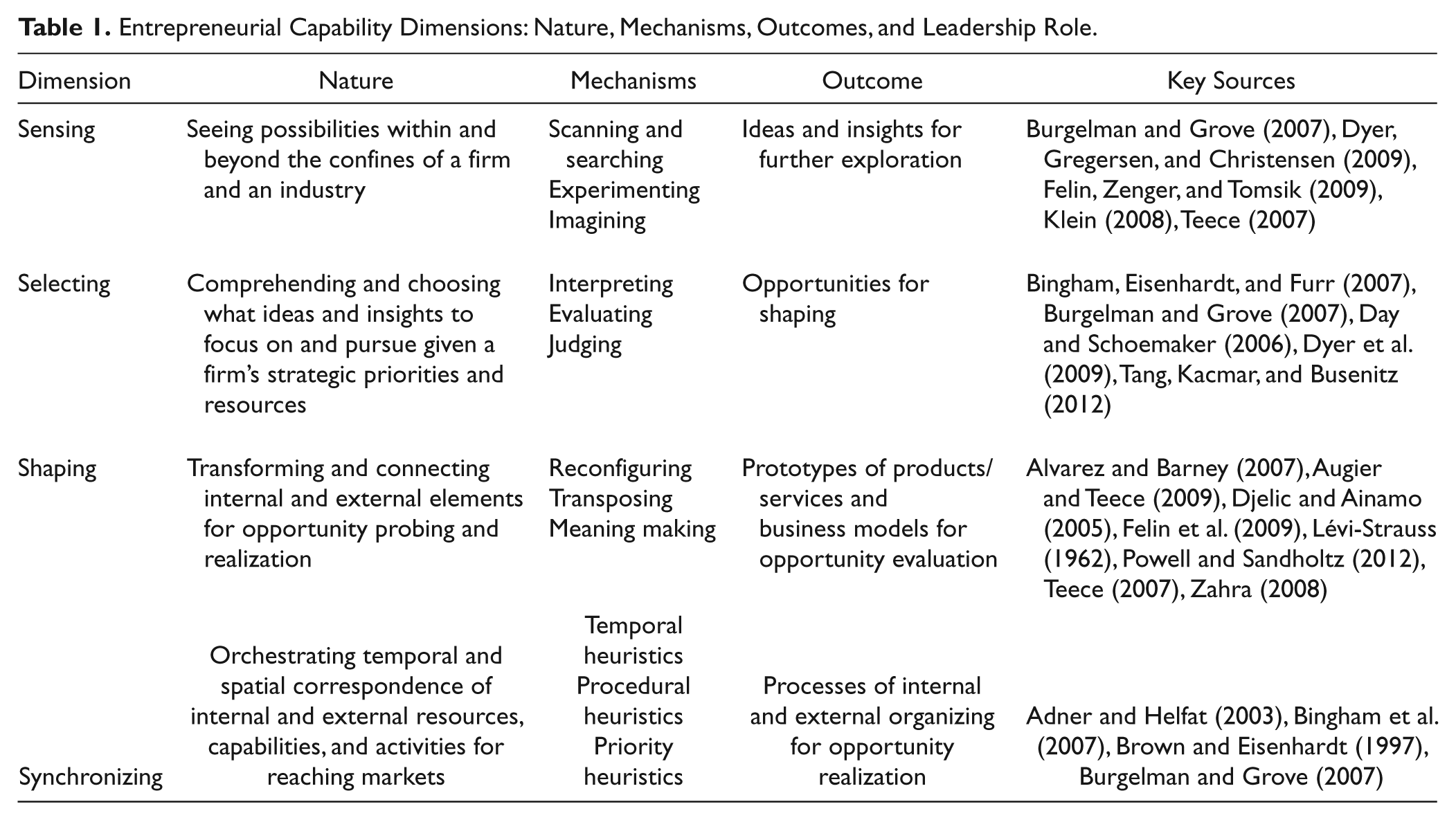
The sensing dimension of EC centers on seeing or envisioning market and technological opportunities, within as well as beyond the confines of an industry, as in the case of cross-boundary disruptors (Burgelman & Grove, 2007; Felin, Zenger, & Tomsik, 2009; Teece, 2007). As Table 1 indicates, key mechanisms for the sensing dimension of EC include alert scanning and searching (March & Simon, 1958; Tang, Kacmar, & Busenitz, 2012), experimenting (Dyer, Gregersen, & Christensen, 2009), and imagining (Felin et al., 2009; Klein, 2008).
Sensing ideas and insights that may become profitable opportunities can originate both from individuals within an organization such as middle managers or employees as well as from a company’s dedicated collectivities such as its R&D function or unit (Teece, 2007). It can also originate outside, through suppliers, customers, or other members of the company’s network. Users are also a frequent source of new opportunities’ identification (Shah & Tripsas, 2007). Sensing requires avoiding “vigilance gaps” by developing a strong peripheral vision that is sensitive to distant, weak, and unclear signals. To develop this capability, the attitude of leadership toward the periphery is essential as is its role for fostering of curiosity and sharing of insights.
Whereas sensing can be heightened by gaining access to new knowledge and exposure to contradictory information, it can be hampered by selective learning. Leaders adept at promoting sensing of opportunities are usually alert to contradictory information, viewing it as a potential signal of new, hitherto unanticipated sources of new directions. Contradictory information can stretch the mind-set and imagination of the firm’s managers, encouraging them to look into formerly unattended or even controversial scenarios. This contradictory information often causes discomfort and dissonance for senior leaders. To counteract this, firms with well-embedded EC often encourage individuals to question the collective wisdom of their company’s dominant mind-set. Strong leaders realize that the sensing dimension of EC is strongest when it contains elements that allow or create processes that require the collision of new possibilities with established “taken-for-granted” views and practices (Burgelman, 1991; Phan et al., 2009). Although this collision can be paralyzing, senior leaders can safeguard against this risk by establishing milestones, criteria, and timetables. They can also define the situation, providing meaning and assigning accountability.
Selecting, a second EC dimension, denotes the firm’s ability to comprehend and choose what ideas and insights have the potential to become viable opportunities. Effective EC involves openness to new ideas, and the willingness to forego some possibilities. Selecting is most directly linked to senior leaders’ thinking and decision-making processes. The selection capability can flourish within a firm through internal competition or could be left to market forces (Birkinshaw, 2001; Burgelman, 1994). Selection demands the evaluation of competing strategic proposals to decide which are of interest and provide senior executives with scenarios for further action (Burgelman, 1983). Regardless of the approach taken, there is a need to consider as many ideas for innovation as possible, then subject them to rigorous analysis and evaluation (O’Connor & Rice, 2001; Phan et al., 2009) or prototype and test them.
Shaping, the third dimension of EC, refers to transforming and connecting internal and external elements to allow for opportunity probing and realization. As Table 1 shows, key mechanisms for shaping an opportunity are reconfiguring, transposing, and meaning making. Reconfiguring is a mechanism through which familiar elements are combined in new ways. Transposing refers to creating an opportunity by taking the underlying logic or practices and/or elements from a more distant domain and bringing them in into another (Powell & Sandholtz, 2012) such as importing principles and practices from fashion into the field of mobile telephony (Djelic & Ainamo, 2005). Both reconfiguring and transposing involve some degree of bricolaging where internally and externally available resources and capabilities at hand are mobilized regardless of their original purpose (Baker & Nelson, 2005; Lévi-Strauss, 1962). Finally, meaning making involves reasoning and justification in which managers and entrepreneurs become proponents of new courses of action (Felin et al., 2009). Meaning making is an essential capacity of successful leaders (Podolny, Khurana, & Besharov, 2010), which allows them to connect new opportunities with the larger purpose of the organization and its strategy. These different mechanisms highlight the critical importance of leaders in the organization, especially senior managers. Shaping requires a vision that uplifts the conversation in a company to a level where the concept of the organization is refined or crafted anew.
Finally, synchronizing means temporally and spatially orchestrating the correspondence among internal and external elements of EC. Internal alignment involves simultaneous exploration and exploitation of opportunities. External alignment is about harmonizing a firm’s actions with the speed of the environment and the opening and closing of the windows of opportunity. Furthermore, this may also require a dynamic reconfiguration of organizational talent (Prahalad & Krishnan, 2008). For example, executive teams’ fast decision making is essential for succeeding in high-velocity environments (Eisenhardt, 1989). In these environments, synchronizing involves both understanding the speed of the different elements requiring alignment as well as the integration and actions to harmonize their “arrival.” Although capabilities themselves may be enduring, the co-occurrence of conditions in optimally matched states may be highly transient. Thus, one of the keys to actual game changing may be synchronizing the skills of the focal individuals or groups in the firm with those outside.
As Table 1 shows, synchronizing operates through three mechanisms. The first is using temporal heuristics that specify sequence, pace, and timing. The second is procedural heuristics that articulate process or actions for opportunity execution. The third is applying priority heuristics that articulate the ranking of opportunities in terms of their importance for the firm (Bingham et al., 2007).
To summarize, as we suggest in Table 1, each dimension of EC provides senior leaders with unique, though interconnected, information (e.g., ideas to explore, opportunities to pursue, prototypes to evaluate, and alignment processes to fine tune) that is useful in conceiving, selecting, evaluating, and co-aligning opportunities. This process is generated and sustained both by the firm’s human capital which is embedded in individuals and collective skills, talents, feelings, attitudes, and judgments as well as the organizational systems and practices. The four dimensions we have outlined in Table 1, therefore, transcend individual contributions. Instead, they form important organizational-level activities and skills. In fact, these dimensions may not occur sequentially or in strict order because the dimensions of EC both coexist and affect one another in a variety of patterns that are difficult to predict in advance. This unpredictability makes game-changing strategy harder for competitors to anticipate, as discussed in the text.
Entrepreneurial Capability Integration and Game-Changing Strategies
Game-changing analogies have proliferated the strategy and entrepreneurship literatures, as revealed by the plethora of titles that use them (see, e.g., Gray, Brown, & Macanufo, 2010; Lafley & Charan, 2008; Markides, 2008; Osterwalder & Pigneur, 2009). Authors have used the metaphor of a “game” as a gainful activity that involves rivalry and strategy (“Game,” n.d.). The objective is to identify ways of improving the odds and outsmarting other players in pursuit of profit and growth. In explaining the logic of these competitive games, authors have focused on established and newly created markets as the “playing field” but have rarely considered the broader context of economic activity that occurs within them (Dacin, Ventresca, & Beal, 1999).
We believe that there are two main mechanisms that contribute to a firm’s initiating steps for game-changing strategies: the integration of EC dimensions (Table 1) and their organizational embeddedness. Below, we discuss these mechanisms in relation to the processes of novelty generation, transformation, and opportunity realization, all of which can spark radical strategic change.
Integration of Entrepreneurial Capability Dimensions and Game Change
Generally speaking, all higher order organizational capabilities aim to create or secure the long-term viability and welfare of the firm’s business. Thus, the central mission of EC is to sense, shape, select, and synchronize activities (internal and external to the firm) in order to realize opportunities that enhance the viability and welfare of the firm. The outcomes of developing and exercising EC are far from predicable. Therefore, in the figures that follow, we present three different but realistic paths of such potential outcomes. As Figure 1 depicts, the direct object of EC (Box 1) is to enact an opportunity realization process (Box 2) which, in turn, enhances the ongoing performance of the firm (Box 3). The performance implications of these efforts will reinforce or alter EC (Box 1). Opportunity realization means the proactive pursuit of those opportunities selected through senior leaders’ judicious deployment of organizational resources, skills, and capabilities.

Entrepreneurial capability, opportunity realization, and performance primary path.
Sometimes, as shown in Figure 2, EC (Box 1) leads directly to radical innovations that are manifested in the opportunity pursuit process (Box 2), which influences a firm’s performance (Box 3). In this context, EC may have some moderate effects on the way others connected to them “play the game” (Box 5). At the same time, performance effects of radical changes are rather unpredictable (Box 3). If the performance effects are negligible or negative, we cannot always expect much impact on the behavior of competitors, suppliers, customers, or other companies. However, if the desired positive effects are unusually strong, we can expect game-changing strategies to emanate from two sources. First, the positive feedback on the focal firm will enhance its determination to change the game in a manner that reflects and leverages the innovations in its opportunity realization process to change the game (Box 5). Second, such strong performance will draw the attention and response of other players and companies’ leaders to either imitate or otherwise leverage the radical innovations for themselves (Box 4). These efforts center on copying or leveraging the focal firm’s efforts, further accelerating changes occurring in the way the competitive game is being played (Box 5). Finally, not only will the performance of the focal firm alter its EC but the changing game will also drive changes in its EC (Box 1)—eventually restarting and altering the entire cycle.
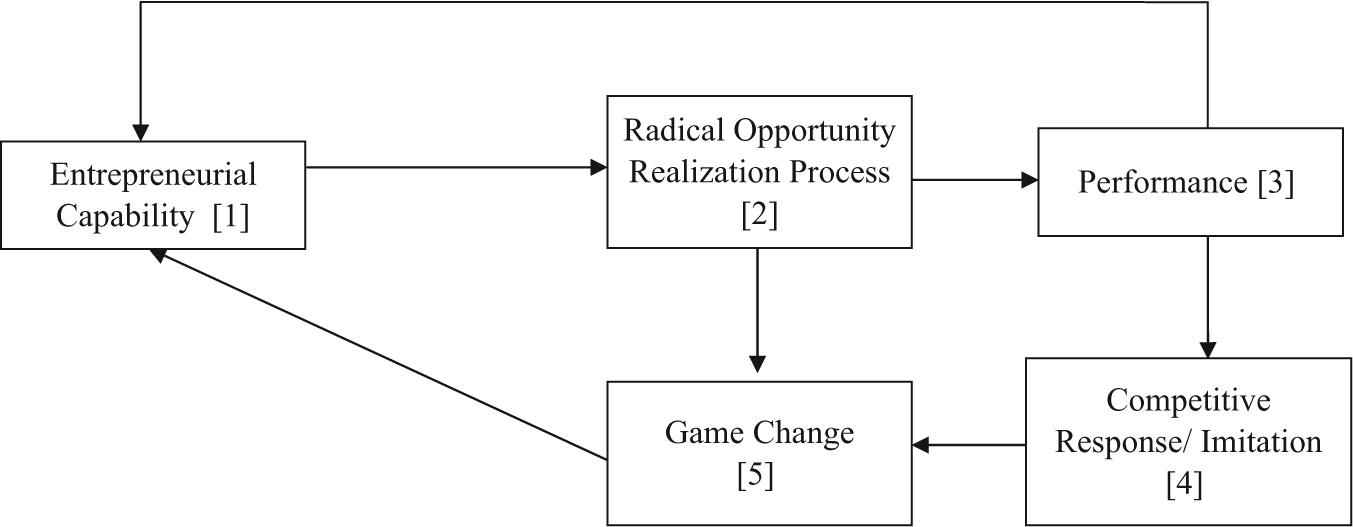
Entrepreneurial capability, radical opportunity realization, and unintended game change.
The game change processes depicted in Figure 2 are a by-product of the focal firm’s efforts to realize opportunities. The firm’s intention may not be to alter the game at all, but rather to take advantage of an existing weakness, which it hopes others will not copy or will be unable to copy effectively. As noted, the greater the focal firm’s success with its innovations, the greater the likelihood that the game will be changed as others hasten to keep up and learn. It is possible, too, that the game is altered in ways that undermine the long-run stability and competence of the focal firm despite the early successes it might achieve. Failures can also inform other players in ways that change the competitive game.
Our discussion indicates that unintended game change is most likely to evolve out of radical changes that meet with significant success. Success encourages these firms’ leaders to persist, repeat, and refine their efforts. They will also likely redouble their efforts to encourage external firms to cooperate with them and make changes that more fully leverage what they are doing. Success also encourages both competitive responses and imitation that quicken game change. At this point, a self-reinforcing pattern is embedded in multiple actors in the field (e.g., companies’ senior leaders) as they adjust their own processes and capabilities to meet the emerging new game.
Figure 3 depicts another, but less common, way in which game change emerges. Here, the focal firm proactively attempts to change the game as a precondition for realizing an opportunity that it has envisioned. In this process, the firm’s leadership might have concluded that a promising opportunity can be brought into existence only if the way the game is played is altered first. For example, a regulatory or financial barrier may have to be removed if the firm’s innovation is to succeed. For the most part, unless firms are “missionary”-type organizations, business firms will not seek to change the competitive game for the sake of change. Changing the game means synchronizing or creating those conditions that allow the firm to realize an opportunity.

Game change as an intended instrument of the opportunity realization process.
This path (depicted in Figure 3) begins in a manner very different from the ordinary process shown earlier in Figures 1 and 2. Here, a firm takes actions to change aspects of the competitive game (Box 2). If this action is met with success, the alteration of the game allows the focal firm to engage its intended opportunity realization process (Box 3). This new realization process, then, affects the performance of the firm (Box 4). Furthermore, because the competitive game has been altered in some small way, other firms in the industry may also be affected (Box 5). Again, if the results are positive, others will imitate or respond (Box 4) and this will further encourage game-changing moves (Box 2). These changes and performance itself will feed back into the firm’s EC (dotted lines in Figure 3).
We believe that this latter, intentional process is probably less common because inertial forces constrain what firms can do and what they believe they can do. All else being equal, however, we would expect that firms with very strong EC are more apt to attempt to alter the fabric of an entire ecology. Given the number of forces at play and the unpredictability of even the near future in dynamic environments, we doubt that firms can reliably and predictably “control” the consequences of such efforts. Rather, we suspect that those that use this aspect of game changing do so through collective action that enables them to take small, “affordable” risks. Although we cannot deny that some firms have honed their judgment and knowledge to high levels of expertise, constrained experimentation and trial-and-error learning rather than percipience is a likely explanation.
The individual dimensions of EC (Table 1) may matter little if they are not interwoven and coordinated with one another to create momentum in a company’s pursuit of a chosen opportunity. Sensing the environment may be exciting and informative. Yet unless linked to selecting, shaping, and synchronizing, sensing becomes little more than an academic exercise and the firm will fail to realize competitive advantage. The emergence and evolution of EC depends on honing and coordinating organization-level capabilities. This is why active integration by managers of the various EC dimensions is crucial. This integration confers potency on the various dimensions of EC, a value that goes well beyond the contribution of each individual dimension. Our discussion suggests the following propositions: Proposition 1a: Individual dimensions of EC are weakly but positively related to opportunity realization. Proposition 1b: Integration moderates the positive relationship between the individual dimensions of EC and opportunity realization such that in the presence of integration, the positive relationship between EC and opportunity realization will be stronger.
The integration of EC dimensions also allows for continuous novelty generation within a company’s operations. Novelty refers to actions that fall typically outside an organization’s existing strategic repertoire. Novelty is conducive to firms’ long-run viability as contexts and competitive requirements change. However, there is no reliable way to accurately predict which of them will succeed (March, 2010). Hence, persisting in the pursuing novelty and game change requires a strong organizational culture that tolerates failure and provides the slack resources needed to endure its effects. For instance, Pixar offers its employees “opportunities to fail together and to recover from mistakes together” (Taylor & LaBarre, 2006). If failure is an outcome of pursuing novelty in the organization, senior leadership also needs to handle the cases of losers whose technologies, products, or business models do not get adopted. With careful management, failure could be demotivating for both managers and employees (Birkinshaw, 2001).
To ensure novelty generation, the various dimensions of a firm’s EC need to operate at the intersection of creation and destruction. As some research suggests, this is difficult for incumbents who usually fail to pursue novel paths and are phased out, though sometimes they persist and even displace intruders (Tripsas, 1997). Because new entrants are less restricted by dominant standards or taken-for-granted rules (Autio, Sapienza, & Almeida, 2000), game-changing strategies are often championed by newcomers, who are willing to cross industry boundaries to initiate something new (Burgelman & Grove, 2007). Some newcomers bring into the industry new mental and business models, and reframe industry dynamics and boundaries around these different mind-sets. Newcomers also make use of their ECs, which have been honed in other domains, to identify key points of entry and how best to build solid positions that give them market lead. This discussion suggests the following proposition: Proposition 2: Integrated EC is positively related to the creation of new opportunity realization paths, thereby increasing organizational novelty.
Novelty generation contributes to imagining the reshaping of the organization’s processes, systems, resources, and capabilities necessary to realize and address the envisioned external disruption. When focused externally, EC can be channeled toward envisaging changes in an industry’s architecture (Jacobides, Knudsen, & Augier, 2006) and the business ecosystem (Teece, 2009, p. 16). Industry architecture denotes the evolving relationships among value chain participants and determines how labor and surplus are divided among the types of players involved (Jacobides et al., 2006). This architecture facilitates those interactions that allow firms to identify opportunities for and constraints to radical transformation and change. Knowledge of this architecture is essential to identifying who does what (the roles) and to what norms (the rules). The business ecosystem usually incorporates architecture across multiple industries.
Attending to industry architecture and the business ecosystem (Moore, 1993; Teece, 2007) expands the firm’s playing field beyond the boundaries of its industry value chain. By interacting with various existing players in its ecosystem (e.g., customers and suppliers) and proactively seeking new players (e.g., boundary disruptors), a firm can bring about ecosystem transformation. An example of this success is P&G’s “Connect and Develop” initiative, which has established more than 1,000 active agreements with partners in its ecosystem. These agreements have facilitated P&G’s opportunity realization by creating new markets and applications, developing technologies that build on convergence, and thus gain access to innovation. These benefits will be greater when the firm’s leadership has developed an integrated and coherent EC able to capture knowledge, resources, and ideas from diverse groups. This discussion suggests the following proposition: Proposition 3: Integrated EC is positively related to the transformation of a firm’s business ecosystem.
Entrepreneurial Capability Integration and Game-Changing Strategies
When a firm’s EC is embedded in and distributed across its different units, the company can more easily engage in game-changing strategies. Though a company can choose to centralize access to information to ensure unity and clarity of command and expedite information retrieval and processing, centralization has serious drawbacks for EC. It can deprive the organization of gaining access to the rich and often soft information that permeates intraorganizational networks and informal innovation hubs that grow naturally in the decentralized firm’s operations.
With dispersed EC, a firm can capture and synthesize information within and outside the organization. As EC becomes embedded in the firm’s operations, it becomes easier for its leaders to glean insights that enrich organizational intelligence and foster creativity. Members of the organization often have different views about the industry’s evolution, how the firm fits within the industry’s existing social structures, and where potential changes may occur. Organizational members also pay differential attention to diverse sources, leading to multiple (and oftentimes conflicting) views about how to “upset the applecart” by taking risks and pursuing innovations. Integrating, and learning from, different views can enhance EC.
A highly embedded EC allows challenging deeply ingrained and strong organizational mental models about how to exploit emerging opportunities, as they can hamper the generation and adoption of new ideas (Markides, 2008). It also permits bringing together different and even divergent interpretations that may serve as a basis for novelty. These interpretations frequently serve as the foundation for conceiving and developing new strategies that bring fundamental changes in perceptions and views of the competitive arena and consider how to shape this arena in ways that create a competitive advantage. These observations suggest the following propositions: Proposition 4a: The higher the organizational embeddedness of EC, the greater the novelty a firm will generate internally. Proposition 4b: The higher the organizational embeddedness of EC, the more likely the firm will initiate game-changing strategies.
EC embeddedness also facilitates and expedites data collection, analysis, interpretation, and absorption. It also spurs the rapid development of new ideas or knowledge. When the firm has systems that effect speedy information processing and which are open to regeneration of ideas, it is less susceptible to “paralysis by analysis,” where managers become captive of competing interpretations that they cannot resolve (Zajac & Bazerman, 1991). Resolving complexity in a coherent manner becomes a major challenge for senior executives when the EC is highly diffused throughout the organization, and different groups of people hold divergent visions of things to come. To ensure rapid adaptation, executives need to develop their company’s EC in a way that quickly considers rival interpretations and attendant scenarios; they may integrate these views or simply select one path to pursue. Forming a habit of quickly choosing a resolution path allows senior managers to move ahead of their rivals and reshape the competitive game. Time itself may thus become an important means of creating successful game change. These observations suggest the following proposition: Proposition 5a: The higher the organizational embededdness of EC, the faster the firm will engage in game-changing strategies.
A highly embedded EC results in speedy action in recognizing and pursuing opportunities. It can also increase the radicalness of game change strategies that the firm could undertake. EC brings to focus multiple, divergent, and often radical views of the competitive arenas, their context, and the agenda of different players. This allows senior leaders to theorize about the radical changes they might wish to initiate to “shuffle the cards” and introduce a new regime in the industry. Leaders can also visualize a new landscape where they can capitalize on their firm’s resources, skills, and capabilities as they redefine the core competencies essential to success in the new arena. By changing a few of the key industry taken-for-granted assumptions or fundamentals, a firm’s senior leaders can dramatically alter the ecology of competition in profound ways. Clearly, changing the ecology of the game is harder and riskier than simply upgrading products, changing pricing policies, or joining alliances. A well-honed and organizationally embedded EC makes it possible to recognize the potential for radical change, even when signals of pending transitions are weak. These observations suggest the following proposition: Proposition 5b: The higher the organizational embeddedness of EC, the more likely the firm will engage in radical game-changing strategies.
Game-changing strategies also differ in pattern, magnitude, and pace. They unfold through sudden, sweeping disruptions or through minute alterations that build up momentum over time to amount to a radical transformation. Whether EC paves the way to game-changing strategies and of what nature and magnitude can only be determined ex post. These strategies can initially involve a disruption by creating and introducing into the market a revolutionary new product or a novel way of doing things that goes against the prevailing industry’s dominant model or logic. This type of disruption opens up a new space of possibilities in the taken-for-granted industry architecture. If these efforts are deepened, industry disruption can grow into transformation whereby some important aspects of the playing field and the system of roles, rules, and relationships among players are preserved, whereas others are simply altered. Transformation occurs as a result of the opportunities emerging after a new competitive game is introduced through experimentation by players, both established and new.
Game-changing strategies also involve the creation of a new game by envisioning and realizing a new playing field and related system of roles, rules, and relationships. This, however, requires both “meaning making” (Table 1) and mobilization of collective action across a range of stakeholders, within and outside the industry, as well as lobbying efforts at the institutional level to legitimize the new game (Aldrich & Fiol, 1994). It also demands careful sequencing and timing of orchestration and negotiation activities so that a new industry architecture and business ecosystem can come into being (Jacobides et al., 2006; Teece, 2007).
Entrepreneurial Capability Integration and Game-Changing Strategies
Finally, for EC to maintain and strengthen its game-changing potential, it should be kept current through constant renewal. As we indicate in Figures 1 to 3, such renewal can occur in three main ways: by continuous incorporation of up-to-date knowledge from the environment (mostly via the sensing dimension of EC), through the feedback obtained in the opportunity realization process, and from how the game-changing process itself unfolds.
EC coevolves with the environment (Lewin & Volberda, 1999; Volberda & Lewin, 2003). Similar to other capabilities, EC can be honed through experience and reflection (Bingham et al., 2007). This allows senior leaders to reconceptualize their environments, identifying emerging changes and corresponding opportunities. EC is a constellation of dimensions or subcapabilities that might change over time, in relationship to the dynamics of the ecosystems and opportunities being explored or used. For example, the ecosystem in which a competitive game is embedded provides clues about the appropriate tipping point where fit with the prevailing game should be abandoned and action toward a transformed or new, more vibrant ecosystem should be initiated.
The dynamism of EC makes it especially invaluable in defining the genesis of variety that breeds novelty and sparks entrepreneurial action. Thus, EC promotes the continuous pursuit of novelty in the presence of constraining forces that pull a firm toward exploitation (March, 1991). The heterogeneous knowledge introduced into the firm on an ongoing basis, the diverse perspectives and insights of managers and employees at all levels, their differential access to different types of knowledge, and their different ways of organizing and processing this knowledge induce variety which can be harvested in the form of novelty. Capturing, comprehending, absorbing, and exploiting these diverse types of knowledge is a daunting challenge (Adner & Helfat, 2003; O’Reilly & Tushman, 2008). As such, EC can become a powerful organizational engine that uses this knowledge in the recognition, definition, refinement, and evaluation of opportunities as well as their realization. Perpetuating novelty requires the creation of a strong organizational culture that tolerates failure and can sustain its energy for simultaneous exploration and exploitation.
Discussion: Senior Leadership and Entrepreneurial Capability for Game Change
As we have argued throughout this article, game-changing strategies introduce new competitive dynamics into an industry or a business ecosystem. While the characteristics and skills of senior leaders shape a company’s strategic choices (Finkelstein, Hambrick, & Cannella, 2009), they are more likely to influence game-changing strategies that reconceptualize the competitive arena anew. As such, EC becomes an important means by which senior leaders exploit the collective intelligence, abilities, and skills of other managers and employees throughout their organization. Therefore, in this article we have defined EC and discussed its dimensions. We also highlighted ways in which it could change the competitive arena and rules of competition, and sequence of competitive moves. This discussion places senior leaders at the heart of the entrepreneurial processes that underlie the creation, maintenance, and renewal of EC. The discussion also underscores senior leaders’ role in connecting entrepreneurial activities with a firm’s strategic choices, especially those focused on game change. In this depiction, entrepreneurship gives birth to competitive strategies (especially game-changing strategies) which, in turn, ignite entrepreneurial activities.
For years, entrepreneurship researchers have argued that prior knowledge and alertness are key antecedents of opportunity recognition. In this mode of discovery, the recognition of opportunities is tantamount to the firm’s leaders connecting the dots (Baron, 2006). Although insightful, some believe that this focus has overlooked “creation” types of opportunities (Alvarez & Barney, 2007). Others have suggested that discovery and creation form an ongoing cycle, with each stimulating the other (Zahra, 2008). Though such depictions of opportunity recognition and discovery/creation are useful, their power is limited when companies find themselves in the throes of fundamental changes in their competitive landscapes. Some firms respond by becoming more rigid, others spring into action unleashing a myriad efforts that end up more or less perpetuating the status quo. Yet some firms engage in entrepreneurial initiatives as they foresee opportunities to shape their industries and change the competitive game, making effective use of their EC.
Managerial Implications
Our discussion underscores that having a well-honed organizational EC per se is not sufficient to effect radical strategic change. Senior managers’ vision, commitment to action, ability to articulate when and where to focus search for opportunities, and social skills are needed to build momentum for entrepreneurship and change. Managing the different dimension of EC requires different leadership skills that allow opportunity exploration that fosters exploitation.
Our definition of EC and our delineation of its mechanisms for sparking game change suggest a shift in perspective in research. First, the locus of entrepreneurial activity is not solely the individual manager but lies in the interplay between individual insights and collective intelligence. Those companies intent on game change, therefore, need to develop their intellectual capital in ways that develop, integrate, and harvest that intelligence. Our approach shifts focus from the ongoing debate of discovery versus creation, to considering their interaction. As we have noted, opportunity realization requires cognizance and recognition of the dynamic interplay between discovery and creation. An EC-centered approach also causes a shift in the conception of opportunity exploitation itself. We have expanded the view of balancing dynamic and operational capabilities to include attention to building and sustaining ECs. Hence, beyond being a distinctive type of dynamic capability, EC offers a means to revisit existing views on the nature of entrepreneurial opportunities.
By focusing on EC and its dimensions, we highlight a need to go beyond individual-centered explanations of a company’s entrepreneurial activities. EC offers an important means of defining (or creating) these opportunities, calling for collective intelligence rather than individual insight or foresight. Given these qualities, senior leaders should focus on creating, nurturing, and sustaining EC rather than simply motivating particular individuals to innovate. Leaderscan also attend to the synchronization of EC’s various elements across units and organizational levels. Synchronizing is a demanding task because different elements move at different paces and their misalignment could result in missed opportunities or miscalculations about the viability of these opportunities or the skills needed to harvest them.
Perhaps, the greatest contribution of the process of engaging EC is stretching the firm’s leaders and managers’ thinking and frames. This can free leaders to consider “far-off” scenarios that are initially hard to justify or even to comprehend. EC requires managers to stretch beyond their familiar “search zone” (March & Simon, 1958) to explore distant signals of pending change (Zahra, 2008). For instance, senior leaders can explore scenarios that predict their own company’s demise, the convergence of distant and unrelated technologies and scientific paradigms, the occurrence of “black swan” events, politically radical global shifts, and many other possibilities. Such “blue sky” exercises are familiar in traditional strategy models. However, when they are firmly embedded in the fabric of the company, they can have a profound educational role: they revise leaders’ and managers’ notions of what their industry (and company) is all about. The result is not only to upset the applecart but to grow new apples and get them to new markets in new carts.
Research Implications
We have highlighted EC as a new category of dynamic capability, operating at the intersection of leaders’ mind-sets and actions. EC enables companies to anticipate game change, and, when feasible and necessary, induce it. Our discussion extends the capability approach to the study of entrepreneurship by offering insights into the content of dynamic capabilities, distinguishing a new category, and articulating a set of dimensions that allows a firm to engage and influence external change. Though the entrepreneurial aspect of dynamic capabilities has been acknowledged (Teece, 2007), to our knowledge this is the first attempt to distinguish EC as a distinctive capability.
We also advance the capability-based view of the firm by articulating a larger theatre of operations, beyond the boundaries of the internal organization of a firm (e.g., resources, processes, routines, and assets) to the competitive game. We emphasize the importance of the business ecosystem and how a firm can proactively transform it through entrepreneurial activities focused on industry game change. Thus, we add to the literature on entrepreneurial opportunities by suggesting how EC can contribute to the coevolution of opportunity exploration and exploitation. Thus, we enrich the discussion on industry emergence and evolution by highlighting the firm’s role in initiating game-changing strategies. This role should be empirically documented in future research.
Another area to explore is the configuration of different ECs. Given the multiple elements that constitute EC, different and multiple types of capabilities might exist that differ across opportunities, across firms, and even within firms. By developing taxonomies of these configurations, it would be possible to study these types as well as how and when they change in their texture. We can then link these shifts to corresponding changes in the opportunities recognized and realized.
The literature also underscores the importance of using the firm’s capabilities to keep them current and productive (Zollo & Winter, 2002). Yet the literature weighs the benefits of frequent use of these capabilities against the costs involved. Being a portfolio of capabilities that is focused on opportunity identification, creation, and exploitation suggests that EC is continuously deployed in different forms and on different arenas. The heterogeneity of these opportunities and the contexts create avenues for learning that keeps ECs current and up-to-date. A question to explore is: How is this variety harnessed to maintain ECs’ vitality while avoiding dilution or decay? This is an important question for future research to tackle.
Having outlined our article’s contributions, we believe that it has several limitations that provide opportunities for further research. First, as it is a theoretical article, the validity of our ideas needs to be empirically tested. For example, we need an empirical exploration of the generalizability of the EC dimensions across a variety of contexts. Once validated empirically and connected to each other, we can use these dimensions to classify different capabilities and connect them to the different opportunities companies might pursue. We can also trace longitudinally the coevolution of capabilities and corresponding opportunities, which in turn also highlights the importance of multilevel research design.
By marrying EC and game-changing behaviors, we hope to minimize a bias that pervades existing research. It is usually assumed that proactiveness and risk taking are essential for market success, even though there is some limited evidence to the contrary (Lumpkin & Dess, 2001). Of course, proactiveness, risk taking, and innovativeness are highly desirable attributes but it is possible to have “too much of a good thing.” It is possible that continually honing an EC might have some dysfunctional effects that should be explored empirically. The conditions under which such dysfunctional effects occur also deserve investigation. For instance, by examining the innovative and financial performance of firms, we can better appreciate the implications of EC for evolutionary and technical fitness (Teece, 2007) and when (and how) ECs become an impediment to change.
Conclusion
In this article, we have advanced the concept of EC as a means of sensing, selecting, shaping, and synchronizing internal and external conditions for the exploration and exploitation of opportunities. We have also proposed that each of these dimensions consists of several subcapabilities and has multiple dimensions. We have highlighted the importance of EC in, unintentionally and intentionally, changing the competitive game through entrepreneurial activities. Our discussion invites future empirical examinations of how some companies change the game and, by doing so, change the world. Future research should give special attention to the entrepreneurial dimension of senior leadership and how it brings about fundamental changes in the complexion, scope, and duration of game-changing strategies that redefine industries and business ecosystems.
Footnotes
Acknowledgements
We are grateful for the support of the Robert E. Buuck and the Curtis L. Carlson Chairs of Entrepreneurship at the University of Minnesota and the Chair of International Entrepreneurship at University of Twente, the Netherlands. We thank Mike Wright, Lance Newey, and Patricia H. Zahra for their many useful suggestions.
Authors’ Note
Parts of this article were presented at the Academy of Management and Annual Conference of the Academy of Entrepreneurship and Innovation held at Tsinghua University, Beijing, China.
Declaration of Conflicting Interests
The authors declared no potential conflicts of interest with respect to the research, authorship, and/or publication of this article.
Funding
The authors received no financial support for the research, authorship, and/or publication of this article.