




Abstract
This study examines whether subordinates’ perceptions of abusive supervision mediate the relationship between subordinate personality and aggression. Results from a cross-organizational sample of 411 working adults suggest that subordinates’ perceptions of abusive supervision account for some of the variance in the relationships between subordinate Agreeableness, Emotional Stability, Extraversion, and subordinate aggression. This study suggests that social-information processing and perceptions of control found within subordinates’ personality influences whether they are more or less likely to perceive supervisory abuse. Perceptions of supervisory abuse were associated with aggression.
Although workplace aggression has received a good deal of research attention, further research is needed to explore the complex effects of personality on workplace aggression (Spector, 2011). Many aggression models conceptualize employee behavior as an interplay between employee personality and organizational context (e.g., Colbert, Mount, Harter, Witt, & Barrick, 2004). Although research suggests a direct relationship between employee personality and aggression (e.g., Berry, Ones, & Sackett, 2007), research is still needed to explore which factors contribute to this relationship and how these factors influence it.
This article explores whether or not subordinates’ perceptions of abusive supervision mediate the relationship between personality and aggression (see Figure 1). Using Lewin’s (1948) personality perspective and reactance theory (Brehm & Brehm, 1981), we propose that the social-information processing and perceived control associated with employees’ personalities will influence who will perceive their supervisor as abusive, and, in turn, affect who may strive to regain control over their work environment by reacting with aggression.
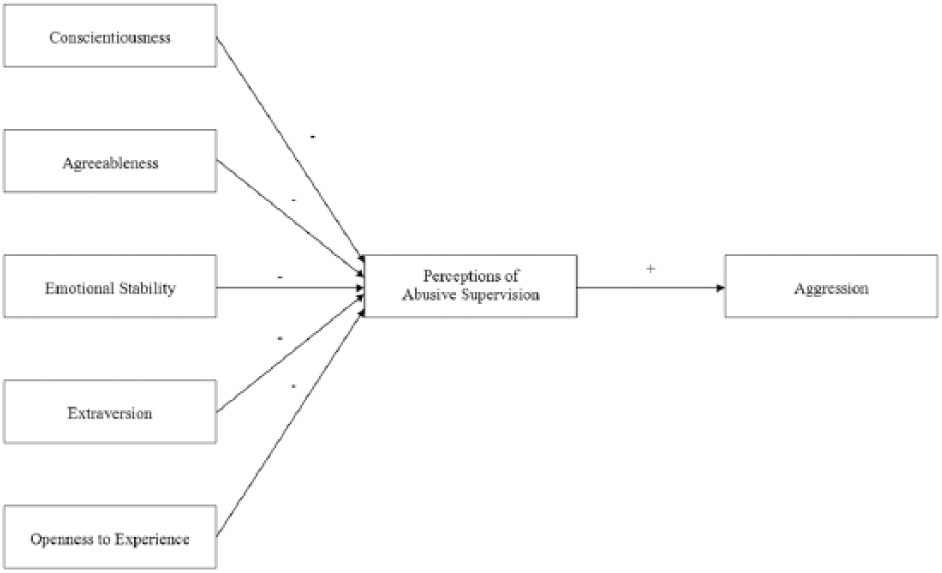
Hypothesized model.
This study makes two theoretical contributions. First, our findings suggest that the social processing and perceptions of control found within employees’ personality influence whether or not they are likely to aggress in the workplace. Therefore, this study lends support for the proposition that social perception may be a key factor linking personality and aggression (Bettencourt, Talley, Benjamin, & Valentine, 2006). Second, this study extends abusive supervision research by showing that subordinates’ individual differences (personality) are associated with their perceptions of abusive supervision.
Theoretical Foundations
Aggression
Organizational aggression is defined as acts by employees to harm others with whom they work or the employing organization (Douglas & Martinko, 2001). Aggression may include stealing, spreading rumors, refusing to provide needed resources, and vandalism and often leads to negative outcomes for the targets of aggression (Barling, Dupré, & Kelloway, 2009). Examples include decreased levels of job performance, job satisfaction, and mental health (Budd, Arvey, & Lawless, 1996), and increased job stress (Budd et al., 1996) and emotional exhaustion (Goldberg & Grandey, 2007).
Prior research suggests that aggression is a complex response due to an interaction of personality and context. Researchers argue that individuals subjectively perceive and appraise their environment and then choose a behavioral response (Spector, 2011). Reactance theory (Brehm & Brehm, 1981) states that people strive to maintain control over their environment and may react when their behavior is restricted. This theory describes behavioral reactance as a three-step process. First, a person perceives unfair control or restriction of personal actions. Second, a state of personal reactance is activated. Third, a person reacts to either remove or balance that perceived restriction. We suggest that subordinates’ personalities may affect not only how and to what extent they may strive to maintain control over their environment, but how they may perceive and respond to sources of authority that frustrate and threaten to reduce their control (Gilbert, 1995).
The Relationship Between Personality and Aggression
Personality is the human tendency to think, feel, and act in consistent ways. Researchers have reported that as much as 25% of the variance in aggression is due to personality (Dill, Anderson, & Deuser, 1997). The five-factor model (McCrae & Costa, 1999) serves as the foundation of personality theory and includes Conscientiousness, Agreeableness, Emotional Stability, Extraversion, and Openness to Experience. Aggression researchers have speculated that employee social-information processing and perceptions of control are key personality mechanisms that can influence people to enact aggressive responses (Bettencourt et al., 2006; Spector, 2011). We will test this perspective and assert that personality alters how people perceive situations and also how they respond.
Lewin’s (1935, 1948) process-oriented perspective of personality explores the role of human personality on social perception. This framework states that humans cognitively construct their environment in alignment with personal goals and motives. Personality allows individuals to perceive, organize, and label their environments into meaningful packages that facilitate action (Graziano, Jensen-Campbell, & Hair, 1996). In other words, personality molds social perception and the ascribed meaning from interpersonal work interactions. Lewin’s personality framework mirrors the person–situation framework proposed by many aggression researchers (e.g., Spector, 2011). Therefore, we argue that the goals and motives found within subordinates’ personality creates meaning for their interactions with their supervisors (i.e., perceptions of abusive supervision) and also influences how they perceive control and respond to sources of frustration that threaten to or actually reduce their control (i.e., aggress). Individuals who aggress generally process social information when setting response goals to social stimuli (Dodge & Coie, 1987).
Mediating Affects of Perceived Abusive Supervision
Abusive supervision is defined as “subordinates’ perceptions of the extent to which supervisors engage in the sustained display of hostile verbal and nonverbal behaviors, excluding physical contact” (Tepper, 2000, p. 178). Perceptions of abusive supervision are “subjective assessments” and “two subordinates could differ in their evaluations of the same supervisor’s behavior” (Tepper, 2000, p. 178). We believe that these evaluations are influenced by personality.
Recent studies illustrate that subordinates’ personality is associated with their perceptions of abusive supervision. More specifically, personality traits such as subordinates’ attribution styles (Brees, Martinko, & Harvey, 2012; Martinko, Sikora, & Harvey, 2012), core-self evaluations (Wu & Hu, 2009), openness personality (Wu & Hu, 2013), negative affectivity, self-efficacy, locus of control beliefs, trait anger, and entitlement beliefs (Brees et al., 2012) have all been linked to perceptions of abuse. These studies argue that subordinates process supervisor interactions in alignment with self-concept and reiterate that supervisor abuse is highly perceptual: shaped in part by subordinates’ personality (Tepper, 2000, 2007).
As we assert in the next section, subordinates who perceive abusive supervision may exhibit reactance behaviors such as aggression (Mitchell & Ambrose, 2007). We suggest that these subjective evaluations of supervisor behavior are perceived differently based on personality and may account for the relationship between personality and aggression and other reactance behaviors (e.g., Yang, Johnson, Zhang, Spector, & Xu, 2013). This study is the first to explore how the factors in the well-accepted Big Five personality theory relate to perceptions of abusive supervision and is one of few studies to view perceptions of abusive supervision as a mediator between individual differences and outcome variables.
Hypothesis Development
Personality Traits and Perceptions of Abusive Supervision
Conscientiousness
Conscientiousness is the tendency to be achievement-oriented, hardworking, dependable, purposeful, careful, and deliberate (Barrick & Mount, 1991) and can actively shape social perception. Conscientious employees perceive fewer workplace obstacles and view work situations more positively (Colbert et al., 2004), cope more productively with problem situations (Watson & Hubbard, 1996), and experience less work stress (Zellars, Perrewé, Hochwarter, & Anderson, 2006) than employees who are not conscientious. Conscientiousness is positively associated with employee job satisfaction (Judge, Heller, & Mount, 2002) and job satisfaction is negatively associated with perceptions of abusive supervision (Tepper, 2000, 2007). Thus, we expect that Conscientiousness will be negatively associated with perceptions of supervisory abuse.
There is evidence that Conscientiousness also shapes employee behavior. When highly conscientious individuals experience breaches of social exchange, they are less likely to react with aggression (Colbert et al., 2004), are less influenced by immediate negative experiences (Watson, Clark, & Harkness, 1994), and maintain healthier relationships with their supervisors (Raja, Johns, & Ntalianis, 2004), than individuals low in Conscientiousness. Highly conscientious employees generally exhibit less dysfunctional behavior after perceiving abusive supervision (Bamberger & Bacharach, 2006; Tepper, Duffy, & Shaw, 2001) than employees low in Conscientiousness.
Therefore, we expect that conscientious employees are less likely to perceive and process supervisor behavior as controlling or abusive because they experience less stress and perceive workplace events more positively than employees low in Conscientiousness. Reactance theory suggests that because conscientious employees are less likely to perceive supervisor abuse and mistreatment, they are less likely to respond with aggression in order to maintain control of their environment than employees low in Conscientiousness.
Agreeableness
Agreeableness refers to the tendency to be kind, gentle, trusting, considerate, forgiving, and tolerant, and has dramatic effects on interpersonal relationships because it influences social perception and appraisal (Graziano & Eisenberg, 1997). Agreeable individuals are motivated to maintain positive relations with others; this motive system induces positive perceptions and attributions to otherwise provocative or controlling behavior by others (Graziano et al., 1996). Agreeable individuals strive to get along with others through pursuing positive relationships (Organ & Lingl, 1995) and are more cooperative in difficult situations than less agreeable individuals (Mount, Barrick, & Stewart, 1998). Alternatively, less agreeable individuals are hostile and irritable, and exhibit a greater need to attack and punish others (Costa, McCrae, & Dembrowski, 1989) than highly agreeable individuals.
Agreeableness also appears to shape behavior. Agreeable individuals respond to conflict with less negative affect than less agreeable individuals (Graziano et al., 1996). Agreeableness influences affective responses and tactical choices during interpersonal conflicts (Jensen-Campbell, Gleason, Adams, & Malcolm, 2003), and decreases anger, hostility, and blaming (Meier & Robinson, 2004). Agreeable individuals are adept at controlling their anger and negative affect in the face of frustrating situations (Ahadi & Rothbart, 1994). Agreeable employees who report perceptions of abusive supervision exhibit less dysfunctional behavior than employees low in Agreeableness (Bamberger & Bacharach, 2006). Also, Agreeableness has been negatively associated with deviance (Hastings & O’Neill, 2009) and behavioral aggression (Ang et al., 2004).
Because agreeable employees exhibit a positive motive system, they will likely perceive interactions with supervisors more positively, experience less negative emotions and frustration, and less likely perceive supervisor behavior as abusive or controlling than less agreeable employees. Therefore, agreeable individuals will likely not perceive abuse and thus not react with aggression. Alternatively, disagreeable employees are hostile and are prone to attack others. Thus, disagreeable employees will more likely perceive supervisor behavior as abusive and will more likely respond with aggression than highly agreeable employees.
Emotional Stability
Neuroticism (reverse-scored Emotional Stability) refers to the tendency to exhibit poor emotional adjustment in the form of stress, anxiety, and depression (Costa & McCrae, 1985). Neurotic individuals perceive their environments and other peoples’ behavior more negatively, experience more adverse events (Headey & Wearing, 1989), identify more negative objective life events (Magnus, Diener, Fujita, & Pavot, 1993), and experience more psychological distress and stress (Ormel & Wohlfarth, 1991) than nonneurotics. Ironically, neurotics strive to avoid potential threats and punishments (Elliot & Thrash, 2002), which increases their desire to actively monitor their environment for potential threats.
Studies suggest that neurotics respond negatively to workplace events. Neuroticism results in frequent appraisals of interpersonal stressors, distress, and hostile reactions to those stressors (Gunthert, Cohen, & Armeli, 1999). Brown and Dutton (1995) argued that neurotic individuals naturally react with negative events and feelings when perceiving hostile behavior. Neuroticism also has been positively associated with hostility (Miller, Lynam, & Leukefeld, 2003) and aggressiveness (Sharpe & Desai, 2001).
Therefore, high neurotics (i.e., those low in Emotional Stability), compared with low neurotics, are more likely to perceive their supervisors’ behaviors as hostile and abusive. Because high neurotics are less able to control and regulate their emotion and behavior in frustrating situations, they are more likely to react with aggression in order to regain control than low neurotics.
Extraversion
Extraversion refers to the tendency to be sociable, dominant, active, and positive and influences how people perceive social interactions. Extraversion and positive affectivity, defined as the tendency to experience positive emotions across situations and time, have been used interchangeably (Perrewé & Spector, 2002). Extraversion predisposes individuals to experience events positively and experience positive affect across a variety of situations (Cunningham, 1998). Zellars and Perrewé (2001) argued that extraverted individuals tend to engage in interpersonal and social activities enabling them to develop greater social support and maintain optimism.
Extraversion also influences behavior. Research findings on the Extraversion and aggression relationship have been mixed. Early research found that Extraversion was positively associated with aggression (Edmunds, 1977) and later studies found that extraverts engage in antisocial behavior because they exhibit stronger sensation-seeking tendencies (Eysenck, 1996). Meta-analyses, however, have shown either a weak (Berry et al., 2007), negative, or insignificant relationship between Extraversion and aggression (Hastings & O’Neill, 2009). Researchers suggest Extraversion might interact with situational factors (Oh, Lee, Ashton, & de Vries, 2011), such as perceptions of abusive supervision, to influence behavior.
Therefore, because extroverts perceive workplace events and interpersonal relationships positively, we predict that they are not likely to perceive supervisor behavior as abusive, controlling, or hostile. Because extroverts are not likely to perceive supervisor abuse, they will not likely react and respond to these behaviors with aggression.
Openness to Experience
Openness to Experience (Openness) refers to the willingness to explore, tolerate, and consider new ideas, approaches, and experiences. Openness refers to “a fundamental way of approaching the world that affects not only internal experience but also interpersonal interactions and social behavior” (McCrae, 1996, p. 323). Openness heavily influences individuals’ cognitive, affective, and sensory systems (McCrae, 1993).
Closed individuals subscribe to structured hierarchical systems, advocate punishment for nonconformity (McCrae, 1996), and find it difficult to appreciate and adapt to other peoples’ perspectives (Gurtman, 1995). Based on the similarity/attraction perspective, closed individuals will likely experience a greater degree of frustration and conflict with others than open individuals due to differences in attitudes toward various topics (Williams & O’Reilly, 1998). As a result, closed individuals generally have more negative expectations and stereotypes of others than open individuals.
The relationship between Openness and deviant behavior is less clear. Open individuals are accepting of divergent attitudes and opinions between individuals (McCrae, 1996). Open individuals are also less likely to experience anger and frustration, which are positively associated with aggression (Douglas et al., 2008). Closed individuals exhibit a high need for cognitive closure (Kruglanski, 1996), which may increase their propensity to aggress when experiencing anger-provoking events (Douglas et al., 2008).
Therefore, we expect that closed individuals are more likely to experience disagreements and conflict with their supervisors and more likely to perceive supervisory behavior as abusive than open individuals. Because closed individuals perceive more abuse than open individuals, they will more likely react with aggression due to heightened feelings of frustration and anger.
Method
Sample and Procedure
A cross-organizational sample of 411 working adults completed an online survey (62% response rate). The average age of the subjects was 44.1 years old (SD = 12.9) and ranged from 19 to 76 years. Subjects’ average company tenure was 6.9 years (SD = 2.1) and ranged from 3 months to 28 years. Fifty-three percent of the sample was female.
Students enrolled in undergraduate business courses at a southeastern U.S. university were asked to e-mail online surveys to working adults they knew who were working full or at least part-time (20 or more hours per week). Subjects were informed that they were participating in an anonymous online study of human behavior in the workplace. In order to associate surveys with specific students, students provided subjects with a unique code that the subjects were asked to provide at the end of the survey. Robustness checks were used to ensure data collection integrity, including verification of unique IP addresses and appropriate survey completion time (i.e., surveys completed in less than 5 minutes were discarded). The questionnaire began with the personality measures, followed by the mediator and outcome measures. The control variables of gender, age, organizational tenure, and perceptions of conflict were collected last.
Measures
Personality factors were measured using the 50-item International Personality Item Pool representation of Costa and McCrae’s (1992) five NEO domains. Each factor was measured using 10 items and all responses were recorded on a 5-point scale (1 = strongly disagree, 5 = strongly agree).
Conscientiousness
Two sample items from the Conscientiousness scale were “I am always prepared” and “I pay attention to details.” The internal reliability (α) was .83.
Agreeableness
Two sample agreeable items were “I am interested in people” and “I take time for others.” Internal reliability (α) was .87.
Emotional Stability
Two sample items include “I am relaxed most of the time” and “I seldom feel blue.” The internal reliability (α) for Emotional Stability was .90.
Extraversion
Two sample items were “I am the life of the party” and “I start conversations.” Extraversion’s internal reliability (α) was .93.
Openness
Two sample items from Openness to Experience were “I believe in the importance of art” and “I have a vivid imagination.” Internal reliability (α) was .80.
Abusive Supervision
Abusive supervision was measured using Tepper’s (2000) 15-item abusive supervision measure. Responses to the statement “My boss . . .” were recorded on a 5-point scale (1 = I cannot remember him/her using this behavior with me, 5 = He/she uses this behavior very often with me). Sample items from this measure include “ridicules me,” “is rude to me,” “invades my privacy,” “lies to me,” and “makes negative comments about me to others.” Internal reliability (α) was .95.
Aggression
Aggression was measured using a 13-item scale that has been used in prior aggression research (Douglas & Martinko, 2001) that adapts items from Robinson and O’Leary-Kelly’s (1998) Individual Antisocial Behavioral Scale. The items ask subjects to indicate on a 5-point scale the extent to which they engaged in aggressive workplace behaviors during the past 6 months (1 = never, 5 = more than 10 times). Two items include “damaging property belonging to your employer” and “doing work badly, incorrectly, or slowly on purpose.” Internal reliability (α) was .84.
Controls
Employee age, gender, organizational tenure, and perceptions of organizational conflict were controlled for to account for any potentially spurious effects. Subject age was measured by asking their year of birth. Organizational tenure was measured by asking the subject how many years they have been working in their current job. Perception of organizational conflict was measured using an eight-item scale. These responses were recorded on a 5-point scale (1 = none, 5 = a lot). Two sample items include “how much tension is there among members in your work unit” and “how frequently are there conflicts about ideas in your work unit.” Prior research supports that employees’ perceptions of organizational conflict are positively associated with aggression (Raver & Barling, 2008) and perceptions of abusive supervision (Tepper, Moss, & Duffy, 2011). Therefore, to ensure that subjects’ perceptions of abusive supervision were not simply a perception of their general work environment, we controlled for it.
Results
Measurement Model Results
Confirmatory factor analyses were conducted with maximum likelihood estimation method in AMOS 18.0 (Arbuckle, 1997) to examine the distinctiveness of the substantive variables. The measurement model consisted of all seven factors: Conscientiousness, Agreeableness, Emotional Stability, Extraversion, Openness, abusive supervision, and aggression.
The results indicated acceptable fit to the data; χ2(168) = 364.37, p < .001, chi-square statistic = 2.17, root mean square error of approximation (RMSEA) = .053, comparative fit index (CFI) = .965, normed fit index (NFI) = .937, and Tucker–Lewis index (TLI) = .956. RMSEA scores below .08 (Hoyle & Panter, 1995) and CFI and TLI scores above .90 (Bentler & Bonnett, 1980; Bollen, 1989) with values approaching .95 indicate acceptable fit (Hu & Bentler, 1999). All indices met guidelines for acceptable model fit.
Descriptive Statistics and Correlations
Table 1 shows descriptive statistics, intercorrelations, and internal reliability information for the study variables.
Means, Standard Deviations, and Correlations Among Study Variables.
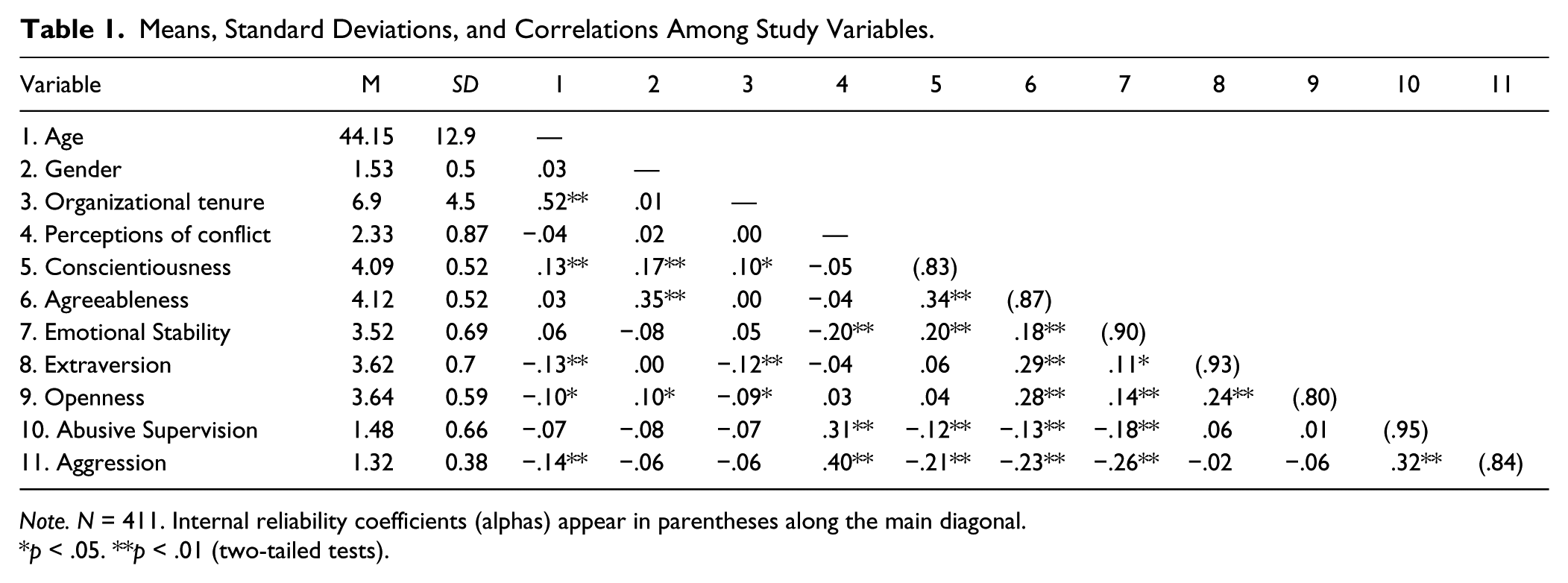
Note. N = 411. Internal reliability coefficients (alphas) appear in parentheses along the main diagonal.
p < .05. **p < .01 (two-tailed tests).
Hypothesis Test Results
All variables appeared to be normally distributed and fell within normal skewness and kurtosis ranges (Muthén & Kaplan, 1985). Variance inflation factor scores for predictive variables averaged 1.4, well below the standard of 10 (Ryan, 1997); thus, multicollinearity did not appear to present a biasing issue. We conducted Harmon’s single-factor test (Podsakoff, MacKenzie, Lee, & Podsakoff, 2003) to assess common method variance. The analysis suggested neither a single factor nor a dominant general factor accounted for the majority of the variance in subjects’ responses.
A bootstrapping method (with n = 5,000 bootstrap resamples) was used to assess the mediation hypotheses (Hayes & Preacher, 2013). Indirect effects and confidence intervals are provided in Table 2 and total effect sizes are found in Figure 2.
Results of Test for Mediation.

Note. N = 411. Confidence intervals (CIs) are significance tests for indirect effects; CI = .95; Bootstrapped = 5,000.
p < .05. **p < .01. ***p < .001.

Hypothesized model with effect sizes.
Hypothesis 1 was not supported, demonstrating that perceptions of abusive supervision did not mediate the relationship between Conscientiousness and aggression (B = .00, ns; lower limit CI [LLCI] = −.02, upper limit [ULCI] = .01). Conscientiousness did not have a direct effect on perceptions of abusive supervision (B = −.05, ns), but it did have a statistically significant direct effect on aggression in the hypothesized direction (B = −.07, p < .05). Hypotheses 2 and 3were both supported, suggesting that perceptions of abusive supervision mediated the relationships between Agreeableness (B = −.01; LLCI = −.03, ULCI = −.001) and Emotional Stability (B = −.01; LLCI = −.02, ULCI = −.001) and aggression. Furthermore, Agreeableness and Emotional Stability both had statistically significant negative direct effects on perceptions of abusive supervision (B = −.13, p < .05, B = −.11, p < .05, respectively) and aggression (B = −.11, p < .01, B = −.06, p < .01, respectively), offering full support for Hypotheses 2 and 3. Results for Hypothesis 4 were mixed. Perceptions of abusive supervision mediated the relationship between Extraversion and aggression (B = .01; LLCI = .001, ULCI = .002), but Extraversion did not have a direct effect on aggression (B = .02, ns) and its direct effect on perceptions of abusive supervision was not in the hypothesized direction (B = .10, p < .05). Hypothesis 5 was not supported, revealing that perceptions of abusive supervision did not mediate the relationship between Openness and aggression (B = −.01; LLCI = −.001, ULCI = .01). Furthermore, Openness did not have a direct effect on perceptions of abusive supervision (B = .02, ns) or aggression (B = −.02, ns).
These relationships were found when controlling for the effects of age, gender, organizational tenure, perceptions of organizational conflict, and the other personality variables. The total effects model (i.e., overall model), including the four controls, five personality variables, and perceptions of abusive supervision (when applicable) accounted for roughly 14% of the variance in subordinates’ perceptions of abusive supervision (R2 = .14) and 27% of the variance in aggression (R2 = .27).
Discussion
This study found that subordinates’ perceptions of abusive supervision accounted for the relationship between three personality dimensions and aggression. These results help validate and reiterate prior researchers’ contentions (Bettencourt et al., 2006; Spector, 2011) that a relationship exists between employees’ internal factors (i.e., personality) and environmental factors (i.e., perceptions of an abusive supervisor) when predicting individuals’ inclinations to exhibit workplace aggression.
This study demonstrated three key findings. First, we identified a social-processing mechanism (i.e., personality) and control response (i.e., reactance to perceptions of abusive supervision) that explained personality’s association with aggression. Supporting prior theorizing (e.g., Bettencourt et al., 2006), our study’s results suggested that subordinates’ personalities influence whether or not they exhibit aggression through personality’s pervasive impact on employee social-information processing (Gilbert, 1995) of supervisor interactions and how they perceive control of their work environment. Our results suggest that employees’ personality influences which environmental factors are attended to, how they are perceived, and how employees respond to them.
Second, this study corroborated prior aggression models (e.g., Spector & Fox, 2005) suggesting that internal factors (e.g., personality) combine with contextual factors (e.g., perceptions of abusive supervision) to predict aggression. These interactive models of aggression continue to garner support through empirical investigation. Thus, future aggression models should include perceptions of abusive supervision as an important environmental condition in predicting aggression in organizations.
Third, we showed that subordinates’ personality is associated with their perceptions of abusive supervision. Our findings lend further credibility to initial studies (e.g., Martinko, Harvey, Sikora, & Douglas, 2011) showing that individual differences such as attribution style that are associated with self-concept beliefs and social-information processing influence the degree to which subordinates perceive their supervisors’ behaviors as abusive. Similar to the underlying mechanisms that influence aggression, individual differences play a role in forming individuals’ biases and tendencies and influence individuals’ perceptions of abusive supervision.
We used the Big Five classification system to identify personality factors because it has received substantial support as a personality framework (Barrick & Mount, 1991). Ultimately, Conscientiousness (r = −.12; β = −.04), Agreeableness (r = −.13; β = −.10), Emotional Stability (r = −.18; β = −.11), Extraversion (r = .06; β = .11), and Openness (r = .01; β = .02) were all associated with subordinates’ perceptions of abusive supervision, to some degree, when controlling for the effects of one another, as well as the effects of age, gender, organizational tenure, and perceptions of conflict. Future research should examine how employees’ personalities function while at work and examine more narrow personality traits. Such research would likely reveal larger effect sizes for associations between subordinates’ personalities and their proclivities to perceive abusive supervision. Incorporating the Big Five into the abusive supervision literature may strengthen the literature’s explanatory and predictive abilities.
It is interesting to note that only the Agreeableness, Emotional Stability, and Extraversion relationships with aggression were mediated by subordinates’ perceptions of abusive supervision. This suggests that these specific personality factors may heighten individuals’ propensities to provocation from environmental stimuli and/or behavioral responses to perceived control by authority. Alternatively, these personality factors may simply increase individuals’ attention toward specific types of social interactions and control restricting behavior (Spector, 2011). Our results also suggest that individuals high in Agreeableness, Neuroticism, and Extraversion are more prone to exhibit aggression in response to provocation (Bettencourt et al., 2006). It appeared that Conscientiousness and Openness are less likely than Agreeableness, Neuroticism, and Extraversion to influence perceptions of abusive supervision and therefore lead to aggressive responses.
In corroboration with prior research, three of the five personality factors also exhibited direct relationships with aggression. Specifically, Conscientiousness (β = −.07, p < .05), Agreeableness (β = −.12, p < .01), and Emotional Stability (β = −.07, p < .01) all exhibited statistically significant relationships with aggression. Direct relationships between Extraversion (β = .03, ns) and Openness (β = −.02, ns) and aggression were not statistically significant. Since several meta-analyses already demonstrate a direct relationship between personality and aggression, we did not hypothesize these relationships. However, the fact that these relationships match prior empirical research results gives us further confidence in the validity of our study’s findings. Also worth noting is the positive and statistically significant relationship between subordinates’ perceptions of abusive supervision and aggression (β = .09, p < .001). This finding compliments prior abusive supervision studies’ (e.g., Mitchell & Ambrose, 2007) finding that greater perceptions of supervisory abuse are associated with an array of counterproductive and/or deviant work behaviors.
Of particular interest, our results showed that Extraversion had an indirect relationship with aggression, but not a direct effect. This study provides further validity to prior researchers’ (Oh et al., 2011) contentions that Extraversion must interact with other personality and/or situational factors to result in aggression. This suggests that perceptions of abusive supervision can be an important environmental factor in predicting whether extraverted employees will exhibit aggression in the workplace. Also, our finding that Emotional Stability was negatively associated with perceptions of organizational conflict (r = −.20, p < .01) suggests that Emotional Stability may play a key role in how individual differences and perceptions of the workplace environment influence aggressive reactions. Future research can explore this complex relationship.
The literature on abusive supervision and various forms of deviance has been criticized for consistently yielding relatively small effect sizes. This study’s effect sizes may encourage further research examining the role of broad personality factors in the prediction of employees’ proclivities to perceive abusive supervision and/or engage in aggression. Although the effect sizes in our study followed the general trend of being small, our effect sizes for personality factors were estimated based on their relationships with abusive supervision while controlling for the effects of the four other personality variables and four control variables. Thus, although the effect sizes may be small, it is noteworthy that the relationships were detected despite controlling for eight other variables. This is interesting because employees’ perceptions of organizational conflict were moderately correlated with aggression (r = .40, p < .001), making it an especially important control variable in the context of this study.
Although our theoretical explanation for the relationship between subordinates’ personality and their perceptions of supervisor abuse relied on phenomenological principles, we acknowledge that alternative explanations for these relationships exist. For example, it is possible that supervisors treat subordinates differently based on their evaluation of subordinate personality and behavior. However, since Tepper’s (2000, p. 178) definition and measure of abusive supervision rely on subordinates’ “subjective assessments” and asserts that “two subordinates could differ in their evaluations of the same supervisor’s behavior,” we maintain that our perceptual mechanism perspective is a valid explanation of these relationships. Since both these theoretically explanations are plausible, we suggest that future abusive supervision studies be designed to isolate supervisor behavior across subordinates (e.g., through a video simulation) in order to test this rational more explicitly.
Limitations
There are a few notable limitations of this study. First, a convenience sample was used. Second, we used a cross-sectional design, which precludes any conclusive claims of causality. Because personality factors are exogenous in any social science research model, it is reasonable to assume that they precede perceptual differences and that behavioral outcomes are a result of these stable individual differences (Chan, 2009).
Third, only self-report measures were used. Secondary source data would help inform whether employee behavior was considered aggressive or not, but most aggression researchers use similar designs. More objective reports of employee behavior, such as formal complaints or reprimands, may not be indicative of actual employee behavior because there may also be biases in the way these data are reported. Also, personality factors reflect internal, unobservable personality dimensions that are likely best known by employees themselves. Thus, there are advantages to using self-reports for our study, as each of the employees is probably the most knowledgeable about his or her own personality (Chan, 2009).
Conclusion
This study found that individuals’ perceptions of abusive supervision mediate the relationship between three personality factors and aggression, contributing to aggression research in several ways. First and foremost, this study empirically demonstrates that personality factors are associated with both perceptions of abusive supervision and aggression. Our results support the notion that self-concept, social motives and perceptions of control from employee personality influence whether or not employees are likely to react with aggression (Bettencourt et al., 2006). Second, this study extends prior aggression research by empirically demonstrating that personality factors can combine with relevant environmental boundary conditions (i.e., perceptions of abusive supervision) in predicting aggression. More specifically, our findings indicate that the likelihood of aggressive behaviors increases when employees who are high in Agreeableness, Neuroticism, or Extraversion perceive their supervisors as abusive.
Footnotes
Declaration of Conflicting Interests
The author(s) declared no potential conflicts of interest with respect to the research, authorship, and/or publication of this article.
Funding
The author(s) received no financial support for the research, authorship, and/or publication of this article.