



Abstract
This mixed methods study explored the antecedents of servant leadership. The sequential explanatory research design consisted of two distinct phases: quantitative followed by qualitative. The Phase 1 quantitative survey collected data from 499 leaders from community leadership programs and 630 raters using the Servant Leadership Questionnaire. During Phase 2, 12 selected leaders from Phase 1 were interviewed to explain the Phase 1 results in more depth. Four key findings emerged from the data: (a) the longer a leader is in a leadership role, the more frequent the servant leader behaviors; (b) leaders who volunteer at least 1 hour per week demonstrate higher servant leader behaviors; (c) servant leaders influence others through building trusting relationships; and (d) servant leaders demonstrate an altruistic mindset.
Introduction
Servant leadership is a relatively new paradigm in leadership studies. Much of what is written about servant leadership is not the result of empirical study. The literature regarding servant leadership is rather indeterminate, somewhat ambiguous, and mostly anecdotal (Russell & Stone, 2002). Three streams of research on servant leadership have emerged identified as conceptual, measurement, and model development (Parris & Peachey, 2013). Absent from these streams are empirical studies on the antecedents of servant leadership.
There remains a need to understand better how managers and scholars understand and apply servant leadership. Previous researchers have called for research into the antecedents of servant leadership (e.g., Barbuto & Wheeler, 2006; Bommer, Rubin, & Baldwin, 2004; Graham, 1991; Huckabee & Wheeler, 2008; Hunter et al., 2013; Ostrem, 2006; Parris & Peachey, 2013). Moreover, there is very little mixed methods research in this area. Parris and Peachey’s (2013) review of peer-reviewed publications of servant leadership between 2004 and 2011 outlined 39 empirical studies, and only one was a mixed methods design. Hunter et al. (2013) argue for more advanced research designs and more explorations of the antecedents of servant leadership. Given this lack of empirical study, the purpose of this article is to explore the antecedents of servant leadership using a sequential explanatory mixed methods research design.
Literature Review
Servant Leadership Construct
Servant leadership can be recognized by what Robert Greenleaf (1970) suggested was a unique leadership philosophy motivated by a need to serve others over an aspiration to lead others. He states, “It begins with the natural feeling that one wants to serve, to serve first. Then conscious choice brings one to aspire to lead” (p. 4). He described the evolution as follows:
That person is sharply different from one who is leader first. . . . The difference manifests itself in the care taken by the servant first to make sure that others people’s highest priority needs are being served. The best test, and difficult to administer, is: do those being served, become healthier, wiser, freer, more autonomous, more likely themselves to become servants? And, what is the effect on the least privileged in society: will they benefit, or at least, not further deprived? (Greenleaf, 1970, p. 13)
Servant leadership is often described as synonymous with Burns’ (1978) original conceptualization of transforming leadership (Barbuto & Wheeler, 2006; Farling, Stone, & Winston, 1999; Graham, 1991). Servant leaders have been described as those who view themselves as stewards, as those who develop and empower others to reach their highest potential (Sendjaya & Sarros, 2002), and as those who share similar characteristics with authentic leadership (Avolio & Gardner, 2005). Others have described servant leadership based on the most moral development through charismatic effects and distinct from transformational leadership (Graham, 1991).
Transformational, authentic, and servant leadership all recognize the importance of a positive moral perspective and a focus on the follower’s development. Servant leadership as a construct is different whereby the servant leader’s behavior moves beyond transforming leadership and developing the followers; rather it has the objective of aligning the leaders’ and followers’ motives (Barbuto & Wheeler, 2006).
Van Dierendonck’s (2011) conceptual model outlines antecedents of servant leadership to include motivation (rooted in Greenleaf’s original description of the desire to serve and then the choice to lead), culture (based on the GLOBE study’s dimensions of power distance and humane orientation), and individual characteristics (i.e., self-determination, moral cognitive development, and cognitive complexity). Regretfully, this conceptual model is just that, conceptual. The potential antecedents described lack empirical research specific to the servant leadership construct. Sun (2013) examined why individuals engage in servant behaviors. He outlined four “attributes of servant identity” as calling, humility, empathy, and agape love. Regretfully, the servant identity as described may help inform managers and scholars about predictors of servant leader behaviors; this is another conceptual model.
Barbuto and Wheeler’s (2006) Servant Leadership Questionnaire (SLQ) is based on the early work and definitions presented by Greenleaf (1970) and operationalizes servant leadership into five distinct factors. The behaviors are identified as: altruistic calling, emotional healing, wisdom, persuasive mapping, and organizational stewardship (see Figure 1 for definitions). Unique to their measure is the construct of “calling,” a behavior that is highly distinctive to servant leadership.

Servant leadership behaviors
Using both quantitative and qualitative data, Sendjaya, Sarros, and Santora (2008) proposed a model characterized by a service orientation, a holistic outlook, and a moral-spiritual emphasis. Similar to the concept of “calling,” Sendjaya et al.’s (2008) “spirituality” is perceived as an important source of motivation for the servant leader and has been assessed with servant leadership in previous studies (Fry, 2003; Fry & Slocum, 2008; Herman, 2010; Pawar, 2008).
Liden, Wayne, Zhao, and Henderson’s (2008) model of servant leadership has three components: antecedent conditions, servant leader behaviors, and leadership outcomes. They argue that there are antecedents that have an impact on servant leadership (i.e., context and culture, leader attributes, and follower receptivity). Regretfully, the antecedent conditions identified by Liden et al. (2008) are conceptual.
While there have been several efforts to measure servant leadership behaviors (e.g., Dennis & Bocarnea, 2005; Laub, 1999; Page & Wong, 2000; Reed, Vidaver-Cohen, & Colwell, 2011; Sendjaya et al., 2008; van Dierendonck & Nuijten, 2011) there is less work addressed at understanding the antecedents of servant leadership behavior. Reed et al. (2011) examined servant leadership by specifically studying top executives and found that “it does hold promise as one form of ethical leadership” (p. 431) and encouraged further research into the exploration of the antecedents of servant leadership.
An antecedent at the core of servant leadership is the need to serve and the subsequent choice to lead (Greenleaf, 1970; Ng, Koh, & Goh, 2008; van Direndonck, 2011). Servant leaders are motivated by the need to serve (Luthans & Avolio, 2003). However fundamental this motivational state may be to the servant leadership construct, it is still a concept that has yet to be fully explored as a causal link to behavior.
Hunter et al. (2013) empirically examined aspects of a leader’s personality as antecedents of servant leadership. They concluded that “leaders scoring high in agreeableness and low in extraversion were more likely to be perceived as servant leaders by their followers” (p. 327). Parris and Peachey (2013) conducted a systemic literature review of empirical studies of servant leadership and concluded servant leadership to be an area worthy of study with positive outcomes for followers but found that as a field of study is lacking consensus regarding how to define servant leadership and how to measure it. Van Dierendonck (2011) argues that a lack of consensus over its definition creates confusion.
Servant Leadership Behaviors
In this study, to mitigate the issue of confusion over the instrument and definitions of the behaviors, the Servant Leader Questionnaire (SLQ) was selected to measure the servant leadership behaviors of individual leaders. I expand on Barbuto and Wheeler (2006) by further exploring the servant leader behaviors of altruistic calling, emotional healing, wisdom, persuasive mapping, and organizational stewardship.
Altruistic Calling
Altruism is defined as behavior that is aimed at benefitting another person (Snyder & Lopez, 2007). Russell and Stone (2002) identify nine attributes of servant leadership, with service recognized as a key component. Farling et al. (1999) propose that leaders must understand that their primary function is to serve others. Altruistic behavior can be motivated by an empathic desire to benefit another person, or it can be prompted by personal egotism. A servant leader is willing to sacrifice self-interests for the sake of others (Barbuto & Wheeler, 2002). However, egotism is the motive to pursue some sort of personal gain through targeted behavior and has been identified as one of the most influential of all human motives (Snyder & Lopez, 2007). Bass (2000) suggests that one of the core issues differentiating the transformational leader from the servant leader is intent. Typically the transformational leader’s focus is the organization, whereas the servant leader’s desire is to make a difference in an individual’s life. Greenleaf (1977) described this difference as manifesting itself in the care taken by the servant leader to make sure that other people’s needs are being served. The framework developed by Barbuto and Wheeler (2002) specified that calling is a key element that is fundamental to the servant leadership philosophy.
Emotional Healing
Servant leaders are empathetic with highly developed listening skills, making them proficient at facilitating the healing process. Leaders rated high in emotional healing are the ones followers turn to when they have a personal trauma because these leaders have created an environment where employees are able to voice personal and professional issues (Liden et al., 2008). Empathy is defined as an emotional response to the perceived plight of another person (Snyder & Lopez, 2007). Emotional healing is characterized by taking the opportunity to see the world through the eyes of others. Servant leaders place a high priority on the concerns and the holistic development of others (Ehrhart, 2004; Hunter et al., 2013; Liden et al., 2008; Sendjaya et al., 2008; van Dierendonck, 2011). Servant leaders have the capacity to participate in the circumstances of others and to recognize individuals for their uniqueness (Degraaf, Tilley, & Neal, 2001). According to Goleman (2003),
Empathy means thoughtfully considering employees’ feelings—along with other factors—in the process of making intelligent decisions. Empathy is particularly important today as a component of leadership for at least three reasons: the increasing use of teams; the rapid pace of globalization; and the growing need to retain talent. (p. 236)
“Servant leaders must listen to followers, learn about their needs and aspirations, and be willing to share in their pain and frustration” (Yukl, 2006, p. 420). A leader must understand followers to determine how best to serve their needs. Listening is the forgotten skill in communication and leading and is a critical skill for servant leaders (DeGraaf et al., 2001; Hunter et al., 2013). Listening is a skill that can be developed. Listening is essential for those desiring to be a servant leader for it is through listening that many of the other characteristics of servant leadership are nurtured. The ability to understand and experience the feelings of others is described as a key characteristic of servant leadership (George, 2000; van Dierendonck, 2011). Previous studies have found that emotional intelligence is an important leadership construct (Goleman, 1998; Mayer, Caruso, & Salovey, 2000; Meers, 2009; Northouse, 2010).
Wisdom
Servant leaders demonstrate a combination of an awareness of their surroundings and an anticipation of consequences (Bierly, Kessler, & Christensen, 2000). Sternberg (1998) developed a model called the “balance theory of wisdom,” which emphasizes the organization and application of pragmatic knowledge used in balancing self- and other interests within the environmental context to achieve a common good. From Greenleaf’s concepts of awareness and foresight, Barbuto and Wheeler (2006) defined wisdom as the combination of knowledge and utility. Servant leaders gain clues from their environment to inform their opinions and decisions (Barbuto & Wheeler, 2002).
Persuasive Mapping
A cornerstone of leadership is the ability to influence others (Yukl, 2006). Barbuto and Wheeler (2006) found that leaders using persuasive mapping influence others with sound reasoning and mental frameworks. Servant leaders have an ability to conceptualize greater possibilities and encourage others to dream great futures. Leaders using persuasion are able to influence others without relying on formal authority. Servant leaders rely on persuasion in their interactions with followers (Greenleaf, 1998; van Dierendonck, 2011).
Organizational Stewardship
Stewardship is being responsible for the common interest and to act not only as a caretaker but as a role model (Greenleaf, 1977; van Dierendonck, 2011). Organizational stewardship is preparing an organization to leave a positive legacy. Servant leaders believe that organizations play a moral role in society and make sure to give back to make things better than the way they were found. Burns (1978) states that “the most lasting tangible act of leadership is the creation of an institution . . . that continues to exert moral leadership and foster needed social change long after the creative leaders are gone” (p. 454). Organizational stewardship is being involved with something bigger than ourselves. Block (1996) defines stewardship as “the willingness to be accountable for the well-being of the larger organization by operating in service, rather than in control, of those around us. Stated simply it is accountability without control or compliance” (p. 6).
Methodology and Procedure
Creswell and Plano Clark (2007) argue that used by themselves, quantitative data are inadequate in addressing the domain of leadership. Given the complexities of leadership, quantitative results may be inadequate; therefore, qualitative data are needed to help explain initial quantitative data. The combination of quantitative and qualitative data should provide a more complete picture and a “voice of the participants.”
Following Creswell and Plano Clark’s (2007) recommendations, this study employed a mixed methods sequential explanatory design consisting of two distinct phases: Phase 1, a quantitative study, followed by Phase 2, a qualitative study in which interviews were conducted and responses were coded and analyzed for possible themes. Triangulation was used to analyze the quantitative and qualitative data to validate the findings of the data collected.
Phase 1: Quantitative Study
The Phase 1 quantitative survey collected data via a web-based survey using the SLQ (Barbuto & Wheeler, 2006). Participants were asked to identify four to six coworkers or colleagues, who have observed them in a leadership role, and request they complete the other-rater version of the SLQ.
Sample: Phase 1
Participants were recruited from a group of leaders who had completed an extensive 12-month community leadership training program and who were concurrently in leadership positions or were judged to have potential for providing leadership to the community. Leaders were employed in a variety of industries from both rural and urban areas in the Midwest. Data from 499 leaders and 630 raters were collected.
Leaders
Leaders (N = 499) were predominantly female (54%, 46% male) and mostly White/Caucasian (94%) with 6% identifying as non-White. Participants represented a spectrum of age groups, with percentage being between 40 to 49 years old (38%); the age of the remaining participants were age 30 to 39 years (30%), 50 years or older (25%), and the smallest group was represented by those aged 20 to 29 years (6%). The sample included those who were highly educated including (46% having completed a bachelor’s degree, 41% holding a degree beyond a bachelor’s, and 13% having less than a bachelor’s degree). When asked about volunteer behavior during an average week, 59% of the leaders volunteered 1 to 5 hours per week, 25% completed more than 5 hours per week, and 16% volunteered less than 1 hour per week.
Raters
There were 630 coworkers who served as raters of the leaders in this study. Each of the 499 leaders were rated by 1 or more raters. The majority of raters were female (62%) with 38% male and as a group represented a similar ethnic proportion to the leaders (96% White/Caucasian and 4% non-White). When asked about their level in the organization, 12% were at a higher level than the leader, 29% were at the same level as the leader, the majority (49%) was lower level in the organization than the leader they rated, and 10% did not identify their organizational relationship with the leader. When asked about their experience working with and observing the leader they rated 41% of the raters had observed their leaders for 6 years or more. Twenty-one percent of the raters had observed the leader they rated for more than 10 years, with 20% having observed their leader for 6 to 10 years. Fifty-four percent of the raters had observed their leader for 1 to 5 years with only 6% of raters having observed their leader for less than a year.
Measures
Servant Leadership Questionnaire
The quantitative phase of this research involved collecting data using the SLQ self-rating and a parallel version for other-rating (Barbuto & Wheeler, 2006). The instrument measures five factors of servant leadership using 23 leader behaviors in which the respondents are asked the frequency the leader demonstrated each behavior. The SLQ has been utilized in several dissertations (e.g., Anderson, 2009; Bugenhagen, 2006; Daubert, 2007; Huckabee, 2008; Ostrem, 2006) and several other empirical studies (e.g., Barbuto & Gifford, 2010; Barbuto & Hayden, 2011; Garber, Madigan, Click, &Fitzpatrick, 2009; Melchar & Bosco, 2010). As a composite measure, SLQ when rated by the leaders had an alpha of .90. Since I was examining the various subscales of servant leadership, I verified their reliabilities as well: altruistic calling: leader (.80), emotional healing: leader (.88), wisdom: leader (.79), persuasive mapping: leader (.87), and organizational stewardship: leader (.79). As a composite measure, SLQ when responded to by the raters had an alpha of .96. The five servant leader subscales reported acceptable reliabilities as well—altruistic calling: rater (.89); emotional healing: rater (.93); wisdom: rater (.92); persuasive mapping: rater (.90); and organizational stewardship: rater (.90). The intercorrelations for self and rater versions of the five servant leadership subscales were calculated and are reported in Table 1.
Descriptive Statistics and Correlation Matrix for Leaders.
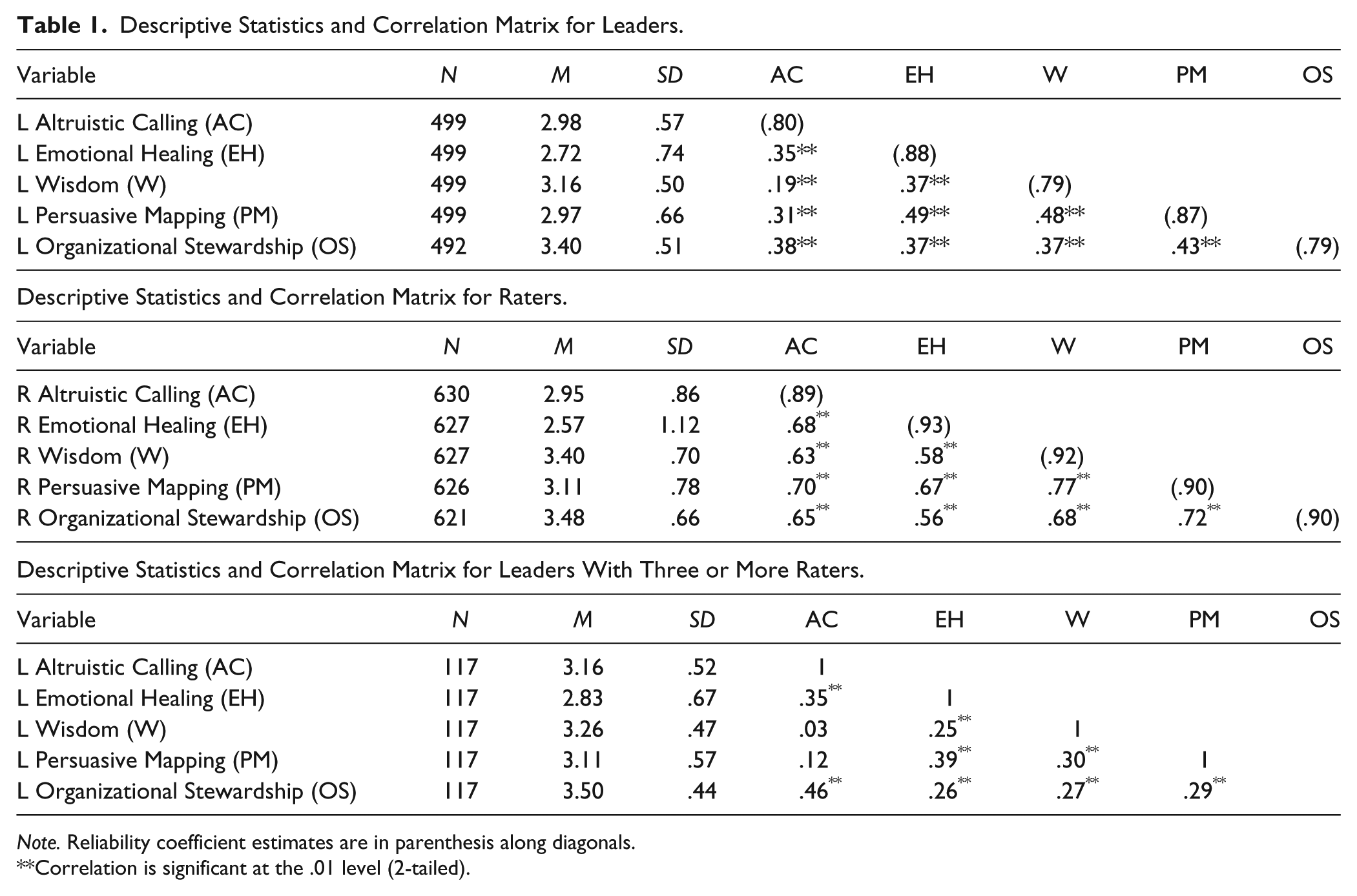
Note. Reliability coefficient estimates are in parenthesis along diagonals.
Correlation is significant at the .01 level (2-tailed).
Independent Variables
Several demographic variables were measured to understand better what life experiences and leader behaviors or characteristics might influence servant leader behaviors. The following variables were assessed as antecedents to the servant leader characteristics: Leadership experience (measured as years of serving in a leadership role, categorically coded), Volunteerism (measured by hours volunteered on average per week, categorically coded), and Gender (male or female).
Analyses and Results
Phase 1: Quantitative Study
The SLQ (self and rater versions) was used to measure leaders’ level of servant leader behaviors. The data collected using the SLQ were then used as a springboard for further data involving one-on-one interviews. Descriptive statistics and Pearson correlations served as the basis for analyzing the independent and dependent variables. One-way and two-way ANOVA tests were done to compare the different populations studied and were followed up by conducting Kruskal–Wallis and Mann–Whitney nonparametric tests.
Phase 1: Simple Statistics and Correlations
Simple statistics and correlations were calculated for all variables of the study for participants (leaders N = 499; raters N = 630). Variable means, standard deviations, and correlations are reported in Table 1. Table 1 also reports the internal consistency reliability (Cronbach alpha coefficient) was acceptable (Nunnally & Bernstein, 1994).
Phase 1: Leader Demographic Variables Analysis
To further the relationship between the independent variables of servant leadership and the dependent demographic variables a one-way ANOVA was conducted to test for statistically significant difference among the following mean scores for the servant leadership subscales and the overall SLQ scores.
Consistent with the goal of the study to understand better the antecedent of servant leadership behavior the analyses were highly exploratory. All demographic variables were considered, and those that had significant relationships with the overall measure of servant leadership or one or more of the factors are reported here.
There was a significant difference (p < .05) for “Years in a Leadership Role” for each servant leadership subscale and the overall SLQ score. There was a significant effect of “Years in a Leadership Role,” F(2, 115) = 1.08, p < .05 (M = 3.9, SD = 0.44). There was a significant difference (p < .05) for “Hours Volunteered” for four of the five servant leadership subscales and the overall SLQ score. In this study, the one servant leadership subscale that did not result in a significant score for “Hours Volunteered” was emotional healing. There was a significant effect of “Hours Volunteered,” F(2, 115) = .37, p < .05 (M = 3.9, SD = 0.44). There was a significant difference (p < .05) for “Gender” for three of the five servant leadership subscales. Female leaders scored significantly higher than male leaders in altruistic calling (.003), emotional healing (.000), and organizational stewardship (.001). The overall SLQ score and the subscales wisdom and persuasive mapping did not result significant scores by “Gender.” There was a significant effect of “Gender,” F(1, 115) = 9.0, p < .05 (M = 3.9, SD = 0.44).
Phase 1: Rater Variables Explored
Comparison of leader ratings and other-raters
Of the study population of leaders, 169 participants received ratings of their servant leadership behaviors measured by the SLQ. To examine, the scores of leaders compared to raters was calculated by taking leader self-scores and then subtracting the mean of the raters’ scores. This analysis produced an average deviation score between leaders’ self-score and the mean raters’ scores. This data were analyzed with one-way ANOVA for the variables with three or more groupings and a t test was used for those variables with two groups. There was a significant difference (p < .05) in the variable of years in leadership. Raters rated leaders higher than leaders rated themselves in the servant leadership subscales of wisdom, emotional healing, and the overall SLQ score.
Phase 2: Qualitative Study
The purpose of Phase 2 was to understand better the characteristics and behaviors associated with those perceived as being exemplary servant leader behaviors via in-depth one-on-one audio taped interviews (Richards & Morse, 2007). The interview protocol included nine open-ended questions, and the questions were pilot tested for clarity with graduate students in a leadership studies program (see the appendix). The participants were informed that the interview will be audio-recorded and transcribed verbatim. The participants reviewed the transcripts of their interviews to clarify or expand their responses as needed. Only one of the interviewee’s responded with minor edits to their interview transcript (see the appendix for interview protocol and interview questions).
Sample: Phase 2
To identify those leaders perceived by their raters as exemplary, leaders’ average rating on the SLQ Composite score was compared to the average SLQ score of the entire sample (M = 3.19). Leaders with the highest mean scores based on their respective raters were sampled, and 12 leaders (M = 3.74) were purposively selected to participate in the qualitative interviews.
Analyses and Results
Phase 2: Qualitative Data Analysis
The qualitative data were explored and coded to help explain why these participants demonstrated exemplary servant leadership behavior. Following an inductive process, a large set of data were collected and were progressively narrowed down into smaller groups of data (Creswell, Plano Clark, Gutman, & Hanson, 2003). An iterative process for analyzing the qualitative data was implemented (Bloomberg & Volpe, 2008; Tashakkori & Teddlie, 1998) that included the following: reviewing and exploring the data, rereading and coding the data, and collapsing the codes into themes. Interrater reliabilities were conducted by two PhD’s in Leadership Studies with expertise in qualitative methodology. They reviewed the codes and themes to check for appropriateness and relevance to the research questions. Findings statements were generated, including excerpts using participant quotations. The findings were then interpreted by consulting the literature and linking these patterns of behavior and themes in light of previous research.
Validity in a mixed methods study is defined “as the ability of the researcher to draw meaningful and accurate conclusions from all of the data in the study” (Creswell & Plano Clark, 2007, p. 146). The validity or inference quality procedures (Creswell, 2003; Ivankova, 2014) used in this study included member checking, triangulation, and peer review. As stated previously, two content experts of servant leadership reviewed the coding results of the participant interviews and the iterative procedures to confirm the results.
Findings
This study was guided by the central question: Are there characteristics, behaviors, or life experiences that would predict a servant leader?
Major Findings That Emerged From This Study
The longer a leader is in a leadership role, the more frequent the servant leader behaviors.
Those leaders who volunteer at least 1 hour per week demonstrate higher servant leader behaviors.
Servant leaders influence others through building trusting relationships.
Servant leaders demonstrate an altruistic mindset.
By way of a mixed methods study, the researcher set out to explore the antecedents of servant leadership through the experiences of the research participants. The emphasis is on letting the participants speak for themselves. Illustrative quotations gleaned from interview transcripts attempt to portray perspectives from the participants and capture some of the richness and complexity of the phenomenon. Where appropriate, quantitative data are woven in with the interview data to augment and strengthen the discussion.
In the quantitative data collected in this study, this researcher found a significant (p > .05) difference in the scores of leaders who have been in a leadership role for more than 10 years compared to those with either 6 to 10 and 5 or less years in a leadership role. This difference was found for all five subscales and the overall SLQ score. However, the age of the leader did not have the same consistent results as did the years in leadership variable.
As the interviews were collected and the data analyzed it became clear that these exemplary servant leaders had processed experiences in their lives with the following themes emerging to further explain this finding: role of a mentor, reflection, self-awareness, and self-efficacy.
Role of a Mentor
This finding is highly significant as a result that all 12 of the participants (100%) described the importance of a positive role model or mentor in their formative development as a leader. Kim said “I’ve had with a few mentors. And they both took me under their wing and they really taught me about having integrity.” Daniel expressed the impact of a mentor in the following way: “ . . . but I think that’s probably what I would have to say that I had a very good mentor.”
Reflection
Ten of the 12 (83%) of the participants described the act of reflection as instrumental to their processing experiences in a way that led to personal growth. Bill said “I think you have to reflect personally, get inside yourself and say, what do I want to do when I grow up?” Sharon recalled,
Oh, yeah. I go back and I piece it all together, and then I have my ah-ha moments. And that’s like, “Oh yeah, OK. Then it will make sense. That’s why that happened.” After I sit and I think about it and I put all the pieces together, and then hopefully that better prepares me for the next encounter or the next engagement.
Mary said “Usually then I know how to, you know, then I can reassess myself and kind of hopefully respond better . . . you know, the next time.” Daniel expressed that “ . . . I go back and revisit that story in my head a lot.” Sarah said that “A lot of times, I’ll refer back to past experiences to help make a decision. Sometimes I’ll try to think of how would (my two mentors) handle this situation.”
Self-Awareness
Self-awareness was presented by a majority of the participants (11 of 12, 92%) as a process in which they gained a better understanding of themselves, including their strengths and weaknesses, and the impact they have on others. James recalled “ . . . a high school literature class talking about the Greeks and the idea of ‘know thyself,’ and how that stuck with me . . . and I’ve always kinda focused on that.” Jill addressed knowing herself and having a clear sense of who she is in the following way: “This is something I’ve learned about myself as I’ve gotten older.”
Self-Efficacy
Self-efficacy was emphasized by 10 of the 12 participants (92%) and can be defined as the belief that a person has the ability to successfully accomplish a specific task. Kim described the process of improving her self-efficacy as a leader this way:
I think it builds on itself in that it’s something you want to do. And then the more you do it, the more you want to and the more it is, so . . . it’s probably a little like working out or eating right or . . . (laugh) you know, those things that start out maybe being hard, but you know, once you get it and get good at it, it becomes who you are.
In the quantitative data collected in this study, this researcher found a significant (p > .05) difference in the scores of leaders who volunteer more than 5 hours per week compared to those with either 1 to 5 hours or less than 1 hour as a volunteer per week. This difference was found for four of the five subscales and the overall SLQ score. The data that emerged from this study suggested the following themes to support this finding: sense of purpose, giving back, and spirituality.
Sense of Purpose
The overwhelming majority (11 of 12) or 92% of the participants indicated that they have a clear understanding of what they are to do with their lives. Jill described it as “ . . . just to have that sense of purpose and this is why I’m here. I’m here to help others. I get great satisfaction out of knowing that something I did made a difference for someone else, in a positive way.”
Giving Back
All of the participants (100%) indicated that giving back had meaning for them. James described giving back as a desire to be a part of something bigger than himself. Bill was even more explicit in describing what giving back means to him “Oh, I think I need to give back all the time, and I do that. I think it’s important to give back to the community and help others that don’t have it as good as I do.” Sandy said “And I truly do believe that, in order for your community to thrive, you have to be active. It doesn’t just happen.” Mary framed giving back as follows:
Well, we’ve, you know, we’ve been given a great deal and so if, somebody else needs help, it’s important that, we, try to help and that we don’t sit back, you know, let something bad happen to other people. Like you could be out there, making a positive difference.
Spirituality
In this study, the quantitative data found a significant difference regarding a leader’s self-identified level of spirituality only in the servant leadership subscale of altruistic calling. However, the qualitative data suggested that a leader’s spirituality, faith, or involvement with their church played a role in their leadership behavior. Mary described her faith as a “big part” of her leadership. Jill said “ . . . that it’s central to my leadership, I’m a Christian, and that’s what’s expected of me as a Christian, is to serve others, and to serve the community.” Jeremiah described the important role of spirituality as follows:
Well, I mean, it’s, a critical element. I don’t think I’d feel right doing something that, I felt was inconsistent with the tenets of my faith. So, you’re constantly kind of measuring your actions against your belief system. And certainly, you can get off kilter some, but I think the good thing about core values and, the feeling that there are some moral absolutes that kinda keep pulling you back on course, you know. In other words, as if you had a compass.
The data that emerged suggested that valuing relationships, congruent behavior, consensus building, and honest feedback and communication are methods for developing trustworthiness.
Valuing Relationships
Nine of the 12 (75%) participants presented the importance of building positive relationships with others. Bill talked about how he knew each of his employees and said “I can tell you about each one of ‘em.” He described how valuable these relationships were and that as a result of building a positive relationship with each one, he knew how to tap into the strengths of each employee and what each of his employee’s was looking for in terms of a quality workplace. Jill described the value of relationships that are based on trust when she said,
I’ve learned that there are different ways to get things done, and people use their strengths to, um, accomplish something and it might be a different avenue than I would take, but I think a lot of that comes with trust too and knowing who your co-workers are and how they tick.
Congruent Behavior
Congruent behavior by the leaders was emphasized by 10 of 12 (83%) participants in this study. Congruence can be characterized as behavior that is consistent with what is said by the leader. Jeremiah said the following to describe the importance of congruent behavior: “Well, I think integrity is critical. If people feel that you’ve lied to them and deceived them, they’re not going to trust you. And so, consistency, over time, being accurate in what you say and not deceiving people.” Jill said “I think honesty and integrity are very important. Kinda like walk the talk. So setting a good example for others in the office allows for that trust to develop.” Sharon added “Building trust takes time. It just doesn’t happen overnight. Showing that your words and your actions jive, and that they’re the same and that they aren’t mixed.”
Consensus Building
Building consensus was emphasized by all of the participants (N = 12, 100%) and involves valuing the opinions of others and providing a forum for diverse opinions and then negotiating what is in the best interest of those involved. Pete said “I think when you build consensus among a group and allow for dissention, instead of cutting it off, that people tend to feel good about the process.” Bill said “The group is looking for the leader to find . . . to find what the group desires, and then to help get them there.” Daniel described building consensus as follows: “Knowing the people that you’re talking to, and knowing what the end result is, you know, or what the goals are that you’re gonna be trying to achieve with whatever that change is or whatever that new process is.” Mary said,
Well, I don’t know that it’s always important that it goes, you know, the direction that, that the leader would like it to go. I think you have to be open that maybe your direction isn’t, you know, it has to be the group’s direction.
Kim described it as “. . . you always align your goals, your best interest with their best interest. The organization’s best interest, your best interest, their best interest . . . all lined up.”
Honest Feedback and Communication
Honest feedback and communication was addressed by 11 of the 12 (92%) participants as an important element of building trusting relationships. Pete described honest feedback and communication as “ . . . sometimes they need a sounding board, and sometimes they need an idea man, and I can do that.” He also said “ . . . people would come to me if they were in a difficult time because I don’t think that there is only one right way to solve things, and you know here are some options you might try.” Ann said “I feel that I listen and I also help to give her positive feedback that she needs which is really important.”
Altruistic mindset is operationalized as acting in the best interests of others (regardless of personal consequence) and is demonstrated by an others orientation, a desire to make a positive difference in the lives of others, and leading to help others.
Others Orientation (Ethical Altruism)
It was not surprising that people identified by their raters as servant leaders would describe their conduct as an act of promoting the best interests of others. All of the participants (100%) addressed the issue of an orientation toward others. Sharon said “I just like helping others.” Mary described her orientation toward others as “It comes from within; I think I was born with it. I like to help people. I’ve always, just felt good about serving.” Jill said for her,
I think it’s just developed, you know, maybe over the past five or six years. Just realizing how important it is . . . when you’re trying to figure yourself out and, what you’re doing here, you know . . . I decided to serve others in the community.
She went on to describe her orientation toward others as “This is why I’m here. I’m here to help others. I think you get great satisfaction out of knowing that something you did made a difference for someone else, in a positive way.”
Pete described his awareness of an orientation toward others while being involved with the Jaycees, in which he said “ . . . it helped me understand where all that ‘service to humanity is the best work of life’ came from . . .” Sarah said “I think in my mind, you know, regardless of how maybe religious I am, spiritually I feel that I need to serve others.” James said “ . . . I’d rather be known as a giver than a taker . . . but I just try to do whatever I can to help ‘em” when he described his desire to serve others.”
Desire to Make a Difference in the Lives of Others
Making a positive difference in the lives of others was expressed by a majority of the participants (9 of 12, 75%). Mary described this desire to affect others; she is “very focused on developing people, and is really driven to empower others.” Sharon described her desire to affect others in a positive way as follows:
I guess it’s the belief in empowering others. My dad was a track coach and he would always say to me, “You can do it.” But yet, I think he helped me by giving me the tools to make myself successful but he never came out and claimed that it was him that made me successful.
Sarah framed this desire to make a difference in the lives of others as follows, “Quite honestly, originally, with the backpacks for example, it literally was something where I felt obligated to do it, so I did it, and then I was so thankful that I did it.”
Leading to Help Others
Leading as a means to help others was described by a majority of the participants (9 of 12, 75%) in this study. Bill said,
I enjoy watching people grow. . . . What I do as a leader is I paint a vision where I want to take the group, and then I watch different people execute that. And to me, it’s just an awesome feeling to see that.
Sharon described her role as a leader as “I’m like I’m a coach. I’m a teacher. I’m here to teach. I’m here to help. I’m here to serve . . . I’m here to guide. I guess I’m more of a guide.” Mary framed her leading to help others as “So, when you’re leading you’re helping somebody. You’re in the background.” Sarah described her leadership role as “I also always kinda felt like my role as the leader was to not only get people there and get people involved . . . but also to help other people nurture their ideas, you know.” Kim spoke poignantly about leading to help others create a positive work environment when she said “ . . . you know, the payoff is when goals are met and people have jobs they love and you know that you helped make that possible.”
Discussion
The four major findings and the themes that emerged from the data analysis lend support to the notion that there are characteristics, behaviors, and life experiences that predict a servant leader. Servant leadership is a transformational approach to create a more caring and just society. Servant leaders put people first and define growth in terms of the individual follower. A servant leader serves others so that their followers become healthier, wiser, more autonomous, and more likely to become a servant themselves (Greenleaf, 1970). The followers are transformed through the act of service.
A common theme among the participants in this study was that exemplary servant leaders are characterized by interpersonal competence. Interpersonal competence can be defined as an astute awareness of others’ emotions, concerns, and behaviors and shows that they care about these concerns and behaviors and act appropriately on that understanding. The exemplary servant leaders in this study emphasized the importance of active listening and how important this is in terms of effective leadership. They described an ability to recognize and understand affective information that could be characterized as being empathetic. The interviewees spoke about being alert to the nonverbal communication of others as an important element of their relationships. One leader said “It isn’t a case of listening so you can formulate an answer. It’s simply trying to understand. And, it’s very powerful when a person feels that someone else really truly understands and is trying to understand them.” Based on the quantitative analysis and the qualitative interviews I propose the model of antecedents of servant leadership (see Figure 2).
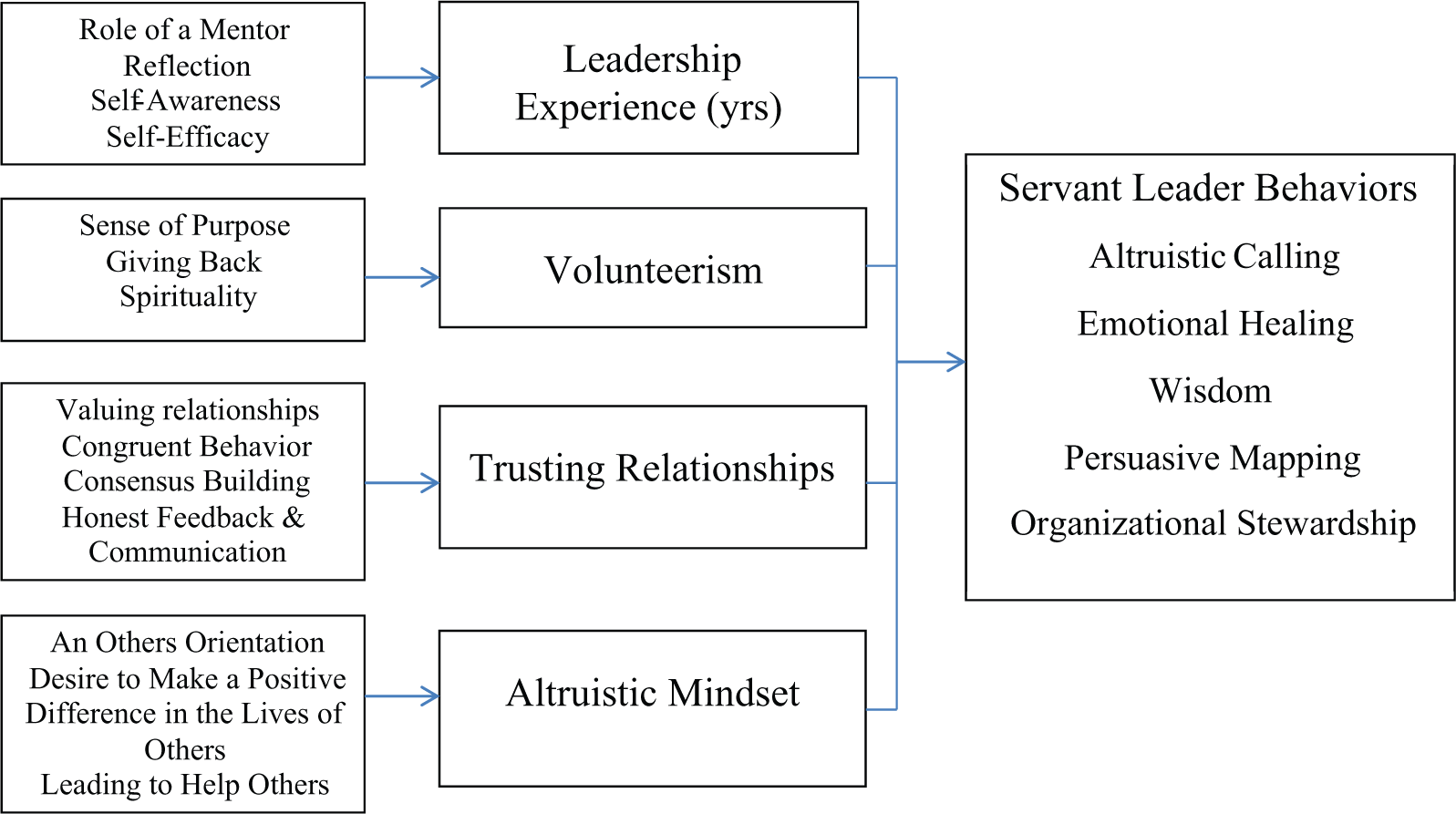
Antecedents of servant leadership.
This finding raises a common question in leadership studies regarding born versus made. Are servant leaders born or made? The data from this study suggest that there is something going on during the first 10 years in a leadership role that is resulting in higher servant leader behaviors. There is a significant difference (p < .05) in servant leadership scores for those leaders who have been in a leadership role for more than 10 years. Previous research has found that an estimated 30% of the emergence in leadership roles could be accounted for by genetics (Avolio & Luthans, 2006). That would mean that a possible 70% of the leadership behaviors were unaccounted for by genetics and therefore likely that environment could possibly explain a portion of the variance. The findings of this study would seem to indicate some environmental factors (i.e., socialization), in general, and mentors, reflection, self-awareness, and self-efficacy, in particular, do play a significant role in identification and development of servant leaders.
Meers (2009) found in his study that significant life experiences had an impact on the development of effective leaders and that significant life experiences seem to indicate the potential for the development of servant leadership behaviors. Avolio and Luthans (2006) emphasize the importance of “moments that matter” or “trigger events” in the development of a leader. An important exercise that affects career success is an effective mentor relationship (Ensher & Murphy, 2005). The findings of this study would seem to support the perspective that experience is important in the development of servant leaders. One of the trigger moments may be the role of a mentor.
Self-awareness can be defined as having a realistic assessment of oneself and a process in which individuals understand themselves, including their strengths and weaknesses, and the impact they have on others (Goleman, 1998; Luthans & Avolio, 2003; Yukl, 2006). Gardner Avolio, Luthans, May, and Walumbwa (2005) argued that when leaders know themselves, they have a strong anchor for their decisions and actions. The data suggest that knowing yourself and having a clear sense of oneself are fundamental to servant leadership.
Bandura (1982) defined self-efficacy as how well one can execute courses of action required to deal with prospective situations. Bandura (1997) also defined perceived self-efficacy as a person’s belief about their capabilities to produce levels of performance that exercise influence over events that effect their lives. Luthans (2002) argued that self-efficacy can be developed in leaders. Smith (2005) found that women who completed a leadership course enhanced their leadership self-efficacy and became better leaders. Luthans (2011) further defined self-efficacy to be state-like and therefore open to training and development. Luthans (2011) states “Bandura strongly emphasizes that this self-efficacy is the most pervading and important of the psychological mechanisms of self-influence” (p. 206). It appears from this study that self-efficacy is an important construct for developing servant leadership behaviors.
The quantitative data seems clear that those leaders who engage in a volunteer activity for at least 1 hour peer week will demonstrate servant leadership behaviors. It also appears from the findings of this study that leaders who scored high in servant leadership behaviors also demonstrated a clear sense of purpose and that giving back had meaning and along with the leader’s commitment to their spirituality was a connection to something bigger than themselves.
This finding raises the questions of what is the source of motivation for these leaders. Barbuto (2006) classifies motivation into four broad categories including content theories that identify the root or source of human motivation and therefore appears to be the most applicable to this study. Specifically, within the content theories perspective, the motive labeled “goal internalization motivation” may help explain the source of motivation for servant leaders. Barbuto (2006) states, “This motive occurs when individuals adopt attitudes and behaviors whose content is congruent with their personal value system” (p. 565). This motive also embodies the absence of self-interest (Barbuto, 2000).
The findings of this study would seem to indicate, in general, that the source of servant leader motivation is intrinsic, and servant leaders are motivated by adopting attitudes and behaviors, in particular, that are congruent with their personal value system demonstrated by a sense of purpose, giving back, and their level of spirituality, which play a significant role in the identification of servant leadership.
Trust is defined as firm reliance on the integrity or character of a person (Fritz, Brown, Lunde, & Banset, 2005). Yukl (2006) argues that when a person’s behavior is congruent with their advocated values, the person is said to have integrity. Integrity is a primary determinant of whether a follower will perceive a leader to be trustworthy (Fritz et al., 2005). Therefore, in order to be an effective leader it is important to increase trustworthiness (Yukl, 2006). The findings of this study suggest that congruent behavior, consensus building, and providing feedback and accurate communication are methods for developing trustworthiness.
In a meta-analysis review of leadership and trust, Dirks and Ferrin (2002) examined 106 empirical studies of leadership and trust and determined that trust in the leader had a positive relationship with all organizational citizenship behaviors including altruism (r = .19). Previous research has shown that servant leaders are likely to engage individuals to be more motivated, empowered, and action-oriented, based on environments that sustain hope and trust (Ostrem, 2006). Leaders establish trust by taking actions that are consistent over time between words and actions (Sashkin, 1984). Joseph and Winston (2005) found that organizations perceived as servant-led exhibited higher levels of both leader trust and organizational trust than organizations perceived as non-servant-led. In the data from this study, the servant leadership subscales of persuasive mapping and wisdom had a significant correlation (.77) of the rater’s perception of leaders. This data seem to suggest that wisdom (knowledge and utility) and persuasive mapping (influence using sound reasoning) are perceived by the raters as being correlated with building trust. The findings of this study would appear to suggest that trust, in general, is important for developing effective relationships, and valuing relationships, congruent behavior, consensus building, and honest feedback and communication, in particular, play a significant role in the identification and development of servant leaders.
Altruism is behavior that is aimed at benefitting others (Batson, 1991; Cialdini, Brown, Lewis, Luce, & Neuberg, 1997; Mastain, 2006; Snyder & Lopez, 2007). Kanungo and Mendonca (1996) wrote, “Our thesis is that organizational leaders are truly effective only when they are motivated by a concern for other, when their actions are invariably guided primarily by the criteria of the benefit to others” (p. 35). Altruism suggests that actions are moral if their primary purpose is to promote the best interests of others (Northouse, 2010). It appears that the findings of this study regarding servant leaders having an others orientation, having a desire to make a difference in the lives of others, and leading to help others align with the construct of altruism. Northouse (2010) states “With its strong altruistic overtone, servant leadership emphasizes that leaders should be attentive to the concerns of their followers and should empathize with them; they should take care of them and nurture them” (p. 385).
Previous research has shown that serving others or altruism is an important and vital component of leadership effectiveness (Moss, 2006). The findings of this study would seem to indicate that altruism, in general, and an others orientation, desire to make a difference in the lives of others, and leading to help others, in particular, play a significant role in the identification of servant leaders.
This study represented the first research known to focus on the antecedents of servant leadership using a mixed methods research design and sought to provide answers to the following research questions: (1) Are there certain characteristics or behaviors that would predict a servant leader? (2) Are there experiences or life events that would predict a servant leader?
Identifying characteristics, behaviors, or life experiences that are predictors of servant leadership provides a framework for developing more servant leaders. Understanding how a leader comes to demonstrate servant leadership behaviors is central to the question of how to teach or inspire leaders to adopt servant leadership as a model. For example, communities or organizations desiring to recruit and select servant leaders for positions of leadership may select candidates who possess more of the characteristics and tailor the training curriculum to include developing these characteristics. Moreover, exploring the life experiences may potentially provide a model of how to identify and train individuals to become servant leaders by planning and accelerating these “trigger” events.
This study makes several potentially unique contributions to research on servant leadership. First, this study attempted to fill the gap in research on the antecedents of servant leadership. The antecedents that emerged from the data analysis are the result of empirical research methodology, not a conceptual model. The data from this study suggests that there are antecedents that influence exemplary servant leader behaviors.
This study makes a potentially important contribution by using a mixed methods research design to provide insight into servant leadership. This researcher hopes to stimulate even more research into servant leadership specifically using a mixed methods approach. Exploring servant leadership using both quantitative and qualitative research may lead to further evidence on how to identify and develop servant leaders.
Arguably the most important contribution of this study is the empirical evidence it provides about servant leaders. First is the development of the leader’s servant leader behaviors that occur over time as a leader. This study found that to maintain an accurate self-awareness, to build self-efficacy, and to grow as a leader influenced by a role model results in demonstrating more frequent servant leader behaviors. In the data analysis from this study, the role of a mentor, self-awareness, and self-efficacy contribute to the knowledge that servant leadership behavior can be identified and developed through environmental factors (e.g., modeling) and training. Heightened levels of self-awareness and self-efficacy are core elements of servant leadership, as is the role of a mentor in shaping the development of a servant leader. Second, a servant leader does not just serve others but serves as a role model through service. This study found that leaders who were viewed by their followers as servant leaders and who volunteered at least 1 hour per week demonstrated a clear sense of purpose that giving back not only to other individuals but also to their organizations and their communities had meaning. Servant leaders view their service with a purpose, which for many included a sense of calling and along with the leader’s commitment to their spirituality, was a connection to something bigger than themselves.
Furthermore, this study found that servant leaders influence others through developing trusting relationships. Integrity is an important element of servant leadership. This researcher found that the raters rated their leaders higher than leaders rated themselves in wisdom, emotional healing, and the overall SLQ score. This indicates that the raters trusted the leaders to look out for the follower’s best interest. This research also found that the use of consensus building and providing honest communication are methods by which servant leaders demonstrate trust and provide opportunities for the follower’s growth.
Finally, this study found that exemplary servant leaders demonstrate an altruistic mindset. It is the application of an altruistic mindset (e.g., to focus on the follower’s positive growth and development) that separates servant leadership from other forms of leadership. An altruistic mindset is fundamental to the servant leadership construct. The motivation to serve is then followed by the choice to lead.
Delimitations and Limitations of the Study
This study included participants who are either currently enrolled in or are an alumnae of a community leadership development program from a state in the Midwest. Self-selection may bias the sample by encouraging those with more initiative, self-efficacy, or education to participate. The qualitative data was obtained from a small subset of the original study population and therefore may limit the generalization of these results.
A delimitation of this study is the influence of ratings. The study participants self-report their servant leadership factors, and this may not fully reflect their actual leadership behaviors. Each participant will also encourage colleagues/coworkers to report the participant’s servant leadership behaviors. This assumes that the other-rater provided an accurate estimate of the participant’s behavior. The other-rating is generally reported as more credible than self-rating and may be somewhat limited as not all of the servant leadership behaviors may be observed by the other-rater. Moreover, other-raters may not rate the leader accurately based on their relationship (Hunter, Bedell-Avers, & Mumford, 2007).
Implications for Practice
The findings of this study provide opportunities to explore the development of servant leadership. Many of the antecedents identified in this study are state like and open to development. A leadership development program designed to develop servant leaders would also include the antecedents identified in this study, provide opportunities for professional development and training programs to develop servant leader behaviors (e.g., self-awareness, self-efficacy, consensus-building, reflection, honest feedback and communication, active listening, empathy, and mentoring), and incorporate service opportunities into organizational objectives. A servant leadership program should include encouraging leaders find an area of service that aligns with their individual sense of purpose, calling, or desire to give back and emphasize ethical training and conduct. A leadership development program to develop servant leaders would also include core elements identified in this study that may not be teachable but need to be observed and nurtured. These elements of a servant leader would include an altruistic mindset, congruent behavior, an others orientation, spirituality, a desire to make a positive difference in the lives of others, and leading to help others. Organizations may look for opportunities to recruit and/or develop individuals who possess more of the servant leadership behaviors. Moreover, communities, practitioners, and researchers may benefit by being able to identify, select, or develop servant leaders using the findings from this study
Directions for Future Research
Because this study represented the first known research to examine the antecedents of servant leadership using a mixed methods research design, these findings provide opportunities to further test the antecedents presented. The antecedents that emerged from the data in this study need further research; to identify a measure for each antecedent and to further study the developmental aspect of each of the measurable behaviors. There is a need for controlled studies to further explain the variance in environmental factors influencing the servant leadership scores of leaders who have been in leadership roles for more than 10 years. Exploring an individual’s motivation to serve may also be worthwhile. This study found an interesting element involving the aspect of spirituality and servant leadership regarding a connection to calling or something greater than ourselves. This may provide a springboard to the next steps in this line of research. Greater attention to the antecedents of servant leadership will prove valuable to the field of leadership studies.
Footnotes
Appendix
Acknowledgements
The author would like to thank the reviewers and editors from the Midwest Academy of Management and Ronda M. Smith for their assistance with this article.
Declaration of Conflicting Interests
The author(s) declared no potential conflicts of interest with respect to the research, authorship, and/or publication of this article.
Funding
The author(s) disclosed receipt of the following financial support for the research, authorship, and/or publication of this article: The author gratefully acknowledges the funding from the Greenleaf Center for Servant Leadership for the research of this article.