



Abstract
This study investigated how congruence between dyadic partners’ leader and follower prototypes affects leader–member exchange (LMX) quality. Specifically, we examined cooperation as a process variable in the dyadic relationship. Participants in a laboratory setting completed a group task followed by dyadic task in the context of a leader–follower relationship. Observed cooperation mediated the relationship between congruence on leader prototypes and leader assessed LMX quality, and the relationship between congruence on leader prototypes and LMX agreement. As congruence on leader prototypes decreased, leaders were less likely to be cooperative in an exchange relationship. As congruence on follower prototypes decreased, there was a greater chance leaders would cooperate but followers would defect.
Classic, as well as recent, research on supervisor–subordinate relationships has shown convincingly that leaders do not behave consistently toward all subordinates (Chun, Law, Chen, & Tjosvold, 2008; Dansereau, Graen, & Haga, 1975; Engle & Lord, 1997; Graen, 1976). Instead, leaders form different quality relationships with their subordinates (Liden & Graen, 1980). Despite the impressive body of leader–member exchange (LMX) research, previous research has largely overlooked factors that may affect the LMX relationship (Markham, Yammarino, Murry, & Palanski, 2010). One such area is the role implicit theories of leadership and followership in LMX perceptions (Lord & Maher, 1991). There is a wealth of research demonstrating implicit leadership theories (ILTs) held by followers have a strong effect on relationship quality, emphasizing the importance of such schemas for the leadership process (Engle & Lord, 1997; Epitropaki & Martin, 2005; Subramaniam, Othman, & Sambasivan, 2010; van Gils, van Quaquebeke, & van Knippenberg, 2010). There is far less research demonstrating the effect of implicit followership theories (IFTs) on relationship quality (Carsten, Uhl-Bien, West, Patera, & McGregor, 2010; Sy, 2010).
No research study to date has examined both ILTs and IFTs from the perspectives of both leaders and followers in the same study. This is surprising, given dyadic partners are likely to perceive the contribution each person makes to the relationship based on their expectations for the particular role of the person. Van Gils et al. (2010) proposed leaders and followers perceive their own and the other’s behavior through the lens of their ILTs and IFTs. Only when congruence between a leader’s and a follower’s implicit theories exists do both parties base their behavior on the same guidelines and interpret each other’s behavior in the same way (Engle & Lord, 1997). This highlights the need for research exploring congruence on characteristics of leaders and followers from the perspectives of both dyadic partners.
Most current literature examining LMX has focused on establishing antecedents and outcomes of LMX assessments made by leaders and followers (Engle & Lord, 1997; Jackson & Johnson, 2012; Liden, Wayne, & Stilwell, 1993; Wayne, Shore, & Liden, 1997; Zhang, Wang, & Shi, 2012) rather than observing the exchanges directly. There exists a need for research directly examining the exchanges between leaders and followers in addition to assessments of LMX. Although research has provided some evidence that cooperation, as a process variable, affects LMX (Chun et al., 2008), these findings have not yet been extended to observed cooperation between dyadic partners. We propose to fill this gap by directly examining the exchanges taking place between leaders and followers.
The purpose of this study is to investigate how congruence between dyadic partners’ ILTs and IFTs affects cooperation between dyadic partners as well as subsequent ratings of the exchange relationship. Specifically, we use path analysis to examine the mediating role of cooperation between congruence on leader and follower prototypes and leaders’ and followers’ perspectives of the LMX relationship as well as LMX agreement. We then apply the conceptual framework established by Cogliser, Schriesheim, Scandura, and Gardner (2009) for examining exchange relationships to cooperation. As such, this study makes several contributions to the literature. First, we examine implicit theories of leaders and followers from the perspectives of both dyadic partners, addressing calls made by Sy (2010) and Lord and Brown (2004) for research generating a deeper understanding of follower roles and effects on the leadership process. Second, we contribute to the LMX literature by examining cooperation as a process mediator of the relationship between congruence on leader and follower prototypes and LMX. Specifically, we examine both the leader’s and followers’ perspectives of LMX as well as LMX agreement. Third, we demonstrate how ILTs and IFTs affect leader–follower relationship quality, as called for by Cogliser et al. (2009), as well as observed exchanges between leaders and followers.
Leader–Member Exchange Between Dyadic Partners
Recent findings have suggested that exchange quality is often assessed differently by dyadic partners in different roles (van Gils et al., 2010). Two meta-analyses have supported this conclusion. First, a meta-analysis in which primary data were also collected (Sin, Nahrgang, & Morgeson, 2009) found a correlation of .37 between leaders’ and members’ assessment of LMX. A second meta-analysis conducted by Gerstner and Day (1997) across 24 independent samples (N = 3,460) found that the correlation between leader and member reports of LMX was .29. These findings showed only moderate agreement between dyadic partners on relationship quality, leaving a need to study individual perspectives of the relationship as well as agreement on these ratings.
Such disagreement in LMX relationships is thought to be due largely to cognitive knowledge structures such as prototypical characteristics (Lord, Foti, & De Vader, 1984; Lord & Maher, 1991). Since leaders and followers often have access to different resources and develop unique experiences depending on their roles, the quality of the relationship is evaluated differently by each dyadic partner (Dienesch & Liden, 1986; Engle & Lord, 1997; Liden et al., 1993; Lord et al., 1984; Lord & Maher, 1991). In a key longitudinal study, Liden et al. (1993) found leader and member expectations of each other predicted LMX at 2 weeks and 6 weeks of the dyads’ existence; member expectations of leaders also predicted LMX at 6 months. Therefore, exchange quality may be affected by differences in the evaluations of the cognitive correlates associated with the relationship quality as well as cooperative behavior between partners (Dienesch & Liden, 1986; Wayne et al., 1997).
Congruence on Leader and Follower Prototypes
Individuals have a strong predisposition to organize information into useful knowledge structures allowing for the classification of others into category members and noncategory members (Lord et al., 1984; Lord & Maher, 1991; Shondrick, Dinh, & Lord, 2010; Shondrick & Lord, 2010). To understand how knowledge structures affect relationship quality, it is essential to understand both leaders’ and followers’ ILTs and IFTs. Central components of ILTs and IFTs are prototypes, defined as abstract composites of the most representative member or the most commonly shared attributes of a particular category (Lord et al., 1984; Shondrick & Lord, 2010). Leader prototypes are focused on expectations of how a leader should behave, while follower prototypes are conceptualized as how followers should behave.
In social exchange processes, an individual’s behavior is perceived by the individual as well as by the other party of the dyad (van Gils et al., 2010). This perception is governed by implicit expectations about how the individual believes a leader or follower should act within his or her specific role (van Gils et al., 2010). Hence, each member of the dyad develops prototypes of what a leader or follower should be. These prototypes are based on direct and indirect experiences with leaders and followers (Carsten et al., 2010; Shamir, 2007). Given perceptions and expectations are shaped by individual experiences, leader and follower prototypes are likely to vary widely depending on role (e.g., leader or follower) held by the perceiver (Engle & Lord, 1997; Lord & Maher, 1991; Shamir, 2007).
Since prototypes guide behavior and the interpretation of the behavior, high exchange quality between a leader and a follower can be achieved when the behavior of both partners aligns with expectations, and both partners interpret it similarly (Engle & Lord, 1997; Lord & Maher, 1991; Shondrick & Lord, 2010; van Gils et al., 2010). Given prototypes serve as both a standard by which to evaluate the behavior of others and as a standard for one’s own behavior, congruence between prototypes held by a leader and follower are mutually reinforcing. Specifically, both leaders and followers perceive the behavior of the other member as consistent with their prototype, thus reciprocally influencing the relationship. Engle and Lord (1997) demonstrated congruence on prototypes has an effect on LMX ratings and that affect (liking) mediated this relationship. To our knowledge, no known study has explored congruence on both leader and follower prototypes from both members of the dyad in an exchange relationship.
Cooperation in Dyadic Relationships
Cooperation as a Mediator
Several classic and recent studies have advocated that reciprocity is essential to the development and maintenance of high-quality working relationships (Gouldner, 1960; Schyns & Day, 2010; Uhl-Bien & Maslyn, 2003; van Gils et al., 2010). Reciprocity can be found in both positive and negative LMX relationships, however, as dyadic partners could potentially reciprocate in either a cooperative or defective fashion (Erdogan, Liden, & Kraimer, 2006; Liden, Sparrowe, & Wayne, 1997). A high-quality exchange relationship between a leader and follower depends on the reciprocation of positive contributions to that relationship and encourage the other partner to engage in cooperative behavior (Delton, Nemirow, Robertson, Cimino, & Cosmides, 2013; Paglis & Green, 2002; van Gils et al., 2010). Furthermore, when a contributing member of a dyad perceives a lack of positive reciprocity from a partner (e.g., leader, follower), negative feelings regarding the exchange relationship are a likely consequence (van Gils et al., 2010). Cooperation, therefore, is important because it involves positive reciprocal exchanges.
Cooperation is instrumental in predicting perceptions of exchange relationships and outcomes of those relationships, yet it is separate from relationship quality itself (Chun et al., 2008; Koster & Sanders, 2006; Sanders & Schyns, 2006; Tjosvold, 1982). To effectively accomplish tasks that require the assistance of subordinates, supervisors commonly engage in proactive tactics to solicit their cooperation (Chun et al., 2008; Sanders & Schyns, 2006; Yukl, Chavez, & Seifert, 2005). This is not limited to supervisors, as followers engage in such tactics to increase cooperative behavior of their supervisors as well. Yukl et al. (2005) identified collaborative or cooperative behavior as an influence behavior, with cooperation from the partner as the expected outcome. From this perspective, both leaders and followers can be seen as actively influencing each other; seeking cooperation to achieve common goals and foster positive relationships with each other (Kang & Stewart, 2007). Recent empirical research (Chun et al., 2008; Han, 2010) as well as classic literature by Tjosvold (1982) corroborated this proposition; showing effective cooperation between supervisors and subordinates leads to both partners enjoying a better LMX relationship and subsequently rating the exchange quality higher. Therefore, individual perspectives of LMX relationship quality can be viewed as a consequence of cooperation (Chun et al., 2008; Sanders & Schyns, 2006). When both partners perceive mutual cooperation, their assessments of the relationship quality should be similar, leading to high LMX agreement (van Gils et al., 2010).
There is also support for congruence on prototypes as a predictor of cooperation. Research has also shown that perceptions of the characteristics exhibited by both leaders and followers influence the behavior of by members of the dyad (Carsten et al., 2010; Engle & Lord, 1997; Lord et al., 1984; Lord & Maher, 1991; Matsubara, 1984; Shondrick & Lord, 2010). An experiment carried out by De Cremer (2006) demonstrated that characteristics exhibited by leaders (charisma, self-sacrifice) affects the motivation of others with regard to cooperation. Additional research has suggested followers matching leaders’ follower prototype may be evaluated positively by the leader suggesting prototypes influence reciprocity and, subsequently, cooperation in a working relationship (van Gils et al., 2010). Together, this research suggested characteristics exhibited by leaders and followers reciprocally influence cooperation between leaders and followers and, consequently, the exchange relationship. As such, cooperation may mediate the relationship between congruence on prototypical characteristics and LMX. Specifically, more congruence should positively influence cooperation and subsequently lead to higher ratings of LMX as well as more agreement on those ratings. Thus, we predicted the following:
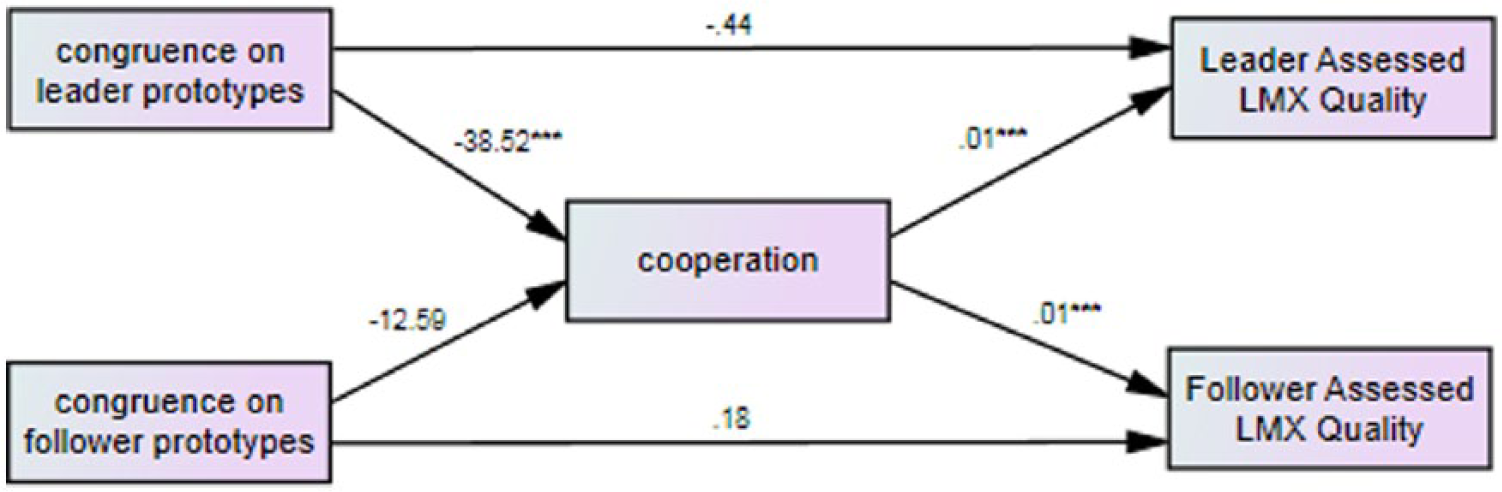
Manifest path model for cooperation mediating the relationship between leader prototype congruence and leader assessed LMX quality as well as the relationship between follower prototype congruence and follower assessed LMX quality (Hypothesis 1a and Hypothesis 1b).
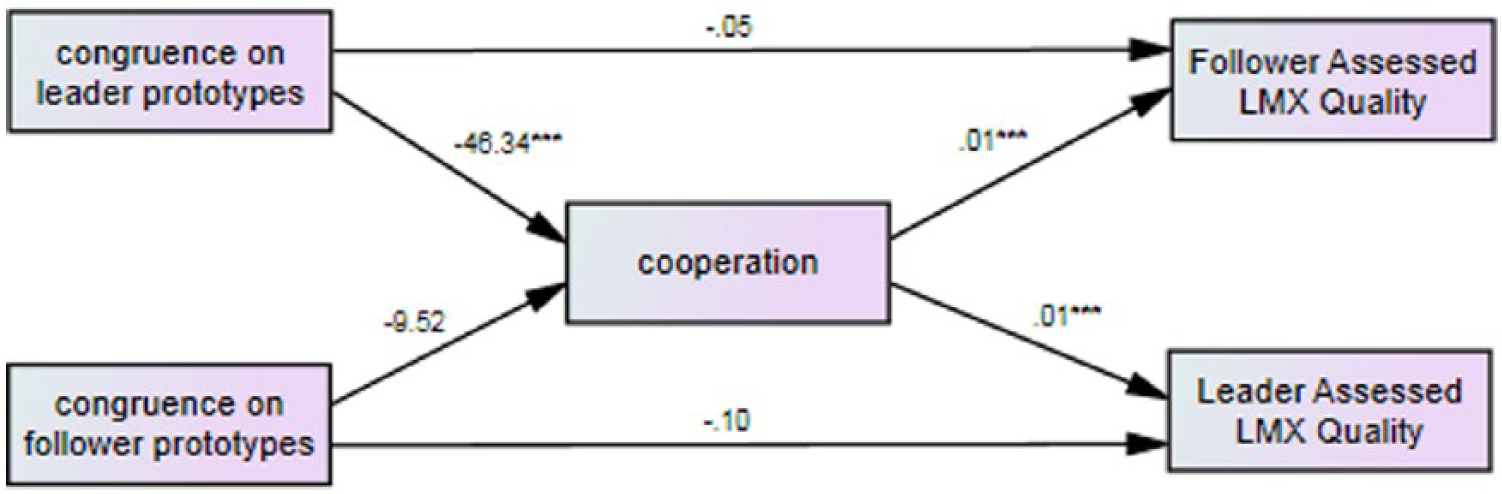
Manifest path model for cooperation mediating the relationship between congruence on leader prototypes and follower assessed LMX quality as well as the relationship between congruence on follower prototypes and leader assessed LMX quality (Hypothesis 2a and Hypothesis 2b).
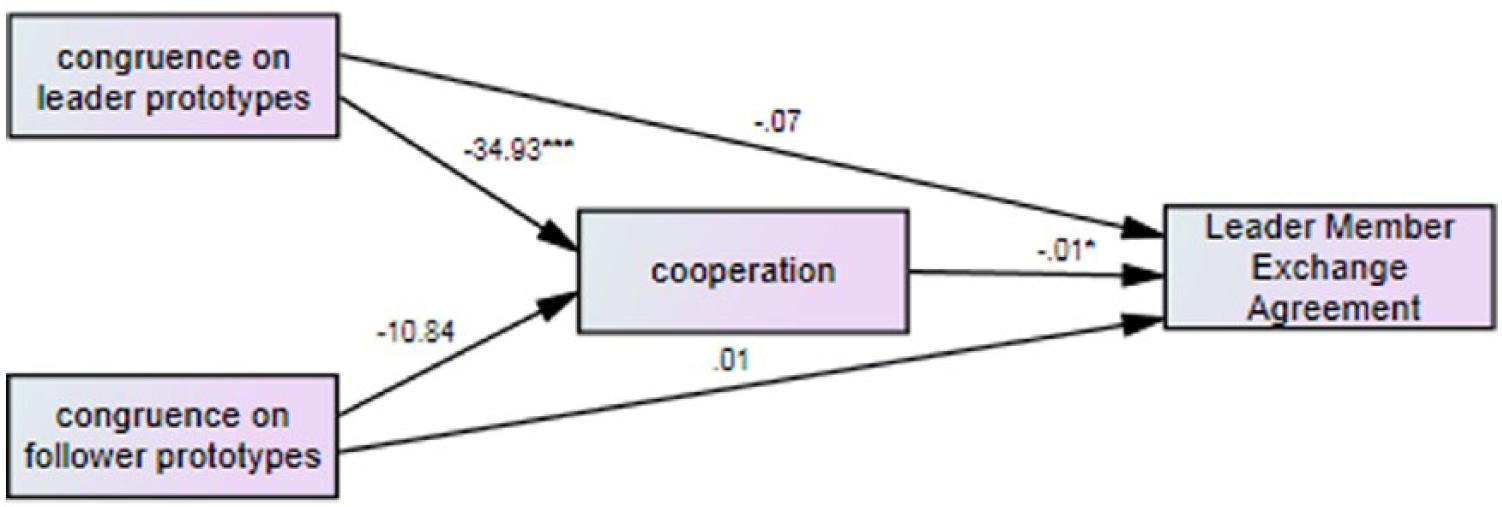
Manifest path model for cooperation mediating the relationship between leader prototype congruence and LMX agreement as well as the relationship between follower prototype congruence and LMX agreement (Hypothesis 3a and Hypothesis 3b).
Patterns of Cooperation in LMX Relationships
Based on the work of Yammarino and colleagues (Atwater, Ostroff, Yammarino, & Fleenor, 1998; Atwater, Waldman, Ostroff, Robie, & Johnson, 2005; Atwater & Yammarino, 1997; Yammarino & Atwater, 1997), Cogliser et al. (2009) introduced a conceptual model for examining leader and follower perceptions of LMX, as well as outcomes of LMX agreement, across four categories of exchange quality: balanced/high (exchange quality rated high by both dyadic partners), balanced/low (exchange quality rated low by both partners), follower underestimation (exchange quality rated high by the leader and low by the follower), and follower overestimation (exchange quality rated high by the follower and low by the leader). Cogliser et al. (2009) showed congruent relationships were associated with higher follower outcomes, while incongruent relationships were associated with intermediate levels of follower outcomes.
When using cooperation to define the categories, rather than LMX, patterns of reciprocity between leaders and followers can be examined using this framework. Previous research has demonstrated pattern-oriented approaches to leadership can provide unique insights regarding prototypical characteristics of leaders and followers and LMX as well as well as complement existing variable-oriented analyses (Cogliser et al., 2009; Foti, Bray, Thompson, & Allgood, 2012). To build on the findings of Cogliser et al. (2009) and provide a comprehensive examination of LMX, we frame this model for examining cooperation as a direct indication of the exchange relationship, and examine LMX ratings, as well as LMX agreement, as outcomes of cooperation and predicted the following:
Method
Participants
The sample size consisted of 136 participants organized into 68 dyads (N = 68). Participants were undergraduate students recruited from psychology and management courses at a large South-Eastern University across two academic semesters. Participants were assigned to one condition in a 2 (gender of leader) × 2 (gender of follower) experimental design. That is, 17 dyads contained a male leader with a male follower, 17 contained a male leader with a female follower, 17 contained a female leader with a male follower, and 17 contained a female leader with a female follower. To maintain participant anonymity, a limited amount demographic data were collected, and informed consent was obtained prior to and separately from all other data.
Procedure
Participants arrived in groups of two, four, or six, with a median of four. On arrival, participants were randomly assigned to dyadic pairs and assigned to a role as either leader or follower after giving informed consent, although they were not informed of any of these assignments (partner or role) at this time. Participants then completed a questionnaire measuring their leader and follower prototypes. Upon completion, they were asked to complete Task 1 as a group. The purpose of this task was to allow participants to form an opinion of other participants without any role labels. Following the successful conclusion of this task (all groups completed Task 1 successfully), dyadic pairs were separated into different research rooms. Dyadic partners were then informed of their role as either “leader” or “follower” and participated in Task 2 with their dyadic partner. The purpose of Task 2 was to evaluate the exchange relatoinship. During this task, cooperation in the dyad was measured as a direct indication of LMX. Following this task, participants completed surveys assessing the relationship quality. The procedure took 1 hour on average.
Tasks
Two tasks were used in this experiment. Task 1 was designed to allow participants to form an opinion of other participants without role labels. In Task 1, a 5 × 8 floor grid was organized into 1 square foot sections, yielding a rectangular shaped grid with a total of 40 squares. One correct path containing 13 squares leading across the length of the rectangle from one side to the opposite side was determined in advance. The objective for the group was to find and take the correct path through the grid from one side to the other through a series of trial and error.
Participants took turns attempting to navigate through the grid; they were able to move side to side, diagonal, or forward in any direction, but not backwards. When a participant stepped on a correct square, he/she was notified by the research assistant and allowed to continue, however, if they stepped on an incorrect square, they were instructed by the research assistant to return to the starting side of the map. At this point, it was the next participant’s turn to make an attempt. The person in a current attempt to navigate the map was allowed to receive assistance from the previous participant regarding which squares were correct but not from any other participant. No participant was allowed to delegate tasks to the group at any time. In addition, each participant had a chance to observe other individuals in both the leader and follower role. Thus, each participant had the opportunity to observe and subsequently form an initial opinion of their subsequent partner, without the bias of being associated with only one role (e.g., leader vs. follower). This task was complete when the correct path was found, and all participants had successfully taken the correct path to the other side. If an error was committed after the correct path had been found, all participants having successfully made it to the finishing side had to return to the starting side. On average, 15.5 minutes were needed for groups to complete this task successfully.
Task 2 was a matrix game designed to evaluate leader–follower exchange relationships (Zahn & Wolf, 1998). In this task, leaders were given two cards labeled “support” and “ignore” while followers were given cards labeled “work” or “loaf” that depicted strategy alternatives each participant could take. Both participants were given a pay-off matrix outlining the potential points earned as a result of their joint decision. Both participants were allowed to communicate as frequently as they wish; however, communication was restricted to 10 seconds between rounds. To prevent participants from being prompted in specifically competitive or cooperative ways, no other specific instructions were given. In addition, each participant sat side by side (Zahn & Wolf, 1998). Participants were asked to show their cards simultaneously, indicating which strategy they chose to take. Points awarded for each round were disclosed afterwards. After the completion of 75 rounds, total points were disclosed. On average, 29 minutes were needed for dyads to complete this task.
Measures
Leader Prototypes
Leader prototypes were measured using a 21-item version of the original 41-item scale developed by Offermann, Kennedy, and Wirtz (1994) and revised by Epitropaki and Martin (2004) to measure the characteristics believed to be prototypical of leaders. Participants were asked to rate how characteristic a list of 21 traits is of a leader, with no definition of the term provided (Epitropaki & Martin, 2004). This scale includes six dimensions: Sensitivity, Intelligence, Dedication, Dynamism, Tyranny, and Masculinity. Higher scores signified stronger standing on the traits prototypical of leaders. Both leaders and followers completed this measure. Each trait was rated on a 9-point scale with response options ranging from (1) not at all characteristic to (9) extremely characteristic. Congruence on leader prototypes was measured by taking the square root of the sum of squared differences between ratings by each member of the dyadic pair for each item. Edwards (1994) called this statistic “D.” In this regard, a lower score signifies more congruence on leader prototypes.
Follower Prototypes
Follower prototypes were measured using a 9-item scale based on the traits identified by Sy (2010) and adapted by Whiteley, Sy, and Johnson (2012) to measure the positive characteristics believed to be prototypical of followers. Participants were asked to rate how characteristic a list of 9 traits is of a follower, with no definition of the term provided (Sy, 2010). This scale includes three dimensions: Industry, Enthusiasm, and Good Citizen. Higher scores signified stronger standing on the traits prototypical of followers. Both leaders and followers completed this measure. Each trait was rated on a 9-point scale with response options ranging from (1) not at all characteristic to (9) extremely characteristic. As with leader prototypes, congruence on follower prototypes was measured by taking the square root of the sum of squared differences between ratings by each member of the dyadic pair for each item. As with leader prototype congruence, a lower score signifies more congruence on follower prototypes.
Cooperation
Cooperation was operationalized by taking the sum of total points awarded to the leader and the follower for each round during the matrix game and then adding these sums for all 75 rounds. In this way, each dyad had one total score of cooperation, even though both partners had separate point totals during the task. If both dyadic partners chose to cooperate for a round, the leader earned 5 points and the follower earned 3 points; thus they earned a total of 8 points for the round. If one partner chose to cooperate and the other chose to defect, the cooperating partner lost 10 points and the defecting partner gained 10 points; thus they earned a total of 0 points for the round. If both partners defected, the leader lost 5 points and the follower lost 3 points; thus they earned a total of −8 points for the round. In this way, higher scores signified higher cooperation. The maximum possible score was 600 and the minimum possible score was −600 (see Table 1).
Means, Standard Deviations, Correlations, and Reliability Coefficients for Dyadic Variables.

Note. N = 68. Gender represents dyadic controls for gender, where 1 = a male/male dyad, 2 = male leader/female follower dyad, 3 = a female leader/male follower, and 4 = a female/female dyad. Experimenter was coded using a predetermined number assigned to each experimenter. Leadership experience is self-reported total number of years of general experience in a leadership role.
p < .05. **p < .01. ***p < .001.
Leader–Member Exchange
Leader–member exchange quality was measured using the 10-item LMX-SLX scale originally developed by Graen, Hui, and Taylor (2004) specifically to assess both leader and follower perspectives of the exchange relationship (e.g., “My leader/follower has confidence in my ideas”). These items were measured on a 5-point scale with response options ranging from (1) strongly disagree to (5) strongly agree. Previous research found scores on this measure demonstrate satisfactory psychometric properties including reliability (e.g., Graen, Hui, & Taylor, 2006; Scherbaum, Naidoo, & Ferreter, 2007). Higher scores signify higher quality LMX as assessed by each dyadic partner. As with leader and follower prototypes, LMX agreement was measured by taking the square root of the sum of squared differences between ratings by each member of the dyadic pair for each item. In this regard, a lower score signifies more LMX agreement.
Results
Table 1 presents means, standard deviations, and correlation coefficients for the dyadic variables of interest. No significant correlations were found between any of the control variables (gender manipulation, experimenter, group size, and leadership experience; e.g., clubs, activities). Cronbach’s alpha for outcome variables of LMX from the leaders’ perspective (.95) and from the followers’ perspective (.94) indicated strong reliability. Cronbach’s alpha for each of the six subscales of leader prototypes in this study are listed as follows: Sensitivity (.63), Intelligence (.71), Dedication (.70), Dynamism (.70), Tyranny (.85), and Masculinity (.88). Cronbach’s alpha for each of the three subscales of follower prototypes are listed as follows: Industry (.92), Enthusiasm (.84), and Good Citizen (.88). These reliability coefficients, for the most part, demonstrate acceptable reliability for the scales used in this study.
Assessment of Construct Validity
Construct validity for the measures was established using a confirmatory factor analysis framework. A measurement model specifying all latent constructs together as well as several models specifying fewer latent constructs were fit and compared with test for convergent and divergent validity using AMOS, version 22. Because the item “pushy” was highly correlated with “domineering” (.56) and “manipulative” (.69), within the “tyranny” subscale of leader prototypes, residuals from these items were allowed to covary. The results are presented in Table 2. Overall, the model specifying 10 latent variables (six subscales within the leader prototype measure, three subscales within the follower prototype measure, and LMX) indicated acceptable fit: χ2(619) = 902.87 (p < .05; normed χ2 = 1.49); comparative fit index (CFI) = .90; incremental fit index (IFI) = .90; root mean square error of approximation (RMSEA) = .06. The latent constructs were allowed to covary. All models testing fewer latent constructs fit poorly, suggesting adequate construct validity for the measures used in this study.
Overall Reliability Fit Indices for Measurement Models using Confirmatory Factor Analysis.

Note. N = 136. Numbers in bold indicate acceptable fit indices. CFI = comparative fit index; IFI = incremental fit index; RMSEA = root mean square of approximation.
p < .01.
Evaluation of Congruence Indices
Both leaders and followers completed measures of both leader prototypes and follower prototypes as well as assessments of LMX. Because leaders and followers could have equal scale scores equal, yet differ widely in their ratings of specific items (e.g., hardworking, intelligent, my leader/follower has confidence in my ideas), it was necessary to create a measure to examine the separate effects of similarity on leader prototypes, follower prototypes, and LMX. Edwards (1994) noted that congruence scores such as “D” (the square root of the sum of squared differences) have been used to represent similarity between leaders and subordinates, while Engle and Lord (1997) used “D” to estimate congruence on leader prototypes for leaders and followers. Although polynomial regression is preferred to measure congruence, the sample size in this study (N = 68) was insufficient in terms of statistical power to attempt such an analysis. Like other congruence scores, however, there a number of assumptions potentially hindering the reliability of using “D” (Edwards, 1994; Engle & Lord, 1997). Several important studies have shown congruence scores are sensitive measures in that they may pick up on differences in individual items as well as aggregate scales (Edwards, 1994; Engle & Lord, 1997; Johns, 1981). Furthermore, difference scores can be less reliable than their component scores and difficult to interpret (Edwards, 1994; Johns, 1981). Thus, we empirically evaluated “D” by following the procedure noted by Edwards (1994) and used by Engle and Lord (1997). The results are presented in Table 3.
Results of Regression Analysis Testing Effects of Prototype Congruence on Component Variables.

Note. N = 68. Unstandardized regression coefficients are reported. The first two terms in the regression model used in the current study reflect the component variables (the separate effects of leaders’ and followers’ perspective). The third term, as recommended by Edwards (1994) and Engle and Lord (1997), is a dummy variable (W1) taking a value of 0 if leaders’ perspective is greater than or equal to followers’ perspective and of 1 if leaders’ prototype is less than the followers’ prototype as recommended by Edwards (1994) and used by Engle and Lord (1997). The final two terms show the interaction of this dummy variable and the leaders’ and followers’ perspectives. These three terms (W1, W1 × leader perspective, and W1 × follower perspective) allow the regression slopes and intercepts to change at the point at which leader and follower scores are equal (Engle & Lord, 1997).
p < .10. *p < .05. **p < .01. ***p < .001.
These models explained a significant amount of variance in the “D” of leader prototypes (37%), follower prototypes (83%), and LMX (81%). In addition, these models demonstrated acceptable empirical support for the constraints Edwards (1994) identified as being inherent in interpretable absolute difference models. These constraints, for each congruence measure, were identified as follows (Edwards, 1994). First, the weights for the leader and follower prototypes components should be significant and of opposite sign. Second, the leader component should be of opposite sign to the interaction of a dummy variable (labeled W1) and the leader component for leader prototypes and approximately twice as large. This dummy variable is calculated at the dyadic level and takes a value of 0 if leaders’ perspective is greater than or equal to followers’ perspective, and a value of 1 if leaders’ prototype is less than the followers’ prototype. Third, the interaction of the dummy variable (W1) and the follower component should be of opposite sign to the follower component and approximately twice as large. Finally, the regression weight for W1 should not be significant. As our models generally showed support for these constraints, we believe these empirical tests show justification for interpreting “D” as primarily reflecting congruence in leaders’ and followers’ prototypes, as in previous research (Engle & Lord, 1997).
Path Analyses Testing Cooperation as a Mediator
To test Hypotheses 1 through Hypotheses 4, manifest path models were specified with observed cooperation as a mediator between congruence on observed scores of leader and follower prototypes and relationship quality reported by each dyadic partner. Because of the sample size in this study (N = 68), three mediation models were fit to satisfy the requirement for adequate statistical power. At the dyadic level, only some items appeared to be reasonably normally distributed; follower assessed LMX and LMX agreement showed evidence of high kurtosis; thus, the decision was made to use an asymptotically distribution free estimation technique; which is appropriate in instances of nonnormality with respect to kurtosis. The fit of these models was then assessed. Mediation was determined using recommendations made by Zhao, Lynch, and Chen (2010), who noted that mediation should be tested by examining the indirect (or mediated) effect of antecedent (congruence) on the outcome (LMX). Significance of the indirect effects were evaluated using confidence intervals (CI) based on 5,000 bootstrap samples. Following, the direct effects of congruence variables on LMX were evaluated to classify the mediation type (Zhao et al., 2010).
Figure 1 shows the manifest path model testing cooperation mediating the relationship between leader prototype congruence and leader assessed LMX quality as well as the relationship between follower prototype congruence and follower assessed LMX quality (Hypothesis 1). Because of the high correlation between leader and follower assessed LMX, the residuals of these variables were allowed to covary. The mediated model showed good fit: χ2(3) = 2.20 (p > .05; normed χ2 = .73); CFI = 1.00; IFI = 1.00; RMSEA = .00. The indirect effect of congruence on leader prototypes on leader assessed LMX was significant (−.38; CI = −.90 to −.11; p < .05), thus providing support for mediation and Hypothesis 1a (Zhao et al., 2010). The direct effect was not significant (−.44; CI = −1.06 to .16; p > .05), providing support for indirect-only, or full, mediation, consistent with the proposed theoretical framework (Zhao et al., 2010). The direction of the path coefficient leading from the congruence on leader prototypes was negative, indicating that as congruence values decrease (higher congruence), cooperation and assessed LMX increase. Additionally, the indirect effect of congruence on follower prototypes on follower assessed LMX was not significant (−.12; CI = −.41 to .06; p > .05). As such, Hypothesis 1b was not supported (Zhao et al., 2010). The direct path from congruence on follower prototypes to follower assessed LMX was not significant (.18; CI = −.24 to .53; p > .05), indicating no effect. Cooperation, however, significantly predicted both leader and follower assessed LMX (.01; p < .05).
Figure 2 shows the path model testing cooperation mediating the relationship between congruence on leader prototypes and follower assessed LMX quality as well as the relationship between congruence on follower prototypes and leader assessed LMX quality (Hypothesis 2). Again, the residuals of leader and follower assessed LMX were allowed to covary. The mediated model showed good fit: χ2(3) = 4.19 (p > .05; normed χ2 = 1.40); CFI = .96; IFI = .97; RMSEA = .08. The indirect effect of congruence on leader prototypes on follower assessed LMX was significant (−.49; CI = −1.10 to −.16; p < .05), thus providing support for mediation and Hypothesis 2a (Zhao et al., 2010). The direct effect was not significant (−.05; CI = −.58 to .16; p > .05), providing support for indirect-only mediation, consistent with the proposed theoretical framework (Zhao et al., 2010). Additionally, the indirect effect of congruence on follower prototypes on leader assessed LMX was not significant (−.12; CI = −.42 to .12; p > .05). As such, Hypothesis 2b was not supported (Zhao et al., 2010). The direct effect from congruence on follower prototypes on follower assessed LMX was not significant (−.10; CI = −.52 to .38; p > .05), indicating no effect. Again, cooperation significantly predicted leader and follower assessed LMX (.01; p < .05).
Figure 3 shows the manifest path model testing cooperation mediating the relationship between leader prototype congruence and LMX agreement (Hypothesis 3) as well as the relationship between follower prototype congruence and LMX agreement (Hypothesis 4). The mediated model showed good fit: χ2(1) = .40 (p > .05; normed χ2 = .40); CFI = 1.00; IFI = 1.06; RMSEA = .00. The indirect effect of congruence on leader prototypes on LMX agreement was significant (.04; CI = .00 to .10; p = .05), thus providing support for mediation and Hypothesis 3a (Zhao et al., 2010). The direct effect was not significant (−.07; CI = −.20 to .03 p > .05), providing support for indirect-only mediation, consistent with the proposed theoretical framework (Zhao et al., 2010). Additionally, the indirect effect of congruence on follower prototypes on LMX agreement was not significant (.01; CI = −.01 to .04; p > .05). As such, Hypothesis 3b was not supported (Zhao et al., 2010). The direct effect from congruence on follower prototypes on LMX agreement was not significant (.01; CI = −.08 to .09; p > .05), indicating no effect.
Patterns of Cooperation in Dyadic Exchange Relationships
A number of interesting observations were made regarding the relationships between dyadic partners during the matrix game (Task 2). As demonstrated by Zahn and Wolf (1998), multiple strategies, including tit-for-tat, win/stay lose/change, altruism, and equality were observed. The behavior of one partner had a tendency to subsequently influence the behavior of the other. For example, the defecting of one partner frequently led to the defection of the other partner in the following round. Most exchange relationships appeared to be mutual over the course of the matrix game (25 dyads mutually cooperated, 25 dyads mutually defected); however, some exchange relationships were unbalanced (in 9 dyads, leaders cooperated more frequently; in another 9 dyads, the pattern was reversed).
To examine direct exchanges between leaders and followers, we adopted the framework established by Cogliser et al. (2009) using cooperation to define the categories of dyadic interactions rather than LMX. Similar to Cogliser et al. (2009), median splits were used to determine membership; however, unlike with Cogliser et al. (2009), these splits were on each dyadic partners’ score on the matrix game. Balanced relationships in which both dyadic partners predominantly were observed to cooperate with each other, resulting in a high score on the matrix game, were labeled as balanced/high cooperation. Balanced relationships in which both dyadic partners predominantly were observed to defect, resulting in a low score on the matrix game, were labeled balanced/low cooperation. Unbalanced relationships in which the leader predominantly was observed to cooperate, while the follower was observed to defect, resulting in the leader scoring higher than the follower, were labeled more leader cooperation. Unbalanced relationships in which the leader predominantly was observed to defect, while the follower was observed to cooperate, resulting in the follower scoring higher than the leader, were labeled more follower cooperation.
Multinomial Regression Analysis
Hypothesis 4a predicted that dyads with more congruence on leader prototypes would have greater odds of experiencing a mutually cooperative exchange relationship. Hypothesis 4b predicted that dyads with more congruence on follower prototypes would have greater odds of experiencing a mutually cooperative exchange relationship. Multinomial logistic regression was used to examine these odds. Table 4 presents the coefficients, standard errors, odds ratios (OR), and 95% Cis of more leader cooperation, more follower cooperation, and balanced/low cooperation exchange relationships relative to balanced/high cooperation relationships for each one unit increase in congruence on both leader and follower prototypes. As mutually cooperative dyadic relationships should theoretically have the most positive exchanges, this category was chosen as the reference group.
Standardized Estimates, Odds Ratios, and 95% Confidence Intervals of More Leader Cooperation, More Follower Cooperation, and Balanced/Low Cooperation Exchange Relationships Relative to Balanced/High Cooperation Relationships.

Note. SE = standard error; CI = confidence interval.
p ≤ .05.
First, for a one-unit increase in leader prototypes for more follower cooperation exchange relationships relative to balanced/high cooperation dyadic relationships the OR was 1.35, given congruence on follower prototypes is held constant. In other words, given a one-unit increase in congruence on leader prototypes values (as dyadic partners experience less congruence on leader prototypes), the odds of having more follower cooperation in an exchange relationship is 1.35 times more likely. In addition, the OR for a one-unit increase in leader prototypes for balanced/low cooperation exchange relationships relative to balanced/high cooperation dyadic relationships was 1.28. Given a one-unit increase in congruence on leader prototypes (as dyadic partners experience less congruence on leader prototypes), the odds of having a balanced/low cooperation dyadic relationship is 1.28 times more likely. The OR for leader cooperative/follower defective exchange relationships relative to mutually cooperative relationships was nonsignificant.
Second, for a one-unit increase in follower prototypes for more leader cooperation exchange relationships relative to balanced/high cooperation exchange relationships the OR was 1.37, given congruence on leader prototypes is held constant. Given a one-unit increase in congruence on follower prototypes (as dyadic partners experience less congruence on follower prototypes), the OR of having more leader cooperation in an exchange relationship is 1.37 times more likely. The ORs for more follower cooperation exchange relationships and balanced/low cooperation exchange relationships relative to balanced/high cooperation exchange relationships were nonsignificant. As such, Hypothesis 4a and Hypothesis 4b are partially supported.
Tests of Mean Differences in LMX
Hypothesis 5a predicted that dyads with balanced/high cooperation exchange relationships will show higher ratings of LMX as assessed by leaders than dyads with balanced/low cooperation relationships and unbalanced exchange relationships. Hypothesis 5b predicted that dyads with balanced/high cooperation exchange relationships will show higher ratings of LMX as assessed by followers than dyads with balanced/low cooperation relationships and unbalanced exchange relationships. Means difference tests were used to examine the differences on leader and follower assessed LMX. Specifically, we were interested in comparing the results of Cogliser et al. (2009) to those obtained in this study. Table 5 reflects the mean scores obtained from the univariate analysis of covariance (ANOVA) models for the congruence variables (leader assessed LMX, follower assessed LMX and LMX agreement) across the four patterns of cooperation in exchange relationships previously discussed. The one-way ANOVAs for leader assessed and follower assessed LMX were significant at p < .05. Surprisingly, the one-way ANOVA for LMX agreement was not significant. Following the one-way ANOVAs, post hoc tests were conducted on both partners’ assessments of LMX.
Mean Group Differences for LMX by Patterns of Cooperation in Exchange Relationships.

Note. Letters in subscript indicate group means are significantly different from each other (p < .05).
For leader assessed LMX, balanced/high cooperation exchange relationships showed the highest mean assessment of LMX, while more leader cooperation exchange relationships showed the lowest mean assessment of LMX (M = 21.00). The mean score for balanced/high cooperation exchange relationships was significantly higher than balanced/low cooperation and more leader cooperation relationships but not significantly higher than more follower cooperation relationships.
For follower assessed LMX, balanced/high cooperation exchange relationships showed the highest mean assessment of LMX, while balanced/low cooperation exchange relationships showed the lowest mean assessment of LMX. The mean score for balanced/high cooperation exchange relationships was significantly higher than balanced/low cooperation and more follower cooperation relationships but not significantly higher than more leader cooperation exchange relationships. Thus, Hypothesis 5a and Hypothesis 5b were partially supported.
Discussion
This study investigated how congruence between dyadic partners’ leader prototypes and follower prototypes affects cooperation between dyadic partners as well as subsequent ratings of the exchange relationship. Specifically, we empirically evaluated both leader and follower prototypes from both leaders’ and followers’ perspective. Observed cooperation between dyadic partners was examined as a mediator between congruence on prototypes and LMX. Observed cooperation between leaders and followers indirectly mediated the relationship between congruence on leader prototypes and leader assessed LMX quality, indicating support for the proposed theoretical framework (Zhao et al., 2010) but not the relationship between congruence on follower prototypes and follower assessed LMX quality. In addition, cooperation between leaders and followers indirectly mediated the relationship between congruence on leader prototypes and follower assessed LMX quality but not the relationship between congruence on follower prototypes and leader assessed LMX quality. Cooperation also indirectly mediated the relationship between congruence on leader prototypes and LMX agreement, however, congruence on follower prototypes did not significantly predict cooperation or LMX agreement. These results suggest congruence on leader prototypes is important for how both leaders and followers evaluate the exchange relationship. The results also corroborate previous research by Chun et al. (2008), which asserted cooperation is predictive of both leaders’ and followers’ assessments of relationship quality.
The results of the multinomial regression show that dyads with less congruence on leader prototypes are more likely to have the leader defect in the exchange relationship rather than cooperate, regardless of what follower does, relative to balanced/high cooperation. In addition, dyadic partners with less congruence on follower prototypes are more likely to have more leader cooperation in an exchange relationships relative to exchange relationships with balanced/low cooperation. Therefore, dyadic relationships where the leader cooperates and the follower does not reciprocate positively may be likely to experience less agreement on LMX. The ANOVAs showed dyadic partners’ are likely to rate the exchange relationship lower if they perceive lack of positive reciprocity in the relationship. These findings add new insight to the framework established by Cogliser et al. (2009) by demonstrating that this framework is applicable to observed cooperation in an exchange relationship in addition to assessments of the relationship.
Implications
The results of the mediation models add meaningful insight to those of Engle and Lord (1997), who showed congruence on performance prototypes is a significant predictor of LMX in a field study of subordinate and supervisor relationships. Performance prototypes differ from follower prototypes in that they are “goal driven” theories; therefore, although there is some conceptual overlap, follower prototypes are broader and consist of both negative and positive descriptors (Sy, 2010). This suggests that performance is a characteristic of followers that is valued by leaders above and beyond other relevant qualities a follower may possess. In our study, congruence on leader prototypes also significantly predicted leader assessed LMX quality, which was not the case in Engle and Lord (1997). These differences in the results may be attributed to differences in the methodologies used and sample composition in each study, as demonstrated by Epitropaki and Martin (2005) about the importance of leader prototypes in LMX relationships. Our results add to these findings demonstrating that congruence on leader prototypes are valued by leaders as well as followers when assessing relationship quality. Furthermore, our study offers empirical support that congruence on leader prototypes is determinant of agreement on relationship quality (van Gils et al., 2010).
This study provides evidence that a fuller integration of research on leader and follower prototypes with LMX is fruitful and corroborate previous studies that made the case that the quality of each exchange relationship depends on the reciprocation of contributions to the relationship and brings a new perspective regarding the exchanges between leaders and followers (Dienesch & Liden, 1986; Graen & Scandura, 1987; van Gils et al., 2010). As such, a fuller integration of leader and follower roles in a field setting may lead to better understanding of the follower role, thus mitigating the negative stereotypes commonly associated with the follower role (Hoption, Christie, & Barling, 2012).
The results of this study make a significant contribution in terms of how leaders and followers develop LMX relationships, which affects many job-related outcomes. Such workplace outcomes have been shown to include, but are not limited to, higher satisfaction and commitment, less conflict, and higher performance ratings (Graen et al., 2004; Liden et al., 1993; Scandura & Graen, 1984). As noted in previous research, it is ill-advised for organizations to allow low-quality LMX relationships to permeate their workforces, as the effect of these relationships may be directly reflected in profits, revenues, and other financial indicators of success (Engle & Lord, 1997; Scandura & Graen, 1984). LMX-based interventions have been shown to help remedy such situations (Engle & Lord, 1997; Liden et al., 1993). If used, some form of cognitive norming, where organizational performance standards should be explicitly provided to leaders and followers, should be included, perhaps through the use of frame-of-reference training (Engle & Lord, 1997; Hauenstein & Foti, 1989).
Limitations and Future Research
As with many laboratory-based experiments, there were certain limitations that may limit the generalizability of the findings of this study. Most notably, the sample composition was limited to undergraduate students in a large South-Eastern University. Moreover, the relationships evaluated in this study were all short-term. Although these limitations were somewhat mitigated by controlling for gender and leadership experience, replication using different types of samples is needed. Furthermore, while testing these relationships in a field setting has been shown to be important (Liden et al., 1993), isolating effects in a laboratory setting is an important first step and should not be ignored. This approach has been taken in previous studies examining antecedents of LMX (Griffith, Connelly, & Thiel, 2011). Future research should focus on obtaining longitudinal data from supervisors and subordinates in a working environment to control for tenure and evaluate longer term relationships. Research using longitudinal data would be a logical step forward, as the dynamic nature of prototypes is not fully understood (Shondrick & Lord, 2010). Also, examining patterns of cooperation using pattern-oriented analysis methods such as latent class analysis or latent profile analysis with leader and follower prototypes as predictors of cooperation may add addition insight (Foti et al., 2012; Smith, Coyle, Baldner, Bray, & Geller, 2013).
Conclusion
In summary, this study makes a significant contribution in terms of how leaders and followers develop LMX relationships, which affects many job-related outcomes. Such outcomes include higher satisfaction and commitment, less conflict, and higher performance ratings (Graen et al., 2004; Scandura & Graen, 1984). As noted in previous research, organizations should not allow low-quality LMX relationships to exist in their workforces for these reasons (Engle & Lord, 1997; Scandura & Graen, 1984). In conclusion, these results shed new light regarding the complexity of the processes underlying leaders’ and followers’ assessments of LMX relationships with their dyadic partners.
Footnotes
Declaration of Conflicting Interests
The author(s) declared no potential conflicts of interest with respect to the research, authorship, and/or publication of this article.
Funding
The author(s) received no financial support for the research, authorship, and/or publication of this article.