



Abstract
The purpose of this article is to describe how organizations have evolved across three periods of modern economic history. These periods can be called the age of competition, age of cooperation, and age of collaboration. The major organizational forms that appeared in each of the three eras, including their capabilities and limitations, are discussed.
Keywords
I am grateful to have the opportunity in this scholarly essay to summarize the research on organizations that I have conducted over the past four decades. Virtually all of my research has been done collaboratively—with my mentors, colleagues, and doctoral students. In this essay, I will discuss how organizations have evolved as viewed through the perspectives and frameworks my colleagues and I have used or developed.
The time in which large-scale organizing began in the United States up until the present can be divided into three eras: the age of competition, age of cooperation, and age of collaboration. The first part of the article discusses the essential characteristics of competition, cooperation, and collaboration. This discussion sets the context for explaining why organizations developed the particular shapes and features of a given era. The second part of the article discusses the specific organizational forms that appeared in each of the three eras.
Characteristics of Competition, Cooperation, and Collaboration
An organization is a goal-directed, boundary-maintaining activity system (Aldrich & Ruef, 2006). Every organization is created to accomplish a particular mission or purpose. Just as in architecture where form follows function (Sullivan, 1896), an organization’s structures and processes must fit its purpose (Chandler, 1962). Managers operate organizations by identifying, assembling, and allocating resources (Penrose, 1959), including tangible and intangible resources such as people, money, and knowledge, to achieve their goals. Organizations adapt by reconfiguring their resources to maintain fit with their dynamic environments (Miles & Snow, 1984).
Organizations must continually solve the entrepreneurial, engineering, and administrative problems they face to survive and prosper (Miles & Snow, 1978). Organizations in the 19th- and 20th-century American economy faced very different social and technological conditions than do organizations today. One could argue that over the past 150 years or so, organizations had to learn how to, first, compete, then cooperate, and currently, to collaborate. Understanding the behavioral dynamics of competition, cooperation, and collaboration, therefore, helps explain why and when particular organizational forms appeared and how they function. Two important factors underlie the processes of competition, cooperation, and collaboration: (a) the motivation that energizes each type of behavior and (b) the beliefs and actions required to sustain behavior, especially the level of trust and commitment among the parties to a relationship (Miles, Miles, & Snow, 2005).
Competition
Firms view their know-how and capabilities as proprietary assets and the primary means by which they create economic value in the marketplace. Managers understand that protecting know-how is how a firm defends its competitive position. And competition—between firms and among units and individuals within firms—is the centerpiece of much of the global economy, a position justified by the expectation that vigorous competitive behavior will result in the most desirable economic outcomes (Porter, 1990).
Firms learn to accommodate competitive pressures with strategies that maximize the utilization of their particular mix of resources and capabilities while not encouraging damaging attacks from other firms. Inside firms, some reward systems encourage competitive behaviors among units and individuals, so organization members must learn over time where and how to compete as well as where and how to cooperate. Being careful—and calculating when, where, and with whom to share information—is an unquestioned part of most managers’ beliefs.
Competitive behavior is driven by organization members’ desires to achieve as large a share of the rewards available in a given situation as their energy and abilities will allow. This motivational assumption is explicit in economic theory: Individuals and firms act in their own self-interest, and they seek to maximize their returns. When the primary purpose of engaging in an activity is the economic reward it will bring, psychologists refer to the underlying motivation as “extrinsic”—the reward comes from a source external to the doer (Herzberg, 1966). On the other hand, when an individual engages in work or other activity for the sheer enjoyment of it, he or she is said to be motivated “intrinsically”—by the activity itself and not the external reward of pay or a promotion (Deci & Ryan, 1975). Although few activities are undertaken purely for either their intrinsic or extrinsic rewards, the primary form of motivation that drives an individual is important in differentiating among competitive, cooperative, and collaborative behaviors.
Participants in many settings, from business to politics to sports, expect other participants to learn and follow the basic rules of the game or activity. Those who do not are quickly spotted as people who are not to be trusted. Unfortunately, cheaters can and do win on occasion, so the level of trust that exists among participants in competitive situations is an important determinant of how they behave in those situations—how they treat the other party, how they handle relevant information, how they negotiate, and so on. The minimum level of trust that organization members expect of their superiors is that they will apply sanctions as specified in the rules (both the organization’s rules and general moral and ethical principles). A higher level of trust exists when superiors can be counted on to allocate rewards in a similarly fair and principled manner. In short, organization members in competitive situations seek sufficient trust to assure that basic rules and traditions will be followed.
In competitive situations, participants are assumed to calculate the returns they expect from their striving from beginning to end. Trust in competitive situations is usually calculated in advance, especially when the parties have had little, if any, experience with one another. Such calculation is required before participants can determine how they will behave in a particular deal, transaction, or situation. However, repeated interactions can provide a level of trust that lessens the need for deliberate, ongoing calculations of trust.
Cooperation
Cooperation occurs when one person or group helps another in carrying out a task whose outcome benefits both partners (Evans, 2003). The primary determinant of cooperative behavior, with respect to both individuals and organizations, is that the desired or chosen task cannot be accomplished alone. Sometimes, individuals and groups are forced to cooperate in order to survive, such as in ancient societies based on farming, hunting, or fishing (Udy, 1959). In today’s world, however, most cooperative ventures arise because the parties choose to work together to accomplish their mutual objectives. Parties engaged in cooperation still act in their own self-interest, but their interdependence requires different ways of making decisions and handling information than in competitive situations.
Both individuals and organizations must come to grips with the issue of trust in cooperative situations. Cooperation succeeds when the parties bring their respective resources to the venture and then jointly determine how to leverage and use those resources. If one of the partners exploits the situation in some way, then the overall venture cannot be successful and may not be sustainable. Most cooperative ventures, even those in which the parties trust each other, are secured by contracts. Contracts protect the cooperating parties against risk and damage (Williamson, 1975).
In recent decades, the phenomenon of “co-opetition” has been growing (Bengtsson & Kock, 2000). The word itself refers to simultaneous cooperation and competition. Advocates of co-opetition argue that the maximization of total benefit occurs when firms cooperate in the generation of wealth (creating the pie) while still competing for their own share of the enhanced outcome (dividing the pie). From a game theoretic perspective (Brandenberger & Nalebuff, 1997), co-opetition is the rigorous search for mutually advantageous agreements that lead to a higher potential gain for both parties. Strategies following co-opetition principles rely on complementary value-adding behaviors such as, for example, those between Microsoft and Intel or those between credit card companies and airline frequent flier programs. Such programs benefit two or more parties without constraining their individual efforts to obtain maximum returns. Similar strategies have been used in other settings involving bidding, negotiations, and customer and supplier relationships.
Co-opetition strategies highlight similarities in the underlying motives of both competitive and cooperative behavior. That is, in either a competitive or cooperative approach, the primary outcome that each party is pursuing is an improvement of its own position. Co-opetition is behavior that is extrinsically motivated, calculative, and self-serving.
Collaboration
Collaboration is a process of shared decision making in which all the parties with a stake in the problem constructively explore their differences and develop a joint strategy for action (Gray, 1989). Collaboration can be directed toward any mutually desired objective: solving a complex problem, resolving a persistent conflict, creating a new business firm, and so on. According to Appley and Winder (1977), collaboration works best when certain conditions are present, such as voluntary relationships in which the parties care for and are committed to each other. Collaboration is most effective when competent, mature individuals treat each other fairly and value their relationship as much as their own self-interest.
Collaboration differs from competition and cooperation in two main ways. First, cooperation is motivated by the benefits each party expects to receive from combining ideas, information, and resources. Therefore, while cooperative behavior may be enjoyable in its own right, it is primarily extrinsically motivated. Second, because cooperative behavior ultimately involves the pursuit of self-interest, it requires periodic or even continual assessment by each party of the amount of trust and commitment of the other party. In collaborative relationships, on the other hand, each party is as committed to the other’s interests as it is to its own, and this commitment reduces the need for the continual assessment of trust and its implications for how rewards will be divided. Because it is the relationship itself that is valued, collaborators can focus on its intrinsic aspects confident that any future returns will be equitably allocated. Thus, a collaborative relationship is built on intrinsic motivation and caring trust (von Krogh, 1998).
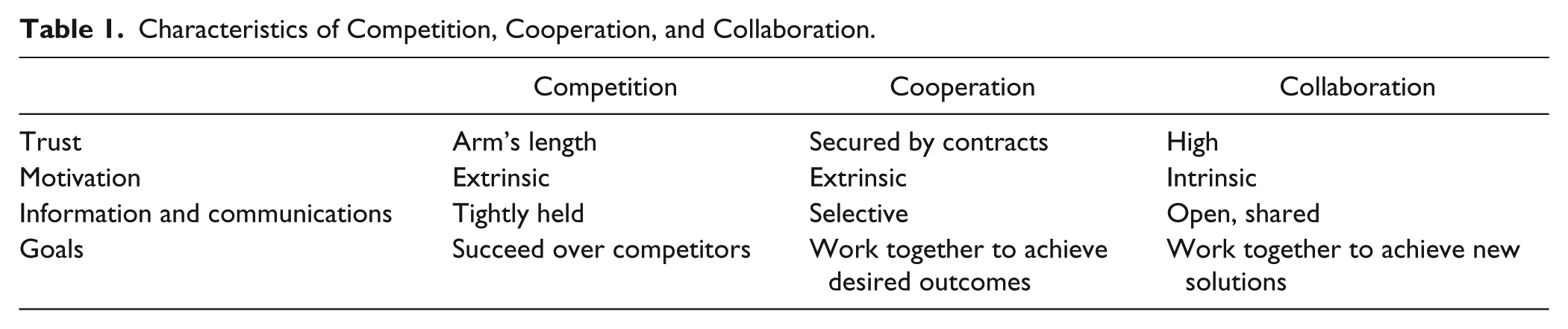
The characteristics of competition, cooperation, and collaboration are summarized in Table 1. These characteristics will help inform the discussion of organizational forms below. Every organizational form is a product of its era. This means that every organization must adapt to the conditions of its times—cultural attitudes, managerial philosophies, economic conditions, and so forth.
Characteristics of Competition, Cooperation, and Collaboration.
Organizations in the Age of Competition
In the United States, the first era in the development of large business firms began in the late 1800s and continued into the 1970s. This approximately 100-year period began with the emergence of nationwide markets for standard goods and services. Their creation was made possible by the establishment of transcontinental railroads and communications systems. Viewed in hindsight, the era of competition presented organizations with three successive challenges: (a) how to develop the technical and organizational capability to achieve efficient mass production, (b) how to segment markets and deliver customized products, and (c) how to manage existing businesses while diversifying into related or unrelated businesses.
Functional Structure
The companies that pioneered the organizational form appropriate for mass production were the railroads and steel producers (Chandler, 1962; Lawrence & Dyer, 1983). Andrew Carnegie, then in his early 30s, left his position with the Pennsylvania Railroad to start a company manufacturing steel rails. Convinced that the management methods he and others had developed on the railroad could also be applied to the manufacturing sector, Carnegie started the modern steel business in the United States. He played a major role in forging the world’s first billion-dollar corporation, U.S. Steel.
At the heart of Carnegie Steel’s success was its reliance on centralized management (particularly cost accounting and control) and vertical integration. Carnegie recognized early the benefits of vertical integration in the fragmented, geographically dispersed steel industry in the latter half of the 19th century. His company integrated backward into the purchase of ore deposits and the production of coke as well as forward into the manufacture of finished steel products. Vertical integration permitted a new “fit” in the steel industry: Substantially larger market areas could now be served more quickly, efficiently, and profitably.
As one of the leading companies in this period, Carnegie Steel adopted a functional organization structure, which it supplemented with plant design, transportation logistics, continuous technological improvements, and successful (though limited) product diversification. Other pioneering companies also contributed to the refinement and extension of the functional structure. Henry Ford, for example, developed his vaunted assembly-line manufacturing process during this time and was able to achieve national distribution of his Model T automobile. Unlike small, owner-managed firms that operated only locally or regionally, the size and complexity of the new mass producers required the use of professional managers. These individuals possessed the knowledge and skills needed to rationalize the use of the entrepreneur’s accumulated resources, increasingly substituting impersonal mechanisms of control and coordination for the owner’s direct supervision.
The success of the functional organization depended on the contributions of specialized departments (manufacturing, sales, accounting, etc.), coordinated and controlled by centrally determined plans, budgets, and schedules. The functional structure facilitated the development of technical competence within each of the functions as well as overall economies of scale. These strengths were offset by limitations in the ability to accommodate diversity and variability in the organization’s environment. In the United States, the functional structure was the dominant organizational form up until the end of World War I (1920).
Divisional Structure
At the end of World War I, many firms sought to pursue business opportunities that were emerging at the time, but their functional organizations were not well suited to strategies of growth and diversification. The company that initially developed the organizational form appropriate for this challenge was General Motors (Chandler, 1962). Among the early automobile makers, William C. Durant was a strong believer in the market potential of the moderately priced car. Acting on his beliefs, Durant put together a group of companies engaged in the making and selling of automobiles, parts, and accessories. In 1919, the total combined assets of General Motors made it the fifth largest company in the United States. Although Durant had moved rapidly to assemble a set of companies to take advantage of opportunities in the automotive market, he had little personal interest in further developing the organization he had created.
In combining individual firms into General Motors, Durant relied on the organizational approach of volume production and vertical integration that was popular at the time. This approach, however, led to little more than an expanding agglomeration of different companies making automobiles, parts, accessories, trucks, tractors, and even refrigerators. An unforeseen collapse in the demand for automobiles in 1920 precipitated a financial crisis at General Motors, which was quickly followed by Durant’s retirement as president. Pierre DuPont, who had been in semiretirement from the chemical company, agreed to assume the presidency of General Motors. One of DuPont’s first acts was to approve a plan devised by Alfred P. Sloan, a high-level General Motors executive, whose family firm had been purchased by Durant. Sloan’s plan defined an organizational structure for the fragmented company (Sloan, 1964).
Sloan’s organizational scheme, which went into effect early in 1921, called for a general office to coordinate, appraise, and set broad goals and policies for General Motors’ numerous loosely controlled operating divisions. Individually, the general officers were to supervise and coordinate different groups of divisions; collectively, they were to help make policy for the corporation as a whole. Staff specialists were to advise and serve both the division managers and the general officers, and to provide the business and financial information necessary for appraising the performance of the individual divisions and for formulating overall policy. Although most of Sloan’s proposals were carried out by the end of 1921, it was not until 1925 that the original plan resulted in a smooth-running organization. The divisional organization allowed General Motors to diversify a standard product, the automobile, to meet a variety of consumer needs and tastes while maintaining overall financial synergy.
From 1924 to 1927, General Motors’ market share rose from 19% to 43%. Unlike its major competitor, Ford, which had been devastated by the Depression, General Motors’ profits grew steadily throughout the Depression and World War II. The firm headed into the 1950s as the leading automobile manufacturer in the world, and for years was the corporate model for similar structural changes in other large American companies. The divisional form also facilitated overseas expansion by U.S. firms in the post–World War II period (Thompson, 1983). Divisionalized firms that had been selling their domestic products through overseas sales offices began to convert their international operations into country divisions, which could design and build goods especially for foreign markets. In such cases, the divisional organization was exported in its entirety—a new market simply meant that a new division was added to the organization structure.
The benefits of the divisional organization lie in its ability to collect and process information about various customer preferences and requirements, and to meet the demand by delegating operating authority to the divisions. R&D and finance remain centralized so headquarters managers can control the allocation of resources among divisions. Thus, the divisional form enables the exploitation of economies of scope in the service of differentiated customer demand (Teece, 1980). Its main limitation is constrained resource sharing across divisional lines.
Matrix Structure
The divisional form of organizing spread throughout American industry in the 1950s and on into the 1960s. The flexibility of the divisional approach allowed companies to pursue market opportunities quickly and effectively. As global and domestic demands became more complex, however, some companies were motivated to overcome the main difficulty associated with the multidivisional structure, namely, its inefficiency in allocating resources across product groups. The laboratory for the next set of organizational experiments was the aerospace industry.
At the time, aerospace and electronics firms that did business with the federal government regularly landed contracts that called for the development of sophisticated, one-of-a-kind products, often for military use. Firms bidding for such contracts found it difficult (or impossible) to hire new teams of engineering, scientific, and production personnel for each contract. It was prohibitively expensive to hold such personnel in an unproductive or underemployed status between projects. A more logical approach, it appeared, was to temporarily “draft” the human resources needed for a given project from the permanent departments that employed them on larger, standardized, and long-term projects. The permanent departments would continue to acquire and develop key human resources. With careful planning and some minimum amount of slack resources, these departments would move people to projects as needed and redeploy them within the department when they returned.
From 1960 to 1963, TRW Systems (a business unit of TRW Corporation) completed the transition from what had been almost a subsidiary of the U.S. Air Force to an independent, competitive aerospace company (Davis & Lawrence, 1977). TRW Systems, along with most other aerospace companies, organized itself into a form that came to be called the matrix (Mee, 1964). TRW’s matrix had five operating divisions: space vehicles, power systems, systems engineering and integration, electronic systems, and systems laboratory. In each division, there were two main types of managers: operations managers and project managers. Operations managers were in charge of functions such as fabrication and manufacturing. Their main job was to maintain and upgrade human and technical resources in their respective specialties. Project managers, on the other hand, were responsible for particular projects (e.g., Atlas, Titan, Saturn). Their job was to coordinate the resources needed by their project as well as work directly with the government and private customers. Over time, people and other resources flowed back and forth among projects and functions within the operating divisions. A simple matrix across functions and projects (or products) is called a two-dimensional matrix (Davis & Lawrence, 1977).
Matrix organizing combines into a single structure the best features of both the functional and divisional structures. The matrix seeks to capture the efficiency and specialization of the functional form as well as the customer focus and flexibility of the divisional form. The cost of simultaneous efficiency and flexibility is high internal complexity. As the matrix organization became increasingly sophisticated and refined in the 1960s, it spread from aerospace to other industries. Furthermore, the extension of matrix organizing to multinational firms began in earnest in the 1980s. In the international arena, matrix organizations were used to integrate products, functions, and regions of the world—a three-dimensional matrix structure. Virtually all large multinational corporations employ some form of matrix organizing (Galbraith, 2008).
Strategy, Structure, and Process
At the time of our original research in the 1960s and 1970s, the field of strategic management did not yet exist as a formal academic discipline. The Miles–Snow (1978) typology of organizations helped establish the field by integrating the literature on managerial strategizing and planning with the literature on organization theory. Our empirical studies included firms in a rapidly expanding industry (college textbook publishing), two industries adapting to new technologies (microelectronics and hospitals), and a stable industry (food processing). In each industry, we identified patterns in firms’ strategic choices as they competed in their particular environment. Prospectors were first to the market with new technologies and products, analyzers were adept at product enhancement and commercialization, and defenders were efficient producers of products in market segments that are predictable and expandable. Furthermore, our studies examined the relationship between a firm’s strategy and its management philosophy as well as the capabilities required by each strategy (Snow & Hrebiniak, 1980). An effective organization is one in which all of these elements are aligned in a coherent configuration (Ketchen, Thomas, & Snow, 1993; Snow, Miles, & Miles, 2005).
An organization’s environment is seldom static. Markets are constantly on the move as tastes change and advanced products and services raise expectations about future products and prices. Prospectors push an industry into new territory, and defenders help an industry remain efficient and cost-conscious, making sure the customer receives good value for low prices. Analyzers keep both prospectors and defenders alert—forcing prospectors to continue to innovate by improving on their offerings and prodding defenders to make new investments in efficiency by approaching their price levels with products or services of more advanced design. Healthy industries tend to be populated with firms pursuing these different but complementary strategies (Lei & Slocum, 2014; G. Miles, Snow, & Sharfman, 1993).
Organizations in the Age of Cooperation
Firms in the age of competition were self-reliant—they used only their own resources and capabilities to compete in their respective industries. During much of the decade of the 1970s, however, large American firms were widely criticized in the business press for their lack of competitiveness compared with large Japanese companies like Sony, Toyota, and Honda. In their attempts to become more competitive, American firms began to change how they were organized. Many firms downsized to reduce costs. Other firms removed layers of middle managers from their hierarchies to speed up decision making and resource allocation. Some firms began to subcontract a portion of their activities —first, manufacturing and, later, other functions—to external providers that were specialists in that particular activity. Gradually, a new organizational form emerged called the network organization (Miles & Snow, 1986; Thorelli, 1986).
A multifirm network organization is different from a traditional self-contained organization in several respects. First, instead of holding in-house all the resources needed to offer a product or service, multifirm networks use the collective resources of multiple firms. Each firm in the network specializes in a set of activities that constitute a portion of the total business. Second, multifirm networks rely heavily on market mechanisms in addition to administrative mechanisms to manage resource flows. In order to maintain its position in the network, a firm must behave efficiently and reliably, just as it would have to behave if it wanted to be successful in the open market. Third, lead firms in many multifirm networks expect their suppliers to contribute proactively—to engage in behaviors that improve the network rather than simply fulfilling a contractual obligation. Doing so can help the whole network learn, improve, and adapt. Last, a multifirm network can be more flexible and scalable than a traditional self-reliant organization. It can increase or decrease in size relatively quickly, and it can more easily expand its scope than a traditional organization.
The rise of the network form created the need for a new vocabulary to describe the new roles and relationships in this type of organization. In our formulation (Miles & Snow, 1994), a network organization consists of four main elements. The first is a network firm located at some point along an industry value stream. The network firm is likely to specialize in a few core competencies: Nike in R&D and marketing, Dell Corporation in customer-driven technology, and so on. Second, when various network firms team up with one another to operate a business, this set of companies constitutes an activated network. Companies in an activated network are partners—members of strategic alliances of greater or lesser permanence. Third, all the firms, whatever their current linkages, represent a network of potential partners. This set of firms in a dynamic industry changes frequently, as activated networks add new partners or shed existing ones. Last, a network organization requires new roles to be played by both firms and managers. For example, a network is usually organized and led by a lead firm. And within the network, someone (or some unit) must play the roles of broker, cooperator, and caretaker (Snow, Miles, & Coleman, 1992; Snow & Thomas, 1993).
The typical network firm is likely to be smaller in headcount than its non-network counterparts because it focuses on those activities to which it can make the greatest contribution along the supply chain. To succeed, a network firm must be managed in a manner that keeps its technical competencies current and its management know-how responsive to market changes. In addition, the network firm must maintain and enhance its ability to respond flexibly and efficiently to the needs of current and potential network partners. During the period in which two or more firms are linked to produce a product or service, the activated network thus created has clear cooperative properties. Each of the firms is expected to provide a customized response to the needs of its supply chain partners, a response that reflects its distinctive competence. Moreover, responses to partners must be timely and efficient. Firms must not exploit one another or impose costly conditions on their association. It is the task of key network managers to assist market forces in these exchanges. Managers from all the firms in an activated network add value to their network by sharing information and expertise, demonstrating goodwill and trustworthiness, and making certain their firms meet or even exceed their responsibilities.
The network form of organizing diffused widely in the 1980s and 1990s, to the point where it is commonly found in most industries today (Snow & Fjeldstad, 2015). A well-designed network organization has several advantages over a self-contained organization, including flexibility, the variety of capabilities that can be assembled, and the economies of scale and experience that can be leveraged in each activity. Through interfirm cooperation, a network organization can achieve a “relational” advantage (Dyer & Singh, 1998). The main limitation of network organizing is the high cost of control and coordination. An effective network needs to be hooked together by advanced infrastructure that allows for timely information flows among member firms so that they can largely self-control and self-coordinate. Leaders of the network must build the processes and systems to operate it efficiently, and they must avoid or remove bureaucracy that gets in the way of responsiveness.
Organizations in the Age of Collaboration
Knowledge-intensive industries such as computers, biotechnology, and microelectronics have been the spawning ground for the innovative organization designs that are evolving today. In industries where knowledge is complex, growing, and widely diffused, the locus of innovation extends beyond the individual firm (Powell, Koput, & Smith-Doerr, 1996). To leverage such knowledge, many firms have reorganized their value-creation processes through the use of various types of multiparty collaboration. Collaboration can increase value creation by expanding the availability and use of relevant knowledge and other resources. Collaboration has been shown to reduce risk, speed products to market, decrease the cost of product development and process improvement, and provide access to new markets and technologies (Wheelwright & Clark, 1992). In knowledge-intensive industries, those organizations that are unwilling or unable to collaborate may suffer the consequences of not being sufficiently innovative to keep pace with technical and market developments.
Recent organization designs have served to “open up” the process of problem solving or innovation (Chesbrough, 2003) to take advantage of the “wisdom of crowds” (Surowiecki, 2004). For example, InnoCentive uses a global network of scientists, engineers, and other problem solvers to help companies overcome technical challenges that they cannot overcome themselves. Along with major research universities and the national government of six countries, IBM’s six “collaboratories” develop solutions to complex problems such as electricity distribution on the island of Malta and traffic congestion in Moscow, Russia. Lego helps entrepreneurs start their own businesses by providing online toolkits featuring its popular building blocks. Apple provides a “platform” (Gawer & Cusumano, 2002) for a community of software engineers to develop applications for its smartphones. And Nike’s NIKEiD program enables sports enthusiasts to design their own shoes.
The age of collaboration is marked by the global proliferation of communication, financial, and logistics services that create value by linking actors who are or wish to be interdependent (Castells, 1996; Stabell & Fjeldstad, 1998). These societal infrastructure services reduce the cost of interaction and enable new ways of organizing exchange and innovation. The resulting complexity of global business and the need for rapid, effective responses to opportunities and challenges have put pressure on traditional hierarchical organizational forms. Attempting to redesign organizations to cope with such pressure challenges the usefulness of hierarchy as the primary mechanism of control and coordination. Following the logic of requisite variety (Ashby, 1956), hierarchies themselves could be made more complex to match the complexity of the environment, but there are control and coordination costs associated with increased hierarchical complexity (Jensen & Meckling, 1976; Williamson, 1975). The limitation of hierarchy as a control and coordination mechanism lies in the filtering and delay it imposes on the interactions among organizational units and/or external partners who are or want to be connected. In large organizations, it is difficult for upper level managers in a hierarchy to fully understand how resources contained both inside and outside the firm should be organized to take advantage of opportunities and overcome challenges. Furthermore, when uncertainty increases because of introducing new products, entering new markets, or employing new technologies, the result is more exceptions, more information processing, and an overloaded hierarchy (Galbraith, 1974).
New organization designs are emerging in which rich sets of resources are made available to large sets of actors who self-organize on unlimited sets of projects (Benkler, 2002). Common to these designs is the ability of organizational actors to dynamically form collaborative relationships. Reliance on self-organization and local decision making in the development and delivery of complex products and services requires mechanisms that allow actors to become aware of problems and opportunities, and identify and form relationships with suitable collaborators. Collectively, the collaborating parties must be able to manage their common resources and goals (Ostrom, 1990) and overcome the agency problem of free riding (Alchian & Demsetz, 1972; Olson, 1965). The lateral nature of decisions about which projects to pursue, which resources to share, and how returns will be divided is a major difference between the architecture of these emerging designs and previous organizational forms.
Based on our studies of a wide variety of collaborative organizations, we have developed an actor-oriented architectural scheme to replace the hierarchical scheme on which traditional organizations rely (Fjeldstad, Snow, Miles, & Lettl, 2012). Our actor-oriented scheme draws on well-established architectural principles expressed in object-oriented computer systems (Dahl & Nygaard, 1966), agent-based and blackboard-based artificial intelligence systems (R. Davis & Smith, 1983; Hayes-Roth, 1985), and the architecture of the Internet (Krol, 1993; Licklider, 1960). The architecture of the Internet allows it to be self-organizing—that is, each node decides the best routing for its own traffic by assessing adjacent nodes. In emerging organization designs, control and coordination are based on direct exchanges among the actors themselves rather than by hierarchical planning, delegation, and integration. Although hierarchy, in the sense of near decomposability (Simon, 1962), is present in newer organization designs, these designs rely mainly on lateral, reciprocal relationships among actors for control and coordination. Where the hierarchical scheme establishes specific superior–subordinate relationships, the actor-oriented scheme contains mechanisms by which dynamic networks of relationships can be established, maintained, and dissolved.
The actor-oriented organizational scheme has three elements: (a) actors, who have the capabilities and values to self-organize; (b) commons, where the actors accumulate and share resources; and (c) protocols, processes, and infrastructures that enable multiactor collaboration. Taken together, these elements both create and function within organizational contexts consisting of various combinations of transparency, shared values, norms of reciprocity, trust, and altruism.
Control and coordination in an actor-oriented organization are accomplished via direct interaction among the actors themselves rather than by hierarchical authority. Infrastructures—systems that connect actors—allow actors to connect with one another as well as access the same information, knowledge, and other resources. Competent actors who have the knowledge, information, tools, and values needed to set goals and assess the consequences of potential actions for the achievement of those goals, can self-organize. Self-organizing actors use protocols to guide their collaboration. Protocols are codes of conduct used by organizational actors in their exchanges and collaborative activities. An important category of protocols deals with the division of labor—the mobilization and linking of actors for a particular project or task. Examples are protocols by which actors advertise problems or opportunities as well as their own capabilities and availability, and protocols by which actors search for potential collaborators. Other protocol categories deal with interactor coordination within the resulting network. Commons refers to resources that are collectively owned and available to the actors. One example of a commons is shared situational awareness—an up-to-date portrait of problems and opportunities in the organization’s environment as well as the current availability of resources to address those problems and opportunities. Another type of commons is data sets that are available to all of the actors for their use in developing new solutions. Collectively, the elements of the actor-oriented organizational scheme enable large groups of collaborating actors to self-organize with only minimal use of hierarchical mechanisms.
Many of the collaborative communities we have studied benefit from the presence of a shared services provider (Bøllingtoft, Müller, Ulhøi, & Snow, 2012). For example, in Blade.org, a collaborative community of firms in the computer server market, shared services are provided by the Principal Office, a small group of people whose time and efforts are donated to Blade.org by its sponsoring firms (Snow, Fjeldstad, Lettl, & Miles, 2011). A shared services provider plays a facilitative role in the community, providing infrastructure and administrative services that serve the community as a whole. “Facilitating” collaborative activities among community members is different from “coordinating” or “orchestrating” those activities, the leadership role performed by managers in traditional organizations. A shared services provider can provide facilitative leadership to a collaborative community in numerous ways: (a) screening and/or selecting members, (b) providing infrastructures and protocols for members to connect and work with one another, (c) developing data sets and other types of resource commons, (d) providing educational services, (e) locating resources based on member requests, and (f) formulating strategic initiatives to help the community expand and improve.
Recent organization designs such as collaborative communities, customer co-creation, and crowdsourcing reflect a focus on large-scale collaborative behavior across sets of actors who follow protocols for sharing resources and rewards both within and across organizations. Multiparty collaboration is critical to the effective solution of complex problems and continuous adaptation to changing environments (Miles, Miles, Snow, Blomqvist, & Rocha, 2009).
Conclusion
Across the eras of competition, cooperation, and collaboration, managers and organization designers changed their views about the use of resources. During the age of competition, managers believed it was important to control resources through ownership. Whatever resources the firm needs, it is the management’s job to acquire those resources for use by the firm. During the age of cooperation, managers’ resource strategies expanded to include the practice of “link and leverage.” Here the belief is that the firm need not own all of its resources; it can also link to other firms and thereby gain access to external resources. Finally, during the age of collaboration, managers learned the value of sharing resources. By forming resource commons that multiple parties can share, organizations in certain kinds of situations can achieve increasing returns on their use of resources.
Organizations will continue to evolve as they reconfigure their resources and capabilities to pursue new opportunities and overcome existing challenges. Pioneering organizations will develop new organization designs that fit the particular circumstances in their sectors, and the new designs will diffuse as managers in other sectors adapt the designs to their own organizations. Overall, the result is organizations of greater complexity but also of greater speed and capability.
Footnotes
Declaration of Conflicting Interests
The author(s) declared no potential conflicts of interest with respect to the research, authorship, and/or publication of this article.
Funding
The author(s) received no financial support for the research, authorship, and/or publication of this article.
Author Biography
References
Supplementary Material
Please find the following supplemental material available below.
For Open Access articles published under a Creative Commons License, all supplemental material carries the same license as the article it is associated with.
For non-Open Access articles published, all supplemental material carries a non-exclusive license, and permission requests for re-use of supplemental material or any part of supplemental material shall be sent directly to the copyright owner as specified in the copyright notice associated with the article.
