



Abstract
This research studies the leadership development of 243 working MBA students and finds personal characteristics and career context to be associated with development of leadership behavior in general, and with specific leadership styles. Specifically, personal characteristics of proactiveness, risk taking, and social skill, and the career contextual variables number of subordinates, level of interaction with others, and time pressure are found to be associated with increased development of leader behavior. Gender was not a differentiator in the development of leadership; however, socially skilled males with high interaction working under time pressure exhibit directive leadership, while personality variables are associated with egalitarian leadership.
Introduction
Leadership is widely considered a source of competitive advantage and firms invest substantial resources in the development of leadership in their employees (McCall, 1998; Vicere & Fulmer, 1998). Because recruitment and training costs are substantial, especially in the white-collar professional and knowledge worker segments, firms can gain advantage by understanding how certain personal and career-contextual characteristics relate to leadership emergence in the early stages of employees’ careers. Bommer, Rubin, and Baldwin (2004) contend that leadership research should “shift the focus upstream” (toward antecedents), because such research has the potential to determine who will engage in leadership behaviors and who will not. Thus, this research seeks to determine whether nascent leadership behaviors can be predicted in early career white-collar professionals.
In our review of research on leadership antecedents, we found that most studies focused on one specific set of leader behaviors. Indeed, the Bommer et al. (2004) study focused only on transformational leadership, one of several important leadership paradigms (Pearce et al., 2003). Yukl (1998) posited that preoccupation with specific leadership archetypes was less desirable than studying an overall pattern of leadership behavior. This is particularly true given that leadership behaviors are not mutually exclusive, are often exhibited by the by same employee over time, and may be situationally appropriate (Bass, 1985; Pearce et al., 2003). Accordingly, we used a four-archetype framework proposed by Pearce et al. (2003) to include directive leadership (Arvey & Ivancevitch, 1980; McGregor, 1960; Quinn, Faerman, Thompson, & McGrath, 1990), transformational and transactional leadership (Bass, 1985), and empowering or shared leadership (Bandura, 1986; Erez & Arad, 1986; Manz & Sims, 2001). By studying four major leadership archetypes, we increase our ability to discover nascent leadership behavior in employees who may be responding to different situational cues.
Numerous antecedent characteristics, traits, and contexts have been examined as predictors of leadership emergence (Murphy & Johnson, 2011). In their 2004 meta-analysis, Bono and Judge (2004) argued that understanding personality traits has important implications for leadership selection and ultimately for leadership training and effectiveness. Chan and Drasgow (2001) explored the ability of sociocultural values, the quality of leadership experience, and leadership self-efficacy (along with personality and cognition) to explain variance in a construct they labeled “motivation to lead.” In their model, motivation to lead was posited to influence the actual emergence of leadership. Shamir and Howell (1999) proposed that organizational contexts, such as governance mode, level of technology, organizational level, task-value congruence, and so on, would affect the emergence of charismatic (transformational) leadership. Despite the breadth of variables studied, there has been significant repetition in the choice of antecedents and in the specific forms of leadership explored (e.g., using the Big Five personality factors to predict variation in the emergence of transformational leadership behaviors). Two major sets of antecedents emerge from the prior research: personal characteristics and career context (Woolley, Caza, & Levy, 2011). Accordingly, we initially ask the general question: What personal characteristics and career contextual variables are associated with the emergence of leadership behavior? We then ask whether certain personal or career-contextual task characteristics are associated with specific types of leadership behavior? Specifically, we differentiate between directive leadership behavior and egalitarian leadership behavior (e.g., where there is a two-way relationship between the leader and subordinates). Egalitarian leadership combines transactional, transformational, and empowering leadership based on the work of Pearce et al. (2003).
Literature Review
Prior research on leadership antecedents has varied in its focus and results. Leadership research before 1945 was primarily concerned with identifying traits, behaviors, and personality patterns that differentiated leaders from nonleaders (Fiedler, 1996). Fiedler also posited that leadership is a complex interaction between an individual and the social-task environment. Leadership research until the early- to mid-1980s was highly introspective or contingency based. According to Coad and Berry (1998), such work originally was focused on leadership traits (e.g., Barnard, 1938; Ghiselli, 1971; Stogdill, 1948), evolved to examine leadership styles (e.g., Blake & Mouton, 1964, Likert, 1961; McGregor, 1960), and eventually included contingency theories (e.g., Fiedler, 1967, Vroom & Yetton, 1973). During the 1980s, leadership research began to stress the role of followers and eventually focused on the reciprocal influence of leaders and followers to achieve a shared purpose (Coad & Berry, 1998; Pearce & Manz, 2014).
Bass’s (1985) model of transformational and transactional leadership exemplifies the reciprocal approach to leadership. Bass’s theory was an extension of Burns’s (1978) distinction between transformational and transactional leadership. According to Burns and Bass, transformational leadership is based on the shared values and common goals of the leader and follower(s). The relationship between both parties is mutually reinforcing, leading to increasingly higher levels of motivation. The end result is a movement toward congruent goal orientations between leader and follower(s). Transactional leadership (Bass, 1985) is completely independent from transformational leadership in that transformational and transactional leadership could be exhibited individually, together, or not at all (Coad & Berry, 1998). Quinn et al. (1990) agreed that leaders could perform multiple leadership behaviors simultaneously or sequentially. Transformational and transactional leadership have remained dominant paradigms in leadership research (Sashkin & Rosenbach, 1993; Yukl, 1998).
Pearce et al. (2003) describes an expanded leadership paradigm to include empowering and directive leadership. Empowering leadership is developed on Thorenson and Mahoney’s (1974) behavioral self-management, Meichenbaum’s (1977) cognitive behavior modification, and participative management and goal setting (Locke & Latham, 1990). Empowering leadership encourages opportunity thinking, self-reward, self-leadership, participative goal setting, and encourages sharing and teamwork (Pearce et al., 2003; Pearce & Manz, 2014), and similar to transformational and transactional leadership focuses on the exchange of leaders and subordinates.
Directive leadership is based on McGregor’s (1960) “Theory X” leadership, Fleishman’s (1953) initiating structure, and Arvey and Ivancevitch’s (1980) punishment research. Directive leadership involves authoritative behavior and is characterized by control, structure, punishment, and task orientation. While transformational leadership deals with mutual relationships, community, and goal congruence and achievement, and transactional leadership deals with transactions (economic or other) that motivate individuals to achieve a common goal through self-interest, Pearce et al.’s (2003) conceptualization of directive leadership imposes control, task structure and orientation, and punishment to achieve goals. In short, the leader makes all or most decisions, and the relationship is typically devoid of the reciprocal quality of the other three leadership behavioral types.
Antecedents to Leadership
Based on our review of the literature, we divided research into two categories that we believe to be important to our study of white-collar professionals: personal characteristics and career-contextual characteristics.
Personal Characteristics
The idea that personal characteristics might determine leadership potential originates with the early trait-based leadership research; however, results have been spotty. Some researchers discount trait theories entirely (House & Aditya, 1997). For example, House and Aditya (1997) concluded that there appear to be few universal traits associated with effective leaders. Still, there is some research to support the inclusion of personality and other individual characteristics in predictions of leader emergence. In their review, Judge, Bono, Remus, and Gerhardt (2002) found that none of the traits studied, except for self-confidence, emerged consistently as related to leadership. Judge et al. (2002) also provided a quantitative analysis linking the Big Five personality traits of extraversion, conscientiousness, and openness to experience, and neuroticism were the most heavily associated with leadership emergence. In another meta-analysis, Bono and Judge (2004) found that extraversion and neuroticism were linked to transformational leadership and a component of transactional leadership, contingent reward. In general, transactional leadership behaviors were less strongly related to personality than were ratings of transformational leadership behaviors. Despite the strength of the extraversion link, the results for the other four Big Five traits were mediocre, “indicating that the Big Five may not be the best way to discover personality antecedents of transformational and transactional leadership” (Bono & Judge, p. 908).
In a 1993 study, Mumford, O’Connor, Clifton, Shane, and Zaccaro (1993) posited that the popular dismissal of trait theories is premature in light of flaws inherent in some of the fundamental studies. This study examined a multitude of possible antecedents grouped into five scales: cognitive characteristics, motivational characteristics, social interaction characteristics, personality characteristics, and developmental (input) variables. According to Mumford et al. (1993), measures of cognitive capacity, motivation, and social skills are likely to yield prediction of leadership emergence, while personality variables and input variable scales were not found to be effective predictors of leadership emergence. Of interest to our study, social skill had a significant positive correlation with the emergence of leadership.
Another important personal characteristic/trait in prior research is gender (McColl-Kennedy & Anderson, 2005; Vecchio & Brazil, 2007). Early work in leadership found that men were more likely than women to emerge as leaders (Kent & Moss, 1994). Eagly (1983) indicated that women are more easily influenced and are less influential than men. Other research has found that the emergence of leadership behavior may depend on the type of task and the work climate (Woolley et al., 2011), specifically gender orientation of a group’s task matters greatly (Wentworth & Anderson, 1984). Men were more likely to emerge as leaders when the task was masculine-oriented, while women were likely to emerge as leaders when the task was feminine-oriented. Karakowsky and Siegel (1999) found that group members with gender differing from the gender orientation of the group’s task exhibited lower levels of emergent leadership compared to those performing a gender-congruent task. Overall, prior research indicates there is a relevant, albeit uncertain, relationship between gender and the emergence of leadership. Based on the above, we expect early career white-collar professionals will exhibit a set of personal characteristics that mark the possible emergence of leadership behaviors.
In accordance with the preponderance of gender–leadership emergence research described above, we hypothesize that men will be more likely to display signs of emergent leadership, due to their comparatively higher levels of social/group dominance and participation.
Prior research suggests certain personality traits will be associated with the emergence of leadership behavior. Specifically, extraversion (Bono & Judge, 2004; Judge et al., 2002), achievement motivation (Mumford et al., 1993), motivation to lead (Chan & Drasgow, 2001), energy level (Mumford et al., 1993), and creativity (Mumford et al., 1993). We posit that professionals who are extraverted, energetic, motivated, and creative will also exhibit risk taking and proactiveness, two traits stereotypical of successful white-collar professionals. Accordingly,
Finally, as indicated above, Fiedler (1996) described contemporary leadership as a complex interaction between an individual (leader) and the social-task environment. Particularly, because leadership may occur in a politicized environment, social skill may be important to the emergence of leadership (Brouer, Douglas, Treadway, & Ferris 2012). Arvey, Rotundo, Johnson, Zhang, and McGue (2006) explained that social potency is significantly correlated with occupancy of leadership roles. Mumford et al. (1993) described social skill as an effective predictor of leadership emergence. Accordingly,
Career Context
Links between career context and leadership have not been investigated to the extent traits have, however, some research is starting for focus in this area (Nicolaides & McCallum, 2013; Woolley et al., 2001). Avolio (1994) claimed that positive work experience and qualitative experience in school predicted transformation leadership. He defined positive work experience based on actual experience in first jobs, similar to the early career experiences of our sample. Shamir and Howell (1999) propose that charismatic leadership (a subset of transformational leadership) is impacted by characteristics of the work task environment. Among the elements of the work task environment thought to affect leadership development, task difficulty (Ohloff, 2003), job level (Ortega, 2001; Shamir & Howell, 1999), and the extent of relations between the leader and subordinates appear most relevant to our sample (McColl-Kennedy & Anderson, 2005).
Shamir and Howell (1999) propose that leadership, especially transformational leadership, is more likely to emerge at higher levels of the organizational. This, however, does not preclude those in lower organizational levels from exhibiting emergent leadership behaviors, rather leadership develops in phases, characterized by the learning and the mastering of distinct skills in each phase (Lord & Hall, 2005). Implicitly, as individuals attain higher ranks in the organization new skills, including leadership, are required and mastered.
Many contemporary leadership theories are based on interaction with followers, thus a potential prerequisite to leadership emergence is whether a person works with “others” and whether those “others are subordinates” or not. Behling and McFillen (1996) developed a syncretical model of charismatic/transformational leadership that highlighted the importance of interaction with followers in the emergence of leadership. Dansereau (1995) also highlighted this dyadic approach to leadership, which posits that as leaders emerge they develop differential relationships between individual subordinates. Similarly, Smith and Foti (1998) stated “that an important advance in the study of leadership has been the explicit acknowledgement of the role of followers in the leadership process” (p. 147). Leader–member exchange emerged as a major leadership theory by examining the relationships between leader and subordinate (Graen & Uhl-Bien, 1995; Scandura & Lankau, 1996) and has elaborated that the effective development of leaders can occur through the quality of relationships with subordinates.
The organizational environment can have an influence on the emergence of leadership through its impact on the demands of individual jobs. Shamir and Howell (1999) propose that (charismatic) leadership is more likely emerge when tasks are challenging and require individual and group effort to complete. Challenging tasks often involve long hours and heavy workloads ultimately resulting in time pressure. Such demands should stimulate white-collar professionals to orchestrate the efforts of overworked, stressed subordinates by developing leader behaviors. Based on the above arguments, we propose,
Directive Versus Egalitarian Leadership Behavior
In this research, we differentiate between directive, or one-way, leadership behaviors and those which are more involving of subordinates, namely, egalitarian leader behavior. Although transactional leadership also appears to be qualitatively different than transformational and empowering leadership, it is similar in that all appeal to follower self-interest, albeit in different ways, with the intent of motivating the followers to attain particular goals. Transformational leadership emphasizes mutually reinforcing interpersonal relationships and values that foster belief in and congruence toward a common goal. Individuals act to achieve satisfaction from increasing attunement with relationships and values, which are also aligned with desired goals. Empowering leadership appeals to self-interest through the prospect of heightened self-efficacy, resulting from increasing responsibility and involvement in decision making. Transactional leadership motivates followers by offering economic or other transactions. We find that transformational, transactional, and empowering leadership were all correlated above .80 with the egalitarian leadership meta-construct. While directive leadership was significantly correlated with the total leadership measure, the correlation was much weaker (.38). Thus, we believe examination of each of these constructs individually would result in a nearly homogenous set of antecedents, but we expect differences will arise in the antecedents of directive versus egalitarian leadership.
Directive Leadership
According to Driskell, Olmstead, and Salas (1993), women tend to be less authoritative in task groups than men. Vecchio and Brazil (2007) find that female leaders develop more positive and reciprocal relationships with subordinates. Mentoring may be a key antecedent to the development of leadership (Chopin, Danish, Seers, & Hock, 2012), and research has consistently shown that females have fewer mentors in organizations. Consequently, we hypothesize that male professionals are more likely than female professionals to exhibit leadership emergence through directive behaviors.
As argued above, prior research posits that social skill be associated with the emergence of leadership behavior, however, we now specify that those employees with lower levels of social skill will exhibit directive leader behavior, because this type of behavior is simpler and characterized by one-way interaction, such as control, task orientation, and punishment, which does not require the enhanced social interaction of egalitarian leadership.
Lord and Hall (2005) posited that leadership emergence and development follows chronologically ordered phases. We expect that the type of leader behavior that emerges will be related to the proximal task environment during emergence. Those who develop leadership while at lower levels of the organization may, due to a lack of formal position, develop more interactional behaviors. Accordingly, we hypothesize that if a leader emerges while at higher levels of the organization, he or she will exhibit more directive behavior because he or she can now rely on power and position and can choose to limit interaction.
Similarly, independence in a work environment does not foster the interaction on which egalitarian leadership is based. Those who work extensively with others are more likely to recognize the value of these relationships and to evolve more participatory leader behaviors.
We have argued professionals who have more subordinates are more likely to emerge as leaders due to the increased need to develop leadership skills. The hierarchical relationship, however, increases the potential for directive leader. In addition, heightened responsibility for a larger number of subordinates could lead to an increased workload and less time to interact with individual subordinates. Moreover, when time pressure exists, leaders are more likely to take short cuts, opting for directive behavior over time-intensive participatory methods.
Egalitarian Leadership Behavior
Converse to Hypothesis 3a, women, as less authoritative professionals (Driskell et al., 1993), are more likely to display egalitarian leadership. Women have also been found to facilitate positive relationships with subordinates (Vacchio & Brazil, 2007).
We have posited that egalitarian leader behavior is more complex, time-consuming, and requires more effort than directive behavior. Accordingly, we expect employees who are proactive and who are comfortable taking the risks associated with interaction and investment in relationship to be more likely to engage in egalitarian leadership.
Similarly, social skills are necessary to engage efficiently in meaningful relationships with subordinates. Those with such skills are more suited to emerge as egalitarian leaders, since this type of leadership is marked by the importance of interaction through relationships.
It is possible that job level predicts egalitarian, as well as directive leadership, which after all are not mutually exclusive. At higher levels of the organization, emergent leaders have the safety of positional authority, which may act to reduce perceived risk of participatory leadership behavior. They will also have had the opportunity to observe and experience more leaders as they rise through the ranks learning vicariously the skills required to lead through relationships and participation.
It is also likely those professionals who spend a greater proportion of their time working with others will be more comfortable with relationships, likely will have honed their social skills, and thus, will display egalitarian leader behavior.
It is feasible that more subordinates and enhanced job demands (through time pressure) would encourage a professional to turn to his or her relationships, rather than his or her authority. The lack of time could inhibit the ability of a leader to provide specific control and detailed structure for subordinates Thus, the possibility arises that the greater the number of subordinates and the greater the job demand (through time pressure), the greater the possibility of displaying egalitarian, as well as directive, leadership behavior.
Method
Sample
The sample consisted of 243 people beginning a large MBA program at a university in the Mid-Atlantic region of the United States. All were working full-time while attending classes on a part-time basis at night. Respondents were white-collar professionals in the early stages of their careers. As part of an orientation program, respondents were asked to complete an on-line survey that asked questions about their background, career, personality, skills, and attitudes. To ensure confidentiality, respondents were issued code numbers. 100% of the surveys were returned. The average age of the respondents was 27.4 years, and 38.6% were female.
Measures
We included four personal characteristics: gender, risk-taking propensity, proactiveness, and social skill. Career-contextual characteristics were also measured with four variables: job level, number of subordinates, time spent working alone, and job time pressure.
Gender was measured by asking respondents whether they are male or female. Risk-taking propensity was measured using a six-item Likert-type scale with a 7-point response format. Example items include “I like to be the one who has to make the most risky decisions” and “risky activities make me feel uncomfortable” (reversed). The scale demonstrated good reliability (α = .83). Proactiveness was measured using Bateman and Crant’s (1993) six-item Likert-type scale with a 7-point response format. Example items include “when I have a problem, I tackle it head-on” and “I often delay taking action until problems become serious” (reversed). The scale demonstrated good reliability (α = .86). Finally, respondents were asked to report on their social skills using a five-item Likert-type scale with a 7-point response format. Example items include “networking comes easily to me,” “I have all the skills necessary to be an effective networker,” and “I could use more training in how to develop relationships with coworkers” (reversed). The scale demonstrated good reliability (α = .77). In an exploratory factor analysis, three factors emerged closely matching our expectations: risk taking, proactiveness, and social skill. Cross-loadings were small (<.40).
Career-contextual characteristics were measured using four variables. To measure job level, respondents indicated which of the eight categories best matched their current position: trainee, beginning analyst, senior analyst, project manager, general manager, senior manager (VP), senior staff (VP) and top manager/staff (CFO, EVP, COO, CEO), with trainee coded as 1 and top manager coded as 8. We measured “working with others” by asking respondents to relate the proportion of their work day spent working alone. The item provided the respondent with eight buckets of activities, seven of which involved interaction with others. Respondents were to distribute 100 points to the buckets representing how they spent a typical work day. Our measure was the response for the bucket labeled “working independently” divided by 100. We measured the number of subordinates who directly reported to the respondent. Finally, we asked two questions to gauge the level of job demand, through time pressure, involved in the tasks the respondents typically performed. The items were asked using a 7-point Likert-type response format. The items were “I have plenty of time to do the work I need to do” (reversed) and “I typically have tight deadlines to perform my work.” The items showed acceptable reliability (α = .71).
Leadership
Leadership encompasses a broad set of behaviors thought to affect subordinates and outcomes. We adopted a rigorous and empirically verified typology containing four behavioral archetypes: directive, transactional, transformational, and empowering (Pearce et al., 2003; Pearce & Sims, 2002). All leader archetypes were measured using multi-item scales with 7-point Likert-type response formats. Directive leadership was measured using seven items (α = .84), including “I often give others instructions about how to do their work,” “I tell others when I believe their work is not up to par,” and “I seldom tell others what to do” (reversed). Transactional leadership was measured using four items (α = .68), including “I recommend that others are compensated when they perform well” and “I give others a pat on the back when they meet a challenge.” Transformational leadership was measured using four items (α = .77), including “I provide a clear vision for the teams on which I am a member” and “I encourage others to go above and beyond what is normally expected of them.” Finally, empowering leadership was measured using four items (α = .81), including “I encourage other to search for solutions without being told to do so” and “I often view unsuccessful performance by others as a chance to learn.” Because our first research question focused on whether respondents displayed any leadership behaviors, we computed an omnibus variable consisting of all the leader behaviors. In the second part of the analysis, we focused on whether the leadership behavior displayed was directive, or whether it was more inclusive in nature. Accordingly, we collapsed the three more inclusive leader behavioral styles (transactional, transformational, and empowering) into one measure we termed egalitarian leadership.
Results
A correlation matrix of all variables used in the analysis is included as Table 1. Multiple regression analysis was used to test for relationships between the personal characteristics, career-contextual characteristics, and leadership behavior. First, we tested for relationships between the set of personal characteristics, career-contextual characteristics, and the display of leadership behavior, irrespective of type. As is seen in Table 2, the set of predictors is significantly (F = 10.886, p < .000) related to leader behavior and explains 29.4% of the variance. Moreover, three of the four personal characteristics are either significant or marginally significant, and three of the four career-contextual variables are significant. Thus, both personal characteristics (Hypothesis 1) and work context (Hypothesis 2) appear to be associated with the development of leader behavior in early career white-collar professionals. Specifically, in support of Hypothesis 1b, proactiveness was found to be related to increased leadership (β = .331, p < .001). Risk taking (Hypothesis 1c) was also found to be marginally related to leadership (β = .132, p = .060). Social skill (Hypothesis 1d) was also found to be marginally related to leadership (β = .133, p = .065). Of considerable interest, and contrary to some prior research, gender (Hypothesis 1a) was not found to be a differentiating factor in whether leadership behavior was displayed.
Correlation Matrix.
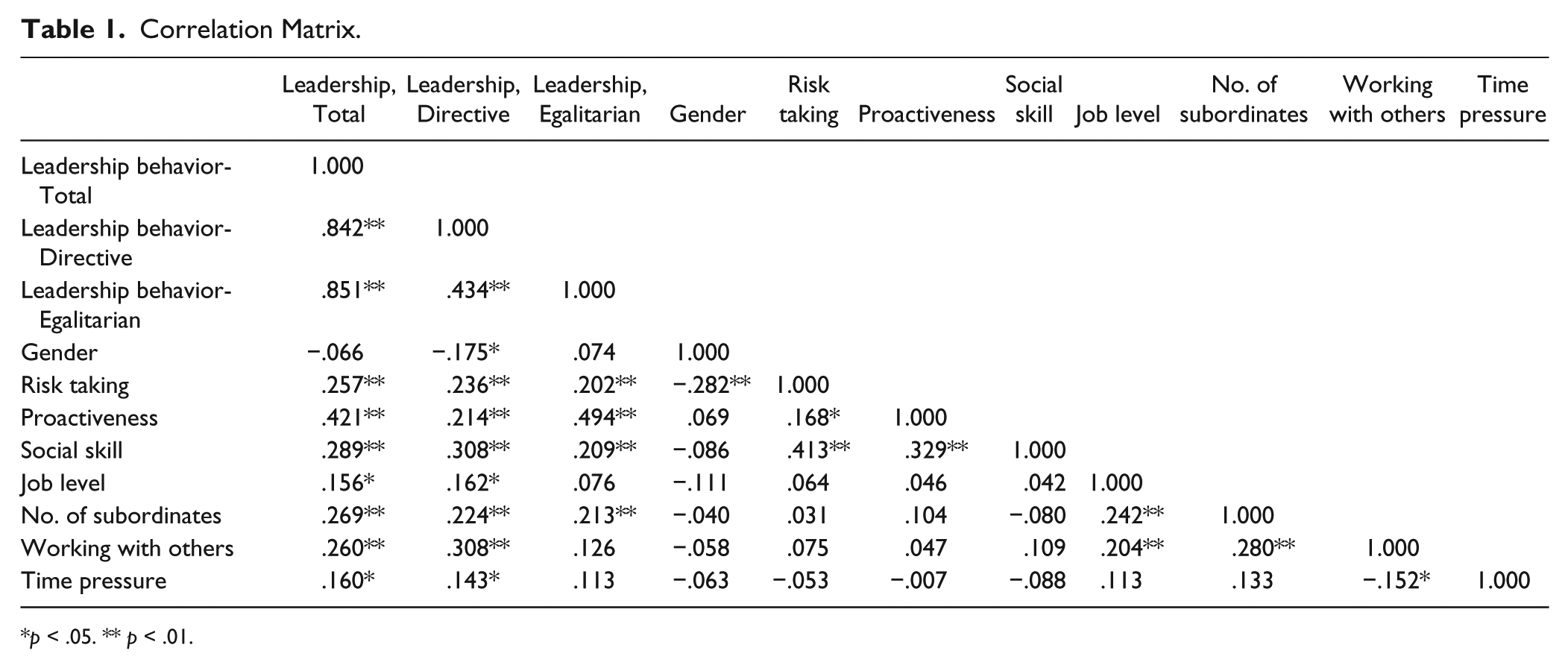
p < .05. ** p < .01.
Multiple Regression of Personal Characteristics and Work Context on Total Leadership Behavior.
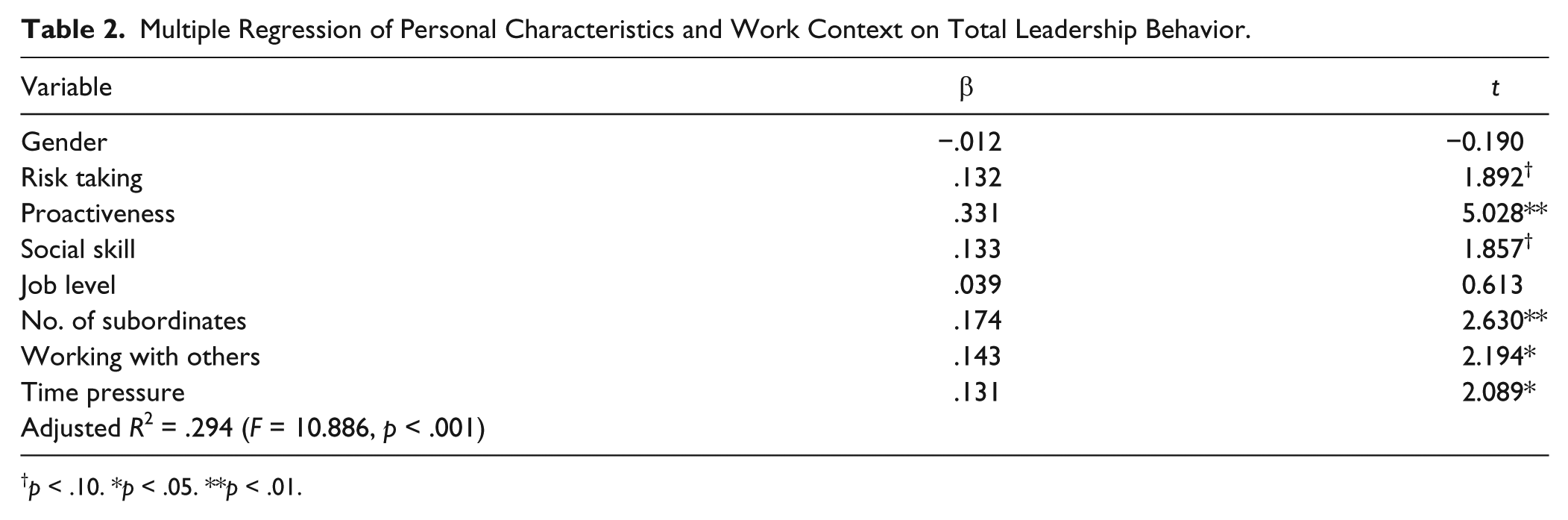
p < .10. *p < .05. **p < .01.
Three of four career-contextual measures were related to leadership. Working with others (Hypothesis 2b: β = .143, p < .05), the number of direct subordinates (Hypothesis 2c: β = .174, p < .01), and job demand measured as time pressure (Hypothesis 2d: β = .131, p < .05). Job level was not related to leadership.
We next analyzed whether the predictors of leadership were related to the type of leader behavior exhibited by respondents, that is, are certain antecedent conditions associated more with directive versus egalitarian approaches to leadership? Table 3 shows the regression of personal characteristics and career-contextual characteristics on both directive leadership and egalitarian leadership. Hypothesis 3a stated that males would be more likely to display directive leader behavior. We found weak support for this relationship (β = −.112, p = .093). Contrary to our expectations (Hypothesis 3b), social skill was related to directive rather than egalitarian leader behavior (β = .229, p < .01). Although we did not offer formal hypotheses for risk taking and proactiveness, we report that neither was found to be related to directive leader behavior. Job level was not found to be related to directive behavior (Hypothesis 3c). Consistent with our expectations (Hypothesis 3d), those who spend a larger proportion of their time working independently were found to display directive leader behavior (β = .201, p < .01). Having subordinates (Hypothesis 3e) also was related to directive leader behavior (β = .143, p <.05). Finally, job demand (time pressure) was marginally related to directive leader behavior (β = .107, p = .10). Thus, the main factors related to directive leadership behavior appeared to be the career-contextual variables.
Multiple Regression of Personal Characteristics and Work Context on Directive and Egalitarian Leadership Behavior.
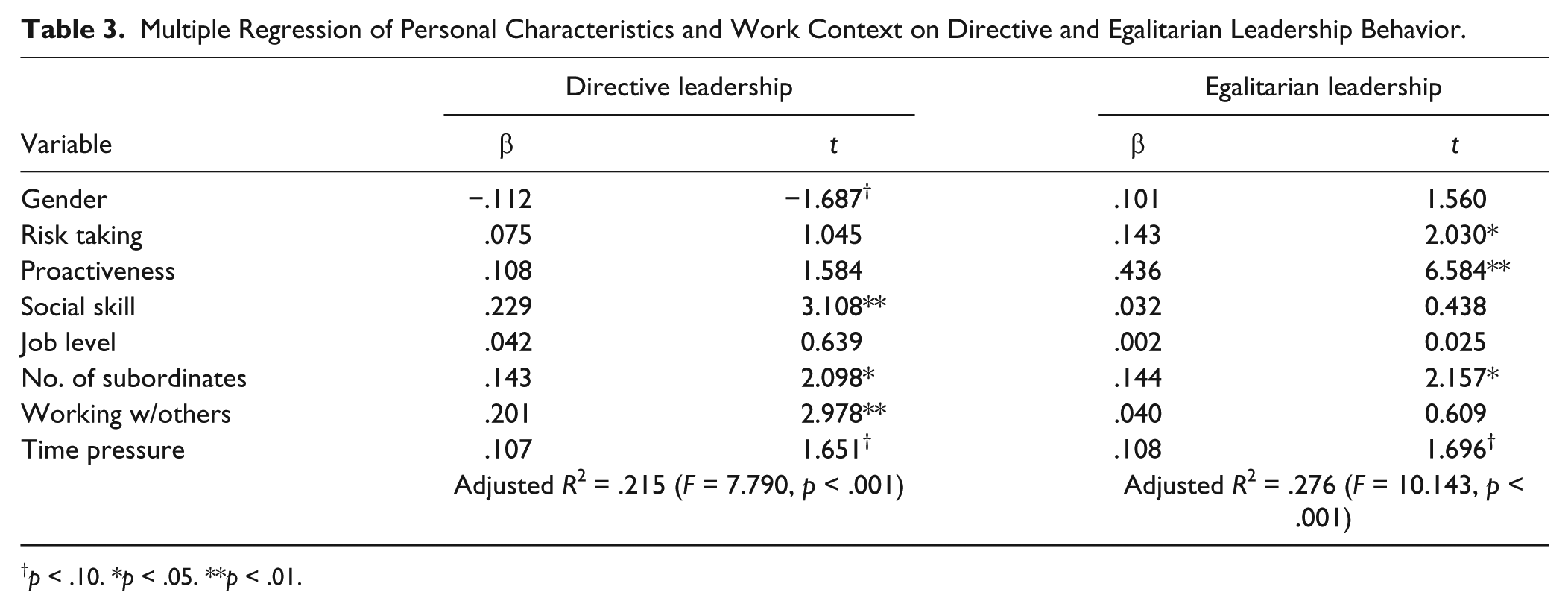
p < .10. *p < .05. **p < .01.
We found that personal characteristics, particularly personality, were strongly related to the display of egalitarian leader behavior. Specifically, both risk-taking (Hypothesis 4b: β = .143, p < .05) and proactiveness (Hypothesis 4c: β = .436, p < .01) were related to egalitarian leadership. Additionally, although not significant (p = .12), the direction of the relationship suggests that women may be more likely to display egalitarian leadership than men. Contrary to our expectations (Hypothesis 4d) social skill was not related to egalitarian leadership. Career-contextual variables were also related to egalitarian leadership. Specifically, the number of subordinates (Hypotheis 4g: β = .144, p < .05) and job demand (time pressure; Hypothesis 4h: β = .107, p < .10) were associated with egalitarian leadership. Contrary to our expectations, working with others and job level were not associated with egalitarian leadership. In sum, both personal and career-contextual characteristics were related to leadership. Directive leadership was associated with work characteristics and with a slight male skew. Egalitarian leadership was associated more strongly with personality, particularly risk taking and proactiveness.
Discussion
The objective of this study was to identify personal characteristics and career-contextual variables associated with the emergence of leadership behavior in early career white-collar professionals. A second goal was to identify whether there were any differences in the correlates of directive versus egalitarian leadership. We found that both types of antecedents were related to leadership behavior. Indeed, three out of four variables of each type were related to leadership. Thus, it appears that the development of leadership behavior early in the careers of white-collar professional employees is associated with measurable, and thus identifiable, characteristics of both employees and their work environments.
Though personality correlates to leadership have been widely researched, our findings add to our understanding of which personality factors are associated with early development of leadership in an important set of employees. Proactivity and risk taking were found to be associated with leadership in general and with egalitarian leadership in particular. Gender effects, while not statistically significant according to research conventions, were suggestive that future research in this area is likely to be fruitful. Were gender to be found to affect propensity for leadership development in general and the emergence of certain types of leadership in particular, organizations could use this knowledge to target training for desired behaviors. Armed with this knowledge, organizations could make better use of their talent pool regardless of gender composition.
Social skills also serve as an important antecedent to leadership. Leadership is essentially interactive in nature. Thus, relationships are a fundamental training ground for leadership emergence. Employees who have, or who gain, more social skill have the ability to develop leadership earlier in their careers. It is interesting, and counter to our expectations, that social skill was associated not with egalitarian, but with directive leadership. Directive leadership has sometimes been denigrated and certainly carries the risk of negative spillovers, however, has been found to be a necessary and valuable leadership skill when dealing with crisis (Maggitti, Slay, & Clark, 2010) or extreme ambiguity. Our finding sheds light on how social skill allows white-collar professionals to use their relationships to exert influence on others in an efficient and direct manner.
The career-contextual variables associated with leadership were working with others, having subordinates, and the job demand (time pressure) of the task environment. These three variables have one thing in common; they each provide the opportunity for leadership behavior. Leadership is inherently about human interaction, in this case the interplay between leaders and others important to achieving organizational goals. White-collar professionals who spent proportionately more of their time working with others, simply have greater opportunity to develop and display leader behavior. The implications of this finding are strong. Many entry-level positions for white-collar professionals may require considerable independent effort (e.g., analysts, salespersons, auditors). While the ability to develop individual technical skill is certainly important, such positions may inhibit the development of leadership. Once these people eventually find themselves in circumstances where leadership is expected, they may have difficulty coming “up-to-speed.” Thus, our research may suggest that organizations structure early assignments for adequate interpersonal activity, so that opportunities for leadership development present themselves early and often.
Although only about 45% of the sample had subordinates, these people appear to be developing leadership behaviors more quickly than their counterparts. Again, interaction is a prerequisite for leadership and the specific case of interacting with subordinates provides a rich context for leadership development. While leadership can be exhibited with colleagues and even superiors, the existence of a structural hierarchy prompts those in a position of authority to develop and display leader behavior. The flattening of the organizational hierarchy makes it increasingly unlikely that early career white-collar professionals will have subordinates. Thus, where possible, employers might think about how to provide horizontal leadership opportunities to employees early in their career. An example might include assigning rotating responsibility for tasks, so that periodically employees are assigned a leadership role, even when hierarchically they are equivalent or even subordinate, to those with whom they interact.
Job demand, measured as time pressure, was also found to be associated with increased leadership behavior. When resources (in this case time) are plentiful, outcomes are likely to be easily achieved even in the absence of the structural and motivational elements of leadership. When the task environment becomes more difficult, the need for and payoff from leadership becomes more obvious. Though time pressure appears to be becoming more prevalent across a great variety of work environments, effective learning and development may require a context where employees iterate between high- and low-pressure situations. Such learning spirals (Nonaka & Takeuchi, 1995) may occur more regularly when organizations design down time between challenging assignments.
There were distinct relationships between antecedent characteristics and directive versus egalitarian leadership. Emergence of egalitarian leadership was associated with risk taking (positive) and proactiveness (positive). These personal traits relate to egalitarian leadership through the importance of interpersonal relationships. As mentioned above, the results are also suggestive that women may be more likely to develop egalitarian leadership. At the same time, directive leadership was significantly correlated with males, social skill, and time spent working alone. Males are perceived to be more dominant than females. Accordingly, men may be more likely to use control, structure, and/or reprimand in their leadership style. Of these results, only the relationship between social skill and directive leadership was somewhat surprising. It is feasible that social skill is a more complex construct than our measure was able to capture or that we captured only one facet of social skill—namely the power and influence dimension. Perhaps our measure mainly captured dynamics more prevalent in the unidirectional relationships of directive leadership. The number of subordinates and the level of job demand were both significantly correlated with the emergence of directive and egalitarian leadership. The message from these results could be that career-contextual antecedents to leadership, such as the number of subordinates and job demand, foster the opportunity and pressure necessary to catalyze the emergence of leadership, while personal characteristics provide the “spark” affecting the particular type of leadership an individual develops.
An interesting avenue for future research relates to the potential link between the need for goals and the development of leadership behavior. As Gersick’s (1988) work on pacing in teams demonstrates, time pressure may be a fairly universal catalyst for effort and for organization. The critical factor here may be that difficult/stressful jobs require an organized approach in which leaders and subordinates are pulling toward goals in an orchestrated way. Additionally, as the number of subordinates increases, greater levels of leadership will be required to pull subordinates together in the pursuit of such goals. These additional stimuli may heighten the motivation for white-collar professionals to develop leadership competencies.
Limitations and Future Research
The study is in one sample, thus the results may not generalizable to other types of people or other work contexts. Still, we believe that early career leadership emergence is critically important to our economy and society. We also believe that the career-contextual antecedents that appear early in an employee’s career may have a great effect on whether leadership develops in that individual later in their career, or even at all. Whereas personality and gender are determined well prior to entering the work force, employers may act to encourage the development of leadership, regardless of personal characteristics.
It is also important to note that we do not evaluate the effectiveness of various leader behaviors in the research, just the display of leader behavior. It is certainly plausible, and prior research would suggest, that certain types of leader behavior are more effective when time pressure occurs and/or when greater numbers of subordinates are involved. For example, at least one study (Scully, Sims, Schnell, Smith, & Smith, 1994) proposes that difficult circumstances may require a more directive approach.
Another limitation of this research is that leadership behaviors are self-reports. Despite Shaffer et al.’s (1986) assertion that self-responses are consistent with the evaluations of external observers, the inclusion of other’s ratings would strengthen our results. A final limitation is the single source used to collect the data. While we designed the questionnaire such that the dependent variables were located in a different section from the predictors, we cannot rule out the possibility of percept-percept bias. As an additional precaution, the response format of the predictor variables differed significantly from that of the leadership items. As further evidence that the risk of percept-percept bias is low, we note that there is considerable variation across all measures and that the intercorrelations between the predictors and leadership are in the low to medium range.
Future research should endeavor to include both traits and career-contextual variables to predict leadership. Prior research has tended to look at one or the other, and this is an unnecessary division in the stream. Future research should also try to further differentiate the predictors of different types of leadership. This is particularly important since a given leader may display all, a portion, or none of the various leader behaviors included in the various typologies. Finally, we would encourage researchers to look more closely at the early career experiences of employees and to determine links to the display of leadership in later stages of the career.
Footnotes
Declaration of Conflicting Interests
The author(s) declared no potential conflicts of interest with respect to the research, authorship, and/or publication of this article.
Funding
The author(s) received no financial support for the research, authorship, and/or publication of this article.