



Abstract
Today’s leaders face unprecedented complexity and dynamism in the external environment. Sensemaking provides a useful framework for understanding how leaders extract meaning from that environment; however, its focus on purely conscious processes limits its applicability. We revisit and overcome major epistemological and ontological arguments against reconciling sensemaking with other decision-making models. This allows us to propose a dual systems model of sensemaking by introducing unconscious sensemaking as a complementary process that supports conscious sensemaking. We propose that the plausible stories that result from conscious sensemaking lead to schemas over time through which leaders can unconsciously make sense of their environment. This dual systems model holds important implications for leadership scholarship, in both describing leaders’ cognitive processes and how those leaders can utilize this improved model to better effect change.
Keywords
Introduction
Today’s organizational environment is defined by immense complexity, chronic regulatory, political and technological instability, and information overload. For example, by 2004, Walmart had collected and stored an estimated 460 terabytes of data from its more than 40-year history (Hays, 2004). By 2012, Walmart was collecting 2.5 petabytes of data each hour (McAfee & Brynjolfsson, 2012). That is, in 2012, Walmart was collecting more than five times the amount of data in 1 hour than it had collected in its more than 40-year history before 2004. Walmart is not alone. Rather, the trend toward “big data” is far reaching (McKinsey Global Institute, 2011), making it impossible for leaders in organizations in nearly every industry to consciously process the vast amounts of information available to make fully rational business decisions (Fiedler, 1986; Weick, Sutcliffe, & Obstfeld, 2005). In this context, Weick’s (1995) sensemaking concept, which explains how organizational members extract meaning from—or make sense of—their complex and dynamic environments, is increasingly valuable. By processing information on an abstract level and focusing on plausible rather than accurate stories, leaders use sensemaking to develop the understanding necessary to address threats and opportunities in the complex and dynamic environment (Weick, 1995).
Sensemaking is conceptualized as a cognitive social process that helps leaders process ambiguity and construct stability in an ever-changing reality (Weick, 1995; Weick et al., 2005). However, organizational scientists have developed sensemaking largely in isolation from other fields, resulting in missed opportunities to advance the sensemaking literature. Recently, scholars have recognized the complementary nature of sensemaking and decision making and have started to developed frameworks that help leaders make sense and determine the best course of action in different environments (e.g., Hannah, Uhl-Bien, Avolio, & Cavarretta, 2009; Snowden & Boone, 2007). However, this integration has been hampered by scholars who argue that sensemaking and decision making have irreconcilable ontological and epistemological differences (Boland, 2008).
Unlike sensemaking, decision making has benefited from cross-disciplinary scholarship. Contemporary dual systems models of decision making that incorporate both deliberative and intuitive processes (e.g., Evans, 2008; Evans & Stanovich, 2013; Strack & Deutsch, 2004) is one such benefit that provides a fruitful path for the sensemaking stream. As decision making and sensemaking are both cognitive processes, successfully reconciling the two streams may allow scholars to develop models that better explain how leaders make sense—both consciously and unconsciously. The notion of unconscious sensemaking may greatly advance our understanding of how leaders create understanding of their environment, as the conscious processes hitherto examined only explain a small part of leaders’ information processing (Fiske & Taylor, 1984).
While sensemaking has contributed much to our understanding of how leaders derive meaning from the environment, it has been limited by its focus on conscious processes. To counter this limitation, we introduce the idea that sensemaking—just like decision making—can be conscious and unconscious. Specifically, we postulate that over time the stories that result from sensemaking become schemas that enable leaders to reduce complexity and allow for unconscious sensemaking to create meaning. Unconscious sensemaking, therefore, saves limited cognitive resources, increases information-processing efficiency, and has the potential to improve a leader’s overall sensemaking ability.
Our contributions are threefold. First, we contribute to the sensemaking literature by reconciling the ontological and epistemological differences that have resulted in the isolation of sensemaking from other fields. Second, we build on work in decision making to propose a dual systems model of leaders’ organizational sensemaking that more fully explains how leaders make sense of the complex and dynamic environment. Third, we contribute to leadership theory by linking story, as used in much work in leadership (Barnett & Tichy, 2000; Shamir & Eilam, 2005; Sparrowe, 2005; Tichy & Cohen, 1997), with sensemaking, demonstrating how stories influence leaders’ conscious and unconscious sensemaking over time. This comprehensive and parsimonious model may better equip leaders to not only make sense but also to give sense and effect change.
Theoretical Context
Finding Common Ground
Previous integration of sensemaking and decision making has been hampered by suggestions of irreconcilable ontological and epistemological differences (Boland, 2008). Sensemaking is an ongoing social process through which a leader consciously assigns meaning to a situation by selecting, interpreting, and linking cues perceived from the environment. Sensemaking is social in that it does not occur in isolation from others, and that the meaning derived is often shaped by the context of the collective. Scholars have utilized sensemaking to explain how leaders create an understanding of their constantly changing business environment (Ancona, 2012; Ancona, Malone, Orlikowski, & Senge, 2007). Moreover, sensemaking has been recognized as a fundamental leadership capability that fosters visionary and creative thinking (Ancona, 2012; Drazin, Glynn, & Kazanjian, 1999; Pye, 2005).
Similarly, decision making is an ongoing cognitive process that is embedded in a social environment and causes an individual to choose a course of action over other alternatives (Wilson & Keil, 2001). Previous research has acknowledged that sensemaking and decision making share similarities but has also failed to integrate them, as “each considers the world to be composed of quite different sorts of being, and each represents a very different way of knowing about the world” (Boland, 2008, p. 59). This conclusion follows from the notion that sensemaking is rooted in a constructivist perspective of reality, while decision making is rooted in an opposed positivistic perspective. The constructivist view sees reality as being coconstructed and subject to perception (Guba & Lincoln, 2005). Boland (2008) reasons that sensemaking “emphasizes the stream of action in its immediacy as being the real, and the immersion in action as being the source of truth” (p. 60). However, while Weick (1995) acknowledges that action triggers further action and is part of sensemaking, he does not propose action as the source of truth but, rather, perception as the source of truth or sense. Specifically, Weick (1995) notes that “the perception of arousal triggers a rudimentary act of sensemaking” (p. 45). Given this focus on the social and perception based nature of reality central to sensemaking, the constructivist label appears to be appropriate.
In contrast, labeling decision making as positivist may not be appropriate. A positivistic view assumes objectivity and a reality that can be assessed, rationalized, predicted, and monitored (Guba & Lincoln, 2005). Positivistic decision-making concepts were dominant in administrative science and organization theory throughout much of the 20th century and continue to hold an important place in the scholarship of organizations. While these normative decision-making models emphasize rationality of decision makers’ choices across alternatives, scholars have long noted the importance of perceptual factors that limit this rationality. Boland (2008) suggests that
theories of decision making do not have much at all to say about the origin of alternatives, and for good reasons. Alternatives are assumed to be a given—they are considered as a stable part of the presented decision problem. (p. 60)
We posit that this “bounded rationality” (Simon, 1955), created by a limited perception, may limit the range and type of alternatives leaders can identify and determine the leaders’ ability to process these available alternatives. As such, leaders do not act based on full information, which causes normative models to incorrectly predict decisions (Gigerenzer & Selten, 2002). This idea is also supported by Kahneman (2003) who revisited numerous studies that reinforce the notion of a bounded rationality within intuitive judgment and decision making. The operations of intuition are faster, automatic, effortless, and governed by habit, while the operations of reasoning are slower, deliberate, effortful, and governed by rules.
Due to the shortfalls of normative decision-making models, scholars have focused on behavioral decision research (see Beach & Connolly, 2005) that supports a constructivist view of decision making (Guba & Lincoln, 2005; Payne, Bettman, & Johnson, 1992). For example, Keller and Ho (1988) found differences in how individuals generate alternatives during the decision-making process and therefore deliver strong support that alternatives are not given but rather are constructed by the decision maker. This is also supported by Ingvar (1985), who traced searching for alternatives during the decision-making process to the prefrontal cortex of the brain, noting that alternatives are subject to limitations of brain capacity. Hence, a positivist label may not always be appropriate, as alternatives are limited, selected, and shaped by perception.
While Boland (2008) contended that the two approaches cannot be reconciled due to ontological and epistemological differences, we argue that both literature streams can and should be viewed through the same ontological and epistemological lenses. This is supported by Weick (1995) himself who stated that “people who study sensemaking oscillate ontologically because that is what helps them understand the actions of people in everyday life who could care less about ontology” (p. 35). Some scholars have already acknowledged the complementary nature of sensemaking and decision making and developed models that use leaders’ sensemaking as an input for their decision making (e.g., Hannah et al., 2009; Snowden & Boone, 2007). We go a step further and use findings from the decision-making stream to advance sensemaking. We are particularly interested in the dual systems model of decision making as it advanced decision making from an exclusively conscious cognitive process to one that acknowledges both, conscious and unconscious cognitive processes.
Dual Systems
Early psychologists often used attitudes as a proxy for behavior; however, this link frequently failed to account for variation in behavior (Bentler & Speckart, 1979). To remedy this, Ajzen and Fishbein (1977) introduced the theory of reasoned action in which behavioral intentions mediate the relationship between attitudes and behavior. Behavioral intentions are still widely used as predictors of or proxies for behavior. However, scholars have found that self-reported attitudes or intentions do not always predict actual behavior but, rather, self-reported behavior (Greenwald, Poehlman, Uhlmann, & Banaji, 2009). To address this shortcoming, scholars developed theories of cognitive dual systems, suggesting that there are separate cognitive systems that control unconscious and conscious behavior (Epstein, 1994; Evans, 2008; Evans & Stanovich, 2013; Strack & Deutsch, 2004). This differs from the theory of reasoned action which accounts for only conscious behavior.
The idea of unconsciously driven or reflexive behavior is not new. In psychology, unconscious and intuitive systems have been widely accepted since Freud’s (1901) theory of the id, ego, and superego. In an early study, Zajonc (1980) demonstrated that individuals evaluate many situations intuitively without activating the conscious mind. This is supported by Bargh and Chartrand (1999) and Greenwald and Banaji (1995) who found that many social cognitive processes run automatically. Further support for dual systems decision-making models comes from neurocognitive research and combines knowledge from neurochemistry, neuroanatomy, and neurophysiology to explain how neurons in our brains function (Churchland, 1989; Gazzaniga, 2000). The use of technology such as functional magnetic resonance imaging which measures brain activity has provided valuable insights in how individuals’ intuitive social cognition works. Specifically, scholars found that individuals who faced familiar situations activated different brain regions than individuals who faced novel and complex situations (Lieberman, Jarcho, & Satpute, 2004). Hence, scholars studying how the brain receives, processes, and interprets stimuli now believe that reflexive decisions are located in the lateral temporal cortex, amygdala, and basal ganglia, while the prefrontal cortex, the anterior cingulate, and the hippocampus are responsible for conscious decisions (Lieberman, 2000; Lieberman, Gaunt, Gilbert, & Trope, 2002).
Conscious decisions actively compare the probability of potential benefits and consequences of behavioral options and reach a preference for a course of action. Behaviors are then activated to engage in the selected course of action (Strack & Deutsch, 2004). If environmental feedback is positive, cognitive schemas are created to streamline future decision making in similar situations (Lieberman et al., 2002). Cognitive schemas can be understood as conceptual mental structures that are organized in a framework that also stores information about the relationships between them (Rumelhart, 1978; Strack & Deutsch, 2004). Unconscious decision making is based on a pattern-matching process that compares previously recorded cognitive schemas with information perceived from the environment (Evans, 2008; Strack & Deutsch, 2004). This pattern-matching process is nearly effortless and, when successful, will activate courses of action directly. Breakdowns in pattern matching activate the conscious system of decision making for further evaluation and result in a conscious reevaluation of the cognitive schemas and potential adaptation of existing cognitive schemas (Lieberman et al., 2002).
Scholars across multiple disciplines have provided support for dual systems model of decision making and have improved our understanding of an individual’s information processing and behavior (Evans, 2008; Evans & Stanovich, 2013). We suggest that, just as the decision-making literature has benefited from a dual systems approach, so too can sensemaking, as leaders do not have to consciously make sense of every situation but may often use a combination of unconscious and conscious sensemaking to understand their environment.
Theory Development
Sensemaking has been conceptualized as a purely conscious process in which a leader first has to recognize a change in a known procedure or face a new and complex situation. However, there are several indicators that suggest that there are unconscious processes influencing this process. For example, Weick (1995) assumes that any perceived interruption of an ongoing process can result in emotions that trigger sensemaking. But emotions not only trigger the sensemaking process they also significantly and unconsciously influence it by determining how past experiences are remembered (Snyder & White, 1982). Lange and James (1922), for example, suggested that individuals cannot separate emotions from cognition. This is supported by more recent research that found that depressed individuals perceive news more negatively due to an attention bias (e.g., Mogg & Bradley, 2005). Moreover, Lieberman (2000) inferred that neurological regions responsible for intuitive reasoning are also related to emotional reactions as emotions are, from a neuroscience perspective, essential in social cognition and decision making (Damasio, 1999). In the same vein, Epstein (1994) linked emotions to the intuitive, reflexive system, and Hassin, Uleman, and Bargh (2005) linked emotions to automatic processes during social cognition. Since emotions are intuitively recognized and influence the sensemaking process involuntarily, sensemaking may be less consciously driven than previously suggested. Furthermore, if leaders had to rely solely on conscious sensemaking to create an understanding of their environment, one would expect that cognitive ability is related to good leadership decisions. However, much work indicates that the relationship between leadership and cognitive ability is rather weak (Judge, Colbert, & Ilies, 2004), which has resulted in scholars examining better predictors of leadership success, such as “gut feeling” or intuition (Behling & Eckel, 1991; Dane & Pratt, 2007; Harper, 1989).
Supporters of the dual systems decision-making model often refer to intuition when discussing unconscious decision making (Evans, 2008). While some scholars see intuition as a product, most refer to it as the process of perceiving and sorting information (Behling & Eckel, 1991; Dane & Pratt, 2007). It is an unconscious process that involves instant pattern matching and results in judgment (Raidl & Lubart, 2001). Most important, scholars reason that intuition has access to thousands of patterns deposited in long-term memory and is, therefore, able to quickly resolve complex situations and deliver accurate responses (Shirley & Langan-Fox, 1996). Leaders relying on intuition form judgments suddenly and effortlessly without activating their conscious and are unaware of the mental processes that led to the result (Behling & Eckel, 1991; Dane & Pratt, 2007). This is supported by cognitive researchers who found that social cognition often operates to a high degree implicitly and automatically (Bargh & Chartrand, 1999; Greenwald & Banaji, 1995).
Leaders in today’s competitive environment are flooded with information, and consciously analyzing information on a high level helps leaders process information and understand their environment. However, cognitive researchers argue that individuals process information both consciously and unconsciously (Evans, 2008). In line with decision-making scholars who have moved away from purely conscious, rational decision-making models, we suggest that sensemaking, too, has an unconscious component that is based on cognitive schemas. Weick (1995) already implied the existence of schemas by noting that “stories are templates. They are products of previous efforts at sensemaking” (p. 61). These stories contain patterns that represent parts of the reality and support future sensemaking (Weick, 1995). Similarly, cognitive schemas are based on past experiences and used to recognize aspects in everyday situations (Strack & Deutsch, 2004). Hence, a dual systems point of view of sensemaking allows for conscious and unconscious sensemaking to coexist and explains in more detail and based on knowledge from different fields how leaders are able to make sense. Therefore, we propose the following:
Sensemaking results in a comprehensible story of a multifaceted environment necessary to create a shared vision and take actions (Weick, 1995). A plausible story that has been consciously crafted provides leaders with an understanding of their environment that can be communicated to others. Moreover, Weick (1995) notes that these stories are remembered for future sensemaking. These stories describes not only how leaders see their environment—the where are we story—but also how they see themselves in their environment—the who am I story—which when shared can be powerful tools for leaders’ success (Barnett & Tichy, 2000; Tichy & Cohen, 1997). Linked together, these anecdotes build a leader’s life story. Leaders who are aware of their life story not only understand who they are but also recognize that their story influences what decisions they will make in the future (Shamir & Eilam, 2005; Sparrowe, 2005; Starbuck & Milliken, 1988; Weick et al., 2005). Their self-concept clarity and appreciation of their own identity, therefore, act as a compass that guides future sensemaking, thus closing the cycle of continuous sensemaking (Weick, 1995). While Weick (1995) is silent about how stories are related to cognitive processes, more than 30 years of research in psychology suggests that stories as created through sensemaking are stored as schemas which can then guide future behavior (Rumelhart, 1978). As noted, schemas are flexible information patterns that are based on past experiences and help individuals process information (Behling & Eckel, 1991; Dane & Pratt, 2007; Harper, 1989; Rumelhart, 1978). Using schemas as the foundation of unconscious sensemaking, therefore, might explain why leaders are often unable to describe how they see their environment but intuitively understand it (Behling & Eckel, 1991; Dane & Pratt, 2007). Therefore, we propose the following:
Action in an organizational setting is a continuous stream of communication, which is often interrupted by other actions that affect the organizational environment (Eccles, Nohria, & Berkley, 1992). Weick (1995) is very clear that “sensemaking never starts. The reason it never starts is that pure duration never stops. People are always in the middle of things” (p. 43). Similarly, dual systems are never ending, as individuals, on a micro level, form both intuitive and reflective judgment perpetually to act (Epstein, 1994; Evans, 2008; Lieberman et al., 2004).
However, decision-making scholars agree with social psychologists that consciously applying logical rules to complex tasks within an uncertain environment is difficult and can quickly exhaust limited cognitive resources (Fiedler, 1986; Strack & Deutsch, 2004). Deliberate reasoning has its limits and can be overwhelmed by too much information (Behling & Eckel, 1991; Dane & Pratt, 2007). To avoid information overload, the brain will try to reduce complexity not only by analyzing information on a higher, abstract level but also by using automated reasoning whenever possible (Fiske & Taylor, 1984). While conscious sensemaking is able to apply analytical rules and provide leaders with a rationale for how they derived meaning from their environment, it is time consuming, sequential, and only has access to limited cognitive resources. Due to the effectiveness and advantages in processing speed of the pattern-matching process, unconscious sensemaking will often be able to make sense of a situation without requiring significant cognitive efforts (Evans, 2008). Even when unconscious sensemaking provides an incomplete understanding, it may still allow limited cognitive resources to be allocated to novel aspects of the situation. Thus, we propose the following:
Organizational sensemaking is highly influenced by the context and never occurs in isolation (Weick, 1995). A leader’s thoughts, intentions, and behavior are affected by the expectations and actions of others. As a result, leaders may reconsider, revise, or delay their actions based on what they think is appropriate in a specific context (Weick et al., 2005). Sensemaking scholars, however, are silent on how this interaction with the social environment changes the result of sensemaking. Insights from dual systems decision-making models can again shed light on how the social environment influences current and future sensemaking.
As proposed, unconscious sensemaking is based on cognitive schemas that are used in a pattern-matching process to quickly and effortlessly make sense of the environment. Since cognitive schemas store information regarding the social environment (Rumelhart, 1978), they guide leaders’ unconscious sensemaking in different social settings. More important, cognitive schemas are developed and strengthened when leaders receive positive feedback from their environment (Epstein, 1994; Evans, 2008; Lieberman et al., 2004). Negative feedback, on the other hand, creates an unexpected interruption of a daily routine and will, therefore, trigger conscious sensemaking (Weick, 1995). Based on this conscious sensemaking, leaders adapt existing schemas to avoid negative feedback in the future. Therefore, we propose the following:
The above theorizing and overarching conceptual model are summarized in Figure 1. Our model is well illustrated by an example. Consider the career of a typical college graduate. By the time a college student graduates and enters the workforce, she will have developed many schemas that provide her with an instant understanding of her daily routine. However, these schemas are challenged in a new organizational setting. One can imagine her lying in bed after her first day at work consciously making sense of her new experiences. Conscious sensemaking will, therefore, initially dominate the process by which she understands her organization’s culture (Harris, 1994), interprets downsizing (Bean & Hamilton, 2006), organizational change (Bettis, Mills, Williams, & Nolan, 2005), and many other organizational events. If her understanding is confirmed by her environment, she will create new and refine existing schemas that help her future sensemaking. If her current understanding is shocked by an unknown, she will again activate conscious sensemaking. Hence, when she is ready to take on a leadership role in her organization, she will have developed countless schemas that help her intuitively understand her organization. Yet while schemas will support her sensemaking, constant organizational changes still require conscious sensemaking (Chaudhry, Coyle-Shapiro, & Wayne, 2011). This example is informative as it demonstrates that sensemaking utilizes previously confirmed information unconsciously, while adding new information to derive new meaning from the environment.
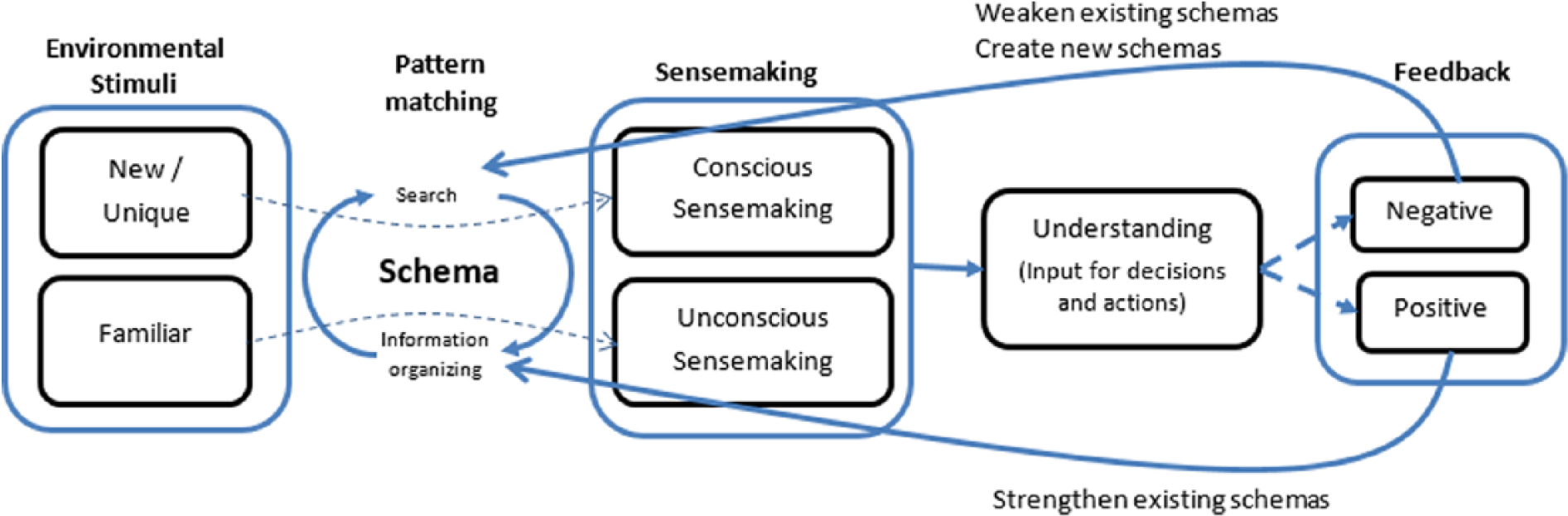
Conceptual model.
Discussion
Prior to our theorizing, sensemaking has been proposed as conscious cognitive process that depends on limited cognitive resources to provide leaders with a plausible understanding of their environment (Weick, 1995; Weick et al., 2005). Sensemaking is therefore a key leadership capability required for leaders to understand their environment (Ancona, 2012; Ancona et al., 2007, Weick, 1995). Similarly to Pye (2005), we argue that the sensemaking concept provides a fruitful avenue for leadership scholars to advance the field. However, the complex environment that today’s leaders face cannot be fully comprehended by conscious reasoning on a high level (Fiedler, 1986; Marion & Uhl-Bien, 2002). Adopting a dual systems approach to sensemaking significantly increases its power by offering an additional path to explain how meaning is derived in a complex and dynamic environment.
Our proposed dual systems model of organizational sensemaking enhances the field’s understanding of how leaders make sense, and, therefore, act in a complex environment by removing sensemaking from its conceptual silo and incorporating work from the decision-making stream. We have proposed that, over time, the plausible stories that result from conscious sensemaking become cognitive schemas that build the foundation for unconscious sensemaking, which are adapted based on feedback from the environment. The continual development and improvement of cognitive schemas created through plausible stories, therefore, may shape a leader’s identity (Sparrowe, 2005). This approach stresses sensemaking as a social process and explains how leaders are able to craft a plausible story in the context of the collective. Acknowledging schema-based unconscious sensemaking also explains how leaders can continuously identify and extract important cues from their environment when they are seemingly flooded with information.
Implications for Leadership
Weick and colleagues conceptualized sensemaking as a conscious cognitive process. Given this focus on cognition, cognitive ability should, therefore, relate to improved sensemaking and, subsequently, successful leadership. However, a meta-analytic results suggest only a weak relation between leadership and cognitive ability (Judge et al., 2004). As unconscious sensemaking does not rely on limited cognitive resources, our dual systems model could provide a missing link to explaining what makes sensemaking a key leadership capability. As a fundamental leadership skill, sensemaking contributes to a leader’s success and failure (Ancona, 2012; Ancona et al., 2007). Accepting our dual systems approach to organizational sensemaking, which acknowledges the existence and importance of unconscious aspects, can, therefore, be used to educate leaders and improve their success, as has been accomplished by others for strictly conscious sensemaking (Ancona, 2012). For example, leaders’ sensemaking can result in an incorrect understanding of a situation that is no longer questioned. If leaders are aware of unconscious processes that impede their sensemaking, they can question their intuition, improve their sensemaking, and prevent inaccurate understandings of the environment. In contrast, ignoring intuition as a factor that can considerably influence leaders’ sensemaking reduces sensemaking’s predictive power and can result in insufficient explanations of observed phenomena.
Separately, leaders’ sensemaking may also be closely related to their sensegiving. Sensegiving refers to “the process of attempting to influence the sensemaking and meaning construction of others toward a preferred redefinition of organizational reality” (Gioia & Chittipeddi, 1991, p. 442). Born in the context of strategic change, sensegiving involves framing and disseminating a vision or interpretation for a particular change, process, or structure (Fiss & Zajac, 2006). That is, sensegiving is one tool with which leaders can craft their actions or ideas as legitimate in the eyes of others (Smerek, 2010). Hence, in order to give sense and initiate change in others, leaders have to understand their followers’ sensemaking. Since followers may not always use conscious sensemaking, prior conceptualizations may have drawn an incomplete picture of sensegiving (Maitlis & Lawrence, 2007). Moreover, a fuller understanding of leaders’ organizational sensemaking could influence how leaders deploy personal and organizational stories as a leadership tool (Barnett & Tichy, 2000; Tichy & Cohen, 1997), shedding light on the possible role of those stories in developing schemas over times to guide unconscious actions by followers.
Directions for Future Research
We hope that our dual systems approach to sensemaking stimulates new research. For example, sensemaking scholars note that individuals interpret similar cues in different social settings differently (Weick et al., 2005). However, current sensemaking literature merely touches the surface of identifying and explaining the forces that result in different judgments. Dual systems models (e.g., Evans & Stanovich, 2013; Strack & Deutsch, 2004) provide an elaborate explanation of how two systems are part of an individual’s identity and thereby contribute to our understanding of complex human reasoning that helps extract new meaning from the environment. For example, using the Watson selection task, scholars found that cognitive ability was only related to problem solving in a theoretical environment that required abstract reasoning. When the problem was framed within a realistic environment with pragmatic cues, the relation with cognitive ability disappeared (Stanovich & West, 1998). Referring to cognitive dual systems, the authors argued that abstract tasks require active evaluation of the situation, while situational cues enable the decision maker to act unconsciously and think afterward. Evan’s (2008) review also concluded that conscious processes are related to working memory capacity and general intelligence, while unconscious processes are not. Using our dual systems view of sensemaking, we anticipate that leaders’ sensemaking is analogous. Cognitive ability might be important for conscious sensemaking to derive new meaning from abstract and unique situations. However, when leaders are able to identify similar patterns in complex or new situations, their sensemaking could be unrelated to their cognitive ability. Future studies that measure brain activity using functional magnetic resonance imaging are therefore needed to shed further light on how leaders consciously and unconsciously derive meaning from their environment.
Conclusion
In today’s complex environment, leaders cannot consciously process and comprehend all information necessary to create an exact understanding, and, therefore, act in a utility-maximizing way. While decision-making scholars have long proposed dual systems models to account for decision making in the context of scarce cognitive resources, the sensemaking stream has been hampered by its isolation. After reconciling the ontological and epistemological barriers between sensemaking and decision making, we incorporate dual systems logic to propose that conscious sensemaking is supported by unconscious sensemaking. By introducing unconscious sensemaking, the field is able to better explain how leaders derive meaning in a complex and dynamic environment.
As sensemaking is a cognitive social process, utilizing recent findings from psychology and cognitive science to advance it makes good sense. Sensemaking’s isolated development has not only hampered the development of the stream but has also led to a significant overlap with constructs in other fields. Although scholars (e.g., Boland, 2008) have had concerns about reconciling sensemaking and decision making, we have demonstrated that the two can be viewed through the same epistemological and ontological lenses. We have also proposed a dual systems model of organizational sensemaking that allows for unconscious sensemaking through the development of schemas over time. This dual systems model of sensemaking has explanatory power above and beyond the traditional sensemaking approach, as it integrates traditional sensemaking into a well-established body of literature.
Footnotes
Declaration of Conflicting Interests
The author(s) declared no potential conflicts of interest with respect to the research, authorship, and/or publication of this article.
Funding
The author(s) received no financial support for the research, authorship, and/or publication of this article.