




Abstract
Leadership clearly has an impact on organizational outcomes, and previous research has revealed the antecedents and consequences of leadership styles and the effects of leaders’ personality traits. We focus on an area that has received much less attention: ethical leadership practice and the virtues that guide it. Following the positive turn in leadership research, we examine what constitutes virtuous action of leaders. We draw on observations made in a novel realm, rock climbing, and integrate them with the literature on leadership virtues while drawing parallels to business. We identify six essential virtues at the core of the ethical leadership model we propose: rationality, honesty, independence, integrity, justice, and pride. Three of these—rationality, independence, and pride—are not conventional virtues, but we suggest that they are critical for ethical leadership, as is the standard of human flourishing and the leader’s relationship with followers as a trader of values. Our analysis is summarized in testable propositions.
Introduction
Leadership, with its potentially significant positive or negative impact on outcomes, is an enduring subject of academic research (Demirtas, 2015; Yammarino, 2013). Much of this research has been based on surveys and experiments, or on interviews of leaders and followers; for the most part, it has attempted to identify personality traits of leaders or leadership styles and their antecedents and consequences (Avolio & Gardner, 2005; Brown & Treviño, 2006; Hunter et al., 2013; Mayer, Aquino, Greenbaum, & Kuenzi, 2012). However, observations and accounts of what leaders—and ethical leaders in particular—actually do while leading are rare (Fehr, Yam, & Dang, 2015, p. 184).
Frisch and Huppenbauer (2014) have recently used interviews to shed light on the specific behaviors that ethical leaders display, focusing on what might be called the moral actions of leaders. Aligning with this recent attention to what constitutes ethical leadership as manifested in virtuous action, and following the practice turn in social science and in management studies in particular (Clegg, Kornberger, & Rhodes, 2007; Jarzabkowski, 2005), we argue that developing an accurate theory of any human interaction requires observing and describing the actual practices of the actors involved. Observing ethical leadership in a business setting is, however, fraught with challenges, including obtaining access to leaders and overcoming the opaque nature of leading (adoption of new methodological approaches such as discursive analysis notwithstanding (Fairhurst & Uhl-Bien, 2012)).
In certain contexts, leadership behaviors and their impact are more exposed. Since they can be observed more readily, it may be possible to derive insights that can then be applied to other settings, including business. Based on our experience, rock climbing is such a context. Rock climbing, when done in teams of two or more, 1 has a very tangible leadership component. It may be immediately pointed out that leading in climbing is primarily a physical activity, while leading in business is normally nonphysical. However, anyone who has participated in climbing for any length of time will readily agree that there is much more involved in leading a climb than the merely physical. We suggest that because leadership behaviors in climbing are highly observable, and because the behavior of ethical climbing leaders is not dissimilar to that of ethical business leaders, it is possible to draw useful parallels to leadership in business and beyond.
Ethical leadership has been defined as “the demonstration of normatively appropriate conduct through personal actions and interpersonal relationships, and the promotion of such conduct to followers through two-way communication, reinforcement, and decision-making” (Brown, Treviño, & Harrison, 2005, p. 120). Despite being widely cited, this definition does not tell what constitutes “normatively appropriate conduct” for leaders. We, therefore, focus on leadership virtues, induced by observing leadership practice, as the substantive content of our proposed model of ethical leadership.
Virtues are often defined as positive character traits (Flynn, 2008; Whetstone, 2003). We understand them more specifically as moral action principles, such as honesty and integrity, that guide decisions and behavior consistently toward achievement of values (Crossan, Mazutis, & Seijits, 2013), acknowledging that repeated practice will turn virtues into character traits (Hackett & Wang, 2012): “We are what we do” (Smith, 2006, p. 227). This definition is thus consistent with the Cambridge Dictionary of Philosophy (quoted in Hackett & Wang, 2012, p. 873): “Virtue is a character trait that disposes a person to do what can be independently identified as morally required or what is best for self/others.” This definition emphasizes actions required to achieve goals and values, which is necessary for human survival and flourishing and consistent with the Aristotelian view of virtues as a means to happiness (Cameron & Caza, 2002; Hackett & Wang, 2012). This is also consistent with the naturalistic view of ethics: that our nature dictates what is good for us, and that ethical, virtuous action consists of achieving that good, that is, flourishing (Smith, 2006, pp. 2-3).
This view is a clear departure from the Kantian notion of virtues as valuable for their own sake and ends in themselves (Cameron, 2011; Kant, 1969). In this view, the virtues that ethical leaders possess produce the ethical behaviors described by interviewees in the Frisch and Huppenbauer (2014) study. Those behaviors are the means to achieving a leader’s values, such as the organization’s success. Achievement of values reinforces the virtues, encouraging their continual application. The key concepts of our model are defined in Table 1. The proposed model linking ethical principles and virtues with leadership practices and value achievement is depicted in Figure 1.
Definitions of Key Concepts in the Proposed Ethical Leadership Model.


Proposed ethical leadership model: Virtues, practices, and values.
Virtuous leadership as ethical leadership has been shown to play an important role in leading, following, and the achievement of values (Cameron, 2011; Cameron & Caza, 2002; Crossan et al., 2013; Hackett & Wang, 2012; Miska, Hilbe, & Mayer, 2014). Although previous authors have called for the study of leadership virtues in the business context, little empirical research on them exists (Manz, Anand, Joshi, & Manz, 2008).
One of us is an experienced rock climber, and the other has had exposure to rock climbing, besides experience in mountain wilderness expeditions. These backgrounds suggested the idea of observing the highly visible leadership in rock climbing, identifying virtues it manifests, and drawing parallels to business. As displayed in our scenario below, leading in rock climbing is a very tangible endeavor, which makes it possible to observe actions and their results and to induce ethical leadership principles and virtues. Our observations of climbing leaders in action (including self-observation), and a review of the empirical and conceptual ethical leadership literature, confirm virtues as a means to effective leadership (Cameron, 2011; Hackett & Wang, 2012). We treat our observations as illustrative examples and combine them with an analysis of the literature to develop testable propositions and an ethical leadership model.
The connection between leadership and outdoor challenges has been discussed in the literature but with a focus on application in management training to instill particular leadership principles, for example, a description of the Wharton MBA and Executive MBA trek to Everest Base Camp (Useem, 2001). We examine leadership virtues demonstrated by those who have chosen to participate in climbing activities rather than by those who have had them imposed on them in artificial circumstances. Various authors have also attempted to draw lessons to decision making, organizational dynamics, or ethics from the 1996 Everest disaster as chronicled in the book Into Thin Air (Krakauer, 1997; e.g., Kayes, 2004; Roberto, 2002). Our interest is in studying leadership itself and using climbing as a lens for delineating leadership virtues more clearly.
Rock Climbing, Business, and Ethical Leadership
Consider the following rock-climbing scenario:
It is early in the morning, and so far it looks like it will be a clear day. You and your teammate are making your way up the mountain trail to the local rock climbing crag, slowly approaching the base of the cliff and the multi-pitch climb that you have been thinking about all week. You’ve read the climbing guidebook description over and over, parsing the clues as to what you will encounter (“. . . a short steep face with good holds leads to a roof which is bypassed on the right . . .”) and scanning the topo map so often that you can almost see the rock features. At last you reach the rock face and locate the start of the climb. Unpacking your gear, you put on your helmet, harness, and shoes and lay out the rope. The plan is for you to lead the first pitch. You will tie into one end of the rope and then begin climbing, while your teammate feeds out the rope from below. Along the way, you will protect yourself by placing devices such as spring-loaded cams and metal nuts into cracks in the rock and then tying them into your rope with slings and carabiners; this gear and your belaying teammate’s control of the rope will prevent you from falling all the way to the bottom if you slip. When you reach a good stance at the top of the first pitch, you will use the remaining gear to build up a secure belay point that is anchored to the rock, attach yourself to it, and then bring up your teammate on the rope safely. Looking up from the bottom of the cliff, you can identify the first part of the route. The guidebook rating of the difficulty suggests that your experience and training will make this climb well within your capabilities. But the route is steeper than you anticipated, and most of the climb cannot even be seen from here, as it disappears over a rock roof. It’s uncertain just how challenging this climb may be. You have confidence that your teammate can belay safely and climb well enough to follow as “the second,” but you know you are the only one who can lead this pitch. The leader’s gear rack is at your feet, and your teammate is waiting. What will enable you to lead this climb?
The context of recreational (sometimes competitive) rock climbing and the context of business—competitive production and trade of material values—seem so different at first glance that parallels are not obvious. What can rock climbing, as in this lead climbing scenario, teach us about ethical leadership in business? Our reasoning as to why drawing such parallels is possible, and fruitful, follows.
Similarities and Differences Between Leadership Challenges in Rock Climbing and Business
Leadership does not have one, simple definition. The Living Webster Encyclopedic Dictionary, for example, defines its root verb “to lead” as “to guide or conduct by showing the way, route, course; to command, govern, direct; to initiate and guide” (as the most relevant meanings for our purposes). Leadership is the “position, function, or guidance of a leader; ability to lead.”
In contrast, rock climbing is straightforward to define: It is climbing up a rock face by using your hands and feet. It can be done “free solo” without rope or partner, but in steep terrain it is safest with a partner and a rope and gear. A team of at least two people is needed. One is the leader, who takes up one end of the rope attached to her as she climbs and carefully secures it to the rock along the way for protection in case of falls, using special-purpose gear or preplaced bolts. The other person is the second or belayer, who maintains a hold on the other end of the rope down below, using a friction device to stop the leader if she happens to fall (and consequently stopping her fall near the closest anchoring point on the cliff).
“Lead climbing” thus exemplifies the dictionary definition: It literally means initiating the climb and guiding others, showing the way up while carrying up one end of the rope, making it both possible and safer for teammates to follow, for the purpose of achieving a specific, concrete, mutual goal: reaching the top and returning safely. Rock climbing is done as a challenge to get up a rock face, either by following established climbing routes or by finding new ones. Usually it is a one-day project, involving a multipitch ascent or several shorter ones. Multiday ascents are typically mountaineering expeditions, where the goal is longer term: to reach the summit(s) of a mountain(s) and to return safely, such as in climbing expeditions to Mt. Everest and other lofty mountains in the Himalayas and the Karakoram.
There are clear parallels between rock climbing and business. Both have an explicit orientation toward a fundamental goal: reaching the top and returning safely in climbing, and maximizing long-term profitability through the production and trade of goods or services in business. 2 In climbing, once the goal of ascending a particular route has been established, the team is, as in business, an organization that must be brought together and guided to attain that goal.
One might argue that leading in rock climbing is very short term compared with business. In fact, the leading experience in climbing may be as short in duration as a single pitch, that is, the time it takes to climb until an anchor is placed—not a greater distance than the rope’s length of 50 or 60 meters. However, being able to lead takes a good deal of preparation, training, and climbing experience. Climbing for many is a lifelong pursuit involving trips to diverse rock-climbing areas. Particularly advanced climbers may spend years at their local climbing crag on new “projects” to establish original climbing routes. These individuals are pursuing not long-term profit maximization but a higher level of long-term enjoyment through the enhanced skills that come from continual challenge and learning.
When observing climbers, the challenges associated with rock-climbing leadership may seem primarily technical. Indeed, some of the skills required for “getting the rope up there,” such as the ability to find the best route on a complex cliff face or the ability to place protective gear so that it will stay in place under load in a leader fall, are purely technical. Some would say that the skills required of a successful leader in business, such as financial acumen or the ability to interpret accounting statements, are also chiefly technical. However, this is a very narrow view of business leadership, ignoring the moral, social, and political aspects of many business settings. Similarly, leadership in rock climbing requires much more than technical skills. Successfully leading the climb in our scenario above requires much planning prior to getting to the cliff: The leader must research the proposed climbing route, choosing among a variety of available goals. He has to display abilities in human resource management, including selecting the right teammate, correctly evaluating their skill, and motivating them to share his goals. He requires skills also in project management, such as the ability to forecast changing weather conditions as well as the time required to complete the climb. We will argue that ethical leadership further requires a number of indispensable virtues, such as rationality and honesty.
In our scenario, it is unclear what the climb itself will require of the lead climber, who embarks into an unknown situation without full information. The risk involved is another parallel between rock climbing and business. Rock climbing entails uncertainty, and it is a potentially dangerous sport, although in most climbing situations the risk can be controlled through astute decision making—otherwise there would be far fewer recreational climbers. Business is also risky, but usually only money (and perhaps reputation) is at risk. What is similar across business and climbing is the risk of failure to achieve a specified goal. Failure is typically not due to a mere lack of technical skills but, we argue, to a lack of the leadership virtues that make success much more likely.
Differences Between Rock Climbing and Business Expose Leadership Virtues
There are clearly differences between leading in climbing and leading in business, but we can draw on these differences to understand the place of virtues in ethical leadership. The highly conspicuous nature of leadership in rock climbing, unlike in business, means that there is nowhere to hide and no one else to blame. A leader’s mistakes (and accomplishments) can be easily observed. Leadership in rock climbing is also very immediate in its impact: Either the climb is successful—the climbing party reaches the top and descends safely—or it is not. The leader’s shortcomings in judgment, such as choosing poor team members, bringing insufficient or inappropriate gear, failing to assess the demands of the climb accurately prior to starting up, being overconfident in one’s own or the team’s abilities, or getting off route, can be readily observed.
In business, mistakes, evasion, or deception may accumulate over time before they lead to a disaster such as collapsing factories or collapsing pyramid schemes, so that leadership shortcomings are often not tangible immediately. In our climbing scenario, the responsibility for leading is squarely placed with the lead climber; it will be difficult or impossible to blame others for not successfully completing the rock pitch.
For these reasons, leadership in rock climbing provides a platform on which leadership shortcomings—and therefore also virtues—are exposed and parallels for business can be drawn.
Principles for Ethical Leadership in Rock Climbing—With Parallels to Business
Leaders as Traders, With Objective Standards
It has been suggested that ethical leadership is about serving others (Reed, Vidaver-Cohen, & Colwell, 2011; Searle & Barbuto, 2011). Based on our observations in rock climbing, we argue that service to others is not a sustainable basis for leadership. Leading is a difficult activity that requires great concentration and attention to securing the safety of oneself and the team while moving toward the goal. As an illustration, in a multipitch climb, team members will “trade leads” (if skill levels permit), taking turns at leading, because it is not only a joyful, personally rewarding activity but also physically and mentally taxing. Serving others in climbing could be displayed either by continually leading to relieve the team of the necessity, or by continually following to allow others the excitement and personal reward of leading. Neither position is sustainable. The continual forfeiting of her own interests for the sake of others could not maintain a leader’s interest in leading but would trigger burnout and quitting. Rather than service to others, it is a person’s love of climbing—her rational self-interest—that makes her assume a leadership role often. Leading is rewarding because of the very personal sense of accomplishment it bestows. At each instant there is a decision to be made that has immediate consequences for achieving values. Successfully making the right series of decisions can be breathtaking for the leader. In contrast, being the “follower” and not taking a leadership role can give a sense of being “along for the ride” and not being fully committed to the endeavor.
We argue that a leader who does not love climbing but merely does it out of a sense of duty to others would not be motivated enough to continue learning and improving. Rational self-interest—pursuing and trading mutually shared values—is required as the sustained basis of effective leadership, as confirmed by the Aristotelian view of eudaimonia: one’s own happiness and the good life are proper moral goals (Arjoon, 2000; Cameron & Caza, 2002; Crossan et al., 2013; Hackett & Wang, 2012; Miska et al., 2014).
The principle of rational self-interest has a parallel to ethical business leadership. Business by definition is a self-interested activity based on production and trade; it could not succeed on the premise of self-sacrifice (Allison, 2014; Avolio & Locke, 2002; Woiceshyn, 2012). If a business leader continually placed others’ needs first instead of focusing on business goals, her company could not fulfill its primary function: creating value for shareholders by providing value for customers.
Ethical leaders must, in effect, be traders, so that leaders and followers agree to form a temporary alliance, discharging their respective duties and contributing their individual and necessary skills. In climbing, leaders trade their leadership for belaying by the teammate to safely ascend a route, whereas in business, leaders trade leading for shareholders’, employees’, and others’ input to the company’s success. This principle of self-interest in ethical leadership can be summarized as
In rock climbing there is an objective—and visible—standard of value against which a leader’s performance is measured: the climbing party reaching the top (or another predetermined goal)—and returning safely. This standard is objective, based on the fundamental goal of rock climbing, and consistent with the requirements of human survival and flourishing (Smith, 2006). Any standard inconsistent with such requirements would be destructive.
An example of a destructive standard is one person’s benefit by exploiting others, such as the leader making it to the goal but others getting stranded, getting hurt, or worse. However, people are capable of choosing different standards, as climbers on Mount Everest have shown, for example in the case of the English mountaineer David Sharp. He was passed by several other climbers in 2006 when he ran into trouble on his solo attempt without oxygen and subsequently died. In contrast, Australian climber Lincoln Hall was rescued by other climbers when he suffered from altitude sickness near the summit shortly after Sharp perished (Hall, 2007).
The principle of human nature as the standard of value has parallels in business, as it too needs an objective standard (cf. Moccia, 2012). Similar to rock climbing, abandoning an objective standard of value (the requirements of human survival and flourishing) would be hazardous in business (Allison, 2014). The survival and success of business firms depends on the requirements of long-term profitability, which constitute the objective standard of value in that realm (Woiceshyn, 2012). Focusing solely on short-term profit through any means would permit harmful actions, such as misleading investors or customers, or both, skipping safety precautions or quality control, and bribery, with disastrous consequences. For example, consider the collapse of Lehman Brothers, the BP Deep Water Horizon blow-out, and the corruption scandal of SNC-Lavalin. Without adhering to the objective standard of long-term profitability’s requirements, business may be able to maximize profits on the short term but not on the long term (Woiceshyn, 2012). The principle of human nature as the objective standard of value as a basis for ethical leadership can be summarized as
Moral Virtues as the Core of Ethical Leadership Action
The principles of rational self-interest and human nature as the standard of value set the prerequisites for effective leadership in rock climbing. We further identify six moral virtues that guide achievement of values. These virtues—rationality, honesty, independence, integrity, justice, and pride—outline the actions human survival and flourishing (and long-term profitability) require. These virtues, summarized in Table 2, are also exhibited by ethical rock-climbing leaders.
Leadership Virtues in Rock Climbing and in Business.
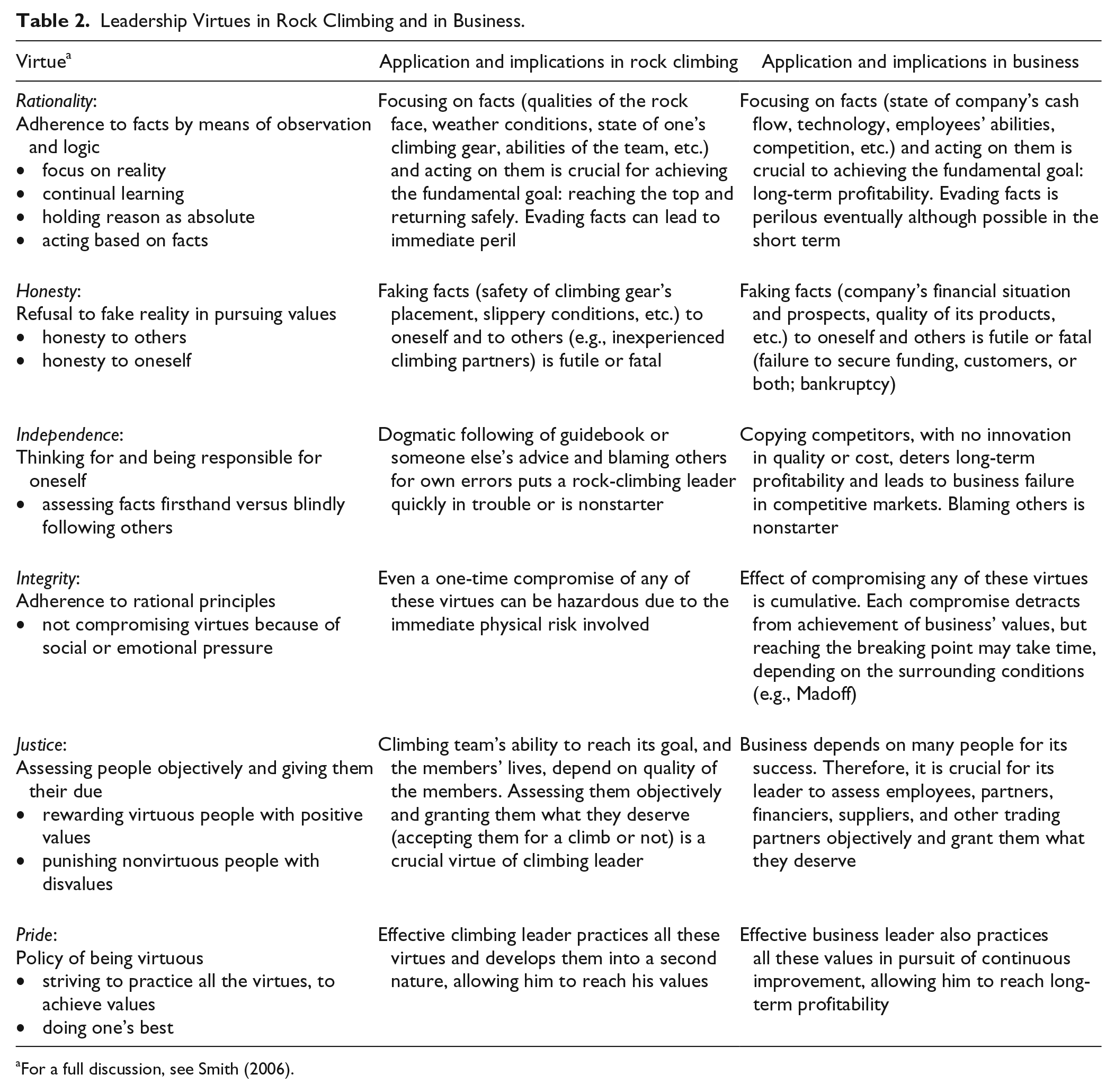
For a full discussion, see Smith (2006).
Identifying leadership virtues by observing actual leadership practice contrasts with and complements previous literature on ethical leadership that is either purely conceptual or relies on interviews and surveys. For example, Hackett and Wang (2012) distill from literature six leadership virtues they consider most important: courage, temperance, justice, prudence, humanity, and truthfulness. They identified 59 virtues that were empirically or conceptually associated with different leadership styles; nine virtues were common across all styles. Hackett and Wang further reduced the common virtues to six, based on four criteria: They are (a) considered cardinal virtues by different philosophers, (b) culturally universal, (c) interrelated (and constitute “good character”), and (d) associated with ethical and/or effective leadership traits.
While we do not claim to have induced new virtues—the six we observe have been identified previously by others—we nevertheless show with examples how effective rock-climbing leaders practice them. Because virtuous action requires consistency to lead to values, virtues are interrelated in that they emphasize different but related aspects of value-pursuing action. In our description of rationality, honesty, independence, integrity, justice, and pride, we also draw parallels to business. We highlight the novelty of rationality, independence, and pride in that context. Honesty, justice, and integrity have been considered the common leadership virtues (Demirtas, 2015; Fehr et al., 2015). However, our definitions of them differ from the conventional view.
Rationality, though not conventionally considered a virtue, is the fundamental virtue required of effective leaders in rock climbing: It means adherence to facts by the means of observation and logic (Rand, 1964). Rock climbing, and leading in particular, requires relentless attention to and appraisal of facts: whether the route can be ascended, given climber abilities and goals; whether the placement of gear is such that the physical principles of gravity, force, and friction will enable a fall to be stopped; whether one’s own and the climbing team’s abilities match the requirements to complete this climb safely; the assessment of current and incipient weather conditions, and so on. Facts are inescapable in business also, but there is more room to evade them and to cover up mistakes. As examples, consider some famous, even fatal business disasters, such as the collapse of unsound garment factory buildings in Dhaka, Bangladesh, and pyramid investment schemes like that of Bernie Madoff.
Rationality has four primary requirements: (a) focus on reality, (b) continual learning, (c) holding reason as an absolute, and (d) acting based on facts (Smith, 2006). Leading in rock climbing demands focus; it is eminently clear to even the most inexperienced leader that if the mind wanders from the demanding task at hand, consequences could be serious and even fatal. Experience in leading also contributes to the ability to focus. This is part of continual learning: The more knowledge a leader has about leading in general and about the chosen route in particular—from guidebooks, other climbers, and her own observations—the better able she is to lead effectively and safely. Only factual information, acquired through reason, will facilitate a successful climb. The successful leader soon learns not to depend on emotions, wishful thinking, or leaps of faith instead of reason, as the hard face of natural rock will quickly bring her back to reality. Rationality requires the leader to use reason to come to conclusions about the best way to act—and then act on those conclusions based on facts (cf. Crossan et al., 2013; Moccia, 2012)—because in rock climbing, facts are inescapable and ignored at one’s peril. In our climbing scenario, the leader must rely on rationality to determine which way to go when the route is not obvious and to determine that each piece of gear is placed in such a way that the downward force of a fall will not pull the piece out of the rock.
Rationality is also the primary virtue in business, because success in it can only be achieved by adhering to facts (Allison, 2014; Miska et al., 2014; Puris, 1999). For example, facts such as a new competitor entering the market, the company’s technology being outdated, customers choosing competitors’ products and services, or the company losing money, cannot be ignored in the long term. Evading reality today will come to haunt the evader eventually and unfortunately hurt his victims—customers, employees, business partners, shareholders—also. Business leaders who acknowledge facts, learn continually, and depend on reason only, instead of trusting mystic insights or following others blindly, achieve competitive advantage for their companies. It has also been suggested that rationality is the fundamental virtue: without adherence to facts, no other virtues, such as honesty, justice, and integrity can be practiced (Moccia, 2012, citing Pieper, 1970). Rand (1964) considered rationality as the fundamental virtue from which the others are derived (Smith, 2006). As a leadership virtue, it can be summarized as
Honesty is another virtue crucially important to rock-climbing leaders. It is the flip side of the virtue of rationality: Whereas rationality guides a leader to adhere to facts, honesty urges him to not fake them (Rand, 1964). In climbing, honesty is crucial to maintaining safety; for example, the leader in our climbing scenario must not pretend that a piece of climbing gear is properly placed to protect a leader fall when it is not.
An unwritten code of climbing ethics also places great importance on honesty. For example, a climber following a line of preset bolts up a rock face is obliged not to use those bolts for anything but protection from a fall. If she pulls on a bolt or a runner that she has attached to it, the climb does not count as a legitimate free ascent, and she is bound by the ethical code to divulge that, even if no one saw her do it. Note that honesty is not just telling the truth to others. It also means honesty to oneself. Both kinds of dishonesty—to others and to oneself—are futile and hazardous (Smith, 2006), as a climbing leader’s dishonesty in one small matter may breed dishonesty in more important (and possibly life-threatening) matters.
Honesty—not faking facts to gain a value—is equally important for business leaders (Bauman, 2013; Brown et al., 2005), although it is easier for them to fool themselves into thinking that it is possible to get away with dishonesty, such as deceiving investors, customers, or employees. However, faking is futile also in business: values—high-quality products, new technologies, competent employees, investors, profits—cannot be achieved in the long term by misrepresenting facts. The virtue of honesty in ethical leadership can be summarized as
Climbing leaders also require the virtue of independence: thinking for and being responsible for oneself. Whereas rationality emphasizes adherence to facts, independence highlights the firsthanded nature of thinking and action. The leader in our scenario will be alone in front of the rock face, high above the second, and must independently, and repeatedly, determine the exact choice of path up the cliff. Leading in climbing actively reinforces independence, as there is no one to depend on when you are out on the “sharp end of the rope.” A leader relies on his belayer to help keep him safe, and the belayer may have a vantage point to offer advice, but the leader’s primary responsibility for his own safety (and ultimately that of the entire team) lies with himself. Independence is enforced by physical distance and by the nature of the task: Only one person can move the rope up at a time.
Although independence may seem like an obvious virtue for a leader in any context, it is not conventionally considered a virtue because it is perceived as not sufficiently other-regarding (Smith, 2006). Being independent does not mean not being a team player and not consulting others. It means independent thinking and judgment: the continual decision making and firsthand assessing of facts that are necessary for leading up a new route, for example.
A climbing leader can violate the virtue of independence, for example, by reading the guidebook dogmatically, or by acting on “beta”—advice from other climbers—without evaluating it first. Inexperienced leaders may follow a presumed climbing route up into a dead end because they see bits of rope and runners that were left behind by previous leaders who mistakenly ended up there; this is both dangerous and a waste of the precious time that is available to achieve the goal.
The importance of the virtue of independence in business is obvious (Kouzes & Posner, 2012). Innovation, one of the most sustainable sources of competitive advantage and of long-term profit, requires independent thinking. Innovation and long-term profitability cannot be achieved by imitating competitors. As in rock climbing, it is fine and often extremely helpful for business leaders to consult others, but leaders need to assess others’ advice by thinking for themselves. The virtue of independence in ethical leadership can be summarized as
Integrity, defined as “commitment in action to a morally justifiable set of principles and values” (Becker, 1998, pp. 157-158) or “loyalty to rational principles” (Smith, 2006, p. 176), is another demonstrably important virtue for climbing leaders. Integrity means adhering to rational principles one knows to be correct, with the emphasis on resisting the temptation by social or emotional pressures to compromise them. A leader’s climbing partners may pressure her to continue on a climb despite the potential for changes in the weather, or she may foolishly decide to show off her climbing prowess to the other climbers by attempting a route beyond her skills. However, succumbing to such hubris tends to make things inadvertently go wrong, resulting in “subjective hazards” that are created by the leader’s distraction. Subjective hazards, such as “z-clipping,” where the bolts on a route are clipped out of order, potentially resulting in a serious fall, add to the objective hazards of climbing.
Integrity is a climbing leadership virtue because it is an essential means to one’s goals. To be successful, the leader in our scenario must be committed to factual appraisal of all the unpredictable events that may occur (e.g., incorrect guidebook information, loose bolts that need to be backed up by additional gear, a change to threatening weather). He must be honest to the second and to himself concerning, for example, potential mistakes in route finding. He must think independently, continually judging the rock conditions against the team’s abilities and deciding whether they can safely continue or must instead get back down by rappelling.
Integrity is also a crucial leadership virtue in business (Bauman, 2013; Brown & Treviño, 2006) as the basis of trust between leaders and followers, managers, and subordinates. There is no faster way for leaders to lose credibility—the trust of their followers—than to compromise on their avowed principles. Claiming to subscribe to the virtue of justice—for example, the principle of pay for performance—while playing favorites, would quickly erode a leader’s credibility. Promising transparency and honesty and then hiding pertinent facts about their company’s performance would have a similar effect. According to Jim Hackett, CEO of Steelcase: “You can’t lead if you don’t have trust, and you can’t have trust if you don’t have integrity” (Tichy & Bennis, 2007, p. 83). The virtue of integrity in ethical leadership can be summarized as
Why would climbing leaders need the virtue of justice? Justice means assessing people objectively and granting them what they deserve (Smith, 2006). It is rationality applied to evaluating and treating people. It means rewarding virtuous people—those who are competent, hardworking, honest, independent, reliable, courteous, so on—with positive values, such as praise, promotion, bonuses, friendship. It also means punishing nonvirtuous people—those who are incompetent, lazy, dishonest, blind followers, unreliable, so on—with disvalues, such as reprimands, demotion, termination of employment relationship, and withdrawal of friendship.
The success of a rock-climbing outing, like that of a business project, depends on the quality of the team. To achieve the team’s goal, it is crucial that the leader assess each member objectively and reward them—with participation in the climb, in an appropriate position with appropriate responsibilities. To assess the climbing party, the leader needs to know the members reasonably well. What is each person’s skill level? How well can they handle a challenging climb? What are their personalities like—will they stay calm in unexpected situations? How dependable are they? How safety-conscious? For the leader to be just, she needs all this factual knowledge about her climbing party to assess whether she can assume the leadership role for a climb that may turn out to be more challenging than anticipated—and she must be willing to cancel the climb if the team is not fully capable. In our climbing scenario, an unjust assessment of the second’s belaying abilities could be exceedingly hazardous in the event of a leader fall.
Justice is also universally considered a virtue in business (Crossan et al., 2013; Fehr et al., 2015; Hackett & Wang, 2012). Like rock climbing, business requires the input of many people to achieve the goal of long-term profit maximization through production and trade of goods and services. Therefore, it is crucial that business leaders carefully evaluate those who they hire. Dishonest, unreliable, unproductive, or incompetent employees, as well as business partners and suppliers, can ruin the business, whereas honest, productive, and competent ones will facilitate its long-term success. Although this should be self-evident, many business leaders make poor decisions in evaluating people, for example, hiring based on need versus merit (Woiceshyn, 2012). The virtue of justice in ethical leadership can be summarized as
Pride was called the crown of all virtues by Aristotle; a proud person practices all the virtues to achieve happiness. Pride can be understood as a policy of being virtuous—rational, honest, having integrity, independent, just. Despite a common connotation, pride does not mean arrogance or boastfulness but instead demands consistent rational action to survive, flourish, and achieve the values that it entails (Smith, 2006). In rock climbing, the virtue of pride encourages a leader to do his best—adhering to facts, not faking, sticking to his principles, thinking for himself, and evaluating others and himself objectively—so as to reach his goal of enjoying rock climbing, including leading others effectively. Pride is required for belief in oneself; it is necessary to successfully start a challenging climb. In our scenario, the leader’s pride in his abilities is essential in generating the confidence required to take the first step onto the rock and to follow through with the climb. Pride also makes him adhere to the ethics of climbing, such as setting up an uncluttered anchor with a carefully stacked rope, and organizing protective gear on the rack so that it can be found quickly when needed at a critical point. Practicing pride will also make the climb faster and safer.
Pride extends to the style of climbing used in an ascent: for example, in free, nonaided climbing a climber will try not to pull on an existing bolt in the rock for assistance, and he is bound by pride to be honest and admit if he did so. It is considered good style always to conduct yourself in a way you will be proud about, and this will naturally cause appropriate actions to follow. Choosing climbing partners who share this virtue, or helping them adopt the policy of doing their best, are also important for reaching the team’s goal of safe, enjoyable climbs.
The virtue of pride matters also in business, as an important motivational force and driver for continual improvement—and for long-term profitability (Woiceshyn, 2011). Leaders themselves need to embrace the policy of doing their best, but it is crucial for the long-term survival and profitability of their companies that their followers also adopt this policy. The evidence of employees not guided by pride in their work is too common, either as shoddy workmanship or poor service (Avolio & Locke, 2002; Allison, 2014; Woiceshyn, 2012). The virtue of pride in ethical leadership can be summarized as
Discussion and Conclusions
Ethical leadership practices, condensed and abstracted in general leadership virtues, are difficult to observe in most contexts. Yet such observation is important to uncover what constitutes ethical leadership practice and to induce the virtues to guide it. Because of the exposed nature of leadership in rock climbing, it highlights the role of leadership virtues, providing an ideal case (Eriksson & Kovalainen, 2008). We have drawn parallels between leading in the realms of rock climbing and of business. Superficially, these are very different spheres of conduct, but beneath the surface there are similarities. Furthermore, we have argued that these similarities are so fundamental that the virtues that are consistent with strong leadership abilities on the rock will also empower business executives and managers to lead effectively.
Our discussion and elaboration of these virtues—rationality, honesty, independence, integrity, justice, and pride—contributes to the emerging literature on ethical leadership. This literature is important because it represents a positive turn in the leadership and organizational behavior literatures (Manz et al., 2008). This turn was inspired by the growing field of positive psychology (Seligman, 2002) that focuses not on human dysfunction but on human ability to achieve values and the associated positive qualities (Cameron & Spreitzer, 2012; Luthans, 2002). Achievement of values—overall flourishing and well-being in the Aristotelian sense—is possible by practicing the right virtues. In the world of business, as in rock climbing, virtuous leaders set the direction and provide an example for others, and therefore they have the biggest impact on the achievement of goals.
The practitioner literature on leadership offers valuable insights into leadership practices as well. For example, Kouzes and Posner’s (2012) best-selling book identifies five concrete effective leadership practices: (a) model the way, (b) inspire a shared vision, (c) challenge the process, (d) enable others to act, and (e) encourage the heart. While these offer concrete guidance to leaders, our identification of leadership principles and virtues—which subsume such concrete practices—contributes to the theory of ethical leadership at a higher level of abstraction (by condensing information without omitting any). For example, the trader principle (leaders trading value for value), subsumes the practices of modeling the way, inspiring a shared vision, and enabling others to act—all of them involve enabling or inspiring members to contribute their efforts to their organization’s success for the values (interesting assignments, compensation, recognition, etc.) they receive in return from the leaders. Modeling the way, enabling others to act, and encouraging the heart are driven by the virtue of justice, as it is not fair to ask followers to do tasks without showing them how, providing the resources needed, and motivating them. The practice of challenging the process falls under the virtue of independence. And all these practices are subsumed by the virtue of rationality, which guides leaders to act based on the facts of the given context: the requirements of their role and the qualities of those they are leading.
In contrast to effective leadership practices identified in the practitioner literature, the ethical leadership model proposed here provides an explicitly moral perspective: It identifies the moral action principles—virtues—required to achieve the long-term values of human well-being and flourishing in organizational and other contexts.
We summarized the six leadership virtues and the two associated ethical principles in the eight propositions. While they have a basis in firsthand observation of rock-climbing leadership and literature on ethical and virtuous leadership, they can be further tested with additional data. We have emphasized the importance of studying ethical leadership practice, so an obvious way to confirm or reject the propositions is through field research in a business context, such as participant observation. Such field research could be complemented with other, less direct methods, including discursive analysis of texts (such as journals of leaders and subordinates, leaders’ written statements, e.g., letters to shareholders), and interviews of leaders and followers (Eriksson & Kovalainen, 2008). Ethical leadership practice is harder to capture through quantitative methods, but surveys of both leaders and their followers could be used, even in conjunction with field research (cf. Demirtas, 2015). Scales would need to be developed to operationalize the six leadership virtues and their foundational principles proposed here (Khuntia & Suar, 2004; Yukl, Mahsud, Hassan, & Prussia, 2013). This would be relatively straightforward, given the clear definitions of the virtues, the underlying literature, and our observation-based elaboration.
Encouraged by the recent increased interest in ethical leadership and leadership virtues, we hope that the lessons that we have drawn from rock climbing will motivate further empirical study of ethical leadership practice as outlined above—particularly in the business context—and that leaders in business and elsewhere will discover and apply the virtues examined here.
Footnotes
Declaration of Conflicting Interests
The author(s) declared no potential conflicts of interest with respect to the research, authorship, and/or publication of this article.
Funding
The author(s) disclosed receipt of the following financial support for the research, authorship, and/or publication of this article: The first author gratefully acknowledges the financial support of the Canadian Centre for Advanced Leadership in Business at the Haskayne School of Business, University of Calgary.