



Abstract
This study examines the effects of corporate social responsibility (CSR) on employee attitudes (affective commitment and job satisfaction). Based on a sample of 1,249 employees in 40 firms, collected across multiple time points from multisource data, hierarchical linear modeling was employed to examine the mediating role of relational social capital between CSR and employee attitudes and the moderating role of communication in this relationship. The results indicate that CSR has a positive influence on affective commitment and job satisfaction and that this is fully mediated by relational social capital. However, the moderated mediation effects of communication were insignificant. The results suggest that firms may “do well” by eliciting positive employee attitudes through relational social capital stemming from “doing good.” Implications and directions for future research are discussed.
Keywords
Introduction
Throughout the past decades, scholars and businesspersons alike have speculated “if” and “how” firms may benefit from their corporate social responsibility (CSR) activities (Aguilera, Rupp, Williams, & Ganapathi, 2007; Aguinis & Glavas, 2012; Margolis, Elfenbein, & Walsh, 2007; Orlitzky, Schmidt, & Rynes, 2003). Although many scholars have strived to find explanations and provide empirical evidence that supports a consistent pattern, results have been somewhat inconsistent (Aguinis & Glavas, 2012; McWilliams & Siegel, 2001). Nevertheless, a majority of studies find that CSR has positive effects on firms, such as enhanced firm financial performance, increases in firm reputation, customer satisfaction, and the development of important organizational intangible capabilities (Aguinis & Glavas, 2012; Orlitzky et al., 2003; Surroca, Tribó, & Waddock, 2010). Recently, scholars have found that CSR can be beneficial to the firm as CSR has the potential to engender positive employee attitudes such as, affective commitment and job satisfaction (Brammer, Millington, & Rayton, 2007; Chun, Shin, Choi, & Kim, 2013; De Roeck, Marique, Stinglhamber, & Swaen, 2014; Turker, 2009; Valentine & Fleischman, 2008; Vitell & Davis, 1990). This article focuses on the positive influence of CSR by examining the effects CSR has on fostering these positive employee attitudes. Exploring the effects CSR has on employee attitudes are important as prior research finds that positive employee attitudes may lead to superior firm performance (Chun et al., 2013; Koys, 2001).
However, as noted by Aguinis and Glavas (2012) in their review, although the number of studies linking CSR with individual-level outcomes is increasing, compared with the manifold amount of research about the organizational factors related to CSR, relatively few studies have examined how CSR influences employees. Furthermore, existing studies are limited in that they tend to assess the effects of CSR, which is a Level-2 construct, directly to employee attitudes, which are Level-1 constructs, without considering the multilevel effects (Aguinis & Glavas, 2012). As such, it is possible that the results of current research may be overestimated or biased, and there could be problems related to wrong-level inference fallacy (Raudenbush, Bryk, & Congdon, 2004). Moreover, studies that examine the “black box” behind the association between CSR and employee attitudes remain surprisingly sparse (De Roeck et al., 2014; Farooq, Payaud, Merunka, & Valette-Florence, 2014; Jones, 2010). There are also problems related to reverse causality, as most studies are based on cross-sectional analyses (De Roeck et al., 2014), and those related to common method bias have also been noted (Hansen, Dunford, Boss, Boss, & Angermeier, 2011). Moreover, the results may be somewhat culturally biased, as they are mostly based on Western populations (Hofman & Newman, 2014; Oh, Chang, & Martynov, 2011). In addition, studies that examine the contingent factors or boundary conditions behind the relationship between CSR and employee attitudes are very scarce (Farooq et al., 2014).
This article sought to respond to these gaps and limitations in current literature. To overcome problems with multilevel issues, hierarchical linear modeling (HLM) was employed to examine the relationship between CSR and employee attitudes (specifically affective commitment and job satisfaction) at the proper levels. Furthermore, the mediating role of the relational dimensions of social capital (relational social capital) was examined to provide insights into mechanisms through which CSR leads to positive employee attitudes. Relational social capital is an important social capital which includes aspects such as trust, mutual senses of identification, shared norms, and perceived obligations, as well as positive relationships and high levels of intimacy between actors (Bolino, Turnley, & Bloodgood, 2002; Nahapiet & Ghoshal, 1998; Saeed & Arshad, 2012; Watson & Papamarcos, 2002). Although recent studies imply that CSR may foster relational social capital (Aguilera et al., 2007; Lee, Lee, & Li, 2012; Pastoriza, Arino, & Ricart, 2008; Saeed & Arshad, 2012), a majority of them are conceptual, and the few existing empirical studies focus on only one aspect of relational social capital, mainly trust. This article expands on previous studies in that it empirically examines the arguments of prior conceptual and theoretical studies, and that it examines not just one facet of relational social capital but multiple facets of relational social capital: trust, positive social relationships, and a close-knit cooperative climate. It is also novel in that it considers not only how CSR leads to better firm and employee relationships but also about how CSR may foster relational social capital among employees within the organization. To provide theoretical support for the hypotheses, the article utilizes social capital theory (Coleman, 1998; Nahapiet & Ghoshal, 1998), which emphasizes that relational social capital is important to fostering positive employee attitudes (Cohen & Prusak, 2001; Leana & Van Buren, 1999; Lee et al., 2012; Parzefall & Kuppelwieser, 2012; Watson & Papamarcos, 2002). The study also employs arguments from social exchange theory (Blau, 1964) and social identity theory (Ashforth & Mael, 1989), which is frequently mentioned in studies about CSR and employee attitudes, as reciprocity and positive social exchange among organizational members, as well as mutual identification, are considered important to the development of relational social capital.
To deal with problems related to reverse causality and cultural issues, data based on a Korean sample collected across multiple time points were used for the analyses. In addition, limitations related to common method bias were dealt with by employing multisource data, so that data about CSR and employee attitudes are collected from different data sources. Furthermore, a contingency perspective was employed to examine the role of communication in firms as a moderator in the relationship between CSR, relational social capital, and employee attitudes, so as to provide a better understanding about any contingent factors or boundary conditions in the relationship between CSR and employee attitudes. Prior research argues that communication is important as it makes more clear the intentions and organizational policies to employees (Den Hartog, Boon, Verburg, & Croon, 2013). Thus, this article examines whether communication may strengthen the positive effects of CSR on employee attitudes via relational social capital by making employees more attuned to CSR.
In short, the purpose of this research was to examine the relationship between CSR and employee attitudes, focusing on the mediating role of relational social capital and the moderating role of communication in the mediated relationship. The article contributes to current literature in that, to my knowledge, it is the one of the few studies, if not the only one, to empirically examine the relationship between CSR, multiple aspects of relational social capital, and employee attitudes. Furthermore, it provides insights into how firms may benefit from CSR, by shedding light into the black box behind CSR and employee attitudes, as well as on the contingent factors that may be needed to strengthen the positive effects of CSR. This study also contributes in that it uses multilevel analyses, one of the few studies about CSR to do so, and utilizes a large Korean sample, thus providing insights into how CSR may influence employee attitudes in an Asian context. Below is a model of the hypotheses (Figure 1).
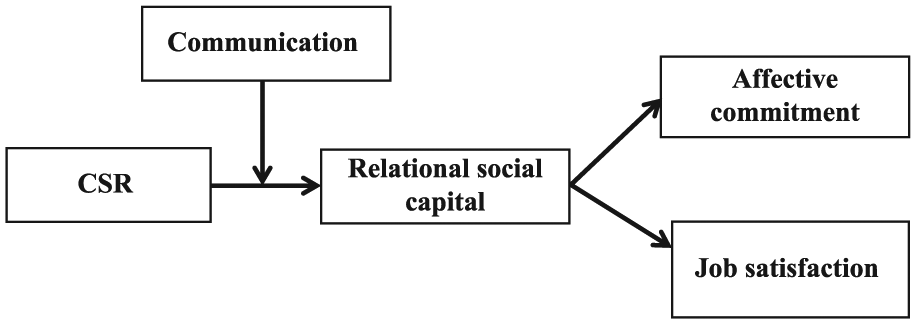
Research Model.
Theory and Hypotheses
CSR and Employee Attitudes
Although various definitions relevant to the concept of CSR exist, it can generally be conceptualized as the activities a firm engages in that appear to advance a social agenda or benefit beyond the interest of the firm and beyond what is required by law (McWilliams & Siegel, 2001). This includes both external CSR, which refers to socially responsible behavior directed toward external stakeholders (i.e., customers), and internal CSR, which is behavior directed toward internal stakeholders (i.e., employees; Aguinis & Glavas, 2012; De Roeck et al., 2014; McWilliams & Siegel, 2001). Various studies have been conducted about the antecedents as well as the outcomes of CSR (Aguilera et al., 2007; Aguinis & Glavas, 2012; Bingham, Dyer, Smith, & Adams, 2011; Margolis et al., 2007; Marquis & Lee, 2013; Orlitzky et al., 2003; Surroca et al., 2010). Although few compared with research about CSR and organizational-level outcomes; several studies report that CSR has a positive influence on employees’ attitudes, such as affective commitment (Brammer et al., 2007; Chun et al., 2013; Collier & Esteban, 2007; Farooq et al., 2014; Lee et al., 2012; Wong & Gao, 2014) and job satisfaction (De Roeck et al., 2014; Lee et al., 2012; Valentine & Fleischman, 2008; Vitell & Davis, 1990). Affective commitment refers to a positive emotional attachment, identification with, and continued involvement between an employee and his or her organization (Allen & Meyer, 1990; Mowday, Steers, & Porter, 1979), whereas job satisfaction can be viewed as “a pleasurable or positive emotional state resulting from an appraisal of one’s job or job experiences” (Locke, 1976, p. 1300). Generally, extant studies use social exchange theory and social identity theory to explain the direct relationship between CSR and employee attitudes.
Literature about social exchange theory and perceived organizational support (Blau, 1964; Farooq et al., 2014; Jones, 2010; Rhoades & Eisenberger, 2002) posit that when employees feel that they are being supported by their organization and receive socioemotional benefits, they reciprocate by demonstrating positive employee attitudes. Because CSR involves doing good for all stakeholders, including employees, firms more engaged in CSR are likely to provide more support to their employees and work harder to satisfy their various needs (De Roeck et al., 2014; Farooq et al., 2014; Fu, Ye, & Law, 2014; Jones, 2010), thus causing employees to feel more obligated to respond in kind. Furthermore, even CSR directed toward external stakeholders elicits employees’ desire to “give back” to their organization (Hansen et al., 2011), as employees infer how insiders will be treated based on how the organization treats outsiders, and use this to make evaluations about how they are being treated (De Roeck et al., 2014; Rupp, Ganapathi, Aguilera, & Williams, 2006). Similarly, CSR leads employees to have positive perceptions about their firms, and prompts employees to feel good about themselves and proud to belong to such a socially well-regarded organization, hence satisfying their needs for belongingness, self-esteem, and a positive self-identity (Brammer et al., 2007; Collier & Esteban, 2007; Jones, 2010; Lee et al., 2012; Rupp et al., 2006). This is important to employee attitudes, as studies about social identity theory (Ashforth & Mael, 1989; Brammer et al., 2007; De Roeck et al., 2014; Farooq et al., 2014) note that employees prefer to identify with organizations that have a prestigious image and enhance their feelings of self-esteem and self-worth, and that when this is satisfied, they respond by displaying positive attitudes such as affective commitment and job satisfaction. In this vein, it is expected that CSR will be positively correlated with employee attitudes, such as affective commitment and job satisfaction, even in an Asian context such as Korea and when considering multilevel effects.
The Mediating Role of Relational Social Capital
The present study, using social capital theory, as well as incorporating arguments from social exchange theory and social identity theory mentioned above, tests the multilevel effects of CSR on relational social capital. According to social capital theory, social capital can be defined as a form of capital and an asset that is embedded in social relationships and networks, and thus is reflected in the existence of close interpersonal relationships among individuals (Adler & Kwon, 2002; Bolino et al., 2002; Coleman, 1988; Nahapiet & Ghoshal, 1998). Nahapiet and Ghoshal (1998) demonstrate that social capital can be distinguished into three different dimensions: (a) a structural dimension, (b) a relational dimension, and (c) a cognitive dimension. This article focuses on the relational dimension, which is reflected by key facets such as trust, mutual senses of identification, shared norms, and perceived obligations, as well as positive relationships and high levels of intimacy between actors (Bolino et al., 2002; Nahapiet & Ghoshal, 1998; Saeed & Arshad, 2012; Watson & Papamarcos, 2002). Although previous studies have provided significant insights into social capital, there is a need for more research about the antecedents and conditions in which social capital can develop (Adler & Kwon, 2002; Bolino et al., 2002; Dutton, Roberts, & Bednar, 2010; Leana & Van Buren, 1999; Pastoriza et al., 2008). This article argues that CSR could play an important role in fostering relational social capital, which is conceptualized in this study as high levels of trust, positive social relationships, and a close-knit and cooperative work climate.
CSR may contribute to relational social capital because CSR sends important signals to employees about the firms’ ethics and values, as well as about how just or fair the firm is, therefore providing implications to employees about the extent to which it can be trusted (Aguilera et al., 2007; De Roeck et al., 2014; Hansen et al., 2011; Lee et al., 2012; Rupp et al., 2006). For example, Hansen et al. (2011) and Lee et al. (2012) found that a firm’s CSR elicits trust from employees, as CSR leads employees to understand that the firm is acting in good faith and believe that it will be considerate of their interests and welfare. Furthermore, in their conceptual study, Aguilera et al. (2007) noted that CSR has potential to foster higher levels of trust, increased feelings of belongingness, and higher quality relationships due to the influence of CSR on employees’ fairness and justice perceptions.
CSR may also be important to relational social capital, as CSR encourages employees to behave in more virtuous ways and treat each other with respect and fairness, as well as to help and share with one another (Chun et al., 2013; Fu et al., 2014; Khandelwal & Mohendra, 2010; Pastoriza et al., 2008; Saeed & Arshad, 2012; Shen & Benson, 2014; Wong & Gao, 2014). This is likely to increase trust and produce higher quality relationships among organization members, as well as fostering a close-knit and cooperative organizational climate (Bolino et al., 2002; Dutton et al., 2010; Saeed & Arshad, 2012; Vitell & Davis, 1990). This may be because CSR fosters a positive organizational climate in line with its socially responsible initiatives and values, which, in turn, encourages positive and ethical employee behavior (Collier & Esteban, 2007; Verbos, Gerard, Forshey, Harding, & Miller, 2007). Furthermore, according to social exchange theory and related studies about perceived organizational support, employees exhibit more positive behaviors, such as organizational citizenship behaviors, helping others, and being more cooperative and cordial, when they feel they are being supported by the organization (Konovsky & Pugh, 1994; Mossholder, Richardson, & Settoon, 2011; Rhoades & Eisenberger, 2002). To the extent that CSR displays commitment and support to employees, CSR is likely to compel employees to display more positive behaviors that are likely to foster relational social capital. For example, Fu et al. (2014) found that CSR led to employees’ extrarole helping behaviors, such as helping group members with their work, which in turn, is important to fostering relational social capital in the workplace (Bolino et al., 2002). Although not tested empirically, Pastoriza et al. (2008) suggested that humanistic and ethical management approaches may contribute to the generation of relational closeness in an organization.
Last, CSR may foster relational social capital by increasing employees’ organizational identification and creating shared visions and values. As mentioned, several studies based on social identity theory found that CSR increases employees’ identification with the organization (De Roeck et al., 2014; Farooq et al., 2014; Jones, 2010; Shen & Benson, 2014). Employees’ organizational identification is important to relational social capital, as it motivates employees to trust, share and help, and cooperate with the firm and consequently, one another (Nahapiet & Ghoshal, 1998; Pearson, Carr, & Shaw, 2008; Shen & Benson, 2014). Furthermore, it is likely to lead to an increased mutual sense of identification among employees, as employees’ organizational identification causes individuals to view themselves as part of the collective (Nahapiet & Ghoshal, 1998). Moreover, CSR positively influences the creation of shared norms and values through the firm espousing and practicing socially relevant values (Khandelwal & Mohendra, 2010), thus further having potential to elicit a mutual sense of identification and other aspects of relational social capital. For example, Surroca et al. (2009) argued that CSR may generate a common language, and that because of this CSR has potential to promote collaborative relationships and mutual trust in organizations.
This is important, as social capital theory (Coleman, 1988; Nahapiet & Ghoshal, 1998) and a substantial amount of related literature about the relational dimensions of social capital, such as high-quality relationships and trust, indicate that relational social capital is important to fostering positive employee attitudes, such as affective commitment and job satisfaction (Cohen & Prusak, 2001; Leana & Van Buren, 1999; Lee et al., 2012; Parzefall & Kuppelwieser, 2012; Watson & Papamarcos, 2002). For example, Watson and Papamarcos (2002) and Parzefall and Kuppelwieser (2012) provided empirical support showing that relational social capital leads to increases in organizational commitment. As such, it is hypothesized as follows:
The Moderating Role of Communication
The importance of communication is well recognized by CSR-related studies, which emphasize that communication is critical to influencing stakeholders’ responses to CSR (Du, Bhattacharya, & Sen, 2010; Jahdi & Acikdilli, 2009; Morsing & Schultz, 2006; Powell, 2011). Nevertheless, most of these studies are conceptual and tend to mainly focus on communication with external stakeholders. However, various scholars posit that communication levels inside the organization play a significant role in fostering positive employee attitudes and behaviors (Carrière & Bourque, 2009; Orpen, 1997; Pettit, Goris, & Vaught, 1997; Smidts, Pruyn, & Van Riel, 2001). Furthermore, Aguinis and Glavas (2012) suggested that paying attention to how communication within the organization influences the relationship between CSR and employee outcomes is important for future research. Therefore, this study focuses on how a firm’s communication within the organization may influence the relationship between CSR, relational social capital, and employee attitudes. Based on prior studies (Den Hartog et al., 2013; Roberts & O’Reilly, 1974), communication is conceptualized as whether the firm provides accurate information, and a sufficient amount of it to employees; whether communication quality is sufficient between departments; and whether communication is upward and open, allowing sufficient employee participation. I argue that it will play a moderating role between CSR and employee attitudes. Although few, some recent studies, such as Rupp, Shao, Thornton, and Skarlicki (2013) and Hofman and Newman (2014), have found that certain factors such as employees’ moral identity or organizational culture may either strengthen or weaken the effects of CSR on employees. This study examines whether this contingency perspective is consistent in a different context and with a different sample, and it is expected that communication will play a similar moderating role, contributing to strengthening the effects of CSR on fostering relational social capital and consequently engendering positive employee attitudes.
Prior studies note the importance of communication for employees’ perceptions and responses to a firm’s actions, policies, and decisions. This is because communication contributes to increasing employees’ understanding of a firm’s norms and values, and provides information about what is offered by the organization and the reasons behind organizational actions and policies (Den Hartog et al., 2013; Kernan & Hanges, 2002; Smidts et al., 2001). Accordingly, Den Hartog et al. (2013) found that communication strengthens the effects that a firm’s actual human resource management practices have on employees’ awareness of those practices. Furthermore, CSR studies note that communication is important to increasing stakeholders’ awareness of a firm’s CSR activities, which is a key prerequisite for firms’ CSR activities to reap strategic benefits (Du et al., 2010). As stressed by Rupp et al. (2013, p. 897), “how employees perceive the CSR of their employer has more direct and stronger implications for employees’ subsequent reactions than the actual CSR behaviors of firms, which employees may or may not be aware.” As such, because higher communication levels may contribute to increases in employees’ awareness of a firm’s actual CSR activities, this may strengthen the effects that CSR has on fostering relational social capital in the organization. Similarly, Powell (2011) noted the importance of internal marketing in eliciting employees’ awareness of CSR, so that this contributed to the effects of CSR being amplified.
Furthermore, communication may not only increase employees’ awareness of a firm’s CSR but also influence how positively employees perceive the firm’s CSR activities and how much they identify with them. For example, Rupp et al. (2006) noted that because employees are less likely to be involved in developing and implementing CSR policy, they are less likely to have fully internalized a firm’s CSR and may even be defensive about it. Prior studies find that communication is important to increasing employees’ internalization and identification with a firm’s policies and values (Dutton, Dukerich, & Harquail, 1994; Smidts et al., 2001). More important, Morsing and Schultz (2006) posit that a two-way communication process between the firm and stakeholders is important for building legitimacy and reaping positive responses from stakeholders, emphasizing that firms need to move from “informing” stakeholders to “involving” stakeholders in CSR communication itself. This is echoed by Weber, Unterrainer, and Schmid (2009), who argue that open and free communication is crucial for a firm’s norms, values, and principles to gain legitimacy with employees. As communication is conceptualized and measured in this study to include not only how much information is being given but aspects of how open and participative the communication process is in the firm, it is argued that high levels of communication will strengthen the effects that CSR has on relational social capital and employee attitudes, as it is likely to elicit more positive responses from employees about a firm’s CSR. In this vein, it can be hypothesized as follows:
Methodology
Sample and Data
To test the hypotheses, data were collected from two main sources: (a) the KEJI index provided by the Korea Economic Justice Institute and (b) The Human Capital Corporate Panel (HCCP) survey, distributed by the Korea Research Institute for Vocational Education and Training. The KEJI index provides CSR ratings of Korean companies listed on the Korea Exchange, using information from annual reports, news reports, and governmental authorities. It has been announced every year, beginning in 1991, and is considered to be comparable to the United States. CSR ratings conducted by the Kindleberger, Linder, and Domini database (Oh et al., 2011). The HCCP is a biennial government-sponsored survey drawn from Korean firms with more than 100 employees, and contains data about the firms collected from both managers and employees. Both the HCCP and KEJI have been extensively used by previous studies (i.e., Chang, Oh, Park, & Jang, 2015; Choi, Kwak, & Choe, 2010; Oh et al., 2011). The two data sets were merged to gain a collective longitudinal data set about firms’ CSR ratings, employee attitudes, and the necessary control variables.
For more robust analyses, and to overcome problems related with reverse causality, employee attitudes was lagged by 2 years from the year CSR was measured; thus CSR data from the 2009 KEJI index were merged with the 2009 and 2011 employee attitudes, relational social capital, and control variable data from the HCCP survey. After ensuring that the data fit the conditions of multilevel analyses, the overall sample was 1,249 employees across 40 firms. All firms in the sample had at least 200 employees, were in the manufacturing industry, and had unions to represent employees.
Measures
Corporate Social Responsibility
CSR was measured using the CSR ratings collected from the KEJI index. The index comprises seven categories: Environment, Community, Corporate Governance, Corporate Integrity, Customer Satisfaction With Product Quality and Safety, Employee Relations, and Long-term Orientation, which are categories comparable to the Kindleberger, Linder, and Domini database. It is an objective measure of CSR that is measured by external analysts and not by employees in the firm, and includes both external and internal dimensions of CSR, as it takes into consideration not only CSR toward the community, consumers, and the environment but as well as CSR toward employees (Chang et al., 2015; Choi et al., 2010; Oh et al., 2011). A score in each category is given and summed together to produce a total score about a firm’s CSR. A full score in the KEJI index is 75, with higher scores indicating higher CSR. This study used the 2009 KEJI index, which represents the CSR ratings in 2008.
Affective Commitment
Affective commitment was measured based on three items in the HCCP data set which are noted as measuring employee commitment, and are similar to items used in previous literature (Meyer & Allen, 1984; Mowday et al., 1979). The statements used were “I feel loyal to this organization,” “I would lose a great deal if I left this organization,” and “I feel as if the problems in my organization are my own.” A 5-point response scale was used, with 1 indicating not at all and 5 indicating absolutely. Cronbach’s alpha for the scale was .744.
Job Satisfaction
Emulating the measure by Den Hartog et al. (2013), and based on research about the reliability of using one or two items to measure job satisfaction (Wanous, Reichers, & Hudy, 1997), job satisfaction was measured using two items: “I am satisfied with my work” and “Overall, I am satisfied with my job.” As in the case of affective commitment, a 5-point response scale was used. The Cronbach’s alpha was .840.
Furthermore, confirmatory factor analysis (CFA) was conducted to ensure construct validity of the two dependent variables of employee attitudes. The results indicated that a two-factor model showed good model fit for the five indicators of attitudes; one factor for the three indicators of affective commitment and one factor for the two indicators of job satisfaction (χ2 = 9.167[4], comparative fit index [CFI] = .998, Tucker–Lewis index [TLI] = .994, normed fit index [NFI] = .996, standardized root mean square residual [SRMR] = .009).
Relational Social Capital
Relational social capital was measured to reflect various facets of relational social capital such as trust, cohesiveness of workforce, and quality of relationships (Bolino et al., 2002; Fujino et al., 2013; Nahapiet & Ghoshal, 1998; Saeed, & Arshad, 2012; Sapp, Kawachi, Sorensen, LaMontagne, & Subramanian, 2010; Watson & Papamarcos, 2002). Adapting items from Fujino et al. (2013), Sapp et al. (2010), and Ommen et al. (2009), using a 5-point response scale, 5 items which asked employees: (a) how much they trust the firm and managers, (b) how much they trust their fellow employees, (c) how much they thought the firm was a close-knit and cohesive workplace with an intimate and cooperative organizational climate, (d) a sense of unity like a family, and (e) how they felt about their interpersonal relationships with other employees were used for the measure. CFA of the one-factor model demonstrated good model fit (χ2 = 137.704[5]***, CFI = .946, TLI = .892, NFI = .944, SRMR = .037), conveying that the items were related to a single construct to have construct validity. The Cronbach’s alpha for the scale was .844.
Communication
Communication was measured with four items, similar to prior studies (Den Hartog et al., 2013; Roberts & O’Reilly, 1974), and included both accuracy and sufficiency of information, as well as directionality of communication, so as to comprehensively measure the overall communication level in a firm. Using a 5-point response scale, employees responded to the following statements: “My firm provides employees with accurate and sufficient information about the firm (e.g., issues and policies),” “Communication among departments is good,” “Communication flows from the top to the bottom (reversely coded to indicate upward communication),” and “Employees can freely give opinions to supervisors.” The CFA demonstrated a good model fit (χ2 = 6.470[2]*, CFI = .997, TLI = .990, NFI = .995, SRMR = .013). Furthermore, as communication was used as a firm-level variable aggregated from the individual level, aggregation was statistically justified by investigating the interrater agreement and the intraclass correlations (ICC1 and ICC2) of the variables (Klein, Dansereau, & Hall, 1994). The interrater agreement was .971, assuming uniform distribution, and ICC1 was .117, while ICC2 was .805. ICC1 scores depict the amount of variance in dependent variables due to groups and ICC2 refers to the reliability of the group means. The acceptable threshold of .70 for both ICC2 and interrater agreement required for a construct to be meaningfully aggregated to a higher level (James, 1982). The Cronbach’s alpha for the aggregated measure was .757.
Control Variables
As in previous research on affective commitment and job satisfaction (Hansen et al., 2011; Mathieu & Zajac, 1990; Parzefall & Kuppelwieser, 2012; Shen & Benson, 2014), gender (0 = male, 1 = female), age (measured in years), education (measured in years), job level (0 = nonmanager, 1 = manager), and marital status (0 = not married, 1 = married) were controlled. For example, in their meta-analysis about the antecedents of organizational commitment, Mathieu and Zajac (1990) found that personal factors such as gender, age, education, and marital status were all correlated for organizational commitment, especially as they are important aspects of one’s life. As such, these variables were controlled for in the model.
Analysis
The hypotheses were tested by HLM using HLM 6.0 (Raudenbush et al., 2004) and R-3.0.3 (R Core Team, 2014). HLM is a statistical technique that is useful for handling multilevel or nested data, such as the data for this study. This is because it addresses and resolves issues of inflated and biased estimates when using such data collected at different levels of analysis by portioning the variances accordingly (Raudenbush et al., 2004). Specifically, a two-level HLM model where Level-1 variables were individual employees and Level-2 variables were firms were used for the analysis. For the mediation analysis, first the conventional causal steps approach suggested by Baron and Kenny (1986) and adapted to multileveling modeling (Krull & MacKinnon, 2001) was implemented. Specifically, the mediation hypotheses constituted 2-1-1 multilevel mediation models. These models were then moderated by a Level-2 variable for the hypotheses regarding moderated multilevel mediation. The significance of the mediation and moderated mediation effects were tested using Monte Carlo (MC) simulation. According to Preacher and Selig (2012), the MC method is not only comparable to other accepted methods but also has various advantages over them. Level-1 variables were grand mean centered in testing for mediation of the main effects hypotheses. This followed recommendations and conventions for efficient interpretation of results by Hofmann and Gavin (1998). Level-2 variables were left uncentered.
Results
Table 1 presents the descriptive statistics, specifically the mean and standard deviations and Pearson correlation coefficients, for the variables in this study. These preliminary results indicated positive correlations between CSR, affective commitment, and job satisfaction, and suggested that demographic characteristics were also correlated with these employee attitudes.
Descriptive Statistics and Correlations Between Key Variables.
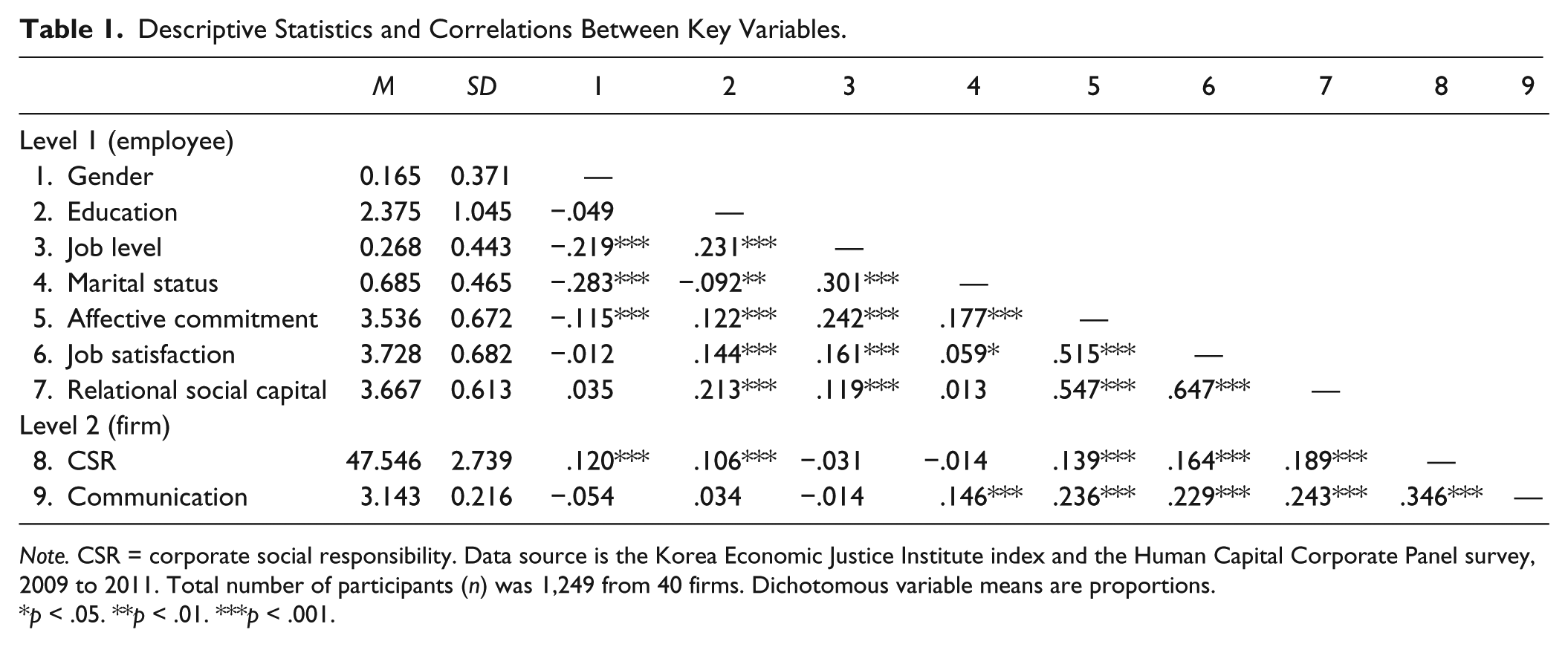
Note. CSR = corporate social responsibility. Data source is the Korea Economic Justice Institute index and the Human Capital Corporate Panel survey, 2009 to 2011. Total number of participants (n) was 1,249 from 40 firms. Dichotomous variable means are proportions.
p < .05. **p < .01. ***p < .001.
The results of the HLM analyses are given in Table 2 for affective commitment and job satisfaction. The ICC from the null model for affective commitment was .113. Similarly, the ICC of the null model for job satisfaction was .110. ICC refers to the proportion of variance in a dependent variable accounted for by the group level to indicate group-level dependency (Clarke, 2008). The results showed that firm differences accounted for 11.3% of the overall variance of affective commitment and 11.0% of the overall variance in job satisfaction.
Results of Hierarchical Linear Modeling Models.
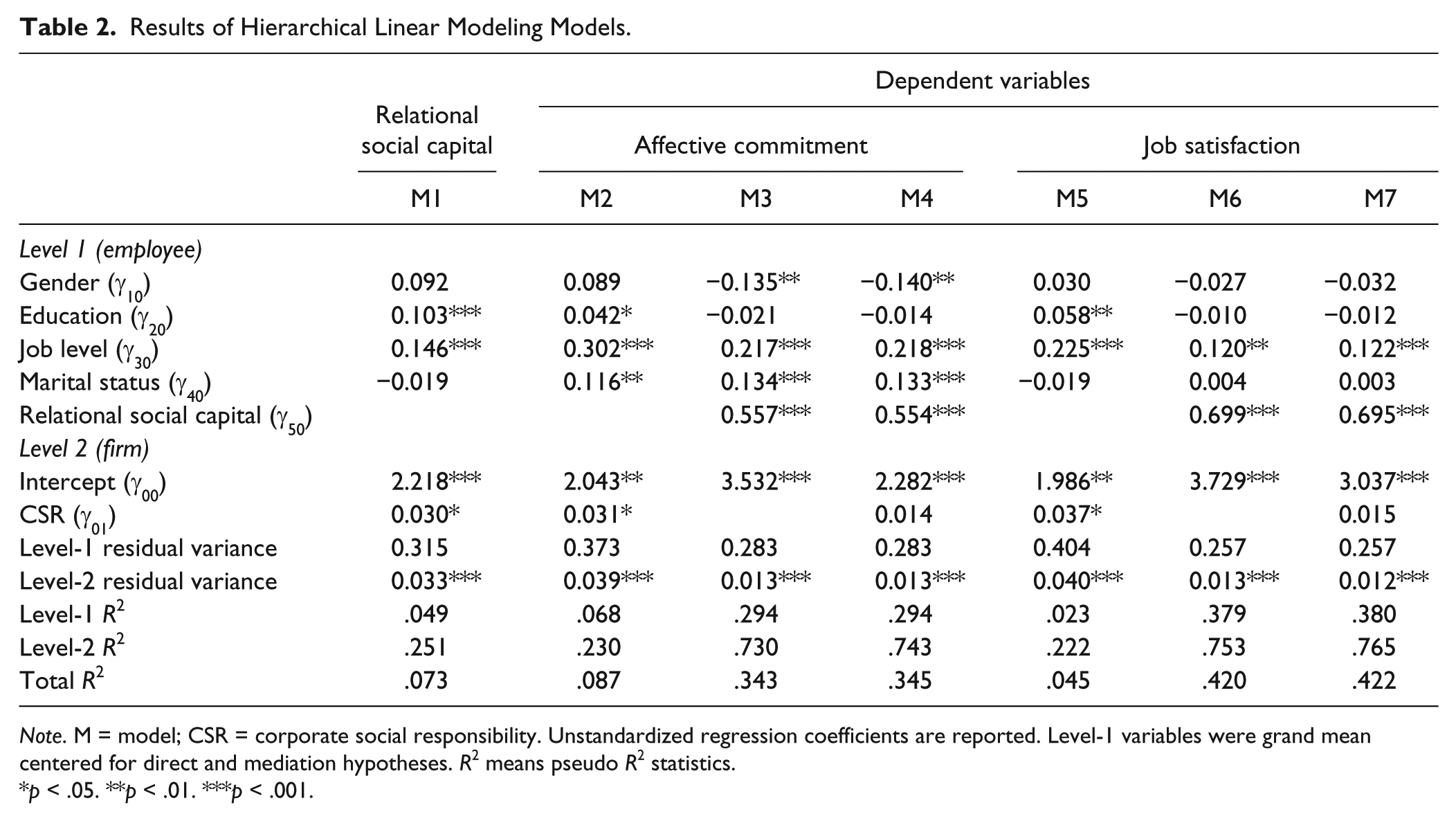
Note. M = model; CSR = corporate social responsibility. Unstandardized regression coefficients are reported. Level-1 variables were grand mean centered for direct and mediation hypotheses. R2 means pseudo R2 statistics.
p < .05. **p < .01. ***p < .001.
Regarding the specific hypotheses, first, it was postulated that CSR would be positively associated with employees’ affective commitment and job satisfaction. HLM analyses results of Model 2 and Model 5 for Table 2 revealed a significant positive association for affective commitment (γ01 = 0.031, p < .05), as well as for job satisfaction (γ01 = 0.037, p < .05). Therefore, both Hypotheses 1a and 1b were supported.
The study further hypothesized that relational social capital would mediate the effects of CSR on affective commitment (Hypothesis 2a) and job satisfaction (Hypothesis 2b). For both dependent variables, all conditions of the causal steps approach were supported, suggesting full mediation. Elaborating, CSR was significantly and positively related to each of the employee attitudes as noted above (Model 2 and Model 5 of Table 2). Next, CSR (as reported in Model 1 of Table 2) was significantly and positively associated with the mediator, relational social capital (γ01 = 0.030, p < .05). Furthermore, relational social capital (as reported in Model 3 and Model 6) was positively and significantly associated with both affective commitment (γ50 = 0.557, p < .001) and job satisfaction (γ50 = 0.699, p < .001). Finally, as shown in Model 4 and Model 7 of Table 2, when relational social capital was included in the initial CSR–employee attitudes regression models, the significant positive associations between CSR and affective commitment (γ01 = 0.014, ns) and CSR and job satisfaction (γ01 = 0.015, ns) became insignificant, while the positive associations of relational social capital with affective commitment (γ50 = 0.554, p < .001) and job satisfaction (γ50 = 0.695, p < .001) were still significant, indicating full mediation. As such, Hypotheses 2a and 2b were fully supported.
The significance of the mediation effects was found by constructing MC confidence intervals (CIs) for the indirect effects (Zhang et al., 2009), which were quantified as the product of the coefficient of CSR on relational social capital (Model 1) and the coefficient of relational social capital on each of the dependent variables of affective commitment (Model 4) and job satisfaction (Model 7) as depicted in Table 3. The results indicated that the indirect effects of CSR on employee attitudes through relational social capital were significant for both affective commitment and job satisfaction (affective commitment = 0.021, 95% CI [0.004, 0.038]; job satisfaction = 0.017, 95% CI [0.002, 0.034]), while the direct effects were not significant, which also supported full mediation. Also, the total effects were significant (affective commitment = 0.031, 95% CI [0.012, 0.061]; job satisfaction: 0.036, 95% CI [0.008, 0.055].
Summary of Mediating Effect Test.
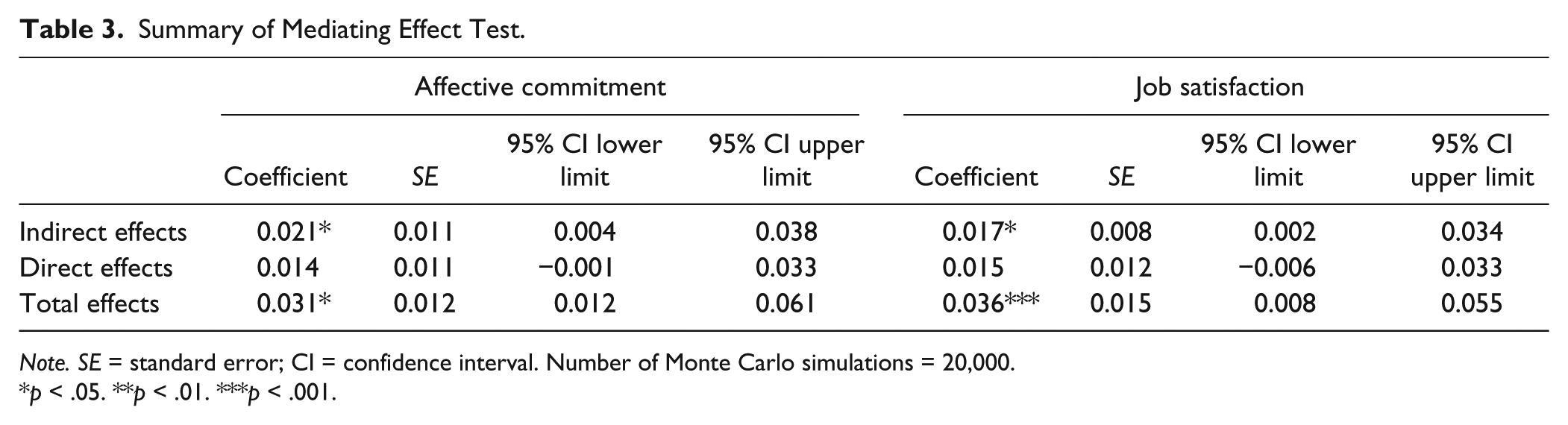
Note. SE = standard error; CI = confidence interval. Number of Monte Carlo simulations = 20,000.
p < .05. **p < .01. ***p < .001.
It was also expected that communication would moderate the mediated relationship between CSR and employee attitudes (affective commitment and job satisfaction) via relational social capital in Hypothesis 3. In testing the hypotheses, the moderator of communication was included in the Model 1 of Table 2 which examined the relationship between CSR and relational social capital (as shown in Model 1 of Table 4). Furthermore, communication was included in the final models of Model 4 and Model 7 in Table 2 about the relation between CSR and employee attitudes (affective commitment and job satisfaction) via relational social capital (as reported in Model 2 and Model 3 of Table 4). Following the recommendation of Preacher, Rucker, and Hayes (2007), four conditions were examined: (a) significant total effects of CSR on affective commitment and job satisfaction; (b) significant interaction effects within the models; (b) significant effect of relational social capital on the dependent variables; and (c) most important, the different conditional indirect effects of CSR on the dependent variables via relational social capital across various levels of communication. The significance of the moderated mediation effects were tested by calculating the conditional indirect effects via constructing MC CIs for high, middle, and low values of relational social capital (Preacher et al., 2007). Moderated mediation exists when their magnitude differs significantly across high, middle, and low values of the proposed moderator (Hayes, 2013). Conditions b and d were not satisfied as interaction affects were not significant and as the pattern of significance of the conditional indirect effects did not change for all levels of communication for both affective commitment and job satisfaction as displayed in Table 5. Therefore, Hypothesis 3 was not supported.
Results of Moderated Mediation Models.
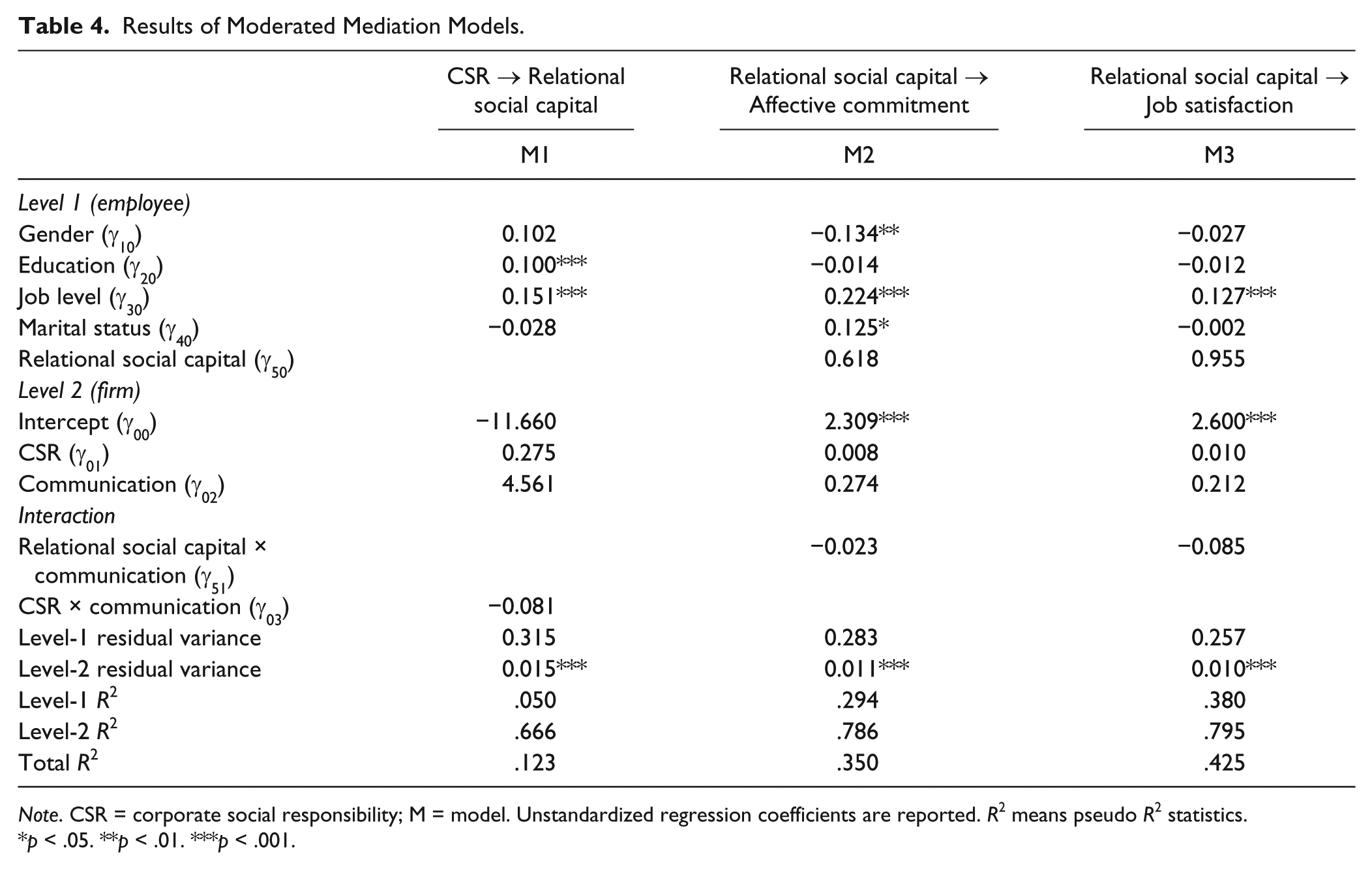
Note. CSR = corporate social responsibility; M = model. Unstandardized regression coefficients are reported. R2 means pseudo R2 statistics.
p < .05. **p < .01. ***p < .001.
Summary of Conditional Indirect Effects.
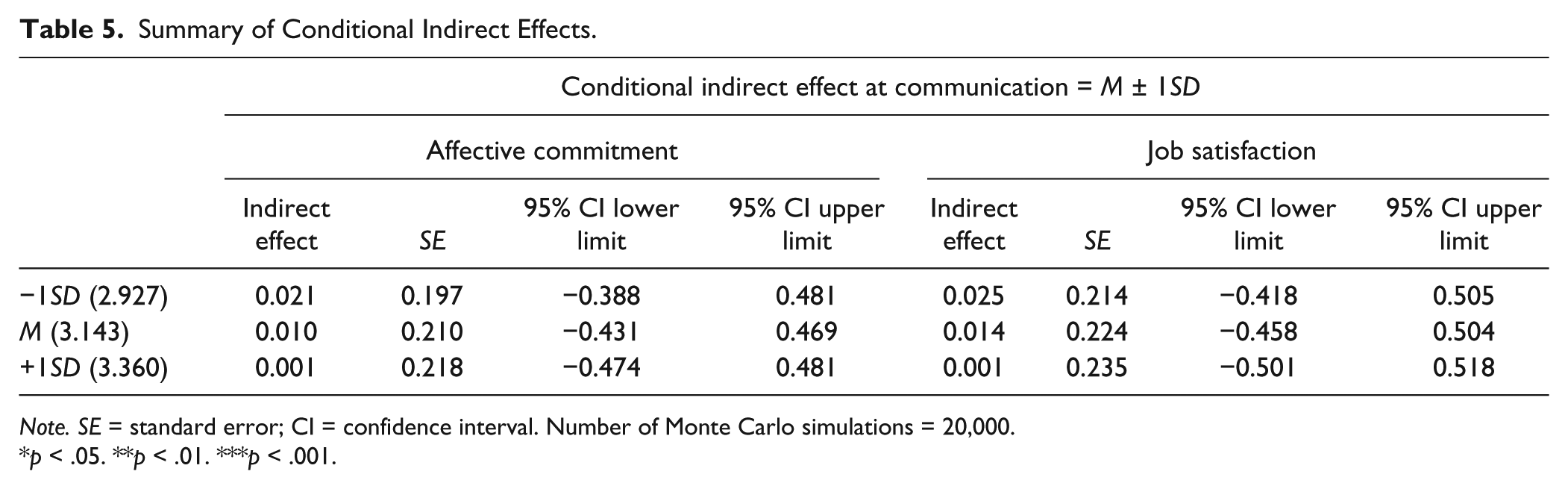
Note. SE = standard error; CI = confidence interval. Number of Monte Carlo simulations = 20,000.
p < .05. **p < .01. ***p < .001.
Last, pseudo R2 statistics given in bottom of Table 2 and Table 4 for affective commitment and job satisfaction showed the amount of variance the models explained. In the case of CSR-affective commitment models, the model for Hypothesis 1a (Model2 of Table 2) explained 6.8% of the Level-1 variance, 23% of the Level-2 variance, and 8.7% of the total variance. The model for Hypothesis 2a (Model 4) explained 29.4% of the Level-1 variance, 74.3% of the Level-2 variance, and 34.5% of the total variance. Also, the model for Hypothesis 3 related to affective commitment (Model 2 of Table 4) explained 29.4% of the Level-1 variance, 78.6% of the Level-2 variance, and 35.0% of the total variance. In the instance of CSR—job satisfaction models, the model for Hypothesis 1b (Model 5) explained 2.3% of the Level-1 variance, 22.2% of the Level-2 variance, and 4.5% of the total variance, the model for Hypothesis 2b (Model 7) explained 38.0% of the Level-1 variance, 76.5% of the Level-2 variance, and 42.2% of the total variance and the model of Hypothesis 3 for job satisfaction explained 38.0% of the Level-1 variance, 79.5% of the Level-2 variance, and 42.5% of the total variance. Furthermore, the residual variances at the firm level, given along with the pseudo R2 statistics, were still significant for both the CSR—affective commitment and CSR—job satisfaction models, suggesting that other Level-2 firm factors could explain them further.
Discussion
Despite the increasing research about CSR and the essential role of employees as key internal stakeholders (McWilliams & Siegel, 2001), research about the effects of CSR on employees and the mediating or moderating factors has received surprisingly little attention (Aguinis & Glavas, 2012; De Roeck et al., 2014; Jones, 2010). As such, the purpose of this article was to examine how CSR may contribute to positive employee attitudes, by focusing on the mediating role of relational social capital, and the moderating role of communication in the mediated relationship. The results provide support for the positive and significant influence of CSR on employee attitudes (Hypotheses 1a and 1b). Particularly, the results show that relational social capital fully mediates the relationship between both CSR and affective commitment (Hypothesis 2a) and CSR and job satisfaction (Hypothesis 2b). However, the moderated mediation effects of communication pertaining to relational social capital (Hypothesis 3) were insignificant. This study may contribute to current literature in several important ways, and the implications and contributions of the results are discussed below, before outlining the limitations and suggestions for future research.
Implications and Contributions
First, the results imply that a firm may “do well” through “doing good,” as CSR elicits employee attitudes important to firms, such as affective commitment and job satisfaction (Chun et al., 2013; Koys, 2001). In this vein, the findings support current arguments of scholars about how CSR may not be just a burden or a cost to firms but may have mutual benefits for the firm and society (Chun et al., 2013; Margolis et al., 2007; Orlitzky et al., 2003). Particularly, results show that CSR has a positive effect on employees’ attitudes, even in an Asian context, which implies that CSR may be universally beneficial to firms. Furthermore, this study extends current research, as it conducts multilevel analyses and uses multisource data with multiple time points to examine the effects of CSR on employees, thus providing more robust results about the relationship and causality between CSR and employee attitudes, as problems regarding cross-sectional analyses and common method bias have been consistently noted by prior studies (De Roeck et al., 2014; Farooq et al., 2014; Hansen et al., 2011). It also provides more robust results in that it used an Asian sample, showed the specific mechanisms behind the link behind CSR and job satisfaction and commitment, and also in that it examined contingent factors (Farooq et al., 2014). The research generally complements and confirms prior studies conducted at one level of analysis, and the results show that consistent with past research about the positive relationships between CSR and employee attitudes at only one level of analysis, CSR can lead to increases in positive employee attitudes, even when multilevel effects are taken into consideration. However, the results show that relational social capital fully mediates this relationship, which suggests that it is important to pay attention to the mediating mechanisms between CSR and employee attitudes.
The research contributes to current literature by providing insights into the black box between CSR and employee attitudes. Particularly, the study contributes as it extends literature about the relationship between CSR and relational social capital by providing empirical findings that shed light on previous conceptual studies, and by examining how CSR influences a multidimensional construct of relational social capital, something that has not been researched by prior studies. The findings confirm that CSR fosters relational social capital, which in turn increases the level of affective commitment and job satisfaction. The effects of CSR on relational social capital support the theoretical assertions in the social capital literature regarding the importance of CSR (Aguilera et al., 2007; Pastoriza et al., 2008; Rupp et al., 2006; Saeed & Arshad, 2012), and are in line with empirical studies that find CSR has a positive influence on trust (Farooq et al., 2014; Hansen et al., 2011; Lee et al., 2012). The findings are important as they provide insights into the antecedents of social capital, contributing to a better understanding of what organizations can do in order to foster social capital (Bolino et al., 2002; Dutton et al., 2010; Leana & Van Buren, 1999; Nahapiet & Ghoshal, 1998; Pastoriza et al., 2008). In addition to prior studies that emphasize employment practices (Leana & Van Buren, 1999; Parzefall & Kuppelwieser, 2012), the findings suggest that CSR can also play an important role.
Last, this study may contribute to current literature in that it examined whether a contingency perspective holds for the CSR–employee attitudes relationship, specifically by examining the moderating role of communication. However, contrary to studies that emphasize the importance of communication on the relationship between CSR and the attitudes and behaviors of external stakeholders, the moderating effects of communication on the influence of CSR on employee attitudes via relational social capital were insignificant. As such, this study did not find support for a contingency perspective on CSR. This may imply that there are no boundary conditions for the positive effects that CSR has on employee attitudes via relational social capital, at least in Korean samples. On the other hand, it may be possible that because employees are internally embedded in the firm, contrary to external stakeholders, communication is not that important in strengthening the effects of CSR on relational social capital and employee attitudes, as employees may already be fully aware of a firm’s CSR policies and activities. It is also possible that communication tailored toward specifically communicating CSR may be more important than communication in general, as prior studies mostly focus on this type of communication. Moreover, the insignificant results can also be attributed to low power or that the measure of communication used in this is not enough, thus caution is needed when interpreting the results. A more comprehensive analysis of various other moderators is needed to examine whether contingent factors or boundary conditions exist in terms of the effects CSR has on relational social capital and employee attitudes.
Limitations and Future Research
This study has several limitations that should be kept in mind when interpreting the results, and which suggest directions for future research. First, although the measures are adapted from previous studies, the measures, such as those for relational social capital and communication were somewhat limited in that already existing secondary data (the HCCP) was used. Future studies that use more robust measures, such as those that incorporate more items, may be needed to improve the comprehensiveness and soundness of the results. Second, although the methodology is robust in that it considers multilevel effects and uses multiple time points, it is possible that other contextual factors that were not directly controlled for influenced the results. Therefore, the results of this study must be considered with appropriate caution. Furthermore, although the sample is fairly large in terms of individual employees, the sample is rather small in terms of firms. Although the focus of the article was on employee attitudes, it may be important to use a larger sample of more firms for the results to be applicable across various firms. Moreover, the sample was based only on firms in the manufacturing industry, thus future studies that take into consideration other industries are needed for the findings to be more generalized. Similarly, the research may be limited because the study examines only a Korean sample. Thus, future studies with a larger and more diverse sample of employees and firms in various countries, especially those that compare Asian with Western populations, may be important to further explore whether the findings are widely applicable across cultures as well.
Beyond these limitations, future studies that empirically examine other forms of social capital, such as structural or cognitive social capital, should be able to expand research on CSR and social capital. Furthermore, although the results did not support the contingency perspective, it is highly possible that other contingent factors besides communication may moderate the effects of CSR. As such, future research is needed that takes into consideration various other moderators.
Footnotes
Declaration of Conflicting Interests
The author(s) declared no potential conflicts of interest with respect to the research, authorship, and/or publication of this article.
Funding
The author(s) received no financial support for the research, authorship, and/or publication of this article.