



Abstract
Drawing on justice theory and the side-bet theory of commitment, we explored the nuanced relationship between idiosyncratic deals and outcomes. We developed a model that posits affective commitment as a mediator between idiosyncratic deals and positive work outcomes, whereas continuance commitment mediates the relationship between idiosyncratic deals and negative nonwork domain outcomes. Furthermore, we hypothesized moderated mediation in that the employee’s assessment of organizational justice will moderate the relationship between idiosyncratic deals and continuance commitment, which in turn influences the nonwork domain outcomes. Data collected from 182 employee–manager dyads indicated support for our conceptual model. The implications of these findings are discussed in terms of how to manage both the benefits and the costs of idiosyncratic deals.
A generational shift in the American workforce has increased the tendency of employees to negotiate the terms of employment with their employers. Whether it be the advent of a society hyperfocused on me (e.g., Generation Me; Twenge, Campbell, & Freeman, 2012; Twenge, Campbell, Hoffman, & Lance, 2010), increased education and its attendant sense of entitlement (Ng & Feldman, 2010), or evolving preferences for workplace cultures that prioritize flexibility, adaptability, and autonomy (Rousseau, 2005; Thornthwaite, 2004; Wrzesniewsk, Dutton, & Debebe, 2003), employees are now more likely to be proactive in shaping the terms of their employment (Lawler & Finegold, 2000). By and large, employers have been responsive to this trend and seek to motivate employees by engaging them in individualized employment relationships. Work by Rousseau and colleagues developed a construct to reflect this customization of employment terms: idiosyncratic deals or “i-deals” (Rousseau, 2005; Rousseau, Ho, & Greenberg, 2006). I-deals are “special terms of employment negotiated between individual workers and their employers that satisfy both parties’ needs” (Rousseau et al., 2006, p. 977). I-deals are inherently distinct from employee to employee but generally fall into categories related to flexible working hours, telecommuting options, customized training, or specialized compensation (Rosen, Slater, Chang, & Johnson, 2013).
Critical to the concept of an i-deal is the understanding that, through its issuance, the i-deal is intended to create value for both employee and employer. Researchers use both social exchange theory and organizational support theory to support this conclusion. More specifically, for the employer, through an employee’s sense of obligation to reciprocate, it is assumed that the employee will return the organization’s inducement with a contribution intended to benefit the organization (Blau, 1964; Gouldner, 1960), such as improved work performance (Anand, Vidyarthi, Liden, & Rousseau, 2010; March & Simon, 1958; Rousseau, 2005; Rousseau et al., 2006). I-deals may also motivate feelings of emotional connection with the employer because the essence of an i-deal—customized employment terms suited to individual employee preferences—implies that an organization is interested in an employee’s needs and values (Ng & Feldman, 2010; Rosen et al., 2013). Positive work outcomes related to the receipt of an i-deal support this finding that i-deals are more positively linked to outcomes depending on the context (Anand et al., 2010; Hornung, Rousseau, & Glaser, 2008; Ng & Feldman, 2008, 2010). Thus, it appears that mutual value to employee and employer is not maximized simply by the parties engaging in an i-deal. As a consequence, organizations may not be maximizing the value of—that is, reaping returns for—their investment in i-deals.
To explore the nuanced relationship between i-deal receipt and outcomes, we conducted an empirical investigation of the outlined issues and extended Ng and Feldman’s (2008) work by drawing on justice theory (Greenberg, 1990) and the side-bet theory of commitment (Becker, 1960) to examine the influence of i-deal receipt concurrently on affective and continuance commitment. Furthermore, we explored how each type of commitment has repercussions for outcomes both within (e.g., performance, citizenship) and outside (e.g., management of work–family conflict) the work domain. Broadly, our model posits that the emotional connection stemming from an i-deal inspires greater affective commitment and is related to employee motivation to reciprocate the inducement with enhanced performance (in-role performance and citizenship behaviors; Lavelle, Rupp, & Brockner, 2007). At the same time, the i-deal’s potential lack of replicability with alternative employers creates a sense of continuance commitment within the employee. Continuance commitment occurs when an employee remains with an organization because her or his current job offers unique features of employment unavailable or untenable in alternate organizations (Meyer, Allen, & Smith, 1993). From the employee’s perspective, continuance commitment is not a desirable form of commitment because an employee may feel involuntarily “stuck” with his or her current employer. Thus, we simultaneously expect i-deals to result in the negative outcomes frequently associated with continuance commitment. To understand the complex relationship between i-deals and these two forms of commitment, we modeled how an employee’s assessment of the justice context influences her or his valuation of the i-deal (see Figure 1).
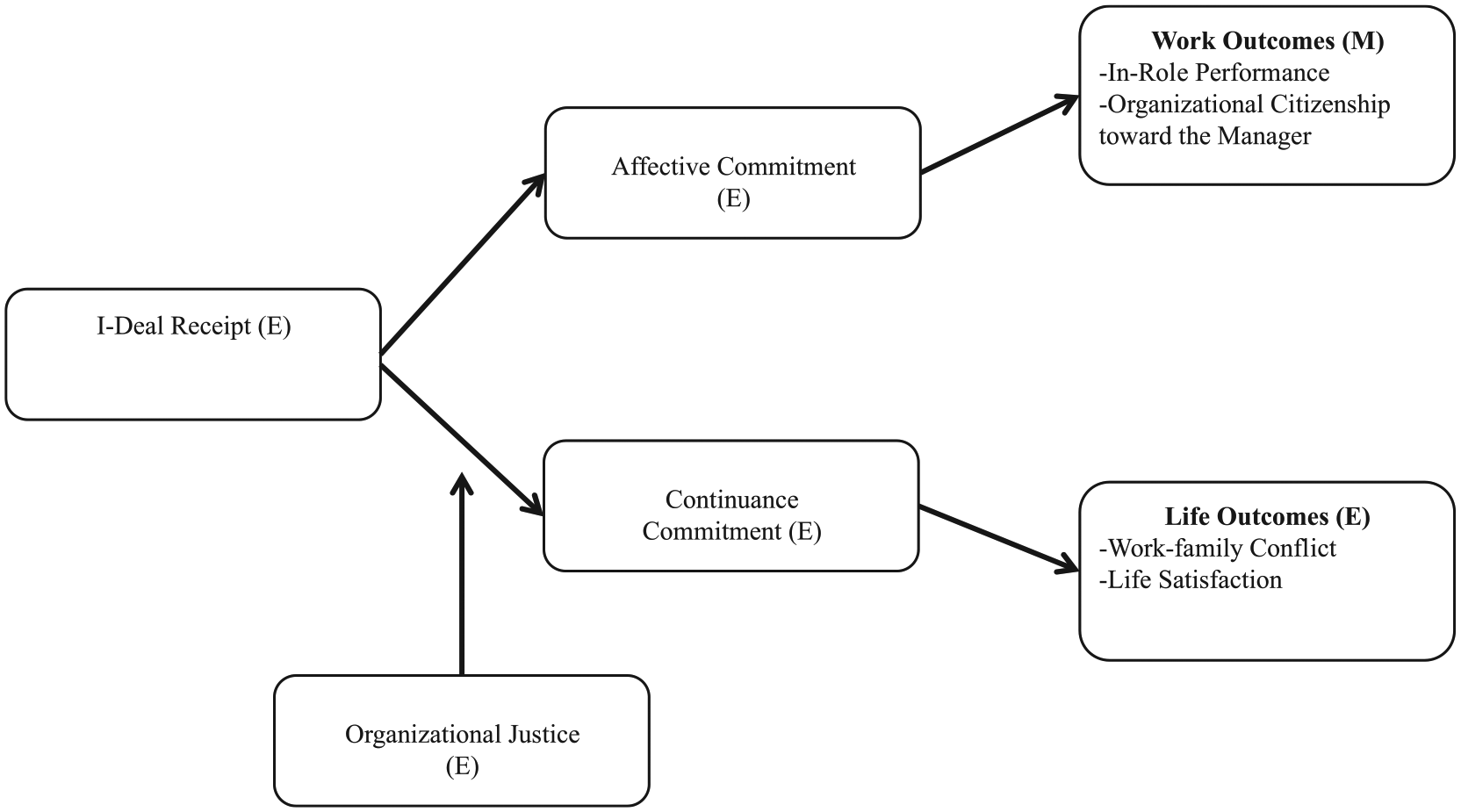
Hypothesized model of i-deal receipt on work and life outcomes.
In empirically exploring the concurrent roles continuance and affective commitment play in reaction to i-deal receipt, this article aims to make three theoretical contributions to the employment relationship literature. First, it uncovers the unintentional and potentially damaging irony of an i-deal: An i-deal is created in response to employee-driven requests for customized work arrangements, yet the resulting increase in continuance commitment may unintentionally result in negative outcomes for the employee and employer (Briscoe & Hall, 2006; Ng, Sorensen, Eby, & Feldman, 2007), hindering workplace performance and an employee’s ability to manage work–family conflict. While Rosen and colleagues (2013) found no significant relationship between i-deal receipt and continuance commitment except in those situations where the ideal was schedule based, here we suggest that a relationship between the variables does exist when considering contextual elements (justice). This article consequently deepens our understanding of the outcomes related to engaging in an i-deal, highlighting both the intentional consequences (e.g., issuance as a means to induce an employee to, in some way, reciprocate) and the unintentional consequences (e.g., an i-deal recipient’s increased tetheredness to his or her job).
Our second contribution focuses on the cross-domain impact of i-deal receipt, specifically operationalizing the psychological mechanism that connects receipt of i-deals to various types of commitment. Here we consider the impact of i-deals not solely on the work domain, for which the reciprocity- and performance-based benefits for the individual and organization are clear, but also on an employee’s nonwork domain. Increasingly, researchers are interested in the cross-boundary effects of workplace events on life attitudes (Amstad, Meier, Fasel, Elfering, & Semmer, 2011). In fact, i-deals are often created with the intent to address unique employee work life needs (e.g., a flexible work schedule to care for an elderly relative), and research has only just begun to explore if i-deals, and the subsequent feelings of connection and the cost of leaving, have cross-domain effects (e.g., Hornung et al., 2008). In our article, we explore two nonwork domain outcomes, work–family conflict and life satisfaction, and their relationship to continuance commitment (in addition to within-domain effects between affective commitment and performance-based outcomes). This allows us to explore the boundary-crossing effects of i-deal receipt. In doing so, we offer a more robust picture of how i-deals shape an employee’s work–life balance.
Our final contribution focuses on the context in which an i-deal is issued—that is, within a context of justice perceptions. Justice is indicative of relationship quality (Cropanzano, Rupp, Mohler, & Schminke, 2001; Lind, 2001; Lind & Tyler, 1988), and relationship quality is a filter through which employees evaluate the inducements received (Shore, Coyle-Shapiro, Chen, & Tetrick, 2009), inclusive of i-deals. We specifically draw attention to how i-deals issued in an environment perceived as unfair by an employee may undesirably tether the employee to the employer, producing negative consequences. By positioning justice as a moderator between receipt of an i-deal and commitment, we contribute to the literature’s understanding of how employees’ reactions to receipt of i-deals may be heterogeneous. This also builds the literature by suggesting that the value of an i-deal is contingent on justice, insofar as an identical i-deal can have greater benefits or costs based on the type of justice context in which it is offered.
Theory and Hypotheses
I-Deals
I-deals are formed to complement employee values, preferences, or needs in either the work or the life domain (Rousseau, 2005; Rousseau et al., 2006). For example, an employee may negotiate employment terms that allow her or him to leave work early for evening university courses or to attend to domestic responsibilities. I-deals may also help match work responsibilities more closely to an employee’s unique skills (e.g., redesigning job responsibility to better align with the employee’s specialized skills; Hornung, Rousseau, Glaser, Angerer, & Weigl, 2010), because of this person–job fit having a strong association with performance (Kristof, 1996) and career success (e.g., salary, promotions; Bretz & Judge, 1994). Despite these benefits to the individual employee, there are costs to the organization because of the personalized tailoring of employment terms: the risk of felt injustice if employees perceive undeserved differentiated employment relationships within a work group (Greenberg, Roberge, Ho, & Rousseau, 2004; Lai, Rousseau, & Chang, 2009), the possibility of nonreciprocation (Ng & Feldman, 2010), costly time spent crafting and negotiating the i-deal (Rousseau, 2005), and increased job complexity, which potentially hinders employee performance (Hornung et al., 2010). This suggests that when making i-deal agreements, managers must carefully weigh both the probable benefits and the costs stemming from its receipt.
Much work on i-deals has been devoted to uncovering the benefits accrued by an organization in response to issuing an i-deal. These benefits include increased worker engagement and a proactive approach to work (Hornung et al., 2010), as well as extra-role behaviors, particularly as a compensatory mechanism (Anand et al., 2010). In general, these studies rely on the norm of reciprocity (Gouldner, 1960) and social exchange theory (Blau, 1964), which collectively state that employees will make contributions meant to discharge feelings of obligation to reciprocate as a result of receiving the personalized i-deal (Cropanzano & Mitchell, 2005; Gouldner, 1960; Mitchell, Cropanzano, & Quisenberry, 2012). In their work on i-deals and affective commitment, Ng and Feldman (2010) make the case that after receiving an i-deal, certain employee groups (e.g., older workers) are more likely to reciprocate; specifically those employees with lower core self-evaluations, who feel a particularly strong need for reciprocation because of their artificial sense of unworthiness, tend to be overly eager to return the favor. This more specifically indicates that the value of an i-deal is not absolute across a set of employees. This conclusion is important because it highlights a growing recognition that we cannot expect a uniform, positive reaction to i-deal receipt.
Ideals and Affective Commitment
Most work on i-deals suggests that employees may hold multiple, concurrent reactions that reflect both the benefits and the drawbacks of i-deal receipt. On the positive side, receipt of an i-deal elicits a sense of attachment (Ng, Butts, Vandenberg, Dejoy, & Wilson, 2006), because the giving of an i-deal “has symbolic value to the employee; it is tangible proof of an organization’s care and concern for the individual” (Ng & Feldman, 2008, p. 269). Perceived organizational support theory argues that employees are apt to feel affective commitment, or an emotional connection based on trust and caring (Meyer & Allen, 1984; Meyer, Stanley, Herscovitch, & Topolnytsky, 2002), when an employer displays specific attention to individual employee needs (Aselage & Eisenberger, 2003). Indeed, much research has underscored the importance of affective commitment as a clear, proximal outcome of organizational concern (Meyer et al., 2002; Rhoades, Eisenberger, & Armeli, 2001). Furthermore, the i-deal may contain terms that improve certain features of the job, engaging the employee with his or her work (e.g., Cole, Walter, Bedeian, & O’Boyle, 2012), which manifests as a positive attitude toward staying with one’s current organization.
Consistent with research on target similarity models, which argue that actions by a specific referent mobilize employee attitudes and behaviors toward that referent (Lavelle et al., 2007), we expect affective commitment to be felt toward the issuer of the i-deal, which in our case is the manager. More broadly, this indicates that outcomes associated with affective commitment should reflect employee performance, insofar as it is a key way in which an employee can reciprocate to her or his manager. Social exchange theory (Blau, 1964) and the norm of reciprocity (Gouldner, 1960) both describe how a person’s willingness to help another is increased when the emotional connection is greater. Within the context of commitment, this simply means that when an employee feels affective commitment, the desire to assist the person inspiring that commitment—here the manager—increases. Because managers’ own success and performance reviews are often in part determined by their employees’ performance (Dierdorff, Rubin, & Morgeson, 2009), employees will be likely to improve in-role performance when feeling affective commitment in order to benefit their manager. Furthermore, employees feeling highly affectively committed toward their manager will also be willing to put forth extra effort as a means to reflect their own investment and connection with the manager (Meyer et al., 2002). Organizational citizenship toward the manager (OCB-M), or workplace behaviors meant to supplement work on core job tasks by helping other workers or the manager, reflects this extra effort (Borman & Motowidlo, 1993; Lavelle et al., 2007; Van Scotter, Motowidlo, & Cross, 2000).
Ideals and Continuance Commitment
Extant literature on i-deals has left the “cost” side of i-deal receipt underresearched. This is a critical omission because it masks a true tally of the impact of an i-deal. As noted above, i-deals require organizational resources: Time and energy are spent crafting and managing a deal that is both fair and suited to an employee’s idiosyncratic work or life needs (Rousseau, 2005). Exploring how reactions to i-deal receipt increase the costs of an i-deal is therefore critical. Specifically, on the drawback side, because of their inherently unique nature, i-deals are often thought to be inimitable by other organizations, inducing in employees a sense of high risk at the thought of leaving an organization. This inimitability stems from the fact that i-deals are negotiated with a specific other, and therefore negotiation with another employer may not lead to the same conclusion (because of one of the parties being different; Rousseau et al., 2006), hence the associated risk.
In terms of commitment theory, this risk is called an employee’s “side-bet.” A side-bet specifically references an additional employee investment in the employer beyond basic employment and is, in essence, betting more on the continued employment of the employee. Specifically, in a situation where an employee is offered and accepts continued employment that is partially predicated on an i-deal, the employee is making two bets. The first bet is that he or she will not find a comparable job situation in the current job market. This bet is an evaluation of an amalgam of factors, such as the pay, job satisfaction, culture, commute time, quality of life, and so on. The second bet is related to becoming a party to an i-deal. Engaging in an i-deal is the side-bet—that is, the employee will lose both his or her current employment situation (including factors such as pay, job satisfaction, culture, etc.) and the i-deal that he or she has received (Becker, 1960; Ng & Feldman, 2008). In this way, employees who receive i-deals are accepting more risk into their employment relationship—the cost of leaving is increased once an employee receives an i-deal because there is no guarantee that it will be matched by a new employer. Thus, an employee’s terms of employment become less replicable as i-deal receipt increases.
There has been some progress connecting the concept of side-bets to employment terms. Ng and Feldman’s (2008) work demonstrates that employees with contractual promises believed to be not replicable were more likely to feel that the cost of leaving their current job is too high because the unique employment terms are considered a large side-bet. Ng and Feldman (2008) point out that unique contract terms make an employer appear unique—that is, the employee will be unable to find an employer who offers similar contractual terms, and while the employee may appreciate the positive terms, he or she will also feel relatively “stuck” with his or her current employer if those terms are to be realized. From this, we can infer that employees who have an i-deal will feel that they have “lost” the side-bet if they leave the issuing employer (Becker, 1960); the i-deal here has directly increased the employee’s ties to his or her current employer. Specifically, employees, feeling that a similar deal will not be possible with another employer, develop a sense of commitment based on the costs associated with leaving (Becker, 1960; Meyer & Allen, 1984). This feeling of heightened costs associated with leaving is called continuance commitment (Meyer et al., 1993). In sum, while on one hand the receipt of an i-deal may be a signal that an employer values an employee, inducing reciprocal feelings of affective commitment, as described in our first hypothesis (Ng et al., 2006; Ng & Feldman, 2008), i-deal receipt may also concurrently create feelings of continuance commitment.
Employees experiencing continuance commitment often feel a sense of disengagement and dissatisfaction because they feel confined to their current job (Meyer et al., 2002), undermining the basic need for autonomy (Deci & Ryan, 2000). Continuance commitment has consequently been associated with negative outcomes in nonwork domains, including reduced well-being, increased exhaustion, higher levels of work–life conflict, and increased anxiety (Addae & Wang, 2006; King & Sethi, 1997; Meyer et al., 2002). This is largely because employees are choosing to stay with their employer because of instrumental benefits rather than choice or connection. Meyer et al. (2002) write, “It is possible that having a sense of being trapped in an organization is both stressful for employees and a source of conflict in the home” (p. 40). Indeed, work by Hornung et al. (2008) demonstrates that employees experience increased work–nonwork conflict on receipt of a developmentally based i-deal. This is consistent with conservation of resources theory (Hobfoll, 1989), which finds that depletion of existing resources may affect the extent to which an employee can buffer home life from the demands of work. Here, we address this by proposing continuance commitment as the mechanism by which i-deal receipt is linked to nonwork domain outcomes. Specifically, when employees perceive increased continuance commitment when an i-deal is received, that continuance commitment is related to a depletion of resources, such as the sense of autonomy and job mobility described previously, or reduced freedom to “shut off” work demands because of their i-deal-induced side-bet. The depletion of resources manifests both acutely, within the domain of the stress (here, work–family conflict), and more generally, with feelings of malaise about one’s life (Ambrose, Hess, & Ganesan, 2007; Demerouti, Bakker, Nachreiner, & Schaufeli, 2001; Halbesleben & Bowler, 2007; Hobfoll, 1989, 2002). We further extend these studies by articulating the mechanism—continuance commitment—as the means by which i-deals link to increased work–family conflict and decreased life satisfaction.
Because we have considered receipt of an i-deal as a risky side-bet, further investigation of the contextual factors in the work environment that alter the magnitude of the risk associated with leaving the job is warranted. One critical environmental element related to i-deals is justice, specifically the attributions employees make about the fairness of the receipt or distribution of i-deals. As Rousseau et al. (2006) point out, “Because i-deals create differences among coworkers in conditions of employment, failure to recognize and attend to i-deals can exacerbate the injustice their existence might engender, eroding trust and cooperation in the organization” (p. 978; see also Rousseau, 2005). This indicates that when an employee receives an i-deal, particular attention needs to be paid to how fair the work environment is.
Justice research argues for a shift to a more general notion of justice (Ambrose & Arnaud, 2005; Lind, 2001). Ambrose and colleagues (2007) demonstrate that a focus on the relative contributions of different forms of justice, for example, procedural versus distributive, potentially masks the total effect of justice. Put another way, employees may not cognitively distinguish between forms of justice during their evaluation of the overall organizational environment. This is particularly true when forming a judgment about a more amorphous construct, like justice (Ambrose & Schminke, 2016). A general impression of justice may therefore be more telling in terms of effects on psychological consequences, particularly when one is interested in the influence of justice relative to other motivational forces (Ambrose & Schminke, 2016). This conceptualization of justice also enables us to see this evaluation as an aggregation of the total justice-based events in an organization. For example, an employee may have experienced several occasions of highly fair decisions but also been the victim of one very unjust experience. Because of humans’ tendency to remember more clearly the negative than the positive (Taylor, 1991), that single event will factor more greatly into overall perceptions, something that evaluation of a form of justice on a never–sometimes–often continuum would fail to capture. Or an employee may perceive just treatment from coworkers but not from the organization, which implies confusion about which justice foci an employee is using to evaluate justice (Lavelle et al., 2007). For these reasons, we consider organizational justice, or an individual’s overall assessment of how fairly employees are treated by the organization.
When employees feel that how their organization treats its employees is contingent on an equitable inducement–contribution ratio (i.e., positive organizational justice perceptions), they are also likely to believe that their specific i-deal was fair and merited. The employees will likely perceive that because fairness is of organizational concern, what they receive personally is born from a just decision. As such, employees can extrapolate that because the i-deal is the inducement appropriately matched to their contributions (and that their contributions are replicable across employers), receiving an i-deal from another employer is likely. In contrast, in a context where the organization is seen as not treating employees fairly, the receipt of an i-deal may not be seen as an accurate reflection of the employer’s fair and impartial analysis of deserved rewards. Whether the i-deal is obtained by politics, luck, or mismanagement, an employee with an i-deal working in an unjust organization is likely to assess the i-deal as less replicable because the decision rules underlying its dispersal are opaque. Thus, the side-bets influence increases, and so, too, do the costs associated with i-deal receipt.
Method
Data were collected from a random sample of white-collar employees at a food manufacturing and distribution organization in the United States. Surveys were distributed via e-mail to 215 employees, representing the white-collar workforce of the company, with 194 completing the survey (response rate = 90%). Next, a survey containing questions about employees was sent by the researchers to each employee’s manager, of which 181 managers responded (response rate = 72%), providing us with a sample of 181 complete dyads on which to test our hypotheses. This response rate is not atypical for a survey distributed by e-mail (Dillman, 2000). Because we did not distribute rewards for completion of a survey, some respondents may have lacked the motivation to complete the survey (Gupta, Shaw, & Delery, 2000). Managers who had more than one direct report were randomly assigned to complete a survey about only one of those direct reports (in most cases). Managers rated on average 1.1 employees. Employees held a variety of white-collar jobs, including jobs in sales, marketing, operations management, finance, and accounting. The managers surveyed (also white collar) had direct authority over the employees, including control over pay, promotion, and training decisions, in addition to direct task responsibilities.
Demographic Information
Demographic information was collected from both employee and manager samples. Employees were 44% female, 70% Caucasian, 12% Black, 8% Hispanic, 8% Asian, and 2% nonresponding. Employees had an average age of 40 years, with 77% holding a bachelor’s degree or higher, and of this population, 10% had a master’s degree or higher. Employees had worked at the company for an average of 4.9 years and with their current manager for 1.7 years. Managers were 21% female, 72% Caucasian, 18% Black, 5% Hispanic, 2% Asian, and 3% nonresponding. Managers had an average age of 44 years, with 46% holding a bachelor’s degree or higher and 35% holding a master’s degree or higher. They had an average organizational tenure of 7.2 years.
Measures
All measures, unless otherwise noted, were assessed on a Likert-type scale, from 1 = strongly disagree to 5 = strongly agree.
I-Deal Receipt
To assess i-deal receipt, we adopted Rousseau’s (2005) five-item measure (α = .85), changing the referent from “organization” to “manager” and altering the time from “at the time of hire” to the arrangement that the employee currently had. An example item is “I have made work arrangements with my manager that differ from those of the typical employee here.”
Affective Commitment
Meyer et al.’s (1993) six-item measure of affective commitment was used (α = .83). An example item is “I really feel as if this organization’s problems are my own.”
In-Role Performance (Manager Rated)
To assess in-role performance, we adopted Welbourne, Johnson, and Erez’s (1998) four-item measure (α = .89), which asked the manager to rate the extent to which he or she was satisfied with the focal employee’s “quantity of output,” “quality of output,” “accuracy of work,” and “customer service provided.”
Organizational Citizenship Toward the Manager (Manager Rated)
OCB-M was assessed using five-items from Williams and Anderson’s (1991) measure of interpersonal organizational citizenship behaviors (α = .81). We modified the items such that they specifically referenced the manager. Specifically, an example item asks the manager to rate the extent to which the employee “helps you [manager] when you have a heavy workload.” In the original, the scale asked the manager to rate the extent to which the employee “helps others when they have a heavy workload.”
Continuance Commitment
Meyer et al.’s (1993) six-item measure of continuance commitment was used (α = .81). An example item is “It would be very hard for me to leave my organization right now, even if I wanted to.”
Work–Family Conflict
To assess work–family conflict, we used the time-based conflict section of Carlson, Kacmar, and Williams’s (2000) three-item scale (α = .84). An example item is “Work keeps me from family activities more than I would like.”
Life Satisfaction
Diener, Emmon, Larsen, and Griffin’s (1985) five-item measure of life satisfaction was used (α = .80). An example item is “In most ways, my life is close to ideal.”
Organizational Justice
We used Ambrose and Schiminke’s (2016) three-item measure of organizational justice (α = .85). An example item is “For the most part, this organization treats its employees fairly.”
Control Variable: Tenure
We considered the number of months that the employee and the manager worked together. Longer tenure may provide more opportunity for a manager to offer an i-deal.
Results
Confirmatory Factor Analyses
Prior to testing our hypotheses, we first conducted analyses to determine if collinearity presented a significant bias in our data. To do so, we conducted comparative confirmatory factor analyses (CFAs), first running a baseline measurement model, then collapsing sets of two measures. We used Anderson and Gerbing’s (1998) suggestion for evaluating the change in the value of chi-square and the model’s degree of freedom. If the change in chi-square is significantly different based on the change in the degrees of freedom, evidence of a significantly different model is found. In the case of our model, if the alternative model tested had an increase in the value of chi-square that was significant, we can conclude that the model has significantly worse fit. LISREL 8.71 was used. For the employee-rated measures, we collapsed the two forms of commitment (affective and continuance) and the two life domain measures (work–family conflict and life satisfaction). The results are reported in Tables 1 and 2; in summary, both alternative models have significantly worse fit and a significant increase in chi-square, supporting the proposed measurement model. Furthermore, the Akaike information criterion (AIC) and sample size–adjusted Bayesian information criterion (BIC) increased in the model that collapsed affective and continuance commitment (Δ AIC = 269.47; Δ sample size–adjusted BIC = 269.01) and in the model that collapsed work–family conflict and life satisfaction (Δ AIC = 303.32; Δ sample size–adjusted BIC = 302.85). When comparing CFAs, lower AIC and sample size–adjusted BIC values indicate better model fit. Hence, we have confidence in our employee measurement model. A similar pattern of results was found for the employer-rated measures, wherein there was an increase in the AIC (Δ = 8.28) and the sample size–adjusted BIC (Δ = 8.70) for the model that collapsed both scales into one latent factor.
Structural Equation Model Comparisons: Employee Measures.
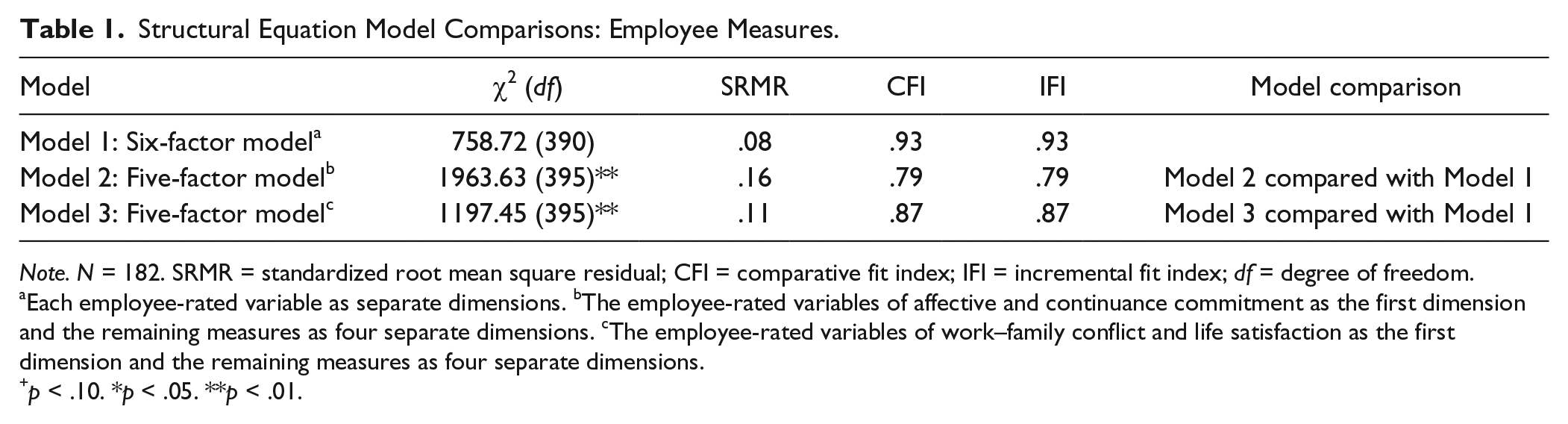
Note. N = 182. SRMR = standardized root mean square residual; CFI = comparative fit index; IFI = incremental fit index; df = degree of freedom.
Each employee-rated variable as separate dimensions. bThe employee-rated variables of affective and continuance commitment as the first dimension and the remaining measures as four separate dimensions. cThe employee-rated variables of work–family conflict and life satisfaction as the first dimension and the remaining measures as four separate dimensions.
p < .10. *p < .05. **p < .01.
Confirmatory Factor Analysis Comparisons: Manager Measures.
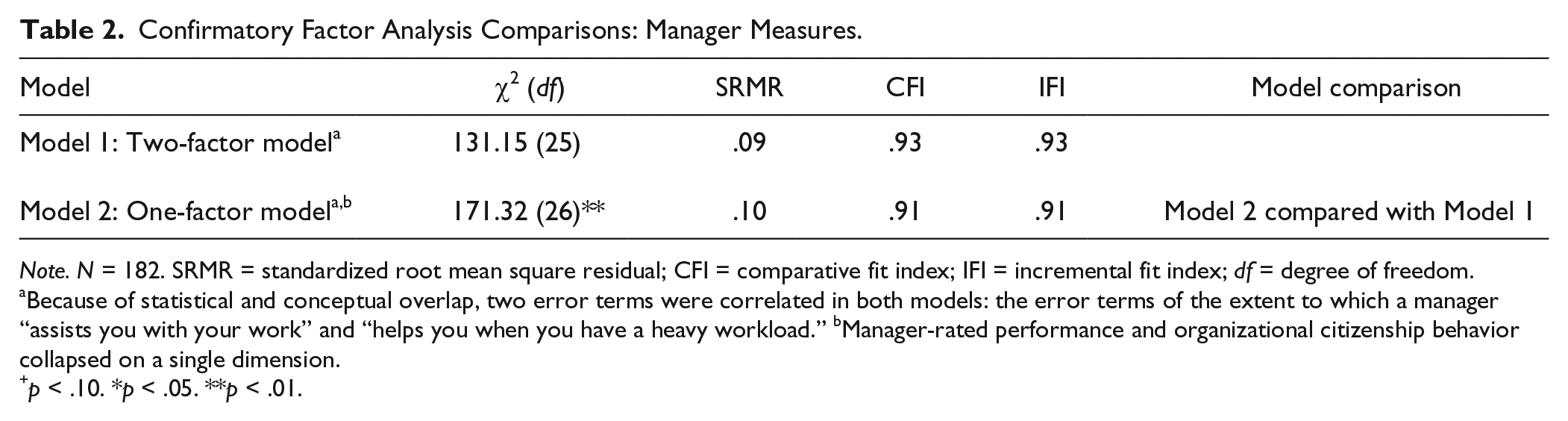
Note. N = 182. SRMR = standardized root mean square residual; CFI = comparative fit index; IFI = incremental fit index; df = degree of freedom.
Because of statistical and conceptual overlap, two error terms were correlated in both models: the error terms of the extent to which a manager “assists you with your work” and “helps you when you have a heavy workload.” bManager-rated performance and organizational citizenship behavior collapsed on a single dimension.
p < .10. *p < .05. **p < .01.
To address discriminant validity concerns, we also conducted Harman’s single-factor test (Podsakoff, MacKenzie, Lee, & Podsakoff, 2003). This involves collapsing all measures onto a single factor and assessing the model’s fit. Poor model fit is indicative of discriminant validity. The results of this test do suggest poor model fit (χ2[405] = 4346.6, comparative fit index = .50, incremental fit index = .50, standardized root mean square residual = .21), giving us more confidence in the discriminant validity of our results. We conducted one final test to address multicollinearity: Podsakoff et al.’s (2003) common methods factor test. This analysis involves conducting a CFA on a set of measures and also adding within the CFA a common methods latent factor on which all items load. This common methods factor is programmed to not correlate with the other latent constructs. If when compared with the CFA without the common methods factor this new model has no significant improvement in fit, then greater confidence that multicollinearity does not severely bias the results is present. With the present employee data, this test provided favorable results: When the common methods latent factor was added to the employee CFA, no significant improvement in fit occurred (Δχ2(Δ31) = 4.55; p > .05). We therefore conclude that multicollinearity did not severely affect our analyses.
Test of Hypotheses
Table 3 provides the zero-order correlations, means, and standard deviations for our model. To test our hypotheses, we used hierarchical regression. We included manager tenure as a control variable—specifically how long an employee had been working with his or her current manager. Our limited sample size restricted our ability test to a structural equation model that included a moderation effect. However, for Hypotheses 4 and 5, we conducted a test of moderated mediation; that is, the interaction of i-deal receipt and organizational justice will affect (a) life satisfaction and (b) work–family conflict through the interaction’s relationship with continuance commitment.
Means, Standard Deviations, and Correlations Among the Study Variables.
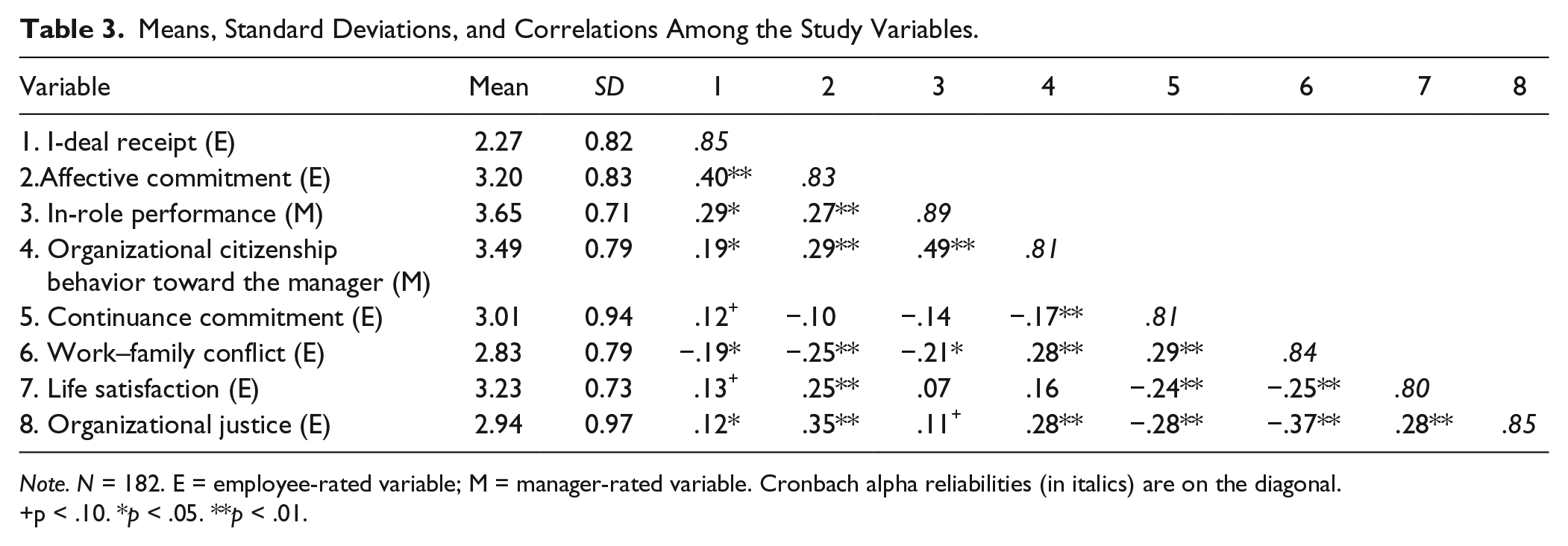
Note. N = 182. E = employee-rated variable; M = manager-rated variable. Cronbach alpha reliabilities (in italics) are on the diagonal.
p < .10. *p < .05. **p < .01.
In support of Hypothesis 1, receipt of an i-deal was positively related to affective commitment (b = .42, p < .01). In support of Hypothesis 2(a), in a regression model that included both the mediator (affective commitment) and the outcome (manager-rated performance), affective commitment had a positive relationship with manager-rated performance (b = .18, p < .05). Receipt of an i-deal was no longer related to manager-rated performance when affective commitment was included in the model (b = .27, p > .05), supporting full mediation.
For the set of hypotheses that evaluated mediation and moderation effects, we used a test pioneered by Judd and Kenny (1981) as well as Baron and Kenny (1986), and refined by MacKinnon, Lockwood, Hoffman, West, and Sheets (2002) and MacKinnon, Lockwood, and Williams (2004). Specifically, using macros developed by Preacher and Hayes (2008), we conducted the mediation test method to determine if there was a significant indirect effect of i-deal receipt on manager-rated performance. Their technique uses bootstrapping, which is “a computationally intensive method that involves repeatedly sampling from the data set and estimating the indirect effect in each resampled data set” (p. 880). Specifically, Gully, Phillips, Castellano, Han, and Kim (2013) discuss that, by bootstrapping,
the sample frame is repeatedly resampled with replacement so that a new sample of size n [here, 1,000 new samples] is built by sampling cases from the original sample. Once a resampling distribution is constructed, the multiplicative indirect paths are re-estimated and the product of the path coefficients stored. (p. 952)
In doing so, the significance of the indirect path is estimated by constructing confidence intervals around the indirect effect through this repeated sampling. If a confidence interval contains 0, there is no significant effect. In further support of Hypothesis 2(a), there was a significant indirect effect of i-deal receipt on manager-rated performance (effect = .05, SE = .03, lower confidence level = .01, upper confidence level = .13). In support of Hypothesis 2(b), in a regression model that included both the mediator (affective commitment) and the outcome (manager-rated OCB-M), affective commitment had a positive relationship with manager-rated OCB-M (b = .23, p < .01). Receipt of an i-deal was still related to manager-rated OCB-M when affective commitment was included in the model (b = .19, p > .05), indicating partial mediation. Again using Preacher and Hayes’s (2008) mediation test for an indirect effect, we found that there was a significant indirect effect of i-deal receipt on manager-rated performance (effect = .06, SE = .03, lower confidence level = .01, upper confidence level = .15).
We next analyzed meditational hypotheses related to continuance commitment. Hypothesis 3 received support: Receipt of an i-deal was positively related to continuance commitment (b = .10, p < .05). Hypothesis 4a received support: In an equation with the independent variable (i-deal receipt), mediator variable (continuance commitment), and dependent variable (work–family conflict), there was a positive relationship between continuance commitment and work–family conflict (b = .33, p < .01) and i-deal receipt had no significant relationship with work–family conflict. Considering the support for Hypothesis 3, there is support for continuance commitment fully mediating the relationship between i-deal receipt and work–family conflict. Hypothesis 4b received partial support: In an equation with the independent variable (i-deal receipt), mediator variable (continuance commitment), and dependent variable (life satisfaction), continuance commitment was negatively related to life satisfaction (b = −.21, p < .01) but i-deal receipt still had a positive relationship with life satisfaction (b = .21, p < .01) independent of continuance commitment.
Our final set of analyses examined our proposed moderation. Specifically, to test Hypothesis 5, we used again Preacher and Hayes’s (2004, 2008) nonlinear bootstrapping technique. This technique combines three approaches: (1) the normal theory approach (e.g., the Sobel test), (2) a bootstrap approach, and (3) Baron and Kenny’s (1986) indirect test technique. As described previously, this technique resamples our data 1,000 times to estimate the significance of the proposed moderation effect. This is of particular importance for moderation hypotheses because the interaction’s product coefficient (i.e., i-deal receipt × organizational justice) is nonnormally distributed. Preacher and Hayes (2004) enabled us to test the direct effect of our interaction on our two outcome variables (work–family conflict and life satisfaction) and the indirect effect of our independent variable (i-deal receipt) on these two outcome variables at different levels of the moderator (see also Hayes, 2013; Preacher, Rucker, & Hayes, 2007). In support of Hypothesis 5(a), the interaction of i-deal receipt and organizational justice was significant (b = –.27, p < .01), and in the moderated mediation model, this interaction explained approximately 9% of the variance in the dependent variable of work–family conflict (see Table 4). Furthermore, the conditional effect of i-deal receipt on work–family conflict was significant for those with greater (but not lesser) amounts of organizational justice: For the +1 standard deviation regression line, the confidence interval did not include 0, with z = 2.0, p < .02. This result also further supported Hypothesis 4a in that it demonstrates that in conditions of greater organizational justice there is a significant indirect effect of i-deal receipt on work–family conflict. In graphing this interaction effect, you can see that for those with lower organizational justice there is a more strongly positive relationship between i-deal receipt and continuance commitment. And for those employees who perceived greater organizational justice, i-deal receipt did not affect continuance commitment (see Figure 2). Finally, in support of Hypothesis 5b, the interaction of i-deal receipt and organizational justice was significant (b = −.26, p < .01), and in the moderated mediation model, it explained approximately 16% of the variance in life satisfaction (see Table 5). Furthermore, the conditional effect of i-deal receipt on life satisfaction was significant for those with greater amounts of organizational justice: For the +1 standard deviation regression line, the confidence interval did not include 0, with z = 2.6, p < .01. This result also further supported Hypothesis 4b in that it demonstrates that in conditions of greater organizational justice there is a significant indirect effect of i-deal receipt on life satisfaction. This interaction effect suggests that, as with Hypothesis 5a, for those with lower organizational justice there is a more strongly positive relationship between i-deal receipt and continuance commitment.
Mediated Moderation Effect: Work–Family Conflict.
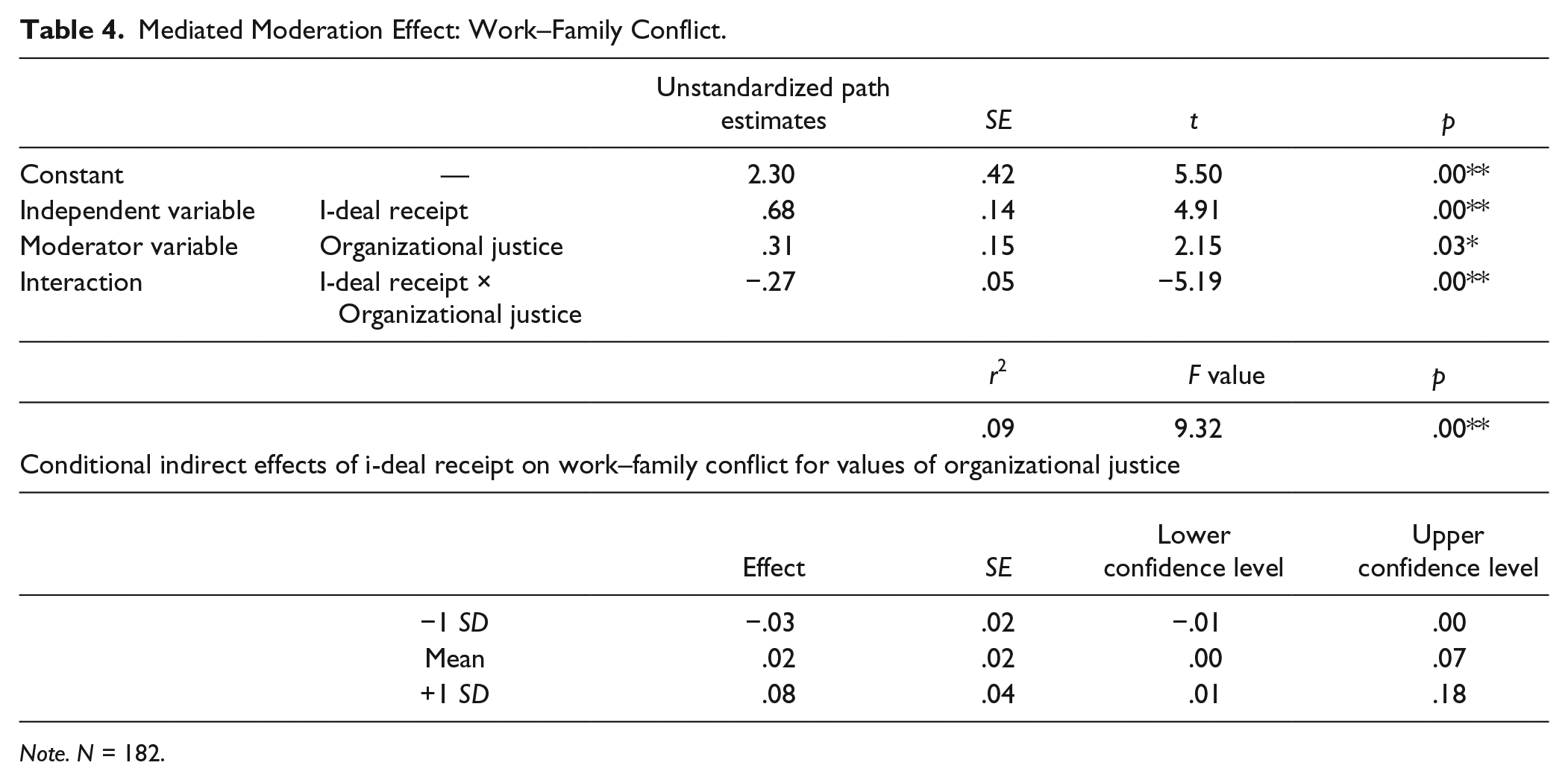
Note. N = 182.
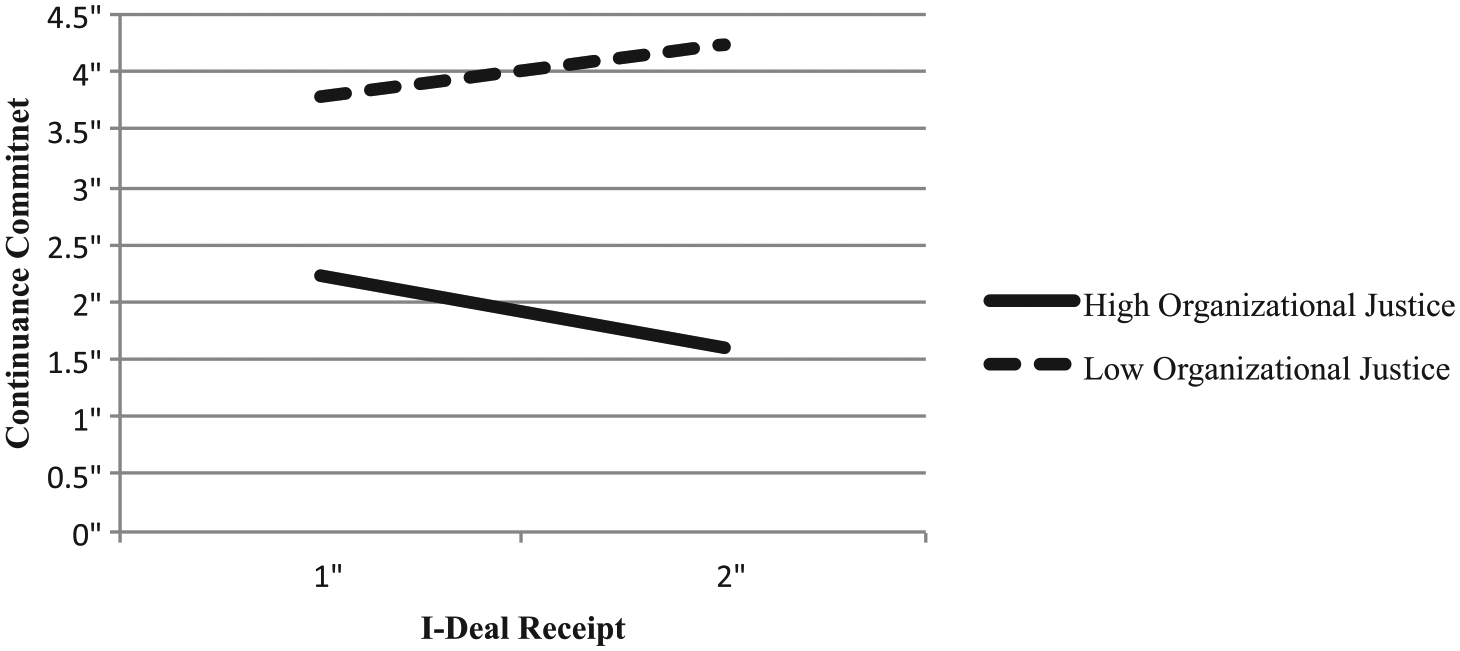
Interaction effect of i-deal receipt on continuance commitment as affected by level of organizational justice.
Mediated Moderation Effect: Life Satisfaction.

Note. N = 182.
Discussion
I-deals have increased in popularity as a mechanism to both attract and retain talented employees and induce improved multifaceted performance. This set of customizable employment terms are, in part, meant to be a reflection of the value an employer places on an employee (Anand et al., 2010). Organizations benefit from issuing i-deals not only by inspiring higher commitment on the part of the employee but also with reciprocal contributions (here, performance and citizenship) because i-deals support high-quality exchange between employee and employer (Rousseau, 2005). The model we developed reflects these conclusions, finding that affective commitment to one’s employer fully mediates the relationship between receipt of an i-deal and in-role and extra-role performance.
Despite the apparent benefits of i-deals, we were further interested in the potential costs of engagement in such deals. Specifically, while performance gains may be reaped by the employer through employees receiving i-deals, is there a downside to this gain? We began with the premise that developing an i-deal is not without drawbacks: The employer must actively negotiate the i-deal, using time and cognitive resources, and the payoff is not guaranteed as employees are generally employed at will. An understanding of the drawbacks of issuing an i-deal is therefore necessary to accurately assess its overall efficacy. To reflect this in part, we developed our model incorporating a major drawback of i-deal receipt, continuance commitment. Because of its customized nature, the value of an i-deal to an employee is great. More specifically, replicating the i-deal with a new employer may prove difficult because the employee may not immediately have the high-quality exchange relationship with the new employer that precipitated the i-deal with the existing employer. Or a different employer may not have the resources or autonomy to issue an i-deal. We therefore posited and found support for the idea that an employee may feel tethered to an employer who offers him or her an i-deal. This manifests as the attitude of continuance commitment. To the best of our knowledge, our study is the first to test these relationships empirically and, therefore, is a useful springboard for more research on the manifold and sometimes ambiguous consequences of i-deal receipt.
As in prior research, we found distinct costs associated with feelings of continuance commitment. Employees tethered to their employer feel pressure to keep their jobs for instrumental reasons and, thus, face the negative psychological repercussions associated with this type of commitment. We found that continuance commitment mediates the relationship between i-deal receipt and work–family conflict as well as life satisfaction, presumably as a result of the intense pressure that results from a perceived lack of satisfying employment alternatives. Furthermore, although i-deal receipt does have a positive relationship with life satisfaction, that relationship is attenuated when considering continuance commitment as an outcome of i-deal receipt. Summarizing the benefits and costs of i-deals, we can see on one hand workplace performance gains, but at the potential expense of work–life balance and satisfaction in the home domain.
Our final finding focuses on the role of organizational justice as a factor in the development of continuance commitment as a result of an i-deal. Given the dominant focus on equity within organizations (e.g., Baldridge & Schulze, 1999), perceptions of injustice often stem from misallocation or ambiguity in the mode of distribution of rewards. Receipt of an i-deal in an organizational context wherein employees are not rewarded equitably casts doubt on the rationality of the i-deal; that is, does the employee feel that he or she actually earned it? In a context of low organizational injustice, an employee may conclude that the receipt of an i-deal was not based on contributions to the organization because decisions are made without respect to deservedness. The likelihood of i-deal replicability thus depletes. Accordingly, we found that perceptions of injustice enhanced the effect of i-deal receipt on continuance commitment. Importantly, when organizational justice was high, there was little impact of i-deal receipt on continuance commitment, underscoring again the criticality of issuing i-deals in a fair context.
Contributions
The present study contributes to the literature on i-deals and their implications for work and home performance in several ways. First, we empirically undertook the examination of the benefits and costs of i-deal receipt concurrently to demonstrate how they coexist, highlighting potential ambiguities in the previously assumed positive nature of i-deals. Theory related to i-deals should thus incorporate analysis not only of the potential for reciprocity stemming from issuance but also of potential drawbacks. Specifically, by incorporating the theoretical lens of side-bets into conservation of resource theory, we advanced understanding of how potential risk (here, the side-bet of continued employment stimulated by the i-deal) can deplete resources (here, the felt effect of continuance commitment on life outcomes).
This study also highlights the importance of context when considering the value of an i-deal. Research (Anand et al., 2010; Lai et al., 2009) highlights that an organization’s treatment of one’s coworkers cannot be separated from personal perceptions of an i-deal. This article suggests that i-deals provided in a context wherein coworkers are treated equitably lends credibility to the i-deal, depressing its positive effect on continuance commitment, presumably because the fair treatment indicates that the i-deal is deserved and therefor, can be imitated in alternative employers. More broadly, this suggests that further work on the reciprocal effects of i-deals incorporate the value the employee places on the i-deal relative to coworkers (Ho, 2005). This article suggests that the perceived risk to resources is mitigated when the resources afforded by the i-deal seem more deserved, again demonstrating how the side-bet theory of commitment and conservation of resources theory can intertwine to explore the nuances of the effects of i-ideal receipt.
A final theoretical implication stems from the cross-domain analysis of the consequences of i-deal receipt. Our findings suggest that a focus on same-domain outcomes of i-deal receipt may be short-sighted and misses the fuller spectrum of the psychological consequences of i-deal receipt. The framework for understanding these consequences is rooted in social exchange theory (Rousseau et al., 2006). Central to this theory is the deliberate effort each party invests in the maintenance of a high-quality relationship (Blau, 1964), yet often research does not account for the demand on resources that maintenance requires (Hobfoll, 2002). The present study explicitly models these demands. Conceptualizations of i-deals as part of a larger employer–employee reciprocal relationship should account for resource depletion and its attendant stress.
Our study also suggests several practical implications. The assumption that employees’ aggressive mobility will always reap rewards may be short-sighted. Receipt of an i-deal may seem superficially beneficial, but without careful evaluation of the reciprocal expectations of the employer, the employee may overweigh the upside of i-deal receipt to the detriment of work–life balance. More practically, employees should be well-informed about the benefits and drawbacks of accepting an i-deal prior to accepting. Not only does such information clearly convey the reciprocal expectations on the part of the employer, but it also enables an employee to understand the full extent of the obligation that precipitates from participating in the i-deal.
Relatedly, an i-deal involves some very real risks for an organization: the time spent negotiating the deal, the likelihood that coworkers will perceive the i-deal as undeserved, the potential for nonreciprocation. As such, i-deals must be selectively negotiated with only those employees from whom the organization can expect a reasonable return in terms of workplace performance. In finding that there are limits to the benefits of i-deals, this should be factored into the cost–benefit analysis prior to issuance.
Finally, this study suggests that i-deal issuance cannot overshadow general unfairness within an organization. Employees who receive an i-deal but also perceive their employer as acting without proper justification suffer significant personal consequences. Work–family conflict and life satisfaction issues can ultimately harm an employee’s performance (Hoobler, Hu, & Wilson, 2010), and prematurely sever the employer–employee relationship (Amstad et al., 2011). Organizations that look to entice high-talent employees with lucrative i-deals at the expense of the greater employee body will be unable to capitalize fully on the numerous benefits associated with i-deal receipt.
Limitations and Future Directions
It is worth noting the potential limitations of this research. First, the data described herein are static, capturing i-deals, justice perceptions, and commitment at a single time point. However, the true process of receiving and implementing an i-deal is dynamic and may unfold over time. Future research would benefit from assessing the i-deal experience at several key time points, with particular emphasis on the negotiation and early-implementation phases of an i-deal and with follow-up data collection assessing affective and continuance commitment after the i-deal has been in place (Rousseau et al., 2006). Understanding the temporal aspects of i-deal negotiation and receipt, including whether or not the i-deal has a timeline (e.g., whether the i-deal is renegotiated each year based on performance), would further benefit our understanding of the i-deal relationship.
While a strength of this article is the fact that performance data were collected from the manager (as opposed to self-reported data), there are nonetheless limitations to our assumptions regarding job performance that deserve mention. Our theoretical model proposes that in-role and citizenship performance behaviors are initiated by employees as a form of reciprocity for the i-deal received. However, a countervailing point is that high-performing, highly committed employees may be more likely to receive an i-deal. The potential for reciprocal causality between i-deals and performance merits future research, and our inability to infer causality is a limitation of our paper.There is also a methodological limitation in our article that bears discussion. In our CFA of manager-rated measures, we correlated the error terms of two of the OCB-M items. A more robust or longer measure of helping behavior that is directed interpersonally may better capture the effect of i-deal receipt on OCB-M.
Another important consideration for interpreting this research is that we focused on i-deals as a broad class of individually negotiated employment situations. The theoretical frameworks that we employed are relevant regardless of the type of i-deal received (e.g., flexibility, developmental opportunities). However, the specific nature of the i-deal may, in fact, ameliorate or exacerbate the nature of the relationships reported here (e.g., Hornung et al., 2008). Our article suggests that commitment is a key psychological mechanism that mediates the receipt of an i-deal and related outcomes. Yet more specific types of i-deals may necessitate greater specificity with respect to that mechanism. For example, a sense of obligation may be a critical mediator if i-deals give employees long-term benefits (e.g., time off for education), or a sense of entitlement may be critical if an i-deal is given that improves an employee’s work performance (e.g., additional training). Relatedly, job type or job attributes may play a critical role in the filter through which an i-deal is perceived by an employee. Some jobs, such as service work, have far more limited alterable terms. For example, working from home is not possible for a retail clerk. And some jobs have less complexity or more interdependence, which too limits the extent to which terms of employment may be negotiated vis-à-vis an i-deal. In this vein, the type of i-deal offered and its content may be limited through job type or job attributes.
Similarly, we did not explore the extent to which the i-deal that is received by the employee matches what he or she wants (Rousseau et al., 2006). Incorporating the extent to which the negotiation is (a) unilateral or (b) reflects fully what the employee aimed to receive would provide interesting insight on relative power and its effects on the consequences of i-deal receipt. An i-deal that captures most fully what an employee desires and the negotiation of which involved full participation by the employee is likely to be perceived as most reflective of the inducement–contribution balance. Put another way, the employee may believe that the i-deal is an appropriate reflection of what he or she deserves and, as we describe in our moderation hypotheses, that the i-deal is more replicable. I-deals that are more actively negotiated by an employee may suffer fewer harmful consequences. On the other hand, i-deals that are contractual in nature or have contingencies may induce more harmful consequences. More broadly, our research assumes that the negative consequences of continuance commitment for nonwork roles result from the distress associated with feeling “stuck” with one’s organization. A more in-depth investigation of the psychological and behavioral responses to continuance commitment, and how they affect nonwork factors, would be a useful contribution beyond the findings reported here. Furthermore, the extent to which the employee feels that the i-deal has been fulfilled would also be an important consideration. Therefore, even if an employee has negotiated a well-fitting i-deal, if it has not been fully realized, the result may be negative for work domain outcomes as well. In other words, if the employee feels that the i-deal has been breached in some way, affective commitment may be lessened, resulting in lowered performance and citizenship behaviors.
A final area for future research is the integration and expansion of existing research on the moderators of the relationship between i-deals and both positive and negative employee outcomes. Our research incorporates a contextual variable that references the organizational level (i.e., justice perceptions) to this body of work, whereas other research has focused on the individual (e.g., Liu, Lee, Hui, Kwan, & Wu, 2013; Ng & Feldman, 2010) and dyadic (e.g., Anand et al., 2010) levels. We recognize that several of these moderators could play a role in our model. For instance, a high-quality relationship with one’s manager may mitigate the feeling of continuance commitment as well as increase affective commitment, helping to both increase positive work domain outcomes and reduce negative nonwork domain outcomes. Yet, as in our current model, this possibility still suggests the possibility of both types of commitment being felt simultaneously. Future research that explores the cross-foci effects (Lavelle et al., 2007) of i-deal receipt and commitment is likely to be fruitful. For example, i-deal receipt may increase continuous commitment if the employee does not feel that the i-deal is replicable in another organization and simultaneously feels a strong kinship toward his or her boss for facilitating the i-deal (or more distal help, e.g., mentoring or training).
We also think that future research should explore dispositional variables to shed further light on how to buffer the relationship between i-deals and continuance commitment. For example, Ng and Feldman (2011) found that employees with a high internal locus of control are more likely to become embedded in their organization. For these people, the side-bet may be even greater. Alternatively, employees who have a particular exchange orientation, such as an orientation that includes a preoccupation with “paying back” someone or something for a benefit received (Clark & Mills, 1979), may feel less apt to feel a change in either sort of commitment when an i-deal is received. Instead, such employees may feel that the i-deal was merited by their hard work or dedication and no payback to their employer is necessary. Exploration of norms of reciprocity would be interesting in the context of i-deal receipt. However, rather than continuing to explore these factors independently, we recommend the development of an integrative framework that simultaneously examines the competing and additive effects of several individual and institutional variables on the relationship between i-deals and outcomes for the individual and the organization. This research should incorporate multilevel tests of i-deals and outcomes. In the organizational citizenship literature, for example, research considering how both individual and group context features affect the provision and receipt of citizenship behavior has led to fruitful conclusions about the nature of citizenship, such as when it is most common, when employees are apt to withhold it, and how to stimulate it (Bommer, Dierdorff, & Rubin, 2007; Ehrhart & Naumann, 2004). Following a similar line of inquiry—specifically on how i-deals given within a team affect an employee’s propensity to reciprocate the benefit—is likely to reveal more nuance as to when i-deals are beneficial and when they are not.
Conclusion
The purpose of the present study was to draw attention to both benefits and drawbacks of i-deal receipt. Through the lens of commitment and justice theories, we examined how receipt of an i-deal relates to feelings of connection with one’s employer, based on both satisfaction with the relationship with one’s employer and a feeling of being “stuck” with one’s employer for lack of employment term replicability in other organizations. In the former case, that is, when an employee feels affective commitment, the employee is more likely to reciprocate positively toward the organization with in-role and extra-role behavior; yet in the latter case, that is, when the employee feels continuance commitment, his or her work–life balance suffers, including life satisfaction. This negative effect is exacerbated when the i-deal is perceived to have been received in an unjust context, because such an environment increases the inimitability of the i-deal. We conclude that employer and employees should be mindful of the potential downsides of i-deal receipt to understand how the employment relationship is altered postissuance.
Footnotes
Declaration of Conflicting Interests
The author(s) declared no potential conflicts of interest with respect to the research, authorship, and/or publication of this article.
Funding
The author(s) received no financial support for the research, authorship, and/or publication of this article.