



Abstract
There has been a growing interest in leader emotion in organizational scholarship. Concomitantly, the body of research on self-leadership continues to expand. Nonetheless, relatively little work has focused on emotional self-leadership. We address this void by exploring intrapersonal and interpersonal aspects of emotional self-leadership and its inherent challenges and opportunities. Specifically, we examine how emotional self-leadership strategies can be used to shape emotional experiences, emotional authenticity, and other work-related outcomes. We offer an emotional self-leadership model, research propositions, and implications for research and practice.
Research on leadership and emotions has become an area of increasing organizational scholarship (e.g., Arnold, Connelly, Walsh, & Martin Ginis, 2015; Connelly, & Gooty, 2015; Cron, Slocum, VandeWalle, & Fu, 2005; Van Kleef et al., 2009; Venus, Stam, & van Knippenberg, 2013; Youssef & Luthans, 2012). Likewise, self-leadership continues to receive significant attention in the organization’s literature (e.g., Manz, 1986, 2015; Manz & Sims, 1987; Neck & Houghton, 2006; Neck & Manz, 2013; Neck, Manz, & Houghton, 2017). Nonetheless, with only a few exceptions (e.g., Côté, 2005), relatively little focus has been devoted to the intentional self-influence of emotion in the workplace, especially of a constructive nature. Indeed, in a recent review of the self-leadership literature, Stewart, Courtright, and Manz (2011, p. 198) suggest that “the emerging issue of self-influence of emotion is a particular area where future self-leadership research . . . is needed.”
Earlier research focusing on the self-influence of emotion in the organizational literature has focused largely on emotional labor (Ashforth & Humphrey, 1993; Hochschild, 1983; Rafaeli & Sutton, 1987). A primary theme of these efforts is that when organizational members regulate themselves to project specific emotions necessary for their organizational roles, various harmful consequences may occur within the person. In a notable exception to this primary theme, Côté (2005) relies on a social interaction perspective and suggests that the response of receivers to an actor’s display of emotions, influenced by the discrete emotion displayed, and the form of emotion regulation involved, will affect the longer term emotional experience of the actor via the projected support and reinforcement or disapproval and disagreement of receivers (an interpersonal perspective).
In this article, we explore both intrapersonal and interpersonal aspects of emotional self-leadership and consider its various beneficial and possible deleterious implications. In particular, we hope to broaden the organizational literature by more fully acknowledging the potential opportunities present in the constructive self-influence of emotion, especially when the emotion is both intentional and authentic. We will examine different classes of emotional self-leadership strategies, how the type of strategy employed can affect the level of authenticity experienced and displayed by emotion regulators, and how this can ultimately influence their personal well-being and workplace effectiveness. In doing so, we also expand on the social interaction model of emotion regulation (e.g., Manz, 2015). We will develop and present an integrated model of emotional self-leadership, emotional experiences, emotional authenticity, and related workplace outcomes, before examining a variety of implications for the contemporary challenges faced by organization members.
There are many sources of emotional experience for employees. An emotion might be triggered by a work situation, a largely automatic passing thought, or by attempts at personal regulation exercised by the individual. We view emotions as originating from within organizational members as well as from their work contexts and experiences. Furthermore, while it may not be possible to guarantee that certain emotions will or will not occur, prior research in the area of emotion regulation suggests that it is possible to increase or decrease the likelihood of certain emotions and whether these emotions are handled productively (e.g., Gross & Thompson, 2007). Our interest in this topic follows not only from a long-standing interest of social scientists in emotions but also from an increasing appreciation among psychology and management scholars for the role of emotional factors in determining social behavior.
Some of the corresponding research areas relevant to this article include emotional intelligence (Feldman Barrett & Gross, 2001; Salovey & Mayer, 1990), emotional labor (Ashforth & Humphrey, 1993; Hochschild, 1983; Rafaeli & Sutton, 1987), emotional coping strategies (Baker & Berenbaum, 2007; Lazarus & Folkman, 1984), and especially emotion regulation (Gross, 1998a, 1998b, 2002; Gross & Thompson, 2007; Richards & Gross, 2000). Among these, emotional intelligence has been particularly influential in popularizing the importance of noncognitive factors in behavior. Because emotional intelligence has traditionally focused on individual capacities rather than social abilities that reflect action, research on emotions has tended to emphasize fixed and static characteristics of emotions rather than dynamic and emerging processes (Feldman Barrett & Gross, 2001). Additional research is needed to enhance our understanding of the processes by which emotions originate, evolve, transform, and occur in specific organizational contexts. In this article, we examine emotions in the workplace and how they may be shaped and influenced by individuals and organizations. More concretely, after overviewing some relevant literature related to the self-influence of emotion, we develop and present an integrated model of emotional self-leadership, emotional experiences, emotional authenticity, and other work-related outcomes along with associated research propositions. Finally, we discuss implications for research and practice.
Facets of the Self-Influence of Emotion in the Workplace
The various means that people use to influence their own emotions has received increasing attention in the fields of psychology (Gross, 1998a, 1998b, 2002; Gross & Thompson, 2007; Richards & Gross, 2000; Quoidbach, Mikolajczak, & Gross, 2015) and management (Ashkanasy & Daus, 2002; Morris & Feldman, 1997). In this section, we provide an overview of two significant facets of the workplace literature on the self-influence of emotion—emotional authenticity and emotional labor—which are important considerations related to the concept of emotional self-leadership which we introduce in the following section.
Emotional Authenticity and Its Potential Violation at Work
Luthans, Norman, and Hughes (2006), citing Erickson (1995), point out that the concept of authenticity has evolved significantly over time. It can be defined as having ownership over one’s experiences of phenomena such as thoughts, beliefs, preferences, emotions, wants, and needs. Authenticity may be further characterized by acting consistently with one’s genuine thoughts and beliefs (Harter, 2002). Authenticity can be viewed as the expression of one’s true nature during ongoing activity (Kernis, 2003). Being aware of deep personal values, a sense of self, and one’s emotional experience are critical aspects of authenticity.
We view emotional authenticity as an underemphasized but critical aspect of organizational behavior. The degree to which organizational members are able to express themselves authentically at work, particularly in regard to their feelings, could significantly affect the quality of their work life experience. When individuals find themselves in jobs and situations that require displays of emotions that are inconsistent with the way they actually feel, the result can be quite detrimental (Grandey, 2003). Indeed, a variety of undesired consequences can result, including the experience of internal personal conflict and dissonance as well as negative feedback and responses from others that are on the receiving end of the emotional displays (Côté, 2005; Côté & Morgan, 2002). When work situations or roles require inauthentic expressions of emotion, a phenomenon generally referred to as emotional labor can result.
Emotional Labor
A growing body of research has addressed the challenges posed by emotional labor within organizations (Ashforth & Humphrey, 1993; Côté, 2005; Gabriel, Daniels, Diefendorff, & Greguras, 2015; Hochschild, 1983; Pugh, 2001, 2002; Rafaeli & Sutton, 1987; Schaubroeck & Jones, 2000). More specifically, studies have examined the physical and psychological toll of work situations that require employees to display specific emotions regardless of their authentic feelings at the time (e.g., Brotheridge & Grandey, 2002; Carlson, Ferguson, Hunter, & Whitten, 2012). For example, the roles performed in many service jobs, such as sales clerks in retail stores or wait staff in restaurants, require employees to respond to customers, even very rude ones, in a cheerful and courteous manner. Some specific examples suggested by Côté (2005) include suppressing emotional displays during negotiations to enhance gains from the negotiation (Thompson, Nadler, & Kim, 1999), service providers purposely projecting high enthusiasm (Pugh, 2001), and collectors displaying exaggerated anger to induce payment from debtors (Sutton, 1991). Each of these choices reflect emotion regulation processes that focus on modifying responses to arising emotion as opposed to attempting to regulate them at a deeper more authentic level. It is not the underlying true emotion that is emphasized; rather it is the emotional display being acted out that is the concern.
If an employee is worried about an ill child at home or has just been treated very badly by a manager or customer, the effort required to project false emotions can have a significant detrimental impact on the person. Emotional labor can deplete both mental and physical energy and put health as well as performance at risk through the stress and strain it creates (Côté, 2005; Hochschild, 1983; Hülsheger, Lang, & Maier, 2010; Morris & Feldman, 1997; Wharton, 1993). Emotional labor has been associated with strain in a variety of work contexts (Ashforth & Humphrey, 1993; Côté, 2005; Grandey & Brauburger, 2002; Hülsheger et al., 2010; Pugh, 2002), suggesting that appearing to feel good may actually feel quite bad. It is notable, however, that it is the suppression of negative emotion rather than the amplification of positive emotion that appears to be most associated with strain (Adelmann, 1995; Brotheridge & Grandey, 2002; Côté, 2005).
This suggests that work life pressures to intentionally manipulate one’s emotions and behave in an inauthentic manner in order to project an artificial image to others can potentially introduce multiple hidden costs. Yet being an organizational member often requires acting in ways that are not consistent with authentic beliefs, feelings, and preferred modes of behavior. This pressure toward being and acting inauthentically could potentially trigger significant dysfunctional emotional experiences.
In addition, Côté (2005), relying on a social interaction perspective, has pointed out that certain emotional displays are more likely to result in approval and desirable feedback from receivers. That is, display of some specific discrete emotions such as happiness (Izard, 1993; Tsai & Huang, 2002) or embarrassment (Keltner & Buswell, 1997) can produce favorable responses from receivers. This in turn can have positive effects (such as reduced strain) on the sender. From a dramaturgical perspective, organization members may convey specific emotional states to reap the desirable outcomes of positive treatment from customers and clients, as has been suggested for the service industry (Pugh, 2001). This relationship, however, seems to be affected by the perceived authenticity of the emotional displays such that authentic displays of more positively received emotions, such as happiness or embarrassment, result in a favorable response, while inauthentic displays (“faking happiness”) receive unfavorable responses (Côté, 2005).
In contrast, Côté (2005) has pointed out that some discrete emotions, such as anger and contempt, are received unfavorably even when they are authentically displayed. This suggests that while authentic displays of emotion may generally increase the probability of receiving favorable response from others, this is not the case for some discrete emotions that, whether authentic or not, carry their own unfavorable response baggage. It is the combination of the discrete emotion displayed coupled with the degree of authenticity that together determine responses from receivers, which in turn affect the further emotional experience of the sender.
Emotional Self-Leadership
Just as a variety of individual strategies for the self-leadership of behavior have been presented in the organizational literature (e.g., Luthans & Davis, 1979; Manz & Sims, 1980; Neck & Houghton, 2006; Neck & Manz, 2013; Stewart et al., 2011), individual strategies also can be applied to exercise self-influence over emotion. Self-leadership is generally described as a self-influence process involving a comprehensive set of prescriptive strategies that help individuals develop the self-direction and self-motivation necessary to perform effectively in the workplace (Pearce & Manz, 2011; Stewart et al., 2011). Manz (2015) proposed the concept of emotional self-leadership as one potential direction for expanding overall self-leadership capacity. He suggests that the basic self-leadership concept may be extended beyond its traditional focus on behavioral and cognitive processes toward a focus on the self-influence of emotions. We build on the suggestions of Manz (2015) to develop and present emotional self-leadership as a comprehensive set of prescriptive strategies aimed at increasing individual effectiveness in regulating emotions and shaping emotional experiences. We present our emotional self-leadership framework within the overarching theoretical context of emotion regulation (e.g., Gross, 2002; Gross & Thompson, 2007). We do so, not only in response to Manz (2015) but also in response to Stewart et al. (2011), who noted that there is great potential for expanding, categorizing, and better understanding emotion self-influence as an enhanced form of self-leadership.
Emotional self-leadership strategies may be divided into five distinct categories: environmental focused strategies, behavioral/action focused strategies, natural reward focused strategies, cognitive focused strategies, and physiological focused strategies. Environmental focused strategies involve selecting and/or modifying situations so as to foster favorable emotional responses. Specific strategies include choosing pleasant activities or influencing a work process to make it more enjoyable or focusing attention on desirable features of the current situation. For example, purposely applying stimuli such as colors or sounds (e.g., painting the office with a specifically selected color or playing classical music in the background) to invoke desired physical responses via the primary senses, in order to cause desired emotional experiences, fall within the situation modification category since they change the situational experience of the actor. Research has indicated that various colors can influence mood by stimulating positive, motivating, and more secure feelings about oneself and about current life contexts (Hemphill, 1996; Schifferstein & Tanudjaja, 2004). For example, light pink tends to induce emotional calm, while red may stimulate more heightened emotion. Research suggests that fragrances can trigger moods, although it appears that scents can have different individual affects perhaps depending on their association with earlier life experiences. For instance, Warrenburg (2005) reported results of a study that used a multidimensional mapping measurement method that assesses subjects’ moods (e.g., relaxed, stimulated, irritated, stressed) associated with a variety of fragrances. Among his conclusions was that certain fragrances can reduce stress experienced during a performance task. For example, the smell of citrus (clementine) can be more stimulating than other scents such as vanilla which can have a relaxing affect.
Behavioral/action focused strategies involve choosing specific actions or behaviors that are likely to result in favorable emotional responses. Verbal behavior is one means to facilitate desired emotional responses. For example, a person can choose to verbally agree with some feature of an insulting statement made by an upset coworker during an interpersonal conflict. By searching for areas of agreement (“we both agree there is a problem that needs to be addressed”) rather than areas of disagreement (a statement that “your view is all wrong and will create many more problems than it will solve”) to focus on first, the escalating emotionality of the situation may be temporarily reduced. This in turn can create an opening for potential collaborative dialogue for seeking a mutually positive solution to the current challenge. Similarly, proactively addressing an emerging problem on a sensitive issue, to preemptively avoid a recurrent emotion-charged conflict situation with a colleague that emerges when this kind of problem arises, can help manage potential emotional challenges before they occur.
Natural reward focused strategies focus on connections with naturally occurring intrinsic affective experiences. For example and consistent with Appreciative Inquiry (Cooperrider & Srivastva, 1987), change efforts (which have the potential for evoking difficult emotional responses for those affected) purposefully may be facilitated via a process based on amplifying what is working well rather than focusing on problems that need to be fixed. By bringing together employees from across a work context and soliciting descriptions of their most significant successes, ideas for spreading these positive processes across the organization can be identified. During such a process, naturally positive emotions connected with celebrating and learning from successes are unleashed. As a related example, in a longitudinal study, Brown, Cron, and Slocum (1997) found that positive salesperson emotions, which are positively related to goal attainment (successfully reaching goals), are an important driving force for salesforce motivation. Furthermore, managers and members of a work organization or unit can place priority on acting authentically with conviction rather than artificially adhering to some organizational norm. Essentially, an emphasis on authentic (deep) acting as opposed to surface acting can be intentionally chosen and thereby facilitate more constructive emotional outcomes (Abraham, 1998; Erickson & Wharton, 1997; Hewlin, 2003; Morris & Feldman, 1997; Wharton, 1993).
Cognitive focused strategies include meditation, mental imagery, mental reframing, self-talk, and challenging dysfunctional beliefs and assumptions. In terms of self-talk for example, research suggests that one may control one’s emotions by changing the internalized verbalizations or self-talk taking place in one’s mind (Neck & Manz, 1992, 2010). It is clear to see how an author who tells herself, “I missed the deadline on the manuscript I’m writing so I’ll never get an article published,” will result in unfavorable emotional experiences. However, if she instead told herself, “I missed the deadline but I will use the extra time to make the article even better,” this would likely result in more favorable emotional outcomes.
The active challenging of dysfunctional beliefs and assumptions is another cognitive focused strategy for improving one’s emotional experiences. Dysfunctional thinking involves cognitive distortions that can hinder personal effectiveness and even lead to extreme negative emotion such as forms of depression (Burns, 1980). These distorted thoughts are based on some common dysfunctional beliefs and assumptions that are activated by potentially troubling situations. Individuals can take an initial step toward improving their emotional outcomes by performing a process similar to that prescribed by Ellis (1975) and Burns (1980) for identifying and confronting dysfunctional beliefs and replacing them with more rational ones.
Physiological focused strategies involve methods and techniques that relate to the physical and chemical functioning of humans. A large body of evidence supports the relationship between positive mood state and diet (Benton & Donohoe, 1999, Neck & Cooper, 2000), exercise (Fox, 1999; Neck & Cooper, 2000, Yeung, 1996), smoking cessation (e.g., Kahler, Spillane, Busch, & Leventhal, 2011), massage (e.g., Edge, 2003; Stevensen, 1994), music (e.g., Campbell, 2001; Manz, 2003), deep relaxed breathing (Manz, 2003), laughter (e.g., Christie & Moore, 2005), and nontraditional physical fitness including activities practiced in the far East such as yoga, Qigong, and Tai Chi (e.g., Caldwell, Harrison, Adams, & Triplett, 2009).
Some research suggests that eating foods high in carbohydrates, low in fat, low in sugar, and high in iron and thiamine can promote enhanced mood states (Benton & Donohoe, 1999; Somer, 1995). While the evidence on the relationship between these food groups and mood level is mixed, there is growing support for the contention that diets low in omega-3 fatty acids may contribute to mood disorders in humans (Parker et al., 2006).
Growing evidence demonstrates that performing low impact, moderate intensity exercise can be effective in improving mental states. Senior citizens who participated in moderate intensity exercise training for 10 weeks experienced more enhanced moods than those who did not participate in the exercise program (Engels, Drouin, Zhu, & Kazmierski, 1998). A study revealed that people who quit smoking are happier than people who continue smoking. In this study, even people who quit smoking for only a short time were likely to have fewer symptoms of depression while they are away from cigarettes—but these symptoms returned when smoking resumed (Kahler et al., 2011).
Having occasional massages may help individuals improve their affective states. For example, a recent study showed that women getting a weekly 1 hour massage for a 6-week period experienced reduced anxiety and increased feelings of relaxation (Edge, 2003). Certain music and sounds have been associated with various brain wave patterns and emotional responses. Such auditory stimuli have been employed as a tool for achieving desired emotional states such as relaxation conducive of effective learning, or to foster emotional uplift before making an important speech that is intended to be inspiring (Campbell, 2001; Manz, 2003; Miles, 1997). Deep relaxed breathing is perhaps the best known and widely practiced physiological strategy. Breathing deeply into the abdomen, rather than the chest, is often prescribed (Manz, 2003; Weil, 1995). Manz (2005) describes a breathing technique that is adapted from an approach that has been effectively used by Weil (1995) in his medical practice. It involves concentrating on exhaling as much air as possible at the beginning of the breath, since the musculature is stronger for controlling the out breath than for breathing in. This causes the lungs to automatically take in more air on the in breath, which has a calming affect resulting from the intake of more oxygen. After consciously trying to take in even more air, first into the abdomen and then the chest, the breath is finally let go with a sigh. Finally, nontraditional physical fitness programs may be an effective strategy for enhancing both younger and older adults’ mood states. A recent study, for example, revealed that college students who participated in exercise programs such as Pilates (twice a week for 75 minutes each session) and Tai Chi (twice a week for 50-minute sessions) enjoyed enhanced moods over those than do not participate in such programs (Caldwell et al., 2009). The preceding discussion on physiological strategies suggests a wide range of techniques to control and improve one’s mood and emotions. These include (a) eating a diet that includes omega 3s; (b) getting low impact, moderate intensity exercise several times a week; (c) having massages, quitting smoking, and listening to music; (d) practicing deep breathing exercises; and (e) participating in nontraditional exercise programs such as Pilates and/or Tai Chi.
The emotional self-leadership strategies we outlined are most often applied as antecedent focused strategies (Gross & Thompson, 2007). For example, purposely reinterpreting a difficult situation (seeing a disagreement with a colleague as a useful problem-solving session rather than a threatening argument) is a perfect example of an antecedent focused strategy for cognitively reappraising a situation (assuming the strategy is employed prior to the emergence of emotional response). Many of the strategies may also be applied as response focused strategies (Gross & Thompson, 2007). An example of a response strategy might include choosing to suppress emotional reactions (by counting to 10 and taking deep relaxing breaths to calm down) that might otherwise lead to “telling an argumentative colleague off” resulting in long-term work relationship problems. Similarly, a person might choose to suppress true emotions that could trigger dysfunctional behavioral displays in order to act out a role that is consistent with company policies, such as “always greet customers with a smile” and “the customer is always right.” Note that the emotional self-leadership strategies outlined above which are primarily concerned with shaping the actual emotion experienced are more consistent with antecedent, as opposed to response, emotion regulation strategies. Although efforts to apply response strategies, such as trying to relax various muscle groups or suppressing difficult emotions and choosing to act in ways that do not reflect true but undesired feelings, can be used to regulate emotions and connected behaviors, they tend to be less useful in shaping authentic emotional experience (Côté, 2005; Gross, 2002).
Emotional Self-Leadership and Emotion Regulation
Emotional self-leadership is connected to the basic conceptual framework of emotion regulation, but goes beyond the categories and strategies suggested in the emotion regulation literature to present a more comprehensive theoretical view with a broader set of prescriptive strategies. More specifically, emotional self-leadership has the following characteristics that help distinguish it from the similar concepts of emotion regulation and emotional intelligence:
Its theoretical foundation is based on research findings across multiple disciplines, especially drawing from the organizational literature (e.g., employee self-management and self-leadership, emotional labor, and facades of conformity) and the psychology literature (e.g., behavior modification, goal setting, locus of control).
It concerns both practical strategies for effectively dealing with emotion and emotion-laden situations and capacities gained over time through creation and mastery of repertoires of such strategies.
It is especially relevant to work situations and/or personal life situations that have direct implications for work and career.
It is part of a wider interrelated system of self-leadership components concerning environment, behavior, cognition, natural rewards, and physiology that can contribute to theoretical understanding of self-influence processes and practical implementation of intentional self-influence.
Related to Point 3, emotional self-leadership offers a holistic approach to addressing emotion and emotionally relevant situations through a system of interrelated levers connected with environmental, behavioral, cognitive, intrinsic, and physiological self-leadership strategies.
Finally, and perhaps most significantly, emotional self-leadership also concerns the locus of guiding intent for the exercise of self-influence—it concerns the issues of “why” the emotional self-leadership is taking place and “what” is intended to be accomplished (Manz, 2015). Rather than basing the intent of the influence process on the pursuit of organizational goals that satisfy certain organizational standards or values (such as maximizing sales, profitability, or ROI), which might call for surface acting resulting in emotional labor (e.g., to make a sale or satisfy a customer) the focus is on the standards and values of the individual.
Emotional Self-Leadership and Positive Emotions
We suggest that emotional self-leadership will result in more effective emotion regulation and thus in more favorably experienced discrete emotions (e.g., happiness, interest, joy). This results in enhanced information processing and problem solving, while helping reduce ineffective emotion regulation and associated unfavorably experienced discrete emotions (e.g., fear, anger), which tend to decrease information processing capacity (Isen, 1990; Isen, Daubman, & Nowicki, 1987). While exceptions have been found, such as a positive relationship between unpleasant moods and performance (Forgas, 1995; Martin, Ward, Achee, & Wyer, 1993) on some very specific tasks such as computer programming (Schwarz & Clore, 1996), most evidence supports the performance benefits of favorably experienced emotions. Meanwhile, unfavorably experienced emotions such as fear and anger have been found to reduce response alternatives to more limited action choices such as escape or attack (Frijda, Kuipers, & Schure, 1989; Lazarus, 1991; Oatley & Jenkins, 1996).
Each discrete emotion may have desired or undesired effects depending on the type of work being performed and the organizational context and are not inherently good or bad (Côté, 2005; Gross & Thompson, 2007). Nevertheless, despite some caution that has been raised about labeling emotions in ways that imply that they fall in desirable or undesirable classifications), researchers have suggested that it is sometimes useful to categorize emotions according to the orthogonal dimensions of positive and negative (Fredrickson, 2003; Tellegen, Watson, & Clark, 1999). We also note that the use of the emotion labels of positive and negative should not be viewed as indicating opposites along a single dimension but rather two affective states that are largely independent of each other (Watson, Clark, & Tellegen, 1988). In general, positive emotions such as love, joy, and contentment manifest themselves through pleasant thoughts and pleasurable physical sensations, whereas negative emotions such as fear and anger involve disturbing thoughts, physical discomfort, and even pain in specific locations of the body. Therefore, it is not only possible, it is indeed likely that complex situations and events can evoke both positive and negative emotions.
It appears that emotions that are experienced in a more favorable manner, such as happiness or joy, engage higher brain mechanisms, more effective information processing, and enhanced memory, while emotions that are experienced in an unfavorable manner such as fear or anger tend to interfere with higher cognitive functions (Fredrickson, 2003; LeDoux, 2002). For example, Fredrickson (2003) has delineated many potential benefits of what she has labeled “positive emotions” (e.g., joy, interest, contentment, gratitude, love). She has proposed a “broaden and build” theory and conducted a number of studies to test it. Her findings suggest that negative emotions work to narrow one’s cognitive and behavioral options), while positive emotions expand them (Fredrickson, 2003). In addition, positive emotions have been associated with an expanded capacity to cope with challenges, and thereby to further increase the level of positive emotions experienced (Fredrickson & Joiner, 2002).
Various studies have connected more favorably experienced emotion with health and well-being. For example, Fredrickson and her colleagues have found a positive relationship between positive emotion and enhanced cardiovascular health (Fredrickson & Levinson, 1998; Fredrickson, Mancuso, Branigan, & Tugade, 2000). Other research has revealed a significant relationship between more favorably received emotion and improved immune response (Segerstrom, Taylor, Kemeny, & Fahey, 1998). Indeed, given the levels of stress and strain that can be associated with the dynamic and complex work contexts in contemporary organizations, the potential benefits posed via the experience of certain positive emotions for employee well-being appear to be quite promising.
In order for effective emotion regulation choices to be made, some level of emotional awareness may be needed that establishes an informed foundation for proactive preparation for emotional challenges and constructive responses when they occur. Frost (2003) pointed out that awareness can increase sensitivity to emotional cues, increase understanding of what is actually occurring, and provide the basis for decisions that are better informed and more effective than if founded on unconscious impulsivity. Research on emotion regulation indicates that conscious antecedent strategies can be applied to effectively meet difficult emotional situations in ways that reduce both negative emotional experiences and dysfunctional behavioral responses (Gross, 1998a, 1998b, 2002; Jackson, Malmstadt, Larson, & Davidson, 2000). This literature offers a hopeful contrast to writings that mostly concentrate on the potential detriments and challenges of response focused emotion regulation that fosters artificial displays such as those associated with emotional labor (Abraham, 1998; Brotheridge & Grandey, 2002; Côté, 2005; Erickson & Wharton, 1997).
We espouse a view of emotional self-leadership as a process that provides a potential means for more effectively creating and coping with emotional experience in ways that may help ameliorate the dysfunctional effects of emotional labor. For example, employees faced with pressures toward inauthentic emotional expression (especially to suppress negative emotions) might use emotional self-leadership strategies to proactively reappraise the situation (cognitive change) and make choices consistent with elements of authenticity inherent in deep acting that transcends emotional labor effects, thereby more constructively regulating potential outcomes. The primary advantages of emotional self-leadership include an emphasis on antecedent strategies that promote authenticity and self-awareness while generally evoking favorably experienced discrete emotions conducive to heightened personal effectiveness. In the following section, we develop an integrated model of emotional self-leadership in the workplace that focuses on emotional experiences, emotional authenticity, and related workplace outcomes.
An Integrated Model of Emotional Self-Leadership in the Workplace
A proposed integrated model of emotional self-leadership in the workplace is shown in Figure 1. In the following paragraphs, we will develop and explain the propositions contained in the model while providing conceptual and empirical support for each proposed linkage. Our model expands on Côté’s (2005) basic social interaction model of emotion regulation to examine the specific effects of emotional self-leadership strategies on emotional experiences, emotional authenticity, and other work-related outcomes.
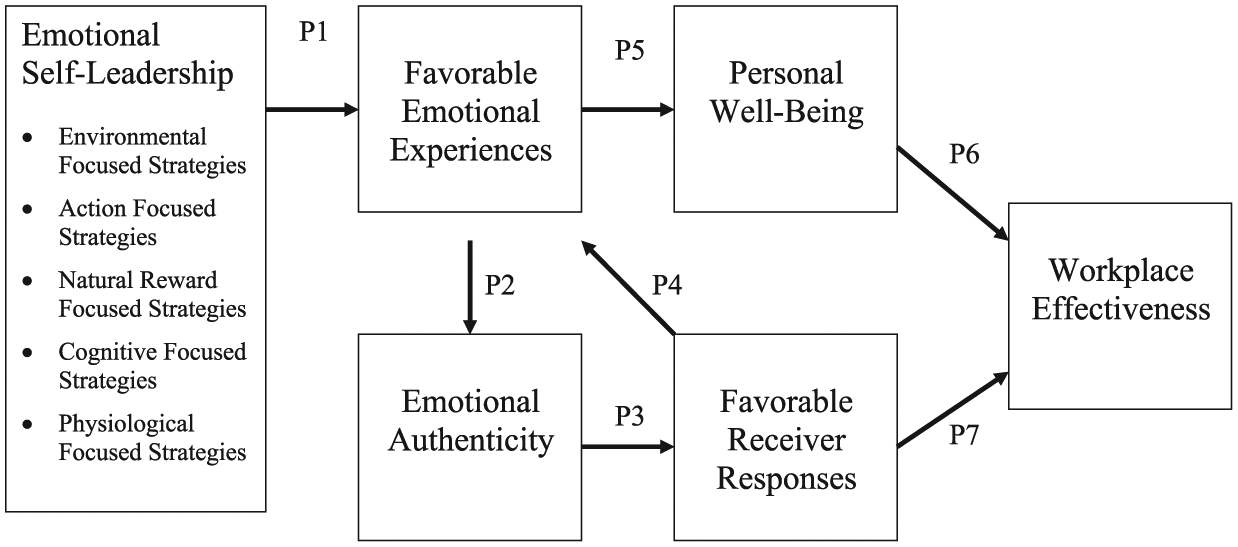
A model of emotional self-leadership, emotional experiences, emotional authenticity, and work-related outcomes.
Emotional Self-Leadership and Favorable Emotional Experiences
The emotional self-leadership strategies outlined previously should result in more favorable emotional experiences. Indeed, Neck and Houghton (2006) proposed positive affect as one of a number of likely outcomes of self-leadership. Empirical research has provided evidence in support of this proposition. For instance, Neck and Manz (1996) reported increased levels of positive affect for employees who received a self-leadership training intervention as compared with a no-training control group in a sample of airline employees. Along similar lines, Houghton and Jinkerson (2007) found a significant relationship between certain self-leadership strategies and subjects’ subjective well-being. Additionally, the emotional self-leadership strategies outlined previously (and summarized in the following sentence) should result in more deep acting and genuine favorable emotions rather than mere surface displays of emotion. To illustrate, these can include strategies that foster constructive emotions focused on the environmental context (e.g., establishing positive emotional cues such as inspiring office wall posters), action/behavior (e.g., reinforcing oneself for positive support of valued colleagues), natural rewards (e.g., choosing task approaches that create natural good feelings for the performer, such as approaching work as a kind of challenging game process), cognitions (e.g., purposely focusing thoughts on the opportunities of challenges rather than obstacles), and physiology (e.g., having a meeting with a colleague during an enjoyable walk outdoors on a beautiful day).
Hence, we posit:
Favorable Emotional Experiences and Emotional Authenticity
Emotional authenticity involves having ownership over one’s emotional experiences and acting consistently with one’s genuine emotions (Erickson, 1995; Harter, 2002). Individuals who experience more actual favorable emotional outcomes through a process of deep acting are likely to experience more emotional authenticity than those who are merely portraying favorable emotions through a process of surface acting (e.g., Côté, 2005; Grandey, 2003). Drawing on affective events theory (e.g., Weiss & Cropanzano, 1996), Gardner, Fischer, and Hunt (2009) developed a comprehensive model of leader emotional labor and authenticity in which they proposed that positive affective events are positively related to genuine emotional displays, to more deep acting, and consequently to more feelings of authenticity. Based on this theoretical reasoning, we contend:
Emotional Authenticity and Favorable Receiver Responses
Emotional authenticity tends to result in more favorable emotional responses from the person who receives the emotion (Côté, 2005). For example, one study (Butler et al., 2003) showed that emotion receivers who interacted with partners who engaged in deep acting and reflected more authentic displays of emotion, tended to like their partners more, feel higher levels of rapport with their partners, and exhibit smaller blood pressure increases when compared with receivers who were paired with partners who were surface acting and showing inauthentic emotional displays. Similarly, studies suggest that people will experience fewer positive emotions and rate others less favorably when they are shown inauthentic displays of happiness when compared with authentic displays of happiness (Frank, Ekman, & Friesen, 1993; Grandey, Fisk, Mattila, Jansen, & Sideman, 2005). Based on this evidence, we suggest:
Favorable Receiver Responses and Favorable Emotional Experiences
The next linkage in our model suggests that favorable emotional responses from the receiver of the emotions are likely to result in additional favorable emotional experiences for the emotional actor. In support of this supposition, we note that exposure to other people’s emotions significantly shape one’s own emotions via a process known as interpersonal emotional transfer, which may be facilitated by both emotion contagion and social appraisal (Parkinson, 2011). Social appraisal occurs when the emotions of others influence how we interpret or evaluate a given situation thereby changing our own emotions to conform more to those of others (Parkinson, 2011). For example, one study showed that subjects’ anxiety in decision making was positively related to the level of anxiety shown by another person present while the decision was being made (Parkinson & Simons, 2009). In contrast, emotion contagion involves a direct mirroring or mimicry of the emotions of others without an interpretive evaluation of others’ emotions (Parkinson, 2011). Indeed, a number of empirical studies have demonstrated the direct effects of emotion contagion in which people “catch” the emotions of others (e.g., Johnson, 2008: Parkinson & Simons, 2009; Pugh, 2001). On these theoretical and empirical bases, we propose:
Favorable Emotional Experiences and Personal Well-Being
Our model also indicates that favorable emotional experiences will result in enhanced levels of personal well-being. We propose this linkage largely based on Fredrickson’s (2003) broaden and build theory as outlined above. Empirical evidence tends to support this supposition. For example, Fredrickson and Joiner (2002) provided evidence in support of the prediction that positive emotions may create upward spirals leading to increased personal well-being. Another study reported that positive emotion mediated the relationship between positive psychological capacities and well-being (Avey, Wernsing, & Mhatre, 2011). Furthermore, research evidence suggests that antecedent focused regulation strategies, such as those suggested by emotional self-leadership, were associated with greater well-being than response modulation strategies (Schutte, Manes, & Malouff, 2009). Consequently, based on this theoretical and empirical evidence, we advance:
Personal Well-Being and Workplace Effectiveness
A number of studies have shown a relationship between individual well-being and job performance (e.g., Baptiste, 2008; Cotton & Hart, 2003). Edgar, Geare, Halhjem, Reese, and Thoresen (2015) examined this linkage in detail in an empirical study that found significant relationships between well-being and performance. Also, van den Bosch and Taris (2014) reported significant relationships between authenticity at work, well-being, and work outcomes in a study of 685 workers. In addition to this empirical evidence, a number of conceptual and theoretical arguments in support of this relationship have been advanced in the literature (e.g., van Veldhoven & Peccei, 2015). Given this cumulative evidence, we suggest a relationship between personal well-being and general workplace effectiveness as follows:
Favorable Receiver Responses and Workplace Effectiveness
Finally, our model suggests that favorable responses from the emotional receiver will have a direct impact on workplace effectiveness. This relationship is likely to be especially true for those workers who have extensive interaction with customers and whose jobs require positive affective displays (Grandey, 2003). In these cases, favorable responses from emotional receivers are likely to result in tangible positive customer outcomes, such as intention to return and perceptions of overall service quality (e.g., Pugh, 2001; Tsai, 2001). One empirical study, for example, indicated that positive affect among employees could neutralize the negative effects of abusive supervision on work outcomes (Harvey, Stoner, Hochwarter, & Kacmar, 2007). Another study showed that experiencing positive emotions influences team effectiveness for both additive and disjunctive tasks (Galanakis & Anastasios, 2007). Based on this evidence, we propose:
Implications for Future Research and Practice
This article adds to the growing body of work on the self-influence of emotions in the workplace by expanding the concept of emotional self-leadership. We present a model of emotional self-leadership, emotional outcomes, emotional authenticity, and related workplace outcomes. In particular, our model addresses how emotional self-leadership strategy choices can affect the level of authenticity inherent in situations where employees are called on to regulate their emotions. Emotional labor tends to reflect a surface level of emotion regulation that is response focused as opposed to being oriented toward proactively addressing the antecedents of emotional experience. Such response strategies are more likely to result in inauthentic emotional expression and consequently trigger the various detriments associated with emotional labor that have received considerable emphasis in the organizational literature.
Implications for theory and practice are significant. For example, research that specifically addresses the types of emotional self-leadership strategies used by employees in the course of doing their work and the relationship these personal strategy choices have with their level of perceived authenticity offer potential for advancing our understanding of emotional self-influence processes in the workplace. Both the influence on the actor as well as the response of receivers to the emotional expressions could be examined in light of the emotional self-leadership strategy–authenticity relationships. This could help create richer theoretical explanations of how both personal (within the individual actor) and interactive (between the actor and receiver) self-influence mechanisms operate to shape the subsequent emotional experience of actors and the resulting affect this experience has on well-being and workplace effectiveness.
In a more general sense, insights from this line of research could help us better understand how engaging in emotional self-leadership strategies, subsequent emotional experiences, and emotional self-efficacy might be related. Even if employees have an advanced personal capability to successfully perform immediate tasks, when upsetting circumstances arise causing them to feel emotionally disturbed and either no effort or failed attempts at regulating the emotional experience follows (perhaps due to selection of inappropriate or ineffective emotion regulation strategies), a sense of powerlessness can result. This can feed a general lack of perceived efficacy for effectively coping with difficult emotional experience.
In contrast, being emotionally efficacious, in terms of awareness of emotion and success in regulating it, offers the potential to enhance one’s capacity for making constructive behavioral choices and is likely to result in more successful workplace performance. A better understanding of the operation of emotional self-leadership strategies may be a key factor for facilitating more effective emotional self-influence processes in the workplace. Indeed, shaping emotions in more favorable ways can foster a variety of performance inducing discrete emotions, while buffering against an array of potentially debilitating discrete emotions. This may be particularly important during challenging adjustment periods and organizational change efforts that can trigger feelings of resistance, insecurity, and anxiety.
In conclusion, the process of emotion regulation would seem to be neither entirely good nor entirely bad. Emotion regulation sometimes may result in dysfunctional outcomes such as when employees project false emotions to meet work role demands. But disadvantages such as these should be considered relative to the possible enhancements of workplace effectiveness and well-being as reflected in the model of emotional self-leadership and emotional authenticity presented here. More than ever before, today’s complex and fast-paced work environments present substantial emotional challenges for organization members and managers alike. Emotional self-leadership has the potential to serve as a critical tool to help organizational members effectively shape their emotion regulation processes in the face of the contemporary emotional pressures of the workplace.
Footnotes
Declaration of Conflicting Interests
The author(s) declared no potential conflicts of interest with respect to the research, authorship, and/or publication of this article.
Funding
The author(s) received no financial support for the research, authorship, and/or publication of this article.