



Abstract
Leader developmental efficacy, or one’s belief in his/her ability to develop leadership knowledge or skills, is theorized to predict engagement and success in leader development. Conducting the first empirical studies on this construct using cross-sectional and quasi-longitudinal surveys across three samples consisting of 73, 94, and 49 leaders, respectively, we find that leader developmental efficacy predicts intentions to self-develop leadership above and beyond past leader development. Intentions to develop as a leader, in turn, predicts actual implementation of leader development behaviors 1 month later. Examining reverse directionality, we observe that the quantity, and potentially the quality, of past leader development behaviors are positively related to current leader developmental efficacy. Finally, leader developmental efficacy is associated with an increase in leader efficacy through a leader development program. Implications for assessing and developing leader developmental efficacy prior to formal programs are discussed.
Whether you think you can, or you think you can’t—you’re right.
Workplace trends signal a move toward more leader self-development—a self-directed process where leaders initiate, monitor, and evaluate their own leader development instead of relying on their organization to construct a plan for them (Boyce, Zaccaro, & Wisecarver, 2010). For example, changing psychological contracts have reduced long-term job security (Rousseau, 1997), and more of today’s leaders are opting for self-directed and values-driven Protean careers (Hall, 1996). It is not just the individual leader who values maintaining one’s marketability through continuous development, but organizations also treasure leaders who are self-driven and proactive learners because of increased organizational agility and adaptability. The value of self-directedness stems from the reality that in a highly complex and fast-paced information age, not all organizational problems can be anticipated and planned for by top leadership teams. As reflected in views of organizations as theater (Bolman & Deal, 2013), much of organizational life remains improvised and leaders need to evolve to fit their changing circumstances. For all the good that human resource development systems, competency models, and succession planning do for leaders, nothing is quite as powerful as the individual leaders’ desire and ability to self-develop (DeRue & Ashford, 2010).
This sentiment is echoed by recent training and development spending. Budgets for informal learning doubled in 2011 (O’Leonard, 2012), suggesting that increasingly employees are expected to self-develop by learning on the go, in informal or unplanned situations. More generally, investment in employees’ professional growth is a booming industry. The Association for Talent Development (2015) estimates that in 2014 U.S. organizations on average spent $1,229 per employee on learning and development. Despite the importance of and investment in fostering leader self-development in organizations, with the exception of Boyce et al. (2010), little is known about what drives leaders’ intentions to and, ultimately, their engagement in leader self-development activities.
Prior theory and research indicate that individual differences are important precursors to employee development activity, generally (Major, Turner, & Fletcher, 2006; Maurer & Tarulli, 1994). Successful self-development requires significant motivation and self-regulatory skill (Nesbit, 2012), among other personal resources for weathering the ups and downs of any development trajectory. A consistently strong individual difference predictor of such motivated behavior is self-efficacy, or one’s belief in his/her ability to execute action to complete an activity (Bandura, 1997; Stajkovic & Luthans, 1998). Prior researchers have operationalized self-efficacy in a variety of ways, sometimes examining generalized self-efficacy (Boyce et al., 2010; Judge & Bono, 2001; Noe & Wilk, 1993) and other times explicitly focusing on confidence in ability to learn (Maurer & Tarulli, 1994).
Despite its theorized importance, only Boyce et al. (2010) have studied leader development activity as an outcome of efficacy. Although an important single study, it was limited in that they measured generalized (trait-like) efficacy as a distal predictor in one sample of Army leaders. This is an unfortunate limitation of existing research. Although understanding traits likely to predict leadership growth is important for selection purposes, individuals and institutions invested in developing leaders also need more malleable (state-like) predictors, over which they have some control and opportunity to enhance. Finally, the Army sample in the Boyce et al. (2010) study may have limited generalizability. Therefore, more precise measurement and study of domain-specific efficacy as an antecedent to leader development activity across multiple samples of leaders is needed.
Building on theorizing from Day, Harrison, and Halpin (2009) as well as Murphy, Reichard, and Johnson (2008), we examine the claim that an important precursor of effort and success in leader development includes leader developmental efficacy (LDE), or one’s belief in his or her ability to develop as a leader. Importantly, LDE is theorized (yet not empirically tested) to be a key motivational construct that predicts a leader’s engagement in developmental activities (Reichard & Johnson, 2011; Reichard & Walker, 2016). Given the significant investment in leader development and the strong role of the individual difference of efficacy in predicting behavior in other domains, empirical research is needed to examine the theorized role of efficacy in the domain of leader development.
The purpose of this article is to empirically test the predictive validity and utility of LDE as both an antecedent and outcome of leader development, as depicted in the theoretical model displayed in Figure 1. This model takes into account existing theory on leader development, and we focus particularly on the role of self-efficacy, specifically LDE. After reviewing the literature on social cognitive theory and self-efficacy (Bandura, 1986), we define and discuss the construct of LDE. More specifically, we provide theory and rationale for why LDE is expected to be a precursor of leader development intentions and, ultimately, the implementation of leader development behaviors. We also discuss the bidirectionality of the relationship between LDE and leader development. Finally, we provide the first empirical tests to determine if LDE is, in fact, predictive of engagement in leader development through a series of studies.
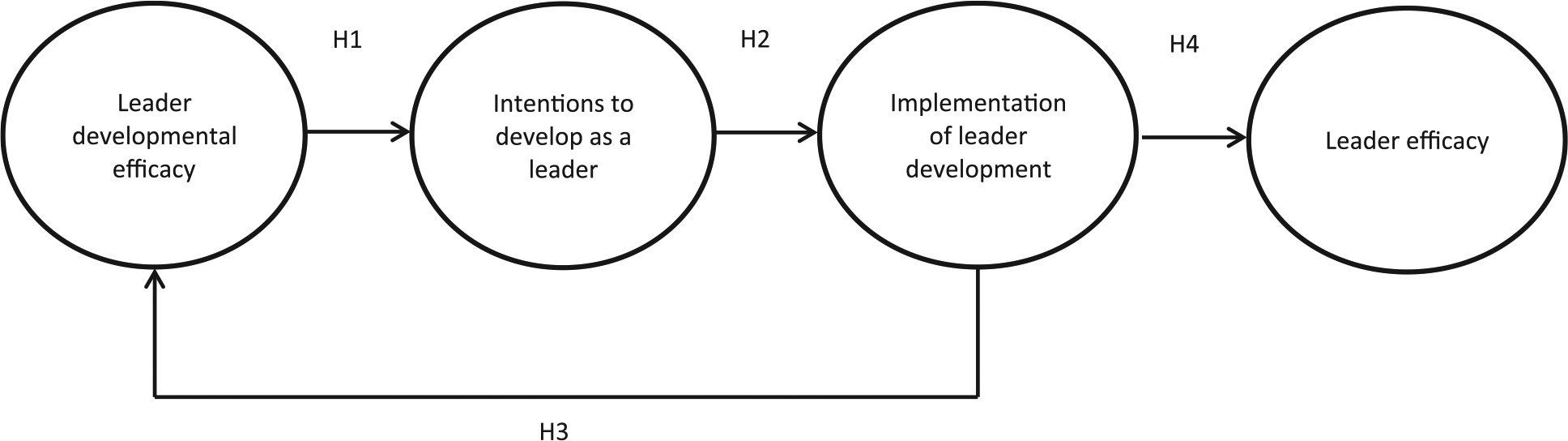
Theoretical model.
This research contributes (a) to the training and development literature by longitudinally assessing a precursor to involvement in both formal and informal leader development and (b) to the leader development literature by empirically testing theoretical propositions put forth by Day et al. (2009), Murphy et al. (2008), and Avolio and Hannah (2008, 2009), as well as integrating the theory of planned behavior with scholarship on leader development. Finally, this research may provide a useful tool for practitioners to identify and prepare leaders for developmental opportunities. By identifying leaders with and without the cognitive and affective resources needed to develop (i.e., determining who is high and low in LDE), practitioners may be able to secure a higher return on training investments (Avolio, Avey, & Quisenberry, 2010) and provide efficacy building resources to those with low LDE to prepare them for future development experiences.
Self-Efficacy: A Driver of Self-Regulation, Effort, and Persistence
Like other forms of efficacy, the origins of LDE are rooted in social cognitive theory. In this theory, Bandura (1986) posits that people are both products and active producers of their environment and behavior. By calibrating beliefs about the extent to which effort will lead to success, self-efficacy is an important precursor to effortful behavior. Efficacy refers to one’s confidence in his or her ability to organize and execute the requisite cognitive energy, motivation, and behavior for a desired purpose; and it is a central mechanism by which people self-regulate their behavior (Bandura, 1977). Self-efficacy has less to do with the objective value of the skills one possesses and, instead, reflects one’s value estimation or perceived ability to put those skills to use when difficult circumstances arise. Efficacy beliefs improve motivation and subsequent performance through effort and persistence (Kanfer, 1990).
In the context of employee development, prior research suggests that self-efficacious individuals feel more comfortable working on difficult assignments and assuming responsibility for their own development, such that people with high domain-specific self-efficacy are more likely to challenge themselves in order to acquire new knowledge, skills, and abilities (Bandura, 1982; Bandura & Schunk, 1981; Gist & Mitchell, 1992; Stevens & Gist, 1997). For example, extant research has investigated self-efficacy for development as a predictor of an individual’s attitude toward employee development programs (Maurer, Mitchell, & Barbeite, 2002; Maurer & Tarulli, 1994), learning motivation during training (Colquitt, LePine, & Noe, 2000), attitudes toward 360-degree feedback (Maurer et al., 2002), participation in developmental activities outside of work (Maurer et al., 2002; Maurer & Tarulli, 1994), and general motivation to continuously learn (Colquitt et al., 2000). Overall, these findings suggest that individuals with high self-efficacy for development are more likely to engage in developmental activities than are individuals who have low self-efficacy for development (Maurer, Weiss, & Barbeite, 2003).
Leader Developmental Efficacy
LDE is a domain-specific, state-like individual difference and is defined as “a leader’s judgment regarding whether he or she can develop a specific ability or skill to employ in a certain leadership context” (Avolio & Hannah, 2009, p. 285). Put more simply, LDE represents the belief in one’s ability to develop leadership knowledge and skills (Maurer et al., 2003). The distinction of LDE as domain-specific is important in contrast to generalized efficacy, or “one’s estimate of one’s fundamental ability to cope, perform and be successful” (Judge & Bono, 2001, p. 80). Although both contribute to variations in motivation and performance, extensive evidence in the motivation literature suggests that domain-specific self-efficacy is more strongly linked to task-specific performance than generalized efficacy (Bandura, 1997; Bandura & Adams, 1977; Stajkovic & Luthans, 1998). In other words, research consistently demonstrates that specific self-efficacy is a better predictor of specific goals and performance behaviors, than general self-efficacy (e.g., Bandura, 1997; Elias, Barney, & Bishop, 2013). Taken together, it may be more meaningful to look at domain-specific efficacy (i.e., LDE) as opposed to generalized efficacy when it comes to predicting engagement in leader developmental activities. Therefore, we propose that LDE is a domain-specific, state-like, and individual-level construct reflecting the beliefs a leader holds about his or her capability to effectively develop leadership skills.
Leader Developmental Efficacy and Leader Self-Development
We expect LDE to be a positive predictor of a leader’s intentions to engage in leader development activities. Leader development is defined as an increase in an individual leader’s capability (knowledge, skills, and abilities) to enact leadership roles (Day, 2000). Methods of leader development range from highly structured formal programs to developmental relationships and even informal reflection on everyday leadership experiences (Avolio, 2005; McCauley, Kanaga, & Lafferty, 2010). Formal programs might include training to develop specific competencies or feedback-intensive assessments designed to increase self-awareness. When these methods of development are voluntary, LDE becomes a particularly important driver of motivation, as there is no external standard to motivate behavior. Instead, the leader must look internally to determine their own standard and discern their own motivation. Therefore, we argue that leader self-development, rather than formal leader development activities that are mandatory and structured by others, is an appropriate outcome variable of LDE as self-development reflects voluntary activity. By removing forced participation, this criterion more accurately represents the self-determined (Ryan & Deci, 2000), agentic behavior encompassed by self-efficacy theory (Bandura, 1997).
Prior theorists have argued for the central role of LDE in motivating and self-regulating leader development activities. Taking a social cognitive perspective of leadership and leader development, Murphy et al. (2008) proposed that LDE would build motivation to develop by strengthening internal beliefs about one’s ability to improve as a leader. Avolio and Hannah (2008, 2009) proposed that LDE, among other indicators of developmental readiness, would accelerate leader development by motivating leaders to set and strive toward challenging goals. In their integrative theory of leader development, Day et al. (2009) proposed that leaders with high self-efficacy are more likely to achieve their goals because they set more positive and self-concordant goals. In this way, leaders’ beliefs about what they think they are capable of achieving orient the goals (i.e., leader development intentions) they set for themselves and the effort they are willing to put forth to reach those goals. More specifically, Day et al. (2009) hypothesized that efficacy would be especially linked to a leader’s self-development activities.
In fact, as previously mentioned, Boyce et al. (2010) found a positive relationship between generalized self-efficacy and propensity to self-develop, suggesting that self-efficacy is an important predictor of whether a leader is likely to self-direct his or her own learning and development. Boyce et al. (2010) assessed self-efficacy as a stable, trait-like variable, in order to better understand a leader’s confidence in performance abilities over the long-term. The current studies extend Boyce et al.’s (2010) work by operationalizing LDE as a state-like variable specifically focused on beliefs about the domain leader development.
As proposed by Murphy et al. (2008), LDE is particularly valuable in accounting for voluntary development activity. Various interventions or contextual changes can trigger a development cycle (Gardner, Avolio, Luthans, May, & Walumbwa, 2005), although ultimately the responsibility for carrying the trigger to fruition (i.e., actually developing) rests on the individual leader (DeRue & Ashford, 2010). With no formal authority figure checking in on goal progress or encouraging reflection through structured time away from work in a formal program, the leader’s own store of personal resources to regulate themselves becomes even more important. Investing in leader development involves some risk, as the dividends from development activities are typically long-term, increasing the chances that some short-term objectives may be compromised in the process. To overcome this risk and establish intentions to engage in leader self-development, high levels of LDE are a prerequisite.
For example, a leader who struggles with creating an inviting team climate strives to display more empathy to direct reports. Because showing and managing emotions at work is new and unfamiliar, the leader tries on several provisional selves (Ibarra, 1999), or transitional behaviors, before ultimately landing on something that feels natural. In the meantime, the leader has risked looking and feeling uncomfortable. To the extent that the leader is confident the risk will pay off in terms of skill development (high LDE), he/she will be more likely to take on challenging self-development exercises like displaying appropriate emotion even at the cost of some short-term comfort. In this example, the leader will only be willing to take that risk if he/she believes it will ultimately make him/her a better leader, thereby improving the interpersonal dynamics on the team.
This belief represents LDE, and the effort and persistence that LDE generates manifest as leader self-development activity. Thus, highly efficacious leaders are predicted to possess stronger intentions to engage in leader development activities.
Intentions and Implementation of Leader Development
Intentions, the goals and plans leaders make for their development, are an important precursor to engagement in actual leader development activities. According to the theory of planned behavior (Ajzen, 1985, 1991), individuals’ intentions are the best predictor of future behavior. In fact, the positive link between intentions and implementation is well supported by theory and research (Ajzen & Fishbein, 1977; Sheppard, Hartwick, & Warshaw, 1988). For example, in a study of voluntary employee development, participation in growth activities such as building professional relationships and on-the-job experiences was predicted by intentions, which was, in turn, predicted by attitudes toward employee development (Hurtz & Williams, 2009). Consequently, we expect intentions to develop to positively relate to implementation of leader development activities.
The theory of planned behavior argues that intentions to perform a given activity are formed by three key antecedents: (a) attitudes about the behavior in question, (b) subjective norms or social pressure, and (c) perceived controllability of the behavior (Ajzen, 1985, 1991). First, when leaders think that they are likely to improve their leadership from hard work, they will form positive attitudes about leader development and will be more likely to engage in subsequent leader development activities. For example, holding the belief that leadership skills are malleable (as opposed to the belief that leadership ability is fixed) affects individuals’ self-evaluations when presented a leadership role model (Hoyt, Burnette, & Innella, 2012) and when threatened with a leadership stereotype (Burnette, Pollack, & Hoyt, 2010). Individuals with positive self-evaluations, in turn, will go on to engage in both leadership performance and development behaviors (Day & Harrison, 2007).
As the second antecedent to intentions, subjective norms represent the influence of social pressure to behave a certain way. Subjective norms are fueled by normative beliefs, which are perceptions about important others’ approval or disapproval of certain behaviors, and fueled by how closely someone wants to conform to others’ expectations (Ajzen, 1991). In the leadership context, subjective norms are conceptualized as implicit leadership theories, or the taken for granted assumptions about how typical and exceptional leaders behave (Junker & van Dick, 2014). Leadership categorization theory indicates that people use cognitive representations of prototypical leaders to guide expectations and assessments of leadership behaviors (Lord, Foti, & de Vader, 1984). How motivated someone is to develop as a leader may depend on the extent to which they categorize themselves as a leader. Taking implicit leadership theories as subjective norms, the theory of planned behavior suggests that if an individual’s implicit leadership theory (i.e., his or her leadership prototype) overlaps with his or her self-concept, that individual should feel more motivated to comply with the behavioral expectations associated with that implicit theory. This is because that individual includes him or herself in the category of people for whom the expectations apply (e.g., Leaders are assertive. I am a leader. Therefore, I should be assertive).
Finally, and central to the premise of this article, perceived controllability of a behavior is essentially self-efficacy for the given domain (Ajzen, 2002). Perceived control over behavior exerts both a direct effect on implementation and an indirect effect on implementation through intentions (Madden, Ellen, & Ajzen, 1992). According to the theory, perceived control, or efficacy, is particularly useful in accounting for behavior to the extent that individuals lack complete control, such as in the context of leader development. Leaders cannot control the amount or accuracy of feedback they receive if others are unable or unwilling to give it, nor can they control their access to developmental resources like supportive supervisors, mentors, and organization-sponsored training or coaching. Likewise, even if leaders request challenging job assignments, which have been shown to develop leaders’ capabilities (DeRue & Wellman, 2009), they are not guaranteed to receive the desired assignments. Consequently, the degree of control or self-efficacy leaders perceive they do have over their development should indicate how strongly they intend to engage in developmental activities.
The strength and predictive validity of each antecedent—attitudes, norms, and control—depends on the specific context and behavior (Ajzen, 1991). Certain leadership behaviors will be more or less determined by each antecedent depending on what is activated. For the purposes of this article and our emphasis on leader self-development, we have focused on perceived control or efficacy as it has been underinvestigated in the leader development literature. Given the explanatory power of perceived control in the theory of planned behavior and the demonstrated empirical linkage between intentions and implementation behavior, we predict that intentions will mediate the relationship between LDE and leader self-development behavior.
Effects of Past Leader Development on Leader Developmental Efficacy
So far, we have argued that LDE positively relates to intentions to develop, and that, in turn, intentions to develop mediate the relationship between LDE and implementation of leader development. Based on the reciprocal exchange relationship posited in social cognitive theory (Bandura, 1986), we also expect a reciprocal relationship between implementation of leader development behaviors and leader developmental efficacy, such that, the more a leader engages in leader develop experiences the more confident he/she is to be able to develop in the future (i.e., LDE).
LDE can be developed through leader self-development activities including mastery experience, vicarious learning, and verbal persuasion (Bandura, 1997). Mastery developmental experiences are experiences of success at leader development, or times in which a leader accomplishes a goal for developing some aspect of their leadership. As prior mastery is the primary predictor of self-efficacy (Bandura, 1997; Sitzmann & Yeo, 2013), any experience in which a leader successfully practices new leadership skills should foster feelings of confidence in further ability to develop. Mastery experiences may arise from a variety of leader self-development and leadership activities such as new and challenging job assignments, job rotations, expansion of duties, or expatriate assignments. Additionally, leaders can develop LDE through vicarious learning, or by seeing others grow as leaders. Direct observation of others’ success builds one’s LDE. Finally, verbal persuasion, or direct encouragement and inspiration from trusted others, can foster stronger beliefs in one’s capacity for development. Vicarious learning and verbal persuasion likely occur though developmental relationships (e.g., mentoring, coaching, communities of practice, and networks) in which leaders observe their peers, supervisors, and subordinates making strides toward their goals. Mastery experiences, vicarious learning, and verbal persuasion are all expected to increase LDE.
In fact, some research has called the directionality of the self-efficacy-to-behavior/performance relationship into question. For example, within-person data indicate that whereas performance predicts self-efficacy, self-efficacy either does not predict performance (Beattie, Lief, Adamoulas, & Oliver, 2011) or actually has a negative relationship with performance (Vancouver, Thompson, & Williams, 2001). A recent meta-analysis of self-efficacy demonstrated that although between-person effects of self-efficacy on performance tend to be more strongly positive than within-persons effects, the directionality is reversed when examining within-persons effects: self-efficacy has a stronger effect on performance than performance has on self-efficacy (Sitzmann & Yeo, 2013).
These findings suggest that self-efficacy may play a dynamic role as both an outcome of past performance and a predictor of future performance in both positive and negative directions. The recent research echoes Lindsley, Brass, and Thomas’ (1995) proposition that efficacy and performance are not only reciprocal (bidirectional causality), but augment one another in upward, downward, and self-correcting spirals. More recently, Salanova, Llorens, and Schaufeli (2011) found support for efficacy spirals in a three-wave longitudinal study that demonstrated gains in efficacy, positive affect, and work engagement over time.
Taken together, success in leader development experiences signal to the leader that the learning strategies they implemented actually helped them grow as a leader. When leaders know they were successful in the past, all else being equal, they should be more likely to continue leader development efforts in the future. If these changes lead to valued outcomes, leaders can expect that future development activities will also lead to similarly valuable results, ultimately driving further confidence and motivation (Vroom, 1964). It is important to note that not all leader development activities are successful nor do they all lead to leadership performance gains. It is possible that a leader could engage in development activities and experience difficulty, frustration, and failure, ultimately decreasing their LDE. Nonetheless, mastery experiences (i.e., past performance) are only one of several means of increasing efficacy, and leader development activities can encompass some of these other means. For example, vicarious learning can foster LDE. Even if a leader feels unsuccessful in a given leadership activity (e.g., a role play exercise), they may have the opportunity to observe other people attempting new and unfamiliar leadership behaviors. Watching someone else succeed—provided the leader identifies with that individual—can boost LDE. Similarly, trainers, coaches, and peers engaged in an activity with a leader can offer verbal persuasion to encourage a leader to have greater confidence in their ability to eventually succeed as well as provide them verbal instruction on how to develop. Words of encouragement and guidance from individuals the leader has grown to trust through a leadership program or through one-on-one engagements such as coaching or mentoring can convince a leader that they have the ability to develop. Therefore, we expect that investment of time and energy in past leader development activities will relate to future levels of LDE.
Leader Developmental Efficacy and Leader Efficacy
Finally, leader efficacy is a distinct but highly relevant construct to LDE. Leader efficacy is defined as a leader’s confidence in his or her ability to organize and deploy the motivation, means, and collective resources needed to enact positive outcomes as a leader (Hannah, Avolio, Luthans, & Harms, 2008). So, whereas leader efficacy refers to one’s confidence in his or her ability to perform as a leader, LDE, on the other hand, refers to one’s confidence in his or her ability to successfully improve leadership knowledge and skills. Whereas the former considers actual leader behavior as the relevant performance domain, the “performance” referred to in LDE is leader development. Leader development refers to an expansion of the ability to perform in leadership roles and is conceptually distinct from leadership. Similarly, developing leadership and performing leadership require different skill-sets. Self-regulation, or the ability to actively plan, select, and regulate learning strategies, is one such skill required to develop leadership (Avolio & Hannah, 2008, 2009), and self-regulation has been shown to influence leaders’ acquisition of task-relevant skills, leader effectiveness, and team performance (Yeow & Martin, 2013). Leader performance does not necessarily call for leaders to expand their capability, only to deliver results, whereas leader development requires making new meaning out of experiences. Despite this, since the operational distinction between deliberately practicing leadership and performing leadership remains nearly indistinguishable (Day et al., 2009), the overlap between efficacy for leadership and leader developmental efficacy is considerable.
Success in leader development is likely to result in an increase in both LDE and leader efficacy. In fact, LDE may predict gains in leader efficacy during the course of a leader development program due to the advancement of the leader’s knowledge and skills. Moreover, many formal leader development programs involve the components required to build leader efficacy including practice or mastery experience, vicarious learning from observing other leaders in the program, and social persuasion and instruction from program coordinators or other leaders (Bandura, 1997; Lester, Hannah, Harms, Vogelgesang, & Avolio, 2011). For example, successfully completing a high-potential leader development program can be a mastery experience for a junior executive, resulting in greater leader efficacy (as well as LDE). However, this leader efficacy gain can only be realized if there is sufficient LDE to engage with program content at a deep and meaningful level in the first place. Given this, we expect that LDE will predict leader efficacy gains during leader development.
Control Variables
Personality variables have been discussed as important in the leader development process. People who are extraverted, open to experience, and conscientious are curious about the world, seek out social experiences likely to provide opportunities to lead, and take responsibility for their actions. These characteristics make someone particularly well-suited for self-development. Specifically, prior research suggests that both openness to experience, or imaginative thinking, creativity, and risk-taking (McCrae & Costa, 1987), and conscientiousness, or being thorough, careful, and disciplined (McCrae & Costa, 1987), are significant factors in propensity to self-develop leadership (Boyce et al., 2010) as well as voluntary employee self-development (nonleadership specific; Orvis & Leffler, 2011). Extraversion has also been shown to predict development activity via motivation to learn (Major et al., 2006). Given the theoretical and established empirical connections between personality and leader self-development, where possible, we controlled for personality when testing study hypotheses to demonstrate additional variance explained beyond other known antecedents of development.
Overview
In summary, we predict a positive relationship between LDE and intentions to develop as a leader, which, in turn, will positively relate to implementation of leader self-development activities (Hypotheses 1 and 2). We also expect that quantity and quality of past leader development activities will positively relate to current LDE (Hypothesis 3). Finally, we predict that LDE will positively relate to gains in leader efficacy during the course of a leader development program (Hypothesis 4). Using a quasi-longitudinal design in Study 1, we examine Hypotheses 1 and 2 in a sample of leaders participating in a leadership assessment center. In Study 2, we test Hypothesis 1 and 3 in a cross-sectional survey of nonprofit leaders. Finally, we test Hypothesis 4 in Study 3 on a sample of nonprofit leaders during the course of a leadership training workshop series.
Study 1 Method
The purpose of this first study was to test the relationship between LDE and intentions to and implementation of leader self-development. A quasi-longitudinal, self-report survey design was used during the course of a developmental assessment center of leaders from various organizations in the southwestern United States. Recruitment was conducted by offering an assessment center at no cost to local nonprofit and for-profit organizations, university alumni, individuals in the researchers’ personal networks, and referrals from past assessment center participants.
Two weeks prior to the assessment center session, participants completed an online survey of LDE and personality variables. The in-person assessment center included three simulations designed to measure leadership behavior in relatively realistic situations (Lievens, 1998). Simulations included an email-based in-basket activity, a role-play with a troubled follower, and a leaderless group discussion. Eleven sessions with an average of 12 leaders per session were held over the course of a year and a half. Trained assessors coded participant behavior using behaviorally anchored rating scales. Within 1 month after the assessment center, participating leaders were emailed a 15-page individualized feedback report consisting of tailored leader development strategies based on behaviors displayed during the simulations. On receipt of feedback, participants reported their intentions to engage in leader self-development behaviors over the next month. At the end of that month, participants completed an online survey indicating the frequency with which they had implemented self-development activities during the past month. Prior research on the theory of planned behavior has measured intentions from implementation 1 month apart (Lac, Crano, Berger, & Alvaro, 2013).
Participants
Although a total of 148 leaders participated in this study, only 73 completed one of the two dependent measures, which is to be expected in longitudinal research. There were no significant differences in age, gender, ethnicity, or education between the final 73 leaders in the sample in comparison to the initial 148 participants. Mean age for participants was 39 years. Participants were 40% male and 60% female. Ethnicity was majority Caucasian (66%), followed by Hispanic (non-White; 10%), African American (7%), Asian/Pacific Islander (7%), Hispanic (European; 4%), and Other (7%). The sample was highly educated, with 49% reporting their highest education as a graduate degree, 34% reporting a bachelor’s degree, and 12% reporting some college. Participants supervised a median of four direct reports.
Measures
Leader Developmental Efficacy
To measure LDE, we compiled and adapted two items from Potosky and Ramakrishna’s (2002) learning self-efficacy measure and three items from a measure of self-efficacy related to leadership development from a study on the effectiveness of transformational leadership conducted by the Army Research Institute. All LDE items are available in the appendix. Respondents were asked to report their level of agreement with each statement on a 5-point scale from 1 (strongly disagree) to 5 (strongly agree). An exploratory factor analysis on this sample data using principal axis factoring suggested a one-factor structure using the criteria of an Eigenvalue greater than one and visual scree plot inspection (Tabachnick & Fidell, 2007). The unrotated one-factor solution accounted for 60% of the variance. Using confirmatory factor analysis and as shown in Table 1, the five-item LDE measure demonstrated acceptable model fit on all indices except the root mean square error of approximation, which is considered mediocre when between .08 and .10 (MacCallum, Browne, & Sugawara, 1996). Finally, the scale demonstrated acceptable reliability (α = .82).
Confirmatory Factor Analysis Results of LDE Measure Across Studies.
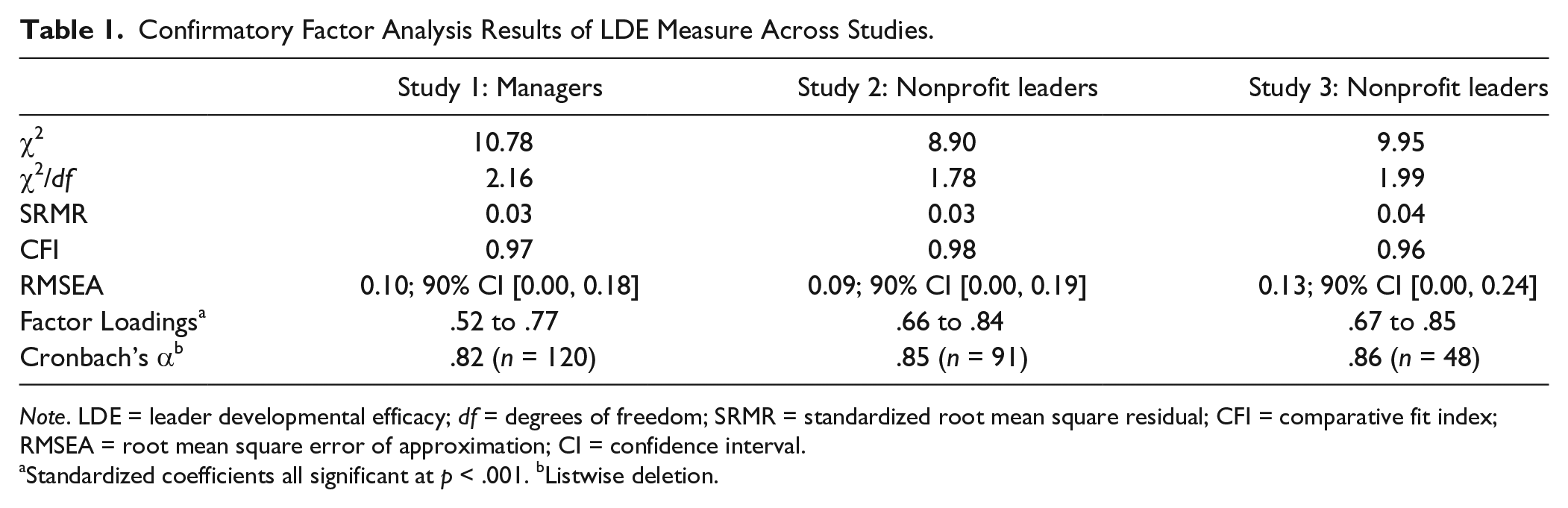
Note. LDE = leader developmental efficacy; df = degrees of freedom; SRMR = standardized root mean square residual; CFI = comparative fit index; RMSEA = root mean square error of approximation; CI = confidence interval.
Standardized coefficients all significant at p < .001. bListwise deletion.
Intentions to Develop Leadership
We used an 18-item scale to measure intentions to develop leadership. The leader intentions to develop scale was developed by Reichard (2006) after conducting focus groups with Army leaders on strategies they use to develop their leadership outside of formally required programs. Response options ranged from 1 (strongly disagree) to 5 (strongly agree). A sample item is, “In the next month, I will seek jobs/positions that stretch my leadership skills.” The scale had a high level of internal consistency (α = .91)
Implementation of Leader Development
The same 18 items from the intentions to develop scale were reworded to assess past implementation of the various developmental activities. A high degree of correspondence between items asked in intention phases and those asked in implementation phases is recommended by Ajzen and Fishbein (1977). Items ask participants on a 5-point scale how frequently they engaged in specific leader development activities in the past month. A sample item is, “In the past month, I reflected on my leadership experiences.” Response options ranged from less than once per month (1) to more than 10 times per month (5). Internal consistency for this scale was high (α = .94).
Personality
We used four items to assess openness to experience and four items to assess conscientiousness from Saucier’s (1994) Big 5 mini-markers scale. Participants indicated how accurately a list of characteristics described themselves. A sample characteristic includes “conventional” (openness, reverse) and “dependable” (conscientiousness). Two of the openness items were reverse coded, and response options ranged from 1 (very inaccurate) to 5 (very accurate). Although the internal consistency reliability estimates were low (openness to experience: α = .64; conscientiousness: α = .62), the Big 5 are the most comprehensive and well-accepted personality indicators (Major et al., 2006). Therefore, we proceeded with creating mean-based scales for these constructs.
Study 1 Results
Of the 73 participants, all reported leader developmental efficacy, 51 reported their intentions to develop as a leader, 49 reported their actual implementation of leader development, and 71 reported conscientiousness and openness to experience, reducing the sample size of listwise complete data. Therefore, data imputation was employed on the 73 cases in order to preserve the sample size (and consequently statistical power). First, Little’s MCAR test failed to reject the null hypothesis that the scores are missing completely at random (χ2 = 9.97, df = 10, p = .44). Failure to reject the null hypothesis suggests that the data are likely missing completely at random and can be subjected to statistical imputation. Multiple imputation (Enders, 2010) was performed using SPSS 20 “Impute Missing Data Values” tool to impute the missing values across 60 samples. The resulting data sets were evaluated to ensure they met assumptions of normality, which they did.
Correlations and reliabilities for Study 1 variables are provided in Table 2. With Hypothesis 1, we predicted that LDE would be positively related to intentions to self-develop. To test this hypothesis, a linear regression was computed predicting leader self-development intentions from LDE, controlling for personality. Personality variables were entered into the model first, and neither openness (B = .18, t[68] = 1.51, ns) nor conscientiousness (B = −0.01, t[70] = −0.09, ns) were significant predictors. Although personality did not make a significant difference in this model, we proceeded with attempting to control for it and entered LDE into the regression model second. Results indicate LDE significantly predicted intentions to self-develop (B = .59, t[69] = 7.45, p < .001), supporting Hypothesis 1.
Means, Standard Deviations, Reliabilities, and Zero-Order Correlations for Study 1 Variables.
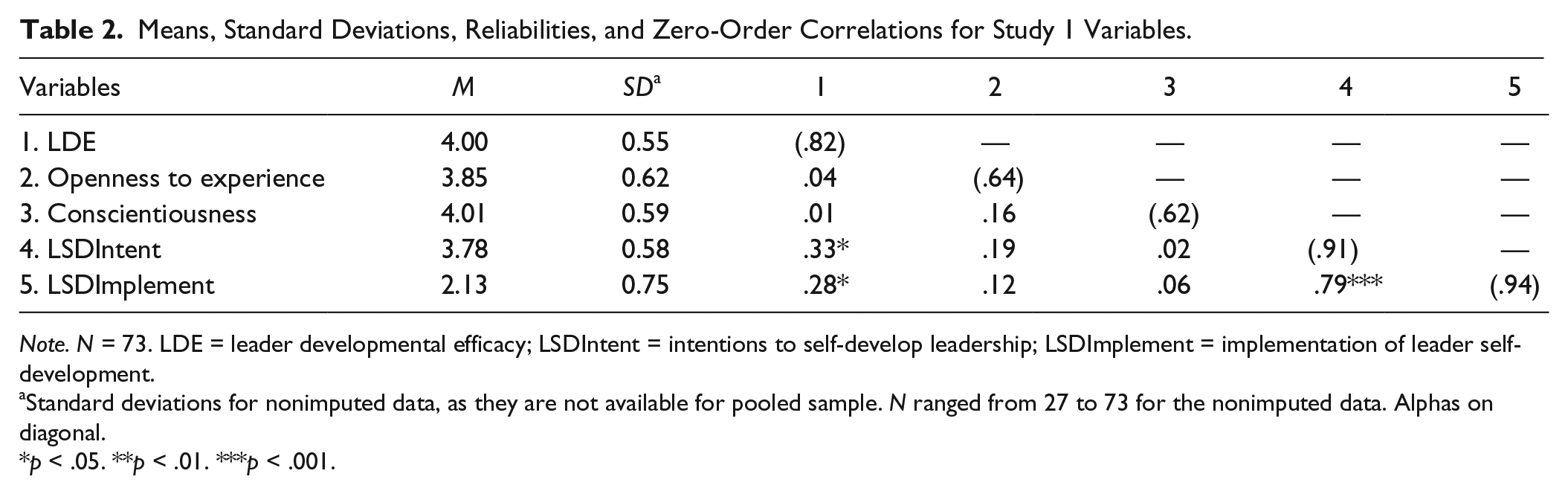
Note. N = 73. LDE = leader developmental efficacy; LSDIntent = intentions to self-develop leadership; LSDImplement = implementation of leader self-development.
Standard deviations for nonimputed data, as they are not available for pooled sample. N ranged from 27 to 73 for the nonimputed data. Alphas on diagonal.
p < .05. **p < .01. ***p < .001.
With Hypothesis 2, we predicted that intentions to engage in leader self-development activities would positively mediate the relationship between LDE and implementation of leader self-development activities. Although a bias-corrected bootstrapping approach is the most common method to test for mediation (Preacher & Hayes, 2004), this analysis is not possible using imputed data. Therefore, Hypothesis 2 was tested by following the four-step approach for evaluating simple mediation suggested by Baron and Kenny (1986), using the pooled results of imputed data sets produced by SPSS. The indirect effect was evaluated using a Monte Carlo method proposed by MacKinnon, Lockwood, and Williams (2004), for use when bootstrapping would be difficult.
We first regressed implementation of self-development activities on LDE. Results suggest that a participant’s LDE is positively associated with implementation of self-development activities (Path c: B = .39, t[71] = 2.08, p < .05). Furthermore, participant’s LDE was positively associated with intentions to engage in self-development (Path a: B = .35, t[71] = 2.56, p = .01). Last, the relationship of LDE and intentions to self-develop were assessed when both were entered into the model to predict implementation of leader development. Results indicated that participants with greater intentions to engage in self-development also reported greater actual implementation of self-development activities (Path b: B = 1.05, t[70] = 6.47, p < .001) and the relationship between LDE and implementations was nonexistent (Path c′: B = .03, t[70] = .15, ns), indicating near complete mediation. Multicollinearity was not an issue. A 95% confidence interval for the indirect effect (a * b = 0.37) was computed using Selig and Preacher’s (2008) Monte Carlo tool for assessing mediation (MCAM) based on 20,000 bootstrap samples, producing an interval above zero (0.08 to 0.69). There was no evidence that LDE influenced implementation of leader development independent of its effect on intentions to self-develop. Taken together, results support Hypothesis 2 that intentions to develop leadership positively mediate the relationship between leader developmental efficacy and the implementation of leader development.
Study 2 Method
The purpose of this study was to examine the reciprocal relationship between LDE and past leader development. Specifically, we concurrently examined present LDE and reporting of both quantity and quality of past leader self-development behaviors using a cross-sectional survey format. Quality of past leader self-development ratings were both self-reported and rater-coded.
Participants
Participants in this study were organizational leaders from nonprofit agencies in the Midwestern United States. In the current study, a “leader” was defined as any individual responsible for important organizational processes and/or the direct supervisor of other organizational members or volunteers. A preliminary list of more than 300 nonprofit organizations was identified through electronic search engines and personal contacts of the authors. In total, leaders from 94 different nonprofit organizations participated in the study by completing an electronic survey (one leader per agency). These 94 leaders ranged in age from 24 to 72 years, with an average age of 48 years. Leaders worked an average of 43 hours per week and 86% were paid employees. Overall, 65% of this sample was female and 94% of this sample was Caucasian.
Measures
Leader Developmental Efficacy
The same 5-item LDE measure from Study 1 was used in this study. These items were rated on a 7-point Likert-type scale ranging from 1 (very strongly disagree) to 7 (very strongly agree), with higher scores representing greater LDE. In the current study, the internal consistency reliability estimate for this scale was .85 and additional fit indices were adequate (see Table 1).
Intentions to Develop Leadership
We used a 20-item scale to measure intentions to develop leadership, which was similar but not identical to the measure used in Study 1. 1 Participants indicated the extent to which they were likely to engage in the leader development strategies in the next month, and response options ranged from 1 (not at all likely) to 7 (extremely likely). A sample item is, “I will force myself to face my weaknesses.” As the items demonstrated a high level of internal consistency (α = .96), items were combined to construct an intentions to develop leadership scale.
Past Leader Development Behaviors
Four items from Boyce et al. (2010) asked leaders to self-report the extent to which they had engaged in leader development behaviors during the last 3 months. These items were rated on a 5-point Likert-type scale ranging from 1 (to a very little extent) to 5 (to a very great extent), with higher scores indicating greater engagement in past leader development activities. An example item includes “During the last three months, I intentionally performed self-directed learning activities to acquire new leadership knowledge.” This scale had an internal consistency reliability estimate of .90.
Quality of Past Leader Development Activities
Three open-ended questions regarding the quality of one’s leader development activities were included to provide additional information about a leader’s engagement in developmental activities (based on Langkamer, 2008, but adapted for the current study). Question one asked leaders to list all of the leader development activities they had participated in during the last 3 months. A summary of these activities is listed in Table 3. Question two asked leaders to provide a short description (two to five sentences) of each developmental activity listed in question one. Question 3 asked participants to describe the skills that were learned through participating in these leader development activities.
Examples of Leader Development Activities Reported by Leaders in Study 2 (Only Reporting Activities With n ≥ 50).

Three raters assessed the quality of past leader development activities by coding responses to these three open-ended questions. Raters were asked to assess quality of engagement in self-development by using three types of ratings for each nonprofit leader. The first quality rating focused on the number of leader development activities the leader engaged in and was rated on a 1 (engaged in no developmental activities) to 4 (engaged in 6+ developmental activities) rating scale. The second quality rating focused on the effort put forth by the leader to engage in leader development activities and was rated on a 1 (no effort spent on developmental activities) to 4 (extensive effort spent to engage in developmental activities) rating scale. The third quality rating focused on the relevance of the leader’s engagement in developmental activities and was rated on a 1 (engaged in no developmental activities) to 4 (highly relevant, clear, direct enhancement of job/leadership skills) rating scale.
To assess initial rater agreement, ratings were made for 20 of the 94 nonprofit leaders. The intraclass correlation coefficient (ICC) was .87 (95% confidence interval [CI] = 0.72, 0.95), showing good agreement in quality ratings of leader development activities across all three raters. As such, the raters were asked to complete ratings for the remaining 74 nonprofit leaders. Because of the high intraclass correlations for Quality Rating 1 (ICC = .95, CI = .93, .96), Quality Rating 2 (ICC = .91, CI = .87, .94), and Quality Rating 3 (ICC = .91, CI = .87, .94), and high correlations between these three different ratings of quality across all raters (r = .69-.89), we averaged all three ratings to create an overall quality score for each nonprofit leader by rater (ICC of .96 with a 95% CI of 0.93, 0.97). With such high agreement across raters, a final observed quality score was calculated for each leader by averaging all three raters’ overall quality scores. This final score was used in subsequent analyses to reflect rated-quality of past leader development activity.
Two additional self-report items were used to assess the quality of a leader’s engagement in developmental activities. These items were created to provide a quantitative assessment of “quality.” The first item states, “Overall, I would rate the quality of my engagement in self-development activities over the last 3 months as ______,” and was rated on a 1 (very low quality) to 5 (very high quality) Likert-type rating scale. The second item states, “Overall, I have learned a variety of new skills by engaging in self-development activities over the last 3 months,” and was rated on a 1 (strongly disagree) to 5 (strongly agree) Likert-type rating scale. These items were averaged together to create a self-report quality rating, with higher scores representing higher quality engagement in leader development activities. This scale had an acceptable internal consistency reliability estimate (α = .80) and the two items were significantly correlated (r = .67, p < .001).
In summary, the current study included two assessments of quality of leader engagement in development: (a) rater-coded scores of quality of leader engagement and (b) leader self-report scores of quality of engagement. These two indicators of quality of past leader development were significantly correlated with one another (r = .62, p < .001).
Number of Hours Engaged in Past Leader Developmental Activities
We included an additional survey item (Langkamer, 2008) to identify the total number of hours engaged in leader self-development activities by participants over the last 3 months. This item was open-ended and participants were asked to fill in their response. This item asked, “During the last 3 months, approximately how many total hours did you spend performing leader self-development activities?” On average, study participants reported engaging in 19.85 hours (SD = 21.07) of leader development activities over the previous 3 months.
Study 2 Results
Descriptive statistics, zero-order correlations, and reliabilities for all variables measured in this study can be found in Table 4. In checking assumptions for the following procedures, we detected high kurtosis for past leader development hours (5.05) and for LDE (11.74). Past leader development hours was log transformed and successfully normalized. One LDE observation was determined to be an outlier (more than three standard deviations from the mean) and was deleted, effectively reducing kurtosis to an acceptable level (.68). Sensitivity analyses indicated that significance of the results did not change as a result of the transformation and removing this outlier, with one exception reported which we will subsequently discuss.
Means, Standard Deviations, and Zero-Order Correlations for Study 2 Variables.
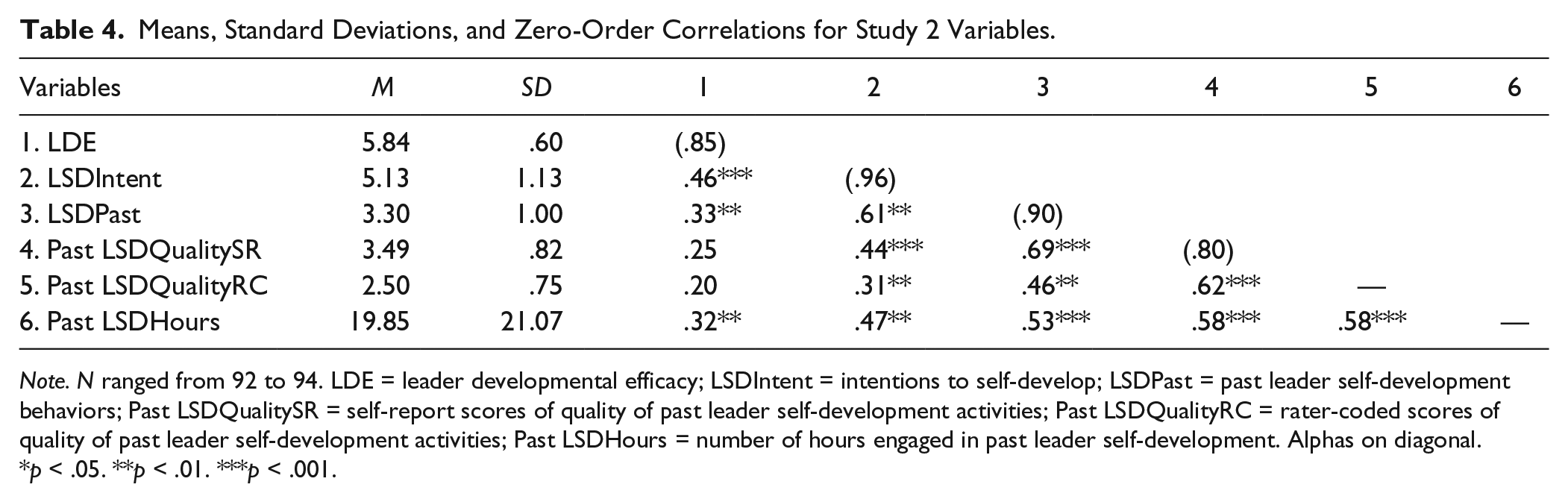
Note. N ranged from 92 to 94. LDE = leader developmental efficacy; LSDIntent = intentions to self-develop; LSDPast = past leader self-development behaviors; Past LSDQualitySR = self-report scores of quality of past leader self-development activities; Past LSDQualityRC = rater-coded scores of quality of past leader self-development activities; Past LSDHours = number of hours engaged in past leader self-development. Alphas on diagonal.
p < .05. **p < .01. ***p < .001.
As a replication of Study 1 results, we again tested Hypothesis 1 on the Study 2 sample, controlling for past leader development. Quantity and quality of past leader development were entered first to control for variance from these variables. Quantity of past leader development significantly predicted intentions (β = .59, t[88] = 5.0, p < .001), although self-reported quality (β = .00, t[88] = .01, ns) and rater-coded quality (β = .05, t[88] = .42, ns) did not. Together, these three variables accounted for 37% of the variance in intentions (R2 = .37, F[3, 88] = 17.32, p < .001). LDE was entered in the second step, and LDE significantly predicted intentions to develop beyond quantity of past leader development (β = .30, t[87] = 3.57, p < .01), explaining an additional 8% of variance (ΔR2 = .08, p = .001). Therefore, Hypothesis 1 was again supported even when controlling for past leader development.
To examine the bi-directional nature of this relationship, we used linear regression to test Hypothesis 3 that quantity (Hypothesis 3a) and quality (Hypothesis 3b) of past leader development experience would predict LDE. As shown in Table 5, quantity of past leader development behaviors positively predicted LDE (β = .33, F[1, 91] = 11.15, p = .001, R2 = .11), as did the number of hours spent engaging in past leader development activities (β = .32, F[1, 90] = 10.47, p = .002, R2 = .10). Thus, Hypothesis 3a was fully supported. These findings indicate that the quantity of past leader development predicted LDE, explaining up to 11% of the variance.
Summary of Regression Analyses From Study 2 Predicting Leader Developmental Efficacy From Past Leader Development.

Note. B represents the unstandardized regression coefficient for each regression analysis. N ranges between 91 and 92.
*p < .05. **p < .01. Self-reported quality of past leader self-development not significant with outlier included.
Similarly, with Hypothesis 3b, we expected that quality of past leader development would predict LDE. The relationship between self-report quality of leader development and LDE was significant (β = .25, F[1,90] = 6.08, p = .02, R2 = .06). However, results of a sensitivity analysis indicate this relationship was not significant when including the outlier (β = .20, F[1, 91] = 3.69, p = .06, R2 = .04). Furthermore, the relationship between rater-coded quality of leader development and LDE was not significant (β = .20, F[1, 91] = 3.74, p = .06, R2 = .04). Therefore, Hypothesis 3b received mixed support.
Study 3 Method
Study 1 showed that LDE predicted intentions to engage in leader development and implementation of leader development. Study 2 confirmed that LDE predicts intentions to develop and showed that LDE is influenced by past development experiences. A third study was undertaken to examine whether LDE influences any meaningful changes in leaders, rather than just engagement in leader development. Therefore, we examined the effects of LDE on increases in leader efficacy during a leader development program.
Participants were recruited via email and invited to receive a 4-hour leader development workshop in exchange for their participation in a research study. The workshop involved two 2-hour sessions focused on goal setting and feedback. The topics of goal setting and feedback were chosen because they are essential to leader performance. Goal setting interventions (Locke, 1968) have proven to have among the largest effects on organizational performance outcomes, and feedback significantly enhances goal setting effects (Neubert, 1998). The workshops used a variety of instructional techniques including lecture, interactive programming, and role plays.
The two sessions were held 1 week apart and participants were given homework to complete between the two sessions. Seven separate 2-week workshops were conducted, with an average of about nine members per workshop. All sessions were delivered by two of the authors of this study. Because it was part of a controlled study, the utmost effort was given to remaining consistent across training sessions. Indeed, there were no differences between the instructors or between sessions on any of the study variables (all ps > .05).
Participants
Participants consisted of 49 organizational leaders from nonprofit organizations in the Midwestern United States. The majority of the participants were women (n = 41), and the majority were White (n = 45). Most participants indicated that they were in the age bracket of 18 to 30 years (n = 19), although nine indicated 31 to 40 years, 12 indicated 41 to 50 years, and 5 individuals were above 51 years. Four participants failed to indicate their ages. Although the workshop was intended for top-level leaders, no restrictions were made as to who could attend. Job titles of the participants ranged from executive director and director of operations to program coordinator and volunteer coordinator of a nonprofit organization. Of the 62 leaders who initially participated in the program, one missed the survey portion on the first day, reducing the total sample to 61. Twelve of these participants did not attend the second day.
Measures
Using a quasi-longitudinal design, Time 1 leader efficacy and leader developmental efficacy were measured before the start of the first session and Time 2 leader efficacy was measured at the conclusion of the second session.
Leader Developmental Efficacy
We used the same 5-item measure of LDE used in Studies 1 and 2. Participants responded on a 7-point agreement scale ranging from 1 (very strongly disagree) to 7 (very strongly agree). The scale demonstrated strong reliability (α = .86) and, thus, was aggregated into an overall scale score. Other scale fit statistics were acceptable (see Table 1).
Leader Efficacy
Leader efficacy was measured using Murphy’s (1992) leadership self-efficacy scale, which assesses confidence in one’s ability to lead a group. This eight-item measure has response anchors ranging from 1 (very strongly disagree) to 7 (very strongly agree). Example items include, “I know how to encourage good work group performance” and “Overall, I believe that I can lead a work group successfully.” Reliability of the eight items was strong (Time 1 α = .90, Time 2 α = .81); therefore, the items were aggregated to reflect an overall indicator of leader efficacy (Time 1 M = 4.84, SD = 0.82; Time 2 M = 5.22, SD = 0.54).
Study 3 Results
Means, standard deviations, correlations, and reliabilities were analyzed for all study variables (see Table 6). Two outliers (greater than 3 standard deviations from the mean) were detected in the LDE distribution. Results are presented for analyses with and without outliers.
Means, Standard Deviations, Reliabilities, and Zero-Order Correlations for Study 3 Variables.
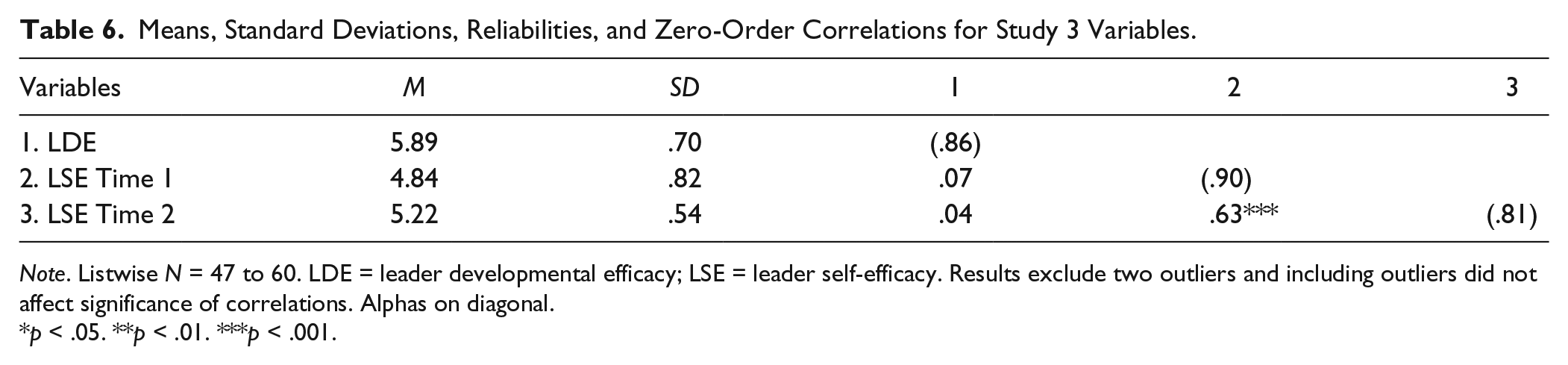
Note. Listwise N = 47 to 60. LDE = leader developmental efficacy; LSE = leader self-efficacy. Results exclude two outliers and including outliers did not affect significance of correlations. Alphas on diagonal.
p < .05. **p < .01. ***p < .001.
Hypothesis 4 stated that LDE would be positively related to increases in leader efficacy during leader development. To test Hypothesis 4 and to analyze the effects of LDE on change in leader efficacy over the course, we conducted multilevel growth modeling techniques recommended by Bliese and Ployhart (2002) using SPSS 20. First, we estimated a model of growth in leader efficacy over time. As multilevel modeling can handle missing data, unequal sample sizes (Time 1 N = 61, Time 2 N = 49) are not a problem (Tabachnick & Fidell, 2012). The two-level model consisted of pre- and postintervention measures (k = 2) of leader efficacy, nested under 61 participants (N = 61). Prior to analysis, time was centered at 0 (pre = 0, post = 1). Model parameters were estimated using maximum likelihood estimation, p values of fixed effects were examined for significance, model fit was evaluated by −2 log likelihoods (−2LL), and model comparisons were made using chi-square difference test (−2ΔLL; Bliese & Ployhart, 2002).
Prior to modeling change in leader efficacy, we estimated a null model (Model 1) with no predictors to derive an ICC. The ICC was .51, which is high enough to justify using multilevel modeling and indicates that 51% of variance in leader self-efficacy can be attributed to between person differences. Next we estimated a random intercepts, fixed slope model (Model 2) by adding time as a predictor of leader efficacy. The addition of time significantly improved model fit over model 1 (χ2[1] = 14.01, p < .001). Results indicate that leader efficacy increased significantly following the intervention (B = .35, SE = .09, t = 3.97, p < .001). This model suggests that leaders began at different levels of leader efficacy (M = 4.85, SD = 0.55) and are expected to increase on average by .35.
Next, in order to directly test Hypothesis 4, LDE was centered at 0, and the interaction term of time and centered LDE was added to the model (Model 3). Model 3 demonstrated significant improvement over Model 2 (χ2[2] = 11.07, p < .01). Providing mixed support for Hypothesis 4, results indicate that LDE significantly predicted differential gains in leader efficacy when the outliers were included (B = −.20, SE = .09, t = −2.28, p < .05), but not when outliers were removed (B = −.08, SE = .12, t = −.64, p = ns). As shown in Figure 2, results indicate that leaders who began at lower levels of LDE increased in confidence more than leaders who began at higher levels of LDE.
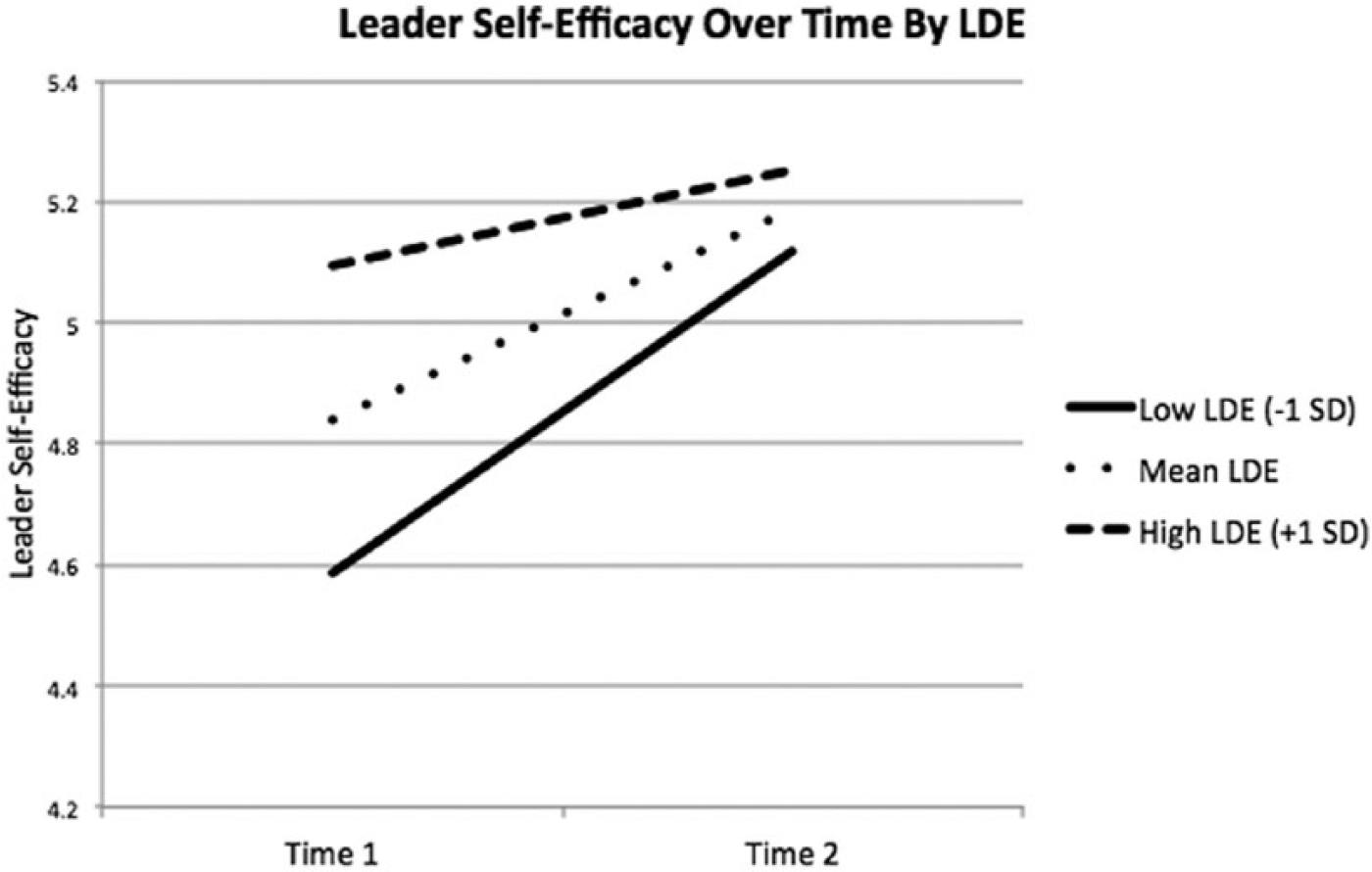
Graph of interaction between LDE and time predicting leader self-efficacy.
Discussion
Ongoing leader development, combined with succession planning, is increasingly important to ensure that organizations are able to fill the gaps left by retiring baby boomers (Barker, 2007). To build their leadership pipeline, many organizations are strategically training high-potential leaders (Conger & Fulmer, 2003). However, even if planning committees accurately identify high potential leaders, some of these high potentials inevitably fail to develop (Morris & Rogers, 2013), resulting in a poor return on leadership development investment (Avolio et al., 2010). The paradox of derailment is that some leaders demonstrate early career success and are expected to excel, but the potential never materializes into the next level of leadership performance (Lombardo, Ruderman, & McCauley, 1988). This suggests that leader development requires more than pure potential; successful development also demands the motivation and ability to apply that potential through ongoing learning—or developmental readiness. Collins and Holton (2004) argued for providing the “right leaders” developmental opportunities. We extend that argument and assert that providing the ready leaders the right developmental opportunities can enhance the effectiveness of such costly interventions.
Theorists have argued for the importance of LDE as an aspect of readiness for leader development that should predict one’s engagement in leader development activities (Hannah & Avolio, 2010). As such, developmental readiness, or “both the ability and motivation to attend to, make meaning of, and appropriate new knowledge into one’s long-term memory structures” (Hannah & Lester, 2009, p. 37) should be influential in predicting engagement and success in leader development. As a multidimensional higher-order construct, developmental readiness consists of both the motivation (interests and goals, learning goal orientation, and leader developmental efficacy) and the ability (self-awareness, leader complexity, and meta-cognitive ability) to develop (Hannah & Avolio, 2010). Of its components, all have been previously studied empirically except for leader developmental efficacy. Although there is prior empirical research related to all the other theorized developmental readiness constructs, this is the first empirical examination of leader developmental efficacy. Therefore, the purpose of this article was to theoretically situate LDE and empirically assess the predictive power of LDE in terms of engagement in leader self-development.
Efficacy has been conceptualized along a range of specificity from generalized to domain-specific to task-specific. We chose the middle ground of domain-specificity LDE for a number of reasons. First, generalized measures are less predictive than domain- or task-specific efficacy measures (Elias et al., 2013). Second, although a domain-specific measure of leader efficacy exists, LDE targets leader development. Thus, LDE should theoretically be an effective predictor of leader development outcomes, such as gains in leader efficacy, which we, in fact, found in Study 3.
However, future researchers may seek to examine a task-specific measure of LDE akin to the task-specificity of Hannah et al.’s (2008) measure of agentic leader efficacy. This would entail assessing confidence in specific types of developmental experiences like mentoring, taking classes, challenging assignments, and so on, as these would likely be better predictors of specific developmental activities and tasks. Practitioners may also use this strategy if they know the specific leader development “tasks” expected of high-potentials entering a development program, by assessing task-specific LDE prior to commencement of the program and boosting LDE where needed. Despite this, there is value in the domain-specific approach to LDE we used in the current studies because this approach can be applied more broadly regardless of the specific developmental activities in which one may engage. In this way, domain-specific LDE is more predictive than generalized efficacy yet more flexible and practical to use than task-specific efficacy.
With this in mind, our first goal in empirically examining the role of LDE in leader development was to test whether this construct predicts leaders’ intentions and, ultimately, implementation of leader development. In two independent samples of leaders in Studies 1 and 2, we found support for the predictive validity of LDE on intentions to develop. The strength of this finding is enhanced by demonstrating that LDE predicted intentions to develop (Study 1) beyond past leader development (Study 2). These findings align with the theory of planned behavior in that intentions to behave predict subsequent behavior (Ajzen, 1991). In fact, in Study 1, we found support for the mediating role of intentions to develop between LDE and actual implementation of leader development. Further strengthening the mediation findings and reducing common method bias is the separation of each measure by several weeks. This study design and associated findings are highly relevant to a leader self-development context because of the required forethought, goal-setting, and self-regulation needed to successfully develop leadership skills (Boyce et al., 2010) and sustain them over time. Thus, a main contribution of this article is theoretically and empirically establishing LDE as an important individual difference when it comes to leader developmental readiness and engagement and implementation of leader development behaviors.
Our second goal was to examine LDE as an outcome of past leader development. In their meta-analysis, Sitzmann and Yeo (2013) found that past performance has a stronger effect on self-efficacy than self-efficacy has on performance. Supporting a reciprocal relationship, self-reported frequency of past self-development and the number of hours spent engaging in past development did predict current LDE. However, we did not find this trend with regard to the quality of past leader self-development—particularly expert-coded—with current LDE. Perhaps, LDE is most affected by how much time and effort a leader “thinks” they have spent on past development as opposed to how effective those past strategies actually were at developing their leadership. This aligns with the idea of efficacy as a perception of ability as opposed to an objective assessment of that ability (Bandura, 1997).
Our final goal was to test whether LDE predicts “success” in leader development rather than just engagement in development. We examined the interrelationship between LDE and the similar, but distinct, construct of leader efficacy. We argued and found mixed support for LDE predicting gains in leader efficacy over the course of a leader development program, depending on how one interprets the presence of two low-scoring outliers. On one hand, if because of their extremity the two outliers are considered to be from a wholly different population as compared with the rest of the sample and thus removed from the analysis, then we observed no support for the relationship between LDE and gains in leader efficacy in Study 3. However, on the other hand, it may be feasible to consider these two lower-scoring outliers as representative of the same sample population. It is reasonable to assume that some individuals will possess lower LDE. Taking this approach suggests that not only is LDE malleable, but that those who are lacking in LDE can eventually catch up to those with high levels of LDE. Leaders who are not confident in their ability to develop may end up benefitting the most from leadership programs that boost their confidence. This finding is important because leader efficacy has been shown to positively predict leadership performance (Chemers, Watson, & May, 2000; Lester et al., 2011).
It is important to note that gains in leader efficacy do not necessarily indicate gains in leadership ability. Some leaders may feel more capable without gaining any demonstrable capabilities. For example, narcissists’ self-perceptions of their leadership tend to be higher than and sometimes divergent from others’ perceptions (Judge, LePine, & Rich, 2006). Nonetheless, considering the central claim of self-efficacy theory (Bandura, 1997), that efficacy drives performance, this result suggests that managers who feel more confident in their ability to lead may perform better in their leadership roles. Thus, LDE fosters not only development behavior, but also may strengthen a key antecedent to leadership as well.
Strengths, Limitations, and Future Research
Despite its limitations, the strengths of this research make several contributions to the literature on leader development. First is the external validity of this research. All three study samples were based on working leaders. Moreover, two of the studies were conducted within the explicit context of leader development initiatives (Study 1: assessment center; Study 3: training program). Although such applied research comes with inherent methodological weaknesses like small samples sizes and missing data, the generalizability of the research is enhanced. To address low power in Study 1, we used multiple imputation of missing data, the recommended method despite some controversy (Enders, 2010). Future research should seek to replicate these findings on larger samples of leaders.
Another methodological limitation is the utilization of cross-sectional, self-report survey data, which is subject to common method bias (Podsakoff, MacKenzie, Lee, & Podsakoff, 2003). In Study 1, survey data collection on predictors (i.e., LDE and personality) was completed 1.5 to 2.5 months prior to the collection of the outcome variables, reducing the threat of common method bias from mood states and temporal measurement context effects. In Study 2, we addressed the threat to common method bias posed by social desirability by using external raters to judge the quality of leader development reported by responding leaders. Finally, in Study 3, although Time 1 data of LDE and leader efficacy were collected together, leader efficacy at Time 2 occurred 2 weeks later at the conclusion of a leader development program. Separating measurement time points reduces mood effects and time-based measurement context effects (Podsakoff et al., 2003). Although separated by time, all data collected in Studies 1 and 3 were self-reported.
In addition to separating measurements in time as we did, future researchers should strive to longitudinally examine the role of LDE on success in leader development using multiple sources of outcome data, such as supervisor reports or company records. Ideally, organizations would add this short 5-item LDE measure (and perhaps a leader efficacy measure) to their battery of assessments of high potential employees, select as normal, and later examine success–failure rates in relation to LDE. This type of longitudinal predictive study would allow an examination of the practical value of LDE and allow researchers to tease apart the interrelationships between and the unique effects of LDE and leader efficacy.
Future research should also seek to examine the interaction of LDE with other leader developmental readiness indicators, such as learning goal orientation, self-regulation, and self-complexity. Beliefs about whether leaders are born or made, which could be operationalized in terms of goal orientation, should be taken into account in future research. Confidence in ability to develop as a leader is likely to be a function of general mindsets and implicit theories of leadership as well as more personalized beliefs about one’s own self. To the extent that leaders possess high LDE and a learning goal orientation, they will likely engage in more self-development activities.
Finally, although not examined here, the role of organizational context should be considered as an important moderator of any relationship between various individual differences and development behavior. Supportive manager behaviors, environments with sufficient psychological safety to withstand mistakes, and employee development as a strategic priority will all likely play a role in the implementation of leader self-development behaviors. Future research could test the moderating influence of a learning culture (Marsick & Watkins, 2003) on intentions and implementation of leader self-development. If individuals are extremely motivated to develop, but the wider culture does not emphasize inquiry and feedback or lacks structures to retain shared knowledge, leader self-development could remain limited (Reichard & Johnson, 2011). Based on the theory of planned behavior (Ajzen, 1985, 1991), work environments that foster positive attitudes about personal growth, have strong developmental norms, and give leaders greater control over their development should increase intentions to engage in leader self-development.
Practical Implications and Conclusion
One practical implication of this article is the possibility to use LDE to identify individuals who not only possess the potential to perform in leadership roles, but also possess the potential (i.e., the motivation and ability) to develop. Furthermore, because LDE is malleable, inexpensive interventions can be provided to leaders to increase LDE prior to a costlier and lengthy leader development program. Similar to developing other forms of efficacy (Bandura, 1997), LDE can be enhanced through mastery experiences (e.g., recognizing past successes at development), vicarious learning (e.g., observing similar others succeed at leader development), and verbal persuasion (e.g., encouragement from one’s manager that development is possible). By developing LDE, our research suggests that leaders will be more likely to hold strong goal intentions for development; however, a leader’s intentions to develop only take him or her so far. Translating intentions into actual leader development behavior may require organizational support and resources.
The barriers to successful leader development are plentiful in a modern manager’s busy life. Time constraints limit hours available for formal classroom training, budget limitations shrink opportunities to rely on expensive coaches or software, and incongruous mental demands and individual capabilities make it difficult to synthesize and make meaning out of experience (Kegan, 1995). According to the theory of planned behavior, perceived control (i.e., efficacy) is particularly useful in accounting for behavior to the extent that individuals lack complete control (Ajzen, 1985, 1991). When some aspects of the situation are out of the leaders’ hands they must assess their confidence when deciding what to do.
Nonetheless, leaders must continue to develop in order to tackle the complex problems facing their organizations. Highly efficacious leaders see these real-world obstacles, yet still find the motivation and resources to push themselves into learning opportunities that will expand their leadership capacity because they believe that their effort will pay off. They schedule time, find cost-effective experiential activities to develop, and generally adapt their environment to fit their needs so that they can achieve development goals. Efficacious leaders turn their confidence and their ability to develop into the effort, persistence, and strategies that foster successful leader development.
Based on the theory of planned behavior (Ajzen, 1985, 1991), to the extent that leaders perceive available resources will give them more control over the development process, they may intend to and ultimately implement more development activities. To boost the effect between intentions to develop and implementation of leader development, Reichard and Johnson (2011) argued that translating motivation, or intentions, to develop into actual leader self-development behavior requires resources and support. Resources that foster greater control and higher LDE could include assessments to decrease leaders’ blind spots, flexibility in selecting training opportunities, and supportive back-up behaviors from coworkers to encourage creativity that may lead to personal leadership transformations. Reichard and Johnson (2011) suggest the organization provide leaders resources such as an information-rich technology platform, the support of direct supervisors through individualized consideration and identification of stretch opportunities, and the access to professional networks to aid in meaning making, accountability, and opportunities to experiment with leader development strategies. Available resources may give leaders the confidence to challenge and stretch themselves in new directions rather than feeling locked into habitual patterns of behavior.
Finally, LDE may be considered a viable evaluation outcome of leader self-development programs. As we found in Study 2, quantity of past self-development relates positively to LDE, and depending how one interprets the presence of an outlier in that study, self-reported quality of leader self-development may also relate positively to LDE. Selecting which outcomes to measure is one of many key considerations in designing a leader development evaluation, and the decision process is influenced both by the clarity of program objectives and the availability of valid measures (Craig & Hannum, 2007). This article has served both those needs by analyzing the merits of a potential program objective (LDE) and presenting a way to measure it. LDE may be especially appropriate as a criterion variable for interventions that focus on developmental readiness.
In conclusion, one’s belief in his or her ability to develop leadership skills, or LDE, is an important precursor and outcome of leader self-development. As leader development shifts toward informal, continuous, and self-directed learning, understanding the personal attributes that encourage leaders to take an active role in their development will be crucial. No longer can organizations rely on a few formal programs to teach leaders all they need to know. Instead, complex and constantly changing organizations need leaders who not only care about development, but are confident in their ability to develop. As this series of studies demonstrates, selecting leaders with the efficacy and further fostering this capability in them through mastery experiences, vicarious learning, and verbal persuasion can unlock ongoing development behavior.
In order to accurately identify and prepare developmentally ready leaders, empirical research is needed to examine the predictive validity of theoretically important constructs. In presenting the first empirical studies of LDE, we have taken the initial step toward testing the role of LDE in shaping leaders’ developmental pathways. Results show that LDE is an important individual difference variable when it comes to engagement and success in leader development. Further investigation is needed to build on these initial findings and generate a more complete picture of how LDE functions as a developmental readiness indicator.
Footnotes
Appendix
Leader Developmental Efficacy Items.

| 1. I am confident that I can achieve the levels of leadership ability to which I aspire. a |
| 2. I am certain I can perform new leadership approaches well. b |
| 3. I believe that I could become an exemplary leader. a |
| 4. I am able to learn new leadership approaches quickly. b |
| 5. I am confident that I will benefit from the leadership development I receive in my organization. a |
Items adapted from Army Research Institute study. bItems adapted from Potosky and Ramakrishna (2002).
Declaration of Conflicting Interests
The author(s) declared no potential conflicts of interest with respect to the research, authorship, and/or publication of this article.
Funding
The author(s) disclosed receipt of the following financial support for the research, authorship, and/or publication of this article: Study 1 was funded through a grant received from the Kravis Institute and the Blais Foundation from the Claremont Colleges.