




Abstract
Organizational change has become complex and challenging, and employee attitudes and beliefs toward change are even more important. This article proposes a theoretical framework on how authentic leadership may influence followers’ change-oriented attitudes, beliefs, and behaviors through follower psychological resources including hope, trust, optimism, self-efficacy, and resilience, which influence readiness for change and change implementation. We maintain that an authentic leader’s behavior can influence his or her followers’ change-oriented behaviors in participation in decision-making processes and change initiatives, organization citizenship behavior, organizational learning processes, and forming coalition for change. We developed propositions for further empirical investigation.
Keywords
Introduction
In today’s business environment, many change programs are considered complex in that they are continuous, long-term, unplanned, radical, emergent, iterative, and require learning during change processes (Buchanan et al., 2003; Edmondson, Haas, Macomber, & Zuzul, 2015; Huy, 1999; Sackmann, Eggenhofer-Rehart, & Friesl, 2009). Some have emphasized the complexity of change in terms of continuous development, learning, and innovation rather short-term planned change (Edmondson et al., 2015; Sackmann et al., 2009). Unlike planned change that is based on predefined steps, known benchmarks, and a top-down and centralized leadership approach, emergent change is novel and includes much uncertainty (Edmondson et al., 2015). From this perspective, understanding the role of leadership in such complex change is critical (Herold, Fedor, Caldwell, & Liu, 2008).
Leadership is important to the success of organizational change (Herold et al., 2008); however, the question of “What leadership behaviors tend to be associated with effective change management?” is still pertinent which needs further theoretical and empirical studies (Battilana, Gilmartin, Sengul, Pache, & Alexander, 2010; Herold et al., 2008). Herold et al. (2008) categorized leadership theories into two literatures of (a) broad leadership styles (e.g., transformational leadership) and (b) organizational change leadership behaviors (e.g., create a sense of urgency, provide advanced notice, provide support; e.g., Armenakis & Bedeian, 1999; Armenakis & Harris, 2009; Armenakis, Harris, & Mossholder, 1993; Edmondson et al., 2015; Jack Walker, Armenakis, & Bernerth, 2007; Kotter, 1996; Oreg, Vakola, & Armenakis, 2011; Rafferty, Jimmieson, & Armenakis, 2013), and suggested providing broader theoretical perspectives for future research in order to link these two literatures. These authors argued, “ . . . organizational change studies have examined leader behaviors during specific change implementations yet have failed to link these to broader leadership theories” (Herold et al., 2008, p. 346).
This article proposes that authentic leadership (Avolio, Luthans, & Walumbwa, 2004; Gardner, Cogliser, Davis, & Dickens, 2011; Gardner & Schermerhorn, 2004; Luthans & Avolio, 2003) has potentials to contribute to the effectiveness of change processes in organizations, especially for complex change, in several ways. According to Avolio, Gardner, Walumbwa, Luthans, and May (2004), authentic leaders “have achieved high levels of authenticity in that they know who they are, what they believe and value, and they act upon those values and beliefs while transparently interacting with others” (p. 802). We propose that authentic leadership activates several motivational and learning mechanisms in followers during the change process, which facilitate the effective implementation of change. In addition, authentic leadership can augment the impacts of change-oriented leadership behaviors in change processes identified in the literature (e.g., Walker, Armenakis, & Bernerth, 2007; Battilana et al., 2010; Kotter, 1996; Rafferty et al., 2013). More specifically, this article proposes that authentic leadership can affect followers’ important and popular attitudes and beliefs about change namely cynicism about change (Bommer, Rich, & Rubin, 2005; Dean, Brandes, & Dharwadkar, 1998; Reichers, Wanous, & Austin, 1997; Stanley, Meyer, & Topolnytsky, 2005), commitment to change (Herscovitch & Meyer, 2002), and readiness for change (Armenakis & Bedeian, 1999; Armenakis, Harris, & Mossholder, 1993; Edmondson et al., 2015; Oreg et al., 2011) through building followers’ psychological capacities (Luthans & Avolio, 2003; Luthans, Avolio, Avey, & Norman, 2007). According to Luthans and Avolio (2003), psychological capacities refer to followers’ self-efficacy, resilience, hope, and optimism. Complex change requires high levels of commitment, hope, confidence, and resiliency among those who lead and support complex change, because the complex change process may encounter obstacles.
Theoretical Background and Proposed Framework
Authentic Leadership
Authenticity has been an important subject in modern psychology considering its impacts on human well-being and interpersonal relationships (Avolio & Gardner, 2005; Luthans & Avolio, 2003; Wood, Linley, Maltby, Baliousis, & Joseph, 2008). It has been defined as the extent to which an individual is true to oneself by emphasizing core values, and acts accordingly (Luthans & Avolio, 2003; Wood et al., 2008). Individuals are never entirely authentic or inauthentic because the true self is not a stable phenomenon (Avolio & Gardner, 2005; Ladkin & Spiller, 2013). Authenticity is the outcome of some dynamic regulation mechanisms (Avolio & Gardner, 2005). As Schmid (2005) mentioned,
a man or woman is authentic if they maintain this balance in the process of realizing their own values and needs, their individuality and uniqueness, while at the same time living together with others and the world, meeting the needs and challenges of these relationships in interdependence and solidarity. (p. 75)
Authentic leadership has become an important topic in leadership studies (Gardner et al., 2011), considering its potential for explaining leaders’ impacts on human interactions in organizational settings (May, Chan, Hodges, & Avolio, 2003). Consistent with the notion of authenticity described above, an authentic leader knows himself or herself in terms of thoughts and emotions, and develops transparent relationships with followers. In addition, an authentic leader has a considerable awareness of his or her personal judgments and biases that enable the leader to have control of his or her thoughts and emotions (Gardner et al., 2011). Authentic leaders do not copy other’s behaviors while interacting and learning from others, but act based on their internal values. In addition, authentic leadership has not been proposed as a leadership style, but as a characteristic that underlies many leadership styles, hence a leader’s style may be authentic or not to some degree (Shamir & Eilam, 2005).
In addition, authentic leadership can have an augmenting effect for other types of leadership such as transformational leadership (Avolio & Gardner, 2005) and change-oriented leadership behaviors (Herold et al., 2008). As Edmondson et al. (2015) suggested, leading emergent change requires three groups of leadership behaviors: articulating a vision, inviting participation, and encouraging experimentation. The augmenting impacts of authentic leadership on these behaviors are also discussed in the next sections of this article.
Despite the existence of several conceptualizations and modeling, there seems to be a degree of consensus on some aspects of authentic leadership (Gardner et al., 2011) such as being true to oneself and guided by and acting consistently with one’s internalized values and beliefs. Walumbwa, Avolio, Gardner, Wernsing, and Peterson (2008) suggested that common dimensions among several conceptualizations can be proposed for authentic leaders such as self-awareness, internalized moral perspective, balanced processing, and relational transparency. Self-awareness refers to a deep understanding of one’s internal values, thoughts, emotions, and beliefs. Internalized moral perspective demonstrates a leader’s integrity in guiding his or her behaviors and actions based on his or her values and true beliefs. Preventing personal bias and considering diverse perspectives in decision making result from balanced processing. Relational transparency is demonstrated in open conversation along with integrity in interactions. Diddams and Chang (2012) argued that while the above dimensions may be beneficial for an authentic leader in relation to his or her strengths and positive attributes, there may be concerns about reliance on positive attributes. For example, reliance on strengths may endanger authenticity by increasing self-pride. These authors suggested emphasizing negative attributes and weakness of self in understanding the four dimensions described above in the development of authenticity. From this perspective, authenticity may help leading a change by encouraging change leaders and followers interact openly to acquire necessary knowledge that they may not know but is necessary for implementing change. In addition, self-awareness of weaknesses and lack of knowledge may foster dialogue for acquiring new ideas and challenging old assumptions essential for change processes (Mazutis & Slawinski, 2008; Schein, 1993).
While emphasizing the important role of authentic leaders, authentic leadership is a relational phenomenon, and is dynamically developed in relation to the interaction between leader, follower, and context (Avolio & Gardner, 2005), and extends beyond the actions of only a single leader (Ladkin & Spiller, 2013). In other words, the interaction between an authentic leader and followers forms the authentic leadership process. From this perspective, in order to understand the impacts of authentic leadership on change processes, it is vital to elaborate the roles of both authentic change leaders and followers.
Although there is some agreement about the broad definition of authentic leadership, there is dissimilarity in terms of the extent to which morality is included in the nature of authentic leadership (Gardner et al., 2011). While some researchers such as Bass and Steidlmeier (1999) and Avolio and Gardner (2005) emphasize that morality is a key component of authentic leadership, Shamir and Eilam (2005) avoid considering morality as a component of authentic leadership. In this article, morality is considered an important component of authentic leadership, as the foundations of this theory is greatly interrelated to other ethical theories (Gardner et al., 2011). This distinction is important for the implications of authentic leadership in change contexts, as the morality consideration may resolve some pitfalls of pseudotransformation leadership in change programs.
Attempts to link charismatic and transformational leadership to effective change implementation have produced mixed discussions (Herold et al., 2008; Levay, 2010; Nadler & Tushman, 1990; Wu, Neubert, & Yi, 2007). In particular, it is possible that charismatic leadership may facilitate and/or present major risks for change programs. Nadler and Tushman (1990) proposed that charismatic leadership is important when leading strategic change. In particular, charismatic leaders are expected to mobilize and sustain activities during such change. However, they suggested that despite the vital role of charismatic leaders in large-scale change and development in organizations, some pitfalls may endanger organizations in general, and in change projects specifically. For example, it has been suggested that too much emphasis on the individual role of a charismatic leader may hinder the developmental process of other followers during change processes and their active role in such processes (Edmondson et al., 2015; Nadler & Tushman, 1990). In addition, followers may become reluctant to disagree with the leader given his or her personal influence on followers. This can be a pitfall for complex change, which requires great participation of organizational members as well as a learning environment (Edmondson et al., 2015). It has also been suggested that followers may become angry or frustrated when they realize that the change vision created by their charismatic leader may not be feasible, which leads them to feel betrayed and become cynical. Because of these risks, Nadler and Tushman (1990) proposed that researchers and practitioners must go beyond charismatic leadership.
Bass and Steidlmeier (1999) argued that transformational leadership, which encompasses charismatic leadership, has been sharply questioned in terms of morality. In the context of change, some pseudotransformational leaders may support change processes, but may be perceived as unethical leaders because of their egocentric decisions. For example, a change leader may hide some evidence of failure during change processes to prevent losing his or her credibility and idealized influence on followers. This may cause cynicism about change and a decline in followers’ commitment to change. Bass and Steidlmeier (1999) proposed that transformational leaders must also be authentic to overcome the morality issues of pseudotransformational leadership, which is based on self-interest, deception, and false promises (Turner, 2008). The authentic leadership theory may respond to the issues presented by pseudotransformational leaders, including distrust of managers, reluctance of leaders to listen to followers’ disagreement, and lack of commitment toward organizational goals.
Another potential for authentic leadership theory in relation to change contexts is considering the influence of authentic leadership on followers’ positive emotions and affective processes. It has been suggested that further theoretical and empirical research is required to include positive affection in studies of readiness for change and into change processes (Holt, Armenakis, Feild, & Harris, 2007) as well as affective processes underlying authentic leader–follower relationships (Gardner et al., 2011).
An additional important contribution of this article to the change literature is related to another major question in the change literature asking “How can organizations develop a context for complex change?” when change cannot be managed by predefined blueprints which are typical in planned change (Edmondson et al., 2015). It is suggested here that authentic leadership provides a situation in which followers can be committed to change and become hopeful and optimistic toward it, which is essential for complex change when several failures or challenges may occur during change processes. It is also proposed here that authentic leadership may link the change vision and objectives to internalized values of followers in a way that guides followers’ behaviors until the completion of change projects. This seems to be consistent with some recent research ideas proposed by Burnes and Jackson (2011) describing that value system alignment between the value system of the change intervention and of those organizational members undergoing the change is a critical issue for the success of change initiatives. In addition, even when a failure occurs, psychological capacities (hope, optimism, self-efficacy, and resilience) of followers developed in authentic leadership may help them focus on change processes until completion. From this perspective, this article suggests that authentic leaders can help organizations in leading complex organizational change.
The Role of Authentic Leadership and Psychological Capacities in Follower Change-Oriented Attitudes, Beliefs, and Behaviors
We draw on extant theory and research to explain the mechanisms by which authentic leaders influence follower psychological capacities that underpin effective change. Figure 1 demonstrates our broad framework considering the model proposed by Avolio, Gardner et al. (2004). The framework proposes that authentic change leaders influence their followers through personal and social identification during change processes. They may be considered a change role model or may shape a collective environment for change in which followers identify themselves with the values and collective meanings developed within that environment. More specifically, the new framework proposed here suggests that hope, resilience, optimism, and self-efficacy are psychological capacities that followers develop under the influence of their authentic change leader. Further to this, followers’ trust in the leader derived from identification mechanisms may influence followers’ work attitudes and beliefs at the beginning and/or during change processes. These attitudes may affect organizational members’ change-oriented behaviors in some change processes.
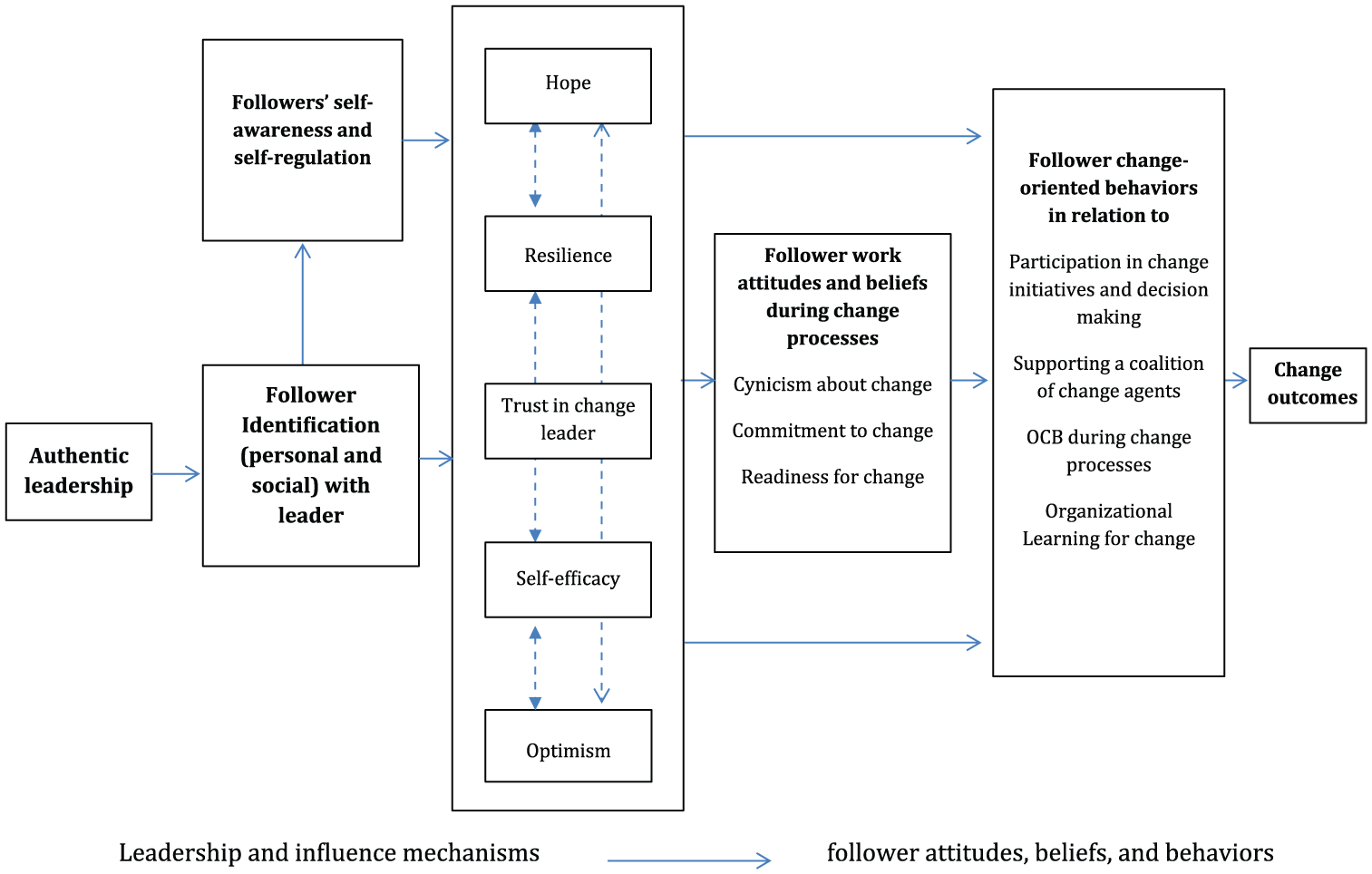
Proposed framework on the role of authentic leadership in organizational change.
Some assumptions must be acknowledged before introducing this framework. First, there is an assumption in this article that change leaders must combine authentic leadership behaviors with other change-related leadership behaviors (Herold et al., 2008). For example, change leaders may be expected to create a sense of urgency and increase readiness for change or encourage some followers to act as change agents and develop a coalition for supporting the change (Armenakis & Bedeian, 1999; Armenakis et al., 1993; Edmondson et al., 2015; R. Gill, 2002; Herscovitch & Meyer, 2002; Kotter, 1996; Rafferty et al., 2013; Oreg et al., 2011), but it is proposed that they are also required to act authentically to promote positive employee responses to complex change. This framework proposes that authentic leadership augments other leadership behaviors in influencing change processes and outcomes. For example, as discussed earlier, charismatic leadership may have a negative impact on follower cynicism to change but the addition of authentic leadership may increase the positive influence of charismatic leadership in change processes through some psychological mechanisms. This perspective is also considered in the development of some arguments and propositions in the next section. Second, constructs proposed within the framework may be multidimensional. Therefore, the dimensions of these constructs are used in the development of arguments and propositions elaborated in the next section, but are not demonstrated within the framework for the sake of simplicity. For example, readiness for change at the individual level may include a follower’s sense of discrepancy (urgency) to become involved in change processes, self-efficacy for participating in change, or positive affective states regarding change initiatives.
Because followers personally identify themselves with their leader and socially identify with their authentic leader’s group, authentic leaders can transfer their psychological capacities of hope, optimism, resiliency, and self-efficacy (Luthans & Avolio, 2003; Luthans et al., 2007) to their followers. According to this literature, authentic leaders possess psychological capacities of hope, optimism, resilience, and self-efficacy, which we propose facilitate the effective implementation of complex change. Hope is defined as “positive motivational state that is based on an interactively derived sense of successful: (1) agency (goal-directed energy) and (2) pathways (planning to meet goals)” (Snyder, Irving, & Anderson, 1991, p. 287). Hope is necessary during complex change processes because uncertainties and failures which may occur during such change. Seligman (1998) defined optimism as a cognitive process containing positive outcome expectancies and causal attributions that are external, temporary, and specific in interpreting bad or negative events and internal, stable, and global for good or positive events. Optimistic individuals tend to demonstrate higher levels of work motivation, performance, job satisfaction and morale, and persevere when facing difficulties. In addition, optimists analyze personal failures as temporary and experience both physical and mental invigoration (Seligman, 1998). From this perspective, optimism is arguably necessary for complex change to motivate organizational members toward completion of change objectives, which are specifically challenging for complex change. Resiliency as another component of psychological capital refers to the strength of sustaining and bouncing back to achieve success when facing problems and failures (Luthans & Avolio, 2003; Luthans et al., 2007). It is suggested here that resilience for both change leader and organizational members is essential during complex change given the characteristics of such change such as the continuous, long-term, unplanned, and iterative, which require resiliency for achieving change missions. Finally, self-efficacy, has also been defined as a resource for putting necessary efforts into being successful at challenging tasks (Luthans et al., 2007) and is another requirement for complex change because of the difficult nature of change processes described above.
It has been suggested that authentic leaders may be able to help followers develop psychological capacities based on different influence mechanisms such as positive modeling (Gardner, Avolio, Luthans, May, & Walumbwa, 2005). As mentioned earlier, this theoretical perspective is important for the change literature, because these capacities can influence followers’ change-oriented attitudes and beliefs such as commitment to change and readiness for change at the initial stages of change processes and during change. Woolley, Caza, and Levy (2011) provided evidence that an authentic leader over time develops psychological capacities in followers. These psychological capacities can also be viewed as an energizing resource (Hobfoll, 2001) for followers during change processes. Stress and negative emotions have been important phenomena in complex and radical change (Huy, 1999). Change can be threatening and demanding, depleting the energy and resources of followers. This can be critical when leading a complex and radical change, in which deep thoughts and emotions may be challenged, and identity issues may cause substantial stress (Huy, 1999). On the other hand, these resources (e.g., hope, resilience, self-efficacy, and optimism) can mobilize an individual for various coping behaviors (e.g., during change processes) and can help him or her develop resources in terms of proactive strategies for future events or for recovering past losses (Hobfoll, 2001; Shin, Taylor, & Seo, 2012).
Given that authentic leadership is a relational phenomenon (Ladkin & Spiller, 2013), authentic followers can play an important role in authentic leadership process by interacting with authentic leaders so that leader and follower develop authentic relationship in which both parties come to know each other and become more transparent (Avolio, Gardner et al., 2004; Gardner et al., 2005). Trust may play a key role in this process, as transparency and authenticity can enhance the leader and followers’ perceptions of benevolence and integrity toward each other, and increasing psychological capacities can influence their perceptions of each other’s abilities during a change program. Psychological capacities (hope, optimism, resiliency, and self-efficacy) may be perceived as indications of ability. In addition, authentic leaders may affect the development of authentic followers through some mechanisms such as positive modeling and providing followers with some trigger events that facilitate development (Gardner et al., 2005). Social identification may also help forming and fostering coalitions for change as an essential component of change initiatives (Armenakis & Bedeian, 1999) through the social influence of authentic leader and followers on each other’s psychological capacities. It must be emphasized that these capacities are suggested to be critical at all stages of a complex change, as followers may require great hope or resilience for completion of change.
In addition to the above theoretical perspective, Gardner et al. (2005) proposed a self-based model for leader and follower authentic development based on role modeling and identification of followers with their leader. Although there are some other components in their model such as personal history and trigger events, the similarity of this model to the previous model proposed by Avolio, Luthans et al. (2004) is the core mechanism of personal and social identification. According to Gardner et al. (2005), role modeling and identification processes transfer self-awareness and self-regulation of an authentic leader to similar self-mechanisms in followers thus generating further positive psychological capital. Similarly, Luthans and Avolio (2003) defined authentic leadership in organizations as “a process that draws from both positive psychological capacities and a highly developed organizational context, which results in both greater self-awareness and self-regulated positive behaviors on the part of leaders and associates, fostering positive self-development” (p. 243). These mechanisms may be important when empowering followers as change agents during change processes. Similar to what has been proposed by Leroy, Palanski, and Simons (2012), we suggest that authentic followers may emerge during authentic leadership, which may be an asset for change programs, as authentic followers can act as change agents during change programs.
Authentic Leadership and Followers’ Attitudes and Beliefs About Change
Authentic Leadership and Cynicism About Change
It has been suggested that an important barrier to some change is cynicism about change that followers (Reichers et al., 1997) or managers (Rubin, Dierdorff, Bommer, & Baldwin, 2009) may have during change processes. Cynicism about change is generally defined as a negative attitude held by followers toward genuine intention and capabilities of managers during a change process (M. Choi, 2011; Dean et al., 1998; Wanous, Reichers, & Austin, 2004). Cynicism about change has been investigated in terms of a pessimistic view about the success of future change as well as dispositional attributions toward the motives and capabilities of those who lead change (Reichers et al., 1997; Wanous et al., 2004). In particular, employee’s negative perceptions of a change agents’ integrity, a gap between the intention and action of change agents, and negative attribution of a change agent can lead to employee cynicism about the success of a change, a change leaders and agents’ plans and resources, or the true intention and necessity of conducting organizational change. In particular, cynical followers may interpret change as being a hidden agenda of a few managers for gaining power, the company’s plan for increasing control over followers, or a way to increase company profit without having consideration for followers. Furthermore, this view may act as a self-fulfilling prophecy mechanism for reducing followers’ participation in change processes (Dean et al., 1998).
This article suggests that authentic leaders may be able to reduce followers’ cynicism about change whether they be managers or employees. Cynicism about change may arguably be more critical for managers than employees, as managers may act as change leaders or agents during change processes (Rubin et al., 2009). When managers are cynical about change, they may convey a message to employees that change are not expected to be successful or there are hidden agendas for current change programs, which may also result in employees’ cynicism about change (Davis & Gardner, 2004; Rubin et al., 2009).
Research has provided support for the impact of transformational leadership on follower cynicism. There is empirical support for transformational leadership decreasing cynicism through perceived informational and interpersonal justice (Wu et al., 2007). Individualized consideration, inspirational motivation, idealized influence, and intellectual stimulation may increase perceived informational and interpersonal justice in ways that allow employees to feel recognized, with sufficient and relevant information about change that may inspire them for further collaboration. In addition, during these processes, employees may feel that are valued because of opportunities provided for them in creating new ideas. We propose that authentic leadership can augment the above mechanisms by increasing perceived informational and interpersonal justice because of its impact on interpersonal trust explained earlier, and the perceived authenticity of information that is provided to employees.
Authentic leaders may be able to transfer their true intentions in a transparent and sincere ways (Luthans & Avolio, 2003), which may in turn increase perceived benevolence and trust (Norman, Avolio, & Luthans, 2010). Authentic leaders can develop interpersonal trust (Avolio, Gardner, et al., 2004; Norman et al., 2010) as an essential component of leadership in change readiness and effectiveness (Neves & Caetano, 2006). This trustful environment may decrease the impact of cynicism for change among followers. Importantly, an authentic leader may develop a trustful environment in which his or her requests for initiating a change may be perceived as a true and genuine intention. In addition, authentic actions by a leader may influence cynical followers’ negative attitudes toward the future of change-related actions. In support of this, evidence in the context of a U.S. presidential election indicates that students’ perceptions of cynicism for change was negatively related to their perceptions of authentic leadership in two presidential candidates (Williams, Pillai, Deptula, & Lowe, 2012).
The role of authentic leadership in cynicism about change can also be discussed from the psychological contract perspective (Rousseau & McLean Parks, 1993). A psychological contract is “a set of beliefs held by a person regarding the terms of an exchange agreement to which that person is party” (Robinson & Morrison, 1995, p. 290). Research has shown that organizational cynicism is related to the breach of psychological contracts (e.g., Johnson & O’Leary-Kelly, 2003; Pate, Martin, & McGoldrick, 2003). That is, in the change context, when individuals have expectations that are violated they may become cynical about the change and its consequences. Authentic leaders have an authentic character and an internalized moral perspective that creates trust in followers in relation to their leader (Avolio, Gardner et al., 2004; Gardner et al., 2005), which we maintain prevents cynicism about the change process. We propose that communication during change implementation (Battilana et al., 2010; Qian & Daniels, 2008), such as information delivered to stakeholders regarding change progress and obstacles, may be more trusted and therefore more effective when it is delivered by an authentic leader. Authentic leadership may also reduce cynicism that may result from miscommunication of the outcomes of previous change.
As mentioned earlier, authentic leaders may increase followers’ hope and optimism (Avolio, Gardner et al., 2004), which may negatively affect pessimistic views about the success of future change. In addition to this, hope and optimism can encourage cynical followers to direct positive energy and find positive paths toward a change (Seligman, 1998; Snyder et al., 1991). Given that authentic leaders develop these attitudes in followers they increase resources that reduce the negative impact of change cynicism. Therefore:
Authentic Leadership and Followers’ Commitment to Change
Commitment as an attitude can have multiple foci in organizational contexts (Allen & Meyer, 1990; Meyer & Herscovitch, 2001). Some researchers have emphasized commitment to change as a key element in the success of organizational change (e.g., Armenakis and Bedeian, 1999). Although there are different theoretical perspectives toward commitment, according to Meyer and Herscovitch (2001), “commitment is a force that binds an individual to a course of action of relevance to one or more targets” (p. 301). From this perspective, commitment to change is defined as “a psychological state that binds a follower to a course of action deemed necessary for the successful implementation of a change initiative” (Herscovitch and Meyer, 2002, p. 475 ). Some researchers consider organizational commitment to change a one-dimensional construct, while others propose that commitment to change is multidimensional, including affective, normative, and continuance components (Herscovitch & Meyer, 2002). Regardless of different conceptualizations, both approaches include affective commitment to change (Jaros, 2010). It is suggested that one important question for future studies of commitment to change is to identify its antecedents (Jaros, 2010; Shin et al., 2012).
We propose that follower psychological capacities (i.e., hope, optimism, self-efficacy, and resilience) provide resources, which lead to positive attitudes and responses to change. Since authentic leadership has been linked to follower psychological capacities (Gardner et al., 2005; Woolley et al., 2011) and psychological capacities are likely to influence change commitment (Shin et al., 2012), it is conceivable that authentic leaders can increase follower commitment to change. More specifically, research has shown that authentic leaders develop stronger follower commitment toward organizational goals through positive affective states (Avolio, Gardner et al., 2004). In addition, authentic leaders’ positive other-directed emotions may arouse strong emotional states among followers (Avolio, Gardner et al., 2004; Gardner et al., 2005; Gardner et al., 2011), which may increase affective commitment (Herscovitch & Meyer, 2002). Finally, a study by Shin et al. (2012) found that resilience is linked to commitment to change.
Authentic leaders may be able to activate personal and social identification mechanisms to influence followers’ attitudes (Avolio, Gardner et al., 2004), which may increase affective commitment based on follower identification with a target or a course of action (Herscovitch & Meyer, 2002). When followers choose the goals proposed by a leader, because of their identification with the leader, a strong emotional state and commitment results (Gardner et al., 2011). An authentic change leader may also be able to help followers internalize values and vision necessary for change through positive modeling. Authentic leadership may also provide a situation in which followers perceive justice during change processes because of their trust in the leader (e.g., by receiving transparent and fair distribution of information about ongoing change). According to Bernerth, Armenakis, Feild, and Walker (2007), perceived distributed and interactional justice are also predictors of commitment to change. Considering the above arguments, authentic leadership may also augment the impact of transformational leadership on commitment to change in relation to identification mechanisms that transformational leadership may create during change processes (Herold et al., 2008). Based on the above arguments, this proposition can be concluded as follows:
Authentic Leadership and Creation of Readiness for Change
It has been suggested that the most popular subject in the organizational change literature has been the issue of readiness for change (Armenakis et al., 1993), which is defined as “the extent to which an individual or individuals are cognitively and emotionally inclined to accept, embrace, and adopt a particular plan to purposefully alter the status quo” (Holt et al., 2007, p. 235). From this perspective, readiness for change contains both cognitive and affective components. Armenakis and Harris (2002) suggested five beliefs as components of readiness for change, namely: a sense of discrepancy, appropriateness of response to the situation (together defined as need for change), efficacy, principal support which refers to a belief that the organization will provide tangible support for change in different forms, and the valence of change for individual followers. In addition to these beliefs, Rafferty et al. (2013) proposed that affective states such as hope and optimism must also be considered in the readiness for change literature, as followers may require these affective states for overcoming stress and becoming more engaged in change-oriented activities. It is argued in this article that authentic leaders may contribute to the creation of readiness for change. Creating a sense of urgency and need for change have been acknowledged as essential components of readiness for change (e.g., Armenakis et al., 1999; Armenakis & Harris, 2002; Kotter, 1996), as these challenge the status quo and attract attention toward the necessity of change. This issue can also be discussed in terms of the effectiveness of change messages. A change message may be effective by answering critical questions for followers who are being asked to initiate a change. It has been proposed that this message must convey discrepancy, appropriateness, efficacy, principal support, and personal valence (Armenakis & Harris, 2002). A leader or change agent needs to communicate a need for change and instill a sense of urgency for this change (Kotter, 1996). This can best be achieved through effective communication of the change and responding effectively to follower questions about the change (Armenakis & Harris, 2002). We propose that authentic versus nonauthentic leaders are more likely to effectively communicate the change because the leader is perceived as genuine and more likely to communicate with followers. This proposes that authentic leadership may increase the impact of communication change messages on readiness for change.
Authentic relationships create a strong sense of responsibility based on a follower modeling the authentic leader’s internalized values and authentic actions (Gardner et al., 2005). We propose that followers who are highly involved in authentic relationships with their leader internalize the actual need for the change and see change events as meaningful initiatives for sustainable growth of their organization. In addition, authentic leaders may be able to convey a sense of confidence and hope that the change may have positive results. Hope as an outcome of authentic leadership process can also provide followers with cognitive and affective states that help them realize that there are paths into their change goals, which influence the extent to which they perceive themselves self-determinant in pursuing their goals (Luthans & Avolio, 2003; Luthans et al., 2007).
Another aspect of the impact of authenticity during change processes is the extent to which a change vision can be enhanced by authentic leadership based on the congruency of internalized values between follower and leader (Gardner et al., 2005). Because of the authentic leader’s self-awareness and psychological capital, the change vision expressed by the leader is the unique expression of his or her understanding of the vision in relation to his or her true values and beliefs, and thus, he or she may put great effort into change activities. This may inspire others and help them see change initiatives as meaningful and valuable, especially with positive modeling (Gardner et al., 2005). In addition, internalized values in relation to the growth of the organization may provide followers with considerable evidence of the leader’s commitment toward the change, which may also enhance his or her role modeling during change processes. The above mechanisms can foster the meaningfulness of change. In other words, while authentic leadership may foster the meaningfulness of a particular change, it may also increase the impact of the change-oriented leadership visionary behavior which may affect follower change readiness.
Followers’ psychological capacities during authentic leadership interactions are also cognitive and affective states that can be very helpful especially at the beginning of a change program in forming readiness for change. These capacities can also be important for dealing with change failures if they occur. From the perspective of the conservation of resources theory (Hobfoll, 2001), it can also be argued that resources provided by authentic leadership (e.g., hope, self-efficacy, resilience, and optimism) can be initial resources for initiating a change, which can be related to readiness for change (Armenakis et al., 1993). These resources can cover both cognitive and affective aspects of readiness for change (Rafferty et al., 2013). These arguments suggest the following proposition:
Authentic Leadership and Change-Oriented Behavioral Outcomes
Authentic Leadership and Followers’ Participation in Change Processes
When change are complex, no blueprint may exist that can respond to all change problems. Consequently, fostering participation to generate high-quality decisions using innovative learning-based approaches is critical for identifying solutions for such nonconventional problems (Edmondson et al., 2015; Kotter & Schlesinger, 2008). It is suggested in this section that authentic leadership can augment participative leadership and foster employee participation during change in different ways. Participative style of leadership is defined here as
a conscious and intended effort by individuals at a higher level in an organization to provide visible extra-role or role-expanding opportunities for individuals or groups at a lower level in the organization to have a greater voice in one or more areas of organizational performance. (Glew, O’Leary-Kelly, Griffin, & Van Fleet, 1995, p. 402)
From this perspective, individual organizational members are invited and given a degree of control on decision-making activities regarding the change or the implementation of change (Pasmore & Fagans, 1992).
Although change participation has a long research history in the organizational decision-making literature (e.g., Miller & Monge, 1986; Pasmore & Fagans, 1992; Vroom & Jago, 1978; Vroom & Yetton, 1973), it has been argued that few empirical studies have been conducted (e.g., Lines, 2004; Pasmore & Fagans, 1992). However, participation has been an important factor in normative change models (Edmondson et al., 2015; Kotter, 1996; Kotter & Schlesinger, 2008). Effective change requires participative leadership in decision making (Vroom & Jago, 1978; Vroom & Yetton, 1973) at both strategic and operational levels to foster learning and innovation (Edmondson et al., 2015). We propose that authentic leadership fosters effective change by facilitating followers’ readiness to participate in change processes.
Follower characteristics influence their readiness for participation in an organization change (Pasmore & Fagans, 1992). For instance, followers may lack sufficient motive to participate. In support of this, studies show that individual need for achievement and independence and high levels of job involvement and commitment influence participative practices (Pasmore & Fagans, 1992; Siegel & Ruh, 1973). Consequently, leaders can influence individual factors that subsequently influence their participation in change.
Brown and Cregan (2008) based on an empirical study proposed that HR practitioners concerned about organizational change cynicism are advised to encourage the line managers of their organizations to adopt a participatory style of leadership incorporating information sharing and involvement in decision making. It is proposed here that authentic leadership can augment this style in a way that employees become supportive for organizational change processes. Authentic leadership may enhance followers’ motives for participation during change processes through several mechanisms. As discussed earlier, authentic leadership may provide a situation in which followers become committed toward change, and follower commitment encourages them to participate in change processes. Psychological capacities can also provide a hopeful and optimistic atmosphere that supports followers’ expectations for achievement in change programs, which in turn positively influence motives for participation. The above influence mechanisms can also be viewed from the perspective of the impact of authentic leadership on readiness for change, as discussed earlier. When authentic leaders increase readiness for change, followers become encouraged and hopeful in supporting the change, which in turn may foster their participation during change processes. Authentic leaders, because of their self-awareness about what they truly know (Gardner et al., 2011), are expected to genuinely look for new solutions and information, which in turn increases followers’ trust in the leader and their motives for participation during change processes. In addition, providing followers with opportunities for taking part in participative procedures (e.g., group decision making and/or individual or group consultation) would be less likely to be perceived as manipulative if the leaders are considered as authentic, because followers have positive perceptions of their leader’s true intention for soliciting their thoughts, information, and collaboration, and also trust their leader. Superficial motives and inauthentic participation programs with limited impact have been of great concern to some researchers (Pasmore & Fagans, 1992). Consequently, authentic leadership will enhance decision acceptance and sense of participation in change processes, which may result in high commitment and subsequent behavioral engagement in change formulation and implementation. In addition, followers’ satisfaction with the authentic leader (Giallonardo, Wong, & Iwasiw, 2010) may positively affect their readiness and positive attitudes toward effective participation requested by their leader. A participative environment may also increase organizational members’ satisfaction with the decisions (Miller & Monge, 1986; Vroom & Jago, 1978; Vroom & Yetton, 1973), which in turn can improve change effectiveness. The above arguments are consistent with the result of an empirical study conducted by Cottrill, Denise Lopez, and Hoffman (2014) that found a statistically significant relationship between authentic leadership and a sense of inclusion (a feeling of being a part of critical organizational processes), which resulted in organizational citizenship behaviors (OCBs). Glew et al. (1995) suggested that future research must identify factors that can establish participation as a process, not a single event. That is, organizations may be able to motivate followers over time to participate in several change projects. As discussed earlier, it is suggested that authentic leadership may be able to provide such psychological capacities/resources and commitment for fostering participation in change initiatives and decision-making processes over time. The above arguments can be used to develop this proposition:
Authentic Leadership and Followers’ Change-Oriented Behaviors for Supporting a Coalition for Change
Coalition for change has been suggested as a success factor in change programs (Armenakis & Bedeian, 1999; Kotter, 1996), and refers to the formation of a group with the power and energy to lead and support collaborative change efforts and can rally others to support change efforts (Kotter, 1996). Although change agents and their coalition may acquire their power from different sources, it is proposed here that an authentic leader plays a key role in encouraging and motivating followers to form a change coalition with high levels of energy for conducting organizational change.
As proposed earlier, authentic leaders are likely to increase followers’ commitment to change. Therefore, when a change is required, followers may hold a strong commitment toward the change, especially among those who are considered change agents. The affective component of commitment to change resulting from social identification with the authentic leader’s work group (Gardner et al., 2005) may influence a follower’s behaviors toward the creation of a coalition for change in conjunction with other followers. This seems to be consistent with the collective team identification idea proposed by Van Der Vegt and Bunderson (2005) that refers to the emotional significance that the members of a given group or team attribute to their membership in that group. Because authentic leadership has a social identification mechanism, change agents in these groups are likely to become highly engaged as a coalition for the implementation of the change because of the meaningfulness and authenticity that is internalized by followers. Avolio, Gardner et al. (2004) and Gardner et al. (2005) suggested that social identification is a mechanism that enables authentic leaders to transfer their internalized values and some characteristics such as hope and passion to followers. As part of followers’ social identification with their authentic leader, followers may also become familiar with each other, exchange their views about change goals and procedures, and become socially integrated in relation to their shared internalized values, beliefs, and emotions. We have demonstrated that authentic leaders affect individual follower characteristics that influence their desire to participate in a coalition for change, but in addition to this, it is likely that authentic leadership can exert influence at the group level on individual followers to take part in change coalitions. In support of this, it has been suggested that leaders play important role in managing team emotions (Pescosolido, 2002). A mechanism proposed in the literature that may also be helpful here is that when an ambiguous event (e.g., an event that necessitates conducting an organizational change) occurs, each group member may look to a group leader to help them make sense of that event (Isabella, 1990). An authentic leader may interpret change for followers by demonstrating an emotional response (e.g., hope and passion for conducting a change), that can affect followers’ emotional states both individually and collectively because followers personally identify with and trust the leader (C. Gill & Caza, 2015). These mechanisms may help organizations by forming a coalition for change (Kotter, 1996) when followers act as change agents within the change context. A highly committed coalition around a common purpose along with a strong commitment and identification in the group can play a key role in running the change. Therefore:
Authentic Leadership and Organizational Citizenship Behavior During Change
J. N. Choi (2007) suggested that individual initiative, one component of OCBs proposed by Podsakoff, MacKenzie, Paine, and Bachrach (2000), includes behaviors that are intended to induce change, such as “voluntary acts of creativity and innovation designed to improve one’s task or the organization’s performance” (p. 524). These supportive behaviors are important because organizations require innovative and voluntary change-oriented behaviors to successfully implement change initiatives (Shin et al., 2012). While change-oriented OCB has been the subject of a few studies, there is a need to develop more understanding of the antecedents of OCB in change contexts (J. N. Choi, 2007).
Change-oriented OCB may be an outcome of authentic leadership through commitment to change, which is elicited in followers by authentic leaders. It has been suggested that affective commitment can result in discretionary behaviors (Meyer, 2014). Discretionary behaviors have been conceptualized as extra effort directed toward the organization, which seems similar to OCB. From this perspective, authentic leaders may also influence followers’ change-oriented OCB through their impact on the strength of followers’ vision and values applied to the goal of change. It is proposed that authentic leaders may be able to transfer their internalized values to followers, and followers can internalize the leader’s values through positive modeling mechanisms (Gardner et al., 2005). If these values are related to a specific change, followers may possess internalized values about the change, which in turn may influence their change-oriented OCB (J. N. Choi, 2007).
Followers in an authentic relationship with their leader may connect their internalized values to the change. These mechanisms may in turn influence followers’ change-oriented OCB. Leader–member exchange (LMX) quality has also been an important antecedent for OCB in several studies (Podsakoff et al., 2000). As authentic leaders provide a situation in which followers develop trust in the leader as a component of LMX (Graen & Uhl-Bien, 1995), and an authentic relationship in which an authentic leader and his or her followers may come to be transparent to each other, it is expected that authentic leaders develop a high LMX relationship (C. Gill & Caza, 2015; Wang, Sui, Luthans, Wang, & Wu, 2014; Wong, Spence Laschinger, & Cummings, 2010), which in turn increase change-oriented OCB. Based on the above arguments, the following proposition can be concluded as follows:
Authentic Leadership and Organizational Learning for Change
Authentic leadership may also be important during change processes from organizational learning and social cognition perspectives by facilitating learning processes essential for organizational change. Leading complex change also requires learning at all levels, because learning provides situations in which change processes can be continued in uncertain situations until the goals can be achieved by continuous learning at all levels (Edmondson et al., 2015; Sackmann et al., 2009). Learning may be a part of some organizational change processes, although change and learning may not always be equivalent (Fiol & Lyles, 1985). It has also been emphasized that learning is a key component of organizational processes for complex change when the change is seen as long-term term as opposed to a series of independent and planned events. This type of change requires iterative learning processes, which need innovation and learning (Edmondson et al., 2015; Sackmann et al., 2009). According to the literature, leaders may be expected to scan external factors and interpret environmental trends in order to explore possible reactions toward the environment of organization, and convince others to adapt themselves and the whole organization for the development and implementation of a strategic change (Crossan, Lane, & White, 1999). It is suggested that authentic leaders may be able to contribute to this process because their transparency and capacity to elicit follower trust in their interpretation of the environment of their organization (Norman et al., 2010).
Although different theoretical alternatives of organizational learning (Easterby-Smith, Crossan, & Nicolini, 2000) may be used for the explanation of how authentic leadership may influence organizational learning, the 4I model (intuiting, interpreting, integrating, and institutionalizing) proposed by Crossan et al. (1999) is chosen here because it explains phases of learning in a change renewal process. Renewals as complex change require that organizations explore and learn new ways while exploiting what they have already learned (Crossan et al., 1999). This kind of change is considered an iterative and unplanned process in which organizational members may face several challenging obstacles.
This article proposes that authentic leadership can affect the effectiveness of the above processes. We propose that the individual active in the 4I model can be an authentic leader or his or her followers who have internalized authenticity during positive modeling (Gardner et al., 2005). Intuiting refers to the realization of patterns and/or possibilities inherent in personal experiences (Crossan et al., 1999). Intuiting may become more detectable and understandable to the change agent if the agent has higher self-awareness of his or her thoughts in every moment, which is a key component of authenticity (Gardner et al., 2011). Interpreting refers to the explanation of thoughts and ideas to self and others (Crossan et al., 1999). Authenticity can help an authentic leader or an authentic follower with interpreting his or her insights and ideas in an honest and open manner, which may result in an effective exchange of ideas and dialogue for affecting group and organizational members’ mental models based on a trusting relationships.
More specifically, dialogue may be considered a key factor in enabling organizational learning (Schein, 1993), which is essential for complex organizational change. Dialogue requires inquiry into and questioning of fundamental assumptions, and freely exchanging ideas (Schein, 1993). Follower responses to a leader who encourages dialogue are more effective if the leader is authentic (Mazutis & Slawinski, 2008), specifically during change processes. Authenticity may enhance psychological safety as a result of balanced processing by the leader, which is required for dialogue and learning (Edmondson, 1999). Further to this, dialogue may be perceived as genuine rather than manipulative from authentic individuals (Mazutis & Slawinski, 2008). In addition, given the openness and truthfulness of the authentic leader (Ilies, Morgeson, & Nahrgang, 2005), a dialogue may be more likely to occur and supported by followers who expect their assumptions will be explored in a trusted relationship. Furthermore, authentic leaders’ self-awareness may help them identify their weaknesses and lack of knowledge in important areas (Diddams & Chang, 2012), which may in turn increase their tendencies to initiate dialogue for learning. This self-awareness may encourage authentic leaders to acknowledge their needs for understanding new knowledge, and this may initiate dialogue processes with other organizational members.
Interpreting may be practiced by both the authentic leader and his or her followers in a strong and clear way based on the self-awareness of the agent (leader or others) and his or her understanding of his or her thoughts. Positive emotions and optimism may also facilitate others’ understanding and interpretation of ideas. Integrating is defined as a process in which shared mental models are developed and collective actions are taken based on the shared mental models (Crossan et al., 1999). In addition, institutionalizing refers to the process of ensuring that routinized actions required for the renewal change occur (Crossan et al., 1999). We suggest that integrating ideas and actions and institutionalizing organizational routines for such change may be fostered when the authentic leader and followers during leadership processes try to develop a shared mental model and translate the model into organizational routines with consistency, and persistence in cooperation with individuals who are engaged and committed in an authentic leadership processes. Thus:
Discussion and Conclusion
This article suggests that authentic leadership contributes into the success of complex organizational change. Complex change is unplanned, iterative, and emergent (Edmondson et al., 2015). This kind of change requires great effort, highly involved changed agents, and a climate for continuous learning. As proposed in the previous sections, authentic leaders can foster the valence of change vision due to their influence on the internalization of values in followers. They also increase change-oriented commitment and leverage learning for complex change by increasing transparency, dialogue for continuous development, and encouraging others to share their ideas. In addition, as authentic leaders develop deep and internalized values in their followers and help them become authentic, they may play important roles in fostering and creating a supporting environment for the success of complex change initiatives associated with long-term business success (Buchanan et al., 2003). This suggests that creating an authentic leadership process can be a platform for the success of organizations in complex and emergent change. Hope, trust, resilience, optimism, and self-efficacy developed during authentic leadership processes may influence followers’ commitment to change and cynicism about change, and foster readiness for change. These attitudes and beliefs may enhance followers’ supportive behaviors during several organizational processes explained in this article. An important proposition of this article is that authentic leadership practiced by change leaders may be crucial for effective implementation of complex and emergent change that require great effort, high levels of participation by followers, and effective learning. This article provides a foundation for future research on the role authentic leadership plays in the successful implementation of complex change.
We proposed a framework in this article incorporating several theoretical perspectives that explains how authentic leadership can provide psychological resources for the success of change. The model proposed in this article (see Figure 1) links authentic leadership to change outcomes through authentic leadership’s impact on followers’ psychological capacities, attitudes, and beliefs, which influence their readiness for and supportive behaviors toward change. Seven propositions have been developed based on this model for future empirical investigations.
The importance of understanding the role of broad leadership theories in change models, and integrating such theories into change models, has been emphasized in the literature (Herold et al., 2008). Although some broad theories such as transformational leadership have been studied in the context of organizational change (Nadler & Tushman, 1990), authentic leadership can also contribute into this literature in a unique way, often by augmenting the influence of transformational leadership on change processes. More specifically, authentic leadership may contribute to the implementation of complex change when change success requires continuous effort, hope, and resilience by change agents, especially because of failures and iterations that may occur during complex change (Buchanan et al., 2003; Edmondson et al., 2015; Huy, 1999; Sackmann et al., 2009). This article can also contribute into the change literature by providing insights into the role of authentic leadership in the creation of positive affective states and psychological resources for change agents during change programs. Emotions are important to change models, especially when change are complex and radical (Holt et al., 2007; Liu & Perrewe, 2005). Some attitudes such as cynicism about change and commitment to change may be influenced by authentic leadership and followers’ psychological capacities in ways that support change processes and facilitate followers’ behavioral support for change.
Some theoretical limitations for the development of the framework must be acknowledged. First, while authentic leadership as a process is a relational phenomenon (Ladkin & Spiller, 2013), and there are mutual interactions between leader and follower attitudes, beliefs, and behaviors, this model proposed only the influence mechanisms of authentic leadership on some change-oriented constructs. There is certainly a need for further elaboration of followers’ impact on their leader during change processes in future theoretical and empirical studies. Second, only a few of the popular change-oriented constructs were included in the framework. It is suggested that further analysis on other possible constructs with similar characteristics could be possible. Third, follower change-oriented behaviors are conceptualized at the individual level, although these individual behaviors may be parts of group-level phenomena. For example, a follower’s change-related attitudes may influence his or her motives to support a coalition for change. Fourth, the individual-level nature of the model hinders the analysis of the possible impacts of authentic leadership on group-level and organizational level aspects of change programs. Authentic leadership, because of social identification mechanism, may be able to influence change process at the group and organizational levels. A more comprehensive theoretical framework is required to explain how authentic leadership may affect change processes at different levels of analysis. Furthermore, an important limitation is that our discussion did not extend to the mutual relationships between attitudes and beliefs or between behavioral outcomes in our model. For example, commitment to change may be related to cynicism about change (a relationship between two attitudes), or there may be a relationship between change-oriented OCB and followers’ learning-based behaviors (a relationship between two behavioral outcomes). This article can be the first step for considering authentic leadership and its augmenting impacts for other change-oriented leadership behaviors in organizational change contexts by both researchers and practitioners.
Footnotes
Declaration of Conflicting Interests
The author(s) declared no potential conflicts of interest with respect to the research, authorship, and/or publication of this article.
Funding
The author(s) received no financial support for the research, authorship, and/or publication of this article.