



Abstract
The present study examines whether and why leaders’ transparent behavior influences employee creativity. Field survey data from 51 teams and 199 employees in a large IT company located in China showed that both psychological safety and ability to focus attention mediated the positive relationship between leaders’ transparent behavior and employee creativity. Furthermore, leaders’ transparent behavior was found to be positively related to employee psychological safety, which in turn affected employee ability to focus attention and creativity. Finally, theoretical and practical implications were discussed.
As organizations encountered fierce global competitions and rapid changes in technology and economics, employee creativity has been regarded as a potential resource for organizations’ survival, which refers to the generation of novel and useful ideas of products, practices, services, and procedures in workplace (Amabile, 1996). Among the abundant factors, leadership has been proved to play an essential role in facilitating employee creativity (e.g., Gong, Huang, & Farh, 2009; Liao, Liu, & Loi, 2010; X. Zhang & Bartol, 2010). However, transparent leadership, which belongs to an important leadership style and is defined as the relationship between leaders and followers that the leader proactively shares relevant information during interactions with the followers, is open to give and receive feedback, and shows true personal feeling, emotion, strength, and weakness (Norman, Avolio, & Luthans, 2010; Vogelgesang & Lester, 2009), has been neglected.
To filling this theoretical gap in the literature, we intend to examine whether and why leaders’ transparent behavior affects employee creativity. Primarily, the reasons why leaders’ transparent behavior has a positive effect on employee creativity was the following: The core tenet of transparent leadership was theoretically relevant to employee creativity (Vogelgesang & Lester, 2009), and when leaders show high transparent behaviors, they will share relevant information with their employees, and give and receive feedback and behave frankly toward employees, which were all beneficial to employee creativity (Huang, Hsieh, & He, 2014; A. Zhang, Tsui, & Wang, 2011; Zhou, 2003). Thus, the first purpose of the present study is to examine whether leaders’ transparent behavior increases employee creativity.
In addition, we set out to explore why leaders’ transparent behavior affects employee creativity with the mediating roles of psychological safety and ability to focus attention. The extant researches almost treat leader’s transparent behavior as an important part of authentic leadership (Walumbwa, Avolio, Gardner, Wernsing, & Peterson, 2008), and its underlying mechanisms mostly focused on the positive psychological processes like psychological capital (e.g., Rego, Sousa, Marques, & e Cunha, 2012, 2014). In the present study, we argue that as a separate important part of authentic leadership, transparent leadership will affect employee creativity both through affective and cognitive routes. From the affective perspective, we argue that leaders’ with high transparent behaviors will treat employees frankly and are forthright about the motives and reasons behind decisions, which can facilitate employee psychological safety. From the cognitive perspective, leaders with high transparent behaviors provide more information for employees to do their work and, moreover, give feedback to employees which may also enhance their attention on work. Therefore, we argue that both psychological safety and ability to focus attention will mediate the relationship between leaders’ transparent behavior and employee creativity.
The theoretical model was depicted in Figure 1. In all, we make several theoretical contributions to leaders’ transparent behavior. First, we contribute to transparent leadership by treating it as a separate construct from authentic leadership, and suggest that leaders’ transparent behavior can increase employee creativity. Second, we reveal the underlying mechanisms of why leaders’ transparent behavior has positive effect on employee creativity with psychological safety and ability to focus attention, which unravels that in addition to the positive psychological processes, affective and cognitive processes can also explain why transparent leadership increases employee creativity (Rego et al., 2012, 2014; Vogelgesang, 2008). Third, by illustrating the sequential processes of psychological safety and ability to focus attention between leaders’ transparent behavior and employee creativity, we not only enrich the literature of creativity research by demonstrating the transferring effect of cognitive processes between affective processes and employee creativity (Seo, Barrett, & Bartunek, 2004) but also prove the joint effect of employee psychological safety and cognitive processes on their creativity (Edmondson, Kramer, & Cook, 2004).
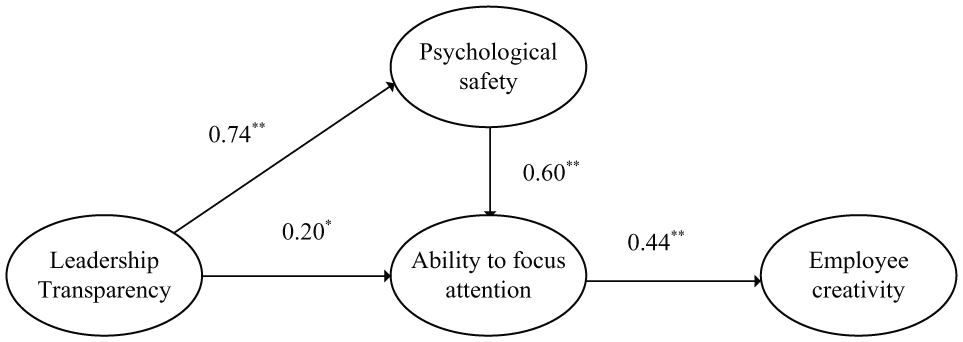
Conceptual model and estimated coefficients.
Theory and Hypotheses
Leaders’ Transparent Behavior
Transparency dates back to the regulatory domain of public accounting and finance, and the self-disclosure domain of psychology (Bushman, Piotroski, & Smith, 2004; Jourard, 1964, 1971). In the realm of self-disclosure literature, transparency has been proposed as a descriptive construct, which refers to that whether the relevant information is open and made known to all stakeholders by sharing deep thoughts, values, and feelings (Jourard, 1964; Vogelgesang & Crossley, 2006). So far, transparency has been used in the disciplines of financial studies, international management, strategic management, and psychology, while it has not been fully explored in the organizational behavior. For example, Walumbwa et al. (2008) just treated leaders’ transparent behavior as a dimension of authentic leadership, which means the relational transparency on the part of leaders working with followers. On these bases, Vogelgesang and Lester (2009) defined transparent leadership as the relationship between leader and follower which emphasized sharing relevant information, being open to giving and receiving feedback, being forthcoming regarding motives, and the reasoning behind decisions.
In empirical studies, researchers have demonstrated that authentic leadership has a positive effect on employee creativity (Rego et al., 2012, 2014); however, no study has examined the relationship between leaders’ transparent behavior and employee creativity by treating it as a separate construct. What’s more, the extant research exploring the underlying mechanisms between authentic leadership and employee creativity was almost from the perspective of positive psychology, such as psychological capital, hope, and positive affect (Rego et al., 2012, 2014), neglect other routes which delivers the effect of leaders’ transparent behavior on employee creativity. In the present article, we set out to examine whether and why leaders’ transparent behavior affects employee creativity.
Leaders’ Transparent Behavior and Employee Creativity
Employee creativity refers to the generation of novel and useful ideas of products, practices, services, and procedures in workplace (Amabile, 1996). We propose that leaders’ transparent behavior will promote employee creativity from two perspectives. From one perspective, when leaders’ transparent behavior is high, they will share relevant information to employees, openly communicate with employees, and give feedback to employees, which enrich the resources for employees’ engagement in creative activities (Gong, Cheung, Wang, & Huang, 2012; Zhou, 2003). Second, high transparent leaders will frankly disclose both strengthens and weakness behind the activities to cultivate an open and transparent organizational climate, so that employees know exactly what is to be rewarded, what is to be encouraged, and do not have to worry about “naive ideas” is ridiculed by colleagues. In such situation, employees are willing to discuss procedures, question the errors of their leaders, and challenge the status quo and stereotypes, speak up, and bring up alternative perspectives or new ideas in an open manner (Edmondson, 2003; Roberto, 2002; Zhao & Olivera, 2006). Hence, leaders’ transparent behavior will contribute to employee creativity by providing information for employees and building a transparent climate. Moreover, in empirical studies, some researchers have demonstrated the positive link between authentic leadership and employee creativity (Rego et al., 2012, 2014), which indirectly supports the positive relationship between leaders’ transparent leadership and employee creativity. Therefore, we propose the following hypothesis:
The Mediating Role of Psychological Safety
Psychological safety is defined as individuals’ perceptions which they can freely offer their opinions and values without fear of retaliation and scorn from others (Edmondson, 1999). We argue that leaders’ transparent behavior will enhance employee psychological safety for the following reasons. For one thing, high leaders’ transparent behavior will reduce the psychological distance with employees. When leaders’ transparent behavior is high, they are open to communicate with employees and share the relevant information about the work they do, which may build a closer connection with employees, and benefit employee psychological safety. As evidence, Detert and Burris (2007) discovered that managerial openness could increase employee psychological safety. Similarly, Walumbwa and Schaubroeck (2009) found that leaders’ ethical behavior (i.e., openness and truthfulness) was also positively related to employee psychological safety.
For another thing, high leaders’ transparent behavior will cultivate a safety atmosphere in the team. High transparent leadership manifests that leaders will disclose about the motives and reasons behind decisions, which may create the transparent team climate without any information hiding. Vice versa, under ambiguous or ill-defined situations, standards for actions are not well understood, employees are not well informed of acceptable and unacceptable activities, and therefore do not perceive the existence of psychological safety (May, Gilson, & Harter, 2004). Thus, the more leaders’ transparent behaviors, the fewer employees take defensive actions and fear of interpersonal threats (Carmeli, Reiter-Palmon, & Ziv, 2010), benefiting the generation of psychological safety. Furthermore, Edmonson and Lei (2014) highlighted that an interpersonal climate of safety must be combined with other essential ingredients (i.e., supportive leadership) to best enable learning and performance. In all, we argue that leaders’ transparent behavior will facilitate employee psychological safety by building psychological connections and cultivating a safety atmosphere in team, and propose the following hypothesis:
Taken together, Hypotheses 1 and 2 propose that leaders’ transparent behavior positively relates to employee creativity and psychological safety; hence, we argue that psychological safety mediates the positive link of transparent leadership and employee creativity. In addition, some researchers have found that employee psychological safety was positively related to employee creativity (Carmeli et al., 2010; Gong et al., 2012; Kark & Carmeli, 2009; Nembhard & Edmondson, 2006). Overall, we infer that leaders’ transparent behavior would enhance employees’ psychological safety, and individuals who perceive a psychologically safe context are more willing to challenge the status quo and participate in creative activities, because they will not be penalized by the leader or other employees for such behavior (Edmondson, 2003). In line to this theorizing, some studies have demonstrated that psychological safety played an essential mediating effect of leadership behaviors and employee voice (Detert & Burris, 2007; Walumbwa & Schaubroeck, 2009), which was similar to creative behavior. Therefore, we propose the following hypothesis:
The Mediating Role of Ability to Focus Attention
Ability to focus attention refers to “one’s ability to pay attention to value-producing activities devoid of concern over the use of power by others in organizations” (Mayer & Gavin, 2005, p. 875), it represents employees’ cognitive resources that they are involved in certain tasks or activities, including both the number and intensity (Kanfer & Ackerman, 1989). High ability to focus attention reflects employees’ high ability to think about specific aspects of their work (D. Gardner, Dunham, Cummings, & Pierce, 1987; George & Brief, 1996), and stronger reactions to the particular aspect of their work. We argue that leaders’ transparent behavior will influence employee ability to focus on attention from the following two routes.
On one hand, high leaders’ transparent behavior provides more information for employees to deal with their work, and give feedback to them about their work, which may reduce the time and efforts of employees to seek information and resources, and both of them could enhance employees’ ability to focus on their work. Moreover, high transparent leadership also teach employees to recognize their strengths and talents and make a better fit between work demand and their ability (W. Gardner, Avolio, Luthans, May, & Walumba, 2005), which may also enhance their engagement and ability to focus attention on their work. On the other hand, high transparent leadership treat employees frankly and are forthright about the motives and reasons behind decisions, so that there is too much need for employees to guess what the leader think and to cope with the organizational politics, which in turn increases employees’ ability to focus attention. Mayer and Gavin (2005, p. 876) argued that “the more an employee spends time and mental energy worrying about what management or a specific manager might do that could adversely impact the employee, the less cognitive resources are available for productive efforts.” In total, we suggest that leaders’ transparent behavior will accelerate employees’ ability to focus attention at work.
In support of this argument, W. Gardner et al. (2005) proposed that authentic leadership would facilitate employee engagement in their work. More relevantly, Mayer and Gavin (2005) discovered that trust toward leaders could facilitate employees’ ability to focus attention on their work. Hence, we argue that leaders’ transparent behavior increases to employee ability to focus attention, and propose the following hypothesis:
In a similar vein, leaders’ transparent behavior is positively related to employee creativity and ability to focus attention; thus, we demonstrate that ability to focus attention mediates the effect of leaders’ transparent behavior on employee creativity. From one perspective, researchers found that the more employees pay attention to a particular aspect of their work context, and the less they focus on other factors, the stronger their reactions to that particular aspect of their work, such as creative activities (Csikszentmihalyi, 1990, 1992). In addition, according to cognitive resource framework (Pugh, Skarlicki, & Passell, 2003), focusing on selective attention and behavior-related information, and ignoring a large number of irrelevant information will save cognitive attention resources employed in creative activities. More important, Amabile (1983) highlighted that cognitive ability was a vital element of creativity generation. Hence, employees’ ability to focus attention may have the positive impacts on their creativity in the organization. From another thing, Mayer and Gavin (2005) suggested that ability to focus attention mediated the positive effect of trust of leaders on employee in-role and extrarole work performance. Based on above rationales and empirical evidences, we propose the following hypothesis:
Finally, we further argue that leaders’ transparent behavior will affect employee psychological safety, which in turn affects ability to focus attention and employee creativity. Specifically, when leaders’ transparent behavior is high, employees perceive high psychological safety, and they will be more focused on their work due to that there is no need for them to seek additional information from others, and there is no worry about the schedules or bureaucratic, resulting in use of limited cognitive resources and attention resources for challenging work (Pugh et al., 2003). In turn, their high ability to focus attention on their work will help them engage in creative process and roles within the organization (Carmeli et al., 2010; Norman et al., 2010; Palanski, Kahai, & Yammarino, 2011).
On the contrary, when leaders lack of transparency, employees feel unsafe and suffer from role ambiguity, they may divert their attention from creative activities to nonfunctional operations (Mayer & Gavin, 2005), and decrease their creativity. Under insecurity or lack of trust situations, an employee must spend a lot of efforts to concern leaders and colleagues to do and what not to do. They see that any creative involvement activities will not be accepted, and even be ridiculed and abused by supervisors or coworkers (Jung, 1960; Mayer & Gavin, 2005), which may distract employees from their work. Therefore, we propose that a leader who interacts transparently with his or her followers creates a psychologically safe environment which promotes follower ability to focus attention and creativity. Thus, we propose the following hypotheses:
Method
Participants and Procedures
The data for this study were collected from a convenience sample of a telecommunications company in China. The company specializes in the field of fiber-optic broadband access, dedicated fiber-optic technology, Ethernet technology, and broadband access technology integration. Before the data collection began, we conducted in-depth interviews with four senior executives and three managers regarding the company’s expectations and policies on employee creativity. We found that the company rewarded constructive and novel ideas to improve performance and efficiency. Then, we contacted the human resource department director and discussed our research goals and scope. The author attended the work sites, briefly presented the subject of the study, and handed out the questionnaires.
To avoid the common method bias, team members answered the measures of leadership transparency, psychological safety, ability to focus attention, intrinsic motivation, and some demographic variables. Team leader answered employee creativity. A total of 266 employees and 58 team leaders participated in the survey, and after deleting the missing or incomplete questionnaires, we got 199 employees and 51 teams, the respond rate was 74.8%. On average, 3.90 employees (ranging from 3 to 10) work for a supervisor. Among the 199 employees, 75.6% were male, with the age ranging from 25 to 44 years (79.4%) and 99% of the participants held a bachelor’s or master’s degree, and the remainder of the participants held a high school diploma or equivalent, and 78.2% had worked with their current supervisors for 2 years or below. We examined potential nonresponse bias based on personnel records from the company, and we did not find any significant differences in age, gender, or years of education between respondents and nonrespondents.
Measures
We used the back-translation process for all items to guarantee the content validity of the Western scales in the Chinese context (Brislin, 1970). Unless otherwise indicated, all the variables were measured using items on a 6-point Likert-type scale (1 = strongly disagree to 6 = strongly agree). We averaged the items for each measure to obtain an overall scale score.
Leadership Transparency
Leadership transparency was measured with a five-item scale developed by Walumbwa et al. (2008), which was used by Norman et al. (2010). Previous research has shown a good validity of this scale with Chinese samples (Walumbwa, Wang, Wang, Schaubroeck, & Avolio, 2010). A sample item was “My leader tells me the hard truth.” Cronbach’s alpha for this variable in our article was .87.
Psychological Safety
Psychological safety was measured with a three-item scale developed by Edmondson (1999). This scale has been widely used in previous research with Chinese samples (Schaubroeck, Lam, & Peng, 2011). A sample item was “I am able to bring up problems and tough issues.” Cronbach’s alpha for this variable in our article was .68.
Ability to Focus Attention
Ability to focus attention was measured with a six-item scale adapted from Mayer and Gavin (2005). A sample item was “The work climate here allows me to focus on doing my job.” Cronbach’s alpha for this variable in our article was .78.
Employee Creativity
Employee creativity was measured with a 13-item scale developed by Zhou and George (2001). X. Zhang and Bartol (2010) have proved the good validity of this scale among Chinese samples. A sample item was “This employee is a good source of creative ideas.” Cronbach’s alpha for this variable in our article was .83.
Control Variables
We controlled demographic variables which have been found to be significantly related to employees’ creativity (e.g., Shalley, Zhou, & Oldham, 2004; X. Zhang & Bartol, 2010; Zhou & George, 2001). These demographic variables include age, gender, education, and tenure. Employee education was measured as a categorical variable. Employee tenure was measured as a categorical variable (1 = 2 years and below, 2 = 3-5 years, 3 = 6-10 years, and 4 = 10 years and above). In addition, we also controlled employee intrinsic motivation, which also may influence employee creativity (X. Zhang & Bartol, 2010).
Results
Preliminary Analysis
Table 1 presents the means, standard deviations, reliabilities, and correlations. Table 1 presents the descriptive statistics, correlations, and scale reliabilities for the variables in the study. Leadership transparency was positively related to employee creativity (r = .23, p < .01), psychological safety (r = .50, p < .01), and ability to focus attention (r = .61, p < .01). Psychological safety was positively related to employee creativity (r = .35, p < .01) and ability to focus attention (r = .50, p < .01). Ability to focus attention was also positively related to employee creativity(r = .31, p < .01).
Means, Standard Deviations, Reliability, and Correlations Among Study Variables.
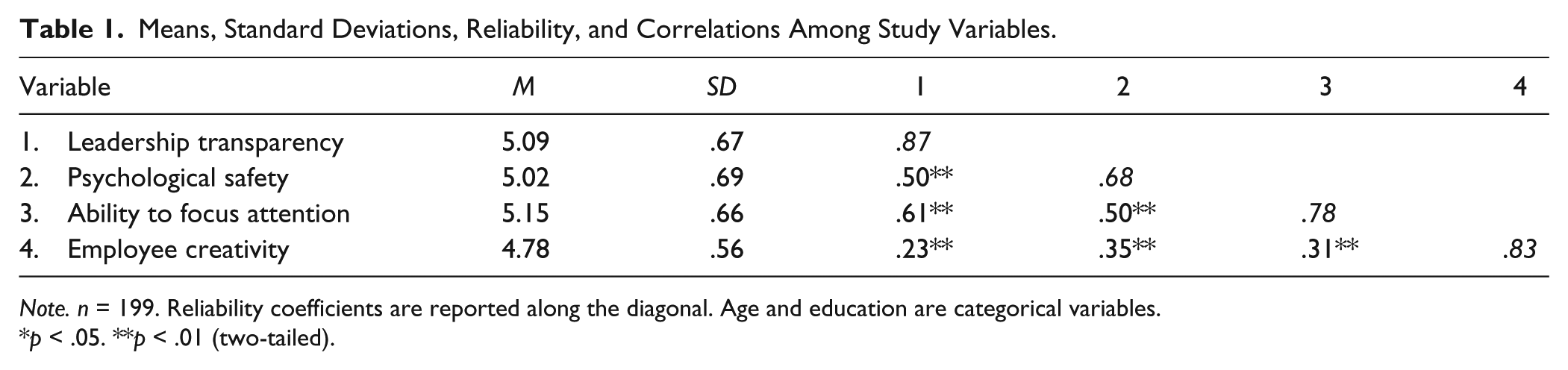
Note. n = 199. Reliability coefficients are reported along the diagonal. Age and education are categorical variables.
p < .05. **p < .01 (two-tailed).
We conducted a set of confirmatory factor analyses to discern the discriminant validity among the four latent variables (i.e., leadership transparency, psychological safety, ability to focus attention, and employee creativity). Results presented in Table 2 shown that our hypothesized four-factor model was a good fit to the data (χ2 = 75, degrees of freedom [df] = 48, χ2/df = 1.56, root mean square error of approximation [RMSEA] = 0.05, nonnormed fit index [NNFI] = 0.98, comparative fit index [CFI] = 0.98). In addition, chi-square difference tests suggested that four-factor model was superior to (1) the three-factor model (psychological safety and ability to focus attention were combined), Δχ2(df = 3) = 40.66, p < .001; (2) the two-factor model (psychological safety, ability to focus attention, and leadership transparency were combined), Δχ2(df = 5) = 161.18, p < .001; and (3) the one-factor model, Δχ2(df = 6) = 385.71, p < .001.
Confirmatory Factor Analysis on the Four Variables.

Note. df = degrees of freedom; CFI = comparative fit index; NNFI = nonnormed fit index; RMSEA = root mean square error of approximation. All alternative models were compared with the hypothesized four-factor model. All Δχ2 differences are significant at p < .001.
Hypothesis Test
The correlations between leadership transparency and employee creativity (r = .23, p < .01) provided preliminary evidence to support Hypothesis 1, which states that leadership transparency has a positive relationship with employee creativity. The correlations between leadership transparency and psychological safety (r = .53, p < .01) provided preliminary evidence to support Hypothesis 2, which states that leadership transparency has a positive relationship with psychological safety. The correlations between leadership transparency and ability to focus attention (r = .61, p < .01) provided preliminary evidence to support Hypothesis 4, which states that leadership transparency has a positive relationship with ability to focus attention.
To test the remainder four research hypotheses, the researcher examined a series of nested models. Table 3 summarizes all the model fit indexes. Figure 1 presents the final structural model with path coefficients.
Structural Equation Modeling With Mediation Results.

Note. LT = leadership transparency; ER = employee creativity; PS = psychological safety; AF = ability to focus attention; → = refers to path; RMSEA = root mean square error of approximation; df = degrees of freedom; TLI = Tucker–Lewis index; CFI = comparative fit index.
Our baseline model is presented as the first model (Model 1). Specifically, we included the direct paths from (1) leadership transparency to psychological safety and ability to focus attention and (2) ability to focus attention to employee creativity. (Refer to Table 3 for an illustration of the model and the model information criteria.) This model does not have direct paths from leadership transparency to employee creativity. As Table 3 shows, all fit indexes have satisfactory fit (χ2 = 75.60, df = 50, χ2/df = 1.51, p < .01, CFI = 0.98, NNFI = 0.98, RMSEA = 0.05).
We then tested indirect effect by removing the direct path from leadership transparency to ability to focus attention and adding the direct path from psychological safety to employee creativity from Model 1. This third model (Model 3, χ2 = 77.12, df = 50, χ2/df = 1.54, p < .01, CFI = 0.98, NNFI = 0.98, RMSEA = 0.05) also had a relatively poorer fit to the data than Model 1, as evidenced by the Table 3 results. Hypothesis 3 was not supported. Psychological safety did not mediate the relationship between leadership transparency and creativity.
Next, we evaluated whether psychological safety and ability to focus attention were independent from each other in affecting creativity. We want to know whether psychological safety was a partial or full mediator of the relationship between leadership transparency and ability to focus attention by eliminating the direct path from psychological safety to ability to focus attention from Model 1 (i.e., testing a full mediate on model). This second model (Model 2, χ2 = 95.53, df = 50, χ2/df = 1.91, p < .01, CFI = 0.97, NNFI = 0.97, RMSEA = 0.07) had a poorer fit to the data than Model 1, suggesting that the full mediation relationship between leadership transparency and ability to focus attention was not sufficient to account for the total relationship between these two variables. As such, psychological safety was a partial mediator of the relationship between leadership transparency and ability to focus attention. Hypothesis 6 was fully supported.
To further examine the results concerning Hypothesis 5 and Hypothesis 7, we tested fourth model (Model 4), fifth model (Model 5), and sixth model (Model 6). Model 4, χ2(df = 1) = 1.01, Model 5, χ2(df = 1) = 0.03, and Model 6, χ2(df = 2) = −0.6, were not significantly different from Model 1. Under the principle of model parsimony, therefore, these results suggested that Model 1 best fitted our data. The results shown in Table 3 support our Hypothesis 3: Ability to focus attention fully mediates the relationship between leadership transparency and employee creativity. Figure 1 shows that the coefficient of the path from leadership transparency to ability to focus attention was significant (β = .20, p < .05), as were the coefficients of the paths from ability to focus attention to employee creativity (β = .44, p < .01).The results shown in Table 3 also support our Hypothesis 5: Psychological safety mediated partially the relationship between leadership transparency and ability to focus attention. Figure 1 shows that the coefficient of the path from leadership transparency to psychological safety was significant (β = .74, p < .01), as were the coefficients of the paths from psychological safety to ability to focus attention (β = .60, p < .05). In support of Hypothesis 7, we found statistically significant and positive coefficients for the paths from psychological safety to ability to focus attention (β = .60, p < .01), and from ability to focus attention to employee creativity (β = .44, p < .01).
In summary, Hypotheses 1 to 7 have been examined, and Hypothesis 3 has not been proven effectively (1) ability to focus attention mediated partially the relationship between leadership transparency and employee creativity; (2) ability to focus attention mediated fully the relationship between psychological safety and employee creativity; and (3) psychological safety mediated partially the relationship between leadership transparency and ability to focus attention.
Discussion
In the present study, we examine whether and how leaders’ transparent behavior affects employee creativity and reveals the following findings. First, leaders’ transparent behavior is positively related to employee creativity. Second, psychological safety and ability to focus attention both mediate the positive association of leaders’ transparent behavior and employee creativity. Third, leaders’ transparent behavior positively influences employee psychological safety, which in turn affects their ability to focus attention and creativity.
Theoretical Implications
The present study contributes to transparent leadership literatures in several ways. First, we verify that transparent leadership is a pivotal contextual factor of employee creativity. For one thing, although some studies have found the relationships between leadership styles (e.g., empowerment, communication, and leader support behavior) and employee creativity (e.g., Amabile, Schatzel, Moneta, & Kramer, 2004; X. Zhang & Bartol, 2010; Zhou & George, 2003), transparent leadership has surprisingly not been paid adequate attention. We found that the more leaders are transparent, the more resources and information employees will get, and the higher creativity they have. For another thing, so far, leaders’ transparent behavior is regarded as an important part of authentic leadership, and no study have examined its separate influence on employee creativity. In the present study, we confirm the positive relationship between transparent leadership and employee creativity by treating it as a separate construct.
Second, we reveal the underlying mechanisms between transparent leadership and employee creativity. The results showed that both psychological safety and ability to focus attention mediated the relationship between leaders’ transparent behavior and employee creativity. These findings demonstrated that in addition to positive psychological processes (e.g., psychological safety; Rego et al., 2012, 2014), the affective (i.e., psychological safety) and cognitive processes (i.e., ability to focus attention) can also transfer the positive effect of leaders’ transparent behavior on employee creativity.
Third, we discovered that there existed the sequential mediating effect of psychological safety and ability to focus attention on the relationship between transparent leadership and employee creativity. These findings contribute to organizational creativity as researchers have suggested that there is a need to examine the role of individual cognitions between employee affect and employee creativity (Seo et al., 2004). We found that ability to focus attention mediates the relationship between psychological safety and employee creativity, supporting the underlying mechanism of cognitions between affective states and employee creativity. Furthermore, we also contribute to psychological safety literature because Edmonson and Lei (2004) stressed that psychological safety was not sufficient to ensure employees’ learning behavior, and it must be combined with a need and capacity for thoughtful and involvement in the work, through which employees could generate greater learning and creative behaviors. Transparent leadership built a safe climate, and thus led to employee conservation of cognitive resources, and finally, has more vigor and psychic energy to invest in creative activities (Hobfoll, 2002; Shirom, 2004). Vice versa, employees perceive transparent leadership and psychological safety; however, if they do not have enough psychic energy or cognitive capacity to invest in creative activity itself, the creativity will be less likely to occur (Csikszentmihalyi, 1992).
Practical Implications
The present study has some practical implications to enhance employee creativity. First, as leaders’ transparent behavior has been proved as a vital precursor of employee creativity, managers can improve the transparency of their behaviors, they can create a climate of safe climate, articulate the clarity of objectives by “sharing the information needed to make decisions, accepting others’ inputs, and disclosing his/her personal values, motives, and sentiments in a manner that enables followers to more accurately assess the competence and morality of the leader’s actions”(Norman et al., 2010, p. 352). Second, we reveal that employee psychological safety and ability to focus attention are two crucial intervening roles transferring the positive effect of leadership transparency on employee creativity. Hence, managers can consolidate the psychological safety, like cultivating the overall team safety climate and training employees and promoting their abilities to deal with the interpersonal risk in work contexts (Bradley, Postlethwaite, Klotz, Hamdani, & Brown, 2012). Due to that psychological safety is also positively related to employees’ ability to focus attention, so managers can improve employees’ concentration on the domain and focusing their attention to achieve creative goal by appropriate task assignment and strengthening the trustworthiness toward their leaders (Mayer & Gavin, 2005).
Limitations and Future Directions
Despite this study makes several contributions, there still exists some limitations deserving consideration. First, the cross-sectional research design may lead to the causality between leaders’ transparent behavior, psychological safety and ability to focus attention, and employee creativity. In future study, researchers can use longitudinal research design or experiment to retest these mediating effects. Second, we collect data within a single firm which may restrict the generalization of conclusions. Future studies should use multiple data from various firms. Third, we just use psychological safety and ability to focus attention as a proxy of affective and cognitive mechanism, accordingly, in future researchers should consider other mediators such as liking and work engagement. Fourth, we conduct this study just in Chinese context, which has relative high power distance and collectivism. In such context, leaders may incline to disclose more private information (e.g., authentic feeling, true thoughts) to those who have high relationship quality with them than those out-group employees (Gong et al., 2012; Pellegrini & Scandura, 2008). So researchers should take some boundary conditions into consideration to explore the relationship among leadership transparency, psychological safety and ability to focus attention, and employee creativity in future studies, such as leader–member exchange quality and perceived insider status.
Footnotes
Declaration of Conflicting Interests
The author(s) declared no potential conflicts of interest with respect to the research, authorship, and/or publication of this article.
Funding
The author(s) disclosed receipt of the following financial support for the research, authorship, and/or publication of this article: The author(s) wish to thank The National Science Foundation of China: No. 71502175; The National Social Science Fund of China: No.14BGL199.