



Abstract
Leading in in extremis situations, when lives are in peril, remains one of the least addressed areas of leadership research. Little is known about how leaders make sense in these dangerous situations and communicate these contexts to others. Because most of the literature on in extremis is theoretical, we sought empirical evidence of how sensemaking proceeds in practice. A qualitative study was conducted based on interviews with 30 Army leaders who had recently led teams in combat. Our findings suggest that during these life-threatening situations, sensemaking and sensegiving are actually occurring simultaneously, the type of training leaders receive is critical, and a sense of duty can influence a person’s role as a leader. Our findings have implications for both theory and practice since crisis leadership is now a coveted executive quality for leadership competency.
If something doesn’t change drastically, and soon, this helicopter will become a multimillion dollar coffin. I’m the senior ranger on the aircraft, and with the fate of twenty-one Americans still undecided, I know it’s up to me to make the difference.
In the quotation above, Nate Self (2011) illustrates the stress, uncertainty, and pressure to perform encountered by combat leaders, and how their perceptions of a situation can influence their leadership decisions. Personal experiences like those described above, coupled with the rest of the riveting tale presented in his book, Two Wars, led two retired military officers and colleagues to explore the dynamics of in extremis, or life-threatening, situations. This exploration led to questions pertinent today, including the following: “Is there anything we can do to better prepare leaders to assume this tremendous burden?” “Can a better understanding of the in extremis environment save lives?” And, most important for this article’s purpose, “Can studying the leadership experienced by combat veterans advance the understanding of both in extremis leadership and leadership in general?” While we will not attempt to answer all of these questions comprehensively, we do hope to expand understanding of the complex dynamics of in extremis environments with this exploratory study.
In an increasingly unstable world, understanding how leaders can make a difference and function in in extremis situations—defined as those in which lives are at high risk (Gardner, Avolio, & Walumbwa, 2005)—is essential to the military (Yammarino, Mumford, Connelly, & Dionne, 2010), first responders (Baran & Scott, 2010), and critical action organizations (Hannah, Uhl-Bien, Avolio, & Cavarretta, 2009). While sharing some similarities, each context has its idiosyncrasies. Past studies have discussed leadership and team dynamics in dangerous environments (military); the reduction of ambiguity during in extremis contexts (firefighters) and developed a detailed framework to look at in extremis contexts (critical action organizations), along with leadership lessons of mountain climbers (Levine, 2014) and skydiving teams (Kolditz, 2007). These studies each helped define in extremis contexts and served as a foundation for this research.
Although most executives do not face situations of physical peril, in extremis leadership has been recognized as relevant for those at the helm of traditional organizations (Pagonis, 2001; Weiss, Donigian, & Hughes, 2010) since perceptions of organizational danger and emotional responses can be similar in these less dire contexts. Additionally, crisis management is also considered a strategic competency for many executives (Coombs, 2006). Finally, different or “unconventional” contexts can sometimes illuminate significant management ideas (Bamberger & Pratt, 2010, p. 665) that may have relevance if context and its variables are considered (Geier, 2016).
Despite the importance of in extremis leadership, conducting research in this context is difficult. It has been argued that research on leadership in perilous conditions is “nearly impossible” (Campbell, Hannah, & Matthews, 2010, p. S2). As a result, in extremis leadership—although a subject of inquiry since the 1950s (Egbert, Meeland, Cline, & Forgy, 1957)—remains one of the least addressed areas of leadership research (Hannah et al., 2009). Most of the empirical work on this subject has appeared in military journals (Baran & Scott, 2010; Olsen, Eid, & Larsson, 2010; Samuels, Foster, & Lindsay, 2010) with a focus on how leaders construe their environments, how ethical behavior is affected, and how leader self-control and leader assertiveness can be improved. Limited in extremis leadership research has also focused on firefighters (Baran & Scott, 2010; Geier, 2016; Weick, 1993), first responders in natural disasters (Chow, 2008), and emergency medical technicians (Popa, Raed, Purcărea, Lală, & Bobirnac, 2010). Related work has also explored leadership during times of stress and ambiguity (Combe & Carrington, 2015). However, despite some insight into the nature of leadership in extremis, there is still limited comprehension on how leaders understand these environments, and how they lead their followers in these contexts.
The purpose of this study is to help fill these gaps by exploring how leaders both make sense of the in extremis events and how they give sense to their followers in order to navigate the in extremis and survive. More specifically, we investigate the sensemaking and sensegiving process when lives are at stake. In these perilous situations, situational awareness is an integral part of the sensemaking process (MacEachren et al., 2011). The study was predicated on streams of literature from sensemaking (Weick, 1995), sensegiving (Gioia & Chittipeddi, 1991), and situational awareness (Endsley, 1995a, 1995b), providing a final narrative that is grounded in both theory and emergent findings. This article explores the in extremis environment through a sensemaking lens (Weick, 1995) and seeks to understand how leaders make sense of these environments and how they convey that socially constructed sense during life-threatening contingencies to their subordinates—an activity known as sensegiving. We explored these phenomena by interviewing recently returned combat veterans from the U.S. Army and analyzing these personal narratives for not only sensemaking but also for sensegiving.
The project’s purpose was to probe the black box of in extremis leadership from the perspective of those who had survived it—not only to contribute to military and first responder literature but also to contribute to broader managerial leadership knowledge. Access to U.S. Army leaders with very recent “at the point of death” experience in the Middle East provided an unusual and rare opportunity to gain insight into how military leaders sense and respond to crises. We conducted a qualitative, exploratory study based on semistructured interviews with 30 military leaders at West Point who had recently led soldiers under combat conditions in Iraq and Afghanistan. The interviews yielded 51 narratives of in extremis leadership, which were analyzed for patterns in how leaders experienced and managed these events.
From these narratives, the authors have developed a model that identifies factors important to sensemaking and sensegiving including distributive cognitive capacity, situational awareness, and presentation capacity. Although situational awareness is a common theme in regard to sensemaking, the narratives suggested the additional theories of Presentation of Self (Goffman, 1959) and Distributed Cognition (Hollan, Hutchins, & Kirsh, 2000) as important to in extremis leadership. The model developed by the authors including these new themes is outlined in the discussion.
In many organizational contexts, leaders need to execute quick decisions: “project strength and control (particularly when they have neither), rely on force rather than collaboration, trade resources for cooperation rather than build trust, and make unwanted compromises to minimize potential damage” (Weiss et al., 2010, p. 68). Thus, leaders facing the need for quick decisions in fluid, yet non–life-threatening environments have a similar need for sensemaking and sensegiving. Situations such as mergers and bankruptcies can feel like disasters for employees when they challenge their ability to make sense of the environment. For example, the potential loss of a job can create the loss of status for individuals and challenge their grounded identity constructions. Consequently, we feel our findings can help leaders experiencing in extremis environments and likely have significant applicability beyond those narrow contexts. Our study contributes to the literature in three important ways. First, we discuss the differences in both sensemaking and sensegiving in in extremis environments; then, we discuss why the training for leaders in these contexts must be different. Finally, we examine how sense of duty can influence a person’s role as a leader. From these elements, we construct a model of sensemaking for in extremis environments.
Our model, shown in Figure 1 and explained in this article, identifies factors that are important to sensemaking and sensegiving, which include distributed cognition, situational awareness, and presentation of self.
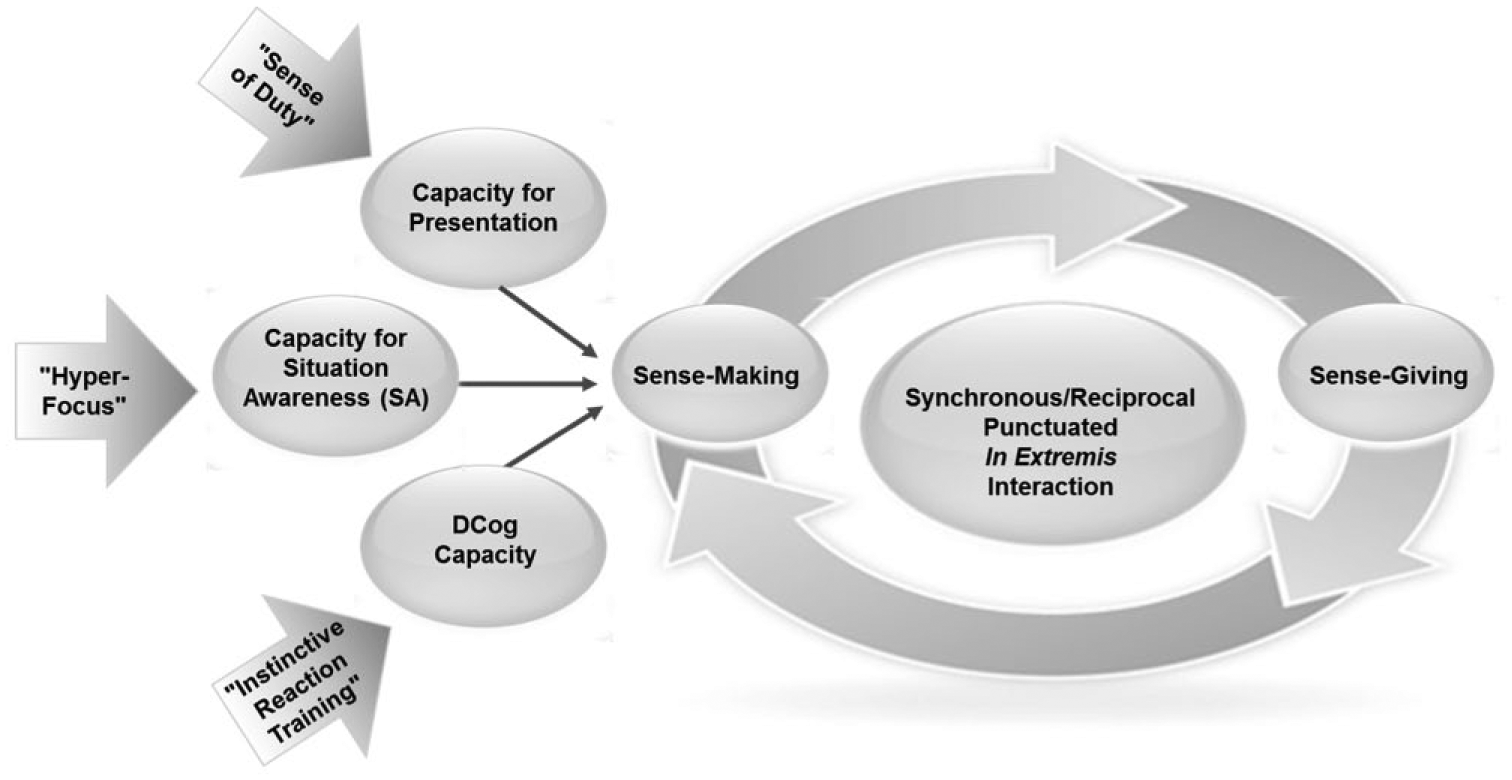
Punctuated in extremis interaction.
Literature Review
Sensemaking has been identified as critical to understanding the in extremis environment. One of the earlier works in the sensemaking literature probed a classic in extremis tale—Weick’s (1993) exploration of the firefighting disaster at Mann Gulch. In that exposition, Weick examined the importance of role identity in sensemaking and how a change of role identity can influence both the perception and outcome of an in extremis situation. In addition to this early emphasis on dangerous environments, such as firefighting and naval flight operations (Weick & Roberts, 1993), the sensemaking framework has been expanded to scrutinize a wide variety of more benign organizational environments (Weick, 1995). The increasingly comprehensive sensemaking research agenda is highlighting sensemaking’s “central role in the determination of human behavior” (Weick, Sutcliffe, & Obstfeld, 2005, p. 409).
In Extremis Context
We adopted Campbell et al.’s (2010) definition of in extremis as a situation “in which leaders or their followers are personally faced with highly dynamic and unpredictable situations and where the outcomes of leadership may result in severe physical or psychological injury (or death) to unit members” (p. S3). The military acronym “VUCA” (Volatile, Uncertain, Complex, and Ambiguous) acknowledges the equivocality of the in extremis context. Consequently, as argued by Campbell et al. (2010), leadership in extremis cannot be examined by only considering the leader as a heroic archetype; it also requires understanding the messy process of how leaders and followers perceive, experience and make meaning of the in extremis context. Since the context of leadership is often used to explain the actions of the leader (Howell & Boies, 2004; Osborn, Hunt, & Jauch, 2002; Westaby, Probst, & Lee, 2010), it follows that studying in extremis context can add insight to the sensemaking and sensegiving.
In extremis leadership research streams have two primary ways of viewing the context. One view is that the context itself qualifies the situation as “in extremis” (Campbell et al., 2010; Hannah & Sowden, 2010; Sweeney, Matthews, & Lester, 2011). If the leader is in a dangerous situation, facing physical danger, then the view is that the leader is in an in extremis situation.
A more complex view of the context, however, involves the perception of danger. As presented in Kolditz and Brazil (2005), followers, sensing themselves to be “at the point of death” (Kolditz, 2006, p. 657), have a heightened awareness that leader behavior will influence their survival. In those situations, it is not just the context but also the perception of the context by involved individuals that is important. Elsewhere, Kolditz (2007) illustrated this nuance by describing an expert mountain guide and a novice both on the same mountain with dissimilar views of the danger involved; the follower might perceive the situation as in extremis, but the leader might not think it is dangerous because of his or her expertise. Both perception of the dangers extant in the environment and the actual danger are different to the individuals because of their levels of expertise and training.
The research outlined in this article aligns with both of these streams of literature; both the context and the perception of the danger make a situation in extremis. Soldiers in combat situations are in an inherently dangerous context, but at specific times, they may perceive themselves in more danger than at other times. For a soldier, eating at the mess hall in Afghanistan may not be in extremis, but patrolling a remote location can be. Similarly, a tandem parachute instructor does not think his normal day-to-day job of jumping is in extremis, but presented with a failed main chute, even his normal job then becomes in extremis. The definition of in extremis can encompass both ideas from Kolditz and the other literature streams; both make the discussion of context richer and more complex.
Similarly, crises that may not be categorized as in extremis can arise in myriad situations and across organizations (Hannah et al., 2009), and those crises may require extreme leadership and both sensemaking and sensegiving. Broadly, crisis leadership can occur when “a situation that threatens high priority goals . . . suddenly occurs with little or no response time available” (Pearson & Clair, 1998, p. 60). For example, physicians performing emergency surgeries may be in crisis—but not in in extremis situations, because their own lives and the lives of the team members are not in immediate danger. Understanding the nuances within the context is also important, as Geier (2016) notes. Both the internal and external factors (organization and environment) must be considered when determining contexts.
Sensemaking
Both research streams of in extremis context lead to a study of sensemaking since sensemaking often is sought when individuals are facing uncertainty or crisis situations (G. Hill, Datta, & Acar, 2015). How individuals make sense of situations is recognized today as a function of the military decision-making process in dynamic and uncertain environments (United States Army, 2010, 2015). Acknowledged in military journals since 1989, studies about sensemaking in military context accelerated after a 2001 Department of Defense call for research linking sensemaking and leader effectiveness. As argued by Mills (2003), sensemaking allows individuals and organizations to transform complex situations into events or information they can comprehend and hence act on quickly and effectively.
Sensemaking, as described by Weick (1995), has seven properties, including identity, retrospective, enaction, social, ongoing, extract cues, and plausibility over accuracy. As individuals interpret events, they develop narratives about the incidents, which in turn convey the sense they made of them.
Weick (1995), who observed sensemaking at the organizational level with a special focus on situations that tend to be ambiguous or changing, defined it as the way people understand and make meaning of their experience (enactments). The first of seven properties Weick (1995) assigned to sensemaking was, “grounded in identity construction” (p. 17), referring to how one thinks about one’s self as part of a team and how one is viewed by the team. Who people think they are in a given context shapes how they enact and interpret events (Currie & Brown, 2003; Thurlow & Mills, 2009; Weick, 1993). The specific identity as a soldier, for instance, shapes an individual’s sense of duty and hence how one should be acting (Tinoco & Arnaud, 2013). Similarly, a specific identity as a leader also shapes the leader’s duty.
“Retrospective,” Weick’s second property of sensemaking, gives one a frame of reference to the event. Frames of reference help each individual qualify and categorize the event. There is a hindsight bias, but retrospective provides clarity and the time to decipher what is really important (Dunford & Jones, 2000; Gephart, 1993; Huzzard, 2004; Weick, 1995). Weick’s retrospective tenant has drawn some criticism, and research is increasingly pointing toward interpretation versus just reflecting on the past (Brown, Colville, & Pye, 2016; Sandberg & Tsoukas, 2015).
This means that an individual’s perceptions of the event can influence the understanding of the event and lessons learned. This research links this article’s contention that context and perception of the situation can influence both sensemaking and sensegiving.
The “ongoing” (Weick, 1995, p. 17) property references the continuous nature of sensemaking; individuals are always in the middle of something and often use past events that are similar to the present to understand their present environment. Thus, people both shape an environment and react to it; they look at results and evaluate their identities (Thurlow & Mills, 2009) through a feedback loop. Continuous and dynamic sensemaking is a vital part of extremis contexts (Baran & Scott, 2010; Geier, 2016).
Weick’s (1995) retrospective and ongoing properties of sensemaking seem to be in contrast with one another. Retrospective concerns the past, while ongoing is in regard to the present and future. The pressure between the two calls for further examination. This article considers this contrast in the discussion.
“Social,” another sensemaking property, refers to human connectivity and shared understandings. The sense we make about phenomena is preserved in narratives shared with others (Isabella, 1990; Maitlis, 2005). The social aspect of sensemaking supports this article’s purpose in studying in extremis leadership and the stories, or narratives, the group tells one another to make sense of the situation in which they find themselves.
Situation Awareness
Occasionally, researchers will discuss sensemaking and situational awareness as similar processes, but the differences lie in the process versus the state (Klein, Moon, & Hoffman, 2006; Leedom, 2001). Situation awareness is about the knowledge state and predictions of the future, while sensemaking is about how an individual arrives at the outcome (Klein et al., 2006).
Situation awareness has been cited as a “fundamental requirement” for managing crisis situations (MacEachren et al., 2011, p. 1) because it refers to how much knowledge an individual has about a situation (Endsley, 1995b; Strater, Endsley, Pleban, & Matthews, 2001) and the degree to which the individual can use it to predict what will ensue (Jensen & Brehmer, 2005). Thus, situational awareness can be an integral component of sensemaking and sensegiving. Situational awareness has been defined as “an intermediate state in the decision-making process of dynamic systems where one should be able to comprehend the situation in order to make an appropriate decision for future development” (Artman & Garbis, 1998, p. 1). Endsley (1995b) argued that situational awareness involves perceiving elements in the environment, synthesizing them to achieve comprehension of the current situation, and envisioning possible future states of the situation. More expressively, Dominguez (1994, as cited in Transport Research & Innovation Portal, 2000) describes situational awareness as requiring the extraction of information from the environment, its integration with relevant internal knowledge to create a mental picture of a current situation and the use of the picture to guide continued perceptual exploration (p. 1, italics added). This constitutes, he argues, a “perceptual cycle” in which perceptions of a situation are continually and actively modified by incoming information (Dominguez, 1994, as cited in Transport Research & Innovation Portal, 2000, p. 38). It is no surprise, then, that situation awareness research has become an imperative part of emergency and crisis management and that the link between sensemaking and condensed time frames necessitates examining situational awareness further in our in extremis context (Harrald & Jefferson, 2007; Yufik, 2014). In this study, the data indicated that situational awareness is an integral component to sensemaking.
Indeed, even ordinary, routine behaviors rely on situational awareness, or on a consistent, almost unconscious current appraisal of relevant facts. In addition, input from the environment is imperative because of the dynamic nature of things (Endsley, 1995b). But many variables can deleteriously affect situational awareness, including—as observed both in the literature and our data—fatigue, stress, and anxiety (Strater et al., 2001). Our data aligned with Endsley (1995b) and indicated that as environmental complexity increases, situational awareness is more difficult to acquire and maintain.
Besides situational awareness, other work in the wider sensemaking genre has begun to explore the activity of sensegiving by leaders (e.g., Maitlis & Lawrence, 2007); however, that work has focused on more static organizational situations (e.g., symphony orchestras). We postulate that sensegiving in extremis environments will have distinct properties due to the dynamic and emotional conditions of these situations.
Sensegiving
Military sensemaking studies have addressed sensemaking with respect to planning and command and control (Alberts & Hayes, 2007; Jensen, 2006, 2009; Jensen & Brehmer, 2005), military training (Klein, 1993; Klein, Phillips, Rall, & Peluso, 2003; Larsson, Johansson, Jansson, & Gronlund, 2001; Sieck, Klein, Peluso, Smith, & Harris-Thompson, 2007), and trust (McGuinness & Leggatt, 2006) between military members. These studies emphasize the importance of leader sensemaking in command and control, training, and trust among the leader and followers, making both sensemaking and sensegiving paramount in a military environment (Attfield et al., 2015; Fallesen, Keller-Glaze, & Curnow, 2011). In addition, scholars of leadership distinguish between leading and leadership (Campbell et al., 2010; Day, 2000; Day, Zaccaro, & Halpin, 2004), the latter being a collective or “. . . social process that engages everyone in the community” (Day, 2000, p. 583; see also Lichtenstein & Plowman, 2009; Palmer, Hannah, & Sosnowik, 2011). In other words, in extremis situations often require collective understandings to ensure survival. The interactive quality of that shared process suggests the importance of understanding not only how a leader makes sense of an in extremis situation, but also how that sense is shared, received, and responded to by others, in other words, sensemaking and sensegiving. Due to the constraints of data collection, this study focused on leaders’ perception of their sensegiving to the followers.
Gioia and Chittipeddi (1991) originated the term “sensegiving,” defining it as “the process of attempting to influence the sensemaking and meaning construction of others toward a preferred redefinition of organizational reality” (p. 442). While exploring sensegiving in a more deliberate strategic environment, they did note the “sequential and reciprocal” nature of sensemaking/sensegiving and also found that the “cycle corresponds to periods dominated by understanding and influence” (p. 443). Sensegiving is an enactment of sensemaking; where sensemaking is about understanding, sensegiving is about influencing (Holt, 2009) and persuading (Bartunek, Krim, Necochea, & Humphries, 1999); in other words, shaping the perception and understanding of the situation. In longer term strategic change environments, such as power generation systems development efforts, the cognitive processes seem to oscillate between understanding and then influencing in a more sequential and orderly manner compared with more dynamic in extremis environments (Corvellec & Risberg, 2007). In extremis situations require the sensemaking and the sensegiving to happen faster and in more condensed time frames.
Sensegiving has been examined predominately as a way to affect the sensemaking of others, but a gap in the research that this article explores involves what individuals actually do when they are giving sense to others (Corvellec & Risberg, 2007) or the conditions associated with sensegiving—that is, who, what, when, and so on (Maitlis & Lawrence, 2007). Most of the extant scholarly work on sensegiving has mirrored Gioia and Chittipeddi’s (1991) approach of using sensegiving in the strategic change arena (Bartunek et al., 1999; Dunford & Jones, 2000; Maitlis, 2005; Maitlis & Lawrence, 2007; Rouleau, 2005; Smerek, 2011). Sensegiving has also been considered in an entrepreneurial context (R. C. Hill & Levenhagen, 1995; Nicholson & Anderson, 2005). Kuperman (2003), for example, examined firms (sensegivers) aiming to influence financial analysts’ (as sensemakers) meaning construction and the importance of cognitive schemas in that process. Kuperman (2003) concluded that deliberate development of cognitive schema could enhance sensegiving activities for key strategic activities. However, despite the dynamic fluidity of the acquisition environments Kuperman (2003) studied, he did not examine the speed at which these schemas could be developed in rapidly evolving situations. A significant portion of the research on sensegiving has examined situations where organizational structures are being developed (R. C. Hill & Levenhagen, 1995; Nicholson & Anderson, 2005), reevaluated (Ravasi & Schultz, 2006), important to the political process (Filstad, 2014), or undergoing strategic change (Bartunek et al., 1999; Smerek, 2011). These sensemaking–sensegiving situations typically transpire over time. Leaders make sense, then take time to craft messages about their vision of organizational change (Bartunek et al., 1999; Smerek, 2011) or development (Nicholson & Anderson, 2005; Ravasi & Schultz, 2006) using narrative, language, symbols, and other methods of communication to lead others toward the intended perception (Dunford & Jones, 2000; Maitlis & Lawrence, 2007; Snell, 2002; Vuori, 2011). Similarly, entrepreneurs develop an essential verbal articulation of a vision that is refined over time (R. C. Hill & Levenhagen, 1995).
Conclusions from works examining organizational structures and changes that developed over time have distinct differences from in extremis environments. For example, Bartunek et al. (1999) found that leaders should seek to appear credible, use sanctions and rewards, and make actions appear reasonable and logical during strategic change efforts. In contrast, in extremis environments are often far from logical to the participants. Moreover, credibility is often created with prior interactions from the leader which are separated temporally from the in extremis context. The reward for successful action in an in extremis environment is survival. Nevertheless, Weick (1993) demonstrates that even the ultimate reward is not enough to overcome breakdowns in sensemaking and sensegiving processes.
In contrast to most of the extant research contexts, sensegiving in an in extremis military context must be conveyed quickly and clearly to help reduce ambiguity and provide common meaning. Misconstrual can cause acute errors (Connaughton, Shuffler, & Goodwin, 2011) including death. Miscommunication can be inconvenient or problematic in normal conversations, but deadly in in extremis situations. Maitlis and Lawrence (2007) identified two conditions under which stakeholders are motivated to engage in sensemaking—first, when the issue has important consequences to the stakeholder, and second, when there is ambiguity and unpredictability or the involvement of numerous stakeholders. In extremis situations can naturally elevate emotions which research shows leaders can use to strengthen their sensegiving (Vuori, 2011).
Distributed Cognition
Distributed cognition is important when discussing sensemaking and sensegiving, because in most situations involving dynamic decision making and control of dynamic systems, the task is undertaken by a team, not by an individual acting alone (Artman & Garbis, 1998; Combe & Carrington, 2015); consequently, a distributed cognition approach to understanding team decision making has been recommended. In distributed cognition (Hollan et al., 2000; Hutchins, 2000; Hutchins & Lintern, 1995), cognitive processes can (a) occur within a group of individuals (social); (b) involve artifacts or aids from the environment; and (c) be temporal, meaning what has already happened can influence what will happen next (Hutchins, 2000). This team approach to understanding context, outlined in the literature as distributed cognition, supports the sequential and reciprocal nature of sensemaking and sensegiving.
As outlined in the literature discussed above, using the theoretical perspectives of sensemaking, situational awareness, sensegiving, and distributed cognition allows the reader to understand the framework of the theory that relates to these dangerous environments. This comprehension, in turn, adds to the readers understanding of the qualitative methodological approach used to study in extremis leadership.
Method
Methodological Approach
Qualitative research, the power of which has been described by Maxwell (2005) as derived from its focus on phenomena and people and its emphasis on words over numbers, facilitates discovery versus testing of variables (Corbin & Strauss, 2008). Within the many forms of qualitative research, the narrative approach, although challenging to use (Creswell, 2013), seemed appropriate for this study because the context of the situation is so pertinent. Narrative research focuses on examining stories told, beginning with experiences they have had and then recount (Fleming, 2001; Pinnegar & Daynes, 2007; Riessman, 1993).
Narrative research can be distinguished from other forms because the elements of the story form a whole, the elements are connected by a course of action, and the individual has specifically chosen these events to recount because they are relevant (Czarniawska, 1997). Most important to our study, narrative stories occur in certain contexts (Creswell, 2013), and narratives are the “medium with which human being make sense of their complex environment” (Augenstein & Palzkill, 2015, p. 5).
Given our context and the reflective nature of the data, we used this narrative analysis approach to examine the data; a process that included “gathering data through the collection of their stories, reporting (Clandinin, 2006) individual experiences” and then organizing the meaning (Creswell, 2013, p. 70). The initial data narrative interpretation process followed the telling, transcription, retranscription, and analysis form recommended by Riessman (1993). A second level of analysis involved coding and clustering the resulting fragments (Manning, 1987). Finally, we used a semiotic analysis technique (Feldman, 1995) to bring meaning and context to the data. At each stage, we examined the results and made iterative adjustments to the analysis as our emergent understanding of the exploratory data evolved. Our ultimate goal was simply to “construct a more adequate understanding of the [in extremis] world so as to keep open the possibility of public discussion guided by practical reason” (Rabinow, 1987, p. 30).
The Interviews
Our access to soldiers at West Point who had recently returned from Iraq and Afghanistan gave us a rare and unique opportunity to capture the lived experience during in extremis contexts. Creswell (2013) comments that qualitative methods are appropriate with the researcher is attempting to “understand the context or settings of the participants” (p. 65). We interviewed the returning army leaders about their experience, thoughts, and feelings of leading in in extremis situations when they were in situ with their unit. Our objective was to generate insight from data emerging from the narrative recollection of informants’ actual leadership experiences in life-threatening situations. From these remembrances, we sought to interpret the data realizing this knowledge is “inescapably practical and historically situated” (Rabinow, 1987, p. 2).
Our interview goals went beyond having the interviewees just remember events—we wanted them to reconstruct incidents to bring them to life once again. Each reconstruction was affected by other memories, and once the soldier began telling a story, he typically became thoroughly involved, linking previous events and using retrospective bias (Weick, 1979, 1995) to enable the filling of blank spaces. This iterative interview process allowed the interviewer and interviewee to establish a “facilitating context” during the telling of the events (Riessman, 1993).
Charmaz (2006) argues that symbolic interactionism is relevant during interviewing, and a researcher’s own insights and experiences can be an important part of the process. The background of the principal researcher, a retired Army officer with in extremis leadership experience in Iraq, thus informed both the collection and analysis of data. After spending 22 years in the Army, the researcher was motivated to help other leaders succeed in dangerous situations.
The interviewees had an immediate connection with the principal researcher’s level of proficiency both as an officer and a colleague with in extremis experience. The spirit of the “brotherhood of arms” was prevalent during interviews, demonstrated by both the involvement of the interviewees (often emotional) and by the use of slang and acronyms that may not have been understood clearly by a civilian interviewer. A retired Air Force pilot who has flown into in extremis conditions in more than one country collaborated on the examination of data and coding.
Data Collection Procedures
Data were collected through 30 interviews of approximately 60 minutes each conducted at West Point. Twenty-seven of the interviews were conducted face-to- face, and three were conducted by telephone for the interviewees’ convenience.
Sample
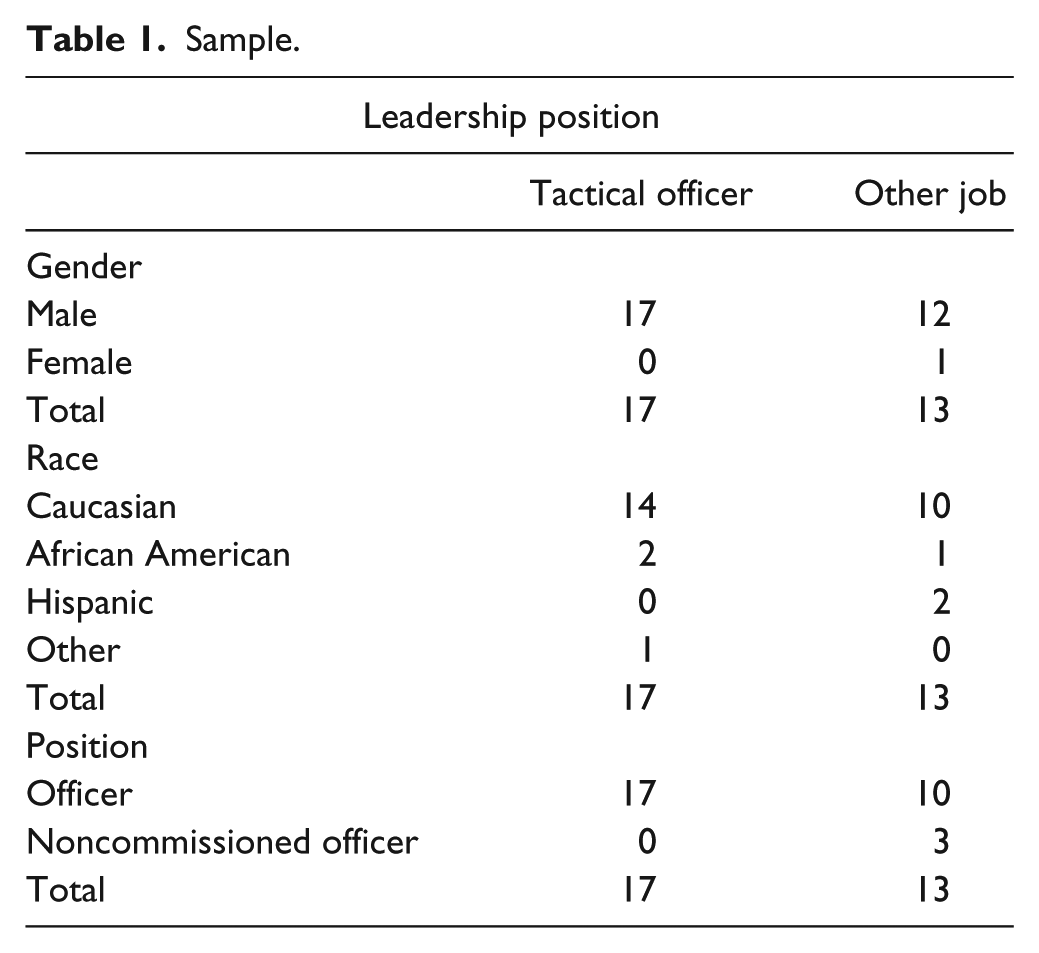
Our sample consisted of 30 mid-level soldiers (both officers and noncommissioned officers [NCOs]) with at least 8 years of leadership experience including recent experience in in extremis events in the Middle East. The majority held the rank of Captain or Major, although several senior NCOs also participated. Many were enrolled in the Eisenhower Leadership Development Program at West Point, in training as Tactical (TAC) Officers (17/30) or mentors to cadets. Others were West Point instructors.
The sample included 27 officers and three NCOs between the ages of 27 and 45 years. Three were African Americans, three were Hispanic, and one was female. Women, although officially comprising 15% of Army personnel, were still banned from most direct combat roles (McSally, 2007; Simons, 2001), thus making it difficult to include them in the sample. Sample demographics including gender, position at West Point, and ethnicity were mapped against jobs and are identified in Table 1.
Sample.
Our participants were selected for this study because they were newly assigned to West Point and most had come directly from combat tours. The academy seeks recent combat veterans to lead and mentor the cadets who will face these in extremis situations in the future. Approval to conduct this research was obtained from the U.S. Military Academy at West Point. Participation was voluntary, and all individuals who volunteered for the study were interviewed.
Each participant was asked to think about a time when he or she felt his or her team’s lives were in danger and to describe in detail how the event transpired and was resolved. The question was started by asking, Think of a time that stands out in your mind when you were in charge of one or more soldiers, and suddenly your lives were in peril. In this instance, because you were in charge, the others relied on you for direction. I’d like to understand everything about that situation.
Probes were used to elicit elaborate detail (see Interview Protocol in the appendix). Thereafter, if time permitted, the respondent was asked to narrate a story with a different outcome: If the first narrative had a positive outcome, the second was a narrative with a negative outcome and vice versa. All leaders interviewed shared at least one story. The majority of the respondents had more than one story, but for some, their timing was such that 1 hour was not sufficient to discuss both.
Many participants acknowledged not having previously detailed the events they reported to anyone other than the subordinates directly involved. Many became emotional reliving the events and some revealed that narrating them triggered recollection of details not consciously considered since the event. An example of an emotional moment that defined a leadership style is as follows: I still to this day, believe that (John)’s dying was my fault. It defines my whole leadership model from there on out. When you’re in charge, be in charge. If you know what the right answer is, don’t accept any dissent. It really defined me as a leader and how I lead my teams after that. (I31)
These soldiers were not just remembering, but were reconstructing and sensemaking; each reconstruction of events was affected by others (Weick, 1979).
Data Analysis
Data analysis commenced with data collection. Although computer programs can help with the organizing the data, the analysis is completed by the researcher (Patton, 2002). The audio recording of every interview was carefully reviewed, and each transcript was read several times before formal analysis began. About a quarter of the interviewees shared more than one story; one individual shared four stories. A total of 51 incidents were reported. The unit of analysis, however, remained on the individual versus the incident.
The interviews yielded 627 pages of transcribed text. Immediately after the transcription of each interview, we “open-coded” it, reading line by line to identify words, sentences, or phrases with possible significance (Boyatzis, 1998, p. 1) of the interviewees that stuck out or resonated in some way. This process resulted in the selection of over 1,100 fragments of text, each of which was tentatively labeled, then sorted into preliminary categories with similarly labeled text from previous interviews. This first phase of coding resulted in 48 categories (see Figure 2). This process is an example of the retranscription methodology for analyzing narratives suggested by Riessman (1993).

Coding categories.
Next, we examined these categories looking for relationships between them, in some cases merging and/or relabeling the categories and documenting ideas and themes emerging from them. Several levels of coding occurred as surface statements were examined, grouped into conceptually oriented and then final categories (Corley & Gioia, 2004; Pratt, 2009). Throughout this rigorous process, we operated with meanings loosely held—ready to change based on emergent themes (Miles & Huberman, 1994). We then began interpreting the data using comparative analysis (Glaser & Strauss, 1967) and narrowed down to 32 subthemes. In a final phase of analysis, we focused on the five key categories from which the findings emerged (see Table 2 for data structure). The findings emerged from writing individual memos and discussing perceived patterns, concurrent with the coding process.
Data Structure.

Note. JRTC = Joint Readiness Training Center.
Interpreting qualitative data can be a challenge, but semiotic analysis facilitated our organization and analysis of the data (Feldman, 1995); a key assumption of semiotic analysis is that there is an underlying structure of one’s culture that is related to spoken statements on the surface. Semiotics then, “is concerned with identifying signs and understanding the processes by which they come to have meaning” (Feldman, 1995, p. 22). We employed a clustering technique (Manning, 1987) that creates a table with three columns: the text being analyzed, a first level of abstraction as subthemes, and a higher level abstraction of findings (see Table 2). The analysis and grouping of the data rely on the researcher’s familiarity with the culture to “draw many pieces together into a pattern that can increase the significance of the data both to the researcher and to the audience” (Feldman, 1995, p. 24). Semiotic clustering can help the researcher discover associations that may not be intuitively obvious to the casual observer. Note how the code examples in the first column of Table 2 lead to the subthemes in the second column, which, in turn, lead to the aggregate findings in the third column.
An example from our data was the idea of the leader’s “being in the zone” when in an intense situation. The leaders used words such as “single-mindedness, focused and seeing through the fog” to refer to the idea of being in the flow or the zone during battle. Those and similar words were grouped into the first column. The second column was a higher level abstraction of connotative meanings. What does it mean when someone from this (Army) culture is discussing this? The final column reflects the “leap” (Feldman, 1995, p. 25) which helps consolidate the ideas in the second column and connect them as the findings.
Validity and Reliability
Assessing validity and reliability of the analysis was an integral component of this effort (Golafshani, 2003; Morse, Barrett, Mayan, Olson, & Spiers, 2002). Validity, for this project, is a term for how trustworthy is the source and what is the generalizability of the study (Schwandt, Lincoln, & Guba, 2007). The idea is the study can be verified by “checking, confirming, making sure, and being certain,” an iterative process that helps ensure congruence as the researcher moves back and forth between the data and not necessarily in a straight line (Morse et al., 2002, p. 17).
At each stage of the data analysis above, the lead author constructed her theoretical assessment and then presented the data and assessment to the other authors for independent interpretation and further refinement. After several iterations involving discussion and self-reflection (Saldaña, 2015), interrater consistency was achieved within the research team. As Kirk and Miller (1986) posit, “reliability, then—like validity, is meaningful only by reference to some theory” (p. 50). Consequently, the authors achieved theoretical coherence and reliability through a multistage iterative process of individual analysis, discussion, and revision. This approach was essential for this exploratory study of phenomena that have been only loosely examined previously.
Rigor
This study included a rigorous approach to every step of the research process. There was “extensive data collection,” “multiple levels of data analysis” moving from small lines of code to broader themes (see Figure 1), and finally, “peer auditor” of the data (Creswell, 2013, p. 54), all to ensure the data were handled meticulously.
Findings
Our initial sense of the importance of this topic was validated after being in combat, then again after spending so much time with recent combat veterans. According to our findings, effective leadership in extremis occurs when leaders successfully make sense of a life-threatening context and are able to convey that socially constructed sense to those around them. From our interview data, we identified five key sensemaking activities that enable effective leadership under these most stressful situations. Those activities are characterized by synchronicity, hyper- focus, reciprocity, sense of duty, and instinctive reaction training.
Veterans and other in extremis leaders should benefit from a better understanding of the dynamics of these environments and the interactions that affect team performance. Figure 1 provides an integrated look at how these various elements interact to achieve effective sensemaking. Overall, our model reflects the fundamental dichotomy between the “retrospective” and “ongoing” characteristics that Weick (1995) identified in his original exposition of the sensemaking framework. Our findings blur the temporal distinction between sensemaking and sensegiving activities. In the intensive and compressed context of in extremis environments, successful leaders will process environmental cues at the same time they are conveying critical information to their subordinates. The following sections provide a detailed look at each of the five findings from the research.
Finding 1: Synchronicity
Consciously or not, leaders make and give sense concurrently, continually refining and revising both. As such, in extremis sensemaking and sensegiving are iterative, recursive, and overlapping parts of a single process (see Figure 3). This synchronicity provides a link between the conflicting “retrospective” and “ongoing” nature of sensemaking that is present in previous literature (Weick, 1995) and the dynamic nature of sensegiving.

Synchronous sensemaking and sensegiving.
During in extremis situations, there is often not a moment to lose. The first inchoate “sense” that a leader and his command may be in extremis triggers a sensemaking/sensegiving cycle. Although the leader may not have time to rationally process the incipient “sense” of an in extremis moment, he or she must swiftly communicate it to subordinates. The pressure of time adds extra stress to the dangerous situation (Hannah et al., 2009). As one officer observed, “It happens so fast that you don’t have time to think. You just react” (I15). Another, who was suddenly shot during a mission and lacked sufficient information to make immediate sense of the situation reported, So I’m thinking, I don’t even know which way to send everybody. I don’t have time for that, or I won’t be able to give orders in a minute because I’ll be gone, so I just yell out, “cover!” (meaning) find yourself some cover and then we’ll work it out. (I12)
A fuller “sense” of the perilous situation, iteratively communicated to this leader’s unit reflected an evolving understanding of it, adjusted and refined as additional information became available. As similar quotes in Table 3 suggest, a military leader’s immediate “sense” of an in extremis situation is often sudden, emotional, and unclear—but despite the pressures of time and insufficiency of data, he or she begins sensemaking and sensegiving to subordinates spontaneously.
Sensemaking and Sensegiving Occur Simultaneously.

Note. IED = improvised explosive device.
One leader explained his process, The Vehicle-Borne IED [improvised explosive device] hit the truck and instantly just put it into a ball of flames. From then, it was followed by an ambush. . . . I didn’t want to scream or make it out worse than it was ‘cause I knew that everyone was listening on the net, and they would take cues from that. (I30)
He was conscious in the role as a leader because he knew others were listening and would take signals on how to act from his response. Once initiated, a continuous cycle of sensemaking and sensegiving ensues as information about the situation accumulates and is processed.
Finding 2: Hyper-Focus
During in extremis situations, our respondents reported often becoming hyper-focused, a state described in vivo as “in the zone” or “in the moment” and characterized by a concentration of energy and attention on the problem they faced. As one leader, describing an event when he was “in the zone” explained, Being in the moment is not worrying about anything else; about experiencing what is going on at that particular point in time. I think it allows you to strip away all the peripheral that doesn’t matter. It allows me to make quicker judgments about friend or foe . . . or what I think we need to do. (I16)
Another informant, discussing this state called it having “your head in the game”; “. . . I mean you’re focused. You know what needs to be done, and you go do it, and you ensure others around you do it” (I20). A third described it as “a heightened state of arousal that tells me that this is important” (I17) and another explained it as being “. . . hyper-focused . . . [having] inherent ability to see through all the fog and make the kind of decisions and do the kind of things that are absolutely necessary to help control the chaos” (I27). In that state, one is, a leader revealed, “. . . focused . . . committed and wholeheartedly in it” while “not having your head in the game (is) going through the motions . . .” (I26).
In narrative after narrative, our respondents related this superattentive state to their ability to absorb environmental cues, make quick decisions based on inadequate data and convey critical orders to subordinates. When in this state, leaders reported filtering out data they deemed superfluous or irrelevant to problem solution—including in some cases their own physical injuries.
I banged my knee really hard on the blue force tracker, which I didn’t even notice at the time. I saw, a couple of days later, a huge bruise, but I didn’t feel or even remember. I’m sure that that’s what happened, so I knew that I was pretty focused or single-minded. I don’t worry about the compartmentalization of being able to deal with the here and now and not be distracted by other things that don’t contribute to the solution of the immediate problem. (I30) When you’re being shot at, you shouldn’t have any other choice or option but to be in the moment . . . you have to focus on what you’re doing at this particular point in time . . . the good thing about being in the moment is when you’re well trained, you don’t have to think about a lot of things. (I16)
Finding 3: Sense of Duty
We found significant clustering from our respondents about the concept of duty. Although qualitative work can be enriched by outliers (Creswell, 2013), the quantity of respondents who mentioned this finding was significant enough to surprise the researchers.
Nineteen of our 30 military leaders (63%) explicitly commented on striving to “do my duty” during in extremis situations. This included presenting themselves favorably to their soldiers and performing to the expected standard. As one officer, describing his priorities said, More than coming home alive, which I obviously wanted to do, more than that, I wanted to do my duty, and I didn’t want to be a coward. I prayed, “God, let me do my duty today, No. 1, and let me live through the day, No. 2.” (I30)
Followers tend to look toward and rely more on leaders to help them make sense in crises situations (Bastardoz, Jacquart, & Antonakis, 2015; Johnson, 2014), and leaders inherently understand this. A commander, recounting a situation in which he was the only person in proximity when someone else was hit remarked, I was worried about not performing up to the standard that I would expect of anybody else, of him dying right there, of not knowing what to do. But I think the biggest fear was not performing. . . . I’m supposed to be the man, and if I f*** this up, I’d never live it down whether or not the guys would be okay with it. And that was almost more of a fear than him actually dying, I think, at the moment. That was really important to me. (I26)
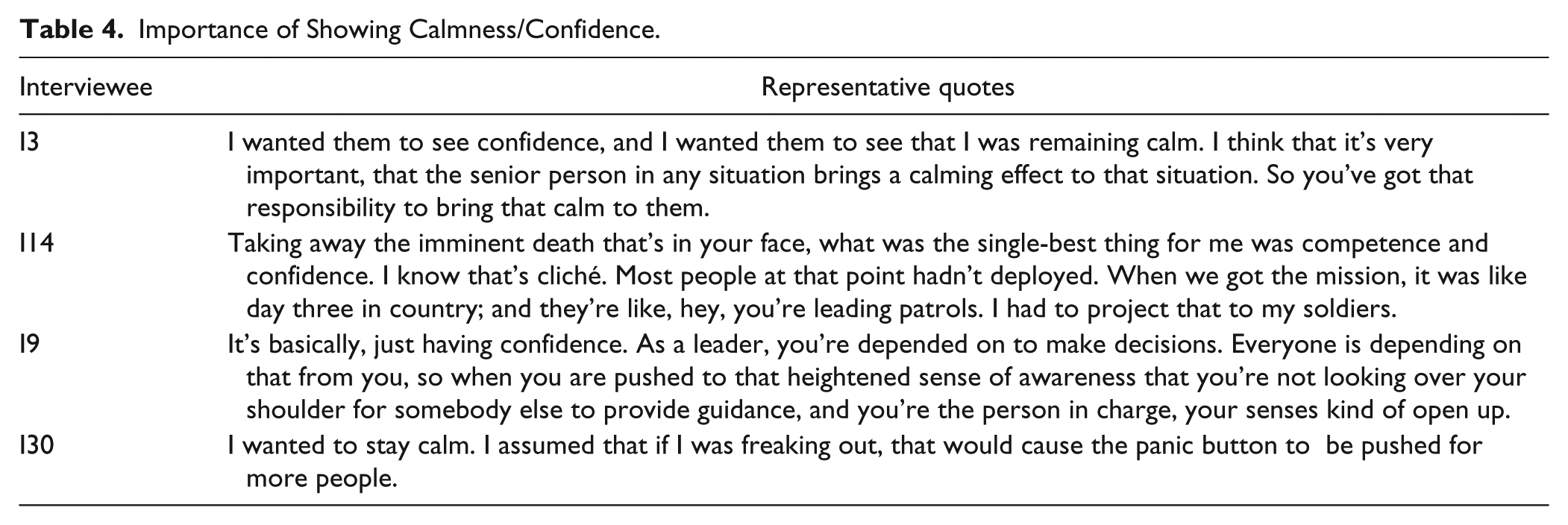
Twenty-six of the soldiers (87%) independently acknowledged consciously striving to project calmness and confidence to subordinates in in extremis situations. One officer explained, “I wanted them to see confidence, and I wanted them to see that I was remaining calm. I think that’s very important, that the senior person in any situation brings a calming effect to that situation” (I3). While the leaders conceded fear and anxiety, they were aware of the importance of projecting control and understood how their physical and emotional demeanor might affect subordinates’ behavior. This reflects an Army study (United States Army, 2012) of junior officers in Afghanistan identifying that the top five leadership attributes necessary for success included both confidence (ranked Number 1) and duty (ranked Number 5; see Table 4).
Importance of Showing Calmness/Confidence.
Finding 4: Reciprocity
Several of our respondents narrated in extremis experiences in which subordinates participated in sensemaking and sensegiving—either having been delegated to do so or having proactively seized that opportunity. The latter was explained by leaders as occurring when they were emotionally overcome in an in extremis situation—no longer “in the zone” and operating with reduced decision-making capacity. At such times, subordinates might intervene to interpret a situation, suggest appropriate action and encourage communication of it to others, thereby facilitating and sometimes retriggering the leader’s own sensemaking process. Eight of our 30 (27%) respondents shared an occasion in which subordinates helped them make sense of a situation when they had become overwhelmed. A leader caught in an ambush with overwhelming odds described he was trying to move to the next village and wait for reinforcements and move his injured men when his NCO told him, “Sir, we need to get the hell out of here. We cannot be here.” The leader explained to the interviewer, “He helped me come to that decision because I was—the adrenaline is starting—my quick reaction thinking is now starting to break down” (I1). Another officer was in an in extremis situation and said he was yelling and not cognizant of a soldier’s intentions and the NCO grabbed him and exclaimed, “Sir, calm down!” The officer realized that he “wouldn’t want to say panicked, but anxiety maybe would be the right word” (I8; see Table 5).
Sensegiving by Subordinates and Leader’s Reactions.
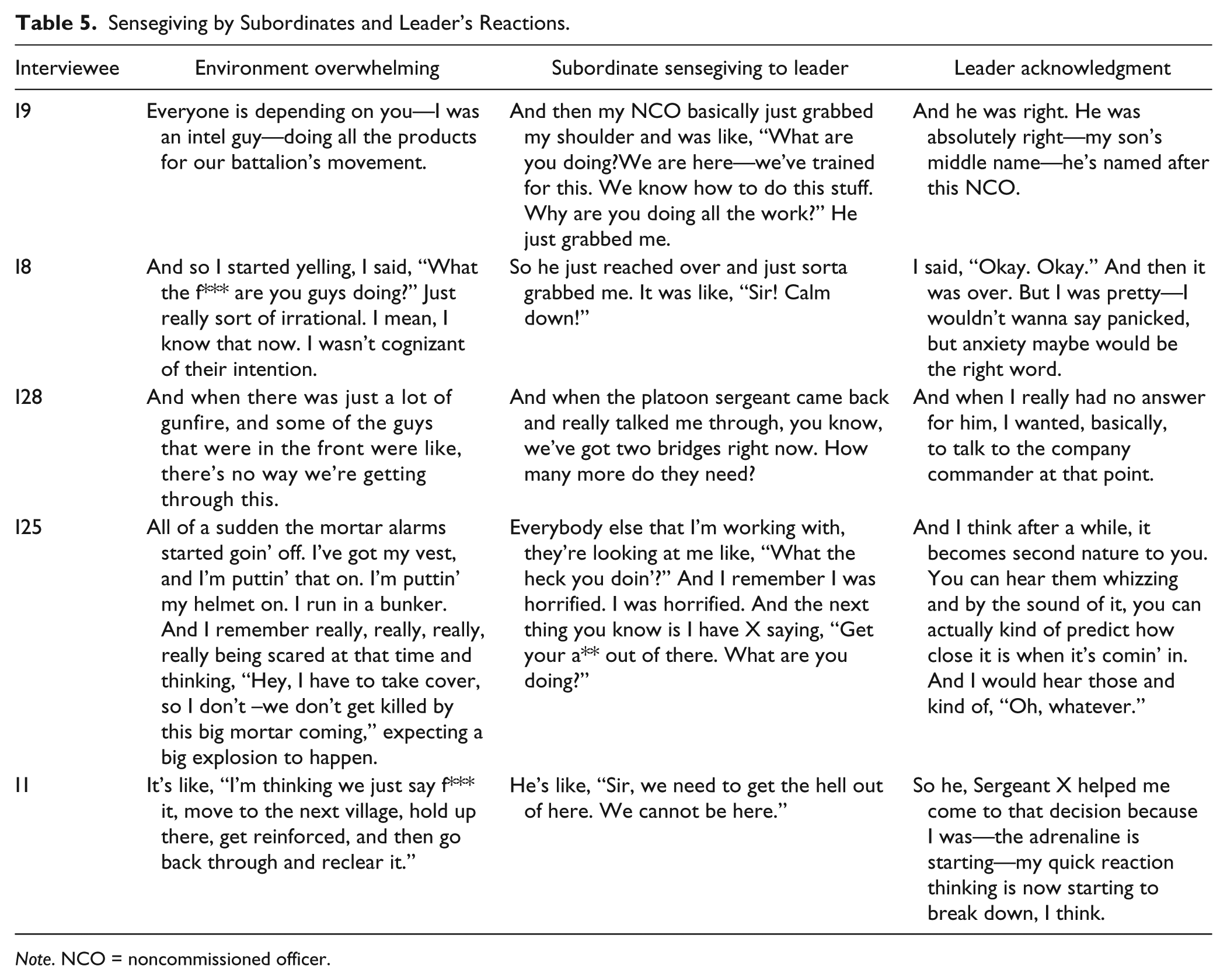
Note. NCO = noncommissioned officer.
Finding 5: Instinctive Reaction Training
Ninety percent of our respondents referenced the role of training in surviving in extremis situations, noting that it allowed them to respond “instinctively” or “intuitively” to certain circumstances when time-consuming, purposeful consideration of alternatives was not an option. As one leader, describing his spontaneous reaction to a sense of unanticipated danger, said, You’re sometimes not truly thinking through the decisions you’re making on a conscious level. I didn’t think, “oh, we need to get the vehicles up” or “we need to lay down, suppress the fire to consolidate the elements.” I didn’t think through it like that. It was just . . . instinctive. (I26)
The instinct comes, our respondents revealed, from training.
Battle drills are the key to successful units . . . you rehearse, rehearse, rehearse battle drills, saving time. What will truly matter is how do your soldiers, how does the unit react in that situation? And it comes like muscle memory, they just do. They just execute because they’ve done it so much already. It’s a rehearsed action. They know how to react because it’s subconsciously built into them. That’s how vital battle drills are in my opinion. (I1)
The instinct and training also came into play with the teams. As one officer noted, So a lot of it is just reaction, but it’s reaction based off prior experiences. A lot of it’s just instinct based on training, I guess I could say. When I’m working with a group of guys, my team leaders know how I’m gonna react. (I10)
One officer explained how it was supposed to be, “This was toward the end of the deployment and we’d been shot at tons, like I’ve been in 40, 50 firefights, direct fire contacts up to this point. So I mean we were seasoned veterans. We’d been doing this. It was like another thing, you get into fights, just another fire fight. No big deal. You know, all the guys knew how to fight, knew how to react. (I1)
As evidenced by the interview excerpts in Table 6, most leaders acknowledged the importance of training as freeing them to act without thinking.
Training Examples.

Discussion
The authors’ personal in extremis experiences motivated an exploration of the issues confronted by leaders in these environments. Effective leadership can make a difference for soldiers and their families for generations to come. The authors’ embedded “sense of duty” compelled an attempt to contribute to the understanding of the complexity of in extremis leadership.
By recounting the details of specific instances in which they led imperiled troops, these soldiers promoted understanding of in extremis leadership in general, and what emerged from the data were details on how leaders make and give sense in life-threatening situations, clear patterns emerged from their stories that clarified how in extremis situations are experienced and managed. The data characterized in extremis situations as a special case of dynamic states in which hyper-focus, sense of duty, and training informs a perceptual cycle of sensemaking and sensegiving (see Figure 1).
According to Weick (1995), by punctuating flows of information coming to them, individuals prioritize what is important and reduce process load. As discussed below, this article’s data suggest hyper-focus, sense of duty, and training help create this punctuated circular interaction between sensemaking and sensegiving during in extremis situations. As mentioned earlier, this insight provides a bridge between the “ongoing” and “retrospective” properties discussed in the sensemaking literature.
The following sections add depth to the model and illustrate how leaders enact the various principles outlined in the findings when under stress in these volatile situations. Hyperfocus enables more effective situational awareness, a sense of duty manifests itself through the presentation of self, and instinctive reaction training enables a distributed cognitive capacity between leaders and subordinates. Ultimately, these elements illustrate how information processing, information distribution, and sensemaking are interdependent during effective leadership activities in these difficult situations.
Hyper-Focus and Situational Awareness
Respondents in this study distinguished, as reported in Finding 2, a particular, heightened state of situational awareness they called “being in the zone” when they were “hyper-focused” on interpretation and comprehension of environmental cues. Hyper-focus is defined as a state of heightened mindfulness in an in extremis situation when he or she is most highly immersed in the receipt and sending of signals. This state of hyper-focus allows leaders to assess the environment and take decisive action during the heightened emotional context of a life-threatening situation. When leaders achieve this hyperfocus, the result is improved situational awareness during life-threatening situations.
The authors recognize the similarity of “being in the zone” to the state described by Weick, Sutcliffe, and Obstfeld (2008) in a discussion about situational awareness and high-reliability organization actors who “have the bubble” (p. 43). Weick borrowed the phrase used by the Navy to describe how crews create cognitive maps from disparate information to get a single picture of a situation. In the psychology literature, this mental peak focus and immersion in an activity (Tardy & Snyder, 2004) has also been called “flow” (Csikszentmihalyi, 1997; Csikszentmihalyi & Jackson, 1999; Nakamura & Csikszentmihalyi, 2002). The data demonstrated that for military leaders who are in the “flow,” the “bubble” or the “zone,” attention and action helped improve situational awareness and concurrently improved the making of mental models (or sense).
This increase in both the ability to hyper-focus and situational awareness leads to an increased ability to understand the cyclical nature of sensemaking and sensegiving. The hyper-focus on what is noticed, comprehended, integrated, and projected evolves into a “perceptual cycle” of sensemaking and sensegiving; therefore, situational awareness is increased.
The data from the respondents consistently conveyed the importance of being “in the zone” as paramount for in extremis leadership. Therefore, Finding 2 also supports the theory that a “hyper-focus” state can increase situational awareness.
This increase in both the ability to hyper-focus and situational awareness leads to an increased ability to understand the cyclical nature of sensemaking and sensegiving. The hyper-focus on what is noticed, comprehended, integrated, and projected evolves into a “perceptual cycle” of sensemaking and sensegiving; therefore, situational awareness is increased.
Because hyper-focus can lead to an increase in situational awareness, training to increase hyper-focus is imperative for in extremis leaders. The literature referencing situational awareness supports the theory that hyper-focus can be increased through training. “Whereas situational awareness refers generically to the big picture that any operator forms, having the bubble refers to an effortful achievement of a high level of situational awareness” (Weick et al., 2008, p. 43). Weick (1988) quotes LaPorte as observing, “The effort and intensity of purpose required to build what we sometimes characterize as the ‘bubble,’ the state of cognitive integration and collective mind that allows the integration of tightly- coupled interactive complexity as a dynamic operational process, is enormous” (Weick et al., 2008, p. 43). This heightened sense of awareness, Weick et al. (2008) argued, infers “ongoing action occurs simultaneously with attention and people act thinkingly with wisdom and heed” (p. 43; italics added).
The situational awareness literature, therefore, emphasizes that situational awareness is largely (though not entirely) cognitive and can be enriched by experience (Hartman & Secrist, 1991), abilities, and training (Endsley, 1995b, p. 35). Thus it requires both “active attentional and inferential processes and . . . significant perceptual and cognitive resources” (Andre, 1998, p. 519). Endsley (2015) noted that situational awareness can be used with dynamic environments to understand meaning (see Figure 4).
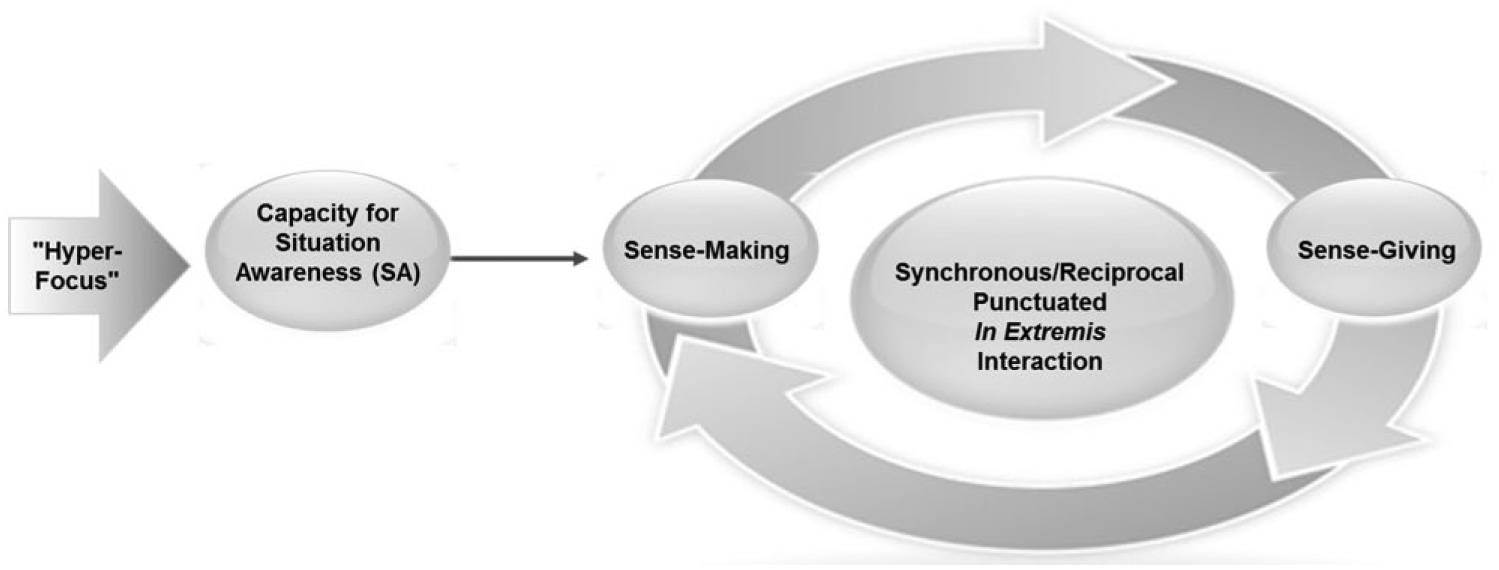
Hyper-focus.
Sense of Duty and Capacity for Presentation
Doing one’s duty has its foundations in organizational citizenship behavior (Organ, 1997; Smith, Organ, & Near, 1983), where individuals care more about other things than money (Gneezy & Rustichini, 2000). Tinoco and Arnaud (2013) have described a sense of duty for an organization, but this article’s discussion involves a sense of duty at the individual level. For the purposes of this research, sense of duty is defined as the willingness to sacrifice oneself, and the willingness to help others. One must be willing to risk oneself and not simply direct others into harm’s way. Willingness to incur personal sacrifice is clearly a part of doing one’s duty. Individuals motivated to do public service may be drawn to this type of honorableness— helping others through a sense of duty, or even, at the extreme, to self-sacrifice (Perry, 1996).
This sense of duty can obligate individuals to take on a certain responsibility and defined role. As Goffman (1959) in elaborating the criticality of roles, observed, “When an actor takes on an established role, usually he finds that a particular front has already been established for it” (p. 27). This was certainly true for our leaders who were well trained to understand their “duty” and hence, their “front.” The interesting implication for our research is that leaders indicated that not only must they do their duty but also the presentation of self must exhibit that sense of duty to those around them.
Even in dangerous, tense, chaotic moments, our respondents prioritized maintaining a duty-bound standard of behavior equated with the role of “being a leader” and “in control.” So strong was this inclination that informants reported consciously taking stock of and monitoring their demeanor in the midst of in extremis events. Aware that an uncontrollable shaking leg might send an unintended signal to subordinates, for example, a leader purposefully moderated the tone, intensity, and speed with which he talked to communicate calmness and control: You see the bullets going, the tracers, rounds are snapping nearby, and I remember I had a physical fear—a physical reaction to fear that very first time. My leg was shaking. I was in my Stryker, in my hatch and we were moving along in a convoy and every single vehicle in front of me was just getting lit up RPG’s [Rocket Propelled Grenade], IED’s [Improvised Explosive Device], and we were just driving right through it. I was thinking, okay, we’re next, my leg was just shaking uncontrollably—I was hyperconscious about how my voice was gonna sound on the radio. Some of it was because it’s the pride thing; you don’t want to sound like you’re chicken or whatever, and also just so I can speak clearly, they can understand what’s going on, and receive the information without being, wow, he is scared out of his drawers right now, it must be really bad, or whatever the case is. So from then on forward, I always took the approach of no matter how close it gets, I would think how to control my own physical fear and my own physical reaction. (I12)
This behavior exemplifies Goffman’s (1959) notion of “presentation of self,” a theory of human behavior that defines humans as actors who perform on two stages— front and back. On the front stage, we present our “public” or ideal selves—behaving the way we wish others to see us—while on the backstage an actor can “step out of character” revealing his “real” self. According to Goffman (1959), “the expressiveness of the individual (and therefore his capacity to give impressions) appears to involve two radically different kinds of sign activity, the expression that he gives and the expression that he gives off” (p. 113). Front-stage performance, Goffman (1959) observes, must thus be impeccably crafted: “Even sympathetic audiences can be momentarily disturbed, shocked, and weakened in their faith by the discovery of a picayune discrepancy in the impressions presented to them” (p. 51).
Our leaders recognized the importance of avoiding a discrepancy in demeanor that might affect their sensegiving to subordinates. They sought to “look competent” to their teams by projecting calmness and confidence, qualities their training equated with leader status. Failure to do so risked that others might be “torn between two possible realities” (Goffman, 1959, p. 140). Therefore, the sense of duty and corresponding role identity as a leader influences both sensemaking and sensegiving and contributes to the cyclical nature of the model presented in Figure 5.
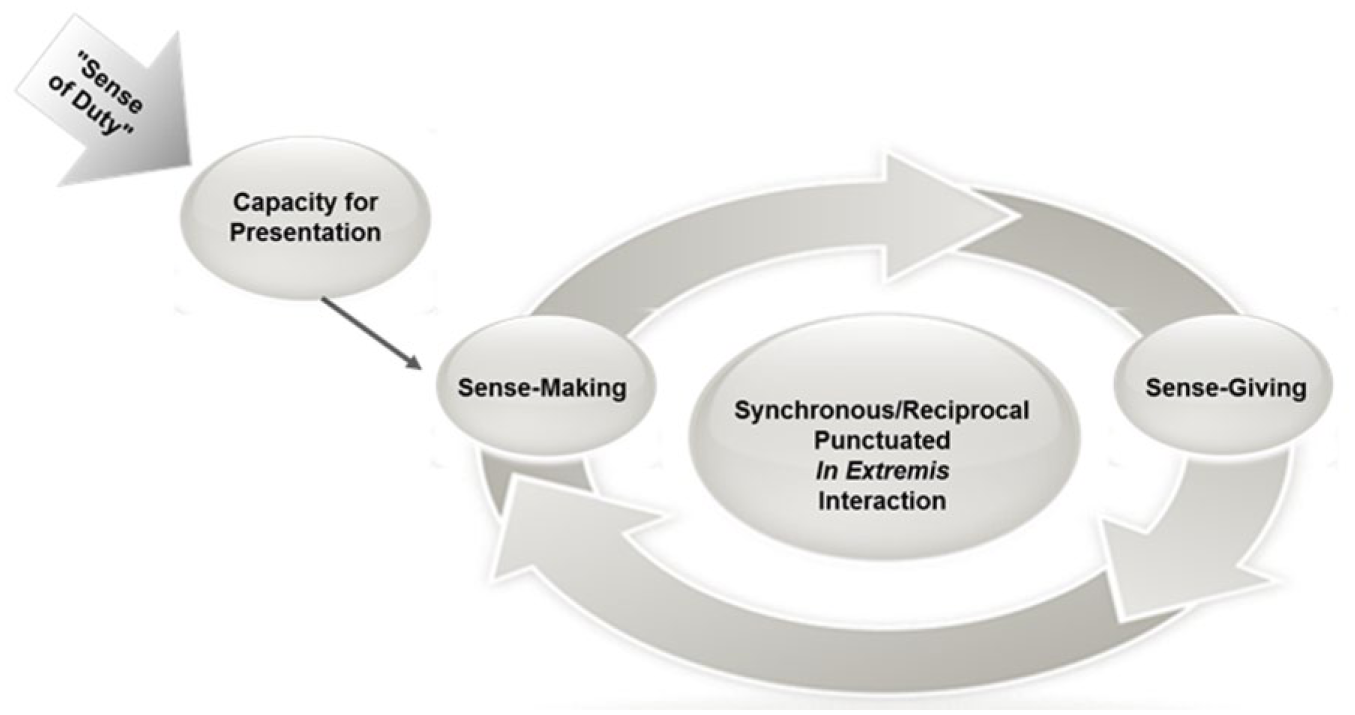
Sense of duty.
Instinctive Reaction Training and Distributed Cognition
Although, as Dreyfus (1997) observed, actors cannot rely on a memorized set of rules to deliver a successful solution, our informants suggested that training sometimes accelerates sensemaking by allowing them to respond instinctively to certain environmental cues thus “freeing up” cognitive space to attend to others. Moreover, leaders seem strongly influenced by training with respect to “how” they communicate to others the sense they are making in in extremis situations. Instinctive reaction training, or repetitive, intensive training that becomes ingrained and instinctual, can help facilitate cognition in in extremis situations.
Our informants revealed drawing on this complex combination of people, environmental factors, artifacts, and heuristics when making and giving in extremis sense. The majority of the sensemaking literature discusses the leader sensegiving to subordinates (Filstad, 2014; Guimarães & Alves, 2014; Matsuo, 2015); our study differs in that it illustrates that this can also work in reverse. Moreover, intensive training frees up distributed cognitive capacity of the team and enables more effective give and take between the leader and subordinates.
During dangerous events, subordinates usually look to their leader (Geier, 2016; Hannah et al., 2009), but our leaders indicated that they were also given “sense” from subordinates. This occurred under various circumstances, such as when leader’s sensemaking was impaired by stress or when their situational awareness was inhibited (or that of others was enhanced) by proximity or access to environmental or other cues. This finding tracks with recent military research that promotes the benefit to leaders of actively soliciting counsel and assistance from subordinates (Laurence, 2011), and when shared leadership may be required (Ramthun, 2013; Ramthun & Matkin, 2014). In distributed cognition, “collaborative” and “robust” decisions can result when every team member understands a mission and knows what others will do in a situation, yielding “knowledge redundancy” that allows anyone of them to make a decision if a leader cannot (Hansen, Gogan, & Baxter, 2012, p. 6). Our data include poignant revelations by several informants who became emotionally overwhelmed in specific in extremis situations and were aided by subordinates who proactively guided their sensemaking and sensegiving (see Figure 6). These leaders indicated that when sensemaking collapsed, intensive training as well as sensegiving by subordinates enabled effective action in these most difficult environments.

Instinctive reaction training.
After consideration of our findings and further examination of the implications of the research, we have developed the model presented earlier in Figure 1, which illustrates the interactive and interdependent nature of sensemaking and sensegiving during in extremis encounters. The research narratives revealed a hyper-focus state, a sense of duty, and training all helped leaders with a new time compressed form of sensemaking and sensegiving, which this research termed synchronous punctuated in extremis interactions. Self-presentation (indicative of Goffman), coupled with capacity for situational awareness (especially that heighten sense of it our informants called “hyper- focus”) and distributed cognition (reflected in the use of training and intuition) advance understanding of how military leaders make and give sense during dynamic in extremis environments (see Figure 1).
Limitations
Our sample was limited to recently repatriated Army officers and some NCO leaders currently stationed at West Point including officers of other military services (e.g., Marines, Air Force, and Navy) who had also experienced in extremis situations may have produced different results. Our methodological approach required interviewees to recall past experiences and incidents—often emotional— and we understand the potential influence of retrospective biases. Our research design did not include interviews with other military personnel involved in the actual in extremis situations reported by our informants, including subordinates. Triangulation in these dynamic environments would be difficult due to the dynamic construction of military teams and the dangerous nature of the environments. Analyzing military teams that remain relatively constant, such as special operations teams, may be one way to achieve triangulation in the future. However, these teams’ operations are often classified, and members may not have the ability to discuss these operations. Another limitation arises because our study was within a singular type of organization, the U.S. Army; consequently, there was not as much variation in identity construction as may occur when other organizations are examined.
Implications for Practice and Future Research
Our work has implications for both future research and practice. Our results, highlighting the importance of individual capacities in the sensemaking and sensegiving process should be of interest and possible use to developers of military and/or other leadership training programs. While the theoretical notions of sensemaking and sensegiving may be appreciated by program developers, we suspect few curricula specify and introduce them in a practical way to participants.
In order for organizations to structure training to address these findings, specifically reciprocity and synchronicity, communications must be examined. This article’s findings emphasize the importance of ensuring team members know one another and practice communications in various environments and in reduced time situations.
The military instinctively does sense of duty training through the culture, but other organizations can also be intentional about developing a shared sense of duty in specific cultures (Tinoco & Arnaud, 2013). Encouraging employees to think of something bigger than themselves, or work toward a higher purpose may expedite this process for organizations.
Our work on instinctiveness and hyper-focus indicates that frequent repetitive training may be necessary to eliminate distractions and allow for increased cognitive processing not only during in extremis encounters but also during time sensitive situations. We are not advocating that individuals just learn by rote, but that like our soldiers, they learn the basics so they do not have to think about it during a crisis situation, which will free up their intellect for newer and higher cognitive actions.
Training is imperative to accomplish these desired outcomes of success in reciprocal and synchronous environments. The training must incorporate ideas for ensuring employees develop a sense of duty, higher communication levels, and become instinctive at the basic tasks required. Training programs may also not focus on the factors our data suggest powerfully influence sensemaking and sensegiving—for example, honing participants’ skills in sensing environmental cues or the role of self-awareness when sensegiving. While critical in in extremis situations, we expect these factors to be relevant in complex crisis situations (Dailey & Starbird, 2015) as well as in more benign organizational settings.
With respect to future research, our findings suggest several promising paths. Our access to participants for this study was limited to individual Army leaders. Much could be learned by researching not only the leader in an in extremis situation but also the followers. Doing so would allow fuller modeling of the dynamic dimensions of sensemaking/sensegiving in life and death situations. Studies that compare sensemaking and giving in different situations are also recommended to identify factors that affect them in varied settings or circumstances. Exploring the context and the construction of leadership in the area between leaders and followers is another area that could benefit from additional examination. Finally, examining the adaptability of leaders, how they can “adjust their thoughts and behaviors to enact appropriate responses” (Hannah, Balthazard, Waldman, Jennings, & Thatcher, 2013, p. 393) in these extreme contexts would be an important addition.
Footnotes
Appendix
Declaration of Conflicting Interests
The author(s) declared no potential conflicts of interest with respect to the research, authorship, and/or publication of this article.
Funding
The author(s) received no financial support for the research, authorship, and/or publication of this article.