




Abstract
Despite the large number of factors at work that have been linked to personal Internet use (PIU), ethical leadership has not yet been examined. The first aim of this study is to test whether ethical leadership is associated with employees’ participation in PIU, specifically with cyberloafing and e-citizenship. The article then proposes an explanation for this linkage. The prediction is made that ethical leadership influences the way followers perceive corporate culture, which, in turn, leads them to PIU. Questionnaire data from 300 employees at 100 investment banks in the City of London on ethical leadership, Cameron and Quinn’s corporate cultures, cyberloafing, and e-citizenship were analyzed. Results found a significant negative relationship between ethical leadership and cyberloafing, and a positive relationship with e-citizenship. Once corporate culture was entered into the model as a mediator, ethical leadership also showed significant links with corporate culture, which, in turn, acted as a significant mediator. All the culture types performed as partial mediators in ethical leadership’s association with cybercivism, and only adhocracy culture performed as a full mediator in the case of cyberloafing. A practical implication is that managers should pay explicit attention to the advantages of supervising PIU with ethical values and, especially in the case of cyberloafing, with the innovative values of adhocracy culture.
Introduction
The constant spread of new technologies (information and communications technology) in recent decades has led management research to pay attention to how and why employees engage in personal Internet use (PIU). PIU encompasses prevalent employee non–work-related activities, while using the company IT resources in the workplace. Inappropriate PIU can become a costly issue for organizations, affecting them both financially and socially.
One way employees often practice these cyber activities at work is by engaging in cyberloafing. V. K. G. Lim (2002) defined cyberloafing as employees’ voluntary misuse of their companies’ Internet access for non–work-related purposes during working hours (V. K. G. Lim, 2002; V. K. Lim & Teo, 2005), including organizationally deviant acts such as downloading software or files for personal or family use and escaping by surfing the Internet. Malachowski (2006) refers to cyberloafing as the most prevalent way for employees to waste time at work. As such, anecdotal evidence from Fox (2007) confirms that employees may come to spend as many as 5 to 6 hours a day engaged in this inappropriate way of surfing the Internet at work. On the other hand, e-citizenship, or cybercivism activities (Zoghbi-Manrique-de-Lara, 2007), have also been suggested as a frequent type of PIU. In contrast to cyberloafing, where employees misuse the company’s Internet resources, e-citizenship activities have generally been conceptualized as prosocial use of these company Internet resources (Anandarajan, Simmers, & D’Ovidio, 2011). Because e-citizenship is organizational citizenship behavior, albeit performed on the Internet—that is, employees’ voluntary behaviors that are not directly or explicitly recognized by the formal reward system (Organ, 1988), e-citizenship shares with cyberloafing the fact that both comprise discretionary nonwork activities that go beyond job requirements. Unlike cyberloafing, which can be counterproductive, e-citizenship activities are instead able to provide benefits to the organization directly and, by including practices that improve daily work processes and work design, to the employee indirectly (Anandarajan et al., 2011). Examples of e-citizenship include interpersonally targeted cybercivic behaviors of employees, such as responding to misdirected e-mails, voluntarily helping peers by sending Web information, or supporting peers online in their successes and setbacks.
The potential risks and benefits of cyberloafing and e-citizenship for the organization have motivated a significant number of studies on managing strategies designed to effectively monitor these cyber activities. In this regard, prior work has suggested a vast number of different antecedents that can have a direct influence on PIU. For example, designing a workplace that employees perceive to be fair has been supported as an effective self-regulatory strategy to deter cyberloafing (V. K. G. Lim, 2002; V. K. Lim & Teo, 2005; Zoghbi-Manrique-de-Lara, 2009). Similarly, some prior research has found that employees engage in e-citizenship, or cybercivism, to the extent that they are satisfied with the work context (Zoghbi-Manrique-de-Lara, 2006). Other factors that have been found to be relevant in predicting PIU activities include role ambiguity and role conflict (Henle & Blanchard, 2008), self-control (Ugrin, Pearson, & Odom, 2008), self-regulation (Prasad, Lim, & Chen, 2010), perceived benefits (Li et al., 2010), organizational security policies (e.g., Shepherd & Klein 2012), social norms (e.g., Liberman, Seidman, Mckenna, & Buffardi, 2011), habit (Moody & Siponen, 2013), and demographic factors (Jia, Jia, & Karau, 2013).
Despite the fact that cyberloafing and e-citizenship could predict behavioral ethics at work, the role the leader’s ethical behavior can play in monitor cyberloafing and e-citizenship has been overlooked by the current PIU literature. PIU activities encompass socially proscribed acts of misconduct because they violate significant organizational standards or ethically exemplary behavior because—as in the case of e-citizenship—they can substantially exceed moral minimums. As PIU behaviors can be associated with behavioral ethics at work, they may be susceptible to being monitored by ethical leadership. In fact, numerous theorists and practitioners in the area of management and organizational behavior have suggested that the leader’s ethical behavior is one of the most relevant factors in influencing employees’ ethical conduct at work (e.g., Brown & Treviño, 2006). It is certainly unlikely that these behaviors can be successfully monitored through strategies other than those encouraging ethical or intrinsic motives. As these cyber activities are hardly detectable by supervisors because they often have low visibility, or are not even required, as in the case of e-citizenship, it seems unlikely that employees engage in or refrain from engaging in PIU just to avoid formal sanctions (Kuvaas & Dysvik, 2009; Piccolo & Colquitt, 2006). To address this gap, therefore, this study will test whether ethical leadership can be a useful tool for managing PIUs because it is significantly related to cyberloafing and e-citizenship activities.
The underlying mechanisms through which ethical leadership is related to cyberloafing and e-citizenship also appear to be underexamined. In this regard, this study contends that the corporate culture shows favorable signs that can be modeled to explain why ethical leadership is related to cyberloafing and e-citizenship. In fact, some prior studies on information technology use suggest that culture-based strategies are critical in influencing employees’ diffusion, adoption, and use of information technology within organizations (Burkhardt, 1994; Cooper, 1994; Grote & Baitsch, 1991; Pliskin, Romm, Lee, & Weber, 1993; Robey, Gupta, & Rodriguez-Diaz, 1992; Romm, Pliskin, Weber, & Lee, 1991). Furthermore, this attempt would be consistent with the culture literature in general, which identifies leaders, especially founders, as critical influential actors in forming and changing corporate cultures, which, in turn, are reflected in performance (for an overview, see Schein, 2010). However, the current literature on PIU has overlooked the study of the link from the leader’s ethical behavior to individual engagement in cyberloafing and e-citizenship through organizational culture. To address this shortcoming, this study will examine whether the corporate culture acts as a mediator in these relationships. If corporate culture is one reason ethical leadership is linked to PIU activities, both ethical leadership and corporate culture should provide managers with helpful tools to guide proper employee PIUs.
In summary, using structural equation modeling (SEM), this article first aims to test whether ethical leadership is negatively related to cyberloafing activity and positively to employee engagement in e-citizenship. The article then proposes to examine whether ethical leadership and corporate culture are also significantly related. After supporting these predictions, this article will examine whether corporate culture helps explain why ethical leadership is related to cyberloafing and e-citizenship, thus playing a mediating role in this relationship. Finally, the managerial implications of the results will be discussed.
Literature Review and Hypotheses
Ethical Leadership and PIU
Brown, Treviño, and Harrison (2005) define ethical leadership as the demonstration of normatively appropriate conduct through personal actions and interpersonal relationships, and the promotion of such conduct to followers through two-way communication, reinforcement, and decision making. Several studies provide support for a relationship between ethical leadership and a large number of positive attitudes and behaviors displayed by followers, including followers’ satisfaction, motivation, and commitment, ethical decision making, prosocial behavior, and decreased counterproductive behavior (e.g., Kim & Brymer, 2011; Mayer, Aquino, Greenbaum, & Kuenzi, 2012; Neubert, Carlson, Kacmar, Roberts, & Chonko, 2009; Zhu, May, & Avolio, 2004).
Social learning theory (Bandura, 1977) offers a rationale to justify why leaders’ performance can influence employees’ motivation to engage in PIU. Social learning theory (Bandura, 1977) suggests that when employees observe the consequences of others’ behavior (such as that of leaders), they use this information to ethically guide their own behavior. Acting ethically, therefore, supervisors can “set a good example” for followers and may be a key source of moral guidance (Brown & Treviño, 2006; Yukl, 2002). As discussed earlier, ethical leadership can be related to PIU because cyberloafing and e-citizenship predict behavioral ethics in work settings. Sharing “similar values” or “congruent values” with their leaders is a subjective evaluation that may exacerbate the staff’s moral state, making followers feel closer to their organization and peers (Collins, 1981, 1989; Gaudine & Thorne, 2001). Ethical leadership, therefore, may lead followers to be ethically obligated to help peers and the organization by engaging in e-citizenship or reducing cyberloafing, as these activities could put their company at risk (Brown & Treviño, 2006) (see Figure 1).
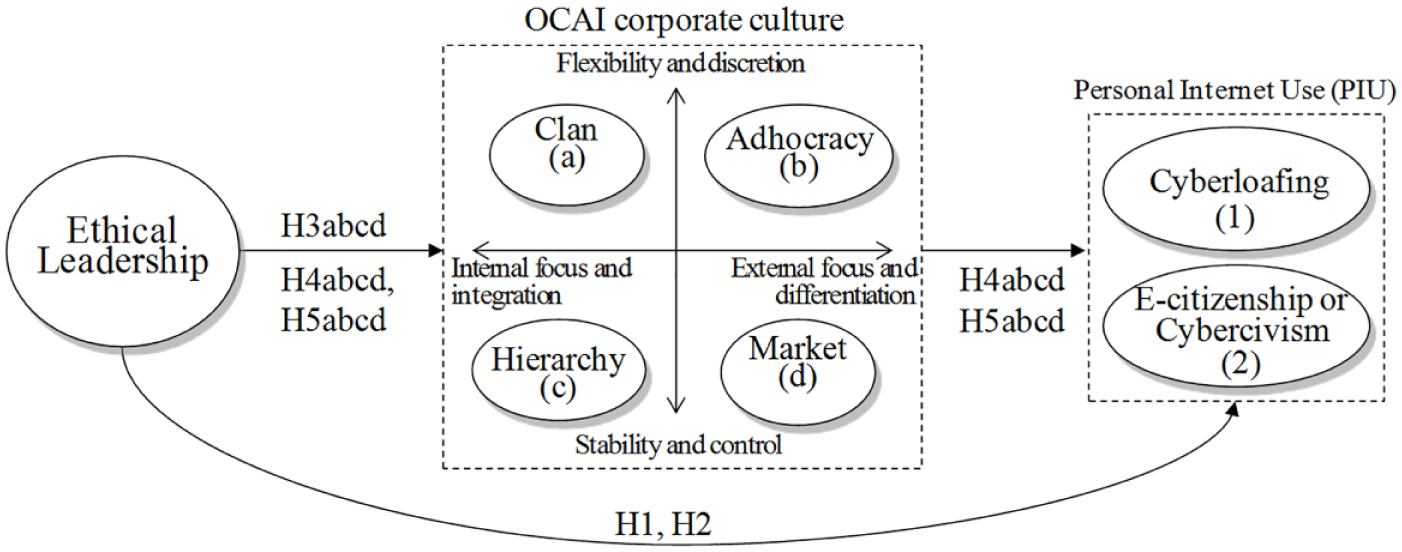
Hypothesized model of corporate culture as a mediator of the link between ethical leadership and personal Internet use.
Ethical Leadership and Corporate Culture
Deal and Kennedy (1982) conceptualize corporate culture as the underlying values and attitudes that affect the way things are done in an organization, that is, the “style” of “the way things are done around here.” Cameron and Quinn (1999) provide a tool to diagnose and measure the culture of an organization (Organizational Cultural Assessment Instrument [OCAI]). The OCAI uses four types of culture: clan, ad hoc (adhocracy), market, and hierarchy (see Figure 1). Theoretically, these four cultures are based on two dimensions: (a) the company’s orientation toward the interior or exterior and (b) its orientation toward flexibility or control. Combining these two dimensions (interior–exterior and flexibility–control), the above-mentioned four types of culture are obtained (see Figure 1).
Corporate culture operates at three levels: through artifacts, values, and assumptions (Schein, 1990). In this regard, the leader’s ethical behavior can influence corporate culture by, first, inspiring followers to act based on more ethical values and more ethical assumptions, the latter implying the evaluation of the workplace context from a more moral perspective. Leaders can also influence corporate culture by embedding ethics within artifacts, that is, the physical evidence of how the organization operates (Schein, 1990). By doing so, artifacts would then provide physical evidence that the organization operates ethically. Ethical leaders value teamwork, participation, and consensus, and, therefore, ethical leadership may lead followers to perceive the clan culture as compatible with joint interests shared with the company’s management (Fox, 1966). These desirable collective attitudes of ethical leadership, such as participation in decision making and open communication, are the reasons for the prediction that ethical leadership may be related to clan cultures. In fact, ethical leadership promotes values that the clan culture can match: a company with familial ties, that is, united and where loyalty and mutual trust are dominant values. Therefore,
The main characteristics of the adhocracy culture can be found in companies that focus on external aspects, but seek a high degree of flexibility and innovation. Most of the adhocracy firms are dynamic and entrepreneurial places that emphasize innovation and progress (Hartnell, Ou, & Kinicki, 2011), thus leading staff to be more willing and likely to take risks. According to Fox’s (1966) unitarism theory, managers and employees have common interests in the effective functioning of their organizations; hence, it is unlikely that a conflict will become a fatal threat to the survival of the organization. Therefore, to stay up-to-date, adhocratic companies should probably minimize (and even overcome) situations that could break the sense of unity among organizational members (Fox, 1966).
As social learning theory (Bandura, 1977) suggests, ethical leaders who discuss business ethics or values with employees can inspire their followers to show empathic concern for these ethically justified organizational initiatives. Certainly, ethical leaders can inspire followers to feel the organization’s need for help with more intensity, thus supporting good initiatives that are also beneficial for the organization’s performance and survival, such as the above-mentioned innovation and progress, willingness to take risks, and flexibility to stay up-to-date (Hartnell et al., 2011; see Figure 1). Therefore,
The market culture appears in organizations that are oriented toward the exterior and the need to achieve. In a study of anomic managers, Cullen, Parboteeah, and Hoegl (2004) found that the leader’s lack of moral standards is a factor that weakens culture values at work, thus suggesting that leaders who are more willing to justify ethically dubious behaviors may culturally leave followers without any moral guidance. This article proposes that unethical leadership is negatively related to Cameron and Quinn’s (1999) market and hierarchical cultures, an argument that stems from the characteristics of these cultures. The market culture encourages individual ambition to achieve goals (Cullen et al., 2004), and as Messner and Rosenfeld (2001) state, achievement values are “conducive to the mentality that ‘it’s not how you play the game: it’s whether you win or lose’” (p. 63). These values are not within the scope of ethical leadership, which would probably discourage followers from having excessive individual ambition to achieve goals and avoid shaping the market culture in their minds (Cullen et al., 2004; see Figure 1). Therefore,
Similarly, Cameron and Quinn’s (1999) hierarchical culture focuses on internal aspects requiring control and stability. Unethical leaders who exaggeratedly focus on their individual ambition to achieve formal goals, with formal procedures generally ruling the actions taken, may be willing to withhold principled moral decision making (Cameron & Freeman, 1991; Tyler & Blader, 2003), inspiring followers to perceive their company as structured and controlled. Instead, ethical leaders seem likely to morally discourage the shaping of hierarchical cultures, reducing followers’ perceptions of working under this culture type (see Figure 1). Therefore,
The Mediating Role of Corporate Culture
Corporate culture as perceived by each employee as a factor that may be involved in the occurrence of cyberloafing and e-citizenship activities. In fact, many of the factors found to affect PIU, such as the organizational security policy (e.g., Shepherd & Klein, 2012) or social norms (e.g., Liberman et al., 2011), seem to be susceptible to stemming from the organizational culture’s values and principles. In this regard, Lim and Chen (2012) note that societal and organizational culture can play a significant role in the growth of cyberloafing in organizations, suggesting that certain individual perceptions of organizational culture, compared with others, could influence cyberloafing activities and perhaps other forms of PIU, such as e-citizenship.
Prior work has tested mediators that may explain why ethical leaders can influence employee performance. In this regard, promoting extra effort (Kim & Brymer, 2011) and feelings of psychological empowerment in followers (Zhu et al., 2004) and shaping an ethical climate (Neubert et al., 2009) have been found to explain why ethical leaders lead followers to job satisfaction and affective organizational commitment (Kim & Brymer, 2011; Neubert et al., 2009), as well as other individual employee outcomes (Zhu et al., 2004). Furthermore, Vianello, Galliani, and Haidt (2010) found that the leader’s moral excellence (interpersonal fairness and self-sacrifice) is a powerful elicitor of moral elevation, and that this emotional response fully mediates interpersonal fairness’ influence on staff helping behavior. However, it is unclear what steps taken by ethical leadership lead employees to participate in cyberloafing and/or e-citizenship.
As we stated earlier, employees may view cyberloafing as socially proscribed acts of misconduct, and e-citizenship as exceeding moral minimums, so that ethical dilemmas can be present in these underlying processes leading staff to PIU. As mentioned above as well, ethical leaders can weaken the staff’s concern and desire to help the company (and hence increase cyberloafing) or inspire good morale to help coworkers (and hence increase e-citizenship; Bowler & Brass, 2006; Hoon & Tan, 2008; Van Dyne, Graham, & Dienesch, 1994). The organizational culture at work may embody the employees’ morale to respond to their leader’s ethical performance. Corporate cultures are patterns of shared values and beliefs that help individuals understand organizational functioning and how to behave according to ethical standards (Deshpande & Webster, 1989; Kotter & Heskett, 1992). By helping followers to settle ethical dilemmas, organizational culture can play a mediating role in explaining how ethical leadership leads employees to engage in cyberloafing, and/or e-citizenship. In sum, this study suggests that ethical leadership influences cyberloafing and e-citizenship by eliciting different types of corporate cultures.
Clan is one culture type in predicting organizational culture as a mediator. Ethical leadership can lead staff to become involved in a clan environment with desirable collective attitudes such as participation in decision making and open communication. This “clan environment” that ethical leadership shapes is likely to be the one that ultimately leads employees to help the company and their peers (e-citizenship) or keeps them from behaving in a harmful way (cyberloafing; Denison & Mishra, 1995). Therefore,
For similar reasons, adhocracy values are also expected to have a positive effect on e-citizenship or cybercivism. Ethical leaders inspire followers’ concern for the organization’s need for help, thus leading them to support adhocracy initiatives that are beneficial for the organization, such as innovation and progress, willingness to take risks, and flexibility to stay up-to-date (Hartnell et al., 2011; see Figure 1). Therefore,
A market culture can encourage individual ambition to achieve goals (Cullen et al., 2004), but preferential treatment of individuals and an emphasis on personal worth may weaken social bonds and engagement with others (Trompenaars & Hampden-Turner, 1998). Thus, market cultures can lead followers to have an individual sense of distrust among group members and, therefore, negatively affect collective employee attitudes (Hartnell et al., 2011). Ethical leadership may discourage staff from ignoring necessary cooperation and interaction with peers (Doran, Haddad, & Chow, 2003), leading to a market context where e-citizenship PIU activities occur. Similarly, unethical leadership can encourage a lack of cooperation and interaction, which, in turn, lead an employee, as Zoghbi-Manrique-de-Lara (2006, p. 588) states, to find “refuge (a protection bubble) in cyberloafing in order to cope with fear; or [ . . . ] as a consolation for his/her self-harming fear (a vicious circle)” (see Figure 1). Therefore,
For similar reasons, formalism in companies’ hierarchical culture can lead employees to perceive a loss of necessary flexibility in procedures, and it can produce task conflict with peers (Cameron & Freeman, 1991). In fact, research on group engagement models of procedural justice postulates that unit members who have little opportunity to be involved in the decision-making process carry out negative actions toward their respective units and peers (Tyler & Blader, 2003). Unethical leaders can elicit perceptions of unfavorable procedural justice, which, in turn, may help shape these negative aspects of hierarchical cultures. As a result, rather than unethical leaders directly, this lack of functional harmony, routine, and consistency provoked by unethical leadership is what ultimately affects employees’ PIU toward the company and peers (see Figure 1). Therefore,
Method
Procedure and Sample Characteristics
The hypotheses were examined by collecting data from 300 colleagues working in three-member work units at 100 investment banks in the City of London during the second half of 2015. Once the research project had received official approval, we e-mailed the questionnaires to team leaders with the request that they ask three of their followers to fill out the survey. This sampling method allowed us to access a large sample more efficiently and select employee-respondents in a homogeneous way that avoids the risk of different surveyors producing unequal conditions in each company. Lower level managers, 46%, middle managers, 40%, and top managers, 14%, were asked to choose followers randomly during their time at work, in different functions and situations within the company. Leaders also had to choose employees who met the criterion of having worked in the company for six months or more, in order to ensure a socialization period at the company. We set the goal of achieving 300 responses. This required us to contact 113 banks and, through them, 367 employees. The sample comprised 69.7% men and 30.3% women; 35% were 34 years old or younger, and 16% were 55 years old or older. In addition, the respondents showed different percentages of more than 6 years of tenure in the sector (82.7%), current company (69.3%), and present position (37%). Furthermore, only 26.7% of the respondents had undergraduate-level studies. Last, of the 300 responses, none was considered invalid, and all of them were retained for further analysis.
Measures
Ethical leadership items were scored on a 7-point Likert-type scale ranging from 1 (strongly disagree) to 7 (strongly agree)—and in the case of cyberloafing and e-citizenship, from 1 (never) to 7 (constantly), and they are presented in Figure 1. Cronbach’s alpha values appear on the main diagonal of the correlations matrix (Table 1).
Exploratory Factor Analysis.

Note. Factor loadings in bold are above the cutoff of .5 in absolute value. Total explained variance % = 64.933. Kaiser–Meyer–Olkin = .863. Varimax rotation. Bartlett’s sphere test (chi-squared approx. = 4628.899; gl = 190; sig. = .000).
Corporate Culture
We used the OCAI by Cameron and Quinn (1999) to measure the four OCAI types of corporate culture. The OCAI uses six blocks containing four items each, where each item measures a type of culture: clan, ad hoc (adhocracy), market, and hierarchy (see Figure 1). This instrument also contains six questions about the company: (a) dominant characteristics, (b) leadership, (c) how employees are managed, (d) the type of “glue” that unites them, (e) strategic profile, and (f) criteria for success. For each question, the employees surveyed were asked to distribute 100 points among four possible alternatives. The points corresponded to each type of culture, averaged for each employee in the sample.
Despite criticisms that it actually just groups different organizations (e.g., Bellot, 2011), the OCAI is an organizational culture taxonomy firmly grounded in the existing culture literature (Ostroff, Kinicki, & Tamkins, 2003), and it is chosen as a culture measure for use in most sectors (Cameron, 2004; Vijayalakshmi, Awasthy, & Gupta, 2009). Furthermore, before identifying 70 instruments, of which 48 could be submitted to psychometric assessment, Jung et al. (2009, p. 1087) stated, “there is no ideal instrument for cultural exploration.”
Ethical Leadership
A 10-item measure developed by Brown et al. (2005) was employed.
Cyberloafing
We used a five-item scale adapted from the one proposed by V. K. G. Lim (2002), which included eight items referring to browsing activities and three to e-mail activities. We selected four of the former and one of the e-mail activities, which combined Lim’s “send” and “read” e-mail. Lim’s third item, “check” e-mail, was omitted because we believe it overlaps with “read” e-mail. The scale is expected to be one-dimensional.
E-Citizenship or Cybercivism
To assess cybercivism, we used Zoghbi-Manrique-de-Lara’s (2007) three-item scale, expanded to five items. The author drew on the conventional Organizational Citizenship Behavior–Individual studies by Lee and Allen (2002), and we constructed two additional items based on this author and others in the literature (Konovsky & Organ, 1996).
Control Variables
Based on the literature, we took into account the gender (1 = man, 2 = woman) and the age (1 = up to 25 years old; 2 = between 25 and 34 years; 3 = between 35 and 44 years; 5 = between 45 and 54 years; 5 = between 55 and 65 years; 6 = older than 65 years) because they could covary with our dependent and independent variables (e.g., Aquino, Galperin, & Bennett, 2004). The control variables were incorporated directly into the model as stand-alone variables (not as cause or effect indicators), allowing a structural path to all exogenous and endogenous factors in the structural portion of the model but not in the measurement portion (Hancock & Mueller, 2006).
Statistical Analysis
The collected data were analyzed using the Statistical Package for Social Sciences (SPSS). SEM was used to assess the validity of the measures and test the hypothesized relationships using the statistical package AMOS 22.0. Tenure, gender, and age were included as control variables. The descriptive statistics included the means and standard deviations for the four types of OCAI corporate cultures studied: clan, adhocracy, market, and hierarchy. They also included the means and standard deviations for the constructs of ethical leadership, cyberloafing, and e-citizenship. The Cronbach’s alpha was calculated to rate the scales’ reliability. The mediation tests followed the approach of sequential chi-squared difference tests (SCDT; Anderson & Gerbing, 1988) and the Baron and Kenny (1986) method. To ensure that the ethical leadership, cyberloafing, and e-citizenship variables were three distinct constructs, a confirmatory factor analysis (CFA) was performed. We checked that all the data loaded according to the factor structure proposed. CFA tests of construct validity included the goodness-of-fit index (GFI), comparative fit index (CFI), normed fit index (NFI), Tucker–Lewis index (TLI), and incremental fit index (IFI), and the root mean square error of approximation (RMSEA). CFA results showed that the three-factor solution is insufficient (χ2 = 968.877, p < .001, degrees of freedom [df] = 235, GFI = .780, CFI = .854, IFI = .855, TLI = .834, NFI = .825, RMSEA = .115), with GFI, CFI, IFI, TLI, and NFI indices below .90, and RMSEA above .05. Because the fit of CFA for the three-factor solution is low, an exploratory factor analysis was also performed. The exploratory factor analysis results displayed in Table 1 support the three-factor solution. All items loaded as predicted in the expected factors, confirming three factors with eigenvalues greater than 1, and no cross-loadings over .5.
Results
Table 2 shows the scale means, standard deviations, reliabilities, and correlations (r) among all the variables. Results reveal significant intercorrelations among the variables in the expected directions, suggesting initial support for the study hypotheses. SEM was used to test the hypothesized relationships among the variables in this study. Figures 2 and 3 are path diagrams that show the relationships between the observed variables (survey answers, in rectangles) and the unobserved latent variables (circles). To test the relationships established in the hypotheses, we first considered a SEM model where ethical leadership was entered along with the control variables and the criterion variables, namely, cyberloafing and e-citizenship (see Figure 2). In Figure 3, we then considered a SEM model to test mediation. In addition to ethical leadership, this model includes cyberloafing and e-citizenship, and, along with the control variables, the four types of culture (clan, ad hoc [adhocracy], market, and hierarchy) were entered as mediators. The control variables were incorporated directly into the model as stand-alone variables (Hancock & Mueller, 2006). The items provided in Table 1 and the OCAI scores were averaged. The various fit indices used, shown in Figure 2, reveal a low but tolerable fit of the model (Hair et al., 2006; χ2 [168, 300] = 833.306, p < .001, Cmin/df = 4.960, GFI = .880, CFI = .916, IFI = .917, TLI = .899, NFI = .894, RMSEA = .069). Support for Hypothesis 1 is provided by the significant main path from ethical leadership to cyberloafing (β = −.197; p < .01). Additionally, Hypothesis 2 is also supported by the significant main effects from ethical leadership to e-citizenship (β = .263; p < .001).
Means, Standard Deviations, Correlations, and Reliabilities.
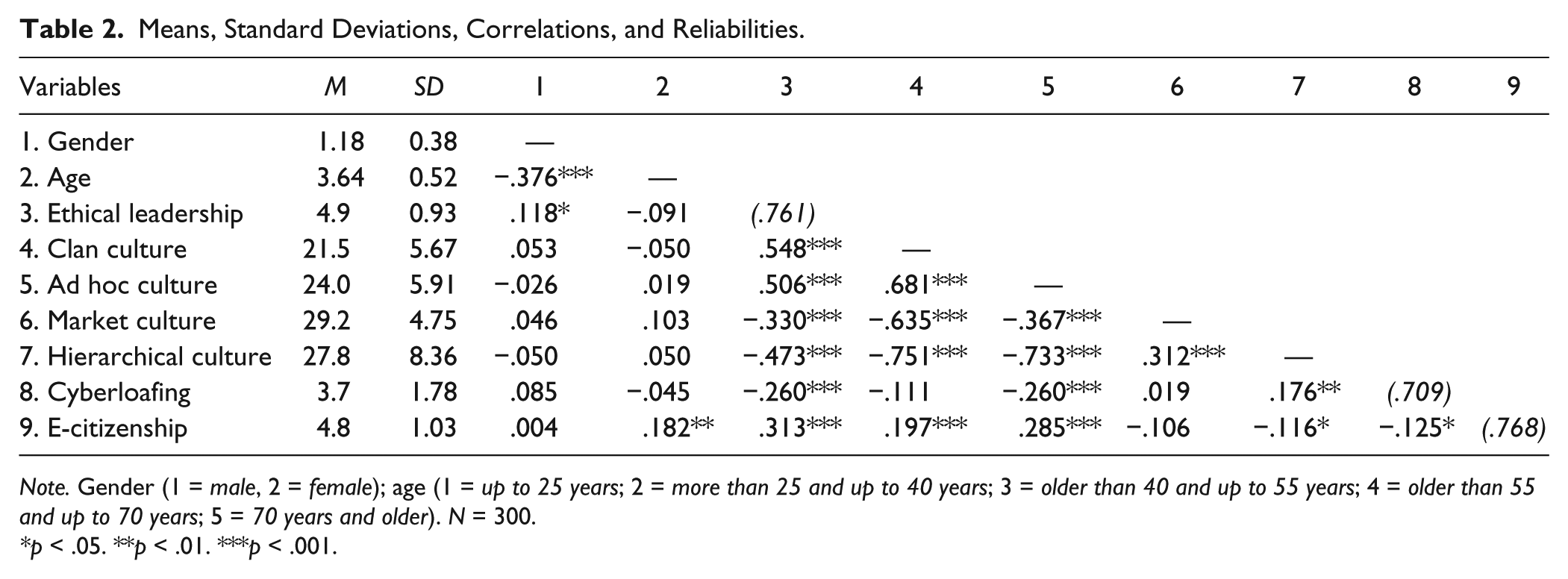
Note. Gender (1 = male, 2 = female); age (1 = up to 25 years; 2 = more than 25 and up to 40 years; 3 = older than 40 and up to 55 years; 4 = older than 55 and up to 70 years; 5 = 70 years and older). N = 300.
p < .05. **p < .01. ***p < .001.
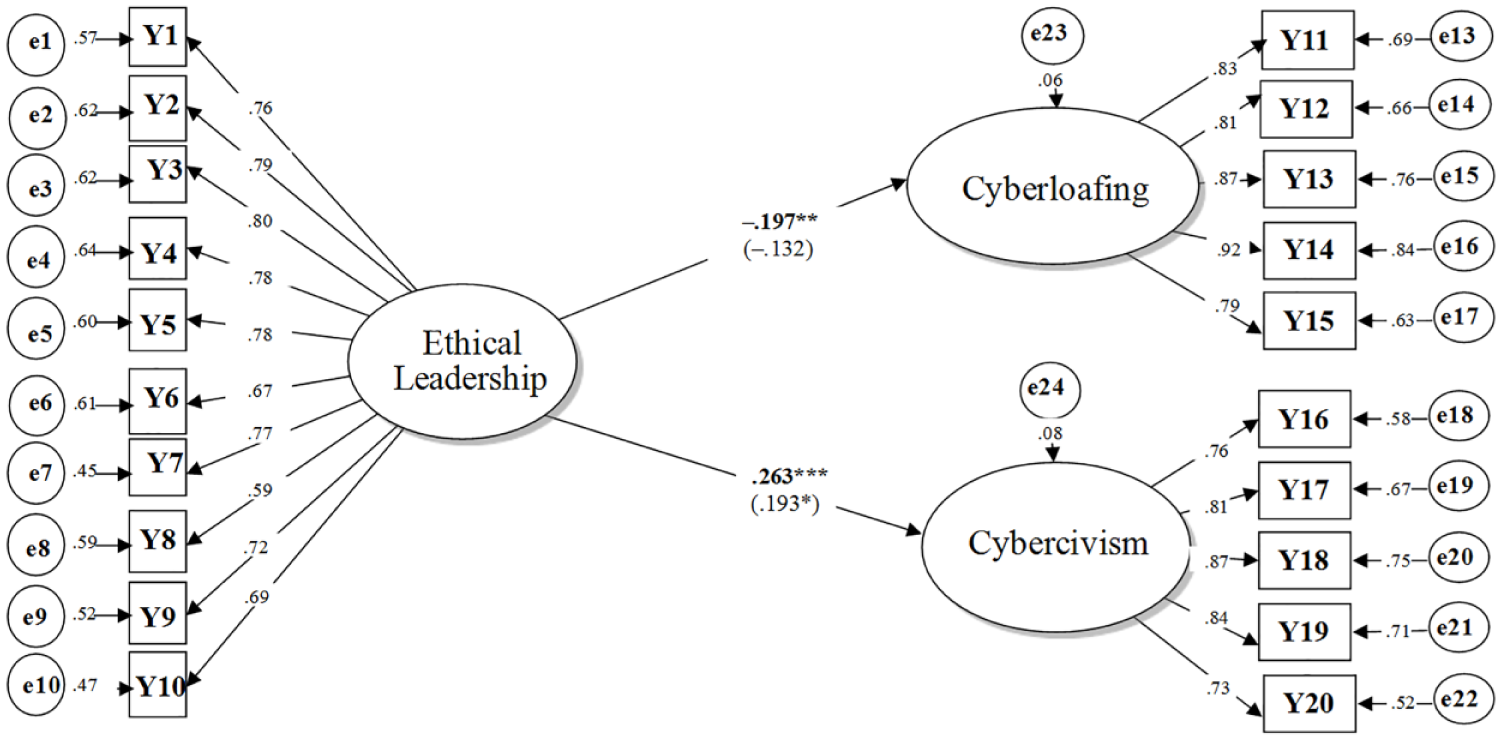
Accepted model of the relationship between ethical leadership and personal Internet use.

Accepted model of ethical leadership, corporate culture, and personal Internet use.
Figure 3 shows the various fit indices used to test mediation, revealing a poor but tolerable fit of the model (χ2[244, 300] = 1976.331, p < .001, df = 293, Cmin/df = 6.745, GFI = .881, CFI = .915, IFI = .916, TLI = .889, NFI = 881, RMSEA = .086). The model displays significant paths from ethical leadership to (a) clan (β = .509; p < .001); (b) adhocracy (β = .554; p < .001); (c) market (β = −.251; p < .001), and (d) hierarchy (β = −.502; p < .001), supporting Hypothesis 3 as a whole and each of its subhypotheses (Hypotheses 3a, 3b, 3c, and 3d). To test Hypothesis 4 and Hypothesis 5, first, a nested-models comparison was conducted using the sequential SCDT. Following Anderson and Gerbing’s (1988) recommendations, our hypothesized model (more constrained) in Figure 3 (χ2[244, 300] = 1976.331, p < .001, df = 293, Cmin/df = 6.745, GFI = .881, CFI = .915, IFI = .916, TLI = .889, NFI = .881, RMSEA = .086) was compared with the saturated alternative model (less constrained; χ2[244, 300] = 1965.034, p < .001, df = 291, GFI = .676, CFI = .712, IFI = .714, TLI = .679, NFI = .680, RMSEA = .139), in which two direct paths from ethical leadership to cyberloafing and e-citizenship were added. This latter model only represents a partially mediated model of the effects of ethical leadership on cyberloafing and e-citizenship. The results of the comparison of the two models reveal that the hypothesized model has a significantly better fit at p < .001 than the alternative model because the change in chi-square is significant (χ2 d [2] = 18,703, p < .001). This supports Hypothesis 4 and Hypothesis 5, where corporate culture as a whole acts as a mediator between ethical leadership and cyberloafing/e-citizenship.
Next, Hypothesis 4 and Hypothesis 5 as a whole were tested by inspecting the three Baron and Kenny (1986) conditions for mediation: (a) the independent variable [ethical leadership] has to predict the criterion variables [cyberloafing/e-citizenship]; (b) the proposed mediator [culture] has to be predicted by the independent variable [ethical leadership] and predict the criterion variables [cyberloafing/e-citizenship]; and (c), the direct path between ethical leadership and cyberloafing/e-citizenship has to decrease (preferably to nonsignificance: full mediation) when the mediator [culture] is added. As Figure 2 shows, ethical leadership fulfilled Baron and Kenny’s (1986) first condition (a) as ethical leadership showed significant paths to cyberloafing (β = −.197; p < .01) and e-citizenship (β = .263; p < .001). Regarding cyberloafing, adhocracy was the only culture type that fulfilled Baron and Kenny’s (1986) second condition (b) because, as Figure 3 shows, it was the only one that was predicted by ethical leadership (β = .388; p < .001) and predicts cyberloafing (β = –.412; p < .001). In the case of e-citizenship, however, all the culture types as a whole fulfilled Baron and Kenny’s (1986) second condition (b) because, as Figure 3 shows, all the culture types were predicted by ethical leadership and predicted e-citizenship. Finally, the numbers reveal that the third Baron and Kenny condition (c) was also fulfilled in the ethical leadership-cyberloafing link. As Figure 2 shows, once all the types of culture were entered as mediators, the betas of the ethical leadership-cyberloafing link decreased from, β = −.197; p < .01, to no longer being significant, β = −.132; p = ns. This decreased beta appears between parentheses in Figure 2. However, the ethical leadership-cybercivism link decreased from, β = .263; p < .001, to β = −.193; p < .05, remaining significant and supporting culture as a partial mediator. Thus, in the case of Hypothesis 4 (cyberloafing), these patterns add support to the adhocracy-type (Hypothesis 4b) culture as a mediator, but they provide less support for Hypotheses 5a, 5b, 5c, and 5d (e-citizenship).
Finally, to examine the significance of the mediating role of each type of corporate culture separately— (a) clan, (b) adhocracy, (c) market, and (d) hierarchy—in the relationships between ethical leadership, cyberloafing (Hypotheses 5a, 5b, 5c, and 5d), and e-citizenship (Hypotheses 6a, 6b, 6c, and 6d), the three Baron and Kenny (1986) conditions for mediation were also inspected individually (see Table 3). Table 3 shows that the betas for ethical leadership’s main effects on cyberloafing and e-citizenship decreased, even becoming nonsignificant. As Table 3 reveals, once each type of corporate culture was individually entered as a mediator, all the betas in each link decreased, thus providing support for all the subhypotheses of Hypothesis 4 and Hypothesis 5. However, these mediating effects of corporate culture were stronger in the case of cyberloafing, where the betas of ethical leadership’s main effects on cyberloafing decreased to a greater extent than the effects on e-citizenship, when culture was entered as a mediator. Moreover, even in the case adhocracy (β = −.195; p = .002), this decrease makes the beta no longer significant (β = −.128; p = .069), which means that adhocracy is a full mediator in the ethical leadership–cyberloafing link (see Table 3).
Indirect Effects of Ethical Leadership on Personal Internet Use (PIU) Through Each Type of Corporate Culture.
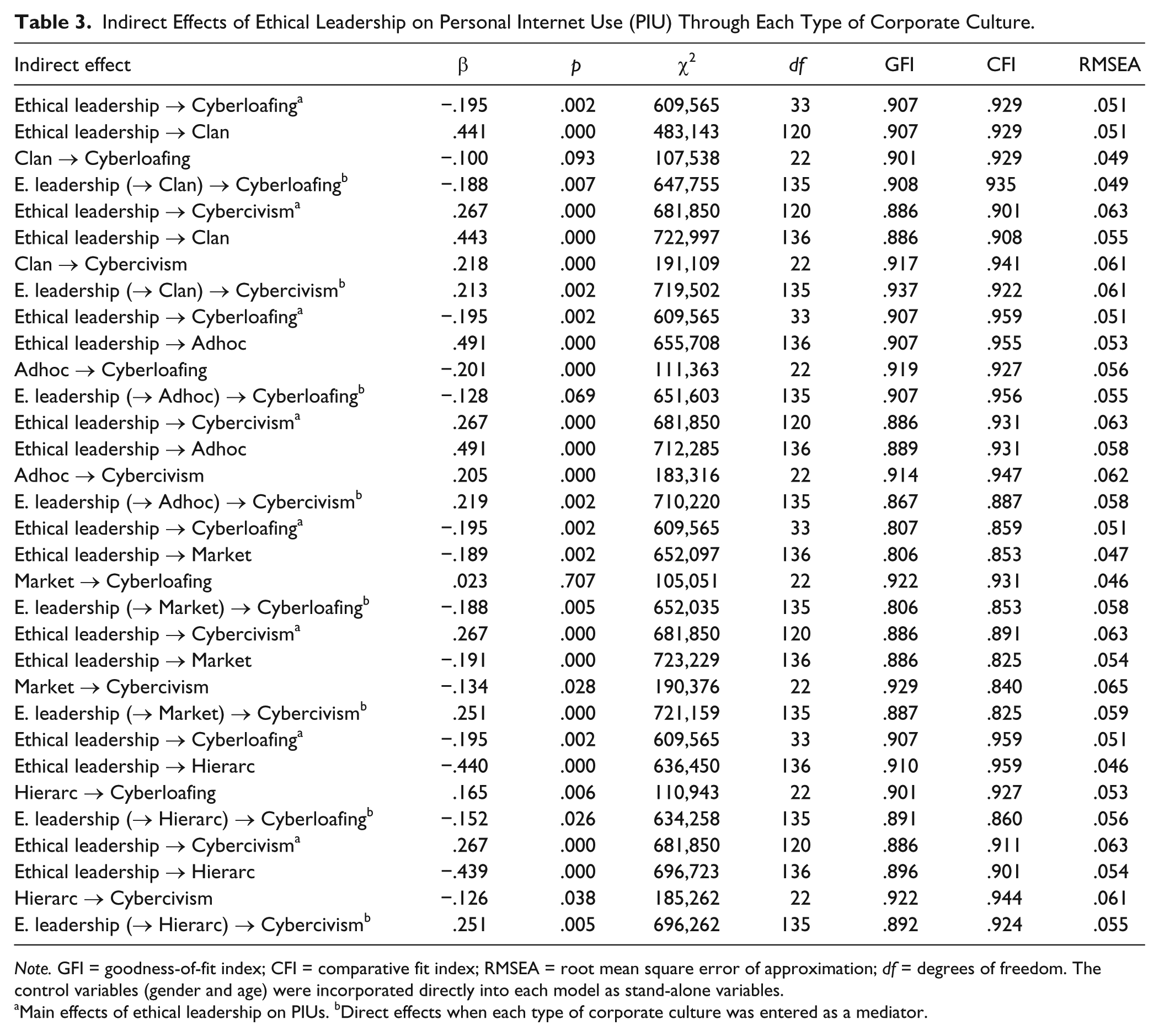
Note. GFI = goodness-of-fit index; CFI = comparative fit index; RMSEA = root mean square error of approximation; df = degrees of freedom. The control variables (gender and age) were incorporated directly into each model as stand-alone variables.
Main effects of ethical leadership on PIUs. bDirect effects when each type of corporate culture was entered as a mediator.
To summarize, as Figure 1 shows, Hypotheses 1 and 2 are supported in this study by the significant SEM paths from ethical leadership to cyberloafing (β = −.197; p < .01) and e-citizenship (β = .263; p < .001). Each of the subhypotheses of Hypothesis 3 (Hypotheses 3a, 3b, 3c, and 3d) were also supported, as ethical leadership is significantly linked to (a) clan (β = .509; p < .001); (b) adhocracy (β = .554; p < .001); (c) market (β = −.251; p < .001); and (d) hierarchy (β = −.502; p < .001). Using the sequential SCDT, a nested-models comparison supported Hypotheses 4 and 5 as a whole, that is, corporate culture as a whole, significantly mediated both ethical leadership–PIU link. Finally, we examined the culture types individually as mediators, also using Baron and Kenny’s (1986) method. For the subhypotheses of cyberloafing—Hypothesis 4 (4a, 4b, 4c, and 4d) and cybercivism—Hypothesis 5 (5a, 5b, 5c, and 5d), these conditions were individually fulfilled for partial mediation in all the culture types, except for adhocracy’s effect on cyberloafing (Hypothesis 4b), which fulfilled Baron and Kenny’s (1986) three conditions for full mediation (see Table 3).
Discussion
The purpose of this study was to examine whether employees respond to ethical leadership in an organization by engaging in cyberloafing and e-citizenship, and the usefulness of corporate culture in explaining the underlying psychological processes in these reactions. The results indicate that ethical leadership led employees to significantly decrease their cyberloafing and increase e-citizenship. In turn, perceptions of corporate culture significantly explained the way employees reacted to ethical leadership by engaging in cyberloafing and e-citizenship. Accordingly, this study will offer several theoretical implications for leadership and organizational behavior in organizations, drawing on the way the surveyed ethical–cultural context performed in predicting cyberloafing and e-citizenship. No less important are specific courses of action that the results of this study suggest for managers in organizations. Finally, the article opens up several avenues for future research.
With regard to cyberloafing, corporate culture as a whole was significantly supported as a mediator of the supervisor’s ethical influence on employees’ cyberloafing, but the results seem to indicate that, when each type of culture was examined alone, only the adhocracy culture type was able to significantly act as a full mediator. Concerning e-citizenship, the results seem to indicate less support for corporate culture as a mediator, whether corporate culture types were tested overall or individually. Furthermore, rather than fully mediating, the different types of corporate culture only partially mediated ethical leadership’s influence on e-citizenship. As a result, the mediating role of corporate culture in the model seems to be weaker in the case of e-citizenship than in the case of cyberloafing.
One explanation for these dissimilar results may lie in the potential differences in the behavioral nature of these two types of PIU. In our view, cyberloafing and e-citizenship related differently to corporate culture and ethical leadership in the model because their behavioral natures differ. Whereas V. K. G. Lim (2002) seems to define cyberloafing as a form of conventional deviance, that is, workplace production deviance that merely targets the Internet resources of the organization “while” online (e.g., V. K. G. Lim, 2002; V. K. Lim & Teo, 2005), the cybercivism definition suggests that e-citizenship is not just care and help while online, but also behaviors that could be delivered online (Zoghbi-Manrique-de-Lara, 2007). In sum, cyberloafing can only influence employees’ work and emotions as a human–computer interaction phenomenon (Lim & Chen, 2012), whereas e-citizenship also seems able to impact targets via the Internet (Zoghbi-Manrique-de-Lara, 2013). The question is then whether organizational culture is perceived in the same way when employees interact face-to-face as when they are working across virtual environments. In our view, there are contextual specificities (such as perceived anonymity and impunity, fewer social sanctions, less recognition, and social distance, among others) that may cause organizational culture to be perceived differently, causing e-citizenship to react differently to conventional corporate culture and conventional leadership, compared with cyberloafing (IJsselsteijn, van Baren, & van Lanen, 2003; Lea & Spears, 1992). After all, as some studies suggest, not all of the conventional literature is necessarily relevant or directly applicable to cyber activity (Maruping & Agarwal, 2004).
The results also contribute to developing literature on the way ethical leadership and corporate culture should be modeled. In this regard, the results of this study join the academic discussion about the proper way to model the ordering of the corporate culture and leadership constructs. Whereas Ofori (2009) posited and supported ethical leadership as a full mediator in the relationship between organizational culture and employee motivation at work, a large number of studies on ethical leadership and culture have suggested that ethical leadership might influence culture, rather than the other way around (e.g., Huang & Paterson, 2014; Schaubroeck et al., 2012; Shin, 2012). This ordering of the constructs seems to be more consistent with the culture literature in general, which identifies leaders, especially founders, as influential actors in forming and changing corporate cultures (for an overview, see Schein, 2010). However, some voices argue that leadership is a phenomenon involved in the organizational climate, which in turn is determined by the corporate culture. The results do not seem to support our hypotheses enough to justify the ordering used in this study, where corporate culture was examined as the mediator between ethical leadership and PIU. Therefore, the question of which ordering fits the facts better, that is, whether the leadership–culture relationship should or should not be reversed in the model, remains unanswered.
In addition to being a very significant outcome of ethical leadership, corporate culture is certainly a significant cause of cyberloafing and e-citizenship in the tested model. Because ethical leadership affects the clan and adhocracy culture types differently, which, in turn, predict lower cyberloafing and higher e-citizenship, both clan and adhocracy appear to influence PIU by revealing the ethics of the supervisor. As argued in this study, supervisors influence employee performance by ‘setting a good example’ for followers (Brown & Treviño, 2006; Yukl, 2002), and they can lead clan and adhocracy to mirror these positive ethics of the supervisor onto the followers. In addition, ethical leadership decreased the market and hierarchy cultures, suggesting that supervisors’ “good example” discourages the shaping of these “opportunistic” culture types that lack ethics. However, we question whether employees really engage in cyberloafing and e-citizenship here for moral reasons. Market and hierarchy showed no significant links to cyberloafing, whereas they inconsistently increased cybercivism. If market and hierarchy are “opportunistic” culture types that lack ethics and employees engage in e-citizenship out of morality, how can they be positively linked? In our view, one explanation can be found in the fact that e-citizenship is supererogatory, that is, it cannot be enforced at work. Because it substantially exceeds moral demands, even perceiving the market and hierarchy cultures as “opportunistic” and insensitive to ethics, its followers engaged in e-citizenship based on their desire to help their peers. Thus, guided internally by moral obligation (Skarlicki, Ellard, & Kelln, 1998), but outside the ethics of culture and leadership, they reacted to “opportunistic” market and hierarchy cultures that can harm peers by helping them online and engaging in e-citizenship.
In sum, the findings seem to suggest that corporate culture explains the behavioral implications of ethical leadership in PIU, and they emphasize the possible moral nature of PIU. Therefore, based on this study, future research should discuss the corporate culture as a potential “breeding ground” for employees’ moral feelings elicited by ethical leadership. Furthermore, the support found in the tested model for the mediating role of corporate culture in ethical leadership’s effects on PIU, beyond a mere “domino effect” on PIU (i.e., corporate culture does not explain ethical leadership effects, but instead “passes” them on to PIU), can offer new insights to better understand employees’ behavioral reactions to ethical leadership in organizational contexts.
Regarding practical implications, these findings may be useful for developing management strategies that favor organizational performance in a business context. Cyberloafing and e-citizenship in the tested model occurred not only in employees who experienced ethical leadership and reacted by favoring the organization in their actions but also in those who witnessed an adhocracy culture. Therefore, this result suggests that business managers who believe that the existence of a specific profile of culture types in their staff is irrelevant in encouraging their cyberloafing and e-citizenship may be incorrect. In fact, the findings suggest that by encouraging a proper culture-type profile, managers can promote the link from ethical leadership to beneficial cyber activity. Adhocracy cultures, however, seem to be a necessary element in designing strategies to tackle employees’ cyberloafing. Addressing ethical leadership and adhocracy-related values seems to be important in cyberloafing, due to the stronger links found from ethical leadership and adhocracy to employees’ cyberloafing. In this regard, management actions that encourage innovation, flexibility, dynamism, and the capacity to experience new ways of performing in the workplace are strongly recommended.
Ethical leadership can play an important role in shaping adhocracy. Therefore, with adequate training and awareness, each supervisor should be able to morally guide his or her followers to internalize corporate mini-cultures that incorporate adhocracy values. It would be beneficial to first audit the existing feelings and values of the followers about PIU morality by testing which staff members are organizationally (cyberloafing) or interpersonally oriented (e-citizenship), and which ones are both. As a result, company management can produce a map of the existing mini-cultures throughout the different departments and areas of the organization. Leaders’ support could thus be crucial in successfully developing adhocracy and guiding employees’ Internet use. Actions of this type might include programs that raise staff awareness about the fact that ethical leader behavior is the first reason to use the Internet properly. In addition to diagnostic interviews, these programs could incorporate counseling and other job-related activities that instill adhocracy culture values in the staff.
Limitations, Future Research, and Conclusions
Regarding the limitations, we acknowledge that this study has weaknesses. First, the study may suffer from one source/method bias, and, hence, caution is needed in interpreting the results. Furthermore, as Zheng and Pavlou (2010) indicate, SEM models cannot infer causality, as they are only a method of inferring “near” (vs. absolute) causality. SEM also only encodes linear relationships among constructs, essentially ignoring the possibility of nonlinear relationships. Second, as an ipsative scoring system is based on the dependency of each informant’s response, there are limitations in using ipsative scoring for OCAI. Third, we have only focused on banking employees who have certain work conditions that are often inherent to their specific sector. Fourth, it is possible that our study overfocuses on the workplace Internet relations where staff interact more, that is, the service areas reported in our survey. Finally, the data were obtained from a limited universe, which questions the generalizability of the findings.
Some questions remain unanswered that could be the basis for future research. For example, as recognized in the limitations about the generalizability of the findings, future research should triangulate our data collection technique. Conducting one or more studies to triangulate the research findings may lead to valuable qualitative insights. Additionally, future research could include the specific impact that perceptions of culture and ethical leadership could have on other factors and/or behaviors, such as workplace deviance between coworkers and toward the company, task performance, service satisfaction, conventional citizenship behavior, and so on. Further research could also consider extending the field of possible models to include ethical leadership, corporate culture, and PIU. This could be aided by contemplating the role that perceptions of organizational (in)justice can play in the studied relationships (e.g., interactional, procedural, or distributive justice). Finally, it is necessary to investigate the different possible effects of perceptions of the culture types studied in relation to the different areas or services where employees work in the banks. This may produce significant differences in the behavior of different constructs used in this study.
In conclusion, this article contributes to a greater comprehension of the way ethical leadership influences success in managing PIU. Discussing cyberloafing and e-citizenship as moral activities, the results support the adhocracy culture as mainly having the most positive and significant impact on PIU, fully mediating ethical leadership’s effects on cyberloafing. Nevertheless, the results also seem to indicate that all types of corporate culture mediate ethical leadership’s influence on PIU to some extent. Given that ethical leadership can produce a specific culture-type profile, managers and organizational strategies should match their values, principles, and beliefs to these cultures accordingly, in order to effectively manage PIU.
Footnotes
Declaration of Conflicting Interests
The author(s) declared no potential conflicts of interest with respect to the research, authorship, and/or publication of this article.
Funding
The author(s) received no financial support for the research, authorship, and/or publication of this article.