



Abstract
Leader efficacy is a key outcome of leader development, but little is known about if and when developmental leader experiences, such as engaging in training, relate to gains in leader efficacy. We present a theoretical model of the effects of mastery goal orientation and performance during development as determinants of leader efficacy. We argue that a mastery goal orientation, whether dispositional (Studies 1, 2) or situationally induced (Study 2), can increase performance and mitigate the deleterious effects of poor performance, resulting in higher leader efficacy. Two field studies of individuals taking leader development courses largely supported these predictions. Study 1 showed that individuals with a high dispositional mastery goal orientation (dMGO) added effort over time, performed better, and had higher leader efficacy than low dMGO individuals. The benefits of dMGO increased over the 4-week leader development course. Study 2 showed that a mastery goal intervention reduced the effects of low dMGO on leader efficacy.
Best-selling authors, consultants, and leadership researchers agree that confidence is integral to leader success (Chemers, Watson, & May, 2000). Popular leadership books such as Larina Kase’s (2008) The Confident Leader and Bobb Biehl’s (1989) Increasing Your Leadership Confidence highlight interest in the topic and imply that confidence can be learned. Ninety percent of TrainingIndustry.com’s “Top 20 Companies for Leadership Training” mention increased confidence as an outcome of leader development. Likewise, in academia, theorists argue that increased leader efficacy is one of the core outcomes of leader development training (Day & Sin, 2011; Lester, Hannah, Harms, Vogelgesang, & Avolio, 2011) because efficacy provides the foundation for all other aspects of agency and is an essential component of leader emergence and effectiveness (Bandura, 2007; Murphy, 1992; Smith & Foti, 1998). Unlike other types of training that focus more heavily on the acquisition of specific skills or knowledge, leader development is primarily concerned with increasing leader self-awareness, identity, and efficacy.
It is generally assumed that sending leaders to development will result in increased leader efficacy because training provides individuals with the opportunity to acquire skills and achieve success (Bandura, 1986, 1997). However, there is wide variation in the extent to which individuals benefit from leader development and many individuals are worse off following a developmental experience than they were before the experience (Day & Sin, 2011). The current study addresses this paradox of when and why some individuals benefit from leader development, while others seem to suffer declines in their leader efficacy following a developmental experience.
Theoretical work on readiness for leader development suggests that having a mastery goal orientation may determine whether one benefits from a development intervention (Avolio & Hannah, 2008; Avolio, Reichard, Hannah, Walumbwa, & Chan, 2009; Day & Sin, 2011; Hannah & Avolio, 2010). Goal orientation reflects how one approaches a learning situation (DeShon & Gillespie, 2005). Individuals who approach a learning situation with the goal of developing their skills, rather than the goal of performing well, are said to have adopted a mastery goal orientation (MGO) in that context (also often referred to as a learning goal orientation) and are, therefore, more likely to benefit from that learning experience (DeShon & Gillespie, 2005; Dweck, 1986; Elliott & Dweck, 1988; Vandewalle, Cron, & Slocum, 2001).
We present a theoretical model of the relationship between MGO and leader efficacy. MGO results in the development of greater leader efficacy given its relationship with performance. MGO can have an indirect effect on leader efficacy through performance because high MGOs perform better and can interact with performance such that high MGOs may be more resilient to poor performance in learning situations (Dweck, 1986; Dweck & Leggett, 1988; Elliott & Dweck, 1988). We test these predictions using a field study in which we measure dispositonal MGO (dMGO), performance, and leader efficacy over a 4-week leader development intervention. In a second study, we use a field experiment involving adults engaging in a leader development course to test the effectiveness of a mastery goal intervention (MGI) aimed at reducing the effects of low dispositional MGO on performance and leader efficacy. The intervention not only offers a practical method of mitigating the effects of low dMGO but also strengthens the theoretical argument that MGO influences leader efficacy.
In doing so, we make substantial theoretical contributions to the literatures on leader development, self-efficacy, and goal orientation. First, we extend leader development theory by answering calls in the literature to understand the factors that influence successful leader development over time (Day, 2000; Day & Sin, 2011) and which aspects of leadership can be developed (Avolio et al., 2009). Second, we add to self-efficacy theory by examining two facets of efficacy beliefs described by Bandura (1997): acquisition and resilience of self-efficacy. Third, we add to goal orientation theory by examining the often theorized, but rarely tested, claim that MGO aids in the development of efficacy (Dierdorff, Surface, & Brown, 2010) and offering one of the few tests of the self-regulatory mechanisms by which this interaction occurs. Fourth, we integrate previous research in which goal orientations have been manipulated with those in which goal orientation is measured as a disposition by both manipulating and measuring goal orientation (DeShon & Gillespie, 2005).
In the subsequent section, we will describe the theoretical underpinnings of leader efficacy and MGO and how they interact over time. We will explain how effort and good performance explain the positive relationship between dMGO and leader efficacy and how dMGO can buffer individuals’ leader efficacy from poor performance. Finally, we explain how an MGI can minimize the negative effects of a low dMGO on leader efficacy, particularly when individuals perform poorly. We use two field studies to test our theoretical model. In the first study, we examine the effects of dMGO, effort, and performance on leader efficacy over a 4-week leader development training program. In the second study, we test these predictions again using situationally induced mastery goal orientation through an MGI. The MGI reduced the effects of low dMGO on leader efficacy over the course of a 1-day intervention.
Theoretical Overview
Grounded in social cognitive theory, self-efficacy relates to one’s ability to “mobilize the motivation, cognitive resources, and courses of action needed to meet given situational demands,” making it one of the fundamental processes involved in self-regulation (Wood & Bandura, 1989, p. 408). Leader efficacy reflects an individual’s confidence in his or her ability to lead (Murphy, 1992). Leader efficacy is an important theoretical antecedent to a wide variety of critical leadership behaviors and numerous studies have established empirical links between leader efficacy and leader performance (Chemers et al., 2000; Hannah, Avolio, Luthans, & Harms, 2008; Luthans & Peterson, 2002; Robertson & Sadri, 1993; Smith & Foti, 1998). Given that self-efficacy is domain specific, it is important to distinguish leader efficacy from other types of self-efficacy. We follow Hannah et al.’s (2008, p. 670) definition of leader efficacy as, “Leaders’ beliefs in their perceived capabilities to organize the positive psychological capabilities, motivation, means, collective resources, and courses of action required to attain effective, sustainable performance across their various leadership roles, demands, and contexts.”
Given its relevance to leadership effectiveness, leader efficacy has been identified as one of the most important outcomes of leader development (van Knippenberg, van Knippenberg, De Cremer, & Hogg, 2004). Leader development should increase leader efficacy because training provides individuals with the opportunity to acquire skills and achieve success (Bandura, 1986, 1997). For example, Lester et al. (2011) found that mentoring, as a leader development intervention, resulted in higher levels of leader efficacy in a sample of military cadets.
Dispositional Mastery Goal Orientation and the Acquisition of Leader Efficacy
Both social cognitive theory (Bandura, 1986) and goal orientation theory (Dweck, 1986) argue that those with an MGO are likely to develop greater efficacy in learning situations (e.g., Brown, 2001; Kozlowski et al., 2001). MGO is part of Dweck’s (1986) theory of goal orientation, which suggests that individuals differ in how they respond to learning situations (Brett & Vandewalle, 1999). Individuals with an MGO are driven to master and learn in a task domain. The focus on mastering course material and belief that skill is malleable results in high MGO leaders gaining greater leader efficacy during training. MGO relates to increases in leader efficacy by enhancing effort and performance and by buffing individuals from the deleterious effects of poor performance (Figure 1).

Theoretical model for Study 1.
Although MGO has been conceptualized as a disposition, mental framework, trait, and belief, DeShon and Gillespie’s (2005) motivated action theory summarizes the MGO literature by describing goal orientation as a pattern of cognition and action. A dMGO is used to describe the situation where a pattern emerges such that one usually adopts a high MGO.
Time
Self-regulatory processes are best understood over a longer time frame in which individuals have the opportunity to receive and react to information about their performance (Carver & Scheier, 2000; Kanfer & Ackerman, 1989). As Day and Sin (2011) suggest, “Development is a complex construct of study in that it inherently involves change and the consideration of time in underlying theory and research” (p. 546). dMGO will become more strongly related to leader efficacy over time, as individuals who are higher in dMGO engage in greater self-regulation during the learning process (Dierdorff & Ellington, 2012).
Effort
Effort may be an essential mechanism by which high dMGO individuals acquire greater efficacy in learning situations. High dMGO individuals tend to set mastery goals in learning situations because they believe that they can acquire new skills through effort and persistence. High dMGO individuals expend greater effort as time goes on and tend to use adaptive learning strategies, such as engaging in more challenging tasks and seeking out feedback to improve their skills. As a result, high dMGOs perform better over time, as they acquire new knowledge and skills via systematic use of learning strategies like feedback seeking and metacognition (Dweck, 1986; Dweck & Leggett, 1988). Conversely, individuals lower in dMGO should be less likely to adapt a mastery goal in a learning situation and, as such, expend less effort because they are less concerned with continual growth and development. Effort, which reflects the intensity of energy allocated toward learning, should be associated with greater levels of performance (e.g., Sitzmann & Johnson, 2012a).
Performance Affects Leader Efficacy
One’s level of successes or failures during the leader development experience is likely to affect one’s leader efficacy because self-efficacy beliefs are most strongly influenced by one’s own performance in a given domain (Bandura, 1986). Good performance results in increases in leader efficacy, whereas poor performance results in declines in leader efficacy (Bandura, 1997). For example, Bandura and Jourden (1991) found that messages indicating increased performance were associated with better self-efficacy than messages indicating declining performance. Likewise, Shea and Howell (2000) found that performance predicted subsequent self-efficacy in a manufacturing simulation. Surprisingly, however, extant research and theory have not included one’s performance as a driver of leader development outcomes.
We hypothesize a mediated moderated effect between dMGO and leader efficacy. The interaction between dMGO and time predicting leader efficacy will be explained by the interaction between dMGO and time on effort and the indirect effect of effort on leader efficacy through performance.
Dispositional Mastery Goal Orientation and the Resilience of Leader Efficacy
In addition, dMGO relates to increased leader efficacy because high dMGO facilitates resilience to poor performance. When high dMGO individuals perform poorly, they interpret the performance information as evidence that more effort is needed rather than that they are low in ability (Dweck, 1986; Elliott & Dweck, 1988; Vandewalle et al., 2001). Moreover, people with a high dMGO tend to see ability as unfixed, so they believe that they can learn. Conversely, if you believe ability is fixed, then you are unlikely to add more effort to work on a task for which you lack ability (Dweck, 1986; Elliott & Dweck, 1988). Therefore, high dMGOs will react more to poor performance with increased effort and with their leader efficacy still intact.
Low dMGO individuals are also less likely to seek out, reflect on, act on, and benefit from negative feedback because they are not focused on improving their skills. Instead, they are likely to react to feedback in the more typical way individuals react to negative feedback in learning situations, which involves a reduction in effort and subsequent decline in performance (e.g., Sitzmann & Johnson, 2012b). In contrast, individuals with higher dMGO will allocate greater effort following poor performance because they interpret poor performance as feedback that they need to invest greater effort rather than feedback that they are low on ability (Ames, 1992; Duda & Nicholls, 1992; Dweck, 1986). For example, Vandewalle et al. (2001) found that high dMGO individuals expended greater effort following performance feedback than individuals with low dMGO though they did not examine the interaction between performance level and dMGO as a predictor of effort. High dMGOs will exert greater effort than low dMGOs following poor performance.
Mastery Goal Intervention
Although we have discussed goal orientation as a disposition thus far, goal orientations can also be manipulated by targeting individuals’ beliefs about whether a skill is fixed or developed through practice (Wood & Bandura, 1989). Wood and Bandura (1989) manipulated the social construal of participants’ theories of abilities by giving different instructions to groups of graduate business students completing a management simulation. In the incremental theory of ability condition, participants were instructed that leadership skills are developed through practice, mistakes are expected, and practice will result in better performance. In contrast, participants in the entity theory of ability condition were told that their performance reflects their underlying ability, those with better abilities will perform better, and the study provides an opportunity for their ability to be evaluated. The situational inducement resulted in positive motivational and performance outcomes for the incremental skills condition.
Ames and Archer (1988) reported that induced MGO was associated with reported increases in effort, the use of learning strategies, and challenge seeking. Similar studies manipulating a mastery goal orientation through task instructions also demonstrated a decrease in anxiety, increase in task-specific efficacy (Martocchio, 1994), and an increase in subjective task complexity (Mangos & Steele-Johnson, 2001). Tabernero and Wood (1999) used the same manipulation as the Wood and Bandura (1989) study with a group of undergraduate students and found that participants’ dispositional theories of ability seemed to supersede the situational inducement, such that those higher in MGO were more motivated and performed better regardless of situational condition. Thus, there is a need to better understand the competing influences of dispositional and situationally induced MGO.
Motivated action theory addresses the theoretical interplay between dispositional and situationally induced mastery goals (DeShon & Gillespie, 2005). The theory argues that goals are arranged hierarchically such that individuals hold superordinate goals related to the self, such as agency and esteem, which drive principle goals, such as growth. Individuals with higher growth goals are more likely to adopt achievement goals that reflect a mastery approach and a mastery approach gives rise to action plan goals, such as how to allocate resources, manage impressions, explore problems, and seek feedback. From this perspective, goal orientation is defined as, “a label used to describe the pattern of cognition and action that results from pursuing a mastery-approach, performance-approach, or performance-avoid goal at a particular point in time in a specific achievement situation” (DeShon & Gillespie, 2005, p. 1114).
Goals that are frequently activated, such as when someone consistently pursues mastery goals, tend to have a consistent influence on behavior across situations. This idea is consistent with the notion of dMGO. However, the theory purports that even individuals who do not tend to adopt a mastery goal can experience the activation of mastery goals as a result of specific aspects of a given situation. When the situation activates a goal, that goal becomes more accessible and should, therefore, trump the individual’s normal approach to goals (i.e., dMGO). Activated goals will remain activated until the individual detects a discrepancy in their progress toward that goal or until a change in the situation occurs.
In other words, a situationally induced goals should have a greater effect on mastery behaviors than dMGO. The situational features that affect the adoption of a mastery goal are those that are most closely aligned with threats and opportunities to the self (the highest level of the goal structure). Furthermore, the likelihood that effort will result in achievement of the desired goal (expectancy) affects the extent to which a goal will be adopted. Thus, an intervention that encourages makes failure acceptable and increases expectancy should increase the likelihood that one will adopt a mastery goal. We developed an intervention aimed at allowing individuals to make mistakes and increasing the expectancy that effort can influence the development of leadership skills.
Based on motivated action theory, we argue that an MGI will activate a mastery goal, causing individuals to engage in mastery-oriented behaviors. The MGI should have little effect on high dMGO individuals, who are already likely to have adopted a mastery goal. However, low dMGO individuals who get an MGI will perform better, be more resilient to poor performance, and develop greater leader efficacy during leader development. Unlike Study 1, we use other ratings of performance (rather than self-ratings) and we do not measure effort but, rather focus on performance (Figure 5). In addition, because the intervention was only a 1-day, 4-hour training session, we do not expect the effects of dMGO or the MGI to vary greatly over time.
We test these hypotheses in two studies. In the first study, we examine the relationships between self-reported dMGO, effort, performance, and leader efficacy over a 4-week training course. In the second study, we test the proposed relationships using a 1-day training course in which we manipulate mastery goals (through an MGI) and measure dMGO and examine the relationship between performance and leader efficacy.
Study 1
Method
Study 1 involved a 4-week leadership training. After each training session trainees were given tasks to try on the job over the course of the subsequent week. We measured self-reported effort, performance, and leader efficacy over time. In addition, leader dMGO was measured at the start of the training. Only the hypotheses related to dMGO were tested in this study because we only did the MGI in Study 2.
Participants
Participants in the training condition were construction apprentices and journeymen completing a leader development course (n = 76). Four different groups of trainees (n = 12, 16, 19, and 29 per group) completed the course, which consisted of one session per week over 4 weeks. The control condition consisted of a matched sample of 29 apprentices and journeymen at similar experience levels as the training group, recruited from the same union and company as two of the training groups, for a total sample of 105 participants across both conditions. The mean age across conditions was 31.74 years (SD = 7.72) and ranged from 18 to 56 years. Most participants were White (n = 72) and all but one were men.
Procedure
Trainees participated in a 4-week leader development session focusing on transactional and transformational leadership. Two trainers delivered the training. Participants attended one session each week, which lasted from 2 to 3 hours. The training consistent of topics related to transactional and transformational leadership in a very applied context. Topics included giving feedback, setting goals and a vision (inspiration motivation), developing employees (individualized consideration), and getting employees to think creatively (intellectual stimulation). The material was taught through a combination of lecture and discussion about how these skills could be applied on the job. Trainers were encouraged to provide real-world examples of how to implement the skills and contrast this approach to a more directive style of leadership.
At the end of each session, participants received a list of three on-the-job practice tasks to complete over the next week. When participants returned the following week, they reported on the number of on-the-job practice tasks they tried (0-3) and their success in implementing them. To address the possibility that reporting on the success of their practice could influence leader efficacy, one training group (n = 19) completed a slightly different homework task and did not report on their effort or success during practice. There were no mean difference in leader efficacy at any time point between those who did and did not complete on-the-job practice tasks (all ps > .10). The analyses for performance and effort include only the 57 participants who completed the on-the-job practice tasks described above. For the control group, only the pretest and posttest ratings were collected at the same time points as the training group.
Measures
Participants completed a presurvey before the first week of training (Time 1) in which they reported on their dMGO and leader efficacy. Subsequently, leader efficacy was measured at the beginning of each training session. Effort and performance were also measured at the beginning of each training session related to their on-the-job practice from the previous week, as these variables could not logically be measured in the first training session.
Leader Efficacy
Three items from Murphy’s (1992) leader efficacy scale were used. The items were, “In general, I am very good at leading a group of my peers,” “I am confident of my ability to influence a work group that I lead,” and “Overall, I believe that I can lead a work group successfully.” The scale was delivered at four points in time and the average level of internal consistency was high (Cronbach’s α = .93).
Mastery Goal Orientation
Five items from Button, Mathieu, and Zajac’s (1996) mastery goal orientation measure were used to assess dMGO. The items were “The opportunity to do challenging work is important to me,” “When I fail to complete a difficult task, I plan to try harder the next time I work on it,” “I try hard to improve on my past performance,” “When I have difficulty solving a problem, I enjoy trying different approaches to see which one will work,” and “I do my best when I’m working on a fairly difficult task.” There was a high level of internal consistency (Cronbach’s α = .86).
Effort
Between each of the four training sessions, participants in the training condition were asked to complete three on-the-job practice tasks in which they applied what they learned that week on the job. Tasks included, “teach another person how to set a SMART goal,” and “give positive recognition to a crew member.” Participants were asked to plan when, where, and with whom they would complete the on-the-job practice tasks at the end of a given session and then were asked to report on their experience with the on-the-job practice tasks at the beginning of the next training session. Effort was measured as how many of the tasks (0-3) they completed that week. The average number of tasks completed was 1.28 (SD = 0.70).
Performance
In addition to reporting on how many on-the-job practice tasks one completed, participants were asked to rate how successful they were on each task using a scale ranging from 1 (very unsuccessful) to 5 (very successful). The average performance across all weeks was 3.56 (SD = 0.94). If a participant did not complete any of the practice tasks in the preceding week, performance was left as missing data for that time point.
Results
Data Analysis
Within and between correlations for Study 1 are presented in Tables 1 and 2. Data were analyzed using hierarchical linear modeling with full maximum likelihood estimates to analyze the within-person results for leader efficacy using SAS PROC MIXED. dMGO, effort, and performance were grand mean centered. Following Bliese and Ployhart (2002), we first examined the amount of variance in leader efficacy within and between leaders. The intraclass correlation (ICC[1]) obtained from this model suggested that 80% of the total variance was within leaders.
Between-Subjects Level of Analysis Correlation Matrix for Study 1 Including Control and Training Conditions.
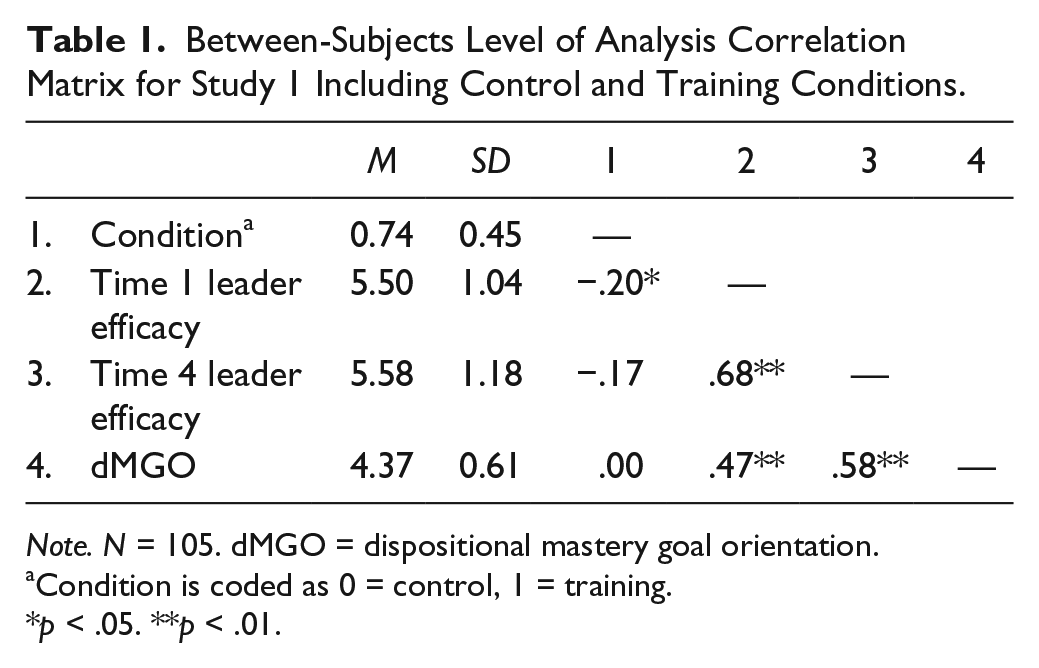
Note. N = 105. dMGO = dispositional mastery goal orientation.
Condition is coded as 0 = control, 1 = training.
p < .05. **p < .01.
Between- and Within-Subjects Correlation Matrix for Training Condition in Study 1.

Note. N = 76; n = 57 for analyses related to performance and effort. Correlations above diagonal are within-persons correlations and correlations below diagonal are between-persons correlations.
p = .09. *p < .05. **p < .01.
A second model was run that included time (coded as 0, 1, 2, 3) to predict leader efficacy. This model regresses leader efficacy on the time variable so that the intercept represents initial leader efficacy and the parameter estimate for time represents the extent to which leader efficacy changed over time. The effect for time leader efficacy changes over time (estimate = −.02, standard error [SE] = .07, p > .05) suggested that, on average, leader efficacy decreased by .02 points at each consecutive data collection time.
A third model was tested in which both the intercepts and slopes were allowed to vary to measure variability in growth parameters (in other words, is there variation between leaders in the extent to which their leader efficacy changes over time). A comparison of the fit of the second model (in which the leader efficacy slopes were set to be equal across leaders) with the fit of the third model yielded a change in log-likelihood ratio of 16.00, p < .05. This indicates that change in leader efficacy differed significantly between leaders. Next, we tested alternative error structures and tested the benefit of estimating a random linear term and intercept. We also tested for curvilinear effects in our analyses but there was no evidence of a curvilinear effect.
The same process was used to examine effort and performance. The ICC for effort and performance suggested that 33% and 36% of the variance was within leaders. The second model, including time, showed that leader effort remained relatively consistent over time, −.01, SE = .09, p > .05, but performance increased over time, .29, SE = .10, p < .05. Testing the variability in growth parameters for effort was 1.60, p > .05, and performance was 0.00, p > .05. We also tested for curvilinear effects but did not find any. Next, we tested alternative error structures and tested the benefit of estimating a random linear term.
Hypothesis Testing
Hypothesis 1 was that dMGO will result in greater increases in leader efficacy as a result of leader development. We examined change in leader efficacy from before to after the program for trainees (and comparing initial responses to responses 5 weeks later for the controls). As such, this hypothesis was tested separately from the subsequent analyses as only two points in time were examined so that we can compare the experimental condition with the control condition. There was no effect for leader development on leader efficacy as evidenced by a nonsignificant interaction between condition and time (ϒ= −.09, p > .05, Table 3). However, the lack of significant effect was qualified by a significant interaction between time, condition, and dMGO, in support of Hypothesis 1 (ϒ = .45, p < .05, Table 5). In the training condition, leaders high in dMGO experienced increased leader efficacy, whereas leaders low in dMGO experienced declines in leader efficacy (Figure 2). In the control group, there were no changes in leader efficacy.
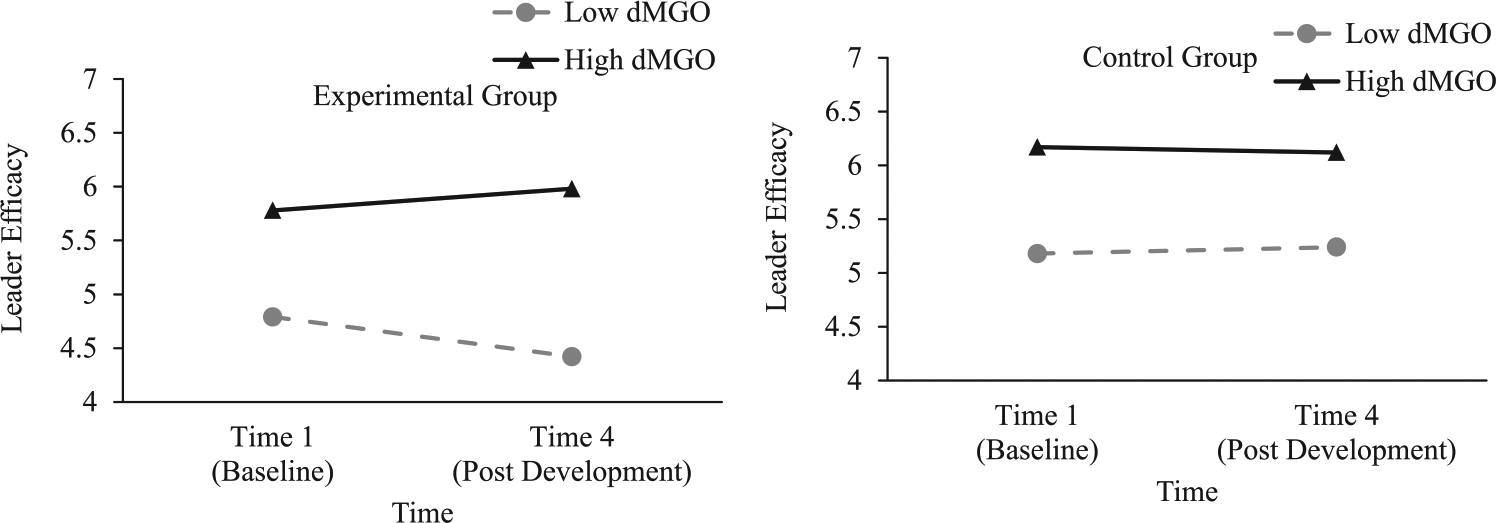
Interaction between dispositional mastery goal orientation (dMGO) and condition predicting leader efficacy in Study 1.
Analyses Comparing Control and Training Conditions in Study 1.
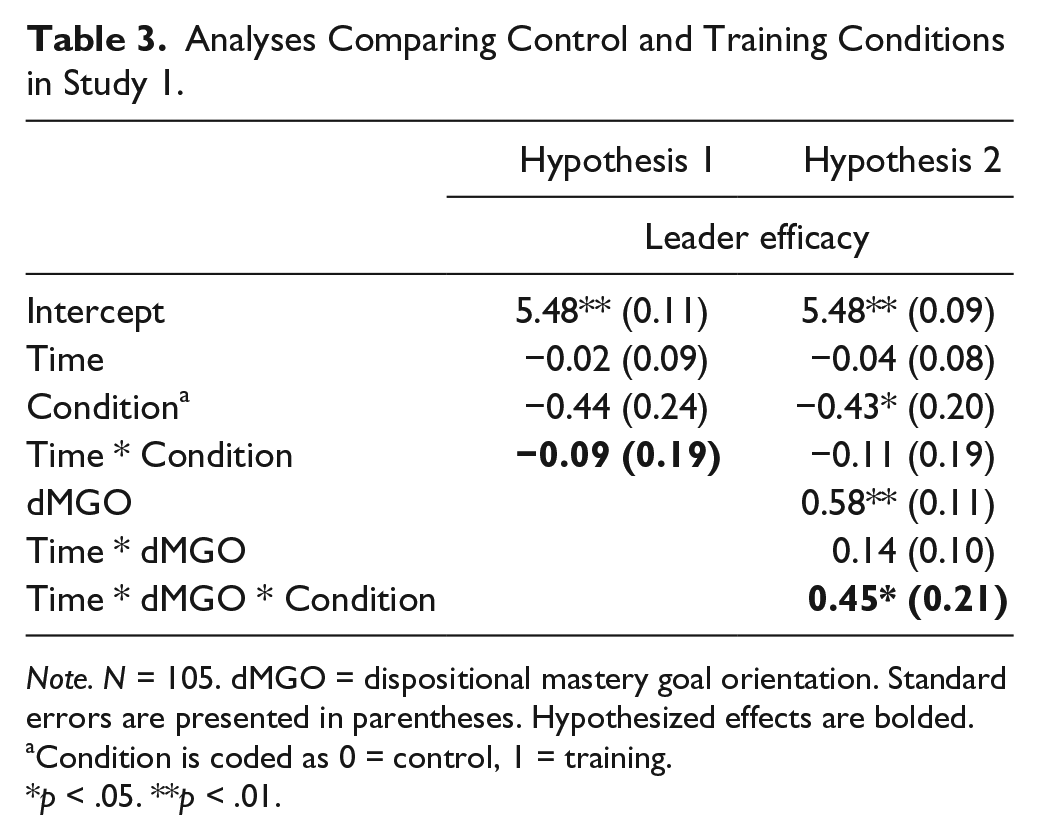
Note. N = 105. dMGO = dispositional mastery goal orientation. Standard errors are presented in parentheses. Hypothesized effects are bolded.
Condition is coded as 0 = control, 1 = training.
p < .05. **p < .01.
Next, we move to the hypotheses examining the mechanism by which dMGO relates to increased leader efficacy using the full four points in time (there is no control group for these analyses). Hypothesis 2 was that the dMGO/time interaction will predict leader efficacy such that the relationship between dMGO and leader efficacy will increase over time. This hypothesis was supported by the significant and positive interaction between dMGO and time predicting leader efficacy (ϒ = .07, p < .05, Table 4, Figure 3).
Relationships Between dMGO, Performance, Effort, and Leader Efficacy in Study 1.
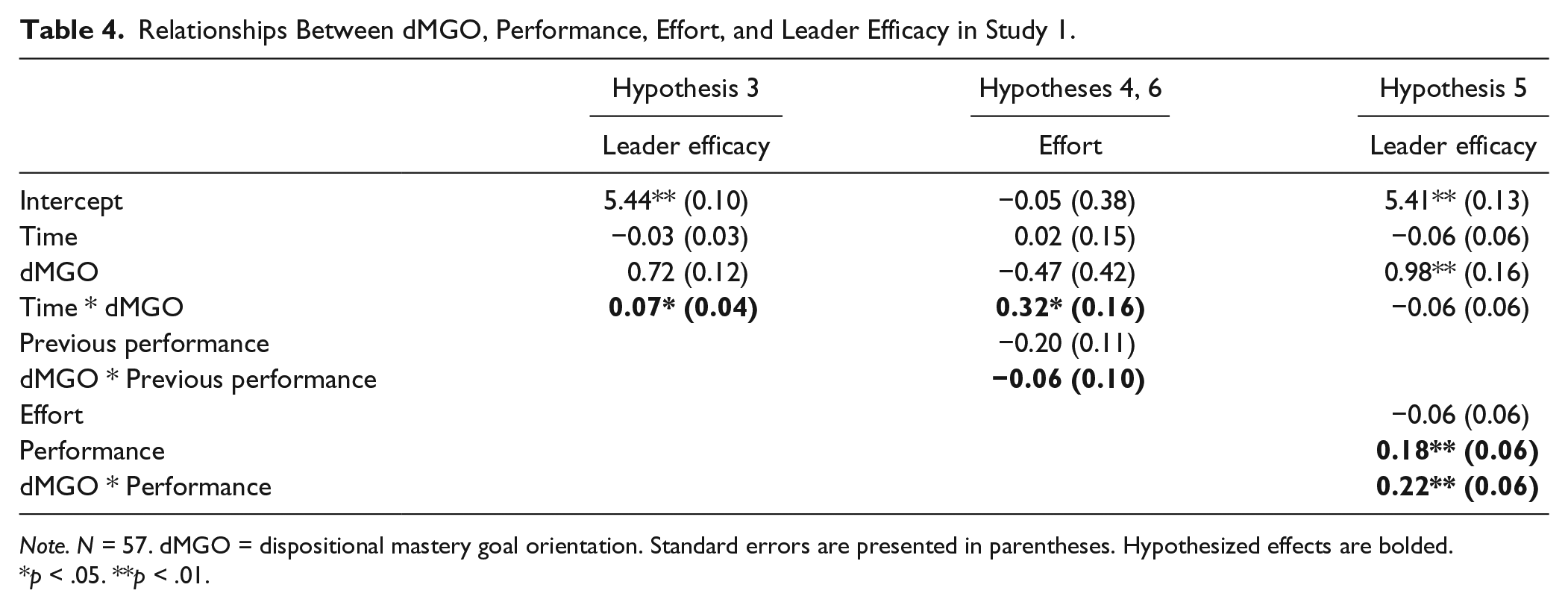
Note. N = 57. dMGO = dispositional mastery goal orientation. Standard errors are presented in parentheses. Hypothesized effects are bolded.
p < .05. **p < .01.

Interaction between dispositional mastery goal orientation (dMGO) and time predicting leader efficacy and effort in Study 1.
Hypothesis 3 was that the effect of the dMGO/time interaction on leader efficacy will be explained through indirect effects of the dMGO/time interaction on effort and through performance, suggesting mediated moderation. dMGO will relate to increases in leader efficacy over time because high dMGO individuals add effort over time, thereby increasing performance, and subsequent leader efficacy.
We extrapolated from the procedures for testing for mediated moderation outlined by Muller, Judd, and Yzerbyt (2005). Three conditions must be met to establish mediated moderation. First, dMGO and time must interact when predicting leader efficacy. This interaction was established in support of Hypothesis 3. Second, dMGO and time must interact when predicting effort. This interaction was statistically significant (ϒ = .32, p < .05, Table 4). 1 Third, there must be a significant effect of the proximal mediator (performance) on the outcome (leader efficacy). Because we include two mediators (effort and performance), it is necessary to test the indirect effect of the dMGO by time interaction on performance through effort and the indirect effect of effort on leader efficacy through performance. 2 We test indirect effects using the Z′ method as suggested by MacKinnon, Lockwood, Hoffman, West, and Sheets (2002). There was a significant indirect effect of the dMGO/time interaction on performance through effort (Z′ = 1.18, p < .05) and there was a significant indirect effect of effort on leader efficacy through performance (Z′ = 1.32, p < .05). In the final model, performance was a significant predictor of leader efficacy (ϒ = .18, p < .05, Table 4). Furthermore, the dMGO by time interaction approached zero when the mediators were entered in the model. Thus, the results support Hypothesis 4 that the dMGO/time interaction on effort and performance mediate the dMGO/time interaction on leader efficacy. dMGO positively relates to increases in leader efficacy over time because high dMGOs expend additional effort over time. This effort translates into better performance which relates to leader efficacy.
Hypotheses 4 and 5 relate to the relationship between dMGO and leader efficacy following poor performance. Hypothesis 4 was that high dMGO individuals will have higher leader efficacy following poor performance than low dMGOs and Hypothesis 5 was that high dMGOs will have higher effort following low performance than low dMGO individuals. Overall, performance was positively related to leader efficacy (ϒ = .18, p < .05, Table 4). The interaction between dMGO and performance significantly predicted leader efficacy (ϒ = .22, p < .05, Table 4). As expected, high dMGO individuals had higher leader efficacy following poor performance than low dMGOs. However, they also had higher leader efficacy than low dMGOs following good performance (Figure 4). Hypothesis 5, that high dMGOs would have higher effort following poor performance than low dMGOs was not supported given the nonsignificant interaction between performance and dMGO on effort the following week (Table 4).
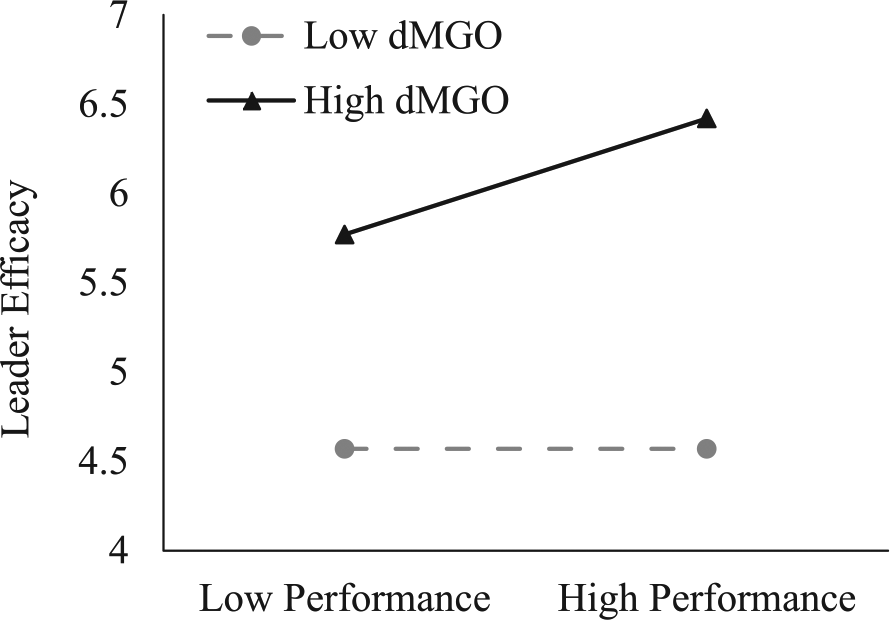
Interaction between dMGO and performance predicting leader efficacy in Study 1.
Discussion
This study highlights the importance of dMGO in determining leader efficacy. Compared with a control condition, leader development only resulted in increased leader efficacy for individuals who were higher in dMGO. The relationship between dMGO and leader efficacy was explained by the increased effort that high dMGOs added over time, resulting in better performance and higher leader efficacy. Individuals with higher dMGO view effort as a method to master a task and, accordingly, dedicate greater effort toward learning over time (Dweck & Leggett, 1988). Greater effort results in greater performance and performance translates into increases in leader efficacy, particularly among high dMGO individuals. The findings support the idea that the benefits of dMGO can be explained by the greater effort that high dMGOs exert during learning.
In addition, dMGO interacted with performance to influence leader efficacy. However, these results were not as expected. Individuals with higher dMGO experienced greater leader efficacy than individuals with lower dMGO when they performed poorly (as expected) but also had greater leader efficacy when they performed well. Although we did not expect this effect, we know well that good performance relates to increased efficacy from Bandura’s (1997) work. Although we expect that this is not as true for individuals with high dMGO because they are more focused on learning, it seems that they too benefit from good performance in terms of increased efficacy. Individuals with lower dMGO had low leader efficacy regardless of their performance.
Study 2
Study 1 showed that leaders with higher dMGO acquired greater leader efficacy during leader development, suggesting that dMGO can determine the effectiveness of a development effort. These findings might suggest that only high dMGO individuals should be sent to leader development. However, there is evidence that MGO can be manipulated with an intervention (see DeShon & Gillespie, 2005, for a review). Therefore, in this second study, we conducted a field experiment to test an intervention aimed at improving leader development outcomes for individuals lower in dMGO and mitigating the deleterious effects of negative performance feedback.
Method
Study 2 involved a 1-day training similar to the training used in the first study. We completed an MGI and then measured the relationship between dMGO, effort, performance, and leader efficacy across six exercises during a 4-hour leadership training. Given the nature of the 1-day training, we could not measure effort in Study 2. Instead, we focused our results on the latter hypotheses which test the mitigating effects of the MGI on the relationship between dMGO, performance, and leader efficacy.
Participants
Participants were construction apprentices and construction management students completing a leader development course (n = 60). Five different groups of trainees (n = 10, 12, 12, 12, and 14 per group) completed the course, which consisted of one 4-hour long session. Half of the participants were randomly assigned to a control condition and half received the MGI. The mean age across conditions was 27.04 years (SD = 6.24) and ranged from 18 to 44 years. Most participants were White (n = 48). There were 52 men and 8 women.
Procedure
Trainees participated in an abbreviated (4-hour) version of the same leader development course used in Study 1, focusing on transactional and transformational leadership. Two trainers were used and one of the trainers was the same individual who delivered training in Study 1. The training involved a mixture of lecture, discussion, and six practice exercises. For the practice exercises, participants worked with a single partner to role-play different leadership scenarios and apply the skills that they had just learned in the class. Trainees worked in the same partner for all six exercises but alternated who was the “leader” and who was the “follower” in the exercise.
Half of the participants received the MGI. Participants were randomly assigned to condition based on which packet they randomly received. The MGI was delivered at the start of the first exercise through written instructions on how to complete the role-play exercises. In the control participants, trainees were told that they would complete six leadership exercises with the same partner, alternating who would lead and who would follow. They were told, “Please note that these ratings are simply used to generate discussion between you and your partner. We are providing you with the opportunity to practice your leadership skills.” The MGI condition said, Please note that these ratings are simply used to generate discussion between you and your partner
After each exercise, participants were scored on the skills they should have applied using a behaviorally anchored rating scale (BARS). The BARS contained specific behaviors that had to be demonstrated in order to earn a score of a 1, 2, 3, 4, or 5. These behaviors were directly related to the material that was just delivered in the course. For example, for goal setting one anchor was, “The leader specified a time frame or end date, and outlined what rate of progress was expected along the way.” The internal consistency of the BARS averaged .78 across the six exercises and ranged from .69 to .89.
Measures
Participants completed a presurvey before the first week of training (Time 1) in which they reported their dMGO and leader efficacy. Performance was measured at the end of each exercises and rated by one’s partner. Leader efficacy was assessed after the leaders were told their score on the exercise and engaged in discussion with the class about the exercise.
Leader Efficacy
The same leader efficacy scale was used as in Study 1 (Murphy, 1992). It was measured before the start of training and used as a covariate in all analyses (α = .91). In addition, one item from the scale was used to measure leader efficacy following each of the exercises (Murphy, 1992). The item was, “I am confident in my ability to lead a group on the job.” The internal consistency across the three time points was α = .89.
Mastery Goal Orientation
Five items from Button et al.’s (1996) mastery goal orientation measure were used in Study 2. The items were, “The opportunity to do challenging work is important to me,” “When I fail to complete a difficult task, I plan to try harder the next time I work on it,” “I try hard to improve on my past performance,” “When I have difficulty solving a problem, I enjoy trying different approaches to see which one will work,” and “I do my best when I’m working on a fairly difficult task.” There was a high level of internal consistency (Cronbach’s α = .89).
Performance
After each exercise, participants were scored on the skills they should have applied using a BARS. The BARS contained specific behaviors that had to be demonstrated in order to earn a score of a 1, 2, 3, 4, or 5. There were multiple BARS per exercise. For example, one of the goal setting anchors was, “Specified a time frame or end date, and outlined what rate of progress was expected along the way.” To get a 5 for “setting a time frame,” leaders had to have exhibited that specific behavior.
Results
Data Analysis
Within and between correlations are presented in Table 5. Hierarchical linear modeling with full maximum likelihood estimates was used to analyze the within-person results for leader efficacy using SAS PROC MIXED. Performance and dMGO were grand mean centered. Following Bliese and Ployhart (2002), we first examined the amount of variance in leader efficacy within and between leaders. The ICC[1] obtained from this model suggested that 56% of the total variance of leader efficacy was within leaders.
Between- and Within-Subjects Correlation Matrix for Training Condition in Study 2.
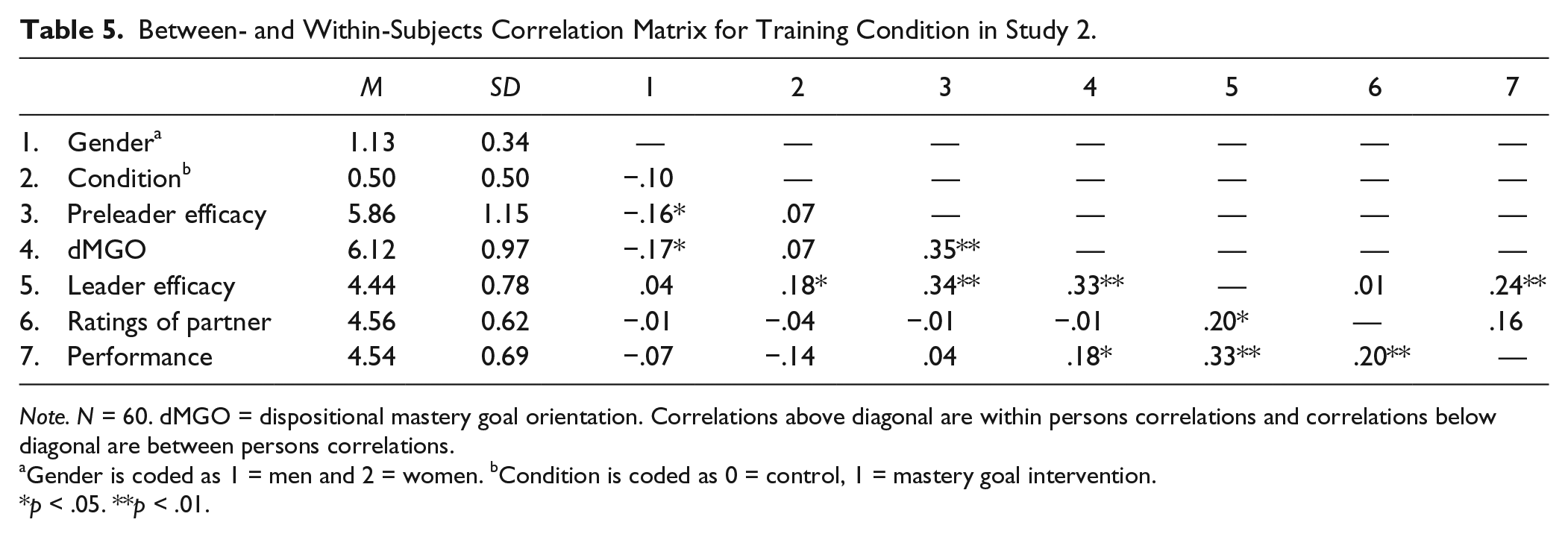
Note. N = 60. dMGO = dispositional mastery goal orientation. Correlations above diagonal are within persons correlations and correlations below diagonal are between persons correlations.
Gender is coded as 1 = men and 2 = women. bCondition is coded as 0 = control, 1 = mastery goal intervention.
p < .05. **p < .01.
A second model was run that included time (coded as 0, 1, 2) to predict leader efficacy. This model regresses leader efficacy on the time variable so that the intercept represents initial leader efficacy and the parameter estimate for time represents the extent to which leader efficacy changed over time. The effect for time leader efficacy changes over time (estimate = .10, SE = .08, p > .05) suggested that, on average, leader efficacy increased by .10 points at each consecutive data collection time, but this increase was not statistically significant.
A third model was tested in which both the intercepts and slopes were allowed to vary indicated that leader efficacy differed significant across leaders (change in log-likelihood ratio of 36.60, p < .05). Next, we tested alternative error structures and tested the benefit of estimating a random linear term and intercept. We also tested for curvilinear effects in our analyses but there was no evidence of a curvilinear effect.
The same process was used to examine performance. The ICC for effort and performance suggested that 20% of the variance was within leaders. The second model, including time, showed that performance diminished slightly over time, −.11 SE = .06, p > .05. Testing the variability in growth parameters for performance yielded a change in log-likelihood ratio of 6.90, p < .05. We also tested for curvilinear effects but did not find any. Next, we tested alternative error structures and tested the benefit of estimating a random linear term (Figure 5).
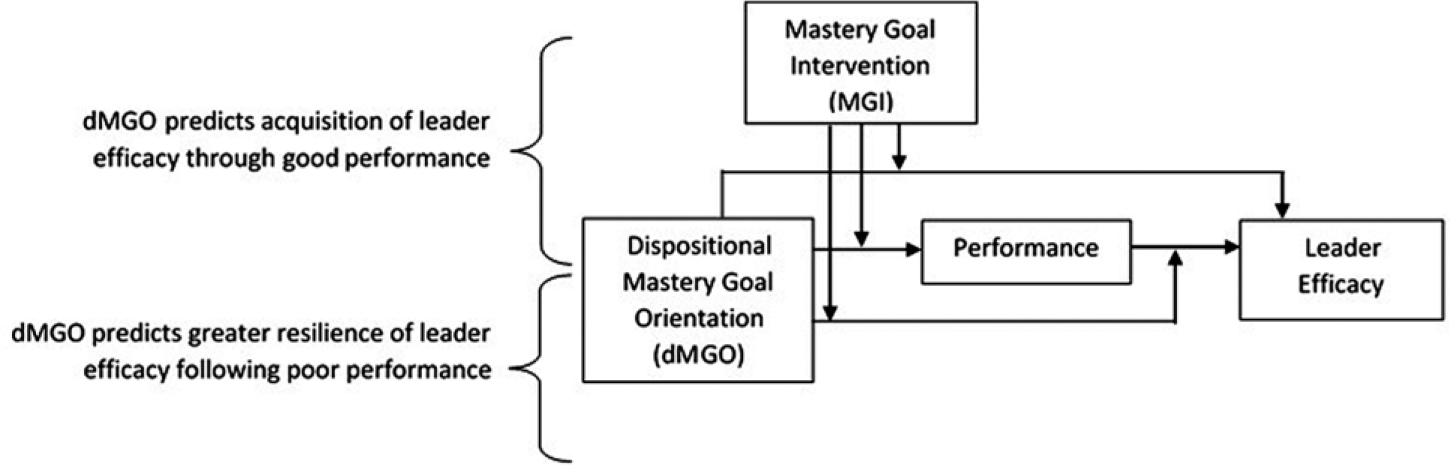
Theoretical model for Study 2.
Hypothesis Testing
All hypotheses relate to the buffering effects of the MGI on the relationship between dMGO and the outcomes of leader efficacy and performance. We control for leader gender, leader efficacy (measured before the start of leader development), and the dMGO by time interaction in all analyses. 3 In addition, given that leaders worked in pairs and, therefore, may have been influenced by their partner’s performance, we controlled for partner’s performance on the preceding trial in all analyses.
Hypothesis 6 was that low dMGO individuals who receive the MGI will have higher leader efficacy than those who do not receive the MGI. There was a significant dMGO by MGI interaction on leader efficacy (ϒ = −.36, p < .05, Table 6). The graph showed that high MGI mitigated the effects of a low dMGO on leader efficacy (Figure 6). Hypothesis 7 was that the MGI will result in higher performance for low dMGO individuals. There was a significant interaction between the MGI and dMGO but the interaction was not as expected (ϒ = .34, p < .05, Table 6). The MGI diminished performance for low dMGO individuals (Figure 7). Hypothesis 8 was that the MGI will mitigate the negative effects of poor performance on leader efficacy for low MGI individuals. The three-way interaction between dMGO, the MGI, and performance was significantly related to subsequent leader efficacy (ϒ = .19, p < .05, Table 6). The graph supported the hypothesized relationship. Low dMGO individuals who received the MGI had higher leader efficacy following poor performance than low dMGO leaders in the control condition (Figure 8).
Relationships Between dMGO, the MGI, Performance, and Leader Efficacy in Study 2.
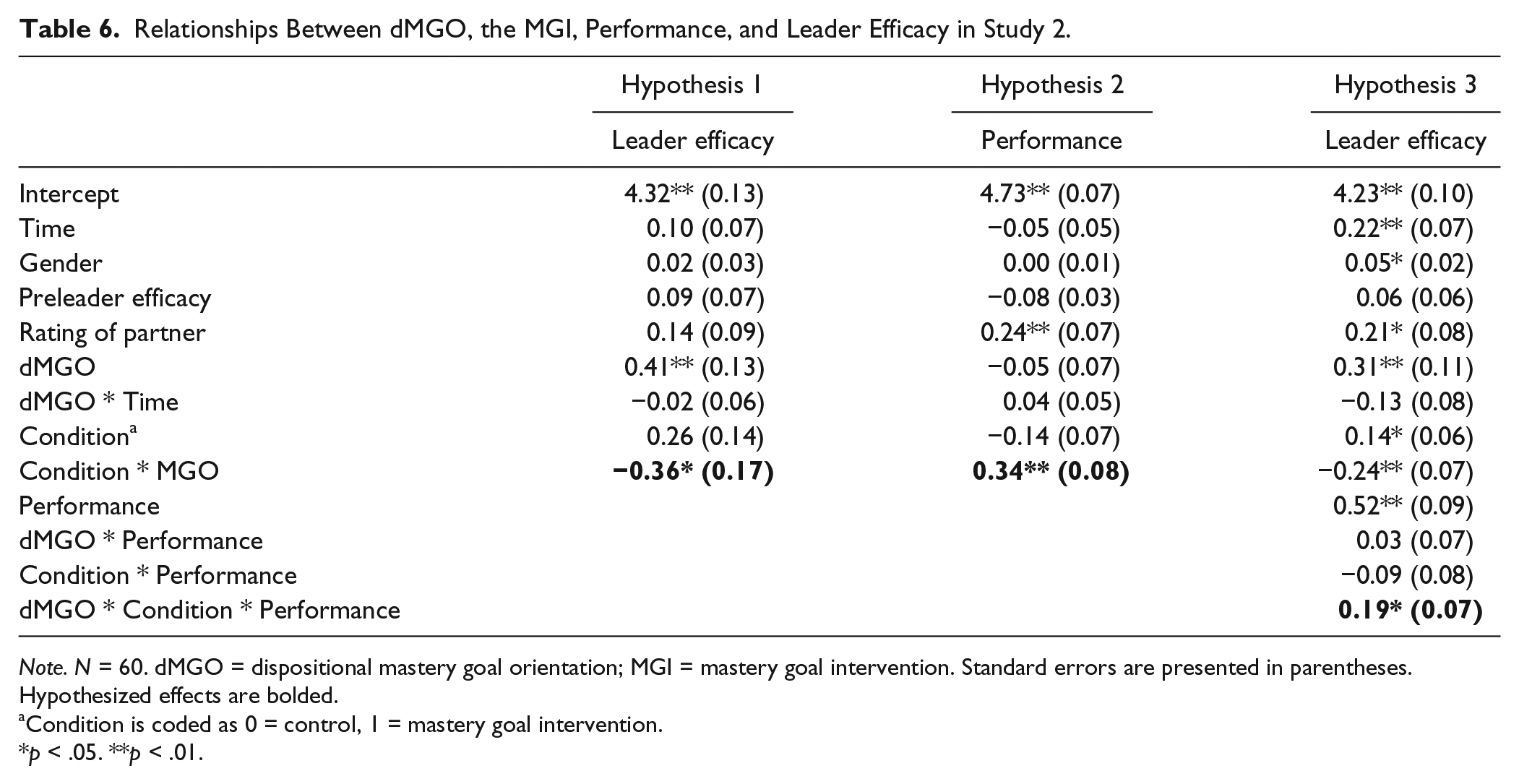
Note. N = 60. dMGO = dispositional mastery goal orientation; MGI = mastery goal intervention. Standard errors are presented in parentheses. Hypothesized effects are bolded.
Condition is coded as 0 = control, 1 = mastery goal intervention.
p < .05. **p < .01.
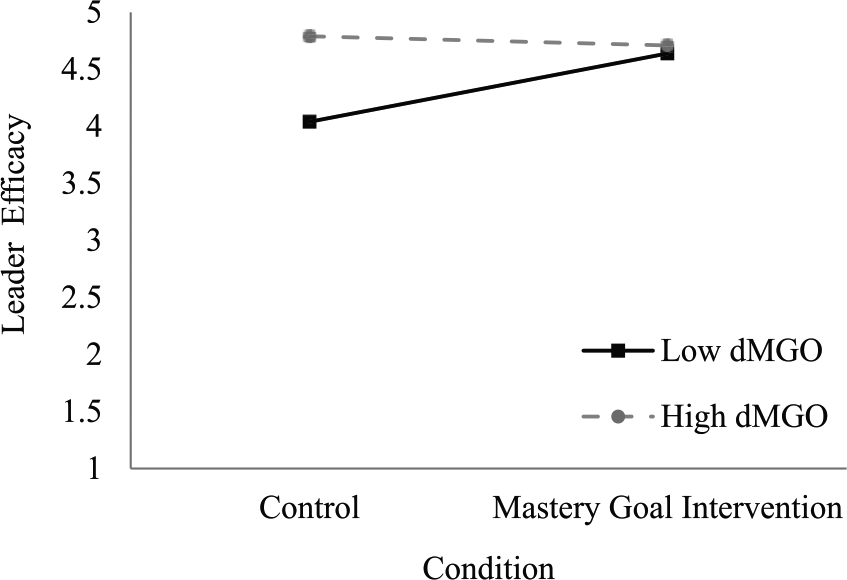
Interaction between dMGO and the MGI predicting leader efficacy in Study 2.

Interaction between dispositional mastery goal orientation (dMGO) and the mastery goal intervention (MGI) predicting performance in Study 2.
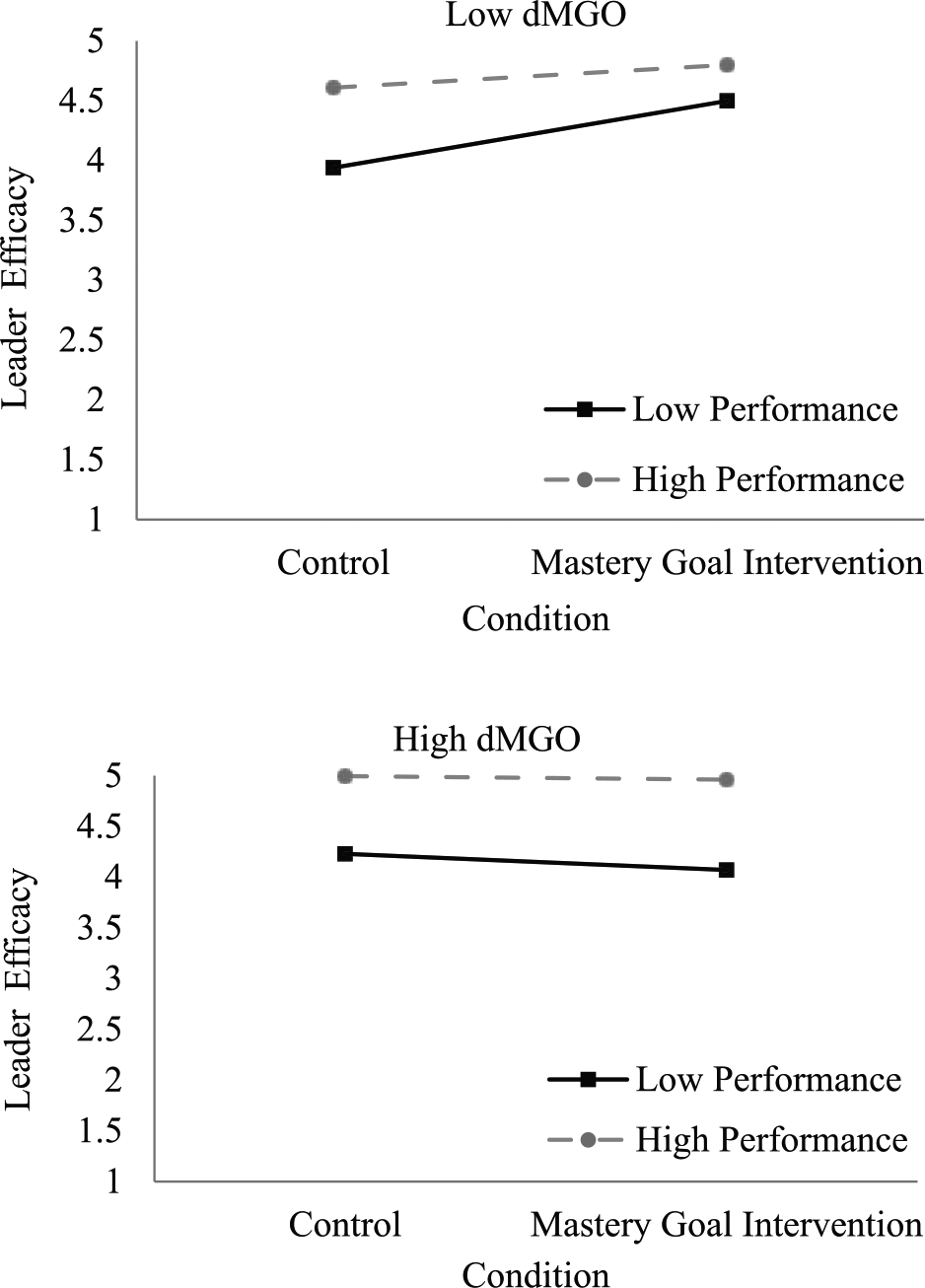
Interaction between dispositional mastery goal orientation (dMGO), performance, and the mastery goal intervention (MGI) predicting leader efficacy in Study 2.
Hypothesis 9 was that the interaction between dMGO and the learning goal intervention (MGI) on leader efficacy will be explained by performance and the three-way interaction between performance, dMGO, and the MGI. Low dMGO individuals who will be less adversely affected by poor performance in terms of leader efficacy than low dMGO individuals who do not receive the MGI. We extrapolated from the procedures for testing for mediated moderation outlined by Muller et al. (2005). Three conditions must be met to establish mediated moderation. First, MGI/MGO interaction must predict leader efficacy. This interaction was established in support of Hypothesis 1. Second, the dMGO/MGI interaction must predict performance, as evidenced by the test of Hypothesis 2. In addition, the dMGO/MGI/performance interaction must predict leader efficacy. This was demonstrated in the test of Hypothesis 3.
Next, it is necessary to test the indirect effect of the dMGO/MGI interaction on leader efficacy through the dMGO/MGI interaction on performance and through the dMGO/MGI/performance on leader efficacy. We test indirect effects using the Z′ method as suggested by MacKinnon et al. (2002). There was a significant indirect effect of the dMGO/MGI interaction on leader efficacy through the MGI/MGO interaction on performance (Z′ = 3.15, p < .05) although this effect was not as expected. The MGI increased leader efficacy for leaders higher in dMGO by increasing their performance. There was also a significant indirect effect of the MGI/MGO interaction on leader efficacy through the dMGO/MGI/performance interaction on leader efficacy (Z′ = 2.25, p < .05). The MGI increased leader efficacy for leaders who were low in dMGO by decreasing the deleterious effects of poor performance on leader efficacy. Taken together, these results suggest that the MGI increased leader efficacy in two ways. First, it increased the performance of leaders higher in dMGO, thereby increasing leader efficacy. Second, it decreased the negative effects of low performance on leader efficacy of those low in dMGO. Even though low dMGOs performed worse when receiving the MGI, their leader efficacy was not adversely affected.
Discussion
Study 2 supported the findings from Study 1 that dMGO is associated with greater leader efficacy. Likewise, the MGI resulted in greater leader efficacy by mitigating the effects of low dMGO on leader efficacy. The MGI did not increase low dMGOs performance, but instead increased the low dMGO’s resilience to poor performance. Interestingly, low dMGOs who received the MGI actually performed worse than low dMGOs who did not. It is possible people with low dMGO lack experience trying out new skills, exploring new tasks, and making mistakes during learning (DeShon & Gillespie, 2005). As such, when instructed to do so their lack of experience could result in poor performance.
General Discussion
Leader efficacy is a key outcome of leader development, although we know little about the conditions under which leader efficacy is gained during leader development (Day & Sin, 2011; van Knippenberg et al., 2004). The studies herein suggest that leader efficacy can be developed but demonstrate that there is wide variation between individuals in how leader development affects leader efficacy. In Study 1, only 34% of the leaders showed increases in leader efficacy, whereas 28% showed no change and 38% showed declines. In Study 2, only 41% of leaders increased in leader efficacy, 35% showed no change, and 24% reported declines in leader efficacy.
Individuals’ performance during development helped explain when and whether their leader efficacy increased or declined. Individuals who performed well showed greater gains in leader efficacy in both studies. This finding support Day, Harrison, and Halpin’s (2009) assertion that leader development activities that may cause one to fail are a risky endeavor. More important, individuals with high MGO showed greater increases in leader efficacy than those with lower MGO. Study 1 showed that high dMGO individuals exerted greater effort over time and, thus, experienced greater performance and greater leader efficacy. Study 2 showed that high dMGOs and those who received the MGI experienced greater leader efficacy than those with low dMGO who did not receive the MGI.
Theoretical Contributions
Our theoretical contributions primarily relate to self-efficacy, mastery goal orientation, and leader development. We add to self-efficacy theory by looking beyond the acquisition of leader efficacy to also examine the resilience of leader efficacy (Bandura, 1997). Theory suggests that individuals engage in “efficacy calibration,” when they perform poorly (Bandura, 1997; Gist & Mitchell, 1992). For example, using a repeated measures design, Shea and Howell (2000) found that many participants adjusted their self-efficacy downward after the initial trial raising “some doubt on the robustness of the findings of studies in which self-efficacy is measured only during early task trials” (Shea & Howell, 2000, p. 809). Likewise, the findings reported here support the relationship between performance and subsequent leader efficacy, suggesting that leader efficacy is sensitive to poor performance.
This research adds to theory on MGO in three important ways. First, we support theory suggesting that dMGO is related to the development of leader efficacy (Dierdorff et al., 2010). Second, we show that an MGI can replicate the effects of high dMGO on leader efficacy, offering one of the first studies to examine the interaction between dMGO and an MGI. Third, we offered a test of the theoretical mechanisms by which MGO relates to leader efficacy. In conjunction, the two studies suggest that MGO serves to increase leader efficacy by increasing individuals’ resilience to poor performance and by increasing effort and performance.
Furthermore, this study adds to the leader development literature by exploring both leader developmental readiness and one’s experience during leader development as predictors of leader efficacy. A recent meta-analysis showed that, after controlling for a host of factors including type and quality of the intervention, organization, setting, and dependent variables studied, there was still considerable variation in the impact of leader development interventions that is likely due to individual differences between participants (Avolio et al., 2009). Consistent with Avolio and Hannah’s (2008) theoretical work, dMGO helps explain who benefits from leader development. Furthermore, one’s performance accounts for differences in the impact of leader development. Individuals who perform better tend to benefit more from leader development than those who perform worse. Thus, we not only address who benefits from leader development but also when that is the case.
Practical Implications
Our findings have practical implications for organizations. It is important to understand methods of enhancing leader efficacy in light of the powerful effects of self-efficacy on work-related performance (Bandura, 1997) and leadership outcomes (Chemers et al., 2000; Luthans & Peterson, 2002; Robertson & Sadri, 1993; Smith & Foti, 1998). Self-efficacy is considered a core outcome of training (e.g., Kraiger, Ford, & Salas, 1993), but no previous research has demonstrated the effects of classroom-based leader development on increases in leader efficacy. The findings reported here suggest that classroom training, at least when mixed with practice opportunities and experiential exercises, can be an effective approach for enhancing leader efficacy among high dMGOs or those who receive an MGI.
A second practical implication of the current research is to either select trainees based on their dMGO or establish the conditions to induce an MGO before leader development. Our findings suggest that an MGI can mitigate the effects of low dMGO on leader efficacy. Importantly, however, low dMGOs who received the MGI performed worse than low dMGOs who did not. Individuals with a low dispositional orientation toward dMGO have less experience with what it means to try out new skills, explore a task, and make mistakes during learning (DeShon & Gillespie, 2005). When instructed to engage in this type of learning, their lack of experience translated into poor performance, but the poor performance did not impair their leader efficacy. Although more work is needed to better understanding this relationship, one practical implication for trainers to consider is whether performance or leader efficacy is more important before an MGI is implemented.
Our findings have implications for the common leader development technique of having individuals engage in stretch assignments (or excessively difficult assignments in which one is likely to fail). Consistent with Day et al.’s (2009) suggestions, our results show that this can be a dangerous practice because individuals who fail may suffer in terms of decreased leader efficacy. This is consistent with theories of adult learning suggesting that overly challenging experiences can have deleterious outcomes if the individual does not have the requisite resources to deal with the demands of the situation (Boud, Keogh, & Walker, 2013). Organizations should target leader development experiences at a level that is close to the skill level of the leaders involved.
An alternative interpretation of the results is that some individuals (those low in dMGO) should not be given negative quantitative performance feedback during leader development. Although providing individuals with feedback is a best practice in leader development because feedback is expected to improve learning, there is consistent evidence that receiving negative feedback can have a deleterious effect on performance (e.g., Kluger & DeNisi, 1998). For example, Sitzmann and Johnson (2012b) found that when individuals thought they had performed well during training, but received feedback to the contrary, they learned less and were more likely to quit the training program. Therefore, one implication of the current research may be to avoid situations that cause individuals to focus on their performance. Alternative ways of giving feedback or ensuring that participants maintain an MGO might be good ways of avoiding this concern.
It is also important to note that leader efficacy affects performance, just as we know that performance influences efficacy (Shea & Howell, 2000). Of course, we began our studies by taking baseline leader efficacy so it is the starting point of our models before the leaders performed any of the behaviors from the training. Moreover, performance was always measured before efficacy and we control for past efficacy and performance in the linear models, supporting the empirical basis of our results. That being said, theory supports both directions of the relationships and the relationship between efficacy and performance is best conceptualized as reciprocal in nature. The reciprocal nature of performance and efficacy actually serves to reinforce the importance of studying these two variables longitudinally and in tandem.
Limitations and Future Research
There are some limitations to the current study that should be addressed. First, in terms of our samples, we used a very specific industry: construction. Future research should test these results in different industries. The sample sizes in each study were also small. Small samples are of particular concern for Type II error, but considering that most hypotheses were supported, the small sample sizes might be of less concern here. Moreover, the strengths of utilizing actual organizational leaders in longitudinal studies of leader development interventions (rather than using students or using a correlational design) outweigh the weaknesses of the small samples and increase the generalizability of our findings. Indeed, Lord and Hall (1992, p. 153) assert that “too much research in the past has attempted to probe the complex issues of leadership using simple bivariate correlations.” Moreover, very few leadership studies actually utilize controlled leadership interventions, raising concern over the direction of causality among variables (Yukl, 2006). Certainly, it would not have been possible to assess change in leader efficacy without using a pre- and postdesign.
Conclusion
Given the large investments organizations make in leader development, it is important to understand the leader characteristics that facilitate change during development. The current studies addressed four questions: (a) Does leader development increase leader efficacy? (b) When is this most likely to occur? (c) For whom is this most likely to occur? and (d) Can an intervention facilitate increases in leader efficacy? We found that leader development does increase leader efficacy but only when individuals perform well or for those individuals who have a higher dMGO or receive the MGI. The findings of Study 1 were explained by the fact that high dMGO individuals add effort over time, resulting in better performance and higher leader efficacy, whereas low dMGO individuals tend to withdraw effort over time resulting in worse performance and lower leader efficacy. Study 2, a field experiment, showed that high dMGOs and those who receive the MGI were also more resilient to poor performance. Leaders can develop efficacy through training, but it is important to know that they can also lose efficacy in training as well.
Footnotes
Authors’ Note
The contents are solely the responsibility of the authors and do not necessarily represent the official views of NIOSH or CPWR.
Declaration of Conflicting Interests
The author(s) declared no potential conflicts of interest with respect to the research, authorship, and/or publication of this article.
Funding
The author(s) disclosed receipt of the following financial support for the research, authorship, and/or publication of this article: Portions of this study were supported by the Center for Construction Research and Training (CPWR) as part of a cooperative agreement with NIOSH (U60-OH009762), and Occupational Health Psychology Training, NIOSH (1T42 OH009229-01).