




Abstract
Using a sample of 488 employees from a large information technology firm in mainland China, this article examines the relationships between leader trustworthiness, employee voice, and supervisor-rated employee performance, as well as individual employee perceptions of organizational attitudes toward uncertainty. Drawing from social cognitive theory, as well as from the literatures on leader trustworthiness and employee voice, this article explores the mediating mechanism of employee voice within the leader trustworthiness–employee performance relationship. Within this Chinese context, employee voice was found to partially mediate the positive relationship between leader trustworthiness and employee performance ratings. Employee perceptions of organizational attitudes toward uncertainty were also found to strengthen the mediated relationship. Implications and limitations are discussed.
Introduction
Much of the existing voice research has focused on Western cultures, leaving a gap in our understanding of the emergence and consequences of voice within non-Western cultures, such as China (Brockner et al., 2001; Gao, Janssen, & Shi, 2011; Liang, Farh, & Farh, 2012). Because the use of voice is not a traditional part of Chinese culture, it can be especially challenging for Chinese employees to express their opinions, thoughts, and concerns within the workplace (Botero & Van Dyne, 2009; Hofstede & Bond, 1988; Klaas, Olson-Buchanan, Ward, 2012). Defined as a discretionary behavior where employees share their ideas, concerns, and opinions on workplace issues, employee voice has generally been found to have a positive impact on both employees and organizations within Western cultures (Klaas et al., 2012; Van Dyne & LePine, 1998). For instance, the willingness of team members to offer thoughts and suggestions during problem solving has been found to improve overall group learning (Edmondson, 1999, 2003). And similarly, voice behaviors have been shown to positively influence creativity and reduce group think during decision making (Janis, 1982; Pyman, Cooper, Teicher, & Holland, 2006). Moreover, research by Greenberg (1990) demonstrated long ago that the expression of voice increases perceptions of fairness and perceived control for employees.
And yet research on the consequences of employee voice in China has been mixed, with some research even finding a negative impact on employee performance (Bendersky & Hays, 2012; Burris, 2012; Klaas et al., 2012; Van Dyne & LePine, 1998). In fact, in these studies, Chinese employees who did express their voice were found to be “problem employees” and given negative performance reviews in response (Bendersky & Hays, 2012; Burris, 2012). Brockner et al. (2001) argued that it is important for researchers to understand both how and when voice is influential as well as the importance of exploring factors that may moderate voice across different contexts (Gao et al., 2011; Liang et al., 2012). Thus, the first objective of this article is to identify what factors, within a Chinese context, allow employee voice to have a positive impact on employee performance (Liang et al., 2012; Milliken, Morrison, & Hewlin, 2003).
Specifically, in this article, we examine how leader trustworthiness may positively affect both employee voice as well as performance for Chinese employees. Recent work on leadership in China has also stressed on the importance of including different forms of trust in examination of Chinese leadership and performance. Specifically, Chen, Eberly, Chiang, Farh, and Cheng (2014) used a relationship-based approach to leader trust and found that affective trust is crucial to explaining the positive relationship between Chinese leaders and employee performance. Most research that has been done on leadership and trust in China has focused solely on affective, or relationship-based, trust (Chen et al., 2014; Kao, 1996; Tan & Chee, 2005). This relational focus has some limitations when it comes to examining the outcome of leader trust on performance. Sashittal, Berman, and Ilter (1998) and Varma, Pichler, and Srinivas (2005) found that relationship-based trust between a supervisor and an employee may result in artificially high performance ratings due to the strong exchange-based relationship between the Chinese leader and the follower. Character-based trust, on the other hand, is focused on the employees’ cognitive evaluation of their leader, rather than on the relationship they share, and as a result, it may provide a new information regarding the relationship between leader trustworthiness and employee performance in China. Therefore, the second objective of this article is to explore the impact of cognitive character-based evaluations of leader trustworthiness on employee voice and employee performance within a Chinese setting.
In addition to determining the role of leader trustworthiness in motivating employee voice and positively affecting employee performance, this article also explores the role of individual employee perceptions of his or her organization’s attitudes toward uncertainty. In this article, we look at how these perceptions may strengthen the relationship between leader trustworthiness, employee voice, and employee performance. Again, because voice is not a traditional part of Chinese culture, it can be especially difficult for employees to engage in voice within this cultural context (Botero & Van Dyne, 2009; Hofstede & Bond, 1988; Klaas et al., 2012). Because employee voice is a change and control-focused behavior that involves the assessment of risk (Detert & Burris, 2007; Milliken et al., 2003), employees must assess the benefits and costs associated with speaking out in their environment. There is also evidence to suggest that employees make assessments of their organization’s willingness to tolerate deviation from rules and routines, as well as their organization’s attitude toward uncertainty and change (Hofstede, 1980; House & Javidan, 2004). In circumstances where individual Chinese employees perceive that their organization is threatened by change and uncertainty, we suggest that they rely more heavily on their evaluations of their leader’s trustworthiness to evaluate the perceived risk associated with expressing voice. Thus, the third objective of this article is to examine how organizational context, in the form of individual employee perceptions of his or her organization’s uncertainty avoidance, may strengthen the relationship between leader trustworthiness, employee voice, and supervisor-rated employee performance within a Chinese setting.
In sum, this article contributes to the management literature in three fundamental ways. First, we contribute to the voice literature by helping understand how and when voice can positively affect performance and by examining factors that may affect the expression of, and consequences for, voice within the Chinese context (Liang et al., 2012; Milliken et al., 2003). Second, this article contributes to research on leadership and trust in China by exploring cognitive, or character-based, evaluations of leader trustworthiness in place of the more commonly studied relational forms of leader trust (Chen et al., 2014). And finally, this article contributes to our overall understanding of how employee perceptions of context may influence not only perceptions of risk associated with expressing employee voice but also how leader trustworthiness may play an important role in mitigating that perceived environmental risk. Figure 1 illustrates the hypothesized relationship.

Hypothesized model.
Hypotheses Development
Leader Trustworthiness and Employee Performance
Management research has provided a wealth of information regarding how leaders can create and build trust in their followers and, in turn, how that trust can have a positive impact on various forms of employee performance (Dirks & Ferrin, 2002). The concept of trust is especially critical to understanding leadership in a Chinese context, where there are powerful expectations, driven by social norms and psychological contracts, which obligate both leaders and subordinates to behave in role consistent ways (Chen & Chen, 2004; Chen et al., 2014). Mayer, Davis, and Schoorman (1995) were the first to make an important distinction in our understanding of trust by differentiating between trust and trustworthiness, with trustworthiness focusing on the characteristics of the trustee and trust focusing on the exchange relationship. Notably, the focus of this article is on character-based leader trustworthiness, which is defined by three leader characteristics: ability, benevolence, and integrity (Colquitt, Scott, & LePine, 2007; Mayer et al., 1995). Regarding ability, an employee’s perception of his or her leader’s ability is measured by whether the employee believes that his or her leader has the skills and knowledge necessary to perform the job (Mayer et al., 1995). For example, if the leader is considered to have a high level of ability, the employees will likely feel more comfortable asking questions and discussing work-related ideas with the leader because they will trust that the leader understands the task well enough to listen and advise them. The second characteristic, benevolence, is reflective of whether the employees believe that their leader has positive intentions toward them (Mayer et al., 1995). Thus, if the leader is perceived to be benevolent, the employees will be more likely to view the leader as someone who wants to help, not hinder, their career development. And finally, the last characteristic, integrity, has to do with whether or not the employees believe that their leader will behave ethically and in ways that are consistent with their own moral values (Mayer et al., 1995). While these components are interesting to study separately, in this article we focus on the overall perception of leader trustworthiness held by the employee.
In the case of supervisor-rated employee performance, when a leader behaves in ways that inspire trustworthiness, employees can take advantage of cognitive resources that would otherwise be used to actively or passively defend themselves from perceived risks originating from an untrustworthy supervisor (Ashforth & Lee, 1990; Mayer & Gavin, 2005). For example, in the case of a challenging project, if an employee perceives his leader as untrustworthy, he may focus his attention on protecting himself from criticism and blame should the project go poorly. Similarly, an employee who perceives her supervisor to be untrustworthy may be unwilling to communicate out of a fear that her supervisor will steal her idea. On the other hand, if the same employee perceives her leader to be trustworthy, she will be able to instead focus her energy and resources on task performance. In this way, by allocating cognitive resources toward the successful completion of the task instead of toward self-protection, employees can apply more resources toward the task (Mayer & Gavin, 2005). Thus, based on the existing leader trustworthiness literature, we propose that leader trustworthiness will have a positive main effect on supervisor-rated employee performance (see Figure 1).
Leader Trustworthiness and Employee Voice
Employee voice is unique in that it is considered both theoretically and empirically distinct from other extra-role behaviors (LePine & Van Dyne, 1998; Tangirala & Ramanujam, 2008). It exists as a means for employees to exert influence with the goal of improving their work environment. This concept of voice as a control mechanism is important to keep in mind as we move forward in the article. And yet engaging in voice carries risk (Seibert, Kraimer, & Crant, 2001) and, often, employees may not feel as though it is safe or worthwhile to speak up (Milliken et al., 2003). For instance, some employees may fear retaliation from their leader for voicing their concerns, while others may not believe that their leader will value their opinions, and that they will lose face in their work group if their suggestion is dismissed.
Colquitt et al. (2007) notes that “two broad outcomes of trust are risk-taking and performance.” Existing leadership research has found that if employees believe that their leaders will be receptive to their thoughts, opinions, and concerns, they will be more likely to see the benefits of using voice as outweighing the risks (Detert & Burris, 2007). Leaders who reflect a high level of ability, benevolence, and integrity can inspire trustworthiness and ultimately reduce perceptions of risk such that employees are able to shift their effort toward performance improvement. Extant voice research echoes the above arguments that the decision of whether to engage in voice is based on an individual assessment regarding the potential benefits and costs associated with expressing voice (Detert & Burris, 2007). If the leader is trustworthy, employees are more likely to see their voice as having more potential benefits than costs, with leader trustworthiness ultimately fostering more employee voice. Taken together, we argue that leader trustworthiness will also have a positive main effect on an employee’s willingness to voice his or her thoughts, opinions, and concerns (Mayer & Gavin, 2005). Accordingly, we propose the following:
Social Cognitive Theory and Employee Voice as a Mediator
The above two hypothesized main effects between leader trustworthiness and employee performance and employee voice are an important first step to examining these relationships, but they are not sufficient for understanding the bigger picture of how these variables relate to one another within this context. In this article, we argue that it is primarily through employee voice that leader trustworthiness can positively affect performance within the Chinese context. As discussed in the above sections, leader trustworthiness reduces risk and inspires a willingness to experiment and express ideas and concerns regarding work, and it also frees up resources that might otherwise be used to protect against an untrustworthy leader (Mayer & Gavin, 2005). And yet the question remains, how exactly do these cognitive resources get converted into increased employee performance? To reiterate, voice is considered a control mechanism for exerting influence on one’s environment. Here, we draw on social cognitive theory to argue that employee voice acts as a form of agency that Chinese employees use to increase their performance.
According to social cognitive theory, employees can achieve their goals in the workplace through different modes of agency (Bandura, 1997, 2001). Bandura (2001) notes that underlying the concept of personal agency is the ability to act with intention and forethought as well as the ability to process information. Through this process, employees can identify and plan pathways toward success in their organization, and they can respond to feedback from their environment and self-regulate accordingly. This mode of personal agency is foundational to the process of performance improvement within an organization (Bandura, 2001). An employee with a trustworthy leader has the resources available to focus on this process, rather than on his or her own self-protection. However, in social cognitive theory, personal modes of human agency are not the only way to achieve higher levels of performance. Bandura (2001) notes that sometimes it is necessary to work with, or through, others to grow and progress toward goals. He identifies both proxy and collective agency as two other modes of agency through which individuals can act to exert control over their environment.
Of importance to this study, in a high-power distance and highly collectivistic culture, such as China, many resources may be held and concentrated at higher levels of the organization, and employees may be most comfortable working in a group or a team-focused system (Bandura, 2001; Botero & Van Dyne, 2009; Hofstede & Bond, 1988; Klaas et al., 2012). Chinese employees may need to use proxy agency, defined by Bandura (2001) as when “people try to get those who have access to resources, expertise, or who wield influence and power to act at their behest to secure the outcomes they desire” (p. 13). Conversely, employees may choose to use collective agency through collaborating with other employees as well with their leader to improve their performance (Bandura, 2001).
By reducing risk associated with employee voice and freeing up cognitive resources, trustworthy leaders can give their employees an opportunity to engage in all three modes of agency. In sum, Chinese employees can use their voice to acquire new skill sets, work collaboratively, ask questions, provide suggestions, or even request assistance, resources, or advice from their leader or teammates. However, without a trustworthy leader, the resources needed for agency to increase performance is likely to be restricted. Therefore, we argue that by having a trustworthy leader, Chinese employees have the resources and freedom to engage in employee voice as a form of agency with which they can steadily improve their performance ratings. As such, we propose that it is primarily through this form of control-focused agency (i.e., employee voice) that leader trustworthiness can increase supervisor-rated employee performance ratings.
The Role of Perceived Context as a Moderator
Hofstede (1983) noted that one of the “decisive dimensions of culture in organizations is uncertainty avoidance” (p. 87). The GLOBE leadership studies, which draw on work by Hofstede (1980), and House and Javidan (2004), define uncertainty avoidance as being the degree to which a culture, organization, or group relies on rules and procedures to avoid uncertainty and resist change or experimentation. Thus, in this article, we focus on individual-level employee perceptions of his or her organization’s attitudes toward uncertainty and change. We propose that employees are hardwired to look to their organization to determine how employee control–focused agency, specifically employee voice, will be interpreted. By including employee perceptions of their organization’s attitude toward uncertainty and change in our theoretical model, we gain new insight into how each employee may uniquely weigh the risk of presenting a new idea or concern within his or her organizational context. And perhaps most important, we begin to tease apart how an individual evaluation of context has the power to influences the role of leader trustworthiness in maintaining a positive link between employee voice and performance for Chinese employees.
Drawing again on social cognitive theory as a framework with which to understand these relationships, we suggest that when an organization is perceived by an employee to be risk averse and highly uncertainty avoidant, the employee’s cognitive resources will be allocated to spend more time on self-protective behaviors. We also propose that in a highly uncertainty-avoidant environment, a trustworthy leader can free up cognitive resources that would otherwise be used for self-protection by acting in trustworthy ways that reduce stress and anxiety for the employee. It is also possible that in this context an employee may perceive the leader as the sole avenue through which he or she can engage in a change-focused behavior, using proxy or collective modes of agency (i.e., employee voice). In this way, the employees may be able to work collaboratively with, or through, their leader to achieve performance improvement. Put more simply, when employees perceives their organization to be risk averse and uncertainty avoidant, that employee will place a stronger emphasis on their evaluation of leader trustworthiness in determining whether to engage in control-focused behavior. Conversely, in an environment that is perceived by the employee to be less uncertainty avoidant, we suggest that employees should be correspondingly less dependent on their leader and less likely to see them as the only avenue for control-focused agency (Bandura, 2001). Accordingly, we offer the following hypothesis:
Method
Samples and Procedures
To test hypotheses, we conducted a field test in a large information technology firm in mainland China. Participants included 569 employees within a single division of the firm with complete data for 488 employees representing an 85.76% response rate suggesting a low presence of nonresponse bias. Of the final participants, there were 188 women and 300 men. Participants age ranged from 23 to 48 years with a mean of 32.29 years (standard deviation [SD] = 5.67). Tenure within the organization ranged from 1 to 26 years with an average tenure of 5.60 years (SD = 5.32) years. Given the prevalence of common method and source biases in organizational research, we separated source of data collection to include both employee- and supervisor-reported data with three variables provided by each group. Specifically, predictors (leader trustworthiness, employee voice, and uncertainty avoidance) were provided by the employees, and criterion (in role performance) were provided by a panel of supervisors. According to Podsakoff, Mackenzie, Lee, and Podsakoff (2003), this type of research design should have a lower presence of this bias than exclusively self-reported data.
Researchers provided hard copies of the surveys in between work shifts for participants to complete. Participants completed informed consent and then self-rated instruments including leader trustworthiness, employee voice, and uncertainty avoidance. After data collection was complete for all participants, a panel of their supervisors (the divisional leadership team) used a consensus method to rate the employees’ performance. The method was used for two reasons. First, multisource ratings are generally considered more valid that a single rater. Second and most practically, this process was already formally used in the organization and what the firm preferred to use. For each group of employees, supervisors discussed strengths and weaknesses and agreed on a rating. There was no interrater agreement available for this variable as supervisors used a consensus discussion method, and all agreed on the final score, and thus, there was no variance in within-person rating. The panel rated each individual employee (performance was at the individual level) and not groups as a unit.
Measures
To address potential language issues, we used the translation and back translation procedures suggested by Brislin (1980). This process yielded adequate isomorphism between the languages. Supervisor trustworthiness (α = .93) was measured with Mayer and Davis’ (1999) multidimensional scale assessing the three components of ability (six items), benevolence (five items) and integrity (six items). Uncertainty avoidance was measured as the individual employee’s perception of his or her organization’s attitude toward uncertainty avoidance, using the two-item instrument from the GLOBE studies (α = .84). The items are “In this organization, orderliness and consistency are stressed, even at the expense of experimentation and innovation.” and “In this organization, job requirements and instructions are spelled out in detail so that employees know what they are expected to do.” In this study, we used Van Dyne and LePine’s (1998) six-item voice instrument (α = .89). An example item was “I develop and make recommendations concerning issues that affect my work.” All self-report items were on a 5-point scale ranging from 1 = strongly disagree to 5 = strongly agree. Supervisor-rated performance was measured with four items from Williams and Anderson’s (1991) supervisor-rated performance instrument that were the most relevant to this field sample. Items were statements beginning with “this employee” and ending with “adequately completes assigned duties,” “performs tasks that are expected of him/her,” “fulfills responsibilities specified in job description,” and “meets formal performance requirements of the job.” Instrument anchors were on a scale from 1 = far below expectations to 5 = far exceeding expectations. This instrument also yielded adequate internal reliability (α = .94).
Mplus software was employed to complete a confirmatory factor analysis (CFA). To model the CFA, each item was fit to its latent factor (e.g., all voice items created an employee voice factor). Results of the CFA were generally strong (as well as internal reliability above and in Table 1). Specifically, MPlus results included a χ2 = 947.90 (df = 371) and fit indices of a comparative fit index (CFI) = .93, root mean square error of approximation (RMSEA) = .05, and standardized root mean square residual (SRMR) =.05. Hu and Bentler (1999) suggest adequate fit indices for CFA close to or less than .08 for SRMR, .06 for RMSEA, and at or greater than .95 for CFI. Given these suggestions, we found support for the proposed factor structure using two of the three indices.
Descriptives and Correlations.
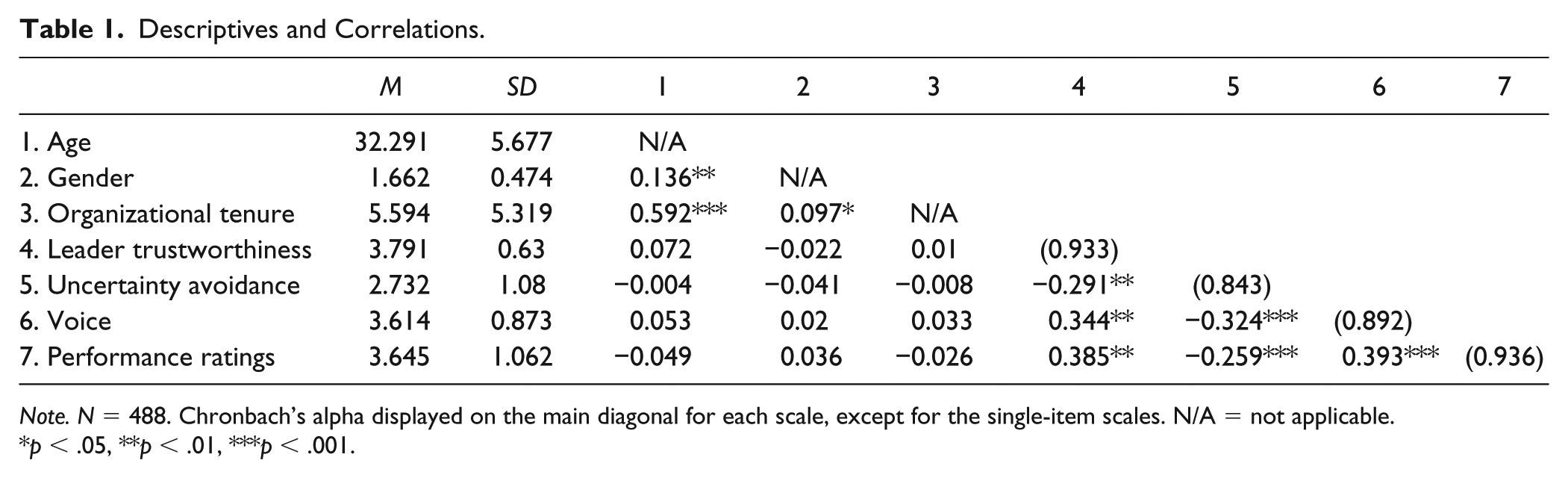
Note. N = 488. Chronbach’s alpha displayed on the main diagonal for each scale, except for the single-item scales. N/A = not applicable.
p < .05, **p < .01, ***p < .001.
Analysis
To address problems with Baron and Kenny’s (1986) causal steps approach and allow testing hypothesized models against alternative, nested models, we adopted Edwards and Lambert’s (2007) approach (see Tepper, Henle, Lambert, Giacalone, & Duffy, 2008) to conduct our analysis. We analyzed the first-stage indirect effect model by combining moderated regression procedures with mediation testing in a path analytic framework (MacKinnon, Lockwood, Hoffman, West, & Sheets, 2002; Shrout & Bolger, 2002). This approach allowed us to test two models in our study for the dependent variable (i.e., performance): (1) the hypothesized first-stage moderated mediation model where uncertainty avoidance moderated the indirect effect of leader trustworthiness on a dependent variable and (2) the mediation model where the moderation of the indirect effect was not specified and to use the W statistics to compare the relative predictive power of these two models. Because of the nonnormal distribution of the product term, we also took Tepper et al.’s (2008) suggestion and used the bootstrapped estimates with 10,000 samples to construct bias-corrected confidence intervals for all significance tests reported in this study.
Results
Descriptive statistics, correlations, and reliability coefficients for the variables of interest are presented in Table 1. Age, gender, and organizational tenure were collected as potential control variables. However, they showed no significant correlations with any of the dependent variables and were therefore excluded from this analysis.
Table 2 shows the regression results for the effects of the control variables, leader trustworthiness, uncertainty avoidance, and the interaction term on voice and performance. Omnibus model testing was conducted by comparing the hypothesized first-stage indirect effect model with a mediation model that does not specify moderation of the indirect effect. Then generalized R2 values were computed for the target model and the comparison model and were compared by using the Q statistic (Pedlhauzer, 1982). The formula for the generalized R2 was as follows:

where

As such, Q = (1 − 0.368)/(1 − 0.359) = 0.985 for performance ratings. The Q statistic has an upper bound of 1 (which means that the two models do not differ). We tested the significance of Q using the W statistic, which is chi-square distributed with d degrees of freedom. The formula for W is

where N refers to the sample size, d refers to the number of restrictions imposed by the more restricted model (the hypothesized model) when compared with the less restricted model (the mediation model), and loge refers to the natural logarithm. For each of the two dependent variables in our sample, comparison between the two models suggests that the generalized variance explained by the hypothesized model (
Regression Results.
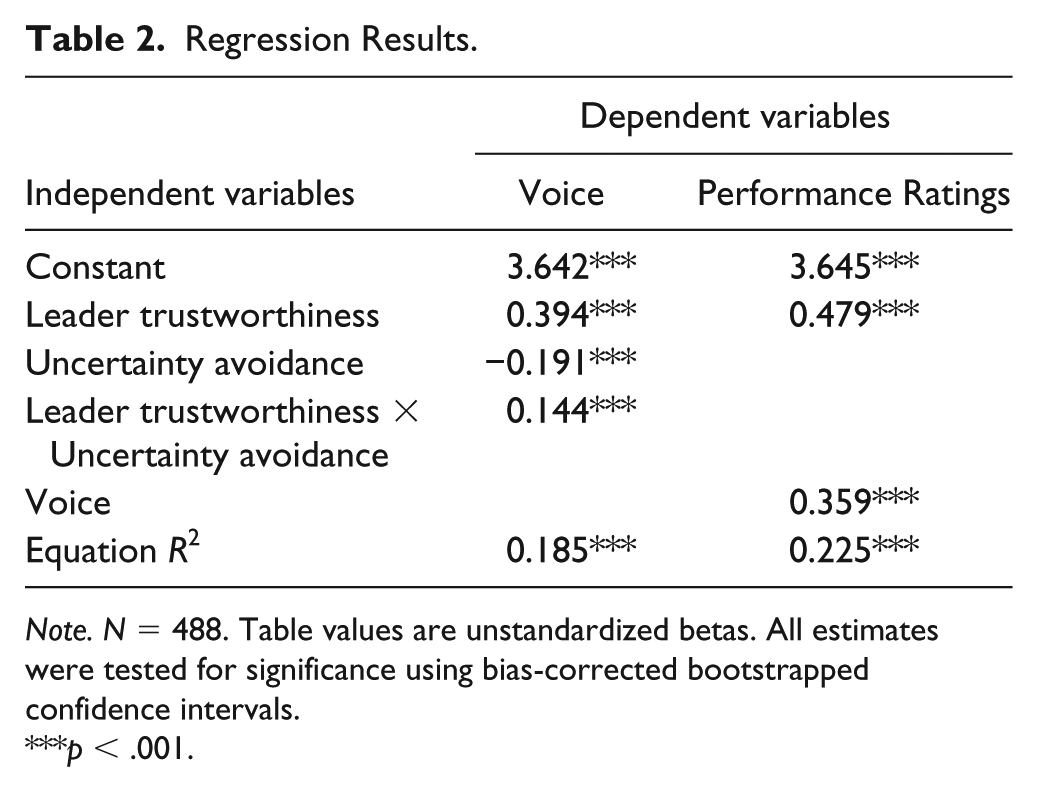
Note. N = 488. Table values are unstandardized betas. All estimates were tested for significance using bias-corrected bootstrapped confidence intervals.
p < .001.
Then the path estimates associated with the hypotheses were examined. In our sample, leader trustworthiness was positively related to performance ratings (b = 0.385, p < .001) and voice (b = 0.394, p < .001), thus supporting Hypotheses 1 and 2. Voice was positively related to performance ratings (b = 0.359, p < .001). When voice was introduced to the model as a mediator, the relationship between leader trustworthiness and performance ratings remained significant (b = 0.479, p < .001). As such, voice partially mediated the relationship between leader trustworthiness and performance ratings, thus providing general support for Hypothesis 3 (Baron & Kenny, 1986). It should be noted that the baseline model for Baron and Kenny’s (1986) approach is a partial mediation model and such a baseline is not appropriate when one is testing for complete mediation (James, Mulaik, & Brett, 2006) and that the independent variable does not necessarily have to be related to the dependent variables, particularly in cases of a moderated mediation model where the moderator could be masking the direct relationship (MacKinnon et al, 2002).
The direct, indirect, and total effects of leader trustworthiness on performance ratings for low and high uncertainty avoidance are reported in Table 3, and the total effects can be observed in Figure 2. As shown in Table 3, the relationship between leader trustworthiness and voice became stronger (P = 0.550, p < .01) when uncertainly avoidance was high and the difference between low and high uncertainty avoidance was significant (P = 0.311, p < .05). Also, the indirect effect of leader trustworthiness on performance ratings became stronger (P = 0.197, p < .01) when uncertainly avoidance was high and the difference between low and high uncertainty avoidance was significant (P = 0.112, p < .01); thus, Hypothesis 4 was supported (see Figure 2). Taken together, support was found for all four hypotheses. The indirect paths between leader trustworthiness and performance ratings varied with uncertainly avoidance.

Total effect of leader trustworthiness on performance ratings.
Direct, Indirect, and Total Effects of Leader Trustworthiness on Subordinate Performance.

Note. N = 488. Table values are unstandardized betas. All estimates were tested for significance using bias-corrected bootstrapped confidence intervals.
p < .01, *p < .05.
Discussion
This article makes three important theoretical contributions to the management literature. First, we contribute to the literature on employee voice by helping identify both how and when employee voice can have a positive impact on employee performance within a Chinese context (Liang et al., 2012;Milliken et al., 2003). Second, this article makes an important contribution to the leadership and trust literatures by examining cognitive, or character-based, evaluations of leader trustworthiness. Because most research on leader trust in China has focused on the social exchange relational forms of leader trust, this article provides new findings regarding how character-based trust can also positively affect employee performance (Chen et al., 2014). And finally, this article highlights the importance of individual employee perceptions of organizational attitudes in determining not only the risk of expressing employee voice but also how important it is to have a trustworthy leader to protect employee cognitive resources and agency pathways for improving performance.
In addition to its theoretical contributions, this research has implications for management practice as well. Specifically, Chinese leaders should take note of the importance of character-based forms of leader trustworthiness in supporting employee voice. In other words, while social exchange between Chinese leaders and followers is extremely important to encouraging employee voice and driving performance, leaders must not overlook the importance of acting in ways that build employee perceptions of leader trustworthiness. This character assessment acts as a foundation that employees will continue to revisit to assess risk and to make decisions regarding whether they can use resources for agency or whether they need them for their own self-protection. Chinese managers should also note that when employees perceive their organization to have a high level of uncertainty avoidance, this will amplify the importance of leader trustworthiness in deciding whether to express voice and protect the positive relationship between employee voice and performance.
Limitations
Although several steps were taken in the research design process to enhance validity of the study, there are still noteworthy limitations that must be recognized. Specifically, there are a few limitations that restrict the interpretation of the data. First, this study was done with Chinese technology employees, which may limit the external validity of the results. In other words, we do not know if the conclusions are generalizable to other populations such as U.S.-based samples or samples from other industrial sectors. Second, some of the data were gathered from the same source (e.g., voice and supervisor trustworthiness) suggesting the possible presence of artificially inflated relationships between constructs resulting from common-source variance. Third, the data were primarily collected with employee and supervisor surveys and therefore could have artificially inflated relationships due to common method bias. Fourth, this was a cross-sectional study and was not experimental in nature. While this enhances external validity, it limits internal validity by negating causality in the research design. Additionally, performance was rated by supervisors, and given the relatively high correlation, there is evidence for common source bias, which can artificially inflate the relationships between two or more variables. Finally, our model is embedded in a larger nomological network. There are possibly other variables in addition to leader trustworthiness and employee perceptions of organizational uncertainty avoidance that may influence voice behaviors. It is perhaps worthwhile for future research to investigate how other variables can interact with leader trustworthiness and employee perceptions of organizational uncertainty avoidance in predicting employee voice. As such, the analysis should be interpreted with this caution in mind. Moreover, there may be other important dependent variables beyond performance that would be beneficial to examine. In sum, although there were many steps taken to enhance study validity, results should be interpreted with caution based on these limitations.
Future Directions
As noted by Avolio, Walumbwa, and Weber (2009), context is important as it sets the boundary conditions for the interpretation of the results. In this study, the explicit focus was on the contextual variable of uncertainty avoidance. While this focus was appropriate given the nature of the research questions, other contextual variables should be considered in future work. For example, an examination of leader trustworthiness might yield smaller effect sizes or insignificant results in a context where risk taking is the norm (e.g., technology/product development, entrepreneurship).
An additional component of context where future research on this topic may show utility is considering sample characteristics. Specifically, the past decade has yielded expansive growth in the interest of generational differences with evidence suggesting small but meaningful main-effect differences between generations (Twenge, Campbell, Hoffman, & Lance, 2010). These differences may include moderating effects of the relationships examined in this study considering variance in generational norms on risk taking and the exercise of voice behaviors. In addition to sample characteristics, various cultural norms may also act as moderators in these relationships. In sum, theory is extended through replication and convergence of results, and future research should consider testing alternative contextual boundary conditions.
In addition to contextual variance in future research, alternative outcome variables should be considered. For example, leader trustworthiness–enabling voice behaviors would likely lead to positive forms of creativity from employees. Creativity in high-reliability contexts (e.g., first response, military, medical) may reveal an even more critical role of trustworthy leaders than the existing evidence shown here. A second important aspect of the mediated relationship between leader trustworthiness and performance is the nature of time. Do followers eventually become unaffected or even jaded by the trustworthy leader or, contrarily, do trustworthy leaders over time yield even higher levels of voice and engagement to where employee power becomes difficult to manage? These questions can only be addressed with a longitudinal research design, and future research would do well to begin to explore these interesting avenues for research.
A third direction for future research would be to examine the impact of the three components of leader trustworthiness separately. For example, because ability is one of the three dimensions of trustworthiness, we cannot test here whether trust mediates or moderates the leader ability to employee voice relationship. However, it is possible that a leader whose employees perceive as having higher ability may differentially influence voice than will a leader who is perceived to be high in integrity and so on. It may also be that certain components of leader trustworthiness are predictive of different types of voice (e.g., promotive or prohibitive voice) in addition to different organizational outcomes beyond employee performance (Liang et al., 2012).
Conclusion
This article has used the literatures on leader trustworthiness and employee voice as a lens through which to further explore the mediating mechanism of employee voice within the leader trustworthiness–employee performance relationship. Within this Chinese context, this article shows that employee voice may indeed partially mediate the positive relationship between leader trustworthiness and employee performance ratings. Employee perceptions of organizational attitudes toward uncertainty may also strengthen the mediated relationship. These findings suggest the importance of character-based forms of leader trustworthiness in supporting employee voice and increasing performance, especially in uncertain environments where employees look to their leaders for how to respond to the challenges they face.
Footnotes
Declaration of Conflicting Interests
The author(s) declared no potential conflicts of interest with respect to the research, authorship, and/or publication of this article.
Funding
The author(s) received no financial support for the research, authorship, and/or publication of this article.