



Abstract
Recent literature has focused on identifying factors that facilitate or impede the implementation of innovation in organizations. Attitudes toward change and transformational leadership are regarded as important determinants of implementation success. This study tested a multilevel model of transformational leadership and leaders’ attitudes toward the innovation being implemented as predictors of staff attitudes and implementation success. Participants were 565 service providers (n = 478) and their supervisors (n = 87) working in mental health organizations currently implementing an evidence-based practice (EBP). Results provided support for positive relationships between transformational leadership and staff attitudes toward EBP, as well as staff attitudes toward EBP and implementation success. Moreover, results supported an indirect relationship between transformational leadership and implementation success through employees’ attitudes toward EBP. The results suggest that the leader’s behaviors are likely more critical to innovation implementation than the leader’s attitudes.
Literature on implementation of innovations has sought to identify factors that facilitate and impede whether innovations are successfully implemented and utilized by targeted employees. A variety of factors have been considered across the organizational, work group, and individual levels. For example, organizational-level predictors of implementation success include structure (Zaltman, Duncan, & Holbek, 1973), strategy (Nicholson, Rees, & Brooks-Rooney, 1990), financial resources (Mohr, 1969), and organizational culture (Damanpour, 1991). Work group characteristics that predict innovation adoption include team structure (Nemeth & Wachtler, 1983), team climate (De Dreu & West, 2001), and team member characteristics (Paulus, 2000). Individual-level staff member characteristics that predict implementation include personality (Barron & Harrington, 1981), motivation (West, 1987), cognitive ability (Wallach, 1985), and job characteristics (Axtell et al., 2000).
The role of leadership has been a particular emphasis in theories of implementation. For instance, the Leadership Behaviors for Evidence-Based Practice Institutionalization Framework (Stetler, Ritchie, Rycroft-Malone, & Charns, 2014) describes the dynamic nature of various observable behaviors leaders at multiple levels can enact to enhance successful implementation of evidence-based practice (EBP), defined as those innovative practices that integrate the best research evidence with clinical expertise and patient values (Institute of Medicine, 2001). As another example, Aarons and colleagues have stressed the importance of first-level leaders in the implementation process. They proposed that leaders who enact specific implementation leadership and transformational leadership behaviors enhance the climate that is conducive for implementation and sustainment (Aarons, Ehrhart, Farahnak, & Sklar, 2014). The critical role of leadership for implementation effectiveness has been supported by empirical research as well (Aarons, Ehrhart, & Farahnak, 2014; McFadden, Stock, & Gowen, 2015; Michaelis, Stegmaier, & Sonntag, 2010; O’Reilly, Caldwell, Chatman, Lapiz, & Self, 2010).
Despite this progress in understanding the role of leaders in implementation effectiveness, there are gaps that remain. For instance, although we know that leaders play a critical role in the implementation process, as described above, and that employee attitudes toward the innovation being implemented can play a critical role in the success of the implementation (e.g., R. A. Jones, Jimmieson, & Griffiths, 2005; Shum, Bove, & Auh, 2008), how leaders influence subordinates attitudes toward the innovation has received less attention. On one hand, transformational leadership research and theory (Avolio & Bass, 1991; Bass & Avolio, 1999) suggests that leaders influence subordinates’ attitudes through their leadership style, specifically through transformational leadership behaviors that encourage the acceptance of change and innovation. On the other hand, literature on the social constructivist perspective (Calder, 1977; Salancik & Pfeffer, 1978), social learning theory (Bandura, 1977, 1986), and emotional contagion theory (Dasborough, Ashkanasy, Tee, & Tse, 2009; Hatfield, Cacioppo, & Rapson, 1994) suggests that leaders’ own attitudes play an important role in influencing attitudes of subordinates. Although previous research has examined the relationship between leaders’ attitudes and staff attitudes during change (e.g., Van Dam, Oreg, & Schyns, 2008), as well as the mechanisms through which transformational leadership affects change outcomes (e.g., Bass, Avolio, Jung, & Berson, 2003; Carter, Armenakis, Feild, & Mossholder, 2013; Nemanich & Keller, 2007), it has not addressed whether it is leaders’ behaviors or their attitudes that are more critical for predicting employee attitudes toward an innovation and implementation success.
The objective of this study was to extend our understanding of the role that leaders play in implementation processes by examining the simultaneous influence of both leadership behavior and leader attitudes through subordinate attitudes on implementation success. The context for the current study was mental health workers and the implementation of EBP. EBPs are usually more effective and efficacious than services-as-usual, which are typically based on individual or management preference (Hoagwood & Olin, 2002). Mental health interventions receive the label of being evidence-based after at least two rigorous randomized controlled trials have found the practice to be superior to a comparable practice or services as usual in improving client outcomes (California Evidence-Based Clearinghouse, 2010). Although common EBPs such as cognitive behavior therapy have been around for many years in mental health agencies throughout the United States, EBPs are being implemented with exponential growth as sponsors at the federal, state, and county level add stipulations about the use of EBP to funding contracts (Essock et al., 2003; National Institute of Mental Health, 1999, 2000, 2002). Such widespread implementation efforts have raised numerous challenges about how to lead such change efforts effectively. Thus, this research contributes not only to the literature on the role of leadership in implementing change but also to the public health challenge of how to best implement EBP in mental health settings. In what follows, we develop the background for proposing both leader behavior and leader attitudes as avenues for the leader’s influence on their subordinates and their particular relevance to the context of implementation.
The Role of Leaders in Employees’ Attitudes Toward Change
Research on attitudes toward change has predominantly focused on employee and leader opinions about change in general. However, there are also examples of attitudes toward a specific implementation being assessed in several organizational contexts, including the implementation of a manufacturing resource–planning package (Klein, Conn, & Sorra, 2001), restructuring of a school district (Oreg & Berson, 2011), changing management information systems in decision support systems workers (Barki & Huff, 1985), and the implementation of EBP in mental health teams (Aarons, 2004). The present research examines the influence of attitudes toward a specific implementation: attitudes toward adoption and use of EBP in mental health. Specifically, we address the influence of both the leader’s transformational leadership and the leader’s own attitudes toward change on employee’s attitudes toward change.
Transformational Leadership and Employees’ Attitudes Toward Change
Transformational leadership is one of the most widely studied styles of leadership (Avolio, Walumbwa, & Weber, 2009) and has been recognized as an effective style to address organizational tensions and aid in overall performance (Bass & Riggio, 2006). Specifically, the literature on transformational leadership has demonstrated its positive effects on a number of organizational outcomes, including improved performance at the managerial (Hater & Bass, 1988; Waldman, Bass, & Einstein, 2011), staff (Zohar, 2002), and team (Bass et al., 2003; Howell & Avolio, 1993) levels. Transformational leadership is also associated with improved staff attitudes, such as job satisfaction (Podsakoff, MacKenzie, & Bommer, 1996; Walumbwa, Orwa, Wang, & Lawler, 2005) and organizational commitment (Bycio, Hackett, & Allen, 1995), as well as decreased negative outcomes, such as turnover intentions (Bycio et al., 1995) and burnout (Constable & Russell, 1986; Corrigan, Diwan, Campion, & Rashid, 2002).
Theory on transformational leadership indicates that this type of behavior is especially relevant during periods of organizational change such as the implementation of an innovative practice (Bass, 1985; Bass & Avolio, 1999; Bass & Riggio, 2006 ; Pawar & Eastman, 1997). Transformational leaders are able to identify the necessity of change, motivate their followers to transcend their self-interests for the good of the team and organization (Bass, 1985, 1999), and intrinsically motivate followers to achieve higher levels of performance (Judge & Piccolo, 2004; Waldman, Bass, & Yammarino, 1990). Several studies have empirically examined the relationship between transformational leadership and implementation of a change. For instance, Aarons, Sommerfeld, and Willging (2011) found that transformational leadership was especially important in maintaining a positive organizational climate in organizations enduring a large-scale system change. As another example, Carter et al. (2013) found that transformational leadership was associated with improved relationship quality with subordinates during the implementation of organizational change, which was then related to improved subordinate task performance and citizenship behavior.
Specifically with regard to attitudes toward change, transformational leaders influence employees’ attitudes in a variety of ways. As noted by Bommer, Rich, and Rubin (2005), “transformational leadership ‘transforms’ individual employees to make them more receptive to, and build capacity for, bringing about organizational change” (p. 734). For instance, they may use inspirational motivation to depict a positive vision for how the organization and the employees will be more effective as a result of implementing the change. Intellectual stimulation behaviors may be utilized to engage employees in dialogue about their concerns with the innovation being implemented and to view those concerns in a different light. Finally, individualized consideration behaviors may be used to foster a sense of trust and confidence in employees’ ability to implement change. As a result, transformational leadership should be associated with more positive employee attitudes toward the change being implemented. Past empirical research supports such a relationship. For instance, transformational leader behaviors have been shown to have positive effects on followers’ change commitment and acceptance to a specific change initiative (Herold, Fedor, Caldwell, & Liu, 2008; Tyler & De Cremer, 2005). Research has also found that transformational leadership was negatively associated with employee cynicism about organizational change in a longitudinal study of three privately owned Midwestern companies (Bommer et al., 2005) and in a sample of 469 employees from a large Chinese organization (Wu, Neubert, & Yi, 2007). Perhaps most relevant for this study, Aarons (2006) found that transformational leadership was positively associated with employees’ attitudes toward EBPs being implemented in mental health teams. We expect to see a similar pattern emerge in our model focused on the implementation of EBP.
Leaders’ and Employees’ Attitudes Toward Change
Separate from the leader’s general leadership behavior, another potential predictor of implementation success is a leader’s own attitude toward the change being implemented within his or her team. Several psychological theories support the notion of leaders’ attitudes toward change influencing those of their staff members. The social constructivist view suggests that employees’ organizational understandings are developed based on their interactions with others (Calder, 1977; Salancik & Pfeffer, 1978) and that leaders are especially influential because they are prominent characters in employees’ socially constructed perceptions about work (Bligh, Kohles, & Pillai, 2011). Following this logic, when service providers are informed about the impending implementation of EBP, they will look to their proximal team leader to guide their own understandings of the practice being implemented. This explanation is in line with social learning theory (Bandura, 1977, 1986), which suggests that individuals will imitate the behaviors of others in their workplace, particularly when those role models are viewed as attractive and credible. The research literature has supported the importance of leaders as role models across a number of domains, including organizational citizenship behavior (Yaffe & Kark, 2011), ethical leadership (Mayer, Kuenzi, Greenbaum, Bardes, & Salvador, 2009), and abusive supervision (Mawritz, Mayer, Hoobler, Wayne, & Marinova, 2012). In the context of the current study, service providers are likely to look to their immediate supervisors as role models for how to respond to the change being implemented. Thus, leaders’ attitudes toward the change should have a direct relationship with employees’ attitudes toward the change.
Last, emotional contagion is the tendency to automatically mimic the cues of another person and subsequently converge emotionally with the conveyer (Dasborough et al., 2009; Hatfield et al., 1994). Leaders’ cues regarding an organizational change may include communications regarding an impending change and the amount of effort exerted in preparation of the change. If employees emulate these behaviors (e.g., using similar language or exhibiting extra effort in implementing a change), they may come to have the same emotional reactions about the change as their supervisors. Since emotional contagion is a largely automatic and unconscious process, staff may be influenced by their leader’s attitudes without being aware of it. Furthermore, emotional contagion may occur without the leader having explicitly disclosed their feelings about the change.
In support of this line of reasoning, empirical research has shown that leader openness to change (Oreg & Berson, 2011), cynicism (Rubin, Dierdorff, Bommer, & Baldwin, 2009), and commitment (Lofquist, Greve, & Olsson, 2011) are associated with subordinate openness to change, cynicism, and commitment, respectively. Lofquist, Greve, and Olsson (2011) found that employee perceptions of their leaders’ commitment to safety related to their attitudes toward a large-scale organizational change. Other research has indicated that leaders may be more likely to exhibit negative attitudes toward change than employees at other levels of the organization (L. Jones et al., 2008; Svensen, Neset, & Eriksen, 2007), which underscores the importance of research focusing on the potential influence of leaders’ attitudes toward change during implementation.
A top-down approach to implementation, in which senior leadership makes the decision for the organization or unit to adopt an innovative practice and does not involve lower levels of employees, may mean that first-level leaders are directed to implement a new practice in their work groups without an effort on management’s part to obtain buy-in from this important level in the organizational structure. The ability of leaders to influence their followers is well documented, and it is important to consider the role that immediate supervisors have in determining the attitudes of their employees throughout the implementation process. When leaders are supportive of an organizational change being implemented in their work groups, they are likely to positively influence their employees’ attitudes toward change. However, if leaders do not agree with the management’s decision to implement change, they may directly and/or indirectly influence their employees’ attitudes to be more negative regarding the impending organizational change. Thus, we hypothesize the following with regard to the study of the implementation of EBP in the current study:
Attitudes Toward Change and Implementation Success
Employees’ attitudes toward implementation of an innovation are widely held to be an important component of the implementation of innovation in organizations (Aarons, 2006; Gotham, 2004; Rogers, 1995). Implementation of an innovative practice requires behavior change on the part of frontline employees asked to implement the practice. For example, successful implementation may require that employees attend training sessions, seek out available resources, and utilize the new practice with all eligible clients. The theory of planned behavior (Fishbein & Ajzen, 1975) suggests that attitudes toward the behavior and perceived behavioral control influence a person’s intention to complete the behavior, which predicts whether the person enacts the behavior. Following this logic, an employee with more positive attitudes toward the practice they are asked to implement will have more intention to enact implementation behaviors, which will lead to more success in implementing the innovative practice. Several studies suggest the importance of staff attitudes toward change in predicting organizational outcomes such as turnover (Wanberg & Banas, 2000), organizational citizenship behavior (Shapiro & Kirkman, 1999), job satisfaction (Axtell et al., 2002), and psychological well-being (Amiot, Terry, Jimmieson, & Callan, 2006; Axtell et al., 2002). However, organizational change research has largely neglected to assess the role of the attitudes toward change in predicting actual success of an implementation effort (Balogun & Johnson, 2004; George & Jones, 2001; Oreg & Berson, 2011).
Research in the field of information technology has found that employees’ “acceptance” of the innovation (Frambach & Schillewaert, 2002) was significantly related to intentions to implement the Internet at work (Agarwal & Prasad, 1998), success of the implementation at the organizational level (Kraut, Rice, Cool, & Fish, 1998), and intention to implement (Venkatesh & Davis, 2000). Additional studies outside the field of information technology support the relationship between attitudes toward change and implementation-related outcomes. For example, Weber and Manning (2001) found that employees whose perceptions of change were similar to those of change agents were more engaged in the change process. Bartunek, Rousseau, Rudolph, and DePalma (2006) reported that positive staff interpretations of a change were associated with organizational gains from the change initiative. Last, Fedor, Caldwell, and Herold (2006) found that the degree of favorableness, perceived extent of the change, and predicted impact of the change were associated with employees’ individual commitment to implementation.
The attitudes of frontline employees may be overlooked by management when rolling out implementation efforts, yet it is often the case that these employees are required to make the most radical change in their work as a result of implementation because they are the ones performing the day-to-day operations of the organization. If employees perceive the implementation to be beneficial, they may be more likely to implement the innovation to the best of their abilities. Even required trainings on implementation may not have the desired effect if employees have negative attitudes and are not engaged in the training process. This study will empirically test whether employees’ evaluations of EBP are related to the success with which an employee implements the new EBP, as rated by their immediate supervisor.
Although there is support in the literature for the relationship between leadership and attitudes toward change, as well as attitudes toward change and implementation, less is known about the potential mediating role of attitudes toward change in the relationships among leadership, leader attitudes, and implementation success. A review of the literature uncovered only two studies related to this relationship. In the first, Lam and Schaubroeck (2000) found that bank tellers whose supervisors were considered to be opinion leaders for service quality showed greater improvements in service effectiveness than a control condition during the implementation of a service quality program, and that tellers’ beliefs about the program being implemented mediated the relationship between the type of leadership (opinion leader or not) and service effectiveness (Lam & Schaubroeck, 2000). Although this research focused on opinion leaders and did not assess leadership ability, transformational leaders may be considered opinion leaders due to their ability to persuade and influence others. More recently, Seo et al. (2012) found that transformational leadership was significantly associated with positive and negative employee affect, which were subsequently associated with behaviors that support implementation.
These studies align with the idea that transformational leaders, through their behaviors, influence their employees by engaging them in the change effort and are able to earn the trust of their followers and positively influence their attitudes toward change. Employees who hold more positive attitudes are then likely to enact implementation behaviors that are important for implementation success.
In addition to leader behaviors, leaders’ attitudes toward change may influence their staff attitudes and thus influence the success of an implementation. Frontline leaders are typically the ones who initiate communication of the impending change to their staff. Therefore, the various verbal cues the leader provides, whether they are negative or positive, could result in emotional contagion occurring. It may also be that while the leader does not directly make comments or openly express their attitudes toward the specific change being implemented, staff make inferences based on the leader’s past change comments. Therefore, staff may be influenced by their leader’s cues, and may come to have similar emotional reactions to the change. This unconscious process may influence the extent to which staff put forth the effort to successfully implement the change being undertaken.
Hypothesized Model
In the model tested in the present study, the relationship between transformational leadership and leader’s attitude toward EBP and the extent to which change is successfully implemented is mediated by followers’ attitudes toward EBP. The conceptual model is depicted in Figure 1.

Hypothesized multilevel model of the simultaneous effects of transformational leadership and leaders’ attitudes toward evidence-based practice (EBP) on EBP implementation success, as mediated by employees’ attitudes toward EBP.
Method
Implementation Change Context
This study was as part of a larger study of EBP implementation (e.g., innovation implementation) in mental health agencies located in Southern California. All of the participating agencies were implementing at least one EBP at the time of the data collection; examples of the EBPs being implemented included Motivational Interviewing® and cognitive behavioral therapy.
Sample
A total of 783 mental health practitioners (i.e., frontline employees) and their supervisors were initially recruited from 11 mental health agencies in Southern California. Of the 783 recruited individuals, 644 participated (82.2% response rate; 92 supervisors and 552 service providers). Of those participants who were supervisors (n = 87), 75.9% were female and 24.1% were male. The average age of supervisors was 46.1 years (SD = 10.0; range = 30-72 years). The supervisor sample was 72.1% Caucasian, 10.5% Asian American or Pacific Islander, 10.5% Other, 4.7% Black or African American, and 2.3% Native American. The majority did not identify as being Hispanic/Latino (88.4%). The highest level of education attained for the majority of supervisors was 86.2% master’s degree, followed by PhD or equivalent at 6.9%, college graduate (2.3%), some college (3.4%), and some graduate work (1.1%). The majority of supervisors (83.9%) were licensed service care providers.
Similar to supervisors, of those participants who were service providers (n = 549), 76.7% were female and 23.3% were male. The average age of participants was 38.5 (SD = 9.7; range = 20-72). The provider sample was 43.6% Caucasian, 33.3% Other, 16.5% Black or African American, 5.7% Asian American or Pacific Islander, and 0.9% Native American. A little more than half of the service providers did not identify as Hispanic/Latino (57.7%). The highest level of education attained was 57.4% master’s degree, 22.2% college graduate, 6.9% some graduate work, 9.3% some college, 2.3% high school diploma or GED, and 1.6% PhD or equivalent. Almost half of providers (47.0%) were interns or trainees.
The final analytic sample used for this study consisted of 565 participants, consisting of 87 supervisors and 478 service providers. The reduction in service providers (n = 71) was due to supervisor not completing the survey, thus missing on supervisor attitudes toward EBP. Note that total number of responses per variable differed due to respondent missing data. Mean team size was 5.49 service providers (range = 2-20 employees per work group).
Procedure
Data were collected using online surveys and paper-and-pencil surveys. For online data collection, each participant was e-mailed a unique username and password along with a link to the web survey. Participants were required to agree to participate in order to access the survey questions. Once participants logged in to the online survey, they were able to answer questions from their personal or work computer and could pause and resume at any time. In-person data collection occurred for those work groups for which online data collection was not practical (e.g., poor Internet access) or successful. In most cases, the research team reserved an hour for data collection during a regular team meeting. Research staff handed out surveys to all eligible participants and ensured completion before providing an incentive. Both the online and paper-and-pencil surveys took approximately 20 to 30 minutes to complete.
Measures
Attitudes Toward Organizational Change
The Evidence-Based Practice Attitude Scale (Aarons, 2004) was used to measure both supervisor and staff attitudes toward the innovations being implemented in their organizations. The measure consists four reliable dimensions for both subordinates (presented first) and supervisors (presented second) levels: Appeal (α = .80, .68; four items), Requirements (α = .94, .94; three items), Openness (α = .81, .76; four items), and Divergence (α = .66, .73; four items). A sample item for the appeal dimension is “How likely would you be to adopt the EBP if it was intuitively appealing?” For the requirements dimension, a sample item included “How likely would you be to adopt the EBP if it was required by your agency?” Sample items for openness and divergence dimensions were “I would try EBPs even if it were very different from what I am used to” and “I know better than academic researchers how to care for my clients.” These analyses focused on the total score (α = .75 for subordinates; α = .67 for supervisors) consistent with our theoretical focus on global attitudes toward the change being implemented.
Transformational Leadership
Transformational leadership was assessed using the Multifactor Leadership Questionnaire (Bass & Avolio, 1995). The Multifactor Leadership Questionnaire 5x utilized in this study has good psychometric properties and internal consistencies. Transformational leadership is measured with four subscales: Idealized Influence (α = .91, eight items), Inspirational Motivation (α = .90, four items), Intellectual Stimulation (α = .91, four items), and Individualized Consideration (α = .90, four items). Consistent with past research, the four subscales within transformational leadership had significant, large correlations (r = .85-.91, p < .001) in this study, and thus transformational leadership was treated as a single scale. The alpha reliability for the overall scale was .98. The Level-2 transformational leadership variable was based on employee ratings of their leaders in the employee survey; the aggregate score from all staff in the same work group was used to create the Level-2 scores.
Implementation Success
The success of an implementation effort was measured using a scale developed for this study because no general measures of employees’ implementation effectiveness or success could be identified. Based on the literature on the implementation of EBP in mental health settings, the research team developed items to assess supervisors’ general perceptions of their subordinate’s preparation, competence, fidelity, and overall success in implementing EBP (α = .96, four items). Because the timeline for implementation was not the same for all work groups participating in the present research, we define implementation success as the extent to which an employee was utilizing the practice at the time of data collection, regardless of how long after the initial implementation effort was initiated within their work groups. A sample item is “To what extent does [subordinate] implement evidence-based practice with fidelity?”
Analyses
Multilevel modeling was used to statistically analyze the hypothesized model in which employees (Level 1) were nested within supervisors (Level 2). The hypothesized multilevel model was tested in Mplus utilizing full information maximum likelihood estimation (Muthén & Muthén, 1998-2017), and thus all available data were utilized in the analyses. Of interest was the extent to which transformational leadership (Level-2 predictor), leader attitudes toward change (Level-2 predictor) and employees’ attitudes toward change (Level-1 mediator variable) were related to employees’ implementation success (Level-1 criterion variable). We followed the Zhang, Zyphur, and Preacher (2009) CWC(M) (centered within context with reintroduction of the subtracted means) approach to test a 2-1-1 multilevel mediation model. This approach addresses the potential conflation of the within and between portions of the model by group-mean centering the predictor and mediator variables at the individual level and reintroducing the mean values of each by reintroducing them at the between level. Because a Level-2 predictor can only predict between-level variance in the mediator and outcome, the 2-1-1 mediation is assessed by examining the between-level relationships among these variables, although the within-level relationships are also modeled and can be interpreted as well (Zhang et al., 2009). To test the multilevel mediation hypothesis, the covariances among the Level-1 random effects were included in order to estimate random indirect effects and corresponding standard errors (Bauer, Preacher, & Gil, 2006). The Monte Carlo method was used to estimate confidence intervals for the hypothesized multilevel mediated relationship to determine its significance. The strength of the indirect effects was tested using RMediation (MacKinnon, Fritz, Williams, & Lockwood, 2007; Tofighi & MacKinnon, 2011), which corrects for the nonnormal distribution of the indirect effect.
Results
Preliminary Statistical Analyses
The means, standard deviations, and correlations of the variables of interest are provided in Table 1. As mentioned above, values for the Level-2 variable of transformational leadership were aggregated to the work group level. The intraclass correlation coefficient, ICC(1) = 0.26, and within-group agreement index using a uniform null distribution (average rwg(j) = .80) confirmed the theoretical rationale for treating transformational leadership as a Level-2 variable (Biemann, Cole, & Voelpel, 2012; Lance, Butts, & Michels, 2006). The Level-2 variable of supervisors’ attitudes toward change was created by assigning each supervisor’s self-rating to his or her work group.
Descriptive Statistics and Correlations.
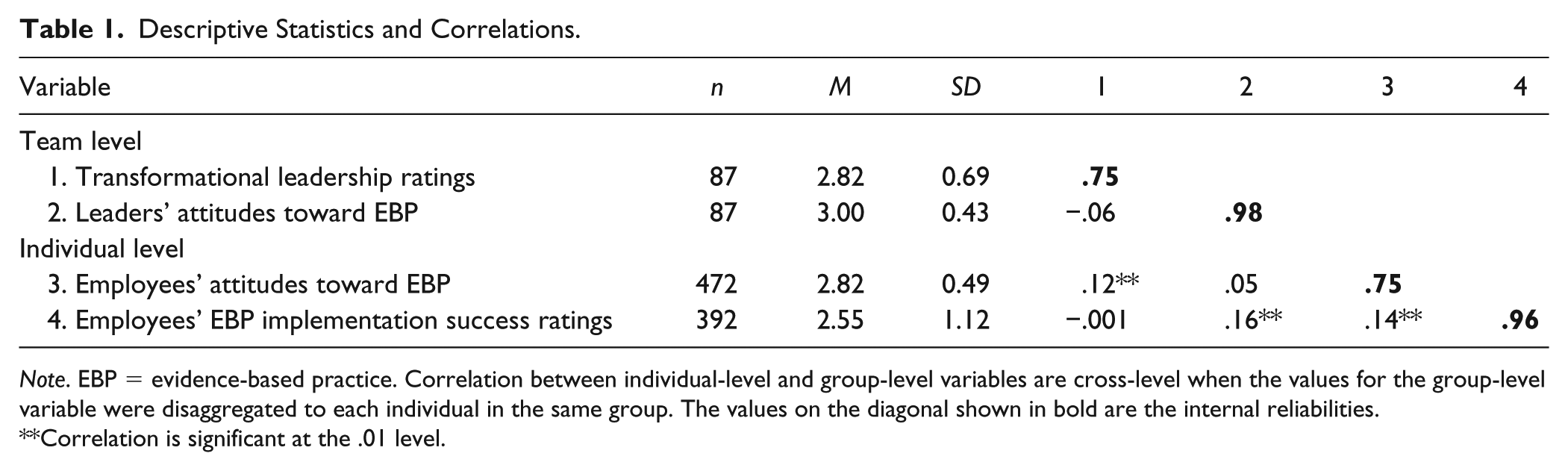
Note. EBP = evidence-based practice. Correlation between individual-level and group-level variables are cross-level when the values for the group-level variable were disaggregated to each individual in the same group. The values on the diagonal shown in bold are the internal reliabilities.
Correlation is significant at the .01 level.
Model Testing
In conjunction with the proposed model, we tested two models that included the direct effect of transformational leadership at Level 2 or at Level 1 on implementation success, as well as the direct effect between leaders’ attitudes toward EBP and implementation success. The Satorra–Bentler scaled chi-square difference test was used to compare this model with the originally hypothesized model (Satorra, 2000). The Satorra–Bentler scaled chi-square difference tests in both cases were not significant, SBΔχ2(1) = .42, p = .52 and SBΔχ2(2) = 1.52, p = .47, respectively. Thus, the more parsimonious model (the originally hypothesized model) was retained, supporting full mediation versus partial mediation. Using the formulas provided by Snijders and Bosker (1999), we estimated that the model explained 3.68% of the Level-1 variance in implementation success and 5.43% of the Level-2 variance in implementation success.
Model Interpretation
Results for the multilevel analysis can be found in Table 2. Two of the three direct relationships hypothesized were supported. Hypothesis 1 was supported in that the between-level relationships between transformational leadership employees’ attitudes toward EBP was positive and significant (Β = 0.108, p = .007). Note that the within-level relationship between transformational leadership and employees’ attitudes toward EBP was also positive and significant (Β = 0.081, p = .004); we will return to this finding in the Discussion section. Hypothesis 2 was not supported in that leaders’ attitude toward EBP was not significantly associated with employees’ attitudes toward EBP (Β = 0.099, p = .129). Hypothesis 3 was supported in that the individual-level relationship between employees’ attitudes toward EBP and EBP implementation success was significant and positive (Β = 0.235, p = .012). Note that the between-level relationship between employees’ attitudes toward EBP and implementation success was also significant and positive (Β = 0.795, p = .031).
Results of Multilevel Analysis Predicting Staff Implementation Success.

Hypothesis 4 predicted that employees’ attitudes toward EBP would mediate the relationship between transformational leadership and EBP implementation success. The strength of the indirect effect of transformational leadership on implementation success through employees’ attitudes toward EBP was tested using RMediation (Tofighi & MacKinnon, 2011), which corrects for the nonnormal distribution of the indirect effect. This program provides a confidence interval (CI) for the indirect effect, which allows significance testing of a multilevel mediated relationship. If the interval provided by RMediation does not contain a value of the opposite sign, significance is indicated. As noted previously, the 2-1-1 indirect effect is tested by examining the relationships among the variables at the between level. Based on the 95% CI, the indirect effect was significant (indirect effect = .086, 95% CI [0.003, 0.209]), providing support for Hypothesis 4. Because the within effects of transformational leadership were also included in the model, we could also test the indirect effect at that level. The indirect effect for the within-group relationships was also significant (indirect effect = .019, 95% CI [0.003, 0.042]). Hypothesis 5, which predicted employees’ attitudes toward EBP would mediate the relationship between leader’s attitudes toward EBP and EBP implementation success, was similarly tested. The Hypothesis 5 test resulted in a nonsignificant indirect path (indirect effect = .081; 95% CI [−0.022, 0.252]).
Discussion
The primary purpose of this article was to evaluate mechanisms through which leadership behaviors and attitudes influence the success of an implementation effort in the workplace. Specifically, supervisor and subordinate survey data were utilized to test the hypothesized multilevel model in which staff attitudes toward the change being implemented (EBP) mediated the relationship between both transformational leadership and leaders’ attitudes toward the change being implemented and implementation success. An additional model was tested and compared with the hypothesized model to evaluate the direct effects of transformational leadership and leaders’ attitudes toward EBP on implementation success.
The findings supported an indirect relationship of transformational leadership on implementation success through employees’ attitudes toward EBP and bolsters the limited previous research investigating this relationship (Lam & Schaubroeck, 2000; Seo et al., 2012). This suggests that developing employees’ attitudes toward the practice being implemented is an important mechanism through which transformational leaders influence the success of an implementation effort. Literature on implementation suggests that employees’ attitudes are a key component to successful implementation (Aarons, 2006; Balogun & Johnson, 2004; George & Jones, 2001; Gotham, 2004; Oreg & Berson, 2011; Rogers, 1995) and this article supports previous findings that leadership is an important precursor to this relationship. Thus, in attempting to improve employees’ attitudes toward the change they are asked to implement, organizations should focus on developing the transformational leadership behaviors of their direct supervisors.
The original model was conceptualized as a 2-1-1 mediation model, such that transformational leadership was conceptualized as a group-level variable that was related to individual-level subordinate attitudes and implementation success. However, because a Level-2 predictor can only be related to between-group variance in the mediator and outcome, the multilevel modeling procedures ensure the within and between effects are unconflated by accounting for the effects at both levels. Thus, even though it was not the primary focus of this article, the results revealed that transformational leadership had effects on attitudes and implementation success between groups and within groups. Thus, in addition to groups with more transformational leaders having better attitudes and higher implementation success, individuals within groups who perceived their leaders as more transformational tended to have more positive attitudes and better implementation outcomes than their coworkers who had more negative perceptions of their shared leader. Such differences could suggest that the leaders treat their subordinates differently within the group (in line with leader–member exchange; Graen & Uhl-Bien, 1995), or that individual subordinates perceive or react to the leader’s behavior differently (e.g., Ehrhart & Klein, 2001; Felfe & Schyns, 2010). Whatever the case, the results suggest that transformational leadership can have positive implications for subordinates relative to their peers in the same work group and to workers in other groups. This study also investigated employees’ attitudes toward EBP as a mediator of the relationship between leaders’ attitudes toward EBP and implementation success. The indirect relationship was found to be nonsignificant, such that leaders’ attitudes toward EBP did not have a significant effect on implementation success through their influence on employees’ attitudes toward EBP. Although the lack of support for this relationship could be due to power issues because there were only 87 work groups in the analysis, there are also other, more substantive explanations. One is that supervisors’ attitudes toward EBP tended to be very positive (M = 3.00 on a scale of 0-4, SD = 0.43). Thus, it may be difficult to find effects for leader attitudes when all leaders are reporting that they are on board with the change. Additionally, it could be that the leader’s attitudes have more of an effect when they are negative. Thus, future research should examine these issues in a sample with a broader range of values in leader attitudes, perhaps looking at curvilinear relationships that would reveal whether the effects of leader attitudes change across levels from negative to neutral to positive.
The support for the effects of leader’s transformational leadership over his or her own attitudes is intriguing. Although these findings may suggest that subordinates are not aware of the leader’s attitudes or even that the leader may actively conceal his or her attitudes from subordinates, there are also theoretical reasons to believe that transformational leaders have employees with more positive attitudes toward change regardless of the leaders’ own attitudes toward change. For instance, intellectual stimulation encourages employees to think about efficiency and new ways of doing things are likely, so these employees may be more open to innovation in general, regardless of their leaders’ opinion of the practice being implemented. Second, individualized consideration may foster a sense of safety and trust that would allow individual employees to feel comfortable in having a different opinion than their leader. Inspirational motivation encourages employees to consider the end goal of their work, which in this study was improving client well-being. It is likely that employees saw the innovation being implemented in this study (i.e., EBP), as important to achieving this goal, regardless of their leaders’ attitudes toward the change being implemented. Last, idealized influence is related to ethical decision making, and the argument can be made that EBPs are more ethical than services-as-usual in that they provide a better chance for clients to have positive outcomes as a result of receiving services. Thus, regardless of the leader’s attitudes toward the specific practice being implemented, his or her followers may have learned to demonstrate ethical behavior and thus have more positive attitudes toward innovations that hold promise to improve client positive outcomes.
Limitations and Future Directions for Research
These findings suggest several directions for future research on leadership, attitudes toward change, and implementation success. First, the attitudes measure used in this study assessed employees’ attitudes toward EBPs in general rather than toward one specific EBP. Although this approach increased generalizability to EBPs for mental health care in general, it may miss out on important individual differences with regard to specific EBPs. There are many different types of EBPs that vary based on intended client population and health problem, as well as practice characteristics (e.g., complexity, structure). Thus, future research should take into account variability in attitudes toward different practices being implemented in these work groups. Conversely, there may be concerns with generalizability of the results of this research to the implementation of innovations across industries. Although data were collected from 10 different agencies, they are all in the field of behavioral health care and are implementing a single type of change. It is important to consider the type of practice or technology being implemented as well as the context of employees’ work when determining the applicability of the results of this article.
This study utilized data collected from work groups in different stages of implementation. As employees and leaders gain experience utilizing an innovative practice, their attitudes toward the new practice may become more positive as initial concerns are alleviated and new employees come into the work groups. Thus, it may be that the case that there would be more variance in leaders’ and employees’ attitudes toward change when implementation is new, which might improve the ability to detect multilevel effects. Future research should explore the relationships proposed in this study in work groups that are newly implementing EBPs.
There are also statistical concerns whenever research is conducted utilizing survey data. As the data are cross-sectional, the design does not allow for strong claims regarding causality. Nevertheless, the order of causality was in line with past theory and research, providing at least some support for the hypothesized causal direction (Mathieu, DeShon, & Bergh, 2008). Future studies should utilize longitudinal data to assess the influence of attitudes toward change on the success of an implementation effort.
Other directions for future research include the consideration of the relationships addressed here in a sample of middle- or lower-level supervisors. Although frontline employees are most commonly studied as organizational change recipients, the factors that influence manager’s attitudes toward innovations being implemented are critical to understand as well. Future research should also address the role of other contextual predictors of attitudes toward EBP that could also affect implementation success. For example, legislation imposed on mental health organizations to adopt specific EBPs may have an impact on both attitudes toward EBP and subsequent practice success. In addition, there may be contextual factors that influence when leader attitudes have a stronger impact on employee attitudes; future research should investigate when such a relationship is most likely to emerge.
Practical Implications
The findings of this research have important implications for improving the success of implementation efforts in the workplace, which is important as a majority of implementation efforts fail within organizations (Balas & Boren, 2000). The strongest relationship found in the analyses was between employees’ attitudes toward the specific change being implemented in their work groups and the success with which they implement the change. Organizations ought to focus on ensuring that those employees being asked to implement have positive attitudes toward the innovation being implemented. Based on the results of this study, one approach could be to develop transformational skills within these first-level leaders (Aarons, Ehrhart, Farahnak, & Hurlburt, 2015), as this study found a significant, positive relationship between transformational leadership and employees’ attitudes toward EBP.
Similar steps can be taken by change agents to develop employees’ and leaders’ attitudes toward the innovation being implemented. Research in the field of developing organizational readiness for change suggests several ways in which organizations can develop positive attitudes toward a change being implemented in their work groups. One approach that organizations may take is being candid about the rationale that the organization used to make the decision to implement. The decision-making process for implementation likely included the consideration of funding, customer needs, and external trends, as well as organizational climate, values, goals, and leadership (Aarons, Hurlburt, & Horwitz, 2011). Sharing this information with team leaders and employees would include a discussion of the personal benefits for employees implementing the change (e.g., decreased time required to complete work) as well as the potential consequences should the implementation effort fail (e.g., decreased competitiveness for continued funding). This type of information is important in developing a sense of the change being worthwhile for employees and leaders on a personal level (Armenakis & Harris, 2009; Bandura, 1982; Weiner, 2009).
Second, organizations should ensure that employees feel supported during implementation through the designation of resources such as training and printed or online materials. This improves employees’ and leaders’ confidence in their ability to effectively implement the change, which is an important component of attitudes toward change (Armenakis, Harris, & Mossholder, 1993). Another important resource is the designation of personnel who are knowledgeable about the practice being implemented to be available to answer employees’ questions and alleviate concerns that they may have about implementing the new practice.
Third, organizational change agents should engage employees and leaders in discussions about the implementation plan. Employees may have important suggestions and concerns that the organization has not yet addressed. Additionally, employees may have more positive attitudes toward the change being implemented if they feel as though organizational leaders understand the potential challenges but have confidence that employees can overcome them and successfully implement the practice. In fact, including employees in change efforts has been shown to have a positive relationship with motivation for organizational change (Coch & French, 1965).
Conclusion
This article tested a multilevel model of how leadership and attitude variables facilitate the successful implementation of a practice within organizations. The findings contribute to the literature by lending empirical support to the indirect relationship between transformational leadership and implementation success through employees’ attitudes toward the change being implemented. These findings suggest that employees with positive attitudes toward the change are more likely to successfully implement the change in their work and that attitudes can be improved by developing transformational leadership behaviors.
Footnotes
Declaration of Conflicting Interests
The author(s) declared no potential conflicts of interest with respect to the research, authorship, and/or publication of this article.
Funding
The author(s) disclosed receipt of the following financial support for the research, authorship, and/or publication of this article: This work was supported by the National Institute of Mental Health grants R21MH098124 (PI: Ehrhart) and R01MH072961 (PI: Aarons) and the National Institute on Drug Abuse grant R01DA038466 (PI: Aarons).