



Abstract
This article examines the relationship between employees’ job involvement and helping behavior directed toward coworkers, as well as how this relationship might be augmented when employees encounter adversity, whether due to malicious leadership (abusive supervision) or threats to their physical integrity (workplace hazards, fear of terrorism). Drawing on a two-wave survey research design that collected data from employees and their supervisors in Pakistan, the results reveal that job involvement increases the likelihood that employees go out of their way to help their coworkers, and this relationship is strongest when they have to deal with the hardships of malicious leadership or threats to their physical safety. For organizations, these findings indicate that employees perceive their own allocation of positive work energy, derived from their job involvement, to helping behaviors that assist other members as particularly useful when they also experience significant adversity, inside or outside the workplace.
Keywords
Employees who go out of their way to help coworkers complete their job tasks, even when their efforts are not formally required by their job descriptions, are crucial to organizational success (Choi & Moon, 2016; Li & Chen, 2012; Tang et al., 2008; Zhu & Akhtar, 2014). Such helping behavior represents a specific and pertinent aspect of organizational citizenship behavior (OCB), which, broadly defined, refers to voluntary activities that go beyond formal job descriptions and for which employees are not directly rewarded (LePine, Erez, & Johnson, 2002; N. P. Podsakoff, Whiting, Podsakoff, & Blume, 2009). An important conceptualization of OCB distinguishes voluntary behaviors directed toward the organization in general from those that target individual colleagues (Williams & Anderson, 1991). We seek to explain why some employees might be more likely than others to engage in the latter aspect of OCB, in recognition of the important role of productive interpersonal work exchanges in spurring positive work performance outcomes (Bachrach, Powell, Collins, & Richey, 2006; Chou & Stauffer, 2016; Nahapiet & Ghoshal, 1998).
That is, discretionary helping activities can benefit the professional well-being of other organizational members and enhance the organization’s competitive advantage (Bachrach et al., 2006; Borman & Motowidlo, 1993; Ng & Van Dyne, 2005), but they also can produce positive outcomes for the focal employees who perform them. For example, employees who are willing to take the time to listen and help resolve coworker problems may experience a sense of fulfillment (Hoption, 2016; Lemoine, Parsons, & Kansara, 2015) or even enjoy performance gains, because they might earn reciprocal support from the targets of their helping behaviors (Hui, Lam, & Law, 2000; Korsgaard, Meglino, Lester, & Jeong, 2010). Yet helping activities, while useful for employees, also can pose significant challenges. Investing significant energy in voluntarily assisting coworkers creates a risk of emotional exhaustion and may reduce employees’ capacity to meet their formal job requirements (Bergeron, 2007; Bolino, Hsiung, Harvey, & LePine, 2015; Koopman, Lanaj, & Scott, 2016). Moreover, the targets of the helping may not be appreciative of such voluntary efforts or find them unnecessary or even intrusive (Organ, 1988; N. P. Podsakoff et al., 2009). Therefore, it is instrumental to create more in-depth understanding of why employees are willing to dedicate substantial energy to help their coworkers voluntarily, despite these challenges. In particular, previous research calls for more studies that explicate how employees’ personal resources might steer them to undertake discretionary work behaviors for which they are not formally rewarded (Choi & Moon, 2016; De Clercq, Haq, Raja, Azeem, & Mahmud, 2018).
This study accordingly proposes that an important impetus for helping behaviors is the extent to which employees exhibit high levels of job involvement (Brown, 1996; Clinebell & Shadwick, 2004; Diefendorff, Brown, Kamin, & Lord, 2002). Job involvement is a personal resource (Mauno, Kinnunen, & Ruokolainen, 2007; Scrima, Lorito, Parry, & Falgares, 2014) that captures employees’ emotional investment in and identification with their work (Brown, 1996; Hallberg & Schaufeli, 2006; Kanungo, 1979). It relates to but is distinct from concepts such as work engagement and affective commitment; they are not interchangeable constructs (Hallberg & Schaufeli, 2006). Notably, job involvement differs from work engagement, in that the former reflects an important source of positive work energy (Brown & Leigh, 1996), whereas the latter implies the very presence of such energy, exhibited in vigor, absorption, and dedication to the work (Schaufeli, Salanova, Gonzalez-Roma, & Bakker, 2002; Scrima et al., 2014). Similarly, employees’ affective commitment differs from job involvement, in that the former captures the positive energy they direct toward their organization overall, instead of just their job, manifested as a sense of belonging to the employing organization (Brown, 1996; Meyer & Allen, 1991). Previous studies that investigate the possible links of these three constructs underscore their distinctiveness, such that high levels of job involvement might spur work engagement (Kühnel, Sonnentag, & Westman, 2009), and organizational commitment can be a direct outcome of job involvement (Brown, 1996) or else an indirect outcome, through the mediating role of work engagement (Scrima et al., 2014).
Instead of investigating attitudinal outcomes of job involvement, this study centers on how the energy-enhancing effect of job involvement may have a positive influence on work behaviors. In particular, the emotional investment in work that highly involved employees display also may stimulate them to allocate significant time and energy to work behaviors that contribute to organizational effectiveness (Brown & Leigh, 1996; Janssen, 2003). For example, job involvement can lead to an enhanced propensity to engage in work efforts aimed at meeting in-role job expectations (Keller, 1997), undertake voice behaviors that seek to change and improve the status quo (W. Wu, Tang, Dong, & Liu, 2015), or perform voluntary citizenship behaviors that contribute to organizational effectiveness (Chiu & Tsai, 2006). As a complement to prior research, we address a specific, critical behavioral outcome: voluntary helping directed toward coworkers. With this focus on an individual-oriented citizenship behavior, we acknowledge that the benefits that highly involved employees might expect from their voluntary work activities—in the form of personal satisfaction and reciprocated efforts, for example—may be particularly salient when these activities are targeted at individual coworkers rather than at their organization in general (Bachrach et al., 2006; Chou & Stauffer, 2016). Moreover, we seek a better understanding of the circumstances that might trigger the positive link between job involvement and helping behavior, so that organizations can determine when energy-consuming, beneficial helping efforts are most likely to materialize among highly involved employees (Keller, 1997; Scrima et al., 2014; Shantz, Arevshatian, Alfes, & Bailey, 2016).
To anchor our theoretical arguments about the positive relationship between job involvement and helping behavior, as well as the factors that might invigorate this relationship, we turn to conservation of resources (COR) theory. This theory emphasizes the important roles that anticipated resource gains and losses have for explaining employees’ work behaviors (Hobfoll, 1989). First, COR theory suggests that employees undertake positive work activities, such as helping coworkers with their job tasks, when they can leverage their personal resources into activities that can generate additional resource gains (Hobfoll, 1989, 2001). Second, COR theory suggests that the objective to leverage relevant personal resources to generate further resource gains becomes especially salient when employees experience adverse situations that threaten them with future resource losses, either for themselves or other organizational members (De Clercq & Belausteguigoitia, 2017; Hobfoll & Shirom, 2000). Consistent with this second logic, we propose that the personal work energy that employees derive from their job involvement should stimulate their helping behaviors in a particularly strong way when they also operate in resource-draining environments.
Formally, we predict that job involvement spurs helping behaviors, and this process is more likely to the extent that employees confront two types of adversity: (a) suffering from malicious leadership (i.e., the extent to which organizational leaders abuse followers; Tepper, 2000) and (b) being concerned about their physical safety. The first type of adversity entails the perception that organizational leaders seek intentionally to harm the interests and well-being of their followers. This specific type of dysfunctional leadership differs from other, nonmalicious types, such as leader incompetence (Krasikova, Green, & LeBreton, 2013; Rose, Shuck, Twyford, & Bergman, 2015). With regard to the second type of adversity, employees’ preoccupation with physical safety may result from features within the workplace (e.g., belief that the work environment is unhealthy or dangerous; Hayes, Perander, Smecko, & Trask, 1998) or outside the work realm (e.g., fear of terrorist attacks; Sinclair & LoCicero, 2006).
We include these different sources of adversity as moderators in our conceptual framework, with the prediction that they generate resource losses by compromising the peace of mind that employees need to perform and succeed in their jobs (Hobfoll & Shirom, 2000). In turn, such adversity might stimulate employees to apply the positive energy derived from their strong job involvement to voluntary helping behaviors, in their attempt to counter the threatened resource losses (De Clercq & Belausteguigoitia, 2017; Hobfoll, 2001). By acknowledging the role of these contingent factors, we offer a novel perspective on how employees’ negative appraisal of their current situation, whether due to leadership or physical safety reasons, may enhance the anticipated value of leveraging their job involvement to perform dedicated helping efforts (Quinn, Spreitzer, & Lam, 2012).
In summary, we seek to contribute to extant scholarship by examining both an underresearched outcome of job involvement (i.e., discretionary helping activities targeted at coworkers) and the conditions in which this process is more likely to unfold. We propose that the positive energy that arises when employees exhibit strong emotional investment in their job roles should promote their helping behaviors, and this process operates more forcefully to the extent that they suffer from resource-draining abusive supervision or threats to their physical safety (Hobfoll & Shirom, 2000). By considering the invigorating effects of these negative conditions, we extend previous research that tends to focus solely on direct harmful effects, such as when abusive supervision hinders OCB (Gregory, Osmonbekov, Gregory, Albritton, & Carr, 2013), workplace safety concerns lead to increased absenteeism (Jinnett, Schwatka, Tenney, Brockbank, & Newman, 2017), or threats of terrorism reduce job performance (De Clercq, Haq, & Azeem, 2017). By taking this somewhat counterintuitive approach, we clarify how employees’ concerns about abusive leaders and their own physical safety actually can increase the anticipated value of leveraging their job involvement in voluntary helping activities. As resource-depleting circumstances that compromise the quality of their own and their colleagues’ organizational functioning, these contingencies should stimulate highly involved employees to channel their residual energy reservoirs into voluntary helping efforts, because they hope to gain further resources through these efforts, in the form of personal fulfillment or reciprocated coworker support (Deckop, Cirka, & Andersson, 2003; Lemoine et al., 2015).
By using Pakistan as an empirical context, this study also responds to calls for more investigations of voluntary work behaviors in non-Western settings (e.g., Murtaza et al., 2016; Rurkkhum & Bartlett, 2012; Uçanok & Karabati, 2013). This country context is highly relevant for our investigation of how the interplay of employees’ job involvement with different sources of adversity can predict helping behavior. First, Pakistani culture tends to focus on group harmony and support (Hofstede, Hofstede, & Minkov, 2010), yet its people also vary in how they trade off pursuing their own work goals and helping others with their job tasks (Murtaza et al., 2016; Oyserman, Coon, & Kemmelmeier, 2002). Second, the high power distance that marks Pakistani culture implies that exposure to abusive leadership might not be uncommon for many employees (Khan, Moss, Quratulain, & Hameed, 2016). Third, weak implementations of safety regulations and laws (Choudhry, Fang, & Rowlinson, 2008) and the presence of unstable political climates (Ismail & Amjad, 2014) may pose significant threats to Pakistani employees’ physical well-being, in the form of workplace accidents or fears of terrorism. The focal issues under study thus are highly pertinent to the Pakistani context, and they also should be informative for other countries that share similar cultural, regulatory, or political characteristics.
The proposed conceptual framework is depicted in Figure 1. We first predict a positive link between employees’ job involvement and helping behavior, which in turn gets invigorated by two types of adversity: malicious leadership (abusive supervision) and concerns about physical safety (workplace hazard and fear of terrorism), as detailed next.
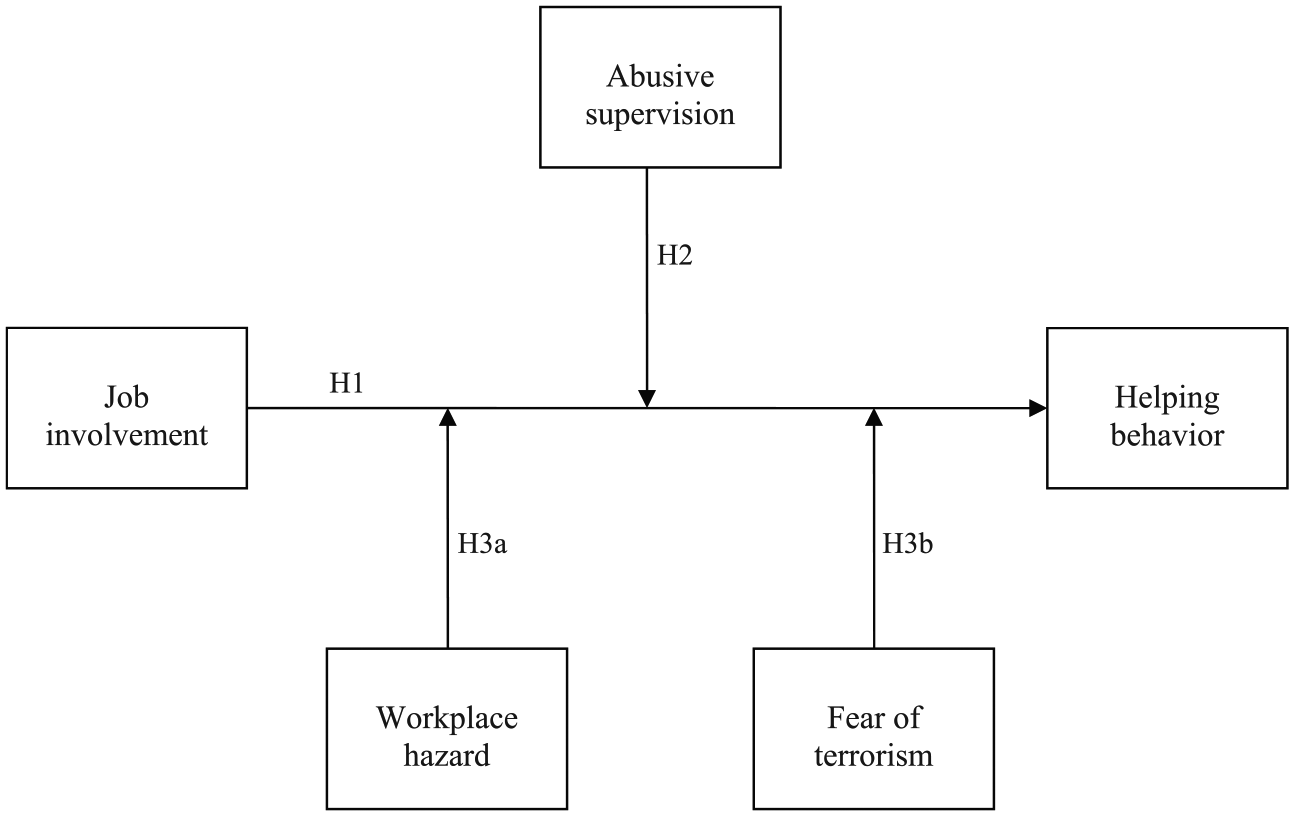
Conceptual model.
Hypotheses
Job Involvement and Helping Behavior
Employees’ job involvement should spur their engagement in helping behavior, for both ability and motivational reasons. First, their strong involvement with their jobs functions as an energy-generating personal resource (Scrima et al., 2014), from which employees can draw to undertake discretionary work activities, such as helping coworkers voluntarily. These helping activities consume significant energy and thus might compromise employees’ abilities to perform their formally listed job tasks (Koopman et al., 2016; Van Dyne & Ellis, 2004). According to COR theory, employees who can draw from valuable personal resource reservoirs are better able to devote significant energy to work activities that demand discretionary efforts, for which there are no guaranteed or immediate returns (De Clercq & Belausteguigoitia, 2017; Hobfoll, 1989). Similarly, when they possess positive work energy, derived from their strong involvement with their job, employees should be better positioned to combine the execution of their formal job obligations with voluntary activities that can contribute to their coworkers’ success (Chiu & Tsai, 2006; Shantz et al., 2016). Conversely, when employees are less involved with their jobs, they are less capable of undertaking additional helping activities; they instead may conserve their energy to ensure they can execute their formally prescribed job duties (Hobfoll & Shirom, 2000).
Second, the logic underlying COR theory suggests that employees are more motivated to apply positive work energy, emanating from their personal resource bases, to the pursuit of positive work activities, when they anticipate that this energy application will generate further resource gains for them, such as in the form of personal fulfillment (Hobfoll, 2001; Hobfoll & Shirom, 2000). Employees who are strongly involved with their jobs derive great satisfaction from improving the quality of their work environment (Cohen, 2006; Kanungo, 1982), which they might accomplish by reaching out to peers and helping them with their job tasks (Lemoine et al., 2015; Organ, 1988). In contrast, employees who exhibit less involvement with their jobs tend to derive less personal joy from assisting colleagues in resolving work-related challenges (Brown, 1996), so they should be less motivated to allocate substantial energy to such helping efforts (Quinn et al., 2012). That is, these employees likely find it less meaningful to contribute to colleagues’ professional success and expect fewer resource gains in return for their helping activities (Hobfoll, 2001).
Invigorating Role of Leadership Adversity
The conversion of job involvement into enhanced helping behavior may be more likely when employees are exposed to malicious leadership, in the form of abusive supervision, which reflects the tendency of organizational leaders to be hostile and verbally aggressive toward followers (Kernan, Racicot, & Fisher, 2016; Tepper, 2000). First, the abusive tendencies of organizational leaders deplete employees’ resources, because they instill fear in employees and undermine the quality of their daily functioning (Frieder, Hochwarter, & DeOrtentiis, 2015; Xu, Loi, & Lam, 2015). In this scenario, employees may consider it particularly useful to apply positive work-related energy, derived from their strong job involvement, to assist coworkers with their work and shared efforts to meet their difficult leader’s expectations (Bachrach et al., 2006; P. M. Podsakoff, Ahearne, & MacKenzie, 1997). Consistent with COR theory (Hobfoll & Shirom, 2000), the anticipated value of leveraging their job involvement in positive helping behaviors should be higher to the extent that the presence of abusive supervision—a critical source of resource depletion (Whitman, Halbesleben, & Holmes, 2014)—is a significant feature in employees’ immediate work environment.
Second, highly involved employees’ propensity to leverage their job involvement as discretionary helping behaviors in the presence of abusive supervision also should contribute to their personal satisfaction levels, because helping behaviors generate a sense of a common fate (N. P. Podsakoff et al., 2009; Van Dyne, Vandewalle, Kostova, Latham, & Cummings, 2000). That is, when organizational leaders are rude and demeaning, applying positive work energy that comes with job involvement to voluntary activities that help coworkers can generate resource gains, in the form of a sense of solidarity (Hobfoll & Shirom, 2000; W.-L. Wu & Lee, 2016). Conversely, when organizational leaders treat their followers with compassion and respect, employees feel less isolated (Kernan et al., 2016) and might not gain much personal fulfillment from leveraging their job involvement in (less necessary) helping activities to protect coworkers from leaders (Hobfoll & Shirom, 2000). The relationship between employees’ job involvement and their helping activities thus might be mitigated when employees experience less personal fulfillment from drawing on their positive job-related energy, because organizational leaders do not exhibit abusive tendencies toward their followers (Tepper, 2000).
Invigorating Role of Physical Adversity
The expected value of job involvement for stimulating helping behaviors also may be contingent on the physical adversity that employees experience, either inside the workplace due to hazardous work conditions (Hofmann, Burke, & Zohar, 2017) or externally due to worries about terrorism (Sinclair & LoCicero, 2006). 1 Exposure to physically unsafe conditions, internal or external, is resource draining, because the associated fears lead to emotional exhaustion and constrain employees’ abilities to succeed at their jobs (De Clercq et al., 2017; Jinnett et al., 2017). In such scenarios, employees might be especially motivated to leverage their job involvement as helping behaviors, because they anticipate reciprocity from the targets of their helping efforts, which should increase their joint capacity to deal with the resource-depleting conditions (Deckop et al., 2003; Hui et al., 2000). For example, if employees feel unsafe because they sense a high likelihood of work accidents or terrorist attacks, the expected value of applying positive work energy, derived from their job involvement, to helping behaviors should increase, because employees expect these behaviors to be reciprocated, such that colleagues also will help them cope with safety issues (Korsgaard et al., 2010; McNeely & Meglino, 1994). In line with COR theory, we thus expect that the anticipated usefulness of job involvement for spurring helping behaviors increases to the extent that employees suffer resource-depleting conditions that threaten their physical safety (Hobfoll, 2001).
Similar to our discussion of abusive supervision, we argue that the tendency of highly involved employees to help their colleagues can create feelings of solidarity, particularly in the presence of physical adversity (N. P. Podsakoff et al., 2009; Van Dyne et al., 2000). If employees can apply positive job-related energy, derived from their job involvement, to voluntary behaviors that help their peers perform their job tasks more successfully, the resulting feelings of mutual support and “being in the same boat” should offer especially strong value in physically adverse conditions, associated with either the workplace or the broader political environment (Pagell, Veltri, & Johnston, 2016; Sinclair & LoCicero, 2006). In contrast, when employees sense little threat to their physical safety, they have less need to leverage their job involvement as voluntary work behaviors that otherwise would create resource gains in the form of solidarity and support (Hobfoll & Shirom, 2000). The relationship between their job involvement and helping behavior thus should be subdued to the extent that highly involved employees anticipate less incremental value from applying their positive work energy to deal with the hardships created by physically unsafe conditions, at work or in their private lives.
Research Method
Sample and Data Collection
To test the hypotheses, we collected survey data in two waves from employees and their supervisors who worked in the sales department of a large shoe manufacturing company in Pakistan. The surveys were administered in English, which is the official language of communication in higher education and business in this country. The participants were assured that their responses were completely confidential, that no individual identifying information would ever be released, that only summary data would be made available outside the research team, and that they could withdraw from the study at any time. The cover letter that accompanied the surveys also emphasized that there were no right or wrong answers, it was normal for employees to vary in their responses, and it was critical to respond to the questions as honestly as possible. These clarifications helped diminish the likelihood of acquiescence and social desirability biases (Spector, 2006).
The survey in the first wave asked employees about their job involvement and perceptions of abusive supervision, workplace hazard, and fear of terrorism; the survey in the second wave, administered to the employees’ immediate supervisors, assessed employees’ engagement in helping behaviors. We applied a time lag of 3 weeks between the two waves—long enough to avoid concerns about reverse causality but not too long that significant organizational events could have occurred during the data collection process. Of the 300 surveys originally distributed to a random selection of employees, we received 213 completed response sets, for a response rate of 71%. The sample consisted of almost all men, whose average age was 31 years, and they had worked for their organization for an average of 8 years. In Pakistan, sales jobs tend to be reserved for men, so it was not unexpected that our sample included only two female participants. Becker (2005) recommends against including irrelevant control variables that might obscure the effects of the focal variables, so we do not include employees’ gender or age as a controls in the regression models; these variables do not correlate significantly with employees’ helping behavior.
Measures
The items for the five focal constructs came from previous research and used 5-point Likert-type scales, ranging from 1 (strongly disagree) to 5 (strongly agree). Table 1 lists the individual measurement items and their factor loadings on their respective constructs.
Constructs and Measurement Items.
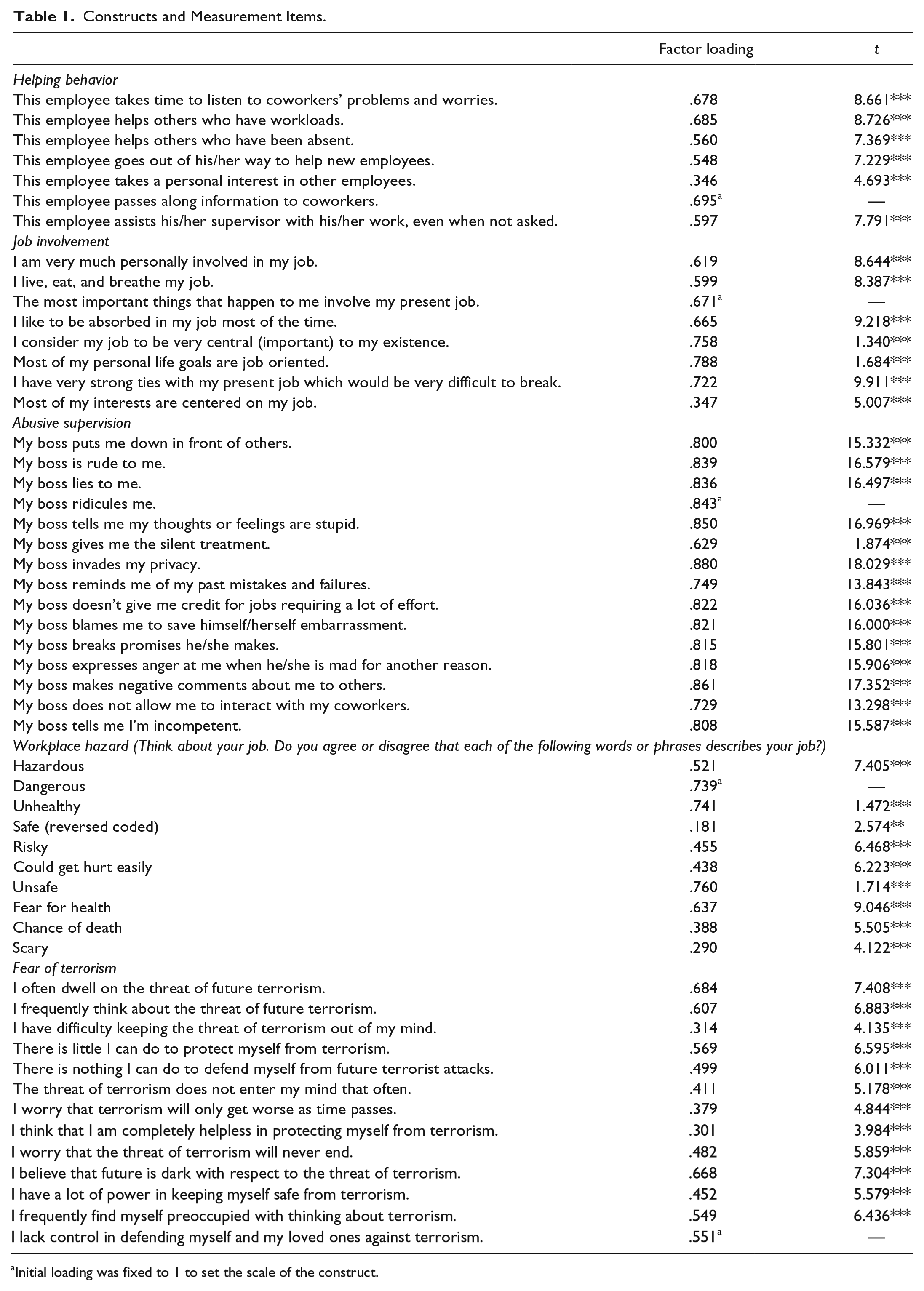
Initial loading was fixed to 1 to set the scale of the construct.
Helping Behavior
We measured employees’ propensity to assist coworkers with a seven-item scale of helping behaviors targeted at coworkers (Williams & Anderson, 1991). To avoid concerns about common method bias, the employees’ supervisors assessed these items. For example, supervisors rated whether “This employee assists coworkers with their work, even when not asked,” “This employee takes time to listen to coworkers’ problems and worries,” and “This employee helps others who have heavy workloads” (Cronbach’s α = .81).
Job Involvement
To gauge the extent to which employees are strongly involved in their jobs, we applied an eight-item scale of job involvement, as developed by Kanungo (1982). Example items were “I am very much personally involved in my job,” “I live, eat and breathe my job,” and “The most important things that happen to me involve my present job” (Cronbach’s α = .85).
Abusive Supervision
To measure employees’ exposure to malicious leadership marked by hostility and verbal aggression, we relied on a five-item scale of abusive supervision, based on Tepper’s (2000) work. For example, respondents rated whether “My boss puts me down in front of others,” “My boss is rude to me,” and “My boss lies to me” (Cronbach’s α = .96).
Workplace Hazard
This measure refers to the extent to which employees perceive that their workplace features conditions that might cause them bodily harm or undermine their physical integrity. We applied a 10-item, reverse-coded scale of workplace safety, such that employees indicated whether various negative words described their job (Hayes et al., 1998). For example, they indicated their agreement with whether their jobs were “hazardous,” “dangerous,” “unhealthy,” or “unsafe” (Cronbach’s α = .79).
Fear of Terrorism
To assess the extent to which employees worry about possible terrorism attacks, we applied a 13-item terrorism catastrophizing scale, developed by Sinclair and LoCicero (2006) and used in prior research (De Clercq et al., 2017). This scale does not directly address whether employees feel personally at risk or just have general concerns about the likelihood of terrorist attacks, yet in the empirical context of this study—Pakistan, a country that has been the target of many attacks in the past (Ismail & Amjad, 2014; Shahzad et al., 2016)—concerns about terrorism likely permeate the minds of many employees. Some example items of the scale were “I often dwell on the threat of future terrorism,” “I have difficulty keeping the threat of terrorism out of my mind,” and “I frequently find myself preoccupied with thinking about terrorism” (Cronbach’s α = .81).
Control Variables
To account for alternative explanations of employees’ helping behaviors—namely, their ability to recognize what the specific work-related needs of their coworkers might be, or the extent to which they have pertinent insights into whether the voluntary assistance of coworkers fits with their organization’s culture—we controlled for their organizational tenure, as the number of years that they had worked for their organization.
Validity Check
We performed a confirmatory factor analysis to assess the validity of the focal constructs. The fit of a five-factor measurement model that includes the factor loadings of the measurement items on their respective constructs and the covariances among the focal constructs (Anderson & Gerbing, 1988) is relatively poor, χ2(1,315) = 3,782.59; Tucker–Lewis index = .67, confirmatory fit index = .68, incremental fit index = .69, root mean square error of approximation = .09, which might be explained by the low covariances among many of the constructs (Lattin, Carroll, & Green, 2003). That is, only two of the 10 estimated covariances between construct pairs (between job involvement and abusive supervision and between job involvement and workplace hazard) are significant, consistent with our theoretical argument about the moderating influences of selected sources of adversity on the relationship between job involvement and helping behavior, rather than their direct influences on helping behavior, as well as with the related argument that the strength of the link between job involvement and helping behavior is contingent on the prominence of this adversity. Notably, each of the estimated factor loadings (Table 1) is strongly significant, in support of the convergent validity of the five constructs (Gerbing & Anderson, 1988). Moreover, we obtain evidence of discriminant validity, by comparing the fit of a constrained model (correlation between constructs set to equal 1) and an unconstrained version (correlation between constructs was free to vary) for each of the 10 pairs generated by the five constructs. Each chi-square difference is strongly significant at p < .001, Δχ2(1) > 10.83, except for that in the job involvement–abusive supervision pair, which is significant at p < .05, Δχ2(1) > 3.84. These results confirm the presence of discriminant validity (Anderson & Gerbing, 1988).
Results
Table 2 reports the zero-order correlations and descriptive statistics, and Table 3 contains the hierarchical regression results for the different regression models (for conciseness, we simply refer to them as models hereafter). Model 1 included the organizational tenure control variable, and Model 2 added job involvement and the three moderators. Next, Models 3 to 5 each featured an interaction term: job involvement × abusive supervision, job involvement × workplace hazard, and job involvement × fear of terrorism, respectively. Adding multiple interaction terms in separate regression equations is appropriate, because their simultaneous inclusion in a single regression model can hide true moderating effects (Aiken & West, 1991; Covin, Green, & Slevin, 2006; Zahra & Hayton, 2008). Consistent with the well-established approach recommended by Aiken and West (1991), the variables were mean-centered before we calculated the interaction terms.
Correlations and Descriptive Statistics.

Note. N = 213.
p < .05.
Regression Results (Dependent Variable: Helping Behavior).
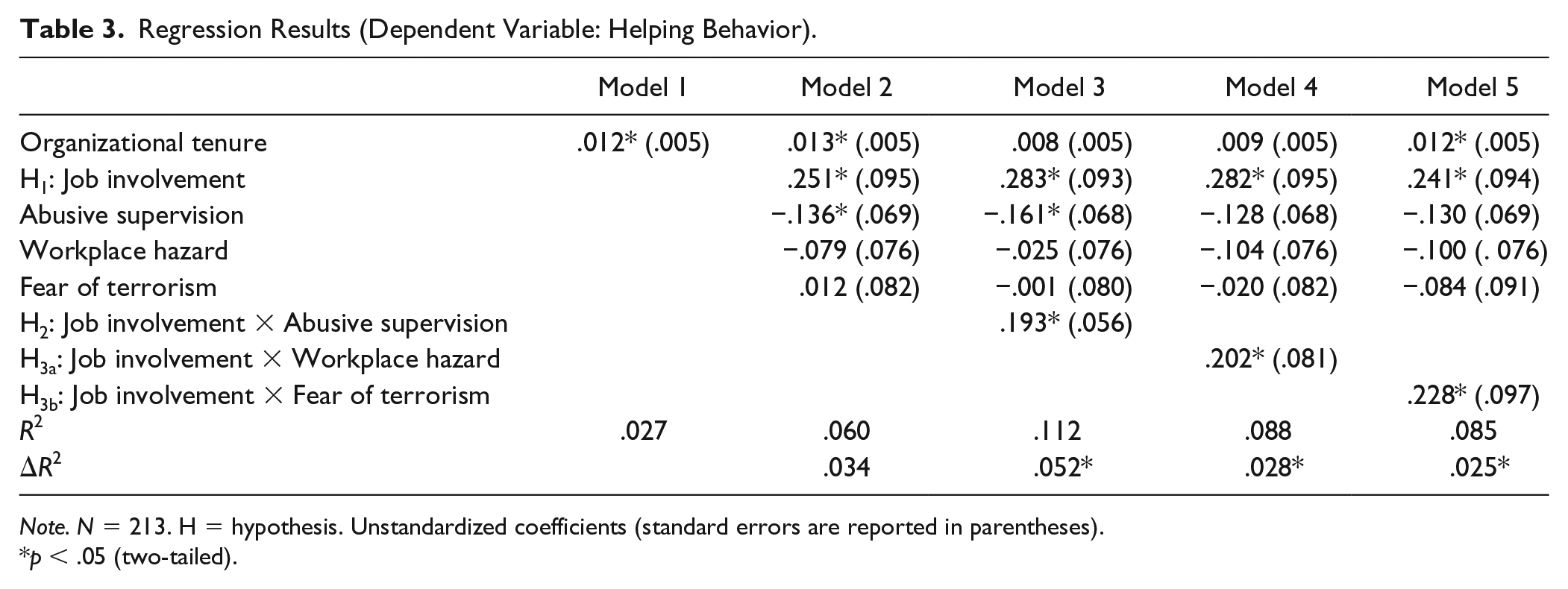
Note. N = 213. H = hypothesis. Unstandardized coefficients (standard errors are reported in parentheses).
p < .05 (two-tailed).
In line with the baseline prediction that the positive energy derived from high involvement levels spurs employees to go out of their way to assist coworkers with their job duties, Model 2 revealed that job involvement related positively to helping behaviors (β = .251, p = .009), in support of Hypothesis 1. Models 3 to 5 also affirmed the hypothesized invigorating effects of the two types of adversity on this relationship. In particular, the relationship between job involvement and helping behavior was stronger at higher levels of abusive supervision (β = .193, p = .001), in support of Hypothesis 2. Similarly, job involvement was more likely to translate into enhanced helping behavior to the extent that employees were more concerned about their physical safety, because of either perceived workplace hazards (β = .202, p = .014) or fear of terrorism (β = .228, p = .019), in support of Hypotheses 3a and 3b, respectively. To depict these interactions visually, we plotted the relationship between job involvement and helping behavior at high and low levels of the moderators in Figures 2 and 3 (Panels A and B), and we performed corresponding simple slope analyses (Aiken & West, 1991). The analyses revealed that the relationship between job involvement and helping behavior was positive and significant when abusive supervision (β = .476, p = .000), workplace hazards (β = .484, p = .000), and fears of terrorism (β = .469, p = .001) were high, but the relationship became not significant at low levels of these moderators (β = .090, p = .369; β = .080, p = .500; β = .013, p = .923, respectively), in support of our overall theoretical framework.

Moderating effect of abusive supervision on the relationship between job involvement and helping behavior.

Moderating effects on the relationship between job involvement and helping behavior: (A) Workplace hazard and (B) Fear of terrorism.
Discussion
This study extends previous research by elaborating on how employees’ job involvement might spur their propensity to help their coworkers complete their job tasks, even if they are not formally required to do so, then detailing when this process is more likely, namely, in the presence of adverse, resource-depleting circumstances. The allocation of positive work energy, derived from strong job involvement, to activities that assist other organizational members can be rewarding for employees, by adding meaningfulness to their organizational functioning (Hoption, 2016), yet these discretionary activities also might compromise their abilities to meet their formal job requirements (Bolino et al., 2015). We have proposed that engaging in helping behaviors is more likely when employees feel strongly involved with their job (Kanungo, 1982). Adopting the logic of COR theory (Hobfoll, 1989, 2001), we predict that the personal resource of job involvement enhances people’s propensity to help coworkers (Scrima et al., 2014). In turn, we anticipate that the translation of job involvement into enhanced helping behavior is more likely to the extent that employees are exposed to abusive leaders (Tepper, 2000) or feel physically unsafe, whether due to hazardous work conditions (Pagell et al., 2016) or their fear of terrorism (Sinclair & LoCicero, 2006). In so doing, we develop the somewhat counterintuitive argument that negative or threatening environments might beneficially promote voluntary work behaviors, by functioning as triggers that motivate employees to leverage their positive work-related energy in the form of dedicated efforts to help coworkers with their work duties. The empirical results offer support for these theoretical predictions.
Discretionary helping efforts require substantial energy that otherwise could have been used to fulfill formally prescribed job duties (Koopman et al., 2016). This challenge may be mitigated to the extent that employees can draw on the positive work energy that arises with their strong job involvement, because this energy enhances their ability to fulfill their formal job duties while also going out of their way to listen to and resolve coworker issues (Diefendorff et al., 2002; Quinn et al., 2012). Employees who are only weakly involved in their jobs may prefer to conserve their personal energy for activities that grant them immediate returns, rather than discretionary activities that are not part of their formal job obligations (Hobfoll & Shirom, 2000). Moreover, employees who are strongly involved with their jobs may enjoy significant resource gains, in the form of personal satisfaction and fulfillment, when they are able to make a difference in the well-being of colleagues through their voluntary helping efforts (Cohen, 2006; Organ, 1988). Thus, employees’ job involvement may stimulate both their ability and their motivation to perform voluntary helping activities directed toward coworkers.
In addition, the positive effect of job involvement on helping behavior is stronger when employees must deal with the hardships of abusive leaders who are hostile and demeaning. The invigorating effect of this form of leadership adversity aligns with the COR argument that the expected value of leveraging valuable personal resources toward the achievement of further resource gains, through helping behaviors, increases in the presence of possible resource losses caused by adverse conditions (De Clercq & Belausteguigoitia, 2017). Applying positive work energy, derived from strong job involvement, to discretionary helping activities targeted at coworkers is particularly useful when organizational leaders exhibit abusive tendencies and do not care about the personal well-being of their followers (Whitman et al., 2014). This energy application is especially beneficial in this case, because it enables coworkers to meet their job targets, despite the challenge of organizational leaders who show little respect for their professional success (Frieder et al., 2015). In addition, the strong connection between job involvement and helping behavior in the presence of abusive supervision might arise from a sense of a common fate, generated when employees go out of their way to support one another in finding ways to deal with malicious leadership styles (Van Dyne et al., 2000). That is, when organizational leaders mistreat their followers, employees might experience positive emotions of solidarity and support if they can leverage their job involvement as voluntary helping behaviors, because of the ability it provides them to undo the sense of isolation that they experience in the presence of abusive supervision (Kernan et al., 2016).
A similar invigorating effect emerges in association with employees’ perceptions of physical adversity. The conversion of positive work energy, derived from job involvement, into increased helping behavior is more pronounced when employees feel more threatened in their physical integrity, either because of the internal functioning of their organization (i.e., workplace hazard; Jinnett et al., 2017) or reasons that spill over from outside the workplace (i.e., possible terrorist attacks; De Clercq et al., 2017). The triggering roles of these two sources of physical hardship are consistent with the same COR-based argument: The perceived benefits of a valuable personal resource such as job involvement for spurring helping behaviors, which in turn can generate additional resource gains, increase in the presence of possible resource depletion, such as that due to unsafe work or life conditions (Hobfoll, 2001; Scrima et al., 2014). When employees feel insecure about their physical well-being, it becomes more important for them to channel the positive energy that accompanies their job involvement into helping activities targeted at coworkers, in the hope that these efforts might be reciprocated in the form of shared ideas about how to deal with unsafe conditions (Deckop et al., 2003; Korsgaard et al., 2010). Furthermore, when employees feel physically threatened, the application of positive work energy, derived from their job involvement, to helping behaviors may be invigorated because they perceive they are all in the same boat, so they feel a need to share emotional support in the precarious situation (Van Dyne et al., 2000).
We explicitly note that the invigorating effects we uncover pertain to the activating or triggering roles of adverse conditions (leadership or physical safety) in determining the incremental contributions of employees’ job involvement to promoting their helping behavior. For organizations, we accordingly clarify that a strongly involved workforce can enhance the discretionary helping activities that take place within their ranks, and we detail the circumstances in which this process is more likely to materialize. From an empirical perspective, this issue is manifest in the slope differences in Figures 2 to 3, at different levels of the sources of adversity. The simple slope analyses reveal that increasing levels of job involvement enhance helping behavior when employees feel less comfortable with their leaders or their physical environments. But this is not the case when they perceive that these environments pose limited threats. Employees who feel strongly involved with their job possess the positive work energy needed to engage in voluntary helping behaviors, but they are only motivated to apply this energy in this manner to the extent that they anticipate more positive outcomes, in the form of greater personal fulfillment or reciprocated support (Hui et al., 2000; Lemoine et al., 2015), which in turn are more prominent or required when they also face hardships due to adverse circumstances.
The finding of this indirect value of adverse conditions—whether originating from employees’ experience of leader-related hardships or threats to their physical safety—in activating their positive work-related energy toward voluntary helping behaviors complements prior research that pinpoints the beneficial roles of adverse work conditions in spurring other productive work behaviors. For example, higher levels of tenacity have been shown to enhance employees’ voice behaviors in the presence of low levels of goal congruence, trust, and organizational support for change (De Clercq & Belausteguigoitia, 2017). Moreover, this study sheds further light on the logic of a possible dark side of employee voluntarism (Bolino, Klotz, Turnley, & Harvey, 2013). When employees consider going out of their way to assist colleagues in areas that technically are not part of their job, they may fear that these distractions will undermine their ability to achieve their own preset organizational performance targets (Bergeron, 2007; Culbertson & Mills, 2011). This logic is consistent with our finding of a lack of a significant relationship between job involvement and helping behavior in the scenario in which there is limited need to apply personal energy to discretionary helping behaviors, as revealed in the slope analyses. That is, only when the resource gains expected from this energy allocation are high enough—to address adverse situations due to malicious leadership or physical safety concerns—might employees be willing to discount the risk of not being able to meet their formal job obligations when they devote significant energy to voluntary helping behaviors (Hobfoll & Shirom, 2000).
Overall, this study expands insights into an understudied outcome of employees’ job involvement, namely, their voluntary assistance to help coworkers with their work tasks, and it elucidates when this source of positive work energy is more likely to increase the likelihood that employees perform helping activities voluntarily, namely, when they feel compelled to protect their colleagues and themselves from resource-depleting conditions that undermine the quality of their organizational functioning. We thus move beyond direct negative effects of unfavorable conditions on helping behaviors, as have been the focus of previous studies (Gregory et al., 2013; Ng & Van Dyne, 2005; Peng & Zeng, 2017; Rispens, 2009), to pinpoint their invigorating effects for leveraging job involvement as helping behaviors. When employees are exposed to leaders who show disdain for their followers, or when they feel physically threatened by unsafe workplaces or concerns about terrorist attacks, the relative value of applying positive work-related energy, derived from strong job involvement, to the stimulation of helping behavior increases. This counterintuitive role aligns with COR theory: The expected benefits of leveraging relevant personal resources in resource-enhancing work behaviors are greater when employees appraise their surrounding environments negatively (Hobfoll & Shirom, 2000).
Limitations and Future Research Directions
This study has some limitations that suggest areas for further research. First, we offered both ability and motivation arguments for the positive relationship between employees’ job involvement and helping behavior; the positive work energy that comes from strong job involvement can spur both the capability to make a valuable difference through dedicated helping efforts and the personal fulfillment that result from such efforts. Continued research could measure the presence of such positive work energy directly, assess whether the ability or motivation mechanism is more prominent in driving this process, and explicitly investigate pertinent mediating mechanisms between job involvement and helping behavior, such as employees’ enhanced work engagement or organizational commitment levels (Kühnel et al., 2009; Scrima et al., 2014). Similarly, we have argued that employees may expect resource gains from their helping behaviors, in the form of reciprocated efforts by coworkers (Hui et al., 2000) or an experience of personal fulfillment (Lemoine et al., 2015), but we did not measure these outcomes directly. A natural extension of this study therefore would be to investigate whether and how employees’ voluntary assistance of coworkers, determined by their job involvement, might change their relative standing in the organization or their personal well-being. A related line of research might investigate whether consensus exists among employees, coworkers, and supervisors in terms of how much helping activities actually take place. That is, we assessed employees’ helping behavior with supervisor ratings, to avoid common method bias in the measure of this desirable work behavior, but these ratings also could be influenced by the quality of employee–supervisor relationships, including the level of abusive supervision. We did not find a significant correlation between abusive supervision and helping behavior (r = −.018, ns, Table 2), but future research could compare self-ratings of helping behavior with other-ratings (Carpenter, Berry, & Houston, 2014).
Second, our investigation of various contingency factors offers a better understanding of how different sources of adversity might trigger employees to channel their positive work energy, resulting from their job involvement, into voluntary helping activities; further research could include the influences of other sources of adversity too. For example, employees might feel more motivated to leverage their job involvement to the extent that their employer imposes excessive workloads on them (Avery, Tonidandel, Volpone, & Raghuram, 2010), their organizational climate is marked by dysfunctional political games (Abbas, Raja, Darr, & Bouckenooghe, 2014), they perceive organizational decision-making procedures as unfair (Schroth & Shah, 2000), or their coworkers suffer conflicting work and family demands (Bragger, Rodriguez-Srednicki, Kutcher, Indovino, & Rosner, 2005). With respect to the role of dysfunctional leadership specifically, future research could investigate whether the triggers associated with dark and malicious aspects of such leadership might be stronger than their nonmalicious counterparts, such as leader incompetence or goal incongruence between employees and organizational leaders (Krasikova et al., 2013; Spain, Harms, & Wood, 2016).
Third, our focus on Pakistan might limit the generalizability of the findings. The features of its national context—an orientation toward meeting collective goals, high levels of power distance, imperfect safety laws, and frequent threats of terrorism—make it highly relevant for examining our conceptual framework. Moreover, the conceptual arguments that we use to derive the hypotheses are general, not country-specific. Nevertheless, it would be interesting to perform multicountry studies to compare whether and how the positive work energy resulting from high levels of job involvement influences employees’ positive work behaviors, as well as the roles of different contingency factors. In a related vein, research could investigate how the contingent factors may be beneficial for leveraging job involvement as helping behaviors in different ways, depending on the specific work sample. For example, the hardship encountered by employees who operate in a military setting might generate especially strong mutual support and camaraderie, such that the application of positive work energy, derived from job involvement, to voluntary work activities might be particularly salient in this case (Haynie & Shepherd, 2011).
Practical Implications
Our investigation of the interplay between job involvement and different sources of adversity for predicting helping behavior also has practical relevance, in that it urges organizations to consider how the combination of relevant personal resources and work conditions may determine whether and how much employees go out of their way to help coworkers, even if these efforts are not formally required. In particular, by spurring job involvement, organizations might be able to stimulate employees to go the extra mile and assist other members, on a voluntary basis, yet this option also depends on contingency factors. In this regard, employees’ job involvement levels are not set in stone; they can be nurtured. Organizational decision makers and managers could work to enhance employees’ involvement in various ways, such as by being transparent about the organization’s goals and actions, helping employees realize their career goals, and limiting their exposure to conditions that create emotional exhaustion (Chiu & Tsai, 2006; Shantz et al., 2016).
The positive interaction effects of job involvement with the different sources of adversity also have practical value. In particular, this study explicates different circumstances in which the presence of positive work-related energy, resulting from strong job involvement, might be a particularly important means to motivate employees to help their coworkers. Organizations might benefit most from having highly involved employees within their ranks when (a) their historical functioning has put people with abusive tendencies in leadership positions or (b) employees feel physically threatened, by either the nature and complexity of the work, which makes it difficult to eliminate work-related safety issues completely, or a volatile external environment that makes fears of future terrorist attacks realistic. To the extent that employees experience these unfavorable, somehow unavoidable conditions, targeted training to teach them how to apply their positive work energy to voluntary helping behaviors should be particularly beneficial. Ultimately, organizations that cannot eliminate all aggressive tendencies by leaders, must function in some hazardous workplace conditions, or operate in political environments that are fertile grounds for terrorism still might thrive, to the extent they can channel their employees’ positive work energy, derived from their job involvement, into discretionary activities to contribute to the well-being of other organizational members.
Conclusion
With this study, we have investigated when employees’ job involvement levels are most likely to stimulate their engagement in voluntary work behaviors. The likelihood that employees’ positive energy reservoirs, stemming from their job involvement, get channeled into enhanced helping behavior increases to the extent that they are exposed to adverse situations, whether due to malicious leadership or threats to their physical integrity. We hope this study serves as a catalyst for further research into how organizations can leverage valuable personal resources among their employee bases toward voluntary work behaviors, especially in the presence of adversity in their work or personal lives.
Footnotes
Declaration of Conflicting Interests
The author(s) declared no potential conflicts of interest with respect to the research, authorship, and/or publication of this article.
Funding
The author(s) received no financial support for the research, authorship, and/or publication of this article.
