




Abstract
How do employees react when an organizational leader commits a value breach (i.e., behaves in a way that employees perceive as inconsistent with the organization’s espoused values)? Prior research provides a mixed view: Employees may conclude that the leader lacks integrity, or they may maintain their perception of the leader’s integrity, despite the breach. We focus on the role of person–organization value congruence in determining employee reactions and propose competing predictions that value congruence is positively (“blind eye effect”) or negatively (“critical eye effect”) associated with employee perceptions of leader behavioral integrity following a breach. In Study 1, field survey data suggested that value congruence was positively associated with the perceived integrity of a leader who had committed a breach. However, two follow-up studies using an experimental vignette methodology revealed additional nuance. An integration of our three studies indicated that before the occurrence of any breaches, employees with high value congruence perceive leaders as higher in integrity than do employees with low value congruence (pre-breach sacralization), but when leaders commit one or more value breaches, high value congruence employees react more harshly—lowering their integrity perceptions to a greater extent (the critical eye effect). As a result, as leaders commit more and more breaches, the initially positive relationship between value congruence and perceived leader integrity weakens and eventually becomes negative. Our findings offer important contributions to theory, research, and practice related to organizational values and leadership.
Keywords
Introduction
Early in Carly Fiorina’s tenure as CEO of HP, she appeared in a commercial for the company, in which she leaned confidently against the humble garage in which the company was founded. Employees at HP generally saw her involvement in the commercial as overly showy and inconsistent with egalitarianism, which had long been a value at HP (McLaughlin, 2012). Yet among those employees—despite widespread consensus that her involvement was inconsistent with egalitarianism—there were radically different interpretations of what this action revealed about Fiorina’s moral character. Some employees questioned Fiorina’s integrity and viewed her involvement as a self-serving attempt to benefit from the company’s legacy. Other employees maintained their view of Fiorina as a person of integrity and viewed her involvement as an innocent mistake (Burrows, 2003). The research literature paints a similar picture: When an organizational leader commits a value breach (i.e., behaves in a way that employees perceive as inconsistent with the organization’s espoused values), the leader’s moral character or integrity is sometimes—but not always—tainted in the eyes of employees (Besharov, 2008; Carroll et al., 2001; Cha & Edmondson, 2006; Kunda, 1992).
Prior research provides mixed predictions regarding how employees react to a leader value breach. On one hand, employees who react negatively to a leader value breach are acting in accordance with existing leadership theories that emphasize leadership accountability for negative events. For example, business ethics scholars contend that leaders shoulder the weight of responsibility for ethical scandals, because leaders are perceived to be the central force guiding ethical behavior within organizations (Brown et al., 2005; Brown & Treviño, 2006; Sama & Shoaf, 2008; Sims, 2009). Research on the romance of leadership has also found that perceivers often blame or condemn leaders for negative events, such as poor organizational performance (Bligh et al., 2011; Gamson & Scotch, 1964; Meindl et al., 1985). On the other hand, employees’ positive interpretations of a leader’s value breach are consistent with other theories that emphasize the tendency to idealize leaders and excuse their negative behavior. For example, social cognition studies have found that individuals are positively biased in their perceptions of people on whom they are dependent, such as managers; this bias helps perceivers feel a sense of control (Clark & Wegener, 2008; Stevens & Fiske, 2000). Similarly, psychoanalytic theories posit that people frequently idealize their leaders in order to achieve a sense of security (Kets de Vries, 2006; G. Petriglieri & Stein, 2012; Rioch, 1975).
These different views present organizational scholars with a puzzle: Why would some employees react to a leader value breach critically—concluding from the breach that the leader lacks integrity, whereas other employees would react rather generously—maintaining their perception of the leader’s integrity, despite the breach? No clear explanation exists in the current literature, but addressing this question is essential for understanding effective leadership in organizations. Leader behavioral integrity (leader integrity), defined as an employee’s perception of a leader’s overall consistency between behavior and espoused values, has important organizational implications. It is a key predictor of individuals’ trust in, satisfaction with, and desire to work for their leaders (Davis & Rothstein, 2006; Humphreys et al., 2010; Lord & Brown, 2001; Moorman et al., 2018; Offermann et al., 2001; O’Toole, 1996; Palanski & Yammarino, 2011; Simons et al., 2007; Simons et al., 2012; Simons et al., 2015). It is also negatively related to employee expedience behaviors (cutting corners), absenteeism, and cynicism and is positively related to customer satisfaction and unit-level profitability (T. Y. Kim et al., 2009; McLean Parks & Ma, 2008; Prottas, 2008; Simons & McLean Parks, 2000).
In light of the critical implications of leader behavioral integrity, researchers have begun to investigate its antecedents. These include leader-related factors such as authentic leadership (Leroy et al., 2012; Vogelgesang et al., 2013), contingent reward and punishment (Hinkin & Schriesheim, 2015), undermining behaviors (Greenbaum et al., 2015), promise breaches (Friedman et al., 2018), and leaders’ perceptions of their own superiors’ behavioral integrity (Simons et al., 2007). Antecedents also include follower-related factors such as employee age (McCann & Holt, 2009), cultural background (Friedman et al., 2018), and ethnicity (McCann & Holt, 2009; Simons et al., 2007). This nascent stream of research provides the valuable insight that employee characteristics can affect their perception of a leader’s behavioral integrity. Building on this insight but departing from the focus of earlier studies on employee demographics, we investigate the impact of person–organization value congruence on employee reactions to a leader value breach.
Person–organization value congruence (also referred to as simply value congruence; Hoffman et al., 2011) is defined as the extent to which an employee perceives that his or her values are congruent with or fit the values espoused by his or her organization (Cable & DeRue, 2002). We focus on value congruence because scholars (e.g., Simons, 2002) have argued that caring about organizational values is likely to affect how employees interpret a leader value breach. Drawing on theoretical work on organizational sacralization and behavioral integrity, we develop two competing predictions that value congruence is either positively (“blind eye effect”) or negatively (“critical eye effect”) related to employee ratings of leader integrity after a breach. We also posit a moderating role of breach repetition—the number of times a leader has engaged in a value breach—in this relationship. We examined our propositions across three studies that employed survey and experimental designs. In Study 1, a pilot field survey of megachurch employees examined the relationship between value congruence and employees’ integrity ratings of a leader who had committed a value breach. In two follow-up experimental studies, we built on Study 1 and tested our main effect and moderation hypotheses under controlled conditions.
Collectively, these three studies offer insight into how and when value congruence affects employee responses to a leader value breach. Our findings help reconcile competing theoretical perspectives on how employees might react to leader value breaches. They also help resolve a broader theoretical puzzle in the leadership literature regarding whether employees tend to interpret undesirable leader behavior positively versus negatively. Furthermore, these findings deepen our understanding of leadership and value congruence, which is often viewed as a uniformly beneficial input on which leaders can draw to promote employee motivation, by showing that value congruence can have the unintended consequence of biasing employees’ assessments of leader integrity.
A Blind or Critical Eye: The Role of Value Congruence
Two opposing possibilities have been implied concerning the role of value congruence in determining employees’ integrity assessments of leaders who have committed a value breach. Theoretical work on organizational sacralization suggests that employees with high value congruence, relative to employees with low value congruence, will view a leader more positively (Harrison et al., 2009). In contrast, theoretical work on behavioral integrity suggests that employees with high versus low value congruence will view the leader more negatively (Simons, 2002). In what follows, we develop these two possibilities (which we term the blind eye effect and critical eye effect, respectively) in more detail.
The Blind Eye Effect: A Positive Effect of Value Congruence
According to organizational sacralization theory, employees whose personal values overlap extensively with their organization’s espoused values may be more inclined to glorify leaders within the organization and view them as “sacred”—worthy of dedication based on their association with the transcendent—and impervious to duplicity (Ashforth & Vaidyanath, 2002; Harrison et al., 2009). By glorifying the organization (and its leaders, who are the organization’s agents), these employees with high value congruence experience a feeling of connection with the transcendent. Organizational values are typically framed in “self-transcendent” terms; they emphasize aims that transcend any one individual, such as environmental responsibility or respect for employees. When an employee embraces his or her organization and the meaningful values for which it stands, he or she feels connected to the transcendent. In other words, the employee feels personally connected to something greater than himself or herself (e.g., a higher ideal, other people, or nature) that is captured in the organization’s values. This need to feel part of something greater than oneself is considered to be an important source of motivation in the workplace (Ashforth & Pratt, 2003; Pratt & Ashforth, 2003).
To protect this feeling of connection to the transcendent, employees with high value congruence are then theorized to develop “emotionally charged” psychological barriers around their conception of the organization and its leaders, reflexively resisting any thoughts (e.g., initially disbelieving any information) that might dishonor them (Harrison et al., 2009, p. 227). In this sense, value congruence may positively bias an employee’s integrity assessment of a leader who has committed a value breach. We refer to this as the “blind eye effect,” whereby employees who psychologically experience strong value congruence with the organization overlook or have less negative reactions to a leader value breach. The result would be that value congruence is positively associated with an employee’s integrity rating of a leader who has committed a value breach.
Excuse theory (Mehlman & Snyder, 1985) provides a possible explanation for how the blind eye effect can occur. This theory suggests that employees with high value congruence generate excuses for a leader value breach, thereby enabling the employee to maintain a relatively positive or glorified perception of the leader, despite the breach. In this regard, external attributions, or the generation of situational excuses for a breach, may be a key mechanism through which value congruence biases the integrity ratings of a leader who has committed a breach. Attributions are defined as causal explanations for behavior; they can be internal (invoking the underlying traits or dispositions of the actor) or external (invoking aspects of the situation in which the actor is embedded). According to excuse theory, perceivers generate external attributions for an actor’s undesirable behavior when they wish to continue viewing the actor as a moral person (Forsyth et al., 1985). Illustrating this phenomenon, Stevens and Fiske (2000) found that people who were motivated to positively misperceive a target made external attributions for ambiguously negative information about the target, which then enabled them to form and justify positive perceptions of the target. Extending this research to leader value breaches, we expect employees with strong value congruence to be more likely to generate external, situational attributions for a leader’s breach, thereby resulting in a positive relationship between value congruence and leader integrity:
The Critical Eye Effect: A Negative Effect of Value Congruence
As an alternative to the blind eye effect, there are also reasons to expect employees with high value congruence to react more negatively than employees with low value congruence to a leader value breach. Leaders are considered to be agents of the organization and are expected to personify and serve as symbols of the organization’s values (e.g., Pfeffer, 1981; Sims & Brinkman, 2002). When a leader engages in an act that breaches organizational values, to the extent that an employee holds congruent values, the employee is likely to experience the leader breach as a threat to his or her own values. In addition, the leader breach will likely threaten the employee’s sense of connection with the transcendent, and increasingly so to the extent that the employee believes his or her values are congruent with those of the organization.
To manage this threat, an employee with high value congruence may engage in psychologically separating the leader (viewing the leader as a deviant or rogue) from the organization (which remains sacred; Harrison et al., 2009). The leader would then be condemned and would likely receive full blame for the breach, rather than being exonerated by the employee through external attributions (Follmer et al., 2018). In this case, the employee makes internal attributions for the leader’s breach of the organization’s values in order to protect the organization from being associated with the breach. In doing so, the employee is able to retain not only a positive view of the organization and its values but also his or her sense of connection to those values. We label this competing prediction as the “critical eye effect” to capture the notion that value congruence may negatively bias employees’ integrity assessments of a leader who has committed a value breach.
Salience effects could also contribute to the critical eye effect. Theoretical work on behavioral integrity posits that employees who care more about a focal issue are more likely to view a leader’s promise–deed inconsistency as indicative of the leader’s low integrity (Simons, 2002). In the case of value congruence, when a leader breaches a value that is deemed personally important and is the basis of person–organization value congruence, that breach is more likely to be salient to the employee, given its relevance to the employee’s well-being (Simons, 2002). Salient behaviors are believed to enhance cognitive accessibility or causally relevant recall, resulting in an exaggerated perception that the behaviors are “indicative of the [actor’s] underlying disposition” (Fiske & Taylor, 2008, p. 55). Extending these insights to the critical eye effect, we expect that employees with higher value congruence are more likely to make internal attributions for a breach, and thus view leaders who commit the breach as having negative traits, such as low integrity:
Study 1
Participants and Procedure
We collected survey data from the employees of a megachurch. Megachurches are Protestant churches with a weekly attendance of at least 2,000. The number of U.S. megachurches has grown exponentially in recent decades, from about 10 in the 1970s to well over 1,000 in 2008 (Thumma & Travis, 2007). Press reports have compared megachurches to modern businesses, and have noted their capacity to influence the social, economic, and political sectors of society (The Economist, 2007; Kroll, 2003). Given the highly values-based nature of churches, they provide an extreme case for understanding interpersonal dynamics associated with organizational values. Extreme cases provide valuable contexts for early-stage research because the phenomena in question are typically more evident than they would be in less extreme contexts (Eisenhardt, 1989; Pratt, 2009).
We met twice with the pastor and received permission to invite staff members to participate in our study. The pastor allocated time at the end of a staff-wide meeting for survey completion. We visited the church and invited all employees—consisting of approximately 100 paid staff and 900 unpaid (volunteer) staff—to participate in our research on leadership by completing a 10-minute paper-and-pencil survey. We assured participants that their individual responses would be anonymous. We also explained that the study results could help the church leadership improve how the church serves its staff members.
A total of 644 employees completed a survey, yielding an approximate response rate of 64%. However, only 94 employees of those who completed a survey identified and gave an account of a value breach committed by the leader (i.e., the pastor, who had served in this role since he founded the church). Among these 94, the 74 employees who reported their gender (22 men and 52 women) were included in our subsequent core analyses, thus, representing our final sample. This decision accounted for the potential effect of follower gender on leader perceptions (Druskat, 1994; Walumbwa et al., 2004). The employees in our final sample had an average age of 40.71 (standard deviation [SD] = 10.69) and an average tenure of 3.81 (SD = 1.00). Nineteen participants identified themselves as paid staff, 49 were volunteers, and six did not report their employment status. 1
To check for any systematic differences between our final sample and the other 570 respondents who completed the survey, we compared their means on a range of variables. There were no significant differences in value congruence, gender, organizational tenure, and employment status.
Measures
Unless noted otherwise, all items used 5-point Likert-type scales with endpoints of 1 (strongly disagree) to 5 (strongly agree). To our knowledge, no validated measures exist in the literature of single occurrences of a leader value breach. However, open-ended questions have been used to investigate related constructs such as psychological contract breach (e.g., Bal et al., 2017; Dawson et al., 2013; Robinson & Rousseau, 1994). Consistent with the critical incident technique (Flanagan, 1954), we measured leader value breach by coding participants’ responses to the following open-ended question: “Has there ever been a time when you felt the church’s stated values were compromised? If yes, describe the incident in the space below.” Using this open-ended format allowed respondents to give an account of a value breach incident in their own words, without any restrictions related to the perpetrator(s) or content of the breach (Miles & Huberman, 1994; Sproull, 1998)—thereby capturing a full, grounded account of the respondent’s experience. We coded the responses based on whether or not the respondent implicated the leader as the person who committed the value breach. The reporting rate of leader value breach (15%, or 94 out of 644 survey respondents) was comparable to employees’ reporting rate of leader-related issues in response to an open-ended question about their organization in a study by Pelletier and Bligh (2008). In Pelletier and Bligh’s study as well as ours, the researchers did not directly prompt participants to comment on organizational leaders. Leader value breaches ranged from the pastor’s decisions regarding church policies, procedures, and events, to the inequitable treatment of congregants and staff members. For example, some employees reported that the pastor had tolerated a pyramid scheme perpetuated by supervisory staff members. Other employees reported that the pastor gave “special treatment” to famous visitors such as politicians, athletes, and performing artists.
Person–organization value congruence was measured with three items adapted from Cable and DeRue (2002): “The things that I value in life are very similar to the church’s stated values,” “My personal values match the church’s stated values,” and “The church’s stated values provide a good fit with the things I value in life” (Cronbach’s α = .89). We measured leader behavioral integrity with respect to the organization’s espoused values using seven items adapted from Simons et al. (2007), including the following: “The pastor’s decisions are consistent with the church’s stated values,” “I never have to wonder whether the pastor will stick to the church’s stated values,” and “The pastor’s decisions are consistently guided by the church’s stated values” (Cronbach’s α = .83).
We considered gender and age as potential control variables based on past research suggesting that these factors can influence interpersonal forgiveness in general (Miller et al., 2008; Steiner et al., 2012), as well as perceptions of leaders (Chua & Murray, 2015; Mroz et al., 2018; Ng & Feldman, 2010). Our consideration of gender and age as the only control variables is consistent with previous survey-based leadership studies, such as research on the perception of leaders following their expressions of anger (Wang et al., 2018). We ultimately included only gender in the subsequent analyses because many employees (28 of the final sample of 74) did not provide their age. As reported in the “Results” section, we examined the impact of not controlling for age, and thus the rigor of the hypothesis testing, by repeating hypothesis testing with varying control variables as recommended by Becker (2005) and Spector and Brannick (2011). In addition, based on prior research on behavioral integrity (Friedman et al., 2018; McCann & Holt, 2009; Simons et al., 2007), we considered cultural background and ethnicity as potential control variables, but ultimately decided not to include them in the analysis because the participants were all from the United States, and the majority of them were White (90%, 70%, and 84% in Studies 1, 2, and 3, respectively). 2
Results
We examined the discriminant validity of our perceptual study variables using the procedure recommended by Fornell and Larcker (1981). We calculated the average variance explained (AVE) for each variable, consisting of the variance measured by the variable relative to the total variance, including the variance created by measurement error (e.g., Andrews et al., 2009). The AVEs of our variables (value congruence = .91, leader behavioral integrity = .71) met the condition for discriminant validity that a variable’s AVE exceeds the squared correlations between it and other focal variables (i.e., shared variance with another variable). Table 1a contains the means, standard deviations, and correlations among the study variables. The positive and significant correlation between value congruence and leader integrity (r = .43, p < .01) provided initial support for Hypothesis 1a.
Descriptive Statistics and Correlations Among Study Variables.

Note. Max N = 74. Gender (0 = female; 1 = male).
p < .01.
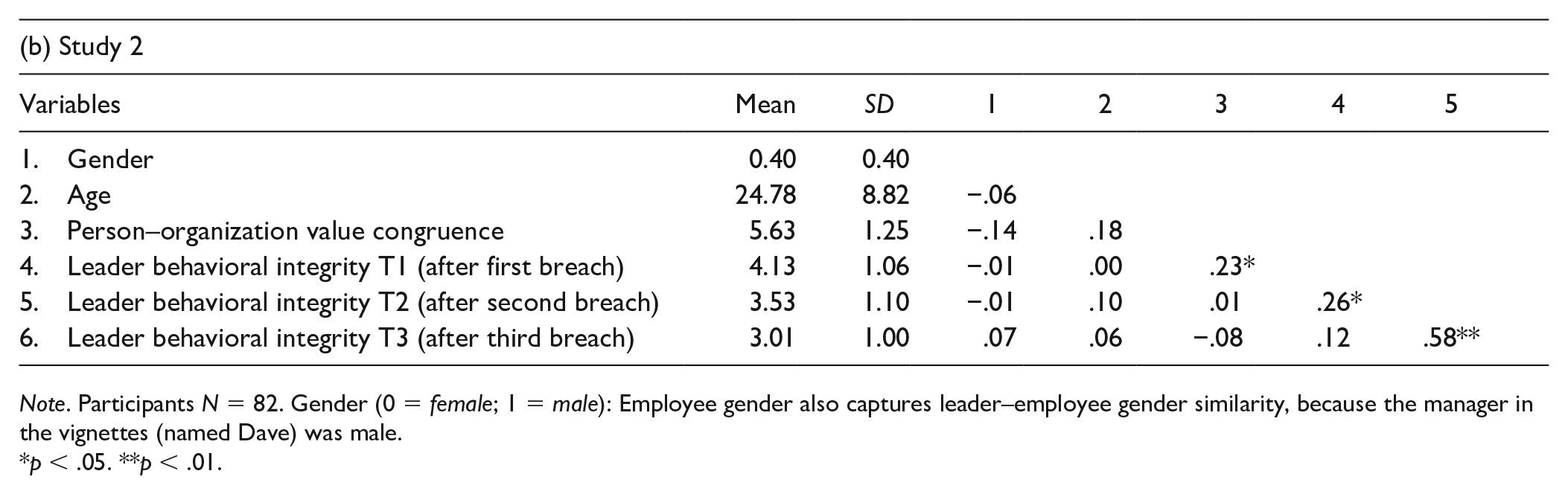
Note. Participants N = 82. Gender (0 = female; 1 = male): Employee gender also captures leader–employee gender similarity, because the manager in the vignettes (named Dave) was male.
p < .05. **p < .01.

Note. Participants N = 180. Gender (0 = female; 1 = male).
p < .05. **p < .01.
Table 2 shows the regression analysis of leader integrity on value congruence. The results from Model 2 indicate that value congruence predicted leader integrity positively and significantly (Β = .47, standard error [SE] = .11, p < .001), thus, lending support to Hypothesis 1a. The variance explained by the study variables was 19.4%. Although this percentage might appear small, it is comparable to findings from previous studies that examined the predictive role of follower characteristics in their perceptions of leaders (e.g., Felfe & Schyns, 2010; Schyns & Sanders, 2007).
Hypothesis Testing: Study 1.
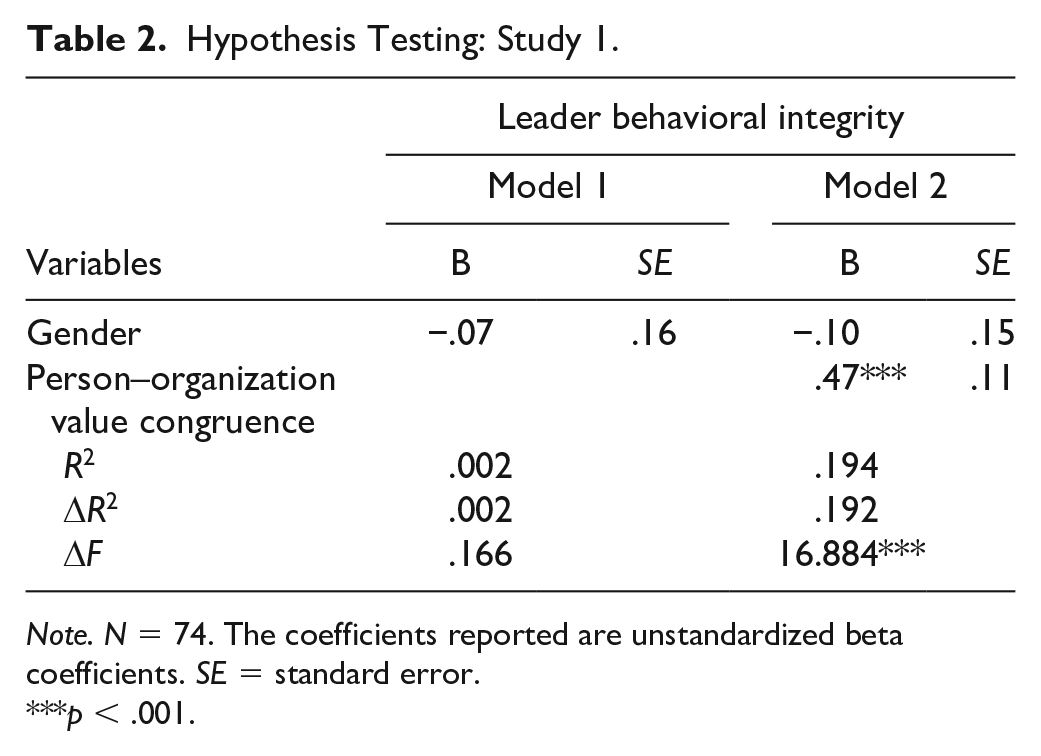
Note. N = 74. The coefficients reported are unstandardized beta coefficients. SE = standard error.
p < .001.
Following the recommendation by Becker (2005) and Spector and Brannick (2011), we repeated the analysis with varying control variables and found consistent results in general. Specifically, when no control variables were entered in the model such that all the respondents who reported a leader value breach were included (n = 94), the relationship between value congruence and leader integrity was positive and significant (Β = .46, SE = .11, p < .001). When age and gender were controlled for, the relationship was only marginally significant (Β = .29, SE = .16, p = .076). However, this finding can be attributed to the greatly reduced sample size (n = 46) caused by the high missing rate of age.
Discussion
The Study 1 results provided preliminary support for the blind eye effect in that value congruence was positively associated with employees’ integrity ratings of a leader who had committed a value breach. However, Study 1 was limited in at least two ways. First, megachurches, although likened in the press to large businesses, could represent a somewhat distinctive research context. Second, each respondent provided his or her own description of a leader value breach, with respondents describing a range of different incidents. In order to examine the generalizability of our Study 1 findings to other settings, we conducted two follow-up studies under controlled conditions. In these experimental vignette studies, we examined again the relationship between value congruence and perceptions of leader integrity following a leader value breach. We further investigated breach repetition as a potential moderator of this focal relationship.
Breach Repetition as a Moderator of the Value Congruence–Leader Integrity Relationship
In this section, we argue that the blind eye effect—the positive relationship between value congruence and an employee’s leader integrity ratings—is moderated by breach repetition, which we define as the number of times a leader has engaged in a value breach. Specifically, we propose that as breach repetition increases, this positive relationship weakens (becomes less positive). Even when an employee is inclined to interpret a leader’s value breaches positively (as Study 1 suggested is the case with high value congruence employees), as breach repetition increases, the employee’s latitude for interpretation—his or her ability to reasonably justify a positively biased interpretation—decreases.
Our argument that breach repetition reduces a perceiver’s latitude for interpretation is consistent with attribution theory. According to attribution theory, the more times a person engages in a certain behavior, the more likely it is that observers will attribute that behavior to the actor’s underlying enduring dispositions, such as the actor’s personality or character (Kelley, 1967, 1973). For example, the more often a person displays a worried facial expression, the more likely it is that observers will infer that the person is anxious by nature. The logic underlying this attribution principle is fairly straightforward (Kelley, 1973). The first occurrence of a certain behavior is often ambiguous, meaning that it is difficult to draw clear-cut conclusions, with a high level of certainty, about what the behavior reveals about the actor (Burke, 1991; Kelley, 1973; J. L. Petriglieri, 2011). It is entirely possible that the first-time behavior represents an anomaly—a “one-off” aberration in the person’s behavior, caused by an unusual set of circumstances, external to the actor, that are unlikely to occur. As a result, it is reasonable for the observer to attribute the behavior to the environment (the situation faced by the actor) rather than to the actor’s dispositions. However, if the actor engages in the same behavior repeatedly, he or she establishes a pattern; the increasingly evident covariation between the presence of the actor and the occurrence of the behavior logically suggests that an enduring characteristic of the actor is the cause of the behavior. As a result, observers increasingly perceive the behavior as valid evidence of, and attribute the behavior to, the actor’s underlying dispositions (McArthur, 1972; Pruitt & Insko, 1980; Ruble & Feldman, 1976).
Applying this attribution principle to the case of leader value breaches, the first occurrence of a breach may provide followers with significant latitude for interpreting what the breach reveals about the leader. As a result, high value congruence employees may still be able to exercise their desire to perceive the leader positively by attributing the breach to extenuating circumstances rather than to their leader’s lack of integrity. Exercising this positive bias becomes less and less reasonable as the leader engages in an increasing number of breaches. In contrast, low value congruence employees lack the same level of motivation to perceive their leader in a positive light. As a result of never having put the leader on a glorified pedestal to begin with, low value congruence employees are likely to demonstrate less variation in their perceptions of leader integrity along a range of breach repetition, compared with their counterparts with high value congruence.
Going a step further, if breach repetition continues to increase, it is even possible that the positive value congruence–leader integrity relationship (blind eye effect) will continue becoming less positive to the point where it disappears (becomes zero) and eventually becomes a negative relationship. In other words, a high level of breach repetition could eventually result in a negative bias (critical eye effect), in which high value congruence employees, relative to low value congruence employees, perceive the leader as having less integrity.
To elaborate, consistent with our earlier argument drawing on attribution theory, at high levels of breach repetition, a high value congruence employee’s latitude for positive interpretations of a leader value breach may eventually disappear. At that point, the leader’s pattern of committing value breaches finally becomes undeniable to high value congruence employees, who are then likely to experience feelings of betrayal, broken trust, and identity threat (Cha & Edmondson, 2006; Harrison et al., 2009; Pargament et al., 2005; J. L. Petriglieri, 2011). According to sacralization theory, feelings of betrayal and broken trust are likely to lead high value congruence employees to punish or avenge themselves against the leader (Harrison et al., 2009; Koehler & Gershoff, 2003) by derogating the leader (e.g., lowering their leader integrity perceptions) to an even greater extent than low value congruence employees. Derogation of a target constitutes a powerful form of punishment because targets with a negative image may be hindered in their ability to influence others and function effectively in organizations (Roberts, 2005; Rosenfeld et al., 2002; Tetlock et al., 2000).
Some research on third-party reactions to injustice provides indirect support for our argument. For example, Skarlicki and Kulik (2004) speculated that third-party observers who identify strongly with the harmdoer (e.g., an organization or organizational agent) may initially give the benefit of the doubt to the harmdoer, but once these observers believe that a line has been crossed, they may react more negatively to the injustice than observers with weaker identification. Consistent with this theorizing, layoff survivors with high versus low levels of initial organizational identification reacted more negatively to the layoffs (Brockner et al., 1992).
Derogating the leader may also provide psychological benefits for high value congruence employees when they face an undeniable pattern of leader value breaches, as suggested by the identity threat literature. For high value congruence employees—whose personal values (a core part of their identity) overlap with organizational values—a leader value breach represents a potential identity threat, defined as “an experience appraised as indicating potential harm to the value, meanings, or enactment of an identity” (J. L. Petriglieri, 2011, p. 641). When another person repeatedly engages in behavior that threatens an identity that is important to us, we often respond by condemning the source, as doing so reduces our subjective experience of danger (J. L. Petriglieri, 2011) and can re-establish our sense of control over the environment (Leotti et al., 2010). Hence,
Study 2
Participants and Procedure
We collected 246 observations of post-breach leader integrity from 82 participants (32 men, 48 women, and 2 participants who did not report their gender). The participants had an average age of 24.78 (SD = 8.82). We recruited participants through newspaper advertisements and a psychology department study pool. The former received $12 for their participation, and the latter received course credit; these groups did not differ on the study variables.
We utilized an experimental vignette methodology. Studies with an experimental design could pose a concern for external validity and generalizability (Argyris, 1975; Scandura & Williams, 2000). However, well-designed and well-implemented experimental vignette methodology enhances experimental realism and thus external validity, while also allowing researchers to examine causal relationships through manipulation (Atzmüller & Steiner, 2010; Hox et al., 1991). Consequently, experimental vignette studies have been successfully utilized in the field of leadership (e.g., De Cremer et al., 2009; Meleady & Crisp, 2017; Steffens et al., 2018). In order to ensure the higher external validity afforded by experimental vignette methodology, we followed multiple recommendations provided by Aguinis and Bradley (2014). Specifically, because we were investigating workplace phenomena, we recruited participants through newspaper advertisements in addition to a study pool within a psychology department, resulting in a sample that included 91.5% nonstudents. We also presented participants with company materials that were carefully modeled after elements of the actual websites of several values-driven companies (e.g., a well-designed logo, company history, and depictions of company products), thereby increasing experimental realism. Additionally, participants completed the experimental task online in their own environments, rather than university facilities.
The experimental design involved a within-subjects manipulation of breach repetition (whether a leader’s value breach was the first, second, or third breach). Specifically, each participant read about three different breaches (actions that were inconsistent with the company’s espoused values, as rated by an independent sample of 22 pretest participants) in a randomly assigned, counterbalanced sequence, thus, controlling for the content of the breach.
Participants completed a 20-minute online survey. The survey instructed participants to imagine that they had recently accepted a new job at a company called BreadBox Bakery. Next, participants read about the company’s history, products, and values. The company espoused two values related to employee well-being: the values of “people” (at the company, i.e., employees) and “respect for others.” We chose these values because they are commonly espoused by companies (American Management Association, 2002; Kelly et al., 2005). After reading about the company’s values, participants completed a value congruence measure. Next, participants read about meeting a manager at a company event. Following this initial encounter, participants read three vignettes, each of which described the manager engaging in a different value breach (see the appendix). After each vignette, participants completed survey items rating the manager’s integrity.
Measures
All items used 7-point Likert-type scales with endpoints of 1 (strongly disagree) to 7 (strongly agree). All variables were measured with the same scales as in Study 1: value congruence with Cable and DeRue’s (2002) scale (Cronbach’s α = .84) and leader behavioral integrity with Simons et al.’s (2007) scale (Cronbach’s α = .89, .89, and .81 for the ratings after the first [T1], second [T2], and third breaches [T3], respectively).
We included follower gender and age as control variables to account for their potential influence on follower perceptions of the leader (Miller et al., 2008; Mroz et al., 2018; Ng & Feldman, 2010; Steiner et al., 2012), even though prior experimental vignette studies on the perception of leaders (e.g., De Cremer & van Knippenberg, 2004; Giessner & van Knippenberg, 2008) as well as actors’ perceived integrity following a trust violation (e.g., Ferrin et al., 2007; P. H. Kim et al., 2006) often did not include any control variables in hypothesis testing, or used follower gender as the sole control variable (e.g., Gartzia & Baniandrés, 2016; Marchiondo et al., 2015). Our hypothesis testing results remained the same with and without controlling for age and gender (Becker, 2005; Spector & Brannick, 2011).
Results
As in Study 1, we examined the discriminant validity of our perceptual variables (i.e., value congruence and leader integrity T1 through T3) using the procedure recommended by Fornell and Larcker (1981). Given that leader integrity was measured more than once from each respondent, we incorporated metric invariance constraints in the AVE analysis. The AVE of each variable (value congruence = .67, leader integrity T1 = .58, leader integrity T2 = .60, and leader integrity T3 = .51) was greater than the squared correlations between it and other variables, thus, meeting the requirement for discriminant validity. Table 1b contains the means, standard deviations, and correlations among the Study 2 variables at the participant level. Value congruence was positively associated with leader integrity T1 (r = .23, p < .05), but not with leader integrity T2 (r = .01, ns) or leader integrity T3 (r = −.08, ns). These patterns were consistent with Hypothesis 2.
As each participant responded three times, the three observations were not independent of one another. When we examined the variance in leader integrity ratings, we found that 80% of the variance in these ratings was within participants (ICC1 = .20). Both the between-participant (Wald’s Z = 2.48, p < .05) and within-participant variation (Wald’s Z = 8.99, p < .001) in leader integrity ratings were significant. These results indicate that leader integrity is an individual perception that varies across individuals, and over time within individuals. In order to account for the multiple ratings of leader integrity nested in each participant, we used multilevel modeling in our hypothesis testing by employing the mixed model feature in SPSS Version 23 (Bliese & Hanges, 2004). We specified the fixed model to include gender, age, value congruence, and breach repetition, and the interaction term of value congruence and breach repetition. The breach repetition condition was coded at three levels (first breach = −1; second breach = 0; third breach = 1). For the random effects, participant number was included as the subject grouping variable. In order to facilitate interpretation, we mean-centered value congruence to compute the interaction term (Aiken & West, 1991), and standardized values of leader integrity.
Model 2 in Table 3 indicates that value congruence was not a significant predictor of leader integrity (γ = .04, SE = .06, ns). Therefore, neither Hypothesis 1a nor Hypothesis 1b was supported. Model 3 suggests that instead of having a main effect, value congruence interacted with breach repetition to predict leader integrity (γ = −.12, SE = .05, p < .05).
Hypothesis Testing: Study 2.
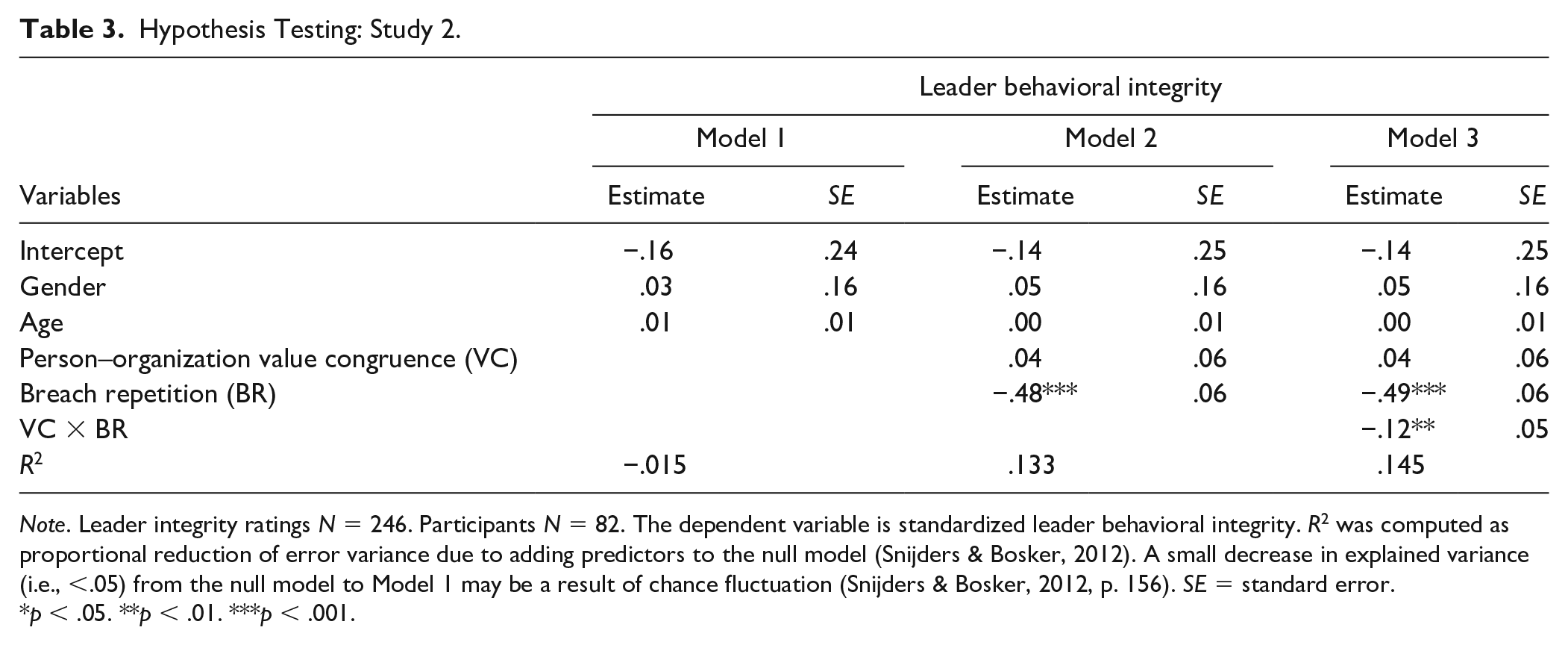
Note. Leader integrity ratings N = 246. Participants N = 82. The dependent variable is standardized leader behavioral integrity. R2 was computed as proportional reduction of error variance due to adding predictors to the null model (Snijders & Bosker, 2012). A small decrease in explained variance (i.e., <.05) from the null model to Model 1 may be a result of chance fluctuation (Snijders & Bosker, 2012, p. 156). SE = standard error.
p < .05. **p < .01. ***p < .001.
The addition of the interaction effect increased the explained variance in leader integrity by 1.2%. Our finding of this ΔR2 may seem like a very small amount of additional variance contributed by the interaction term; however, it is in the typical range for a moderator effect size in social science studies (Champoux & Peters, 1987; Evans, 1985). Moreover, the incremental change in R2 indicates only the improvement in overall fit due to the moderator variable, rather than directly representing the effect of the moderator on the relationship between two other variables (Champoux & Peters, 1987).
In order to interpret the effect of the moderator (breach repetition), we calculated the predicted values of leader integrity for high value congruence individuals (i.e., one standard deviation above the mean) and low value congruence individuals (i.e., one standard deviation below the mean) over repeated breaches, while holding the remaining variables in the model constant at their means. Figure 1 shows that after the first breach, leader integrity was higher for individuals with high value congruence, relative to individuals with low value congruence. Yet with each successive breach, the size of this discrepancy (between the mean leader integrity rating provided by high value congruence employees, deducted by the mean rating provided by low value congruence employees) became less positive. Indeed, breach repetition changed the direction of the association between value congruence and leader integrity from positive to negative within the one standard deviation range of the moderator, indicating a moderation effect that is both statistically and practically significant (Champoux & Peters, 1987). These results thus provided support for Hypothesis 2.
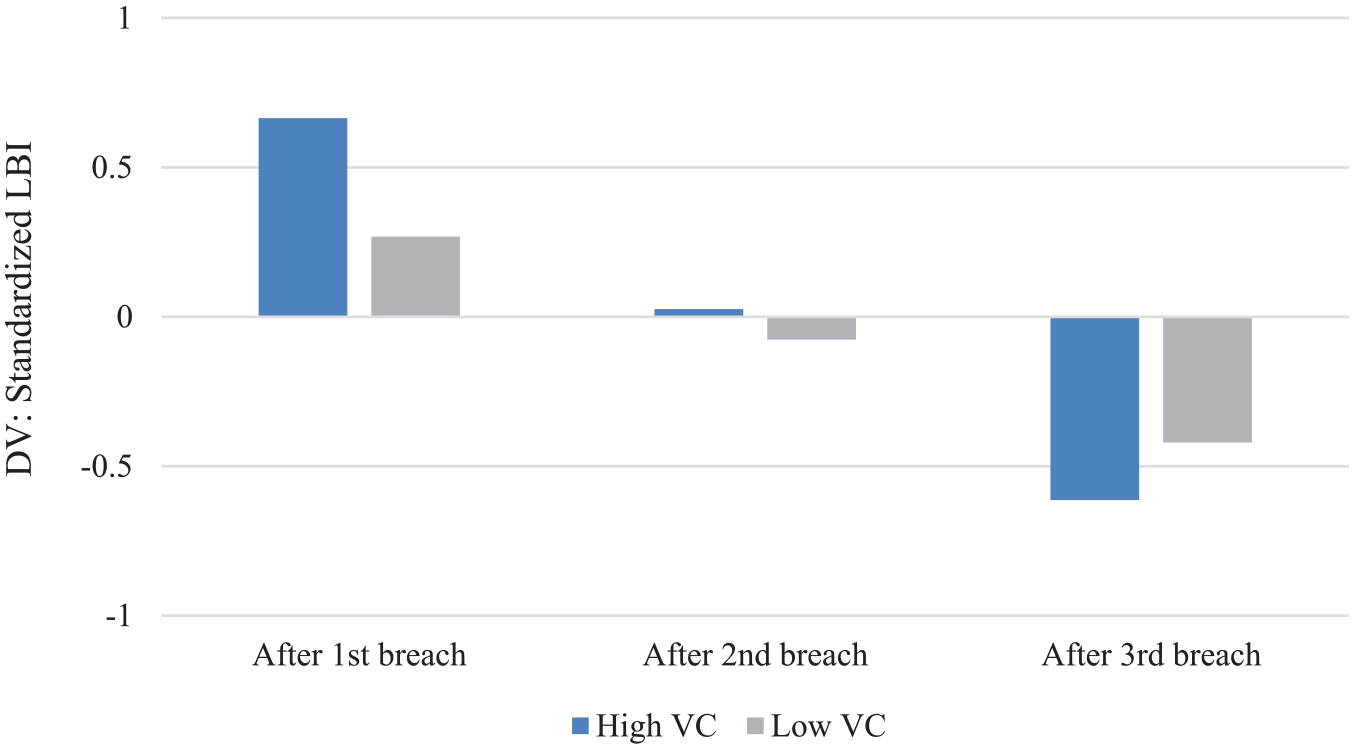
The moderating effect of breach repetition on the impact of person–organization value congruence (VC) on leader behavioral integrity (LBI)—Study 2.
Discussion
In this experimental setting, there was no significant relationship between value congruence and an employee’s leader integrity ratings on average, that is, across the three conditions (after the first, second, and third breaches, respectively). After a first-time breach, the leader integrity ratings provided by high value congruence employees were significantly higher than the ratings provided by low value congruence employees. However, this positive association between value congruence and leader integrity, observed immediately following a first-time breach, weakened as the leader engaged in repeat breaches. Indeed, following the third breach, high value congruence employees rated the leader as lower in integrity than did low value congruence employees.
Study 2 was limited in that our findings did not account for respondents’ baseline perception of leader integrity prior to the occurrence of any leader value breaches. Accordingly, it was not certain whether the positive association (observed after a first-time breach) between value congruence and leader integrity reflected distinct employee reactions to the breach or preexisting differences between high and low value congruence employees in their baseline perceptions of leader integrity. In addition, although we controlled for gender (and thus leader–employee gender similarity) in Study 2, the gender of the leader, in and of itself, may have affected follower perceptions (Eagly & Karau, 2002). We therefore conducted Study 3, a similar experiment with an enhanced design. Specifically, we used a gender-neutral name for the leader and accounted for employees’ baseline perception of their leader’s integrity.
Study 3
Participants and Procedure
We collected 540 observations of post-breach leader integrity from 180 participants through Amazon Mechanical Turk (MTurk), an open online marketplace from which reliable data can be quickly and inexpensively collected (Bendersky & Shah, 2013; Buhrmester et al., 2011). We specified that participants must (1) be 18 years or older in age, (2) be located in the United States, and (3) have an excellent record of past study participation (i.e., a task approval rate of not less than 100). We paid participants $2.50 for participating in the study, which took about 20 to 30 minutes to complete. Forty-two percent of the respondents were female, and 79% were White. The participants had an average age of 33.59 years (SD = 10.96). The sample included 91.1% nonstudents.
The experimental design generally involved the same procedure as in Study 2, with only two differences. First, participants rated leader integrity four times: before they read about any breaches (i.e., immediately after reading about meeting the manager at a company event), as well as after they read about each of the first, second, and third breaches). Second, we used a gender-neutral name for the leader in the vignettes (Chris rather than Dave), so that perceptions of the leader would not be affected by the leader’s gender. In research conducted in the United States, “Chris” was endorsed most frequently as being a gender-neutral name in an experimental study (Merritt & Kok, 1995) and has therefore been used as such in other experimental studies (e.g., Marsh et al., 2006; McConnell & Fazio, 1996; Merritt & Harrison, 2006). As all of our participants were from the United States (which we verified with IP addresses), they were likely to have perceived the name Chris as unisex.
Measures
The same measures as in Study 2 were used: value congruence with Cable and DeRue’s (2002) scale (Cronbach’s α = .95) and leader behavioral integrity with Simons et al.’s (2007) scale (Cronbach’s α = 89, .96, .96, and .96 for the baseline rating [T0] and ratings after the first [T1], second [T2], and third breach [T3], respectively). Consistent with Study 2, we controlled for gender and age in the hypothesis testing. Additionally, we controlled for participants’ baseline rating of leader integrity.
Results
We examined the discriminant validity of our perceptual variables (i.e., value congruence and leader integrity T0 through T3) using the procedure recommended by Fornell and Larcker (1981). Given that leader integrity was measured more than once from each respondent, we incorporated metric invariance constraints in the AVE analysis. The AVE of each variable (value congruence = .88, leader integrity T0 = .65, leader integrity T1 = .79, leader integrity T2 = .80, and leader integrity T3 = .80) was greater than the squared correlations between it and other variables, thereby meeting the requirement for discriminant validity. Table 1c contains the means, standard deviations, and correlations among the Study 3 variables at the participant level. Value congruence had a significant positive correlation with leader integrity T0 (r = .33, p < .01). In contrast, value congruence was not significantly correlated with leader integrity T1 (r = .05, ns), leader integrity T2 (r = −.03, ns), or leader integrity T3 (r = −.14, ns).
Our analytic approach was similar to that in Study 2. We used multilevel modeling to test the hypotheses in order to account for the multiple ratings of leader integrity nested in each participant (ICC1 = .50). Further, both the between-participant (Wald’s Z = 7.00, p < .001) and within-participant variation (Wald’s Z = 13.42, p < .001) in leader integrity ratings were significant. We repeated hypothesis testing, with and without controlling for leader integrity T0, in order to facilitate the comparison of the findings between Studies 2 and 3. Table 4 shows the results of two sets of multilevel analyses. Model 1 in Table 4b indicates that leader integrity T0 was a significant predictor of subsequent leader integrity ratings (γ = .13, SE = .06, p < .05). Results in Table 4 indicate that value congruence was not a significant predictor of leader integrity, either without leader integrity T0 as a control (Model 2 in Table 4a: γ = −.06, SE = .05, ns) or with leader integrity T0 as a control (Model 2 in Table 4b: γ = −.10, SE = .05, ns). Therefore, neither Hypothesis 1a nor Hypothesis 1b was supported. In contrast, the interaction term of value congruence and breach repetition was a significant predictor of leader integrity, with or without controlling for leader integrity T0 (Model 3 in Table 4a: γ = −.07, SE = .02, p < .01; Model 3 in Table 4b: γ = −.07, SE = .02, p < .01). The addition of the interaction effect increased the explained variance in leader integrity by 0.6% (Table 4a) or 0.5% (Table 4b). To facilitate the interpretation of the interaction effect, we plotted it in Figure 2.
Hypothesis Testing: Study 3.

Note. Leader integrity ratings N = 540. Participants N = 180. The dependent variable is standardized leader behavioral integrity. LBI = leader behavioral integrity. R2 was computed as proportional reduction of error variance due to adding predictors to the null model (Snijders & Bosker, 2012).
p < .05. **p < .01. ***p < .001.
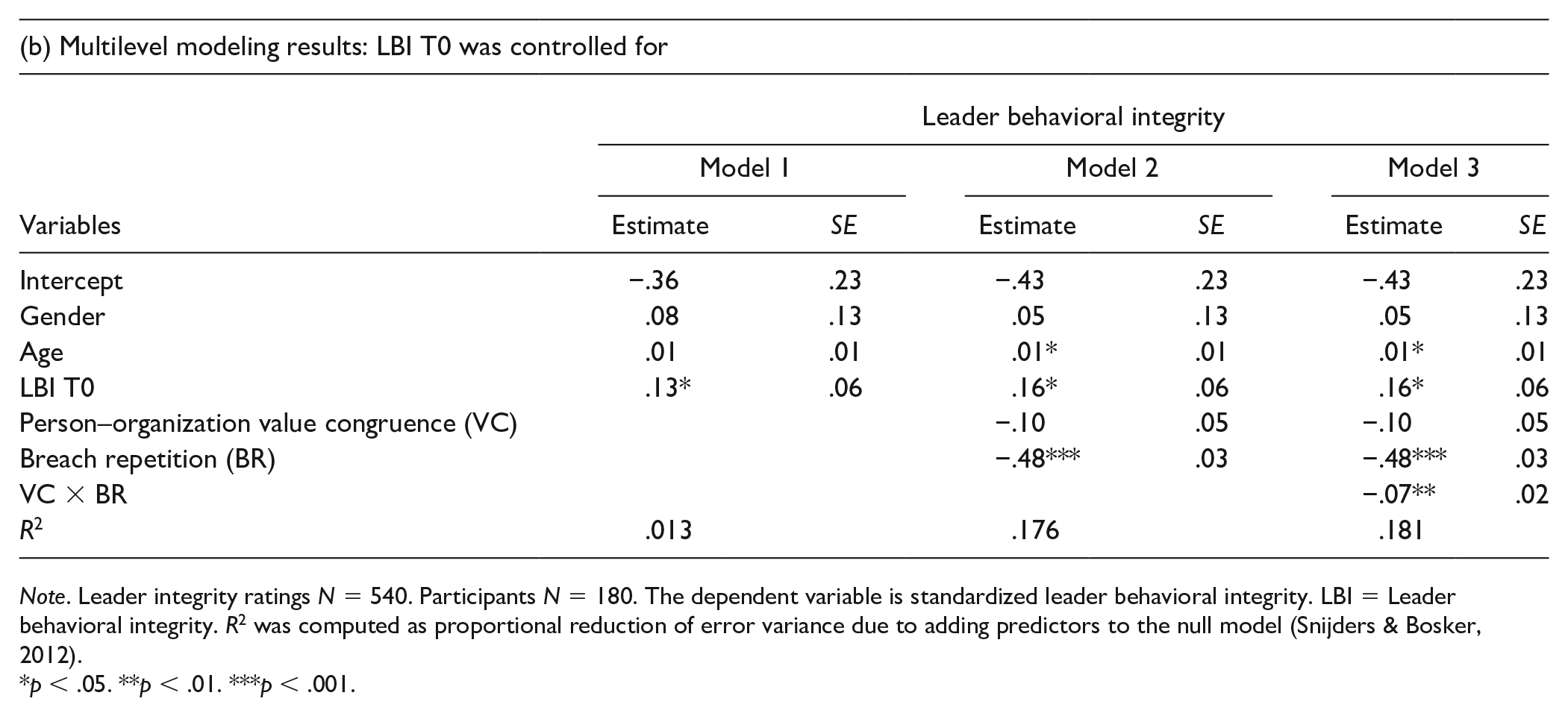
Note. Leader integrity ratings N = 540. Participants N = 180. The dependent variable is standardized leader behavioral integrity. LBI = Leader behavioral integrity. R2 was computed as proportional reduction of error variance due to adding predictors to the null model (Snijders & Bosker, 2012).
p < .05. **p < .01. ***p < .001.
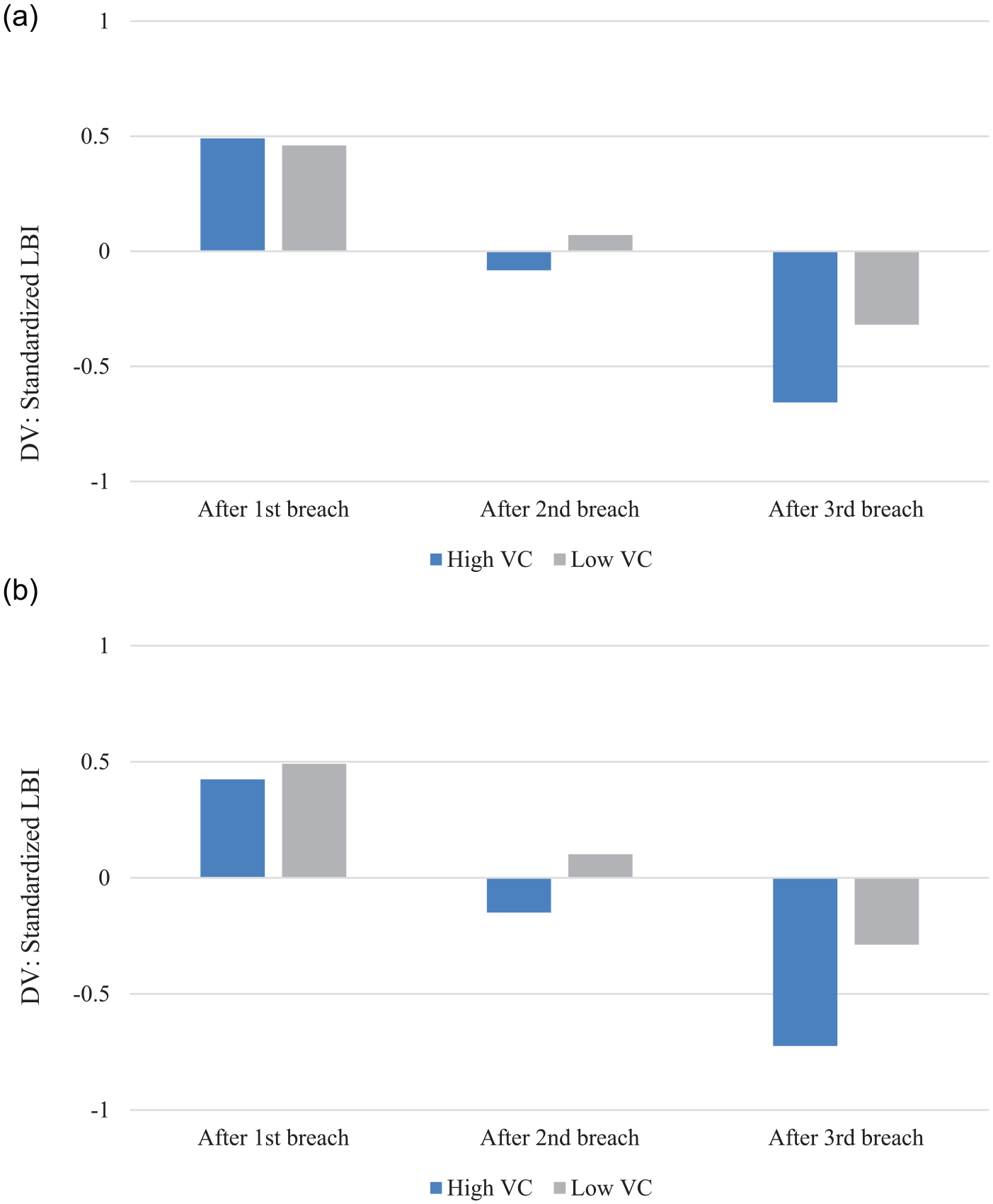
The moderating effect of breach repetition on the impact of person–organization value congruence (VC) on leader behavioral integrity (LBI)—Study 3. (a) LBI T0 was not controlled for. (b) LBI T0 was controlled for.
Figure 2a shows the interaction effect between value congruence and breach repetition in predicting leader integrity, without leader integrity T0 as a control. The pattern is generally consistent with our Study 2 findings in that with each successive breach, the discrepancy in the mean leader integrity rating provided by high versus low value congruence employees became less positive. Put differently, the moderator (breach repetition) changed the direction of the association between value congruence and leader integrity from slightly positive or neutral to increasingly negative. Figure 2b shows the interaction effect found when leader integrity T0 was used as a control. Again, the pattern of the interaction effect was generally similar to Figure 1 and Figure 2a. These analyses provided support for Hypothesis 2.
Discussion
Study 3 provided findings that were consistent with those of Study 2. However, unlike Study 2, Study 3 measured and accounted for employees’ baseline perception (prior to the occurrence of any breaches) of the leader’s integrity. Doing so provided deeper insights into how employees react to leader value breaches, leading us to correct some of our initial interpretation of the findings across multiple studies.
Three key findings replicated those of Study 2. First, value congruence did not have a main effect on employees’ leader integrity ratings. Second, after repeated leader value breaches, employees with high (vs. low) value congruence lowered their leader integrity perceptions to a greater extent, eventually reaching the point at which the leader integrity ratings of high value congruence employees were lower than those of low value congruence employees. Third, in Study 2 (which did not measure or control for baseline leader integrity perceptions), after the first breach the leader integrity ratings of high value congruence employees were higher than the ratings of low value congruence employees (see Figure 1). Likewise, when baseline leader integrity was not controlled for in Study 3, after the first breach the leader integrity ratings of employees with high versus low value congruence were higher (although not significant; see Figure 2a).
The third set of findings initially suggested that employees with high versus low value congruence react more positively to a first-time leader value breach, consistent with the blind eye effect. However, when we controlled for the baseline leader integrity rating in Study 3, this positive difference between employees with high versus low value congruence became a negative difference after the first breach (see Figure 2b). This shift indicates that the positive bias demonstrated by employees with high value congruence after the first breach is actually the residue of employees’ baseline leader integrity perception.
In other words, prior to the occurrence of any breaches, employees with high versus low value congruence regarded the leader as higher in integrity, placing the leader on a higher initial pedestal; one can think of this phenomenon as “pre-breach sacralization.” Indeed, baseline leader integrity (i.e., prior to the occurrence of any leader value breaches) was positively associated with value congruence (r = .33, p < .01) in Study 3. Yet in response to the leader committing one or more value breaches, employees with high versus low value congruence lowered their leader integrity perceptions to a greater extent, evidencing a harsher negative reaction to breaches (i.e., the critical eye effect). After two or more breaches, the residue of employees’ baseline leader integrity perception wore out, and leaders received lower absolute integrity ratings from employees with high versus low value congruence.
General Discussion
This article investigated how employees react to leader breaches of organizational values. We expected that an employee’s reaction would be strongly influenced by his or her value congruence with the organization. In particular, we expected to see a main positive (blind eye) or negative (critical eye) effect of value congruence on employee perceptions of leader integrity following a leader value breach. Across three studies, we found that value congruence does indeed have a major impact on leader integrity perceptions. However, rather than having a main effect, value congruence is positively associated with perceived leader integrity under certain conditions, and negatively associated with perceived leader integrity under others.
Study 1, a pilot study with megachurch employees, found an overall positive relationship between value congruence and employees’ integrity ratings of a leader who had committed a value breach. This finding initially suggested a main (blind eye) effect of value congruence, but follow-up experimental studies revealed additional nuance. Study 2, which manipulated the number of times a leader had committed a breach, revealed that this positive association occurs only after a first-time breach. After repeated breaches, this relationship became negative in Studies 2 and 3.
Importantly, Study 3 (a replication of Study 2 that also measured employees’ baseline perception of leader integrity) found that the positive value congruence–leader integrity relationship after a first-time breach is actually the residue of baseline perceptions—the fact that prior to the occurrence of any value breaches, employees with high value congruence rate the leader as higher in integrity than do employees with low value congruence (pre-breach sacralization)—rather than evidence of a more positive reaction to a first-time breach by employees with higher value congruence. Indeed, after controlling for baseline perceptions, we found that high value congruence employees lowered their leader integrity perceptions to a greater extent in reaction to one or more breaches than did low value congruence employees (the critical eye effect). Our Study 3 finding of pre-breach sacralization was also consistent with the significant and positive relationship between value congruence and leader integrity ratings found among employees who did not report a leader value breach in Study 1 (r = .49, p < .001).
In sum, an integration of our three studies indicated that before the occurrence of any breaches, high value congruence employees rate leaders as higher in integrity than do low value congruence employees (pre-breach sacralization), but after leaders commit one or more value breaches, employees with high value congruence react more harshly than their low value congruence counterparts (the critical eye effect). As a result, as leaders commit more and more breaches, the initially positive relationship between value congruence and perceived leader integrity weakens and eventually becomes negative.
Theoretical Contributions
These findings make several major contributions to the leadership literature. We contribute to leadership research by helping to resolve the theoretical puzzle regarding whether employees react to a leader value breach with a critical or blind eye. Prior leadership theories implied that a breach would elicit either a simplistic negative response (employees concluding that the leader has little integrity, as romance of leadership theory might suggest) or a simplistic positive response (employees fully maintaining their positive view of the leader’s integrity, as psychoanalytic or social cognition studies might suggest). We find instead that employee perceptions of leader integrity are more nuanced and contextually dependent. Specifically, a leader’s integrity in the eyes of an employee, following a breach, is shaped by the interaction of two key factors: the employee’s value congruence with the organization and breach repetition.
We also contribute to research on leadership and value congruence by uncovering the double-edged nature of high value congruence for leadership. Previous scholarship has viewed high value congruence as desirable for organizations (e.g., Astakhova & Porter, 2015; Boon & Biron, 2016). The literature has framed value congruence as a powerful source of employee motivation, and has encouraged leaders to promote value congruence through organizational processes such as recruitment and socialization (e.g., Ashforth & Pratt, 2003; Hayibor et al., 2011; Hoffman et al., 2011; Pratt & Ashforth, 2003; Rich et al., 2010). Our results suggest that value congruence has an additional effect of biasing employees’ leader perceptions, both positively and negatively. By distorting employees’ assessments of leader integrity, value congruence could undermine organizational effectiveness. For example, unethical leaders could covertly take advantage of their initially glorified image in the eyes of employees with high value congruence. Another possibility is that ethical leaders who are perceived as behaving inconsistently with organizational values—while actually balancing competing organizational values in an ethical way (Quinn & Rohrbaugh, 1981)—may have to overcome severely negative responses from employees with high value congruence. Thus, high levels of value congruence may have side effects that are less desirable for leadership processes and organizational ethics than has been suggested in the existing literature.
Next, given the notable differences we observed in employee perceptions of a leader after each instance of a leader value breach, our findings point to the importance of studying perceptions of leaders at a granular level, such as by tracking an observer’s reactions to a leader’s behaviors over time. One limitation of much previous leadership research has been the lack of attention paid to cumulated effects over time (Dinh et al., 2014; Fischer et al., 2017). For instance, prior studies of leader behavioral integrity have primarily focused on employees’ overall perception of a leader’s integrity, measured using cross-sectional surveys (Simons et al., 2012). In contrast, our research took an event-based perspective, in which each leader behavior was treated as a discrete event, to examine potentially important patterns of within-individual differences in follower responses over time, in accordance with the recommendation of Fischer et al. (2017). This allowed us to discover that employees’ ratings of leaders after a first-time value breach can differ radically from their ratings after a repeated breach. Such differences would likely be obscured in a study of overall assessments of leader integrity.
Relatedly, our findings also underscore the value of exploring inversions in organizational research. Inversions, in which the effect of an independent variable on a dependent variable changes from positive to negative or vice versa, are of great theoretical and practical importance because they involve a fundamental qualitative change in the nature of an effect—indicating, for example, that “something often thought to be generally ‘good’ in the field of organizational behavior might actually become deleterious in particular conditions” (Cavarretta et al., 2016, p. 935). However, organizational research on inversions is rare, leading to a recent call for more scholars to consider, build theory on, and test for inversions (Cavarretta et al., 2016). Our findings address this call and help to advance the field of organizational behavior by exploring an inversion and explicating its significant implications for leadership research and practice.
Limitations and Directions for Future Research
The current research is not without limitations. First, in Study 1, a field study, the focal study variables were measured at the same time, making the direction of causality unclear. We addressed this concern in Studies 2 and 3 by measuring value congruence before the occurrence of leader value breaches and leader integrity, and by examining the relationship between value congruence and leader integrity ratings in controlled experimental settings. Second, as online studies that asked participants to imagine that they were employees at a fictitious organization, Studies 2 and 3 could present limitations in terms of external validity. To offset these potential limitations, we carefully implemented Aguinis and Bradley’s (2014) recommendations for ensuring higher external validity in experimental vignette studies. For example, our samples in both studies included over 91% nonstudents. Further, the overall consistency of our findings across field and experimental settings bolsters confidence in their validity. That being said, future research explicitly testing our moderation hypothesis in a field setting would further solidify our findings’ external validity.
Finally, we did not explicitly build theory on or test the potential impact of the leader–follower relationship on the relationship between value congruence and perceived leader integrity. Prior research has found that the leader–follower relationship can affect employee responses to organizational events (Dulac et al., 2008; Restubog et al., 2010). It is therefore possible that employee ratings of leader integrity in Study 1 were affected by the leader–follower relationship. Yet there was no substantial leader–follower history or relationship described in the experimental vignettes in Studies 2 and 3. The consistency of our findings across these settings suggests that the lack of modeling the leader–follower relationship did not likely affect the main conclusions of our article. Future field studies could help to clarify the potential role of the leader–follower relationship by considering relational variables, such as leader–member exchange (Graen & Uhl-Bien, 1995) or follower identification with the leader (Kark et al., 2003).
Several interesting avenues exist for further deepening our knowledge of how employees respond to leader value breaches. First, whereas we focused on one feature of a leader value breach (breach repetition), future research could investigate a range of breach attributes that could affect employees’ reactions. One example is the content of the breached organizational value; employees might respond more negatively, on average, to a breach of employee well-being, which is likely to affect them directly, versus a breach of environmental responsibility, which could affect them less directly. As another example, the breach’s visibility could be important. A breach that is very public will be more widely scrutinized and could make it harder for employees to turn a blind eye, whereas breaches that are private or known to only a few people could make it easier for employees to maintain a positive image of their leader’s integrity.
Second, future research could examine how individual-level factors affect employee responses to a leader value breach. For instance, founder status could matter. The founder of an organization serves as a particularly meaningful symbol of organizational values for employees (Schein, 2004), which might make employees with high value congruence initially sacralize founders to a greater extent. Similarly, leaders who are perceived as prototypical of the group or organization may be more protected from negative evaluations within the group (Hogg, 2001). Thus, employees who perceive a leader as more versus less prototypical of their group or organization might be more positively biased in their interpretation of that leader’s breaches. Employee personality traits could also affect their reactions to leader value breaches. For example, agreeableness, which correlates with forgiveness (Brose et al., 2005), could buffer negative reactions to a breach.
Relatedly, employee reactions to leader value breaches could be affected by their “moral self,” defined as their amalgam of “self-defining moral beliefs, orientations, and dispositions” (Jennings et al., 2015, p. S105). To illustrate, individuals vary in their ethical ideologies or perspectives, such as their tendency to rely on moral absolutes versus relativism in making moral judgments, with one study finding that absolutists, who “assume . . . that the best possible outcome can always be achieved by following universal moral rules” (Forsyth, 1980, p. 176), judge wrongdoers more harshly (Forsyth, 1978). As such, absolutists may perceive leaders who commit value breaches through an especially critical eye. As another possibility, moral ownership—the extent to which individuals feel “a sense of psychological responsibility over the ethical nature of their own actions, those of others around them, their organization, or another collective” (Hannah et al., 2011, p. 674)—prompts individuals to alter their own behavior (and influence other people’s behavior) to be consistent with their personal values (Bandura, 1991, 1999; Hannah & Avolio, 2010). As a result of this felt responsibility, individuals with a high level of moral ownership may be “simply less able to turn a blind eye” to immoral or value-inconsistent behavior (Hannah et al., 2011, p. 675).
Practical Implications
It has been argued that given the expansive, abstract way in which organizational values are generally articulated (e.g., “respect for employees” connotes innumerable actions), leaders may inevitably act in ways that followers view as value breaches (Biron, 2010; Cha & Edmondson, 2006). As a result, all leaders may face the challenge of maintaining their reputation of integrity—which is essential for their effectiveness—in the aftermath of a value breach. Our findings may help leaders anticipate which of their employees will react most negatively to a breach, and when. In addition, leaders of organizations that have many employees with high value congruence may benefit from knowing that value congruence appears to “buy” leaders an initial reservoir of goodwill, which may enable leaders to take risks that, on one hand, may challenge some of the organization’s core values but, on the other hand, may be essential for organizational change, innovation, or even survival (Chatman & Cha, 2003). However, such leaders need to be aware that this reservoir of goodwill is not bottomless; rather, it can be depleted quickly when a value breach is repeated. We hope that this article will serve as a foundation on which organizational scholars will conduct further research to help leaders and employees manage the potential perils of leader value breaches, and to foster the high levels of integrity that are essential for running organizations effectively.
Footnotes
Appendix
Acknowledgements
We thank editors Dr. Sean Hannah and Professor Ken Thompson as well as anonymous reviewers for their helpful comments. We also benefited greatly from the generous feedback of Jane Ebert and Andy Molinsky on earlier versions of the article. Amy Edmondson, Richard Hackman, and Jenny Chatman provided invaluable advice on Study 2 as members of the first author’s dissertation committee. We also appreciate the thoughtful input of David Ager, Teresa Amabile, Tal Ben-Shahar, Shelley Brickson, Saikat Chaudhuri, Jim Detert, Hillary Anger Elfenbein, Robin Ely, Allan Filipowicz, Connie Hadley, Peter Jordan, Nancy Katz, Terri Kurtzberg, Erin Lehman, Elizabeth Long Lingo, Joshua Margolis, Frances Milliken, Josephine Mogelof, Todd Pittinsky, Jeff Polzer, Laura Morgan Roberts, Lisa Rohrer, Seth Rosenthal, Mimi Shields, and Sim Sitkin.
Authors’ Note
Patricia Faison Hewlin is also affiliated with Southwestern University of Finance and Economics, Chengdu, China.
Declaration of Conflicting Interests
The author(s) declared no potential conflicts of interest with respect to the research, authorship, and/or publication of this article.
Funding
The author(s) disclosed receipt of the following financial support for the research, authorship, and/or publication of this article: Funding was provided from the University of Michigan, Harvard University, and the Social Sciences and Humanities Research Council of Canada.
