



Abstract
While there is a burgeoning trend to recognize leadership as an important enabler of new venture development and growth, scant research has explored the performance mechanisms of shared leadership in the entrepreneurial context. Based on the information processing perspective, we propose a moderated mediation model to examine how shared leadership in entrepreneurial teams advance new venture performance by identifying team reflexivity as a pivotal mediator and team boundary spanning as a crucial contingency. The data set from a cross-industry sample of 94 entrepreneurial teams indicated that shared leadership exerts a positive indirect influence on new venture performance via team reflexivity; and team boundary spanning moderates such indirect influence. Finally, how our findings contribute to the entrepreneurship, leadership, team research, and managerial practice are discussed.
Introduction
Entrepreneurial team normally represents more than two people who jointly found a business and are still involved in its subsequent management (Lazar et al., 2020; Santos et al., 2019). Recently, entrepreneurial activities are shifting from individual to team, and thus, entrepreneurial teams gradually become the limelight of contemporary entrepreneurial activities (Wang et al., 2020). For example, new ventures in Germany had 2.2 entrepreneurs on the average, and 70% of new high-tech ventures in the United States were founded by entrepreneurial teams (Zhou et al., 2015; Zhou & Rosini, 2015). Therefore, the understandings on how entrepreneurial teams can effectively function and yield superior performance are of great interests.
Following the focus of entrepreneurship literature on leadership as a vital aspect of team function, previous empirical studies have shown that the leadership behaviors of entrepreneurs or entrepreneurial teams are likely to have deep impacts on the growth of their new ventures (Knipfer et al., 2018; Miao et al., 2019). Most of these scholarly efforts shed light on how the lead entrepreneur’s overarching style and behavior drives the entrepreneurial team dynamics (Knight et al., 2020; Knipfer et al., 2018). However, recent studies have pinpointed that entrepreneurship depends more on a socially distributed process than the hierarchical influence of a formal leader (Cardon et al., 2017). Indeed, given that entrepreneurial teams function in uncertain situations, without well-defined operating procedures, with liability of novelty, and with less bureaucracy, team members face a considerable demand of extensively interacting with each other to perform critical team functions adapting to the environment (Hart, 2014; Zhou, 2016). Under this condition, entrepreneurial teams provide an ideal context wherein the benefits of shared leadership—mutual or collective leadership influence among multiple team members are greatest (Agarwal et al., 2020; Wu et al., 2020). Although some works have informed the value of shared leadership within the entrepreneurial context, such as cultivating among partners a collective understanding of primary objectives (He et al., 2020; Knight et al., 2020), research on the underlying mechanisms of shared leadership in entrepreneurial teams on new venture performance is rare.
To address this gap, we draw on the information processing perspective to explore the team information processing mechanism by which the performance enhancement of shared leadership is achieved. This perspective treats a team as an information processor, and suggests that the team’s ability to process information (e.g., gather, interpret and synthesize information) in a more accurate and timely manner will manifest itself in superior team performance (El-Awad et al., 2017; Engelhard & Holtbrügge, 2017). Entrepreneurial teams serving as the information processing brain of new ventures particularly need to acquire and interpret environmental information to survive in a changing environment (Li, 2018; Parida et al., 2018). Given the relevance of information processing, entrepreneurial teams must execute specific leadership behaviors in initiating, facilitating, and guiding information processing associated with the entrepreneurial challenges and uncertainties (Knipfer et al., 2018). We thus appreciate shared leadership as a facilitator of information processing in entrepreneurial teams, shaping new venture performance. Specifically, our main goal is to explain how shared leadership yields increased new venture performance by means of stimulating a pivotal team information processing activity—team reflexivity. Team reflexivity is the process of reflecting on and regulating collective goals or strategies with responding to current or anticipated conditions (De Jong & Elfring, 2010; Li et al., 2018). It is suggested that team reflexivity is particularly prominent for entrepreneurial teams because constant contemplations and evaluations manifested in team reflexivity can help identify and exploit entrepreneurial opportunities (Knipfer et al., 2018). Therefore, we theorize that shared leadership in entrepreneurial teams can foster team reflexivity, which in turn, heighten new venture performance.
Despite the advantages of shared leadership for addressing interpersonal interactions within entrepreneurial teams being an important driver of team reflexivity, the way information is processed within a team inherently depends on the team’s external relationships (Harvey et al., 2014; Knight et al., 2020). This means entrepreneurial team members who actively search for more information or have more available information might make full use of shared leadership with desirable effects on team reflexivity (Gielnik et al., 2014; Sleptsov & Anand, 2008). For example, partners, customers and suppliers provide the most relevant environmental information, such as varying priorities or objectives and how current decisions affect desired consequences, which is likely to heighten the potential advantages of team information exchange while exploiting shared leadership for attaining team reflexivity (Engelhard & Holtbrügge, 2017; Resick et al., 2014). Specifically, we investigate the team’s external relationships in terms of team boundary spanning—team collective actions to build and maintain associations with the parties in external environment (Yan et al., 2020). Previous studies have indicated that team boundary spanning is an efficient way for entrepreneurial teams to conquer resource shortage by attaining external resources (Joshi et al., 2009). Thus, team boundary spanning is immensely valuable for entrepreneurial teams, because of its high requirements of collecting and processing extensive amounts of environmental information for effective opportunity identification (Knipfer et al., 2018). Although the direct performance effects of team boundary spanning have been empirically examined (Ferguson et al., 2019; Marrone, 2010), how team boundary spanning acts as a boundary condition on the intrateam information processes, particularly in the entrepreneurial context, has so far been much less explored. Therefore, we further investigate the moderation of team boundary spanning on the relationship that shared leadership in entrepreneurial teams has with team reflexivity and subsequently new venture performance.
Literature Review and Hypotheses
We first review the research on our key concepts, namely, shared leadership, team reflexivity, and team boundary spanning, particularly in the entrepreneurial context. Then, we draw on the information processing perspective to detail our hypotheses that shared leadership has a positive indirect influence on new venture performance via team reflexivity; and that team boundary spanning moderates such relationship. Overall, we propose a moderated mediation model of understanding how shared leadership in entrepreneurial teams influence new venture performance. Figure 1 shows our research model.
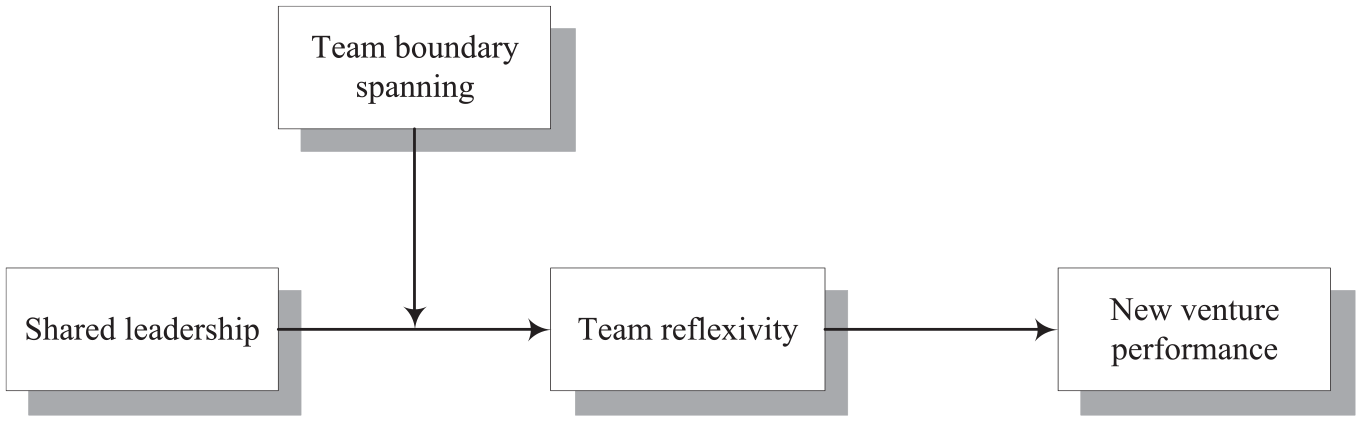
The research model.
Shared Leadership
Shared leadership emerged as the team phenomenon wherein multiple team members undertake leadership roles and functions for achieving collective objectives (He et al., 2020; Hu et al., 2017). To make this concept visible, we offer the following important examples of shared leadership behavior: taking collective responsibility for their actions, sharing power to motivate partners in collaborative teamwork, and shaping collective activities in problem solving (Van De Mieroop et al., 2020). In this way, team leadership is not achieved by hierarchical influence from a formal hierarchical leader, but by the collective or lateral influence from multiple team members (Agarwal et al., 2020; Zhu et al., 2018).
With respect to entrepreneurial teams, shared leadership may be particularly important (Tryba & Fletcher, 2020; Zhou et al., 2015). On the one hand, some scholars have stressed that entrepreneurial teams highly require an equitable power distribution among multiple entrepreneurs when they combine their talents and readily available resources. As Lazar et al. (2020) stated, the division of leadership is often characterized by the “throne versus kingdom” paradox: if lead entrepreneurs desire possession of major shares and leadership authority (i.e., owning the throne), this condition may undermine new venture survival and financial performance (i.e., the kingdom). On the other hand, shared leadership seems excessively valuable in the innovative context such as entrepreneurship within a complex and dynamic environment (Hensel & Visser, 2018; Wang et al., 2014). Several studies have suggested a superior innovative ability of highly autonomous self-directed teams relative to teams with a traditionally vertical leadership (He et al., 2020). Accordingly, the understandings of shared leadership dynamics in entrepreneurial teams are of great interests (Hensel & Visser, 2018).
To address the need for more contextualized understanding of leadership dynamics, the extant research has explored the linkages between shared leadership and its potential outcomes in general work teams (Hans & Gupta, 2018; Nassif, 2019), project teams (Scott-Young et al., 2019), interorganizational teams (Gu et al., 2018), and top management teams (Agarwal et al., 2020; Mihalache et al., 2014). Indeed, since entrepreneurial teams often work in relatively weak situations, the behaviors and activities of entrepreneurial teams likely have a more straight impact on new venture development (Hu et al., 2017; Zhou & Rosini, 2015). Hence, entrepreneurial teams may provide a clear context for testing shared leadership dynamics and its association with the development of new ventures. However, research on the new venture performance mechanisms of shared leadership in entrepreneurial teams is scarce (Hensel & Visser, 2018; Zhou, 2016).
Team Reflexivity
Team reflexivity reflects team members’ collective efforts on reflecting and raising new consciousness about task-related issues (Knipfer et al., 2018; Schippers et al., 2015). It involves the twofold actions of reflective discussions about previous actions such as the alignment of shared goals, and adaptive preparation for future activities such as renewed strategy implementation (De Jong & Elfring, 2010; Lyubovnikova et al., 2017). Because of involving the elaborate assessment to prior work and future scheme, team reflexivity has been considered as a crucial predictor of team outcomes (Chen et al., 2018; Lee & Sukoco, 2011). For instance, Wu et al. (2019) claimed that teams with high degree of reflexivity may be adept at avoiding failure risk because their deep reflection upon inappropriate strategies is helpful for them taking corrective actions.
Indeed, the entrepreneurship literature has suggested the importance of building a norm of reflection in entrepreneurial teams (Rauter et al., 2018). In a highly drastic and competitive environment, entrepreneurial teams must display reflexive behaviors such as collective review and planning, and then modify, reconstruct or adjust the intrateam operations to enact the adaptive strategy (Forsstrom-Tuominen et al., 2019). Furthermore, unlike the executives of established larger ventures who learn by watching their customers, suppliers, or competitors, entrepreneurial teams lack such precedents because of the liabilities of newness (Amason et al., 2006). In this sense, entrepreneurial teams are highly required to reflect on prior task-related practice, and regulate future task objectives and plans in responding with team internal and external conditions (Shin et al., 2017).
Despite the value of reflexivity, the reflexivity demands placed on entrepreneurial teams are uniquely challenging (Forsstrom-Tuominen et al., 2019; Kollmann et al., 2019). Several scholars have demonstrated that it is normally hard for teams spontaneously reflecting on their conventional work styles and processes (Konradt et al., 2015). Particularly for entrepreneurial teams, elaborate reflexivity may involve challenging assumptions about collective goals (Rauter et al., 2018). While growing evidence that team reflexivity is associated with entrepreneurial outcomes is emerging, how entrepreneurs engender collective reflexive mechanisms in entrepreneurial teams remains neglected (Hedman-Phillips & Barge, 2017; Matsuo, 2018). Accordingly, some scholars have stressed that team reflexivity needs specific leadership behaviors to make it happen (Lyubovnikova et al., 2017; Schippers et al., 2008). To our knowledge, research is yet to build the logic linkage between shared leadership and collective reflexivity in entrepreneurial teams.
Team Boundary Spanning
In addition to internal team relationships manifested in shared leadership, external team relationships are also extremely vital for meeting entrepreneurial goals (Lahiri et al., 2019; Tryba & Fletcher, 2020). However, external team relationships do not automatically lead to superior new venture performance. To achieve better performance, entrepreneurial teams must take appropriate actions to exploit external team relationships (Shepherd et al., 2020). In this sense, we shed light on team boundary spanning, which mainly encompasses three types of activities, namely, ambassador, scouting, and task coordination (Ferguson et al., 2019). Specifically, ambassador activities are relevant to seek external support by talking up the entrepreneurship program. Scouting activities pertain to acquiring relevant information such as market opportunities or threats. Task coordination activities focus on solving problems and innovations collaboratively with parties outside the new venture (Carbonell & Escudero, 2019; Yan et al., 2020).
Team boundary spanning is notably important for the development of new ventures, because active information search would be helpful for entrepreneurial teams identifying business opportunities (Shepherd et al., 2020). For example, Resick et al. (2014) suggested that by adjusting objectives or priorities, introducing new chances or risks, and changing how current decisions influence desired consequences, the uncertainty and unpredictability inherent in entrepreneurial settings can accentuate the significance of team boundary spanning for effective team operations. Some researchers further indicated that by spanning, entrepreneurial teams can more accurately tease out the environment, which subsequently helps them better identify externally emerging trends and obtain essential information and resources (Engelhard & Holtbrügge, 2017). In fact, entrepreneurial teams must always make efforts to address both internal and external team interactions, to maintain the balance between accomplishing team inside tasks and outside coordination (Marrone, 2010). While evidence that team boundary spanning is associated with entrepreneurial team outcomes is springing up (Lin & Li, 2013), the specific question of how team boundary spanning complements or supplants internal team interactions (e.g., shared leadership behaviors) in entrepreneurial teams remains neglected.
Shared Leadership and Team Reflexivity
We expect that shared leadership positively affects team reflexivity in entrepreneurial teams. First, shared leadership can facilitate team reflexivity based on its emphasis on learning. It is suggested that the foremost tenet of shared leadership is about encouraging systematic knowledge expression, sharing, or integration (Hu et al., 2017; Kukenberger & D’Innocenzo, 2020). With shared leadership, entrepreneurial team members would be more creative and reflexive on entrepreneurial tasks, because their own views and knowledge can be tested and improved (Liao et al., 2018; Mihalache et al., 2014).
Second, shared leadership can affect team reflexivity because of its focus on shared goals. In general, entrepreneurial teams should take advantage of the diverse knowledge and views within teams to become successful (Mannor et al., 2019; Shepherd et al., 2020). Thus, entrepreneurial teams are deemed to be the information processors who must constantly review information to attain desired shared goals (Jung et al., 2017). In this respect, shared leadership facilitates an intrateam motivation, which encourages team members to voluntarily influence each other for achieving collaborative objectives (Lazar et al., 2020; Wong et al., 2018). In other words, shared leadership can stimulate entrepreneurial team members to consistently reflect on the existing process and strategies to reach entrepreneurial team goals (Lazar et al., 2020).
Team Reflexivity and New Venture Performance
We postulate that team reflexivity positively impact new venture performance. First, team reflexivity may influence new venture performance by promoting team decision quality. Schippers et al. (2014) asserted that process accountability and accuracy motivation manifested in team reflexivity has a bias-reducing effect, thereby promoting team decision quality. By systematically reviewing prior entrepreneurial actions, and regulating desired goals and strategies in responding with inside and outside conditions, team reflexivity can promote team decision quality which is likely converted to improved new venture performance (Knipfer et al., 2018; Rauter et al., 2018).
Second, team reflexivity may positively impact new venture performance by improving team adaption. Some scholars have declared that team reflexivity makes team members easily adapt their own views and behaviors about how to perform tasks when necessary (Konradt et al., 2016). By means of adaption, entrepreneurial teams are able to effectively reduce discrepancy and bring together the diverse knowledge embedded in multiple team members, thereby achieving superior performance (De Jong & Elfring, 2010; Shin et al., 2017).
Third, team reflexivity can also benefit new venture performance through innovation. Team reflexivity is conducive to entrepreneurial teams for breaking existing ways of working to develop new routines and beliefs in react to environmental challenges (Dayan & Basarir, 2010; Lee & Sukoco, 2011). Hence, through procuring novel understandings and methods about how to work effectively, reflecting on entrepreneurial processes may improve new venture performance (Wu et al., 2019).
The Mediating Influence of Team Reflexivity
The information processing perspective offers a teams-as-information-processors perspective, and has been widely adopted to understand the information process of team leadership behaviors on outcomes (Li, 2018; Mihalache et al., 2014). In particular, entrepreneurial teams present a unique context to examine the information processing perspective because that new ventures often lack formal information-processing structures, and thus strategic diagnosis of new ventures often devolves on entrepreneurial teams (George et al., 2016; Parida et al., 2018). In this sense, entrepreneurial teams leading highly novel ventures generally make team information process particularly warranted (El-Awad et al., 2017). Based on this logic, we merge Hypothesis 1 and Hypothesis 2 to posit that the critical collective information processing activities—team reflexivity mediates the transformation of shared leadership into new venture performance. Indeed, previous studies have argued that by introducing knowledge and perspective divergence, shared leadership can encourage flexible thinking and allow new ways of thought, which in turn, would yield more creative outcomes (Karriker et al., 2017; Nassif, 2019). Schippers et al. (2008) have also demonstrated that team reflexivity display a mediating role in the linkage between leadership processes and team effectiveness.
The Moderating Influence of Team Boundary Spanning
We predict that team boundary spanning can intensify the linkage between shared leadership and team reflexivity. The information processing perspective has indicated that boundary spanning activities are vital for entrepreneurial teams obtaining needed information (George et al., 2016; Parida et al., 2018). A high level of team boundary spanning can expand the amount and variety of information available to a team (Ferguson et al., 2019). Extensive external information can then be compared with information which the team members have already stored in memory, allowing the entrepreneurial team to reap the potential advantages of shared leadership into team reflexivity (Lahiri et al., 2019; Tryba & Fletcher, 2020). Gielnik et al. (2014) further suggested that external information acquisition and internal information processing (e.g., interpreting and combining information) are synergistic rather than supplementary in entrepreneurial teams. Also, Klotz et al. (2014) declared that the effects of extensive external information complement, rather than replace, the benefits obtained by having diverse and open discussions in entrepreneurial teams.
On the contrary, a low level of team boundary spanning signifies that entrepreneurial team members search less actively for external information and thus have less external information available (Carbonell & Escudero, 2019). Under this condition, entrepreneurial team members’ frameworks are overlapping (i.e., homogeneous), efforts at task reflection will be redundant because that team members cannot make full use of the potential benefits of members’ shared leadership on task reflection (Gielnik et al., 2014; Yan et al., 2020). Therefore, we hypothesize:
Thus far, Hypothesis 3 predicts that team reflexivity mediates the link between shared leadership and new venture performance, and Hypothesis 4 assumes that the link between shared leadership and team reflexivity can be accentuated by high team boundary spanning. Such configuration is suggested as the moderated mediation (García-Chas et al., 2019; Jahanzeb et al., 2019). Accordingly, these arguments present a moderated mediation model wherein team boundary spanning moderates the indirect influence of shared leadership in entrepreneurial teams on new venture performance through team reflexivity. Although Hypothesis 3 and Hypothesis 4 can be respectively tested by individual paths, the literature has suggested that the testing of individual paths is not necessarily adequate for examining the effects of moderated mediation (Edwards & Lambert, 2007). Therefore, we further hypothesize:
Method
Sample
We administrated a questionnaire survey from March 2019 to June 2019. With the help of the government, we randomly identified 200 new ventures from three high-tech industrial parks in eastern China. Following prior entrepreneurship studies (Dai et al., 2019), all the new ventures chosen meet the criterion of being operational for less than 6 years. Then, we explained the purpose of our research to the CEOs of the targeted new ventures, and most of the CEOs agreed to participate. Accordingly, we gathered a list of 163 entrepreneurial teams. After that, we distributed printed questionnaires sealed in an envelope to each entrepreneurial team. To maintain confidentiality, we identified each envelope with a unique number which was unknown to the informants. Finally, a total of 417 questionnaires from 102 teams were received, among which 376 questionnaires from 94 teams are valid.
In our sample, team size ranged from 2 to 3 members (44.7%), 4 to 5 members (34.0%), 6 to 9 members (12.8%), and 10 members and above (8.5%). Team tenure ranged from 1 to 6 months (20.2%), 7 to 12 months (24.5%), 13 to 36 months (33.0%), and 36 months and above (22.3%). Team members were primarily men (71.3%). The age of the team members ranged between 21 and 30 years (34.8%), 31 and 40 years (36.4%), 41 and 50 years (17.6%), and 50 years and above (11.2%). Of the 376 respondents, 72.9% held a college degree or higher.
Measurement
The scales of these research variables were all adopted from existing studies, with options ranging from 1 (strongly disagree) to 5 (strongly agree).
Shared leadership was measured by an eight-item scale adapted from Mihalache et al. (2014). These items capture the extent to which entrepreneurial team members are involved in the team decision-making process. An example of the eight items is “We have voice in deciding how resource is configured with regard to the priorities of the team.”
Team reflexivity was assessed by a four-item scale that was used in Lyubovnikova et al. (2017). These items evaluate the perceptions of entrepreneurial team members regarding the level of collective reflexivity in their team. An example of the four items is “We frequently review the methods adopted to perform the task in the team.”
Team boundary spanning was rated by a nine-item scale selected from Yan et al. (2020). These items reflect the degree to which the teams search diverse sources of external information. These items include three dimensions: ambassador activities (e.g., “We acquire resources for the team”); task coordinator activities (e.g., “We coordinate activities with external groups”); and scout activities (e.g., “We scan the environment for marketing ideas/expertise”).
New venture performance was evaluated by five items adopted from Cai et al. (2017). These items assess both financial performance and growth performance of their ventures compared with those of their primary rivals. A sample item is “Our venture outperforms our primary rivals in market share growth.”
Control variables that may confound the hypothesized relationships were chosen in this study. Team size and team tenure were controlled because they may exert influences on entrepreneurial team heterogeneity and functioning (Gonzalez-Cruz et al., 2020; Santos & Cardon, 2019). Also, industrial type was controlled because it is suggested to affect the resource requirement or strategy implementation of entrepreneurial teams (Zhou et al., 2015).
Results
Measurement Evaluation
Before data aggregation, we used confirmatory factor analysis to examine the reliability and validity of our core constructs. Table 1 displayed that the values of Cronbach’s alpha ranged from 0.73 to 0.92, which were larger than conventional threshold of 0.70. Besides, the scores of composite reliability ranged from 0.76 to 0.90, which exceeded the benchmark of 0.70. Hence, good reliability for the measurement items of all the constructs is supported. As for convergent validity, Table 1 showed that the factor loading scores in the measurement model were greater than 0.70, which have exceeded the cutoff point of 0.60. Moreover, the average variance extracted (AVE) score of each construct was also larger than the acceptable level of 0.50. It means that the convergent validity was good. Last, we compared the square roots of AVE scores with the correlations among the constructs to assess discriminant validity. The results in Table 2 demonstrated the correlations of each construct with the other constructs were all smaller than its AVE score, thereby confirming discriminant validity.
Loadings, Cronbach’s α, CR, and AVE.
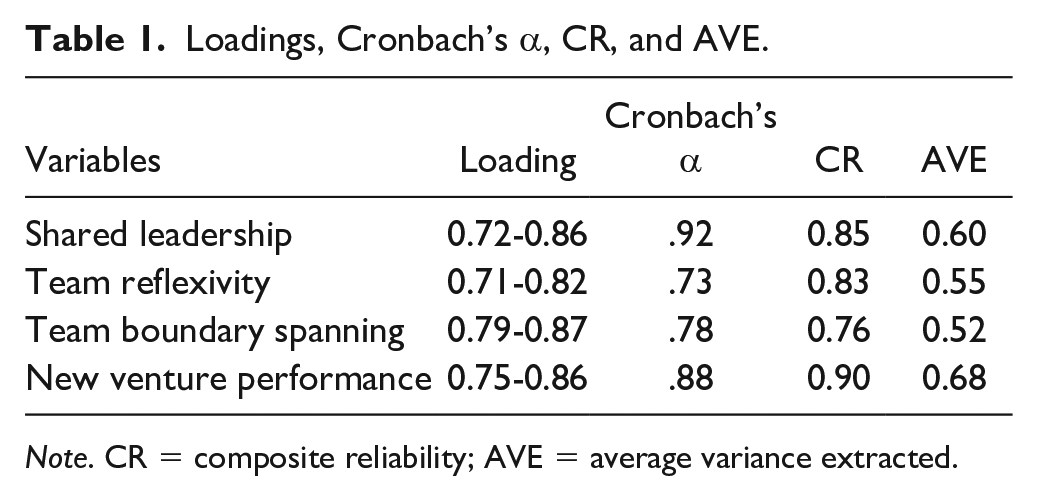
Note. CR = composite reliability; AVE = average variance extracted.
Means, Standard Deviations, and Correlations Among the Variables.
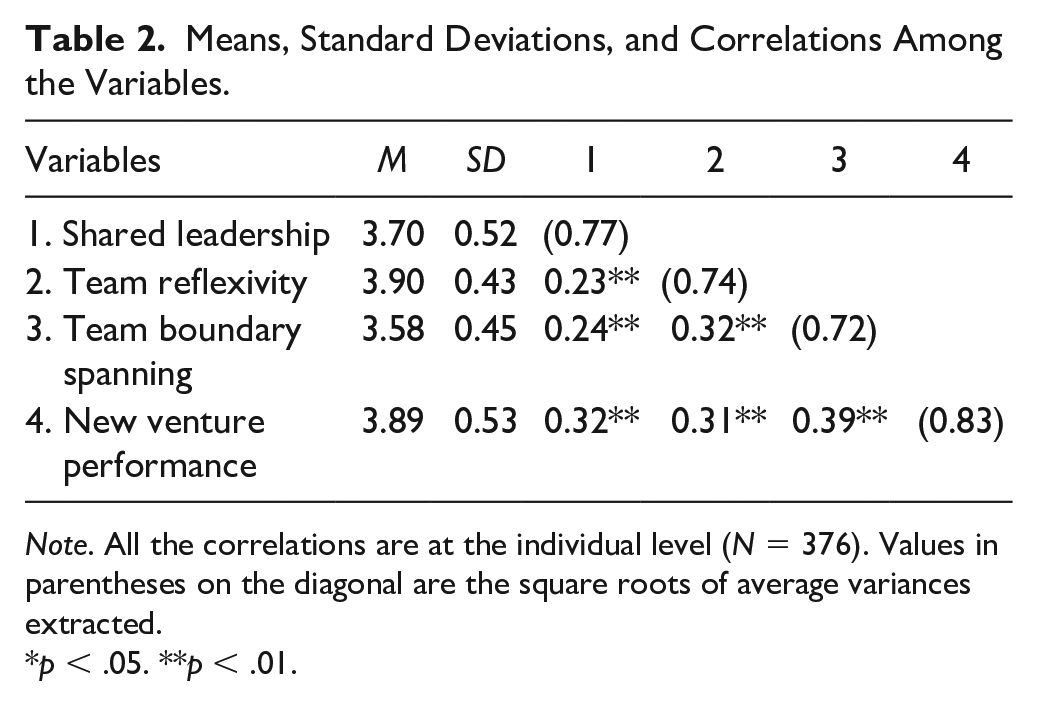
Note. All the correlations are at the individual level (N = 376). Values in parentheses on the diagonal are the square roots of average variances extracted.
p < .05. **p < .01.
Data Aggregation
Given that our model was built at team level, we assessed the viability of individual-level data aggregation. First, we used the interrater reliability coefficient to evaluate within-group homogeneity (James et al., 1993). Rwg values (Shared leadership = 0.98; Team reflexivity = 0.97; Team boundary spanning = 0.96; New venture performance = 0.97) were greater than the criterion of 0.70. Second, we adopted the intraclass correlation coefficient ICC(1) and reliability of the mean ICC(2) to evaluate between-group heterogeneity (Bliese, 2000). The scores of ICC(1) ranged from 0.20 to 0.28, surpassing the benchmark of 0.10. The scores of ICC(2) ranged from 0.55 to 0.66, going beyond the criterion of 0.50. Therefore, the aggregation of key variables was justified.
Hypotheses Testing
To test Hypotheses 1 to 4, we employed hierarchical multiple regression analysis. Hypotheses 1 to 3 identified a set of effects related to mediation. We first followed Baron and Kenny’s (1986) four steps to test a mediating effect: (a) shared leadership is required significantly related to team reflexivity, (b) shared leadership is required significantly related to new venture performance, (c) team reflexivity is required significantly related to new venture performance, and (d) when the reflexivity is present, the coefficient of shared leadership on new venture performance decreases. The results in Table 3 showed that (a) shared leadership was positively related to team reflexivity (β = .28, p < .01, Model 1), thereby supporting Hypothesis 1; (b) shared leadership was positively related to new venture performance (β = .32, p < .01, Model 5); (c) team reflexivity was positively related to new venture performance (β = 0.36, p < .01, Model 6), which provided support for Hypothesis 2; and (d) the coefficient of shared leadership on new venture performance became weaker (β = .32, p < .01, model 5 to β = .24, p < .05, model 7) when team reflexivity was present. Hence, we provided initial support to Hypothesis 3.
Results of Hierarchical Regression Analyses.
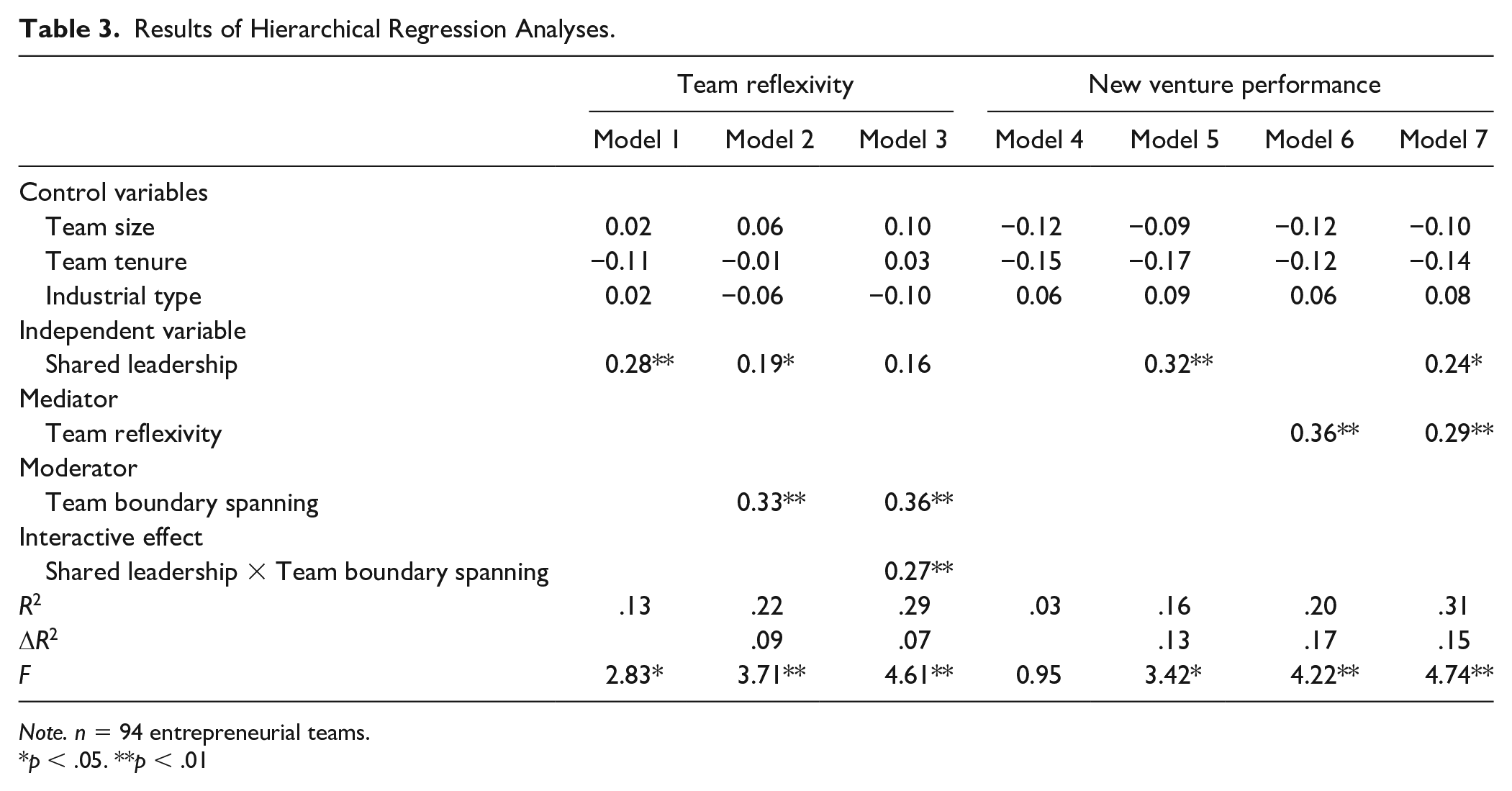
Note. n = 94 entrepreneurial teams.
p < .05. **p < .01
Furthermore, we approached the bootstrapping technique developed by Preacher and Hayes (2004) to examine the indirect effect. The merit of the bootstrapping technique lies in that it does not make postulation about the shape of the distribution of variables. We found that the 95% confidence interval for the indirect effect of shared leadership on new venture performance through team reflexivity did not include zero [0.02, 0.24]. Based on above evidences, Hypothesis 3 was supported.
Hypothesis 4 supposed that team boundary spanning moderates the relationship between shared leadership and team reflexivity. Table 3 showed that the interactive effect of shared leadership and team boundary spanning on team reflexivity is significantly positive (β = .27, p < .01, Model 3). Moreover, we applied Aiken and West’s (1991) procedure to plot such interactive influence. As illustrated in Figure 2, shared leadership was not related to team reflexivity when team boundary spanning was low (simple slope = 0.07, n.s.), whereas significantly related to team reflexivity when team boundary spanning was high (simple slope = 0.40, p < .01). Accordingly, Hypothesis 4 was supported.
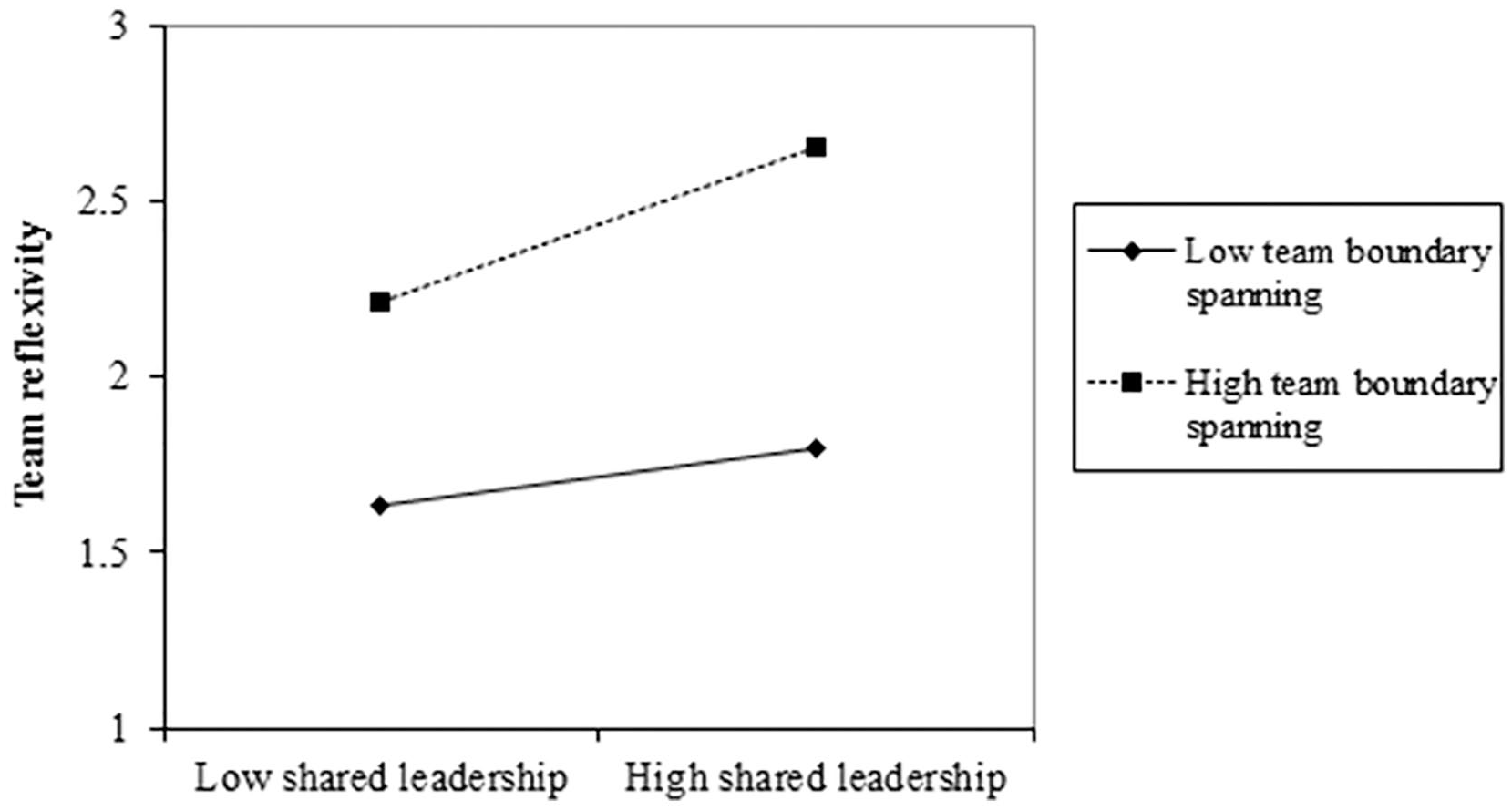
Interaction effect of shared leadership with team boundary spanning on team reflexivity.
Hypothesis 5 proposed the moderated mediation hypothesis. We followed the procedures outlined by Edwards and Lambert (2007) to test the conditional indirect effects. Table 4 demonstrated the indirect effect was nonsignificant (β = −.02, n.s.) when team boundary spanning was low, then became significant (β = .20, p < .05) when team boundary spanning was high. This result provided evidence for our argument in Hypothesis 5 that shared leadership interacts with team boundary spanning to impact team reflexivity, which in turn, influences new venture performance.
Results of the Moderated Path Analysis.
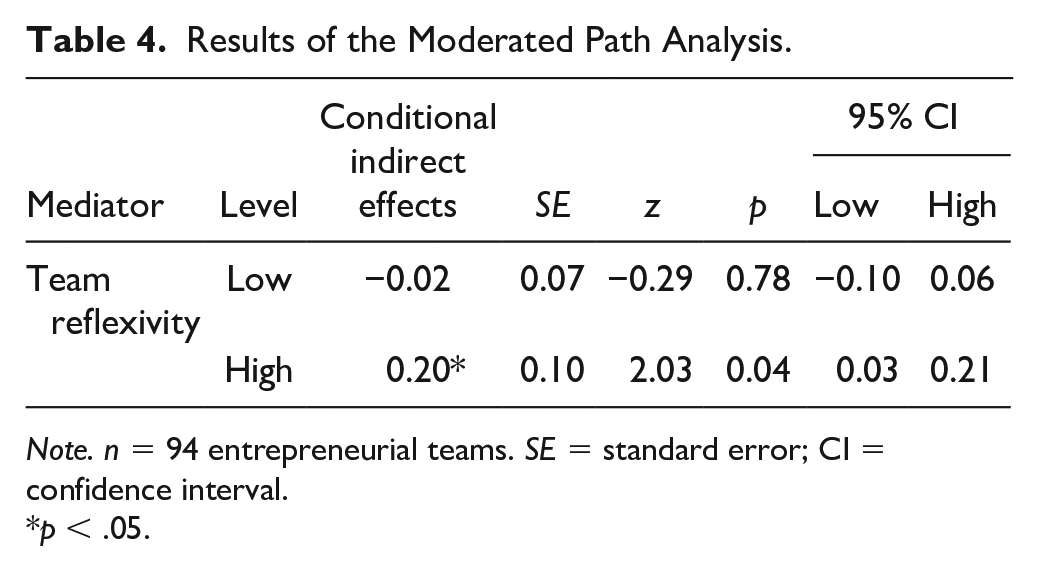
Note. n = 94 entrepreneurial teams. SE = standard error; CI = confidence interval.
p < .05.
Discussion
Given that shared leadership has come forth as the promising leadership framework in the entrepreneurship literature (Hensel & Visser, 2018; Zhou, 2016; Zhou & Rosini, 2015), this study positions to investigate how shared leadership can affect entrepreneurial teams to perform better. Adopting the information processing perspective, this study empirically examines the pivotal functions of team reflexivity and team boundary spanning in accounting for the shared leadership—new venture performance linkage. Our results indicated that shared leadership in entrepreneurial teams is helpful for facilitating a specific team-level information processing activity, namely, team reflexivity. Sequentially, enhanced team reflexivity enables entrepreneurial teams to more thoroughly and systematically reflect on information and make useful changes, thus yielding superior performance. In addition, our results revealed that the positive impact of shared leadership on team reflexivity and ultimately new venture performance was augmented in high rather than in low team boundary spanning. Therefore, by analyzing the roles of team reflexivity and team boundary spanning, we put forward nuanced insights into how shared leadership in entrepreneurial teams promotes new venture performance.
Theoretical Implications
Our findings contribute to several research areas on entrepreneurship, leadership, reflexivity, and boundary spanning. First, the current study extends the entrepreneurship and leadership literature by proposing a more fine-grained model on how shared leadership in entrepreneurial teams promotes new venture performance. One the one hand, prior works devoted little attention on shared leadership in the entrepreneurial context (Hensel & Visser, 2018; Zhou, 2016). With regard to the growing focus on shared leadership, scholars have called for more context-specific context research in which shared leadership is investigated (Gu et al., 2018; Scott-Young et al., 2019). Thus, our findings expand the studies on shared leadership in the entrepreneurial setting. One the other hand, while a handful of previous studies about team leadership exist (Nassif, 2019; Wu et al., 2020), most of the existing studies used the samples of low-level teams within organizations, rather entrepreneurial teams. Moreover, our findings enrich the scanty knowledge on the nexus between team leadership and the outcomes for entrepreneurial teams.
Second, through utilizing information processing perspective, this study uncovers the role played by team reflexivity in helping entrepreneurial teams translate shared leadership into higher performance. It thereby broadens the research on how shared leadership shapes team information processing activities and subsequent performance (Knipfer et al., 2018; Schippers et al., 2008). Additionally, because of the significance of reflexivity in team functioning effectiveness, it is necessary to develop theory on what determinants stimulate teams to be more reflexive (Knipfer et al., 2018; Li et al., 2018). Despite accumulated knowledge about the reflexivity implications of other leadership frameworks, studies on the determinants of reflexivity are still meager (Lyubovnikova et al., 2017). It worth noting that, team reflexivity rarely occur spontaneously, because teams are prone to behave in conventional ways, even when these behaviors may be dysfunctional (Konradt et al., 2015). Therefore, we extend the reflexivity research by identifying shared leadership as a critical determinant for team reflexivity in the entrepreneurial setting, and confirming its benefits for ultimate performance.
Finally, our findings extend the leadership and boundary spanning literature by uncovering that the relationship between shared leadership and team reflexivity was stronger under high team boundary spanning. This finding confirms the value of the boundary conditions of shared leadership (Wu et al., 2020). Also, by characterizing the interaction between shared leadership and team boundary spanning, we pinpointed which combinations are well suited for team reflexivity. Accordingly, this finding verifies that team boundary spanning is a valuable contextual ingredient, which can advance the translation of shared leadership into team reflexivity (Carbonell & Escudero, 2019; Lazar et al., 2020). Furthermore, prior studies argued that it would be necessary to comprehensively understand team boundary spanning and potential consequences across different organizational and team settings (Harvey et al., 2014). Therefore, by integrating team boundary spanning literature with intimately connected literature, such as the leadership and entrepreneurship literature, this study provides a promising research agenda for advancing the research on team boundary spanning.
Practical Implications
First, the findings indicated the benefits of shared leadership for shaping team reflexivity in preventing entrepreneurial failures. Thus, facilitating shared leadership skills of entrepreneurial teams is indispensable because these skills can boost team members to review and discuss their task goals and work experiences in producing superior new venture performance. In order to effectively exhibit shared leadership behaviors, entrepreneurial team members can take part in shared leadership training programs, such as the trainings on how to engage in constructive confrontation leadership behaviors, including the knowledge of how to openly discuss, receive and react to task-related influence, avoid negative emotions, and enhance harmony within the team (Bligh et al., 2006).
Second, the findings suggested that the shared leadership—team reflexivity linkage is not a static situation, and entrepreneurial team members should make account of outside relationships. Entrepreneurial team members should recognize the importance of team boundary spanning behaviors, such as interacting with different external stakeholders, for gaining pluralistic outside information (Ferguson et al., 2019). Under this condition, shared leadership becomes much more useful for the collective reflection of their entrepreneurial team and in considering the benefits of their new venture. This finding suggests that entrepreneurial team members should cautiously balance external and internal interactions, and not focus on one at the expense of the other.
Finally, the findings not only provide suggestions for entrepreneurial team members but also inspire other stakeholders including aspiring entrepreneurs, investors, and educators. Aspiring entrepreneurs can prepare to develop their competency of shared leadership. They can seek for competency assessment and counseling, through attending some activities such as decision-making simulation, in-depth interviews, and situational tests. Based on the assessment to shared leadership competency, investors can recognize high-potential entrepreneurial teams or selecting appropriate entrepreneurial leaders (Shepherd et al., 2020). Additionally, educators can design university entrepreneurship programs wherein students playing as entrepreneurial leaders, can realize the responsibilities and challenges of exhibiting shared leadership.
Limitations and Future Research
First, this study only investigated the moderation of team boundary spanning and the mediation of team reflexivity. Indeed, new venture performance is sensitive to many factors, such as entrepreneurial policies (Shepherd et al., 2020). Future research should examine the effects of institutional factors in the linkage between shared leadership and new venture performance. Second, the cross-sectional design of this study impedes inferring the causality among the key variables (Carbonell & Escudero, 2019; Yan et al., 2020). Thus, longitudinal research should be preferred in future work to test potential causality. Finally, the self-reported data of this study may produce some same-source biases such as self-serving bias (Wu et al., 2019). Therefore, it is expected to collect data from multiple sources in the future research.
Footnotes
Declaration of Conflicting Interests
The author(s) declared no potential conflicts of interest with respect to the research, authorship, and/or publication of this article.
Funding
The author(s) disclosed receipt of the following financial support for the research, authorship, and/or publication of this article: This article is supported by National Social Science Foundation (19CRK021), Philosophy and Social Science Program of Shanghai City (2018BSH006), Philosophy and Social Science Program of Shanghai City (2019EGL020).
