




Abstract
The leadership literature suggests that followers are likely to be autonomously motivated when working for servant leaders, leading them to experience greater psychological empowerment. Guided by self-determination theory, we predicted that this empowerment would then heighten individuals’ perceptions of their teams’ transactive memory systems. When subordinates perceive that discrimination is occurring in their workgroup, however, we expected that the empowerment—transactive memory systems link would be weakened. This moderated mediation model was tested at multiple timepoints using 211 employees from a variety of industries and job types. The results generally supported our predictions, and the implications for theory and practice are discussed.
Keywords
In today’s business landscape, many organizational problems and projects are simply too complex for a single individual to tackle alone, leading organizations to frequently rely on groups of employees to cooperate in teams to achieve performance targets (Mathieu et al., 2019). Team effectiveness, however, at least partially hinges on the ability of individual members to (a) specialize in unique skillsets and knowledge expertise while (b) creating awareness of these different sources of information within the team. Transactive memory systems (TMS), defined as “the cooperative division of labor for learning, remembering, and communicating relevant team knowledge,” feature mutual reliance of the members on one another to achieve team goals in a quick and coordinated fashion (Lewis, 2003, p. 587). TMS have been linked to important outcomes including knowledge received from one’s network (Jarvenpaa & Majchrzak, 2008), creative self-efficacy, individual and team innovative behavior (Fan et al., 2016), and team performance (Z.-X. Zhang et al., 2007).
Although the importance of TMS is indisputable, there has been a surprising lack of studies examining the interpersonal factors that motivate individual employees to build and perceive them. As noted by Lewis and Herndon (2011), “an implicit assumption in TMS research has been that members are [inherently] motivated to share the information they possess to the benefit of group performance” (p. 1255). Aligned with self-determination theory (SDT; Gagné & Deci, 2005), we expect that contextual factors that meet employee needs for autonomy, competence, and relatedness can contribute to efforts to build and sustain high TMS. Indeed, prior scholars have noted that the defining characteristics of high TMS are (a) proactive specialization of expertise, (b) credibility or trust in peer knowledge, and (c) effective coordination and knowledge sharing among peers (Lewis, 2003).
The dearth of research into the interpersonal antecedents of TMS has been particularly glaring in the case of leadership antecedents (Rai & Prakash, 2012), which is unfortunate given that prior work has highlighted the key role that leadership plays in organizational knowledge processes (e.g., Bligh et al., 2006). Building on previous studies that have explored the impact of transformational and transactional leadership on knowledge processes (e.g., Bryant, 2003), we propose that servant leadership may be a particularly valuable asset for TMS creation. Namely, we expect that high levels of servant leadership will lead to heightened psychological empowerment in subordinates (Schneider & George, 2011). Aligned with the needs outlined by SDT (Gagné & Deci, 2005), we suggest that servant leadership helps employees experience psychological empowerment by meeting their inherent needs for autonomy, competency, and relatedness. Specifically, servant leaders encourage followers to take on impactful responsibilities, increase their self-efficacy, and inspire them toward self-transcendence through their own words and actions (Eva et al., 2019). As a result, employees are not only intrinsically motivated to complete their core job tasks but also to go beyond the required behaviors and actively work together to divide responsibilities, share knowledge, and develop unique expertise (i.e., create high TMS; Rai & Prakash, 2012). Supporting this idea, prior scholars have noted servant leadership is related to high trust in the leader (Chan & Mak, 2014) and belongingness with the team (Jaramillo et al., 2009).
We also propose, however, that certain incidents may dilute the effectiveness of empowerment derived from servant leadership for indirectly creating TMS. Namely, when employees perceive high levels of discrimination in their teams, whether personally experienced or witnessed against another, we hypothesize that they will begin to doubt whether hierarchical boundaries are actually being broken, and whether their coworkers are sharing the whole truth about their knowledge and abilities. Perceived discrimination deteriorates interpersonal trust and signals that differential treatment exists (Insko et al., 2001). Regardless of how empowered people feel, we predict that the requisite feelings of competence-based trust, expertise specialization, and coordination necessary to facilitate TMS creation (Jarvenpaa & Majchrzak, 2008) will be less likely to occur in the presence of discrimination. Hence, discrimination can mute the impact of empowerment on TMS. In SDT terms, we expect that discrimination will inhibit interpersonal trust about one’s skills (competence), proactivity to specialize (autonomy), and cooperation of the focal individual with peers (belonging) that are derived from empowerment under normal circumstances, affecting TMS creation. To illustrate our mediation effects, we present our conceptual model in Figure 1.

Conceptual mediation model using the tenets of self-determination theory.
This study stands to make several valuable contributions to the literature. First, although the positive outcomes associated with servant leadership have been well-established (see Eva et al., 2019, for a comprehensive review of the literature), less is known about how perceptions of discrimination might affect its potency. Similarly, leadership is an understudied antecedent of TMS creation (Rai & Prakash, 2012). Finally, by employing SDT, this study answers a recent call to apply alternative theories besides social exchange, social learning, and identity frameworks when studying servant leadership (Eva et al., 2019).
Theory and Hypothesis Development
Self-Determination Theory
We use SDT (Ryan & Deci, 2000) to theoretically anchor our hypothesized effects of servant leadership on psychological empowerment and TMS. According to this theory, leaders can either choose to (a) push or coerce motivation using external structures and pressure (i.e., controlled motivation) or they can (b) pull employees along by inspiring a sense of volition (i.e., autonomous motivation; Gagné & Deci, 2005). Importantly, autonomous motivation occurs when employees naturally enjoy the work they do as well as when they internally adopt the goals and work priorities specified by their leaders. We suggest that servant leadership helps employees meet each of the three basic psychological needs: (a) competence, (b) autonomy, and (c) relatedness (Gagné & Deci, 2005), resulting in psychological empowerment that provides the autonomous motivation to engage in TMS creation. In the following section, we outline more clearly how each of these needs bind our hypothesized mediation relationships.
Servant Leadership as an Indirect Predictor of TMS Through Empowerment
Servant leaders tend to set aside their own self-interests in favor of benefitting their followers (Liden et al., 2008). This involves “a holistic leadership approach that engages followers in multiple dimensions (e.g., relational, ethical, emotional, spiritual), such that they are empowered to grow into what they are capable of becoming” (Eva et al., 2019, p. 111). Far from ignoring the financial imperatives of business, however, servant leaders are also cognizant of the organization’s long-term interests; they simply seek a more sustainable and employee-friendly way to meet performance targets (van Dierendonck, 2011). Combining employee and organizational interests proves to be a productive strategy, as research has repeatedly demonstrated servant leadership’s incremental validity over and above other positive leadership approaches (Banks et al., 2018; Hoch et al., 2018; van Dierendonck, 2011).
Although measured and conceptualized as a global construct, scholars have noted that servant leadership is multifaceted (Ehrhart, 2004; Liden et al., 2008, 2015). First, servant leaders have greater numbers of conceptual skills as well as a desire to help followers grow and succeed. We expect that, by modeling effective problem solving, explaining expectations for high performance, and helping followers reach their full potential, servant leaders will boost the confidence and competence of their employees. Second, scholars have noted that servant leaders are empowering, put their subordinates first, and create value for their communities. We expect that by entrusting followers with decision-making responsibilities, putting follower needs before their own, and encouraging followers to be active in the community, servant leaders will boost subordinate feelings of autonomy. Indeed, scholars have noted that servant leaders provide followers with opportunities for development and autonomous decision-making that build self-efficacy (Chen et al., 2015; Ehrhart, 2004). Being active in the community may also help boost feelings of relatedness among followers. Finally, servant leaders are invested in emotional healing and behaving ethically. By caring about followers’ problems and well-being (van Dierendonck, 2011) and behaving in honest and trustworthy ways, servant leaders are likely to build bonds with followers that further augment relatedness. Indeed, prior research has noted that servant leaders create a shared sense of social identity among their followers (Chen et al., 2015), promoting feelings of belongingness and unity with the team and trust with the supervisor (Jaramillo et al., 2009).
Thus, we theorize that servant leaders will increase the empowerment of employees according to the tenets of SDT given that they are “honest leaders who put the needs of followers first, promote helping in the larger community as well as at work, and possess the technical skills necessary to provide meaningful help to followers” (i.e., meet follower needs of relatedness, autonomy, and competency, respectively; Liden et al., 2015, p. 255). Psychological empowerment, which involves feeling entrusted with authority and decision-making rights by one’s leader, is a key outcome of both effective leadership generally (Maynard et al., 2012), and servant leadership specifically (Eva et al., 2019). Previous research (e.g., Chen et al., 2007; Kirkman & Rosen, 1999) has described psychological empowerment as encompassing four distinct dimensions: meaningfulness (i.e., enjoyment and caring for work tasks), competence (i.e., confidence in one’s ability to complete the task), choice or self-determination (i.e., autonomy over decisions), and impact (i.e., having an influence on others or the organization). Intrinsic motivation for one’s work is highest when all four dimensions are high (Conger & Kanungo, 1988; Spreitzer, 1995, 2008). Importantly, empowerment is distinct from leader behaviors or organizational structures, and comprises the cognitive state that occurs when employees feel empowered (Spreitzer, 1995). We expect that the aforementioned dimensions of servant leadership will align with the respective empowerment dimensions that reflect the SDT needs of competency (i.e., competence and meaningfulness), autonomy (i.e., choice/self-determination), and relatedness (i.e., impact). As noted by Chen et al. (2007, p. 332) “empowered individuals and teams are motivated to perform well because they believe they have the autonomy and capability to perform meaningful work that can impact [others in] their organization,” thereby suggesting that servant leaders have met their SDT needs effectively.
Finally, through its effects on psychological empowerment, we expect that servant leadership will augment individual effort toward TMS creation. Stated alternatively, we expect that heightened psychological empowerment will motivate or push followers of servant leaders to create strong TMS. Indeed, previous studies have noted that when subordinates feel psychologically empowered they are likely to take an active orientation to go beyond the work requirements (Spreitzer, 2008), resulting in outcomes such as better performance and more positive job attitudes (e.g., Maynard et al., 2012) as well as collecting diverse opinions, effortful problem solving (Gilson & Shalley, 2004), sharing novel ideas, and initiating change (Amabile et al., 1996). In SDT terms, we expect that the resources provided by servant leaders will meet employee needs for competence, autonomy, and relatedness that subsequently push them to focus on the TMS facets of competence-based trust, expertise specialization, and expertise coordination, respectively (Lewis, 2003).
In terms of competence, we suggest that when servant leaders model conceptual skills and promote follower development, they will foster more competence-based empowerment and followers will see themselves as more capable and knowledgeable (Spreitzer, 1995). This may enhance TMS creation given that they may feel more confident in their abilities and may be more likely to self-assuredly communicate their expertise to peers (i.e., building competence-based trust). Supporting this idea, Peltokorpi and Manka (2008) found that supportive leaders were likely to foster TMS creation by both helping subordinates understand and accept their unique responsibilities and by motivating them to develop themselves through careful guidance. In addition, employees may be more likely to share their expertise with others given that servant leaders make them feel comfortable with openly sharing their ideas.
Next, when employees have their autonomy needs met by servant leaders, they may be more likely to take proactive steps to claim responsibility and specialize in a specific knowledge domain and may direct others to do the same (i.e., kickstart expertise specialization). Prior studies have demonstrated that servant leaders inculcate followers with a sense of self-directedness that inspires them to devote themselves toward autonomously addressing organizational concerns (e.g., Jaramillo et al., 2009; van Dierendonck, 2011). Each time the servant leader seeks participation from employees, coworkers are able to learn more about their coworkers’ specialized domain of expertise, thereby potentially fostering TMS. Supporting this, Srivastava et al. (2006) theorized and found that empowering leadership leads to greater specialized knowledge sharing in teams, noting that “team members are likely to receive fair recognition by an empowering leader for their contribution of ideas and information, which motivates them to share their unique knowledge with one another” (p. 1241).
Finally, when followers experience high levels of belonging and relatedness with others, they may find it easier to efficiently coordinate their work with peers (i.e., expertise coordination facet of TMS). Supporting this linkage, De Cremer and van Knippenberg (2005) showed that leader self-sacrificing behavior was positively related to cooperation among followers. Moreover, prior work has shown that when leaders create an atmosphere rich in trust, support, and liking, members are more willing to coordinate knowledge sharing and engage in effortful digestion of this knowledge (Ehrhart, 2004; Wang & Noe, 2010).
Supporting the indirect relationship between servant leadership and TMS creation, prior scholars have shown that leadership can influence team processes through psychological empowerment (Liden et al., 2000). In a recent theoretical work, Rai and Prakash (2012) also suggested that servant leaders encourage knowledge creation (and TMS as a by-product) by empowering employees to participate reciprocally in the leadership process and by promoting caring relationships that motivate people toward cooperation. In sum, we propose:
The Moderating Role of Perceived Discrimination in Teams
Bias, or the tendency to favor or disfavor one social group over another, includes cognitive (i.e., stereotyping), affective (i.e., prejudice), and behavioral (i.e., discrimination) components (Eagly & Chaiken, 1998). In this way, workplace discrimination involves the enactment of prejudice via the unfair differential treatment of certain individuals or subgroups, and occurs in varying degrees of hostility and aggression (see Goldman et al., 2006, for a comprehensive review). Research has shown that perceived discrimination can lead to a host of negative outcomes including poor psychological well-being (Schmitt et al., 2014), lowered income and job opportunities (Neumark & McLennan, 1995), and, most relevantly for the present study, greater fear and mistrust when interacting with others (Insko et al., 2001).
Russell and Stone (2002) noted that servant leadership that begets “empowerment emphasizes teamwork and reflects the values of love and equality” (p. 152). Although this is likely to be true, ceteris paribus, we suggest that empowerment fostered in the context of discrimination is unlikely to communicate these values as clearly. In other words, although servant leaders are likely to engender psychological empowerment regardless of how much discrimination is present in the workgroup, subordinates may respond to these feelings of empowerment in different ways depending on the patterns they observe in the behaviors of their leaders and peers.
In understanding how the experience of discrimination might affect the empowerment and TMS relationship, we looked to the literature on sensemaking in the workplace in relation to other-oriented behaviors (Weick et al., 2005). Sensemaking, or the “process by which people construct, interpret, and recognize issues that are novel, ambiguous, or confusing” (Methot et al., 2017, p. 13), can help shed light on the contradictory situation of perceiving discrimination in a group that is led by someone who has devoted their lives to making others a priority (i.e., a servant leader). When faced with violated expectations in the workplace, employees must take time to cognitively reconcile expectations with reality, and subsequently make choices about how they will respond to this incongruence (Weick et al., 2005).
In the previous section, we outlined how high levels of servant leadership would lead to heightened feelings of self-directedness, efficacy, and positive regard that boosts subordinate empowerment. When the leader behaves equitably with all employees, strong feelings of belonging and shared purpose may be stimulated, leading to heightened interpersonal interactions and the independent creation of TMS. The direct or witnessed experience of discrimination, however, violates the assumptions of fairness and low power distance that servant leadership normally communicates. Faced with the incongruent signals of high servant leadership and high discrimination in the workgroup, employees are pushed to reflect in order to make sense of which behaviors will best help them meet their goals given the present context (Methot et al., 2017). In such situations, we suggest that employees may conclude that different team members may not be rewarded or punished equally for engaging in the same behaviors. In light of this realization, rather than focusing on building strong team bonds that lead to openly shared and accessible information, discrimination will likely cause people to isolate themselves and work independently in silos. Employees may weigh the pros and cons of interacting and cooperating with others (Methot et al., 2017), deciding that it may be politically dangerous to do so given the inequalities present. Indeed, prior work has noted that victims of discrimination frequently report social rejection and interpersonal problems (Miller & Major, 2000) and that groups cooperate more smoothly when its members believe they are being treated fairly (Phillips et al., 2001). In addition, scholars have acknowledged that the presence of a single deviant team member (Wellen & Neale, 2006) can damage team cohesion. Finally, TMS development, specifically, is hampered when teams contain out-group members or geographically dispersed subgroups (O’Leary & Mortensen, 2010). Hence, we propose:
Together, the preceding discussions suggest a second-stage moderated mediation (Edwards & Lambert, 2007), such that perceived discrimination moderates the indirect effect of servant leadership on TMS via empowerment (see Figure 2). Specifically, servant leadership positively influences TMS because it fosters employee empowerment; this mediated relationship becomes weaker, however, as perceived discrimination in teams increases. In sum, we propose:
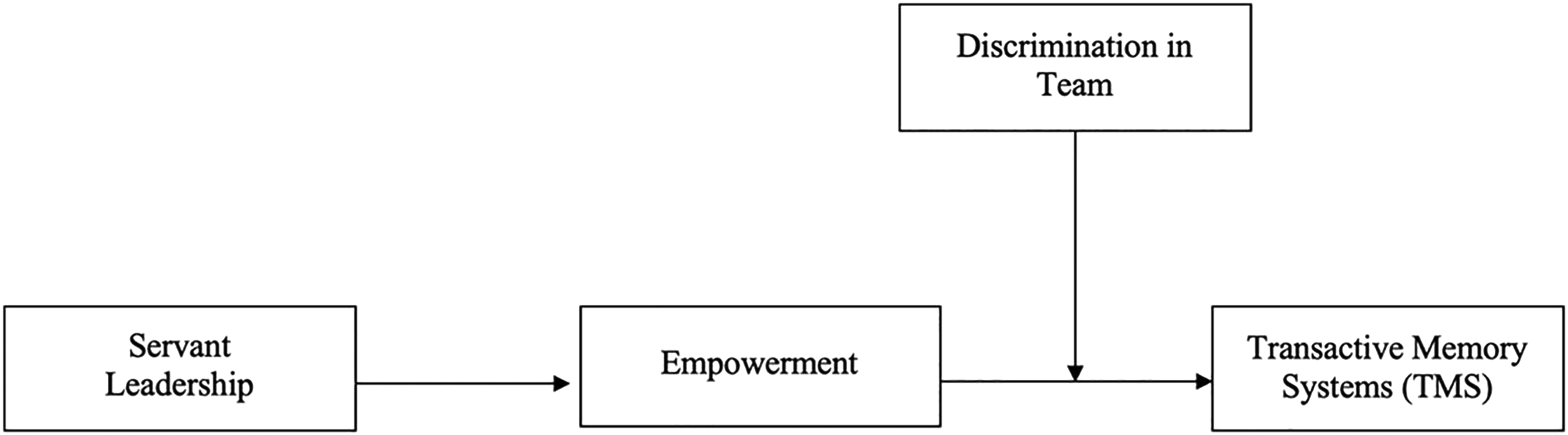
Hypothesized moderated mediation model.
Method
Procedures and Participants
The data were collected at two time points using Qualtrics Panels. We used a population sampling approach based on the population demographic distribution from the most recent U.S. Census Bureau report. Qualtrics Panels is an online participant recruitment service that provides closed-source access to participants through an extensive partnership network. Beyond our demographic sampling request, we also requested that individual participants be at least 18 years of age or older, college-educated (Associate’s degree or higher), and working full-time in the United States in a role that features group collaboration. To ensure equal representation, we also requested an even sample of male and female participants.
We received complete data from 440 individuals at the close of the Time 1 survey. These data included assessments of servant leadership and our control variables. Following a 1-month time lag, we received complete data from 211 individuals at the close of the Time 2 survey. We assessed empowerment, TMS, and perceived discrimination at this timepoint.
Indeed, 52% of the participants were female, 57% were White (non-Hispanic), and they worked an average of 43.78 hours per week (SD = 9.76, range = 30-112). Participants also reported having worked with their current supervisor an average of 4.61 years (SD = 4.55, range = 0-28) and in their current jobs an average of 10.52 years (SD = 8.77, range = 5-45). Participants worked in various occupations and industries such as business and information, education, finance, insurance, health services, retail, legal services, and transportation.
Measures
Unless otherwise noted, all items were rated on a 7-point Likert-type scale that ranged from 1 (strongly disagree) to 7 (strongly agree).
Servant Leadership
We used the Liden et al. (2015) seven-item scale (SL-7) to assess servant leadership. Participants indicated the extent to which they disagreed or agreed with such items as, “My leader puts my best interests ahead of his/her own.”
Empowerment
We used Spreitzer’s (1995) four-dimensional empowerment scale. The subdimensions assess empowerment via meaning, competence, self-determination, and impact. An example item is, “I have control over what happens in my department.” Each dimension features three items.
Transactive Memory Systems
Following minimal adaptation and review, we used 12 items from the Lewis’ (2003) scale for measuring the specialization, credibility, and coordination dimensions of TMS. A sample adapted item is, “Different work group or team members are responsible for expertise in different areas.”
Perceived Discrimination
We used seven items from the Brondolo et al. (2005) perceived ethnic discrimination questionnaire. Participants were asked to indicate the extent to which individuals in their ethnic group experienced specific types of discrimination. A sample item is, “People in this ethnic group have been discriminated against.”
Control Variables
We included three potential control variables at Time 1. Because social identity and categorization tendencies can influence workplace intergroup interactions and individual efficacy beliefs (Hogg & Terry, 2000), we asked participants to indicate their demographic minority status. Furthermore, previous research reveals that racioethnicity can account for variance in psychological empowerment (e.g., Molix & Bettencourt, 2010) and TMS (Zheng, 2012). We also controlled for sex and tenure with supervisor as each have been conceptually linked to empowerment (e.g., X. Zhang & Bartol, 2010) and TMS development (e.g., Hollingshead & Fraidin, 2003). Whereas sex is likely to influence each outcome due to social identity, tenure is more likely to account for variance as a function of time. That is, the longer people work in the same environment, the more likely they are to gain confidence in their work, learn pertinent details about their colleagues, and engage in information sharing and support behaviors (Hollingshead & Fraidin, 2003).
Analytical Strategies
We conducted an item-level confirmatory factor analysis to verify the factor structure of our conceptual model. Following recommendations from Nye and Drasgow (2011) for assessing ordered categorical data, we use diagonally weighted least squares estimation to account for the nonnormality typical of item-level data. Our hypothesized four-factor model provided the best fit to the data, χ2(652) = 1447.96, p < .001, comparative fit index = .99, Tucker–Lewis index = .99, standardized root mean square residual = .07, root mean square error of approximation = .08; 90% confidence interval [.07, .08], and fit the data better than the three-, two-, and one-factor alternative models. Whereas the χ2 test statistic is significant, it is important to note that χ2 statistics are highly sensitive to nonnormality and subject to inflation (Flora & Curran, 2004). Although diagonally weighted least squares addresses this issue, it is not fully attenuated by this or any other estimator. Furthermore, assessing fit is complex. Nye and Drasgow (2011) argued that a single fit index is unlikely to provide sufficient evidence for acceptable fit. Following their suggestions, we turn to the comparative fit index, Tucker–Lewis index, standardized root mean square residual, and root mean square error of approximation, which are all within the ranges of acceptable fit. These points considered, we proceeded with our analysis with minimal concern.
Following recommendations made by Podsakoff et al. (2012), we addressed potential common method variance by introducing temporal and psychological distance. We introduced temporal distance by measuring servant leadership at Time 1 and all other study variables at Time 2. Because the data in this study are part of a larger study, we were able to introduce psychological distance by alternating between positive, negative, and conceptually distinct measures throughout the survey. For example, psychological empowerment items were followed by items that assessed counterproductive work behaviors.
Additionally, we used a residualized dual-factor approach to test the potential threat of common method variance (Podsakoff et al., 2012). Using a bifactor modeling approach, we allowed study items to load on their respective “trait” factors in addition to loading all items onto an uncorrelated “method” factor. The variance explained due to the trait factor was 39%, whereas the variance explained by the method factor was 18%. Given the variance explained by the method factor was below the commonly cited average of 25% (Perry et al., 2010; Williams et al., 1989), we proceeded with evaluation of the study hypotheses.
We used path analysis to estimate two observed variable mediation models, regressing the mediator, empowerment, and the outcome, TMS, onto servant leadership. We included the control variables in the first step and servant leadership and empowerment in the second step of the estimation. Our second model followed the same process and included the main effect of discrimination and the empowerment × discrimination interaction term in the second step. In this model, predictors were centered at their respective grand means.
Results
The correlations, means, standard deviations, and reliability estimates for the study variables are reported in Table 1. Bivariate correlations revealed that servant leadership was positively and significantly related to both empowerment (r = 0.32, p < .01) and TMS (r = 0.53, p < .01). Empowerment was also positively and significantly related to TMS (r = 0.54, p < .01). Based on the lack of significant bivariate correlations between minority status and sex with the study outcome variables, we decided to remove these as control variables (Becker et al., 2016).
Correlations and Descriptive Information.
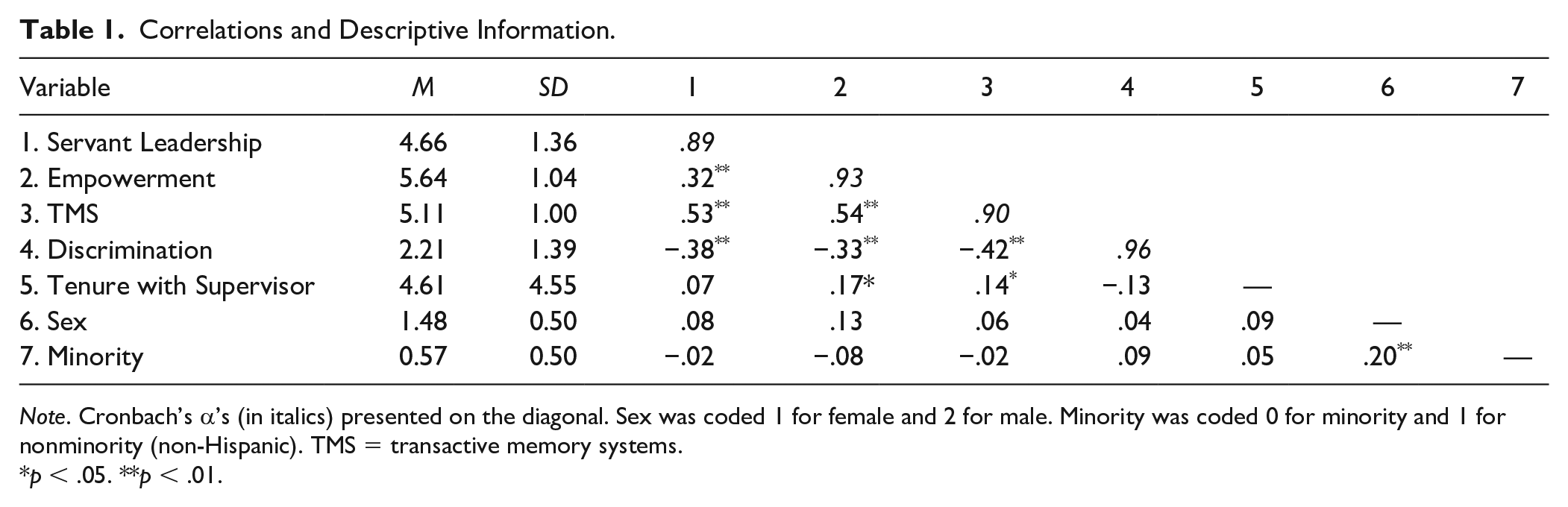
Note. Cronbach’s α’s (in italics) presented on the diagonal. Sex was coded 1 for female and 2 for male. Minority was coded 0 for minority and 1 for nonminority (non-Hispanic). TMS = transactive memory systems.
p < .05. **p < .01.
Hypothesis Testing
We followed recommendations from Edwards and Lambert (2007), Preacher et al. (2007), and Hayes (2018) for assessing the simple and conditional indirect effects models—using bootstrapping (5,000 draws) to estimate our indirect effects. We established simple mediation by first regressing empowerment onto servant leadership and our controls. Following this step, TMS was regressed onto servant leadership, empowerment, and our control variable. Next, we assessed the conditional indirect effect model by replicating the steps in the simple mediation model and including the main effect of perceived discrimination and the empowerment × discrimination interaction term in the second step of the regression—all predictors were centered at their respective means (see Tables 2 and 3, for detailed results).
Indirect Regression.
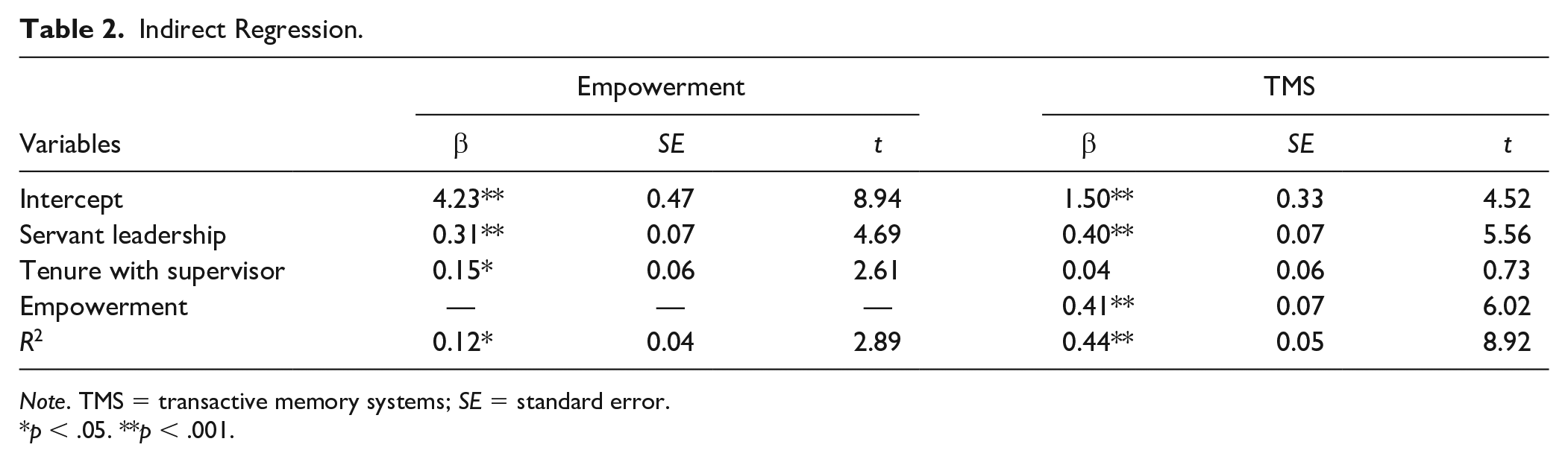
Note. TMS = transactive memory systems; SE = standard error.
p < .05. **p < .001.
Conditional Indirect Regression.

Note. TMS = transactive memory systems; SE = standard error.
p < .05. **p < .01. ***p < .001.
As stated in Hypothesis 1, we expected that servant leadership would be indirectly related to TMS through empowerment. Tests of this hypothesis revealed that servant leadership was significantly and positively related to empowerment (β = 0.31, p < .001) and that empowerment was significantly and positively related to TMS (β = 0.41, p < .001). We used bootstrapping to assess the indirect relationship (a × b) between servant leadership and TMS. Supporting Hypothesis 1, this relationship was significant (β = 0.13, p < .001). Of note, servant leadership was also directly related to TMS (β = 0.40, p < .001), indicating that the indirect effect relationship was only partial through empowerment.
Hypothesis 2 stated that discrimination would moderate the relationship between empowerment and TMS such that the relationship would be strongest (weakest) at low (high) levels of discrimination. The significant empowerment × discrimination interaction term provided preliminary support for the predicted conditional relationship (B = −0.11, p < .05). We probed this interaction by estimating the simple slopes at low (−1 SD), average, and high (+1 SD) levels of the moderator (see Table 4). Supporting Hypothesis 2, the empowerment—TMS relationship was strongest at low levels of discrimination (B = 0.48, p < .001). Visual confirmation of this finding is provided in Figure 3.
Bootstrap Standard Errors (SE) and Confidence Intervals for Indirect and Conditional Effects.
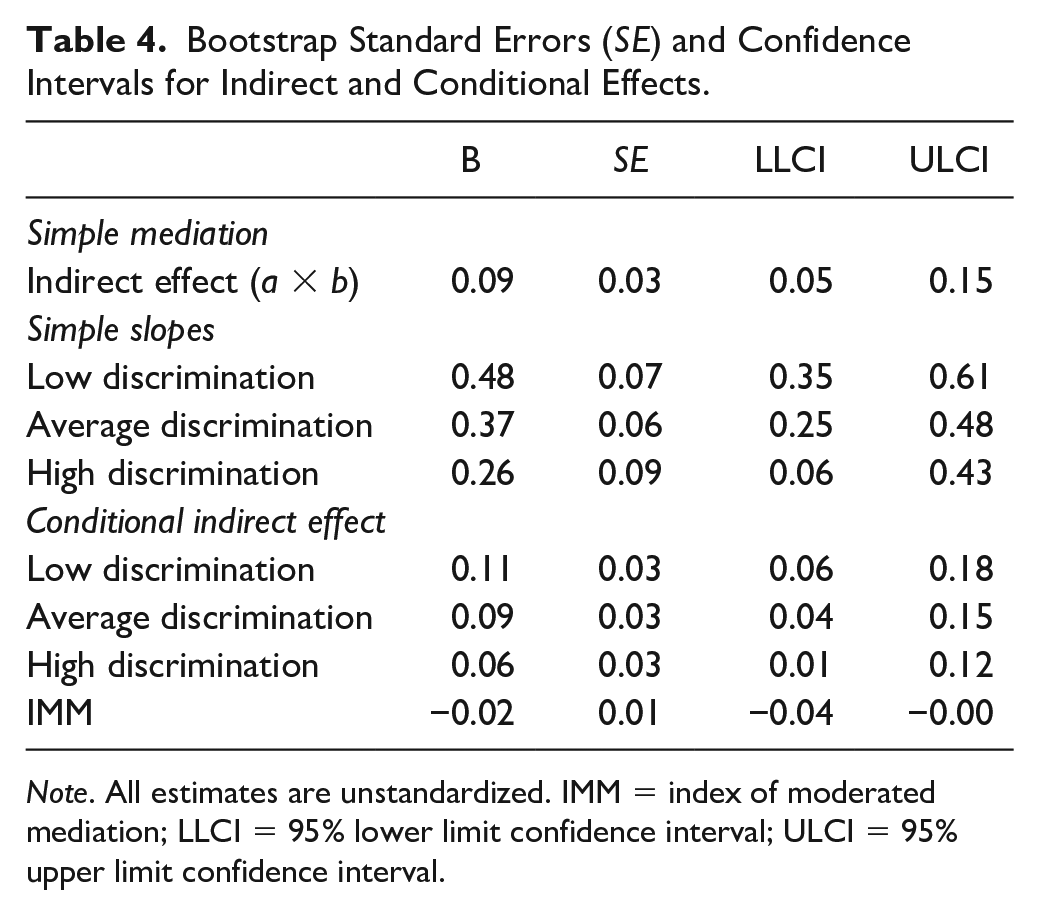
Note. All estimates are unstandardized. IMM = index of moderated mediation; LLCI = 95% lower limit confidence interval; ULCI = 95% upper limit confidence interval.
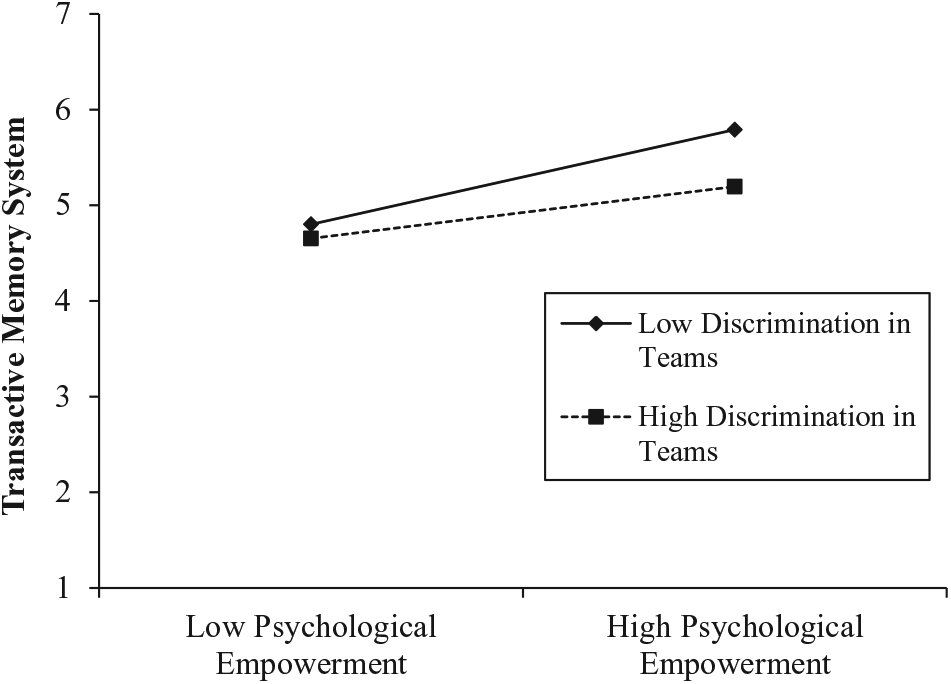
Simple slopes of empowerment on TMS at levels of discrimination in teams.
Our final hypothesis reflects the conditional indirect effect of servant leadership on TMS given the empowerment × discrimination interaction. We expected that the indirect effect of servant leadership on TMS through empowerment would be weakest when discrimination was high. Following procedures described by Hayes (2015, 2018), we estimated the conditional indirect slope at low, average, and high levels of discrimination and computed the index of moderated mediation (IMM; see Table 4). As expected, the relationship was weakest at high levels of discrimination (B = 0.06, p < .05) and strongest at low levels of discrimination (B = 0.11, p < .001). Although the critical score for the IMM was near ±1.96, the estimated effect was not significant (IMM = −0.02, t = −1.90). Whereas the IMM provides a distinctive test of the dependence of the indirect effect on the moderator, agreement as to whether it should be viewed as the sine qua non for assessing conditional indirect effects has not been reached (Hayes, 2015). Accordingly, we view Hypothesis 3 as partially supported.
Discussion
Although team and task characteristics have been well documented as predictors of TMS (Lewis & Herndon, 2011), the role of leadership in this knowledge process has been relatively unexplored. In this article, we investigated how servant leadership indirectly augments TMS through psychological empowerment. We used SDT theory to describe how servant leaders motivate employees to go the extra mile to create TMS by meeting their fundamental needs for autonomy, competence, and belonging (Gagné & Deci, 2005). Whereas Liden et al. (2000) established an indirect link of dyadic exchange via leader–member exchange to interpersonal exchange within teams (team–member exchange) through empowerment, their research focused more on the intermediary process of empowerment between two reciprocity-driven factors. Our study builds on this finding by investigating how other-focused leadership behaviors (i.e., servant leadership) support group-centric knowledge structuring and coordination. The explanation of this relationship is important in light of the key role that leaders play in shaping the motivation of their employees and the culture of teams working for them (van Dierendonck, 2011). Furthermore, our study complements and extends beyond recent research linking a relational leadership approach to employee empowerment and resource-depleting environmental factors (Dust et al., 2018). Our results supported both the existence of this indirect link as well as its contingency on various levels of perceived discrimination in the workgroup. Specifically, the servant leadership and TMS link as mediated by empowerment was strongest when discrimination was low. We elaborate more on the theoretical and practical implications of these findings in the sections that follow.
Theoretical Implications
The results of this study offer several important theoretical implications. The most prominent of these is the provision of a more holistic understanding of the effects of servant leadership on employees working in cooperative settings. We leveraged SDT (Ryan & Deci, 2000) to hypothesize that these leaders help spur autonomous knowledge categorization and delegation (i.e., high TMS) by meeting the fundamental human needs of their employees. Namely, we theorized that by helping employees experience (a) competence, (b) autonomy, and (c) relatedness, servant leaders help boost psychological empowerment and, subsequently, TMS. First, we theorized that servant leaders have the conceptual skills and drive to help followers grow and succeed that helps promote competence and meaningfulness in employees (i.e., dimensions of empowerment), which, in turn boost competence-based trust (i.e., a dimension of TMS). Second, we expected that servant leaders would empower subordinates and put their needs first, resulting in increased perceptions of choice over their work that leads to expertise specialization. Finally, we expect that the servant leadership facets of emotional healing and ethical behavior will boost employee levels of impact, resulting in greater coordination with peers. Although we do not test these specific pathways, our results contribute to the literature by showing that servant leadership can globally affect individual perceptions of TMS, and that this process occurs through empowerment. These findings build on prior work, including those that have documented servant leadership outcomes such as increased employee self-efficacy (Chen et al., 2015), delegation of decision-making authority and a focus on growth opportunities (Liden et al., 2015), and fostering goodwill among followers (Chan & Mak, 2014).
We also uncovered boundary conditions of this relationship, providing evidence that certain contextual factors (i.e., discrimination in the team) can mitigate the positive effects of psychological empowerment derived from servant leaders. Our findings revealed that the positive indirect effect of servant leadership through empowerment was weakened in the presence of perceived discrimination. This result implies that it is not enough for leaders to be consistent in word and action, but they must also ensure that their espoused values are being upheld by all of their employees. Although the significant negative correlation between servant leadership and perceived discrimination suggests that this is often the case, our findings underscore the danger of allowing unequal treatment to happen. We employed a sensemaking perspective (Weick et al., 2005) to suggest that when faced with conflicting messages of high servant leadership and high discrimination, employees may avoid efforts to create TMS. Namely, when interpersonal bonds are threatened by discrimination, employees may fail to create the knowledge structures that help them benefit from the group’s collective expertise.
Practical Implications
Our model of servant leadership’s effects on TMS also has important implications for management practice. In particular, leaders can benefit by understanding the positive effects they stand to gain by enacting servant leadership. By learning and developing one’s competencies in the six facets of servant leadership (van Dierendonck, 2011), employees will feel more empowered. This extra motivation, in turn, may be channeled toward the creation of a shared repository of team knowledge and expertise (i.e., high TMS). Leaders should carefully monitor groups for signs of differential treatment and prejudice, however, to ensure that these positive effects are not diminished. Perhaps implementing diversity training and establishing clear sanctions for discrimination would be prudent. Of course, they should also regularly check to ensure that their own behaviors are being perceived as fair and equitable by employees.
Limitations and Future Research
There are a couple of limitations to the present study that should be noted. First, although we relied extensively on the SDT needs of autonomy, competence, and belonging to derive our hypothesized relationships, we did not measure these variables explicitly. Moreover, we did not measure servant leadership at the facet-level to more clearly provide indirect evidence for these three pathways. We encourage future research to replicate our study using global constructs on the facet-level or using more proximal SDT measures as mediators (e.g., Chiniara & Bentein, 2016) to provide more concrete evidence to support our theoretical mechanisms.
Second, our measures were all self-assessed by the focal individual. Whereas empowerment is an intraindividual variable that is heavily reliant on self-report methodology, servant leadership, perceived discrimination, and TMS can be assessed by multiple raters. Additionally, the lack of assessment of empowerment, perceived discrimination, and TMS at Time 1 did not allow us to control for variations in these variables across administrations. However, the temporal separation of servant leadership and our outcomes and moderator meets Podsakoff et al.’s (2003) criteria for reducing the potential impact of common method bias in our results. We encourage future replications that employ multilevel designs to capture group perceptions of servant leadership, TMS, and discrimination. Additionally, designs that assess each variable at both timepoints may yield inferences about the effect of temporal variations within variables and between paths in the model.
Third, we sampled individuals using the Qualtrics Panels service, thereby resulting in a multitude of different industries and organizations. As a consequence, we are unable to definitively say whether our results hold for a certain task type or for groups with specific characteristics. Moreover, we were unable to sample in-tact teams from a single organization, thereby precluding us from aggregating team-level constructs. Although this methodology helps provide reasonable confidence in the generalizability of our findings, we encourage future research in uniform industries or examining the moderating role of job features such as task type and levels of interdependence. Future research should simultaneously test whether our hypothesized moderated mediation effects hold at both the individual and team levels of analysis, thereby providing more evidence of the multilevel generalizability (Kim et al., in press).
Conclusion
Leadership scholars are increasingly highlighting the importance of servant leadership and follower empowerment. In this study, we show that servant leaders engender empowerment that motivates the creation of TMS. For this process to unfold, however, leaders should ensure fair treatment across all subordinates and adopt a firm policy against discriminatory behavior in their workgroups. Given the positive performance implications of TMS (Jarvenpaa & Majchrzak 2008), our results support the prudence of hiring and training leaders to be other-oriented.
Footnotes
Declaration of Conflicting Interests
The author(s) declared no potential conflicts of interest with respect to the research, authorship, and/or publication of this article.
Funding
The author(s) received no financial support for the research, authorship, and/or publication of this article.
