




Abstract
Drawing on social identity theory and the conservation of resources theory, this study proposes a research framework to reconcile the arguments in previous findings regarding how paternalistic leadership affects team performance. Data from team workers with a variety of professional expertise and skills across 66 high-tech teams in Taiwan were analyzed. The empirical results of this study demonstrate authoritarianism as a double-edged sword for team performance in which authoritarianism positively relates to team performance through team identification but negatively relates to team performance through emotional exhaustion. At the same time, morality positively relates to team performance through team identification, whereas benevolence positively relates to team performance through emotional exhaustion. Based on the findings, theoretical implications, managerial implications, and research limitations are discussed.
Keywords
Paternalistic leadership rooted in the Confucian-oriented value, and the traditional familyism and rationalism values is one of major leadership styles in Asia and Chinese organizations (B. S. Cheng et al., 2004; Farh et al., 2008; Pellegrini & Scandura, 2008), which has received growing attention from scholars and practitioners because of its diverse characteristics and the different results found in previous studies about its positive or negative influence (X. P. Chen et al., 2014). T. T. Lin and colleagues (T. T. Lin et al., 2014; T. T. Lin et al., 2019) have summarized the development of paternalistic leadership, highlighting three key literature on the empirical study of paternalistic leadership. First, based on previous studies (B. S. Cheng, 1995; Redding, 1990; Silin, 1976; Westwood, 1997), Farh and Cheng (2000) identified three constituent elements of paternalistic leadership in detail with cultural analysis method. Second, B. S. Cheng et al. (2000) constructed the Paternalistic Leadership Scale (PLS) and employed confirmatory factor analysis to examine its three factorial composition. Third, B. S. Cheng et al. (2004) established the ternary theory model of paternalistic leadership to contribute to paternalistic leadership literature. Collectively, a majority of literature has shown that paternalistic leadership is not a unidimensional construct. Instead, it consists of three dimensions such as authoritarianism, morality, and benevolence (X. P. Chen et al., 2014; B. S. Cheng et al., 2004; Farh & Cheng, 2000; T. T. Lin et al., 2014, 2019; Pellegrini & Scandura, 2008), referred as a leader’s behavior with strong discipline, moral integrity, and fatherly benevolence respectively (Farh & Cheng, 2000; Farh et al., 2008). Previous research has suggested that these diverse characteristics of paternalistic leadership can generate different effects on team outcomes (X. P. Chen et al., 2014; Y. Wang et al., 2019).
While some research considers paternalistic leadership as having somewhat a negative influence on workers due in part to the derogatory connotation of authoritarianism (i.e., an element of paternalistic leadership; e.g., S. C. Chan et al., 2013; M. Y. Cheng & Wang, 2015; Y. Li & Sun, 2015; Wu et al., 2012), others find the positive influence of paternalistic leadership (e.g., Y. Chen et al., 2019; Huettermann et al., 2014; Tian & Sanchez, 2017; H. Wang & Guan, 2018; Y. Wang et al., 2019) owing to which team workers tend to reciprocate the goodwill and protection of paternal authority with their conformity (Aycan et al., 2000; Martinez, 2005; Pellegrini & Scandura, 2006). The conflicting perspectives concerning the positive or negative influence of paternalistic leadership in team dynamics research represent a valuable research gap for this research to fill.
As previous studies on paternalistic leadership have frequently discussed its influence and process on subordinates’ reactions, attitudes, behavior, and effectiveness at the individual level or the vertical dyad between the leader and the subordinates (T. T. Lin et al., 2014, 2019), there are relatively few studies on the effect of paternalistic leadership at the team level. Specifically, how and through what mediating mechanism paternalistic leadership can actually affect team performance at the team level are relatively understudied, which are thus addressed by this research to contribute to the literature.
In summary of the preceding discussion, this research makes several contributions to the paternalistic leadership literature. First, it aims to reconcile previous controversial arguments about the role of paternalistic leadership by exploring whether there exists a double-edged nature in paternalistic leadership in the development of team performance. Second, this study complements previous research by obtaining an in-depth understanding about the mediating mechanism with dual routes between paternalistic leadership and team performance at the team level, which has been rarely examined in the literature.
Theory and Development of Hypotheses
This study proposes a research framework (see Figure 1) that explains the formation of team performance from the perspective of paternalistic leadership. In the proposed framework, team performance indirectly relates to three distinct dimensions of paternalistic leadership (i.e., authoritarianism, morality, and benevolence; B. S. Cheng et al., 2004; Farh & Cheng, 2000) through the medication of team identification and emotional exhaustion. Drawing on social identity theory (Schaubroeck et al., 2017) and the conservation of resources theory (Hobfoll et al., 2018), this study proposes team identification and emotional exhaustion as key mediators because they represent respectively cognitive and affective factors that complement each other to influence team performance jointly. Previous work has suggested the importance of studying emotional exhaustion and identification simultaneously because, for example, a leader’s culpable negligence can cause increased emotional exhaustion and reduced organizational identification at the same time (Kovoor-Misra & Gopalakrishnan, 2016).
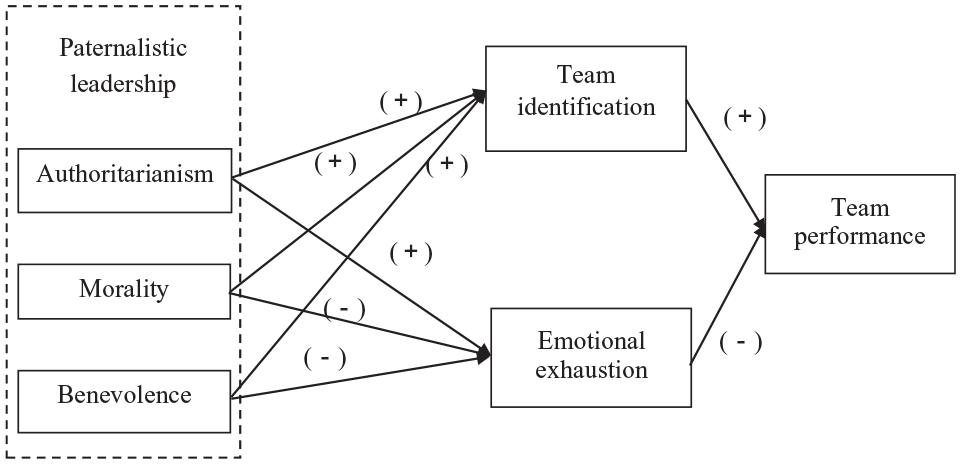
Research framework.
Drawing on team performance theory developed by Paris et al. (2000) based on an input–process–output approach, this study operationalizes team performance in terms of perceived in-role team performance (see the appendix, source: Janssen & Van Yperen, 2004) and elucidates paternalistic leadership that takes on a critical role to motivate such performance. According to Paris et al. (2000), using team performance theory to justify leadership processes versus team outcomes can effectively shed some light on team performance diagnosis (e.g., Nzewi et al., 2015). Team identification is defined as the collective agreement of team workers regarding their cognitive bond toward the team (e.g., C. P. Lin et al., 2017). According to social identity theory, team identification that is often influenced by leadership (Huettermann et al., 2014) represents an affinity with a particular group and can help develop a powerful psychological entity dedicated to achieving team performance (C. P. Lin et al., 2017).
In addition to team identification, emotional exhaustion is an equally important factor (e.g., He et al., 2018) that directly influences team performance. Emotional exhaustion is defined in this study as the collective feeling of team workers regarding their extreme chronic fatigue due to demanding team working conditions. Previous research has found the substantial crossover effects of burnout (in which emotional exhaustion is a key component) among the employees in working environment (Edelwich & Brodsky, 1980). Specifically, due to affective linkage (i.e., emotional connection) between team individuals, they are frequently influenced by each other’s moods (Barsade, 2002), and eventually their emotional state converges to form collective emotion (Totterdell, et al., 2004; Westman et al., 2011). For example, Westman et al. (2011) detected crossover of job demands and emotional exhaustion across time from the team to individuals. Zadow et al. (2017) explained how psychosocial safety climate relates to physical and psychological workplace injuries via emotional exhaustion at the team level. Collectively, emotional exhaustion can be properly examined at either the individual level or the team level (e.g., Catherine & Huang, 2011; Razinskas & Hoegl, 2020). The conservation of resources theory suggests that when team workers become exhausted from dealing with excessive unfavorable leadership, they are unlikely to perform well due to their depleted energy resources (Bakker et al., 2008). Following the above rationales regarding the potential effect of conventional leadership on team identification (e.g., H. Liu & Li, 2018) and emotional exhaustion (e.g., Zheng et al., 2015) that in turn influence team outcomes, this research specifically focuses on paternalistic leadership as a unique and fundamental perspective of supervisory practices.
Characterized by disciplining, instructing, controlling, obedience-demanding, and task monitoring in teamwork (B. S. Cheng et al., 2004; Chou et al., 2010; Chou & Cheng, 2014; Farh et al., 2006), authoritarianism often has dual influences on team performance through team identification and emotional exhaustion. On one hand, disciplining and instructing that improve communication about appropriate behavior, systematic procedures, and desirable decisions in the team can facilitate team workers’ sense of identification with the team (X. P. Chen et al., 2014; Huettermann et al., 2014; Schaubroeck et al., 2017; Y. Wang et al., 2019; Zhang & Xie, 2017) and consequently increase team performance. On the other hand, a leader’s controlling, obedience-demanding, and task monitoring are likely to enhance team workers’ emotional exhaustion by excessively costing team workers’ mental resources to a great extent for coping with the leader (Cropanzano et al., 2003; Pyc et al., 2017; Y. Wang et al., 2019; Zheng et al., 2015), eventually reducing team performance. Collectively, authoritarianism positively relates to team performance via team identification but negatively relates to team performance via emotional exhaustion. These relationships are depicted in detail as below.
Morality is defined as a team leader’s behavior that serves as an example for subordinates by his/her displaying unselfishness, decency, moral quality, and integrity (X. P. Chen et al., 2014; M. Y. Cheng & Wang, 2015; Westwood, 1997). Morality boosts team identification owing to two major reasons. First, moral leaders demonstrate moral principles and responsibility as norms and behavioral codes for team members to place on their own actions, thus shaping their collective self-concepts (Y. Wang & Li, 2019). As a result, members’ team identification is thus enhanced as they view the team as the extension of themselves (Huettermann et al., 2014; Y. Wang & Li, 2019). Second, morality helps team members internalize collective values, attitude, and behavior they share, which facilitates their identification with the team (M. Y. Cheng & Wang, 2015). Specifically, the collective values internalized by morality facilitates a perceived oneness that strengthens a psychological connection between team members and their team. To sum up, the positive influence of morality on team performance is mediated by team identification.
Morality shown by a team leader also represents positive and reliable leadership style that reduces subordinates’ feelings of uncertainty and anxiety (Lind & van den Bos, 2002; Zheng et al., 2015), thus saving emotional resources to prevent emotional exhaustion from happening (Hobfoll, 1989; Hobfoll et al., 2018). The literature has related leadership to team workers’ emotion with “affective reciprocity” (Zhou & Miao, 2014) in which leaders who demonstrate superior integrity and morality instead of acting selfishly are likely to relieve subordinate’s emotional exhaustion by eliciting the subordinates’ positive affective response (Pellegrini & Scandura, 2008), consequently increasing team performance. All in all, morality increases team identification and reduces emotional exhaustion, which jointly boost team performance. Based on the above rationale, this study proposes the following:
Benevolence is defined as a team leader’s behavior involving an individualized and holistic concern for subordinates’ personal and familial well-being in working and nonworking domains (X. P. Chen et al., 2014; Y. Wang et al., 2019). According to social exchange theory, benevolence can inspire the reciprocity of altruistic behavior (Emerson, 1976). When team workers are led by a benevolent leader who puts emphasis on a sense of reciprocal altruism and gratitude in the team, they are likely to follow the leader’s example to increase their psychological connection with the team (i.e., team identification) by reciprocally aligning their interests with those of other team members (M. Y. Cheng & Wang, 2015). Previous research has found that a leader’s benevolence helps increase team workers’ positive motivation for teamwork, esteem for their leaders’ decisions (Niu et al., 2009), trust on coworkers (Malhotra, 2004), and identification with the team (G. Li et al., 2018; Y. Wang et al., 2019). Specifically, team workers tend to identify with their team under a leader who does not put his/her own interest in the front, does not discriminate against team members, and kindly consider relevant information when making decisions that influence team members (i.e., benevolent leadership; van Dijke & De Cremer, 2010), which consequently enhance team identification among team members at the team level. At the same time, a benevolent leader often expresses warmth, empathy, and sincere care toward subordinates in working and nonworking domains (X. P. Chen et al., 2014; Luu, 2019; Y. Wang et al., 2019). Team workers under a benevolent leader can easily experience positive affective feelings that help mitigate emotional exhaustion because such a leader is viewed as sincere in satisfying their needs and devoting all his/her energy to them (Xu et al., 2018). Collectively, a team leader’s benevolence indirectly facilitates team performance via increased team identification and decreased emotional exhaustion. Based on the above rationale, this study proposes the following:
Method
Participants and Procedure
This study empirically tested its research hypotheses using a survey of knowledge team workers with a variety of professional expertise and skills in a leading semiconductor manufacturing company in Taiwan. Teams investigated were related to R&D, administration, manufacturing, and quality control. This study initially distributed a total of 350 questionnaires to 70 teams (i.e., one leader and four members in each team) and eventually collected 330 usable questionnaires from 66 teams (i.e., 66 questionnaires from leaders and 264 questionnaires from members) with the response rate of 94.3%. A high response rate in the survey was achieved mainly because of the full support from managers across various departments in the sample firm. Among the survey participants, 80.9% were male and 100% had bachelor’s degree or above. The ages of team leaders ranged from 36 to 56 years (M = 44.4 years, SD = 4.53) and their job tenures ranged from 10 to 31 years (M = 17.3, SD = 4.63). The ages of team members ranged from 22 to 52 years (M = 37.7 years, SD = 5.62) and their job tenures ranged from less than 1 year to 25 years (M = 11.0 years, SD = 5.41).
To minimize the potential threat of common method variance (CMV), the survey was conducted with two beneficial measures. First, the survey was carried out with precautious procedures, including (1) each questionnaire item was substantially reviewed and improved by professionals familiar with leadership and organizational behavior theories, and thus expressed accurately with a clear meaning (Podsakoff et al., 2003); (2) complete anonymity guaranteed by researchers to ensure individuals’ responses kept confidential (Tsai et al., 2016); and (3) detailed instructions provided in the title of questionnaires to avoid confusion for respondents (M. L. Liu et al., 2019). Second, the data were collected from two major sources in each team (leaders and members, respectively; Huang & Lin, 2019; M. L. Liu et al., 2019; H. Wang & Guan, 2018). That is, three dimensions of paternalistic leadership were evaluated by members, while team performance and its mediators (i.e., team identification and emotional exhaustion) were evaluated by both leaders and members. The literature has indicated that self-reported leadership may be ignored or viewed as immaterial in the research inquiry of leadership (Selden, 2015), it is important to evaluate leadership from the perspective of team members herein.
A work team is defined as a group of workers with different job duties who work interdependently to achieve collective goals with an identifiable leader (Kozlowski & Ilgen, 2006). Since workers and their leader in the same team have frequent interactions and close coordination, the leader has a complementary point of view regarding collective identification and emotion in the team. Therefore, team performance and its mediators can be measured more accurately by members and their leader jointly to obtain an all-round assessment (Chiu et al., 2018; van Helden & Reichard, 2013). Besides, scholars have supported that an effective approach to alleviate potential threats of CMV is to have outcome-relevant variables (i.e., team performance, team identification, and emotional exhaustion) measured by both team members and their leader together instead of the members alone (C. P. Lin, Chen, et al., 2019).
Measures
Measurement items were initially developed based on the prevalidated scales in the literature and then modified to fit the teaming contexts in high-tech industry. Five-point Likert-type scales anchored from 1 as strongly disagree to 5 as strongly agree were used for all measurement items. Before the actual survey, a pilot survey on 60 incumbent employees with teamwork experience was conducted to help improve the quality of survey instruments. These employees in the pilot survey were excluded from the actual survey. Exploratory factor analysis (EFA) was executed to analyze the pilot survey data and some inappropriate items due to serious cross-loadings or poor loadings were modified to remain in or deleted from the questionnaire.
The scale of authoritarianism, morality, and benevolence were modified from X. P. Chen et al. (2014). A sample item for authoritarianism was “My supervisor asks us to obey his/her instructions completely.” A sample item for morality was “My supervisor employs people according to their virtues and does not envy others’ abilities and virtues.” A sample item for benevolence was “My supervisor is like a family member when he/she gets along with us.” The scale of team identification was slightly modified from Mael and Ashforth (1992). For example, the item “When we talk about our team, we usually say ‘we’ rather than ‘they’.” was modified from the original item “When I talk about this school, I usually say ‘we’ rather than ‘they’.” The scale of emotional exhaustion was modified from Whitman et al. (2014). For example, the item “Our team members feel emotionally drained from our work.” was modified from the original item “I feel emotionally drained from my work.” The scale of team performance was modified from Janssen and Van Yperen (2004). For example, the item “Our team always completes the duties specified in our job description.” was modified from the original item “This worker always completes the duties specified in his/her job description.” In the pilot test, five items were then removed from the questionnaire due to their cross-loadings or poor loadings, including original Item 3 of authoritarianism, original Items 1 and 3 of morality, original Item 5 of team identification, and original Item 5 of team performance in the aforementioned literature. The appendix lists all the measurement items used for the actual survey and their sources.
Analytical Approach
The hypotheses were analyzed at the level of teams by using a two-step structural equation modeling (SEM) approach (Anderson & Gerbing, 1988). First, confirmatory factor analysis (CFA) was performed to test measurement model for verifying the reliabilities, convergent validity, and discriminant validity of the empirical data. Second, SEM was conducted to evaluate the hypothesized research model.
The level of analysis should be chosen based on the focus units of the study (D. Chan, 1998; M. L. Liu et al., 2019; Rousseau, 1985). As this study proposed a research framework to evaluate the collective functions of the high-tech teams, team-level data analyses essential. Given that individual-level responses were aggregated to form team-level measures, within-team interrater agreement (IRA) as rwg was used to evaluate whether data aggregation was empirically acceptable and justifiable (Bliese, 2000; D. Chan, 1998; LeBreton & Senter, 2008). The literature has suggested rwg as a more appropriate index to justify data aggregation than intraclass correlation coefficients when the sample teams belonged to the same organization, and the sample size of each sample team was relatively small (i.e., small between-subject variances; Hsu et al., 2006; C. P. Lin, Liu, & Liao, 2020; C. P. Lin et al., 2020). In this study, because all sample teams were from a large semiconductor manufacturing company, and there was a relatively small size for each sample team, thus rwg was a better index used as the criteria for data aggregation justification. The mean rwg values were 0.85 for authoritarianism, 0.85 for morality, 0.91 for benevolence, 0.92 for team identification, 0.89 for emotional exhaustion, and 0.95 for team performance. All these rwg values exceeded the criterion of 0.70 (James et al., 1984), suggesting that the aggregation of individuals’ responses to team-level measures was acceptable. Table 1 lists the descriptive statistics and correlations for all variables given that the scores of team identification, emotional exhaustion, and team performance were generated by our averaging all responses of team members and their leader.
Descriptive Statistics and Correlations.

Note. F1 = authoritarianism; F2 = morality; F3 = benevolence; F5 = team identification; F6 = emotional exhaustion; F8 = team performance.
p < .05. **p < .01. ***p < .001.
After the data aggregation to the level of teams, a CFA was executed to evaluate the goodness-of-fit of the hypothesized CFA model. Table 2 lists the test results, revealing that the normalized chi-square (i.e., χ2/df) was smaller than 2.0, RMR (root mean residual) was smaller than 0.05, RMSEA (root mean square error of approximation) was equal to 0.08, and both CFI (comparative fit index) and NNFI (nonnormed fit index) were very close to 0.9. Collectively, these indices showed that the empirical data fit the model well (Bentler & Bonett, 1980; Hu & Bentler, 1999).
Standardized Factor Loadings, Average Variance Extracted (AVE), and Cronbach’s Alpha (N = 66).
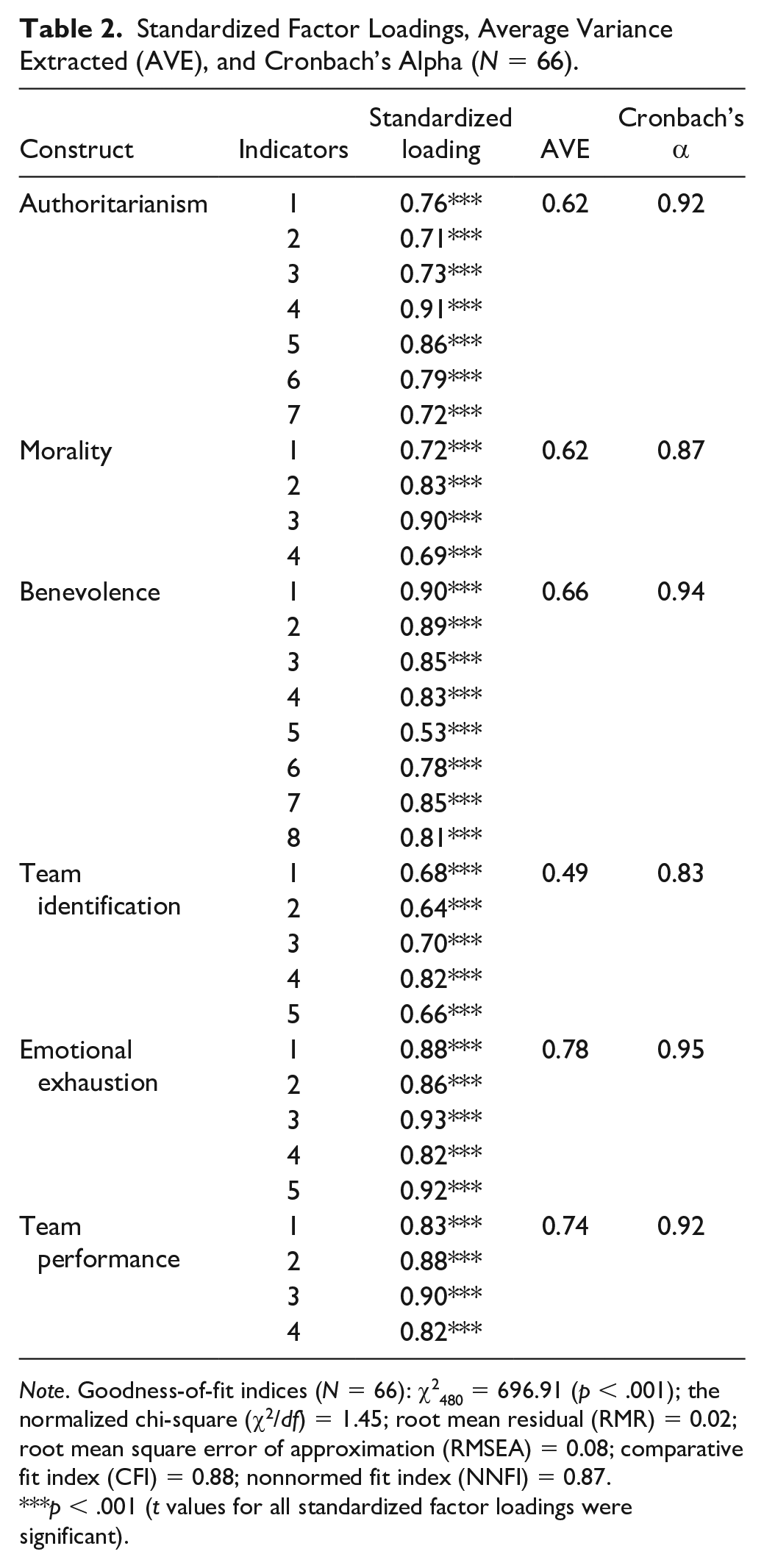
Note. Goodness-of-fit indices (N = 66): χ2480 = 696.91 (p < .001); the normalized chi-square (χ2/df) = 1.45; root mean residual (RMR) = 0.02; root mean square error of approximation (RMSEA) = 0.08; comparative fit index (CFI) = 0.88; nonnormed fit index (NNFI) = 0.87.
p < .001 (t values for all standardized factor loadings were significant).
Table 2 shows that (1) the t values for all standardized factor loadings were significant, (2) the average variance extracted (AVE) values for each construct exceeded or were close to the criterion of 0.5, and (3) the values of Cronbach’s alpha for each construct exceeded the criterion of 0.70, thereby supporting convergent validity (Fornell & Larcker, 1981). Meanwhile, in order to ensure that the proposed model is tentatively accepted, this study conducted a further analysis by comparing the proposed model with competing models where some variables are combined as a single variable (Avolio et al., 2003; M. L. Chen & Lin, 2013). In Table 3, the goodness-of-fit indices reveal that the proposed model based on six factors is the best fit model of all. In addition, discriminant validity was supported by chi-square difference test, the difference of chi-square statistics between constrained models (i.e., fix the covariance of each construct pair equal to 1) and unconstrained model were all significant based on Bonferroni method (Huang & Lin, 2019; C. P. Lin, Wang, et al., 2019).
Fit Indices of This Study’s Validation Models.
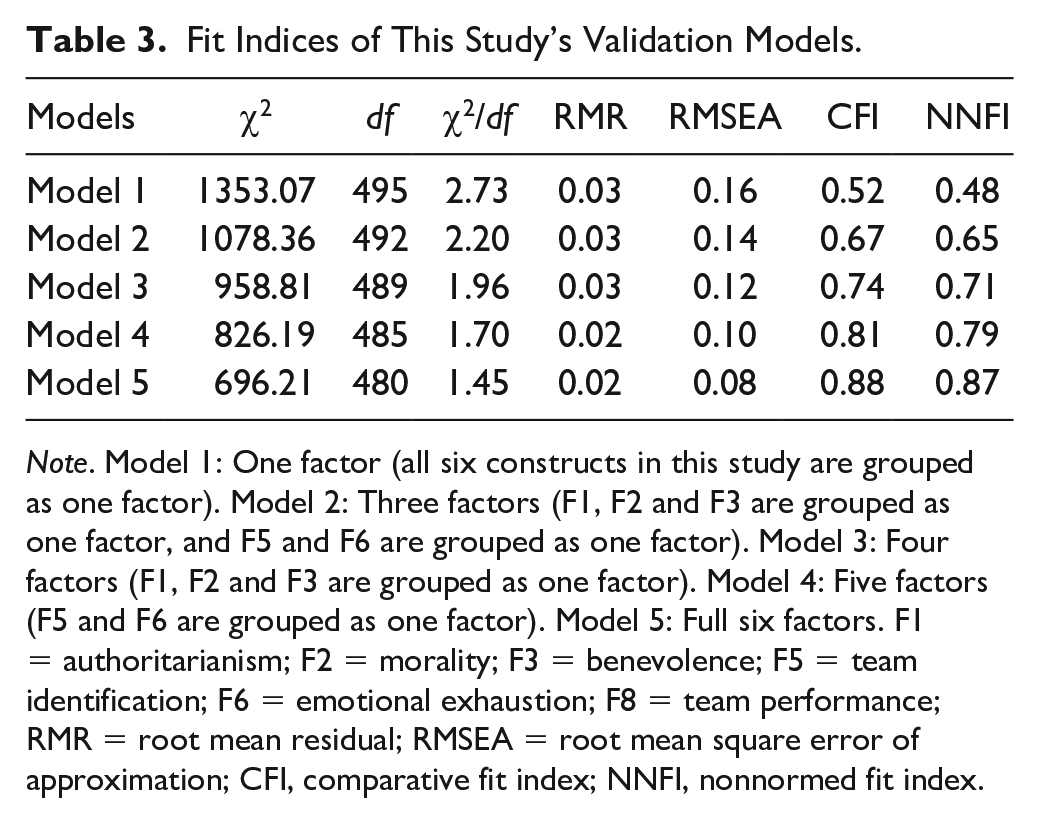
Note. Model 1: One factor (all six constructs in this study are grouped as one factor). Model 2: Three factors (F1, F2 and F3 are grouped as one factor, and F5 and F6 are grouped as one factor). Model 3: Four factors (F1, F2 and F3 are grouped as one factor). Model 4: Five factors (F5 and F6 are grouped as one factor). Model 5: Full six factors. F1 = authoritarianism; F2 = morality; F3 = benevolence; F5 = team identification; F6 = emotional exhaustion; F8 = team performance; RMR = root mean residual; RMSEA = root mean square error of approximation; CFI, comparative fit index; NNFI, nonnormed fit index.
Results
Following CFA, this study performed structural modeling for testing its hypotheses. To avoid unexpected influences by variables beyond its focal constructs, this study included several control variables relevant to team workers’ traits, including gender of team leaders, job tenure of team leaders, the ratio of junior members, and the ratio of members with higher education.
Figure 2 presents the test results in which four out of six hypotheses are supported (i.e., Hypotheses 1, 2, 3, and 6 are supported). In support of Hypothesis 1, authoritarianism is positively related to team identification (β = 0.28, p < .05), which is then positively related to team performance (β = 0.59, p < .001), suggesting the positive and indirect relationship between authoritarianism and team performance via team identification. In support of Hypothesis 2, authoritarianism is positively related to emotional exhaustion (β = 0.24, p < .05), which is then negatively related to team performance (β = −0.40, p < .001), suggesting the negative and indirect relationship between authoritarianism and team performance via emotional exhaustion. In support of Hypothesis 3, morality is positively related to team identification (β = 0.71, p < .001), which is then positively related to team performance (β = 0.59, p < .001), suggesting the positive and indirect relationship between morality and team performance via team identification. In support of Hypothesis 6, benevolence is negatively related to emotional exhaustion (β = −0.64, p < .001), which is then negatively related to team performance (β = −0.40, p < .001), suggesting the positive and indirect relationship between benevolence and team performance via emotional exhaustion.
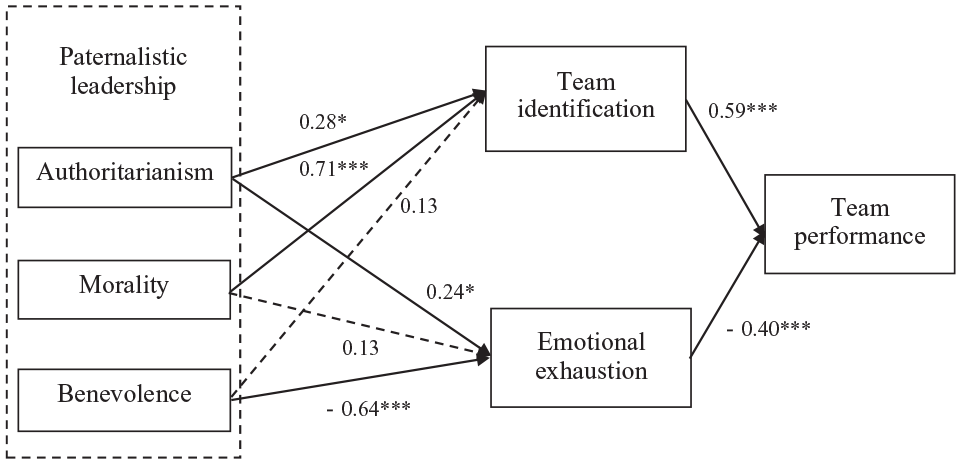
Structural equation modeling analysis results.
To have a robustness check for its hypothesized mediation of team identification and emotional exhaustion, this study conducts a post hoc SEM analysis by adding three direct paths from authoritarianism, morality and benevolence respectively to team performance (see Figure 3). The test results reveal that the three direct paths are all insignificant, suggesting good robustness for the mediation model proposed by this study.
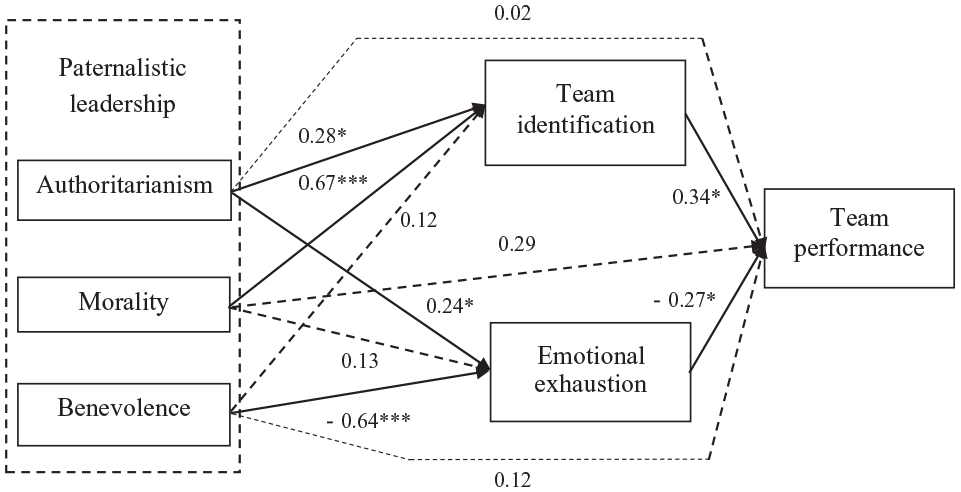
Post hoc structural equation modeling analysis results.
This study adopts a bootstrapping approach recommended in the literature (Edwards & Lambert, 2007; Huang & Lin, 2019; C. P. Lin, Wang, et al., 2019) to evaluate the indirect effects of authoritarianism, morality and benevolence on team performance. The bootstrapping approach is appropriate for this study because it does not require the assumption of normal distributions that is necessary for Sobel tests (MacKinnon et al., 2007). The test results in Table 4 show that the associated bias-corrected confidence intervals do not cover zero for Hypotheses 1, 2, 3, and 6 (i.e., their indirect effects are supported), which is consistent with the test results in the preceding SEM analysis.
The Test Results of Mediation by Bootstrapping With 5,000 Subsamples.

Note. F1 = authoritarianism; F2 = morality; F3 = benevolence; F5 = team identification; F6 = emotional exhaustion; F8 = team performance (Bias-corrected and accelerated).
Finally, this study presents a different statistical method with regression analyses to investigate the stability of its empirical model. Specifically, this study adopts the procedure recommended in the literature (e.g., Frazier et al., 2004; Lin et al., 2020) to test a mediated model. The test results in Table 5 are consistent with the preceding SEM results regarding significant model paths, supporting the high stability of our empirical model across different analytical approaches.
Team-Level Regression Analysis (N = 66).
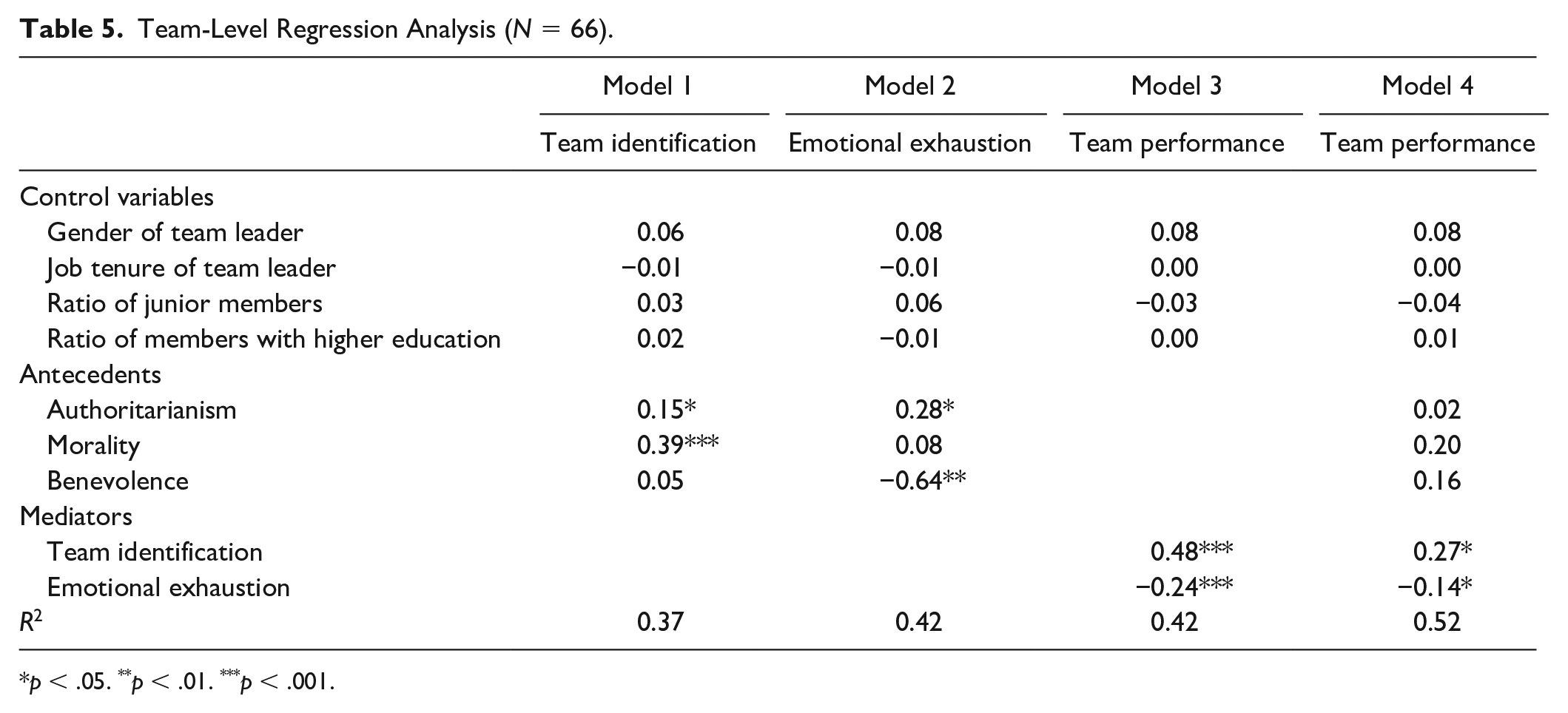
p < .05. **p < .01. ***p < .001.
The unsupported Hypothesis 4 may occur because morality that emphasizes moral reasoning (e.g., rights and duties; Brower & Shrader, 2000) does not involve spreading affective experiences and thus cannot influence team workers’ emotional resources to reduce team-level emotional exhaustion. The literature has emphasized that moral leadership focuses on justice, virtues, and role modeling, which are not allowed to be ruled by emotion (Y. Wang & Li, 2019). The unsupported Hypothesis 5 may occur because there are certain conditions in which benevolent leadership causes a side effect and negatively influences a situation (Kanwal et al., 2019). Specifically, a benevolent leader who provides individualized concerns to satisfy team members’ needs often displays differential treatments to different members (B. S. Cheng et al., 2000). For that reason, benevolent leadership may cause subordinates to perceive favoritism or interactional injustice (Erdogan & Bauer, 2010), and is likely to backfire due to such differential treatments that frustrate team members. Nevertheless, the actual causes why the above two hypotheses are not supported may warrant future research attention so that scientific evidence can be provided to confirm the authentic reasons for the hypotheses.
Discussion
This study proposes a framework to complement previous findings on the role of paternalistic leadership by relating three dimensions of paternalistic leadership to team performance through the simultaneous mediation of team identification and emotional exhaustion. This study provides original contributions to the literature by demonstrating that paternalistic leadership possesses both positive and negative effects that eventually influence team performance to a large extent. Implications for research and practice are provided in the followings.
Implications for Research
The findings of this study complement previous research in three theoretical perspectives. First, this study reveals authoritarianism as a double-edged sword for team performance in which authoritarianism positively relates to team performance through team identification but negatively relates to team performance through emotional exhaustion. This double-edged nature of authoritarianism is analogous with full-range leadership theory that explains how a leader performs various behaviors ranging from completely passive to strongly active (Diebig et al., 2016). In other words, leadership strengths are not always advantages, depending on what perspective it intends to drive.
Second, this study supplements social identity research that has widely justified the mediating role of team identification in terms of transformational leadership (Kearney & Gebert, 2009), authentic leadership (Horstmeier et al., 2017) or ethical leadership (Zhu et al., 2015). Specifically, this study integrates social identity theory and the conservation of resources theory to verify various influences of paternalistic leadership on team performance, which has been relatively understudied in the literature. Scholars have indicated that social identity theory alone is unlikely sufficient to explain all perspectives of team identification, emotional states, and attitude (Ashdown et al., 2015), and thus taking into account both social identity theory and the conservation of resources theory in this study helps effectively demonstrate the development of team performance from a holistic viewpoint.
Third, the finding of this study about how benevolence reduces emotional exhaustion provides additional rationale for belongingness theory justifying the necessary benevolence or goodwill for establishing trust between workers and their leader and encouraging their engagement in extra-role behavior (Erkutlu & Chafra, 2016; Scott et al., 2013). Research has found that benevolent leaders affect subordinates’ work outcomes through emotions (Erkutlu & Chafra, 2016), thus supporting the critical role of benevolence on emotional exhaustion herein. Specifically, when team workers perceive their benevolent leader as sincere in satisfying their needs and concerns, they are more likely to experience positive affective feelings that help mitigate emotional exhaustion (Xu et al., 2018), consequently improving team performance.
Implications for Practice
The analytical results of this study provide useful implications for practice. First, complementing the literature that has classified the concept of authoritarianism as the leaders’ control over their subordinates, projects, and task components (Chou et al. 2010; T. T. Lin et al., 2019), this study finds the double-edged effects of authoritarianism that boosts team identification but also increases emotional exhaustion. This finding suggests that authoritarianism leaders that intend to improve team identification should simultaneously make good use of psychological counselling support to help workers adjust stress and burnout. Under such circumstances, team leaders are likely to boost team identification and mitigate emotional exhaustion, consequently improving team performance. For example, with institutionalization of working teams, team leaders should learn to focus more on establishing the project management system, and systematically setting up team rules, instructions, schedule, milestones, and goals. Through the periodical management review mechanisms to substantially replace strong and pressing control over their subordinates, authoritarianism leaders can achieve both strengthened team identification and reduced emotional exhaustion.
Second, team leaders should lead by example based on moral principles so as to effectively increase team identification and team performance. Given the importance of integrity and fairness in moral leadership, moral leaders should pay attention to justice issues and adhere to ethical principles by demonstrating fairness in making policies and interacting with subordinates. Team leaders should realize the fact that actions speak louder than words, particularly in the teaming context where a high power distance exists (Hui et al., 2004). For instance, the moral behavior of leaders is highly valued and scrutinized by subordinates across industries in Chinese society (M. Y. Cheng & Wang, 2015). If moral leaders exhibit a high level of moral standards and lead morally as a role model in their daily work, the subordinates are likely to trust and learn from the leaders in a collective ethical atmosphere. As a result, team workers tend to abide by ethical standards and rules in the team, consequently facilitating affective attachment toward the team (i.e., team identification) and boosting team performance.
Third, a leader is encouraged to lead his/her team by benevolence, and pay individualized and holistic concerns to their subordinates in working and nonworking domains based on fairness. In Chinese organizations, a leader’s benevolence is viewed as his/her sincerity of satisfying team members’ needs, and thus team members can easily experience social and emotional support that helps mitigate emotional exhaustion in the team, and thus strive harder for team performance. For instance, benevolent leaders can make good use of gentle expressions and optimistic tones to guide subordinates to transcend from the exchange perspective of individuals’ benefits to strengthen their own resiliency by moving toward collective performance goals. Team leaders should be provided with up-to-date trainings related to benevolent leadership so as to alleviate collective emotional exhaustion.
To sum up, team identification and emotional exhaustion represent respectively cognitive and affective factors, which complement each other to jointly influence team performance. Team leaders should develop appropriate leadership styles that effectively motivate team identification and reduce emotional exhaustion. At the same time, team workers should learn to maintain sufficient cognitive and emotional resources when encountering different team leaders so as to obtain strong team identification and lessen emotional exhaustion (i.e. Brammer et al., 2015; Ellemers et al., 2004; Ruggieri & Abbate, 2013; van Knippenberg & Ellemers, 2003).
Limitations of the Study
This study has some limitations regarding data collection and research interpretation. First, the survey of this study was conducted in a semiconductor manufacturing company in Taiwan, so the generalizability of the inferences derived from the empirical results might be limited in high-tech industry. To improve the generalizability, future research in different industries might help complement the findings of this study.
Second, while team performance was measured with the responses of team leaders and their subordinates, future research might collect team performance data directly from KPI (key performance indicators) data of teams to complement the findings of this study. Future research could conduct further exploration from a leader–subordinate dyadic perspective, and tried multilevel analysis to complement this study.
Third, future study could extend the discussion and findings of this study to explore innovation development. Will paternalistic leadership hinder or enhance innovation or creativities? And through what mediating mechanism?
Fourth, this study evaluates how and through what mediating mechanism paternalistic leadership can actually affect team performance on a team-level base, while organization-related management system and interteam relationships might moderate the relationships between paternalistic leadership, and mediators and team performance, for example, team efficacy and interteam competition might be good candidate moderators for future study.
Footnotes
Appendix
Declaration of Conflicting Interests
The author(s) declared no potential conflicts of interest with respect to the research, authorship, and/or publication of this article.
Funding
The author(s) disclosed receipt of the following financial support for the research, authorship, and/or publication of this article: This study was supported by Ministry of Science and Technology, Taiwan.
