



Abstract
This research explores the nature of collective leadership by examining the boundary conditions of how and when it relates to unit functioning. Building from a contingency perspective that considers the impact of contextual factors, we propose that collective charismatic leadership will be associated with lowered unit conflict, and this relationship will be strengthened by the contingency elements of individual charismatic leadership, task complexity, and social inclusion. Furthermore, we propose that the interactions of collective charismatic leadership with these contextual factors will relate to performance and satisfaction through conflict. We examine our hypotheses across two unit-level field studies, and the results illustrated that high levels of these contextual factors enhanced the negative relationship between collective charismatic leadership and conflict, which generally mediated the relationships between these interactive effects and performance and satisfaction. The results also highlight the detrimental aspects of collective leadership and how it can relate to reduced unit functioning when it is not aligned with an appropriate context. Overall, these findings begin to provide a more complete picture of collective leadership from a contingency perspective through a greater understanding of when and how it is related to unit functioning.
Leadership is a vital component for the effectiveness of work groups (Zaccaro et al., 2001). Traditional leadership theory and research have demonstrated the importance of the individual leader to the success of a team (Day et al., 2006; Morgeson et al., 2010). Augmenting this historical conceptualization, scholars have also examined leadership as a shared property or collective activity in work groups, rather than as a behavior exhibited exclusively by an individual member (Contractor et al., 2012; D’Innocenzo et al., 2016; Friedrich et al., 2009; Nicolaides et al., 2014; Wang et al., 2014; Wu et al., 2020). 1 In the present research, we aim to integrate these perspectives and extend the understanding of collective leadership through a contingency approach (Donaldson, 2001) to examine the boundary conditions of how and when it relates to unit functioning.
A collective approach to leadership offers several benefits to work groups, including more fully leveraging the human capital of the team, considering multiple perspectives, and structuring back-up behaviors (Dust & Ziegert, 2016; Yammarino et al., 2012). A number of recent meta-analyses have demonstrated the positive direct effect of collective forms of leadership (D’Innocenzo et al., 2016; Nicolaides et al., 2014; Wang et al., 2014; Wu et al., 2020). At the same time, the meta-analyses call for additional future research to examine “mediators and moderators of this relationship” (Nicolaides et al., 2014, p. 936) as well as to examine individual and collective forms in conjunction “to better understand the coexistence of these two sources of leadership within a team” (Wang et al., 2014, p. 192). Indeed, while prior research has detailed positive effects of collective leadership, there is a general lack of empirical understanding of both when and how this effect occurs (D’Innocenzo et al., 2016). To begin to address this issue, Wu et al. (2020) demonstrated the moderating impact of intragroup trust and task interdependence on the relationship between collective leadership and outcomes, but also noted that “future research endeavors should focus on additional moderating variables” (p. 61). We aim to fill this gap and associated call for research through a contingency approach (Donaldson, 2001), which integrates both the traditional individual form of leadership as well as contextual factors (Johns, 2006) to better understand the boundary conditions of collective leadership. We apply this contingency perspective to an examination of charismatic leadership (Meuser et al., 2016) given the multilevel nature of charismatic leadership (Avolio & Yammarino, 1990; Wang & Howell, 2010) and associated frameworks for identifying potential moderating factors (Shamir & Howell, 1999).
This contingency approach (Donaldson, 2001) used to examine contextual factors (Johns, 2006) facilitates the understanding of collective forms of leadership (Carson et al., 2007) as well as charismatic leadership (Shamir & Howell, 1999). We specifically build from Shamir and Howell’s (1999) framework, which describes contextual influences on the effectiveness of charismatic leadership and also integrates other works examining contextual facilitators of both charismatic leadership (e.g., Klein & House, 1995; Pillai & Meindl, 1998; Walter & Bruch, 2009) and collective leadership (e.g., Dust & Ziegert, 2016; Wang et al., 2014; Yammarino et al., 2012). We examine how three factors strengthen the relationship of collective charismatic leadership and unit functioning: Individual charismatic leadership, task complexity, and social inclusion. These factors represent Shamir and Howell’s (1999) contextual influences of “leader level,” “organizational tasks,” and “organizational culture,” respectively. Across two studies, we highlight how the intersection between collective charismatic leadership and these contextual elements relates to unit-level conflict and ultimately team performance and satisfaction. Figure 1 provides a summary of our model and hypotheses.
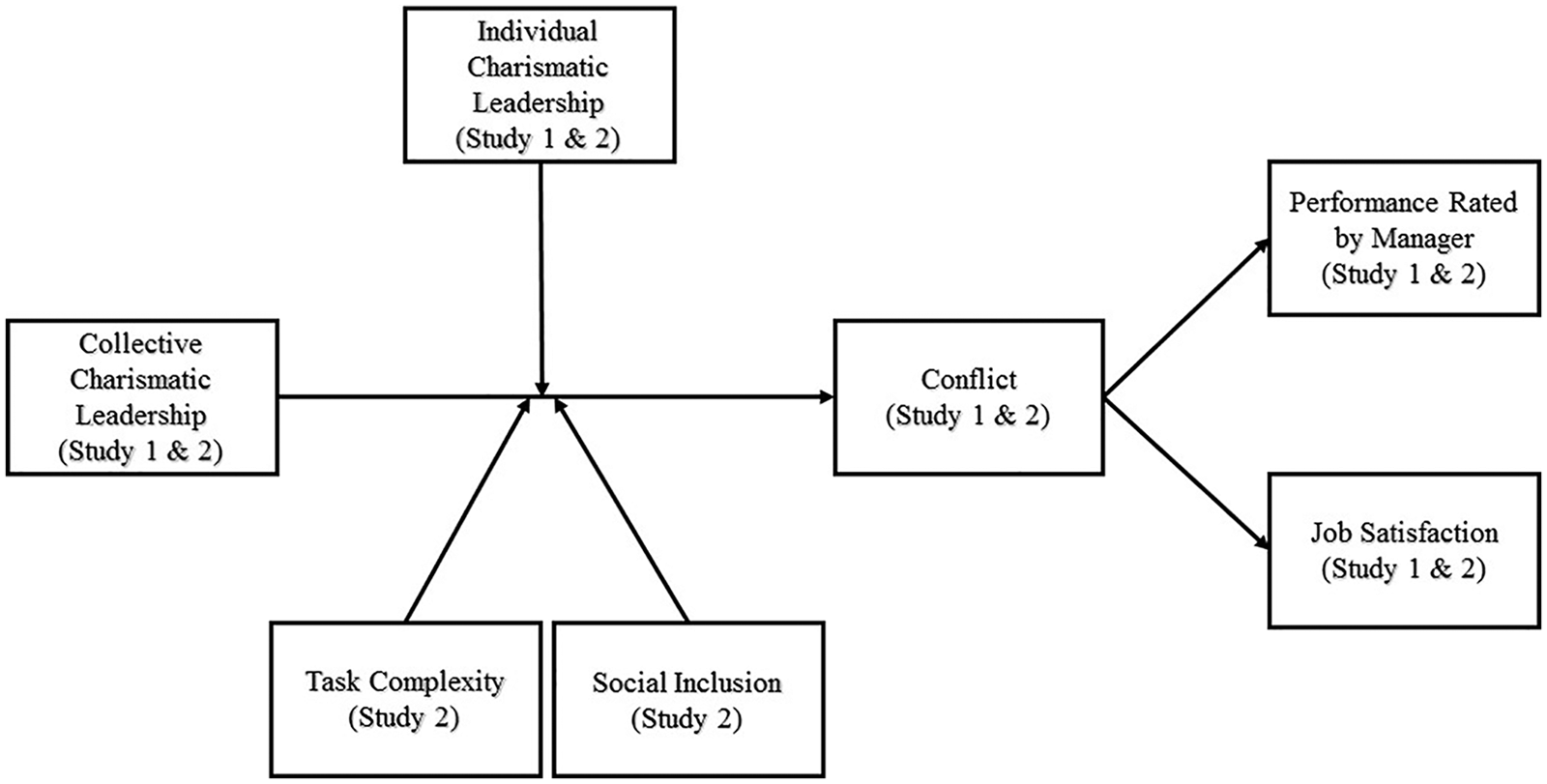
Summary of hypothesized model.
This research makes several contributions to the leadership literature. First, we expand the understanding of collective leadership to illustrate that its positive effects are contingent (Donaldson, 2001) on contextual elements (Johns, 2006; Shamir & Howell, 1999). Our approach therefore provides a more nuanced and balanced perspective of the positive and negative aspects of this form of leadership (Lee et al., 2018). The results engender a better understanding of when and how collective charismatic leadership relates to team functioning by taking into account a broad array of task and social factors across the unit, task, and organization (Wang et al., 2014). This approach highlights the boundary conditions of collective leadership and results in a more holistic understanding of its forms (Zhu et al., 2018).
Second, we integrate collective and individual forms of leadership. Although prior research has demonstrated that collective leadership accounts for unique variance in outcomes over individual leadership from a substitution perspective (Nicolaides et al. 2014; Pearce & Sims, 2002; Wang et al., 2014), we instead examine an augmentation perspective to illustrate that these forms of leadership strengthen one another (Wang et al., 2014). In this regard, we seek to expand conceptualizations of leadership to recognize the importance of individual and collective forms in conjunction, rather than considering them as operating in isolation (Locke, 2003; Pearce et al., 2007; Ramthun & Matkin, 2014). This perspective integrates the traditional individual leadership literature with the collective leadership literature to highlight the need to simultaneously incorporate both perspectives as “the vision of vertical leaders and team members might work best in tandem or partnership” (Wang et al., 2014, p. 192).
Third, broadening the predominantly positive notions of collective leadership (Contractor et al., 2012; Denis et al., 2012; Friedrich et al., 2009), our findings highlight boundary conditions and shed light on potentially negative effects of collective leadership under certain contextual conditions (Dust & Ziegert, 2016). We illustrate that an incongruence between collective charismatic leadership and individual charismatic leadership, task complexity, or social inclusion results in instances where high levels of collective charismatic leadership are associated with increased levels of conflict. In this regard, our study extends the positive meta-analytical evidence (D’Innocenzo et al., 2016; Nicolaides et al., 2014; D. Wang et al., 2014; Wu et al., 2020) to illustrate the conditional negative effects of collective leadership when not situated within the proper context (Dust & Ziegert, 2016). As such, our research not only highlights the benefits of collective charismatic leadership but also offers a cautionary perspective to the collective leadership literature by considering the potential detriments of sharing leadership.
Finally, we extend the charismatic leadership literature through an examination of charismatic leadership at the collective level. We argue that relational elements are a foundation of charismatic leadership (Klein & House, 1995; Pillai & Meindl, 1998; Walter & Bruch, 2009), which suggests that examining it from a peer-based approach is particularly relevant to broadening our understanding of collective leadership (Berson et al., 2016). Thus, collective charismatic leadership is the interaction of members based on a relational process that is embedded in the social system of the unit (Denis et al., 2012; Hiller et al., 2006). Understanding collective charisma from a relational perspective suggests that it aligns with other forms of collective leadership, but its charismatic elements distinguish it from other types.
Theoretical Development and Hypotheses
Multilevel Nature of Charismatic Leadership
Individual forms of charismatic leadership focus on the downward influence of charismatic leadership behaviors by a single leader (e.g., a manager) on the unit (e.g., employees in a department) to achieve some unit-level goal. Charismatic leadership is characterized by a leader displaying behaviors of conviction, communicating a vision, and being sensitive to the environment and others’ needs (Conger & Kanungo, 1994; Judge & Piccolo, 2004). We focus on the common approach of idealized influence behaviors of charismatic leadership characterized by leaders communicating values, beliefs, and purpose as well as emphasizing a collective mission (Antonakis et al., 2003). We examine idealized influence of the designated manager (i.e., nominal leader) of the department as the individual charismatic leader.
Building from the individual view of charismatic leadership (Conger & Kanungo, 1987), collective charismatic leadership is characterized by multiple members exerting downward, upward, and lateral influence through behaviors focused on communicating values, purpose, and mission towards their fellow members (Berson et al., 2016; Hiller et al., 2006; Pearce & Conger, 2003; Yammarino et al., 2012). We seek to combine the individual and collective approaches to charismatic leadership in a multilevel fashion (Hernandez et al., 2011). Charismatic leadership has been conceptualized as multilevel (Avolio & Yammarino, 1990; Wang & Howell, 2010) as it can stem from the behaviors of an individual leader (Bass, 1985; Conger & Kanungo, 1994) or a collective (K. J. Klein & House, 1995; Menges et al., 2011; Waldman & Yammarino, 1999). Indeed, charismatic leadership fits with both an individual and collective leadership approach as “charismatic leadership can operate either as an individualized or group level phenomenon depending on organizational context” (Murphy & Ensher, 2008, p. 336). To examine collective charisma, we build from Yammarino et al.’s (2012) conceptualization of collective leadership, which focuses on a dynamic leadership process whereby the leadership behaviors are distributed among members of a unit.
A relational process is at the core of charismatic leadership (Klein & House, 1995; Howell & Shamir, 2005; Shamir et al., 1993). Building from this view, collective charismatic leadership involves a relational process among members of the unit given that employees’ interactive behaviors increase charismatic leadership (Galvin et al., 2010). Indeed, charismatic leadership influence resides in the relationship between individuals (Klein & House, 1995), as one can think of “charisma as a relationship that is jointly produced by leaders and followers” (Howell & Shamir, 2005, p. 108). Weber’s (1947) original conceptualization of charisma consisted of individuals’ granting authority to one another, and this social process of collective charismatic leadership is characteristic of leadership construction whereby members of the unit reciprocally claim and grant charismatic leadership behaviors through social interaction (DeRue & Ashford, 2010). Based on this integration of collective leadership (e.g., Yammarino et al., 2012) and charismatic leadership (Klein & House, 1995; Howell & Shamir, 2005) frameworks, we define collective charismatic leadership as an emergent process whereby multiple individuals within the unit mutually influence one another through the charismatic leadership behaviors of communicating values, purpose, mission, and beliefs. Collective charismatic leadership is a valuable conceptualization as “shared (or distributed leadership) appears to be a valid addition to future charismatic leadership research” (Murphy & Ensher, 2008, p. 348).
Direct Effect of Collective Charismatic Leadership on Conflict
Building on recent calls to examine conflict in relation to collective leadership (Wu et al., 2020), and in order to establish a foundation from which to examine subsequent moderating effects, we draw from the relational perspective of charismatic leadership to examine its impact on conflict. Conflict involves an awareness of incompatibilities or differences among team members (Jehn, 1995). While conflict has been conceptualized as a variety of forms such as task and relationship elements, we examine conflict as a whole as it reflects the relational focus and task role-modeling perspective of charismatic leadership (Bass et al., 1987). Furthermore, team members’ belief that they share a common goal (characteristics of collective charismatic leadership) is related to both task and relationship conflict (Amason & Sapienza, 1997). Finally, both of these forms of conflict are negatively related to unit outcomes such as performance (De Dreu & Weingart, 2003). As such, we examine conflict as a whole 2 and propose that collective charismatic leadership should be related to reduced levels of conflict.
Charismatic leadership has been proposed as a primary mechanism to manage unit-level conflict given its relational nature (Atwater & Bass, 1994). Charismatic leadership prompts individuals to focus on superordinate, unit-level goals that can help transcend differing positions (Atwater & Bass, 1994). Charismatic leadership enables a shared purpose and mission, increasing employees’ commitment to unit goals and thereby reducing conflicts between individual members (Shamir et al., 1993). Furthermore, charismatic leadership focuses on shared values and beliefs (Avolio & Yammarino, 1990), which highlights commonalities of individuals rather than differences. Additionally, charismatic leadership results in increased cooperation (Paulsen et al., 2009), which should increase a unit’s effectiveness at managing conflict (Erez et al., 2002).
Building from these general characteristics of charismatic leadership, collective charismatic leadership should be negatively associated with conflict based on motivational elements inherent in collectivistic forms of leadership. Research has shown that collective forms of leadership are related to behavioral processes and emergent states (Wang et al., 2014). From a motivational perspective, when individuals play a role in a decision, they are more committed to it (Klein et al., 1999). Extending this individual relationship to the unit level, greater unit-level commitment to a vision may arise when the social interaction process of collective charismatic leadership is stronger. Research has demonstrated that communication among all team members is a key aspect of visionary leadership and integration (Kohles et al., 2012). If multiple individuals provide charismatic leadership behaviors in a collective fashion, unit members will be more dedicated to the direction of the mission that they advocate.
From an influence perspective, research has demonstrated that people tend to follow the lead of similar others (Cialdini, 2001). As a result, influence can be increasingly effective when it comes from peers in terms of collective charismatic leadership. Cialdini (2001) noted that “influence is often best exerted horizontally rather than vertically” (p. 76), suggesting that the utility of collective charismatic leadership for related visionary elements can reduce conflict. Indeed, in a meta-analysis, Chiaburu and Harrison (2008) find that the influence of peers on coworkers’ attitudes and behaviors is generally as great or greater than the influence of the individual leader. Based on these perspectives, we propose,
Contingency Influences on the Effectiveness of Collective Charismatic Leadership
Leadership does not occur in a vacuum (Bass & Bass, 2008), and leadership outcomes are affected by contextual elements (Liden & Antonakis, 2009). Although a variety of theory and research has examined positive and negative contingency elements of individual forms of leadership (e.g., Graeff, 1997; House, 1971; Kerr & Jermier, 1978), this approach has generally been lacking in empirical work on collective leadership (Dust & Ziegert, 2016). While a variety of frameworks have proposed moderators of the relationship between collective leadership and outcomes (Denis et al., 2012; Houghton et al., 2015; Yammarino et al., 2012), empirical research has focused on moderating factors that facilitate the beneficial effects of collective leadership rather than considering potentially deleterious impacts (e.g., Ali et al., 2020; Chiu et al., 2016; Hoch & Kozlowski, 2014; Hoch et al., 2010; Wang et al., 2017). Furthermore, while the meta-analyses (D’Innocenzo et al., 2016; Nicolaides et al., 2014; Wang et al., 2014; Wu et al., 2020) examined moderators that included common coded variables (e.g., measurement approach, publication status, lab vs. field, task interdependence, etc.), the results were inconsistent (D’Innocenzo et al., 2016; Wang et al., 2014). As a result, empirical examination of contingency factors of both the positive and negative effects collective leadership is an important step for understanding more holistic boundary conditions (Zhu et al., 2018).
To examine these contingency effects (Donaldson, 2001), we employ Shamir and Howell’s (1999) framework of contextual impacts on charismatic leadership. Shamir and Howell (1999) argued that while charismatic leadership should apply across a variety of settings and situations, certain organizational and contextual factors facilitate and inhibit its effects. This contingency view of charismatic leadership has been echoed by other authors who note the influence of contextual effects on the relationship between charismatic leadership and unit outcomes (e.g., Klein & House, 1995; Pillai & Meindl, 1998; Walter & Bruch, 2009). Across two studies, we specifically examine three broad contextual categories highlighted by Shamir and Howell: (1) leader level as individual and collective charismatic leadership (in Studies 1 and 2), (2) organizational task as task complexity (in Study 2), and (3) organizational culture as social inclusion (in Study 2).
Interactive Effect of Collective and Individual Charismatic Leadership on Conflict
Following this contingent perspective, we first propose that a unit with high collective charismatic leadership will experience reduced conflict when charismatic leadership by the nominal leader is also high. Collective and individual forms of leadership are supplementary (Day & Harrison, 2007); both the individual leader as well as the collective unit can perform charismatic leader behaviors simultaneously (Hoch & Kozlowski, 2014). We predict that high levels of both collective and individual charismatic leadership results in an integrated approach to leadership, improving unit functioning (Locke, 2003; Pearce et al., 2007; Wang et al., 2014).
In support of the benefit of high-high forms of collective and individual forms, scholars have argued that charismatic leadership should be consistent across levels (Klein & House, 1995; Kohles et al., 2012; Waldman & Yammarino, 1999). Inconsistencies between the alignment of individual and collective charismatic leadership may result in a reduced impact due to differing values (Hoffman et al., 2011), which can engender conflict (Jehn, 1995). For example, low collective charisma coupled with high individual charismatic leadership suggests that there may be a lack of acceptance of the nominal leader’s vision by the unit, as employees are a core component of charismatic leadership and crucial in magnifying its impact (Galvin et al., 2010). Similarly, high collective coupled with low individual charismatic leadership may indicate a lack of vertical alignment, resulting in reduced resources and support from higher levels (Pearce et al., 2007). This misalignment of high–low as well as low–high configurations between collective and individual charismatic leadership forms can influence both perceptions of task and relationship disagreements, fostering conflict (Jehn, 1995).
Charismatic leadership supplements and reinforces itself across multiple levels (Shamir & Howell, 1999). The flow of charismatic leadership from leaders to followers at both an individual (Waldman & Yammarino, 1999) and collective (Margolis & Ziegert, 2016) level highlights the need for alignment of these forms of charismatic leadership. Indeed, charismatic leadership in a collective spreads through a social contagion process. Pillai and Meindl (1998) suggest that “charismatic leadership is particularly susceptible to social influence and control, and the network of relationships that connect group members to each other is the conduit through which such influence occurs” (p. 648). As such, if there is a lack of alignment amongst the network whereby the individual leader is low in charismatic leadership, the resulting effectiveness of high collective charismatic leadership will be decreased due to lower social influence.
Integrating these individual and collective forms of leadership, K. J. Klein et al.(2006) detailed a system in which collective forms of leadership were more strongly related to team functioning when a clear hierarchy and nominal leader was also present. The positive effects of high collective leadership were contingent pon individual leadership; when individual leadership was low, there was a lack of backup behavior and clarity of roles, resulting in reduced team functioning (Klein et al., 2006).
Taken together, we build from the beneficial direct effect of collective charismatic leadership offered in the first hypothesis and propose that it is contingent on the alignment with individual forms of charismatic leadership (Pillai & Meindl, 1998). In particular, the lowest levels of conflict should occur with a high–high configuration of collective and individual forms of charismatic leadership (Hoch & Kozlowski, 2014). Furthermore, levels of conflict should increase when low levels of collective charismatic leadership (based on the first hypothesis) are combined with both low and high levels of individual charismatic leadership, although this increase should be reduced somewhat with high individual charismatic leadership given the benefits of an effective nominal leader for the team (Berson et al., 2016). However, the highest levels of conflict should occur when there is misalignment such that low levels of individual charismatic leadership do not align or with high levels of collective charismatic leadership. In particular, the lack of consistency between the individual and the collective level can result in confusion regarding values (Hoffman et al., 2011), resources (Pearce et al., 2007), and role clarity (Klein et al., 2006), all of which can all foster conflict. We therefore propose,
Moderated Mediation Effects
We place this effect in an input-process-output framework (e.g., Cohen & Bailey, 1997). As Carson et al. (2007) noted, “potential mediating mechanisms linking shared leadership to performance and other effectiveness criteria should be explored” (p. 1230). Conflict results in tension, antagonism, and distraction, thereby decreasing effective unit functioning (Jehn, 1995). Prior research has demonstrated that conflict is negatively related to both unit performance and satisfaction as it can produce tension among coworkers and distract individuals from performing tasks (De Dreu & Weingart, 2003). Furthermore, team conflict has been reported to act as a mediator between leadership and performance (Dionne et al., 2004) as well as job satisfaction (Hooper & Martin, 2008). We therefore examine how conflict mediates the interaction of collective and individual charismatic leadership on unit performance and satisfaction given the value of focusing on multiple outcomes (Wu et al., 2020).
The negative relationship of conflict to performance can be based broadly on an information processing perspective (Carnevale & Probst, 1998). Not only does conflict result in tension and antagonism (Jehn, 1995) but it can also increase cognitive load (Carnevale & Probst, 1998), which then decreases the ability of individuals and collectives to recognize, consider, and process information. Furthermore, conflict reduces flexibility and creative decision making that is needed for information elaboration and ultimately team decision making and performance (van Ginkel & van Knippenberg, 2008). Combining these perspectives of conflict and information processing, De Dreu and Weingart (2003) noted that “all in all, this information-processing perspective suggests a moderate negative correlation between conflict and team performance” (p. 742). As such, we propose:
In addition to performance, we also consider team satisfaction as an outcome. Satisfaction has been considered at the team level (Dineen et al., 2007) as a meaningful outcome for units, and it is defined as “a group’s shared attitude toward its tasks and the associated work environment” (Mason & Griffin, 2002, p. 285). This conceptualization views team satisfaction as a result of within-group homogeneity in job satisfaction at the individual level (Mason & Griffin, 2002). In this regard, team satisfaction represents a composition process with pooled constrained emergence (Kozlowski & Klein, 2000) such that the pattern of satisfaction is relatively uniform across individuals with moderate dispersion. This pattern of emergence results from interaction processes (Kozlowski & Klein, 2000) such that team satisfaction is a result of the unit’s work environment (Mason & Griffin, 2002).
Team satisfaction has been examined as an outcome of shared leadership (Serban & Roberts, 2016)), and prior research has demonstrated that teams where members share leadership have lower levels of conflict and higher satisfaction (Wood & Fields, 2007). The frame of information processing can also underly the relationships between conflict and satisfaction. In particular, increased cognitive load associated with conflict results in negative attitudes toward the task and work (De Dreu & Weingart, 2003) as conflict “limits the information processing ability of the group because group members spend their time and energy focusing on each other rather than the group’s task-related problems” (p. 742). Therefore, we propose:
Study 1
Method
Sample and Procedure
Using a survey-based methodology, we tested these hypotheses with a final sample of 195 departments from 160 organizations in the United States across a wide variety of industries including technology, government, insurance, financial, food service, retail, manufacturing, and medical organizations. We asked undergraduate students to serve as organizational contacts in order to identify and recruit an individual working with an organization willing to serve as a focal employee. Survey packets were hand-delivered to this individual including postpaid return envelopes. The focal individual completed the survey and distributed the survey packet to four additional employees as well as the managerial version of the survey to his or her immediate supervisor. This approach reflects a “snowball method” that is a common design for examining constructs within dyads or collectives (e.g., Grant & Mayer, 2009; Piccolo et al., 2010).
We received 904 employee surveys from 1915 administered (47.2% response rate) and 195 manager surveys of the 383 administered (50.9% response rate). For all analyses, we included departments whereby at least three individuals as well as the manager responded as prior research has illustrated that three responses is a significant number for which to aggregate constructs (Colquitt et al., 2002; Richardson & Vandenberg, 2005; Tracey & Tews, 2005). These criteria resulted in a sample of 195 departments consisting of 895 employees (average of 4.56 respondents per each department in the final sample) and 195 department managers. The average departmental response rate was 42.4% such that an average of 42% of employees within a department completed the survey. 3 The employee sample was 46.2% male, averaged 29.7 years of age, and were 54.3% White, 13.8% Hispanic, and 10.6% Black. The supervisor sample was 54% male, averaged 37.7 years of age, and 70.5% White, 8.4% Hispanic, and 7.3% Black.
Measures
We assessed most measures on a 5-point Likert-type scale ranging from 1 (strongly disagree) to 5 (strongly agree). Performance utilized a Likert-type scale which ranged from 1 (much lower) to 5 (much higher). All measures demonstrated acceptable Cronbach alpha reliabilities, which are reported along the diagonal of Table 1. Employees completed the assessments of individual charismatic leadership, collective charismatic leadership, conflict, and job satisfaction, whereas managers completed the assessment of performance.
Means, Standard Deviations, Aggregation Statistics, and Intercorrelations for Study 1 Variables.
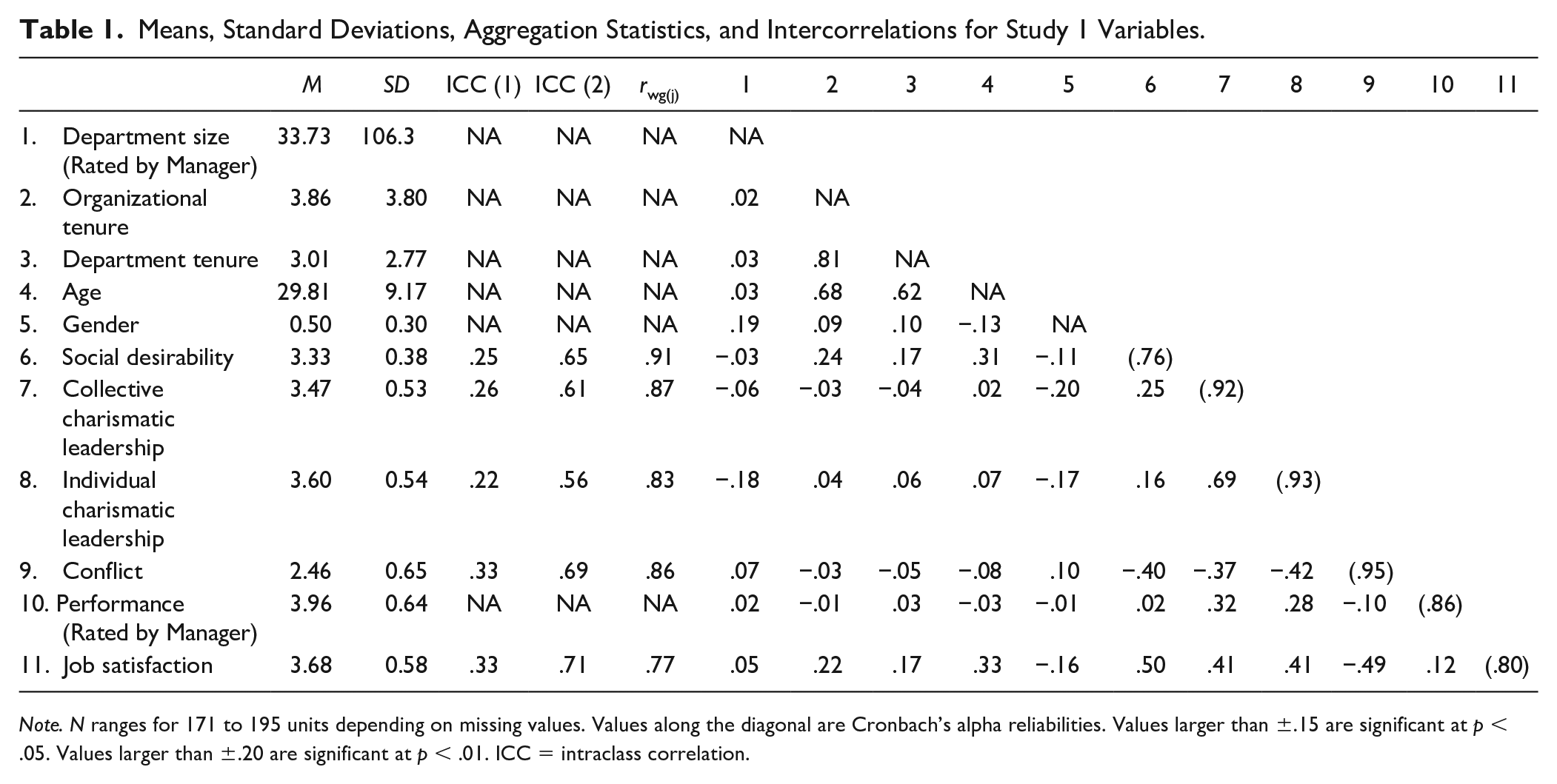
Note. N ranges for 171 to 195 units depending on missing values. Values along the diagonal are Cronbach’s alpha reliabilities. Values larger than ±.15 are significant at p < .05. Values larger than ±.20 are significant at p < .01. ICC = intraclass correlation.
Individual charismatic leadership
We measured individual charismatic leadership of the manager with the four-item idealized influence behavior scale of the Multifactor Leadership Questionnaire (MLQ; Avolio & Bass, 2004). The use of the MLQ to assess charismatic leadership is consistent with prior research (e.g., Brown et al., 2005; Brown & Treviño, 2009; De Cremer & van Knippenberg, 2002; Leong & Fischer, 2011; Paulsen et al., 2009) as “charisma, a major component of transformational leadership, is frequently assessed using the Multifactor Leadership Questionnaire (MLQ)” (DeGroot et al., 2000, p. 357).
Collective charismatic leadership
Similar to individual charismatic leadership, we measured collective charismatic leadership with the same four items, except with a different referent. In particular, we changed the referent from “department manager” to “department employees.” This modification represents a referent shift consensus model (Chan, 1998) and is consistent with Avolio et al.’s (2003; Sivasubramaniam et al., 2002) approach to measuring collective transformational leadership. This referent shift approach to measuring collective leadership has been used by a number of scholars (e.g., Ensley et al., 2006; Hiller et al., 2006; Hoch & Kozlowski, 2014; Pearce & Sims, 2002). While some meta-analyses demonstrate that the referent shift aggregating approach has comparable relationships with outcomes to other approaches such as a network approach (Wang et al., 2014), other meta-analyses have shown that the network approach is more strongly related than aggregate methods (Wu et al., 2020), suggesting that our approach may reduce observed relationships.
Given that collective charismatic leadership and individual charismatic leadership use the same item stems with different referents, we conducted confirmatory factor analyses (CFAs) to examine the factor structure of these two forms of charismatic leadership. We compared the expected two-factor solution of individual and collective charismatic leadership with a one-factor solution that combines these constructs. The two-factor model had adequate fit, χ2(19) = 115.60; standardized root mean square residual (SRMR) = .03; comparative fit index (CFI) = .94, according to Hu and Bentler’s (1999) joint criteria; conversely, a one-factor model did not fit well, χ2(20) = 517.90; SRMR = .13; CFI = .71. As indicated by a change in chi-square test, the two-factor model of individual and collective charismatic leadership fit significantly better than the one-factor model, Δχ2(1) = 402.60, p < .001.
Conflict
We utilized Jehn’s (1995) eight-item measure to assess conflict. This measures both relationship and task conflict, and we examined conflict as a whole. An example item is “There is a lot of tension among employees in my department.”
Performance
We measured unit performance by department manager ratings with the seven-item scale by Delaney and Huselid (1996). An example item from this scale is “How would you compare your department’s performance to other departments that do the same kind of work in terms of quality of products, services, or programs?”
Job satisfaction
We assessed job satisfaction with five items from the measure of job satisfaction by Brayfield and Rothe (1951). Three of these items were also used to assess job satisfaction by Judge et al. (1998). An example item is “I find real enjoyment in my work.”
Controls
In all analyses, we controlled for six variables: department size (reported by the manager), average department tenure, average organizational tenure, employees’ gender, employees’ age, and employees’ social desirability. Social desirability was assessed with 10 items from the short-form of the Marlow–Crowne scale (Strahan & Gerbasi, 1972). We controlled for these variables given the potential effects of size (Karriker et al., 2017, familiarity (Harrison et al., 2003), and demographic factors (Eagly & Johnson, 1990) on leadership and unit functioning.
Analyses
The level of analysis for all analyses was the unit level. We calculated the intraclass correlations ICC(1) and ICC(2) as well as the rwg(j) statistic in order to justify aggregation to the unit level for the measures completed by the employees. As illustrated in Table 1, the values of these statistics met commonly held acceptable standards (Bliese, 2000) providing support for aggregation. Although the ICC(2) values were somewhat low, these values are a function of the number of respondents for each unit (Bliese, 2000; Brown & Treviño, 2009). Furthermore, the ICC(1) values were all significant based on a one-way analysis of variance.
We centered the variables to examine the interactions (Cohen et al., 2002) and graphed them at values of 1 standard deviation above and below the mean. To test moderated mediation, we utilized Hayes’s PROCESS macro (Hayes, 2015, 2018) to examine a first-stage moderation model (Edwards & Lambert, 2007) as Model 7 of the PROCESS macro. We also included the direct effect of the moderating variable of individual charismatic leadership on the outcome of performance and satisfaction to control for its effect. This moderated-mediation approach examines the degree to which an indirect effect is moderated by estimating the difference of conditional indirect effects. The test provides an “index of moderated mediation” that is based on 10,000 bootstrapped samples and a 95% percentile bootstrap confidence interval.
A potential problem that exists with survey research is same-source method bias (Harrison & McLaughlin, 1993). We utilized several approaches to address this problem. First, we controlled for social desirability of employees in all analyses (Podsakoff et al., 2003). This approach seeks to reduce the effects of method variance by partialing out the variance due to social desirability, which is commonly believed to cause common method variance (Podsakoff et al., 2003). Second, we utilized a different source in examining the outcome of performance in terms of manager ratings (Podsakoff et al., 2003). Furthermore, for our interaction hypotheses, same-source bias is not a concern with moderated regression analyses (Evans, 1985; Siemsen et al., 2010) and utilizing employees’ aggregated ratings may provide a more accurate reflection of unit-level properties (Klein et al., 2001), especially for interpersonal processes such as conflict (Fletcher, 2001).
Results
Table 1 displays the descriptive statistics and intercorrelations for the study variables. Hypothesis 1 predicted that collective charismatic leadership would be negatively related to unit-level conflict. This hypothesis was supported as collective charismatic leadership accounted for a significant amount of variance in conflict beyond the controls (ΔR2 = .07, ΔF = 13.69, p < .01; see Model 2 of Table 2).
Hierarchical Regression Analyses for Study 1.
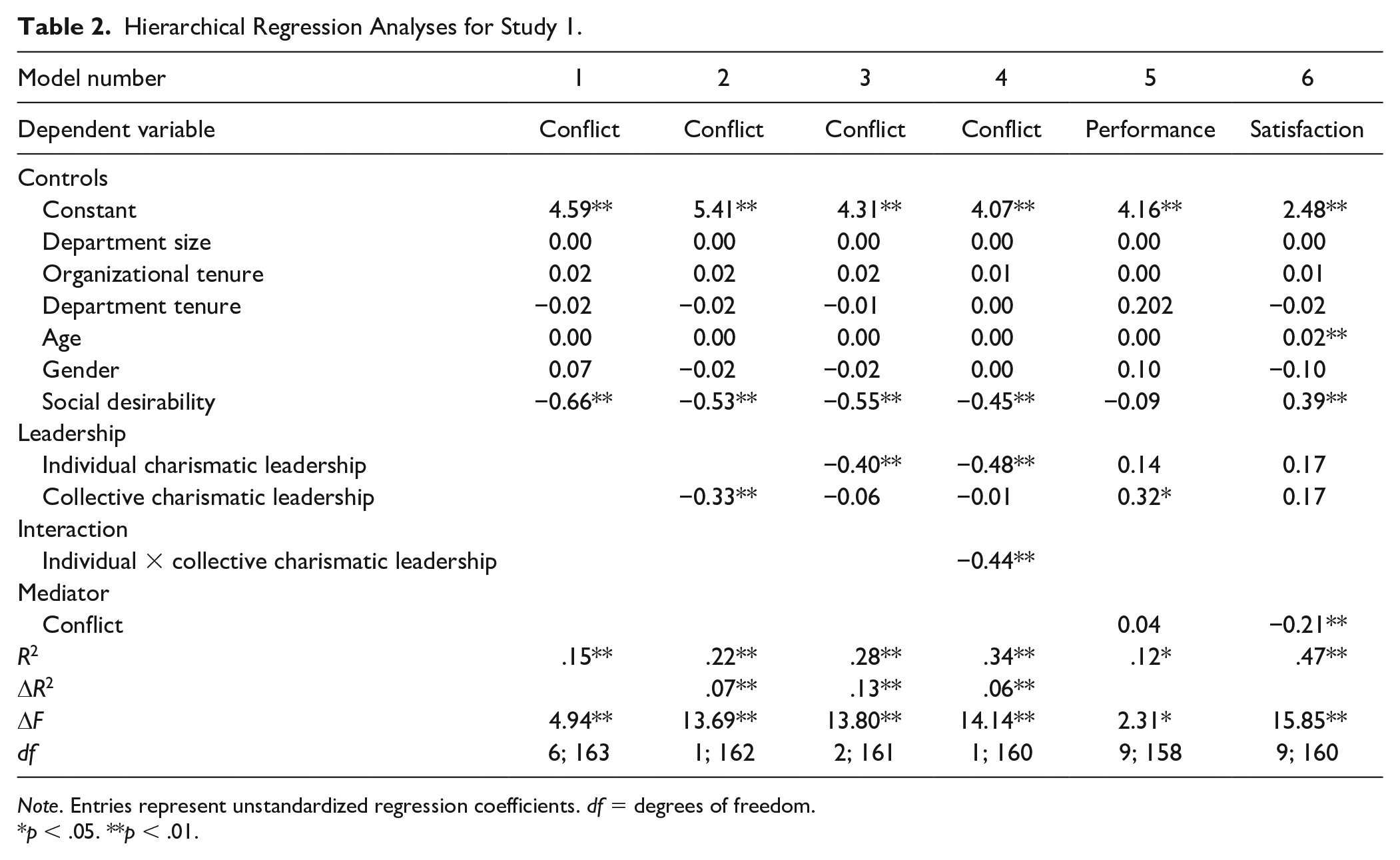
Note. Entries represent unstandardized regression coefficients. df = degrees of freedom.
p < .05. **p < .01.
Hypothesis 2 predicted that the interaction of collective charismatic leadership and individual charismatic leadership would relate to conflict such that high levels of individual charismatic leadership would strengthen the negative relationship between collective charismatic leadership and conflict. This hypothesis was supported (ΔR2 = .06 ΔF = 14.14, p < .01; see Model 4 of Table 2). As displayed in Figure 2, the lowest levels of conflict occurred with high levels of both collective and individual charismatic leadership. The relationship between collective charismatic leadership and employee conflict was stronger in units with high levels (at 1 standard deviation above the mean) of individual charismatic leadership (b = −.25, p < .05) than units with low levels (at 1 standard deviation below the mean) of individual charismatic leadership (b = .22, ns).

Interaction of collective and individual charismatic leadership on conflict: Study 1.
The next set of hypotheses examined moderated mediation and predicted that conflict would mediate the relationship between the interactive effect of collective and individual charismatic leadership with performance (Hypothesis 3) and job satisfaction (Hypothesis 4). Model 5 of Table 2 reports the effect of conflict on performance when including collective charismatic and individual leadership in the model. The resulting index of moderated mediation on performance is −.02 (i.e., the product of −.44 for the interaction term on conflict and .04 for conflict on performance). We generated a bootstrapped bias corrected 95% confidence interval for this index of moderated mediation (the slope of the function of individual charismatic leadership) and the confidence interval included zero [− 0.10, 0.06]. As a result, Hypothesis 3 was not supported. On further examination, this hypothesis may not have been supported given the strong direct effect of collective charismatic leadership on performance (b = .32, p < .05; Model 5 of Table 2), even when including individual charismatic leadership in the model. Model 6 of Table 2 reports the effect of conflict on satisfaction when including collective charismatic and individual leadership in the model. The resulting index of moderated mediation on satisfaction is .09 (i.e., the product of −.44 and −.21) and this value is significant given that the 95% confidence interval excludes zero [0.01, 0.20]. As such, Hypothesis 4 is supported as the indirect effect of collective charismatic leadership on job satisfaction through conflict is moderated by individual charismatic leadership.
Discussion
Taken together, the findings illustrate the importance of collective charismatic leadership on unit functioning. Collective charismatic leadership was negatively related to conflict and this relationship was strengthened when individual charismatic leadership was high. Conflict mediated this interactive relationship with job satisfaction, but not performance. The results highlight the importance of alignment across levels of charismatic leadership and the need for a holistic view to more fully understand its relationship with unit functioning (Shamir & Howell, 1999). To focus only on traditional forms of individual charismatic leadership or emerging forms of collective charismatic leadership results in a decreased ability to fully understand the relationship of charismatic leadership with unit-level functioning. These findings reinforce an integrative model of leadership (Locke, 2003; Pearce et al., 2007) as high levels of individual and collective charismatic leadership complement one another.
In addition to the positive outcomes associated with collective charismatic leadership, the results also highlight a potential negative aspect of it. While the lowest levels of conflict occurred when both collective and individual charismatic leadership were high, the highest levels of conflict existed when collective charismatic leadership was high and individual charismatic leadership was low. This finding illustrates the potential deleterious effects of collective charismatic leadership when it occurs within a context that does not augment it—in this case, low individual charismatic leadership. Consistent with Galvin et al. (2010), the results suggest the important contingency aspects (Donaldson, 2001) of leader level (Shamir & Howell, 1999) in terms of collective and individual charismatic leadership, highlighting both the positive and negative effects of collective leadership. We build from these findings and examine two additional contextual factors in Study 2 based on Shamir and Howell’s (1999) framework.
Study 2
The purpose of Study 2 is to constructively replicate Study 1 and extend it by examining two additional contextual influences based on Shamir and Howell’s (1999) framework to further understand the boundary conditions of collective leadership. We address how collective charismatic leadership aligns with both task complexity and social inclusion, which fits with Shamir and Howell’s (1999) categories of organizational task and culture, respectively. We build from their framework and propose that collective charismatic leadership will be more strongly related to team functioning when coupled with high levels of complexity and social inclusion.
Interactive Effect of Collective Charismatic Leadership and Task Complexity
Bass (1990) noted that “the requirements of the task systematically moderate how different leadership behaviors affect what happens in the group” (p. 633), and tasks have been suggested to play an important role on how groups interact. Tasks have an important relational element as employees’ efforts concerning their work tasks ultimately have an impact on others (Grant et al., 2011), suggesting that the nature of a task should be relevant to the outcomes of collective charisma. Task complexity is the extent to which a job is routine or dynamic in terms of the degree of information sharing and interdependence (Wood, 1986). Task complexity can have contingent relationships on team conflict (Campbell, 1988), suggesting that it is important to understand how this construct fits with the leadership structure in terms of collective charismatic leadership.
We build from Shamir and Howell (1999) and propose that collective charismatic leadership will be more strongly negatively related to conflict as team members’ ratings of task complexity increase. As task complexity increases, so too does the need for information sharing and leadership (Kerr & Jermier, 1978). When a task has multiple, divergent potential solutions (a component of complexity), collective leadership can be especially beneficial. Indeed, Cox et al. (2003) proposed that shared leadership enables supportive and informed evaluation of information and alternatives required by complex tasks.
Collective charismatic leadership should be particularly beneficial in these types of complex environments (Howell & Shamir, 1999). When task complexity is high, work contains a greater level of uncertainty (Wang et al., 2014). Collective charismatic leadership should fit well in these uncertain environments given that charismatic leadership is more strongly related to outcomes under conditions of uncertainty, based on the focus provided by a collective vision (Waldman et al., 2001). As a result, collective charismatic leadership can engender increased levels of buy-in of the unit’s vision, which is especially valuable in a complex environment (Howell & Shamir, 1999). Heightened task complexity can also increase frustrations among team members performing their tasks (Wang et al., 2014). Collective charismatic leadership can help reduce these difficulties given the relational nature of the construct. Charismatic leaders are sensitive to the needs of others (Conger & Kanungo, 1994; Judge & Piccolo, 2004), and this heightened sensitivity associated with collective charismatic leadership should be beneficial for the potential increased frustrations associated with higher levels of task complexity. As a result, we propose,
Interactive Effect of Collective Charismatic Leadership and Social Inclusion
We examine Shamir and Howell’s (1999) category of organizational culture of the department through a focus on social inclusion. Social inclusion is the extent to which individuals perceive themselves to be an “insider” who is an accepted member of their group or organization (Shore et al., 2011; Stamper & Masterson, 2002). Across various studies, feelings of social inclusion are linked with positive outcomes (see Shore et al., 2011, for a review). In addition to an individual-level variable, social inclusion has been conceptualized as a cultural variable where a group as a whole feels socially included (Wasserman et al., 2008). We propose that high levels of social inclusion with the work unit should enhance the negative relationship between collective charismatic leadership and conflict.
When members feel a culture of inclusion, they experience both high levels of belongingness as well as high values of uniqueness (Shore et al., 2011). Both of these elements should facilitate the beneficial effects of collective charismatic leadership and strengthen its negative effects on conflict. When members have a sense of belonging due to inclusion, they participate more fully within the work group and engage at higher levels (Roberson, 2006). This increased level of engagement should magnify the effects of charismatic leadership that involves framing organizational members as part of something bigger than themselves (Shamir et al., 1993). As a result, this feeling of belonging enhances members’ acceptance of the collective that charismatic leadership fosters through vision and mission (Wasserman et al., 2008). Indeed, increased focus on the collective facilitates charismatic leadership (Pillai & Meindl, 1998) due to shared values and perspectives. This feeling of belonging and focus on acceptance of the unit amongst individuals characterized by high levels of social inclusion fosters a mutually reinforcing dynamic, thereby reducing conflict.
Additionally, an important facilitator of inclusion perceptions is whether individuals perceive to have decision-making capabilities (Pelled et al., 1999) in terms of uniqueness. High levels of social inclusion are characterized by individuals’ feelings of being able to contribute fully with their individual talents and in having their voices heard (Shore et al., 2011). These high feelings of uniqueness should facilitate the beneficial effects of collective charismatic leadership in reducing conflict. When individuals feel valued for their unique perspective, they should engage and offer their thoughts and perspectives (Ragins, 2008). As such, individuals will engage more in the decision-making process and therefore be apt to feel part of the vision and mission of the group and further engage with it (Shamir et al., 1993). This higher level of engagement through feeling valued should magnify the effects of collective charismatic leadership in reducing conflict (Nishii, 2013). Based on these aspects of belongingness and uniqueness of social inclusion facilitating the beneficial effects of collective charismatic leadership, we propose,
Moderated Mediation Effects
Similar to study 1, we place these interactive effects within a moderated mediation framework. Based on the prior arguments that conflict is negatively related to performance and satisfaction based on the underlying information processing perspective (De Dreu & Weingart, 2003), we propose that conflict will mediate the interaction of collective charismatic leadership with both task complexity and social inclusion on performance and satisfaction, respectively.
Method
Sample and Procedure
In a separate data collection, we utilized the same methodology as Study 1 and utilized undergraduate students to identify a focal individual within organizations to utilize a snowball sampling approach to then survey a total of five employees and the manager within departments from a variety of organizations in the United States. We received responses from 1,423 employees based on the 1,915 employee surveys we administered (74.3% response rate) and 293 department managers from the 383 manager surveys (76.5% response rate). Similar to Study 1, we included departments that had at least three employee respondents and a response from the manager. The resulting sample was 285 departments consisting of 1,394 employees (average of 4.89 respondents per each department in the final sample) and 285 department managers. The average departmental response rate was 42.2% such that 42.2% of employees within a department completed the survey. 4 The employee sample was 43.3% male, 61.4% White, 14.3% Hispanic, and 11.4% Black, and averaged 30.3 years of age. The supervisor sample was 55.4% male, 64.7% White, 8.8% Hispanic, and 7.2% Black, and averaged 38.5 years of age.
Measures
All measures were assessed on a 5-point Likert-type scale ranging from 1 (strongly disagree) to 5 (strongly agree). All measures demonstrated acceptable Cronbach alpha reliabilities which are reported along the diagonal of Table 3. We utilized the same measures as Study 1 for individual charismatic leadership, collective charismatic leadership, conflict, and job satisfaction. Similar to Study 1, we examined conflict as a whole given the high correlations between task and relationship conflict (r = .89) in the sample. Furthermore, like Study 1, a nested CFA demonstrated that a two factor model, χ2(19) = 315.12; SRMR = .03; CFI = .96, of collective and individual charismatic leadership fit the data significantly better than a one factor combined model, χ2(20) = 2289.99; SRMR = .15; CFI = .68, based on a change in chi-square test, Δχ2(1) = 1974.87, p < .001.
Means, Standard Deviations, Aggregation Statistics, and Intercorrelations For Study 2 Variables.

Note. N ranges for 276 to 285 units depending on missing values. Values along the diagonal are Cronbach’s alpha reliabilities. Values larger than ±.12 are significant at p < .05. Values larger than ±.16 are significant at p < .01.
ICC = intraclass correlation.
Task Complexity
Employees completed Podsakoff and MacKenzie’s (1994) five-item measure of task complexity. An example item is “My job is rather simple and routine” (reverse scored).
Social Inclusion
Social inclusion was assessed with a three-item measure by Stamper and Masterson (2002). An example item is “My department makes me believe that I am included in it.”
Performance
We measured unit performance with six items from the scale by Alper et al. (2000). The department manager completed this scale and an example item is “My department employees work effectively.” We measured performance with a different scale in Study 2 given the potential limitations of the performance scale in Study 1 that may have mitigated the moderated-mediation results. The Delaney and Huselid (1996) measure used in Study 1 was originally developed to assess organizational-level performance by a HR executive over a 3-year time window. Conversely, the Alper et al. (2000) measure was designed to measure performance in teams as assessed by a manager, which is more in keeping with the approach of our study.
Controls
Based on the justifications in Study 1, we utilized the same control variables: department size (reported by the manager), average department tenure, average organizational tenure, employees’ gender, employees’ age, and employees’ social desirability.
Analyses
Similar to Study 1, we calculated the ICC(1), ICC(2), and rwg(j) statistics in order to justify aggregation to the unit level for the employees’ measures. As illustrated in Table 3, the values of these statistics met commonly held acceptable standards (Bliese, 2000) and the ICC(1) values were significant based on a one-way analysis of variance, providing support for aggregation. We utilized the same analytical approach as Study 1 including Hayes’ (2015, 2018) index of moderated mediation to examine first-stage moderation models (Edwards & Lambert, 2007) while including the direct effect of the moderator on performance and satisfaction. To address same-source method bias, we also utilized the same approaches as Study 1 including controlling for employees’ social desirability (Podsakoff et al, 2003), utilizing managers’ ratings of performance (Podsakoff et al., 2003), and examining interactive effects whereby same source bias is not a concern (Evans, 1985; Siemsen et al., 2010).
Results
Table 3 displays the descriptive statistics and intercorrelations for the study variables. We first replicated the results from Study 1. Hypothesis 1 was supported as collective charismatic leadership was negatively related to conflict (ΔR2 = .01, ΔF = 3.98, p < .05; see Model 2 of Table 4).
Hierarchical Regression Analyses With Individual Charisma for Study 2.
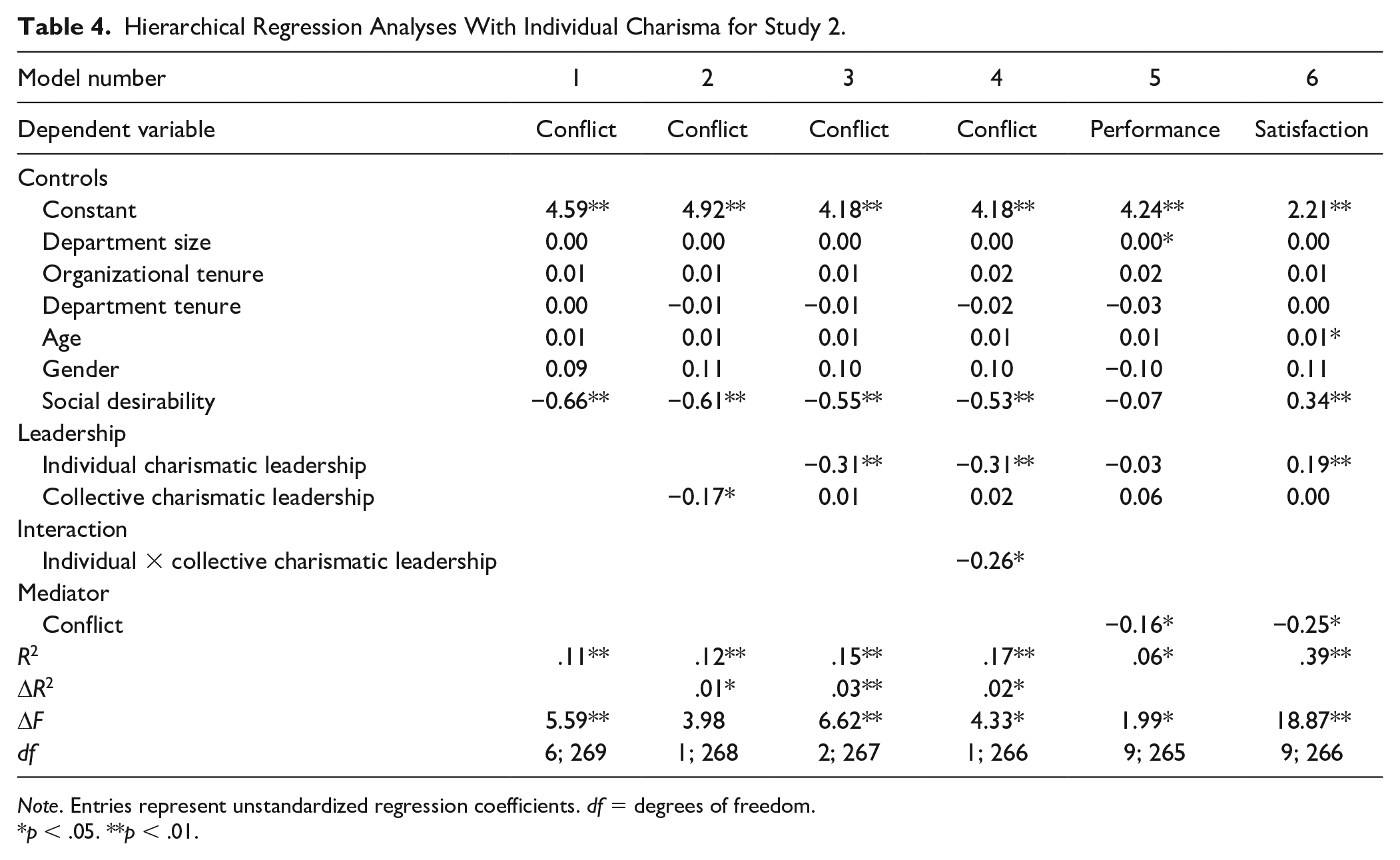
Note. Entries represent unstandardized regression coefficients. df = degrees of freedom.
p < .05. **p < .01.
Hypothesis 2 was supported as the interaction of collective charismatic leadership and individual charismatic leadership was negatively related to conflict (ΔR2 = .02, ΔF = 4.33, p < .05; see Model 4 of Table 4). Figure 3 depicts a similar shape to Study 1 such that the lowest level of conflict was when collective charismatic leadership was coupled with high individual charismatic leadership (b = −.11, ns), whereas the highest level was for low individual charismatic leadership (b = .15, ns).
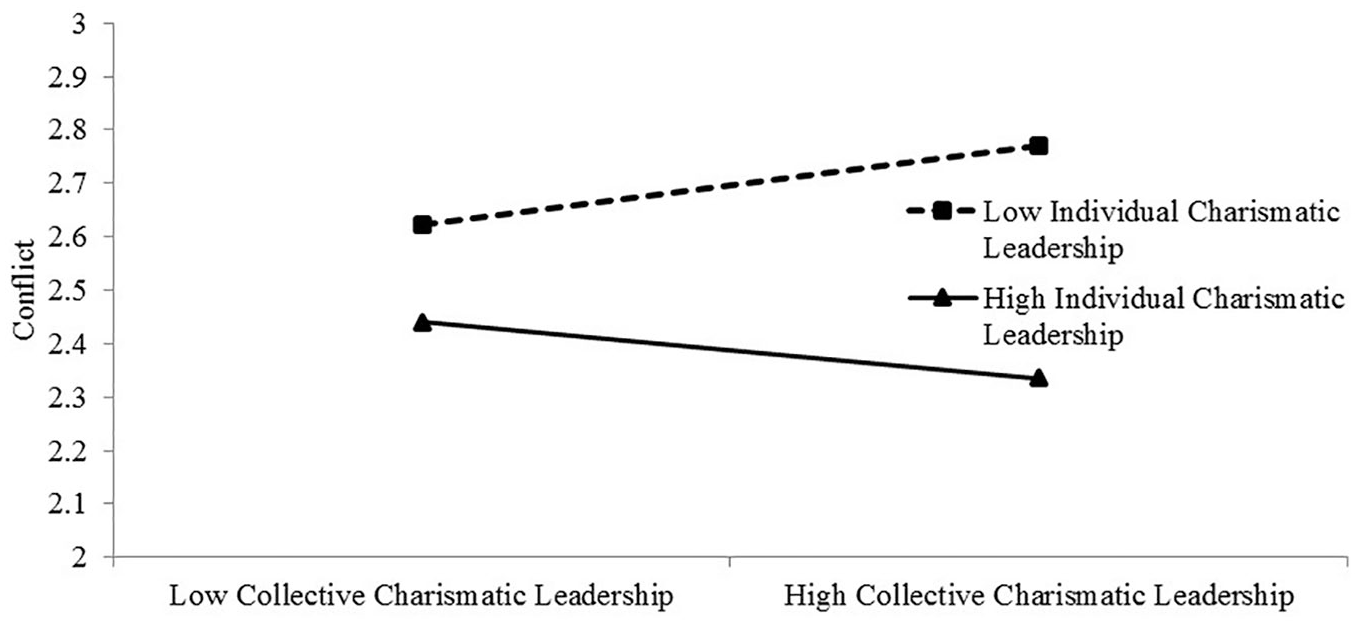
Interaction of collective and individual charismatic leadership on conflict: Study2.
Hypotheses 3 and 4 were not supported. Model 5 of Table 4 reports the effect of conflict on performance when including both individual and collective charismatic leadership in the model. The resulting index of moderated mediation was .04 and the confidence interval included zero [−.01, .11] such that Hypothesis 3 was not supported. Model 6 of Table 4 provides the relationship of conflict on satisfaction when including both individual and collective charismatic leadership in the model. The index of moderated mediation was .07 and the confidence interval included zero [−.02, .14] such that Hypothesis 4 was also not supported.
Collectively, these results replicated Hypotheses 1 and 2, but did not support Hypothesis 3 and did not support or replicate Hypothesis 4. As such, the findings provide further support for the main effect of collective charismatic leadership on conflict as well as the interaction of collective and individual charismatic leadership on conflict. However, there is no support for the effect for moderated-mediation on performance or satisfaction.
Hypothesis 5 predicted that task complexity would moderate the relationship between collective charismatic leadership and conflict such that the relationship would be enhanced when task complexity was high. The results supported this hypothesis as the interaction between collective charismatic leadership and task complexity was related to conflict (ΔR2 = .03, ΔF = 10.18, p < .01; Model 3 of Table 5). As can be seen in Figure 4, when task complexity was high, collective charismatic leadership was negatively related to conflict (b = −.40, p < .01). However, when task complexity was low, the relationship between collective charismatic leadership and conflict was relatively flat (b = .06, ns).
Hierarchical Regression Analyses With Task Complexity for Study 2.
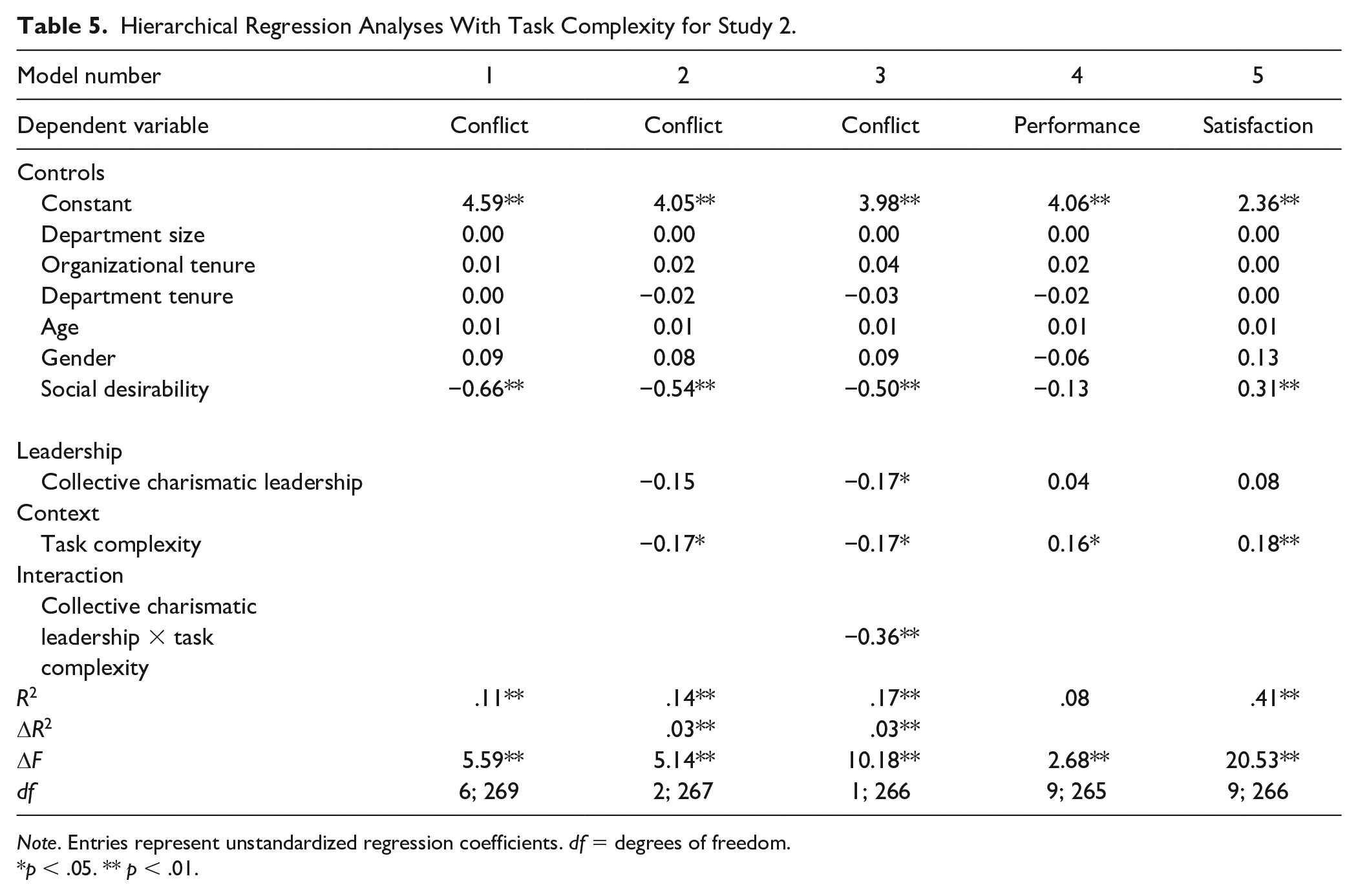
Note. Entries represent unstandardized regression coefficients. df = degrees of freedom.
p < .05. ** p < .01.

Interaction of collective charismatic leadership and task complexity on conflict: Study2.
Hypothesis 6 predicted that collective charismatic leadership would interact with social inclusion to predict conflict. This hypothesis was supported as the interaction was significant (ΔR2 = .01, ΔF = 4.45, p < .05; see model 3 of Table 6). 5 As predicted and illustrated in Figure 5, high levels of both collective charismatic leadership and social inclusion (b = −.13, ns) were associated with the lowest levels of conflict, whereas low social inclusion (b = .14, ns) resulted in the highest levels of conflict. While neither simple slope was significant, the significant interaction term demonstrates that these slopes differ from another.
Hierarchical Regression Analyses With Social Inclusion for Study 2.
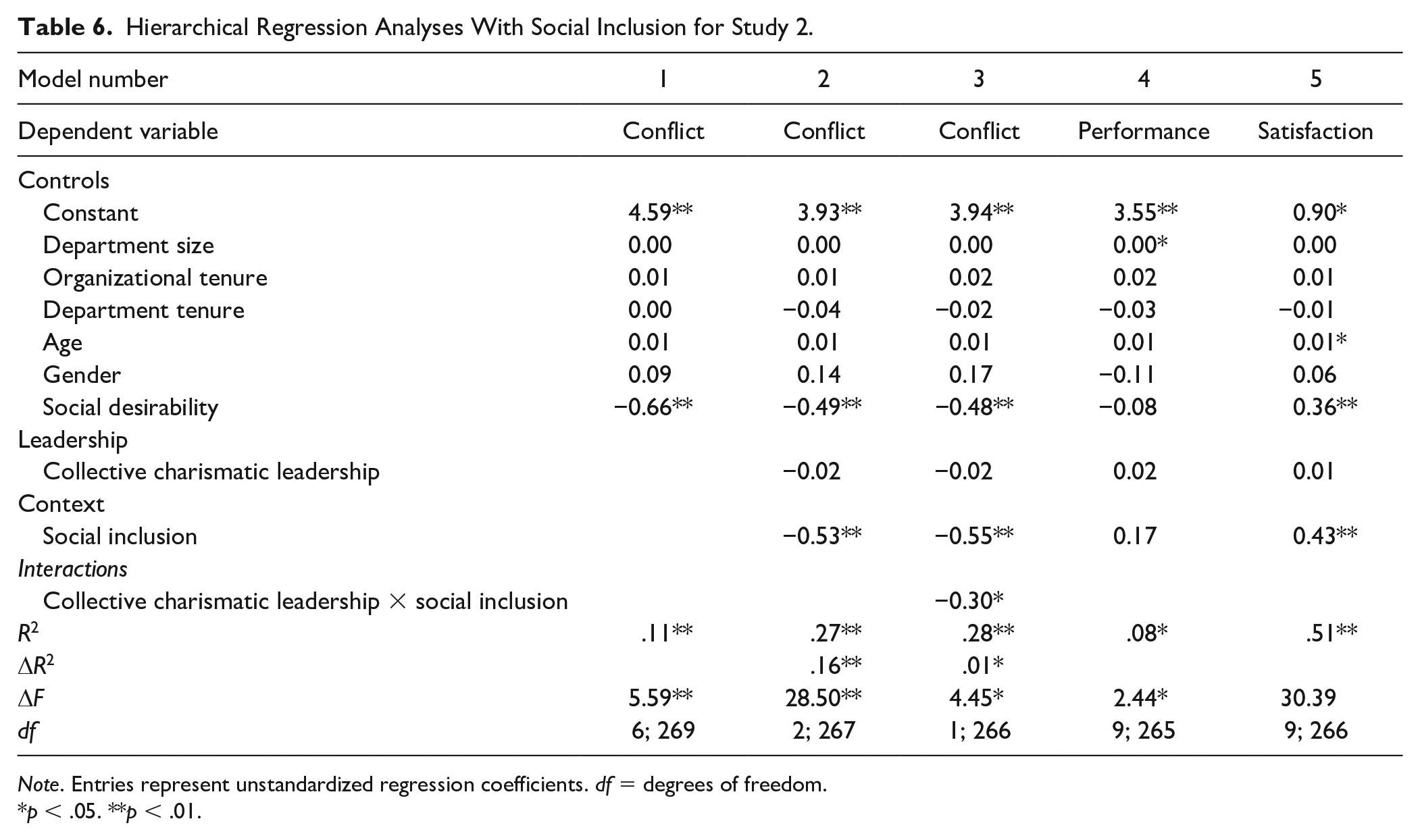
Note. Entries represent unstandardized regression coefficients. df = degrees of freedom.
p < .05. **p < .01.
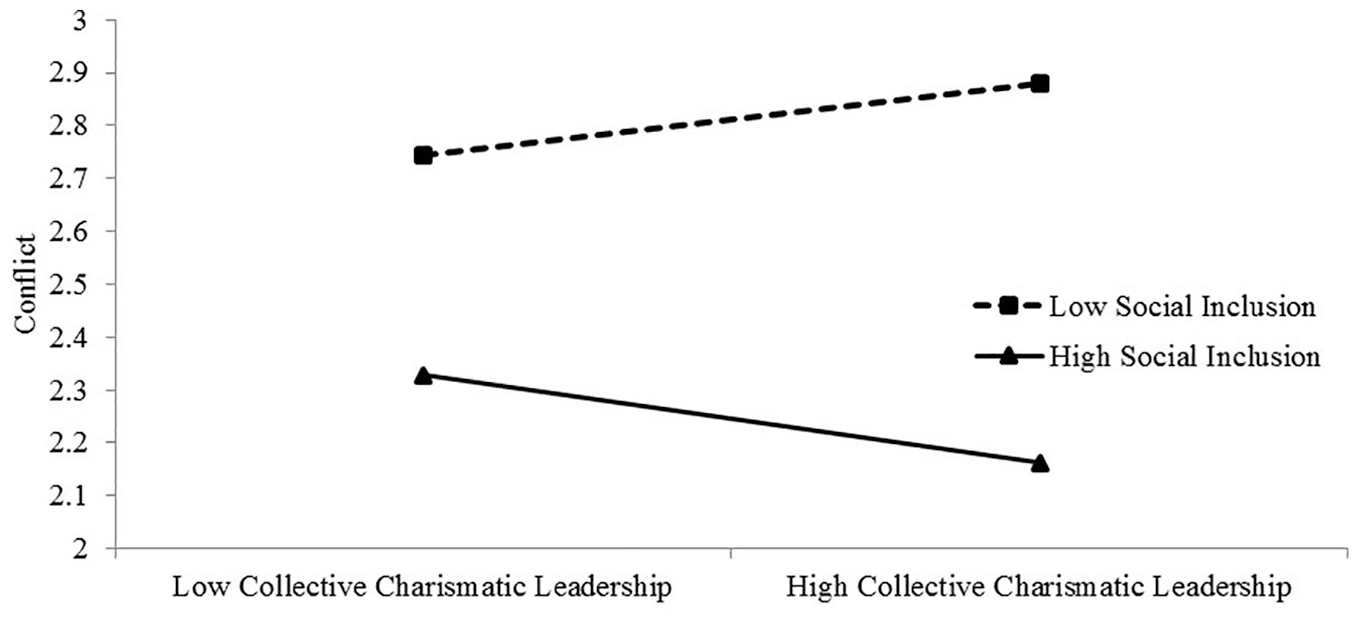
Interaction of collective charismatic leadership and social inclusion on conflict: Study2.
The next set of hypotheses examined moderated mediation and predicted that conflict would mediate the relationship between the interactive effect of collective charismatic leadership and task complexity with performance (Hypothesis 7) as well as job satisfaction (Hypothesis 8). The effect of conflict on performance and job satisfaction when including collective charismatic leadership and task complexity in the model are reported in Models 4 and 5 of Table 5, respectively. The resulting index of moderated mediation on performance was .05. Based on 10,000 bootstrapped samples, this value supports Hypothesis 7 as the 95% confidence interval excludes zero [.001, .11]. Hypothesis 8 was also supported. The index of moderated mediation on job satisfaction was .09 and the confidence interval excluded zero [.03, .16].
The next set of hypotheses predicted moderated mediation such that conflict would mediate the interaction between collective charismatic leadership and social inclusion with performance (Hypothesis 9) and job satisfaction (Hypothesis 10). The effect of conflict on performance and job satisfaction when including collective charismatic leadership and social inclusion in the model are reported in Models 4 and 5 of Table 6, respectively. The index of moderated mediation on performance was .03 and the confidence interval included zero [−.01, .10] such that Hypothesis 9 was not supported. The index of moderated mediation on job satisfaction was .04 and excluded zero [.001, .10] providing support for Hypothesis 10.
Discussion
The goal of this second study was to further understand how and when collective charismatic leadership was related to team functioning through the consideration of the two contextual elements based on Shamir and Howell’s (1999) framework: Task complexity and social inclusion. The results replicated and reinforced the main effect of collective charismatic leadership on conflict as well as the interactive effective of collective and individual charismatic leadership. Furthermore, the findings illustrated that high levels of task complexity and social inclusion enhanced the negative relationship of collective charismatic leadership and conflict. These findings are noteworthy as they illustrate the importance of collective charismatic leadership’s alignment with leader level, organizational task, and organizational culture factors from Shamir and Howell’s (1999) framework.
Similar to Study 1, the results of Study 2 also highlighted the potential negative aspects of collective charismatic leadership. In particular, the highest levels of conflict existed when collective charismatic leadership was high and individual charismatic leadership, task complexity, and social inclusion were low. Taken together, these findings suggest that although collective charismatic leadership can have increasingly beneficial effects on team functioning, it can also have increasing detrimental effects if it does not align appropriately within the contextual aspects of the leader level, task, and culture. These contingency effects of charismatic leadership (Donaldson, 2001; Galvin et al., 2010) are an important consideration for fully understanding collective aspects of leadership (Shamir & Howell, 1999; K. J. Klein & House, 1995).
General Discussion
The purpose of this research was to better understand how and when collective forms of leadership relate to unit functioning and outcomes building from Shamir and Howell’s (1999) contingency framework of charismatic leadership. Across two studies, our results illustrate that collective charismatic leadership is negatively related to team conflict, and this relationship is stronger when individual charismatic leadership, task complexity, and social inclusion are high. For moderated mediation, the interactions of collective charismatic leadership with task complexity and social inclusion are ultimately related to team performance and satisfaction through conflict. These findings move beyond recent meta-analyses (D’Innocenzo et al., 2016; Nicolaides et al., 2014; D. Wang et al., 2014; Wu et al., 2020) to provide a more nuanced perspective of when and how collective forms of leadership are related to unit functioning. Extending the literature further, our findings provide insight into contexts when collective charismatic leadership may even be associated with increased conflict within teams. As a result, we highlight this potential “dark side” of collective charismatic leadership and offer balance to the positive views surrounding collective forms of leadership.
Implications
Theoretical Implications
The results highlight the contingency approach (Donaldson, 2001) to collective charismatic leadership; it is necessary to consider how collective forms of leadership match with the contextual elements (Johns, 2006). Stemming from this contingency perspective, the results not only highlight when collective leadership is beneficial but also illustrate the potential negative aspects. Although scholars have mainly extolled the virtues of collective forms of leadership (Contractor et al., 2012; Denis et al., 2012; Friedrich et al., 2009), the current study not only lends support to this view but also gives pause by illustrating the detrimental relationships of collective charismatic leadership in certain contexts. When collective charismatic leadership did not fit with the context, the highest levels of conflict occurred when high levels of collective charismatic leadership were coupled with low levels of individual charismatic leadership, task complexity, and social inclusion. There are several potential reasons for these negative effects that all draw from a lack of alignment with collective charismatic leadership (Shamir & Howell, 1999). While we did not formally hypothesize these negative trends for high levels of collective charismatic leadership, we offer several possible explanations for the shape of these effects.
When individual charismatic leadership is low, the specific nature of the values and mission may not cascade to the lower levels for collective charismatic leadership (Burns, 1978; Waldman & Yammarino, 1999). Without this guidance, there may be status contests at the collective level (Anderson & Brown, 2010) in terms of what charismatic vision is the most appropriate. When individual charismatic leadership is low, no role model of charismatic leadership exists and attitudes decrease (Farahnak et al., 2020). Thus, situations in which employees display different types of charismatic leadership may result in conflict as there is no nominal hierarchy to resolve this issue (Anderson & Brown, 2010).
When task complexity is low, there simply may not be a need for collective charismatic leadership (D’Innocenzo et al., 2016). When the work is routine, the benefits of collective charismatic leadership are not necessary to complete the work. Thus, in the case of low task complexity, the costs of the added coordination and communication associated with collective forms of leadership (Klein et al., 2006) outweigh any slight marginal benefit given that there is little need for backup behaviors or diversity of thought with low complexity tasks.
For social inclusion, when individuals do not feel part of the larger collective, they are likely to dismiss or work against it given social categorization perspectives. Based on similarity-attraction principles, if an individual does not feel included in a group, she or he will most likely reject the ideals (Williams & O’Reilly, 1998). In this regard, when individuals perceive low social inclusion with the larger unit, they will not engage with the ideas or perspectives of others in the unit and may even reject them, thereby increasing the levels of conflict within the unit.
In addition to highlighting the potential negative effects of collective forms of leadership in certain contexts, the findings illustrate that charismatic leadership operates at multiple levels in its association with team functioning. Focusing on only one level results in an incomplete picture of the effect of charismatic leadership within units. Accordingly, charismatic leadership theory and research should take a more holistic view as most studies approach leadership from an individual level of analysis by focusing on the nominal leader (Yammarino & Dansereau, 2008). The findings help affirm that charismatic leadership can be viewed as both an individual behavior as well as an emergent, collective relational process (Murphy & Ensher, 2008).
Practical Implications
From a practical standpoint, our findings suggest that organizations should be mindful of the potential for collective charismatic leadership in units. In addition to recognizing the charismatic leadership capabilities of the designated individual leader, organizations should also focus on all members as potentially displaying charismatic leadership. Organizations should not reserve leadership training and development solely for the nominal individual in charge of the unit. Instead, organizations should focus on developing and fostering leadership as a collective in order to further facilitate effective unit functioning (Eva et al., 2019).
In addition to a focus on developing collective leadership, organizations should be mindful of factors that can facilitate or inhibit its effectiveness. One salient factor in this regard is the nominal or designated leader. Our findings echo prior work on the importance of the charismatic leadership of a supervisor (Farahnak et al., 2020) and demonstrate how it is especially important when considered in conjunction with the collective charismatic leadership of the unit. In particular, the highest levels of conflict occurred when collective charismatic leadership was high, but individual charismatic leadership by the supervisor was low. Thus, while organizations should focus developmental opportunities for the collective unit, they should not do so at the expense of the individual supervisor. Leadership development should focus on both the individual supervisor and team simultaneously (Day & Harrison, 2007).
In addition to attending to the leadership development of both the nominal leader and the unit, organizations should also pay attention to the broader environment in terms of social inclusion. As low levels of social inclusion can dampen the effects of collective charismatic leadership, managers should attempt to facilitate feelings of acceptance by members of a unit rather than creating different subgroups (Shore et al., 2011). If organizations can foster a climate of inclusion (Wasserman et al., 2008), they will be able to better leverage the effects of collective forms of charisma for unit performance.
Limitations and Future Directions
The current research is limited in several respects. First, the cross-sectional nature of the design limits any causal inferences that could be drawn from it. Although we suggest that collective charismatic leadership influences conflict, it may be that conflict also influences collective charismatic leadership. This possibility fits with Day et al.’s (2004) conceptualization of collective forms of leadership as both an input and outcome of processes. In order to address this possibility, future research should employ a longitudinal design to test and understand the causal relationships (Gupta et al., 2010).
Another limitation of the current research is that it only focuses on one type of leadership behavior in terms of charismatic leadership and only one measure of charismatic leadership. We suggest that charismatic leadership is a theoretically meaningful construct given the focus on individual and collective leadership behaviors, and prior theorizing has proposed that charismatic leadership occurs at these multiple levels (Murphy & Ensher, 2008). Furthermore, focusing specifically on charismatic leadership helps address problems of studying more general forms of transformational leadership across numerous dimensions (van Knippenberg & Sitkin, 2013). However, we recognize that focusing on only one leadership behavior potentially limits the generalizability to other forms of collective leadership. As a result, future research should expand this focus to include multiple dimensions of leadership, such as ethical collective leadership or authentic collective leadership, for a more complete picture of how different types of leader behaviors operate at different levels of analysis. Furthermore, consistent with prior research (e.g., Brown & Treviño, 2009; Brown et al., 2005; De Cremer & van Knippenberg, 2002; Paulsen et al., 2009) and theory (Bass, 1985), this study conceptualized charismatic leadership as idealized influence from the MLQ. Incorporating additional models of charismatic leadership (e.g., Conger & Kanungo, 1987; Shamir et al., 1993) would help provide a more expansive view of individual and collective charismatic leadership.
An additional potential measurement limitation is that we assessed collective charismatic leadership with a referent shift perspective consistent with prior research (e.g., Avolio et al., 2003; Hoch & Kozlowski, 2014; Pearce, 2004) instead of other approaches such as network density (e.g., Carson et al., 2007). We were unable to utilize a network approach given the sampling strategy. While we were able to sample a large number of units across a variety of organizations, we were unable to obtain unit membership rosters in advance that are necessary for a network approach. However, across the existing collective leadership research, meta-analytic evidence suggests that differing approaches to measuring collective leadership (e.g., referent shift, network, individual, etc.) has either little impact on the magnitude of the relationship with outcomes (Wang et al., 2014) or aggregate approaches are more conservative in their estimates than network approaches of collective leadership. Indeed, scholars have concluded that “there is no ‘one best way’ to measure shared leadership” (Hoch & Kozlowski, 2014, p. 392). At the same time, additional measurement approaches such as a network perspective would help provide a more complete assessment of collective charismatic leadership.
A final potential limitation is common method variance. Although we attempted to address this issue with multiple strategies including controlling for social desirability and utilizing managers’ ratings of performance (Podsakoff et al., 2003), a possibility exists that some relationships are inflated. This possibility is heightened for the main effect relationship between collective charismatic leadership and conflict. As the other hypotheses examine interactive effects, and the managers rated performance, common method variance should not impact these findings (Evans, 1985) and using the same source in examining interactions may actually deflate the results (Siemsen et al., 2010). However, using subjective performance measures from the managers also has limitations. Given the sampling strategy, it was not possible to obtain an objective indicator of performance across the variety of organizations (Podsakoff et al., 2003). As such, future research should look to assess objective indicators of performance to examine how collective leadership affetcs nonperceptual outcomes.
Conclusion
In order to more fully understand the nature of charismatic leadership in units, it is necessary to take a multilevel view to examine collective charismatic leadership as well as consider the context with which this shared form of leadership resides (Grille et al., 2015). The results of the two studies generally highlight the contingent benefits of collective charismatic leadership. The negative relationship of collective charismatic leadership with conflict is strengthened with high levels of individual charismatic leadership, task complexity, and social inclusion, and this interactive effect with task complexity is transmitted to team performance and satisfaction, while the interactive effect with social inclusion is transmitted to satisfaction. As such, scholars and practitioners need not only be aware of the potential positive benefits of collective forms of charismatic leadership but also recognize the potential neutralized or negative aspects of it when not placed in the proper context. This more holistic view of leadership and the context allows for a deeper understanding of the complexities of charismatic leadership in units. As organizational structures are becoming more complex, so too should conceptualizations of how organizations are led (Day & Harrison, 2007) to further incorporate collective forms of charismatic leadership within appropriate contexts.
Supplemental Material
sj-pdf-1-jlo-10.1177_1548051820986536 – Supplemental material for Collectivistic Leadership in Context: An Examination of How and When Collective Charismatic Leadership Relates to Unit Functioning
Supplemental material, sj-pdf-1-jlo-10.1177_1548051820986536 for Collectivistic Leadership in Context: An Examination of How and When Collective Charismatic Leadership Relates to Unit Functioning by Jonathan C. Ziegert, David M. Mayer, Ronald F. Piccolo and Katrina A. Graham in Journal of Leadership & Organizational Studies
Footnotes
Acknowledgements
We thank Lauren D’Innocenzo for helpful feedback on the manuscript.
Declaration of Conflicting Interests
The author(s) declared no potential conflicts of interest with respect to the research, authorship, and/or publication of this article.
Funding
The author(s) received no financial support for the research, authorship, and/or publication of this article.

Notes
Author Biographies
References
Supplementary Material
Please find the following supplemental material available below.
For Open Access articles published under a Creative Commons License, all supplemental material carries the same license as the article it is associated with.
For non-Open Access articles published, all supplemental material carries a non-exclusive license, and permission requests for re-use of supplemental material or any part of supplemental material shall be sent directly to the copyright owner as specified in the copyright notice associated with the article.
