




Abstract
We investigated the turnover intentions of employees who perceive that they are being treated with more or less abusive supervision than their coworkers. We call this incongruent abusive supervision. Our findings support our theory that employees associate incongruent abusive supervision with the anticipation of social exclusion from their coworkers. Furthermore, this appraisal of social exclusion threat is associated with feelings of shame, which, in turn, increase turnover intentions. Two experimental vignettes provide support for our theoretical model. These findings demonstrate the effect that incongruent abusive supervision has on employees’ reactions to abusive supervision and introduces shame as an emotional mechanism important for understanding employee responses to supervisor abuse both when they are singled out for abuse and when they are spared abuse while their coworkers are not.
Keywords
Most studies into abusive supervision, “the sustained display of hostile verbal and nonverbal behaviors, excluding physical contact,” (Tepper, 2000, p. 178) have looked at the consequences of focal employees’ perceived abuse by their supervisor. In an attempt to understand why employees often respond adversely to abusive supervision, researchers have started to focus on emotions such as anger and fear (Atwater et al., 2016; Kiewitz et al., 2016; Mitchell et al., 2015; Oh & Farh, 2017). These emotions are important in understanding abusive supervision because they are considered hardwired, basic emotions (or “affect programs”) that are innate, fast, and trigger behavior with high survival value (Ekman & Davidson, 1994). In particular, the current literature has typically argued that the targets of abuse assume the role of the victim and blame the supervisor and/or the organization for the abuse (Bowling & Michel, 2011; Lian et al., 2014; Shoss et al., 2013; Tröster & Van Quaquebeke, 2020; for general research on victimization, see Aquino & Thau, 2009). Accordingly, researchers have typically assumed that employee responses to abusive supervision directly target the perpetrator and are driven by emotions such as anger.
However, this perspective has recently been challenged by studies showing that people may also experience more self-conscious reactions such as shame (Farh & Chen, 2014; Peng et al., 2019) or guilt (Tröster & Van Quaquebeke, 2020). These studies are based on the notion that individuals’ responses to abusive supervision are highly dependent on the extent to which their coworkers are being abused by the same supervisor (Duffy et al., 2006; Farh & Chen, 2014; Peng et al., 2014, 2019; Schaubroeck et al., 2016) and that people generally prefer to be treated better than their coworkers by their leaders (Matta & Van Dyne, 2020). Accordingly, previous work has shown that people experience less shame when they experience less abuse than their peers (Peng et al., 2019).
In this research, we extend these previous studies by theorizing and empirically testing whether shame is similarly experienced by employees who are spared abusive leader treatment while their coworkers are not. We base this theoretical elaboration on information threat theory (Sznycer, 2010; Sznycer et al., 2012, 2016), according to which shame arises when individuals anticipate social exclusion because they perceive others to hold reputation-damaging beliefs about them. We will argue that employees who are being spared abuse may, for example, anticipate being viewed as “brownnosers” or “cowards.” Thus, our study heeds calls for increased research on shame in organizations (Daniels & Robinson, 2019) by showing that employees may experience shame not only when they are treated with more abusive supervision than their peers but also when they experience less abusive supervision. Thereby, we more generally challenge the notion that people prefer to be treated better by their leaders compared to their coworkers (Matta & Van Dyne, 2020; Thau et al., 2013).
Theory and Hypotheses
To examine the consequences of incongruent abusive supervision, we rely on appraisal theories of emotions (Arnold, 1960; Lazarus, 1966), which assert that emotions are adaptive responses to salient features in the environment, appraised as important for the individual's well-being. Appraisal theories of emotion claim that the same event may result in different emotional and behavioral reactions due to differences in an event’s context or in an individual’s concerns (Moors, 2009). Thus, it is not the event itself that determines one's reaction, but how the event is appraised (Ellsworth, 2013). According to appraisal theories, novel events, or a lack of predictable events, warrant increased attention as they can signal danger (Ellsworth & Scherer, 2003). Here we argue that incongruence between one's own and one's coworkers’ abusive supervision is conspicuous, demanding greater attention. In a work environment where a focal employee is spared abuse by the supervisor while coworkers are not, the focal employee's lack of abuse would effectively single them out. Similarly, if a focal employee is abused by the supervisor while coworkers are spared, this abuse would be atypical and notable in an otherwise nonabusive workplace. Hence, incongruence between a focal employee's and their coworkers’ abusive supervision should single out the focal employee from their coworkers. Indeed, previous studies found that individual responses to abusive supervision varied with the level of coworkers’ abusive supervision (Farh & Chen, 2014; Peng et al., 2019), which supports our argument that it is an important environmental stimulus for employees.
Whether employees are treated with more or less abuse than their coworkers is important for the focal employee because, typically, there are no objective standards for what constitutes high or low levels of abusive supervision (Tepper et al., 2017). To know that one is treated with less respect than one's coworkers signals that the focal employee is at risk of becoming an outsider because it signals low status in their work group (Smith et al., 1998; Tyler et al., 1996). Specifically, experiencing more abusive supervision relative to one's coworkers is associated with perceptions that one's coworkers do not respect them (Schaubroeck et al., 2016). This status differential can negatively affect individuals’ relationships with coworkers because coworkers may socially exclude them, believe that the abuse the individual receives is warranted, or gain a sense of pleasure from the individual's situation (Leon & Halbesleben, 2015; Mitchell et al., 2015; Xu et al., 2020). Relatedly, research finds that coworkers are less likely to help employees who are victims of high levels of abusive supervision (Peng et al., 2014) and coworkers can even be motivated to actively undermine these victims (Xu et al., 2020). Experiences such as these, which communicate rejection, can instill in individuals an anticipation of future social rejection (Downey & Feldman, 1996; Feldman Barrett & Swim, 1998). In line with these findings, we predict that employees singled out for abuse by their supervisor will anticipate social exclusion from their coworkers.
Importantly, employees who are treated with more abusive supervision than their coworkers should not be the only ones to anticipate social exclusion. We argue that the same is true for focal employees who perceive that they receive less abusive supervision than their coworkers. This is in line with Exline and Lobel's (1999) arguments that individuals who perceive themselves as targets of others’ upward social comparisons because they are somehow better off experience interpersonal strain and concerns of social exclusion. Catalysts for this sensitivity to being the target of a threatening upward comparison include “fairing better than another … [i.e.] by having more satisfying relationships, or by being spared some tragedy [emphasis added]” (Exline & Lobel, 1999, p. 308). We, therefore, argue that comparatively less abusive supervisor treatment will likely cause interpersonal strain in organizations (Ogunfowora, 2013). In group contexts (i.e., organizations), better fairing individuals can be faced with social disapproval and exclusion from the less fortunate due to less fortunate individuals’ feelings of envy (Feather, 1994; Leary, 1990; Tice & Baumeister, 1990; Williams & Sommer, 1997). Furthermore, employees who have a better relationship with the supervisor (i.e., are spared abuse while their coworkers are not) could be concerned that their coworkers consider them either as a “brownnoser” (Bowler et al., 2010), untrustworthy (Dunn et al., 2012), or cowardly for not standing up to the abusive supervisor on their coworkers’ behalf (DeSmet et al., 2014). We, therefore, similarly expect that employees spared abuse by their supervisor, while their coworkers are not, will anticipate social exclusion from their coworkers.
Taken together, we expect that abusive supervision incongruence will lead to greater anticipation of social exclusion. There is empirical evidence that speaks to our idea. Tse et al. (2013) find support for the emergence of negative sentiments in relationally unbalanced supervisor–employee–coworker relationships in terms of leader-member exchange (LMX) in their research on contempt, a social emotion conveying rejection and social exclusion toward targeted individuals (Fischer & Roseman, 2007). They find that perceived differences in LMX among subordinates cause them to devalue employees receiving comparatively less or more LMX. Likewise, Sherony and Green (2002) show that employees form closer relationships with those coworkers who have a similar relationship with the supervisor as themselves (in terms of LMX relationship quality) but less close relationships with those who differ in their relationship quality to the supervisor. Consequently, we hypothesize the following:
Mediating Effect of Anticipation of Social Exclusion on Shame
Prior research has demonstrated that appraisals of threat to one's social acceptance (e.g., social exclusion) elicit feelings of shame (Gruenewald et al., 2004; Leary et al., 1998). These findings are in line with the information threat theory of shame (Sznycer, 2010; Sznycer et al., 2012, 2016), which states that shame arises when individuals perceive others to hold reputation-damaging beliefs about them. Employees who are targeted for abuse while their coworkers are not may infer that some personal, undesirable attributes (e.g., incompetence) are responsible for their abuse (Peng et al., 2019; Schaubroeck et al., 2016). These personal, undesirable attributes may be considered apparent to coworkers, causing the focal employee to experience shame (Peng et al., 2019). However, shame can also arise when individuals perceive others as holding reputation-damaging beliefs about them—independent of whether the individual knows those beliefs to be false (Robertson et al., 2018). Robertson et al. (2018) demonstrated this experimentally by manipulating participants’ social exclusion and measuring participants’ subsequent feelings of shame. Even when participants knew they had done nothing wrong (such as when employees are spared abuse but their coworkers are not), the perception that their peers thought they did was enough to elicit shame in participants.
The information threat theory of shame also proposes that shame evolved to “limit the likelihood and costs of others forming negative beliefs about the self” (Robertson et al., 2018, p. 566). Thus, shame is believed to be a response to threats to the social self (i.e., self-esteem, status, and acceptance) (Dickerson et al., 2004), motivating a reduction of conflict (Kemeny et al., 2004). As such, shame is not just a side effect of perceived social threat but rather plays a key functional role in reactions to social threats just as the basic emotion of fear does in response to physical threats (Dickerson et al., 2004). Unlike the basic emotion of fear, however, shame is an emotion that involves viewing one's self from the perspective of others (Fessler, 2007). With it comes the realization that one may be negatively judged by others, even when there is no personal belief that one did anything wrong (Crozier, 1998). Thus, a focal employee who is spared abusive leadership (while their coworkers are not), for example, can still experience shame despite the understanding that they are not responsible for their leader's abusive actions toward others.
In sum, shame is an awareness of relational problems (Scheff, 2000) that helps people to preserve their social self, warning people that they are at risk of exclusion by others (Gilbert, 2007). Therefore, we hypothesize the following:
Shame and Withdrawal
From a sociofunctional perspective, emotions facilitate adaptive reactions to challenges in the environment (Keltner & Gross, 1999). As such, emotions are considered beneficial in that they drive a “tendency toward action” (Smith & Lazarus, 1990, p. 610) in the face of threat. The emotion of shame is believed to play a functional role in motivating individuals to act in response to self-threats, such as negative social evaluation or rejection (Maibom, 2010). In circumstances involving exposure to shame-inducing social threats, withdrawal and escape behavior is adaptive in that it reduces social conflict by removing the individual from the socially threatening situation (Dickerson et al., 2004). When employees feel ashamed, withdrawal is an effective means of reducing social conflict with other group members (Mosquera et al., 2008). Avoidance responses, such as withdrawal and escape behavior, can be implemented in organizational contexts by quitting one's job (Miller et al., 1979). This has been demonstrated empirically with previous work reporting increased turnover intentions as a result of employees’ abusive supervision-induced shame (Peng et al., 2019). Building on this previous work, we predict that employees frequently experiencing shame in, or due to, their abusive work environment are more likely to think of seeking employment elsewhere (Figure 1). We, therefore, hypothesize the following:

Theoretical model
Overview of Studies
We test our hypotheses with two experiments. In Study 1, the results of a vignette experiment using a sample of employees located in the United States provide initial support for the portion of our theoretical model predicting employees’ anticipation of social exclusion and shame from incongruent abusive supervision. We test our predictions using an experimental vignette study because of the ethical dilemma associated with manipulating actual abusive supervision. Experimental vignettes have been shown to be effective in establishing internal validity (Aguinis & Bradley, 2014) and previous research exploring leader treatment on individuals’ group-oriented attitudes and behaviors (De Cremer & Van Knippenberg, 2002), as well as individuals’ organization-based self-esteem and turnover intentions (Farh & Chen, 2014), has successfully implemented similar designs. Furthermore, research implementing experimental vignettes has demonstrated convergence between real and imagined reactions to emotional stimuli, justifying their implementation (Robinson & Clore, 2001). Thus, experimental vignettes, and the hypothetical scenarios they entail, offer an effective solution for testing questions relating to abusive supervision without requiring participants to experience abuse first hand. In Study 2, we implement the experimental vignette design used in Study 1 to test our full model using a sample of university students located in the Netherlands. In doing so, we provide additional support for our theoretical model while simultaneously providing additional evidence of the ecological validity of our findings in another sample.
Study 1
Method
Data and Sample. An online vignette experiment was completed by 195 (60% male) participants located in the United States via Amazon's Mechanical Turk (MTurk). MTurk is an online platform where registered users (MTurkers) can participate in scientific studies in exchange for compensation (Berinsky et al., 2012). MTurk has been shown to be a reliable and particularly advantageous data source for organizational researchers due to MTurkers’ demographic diversity and increased work experience over other, more traditional, subject pools such as students (Behrend et al., 2011; Sheehan & Pittman, 2016). Furthermore, MTurkers have been found to be broadly distributed across the labor market (Buhrmester et al., 2016; Michel et al., 2017), allowing for greater external validity than study samples coming from individual labor sectors or companies. Although online environments allow for less control over participant attentiveness, studies show participants recruited via MTurk to be more attentive than traditional samples (Hauser & Schwarz, 2015). Mitigating potential concerns regarding MTurkers’ honesty are findings that MTurkers appear to be truthful in their self-reports (Mason & Suri, 2012; Paolacci & Chandler, 2014; Rand, 2012; Shapiro et al., 2013). Finally, it has been argued that online experiments conducted via MTurk can be as valid as experiments in the laboratory and field (Horton et al., 2011).
In line with previous recommendations on how to ensure the data quality of MTurk samples, we only recruited participants who had completed >50 human intelligence tasks with a high ratio (95%) of approved-versus-submitted tasks (Hauser & Schwarz, 2015; Litman et al., 2015; Peer et al., 2014). Studies have shown that MTurkers with a high reputation are more attentive in online tasks (Goodman et al., 2013; Peer et al., 2014). This is because reputable MTurkers are driven to be attentive when completing tasks so as to not risk losing their high reputation (which is visible to researchers), and thus their access to more desirable tasks, by failing to gain approval for submitted tasks (Peer et al., 2014).
Participants were on average 34.7 years old (SD = 10.2), predominantly White (71%), and had on average 13.3 years of work experience (SD = 10.3). Furthermore, the majority of participants reported having a bachelor's degree or higher university qualification (62%) and all participants reported having full-time employment (outside of MTurk).
Procedures. Informed consent was obtained from participants at the beginning of the study. Participants were then randomly assigned to one of four conditions in a 2 (low vs. high individual abuse) × 2 (low vs. high coworker abuse) experimental design. In each condition, participants were instructed to read about a hypothetical scenario in which they were members of a task force in a company (adapted from the scenario manipulation implemented by Farh and Chen, 2014; Study 2). Participants were informed that the task force was having trouble making progress with their assigned project in order to hold task performance constant across conditions.
In each condition, participants were presented a hypothetical scenario in which they purportedly received four work emails. Two of these emails were sent by the task force's supervisor and two came from fellow members of the task force. The content of the emails distinguished the four conditions based on the abusive supervision directed at the individual (low or high) and the abusive supervision directed at fellow task force members (low or high). Using emails from both the task force supervisor and fellow task force members allowed us to present a scenario in which participants observe the supervisor's abusive behavior and hear about it second hand from coworkers. We included the two additional emails from fellow task force members for three main reasons. First, previous research has shown that coworkers confer about issues of abusive supervision and differential supervisor–subordinate relations (Nandkeolyar et al., 2014; Sias, 1996; Sias & Jablin, 1995; Yagil et al., 2011). By including emails from fellow task force members, we aimed to increase the realism and external validity of our experiment. Second, communication between coworkers can reinforce employees’ perceptions of incongruent supervisor treatment (Sias, 1996). Thus, we aimed to increase the strength of our experimental manipulations by incorporating coworker communications into them. Third, the hypothetical scenario we presented to participants was originally implemented by Farh and Chen (2014) in their work on coworker social comparisons among coworkers regarding abusive supervision. By using an equivalent methodology, we aimed to build on their findings and allow for clear comparison and integration of our work with theirs. 1 Following exposure to the hypothetical scenario, participants completed measures of their anticipation of social exclusion and their state emotion of shame.
Manipulations
Individual Abusive Supervision. Individual abusive supervision was manipulated using an email addressed to the participant personally from the task force's leader. In the low individual abuse condition, the task force leader acknowledged the participant's contribution to the team's effort in the email. In the high individual abuse condition, the participant was berated by the task force leader and their contribution to the team's effort was questioned in the email.
Coworker Abusive Supervision. Coworker abusive supervision was manipulated using an email from the task force's leader addressed to the entire task force and two sequential emails from fellow task force members addressed to the task force's members. Participants first read the task force leader's email and then the two emails from fellow task force members. In the low coworker abuse condition, the task force leader's email concedes that the task force's progress has been slow, but does so using a neutral tone. Following this, participants read the two emails from fellow task force members. In their emails, these members discuss their interactions with the task force leader as being “more or less fair” and “right to the point.” In the high coworker abuse condition, the task force leader's email addressed to the entire task force belittles the task force's progress and berates its members. Following this, participants read two sequential emails from fellow task force members. In their emails, these members discuss their interactions with the task force leader as being “nasty” and “having fallen short […] of [their] expectations.”
Manipulation Checks
As recommended by Hauser et al. (2018), we conducted a pilot study to test the efficacy of our abusive supervision manipulations. Data were collected from 40 MTurkers (73% male) who were on average 33.6 years old (SD = 8.6) with 11.0 years of work experience (SD = 10.1). The majority of participants were White (88%) and had a bachelor's degree or higher university qualification (75%).
Participants were randomly assigned to one of the four experimental conditions. For individual-directed abusive supervision, participants indicated on a single item how they were treated by their supervisor. For coworker-directed abusive supervision, participants indicated on a single item how their coworkers were treated by their supervisor. The following item was used for each respective manipulation check: “Please indicate below how you [your fellow team members] were treated by J.P., the team leader.” Both responses were given using 5-point Likert scales (1 = poor, 5 = excellent). Participants rated their supervisor treatment significantly better in the low individual-directed abusive supervision condition compared to the high individual-directed abusive supervision condition (MLow = 3.80, SDLow = 1.06; MHigh = 2.30, SDHigh = 1.34); t(38) = 3.93, p < .001. Furthermore, participants rated their coworkers’ supervisor treatment significantly better in the low coworker-directed abusive supervision condition compared to the high coworker-directed abusive supervision condition (MLow = 4.15, SDLow = 0.67; MHigh = 2.70, SDHigh = 1.56); t(38) = 3.82, p < .001. Finally, ordinary linear squares (OLS) regression analysis found that the individual abuse and coworker abuse manipulations did not significantly interact to predict participants’ perceptions of their own abuse (B = .20, p = .77) or that of their coworkers’ abuse (B = −.30, p = .78). These results substantiate the efficacy of our manipulation conditions.
Measures
The means, SDs, and zero-order correlations of the study variables are shown in Table 1.
Means, Standard Deviations, and Zero-order Correlations Among Variables in Study 1.
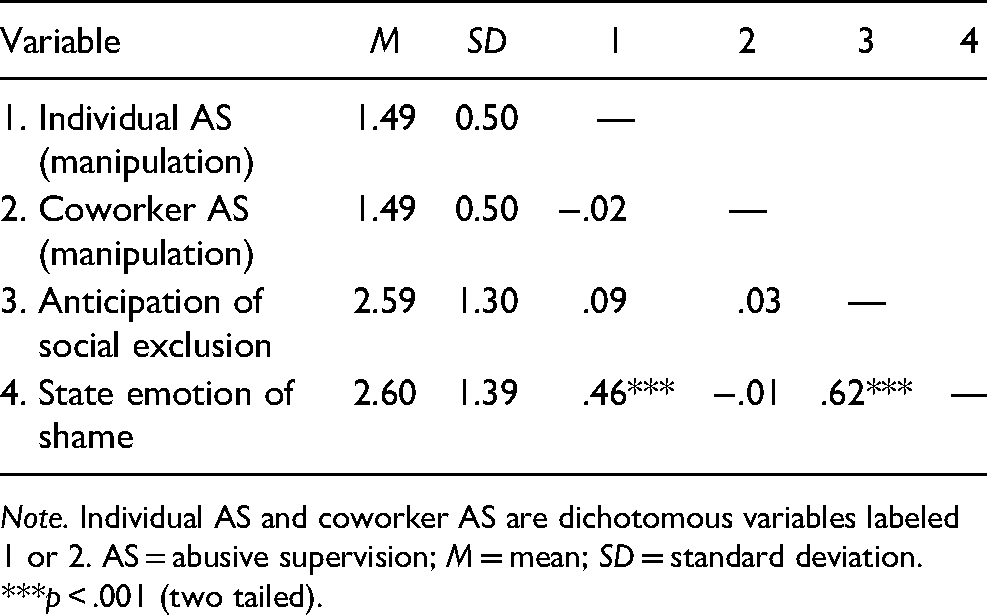
Note. Individual AS and coworker AS are dichotomous variables labeled 1 or 2. AS = abusive supervision; M = mean; SD = standard deviation.
***p < .001 (two tailed).
Anticipation of Social Exclusion. Anticipation of social exclusion was assessed using three items adapted from the four-item Moral Inclusion/Exclusion of Other Groups (MIEG) scale (Passini & Morselli, 2017). One item was not adapted from the MIEG because it was deemed unsuitable for measuring anticipation of social exclusion by one's coworkers (“I think that members of this group of people are extremely (un)civilized”). The three selected MIEG items were adapted to reflect the hypothetical nature of the scenario presented. Participants responded to the following questions: “To what extent do you think other Task Force members would … (1) avoid contact with you, (2) abstain from giving you respect, and (3) see you as a threat to their well-being?” All responses were given using 5-point Likert scales (1 = I would not think this at all, 5 = I would definitely think this; α = 0.88).
State Emotion of Shame. State emotion of shame was assessed using an adaptation of the five-item shame subscale of the State Shame and Guilt Scale (SSGS) developed by Marschall et al. (1994). All items were adapted to reflect the hypothetical nature of the scenario presented. Example items include “I would want to sink into the floor and disappear” and “I would feel small.” All responses were given using 5-point Likert scales (1 = I would not feel this way at all, 5 = I would feel this way very strongly; α = 0.95)
Results
Hypothesis 1 predicted that incongruent abusive supervision leads to greater anticipation of social exclusion, whereas congruent abusive supervision leads to less anticipation of social exclusion. We used analysis of variance (ANOVA) to test Hypothesis 1 with individual abuse as the independent variable, coworker abuse as the moderator, and anticipation of social exclusion as the dependent variable. A significant interaction effect of individual abuse and coworker abuse was found to predict participants’ anticipation of social exclusion, F(1,191) = 25.28, p < .001. Implementing planned contrasts, we found that participants reported equally low anticipation of social exclusion when receiving supervisory treatment congruent with that of their coworkers (i.e., those in either the low individual abuse/low coworker abuse condition or the high individual abuse/high coworker abuse condition) (Mlow/low = 2.09, SDlow/low = 1.30; Mhigh/high = 2.37, SDhigh/high = 1.28). Anticipation of social exclusion did not, however, vary between these congruent abusive supervision groups, F(1,191) = 1.17, p = .28. Moreover, participants reported equally high anticipation of social exclusion when receiving supervisory treatment incongruent with that of their coworkers (i.e., those in either the low individual abuse/high coworker abuse condition or the high individual abuse/low coworker abuse condition) (Mlow/high = 3.03, SDlow/high = 1.15; Mhigh/low = 2.87, SDhigh/low = 1.27). Anticipation of social exclusion did not vary between these incongruent abusive supervision groups, F(1,191) = 0.42, p = .52. Participants in incongruent abusive supervision groups (low/high or high/low, respectively) reported higher anticipation of social exclusion than participants in work environments where abuse was absent (low/low), F(1,191) = 9.54, p = .002; or F(1,191) = 14.09, p < .001, respectively. Moreover, participants in incongruent abusive supervision groups (low/high or high/low, respectively) reported higher anticipation of social exclusion than participants in which abusive supervision was ubiquitous (high/high), F(1,191) = 3.80, p = .05; or F(1,191) = 6.73, p = .01, respectively. The results of these planned contrasts are shown graphically in Figure 2. To summarize, individuals in incongruent abusive supervision groups reported greater anticipation of social exclusion than individuals in congruent abusive supervision groups, supporting Hypothesis 1.
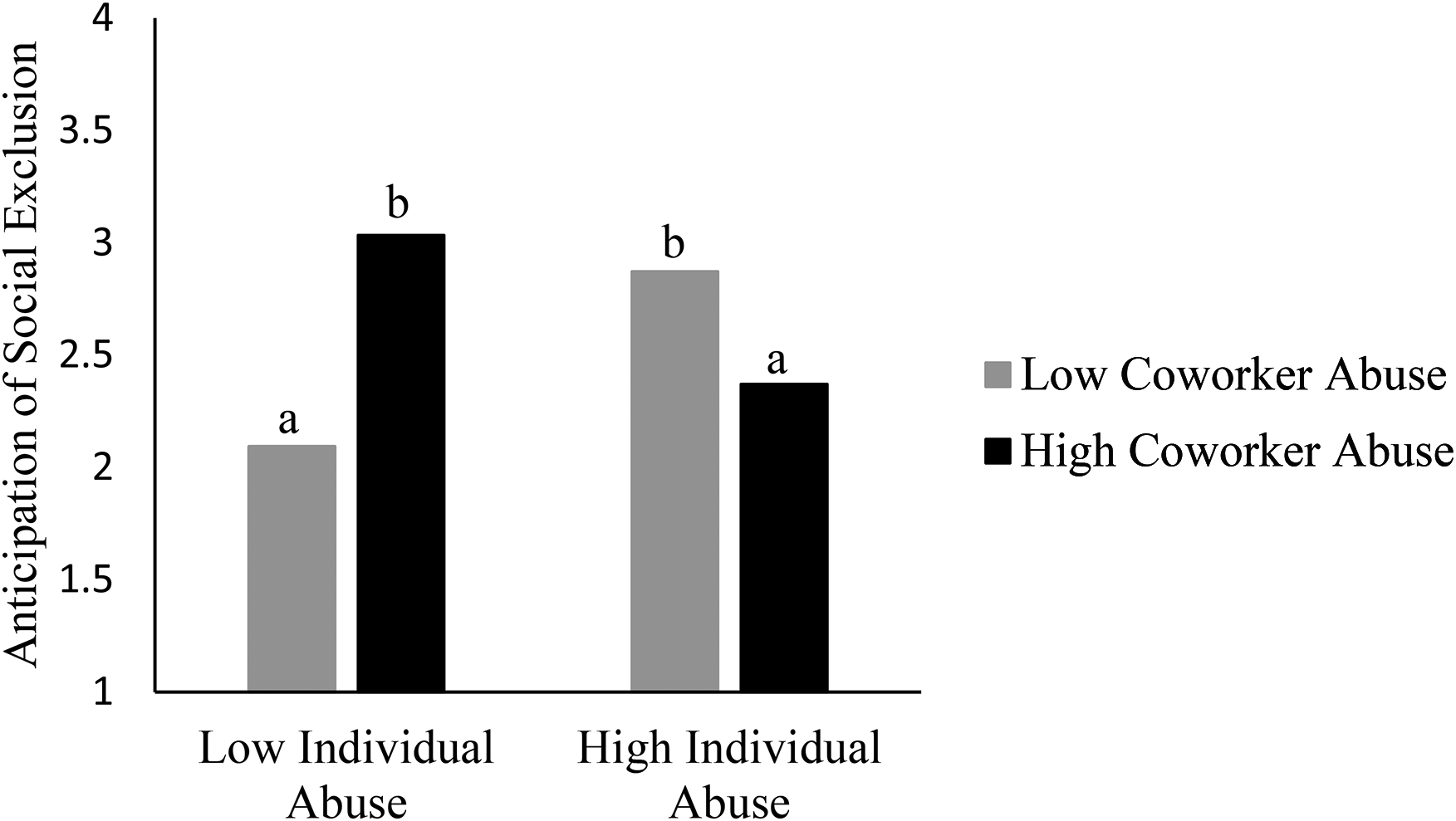
Anticipation of social exclusion across experimental conditions in Study 1.
Hypothesis 2 predicted that incongruence of own and coworker abusive supervision has a positive relation to shame that is mediated by anticipation of social exclusion. In order to test this prediction, we conducted a first-stage moderated-mediation analysis. In this analysis, individual abuse represented the independent variable, coworker abuse the moderator, anticipation of social exclusion the mediator, and shame the dependent variable. The independent variable and the moderator were coded such that low abuse conditions are represented by 1 and high abuse conditions are represented by 2. The mediator was standardized prior to our analysis. Initial analyses demonstrated that an individual abuse × coworker abuse interaction effect predicted anticipation of social exclusion, B = −1.44, p < .001, and that anticipation of social exclusion predicted shame, β = 1.52, p < .001, in line with our expectations (see Table 2 for details).
Regression Results of Studies 1 and 2.
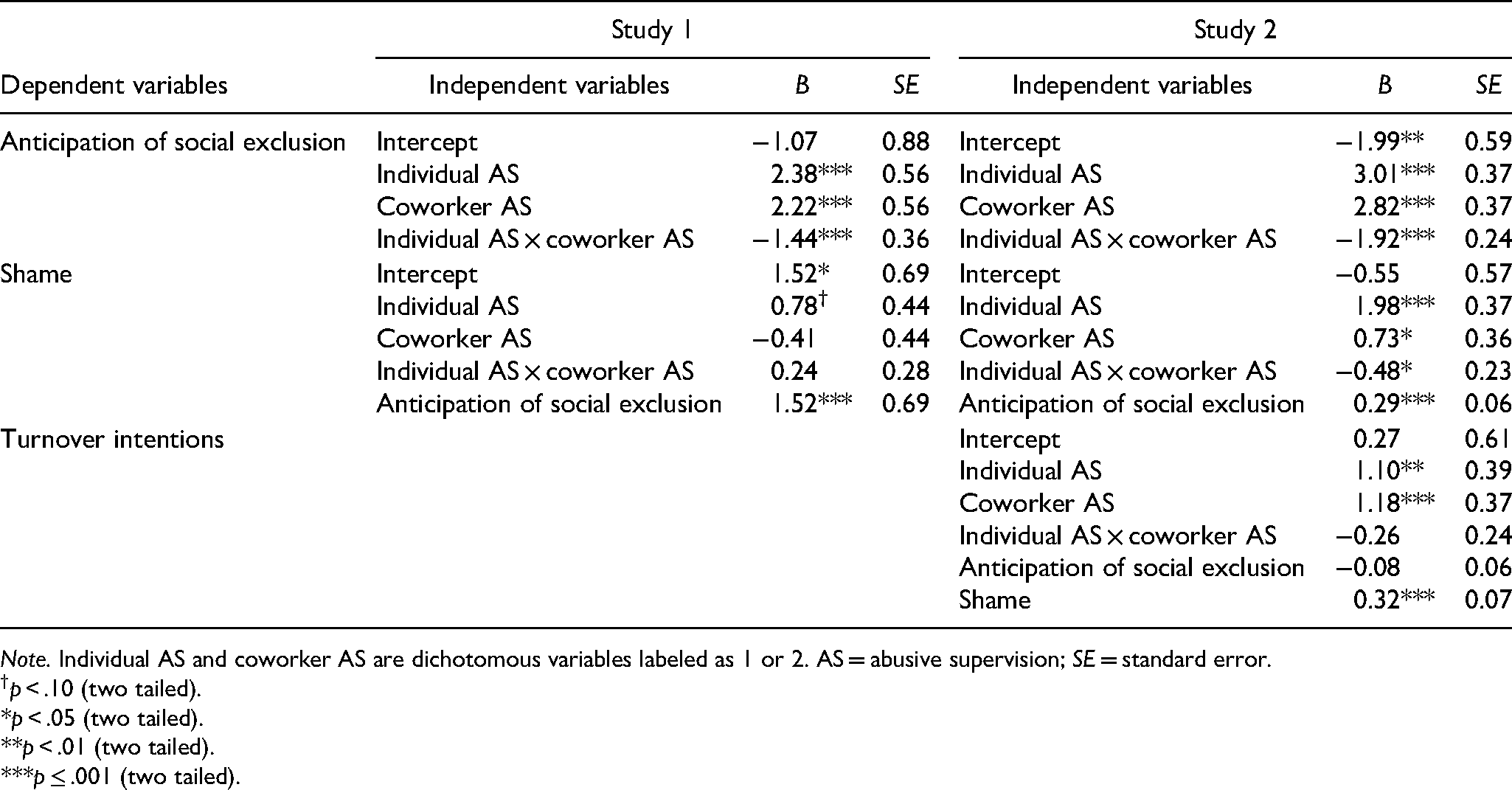
Note. Individual AS and coworker AS are dichotomous variables labeled as 1 or 2. AS = abusive supervision; SE = standard error.
p < .10 (two tailed).
*p < .05 (two tailed).
**p < .01 (two tailed).
***p ≤ .001 (two tailed).
First-stage moderated mediation was then implemented using bootstrapping with 5,000 replications and statistical significance was based on interpretation of the resulting bias-corrected confidence intervals. When coworker abuse was low, the conditional indirect effect of individual abuse was positive, β = 0.79, p < .05, 95% CI [0.38, 1.20], suggesting that anticipation of social exclusion mediates the positive relationship between incongruent abusive supervision and feelings of shame. When coworker abuse was high, the conditional indirect effect of individual abuse was negative, β = −0.42, p < .05, 95% CI [−0.89, −0.002], suggesting that anticipation of social exclusion mediates the negative relationship between congruent abusive supervision and feelings of shame. The indirect effects explored were found to be significantly different from each other, β = 1.20, p < .05, 95% CI [0.64, 1.86].2,3 Taken together, these findings support Hypothesis 2 by showing that incongruent abusive supervision has a positive relation to focal employees’ feelings of shame, which is mediated by their anticipation of social exclusion from their coworkers. 4
Discussion
We examined how, and by what means, abusive supervision incongruence in organizations affects the emotional state of focal employees using a scenario study. In this experiment, we demonstrate that receiving abusive supervision incongruent with that received by one's coworkers leads focal employees to interpret incongruent abusive supervision as putting them at risk of social exclusion. Furthermore, anticipation of social exclusion mediated the effects of abusive supervision incongruence on shame, with incongruent supervisory treatment leading to greater feelings of shame. Thus, we provide strong support with high internal validity for the psychological processes driving the effect of abusive supervision incongruence through a controlled and randomized experiment. In Study 2, we extend these experimental findings to include shame's positive association with turnover intentions, thereby allowing us to concurrently test our full theoretical model.
Study 2
Method
Data and Sample. A vignette experiment was completed in the laboratory by 231 (58% female) students of a large public university located in the Netherlands. Participants were on average 20 years old (SD = 1.9) and participated in the study for course credit.
Procedures. Informed consent was obtained from the participants at the beginning of the study. Participants were then randomly assigned to one of four conditions in the same 2 (low vs. high individual abuse) × 2 (low vs. high coworker abuse) experimental design implemented in Study 1. Following exposure to the hypothetical scenario, participants completed measures of their anticipation of social exclusion, state emotion of shame, and turnover intentions. Lastly, participants answered two manipulation check items.
Measures
The means, SDs, and zero-order correlations of the study variables are shown in Table 3.
Means, Standard Deviations, and Zero-order Correlations Among Variables in Study 2.
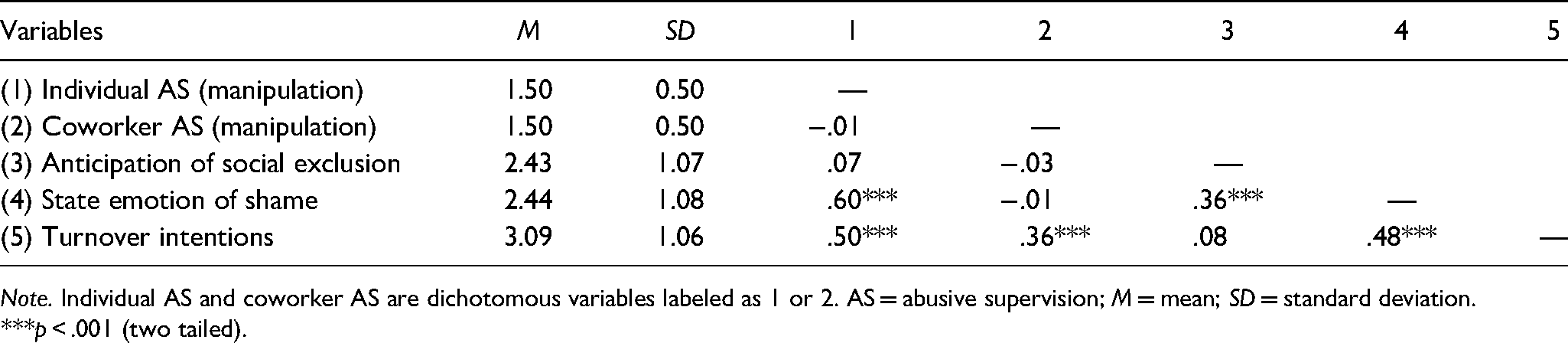
Note. Individual AS and coworker AS are dichotomous variables labeled as 1 or 2. AS = abusive supervision; M = mean; SD = standard deviation.
***p < .001 (two tailed).
Anticipation of Social Exclusion. Anticipation of social exclusion was assessed using the same three items used in Study 1 adapted from the four-item MIEG scale (Passini & Morselli, 2017). All responses were given using 5-point Likert scales (1 = I would not think this at all, 5 = I would definitely think this; α = 0.84).
State Emotion of Shame. State emotion of shame was assessed using the same adaptation of the five-item shame subscale of the SSGS (Marschall et al., 1994) used in Study 1. All responses were given using 5-point Likert scales (1 = I would not feel this way at all, 5 = I would feel this way very strongly; α = 0.90).
Turnover Intentions. Turnover intentions were measured using the two-item scale originally implemented by Bentein and colleagues (2005). Both items were adapted to reflect the hypothetical nature of the scenario presented. These items include “I would think about quitting the organization where I currently work” and “I would intend to search for a position with another employer in the next year.” All responses were given using 5-point Likert scales (1 = strongly disagree, 5 = strongly agree; α = 0.82).
Manipulation Checks. For individual-directed abusive supervision, participants indicated on a single item how they were treated by their supervisor. For coworker-directed abusive supervision, participants indicated on a single item how their coworkers were treated by their supervisor. Both responses were given using 5-point Likert scales (1 = poor, 5 = excellent). Participants rated their supervisor treatment significantly better in the low individual-directed abusive supervision condition compared to the high individual-directed abusive supervision condition (MLow = 3.21, SDLow = 1.06; MHigh = 1.28, SDHigh = 0.51), t(229) = 17.64, p < .001. Furthermore, participants rated their coworkers’ supervisor treatment significantly better in the low coworker-directed abusive supervision condition compared to the high coworker-directed abusive supervision condition (MLow = 3.40, SDLow = 0.99; MHigh = 1.13, SDHigh = 0.43); t(229) = 22.45, p < .001. Finally, OLS regression analysis found that the individual abuse and coworker abuse manipulations did not significantly interact to predict participants’ perceptions of their own abuse, B = 0.19, p = .40 or of their coworkers’ abuse, B = −0.09, p = .65. These results substantiate the efficacy of our manipulation conditions.
Results
We conducted a series of confirmatory factor analyses to test whether the 10 items representing the three constructs measured were distinguishable from one another. A three-factor baseline model composed of anticipation of social exclusion, shame, and turnover intentions showed good fit, χ2(32) = 92.43, p < .001, root mean square error of approximation (RMSEA) = 0.09, comparative fit index (CFI) = 0.95, Tucker–Lewis index (TLI) = 0.94, and standardized root mean square residual (SRMR) = 0.06. Further analysis demonstrated that the three-factor model fit the data better than a two-factor model in which anticipation of social exclusion and shame were allowed to load on the same factor, χ2(34) = 331.55, p < .001, RMSEA = 0.20, CFI = 0.77, TLI = 0.70, SRMR = 0.14, or a single factor model in which anticipation of social exclusion, shame, and turnover intentions were allowed to load on the same factor, χ2(35) = 436.42, p < .001, RMSEA = 0.22, CFI = 0.70, TLI = 0.61, SRMR = 0.15. The difference between the three-factor model and the two-factor model was significant in terms of model fit, χ2(2) = 239.12, p < .001, as was the difference between the three-factor model and the single-factor model, χ2(3) = 343.99, p < .001. These analyses show the discriminant validity of the study's measured variables.
Hypothesis Testing. In Hypothesis 1, we predicted that incongruent abusive supervision leads to increased anticipation of social exclusion, while congruent abusive supervision leads to decreased anticipation of social exclusion. We tested this hypothesis using ANOVA with individual abuse as the independent variable, coworker abuse as the moderator, and anticipation of social exclusion as the dependent variable. A significant interaction effect of individual abuse and coworker abuse was found to predict participants’ anticipation of social exclusion, F(3,227) = 22.10, p < .001. Using planned contrasts, we found that participants showed equally low anticipation of social exclusion when receiving supervisory treatment congruent with that of their coworkers (i.e., those in either the low individual abuse/low coworker abuse condition or the high individual abuse/high coworker abuse condition) (Mlow/low = 1.91, SDlow/low = 0.80; Mhigh/high = 1.98, SDhigh/high = 0.93). Anticipation of social exclusion did not, however, differ between these congruent abusive supervision groups, F(1,227) = 0.13, p = .71. Furthermore, participants demonstrated equally high anticipation of social exclusion when receiving supervisory treatment incongruent with that of their coworkers (i.e., those in either the low individual abuse/high coworker abuse condition or the high individual abuse/low coworker abuse condition) (Mlow/high = 3.00, SDlow/high = 0.91; Mhigh/low = 2.81, SDhigh/low = 0.98). Anticipation of social exclusion did not differ between these incongruent abusive supervision groups, F(1,227) = 1.28, p = .26. Participants in incongruent abusive supervision groups (low/high or high/low, respectively) reported higher anticipation of social exclusion than participants in work environments where abuse was absent (low/low), F(1,227) = 28.33, p < .001; or F(1,227) = 41.94, p < .001, respectively. Moreover, participants in incongruent abusive supervision groups (low/high or high/low, respectively) reported higher anticipation of social exclusion than participants in which abusive supervision was omnipresent (high/high), F(1,227) = 24.09, p < .001; or F(1,227) = 36.60, p < .001, respectively. The results of these planned contrasts are presented graphically in Figure 3. In summary, individuals in incongruent abusive supervision groups reported greater anticipation of social exclusion than individuals in congruent abusive supervision groups. These experimental findings replicate those of Study 1 and provide additional support for Hypothesis 1.

Anticipation of social exclusion across experimental conditions in Study 2.
Hypothesis 2 predicted that incongruence of own and coworker abusive supervision has a positive relation to shame that is mediated by anticipation of social exclusion. A first-stage moderated-mediation analysis was conducted to test this hypothesis with individual abuse set as the independent variable, coworker abuse the moderator, anticipation of social exclusion the mediator, and shame the dependent variable. The independent variable and the moderator were coded such that low abuse conditions are represented by 1 and high abuse conditions are represented by 2. The mediator was standardized prior to our analysis.
First-stage moderated mediation was then implemented using bootstrapping with 5,000 replications and statistical significance was based on interpretation of the resulting bias-corrected confidence intervals. When coworker abuse was low, the conditional indirect effect of individual abuse was positive, β = 0.32, p < .05, 95% CI [0.17, 0.50], suggesting that anticipation of social exclusion mediates the positive relationship between incongruent abusive supervision and feelings of shame. When coworker abuse was high, the conditional indirect effect of individual abuse was negative, β = −0.24, p < .05, 95% CI [−0.42, −0.12], suggesting that anticipation of social exclusion mediates the negative relationship between congruent abusive supervision and feelings of shame. These indirect effects were significantly different from each other, β = 0.56, p < .05, 95% CI [0.31, 0.87]. These experimental findings replicate those of Study 1 and provide additional support for Hypothesis 2 by showing that incongruent abusive supervision is positively related to focal employees’ feelings of shame via their anticipation of social exclusion by coworkers.
Hypothesis 3 predicted that incongruence of own and coworker abusive supervision has a positive relation to turnover intentions via anticipation of social exclusion and shame. We conducted a first-stage moderated-sequential-mediation analysis (Hayes, 2015; Taylor et al., 2008) to test this prediction. Individual abuse was set as the independent variable, coworker abuse the moderator, anticipation of social exclusion the first mediator, shame the second mediator, and turnover intentions the dependent variable. Both mediators were standardized prior to our analysis. Initial analyses demonstrated that an individual abuse × coworker abuse interaction effect predicted anticipation of social exclusion, B = −1.92, p < .001, anticipation of social exclusion predicted shame, β =0 .29), p < .001, and shame predicted turnover intentions, β = 0.32, p < .001, in line with our expectations (see Table 2 for details).
First-stage moderated-sequential mediation was implemented using bootstrapping with 5,000 replications and statistical significance was based on interpretation of the resulting bias-corrected confidence intervals. When coworker abuse was low, the conditional indirect effect of individual abuse was positive, β = 0.10, p < .05, 95% CI [0.05, 0.19]. This finding suggests that the positive relationship between incongruent abusive supervision and turnover intentions is mediated first by anticipation of social exclusion and then by feelings of shame. Furthermore, when coworker abuse was high, the conditional indirect effect of individual abuse was negative, β = −0.08, p < .05, 95% CI [−0.16, −0.04]. This finding suggests that the negative relationship between congruent abusive supervision and turnover intentions is mediated first by anticipation of social exclusion and then by feelings of shame. The indirect effects explored were found to significantly differ from one another, β = 0.18, p < .05, 95% CI [0.09, 0.33]. Together, these findings provide experimental support for Hypothesis 3 by indicating that incongruent abusive supervision has a positive relation to focal employees’ turnover intentions, which is mediated by their anticipation of social exclusion by their coworkers and by their resulting feelings of shame.5,6
General Discussion
We found that incongruence in focal employees’ and coworkers’ abusive supervision elicited shame in focal employees via the anticipation that they would be socially excluded from coworkers (Studies 1 and 2). Moreover, we showed that these incongruencies increased focal employees’ turnover intentions via increases in anticipation of social exclusion and shame (Study 2).
Theoretical Implications
Our studies offer several theoretical contributions to the field of abusive leadership. First, we provide strong evidence that focal employees who perceive themselves as receiving abusive supervision incongruent with that of their coworkers appraise themselves as at risk of social exclusion by their coworkers. Taking these findings into account, we propose a previously unexplored and socially focused cognitive appraisal of abusive supervision. Our work, therefore, offers a theoretical extension to Oh and Farh’s (2017) emotional process theory by showing that social concerns and social emotions arise from, and play an important role in predicting individuals’ behavioral intentions following incongruent abusive supervision. Specifically, we demonstrate that the cognitive appraisals of potential exclusion from coworkers arising from incongruent leader treatment are associated with focal employees’ feelings of shame.
Little empirical research has explored the shame-inducing effects of abusive supervision (for exceptions see Daniels, 2015 and Peng et al., 2019). We believe this is because investigations into abusive supervision have viewed targeted employees predominantly as victims of abuse (Tepper, 2007). In doing so, these investigations have focused in large part on victim characteristics (Brees et al., 2014; Henle & Gross, 2014; Lian et al., 2014; Tepper et al., 2006) and how victims are perceived (e.g., whether they violate social norms or demonstrate yielding behavior) (Aquino & Byron, 2002; Henle & Gross, 2014; Tepper et al., 2011). Shame, however, does not fit into this victim’s perspective because it is not so much about the affected individual themselves as their perception of the social environment in which the abuse occurs. Furthermore, exploring abusive supervision with regard to shame does not focus explicitly on the mistreatment itself (as a victim perspective would do), but instead on what this mistreatment means for the affected individual's social self. This may explain why shame has been largely ignored in the scientific literature on abusive supervision.
We, however, extend emotional process theory to include shame as a crucial emotional component in response to incongruent abusive supervision. Although it has recently been shown that upward social comparisons regarding differential leader treatment can lead to shame (Peng et al., 2019), the cognitive appraisal driving this emotional reaction had not been tested. In this article, we not only provide additional support for Peng et al. (2019) findings but also introduce anticipation of social exclusion as the cognitive appraisal responsible for employees’ feelings of shame. Furthermore, and most importantly, we introduce downward social comparisons regarding differential leader treatment as a source of employees’ feelings of shame. Thus, we argue that perceiving oneself as receiving less abusive supervision than one's coworkers (i.e., making an upward social comparison) can have the same shame-inducing effect as when one perceives themselves as receiving more abusive supervision than one's coworkers (i.e., making a downward social comparison). Furthermore, by establishing shame as an emotional mechanism through which the perceived work environment influences focal employees’ reactions to incongruent abusive supervision, we answer calls for empirical investigation into cognitive appraisals of, and emotional reactions to, abusive leadership (Oh & Farh, 2017; Peng et al., 2014). We hope that this work will motivate future investigations into shame's role in both incongruent abusive supervision and organizational behavior as a whole.
Our study extends previous research that has examined discrete emotions (e.g., guilt, fear, and anger) resulting from abusive supervision by highlighting the prominent role of shame in understanding employees responses to leader abuse. It has been proposed that guilt and shame differ most “in their respective phenomenologies and motivations for subsequent action” (Tangney et al., 1996, p. 1246). Whereas shame induces escape and withdrawal behaviors, guilt induces actions aimed at reparation, such as confessions and apologies (Niedenthal et al., 1994; Tangney et al., 1996). Due to the fact that our research focuses on abusive supervision as a predictor of turnover intentions, an act of withdrawal, we argue that shame, and not guilt, is the social emotion driving this behavioral intention.
Unlike shame, anger is a primary emotion associated with the “fight” response, an antagonistic response taken to actively remove harm (Frijda et al., 1989; Smith & Ellsworth, 1985, 1987). Thus, the action tendency of the “fight” response is the opposite of the “flight” response (Cannon, 1932), which in organizational contexts would take the form of leaving the organization (Oh & Farh, 2017). Anger in response to abusive supervision would, therefore, not be expected to increase employees’ turnover intentions but rather supervisor-directed deviance (Oh & Farh, 2017; Rudolph et al., 2004).
Finally, fear, as a basic emotion, is a response arising from physical threats to one's safety and survival (Dickerson et al., 2004). However, abusive supervision, as a construct, is explicitly defined as nonphysical leader mistreatment (Tepper, 2000). Thus, we would not expect fear in its “pure” form (i.e., as a response to threats to one's physical safety) to be a mechanism through which abusive supervision drives employees from their organizations. Furthermore, should fear in its pure form arise from abusive supervision, it is not clear why incongruence in abuse between a focal employee and their coworkers should alter their emotional or behavioral responses to their own abuse. The presence or absence of similarly abused coworkers does not alleviate or exacerbate the perception of an upcoming physical threat. Thus, although we do not deny that fear plays a crucial role in predicting employee turnover from abusive supervision, we argue that it is a specific type of fear, a fear of social threat (i.e., exclusion), that drives this reaction.
Furthermore, our theoretical framework drawing on appraisal theories of emotions (Arnold, 1960; Lazarus, 1966) not only aligns our findings regarding incongruent leader treatment with previous research on coworker relationships (Sherony & Green, 2002) and social exclusion (Tse et al., 2013), but also accounts for unanticipated results in the abusive supervision literature. Unexpected findings by Farh and Chen (2014, Study 2) suggested that focal employees who are abused less than their coworkers report less self-esteem than those whose coworkers are treated with equally low abuse. To account for their findings, the authors theorized post hoc that simply witnessing the abuse of one's coworkers is associated with the same low self-esteem associated with receiving the abuse oneself. We, however, put forth and provide experimental support for the argument that these previously reported negative effects are due to employees’ cognitive appraisals of social threat and resulting experiences of shame, arising from incongruence in abusive treatment.
Self-esteem and shame are negatively correlated constructs (Tangney et al., 1995; Cook, 1996) associated with the “unfulfilled arousal of positive emotions” (Yelsma et al., 2002, p. 1180). Unlike stand-alone episodes of shame, self-esteem represents a summation of events that are perceived as successes and failures for the ego across one's lifetime (Fessler, 2001). Thus, although Farh and Chen (2014) focused on the broader construct of self-esteem in their work on abusive supervision, we focus on employees’ experiences of shame, a social emotion with the potential to alter individuals’ self-esteem.
Finally, we demonstrate the repercussions of incongruent abusive supervision on employees’ turnover intentions. Our findings are, in part, aligned with previous research demonstrating that upward social comparisons regarding differential leader treatment are positively related to employees’ turnover intentions (Graen et al., 1982; Schaubroeck et al., 2016). However, we build on this prior work by revealing the potentially counterintuitive finding that even comparatively favorable supervisory treatment can motivate employees to leave the organization. Instead of welcoming comparably favorable treatment, our results suggest that equal treatment of subordinates (even when this treatment involves abuse to oneself) is preferred in environments home to abusive supervision. We hope that our findings stimulate future investigations of shame-driven withdrawal behavior in the workplace.
Practical Implications
Our research is important for leaders, managers, and organizations because it demonstrates that when leaders treat focal employees with less abuse, and therefore comparatively better than their fellow coworkers, these focal employees can be negatively affected. Leaders and organizations should understand that abusive supervision can not only motivate the abused to leave the organization but those spared abuse as well. Thus, our study is another call for leaders to avoid abusive behavior altogether (e.g., Liu et al., 2010; Mackey et al., 2015) and warns that even treating single employees favorably can have unintended negative consequences. Moreover, we warn managers not to automatically interpret low turnover as evidence that the leader is treating their subordinates well, as our findings suggest that turnover intentions are lower when all subordinates are equally abused.
Limitations and Future Directions
Our research is important in explaining how turnover intentions can result from incongruent abusive supervision. This work is limited, however, by our focus on employees’ turnover intentions rather than employees’ actual behavior. Although turnover intentions are predictive of employees’ actual turnover (Steel & Ovalle, 1984), future research linking incongruent abusive supervision to actual turnover would help substantiate our theory. Furthermore, our findings are limited to the effect of incongruent abusive supervision on a single employee-related outcome (i.e., turnover intentions). It is, however, possible that our model also explains other work-specific dependent variables. Although turnover intentions represent one form of employee withdrawal, future studies could investigate less drastic (or less progressed) forms of employee withdrawal behavior such as lateness to, and absence from, work (Rosse, 1988). Doing so would allow for the investigation of more subtle effects of incongruent abusive supervision, offering a look at withdrawal behaviors exhibited by employees who are, for one reason or another, bound to their employer and whose turnover intentions are therefore low. Furthermore, explorations into subtle employee withdrawal behaviors could shed light on the development and/or escalation of employees’ behavioral responses to abusive supervision over time. Such investigations might unveil a series of progressive responses to incongruent abusive supervision beginning with employee lateness and ending with employee turnover.
Future studies exploring potential moderators of incongruent abusive supervision's effects on shame are also warranted. Shame has been largely ignored in organizational research (Daniels & Robinson, 2019) and our findings invite the question as to which employers are especially vulnerable to shame in response to incongruent abusive supervision. Relevant psychological traits could, therefore, be incorporated into extensions of our model. One straightforward example of a fitting moderator to study in the future would be individuals’ proneness to shame (Tangney et al., 1995). By taking into account individuals’ psychological characteristics, future researchers could provide a more precise look at who experiences shame as a result of incongruent abusive supervision and why this might be the case.
Conclusion
We demonstrate that employees who perceive themselves as receiving abusive supervision incongruent with that received by coworkers associate their leader treatment with the anticipation of social exclusion from their coworkers. We further show that this appraisal of social threat by employees is associated with feelings of shame which, in turn, affect their behavioral intentions via increases in turnover intention. In doing so, we introduce the effects that incongruent abusive supervision can have on employees’ reactions to abuse. These findings highlight shame as a consequence of incongruent abusive supervision, as well as introduce it as an emotional mechanism important for understanding employee responses to being spared abuse when their coworkers are not. With theoretical arguments and empirical evidence supporting the idea that people can experience negative emotions for being spared abuse by their supervisor, we hope we inspire future research on abusive supervision.
Footnotes
Declaration of Conflicting Interests
The authors declared no potential conflicts of interest with respect to the research, authorship, and/or publication of this article.
Funding
The authors disclosed receipt of the following financial support for the research, authorship, and/or publication of this article: This research was funded by the German Research Foundation (Deutsche Forschungsgemeinschaft) grant TR 1398/1-1 (PI: Tröster).
