




Abstract
This study focuses on follower resistance as a potential antecedent of destructive leader behavior and examines leader-related moderators and mediators to help explain the relationship between follower resistance and destructive leader behavior. Drawing from implicit followership theories, we propose that the relationship between follower resistance and destructive leader behavior is moderated by leaders’ Theory X schema. Furthermore, we build on affective events theory to hypothesize that follower resistance increases destructive leader behavior via leaders’ negative affect. We tested our hypotheses in a within-subjects online field experiment. Our study findings demonstrate that follower resistance increases destructive leader behavior and that this relationship is mediated through leaders’ negative affect and moderated by leaders’ Theory X schema. We discuss theoretical implications regarding the impact of (resistant) follower behavior on destructive leadership and offer methodological advances in terms of research design and analytical approaches to deal with endogeneity issues and derive causal inferences. Lastly, we derive practical implications for utilizing follower resistance.
Keywords
In recent times, more and more research has addressed destructive forms of leadership and their potential negative consequences for organizations, following observations that destructive leadership is a highly salient phenomenon (Aasland et al., 2010; Hogan & Kaiser, 2005; Tepper et al., 2006). For example, research on employees’ experience with destructive leaders suggests that about 65%–75% of employees perceive their leader to be the worst part of their jobs (Hogan & Kaiser, 2005). Destructive leadership includes harmful or deviant leader behaviors toward followers and/or the organization that prevent the attainment of organizational goals and personal goals of followers (Schyns & Schilling, 2013). Although research has brought forth a number of concepts that fall within the domain of destructive leadership (e.g., abusive supervisors, Tepper, 2000; toxic leaders, Lipman-Blumen, 2004), most discussions of destructive leader behavior revolve around control and coercion (Einarsen et al., 2007; Sankowsky, 1995; Thoroughgood et al., 2012). In the present research, we focus on one line of behaviors associated with a specific form of destructive leadership, termed petty tyranny (Ashforth, 1994). This form of destructive leadership as per definition includes behaviors such as close supervision, discouraging initiative and dissent, demanding followers to get his or her way and treating followers in a punitive way, which reflect leaders’ tendency to overcontrol others. Accordingly, we examine a narrower range of behaviors than the broader construct of destructive leadership provides (e.g., Krasikova et al., 2013).
Although prior research has primarily focused on the consequences of destructive leader behavior (e.g., diminished job satisfaction, well-being, and follower performance; Mackey et al., 2017; Martinko et al., 2013; Schyns & Schilling, 2013; Zhang & Liao, 2015), only limited research has accounted for its possible antecedents (Eissa et al., 2020). For example, in a meta-analytic review on the antecedents of abusive supervision (Zhang & Bednall, 2016) the authors emphasize a “relatively nascent state of research” (p. 467) in this area. Furthermore, previous research has illustrated destructive leadership as a multilevel phenomenon (Hershcovis & Reich, 2013; Zhang & Bednall, 2016) that may stem from sources both within the leader (e.g., leader-related attributes) and outside of the leader (e.g., organizational level factors or follower-related factors). This perspective is reflected in the literature describing that destructive leader behavior may emerge because “the leader either lacks the motivation to act in a constructive fashion or becomes motivated to act in harmful ways” (Thoroughgood et al., 2012, p. 231). Although only limited research has undertaken a multilevel perspective to study destructive leadership (e.g., Liang et al., 2016; Liu et al., 2012), we share this viewpoint by incorporating two different streams of research that examine possible causes of destructive leader behavior, namely (1) follower behavior as an antecedent of destructive leader behavior and (2) leader-related characteristics that mediate and moderate the relationship between follower behavior and destructive leader behavior. Specifically, our research goal is to study the possibility that leaders engage in destructive behavior in response to follower resistance and that this destructive leader behavior is also influenced by cognitive attributes and affective reactions of the leader.
First, we want to examine follower resistance as an antecedent of destructive leader behavior. Although a wide range of research has investigated the consequences of destructive leadership for followers, the idea of follower behavior as exerting influence on destructive leadership received less attention (Martinko et al., 2013; Milosevic et al., 2019). For example, the effect of destructive leadership on followers’ deviant behavior is well established now (e.g., Duffy et al., 2002; Tepper et al., 2008, 2009). Instead, the reverse effect (i.e., followers’ influence on destructive leader behavior) is largely understudied, but follower-related antecedents have been identified among the most promising area for future research on the emergence of destructive leadership (Zhang & Bednall, 2016). We aim to contribute to this line of research by studying instances in which followers show resistance behavior as antecedents of destructive leader behavior. We conceptualize follower resistance as comprising a range of behaviors by which followers oppose managerial requests and/or withhold performing them (Falbe & Yukl, 1992). In light of the negative consequences if leaders fail to deal appropriately with follower resistance (e.g., delay of organizational processes and decrease of productivity; Piderit, 2000; job satisfaction and psychological well-being; Bordia et al., 2004), leaders may interpret resistance as a challenge to their power and control, also termed as identity threat (Tedeschi & Felson, 1994; Tepper et al., 2017). Hence, when interacting with followers that articulate resistance, leaders may be prompted to bring followers back on track and exhibit destructive behavior that restricts followers’ decision-making autonomy, including micromanaging (Repenning & Sterman, 2002). This assumption is also reflected in the literature on workplace victimization (i.e., aggressive behaviors toward an organizational member that cause physical or psychological harm to that member) proposing that frequent victims of aggressive behavior display certain behaviors that make them appear as provocative and deserving of being punished, which in turn, triggers negative behavior from coworkers or the leader (e.g., Aquino & Thau, 2009; Lian et al., 2014). Hence, the first purpose of our research is to highlight the possibility that follower resistance behavior may serve as an antecedent of destructive leader behavior.
Second, we further aim to address the question of when the aforementioned relationship between follower resistance and destructive leader behavior is more (or less) likely to occur. Integrating leader-related variables that trigger leaders to exhibit destructive behavior is key given the lack of sufficient literature that has investigated in this area (e.g., Eissa & Lester, 2017). We focus on the role of leaders’ cognition, specifically on their implicit representations of followers, and on leaders’ negative affect. Regarding the former, implicit followership theories (IFTs; e.g., Sy, 2010) postulate that leaders will decide to what extent they will show destructive behavior (e.g., micromanage followers) depending on whether leaders generally think about the degree to which followers need control and “direction” (Whiteley et al., 2012). Specifically, we expect that leaders’ negative IFTs (i.e., negative perception of followers) may exacerbate the relationship between follower resistance behavior and destructive leader behavior. Furthermore, in terms of mediating mechanisms that help explain why follower resistance may trigger destructive leader behavior, we investigate the influence of leaders’ affect, thereby adding to the growing research base that considers the role of emotions in the leadership process (e.g., Ashkanasy et al., 2017; Whiteley et al., 2012). Social interactions between leaders and followers are characterized by certain affective experiences. Previous research on affective events theory (AET; Weiss & Cropanzano, 1996) suggests that these experiences may prompt spontaneous affect-driven behavior. For the context of followers expressing resistance, we apply AET to propose that such expressions represent negative affective events, which trigger emotionally laden responses by leaders that attempt to correct followers’ behavior, because resistance may be perceived as threatening toward the leader's status and perceived control (Tepper et al., 2017).
Last, research on antecedents of leader behavior is mostly restricted to designs that do not allow the drawing of causal inferences and do not provide a strong test of theory (Antonakis et al., 2010; Zhang & Bednall, 2016). A common threat to causality is the endogeneity of the independent variable, a situation where a variable in an estimated model does not vary randomly and hence, is likely to be correlated with omitted causes (Kennedy, 2008). Prevailing sources of endogeneity present in destructive leadership research include omitted variables (i.e., third variables which influence the independent and dependent variable) and simultaneity (i.e., reverse causality between the independent and dependent variable; see Antonakis et al., 2010; Güntner et al., 2020). Studies that do not correct for potential endogeneity in their data may likely obtain biased parameter estimates of the effect of the independent variable on the dependent variable and hence, cannot inform research and practice on the true relationship between two variables. In multilevel models (e.g., repeated occasions nested within persons), the issue of endogeneity can arise when failing to correctly model the unobserved variation due to the hierarchical structure of the data (Antonakis et al., 2019). We use an experimental manipulation of the independent variable to overcome endogeneity issues (Aguinis & Bradley, 2014; Antonakis et al., 2010). Additionally, we apply a within-person approach and use multilevel modeling to control omitted variables due to between-person differences in our mediator (see Antonakis et al., 2019; Bliese et al., 2020). Thus, the design, as well as the analytical approach of this study, allows the drawing of causal inferences about the antecedents of destructive leader behavior.
Summarized, this study makes the following contributions to destructive leadership research: First, we build on previous theorizing that highlights how follower behavior may serve as an antecedent of destructive leader behavior. Second, by integrating a socio-cognitive (i.e., IFTs) and socio-emotional (i.e., AET) perspective of leader–follower relationships, we investigate underlying processes and boundary conditions regarding leaders’ behavior to follower expressions of resistance. Third, we advance previous research in methodological terms by combining analytical methods (i.e., multilevel modeling to account for between-person influences; Antonakis et al., 2019) and an experimental research design (i.e., experimental vignette study; Aguinis & Bradley, 2014) that help understanding causal mechanisms of and preventing destructive leadership, which is an issue that warrants continued scholarly inquiry (Zhang & Bednall, 2016).
Theoretical Background
In recent decades, a burgeoning body of research has concentrated on the effects of negative forms of leadership (e.g., destructive leadership and abusive supervision) showing that these forms of leadership evoke negative types of follower behavior, such as deviant follower behavior (e.g., Tepper et al., 2008, 2009). Instead, for a long time little or no influence was attributed to followers, putting followers in the role of “effected audiences, reacting defiantly with displaced aggression” (Lian et al., 2014, p. 651). Over the years, research has acknowledged followers’ impact on the leadership process (e.g., Baker, 2007; Oc & Bashshur, 2013; Uhl-Bien et al., 2014), with few leadership scholars considering followers’ influence on the emergence of destructive leadership (e.g., Chaleff, 1995; Padilla et al., 2007; Thoroughgood et al., 2012). This line of research suggests that followers play an active role in leader–follower interactions and thus may directly influence the leader's behavior (e.g., Fairhurst & Uhl-Bien, 2012; Oc & Bashshur, 2013; Uhl-Bien et al., 2014). In other words, leaders do not operate in a vacuum, but they are influenced by their social environment, including their followers and the resistance they express. Specifically, we build on previous research that suggests that followers may contribute to the emergence of destructive leadership (Thoroughgood et al., 2012). To do justice to this perspective, we adopt a fine-grained behavioral observation approach that is characterized by an examination of very specific leader and follower behaviors. In doing so, we differ from previous studies that defined destructive leadership in terms of the perceived nature of the target behavior (i.e., abusive supervision; Tepper, 2000) or who investigated destructive leadership at a broader level of analysis (Thoroughgood et al., 2012). Instead, we follow a line of research that focuses on the study of actual fine-grained behavior (see also Cook et al., 2020). This strength of our study is heightened by the literature that emphasizes how leaders may behave constructively in terms of organization-level goals (e.g., focusing on task completion), while at the same time this behavior may be perceived by followers as rather destructive (e.g., neglecting or harming interpersonal relationships with followers; Einarsen et al., 2007). Thus, by using observational research methods, our research can provide a more nuanced view of how certain leader behaviors may emerge, thereby contributing to the general understanding of leadership effectiveness.
One way by which followers can influence their leaders, specifically with respect to destructive leader behavior, concerns followers’ negative “misbehavior” at work (e.g., Lian et al., 2014), including expressions of resistance. Different emphasis can be placed on resistance as “a cognitive state, as an emotional state, and as a behavior” (Piderit, 2000, p. 785). For the present study, we focus on behavioral resistance, actively verbalized through followers’ language, as one type of negative follower behavior. When resistance is expressed as a behavior (e.g., naming reasons against required behavior change or failing to complete assigned work properly), it is particularly ambiguous, because followers who voice their concerns may be perceived as criticizing the management and interrupting the workflow, instead their resistance may reflect their interest to actively participate bottom-up in leadership processes (Piderit, 2000). Hence, the management literature has provided different perspectives on how to deal with resistance. Perspectives on resistance that are aligned with a follower-centric perspective of leadership regard resistance as an expression of voice behavior (Maynes & Podsakoff, 2014) or a desire to express ethical principles (Modigliani & Rochat, 1995). These follower-centric perspectives highlight follower resistance as a response with the positive intention to prevent management from decisions that may not be in the best interest of the organization and to foster alternative management practices (Courpasson et al., 2012).
Instead, leadership approaches with a top-down, management-centric perspective have treated follower resistance as “a problem to be eliminated or minimized” (Giangreco & Peccei, 2005, p. 1816). From this view, resistance solely serves to express discontent and undermine upper management (cf. Dent & Goldberg, 1999). Hence, followers who express resistance may be perceived by leaders as a personal insult or a challenge to their power status (Tedeschi & Felson, 1994). Furthermore, followers may be interpreted as hindering the achievement of leaders’ goals or interrupting organizational workflows in general (Bass, 1990). Correspondingly, a management-centric perspective clearly prescribes actions that leaders should take when they notice resistance, namely increasing control (e.g., micromanaging) and restricting followers’ decision-making autonomy, prescribing solutions, or threatening with confrontations and sanctions. This range of actions is reflected in existing definitions of destructive leadership, specifically in the concept of petty tyranny, describing leaders’ oppressive, capricious, and vindictive use of power and authority (Ashforth, 1994). This form of destructive leader behavior that we focus on in the present research emphasizes leader control and micromanagement, defined as behaviors that exert pressure on others to think, feel, or behave in certain ways (Deci & Ryan, 1985; Gilbert et al., 2012). The role of control has received much attention in the literature on destructive leadership, claiming that destructive leaders use behaviors that intimidate their followers in order to reach their primary objective, that is, the control of others (Hornstein, 1996). By focusing on behaviors by which leaders exert control over their followers, this research examines a very specific range of behaviors associated with leaders’ destructive behaviors.
The management-centric perspective of follower resistance is also consistent with the concept of victimization (e.g., Aquino & Thau, 2009), describing that individuals expressing certain behavior that makes them appear as difficult to deal with are likely to become targets for victimization. In the area of research on leader–follower relationships, studies suggest that destructive leader behaviors are a consequence of follower behaviors that may be interpreted as deviant or counterproductive by leaders (e.g., follower resistance behaviors). These negative follower behaviors may be perceived by leaders as an attempt to undermine their power and control and thus, as threatening (Tedeschi & Felson, 1994). Relatedly, research suggests that leaders may perceive followers’ resistance behavior as a stressor, which in turn prompts more directive leader behavior (Bass, 1990). In a review by Tepper et al. (2017), related concepts of follower resistance (e.g., poor job performance or counter normative behavior by followers) were found to be associated with abusive supervision. Followers who showed some form of unlikable, aggravating behavior that allegedly needed correction (i.e., resistance) were more likely to become victims of abusive behavior by their leaders (i.e., provocative victims; e.g., Lian et al., 2014; Liang et al., 2016; Tepper et al., 2006). Based on the preceding explanations and empirical evidence from related research, we hypothesize:
Boundary Conditions of Destructive Leader Behavior in Response to Follower Resistance: The Role of Implicit Followership Theories
A small amount of previous research has focused on possible leader-related characteristics that prompt leaders to exert destructive behavior toward their followers (see e.g., Tepper et al., 2017). For example, leaders show more abusive behavior when they hold a strong psychological entitlement (i.e., the belief that one deserves more or is entitled to more than others are; Whitman et al., 2013) and have low emotional intelligence (Zhang & Bednall, 2016). Beyond personality characteristics, leaders’ behavior is also linked to various cognitive representations of their followers (i.e., leaders’ cognitive schemata; e.g., Uhl-Bien & Pillai, 2007), which regulate the extent to which leaders exhibit certain behaviors toward their followers. This so-called perception-behavior link (Chartrand & Bargh, 1999) explains that the activation of a cognitive schema (e.g., IFTs) elicits corresponding behavior consistent with that cognitive schema. IFTs constitute implicit assumptions or schemata that leaders have about their followers’ characteristics and work attitudes (Sy, 2010). These implicit assumptions determine how leaders will likely interact with followers, which in turn affects the leader–follower relationship (Epitropaki & Martin, 2005; Whiteley et al., 2012). Once cognitive prototypes of followers are evoked, leaders may selectively focus on schema-consistent information (Phillips & Lord, 1982). We draw from IFTs to theorize how leaders’ cognitive schema of their followers affects leaders’ behavior when interacting with their followers.
One way to capture more or less negative IFTs concerns McGregor’s (1960) Theory X. Leaders with a weak Theory X schema are inclined to believe that followers are willing to act in the best interest of the organization and might even acknowledge followers’ positive intentions toward the organization in some way. In contrast, leaders with a strong Theory X schema see followers as inherently lazy individuals who avoid work and show no responsibility or engagement for the organization. Consistent with the proposition that leaders’ implicit assumptions of followers may influence how leaders evaluate and treat followers (McGregor, 1960), it is likely that leaders with a strong Theory X schema may respond to followers differently than leaders who hold a weak Theory X schema. In this respect, Theory X is an example of how leaders’ conceptions of followers influence their behavior toward their followers (Lawter et al., 2015). This line of reasoning is supported by findings from earlier research by Ashforth (1997) showing that leaders’ Theory X orientation is related to leader behavior associated with petty tyranny. Based on this theoretical reasoning and some preliminary findings in this area (Ashforth, 1997), we derive the following hypothesis:
Furthermore, leaders’ implicit assumptions of followers will likely affect how strongly they respond in particular to expressions of resistance from their followers (e.g., Sy, 2010). Situations that present stimulus cues from followers (e.g., expressions of follower resistance) automatically activate leaders’ preexisting implicit assumptions (e.g., strong Theory X schema), which in turn elicits corresponding behavioral responses consistent with their implicit assumptions. For example, leaders with a weak Theory X schema may evaluate expressions of follower resistance as positive and acknowledge it as a resource that promotes improvement and benefits organizational functioning (van Dyne et al., 2003). Instead, for the case of leaders with a strong Theory X schema, leaders’ internal attribution logic is directed toward followers who are labeled as resistant per se (see e.g., Schermerhorn, 1989) and “will always be opposed to change” (Piderit, 2000, p. 784). Thus, the cause for resistance is seen in followers’ personal shortcomings, such as a lack of openness to change and protection of parochial self-interests (see e.g., Piderit, 2000; van Dam et al., 2008). As a result, leaders with a strong Theory X schema believe follower resistance can only be handled by constant control of followers’ work (Kopelman et al., 2010). Based on our preceding explanations, we propose the following:
Leader Negative Affect as a Linking Mechanism Between Follower Resistance and Destructive Leader Behavior
In addition to considering how leaders’ cognitive representation of their followers affects their own behavior, we also contemplate the role of leaders’ affective experiences stemming from expressions of follower resistance. Our working definition of the term affect for the present research incorporates subjective emotion states that arise in response to a specific object, person, or event (Frijda, 1988). Emotions are perceived as functional components in interpersonal interactions at work (Brief & Weiss, 2002) being evoked and influenced by social interactions (van Kleef et al., 2010). As such, interactions between leaders and followers are considered “ripe with emotions” (Deng et al., 2020, p. 385), highlighting that the expression and perception of emotions may be particularly relevant in such interactions. Perspectives of leadership and affect have commonly focused on how leader affect influences follower affect and how this influence, in turn, shapes follower performance (Gooty et al., 2010). Although the beneficial and detrimental effects of leadership (e.g., leader behavior or affect) on follower-related outcomes including follower affect remains a dominant theme in the leadership literature, much less is known regarding the reverse direction, that is, how follower behavior impacts leader affect. Therefore, we consent with previous research calling for more studies that consider followers as active partners in shaping the leader–follower relationship, including affective processes (Gooty et al., 2010). As such, within interactions between leaders and their followers, leaders’ affective states may be triggered by follower behavior. Relatedly, evidence from a study on everyday incivility (e.g., insulting or rude behavior) suggests an association between uncivil behavior and negative emotions (e.g., anger; Phillips & Smith, 2004). However, to the best of our knowledge, no study to date has investigated how follower resistance behavior triggers leader affect.
To theorize about the role of affect in the context of follower resistance and destructive leader behavior, we draw from AET (Weiss & Cropanzano, 1996). AET states that affective events trigger specific emotions and thusly direct behavior (Frijda, 1988; Weiss & Cropanzano, 1996) and, as such, carries important implications for how leaders’ affective experiences shape their behavior toward (resistant) followers (Ashkanasy & Tse, 2000). Deriving from emotion scholars, we expect that leaders’ experience of negative affect (i.e., unpleasant feelings such as stressed or tense) is associated with corresponding negative behavior aimed at interfering with the follower (Russell, 2003). Empirical evidence has indicated that leader negative emotions, for example, anger and anxiety (Mawritz et al., 2014) and frustration (Eissa & Lester, 2017), were associated with abusive supervision. Relatedly, Pundt (2014) has proposed that unfavorable follower reactions to leaders’ charismatic behavior may be perceived by leaders as threat to leaders’ self-esteem, which in turn may be likely to evoke negative affect and abusive behavior.
We propose that followers who express resistance (an affective event) may function as an antecedent of negative affect in their leader. Because of this negative affective state, destructive leader behaviors are triggered, such that the leader reacts with destructive behavior and tells his/her follower strictly how things are done on the job (i.e., a behavioral consequence). In sum, we expect follower resistance to trigger negative affective states in the leader, and that the extent of this negative affect will in turn promote destructive leader behavior. Put formally,
Method
Design
Actual leaders from the working population completed an online survey in which we evaluated their managerial attitudes (i.e., IFTs) and used audiotaped vignettes to check for leaders’ behavioral and affective response when being directly confronted with a follower who verbally expresses resistance versus motivation to cooperate.
Experimental Approach
In a meta-analytic review on antecedents of abusive supervision (Zhang & Bednall, 2016), the authors note that the findings derived from previous research on the antecedents of destructive leadership have been mostly restricted to methods that preclude causal inferences (e.g., cross-sectional study designs) and neglect a strong test of theory, partly due to issues of endogeneity (Aguinis & Vandenberg, 2014). If endogeneity concerns are not adequately treated, the estimate for the effect of the independent on the dependent variable is likely biased (Sajons, 2020). To demonstrate how researchers can account for these issues and control endogeneity bias, the present study offers solutions in terms of research designs and estimation approaches. Regarding the study design, we implemented an experimental vignette methodology (EVM; Aguinis & Bradley, 2014) that tests moderating and mediating mechanisms of the leader–follower interaction in a sample of actual leaders. Randomized experiments are considered the “gold standard” of determining causality. They allow for random assignments of participants to experimental treatments, which ensure that omitted variables are equally distributed across these treatments and the independent variable is thus truly exogenous. Accordingly, we manipulated follower resistance as the proposed antecedent of destructive leader behavior in a within-subject design. The experimental design of the present study allowed us to gain total control over the independent variable (i.e., follower resistance), that is, the independent variable and the error term are uncorrelated by design, which is one of the key assumptions to provide consistent estimates (Kennedy, 2008).
Experimental Manipulation of Follower Resistance (Independent Variable)
We created two different audio vignettes to experimentally manipulate the amount of expressed follower resistance within a conversation. In both audiotaped vignettes an employee expressed varying extents of resistance toward following work safety guidelines. Both vignettes were on average one minute long and were developed following the best practice guidelines from Podsakoff et al. (2013). That is, we first developed scenarios to represent the focal construct and validated them in an initial sample of 12 working professionals. Aguinis and Bradley (2014) discuss EVM as a way to assess intentions, attitudes, and behaviors by means of presenting realistic scenarios. Not only do vignettes allow researchers to manipulate and control independent variables, which is in favor of internal validity, but also vignettes enhance experimental realism, which increases external validity (Atzmüller & Steiner, 2010). To make experimental research relevant for practice, experiments must be well designed and realistic (Lonati et al., 2018). Vignettes are particularly useful when testing variables that are known to be interdependent and the direction of their causal relationship is yet to be determined. In the context of organizational research, EVM seems to be particularly useful, because it presents an appropriate means to experimentally manipulate sensitive issues (Aguinis & Bradley, 2014), such as follower resistance.
Manipulation Check. To test whether leaders were able to perceive the varying levels of follower resistance in the experimental audio-vignettes, all participants rated the behavioral resistance of the follower using a 5-item scale by Oreg (2006), α = .69, for example, “The employee looked for ways to prevent the change from taking place”; “The employee protested against the change.” The follower in the high-resistance vignette was perceived as significantly more resistant (M = 3.97, SD = 0.82) than in the low-resistance vignette (M = 3.18, SD = 0.77, t(64) = 7.47, p < .00, d = 0.99). Hence, our experimental manipulation worked in the intended direction.
Procedure
In the first part of the survey, all leaders answered Theory X survey questions. The second part consisted of an online experiment within-subject design: Leaders were exposed sequentially to two experimentally manipulated audio vignettes of a follower who expressed differing amounts of resistance. The two experimental conditions were presented in randomized order. After the experiment, leaders were probed for their behavioral and affective reactions.
Sample
We collected data from 122 working professionals via an online research platform (prolific; cf., Peer et al., 2017). To check the leadership role of our participants, they had to confirm their leadership position at the beginning of the survey. Participants (n = 29) who indicated no leadership experience were removed from the sample. Further, we asked participants to report their familiarity with this kind of leader–follower confrontation to ensure that they could relate to the leader–follower scenarios in our experimental manipulation (cf. Aguinis & Bradley, 2014). Participants who said that they were completely unfamiliar with the types of situations described in our scenarios were excluded from the analysis (n = 7; 5.8%).
Among the remaining 86 respondents (28 females) with an average age of 34.73 (SD = 11.16, Min = 23, Max = 63), the majority were German (91.9%). Most respondents held a university degree (59.3%), whereas 17.4% held a high school degree or held a PhD (11.6%). Few respondents held a degree lower than high school (6.9%) or indicated no educational degree at all (4.7%). The majority of participants worked full-time (74.4%) and most participants were either in charge of positions in middle management (32.6%), lower management (25.6%), or managing directors (19.8%). Respondents had various professional backgrounds, such as manufacturing, education, computer engineering, health care, and commerce. Respondents had an average manager-to-staff ratio of 22.41 (SD = 58.67, Min = 1, Max = 450) and had reached on average 5.8 years (SD = 7.42, Min = 0.20, Max = 38) of leadership experience in their work career overall.
Measures
All survey scales in this research underwent a translation–retranslation before they were incorporated in the online survey. The translation process had a few items modified to enhance the naturalism of the translation (van de Vijver & Leung, 1997).
Destructive Leader Behavior (Dependent Variable)
After listening to each experimental condition, leaders wrote down a verbal response in reaction to the follower that they just heard. Leaders’ verbatim responses were classified by means of categories from the measure of tyrannical behaviors including “belittling subordinates,” “a forcing style of conflict resolution,” and “discouraging initiative,” which highlight the controlling behaviors by leaders as one form of destructive behavior (Ashforth, 1994). This instrument allowed us to rate leaders’ responses on a scale from 1 to 5 (1 = not at all destructive, 2 = slightly destructive, 3 = neutral/moderately destructive, 4 = very destructive, 5 = extremely destructive). The rating was conducted by two independent raters who were blind to the experimental conditions. The raters received a standardized 40-h coding training, including instructions on how to differentiate between different levels of controlling behaviors as one form of destructive leader behavior. We calculated two-way mixed intraclass correlations (ICCs) with absolute agreement between both raters to obtain interrater reliability (McGraw & Wong, 1996). The ICC for leader destructive behavior yielded a value of 0.88, indicating excellent agreement according to the cut-off values proposed by Cicchetti (1994). Accordingly, for our analysis, we used the average of both ratings from the two raters.
Implicit Assumptions on Followers’ Attitudes and Behaviors (Moderator)
We used four items from McGregor’s Theory X scale (Kopelman et al., 2010) to measure leaders’ IFTs (α = .85; e.g., “Most employees will not exercise self-control and self-motivation—managers must do this for them”) with a 7-point Likert-response scale (1 = I do not agree at all to 7 = I agree entirely).
Leader's Negative Affective Reaction to Follower Resistance (Mediator)
We measured leaders’ negative affective responses by asking them to what extent the interaction with the employee would make you feel? using three items from the affective presence scale (stressed, tense, and worried; α = .85) on a 7-point Likert-type scale (from 1 = not at all to 7 = completely; cf., Madrid et al., 2016).
Analytical Approach
According to our research design, we used a Bayesian multilevel analysis approach (e.g., Depaoli & Clifton, 2015; Kruschke et al., 2012) to test our hypotheses. More precisely, our hypotheses infer both a multilevel mediation model and a multilevel moderation model, so we tested a mediating process at the within level (i.e., leader affect mediating the association between follower resistance and destructive leader behavior) as well as a cross-level interaction in a second model (i.e., leaders’ Theory X schema moderates the association between follower resistance and destructive leader behavior). For data analysis, we used MPlus version 7 (Muthén & Muthén, 1998–2015). The analysis was run with 100,000 Markov Chain Monte Carlo (MCMC) iterations with uninformative priors (i.e., MPlus default priors; Asparouhov & Muthen, 2010), whereas the first 50,000 iterations served a burn-in phase. We followed recent guidelines to evaluate Bayesian model fit and considered the following criteria (see Depaoli & van de Schoot, 2017; Kaplan & Depaoli, 2012; Muthén & Asparouhov, 2012): posterior predictive p value (PPP) in line with posterior predictive checking (PPC) using a likelihood-ratio test, potential scale reduction (PSR), trace and autocorrelation plots for all parameters. As the autocorrelation plots revealed a high amount of autocorrelation, we thinned the posterior distribution and used only every 10th MCMC iteration (Depaoli & van de Schoot, 2017).
Furthermore, the within-subject design of our study results in a multilevel data structure (repeated measurement occasions nested within leaders) which gives rise to endogeneity concerns. This is because the assumption that the Level 2 error term is uncorrelated with the Level 1 regressors may be violated, which would render the coefficients of the Level 1 regressors causally uninterpretable (Antonakis et al., 2019). We demonstrate how researchers can avoid this problem by means of adequate centering procedures. Specifically, we followed the recommendations of Antonakis et al. (2019) for model specification. Accordingly, we centered the within-person variable (i.e., the mediator) on the person mean (see Enders & Tofighi, 2007; Zhang et al., 2009), and added the respective person mean on the between level. This approach allows to separate the within-level relationship from omitted variables or unobserved causes on the between level.
Results
First, we examined correlations among the variables. Demographical variables were not significantly correlated with any of the other variables of interest, nor did they moderate our findings (see Table 1).
Descriptive Statistics and Intercorrelations.
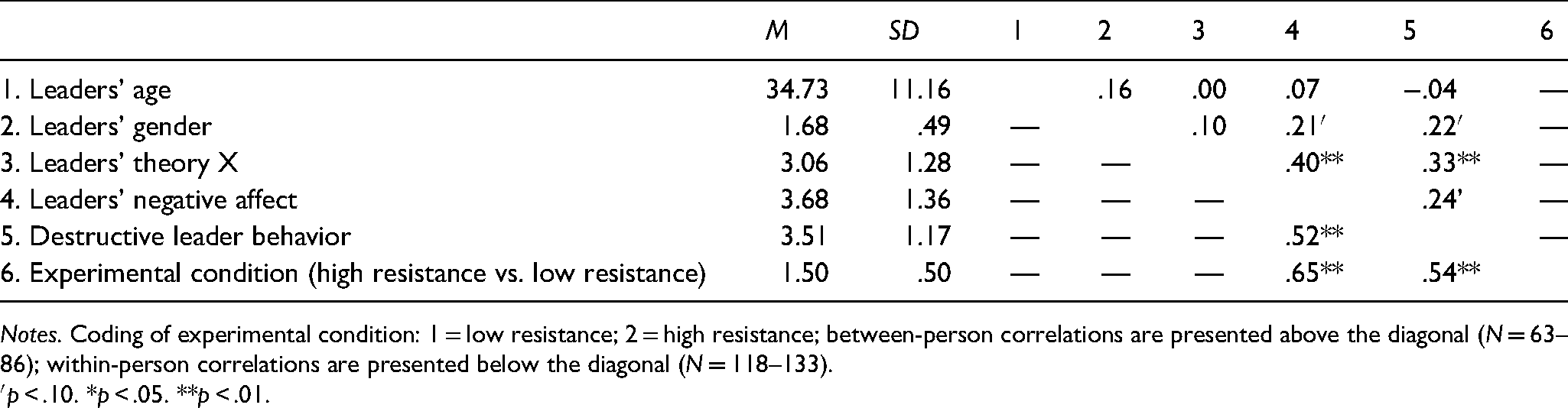
Notes. Coding of experimental condition: 1 = low resistance; 2 = high resistance; between-person correlations are presented above the diagonal (N = 63–86); within-person correlations are presented below the diagonal (N = 118–133).
′p < .10. *p < .05. **p < .01.
An inspection of the different criteria indicated a satisfying Bayesian model fit for the multilevel mediation model (PPP = .50, PPC using χ2 = [−12.29; 13.59], PSR = 1.01) and the multilevel moderation model (PSR = 1.00, PPP and PPC are not implemented for random slope models in Mplus). Additionally, trace and autocorrelation plots for both models revealed MCMC convergence.
For Hypothesis 1, descriptive results showed that in the high-follower resistance condition, leaders’ behaviors were rated as more destructive (M = 3.98; SD = .76), compared to leaders’ behaviors in the low resistance condition (M = 3.05; SD = 1.32). The results from the multilevel moderation model showed that follower resistance (low resistance coded as 1 and high resistance coded as 2) increased destructive leadership behavior (b = .80, 95% CI [.44, 1.17], lending support for Hypothesis 1. Likewise, for Hypothesis 2a, the results from this model indicated that leaders with a high Theory X schema displayed more destructive leadership (b = 1.48, 95% CI [.73, 2.30]; see Figure 1). To test Hypothesis 2b, we examined the cross-level moderation effect of Theory X on the random slope of follower resistance on destructive leadership. The posterior distribution of the cross-level moderation effect showed that the effect of follower resistance on destructive leadership behavior was shaped by Theory X (b = −.79, 95% CI [−1.30, −.32]). The interaction is depicted in Figure 2. Contrary to our expectations, the findings opposed Hypothesis 2b, such that the association between follower resistance and destructive leader behavior was stronger when Theory X was low, and weaker when Theory X was high. Moreover, the interaction plot implies that leaders high on Theory X respond in a destructive manner independently from their followers expressing high or low resistance. Based on our findings, we reject Hypothesis 2b.

Results moderation model.
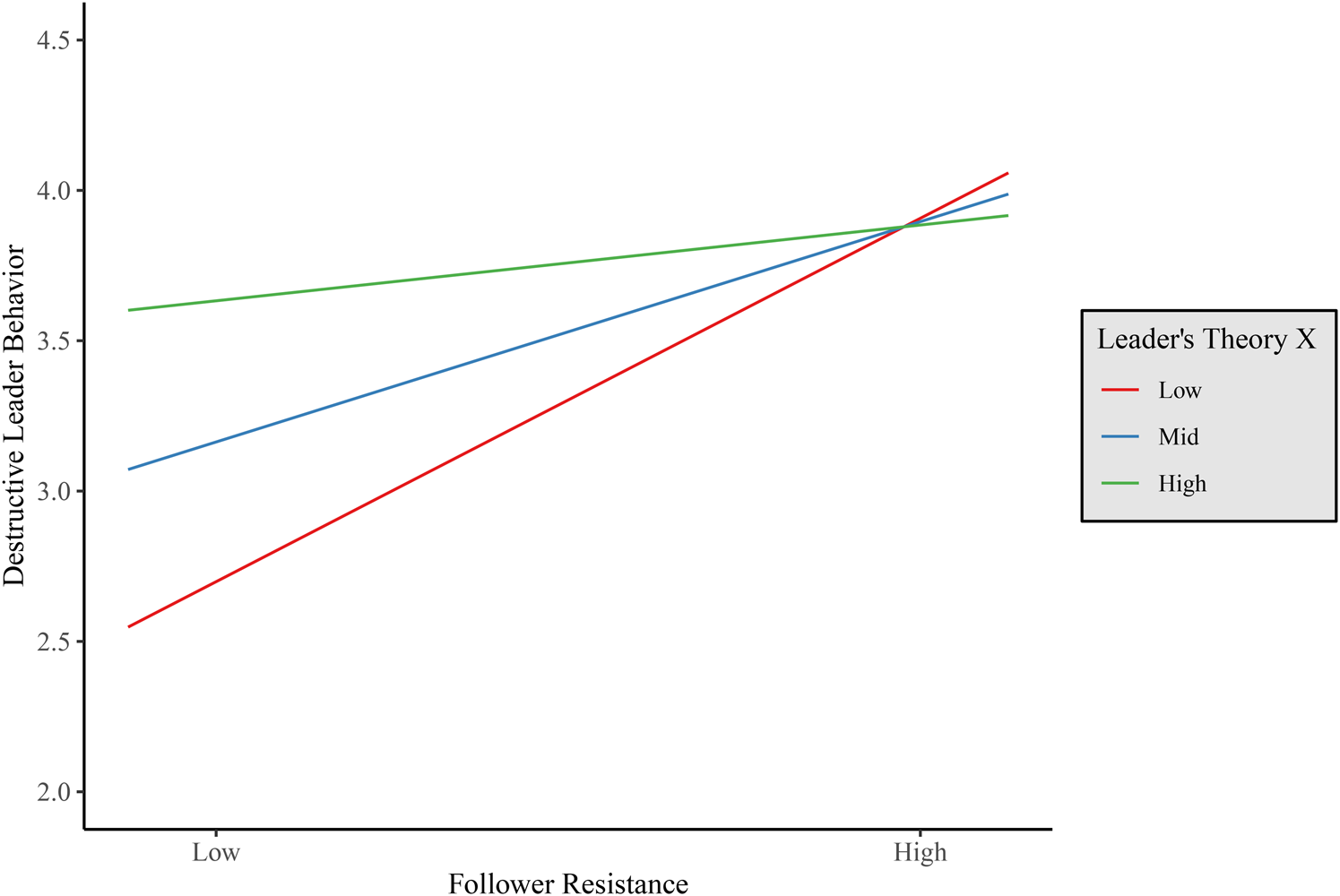
Cross-level interaction.
In the following, we present the results of the multilevel mediation model. For Hypothesis 3, we examined the mediational pathway via negative affect on the within-person level, while controlling for between-person negative affect (i.e., added the person mean as proposed by Antonakis et al., 2019) and Theory X schema. Regarding the within-level mediation, follower resistance enhanced leaders' negative affect (b = 1.29, 95% CI [1.04, 1.54]), which in turn enhanced destructive leader behavior (b = .23, 90% CI [.01; .46]). Additionally, the indirect effect supported Hypothesis 3 (bind = 0.30, 90% CI [.01, .61]). As follower resistance still affected destructive leader behavior (b = .60, 95% CI [.07, 1.10]), results indicated a partial mediation (see Figure 3).
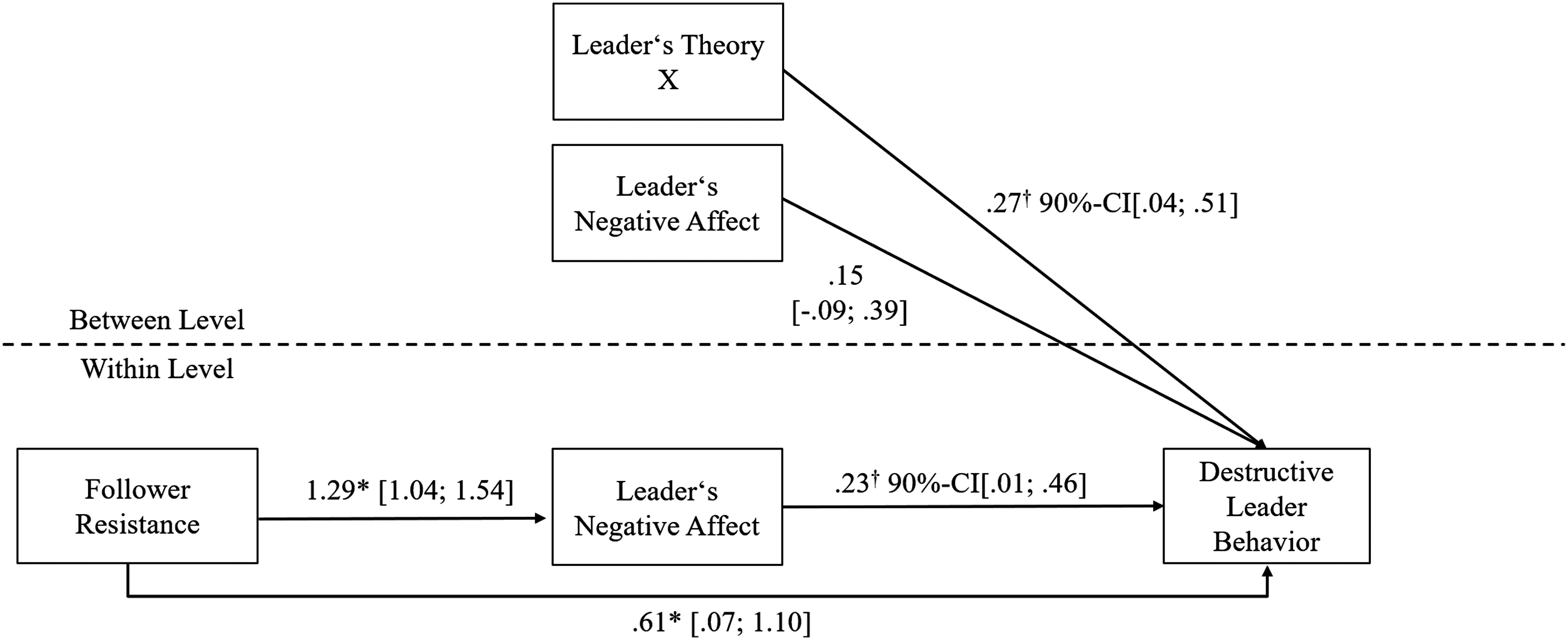
Results mediation model.
Discussion
The present research examined how follower resistance triggers destructive leader behavior while focusing on the underlying cognitive and affective leader attributes that lead to this destructive behavior. Clearly, the negative consequences if leaders fail to address follower resistance properly are related to the performance and health of their followers as well as to the success and survival of their organizations. Thus, theoretical and empirical insights into leaders’ responses to “followers that do not follow” are necessary for addressing follower resistance as a leadership challenge and for deriving implications for both and practitioners and organizational researchers to prevent destructive leader behavior (Martinko et al., 2013).
To date, little is known regarding the immediate consequence of follower resistance for leaders’ behavior, and regarding how leaders’ processing of expressed follower resistance explains this linkage. Our findings contribute to the limited body of research that has investigated the antecedents of destructive leader behavior by taking on a multilevel perspective (Liang et al., 2016; Zhang & Bednall, 2016) that considered both follower-related antecedents (i.e., follower resistance) as well as leader-related attributes (i.e., IFTs) and affective processes (i.e., negative affect) as determining factors of destructive leader behavior. Our results showed that followers’ expressions of resistance triggered destructive leader behavior, as hypothesized. In terms of boundary conditions, we identified leaders’ IFT (i.e., Theory X) as a moderator of leaders’ destructive behavior toward follower resistance. However, the effect was in a different direction than we hypothesized, that is, the relationship between follower resistance and destructive behavior was stronger for leaders with a weak Theory X schema. In terms of explanatory mechanism, leaders’ negative affect mediated the relationship between follower resistance and controlling leader behavior, as we hypothesized. Our findings hold several implications for theory on destructive leadership and leadership in general and provide practical implications for leader–follower relationships in the workplace.
Theoretical and Methodological Implications
First, while research on the negative consequences of destructive leadership, such as negative follower behavior, is highly dominant in past and contemporary literature, our findings support and extend previous research on the antecedents of destructive leadership. Past research on antecedents of destructive leadership mainly focused on leader-related constructs (e.g., personality traits; Kim et al., 2018; Wu & Hu, 2009) or incorporated a social learning perspective (e.g., trickle-down effects; Aryee et al., 2007; Mawritz et al., 2012). We applied research on follower resistance, victimization perspectives (Aquino & Thau, 2009), and leader identity threat (Tepper et al., 2017) to theorize about followers as active recipients that have an impact on leader behavior as part of the leader–follower relationship. In doing so, we addressed recent calls to reverse the perspective on destructive leadership antecedents and focus on the follower (Zhang & Bednall, 2016). Whereas the (resistant) follower as a source of variance in understanding leader–follower relationships has often been neglected in the leadership literature (Avolio, 2007; Lord et al., 1999), we demonstrated that follower resistance can trigger destructive leader behavior. In this respect, we contribute to the leadership literature that highlights followers as active recipients integral to the leadership process, rather than perceiving them as passive, powerless individuals who are under the control of their leader (e.g., Oc & Bashshur, 2013; Uhl-Bien et al., 2014).
More detailed, follower resistance may be seen as an act of provocation by followers that threatens the status and identity of the leader (Tepper et al., 2017). Challenging the leader's status and experiencing an anticipated loss of control causes the leader to behave in a destructive manner: By using destructive behavior, the leader tries to restore his/her status and power. Thus, our findings underline this idea that an identity threat (i.e., follower resistance) can foster destructive behavior of the leader.
Second, research in a related field has previously identified a direct relationship between a decrease in followers’ performance and leaders’ abusive supervision (e.g., Lian et al., 2014), yet the majority of these studies has used research designs (e.g., cross-lagged panel design) that cannot account for the elimination of alternative explanations and hence, cannot derive valid causal claims due to their research design. In this regard, our methodological approach addresses concerns from previous research about potential threats to validity (i.e., consistent estimation of models), stemming from sources of endogeneity including simultaneity (i.e., reverse causality; Antonakis et al., 2010). Our experimental vignette study allowed us to correct for potential influences from the reverse direction, that is, destructive leader behavior triggering follower resistance (Tepper et al., 2008). Furthermore, by using multilevel modeling we accounted for between-person influences, which otherwise were likely leading to biased estimates of our proposed model (Antonakis et al., 2019). Thus, our study offered solutions in terms of estimation approaches and research designs by which researchers can ensure their predictor variable is not correlated with omitted causes, thereby allow the drawing of causal inferences about the antecedents of destructive leader behavior. Because of the urgent need for adequate methods that are able to capture the complex interdependencies between leaders and followers (e.g., Antonakis et al., 2010; Güntner et al., 2020), we hope the methodological approaches we introduced will find increasing recognition in contemporary leadership research.
Third, while our study findings reflect the concept of victimization (i.e., followers show behavior that leaders perceive to be worth punishing; Aquino & Thau, 2009), other than the term victimization implies, we do not think of followers as solely passive victims of their leader or sharing the idea of “blaming the victim.” Instead, we acknowledge the perspective of followers as powerful individuals influencing their leaders, which may enable both researchers and practitioners to seek new approaches for preventing or minimizing destructive leader behavior in organizations. Beyond this perspective, in combination with empirical evidence that negative forms of leadership (e.g., abusive supervision) trigger negative follower behavior (e.g., organizational deviance; Tepper et al., 2017), we can speak of leadership as a mutual influence process that is co-created in dynamic interactions between leaders and followers (Fairhurst & Uhl-Bien, 2012). In the context of destructive leadership, this implies that followers “are rarely ‘pure victims’” (Simon et al., 2015, p. 1800), but that leaders and followers take turns in influencing each other by trading the roles of victim and perpetrator.
By integrating leader-related characteristics into our theoretical model on the relationship between follower resistance and destructive leader behavior, we emphasize that destructive leader behavior is a function of both follower behavior (i.e., resistance) and leader-related attributes (i.e., IFTs and negative affect). In doing so, we contribute to the scarcity of research that takes on a more balanced perspective to explain when and why leaders show destructive behavior. Specifically, previous research has provided only little explanation and empirical evidence on the question what leads to differences in leaders’ likeliness to respond with destructive behavior when confronted with follower resistance (Liang et al., 2016). In aiming to fill this research gap and provide a multilevel perspective on the antecedents of destructive leader behavior, our research investigated leader IFTs and leader affect as underlying mechanisms of the relationship between follower resistance and destructive leader behavior.
Fourth, we identified leaders’ Theory X schema as a moderating influence on the relationship between follower resistance and destructive leader behavior. Perception of followership, and thus, leaders’ behavior toward followers, is largely influenced by the cognitive schemata leaders hold (Sy, 2010; Uhl-Bien & Pillai, 2007). This cognitive categorization process subsequently results in leaders’ judgments about the respective person. Specifically, our findings suggest that leaders with a strong Theory X schema are more likely to show destructive behavior toward followers overall (i.e., independent from their followers expressing high or low resistance). In that sense, we add to previous research stating that leaders who blame followers for poor organizational performance are likely to react to followers with highly controlling behavior (Repenning & Sterman, 2002). At the same time, our counterintuitive finding that the positive relationship between follower resistance and leaders’ destructive behavior is stronger (rather than weaker) for leaders with a weak Theory X schema, compared to leaders with a high Theory X schema, suggests that a weak Theory X schema has an exacerbating effect in the context of follower resistance. Arguably, one reason for our finding could be that although leaders with a weak Theory X schema think of followers in terms of autonomous and self-controlled individuals, they may experience the reflex to assert control over particularly resistant followers (Sager, 2008). However, they may do so in a well-intended manner (i.e., to help followers restore their inner motivation or feeling empathy; LePine & van Dyne, 2001) instead of with a punishing intention. Regarding the scenario of our vignette, it could be that leaders’ destructive behavior (i.e., control) was driven by their concern for work safety policy and to act in the best interest of the organization. That is, it might be that the rationale behind the destructive behavior of leaders with a weak Theory X schema comes with a positive intention in terms of a “righting reflex.” This tendency describes the underlying belief that the leader “must convince or persuade the person to do the right thing” (Miller & Rollnick, 2013, p. 10) and in turn, triggers destructive leader behavior in response to follower resistance.
Furthermore, our results indicate that leaders with a strong Theory X schema show just as much destructive behavior toward resistant followers and cooperative followers. A possible explanation may be that in reaction to follower resistance, leaders with a strong Theory X schema may feel confirmed in their assumption of followers being inherently irresponsible and uncommitted to the organization (McGregor, 1960) and hence, see less need to control followers. Additionally, with regard to the negative moderation effect, leaders with a strong Theory X schema may see follower resistance not as an act of provocation (Tepper et al., 2017), but as an expected behavior. Thus, they may not experience a high identity threat (i.e., loss of status) and react not overly harsh.
Fifth, we illuminated the affective mechanisms by which follower resistance regulates leader behavior, thereby explaining how follower resistance is related to destructive leader behavior. Affect has been ascribed as a key factor in determining leadership effectiveness (Ashkanasy & Tse, 2000; Damen et al., 2008). Not only did our study show a significant association between follower resistance and leaders’ experienced negative affect, but this emotional response also mediates the association between follower resistance and leaders’ destructive behavior. To the best of our knowledge, only one other study by Eissa et al. (2020) has previously examined the role of negative affect in the relationship between provoking follower behavior (i.e., CWB) and destructive leadership, however, the authors examined follower interpersonal deviance (i.e., nonsupervisory interpersonal deviance that is directed at other followers). Thus, we extend this previous work by focusing specifically on follower resistance as negative follower behavior that is directed at the leader. Furthermore, our findings add to previous work on AET, particularly considering followers’ behavioral resistance as an affective event. As an emotional response arises in the leader, followers’ behavior can be conceptualized as an affective event for leaders in terms of AET (Weiss & Cropanzano, 1996), and subsequently trigger leaders’ behavioral response. Hence, we argue contrary to previous scholars who put the focus of attention on the leader (Dasborough, 2006) that followers can be sources of leaders’ negative emotions at work, too. Especially, we identified followers’ resistance as a behavior displayed during leader–follower interactions as one source of these affective events.
Practical Implications
First, our findings offer implications for followers. Research has discussed that follower resistance is often ambiguous and may be interpreted differently by leaders. For leaders it is often not entirely clear whether resistance is well-intentioned and serves to improve organizational activities or if resistance only serves to release followers’ anger. Thus, it is likely that leaders may misinterpret expressions of follower resistance, for example as “unsolicited interference” intended to challenge the status quo and harm organizational goals (Tepper et al., 2004, p. 457). As a result, followers who express resistance can trigger leaders to respond with negative affect and destructive behavior (e.g., micromanaging), which in turn may harm followers. Although our research focus was not to study different types of resistance (e.g., constructive vs. dysfunctional resistance; Tepper et al., 2001), nevertheless our findings imply that followers should pay attention to the way they deliver their resistance in order to be heard by their leaders (Maynes & Podsakoff, 2014).
Second, because we observed destructive leader behaviors as the emergent phenomena in response to follower resistance, we provide implications for leaders, too. Specifically, in the context of organizational change where follower resistance is more present than ever, leaders may interpret resistance as an ego threat (Fast et al., 2014). For example, followers that do not follow, meaning followers who express resistance, have been described as the “enemy of change” (Waddell & Sohal, 1998, p. 543) and the reason for failing change projects (Kotter, 2007). However, followers might be inclined to express resistance when their satisfaction with the change process is particularly bad (i.e., low autonomy in decision-making about the change, high demands on how to change). In this regard, leaders should be mindful toward the reflex to show destructive behavior, such as micromanaging, when confronted with change-related situations where followers express resistance (Neves & Schyns, 2018). Hence, we call for developmental interventions that help leaders in creating self-awareness for their behavioral tendencies and teach them to abstain from destructive behaviors (e.g., micromanaging), which are supposed to undermine individuals’ motivation and substantiate resistance (Klonek et al., 2014). As our findings show, leaders who hold more positive implicit assumptions of followers (i.e., weak Theory X schema) may be particularly receptive to show destructive behavior and hence, should receive special attention in such leadership trainings. In this respect, it seems fruitful to make leaders aware of their implicit followership assumptions, and how these may influence their behavior toward followers.
Limitations and Future Directions
This study has several strengths, such as our combination of an experimental study design with field data that increases both external and internal validity and allows to demonstrate causal effects in leader–follower interactions. Still, we acknowledge several limitations of our study that deserve mention and suggest avenues for future research.
First, in our study, we did not differentiate between different types of resistance (e.g., constructive vs. dysfunctional resistance; Tepper et al., 2001). Instead, we followed a uniformly dysfunctional perspective of follower resistance, stating that leaders will regard resistance as dysfunctional regardless of the way it is expressed. In fact, we believe that in everyday working life, leaders may have a hard time to differentiate whether follower resistance comes with a positive or rather a negative intention (see also Fast et al., 2014). However, we acknowledge that the type of resistance may influence how leaders respond to resistance, as shown by previous research that looked at different types of follower voices (Burris, 2012). Therefore, we suggest future research should investigate (e.g., through experimental manipulation) how different manifestations of follower resistance, including constructive and dysfunctional resistance, trigger different leader behaviors and the kind of intentions (e.g., punishing vs. well-meaning intention; Liang et al., 2016) behind these behaviors.
Second, our research focused on the behavioral expressions of resistance by means of verbalization but did not explore how resistance can be expressed in numerous ways, such as by means of nonverbal or paraverbal expressions. Previous research suggests that distinct nonverbal communication and voice tone affect perceptions of threat in interpersonal interactions. For example, a harsh, imperative tone and offensive gestures are likely to communicate threat (see Ridgeway, 1987). Future research should investigate how distinct combinations of nonverbal, paraverbal, and verbal forms of resistance lead to similar reactions from leaders.
Third, although our study identified both leader-related and follower-related characteristics and behaviors that contribute to destructive leadership, our study did not assess the contextual factors that may invite controlling leader behavior, too (i.e., toxic triangle; Padilla et al., 2007). Specifically, a line of research on the dark side of goal setting suggests that goals can have a powerful negative impact on increasing destructive leader behavior (e.g., Bardes & Piccolo, 2010; Ordonez & Welsh, 2015). Organizations that put particular focus on performance goals (e.g., by use of goal-directed reward systems) may direct leaders’ attention to activities they perceive as relevant in reaching these goals. Leaders may feel pressured to show behaviors by which they try to get followers’ resistance under control, thereby ensuring that organizational goals are met (i.e., implementation of organizational change projects). Future research could consider the effects of an organization's goal-contingent reward system on the occurrence of destructive leader behavior.
Fourth, our study has some methodological limitations. Whereas we did use a sample of professionals with a leadership position, we did not observe real leader–follower conversations. Collecting data of real leader–follower interactions is challenging, and that is why we relied on Aguinis and Bradley (2014) who discuss EVM as a way to assess intentions, attitudes, and behaviors by means of presenting realistic scenarios. Not only do vignettes allow researchers to manipulate and control independent variables, which is in favor of internal validity, but vignettes also enhance experimental realism, which increases external validity (Atzmüller & Steiner, 2010). Yet, future research could examine how our findings on destructive leader behavior in response to follower resistance further generalize to leader–follower conversations in the field. Additionally, it is important to consider the dynamic interplay of leader–follower interactions: Does leader's destructive behavior—as a response to follower resistance—increase follower resistance and therefore lead toward a downward spiral of negative interactions? Or do followers exhibit fewer resistance and accept the leader's position (DeRue & Ashford, 2010)? More longitudinal research is needed to examine antecedents of destructive leadership and the dynamic relationships of destructive leadership appropriately (Schyns & Schilling, 2013).
Footnotes
Acknowledgments
The authors would like to thank Nale Lehmann-Willenbrock for her help in the data collection and helpful comments on earlier drafts of this manuscript. Additionally, the authors would like to thank the two anonymous reviewers for their helpful comments during the revision process.
Declaration of Conflicting Interests
The authors declared no potential conflicts of interest with respect to the research, authorship, and/or publication of this article.
Funding
The authors received no financial support for the research, authorship, and/or publication of this article.
