



Abstract
We examine how leadership structure schemas (LSS) – mental models of how leadership is most effectively structured in groups – interact with formal authority to influence individuals’ leadership behavior and perceptions of others who lead. Across two experiments and a field study, we find that for individuals without formal authority, holding a more shared LSS (relative to a more hierarchical LSS) is positively associated with leadership behavior. However, this effect reverses for individuals in authority positions. Additionally, individuals who engage in leadership behavior are seen as higher in interpersonal warmth by observers who hold a more shared rather than a more hierarchical LSS.
Receiving leadership behavior from a variety of sources is vital to the success of contemporary organizations, which operate in environments that are increasingly complex and ambiguous (Uhl-Bien et al., 2007). Studies have shown (and meta-analytic reviews have confirmed) that groups and organizations function more effectively when leadership is distributed across members and hierarchical levels (Carson et al., 2007; D’Innocenzo et al., 2016; Drescher et al., 2014; Ensley et al., 2006; Hoch & Kozlowski, 2014; Nicolaides et al., 2014; Wang et al., 2014). As such, identifying the factors that encourage leadership behavior, particularly among organizational members who do not possess formal authority, is top of mind for many leadership scholars (e.g., Chiu et al., 2016; Kukenberger & D'Innocenzo, 2020; Wellman et al., 2019).
Research has identified a number of precursors to leadership behavior, including personality traits, (Chiu et al., 2016), interpersonal perceptions such as warmth and competence (DeRue et al., 2015), demographic attributes (Kukenberger & D'Innocenzo, 2020), aspects of formal leaders (e.g., leader humility, Chiu et al., 2016; supportive coaching, Carson et al., 2007; laissez-faire behavior, Wellman et al., 2019), and a supportive team environment (Carson et al., 2007; Kukenberger & D'Innocenzo, 2020; Serban & Roberts, 2016). In addition to these previously-studied factors, individuals’ cognitive schemas may also play an important role in their decision to engage (or not engage) in leadership (DeRue & Ashford, 2010). Because cognitive schemas serve as “templates that group members use to interpret environmental events, plan their activities, and respond to one another's behavior” (Wellman, 2017, p. 603), their influence on leadership is likely to be profound and far-reaching. However, important questions remain about the types of schemas that are most relevant to leadership behavior and how they influence leadership in real-world settings. Addressing these questions would significantly advance leadership theory.
In this article, we explore how mental models of the prototypical structure of leadership activity in groups (i.e., how many group members should ideally enact leadership), which we refer to as leadership structure schemas (LSS; DeRue and Ashford, 2010), influence individuals’ propensity to engage in leadership behavior, as well as how they perceive others who lead. We explain that LSSs range from a hierarchical LSS in which individuals believe that leadership is most effective when it is performed by only a single individual, to a shared LSS, that portrays it as most effective for all members of a group to engage in leadership. Drawing from the literature on social schemas (e.g. Abelson, 1981; Lord and Maher, 1991; Fiske and Taylor, 1991; Schank and Abelson, 1977) and leadership (DeRue & Ashford, 2010; DeRue et al., 2015; Wellman, 2017; Wellman et al., 2019), we propose that possessing a more shared (relative a more hierarchical) LSS is positively associated with engaging in leadership behavior and with perceiving those who engage in leadership as higher in interpersonal warmth and competence. We further propose that these effects are stronger when the actor does not occupy a position of formal authority. Figure 1 summarizes our hypotheses. Two controlled experiments and a field study support many of our core predictions.

Conceptual model of the association between LSS, leadership behavior, and observers’ reactions.
Our studies make several important contributions. Most significantly, they establish LSS as a cognitive schema that affects leadership behavior and reactions. A small body of research has begun to explore the implications of LSS for other outcomes (e.g., Cook et al., 2021; DeRue et al., 2015; Evans et al., 2021), but the effects of LSS on leadership behavior remains unknown. In identifying a more shared LSS as a cognitive, individual-level antecedent of informal leadership, we contribute to the burgeoning body of studies exploring the precursors of shared leadership, and extend prior theories that have asserted mental models of leadership structure may play an important role in leader emergence (DeRue & Ashford, 2010; Wellman, 2017). Moreover, although existing research differentiates between “shared” (informal) and “vertical” (formal) leadership (He et al., 2020; Hoch & Kozlowski, 2014; Pearce & Sims, 2002), few studies have explored the relationship between these two forms of leadership within the same study. We address this limitation by identifying formal authority as an important boundary condition of the positive association between a shared LSS and leadership behavior. Specifically, we explain and empirically show (in Study 3) that this effect is positive in individuals without formal authority, but negative in individuals who possess formal authority.
Theory and Hypotheses
The Nature and Content of Leadership Structure Schemas
Given leadership is an inherent feature of social groups and organizations (van Vugt et al., 2008), individuals gain exposure over time to different leadership arrangements and develop schemas for how leadership should be structured on the basis of these experiences (Higgins, 1987; Lord & Maher, 1991; Mischel, 1973). We formally define LSS as a cognitive schema of the most effective structure for leadership activity in groups. LSSs vary on a continuum ranging from a hierarchical LSS that portrays leadership as best initiated by only a single individual, to a shared LSS that portrays leadership as most effective when shared equally by all group members 1 . Between these two “pure type” leadership structure schemas sit hybrid LSSs that can be described as “more shared,” in which groups work best if many, but not all, members lead, or “more hierarchical,” where leadership is thought to be best accomplished by a relatively small cohort of group members. As with other types of social schemas, individuals are likely to have a single LSS that is chronically salient (Markus & Kitayama, 1991; Fiske & Taylor, 1991), but situational cues can also temporarily “activate” an alternative LSS stored in memory (Higgins, 1990; Mischel, 1973).
Although the initial conceptualization of LSS included only a high-level discussion of LSSs properties and expected effects (DeRue & Ashford, 2010), recent studies have begun to extend our understanding of LSS. A more shared LSS (at the team level) appears to weaken the relationship between team competence centralization and the centralization of leadership perceptions (DeRue et al., 2015). Similarly, a shared LSS has been associated with perceptions of team leadership as being decentralized (Cook et al., 2021). A more shared LSS was also found to be associated with team members taking on additional “interpersonal responsibility,” which had negative implications for their enjoyment of work (Evans et al., 2021). Although these are important advances, most prior research has focused on the implications of LSS for team-level perceptions, and scholars have yet to examine how LSS influences individual leadership behavior, or how formal authority may interact with LSS to impact leadership actions.
Although only a few studies have specifically referenced the LSS construct, related ideas have received more attention. For instance, there is a robust literature on implicit leadership theories (ILTs) – mental models of prototypical leader attributes (e.g., dynamic, intelligent; Epitropaki and Martin, 2004; Lord et al., 1984). Although both LSSs and ILTs are cognitive schemas related to leadership, ILTs are schemas of individual leader attributes, whereas LSSs are schemas of group leadership structure. Unlike ILTs, LSSs do not account for the personal characteristics of leaders. Instead, LSS is concerned with the distribution of leadership influence across group members.
Other research has suggested that four cognitive models of social relations (communal sharing, authority ranking, equality matching, and market pricing) underlie virtually all forms of human activity (e.g., Fiske, 1992; Haslam and Fiske, 1999). LSSs are similar to these cognitive relational models in that they pertain to how groups structure their social interactions. A more shared LSS is consistent with the communal sharing relational model, whereas a more hierarchical LSS incorporates authority ranking principles. However, LSS is a much more specific schema than broad relational models: LSS is relevant to one specific activity (leadership), whereas relational models encompass all forms of social interaction.
Studies have also proposed and found that social identification – that is, the extent to which individuals define themselves as a group member rather than in terms of their differentiating individual attributes – has an important influence on their leadership behavior (Hogg, 2001; van Knippenberg & Hogg, 2003). LSS is distinct from social identification, however, in that individuals with both a more hierarchical and a more shared LSS may equally identify with the group. With LSS, the key difference is not the degree of importance or meaning individuals attach to their group membership, but rather whether they believe leadership activity within that group is most effectively performed by one versus multiple members.
Having discussed the properties of LSS and differentiated it from related constructs, we next consider the causal relationship between LSS and leadership behavior.
The Impact of LSS on Leadership Behavior
Schemas are cognitive structures that underlie and create behavioral expectations and that can be precursors to social norms (Fiske & Taylor, 1991). For example, Wilson and Capitman (1982) found that individuals’ behavior within a given social situation tends to be consistent with the specific relational schema made salient (e.g., talking softly when thinking about a room as a library vs. as a break room). In keeping with these findings, we propose that the nature of individuals’ LSS exerts an important influence on their likelihood of engaging in leadership behavior. In line with prior work (Gerpott et al., 2019; Wellman, 2017; Wellman et al., 2019; Yukl et al., 2002), we define leadership behavior as actions that define a group's objectives, motivate task behaviors in pursuit of these objectives, and/or help maintain a positive and supportive social climate. Research has established that leadership behavior consists of three broad classes of activity: task-oriented leadership behavior (which facilitates the performance of group tasks); social-oriented leadership behavior (which resolves interpersonal conflicts and ensures group members are satisfied and motivated) and change-oriented leadership behavior (which encourages group adaptation). LSSs do not specify the type of leadership behavior team members engage in, but rather the distribution of those behaviors within the team. As such, our theorizing assumes that LSSs have a similar effect on various types of leadership behavior, and discusses leadership behavior broadly rather than specifying particular types or styles of leadership.
We posit that when individuals encounter opportunities to lead, they interpret and respond to those opportunities based on the LSS that is most accessible to them (Fiske & Taylor, 1991; Lord & Maher, 1991). Individuals holding a more hierarchical LSS believe that groups are most effective when only one member engages in leadership. These individuals are therefore likely to be hesitant to engage in leadership behavior even when they detect an opportunity to do so. They may view such behavior as inappropriate, dysfunctional, or even risky (DeRue & Ashford, 2010; Zhang et al., 2020). For instance, when individuals with a more hierarchical LSS observe interpersonal conflict or notice a group member taking an inappropriate approach to completing his or her task work, they may refrain from stepping in to correct the problem. They may similarly refrain from voicing their opinions about what strategic direction their group should be taking. Instead, individuals with a hierarchical LSS are likely to defer to others whom they believe are more qualified to serve as their group's sole leader. As a result, we propose that a more hierarchical LSS suppresses leadership behavior.
On the other hand, individuals whose salient LSS is more shared think that groups are most effective when many or all members engage in leadership. When these individuals perceive a need for leadership, they are more likely to view leading as an expected and appropriate means by which they can improve group functioning. Returning to the earlier examples, individuals holding a shared LSS may be more likely to feel it is appropriate and helpful for them to intervene to resolve a conflict, propose a suggestion for completing task work more efficiently, or articulate a compelling vision of a future objective their group could pursue. Thus, we propose that individuals with a more shared LSS engage in more leadership behavior than those with a more hierarchical LSS. Hypothesis 1. A more shared LSS (relative to a more hierarchical LSS) is positively associated with engaging in leadership behavior.
The Moderating Role of Formal Authority on Leadership Behavior
We also consider how the effects of an individual's LSS on their leadership behavior may be contingent upon their level of formal authority. Formal authority is a powerful source of expectations about how much leadership behavior a given individual should engage in (DeRue & Ashford, 2010). As such, it is important to understand how these expectations interact with cognitive schemas of leadership structure to influence leadership behavior.
We have argued that holding a more shared LSS (relative to a more hierarchical LSS) increases individuals’ leadership actions by causing them to view leadership as expected, appropriate, and desirable. However, we posit that this effect is less pronounced in individuals who possess formal authority. As DeRue and Ashford (2010, p. 640) argued, “people often hold expectations of a supervisory role that include leadership” (see also Wellman et al., 2016). The meaning that individuals associate with engaging in leadership behavior is therefore likely to change when the individuals occupy a formal leadership position. By being placed in such roles, formal authority figures have received a strong institutional grant of a leader identity, and operate under role prescriptions where leadership is expected. Because individuals who occupy a formal leadership role already view engaging in leadership as expected and normative, a shared LSS is less likely to dramatically increase such perceptions. As such, a shared LSS is likely to have a weaker positive effect on the leadership behavior of individuals with formal authority than it has on individuals without formal authority. In fact, because formal authority figures with a more shared LSS view leadership as optimally effective when it is shared by many group members, they may even intentionally step back from an active leadership role to combat perceptions that they will serve as their group's sole leader and to encourage contributions from others (c.f., Kirkman and Rosen, 1999). In this way, they might attempt to foster a system of shared leadership that aligns with their dominant LSS.
Individuals with formal authority who hold a more hierarchical LSS view leadership as best accomplished by a single individual. When these individuals possess formal authority, their formal position may cause them to expect that they should be their group's single leader, and therefore to see engaging in leadership as necessary, safe, normative and appropriate and be more likely to enact leadership behavior. As a result, a more shared LSS may not increase leadership behavior (and a more hierarchical LSS may not suppress leadership behavior) to the same degree for individuals with formal authority than for individuals without formal authority. Hypothesis 2. Formal authority moderates the positive association between a more shared LSS (relative to a more hierarchical LSS) and leadership behavior, such that the association is stronger for individuals without formal authority, and weaker for individuals with formal authority.
The Impact of LSS on Reactions to Leadership Behavior
Cognitive schemas such as LSS have been shown to influence evaluations of social interactions (Sanchez-Burks et al., 2000). People tend to prefer social interactions that are consistent with their prevailing schema over those that are schema-inconsistent (Walsh, 1995). Thus, we extend our theorizing to consider how observers’ LSS influences their evaluations of the interpersonal warmth and competence of individuals who engage in leadership behavior. Warmth refers to perceptions of others as trustworthy, kind, and prosocially-oriented, whereas competence refers to perceptions of others as intelligent, strong, and active. Warmth and competence have been highlighted as foundational elements of interpersonal perception, (e.g., Cuddy et al., 2008; Fiske et al., 2002; Rosenberg et al., 1968; Wojciszke et al., 1998), and as being particularly relevant to the evaluation of leaders (DeRue et al., 2015). As Cuddy et al. (2011, p. 74) pointed out, “Psychological research involving thousands of people from widely varied cultures has established that people use these two trait dimensions – warmth and competence – to ‘sort’ our social worlds, judging people as relatively high and low on each dimension.”
We propose that the extent to which observers perceive others who engage in leadership behavior as high in warmth and competence is contingent upon the observers’ salient LSS. In the shared LSS, leadership is one way that group members can and should contribute to the team, making leadership an expected part of the role set for all members. Thus, actors who engage in leadership behavior should tend to be seen as benevolent (warm) by observers holding a shared LSS – the actors will be viewed as supporting the group by stepping up to lead. In contrast, the expectations and perceptions of individuals with a hierarchical LSS are governed by a “one-leader-is-best” principle. As a result, observers holding a more hierarchical LSS are more likely than those holding a more shared LSS to view leadership behavior as an attempt to establish social dominance. Considering that individuals perceived to be cooperative and benevolent are judged to be warmer than those who are seen as competitive and dominant (Fiske et al., 2002), we expect that observers with a more shared LSS will view individuals who engage in leadership behavior as warmer than will observers with a more hierarchical LSS.
We further hypothesize that observers with a more shared LSS will view actors who engage in leadership behavior as more competent than will observers with a more hierarchical LSS. Individuals who conform to others’ schema- based expectations have been found to be viewed as more credible and competent then those who violate these expectations (Burgoon, 1993; Burgoon & Le Poire, 1993; Burgoon et al., 1982; Sanchez-Burks et al., 2000). Observers with a more shared LSS view leadership as an important means through which many individuals can contribute to collective effectiveness, leading them to expect many members of their group to engage in leadership behavior. In contrast, observers with a more hierarchical LSS are likely to expect only a single member of their group to lead. Thus, leadership behavior is more likely to conform to the schema-based expectations of observers with a more shared LSS than observers with a more hierarchical LSS, rendering shared-LSS observers likely to view actors who engage in leadership as higher in competence. Hypothesis 3. The association between an individual's leadership behavior and the a) perceived warmth and b) perceived competence that an observer attributes to the individual is moderated by the observer's LSS, such that the association is more positive when the observer has a more shared LSS than when the observer has a more hierarchical LSS.
The Moderating Role of Formal Authority on Reactions to Leadership Behavior
Finally, we propose that the formal authority of individuals who engage in leadership moderates the effect of observers’ LSS on observers’ warmth and competence perceptions. We have argued that when observers with a more hierarchical LSS witness another person engage in leadership, the behavior is likely to violate the observers’ expectations and reduce the extent to which the observers perceive the actor as warm and competent. However, this expectancy violation and corresponding reduction in warmth and competence perceptions is less likely to occur when the actor possesses formal authority, due to the widely-held role expectation that individuals who occupy formal leadership positions should engage in leadership. In such cases, observers with a hierarchical LSS are more likely to view the actor as the single group member who is expected, entitled, and most qualified to lead (DeRue & Ashford, 2010; Wellman et al., 2016). Observers may view the actor's leadership behavior as an expected attempt to fulfill widely-held role expectations for the benefit of the group rather than an unexpected or risky form of proactivity. The result is that observers with a hierarchical LSS are likely to perceive actors who engage in leadership as higher in warmth and competence when the actors possess formal authority than when the actors do not possess formal authority.
Conversely, while observers with a more shared LSS may generally expect individuals to engage in leadership behavior and appreciate them when they do so, when the actor engaging in leadership also possesses formal authority, observers with a more shared LSS may view their behavior more negatively. When a formal leader exhibits a good deal of leadership behavior, observers with a more shared LSS may interpret it as an attempt to dominate other group members or stifle others’ contributions – actions that would violate shared-LSS observers’ behavioral expectations and impede the development of the shared system of leadership they see as as most effective. Such perceptions may weaken the positive effect of observers’ shared LSS on their perceptions of the warmth and competence of individuals who engage in leadership. Hypothesis 4. There is a three-way interaction between an individual's leadership behavior, an observers’ shared LSS, and the individual's formal authority on a) perceived warmth and b) perceived competence, such that the intensifying effect of a shared LSS on the positive association between an individual's leadership behavior and perceived warmth and competence is weaker when the individual possesses versus lacks formal authority.
Overview of the Present Research
Three studies provide converging evidence for our hypotheses. Study 1 examines evidence for Hypothesis 1 by exploring how LSS affects the leadership behavioral intentions of individuals without formal authority. Study 2 tests Hypothesis 3 by examining the causal influence of LSS on individuals’ perceptions of a group member who is described as engaging in informal leadership. Finally, Study 3 tests our entire conceptual model in a sample of organizational members both with and without formal authority (i.e., supervisors and their subordinates) across a variety of organizations.
Study 1
We tested Hypothesis 1 through a controlled experiment in a sample of working adults. We focused on establishing the causal relationship between LSS and leadership intentions in individuals without formal authority, because our theorizing suggests that the effects of LSS are likely to be most pronounced for these individuals as the expectations for, and norms governing their leadership are less clear than they are for individuals with formal authority.
Method
Of the 164 remaining participants who constituted our final sample, 79% were Caucasian, 54% were male, and they had an average of 15.70 years of work experience (SD = 8.93 years) and an average age of 36.24 years (SD = 9.60). Participants completed the study online and were randomly assigned to either a hierarchical LSS condition or a shared LSS condition.
After viewing one of the two videos, participants provided their evaluations of and feedback on the video. Upon completing this task, they were told that in a second, unrelated, part of the study, a management department researcher was interested in how they would behave in a hypothetical situation. The situation was described as follows: "Imagine that you work at GreenFood; a large, established company that produces healthy, prepackaged foods that are sold nationwide in grocery stores. You currently work in the marketing area but have rotated through other areas of the company as well. Recently, turnover at GreenFood has increased. In response, senior management has asked P. L., a high-ranking member of the company, to lead a task force charged with generating creative ideas about ways to improve the quality of the work experience for GreenFood employees. P. L. has selected you as a member of the task force and asked you to reserve times for a series of task force meetings. You are ready to get started.”
Thus, participants were placed in a position without formal authority in that they were a member of a task force that another individual had been formally appointed to lead. After reading the vignette, participants were presented with a graphic containing the initials of the other task force members. This graphic was designed to be consistent with the LSS manipulation. Specifically, the initials were arranged either in the form of a hierarchical organizational chart with the initials of P. L., the designated task force leader positioned above the other members (hierarchical LSS condition), or in the form of a network diagram (shared LSS condition).
Results
Discussion
Study 1 provides initial evidence that individuals without formal authority who hold a more shared LSS intend to engage in more leadership behavior than those with a more hierarchical LSS. Given that participants were randomly assigned to experimental condition, we can infer that the observed differences were caused by their experimentally manipulated LSS rather than other attributes that have been previously associated with leadership emergence. In light of this initial evidence that LSS is causally associated with leadership behavior, we next considered its effects on observer responses.
Study 2
Study 2 tested Hypothesis 3 by exploring the causal influence of a more shared or more hierarchical LSS on individuals’ perceptions of a group member without formal authority who engages in informal leadership behavior.
Method
"Now imagine that you are at work attending the first meeting of the new task force. The person heading the task force, P.L., begins the meeting by explaining some of the objectives of the task force and outlining a timeline for the completion of key deliverables. After P.L. finishes speaking, a member of the task force, N.W., speaks up and offers several specific ideas to the group about additional objectives that would enhance the success of the task force's overall core mission. In doing so, N.W. provides a persuasive picture of additional goals that the task force might accomplish that are consistent with the objectives P.L. outlined.”
This addition to the scenario depicts a member of the task force without formal authority engaging in informal leadership behavior that supplements, rather than competes with, the designated leader's actions and vision.
Results
Discussion
Study 2 examined whether leadership structure schemas influence individuals’ perceptions of a member of their group who engages in informal leadership. Individuals with a more shared LSS perceived an individual who engaged in informal leadership as warmer (but not more competent) than did individuals with a more hierarchical LSS. It is important to note that our first two studies examined the perceptions and behavioral intentions of individuals in hypothetical scenarios, for whom the salience of a particular LSS was manipulated. These studies provide evidence that establishes how LSS may influence leadership behavior and responses. However, they raise questions about the external validity of our findings, whether the observed results extend to actual as well as intended leadership behavior, and whether and how actors’ formal authority influences the effects of LSS. Study 3 addresses these important questions.
Study 3
Study 3 tested our full conceptual model in a sample of supervisors and subordinates in organizations across a variety of industries.
Method
We distributed surveys to 246 subordinates and 246 supervisors, and received 206 and 191 responses, respectively, constituting an overall response rate of 80.69%. Given that careless responding can be a concern in snowball samples, we followed a procedure recommended by Marcus et al. (2017) to identify and filter out potentially careless respondents. Specifically, we included a question at the conclusion of each survey enabling respondents to recommend that we not use their data, and excluded the 42 participants who selected this option or whose counterpart selected it.
After excluding those participants and removing cases without complete data, we arrived at a final sample of 318 participants: 159 supervisors and 159 subordinates. Participating supervisors and subordinates worked together in organizations across a broad range of industries: for instance, finance, transportation, health care, manufacturing, and professional services. Participants’ average age was 36.19 years (SD = 12.95), the median level of education was a bachelor's degree, the average organizational tenure was 7.28 years (SD = 7.42), and 51% were female. The predominant ethnicity was Caucasian (63.9%), followed by Hispanic (17.0%). Employees and supervisors had, on average, worked together for 3.70 years (SD = 3.50).
Measures
Results
Table 1 reports descriptive statistics and correlations among the study variables. We first considered the correlations between the variables we included as potential statistical controls and our focal variables. Gender, organizational tenure, observer gender, observer organizational tenure, and relationship tenure are all significantly correlated with one or more of the variables in our model. Per the recommendations of Bernerth and Aguinis (2016), we controlled for these variables in all analyses. The pattern of effects and significance levels we report below do not change when the control variables are omitted.
Study 3: Descriptive Statistics and Correlations.

Note. N = 288 individuals. Gender coded 0 = Male, 1 = Female. Ethnicity coded 0 = Non-Caucasian, 1 = Caucasian. Education coded 1 = High school diploma or GED, 2 = Some college, 3 = Associates degree, 4 = Bachelor's degree, 5 = Master's degree, 6 = Doctorate degree. Formal Authority coded 0 = No formal authority (employee), 1 = Formal authority (supervisor).
p < .10, * p < .05.
To test our hypotheses, we used Mplus version 7.4 to conduct a path analysis (Edwards & Lambert, 2007; Preacher et al., 2007). As noted, the data are hierarchical, with supervisors and subordinates nested in dyads. Preliminary analyses revealed a significant dyad-level effect for perceived warmth [ICC(1) = .21, ICC(2) = .35, F(149,150) = 1.59, p = .002]. To account for this effect, we used analysis type = complex, with clustering at the dyad level. This approach employs the Huber-White sandwich estimator to compute standard errors that are corrected for the non-independence of observations (Huber, 1967; White, 1982). To facilitate the interpretation of interaction terms, we grand-mean centered all the continuous predictors before entering them into the regression equations.
Tables 2 and 3 present the results of our hypothesis tests. Hypothesis 1 predicts that a more shared LSS is positively associated with leadership behavior, and Hypothesis 2 predicts that this association is stronger for individuals without formal authority (subordinates) than individuals with formal authority (supervisors). The model fit the data extremely well (SRMR = .02, CFI = 1.00). As shown in Table 2, Model 2, the main effect relationship between a more shared LSS and leadership behavior (b = −.04, SE = .06, p = .55) proposed in Hypothesis 1 was not supported. However, as shown in Table 2, Model 3, the direct effect of LSS on leadership behavior is qualified by a significant interaction with formal authority (b = −.41, SE = .11, p < .001). To understand the pattern of this relationship, we plotted the interaction and tested whether each simple slope was statistically significant (see Figure 2; Aiken and West, 1991). The results revealed that a shared LSS has a positive relationship with leadership behavior for individuals without formal authority (b = .19, SE = .09, p = .03), and a negative relationship with leadership behavior for individuals with formal authority (b = −.22, SE = .07, p = .002). These results support Hypothesis 2.

Study 3: LSS and formal authority predicting leadership behavior.
Study 3: Summary of Path Analysis Results for Leadership Behavior.

Note. N = 318 individuals. Gender coded 0 = Male, 1 = Female. Education coded 1 = High school diploma or GED, 2 = Some college, 3 = Associates degree, 4 = Bachelor's degree, 5 = Master's degree, 6 = Doctorate degree. Formal Authority coded 0 = No formal authority (employee), 1 = Formal authority (supervisor).
p < .10, * p < .05, ** p < .01.
Study 3: Summary of Path Analysis Results for Warmth and Competence Perceptions.
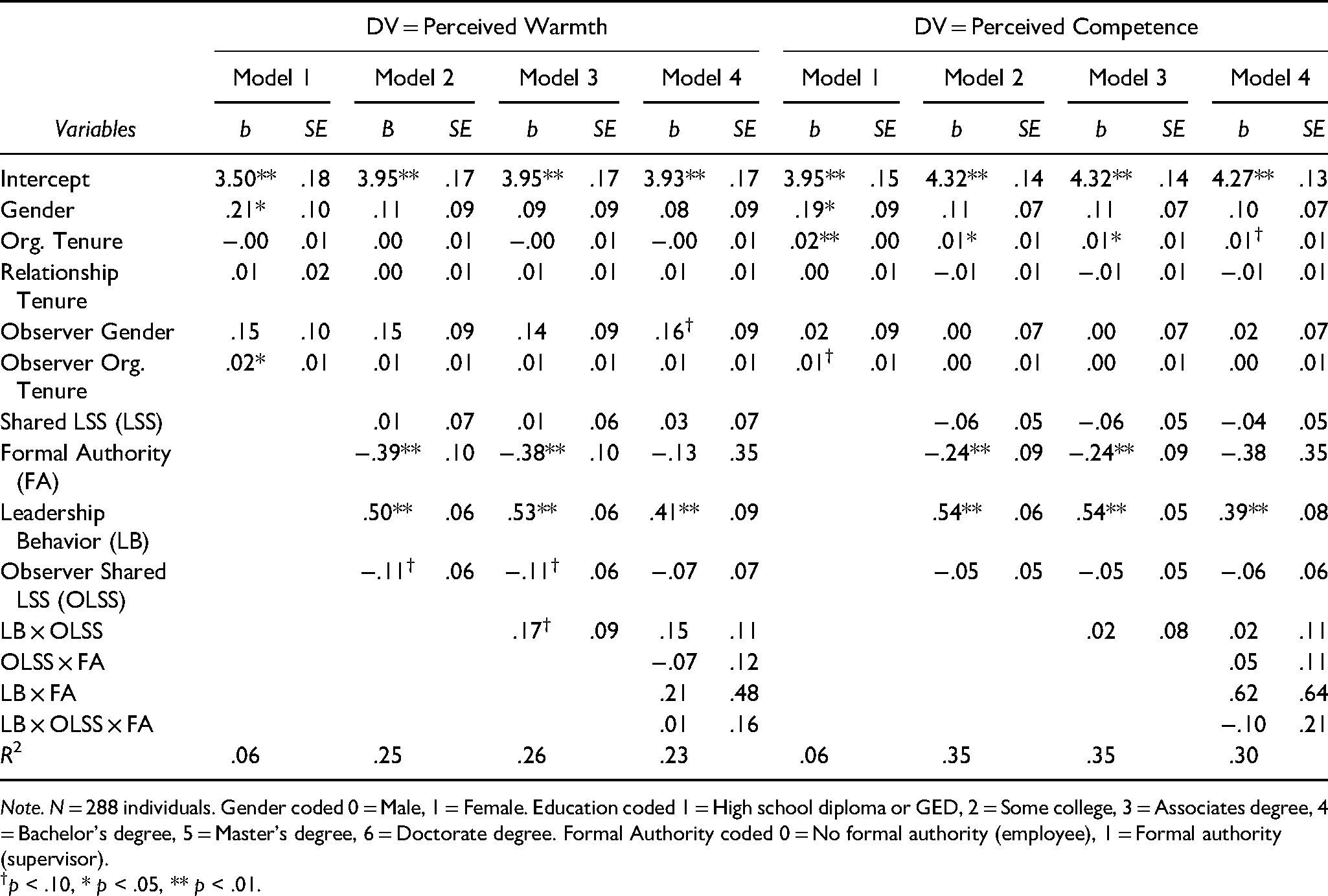
Note. N = 288 individuals. Gender coded 0 = Male, 1 = Female. Education coded 1 = High school diploma or GED, 2 = Some college, 3 = Associates degree, 4 = Bachelor's degree, 5 = Master's degree, 6 = Doctorate degree. Formal Authority coded 0 = No formal authority (employee), 1 = Formal authority (supervisor).
p < .10, * p < .05, ** p < .01.
Model 3 of Table 3 tests Hypothesis 3, which predicts that the positive associations between leadership behavior and observers’ warmth and competence perceptions are stronger when observers have a more shared rather than a more hierarchical LSS. The interaction between leadership behavior and observers’ LSS is a marginally significant predictor of perceived warmth (b = .17, SE = .09, p = .07), but not perceived competence (b = .02, SE = .08, p = .81). As shown in Figure 3a, the association between leadership behavior and perceived warmth is positive and significant both when the observer has a more shared LSS (b = .69, SE = .11, p < .001) and when the observer has a more hierarchical LSS (b = .36, SE = .11, p = .001), but is marginally more positive when the observer has a more shared LSS (Δ b = .33, SE = .18, p = .06). These results offer some support for Hypothesis 3a, although they fall just short of the traditional statistical significance level, but do not support Hypothesis 3b.

Study 3: Leadership behavior and observer's LSS predicting perceived warmth and competence
Hypothesis 4 predicts formal authority moderates the interactive effects of individuals’ leadership behavior and observers’ shared LSS on perceived warmth and competence, such that the effects are stronger for individuals without formal authority than individuals with formal authority. To test this hypothesis, we fit a model including the three-way interaction between actors’ leadership behavior, actors’ formal authority, and observers’ shared LSS, as well as all constituent two-way interactions predicting perceived warmth and competence (Aiken & West, 1991). As shown in Table 3, Model 4, the coefficient for the three-way interaction is not a significant predictor of perceived warmth (b = .01, SE = .16, p = .96), or perceived competence (b = −.10, SE = .21, p = .62). Moreover, including the additional interaction terms in the model dramatically reduced model fit (SRMR = .13, CFI = .48). Thus, Hypothesis 4 was not supported.
We also tested whether the interaction between individuals’ LSS and formal authority has an indirect effect on observers’ perceptions of their warmth and competence through leadership behavior. Due to the nesting in our data, we used R Studio (2015) to estimate Monte Carlo-based 95% confidence intervals for significance testing (Bauer et al., 2006). The indirect effects of a more shared LSS on perceived warmth and competence via leadership behavior are positive for individuals without formal authority [indirect effect—warmth = .10, 95% Monte Carlo CI (.01, .19); indirect effect—competence = .10, 95% Monte Carlo CI (.01, .19)], and negative for individuals with formal authority [indirect effect—warmth = −.11, 95% Monte Carlo CI (−.21, −.04); indirect effect—competence = −.12, 95% Monte Carlo CI (−.21, −.04)]. The difference between the conditional indirect effects for individuals with and without formal authority is significant for both perceived warmth [Δ indirect effect—warmth = −.21, 95% Monte Carlo CI (−.35, −.09)] and perceived competence [Δ indirect effect—competence = −.22, 95% Monte Carlo CI (−.35, −.10)]. These results suggest that the leadership behavior resulting from the interaction between individuals’ LSS and their formal authority has significant implications for observers’ warmth and competence perceptions, offering further support for our predictions.
Discussion
The results of Study 3 are consistent with the Study 1 findings in that holding a more shared LSS is positively associated with leadership behavior for individuals without formal authority (subordinates), but they also revealed that a shared LSS is negatively associated with leadership behavior for individuals who possess formal authority (supervisors). As in Study 2, we also found that observers holding a more shared relative to a more hierarchical LSS perceived those who engage in leadership behavior as higher in warmth.
Overall Discussion
As organizations work to encourage leadership behavior from more sources, understanding the conditions that foster or inhibit such leadership is critical both theoretically and practically. We identified LSS – individuals’ cognitive schemas of how leadership is most effectively structured in groups – as an important and under-appreciated precursor to leadership behavior and responses (DeRue & Ashford, 2010). Across three studies, we demonstrated that individuals holding a more shared as opposed to a more hierarchical LSS are more likely to engage in leadership, and this effect is enhanced among individuals without formal authority. We also found that the positive association between an individual's leadership behavior and the level of warmth observers attribute to the individual is stronger when observers hold a more shared rather than a more hierarchical LSS. That we found a positive association between LSS and leadership behavior in Study 3 after accounting for the influence of formal authority – a known, powerful predictor of leadership (White et al., 2014) – speaks to the additional value the LSS construct offers to the leadership literature. The interaction effects we observe between LSS and formal authority suggest these two constructs are conceptually and empirically distinct and that the effects of one are qualified by the effects of the other.
The pattern of results we observed was largely consistent across studies, samples, and research methods, supporting our confidence in the validity and reliability of our predictions (Singleton & Straits, 1999). However, it is worth highlighting a few inconsistencies. First, Hypothesis 1, positing that those who hold a shared LSS will engage in more leadership behavior, was supported in Study 1 but not Study 3. The explanation for this difference may lie in the fact that all participants in Study 1 were not in a position of formal authority, whereas Study 3 examined both formal authority figures (i.e., supervisors) and those not in that position (i.e., direct reports). In both studies, we observed a positive association between a more shared LSS and leadership behavior for individuals without formal authority, but in Study 3 this effect was counterbalanced by the negative association we observed between a more shared LSS and leadership behavior for formal authority figures. Because assessing the impact of formal authority was a goal of Study 3, our sample was evenly distributed between supervisors and direct reports. The distribution of formal authority in this sample is therefore not representative of many organizations, which tend to have significantly more members without formal authority than with formal authority (as formal leaders often have many direct reports) (Magee & Galinsky, 2008; Wellman et al., 2020). We therefore believe that the overall effect of promoting a more shared LSS on shared, informal leadership within such organizations may be positive.
Additionally, Hypothesis 3b, which proposes that observers with a more shared LSS view individuals who engage in leadership as more competent than do observers with a more hierarchical LSS, was not supported in either study (although we did find that observers with a more shared LSS viewed individuals who engaged in leadership as warmer than did their counterparts with a hierarchical LSS). Although we cannot draw firm conclusions about the reasons for these non-findings, leadership is an assertive behavior (Eagly & Karau, 2002), and assertive behaviors enhance competence perceptions (Anderson & Kilduff, 2009). As such, it is possible that the general positive effect of leadership behavior on competence perceptions overrode any negative effects produced by the behavior's violation of observers’ schema-driven expectations. Social status is also a strong positive predictor of competence (but not warmth) perceptions (Fiske, 2018). Given formal authority (a widely accepted status marker) played a prominent role in our studies, it may be that participants relied on individuals’ level of authority when making their competence evaluations, and this overpowered the effect of their dominant LSS.
Finally, we did not find support for Hypothesis 4, which proposes that the enhancing effect of a shared LSS on the positive associations between an individuals’ leadership behavior and observers’ warmth and competence perceptions is weaker when the individual is in a position of formal authority. Although we cannot draw firm conclusions from null findings, these results suggest that formal leadership positions may be more influential to individuals’ own propensity to engage in leadership than how others evaluate that behavior.
Theoretical Implications
Our studies advance the leadership literature in important ways. Most significantly, we provide the first evidence that LSS is an important predictor of organizational members’ leadership behavior and responses, particularly members who do not possess formal authority. Prior research on the antecedents of informal or shared leadership has focused mainly on group processes (Carson et al., 2007; Kukenberger & D'Innocenzo, 2020), the behavior of formally designated leaders (Carson et al., 2007; Chiu et al., 2016; Wellman et al., 2019), and group member demographics and personality (Chiu et al., 2016; Kukenberger & D'Innocenzo, 2020). Little work has explored information processing or cognition as a potential antecedent of shared leadership, despite recent calls to do so (DeRue & Ashford, 2010; Wellman, 2017). We respond to these calls by proposing and find that LSS influences individuals’ informal leadership behavior. Because we used random assignment to conditions in our experimental studies, and demonstrated the divergent validity of LSS from other implicit leadership theories and related individual differences, we are confident that LSS is a new form of leadership-related cognition with effects that are independent of other related constructs (e.g., power distance, proactive personality, locus of control, implicit leadership theories). We hope this article will encourage future research on the antecedents to LSSs, such as past experience with different leadership structures or socialized beliefs about hierarchy and power. The measure of LSS we develop in the present research may assist in these subsequent efforts.
Additionally, we identify formal authority as an important boundary condition of the positive association between a shared LSS and leadership behavior. Specifically, we explain and show why this association is positive for individuals who do not possess formal authority, but negative for individuals who possess formal authority. In so doing, we reveal how the context (in the form of the distribution of formal authority), can fundamentally change the relationship between individuals’ LSS and their subsequent leadership actions. Our results are also interesting in light of research that has distinguished between “vertical” (formal) and “shared” (informal) leadership in teams. This work has found that both shared and vertical leadership have important independent effects on group outcomes (Pearce & Sims, 2002; He et al., 2020). However, our results suggest that leveraging these joint benefits may be more complicated than has previously been assumed, as factors that increase one of these types of leadership may decrease the other.
Limitations and Future Research Directions
The present research offers many contributions, but it is also subject to certain limitations. Although some experiments include a control condition, our first two studies did not. We have argued contextual cues (such as our experimental manipulations) can temporarily “push” individuals towards a more shared or more hierarchical LSS, but also that individuals have a chronic LSS that they hold in the absence of any contextual pressures. For this reason, a control condition would not contain participants without any LSS, but rather a mixture of participants holding a chronically more shared and more hierarchical LSS. For an initial exploration of the effects of LSS, the most powerful and informative comparison is therefore between participants who we experimentally primed to hold either a more shared or a more hierarchical LSS. That said, future experimental research extending our findings and including a control condition would be valuable.
Moreover, although we found substantial support for the associations between a more shared LSS and both leadership behavior and warmth perceptions, the magnitude of these effects is modest. In particular, the effect sizes in our experiments fall roughly halfway between the cutoff values that have been proposed for “small” and “medium” effects (Cohen, 1988). Although this information should be considered while interpreting our findings, it is also important to keep in mind that the experimental manipulations consisted of subtle verbal cues and images inserted into a brief promotional video. If such a subtle prime was capable of producing the effects we observed, it stands to reason a more powerful manipulation might yield larger effects. We hope scholars will build on our efforts and develop such a manipulation.
In Study 3, we focused on participants’ level of formal authority within their primary team. However, it is possible that some participants who were classified as subordinates in our study also had individuals who reported to them. Unfortunately, we did not assess whether any of the subordinates in Study 3 supervised other people. While the absence of such a measure is a limitation, our approach to assessing formal authority is consistent with the idea that leadership is an inherently relational, contextualized phenomena (DeRue & Ashford, 2010; Emerson, 1962; Hollander, 1992; Wellman, 2017). As such, when it comes to understanding the effects of leadership structure schemas, the most relevant aspect of formal authority is the level of authority participants possess relative to others in their immediate team, which our Study 3 measure captures. Moreover, the nature of our predictions is such that if a subset of the subordinates in this study had direct reports it would render us less, rather than more, likely to observe our predicted pattern of effects. Having direct reports outside of the focal team would cause the individuals we classify as having no formal authority to behave more like authority figures (engaging in more leadership behavior if they hold a more hierarchical LSS, and less leadership behavior if they hold a more shared LSS). That we nevertheless observe significant differences in the effects of LSS amongst participants with and without formal authority is encouraging.
We have argued that LSS is conceptually distinct from social identification and other forms of group orientation. Given that leadership occurs in a group context, there is a reasonable basis for believing that both a more shared and a more hierarchical LSS may be consistent with a group (vs. an individual) focus and therefore that the nature of participants’ LSS is not driven by their group orientation. However, it would be helpful to rule out this possibility empirically. We did not did not include a measure of group orientation in any of our focal studies, but the second measure validation study we report in Appendix B included two constructs that reflect a group focus. First, the social-normative dimension of motivation to lead represents the extent to which individuals feel driven to lead due to social pressures (Chan & Drasgow, 2001). Second, interdependent self-construal refers to the extent that individuals define themselves in terms of their relationship to others, and as such are motivated to fit in and cooperate with others (Markus & Kitayama, 1991). In our second validation study, LSS was not significantly correlated with either social-normative motivation to lead (r = −.10, p = 0.16) or interdependent self-construal (r = .02, p = 0.82), which offers additional support that LSS is distinct from a general group focus. Nevertheless, additional research exploring the nomological network of LSS and empirically comparing it with other related constructs including other forms of group orientation would be helpful.
This article carries the assumption that encouraging more shared leadership is a good thing for teams and their members. Significant evidence that shared leadership offers important benefits to groups who adopt it supports this assumption (e.g., D’Innocenzo et al., 2016; Nicolaides et al., 2014; Wang et al., 2014; Wu et al., 2020). However, we acknowledge that shared leadership may not be appropriate in all contexts (Wellman et al., 2020), and presents disadvantages as well as advantages – for instance, it may lead to less efficient decision-making under certain circumstances (Magee & Galinsky, 2008).
Finally, given that a major objective of the present research was to isolate the effects of LSS on leadership emergence in individuals with and without formal authority, we did not consider other predictors of formal and informal leadership that have been identified in prior research. For instance, conscientiousness and extraversion are associated with increased leadership behavior among formal leaders (Judge et al., 2002), while proactive personality, supportive formal leaders, and a cooperative group climate are positively associated with shared informal leadership (Carson et al., 2007; Chiu et al., 2016; Kukenberger & D'Innocenzo, 2020). The random assignment of participants to condition in our experimental studies helps to rule out these other variables as alternative explanations for the results we observed for LSS. That being said, an important next step is for research to consider the role of LSS in leadership emergence in conjunction with these other constructs.
Practical Implications
LSS offers a key leverage point for individuals and organizations interested in promoting particular patterns of leadership. Specifically, our results suggest that encouraging a more shared, rather than a more hierarchical, LSS in employees can help organizations foster informal leadership. While this may seem like relatively straightforward advice, it may be challenging to implement due to the preponderance of leadership research and thought that highlights individualized, heroic, hierarchical leadership (Ancona & Backman, 2008). Indeed, as Petriglieri (2016) noted, “Leadership fairy tales sell widely in airport bookstores, corporate workshops, and business school classrooms. They are given away daily on the web. The protagonists change, but their format remains the same: A resolute individual gets ahead by bending followers’ wills (and crushing competitors’ souls) more or less gracefully. These portraits matter. They teach us to recognize what leadership looks like so we can recognize and practice it.”
To counteract the cultural influences that might prompt individuals to adopt a more hierarchical LSS, organizations might make explicit efforts to promote a shared LSS by, for example, celebrating groups that were able to achieve performance milestones by relying on shared leadership, or highlighting examples of desirable informal leadership behavior enacted by low-power members of the organization. Similarly, organizational reward systems could be adjusted to distribute greater recognition and rewards to individuals and groups that display high levels of informal and shared leadership. Finally, drawing from our subtle manipulations of LSS in Studies 1 and 2, signs or posters emphasizing the value of shared leadership structures and the importance of contributing proactively to collective goals regardless of one's formal position could be placed in visible locations. All of these activities would make it more likely that a more shared, rather than a more hierarchical, LSS is accessible among employees, thereby increasing the prevalence of informal leadership within the organization.
Conclusion
The research reported in this article constitutes an initial investigation into how individuals’ cognitive schemas of effective leadership structure affect leadership behavior. Our results suggest that by attending more carefully to practices that promote a shared LSS, organizations can cultivate shared, informal leadership from the majority of their members, who do not possess formal authority. These studies not only further the field's understanding of LSS, they also unlock many new and exciting questions relevant to the dynamics of leadership in modern organizations, where both formal and informal leadership are vital for success.
Footnotes
Acknowledgments
We acknowledge the University of Michigan's Department of Management and Organizations and Arizona State University's Department of Management and Entrepreneurship for their support of this research. We have no conflicts of interest to disclose.
Declaration of Conflicting Interests
The author(s) declared no potential conflicts of interest with respect to the research, authorship, and/or publication of this article.
Funding
The author(s) received no financial support for the research, authorship and/or publication of this article.
