



Abstract
Despite increased interest in the role of paradox in organizations, our understanding of paradoxical leader behavior (PLB) remains limited. We analyze PLB through the lens of cognitive dissonance theory and argue that trait mindfulness represents an important boundary condition shaping the effectiveness of PLB as a leadership style. This research sheds light on mindfulness and PLB, by investigating whether leader and follower trait mindfulness changes the impact of PLB on follower performance. Our analyses of multilevel, multisource, and multiphase data from 561 employees working in 54 teams show that PLB is positively related to follower performance when followers have high trait mindfulness. Furthermore, when followers and leaders are both low on trait mindfulness, PLB hurts follower performance. We thereby advance research on managing paradox, trait mindfulness, and the effectiveness of paradoxical leader behaviors for promoting follower performance.
Introduction
Leaders consider capabilities to manage paradox as critical for their success in the post-pandemic era, as they need to demonstrate a wide set of paradoxical behaviors to deal with the many demands they face (Dasborough & Scandura, 2021; Zhang et al., 2021). To date, most leadership theories have adopted an “either-or” philosophy, where leaders adjust their behaviors according to distinct situations (Zhang et al., 2015). However, to respond to situations that are highly complex and ambiguous, leaders may demonstrate seemingly conflicting behaviors at the same time (Schad et al., 2016; Zhang et al., 2015). Therefore, scholars have called for a better understanding of paradoxical behaviors within the context of leadership (e.g., Ishaq et al., 2021; Waldman et al., 2019; Yang et al., 2019).
The first “both-and” leadership style presented in the leadership literature is paradoxical leadership behavior (PLB), which denotes “leader behaviors that are seemingly competing, yet interrelated, to meet competing workplace demands simultaneously and over time” (Zhang et al., 2015: p. 539). More specifically, PLB includes five behavioral dimensions, such that paradoxical leaders: (1) combine self-centeredness with other-centeredness; (2) maintain both distance and closeness; (3) treat subordinates uniformly, while allowing individualization; (4) enforce work requirements and allowing flexibility; and (5) maintain decision control, while allowing autonomy (Zhang et al., 2015). Promoted as a positive leadership style, PLB is expected to benefit follower performance (Fürstenberg et al., 2021; Ishaq et al., 2021; Li et al., 2018; Pan, 2021; She et al., 2020). In sum, existing work has focused on how PLB is effective in dealing with complex situations and thus contributes to better follower performance. Yet, the existing findings suggest rather weak and mixed effects of PLB on performance (Lewis et al., 2014; Shao et al., 2019; Zheng et al., 2018). To further advance the literature on the effectiveness of PLB, we focus here on a new theoretical lens. In this research, we adopt the cognitive dissonance perspective that may help better understand how PLB influences performance.
As a relatively new style of leadership behavior, PLB is different from other established leader behavioral styles in that paradoxical leaders display seemingly conflicting behaviors at the same time. This goes against individuals’ natural inclinations to observe behavioral consistency, (Festinger, 1962). According to cognitive dissonance theory (Festinger, 1962), individuals are hard wired for congruent behaviors; when their behaviors are dissonant from each other, individuals experience psychological discomfort, which motivates them to reduce the dissonance or to avoid information that may increase it. Further, such psychological discomfort not only occurs when individuals demonstrate incongruent behaviors, but also happens when they observe incongruent behaviors (Norton et al., 2003). As such, PLB is a specific case in which individuals (i.e., paradoxical leaders) demonstrate dissonant behaviors. Consistent with cognitive dissonance theory (Festinger, 1962), when leaders demonstrate opposing behaviors concurrently, it prompts cognitive dissonance, which in turn leads to psychological discomfort in both the presenters (the leaders) and the observers (the followers). Therefore, in this study, we refer to cognitive dissonance theory as a lens through which we can explore when PLB may benefit or harm follower performance in the workplace.
The aim of our study is to extend our understanding of PLB by examining leader and follower trait mindfulness as boundary conditions for the successful functioning of PLB (see Figure 1). We argue that trait mindfulness - an individual tendency to demonstrate open and receptive awareness and attention to things happening at present (Brown & Ryan, 2003) - is closely tied to the functioning of PLB. In line with cognitive dissonance theory (Festinger, 1962; Martinie et al., 2010; Robinson & Demaree, 2007; Thau & Mitchell, 2010), the execution of PLB may cause discomfort for both the leaders themselves and for their followers, due to the concurrent display of contrasting behaviors by the leaders. High trait mindfulness not only facilitates leaders’ and followers’ constant attention and awareness to the changing stimuli (e.g., various events that leaders deal with and PLB) (Lewis, 2000; Schad et al., 2016; Zhang et al., 2015), but it also helps leaders and followers accept and manage their discomfort that often arises unconsciously when one engages in or observes paradoxical behaviors. As such, we argue that trait mindfulness of either the leader and/or the follower is required to benefit from PLB and to prevent PLB’s potential negative impact on follower performance that may arise from cognitive dissonance.
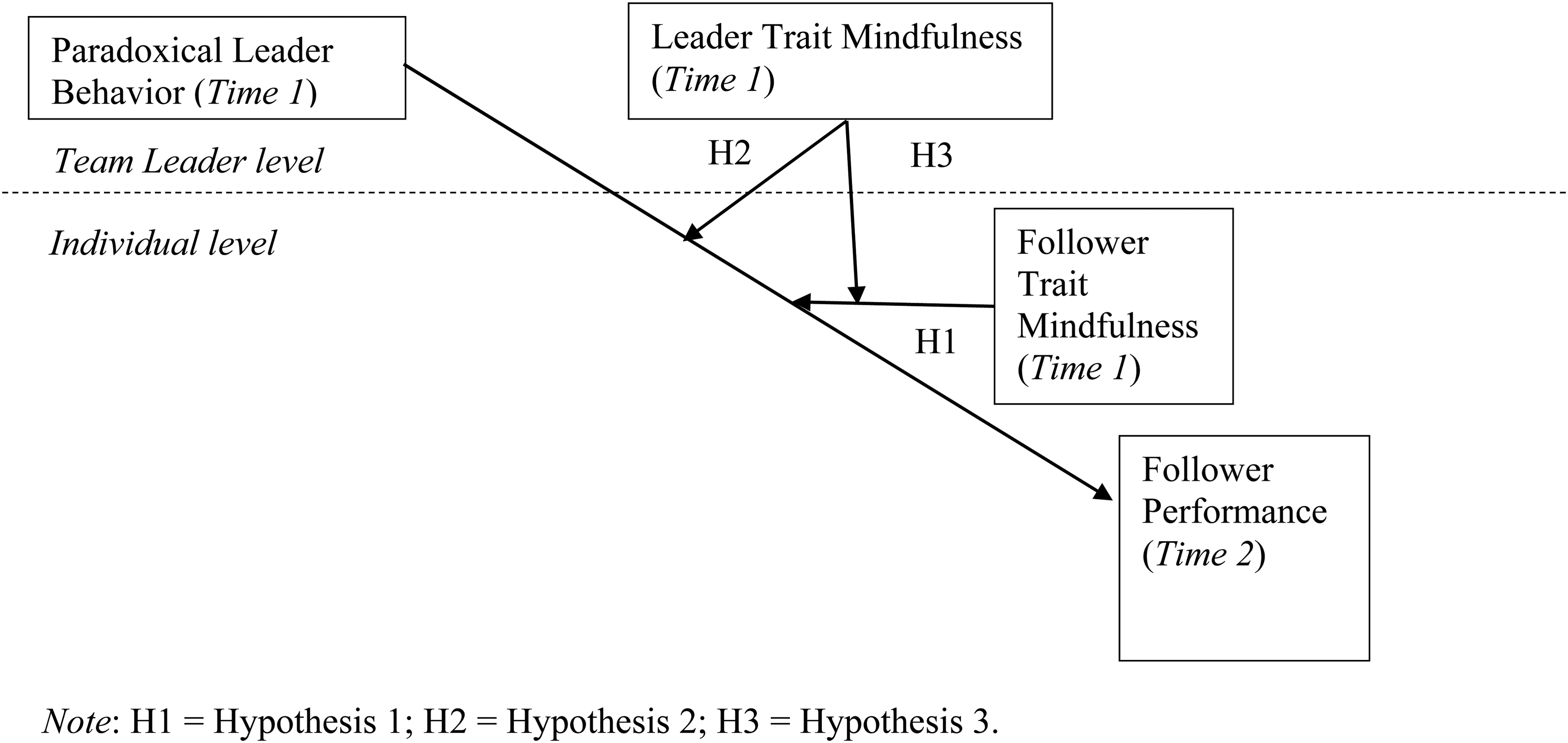
Theoretical model.
In doing so, our research aims to contribute to the paradoxical leadership and mindfulness literatures in two unique ways. First, we contribute to the emerging literature on managing paradox, a key to organizational excellence (e.g., Ishaq et al., 2021; Shao et al., 2019; Yang et al., 2019), by adopting a new perspective to investigate the impact of PLB on follower performance. By adopting cognitive dissonance theory, we provide novel insights into the positive and negative effects of PLB on follower performance. This addresses the mixed findings concerning the relationship between PLB and follower performance, and provides insights for organizations to better realize the benefits of PLB.
Second, when developing PLB theory, Zhang et al. (2015) cautioned about the potential boundaries of the functioning of PLB. Empirical investigations to date have mainly focused on follower characteristics as boundary conditions (for an exception, see Chen et al., 2021). For example, Ishaq et al. (2021) found that followers’ psychological capital reinforced the positive relationship between PLB and follower performance. Additionally, She et al. (2020) investigated how followers’ low need for cognitive closure augmented the positive impact of PLB on employe service performance via employes’ leader identification. In another example, Li et al. (2020) examined follower characteristics of promotion focus and prevention focus on the impacts of PLB on follower voice behaviors. Our research is unique by showing how the moderating role of follower characteristics, which seem to be the focus in existing work, is contingent on leader characteristics. Thus, our study suggests that the effectiveness of PLB is not only a function of how followers processes PLB, but also how leaders execute it.
Paradoxical Leader Behaviors and Follower Performance
Since leaders face contradictory and competing demands (Clegg et al., 2002), PLB is argued to be beneficial for organizations and employes. Leaders engaging in paradoxical behaviors can fulfill conflicting organizational needs and address the followers’ individual needs at the same time (Chen et al., 2021; Zhang et al., 2015). As beneficiaries of leader paradoxical behaviors, it has been shown that followers are motivated to work more proficiently and proactively (Fürstenberg et al., 2021; Zhang et al., 2015), give more voice (Li et al., 2020), and demonstrate more ambidextrous behaviors (i.e., both exploration and exploitation) at work (Kauppila & Tempelaar, 2016; Klonek et al., 2021).
However, leaders engaging in paradoxical behavior may suffer from cognitive dissonance that interferes with their execution of PLB. For instance, Schad et al. (2016) and Schneider (1990) explain how enacting paradoxical behaviors may cause individual cognitive dissonance, which is associated with heightened anxiety and counterproductive defenses. Similarly, paradoxical leaders’ processing of dissonance drains their cognitive resources (Festinger, 1962; Robinson & Demaree, 2007; Thau & Mitchell, 2010) - the same resources that are also employed for the implementation of PLB.
Additionally, PLB might also result in negative reactions within their followers due to vicarious cognitive dissonance, in which one person’s discrepant behaviors can spur vicarious discomfort in observers (Norton et al., 2003). That being said, follower’s observance of inconsistent leader behaviors and the competing goals that such behaviors signal, will also lead to the followers’ own experience of cognitive dissonance. This, in turn, could inhibit their performance at work.
Therefore, enacting PLB can be either positive or negative in terms of its impact on follower performance (see also Lewis et al., 2014; Shao et al., 2019; Zheng et al., 2018). We argue that whether PLB’s possible benefits outweigh its potential drawbacks depends on the traits of those who utilize PLB (i.e., leaders) and who reacts to PLB (i.e., followers). Next, we elaborate on trait mindfulness of the leader and the follower as boundary conditions shaping the effects of PLB on follower performance.
The Moderating Effect of Follower Trait Mindfulness
Paradoxical leadership may present a challenge for followers. On one hand, conflicting leader behaviors might inspire followers to rethink existing polarities and to recognize more complicated interrelationships, thus enabling them to observe a more comprehensive picture of the context (Lewis, 2000). Previous studies have examined when PLB is more likely to be associated with positive follower outcomes (e.g., She et al., 2020). Yet, paradoxical behaviors may also have a negative impact because followers might experience discomfort when they observe the dissonant leader behaviors. This reaction is based on the logic of vicarious cognitive dissonance, and it is stronger when the observers admire or have a significant relationship with the focal person (such as leader-follower relationship) (Norton et al., 2003).
The negative impact of vicarious cognitive dissonance has been examined in the paradox literature. In a series of empirical studies, Norton et al. (2003) demonstrated that one person’s discrepant behaviors can spur vicarious discomfort in observers. Following this line of research, we suggest that followers will experience vicarious cognitive dissonance by thinking about the contradictory behaviors of the leader and the corresponding conflicting goals that are being signaled by those behaviors.
Being high on trait mindfulness might decrease the vicarious cognitive dissonance experienced by followers of leaders demonstrating high PLB, and thus enable followers to perform their job more effectively and efficiently than followers who are low on trait mindfulness. Guided by a paradoxical leader who presents seemingly conflicting behaviors across situations, highly mindful followers are constantly aware of their leaders’ behaviors and the varying situations their leaders face (Brown, Ryan, & Creswell, 2007; Eisenbeiss & van Knippenberg, 2015). With more elements taken into account they are more likely to develop a relatively complicated repertoire of understandings about their leader’s behaviors that reflect organizational intricacies (e.g., Denison et al., 1995; Knight & Paroutis, 2017), compared with those followers who are low on trait mindfulness; thus enabling the positive influence of PLB on follower performance.
Followers who are high on trait mindfulness have keen awareness and acceptance, which enables them to perceive and process psychological discomfort arising from any experienced vicarious dissonance more clearly than less mindful followers (Brown, Ryan, & Creswell, 2007; Shapiro et al., 2018). Their wide attention helps them to see a complete picture (Brown, Ryan, & Creswell, 2007), including not only their own discomfort, but also their leaders’ exhibited actions and tensions from the changing environment. As such, instead of thinking about “what if”, highly mindful followers are more likely to accept their emotional discomfort that may arise when they observe paradoxical behaviors, nonjudgmentally (Bishop et al., 2004; Brown, Ryan, & Creswell, 2007; Kabat-Zinn, 1990), in comparision to followers with low trait mindfulness. As a result, they are more capable of understanding the sources of the discomfort, such that the negative feelings are less likely to affect how they process information at work and thus reinforces a more objective and transcendent lens to interpret the PLB. From this perspective, the potential positive effects associated with PLB can be enhanced when followers have higher trait mindfulness. Hence, we propose:
The Moderating Effect of the Leader’s Trait Mindfulness
Leader trait mindfulness may have a moderating effect on the relationship between PLB and follower performance. With high awareness of the current moment, highly mindful leaders can attend to the internal stimuli (e.g., their thoughts and feelings) and external stimuli (e.g., the opposing demands from the environment) in a registering of the facts observed (Brown & Ryan, 2003; Fiol & O’Connor, 2003), in comparison to leaders who are low on trait mindfulness. High mindfulness thus helps leaders to be aware of the dissonance and accept their opposing behaviors as they are (Kabat-Zinn, 1990). As such, with high trait mindfulness, leaders can concentrate on the complexity of the environmental tensions, enabling them to execute PLB in a more timely and effective manner. In this case, PLB is more likely to have positive effects on follower performance.
High trait mindfulness also allows leaders to “let go” of potential emotional discomfort (Brown, Ryan, & Creswell, 2007; Hülsheger et al., 2013), such as anxiety or frustration, that can arise from cognitive dissonance (Schneider, 1990; Smith & Lewis, 2011). By clearly understanding where their discomfort comes from (i.e., their paradoxical leader behaviors), leaders high on trait mindfulness are more capable of decoupling themselves from the paradoxical behavioral episodes than low trait mindful leaders. In this vein, for highly mindful leaders, such psychological discomfort is less likely to negatively affect their information processing and the effective execution of PLB as compared to less mindful leaders. Therefore, leaders high on trait mindfulness are more likely to implement seemingly conflicting behaviors that impact followers consciously and appropriately. Taken together, we propose:
Paradoxical Leader Behaviors and Follower Performance: the Joint Moderating Effects of Followers’ Trait Mindfulness and Leader’s Trait Mindfulness
To further consider the relationships between PLB and follower performance, we investigate the roles of both leader and follower mindfulness simulatenously. We expect that the attention and awareness of both leader and follower are likely to predict whether PLB benefits or harms follower performance. If the leader is mindful and executes PLB effectively, PLB is more likely to benefit follower performance; however, when leader mindfulness is low, follower mindfulness is critical to determine whether PLB is beneficial or detrimental. We therefore propose a three-way interaction between PLB, leader trait mindfulness, and follower trait mindfulness, in predicting follower performance.
Under conditions when leaders are high in trait mindfulness, PLB is more likely to be executed effectively and thus is more likely to benefit the performance of followers with both high and low trait mindfulness. More specifically, highly mindful leaders are aware of and accept the tensions of the paradoxical behavioral episodes. That is, they not only are more capable of avoiding judgments and counterfactual thoughts associated with their competing behaviors (Brown, Ryan, & Creswell, 2007; Smith et al., 2012), but also accept that their followers’ reactions can be both positive and negative (Reb et al., 2014). Noticing that less mindful followers cannot accurately interpret their behaviors, highly mindful leaders could communicate and accordingly tailor their behaviors to help their followers perform (Shapiro et al., 2018; Smith et al., 2012). As such, in the case of a leader with high trait mindfulness, we expect that PLB has a positive impact on follower performance for followers with both high and low trait mindfulness.
In contrast, when leader trait mindfulness is low, PLB is less likely to be timely and effectively implemented. Also, leaders could have a difficult time overcoming their psychological discomfort associated with exhibiting conflicting behaviors. Thus, PLB may have a negative effect on follower performance. In this situation, follower trait mindfulness is likely to be critical in determining PLB’s impact on follower performance.
More specifically, we argue that low follower mindfulness is more likely to enable the negative impact of low mindful leaders’ PLB on follower performance. In comparison to high mindful followers who are aware of the PLB and the environmental tensions that call for the paradoxical behaviors, low mindful followers may find it difficult to apprehend the rationales of the intricate and seemingly contradictory behaviors of their leaders (Brown & Ryan, 2003; Zhang et al., 2013). Over time, low mindful followers are less likely to understand and accept the intended influence from PLB, and thus exacerbate the negative effects of PLB executed by low mindful leaders.
Further, with low levels of both awareness and non-judgmental acceptance (Brown, Ryan, & Creswell, 2007; Hülsheger et al., 2013), low mindful followers are less capable of dealing with the emotional discomfort associated with observing paradoxical behaviors, especially when such behaviors are implemented by low mindful leaders. In contrast to high mindful followers whose monitoring and adjustment of the situation fosters their response flexibility (Glomb et al., 2011; Shapiro et al., 2006), low mindful followers are less capable of accepting their emotional discomfort and thus may allow their negative feelings to interrupt their information processing and inhibit cooperative responses to their paradoxical leaders. As such, we argue that when leader trait mindfulness is low, PLB is more likely to hurt followers’ performance when follower trait mindfulness is low rather than high. Taken together, we propose:
Method
Sample and Data Collection Procedures
We collected multilevel, multisource, multiphase field data from 561 employes working in 54 work teams at a state-owned truck manufacturing organization in China. Teams of employes are the basic work unit, where team members coordinate with each other to complete work assignments. Due to the high level of interaction required, team leaders and members work together in close physical proximity. All team members regularly observe how their leader treats other team members at work. To ensure confidentiality, we asked all leaders and followers to return their completed surveys in sealed envelopes. We sent out surveys at two points in time, separated by two weeks.
At time 1, we sent 788 surveys to all members of the 98 teams. All followers were asked to answer questions with respect to their demographic characteristics, PLB, and trait mindfulness; all leaders were required to evaluate their own trait mindfulness. Two weeks later, we asked the leaders to rate their individual followers’ performance. At time 1, we received usable responses from 643 followers (response rate of 81.60%) from 66 teams; at time 2, we collected performance evaluations from 71 team leaders (response rate of 72.45%). We then combined surveys from time 1 and time 2. After removing teams with response rates lower than 40% (Timmerman, 2005), our final sample comprised of 561 followers (response rate of 71.19%) from 54 teams (response rate of 55%).
In these 54 teams, the leaders averaged 31.20 years (SD = 5.69) of age, and 8.49 years (SD = 5.90) of tenure. 24% of the leaders were women. The followers averaged 29.58 years (SD = 6.21) of age, and 6.07 years (SD = 4.01) of tenure. 29% of the follower participants were women. Teams averaged 11 members, ranging from 2 to 31 members.
Measures
All items were measured using a 7-point Likert-type scale (e.g., 1 = strongly disagree, 7 = strongly agree). Our surveys were written in Chinese. We followed the translation and back-translation procedures as suggested by Brislin (1980) for all our measures.
Paradoxical Leader Behaviors (PLB). To measure PLB at time 1, we used the 22 item scale developed by Zhang et al. (2015). Followers were asked to rate their team leaders’ paradoxical behaviors, based on descriptions such as “My leader uses a fair approach to treat all subordinates uniformly, but also treats them as individuals” (α = .94). The items on this scale assess the 5 dimensions of PLB: (1) combining self-centeredness with other-centeredness; (2) maintaining both distance and closeness; (3) treating subordinates uniformly, while allowing individualization; (4) enforcing work requirements, while allowing flexibility; and (5) maintaining decision control, while allowing autonomy (Zhang et al., 2015). Consistent with prior work in the field, we assessed overall PLB by first computing the mean for each of the five dimensions and then calculating the average of the five dimensions.
As indicated by Zhang et al. (2015), “PLB is theoretically meaningful as a supervisory - or group-level phenomenon.” (p. 556). In a team setting, leadership behaviors, including PLB, are observed by all team members and affect all team members as a collective due to the interdependency of teamwork (Chen et al., 2007). Further, the specific dimensions of PLB, such as treating subordinates uniformly while allowing individualization, frame this construct at a team leader level, in which team members observe and compare if their leader treats all members the same (Zhang et al., 2015). As such, it is critical to consider PLB as a team leader level construct (see Ishaq et al., 2021; Kauppila & Tempelaar, 2016; Li et al., 2018; Zhang et al., 2015; Zhang et al., 2021; who also adopted a team leader level approach).
We aggregated the individual evaluations of PLB to the team leader level. PLB had an ICC (1) of .10 (F = 1.97, p < .001). Following the suggestions of James et al. (1984), we calculated a quasi-confidence interval of Rwg(j). Biemann et al. (2012) explain that followers tend to have a leniency bias when rating their leaders’ behaviors, thus a slightly negative skew in the null distribution is most likely. Accordingly, we chose a slight skew as an alternative null distribution. Overall, our Rwg(j) value was .89 (SD = 0.20) when adopting uniform as an alternative null distribution and was .71 (SD = 0.34) for the slight skew as an alternative null distribution. We anticipate that true agreement is most likely to fall within this range (Demaree et al., 1984).
The Rwg(j) value (bigger than the standard .70) and our significant F test of the ICC(1) supported data aggregation (Cohen et al., 2001). Although the ICC(2) of .49 was lower than the traditional criterion of .70 (Klein & Kozlowski, 2000), scholars suggest proceeding with aggregation if theory points to a team leader level construct (Brown & Trevino, 2006). Similar approaches have been adopted by previous studies (see also Kauppila & Tempelaar, 2016; Li et al., 2018). As such, we adopted PLB at the team leader level.
Trait Mindfulness. We used the 15-item scale developed by Brown and Ryan (2003) to measure trait mindfulness of leaders (α = .91) and their followers (α = .86) at time 1. They were asked to rate items, for instance, to what extent they “could be experiencing some emotion and not be conscious of it until sometime later” (reverse coded).
Performance. At time 2, leaders were instructed to evaluate their followers’ performance over the past two weeks. Performance was measured using the 4-item scale developed by Welbourne et al. (1998). One sample item is “This follower achieves a high quantity of work output” (α = .89).
Control Variables. Controls must be carefully selected and justified (see Bernerth et al., 2018). Given that paradoxical leader behaviors might have some degree of variability across followers, which could limit our case for the aggregation of PLB to the team leader level, we controlled for the group mean centered PLB at the individual level. Additionally, team size should be controlled when predicting individual performance in teams, due to its potential impact on interactions (e.g., Carter et al., 2013). It is also important to exclude the influence of followers’ gender and age on performance (e.g., Reb et al., 2017; Zhang et al., 2013). Therefore, we controlled for team size, follower gender and age.
We also need to consider leader gender. Alispahic and Hasanbegovic-Anic (2017) have found that women leaders are higher on the “observing” aspect of mindfulness, whereas men are higher on the “acting” aspect. Also, gender might confound with leader mindfulness to impact follower performance (Reb et al., 2014). To exclude this possibility, we also added leader gender as an additional control.
Data Analytical Strategy
To examine the discriminant validity of our key constructs, we used confirmatory factor analyses with Maximum Likelihood Estimation at the follower/individual level (MPlus 8.0). The results revealed that the hypothesized three-factor model (a second-order latent PLB factor with five first-order latent factors reflecting each of the PLB dimensions, follower trait mindfulness with 15 indicators, and follower performance with four indicators) (χ2(771) = 1627.97 p < .001; CFI = .89, RMSEA = .05, SRMR = .05) yielded a better fit than the alternative two-factor and one-factor models.
We choose a multilevel analysis approach to test our hypotheses because leaders’ behaviors exert multilevel influences on followers in teams (Chen et al., 2007). We employed Hierarchical Linear Modeling (HLM) 7 (Raudenbush & Bryk, 2002) to test our hypotheses. Team PLB, leader trait mindfulness, team size, and leader gender were entered at the team leader level (level 2). At the individual level (level 1), we incorporated follower gender, age, individual PLB, and trait mindfulness as independent variables. Following the suggestions of Hofmann and Gavin (1998), we grand mean centered all the other variables to reduce potential collinearity concerns.
Hypothesis Testing Results
The descriptive statistics, reliabilities, and correlations are presented in Table 1. The correlations between the constructs were as expected. Results from the HLM analyses are summarized in Table 2. Hypothesis 1 predicted that follower trait mindfulness moderated the relationship between PLB and follower performance. As displayed in Table 2, Model 2, the moderating effect of follower trait mindfulness was statistically significant (β = 0.15, p < .05). To further interpret the interaction effect, we plotted the interaction (Aiken & West, 1991) (see Figure 2). Consistent with Hypothesis 1, PLB was more positively related to follower performance for followers with higher trait mindfulness.

Interactive effect of paradoxical leader behavior and follower trait mindfulness on follower performance.
Descriptive Statistics and Correlations.a

an = 561. Reliabilities for the scales are on the diagonal in parentheses. * p < .05; ** p < .01. Two-tailed tests. All correlations were calculated at the individual level.
Gender: 0 = male, 1 = female.
HLM Results: the Main and Interactive Effects on Individual Performancea.

n = 54 at the leader level. All coefficients are unstandardized.
pseudo R2 is calculated according to the proportional error variance decrease resulting from predictors at level 1 and level 2 that compared each model with the unrestricted model including only the level-1 intercept term (Snijders & Bosker, 1999).
p < .10; * p < .05; ** p < .01; *** p < .001. Two-tailed tests.
Hypothesis 1 predicted different slopes for the relationship between PLB and follower performance when followers have high versus low trait mindfulness. The significant coefficient of the interactions provided support for Hypothesis 1. To further explore the interaction effect, we assessed the simple slopes. The simple slopes were not significant at 1 SD above and below the mean of the moderator (for high follower trait mindfulness: the simple slope = .13, p = .08), for low follower trait mindfulness: simple slope = −.13, p = .13) (Aiken & West, 1991). We also estimated the regions of significance. The region of significance analysis (Preacher et al., 2006) indicated that when follower trait mindfulness values were higher than 6.64, the simple slope of the relationship between PLB and follower performance were significant.
Hypothesis 2 predicted that leader trait mindfulness moderated the relationship between PLB and follower performance. As shown in Table 2, Model 2, this moderating effect was not statistically significant (β = 0.06, p = .75). Therefore, Hypothesis 2 was not supported. This is an unexpected finding that we will address in the Discussion section.
To investigate further the association between PLB and follower performance, we continued to test Hypotheses 3a and 3b where we incorporated both leader trait mindfulness and follower trait mindfulness in the analyses. Hypothesis 3 predicted a three-way interaction between PLB, follower trait mindfulness, and leader trait mindfulness, on follower performance. The three-way interaction effect was significant (β = −0.15, p < . 05) (see Table 2, Model 3). To further interpret the results, we plotted the three-way interaction (see Figure 3) and conducted a slope difference analysis. As shown in Figure 3 and consistent with Hypothesis 3a and 3b, when leader trait mindfulness was high, PLB was positively associated with follower performance independent of follower trait mindfulness; whereas when leader trait mindfulness was low, PLB’s impact on follower performance became negative when follower trait mindfulness was low rather than high. The slope difference result between the first two conditions (slope difference = −.04, t = −0.17, p = .86) was consistent with Hypothesis 3a: when leader trait mindfulness was high, there was no significant difference between the slopes of the relationship between PLB and follower performance at high versus low levels of follower trait mindfulness. Furthermore, consistent with Hypothesis 3b, we found that when leader trait mindfulness was low, there was significant difference between the slopes of the PLB - follower performance relationship at high versus low follower trait mindfulness (Slope difference = .48, t = 3.87; p < .001)

Interactive effect of paradoxical leader behavior, follower trait mindfulness, and leader trait mindfulness on follower performance.
Similar to Hypothesis 1, Hypotheses 3a and 3b predicted differences in slopes between followers’ high and low trait mindfulness. The significant coefficients of the interactions and the slope difference tests provided support for Hypotheses 3a and 3b. To clarify the interaction effects, we also tested the simple slopes. The simple slope of the relationship between PLB and follower performance was negative and significant at 1 SD below the mean of leader trait mindfulness (low leader trait mindfulness) and follower trait mindfulness (low follower trait mindfulness) (simple slope = −2.07, p < .05). The other simple slopes of the relationships between PLB and follower performance were not statistically significant at 1 SD above and below the mean (for high leader trait mindfulness and high follower trait mindfulness: the simple slope = .11, p = .55; for high leader trait mindfulness and low follower trait mindfulness: simple slope = .15, p = .57; for low leader trait mindfulness and high follower trait mindfulness: simple slope = .10, p = .61). The regions of significance analysis (Preacher et al., 2006) suggested that the simple slope of the relationship between PLB and follower performance was negative and significant for values of follower trait mindfulness below 3.12 and for values of leader trait mindfulness between 2 and 4.91.
Supplemental Analyses 1
Because LMX has been found to be closely related to leader behaviors (e.g., Gottfredson & Aguinis, 2017) and leader mindfulness may affect employe performance via leader member exchange (LMX) (Reb et al., 2019), we also tested our model while including leader member exchange (LMX) as an additional control variable at the individual level (Bernerth et al., 2018). To measure LMX, at time one we asked team members to rate the 7-item scale by Graen and Uhl-Bien (1995) (α = .88). Our results stayed substantively the same when we added LMX as a control variable.
Next, following the advice of Becker (2005), we also re-tested our hypotheses without any control variables. After all controls were excluded, we found that the Hypothesis 2 and Hypothesis 3 testing results stayed substantively the same. Regarding Hypothesis 1, the interaction between PLB and follower trait mindfulness changed from significant (with controls: β = 0.15, SE = 0.07, p < .05) to nonsignificant (without controls: β = 0.08, SE = 0.06, p = .182). We report and interpret our results with the control variables included.
Discussion
Leaders need new skills and capabilities to deal with paradox in the new post-pandemic era. One possible solution for leaders would be to adopt PLB. Can using paradoxical leader behaviors (PLB), however, backfire? Drawing on an integration of the literature on paradoxical leadership behavior (Zhang et al., 2015), cognitive dissonance (Festinger, 1962), and mindfulness (Brown & Ryan, 2003), we examined leader trait mindfulness and follower trait mindfulness as boundary conditions for the effects of PLB on follower performance. We found that PLB was more likely to generate a positive effect on follower performance when follower trait mindfulness was high. Consistent with the notion that paradoxical behaviors induce cognitive dissonance, and therefore can be damaging, the relationship between PLB and follower performance became negative when neither leaders nor followers were mindful. As an individual difference, trait mindfulness enables leaders to effectively implement PLB, and helps followers to pay broad attention to, accept, and hold a non-judgmental view of PLB, fostering cooperation with leaders engaging in PLB.
Our results did not provide support for the prediction that high leader trait mindfulness alone will make the relationship between PLB and follower performance more positive. We speculate that there might be three possible reasons. One reason relates to the three-way interaction we found. In hindsight, the moderating role of leader-mindfulness is contingent on follower mindfulness. Second, it may have to do with our small sample size at the group level (N = 57). Third, we speculate that there might be other potential contingencies impacting the effects of leader trait mindfulness on the relationship between PLB and follower performance. One possible contingency might be the personality traits of the leader (Giluk, 2009). For example, studies have argued that high mindfulness is more useful for individuals with high neuroticism, and it helps those individuals to more effectively deal with stressful situational demands (e.g., Drake et al., 2017). Mindfulness can have limitations and it is essential to examine these limitations in future studies (Lyddy et al., 2021). We provide initial empirical evidence that consideration of trait mindfulness of both leaders and followers provides new and important insights for understanding the effects of PLB. Therefore, we encourage future research into situational contingencies and other leader characteristics that may impact how beneficial trait mindfulness is for PLB effectiveness.
Theoretical Implications
We contribute to the scholarly literature in the following ways. Our study contributes to the growing literature on paradoxical leadership and organizational paradox (e.g., Ishaq et al., 2021; Schad et al., 2016; Shao et al., 2019), by enriching our current understanding of how to manage the competing demands of being a leader. Prior studies of paradox show that mismanaged paradox leads to organizational decline (Sundaramurthy & Lewis, 2003). Leadership behaviors that integrate complex and contradictory elements of the organization and environment, such as PLB, represent one of the promising approaches to managing paradox (Havermans et al., 2015).
We respond to scholars’ calls for investigations of trait mindfulness within the context of leadership. Although previous studies, such as those by Eisenbeiss and van Knippenberg (2015), Liang et al. (2016) and Reb et al. (2014), have articulated the association between trait mindfulness and authentic leadership, ethical leadership, and abusive supervision, to our knowledge no attention has been paid to the relationship between trait mindfulness and PLB. The application of trait mindfulness to PLB is essential because high trait mindfulness enables individuals to excel in dynamic contexts (see Dane, 2011). Our study provides support for this notion, by unraveling how high trait mindfulness helps paradoxical leaders promote follower performance, and how low trait mindfulness of both paradoxical leaders and their followers interferes with follower performance.
Moreover, expanding the previous literature on trait mindfulness and leadership, we are the first to look at both sides of the coin (i.e., trait mindfulness of both leaders and followers), and to do so within a team context. Prior research has emphasized the benefits of individual trait mindfulness, such as better emotional regulation (Hülsheger et al., 2013), less negative reactions to workplace injustice (Long & Christian, 2015), and more helping behaviors (Eisenbeiss & van Knippenberg, 2015). However, leadership occurs in teams, and the effectiveness of leader behaviors depends on the traits of both the leader and the followers within the teams (e.g., Qu et al., 2019). We discovered that follower trait mindfulness may act as a substitute for leader trait mindfulness. PLB is associated with higher follower performance when followers have very high trait mindfulness. Furthermore, PLB does not damage follower performance, as long as either the leaders and/or the followers have high trait mindfulness. Thus, in contrast to prior research that has largely focused on individuals, we introduce a more nuanced multilevel perspective of trait mindfulness in the workplace. We call for scholars to investigate these findings regarding trait mindfulness—of both leaders and followers simultaneously—within the context of other leadership styles.
Practical Implications
Waldman and Bowen (2016) called for the development of paradox-savvy leaders, and they provide initial guidance for managers with regard to this. Our findings indicate that it is necessary and important for managers to be aware of the boundary conditions of PLB - a relatively new style of leadership behavior - so they do not promote it blindly without realizing its potential negative effects. While it has been theorized that PLB stimulates positive follower behaviors in dynamic environments with conflicting demands (Zhang et al. 2015), we caution that PLB is not encouraged when neither leaders nor followers are mindful.
Based on our findings, we suggest that to enable their followers to benefit from PLB, leaders should select and work with highly mindful followers. Also, to avoid the possible negative consequences of PLB, the trait mindfulness of leaders and/or followers needs to be high. We argue that before encouraging PLB within organizations, leaders and followers should both be assessed in terms of their trait mindfulness. As suggested by Brown, Ryan, and Creswell (2007), as evidence for the beneficial effects of trait mindfulness accumulates, organizations might include trait mindfulness as a core trait to be evaluated during the recruitment and selection of team members and leaders. For example, interviews and other selection tools may include assessments of trait mindfulness to aid decision-making (see Qu et al., 2015). The focus on attracting and hiring mindful followers and leaders will particularly benefit complex dynamic organizations where PLB is most suitable.
Limitations and Future Directions
Despite our contributions, this study has limitations to be acknowledged. First, we focus on the boundary conditions (i.e., trait mindfulness of leaders and followers) on the effects of PLB, and we did not examine the underlying processes that connect the cross-level three-way interaction with follower performance. PLB has been found to be associated with positive employe outcomes via mechanisms such as goal clarity, work autonomy, leader identification, self-efficacy, psychological safety, employe thriving, paradoxical mindset, personal service orientation, and individual and team ambidexterity (Fürstenberg et al., 2021; Li et al., 2020; Pan, 2021; She et al., 2020; Yang et al., 2019; Zhang et al., 2021). For instance, Yang et al. (2019) demonstrated that PLB reinforced employe creativity via increasing employe thriving at work. More recently, Fürstenberg et al. (2021) specified goal clarity and work autonomy as two mechanisms for the relationship between PLB and employe work engagement. In addition, Zhang et al. (2021) revealed that PLB enhanced team members’ individual innovation through individual ambidexterity and boosted team innovation through team ambidexterity. These studies have advanced our understanding of why PLB may foster positive follower outcomes. Given that our findings demonstrate the importance of leader and follower trait mindfulness, we call for future research to examine how these individual differences impact the previously studied mechanisms.
Our sample was based in China; this is where the PLB construct was first proposed and measured (Zhang et al., 2015), and thus our sample extends this earlier work. We are aware that results from a Chinese state-owned organization have limited external generalizability and may not apply similarly to private companies in western countries. However, the means and standard deviations of the constructs in our study were not significantly different to those in studies using other types of organizations and within other cultures (e.g., Cunha et al., 2019; Shao et al., 2019; Zhang et al., 2015). To investigate if cultural context influences the functioning of trait mindfulness and PLB, we call for cross-cultural investigations.
To reduce common method bias (Podsakoff et al., 2012), we collected survey data with a temporal separation of two weeks and we used different respondents (leaders and followers). However, we are unable to make causal inferences from this design. Also, the use of self-report measures of trait mindfulness introduces possible measurement error (Kerlinger & Lee, 2000). As shown in Table 1, the reliabilities of all our measures were above .86, which significantly supports the accuracy of the measures. However, to reduce measurement errors even further, we encourage future studies to develop more reliable self-report measures of mindfulness or to use neuroscientific techniques instead (see Wheeler et al., 2017).
Conclusion
This study examined the role of follower trait mindfulness and leader trait mindfulness in understanding the effect of PLB on follower performance in teams. PLB is not always positive for follower performance; it depends on the trait mindfulness of the team leader and followers. More importantly, PLB positively affects follower performance when follower trait mindfulness is high. PLB negatively influences follower performance if neither the leader nor the follower is mindful. Our study thus makes valuable contributions to the PLB literature. We also add to the mindfulness literature by shedding light on when trait mindfulness alters the functioning of leadership in teams. Based on our findings, we caution researchers and managers alike in being more heedful about mindfulness when advocating new styles of leader behaviors in organizational settings.
Footnotes
Declaration of Conflicting Interests
The author(s) declared no potential conflicts of interest with respect to the research, authorship, and/or publication of this article.
Funding
The author(s) received no financial support for the research, authorship, and/or publication of this article.
