




Abstract
To elucidate the mechanism of action of the Astragalus membranaceus–Panax ginseng herb pair in treating coronary heart disease (CHD) through network pharmacology combined with molecular docking and experimental validation. Active ingredients and target proteins were retrieved from the Traditional Chinese Medicine Systems Pharmacology database. CHD-related targets were obtained from GeneCards and DrugBank. Overlapping targets were identified with a Venn diagram, and a protein–protein interaction network was built in STRING. Core targets were screened via topological analysis in Cytoscape 3.9.0. Gene Ontology (GO) and Kyoto Encyclopedia of Genes and Genomes (KEGG) enrichment were performed in Metascape. AutoDock Vina was used for molecular docking. In vitro, tumor necrosis factor (TNF)-α levels in HL-1 cells subjected to oxygen-glucose deprivation (OGD) were measured by ELISA, and the effect of mangiferin pretreatment on cell viability was assessed with a CCK-8 assay. Forty-one active ingredients and 207 putative targets were identified for the herbal pair, and 1843 CHD-related targets were collected; 67 overlapping therapeutic targets were obtained. Topological analysis yielded 27 core targets. GO terms were enriched in responses to lipopolysaccharide, toxic substances, and organic cyclic compounds; molecular functions included cytokine-receptor binding and transcription-factor binding; and cellular components were mainly membrane rafts and extracellular matrix. KEGG analysis highlighted the TNF, fluid-shear-stress, and NF-κB signaling pathways. Docking showed strong binding between key components and targets. In vitro experiments demonstrated that formononetin pretreatment significantly reduced OGD-induced TNF-α levels and improved HL-1 cell viability. The A. membranaceus–P. ginseng combination herb pair exerts anti-CHD effects via multiple bioactive ingredients (e.g., formononetin, quercetin, isorhamnetin, ginsenoside Rh2, kaempferol) by targeting TNF, AKT1, PTGS2, and JUN and modulating pathways including the TNF and NF-κB signaling pathways.
Introduction
Coronary heart disease (CHD) is defined as stenosis or occlusion of the coronary arteries due to atherosclerosis, resulting in myocardial ischemia, hypoxia, or necrosis, and thus presents as a cardiovascular disease. 1 Recent statistical data from China indicate that the number of CHD patients has risen to 11 million, with an annual increase of about 1 million. 2 CHD ranks among the chronic diseases with the highest incidence and mortality worldwide, underscoring the need for widespread recognition of its severity and impact.
Traditional Chinese medicine (TCM) has long contributed to improving the health of the Chinese population, with successive generations of practitioners combining ginseng and astragalus in diverse prescriptions to treat CHD. This herb pair holds particular significance in the field of geriatrics, as studies have demonstrated that the combined application of Ginseng and Astragalus significantly improves cardiac function and quality of life in elderly patients. 3,4 Astragalus, sweet and slightly warm in nature, replenishes qi, consolidates the exterior, detoxifies, promotes pus discharge, induces diuresis, and facilitates tissue regeneration. 5 Modern pharmacological studies show that astragalus exerts therapeutic effects on CHD by modulating targets such as RXRA and PROC, thereby influencing lipid metabolism and coagulation. 6 Ginseng, sweet-slightly bitter and neutral, enters the lung, spleen, and heart meridians and acts to replenish qi, secure the pulse, tonify the spleen, nourish the lungs, generate fluids, and calm the spirit. 7 Ginsenosides activate phospholipase, promoting phospholipid biosynthesis and thereby preventing atherosclerosis in coronary and aortic arteries. 8
Network pharmacology, which integrates high-throughput omics data, virtual computation, and network-database mining, aims to elucidate the effectiveness, toxicity, and metabolic characteristics of herbs by examining biological networks, connectivity, redundancy, and pleiotropy. It features multiple components, targets, pathways, and synergistic effects. 9,10 Further elucidating the action nodes (active proteins or genes) of TCM active ingredients within human protein–protein interaction (PPI) networks contributes to revealing their therapeutic effects on related diseases. 9,10 In this study, we apply network pharmacology to analyze the compatibility of astragalus and ginseng in prescriptions, further exploring the molecular mechanisms underlying their treatment of CHD from a microscopic perspective and providing a scientific basis for the systematic study and improved clinical application of this herbal combination.
Materials and Methods
Elucidating the mechanism of action of the Ginseng–Astragalus herb pair in treating CHD via network pharmacology
Screening of active ingredients and targets of Astragalus membranaceus–Panax ginseng
Chemical constituents for the two herbs were sourced from the Traditional Chinese Medicine Systems Pharmacology (TCMSP) database and analysis platform (http://tcmspw.com/tcmsp.php). 11 Candidate active compounds were screened based on established ADME criteria: oral bioavailability (OB) ≥30% and drug-likeness (DL) ≥0.18. 12 Identified protein targets were subsequently mapped to standardized gene symbols using the UniProt database (https://www.uniprot.org/). 13
Screening of disease targets
Known therapeutic targets for CHD were systematically retrieved from the GeneCards (https://www.genecards.org/) 14 and DrugBank (https://go.drugbank.com/) 15 databases using the search term “coronary heart disease.” Duplicate entries were eliminated, leaving a nonredundant set of disease targets.
Construction and visualization of PPI networks
The overlap between herb-derived targets and CHD targets was visualized with a Venn diagram generated online (http://bioinformatics.psb.ugent.be). Intersecting targets were analyzed in the STRING database (http://string-db.org/), 16 restricted to “Homo sapiens” and a minimum interaction score of 0.4; the resulting data were used to build a PPI network in Cytoscape 3.9.0. 17 Network topology was assessed with the “Network Analysis” tool, and nodes with degree values above the mean were designated as key targets. The top 10 targets underwent molecular-docking validation.
Enrichment analysis
Gene Ontology (GO) and Kyoto Encyclopedia of Genes and Genomes (KEGG) enrichment were performed in the Metascape platform (http://metascape.org/gp/) 18 limited to “Homo sapiens.” Significance thresholds were set at p < 0.01, minimum count ≥3, and enrichment factor >1.5. The results were visualized in R: KEGG pathways as bubble plots and GO terms as bar charts.
Construction and visualization of compound-target-pathway network
Key targets were mapped to their corresponding active ingredients, generating a compound–target list, a target–pathway list, and a node-attribute table. These files were imported into Cytoscape 3.9.0 to construct the integrated “Compound–Target–Pathway” network. Network topology was evaluated with the “Network Analysis” tool, and the five most influential active ingredients were identified according to their degree values.
Molecular docking
Three-dimensional structures of the key active ingredients were obtained from TCMSP, whereas appropriate protein structures were retrieved from the Protein Data Bank (https://www.rcsb.org/), 19 selecting human proteins with a resolution <2.5 Å that already contain a small-molecule ligand. Molecular docking was carried out using AutoDock Vina, and docked complexes were visualized in PyMOL. 20
Experimental validation of myocardial injury in CHD
Experimental materials
Murine tumor necrosis factor (TNF)-α was quantified with an ELISA kit (Catalogue No. MM-0132M2, 48T) from Jiangsu Meimian Industrial Co., Ltd. (MEIMIAN). Major instruments included an Infinite F50 microplate reader (Tecan, Shanghai), a DKW-310 automatic plate washer (Wuxi Huawade), a TG16-W microcentrifuge (Shanghai Lu Xiangyi), an 80-2 electric centrifuge (Changzhou Yuexin), and a DHG-9070 electric blast drying oven (Shanghai Yiheng).
TNF-α level detection
Molecular-docking results suggested that formononetin had the strongest affinity for TNF-α; therefore, we further examined its effect on TNF-α production. The concentrations of TNF-α in HL-1 cardiomyocytes were quantified using a murine ELISA kit, following the manufacturer’s instructions. Briefly, standardized protocols were followed to assay samples and standards in antibody-precoated microplates, with a 30-minute incubation period at 37°C. Following sequential washing steps, the enzyme conjugate was applied to all but the blank wells and incubated at 37°C for 30 minutes to facilitate secondary antibody binding. Substrates A and B were added, and the reaction was left in the dark at 37°C for 10 minutes before adding stop solution. Optical density was measured at 450 nm using a microplate reader, and TNF-α concentrations were interpolated from the resultant standard curve.
Oxygen-glucose deprivation treatment and cell proliferation viability assay for HL-1 cells
To simulate ischemic injury in vitro, HL-1 murine cardiomyocytes were subjected to oxygen-glucose deprivation (OGD), followed by cell viability assessment using the CCK-8 assay. HL-1 cells were cultured in Claycomb medium (supplemented with 10% FBS and 1% penicillin-streptomycin) and maintained at 37°C in a humidified atmosphere containing 5% CO2. They were divided into five formononetin pretreatment groups (2.5, 5, 10, 20, 40 μM) and an untreated control and preincubated for 1 hour. Ischemia was induced by replacing the growth medium with a glucose- and serum-free balanced salt solution, followed by incubation in a trigas hypoxia chamber (0.1% O2, 5% CO2, 94.9% N2) for 8 hours. Post-OGD, 10 μL of CCK-8 reagent was added to each well, and cells were incubated for an additional 2 hours at 37°C before measuring absorbance at 450 nm.
Results
Screening of active ingredients and targets of A. membranaceus–P. ginseng
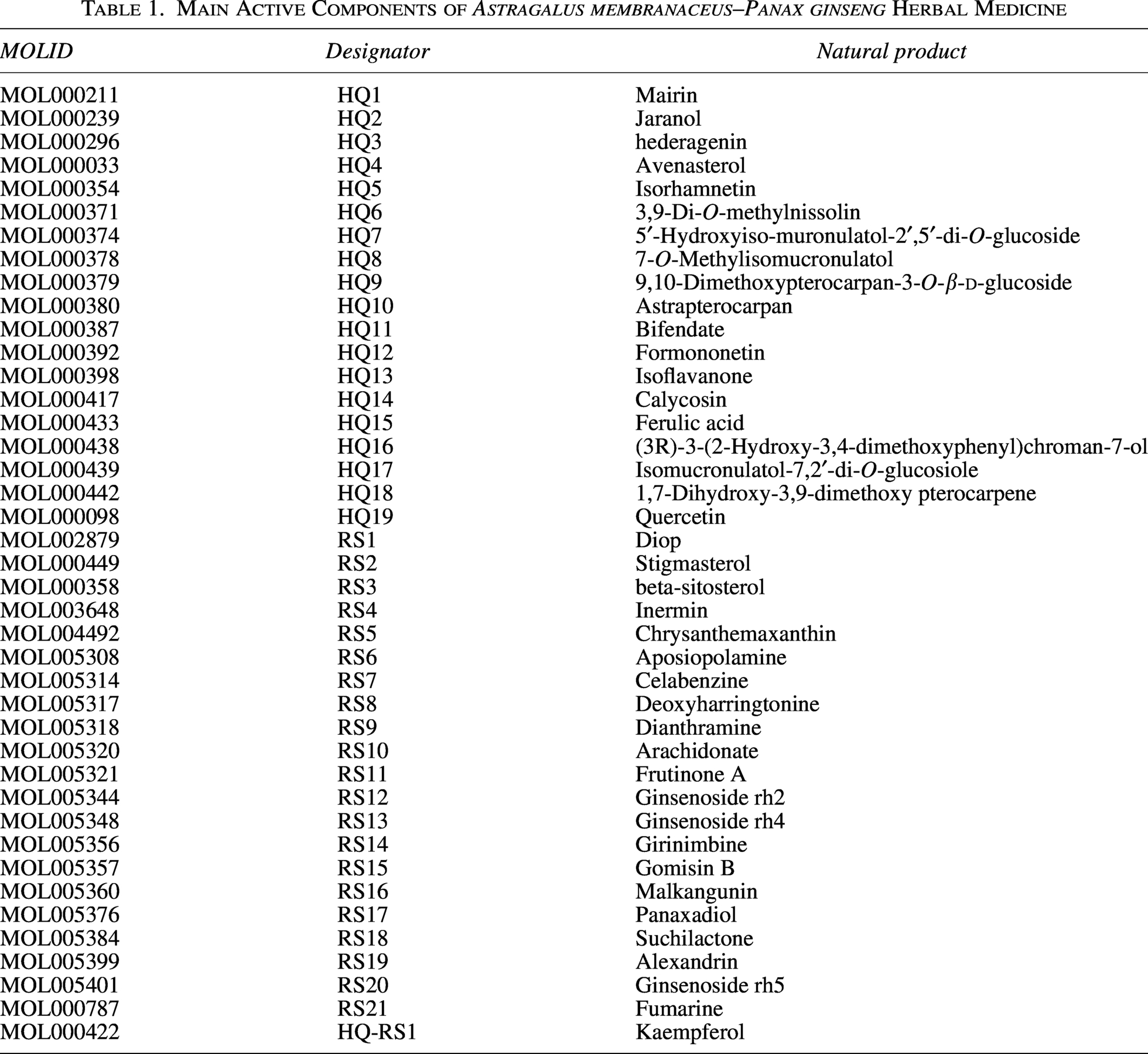
From the TCMSP database, 41 active ingredients were identified: 20 derived from A. membranaceus and 22 from P. ginseng. These ingredients mapped to 207 target proteins. Each target was named according to the parent compound; for example, mairin from A. membranaceus was labeled HQ1, whereas the shared compound kaempferol was labeled HQ-RS1 (Table 1).
Main Active Components of Astragalus membranaceus–Panax ginseng Herbal Medicine
Disease targets
Using a DrugBank score ≥ 0.1, 299 disease targets were retrieved 21 ; applying a GeneCards relevance score ≥20 yielded an additional 1709 targets. 22 After merging and deduplicating the two lists, 1843 unique CHD-related targets remained.
Construction and visualization of PPI networks
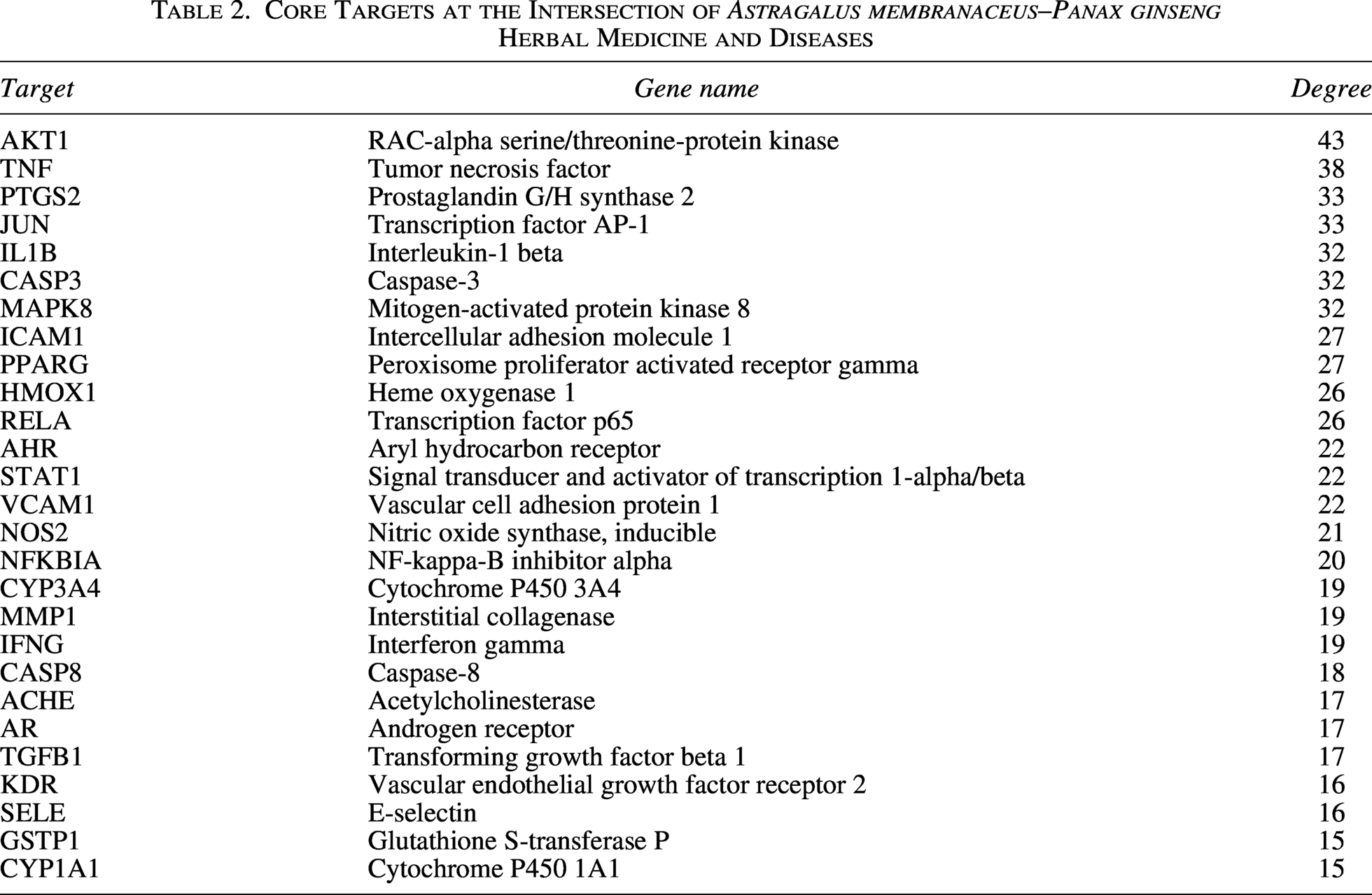
The online Venn-diagram tool identified 67 putative therapeutic targets (Supplementary Fig. S1). After hiding a single disconnected node. Using a cutoff value greater than 0.900 as the screening standard, the STRING analysis returned 66 nodes with 485 edges and an average node degree of 14.5. The PPI network was visualized in Cytoscape, where nodes with higher connectivity were considered more influential. Topological analysis highlighted 27 core targets whose degree exceeded the network mean (Table 2, Fig. S2).
Core Targets at the Intersection of Astragalus membranaceus–Panax ginseng Herbal Medicine and Diseases
Enrichment analysis results
KEGG pathway enrichment analysis
Metascape returned 11 significantly enriched KEGG clusters (Fig. S3). The most prominent clusters were associated with the TNF signaling pathway, fluid shear stress and atherosclerosis, NF-κB signaling, and their downstream regulatory cascades.
GO enrichment analysis
GO functional enrichment analysis yielded 34 distinct clusters (Fig. 1). Within the biological process category, 20 clusters were identified, primarily involving responses to lipopolysaccharide, xenobiotic stimuli, and regulation of angiogenesis. The nine molecular function clusters were characterized by high enrichment in cytokine and TNF-receptor superfamily binding, as well as transcription factor and coactivator interactions. In addition, five cellular component clusters highlighted the involvement of membrane rafts, the extracellular matrix, and transcription-factor complexes. These findings suggest that the A. membranaceus–P. ginseng herb pair exerts its therapeutic effects on CHD through a multitarget, multipathway synergistic mechanism.
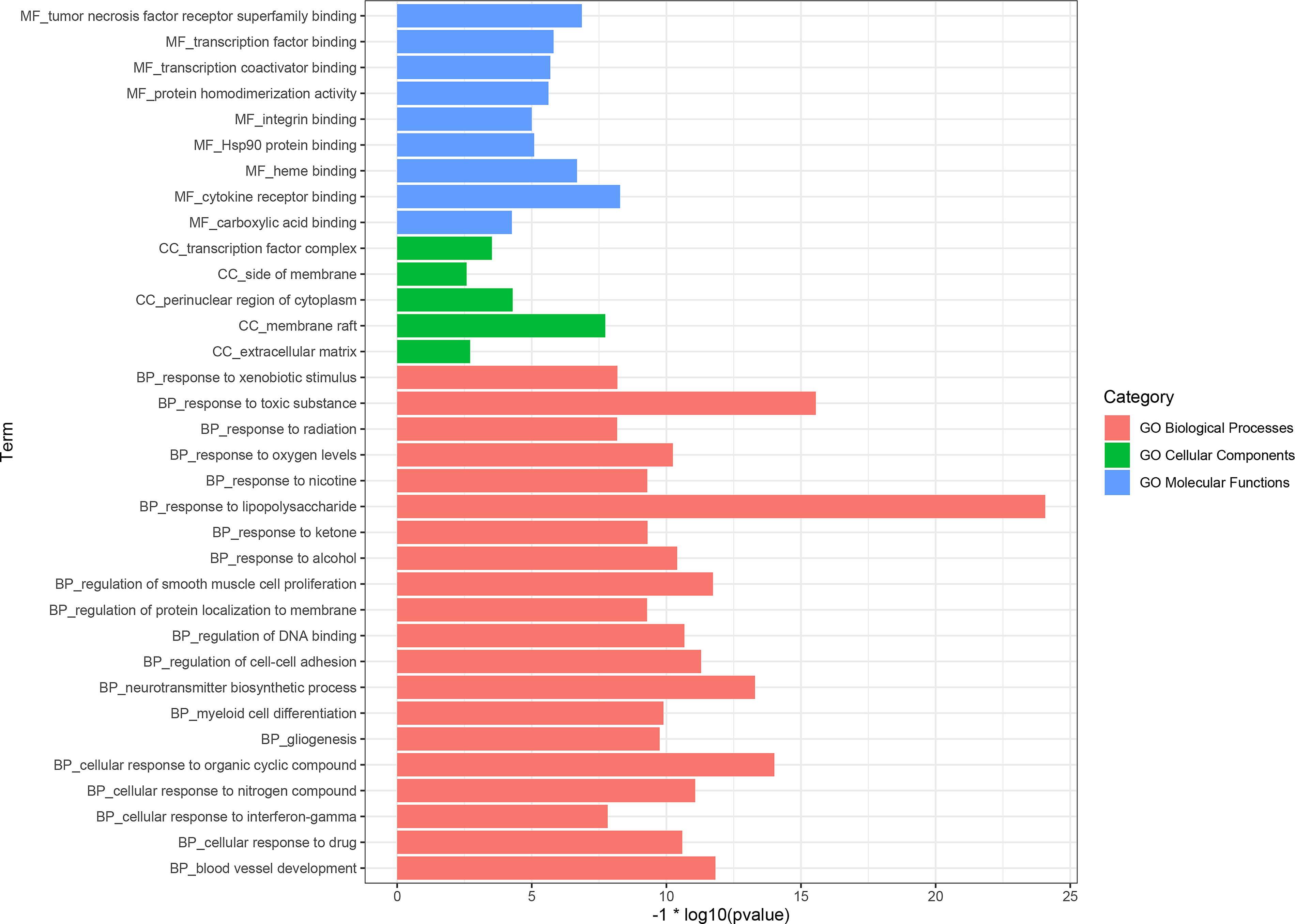
Astragalus–Ginseng treatment of coronary heart disease core target GO enrichment analysis. GO, Gene Ontology.
Construction and visualization of compound-target-pathway network
A multilayered pharmacological network consisting of 62 nodes and 188 edges was constructed using Cytoscape to visualize the interactions between 24 active ingredients, 27 targets, and 11 key pathways (Fig. 2). Network topology analysis, based on degree centrality, identified five primary bioactive compounds: quercetin, kaempferol, formononetin, isorhamnetin, and ginsenoside Rh2 (Table 3).
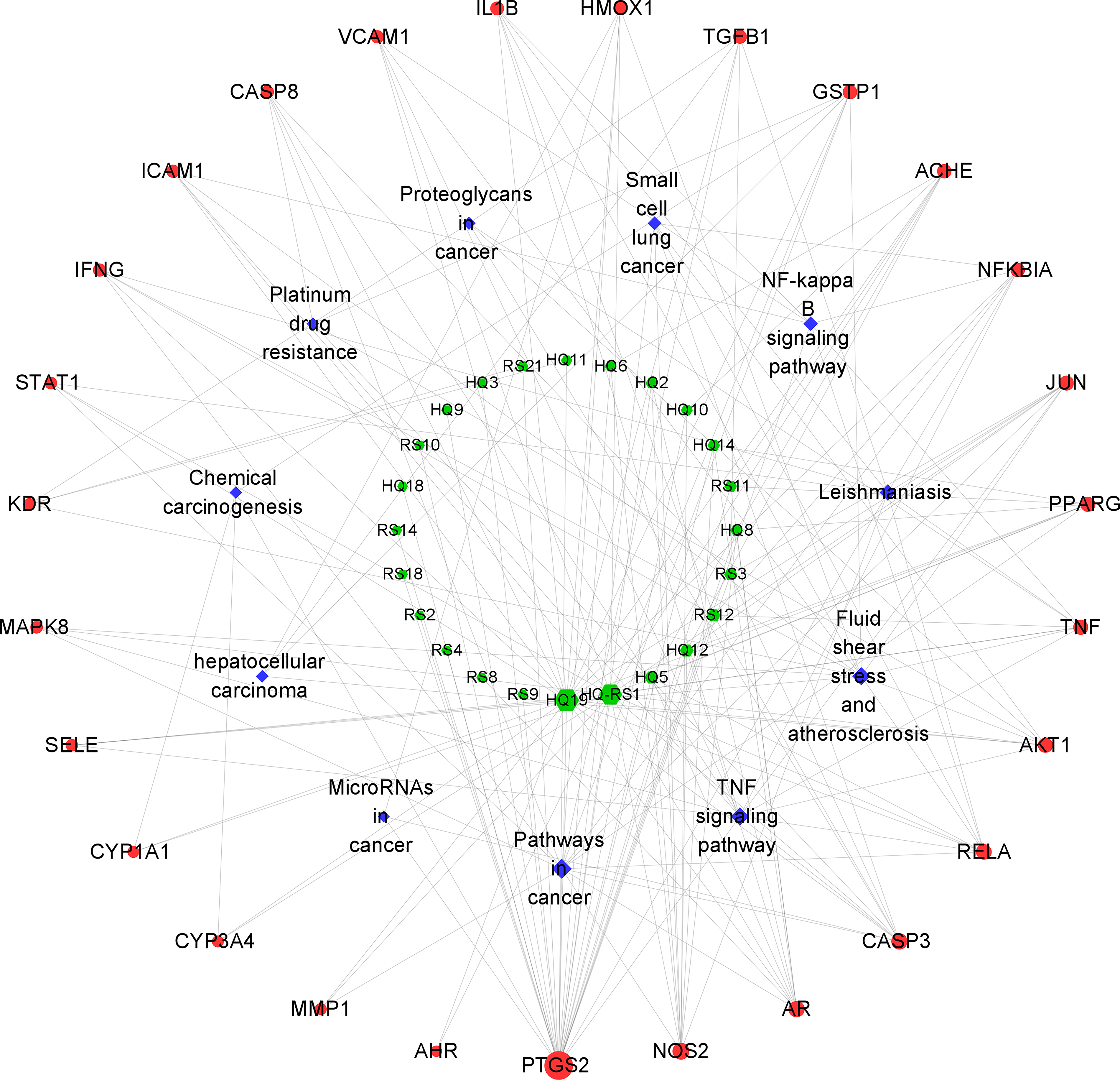
Astragalus–Ginseng therapeutic drug to “compound-target-pathway” visualization network.
Top Five Active Ingredients in Astragalus membranaceus–Panax ginseng Herbal Medicine in Terms of Degrees of Freedom

Molecular docking results
All dockings yielded binding energies below –4.25 kcal/mol, with a mean value of –7.736 kcal/mol, suggesting favorable potential binding affinity. 12 Notably, quercetin and formononetin exhibited some of the lowest binding energies with TNF (–9.829 kcal/mol), indicating relatively strong interactions. A comprehensive heatmap illustrates all binding energy scores (Fig. S4), while representative docking conformations of high-scoring compounds and targets are presented. (Supplementary Fig. S5).
Changes in cell viability
HL-1 cell viability decreased markedly after 8 hours of OGD relative to the normoxic control. Pretreatment with formononetin for 1 hour mitigated this decline, suggesting a cytoprotective effect against hypoxic injury (Fig. S6).
Changes in TNF-α levels
TNF-α levels rose significantly (p < 0.01) in all experimental groups versus the control. Compared with the OGD-only group, formononetin pretreated groups exhibited a significant reduction in TNF-α (p < 0.01) (Supplementary Fig. S7).
Discussion
A. membranaceus–P. ginseng is widely utilized in clinical practice to manage CHD. P. ginseng “tonifies qi,” strengthens the spleen and lungs, promotes fluid generation, quells thirst, and sharpens mental clarity, as recorded in the Ben Cao. It also replenishes the five viscera, soothes the spirit, steadies the soul, eases palpitations, dispels pathogenic factors, improves vision, and enhances cognition. Modern studies demonstrate that ginsenosides promote tissue regeneration and angiogenesis, maintain intracellular Ca2+ homeostasis, counteract oxidative stress, and drive vascular-endothelial differentiation. 23 –25 Collectively, these effects improve cardiac contraction and relaxation in CHD rats and lower circulating adrenaline. Based on further screening of active ingredients, ginsenosides Rh2, Rh4, and Rh5 were identified as the core active components. In contrast, major ginsenosides that are traditionally abundant and extensively studied, such as Rg1, Rb1, and Re, were not prioritized for investigation in this study. This selection may be associated with the higher bioavailability of rare ginsenosides following intestinal flora metabolism compared to their prototypical forms. 26,27 A. membranaceus, sweet-warm and “pure-yang” in nature, supplements deficiencies, boosts vitality, fortifies the spleen and stomach, alleviates muscle heat, invigorates blood flow, and expedites the healing of yin ulcers. Recent work shows that astragalus polysaccharides protect against postinfarction ventricular remodeling by upregulating miR-21 and blocking TLR4/MyD88/NF-κB activation. 28 Both herbs therefore regulate lipid metabolism, exert antioxidant activity, and modulate immune function.
Network pharmacology revealed that the herbal pair acts mainly through 27 targets and 11 pathways. The core targets at the intersection of the Astragalus–Ginseng herb pair and the disease, ranked by degree value, were RAC-alpha serine/threonine-protein kinase (AKT1), TNF, and prostaglandin G/H synthase 2 (PTGS2). As a central node in the PI3K-AKT pathway, AKT1 promotes NO synthesis by phosphorylating and activating eNOS, thereby maintaining vasodilation and inhibiting endothelial apoptosis, while indirectly exerting anti-inflammatory effects by suppressing NF-κB. The downregulation of AKT1 activity leads to reduced NO generation, creating a vicious cycle of endothelial injury that drives the progression of atherosclerosis. 29 As a key proinflammatory factor, TNF-α activates the NF-κB and mitogen-activated protein kinase (MAPK) pathways to upregulate intercellular adhesion molecule 1 (ICAM-1) and VCAM-1 expression, promoting inflammatory infiltration. It also induces oxidative stress and endothelial injury by inhibiting eNOS and increasing ROS, while simultaneously inducing MMPs to accelerate matrix degradation and increase the risk of plaque rupture. 30,31 PTGS2 is highly expressed locally within plaques, where it catalyzes PGE2 production to maintain a chronic inflammatory microenvironment, participates in vascular tone regulation and platelet aggregation, and promotes thrombosis. 32 These three targets form a sophisticated regulatory network in the pathogenesis of CHD to a certain extent: AKT1 downregulation weakens endothelial protection mechanisms, providing the initial conditions for inflammation; TNF-α acts as a central inflammatory mediator, exacerbating endothelial injury and promoting plaque instability through multiple pathways; and PTGS2 sustains and amplifies the pathological process by maintaining the chronic inflammatory microenvironment. Among the key signaling pathways identified via KEGG enrichment analysis, the TNF pathway involves the binding of TNF-α to TNFR1, which recruits TRADD, TRAF2, and RIPK1 to further activate NF-κB, MAPK, and Caspase pathways, mediating inflammation amplification and apoptosis, respectively. 31 The NF-κB signaling pathway degrades IκBα via the IKK complex to release p65/p50 into the nucleus, upregulating ICAM-1 and VCAM-1 to promote inflammatory infiltration, maintain the plaque microenvironment, and drive the formation and development of atherosclerotic plaques. 33 Furthermore, sustained TNF activation of NF-κB induces ROS generation and oxidative stress, synergistically promoting telomere shortening and cellular senescence, ultimately driving the structural and functional decline of the cardiovascular system. 34,35 Further screening identified kaempferol, formononetin, isorhamnetin, and ginsenoside Rh2 as hub constituents. Quercetin exerts antioxidative, anti-inflammatory, antiviral, anticancer, and cardioprotective effects. 36 Kaempferol mitigates atherosclerosis, improves endothelial function, and attenuates ischemia–reperfusion injury 37 ; it protects cardiomyocytes by suppressing TLR4/NF-κB signaling. 38 Ginsenoside Rh2 enhances myocardial contractility, reduces catecholamines, inhibits NLRP3/caspase-1 activation, downregulates PKA, normalizes Ca2+ homeostasis, and thereby alleviates CHD-related dysfunction. 39,40
Molecular docking confirmed strong affinity and stable hydrogen bonding between these key molecules and their targets, supporting the computational predictions. Formononetin exhibited the lowest binding energy with TNF (–9.829 kcal/mol), suggesting a stable interaction. Studies indicate that formononetin, a major isoflavonoid component of Astragalus, possesses anti-inflammatory, antioxidant, and estrogen-like vasculoprotective properties. 41,42 Molecular docking results suggest that formononetin may exert multiple cardioprotective effects by targeting TNF. Experimental results demonstrated that formononetin treatment alleviated the decline in cell viability and modulated TNF-α levels in cells subjected to ischemia-hypoxia, which partially validated this hypothesis at the in vitro cellular level.
This study aimed to explore the potential molecular mechanisms of the Astragalus–Ginseng herb pair against CHD; however, several limitations remain. Regarding network pharmacology, the extensive target landscape of CHD may lead to the overenrichment of common pathways such as TNF and NF-κB. Furthermore, the lack of explicit documentation regarding database versions and screening parameters affects the reproducibility of the results. The molecular docking study did not fully account for protein flexibility and lacked redocking validation, positive controls, and decoy molecules, making it difficult to rule out nonspecific binding. Consequently, future studies should incorporate molecular dynamics simulations and experimental validations such as SPR and ITC. Although formononetin exhibits favorable OB and DL, its in vivo pharmacokinetic profile has not yet been experimentally confirmed. The intestinal first-pass effect characteristic of isoflavonoids may limit actual plasma concentrations, highlighting the urgent need for pharmacokinetic studies to evaluate its potential for drug development. In addition, this study relied solely on a single-cell model and lacked validation in multicellular systems and animal experiments, failing to comprehensively reflect the pathological microenvironment of atherosclerosis. Future research should utilize ApoE−/− animal models combined with gene knockout or overexpression techniques to further elucidate the specific regulatory mechanisms of the TNF/NF-κB axis, thereby providing a robust basis for clinical translation.
Conclusion
The A. membranaceus–P. ginseng pair confers cardioprotection via a convergent network of 27 core targets and 11 key pathways, with TNF- and NF-κB-centered cascades most prominent. Formononetin, together with quercetin, kaempferol, formononetin, and ginsenoside Rh2, emerged as pivotal bioactives, and formononetin exhibited functional cytoprotection in the OGD model. These findings not only substantiate traditional use but also generate testable hypotheses for targeted in vivo studies.
Authors’ Contributions
Z.L. and J.C. participated in the design of the study, analysis of the data, and drafting of the article. T.M. and B.W. conceived of the study, participated in its design, and revised the article. Chengjia L., Changxing L., and Y.W. participated in extracting, merging, and cleaning data. Y.W. is the corresponding author. All authors read and approved the final article.
Footnotes
Acknowledgments
The authors thank the participants of the database and the staff.
Data Availability Statement
The data are available for reproduction of results on request from the corresponding author.
Ethical Considerations
The present study is a bioinformatics-based analysis, so ethical and consent permission is unnecessary.
Author Disclosure Statement
No competing financial interests exist.
Funding Information
This research was supported financially by the Heilongjiang Provincial Natural Science Foundation (
Supplemental Material
References
Supplementary Material
Please find the following supplemental material available below.
For Open Access articles published under a Creative Commons License, all supplemental material carries the same license as the article it is associated with.
For non-Open Access articles published, all supplemental material carries a non-exclusive license, and permission requests for re-use of supplemental material or any part of supplemental material shall be sent directly to the copyright owner as specified in the copyright notice associated with the article.
