




Abstract
Objective
To describe demographics, semiology, etiology, and clinical features in individuals with insulo-opercular and pure insular onset presenting with hyperkinetic seizures (HKS).
Methods
Under PRISMA guidelines, Embase, PubMed, Medline, and Cochrane were searched for articles between 1969 and January 10, 2025, using terms for hyperkinetic/hypermotor seizures, insular epilepsy, sleep-related hypermotor epilepsy, nocturnal paroxysmal dyskinesia/dystonia, nocturnal frontal lobe epilepsy, and complex motor behavior. Eligible studies were reports or retrospective series of patients with pure insular or insulo-opercular epilepsy and HKS, documented with SEEG or subdural recordings, with at least 6 months of postsurgical follow-up and Engels class I. Of 271 studies, 14 met inclusion criteria.
Results
Fourteen studies including 34 patients were analyzed; 61.8% had pure insular onset. Focal cortical dysplasia was the most common etiology, present in two-thirds of cases. Most HKS began with non-motor semiology (76.5%). Hyperkinetic automatisms type 3, defined by integrated/natural hyperkinetic behaviors, manipulation/utilization behaviors, and distal stereotypies, were reported in 49.9% of patients with pure insular onset. Compared with insulo-opercular onset, pure insular onset was associated with a higher frequency of these behaviors, along with agitation, vocalization, and breathing difficulties (p < 0.05). These findings are based on small, heterogeneous samples and should be interpreted cautiously.
Conclusion
HKS were more frequently associated with pure insular onset. Focal cortical dysplasia was the most common etiology, and integrated/natural hyperkinetic behavior was more frequent with pure insular onset. Given limited sample size, heterogeneity, and study design constraints, these findings should be considered exploratory rather than definitive.
This is a visual representation of the abstract.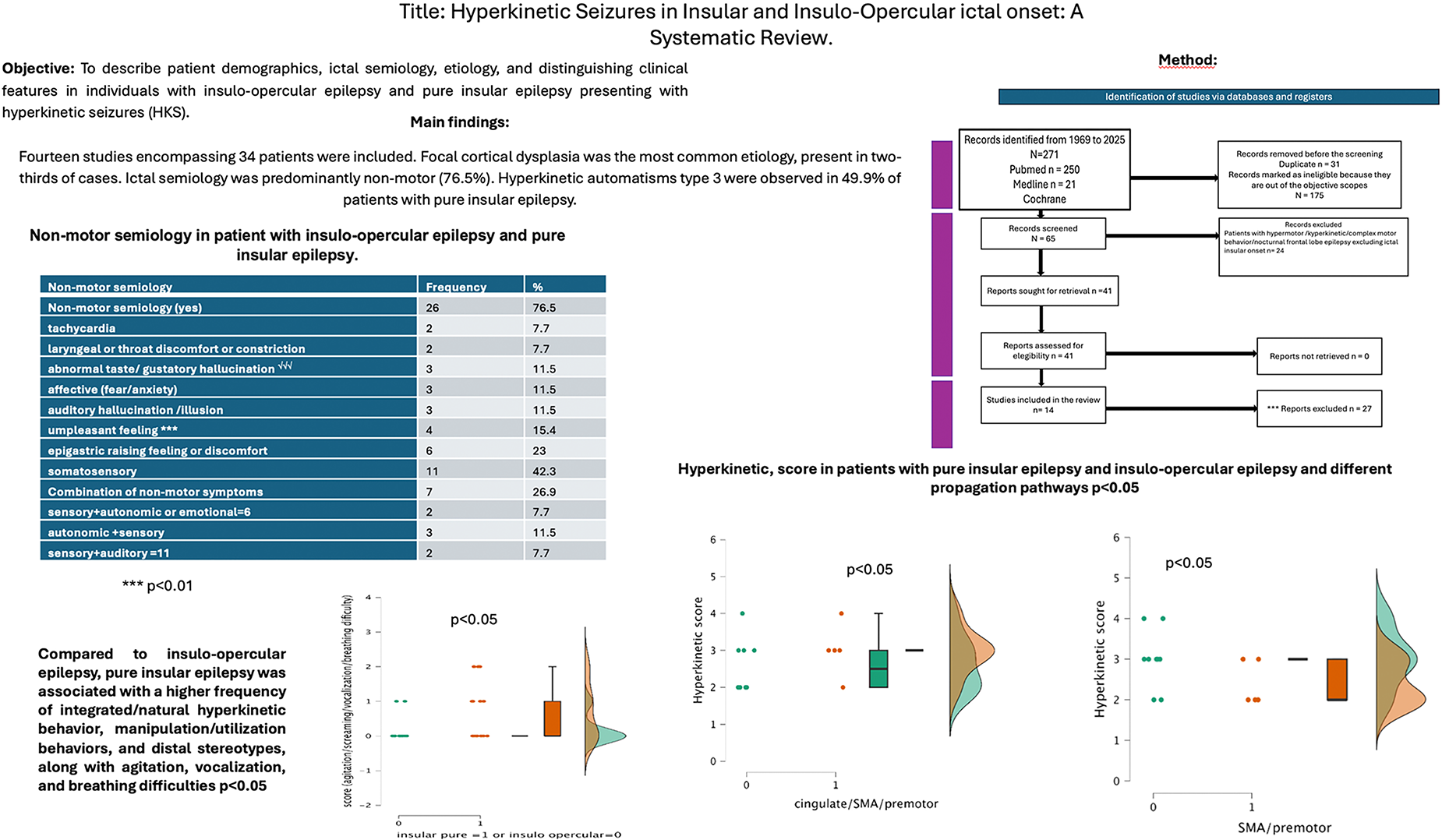
Keywords
Get full access to this article
View all access options for this article.
References
Supplementary Material
Please find the following supplemental material available below.
For Open Access articles published under a Creative Commons License, all supplemental material carries the same license as the article it is associated with.
For non-Open Access articles published, all supplemental material carries a non-exclusive license, and permission requests for re-use of supplemental material or any part of supplemental material shall be sent directly to the copyright owner as specified in the copyright notice associated with the article.
