




Abstract
In La Verne, California, a suburb of Los Angeles, residents have partnered with the town’s historical society to rebuild an important item from that organization’s collections: a 1938 International truck. Driven for decades by longtime La Verne resident Inman Conety, this automobile has logged over 900,000 miles since the early-twentieth century. As an expression of the collective identity of La Verne, the International has served the community as a recycling vehicle and supported civic pride with appearances in Fourth of July parades. The La Verne Historical Society recently launched a campaign to fund reconstruction of the vehicle, with the goal of returning it to the Fourth of July parade and affirming the truck’s status as a historical artifact with deep ties to the community. The 1938 International expresses the centrality of community support to the La Verne Historical Society’s collections.
Keywords
Collection items that exist beyond the traditional institutional boundaries of museums, archives or historical societies have the potential to form strong affective bonds with the communities they serve. In the city of La Verne, located approximately 30 miles east of Los Angeles, California, residents have resuscitated a historical automobile and transformed it into a symbol of history. The vehicle, a 1938 International truck driven by longtime La Verne resident Inman Conety, has become an expression of the town’s heritage. Wesley Inman Conety (always referred to as Inman by friends and citizens), a citizen of La Verne, died at age ninety-three in 1992. His colorful life and contributions to the city, as chronicled through the collections of the town’s historical society, continue to reverberate as today’s residents see tangible evidence of Conety’s work and thriftiness in the form of Conety’s truck. The International logged over 960,000 miles before it was retired and sold to the La Verne Historical Society. Since the sale, the 1938 International has become the centerpiece of the historical society’s collection of artifacts. Alongside numerous articles and letters, it preserves Conety’s legacy.
The story of Inman Conety and the 1938 International is a ribbon that runs through the city’s history and continues to excite pride in its residents. Residents have undertaken a campaign to return Conety’s truck to a functional state, investing significant amounts of time and energy into the reconstruction of the vehicle. Conety’s many voyages in the car cemented the truck as an icon of La Verne. However, by the late-twentieth century, the vehicle had fallen into disrepair, requiring extensive improvements before it could operate again. The La Verne Historical Society led a fundraising effort to invest in the reconstruction of the vehicle, with the goal of including the 1938 International in the city’s major Fourth of July parade by summer 2022.
In this essay, we argue that the community of La Verne, California, has given new life to Inman Conety’s 1938 International truck, which has become the most visible and important item in the historical society’s collections. By recognizing the value of this historic vehicle and committing to building it into a drivable form, residents of La Verne have affirmed the importance of this material manifestation of their history. The 1938 International has now become an icon in La Verne linking important facets of the city’s history to contemporary uses. While Inman Conety’s truck may not have hauled oranges from the famed citrus groves of Southern California, as the new logo of the La Verne Historical Society implies, it does freight a full load of historical significance that modern residents of the city have ascribed to this vibrant artifact. 1 Ultimately, citizens of La Verne have resuscitated Conety’s International as a functional historical artifact, albeit one heavily modified from its original form.
The Heart of the Orange Empire: La Verne, Inman Conety, and the 1938 International
The town that Conety and his truck called home for more than a half century originated over thirty years prior to his arrival. Americans settled the region of California that would become La Verne in the late-nineteenth century. In 1887, approximately 30 miles east of Los Angeles, a small agricultural settlement was established and given the name of Lordsburg. Isaac Wilson Lord, a land speculator and entrepreneur, founded the town in hopes of capitalizing on the growing citrus industry and railroad infrastructure that would shape numerous cities situated along the foothills of the San Gabriel mountains. Lordsburg was incorporated in 1906 and renamed itself La Verne in 1917 to combine with the surrounding unincorporated area of that name. Access to two transcontinental railroads brought settlers to La Verne and strengthened the town’s economy.
In its early days, settlers christened La Verne “The Heart of the Orange Empire.” Citrus groves flourished there, managed by farmers and ranchers who were lured to settle in its Mediterranean climate. Initially these settlers maintained groves of stone fruit, but by the end of the nineteenth century switched to farming citrus. Citizens planted the first oranges in-1890, and these citrus fruits soon became the dominant crop that thrived until the postwar era. Citrus flourished with the advent of railroads and the subsequent expanded markets to which they offered access. A rate war between the two transcontinental lines that serviced Southern California resulted in a huge influx of migrants in the late-1880s and early-1890s, laying the groundwork for La Verne’s commercial prosperity. 2
Into this community came Wesley Inman Conety, lured by the warm California weather and the orange empire. Born in 1898 in Glen Summit Springs, Pennsylvania, Conety began his driving career as a fourteen-year-old, guiding his horse, Dick, who pulled a spring wagon filled with Conety’s siblings and neighbor children to school. He worked around the train station in Glen Summit Springs where his father was the station agent. While living in Pennsylvania, Conety also worked as a contractor, caretaker, and handyman. 3 He attended Harry Hillman Academy in Wilkes-Barre and Lehigh University in Bethlehem, Pennsylvania, and was later employed in Bethlehem Steel’s machine shop.
From an early age, Conety felt a strong connection to history. Describing the origins of his middle name during an interview, Conety remarked that “As for the name Inman; it’s a family name. In Wyoming, Pa., there’s a monument commemorating the battle fought there in 1776. The name Inman is on the monument six times. It was my father’s middle name, and his father’s, too!” 4 After his arrival in Southern California, Conety’s fascination with the past would manifest with a decades-long dedication to preserving community memory. Bowing to an urge to escape the cold weather, he traveled to Southern California on vacation in 1922 and took an excursion on the Pacific Electric streecar system, known as “The Orange Empire Trip,” to La Verne. 5
Like the citrus industry that lent La Verne its nickname, the Pacific Electric Railway, an interurban streetcar system that linked Los Angeles to various communities across Southern California, played a key role in the place-making process of towns across Southern California. Envisioned by railroad tycoon Henry Huntington as a method to transport passengers and freight across the Los Angeles Basin, the Pacific Electric (or PE, as contemporaries labeled it) facilitated movement between the City of Angels and its citrus-producing hinterlands. The PE developed land and established utilities wherever it went, modernizing communities like La Verne as the rail line stretched east from Los Angeles in the first two decades of the twentieth century. Many historians, such as Oscar O. Winthur and Carlos A. Schwantes, have noted the role of transportation in place-making in the American West. Specific to the Golden State, William B. Friedricks has argued that the PE united communities in Southern California into a distinct geocultural entity. 6 As the ensuing discussion of Conety’s 1938 International will show, residents of twenty-first-century La Verne have extended the importance of transportation to the formation of local identity, as they now perceive automobile transit as a defining feature of the community.
Journeying to the “Heart of the Orange Empire” on the PE, Conety decided to stay in La Verne and took a job spraying trees in an orange grove. After he settled in the town, he met schoolteacher Ruby Louise Sheldon at the Methodist Church and began to court her. 7 They were engaged in 1925 before Conety returned to Pennsylvania. He came back to La Verne the following year to marry Ruby, and they journeyed to Pennsylvania and settled in the town of Mountain Top. Conety and Ruby had two daughters, Louise and Charlene. Conety supported his family by delivering ice and coal, first in a horse-drawn wagon and later in a truck. He recalled that the Great Depression did not severely affect his family, as his work did not involve farming but concentrated on delivering essential home heating and cooling supplies. In Conety’s words, “People needed ice in the summer and coal in the winter, so we weathered the Depression very nicely.” 8
In 1937, Conety received an offer to manage managing an orange grove in La Verne—much to Ruby’s pleasure, as she wanted to return to California to escape Pennsylvania’s cold weather. 9 Conety purchased a new 1938 International D-35 truck, packed up his household goods (including a 1934 Buick sedan), and the family traveled west to find a permanent home in California. The Conetys’ cross-country journey was the first of many such trips in the International. Conety once bragged to a reporter at his alma mater, Lehigh University, that he had traveled across the United States more than forty times, frequently using his own vehicle to do so. 10
Upon his return to the Golden State, Conety purchased part of what had once been the grove belonging to his father-in-law, Henry Samuel Sheldon. 11 He planned to sell his truck once he arrived, but he could not entice anyone to purchase the vehicle. As a result, he decided to monetize it, becoming a contract hauler for the Swift Chemical Company in Vernon, California. The International aided Conety in his work, accruing an impressive milage during his thirty-eight years as a contract hauler. The vehicle remained in his possession beyond his retirement (Figure 1).
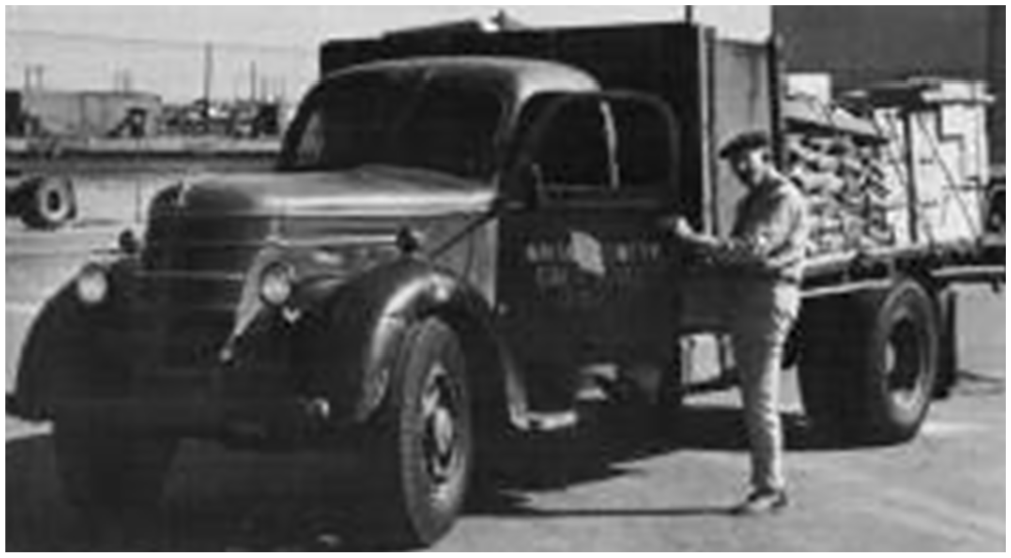
Conety and his 1938 International truck, ca. 1940.
From the driver’s seat of the 1938 International, Conety plied the roadways of Southern California for decades. His deliveries took him from East Los Angeles to Hemet (located in adjacent San Bernardino County), where he delivered “Vigoro” fertilizer and other agricultural supplies in his International. He once commented of his truck, “She’s a little temperamental, but we understand each other.” 12 Although not a trained mechanic, Conety took meticulous care of the International, changing the truck’s oil every 2,000 miles and checking its fluid levels each morning before work. 13 Indeed, Conety carefully logged the maintenance he performed on his vehicle. “His preventative maintenance record book,” one article published in 1975 explained, detailed “every oil change, tire change, gas mileage check, [and] repairs.” Conety “can tell you just about everything from that little brown truck.” Although he originally purchased the vehicle in Pennsylvania, Conety racked up most of the International’s almost-1,000,000 miles in Greater Los Angeles. 14
The Conetys returned to Southern California just as the region’s romance with automobiles bore tremendous fruit. From 1938 to 1939, the Automobile Club of California launched a Traffic Survey to determine where to built a large highway through Los Angeles. This resulted in the construction of the Arroyo Seco Parkway, the first major freeway in Southern California. 15 An intricate network of highways emanating from Los Angeles followed shortly thereafter. Conety took advantage of California’s developed highway system when hauling fertilizer across Greater Los Angeles. He and the 1938 International regularly traveled the freeways linking Los Angeles to important adjacent cities like Pasadena, Pomona, Riverside, and San Bernardino. Conety described the city of Hemet, in Southern California’s Inland Empire, as his most farflung destination; when visiting that destination he clocked more than 90 miles.
Following the conclusion of World War II in 1945, the citrus industry that had attracted Conety to La Verne slowly began to decline across Southern California. During the war, servicemen and industrial workers from across the country had streamed into Greater Los Angeles for military service or to join the defense sector. The need for for residential districts to house these workers enticed many citriculturists to sell their lands, which developers used to build tract homes. 16 The highway system that had expanded in 1930s grew even more dramatically in the 1950s and 1960s to serve growing suburban communities. Thus, while Conety’s agricultural clients largely vacated Southern California in the postwar years, he and the International enjoyed a vastly more developed road system. Importantly, the economic expansion of Southern California came at the expense of the citrus industry. Many orange- and lemon-growers uprooted their property to make quick money selling to land developers. Additionally, a malady called quick decline, or tristeza, killed many citrus trees in the immediate postwar years. 17
By the 1960s, the citrus industry had all but abandoned Southern California, including La Verne. Conety sold his grove to make way for a mobile home park development, cashing in on the housing craze and removing what had become a significant source of stress from his life. Reflecting on the decline of citrus in La Verne, Conety remarked that “It is a relief not to have the orange grove. When I think of getting out those cold nights to light those heaters and walking on the frozen ground, I am glad the trees grew into mobile homes. It was a lot of hard work, but a good investment.” 18 After dispensing with the orange grove, Conety remained employed as a contract driver, relying on the International more than ever.
Maintaining the International as it rolled along California’s impressive highway system posed a number of challenges for Conety. Due to its size and the weight of its cargo, the truck suffered from an abysmal rate of fuel consumption, averaging approximately 11 miles per gallon. Additionally, Conety recalled being stopped on the freeway for “impeding traffic” by driving slowly, forcing him to modify the axle gear ratio to meet the minimum speed limit of 45 miles per hour. These challenges aside, Conety took excellent care of the International, as exhibited by his practice of covering its hood with a blanket to keep the engine dry. “Ther International truck,” Conety brightly concluded, “has brought me a good living and I never abuse it.” 19
Conety’s life remained busy after World War II. Sadly, Ruby passed away in 1958. To fill the emptiness left by his the loss of his wife, during the final years of his career at the Swift Chemical Company and lasting into his retirement, Conety busied himself with community service. Shortly after the formation of the La Verne Historical Society, which grew out of a Cultural Heritage Commission first established in 1969, Conety served as the organization’s corresponding secretary. Shortly thereafter, in 1971, he was elected President of the Historical Society. He worked to incorporate the organization, signing papers to this effect in the summer of 1973. Over the next eighteen years, Conety alternately served as President, Board Member, and President Emeritus of the Society.
Shortly after its formation, the historical society began to accumulate artifacts from La Verne’s citrus history, but lacked the funds to display them in a museum. Conety established a collection center for newspapers and glass to raise money for historic preservation. Hauling recyclables in the International, he made weekly roundtrips of more than 40 miles to bring refuse to a recycling center and recycled more than 400 tons of materials. Proceeds from his recycling efforts exceeded $20,000, which he gave to the historical society to fund its preservation efforts. Among the most important of the society’s activities were the installation of bronze markers at historic homes and the raising of funds for construction of a new city library. 20 Conety also raised fees for speaker programs and supported the publication of a book about the history of La Verne. The recycling center remained active in La Verne until 1989, when it was closed to create a parking lot. 21
Conety immersed himself in community affairs beyond the historical society. He served on the La Verne Beautiful and Bicentennial Committees, the Methodist Church choir, and the Toastmasters. He received a fifty-year pin from the Masonic Order. Every evening he dined at the Crystal Cafeteria in the nearby city of Pomona, sitting at the same table and enjoying a home-cooked meal. He traveled every year to visit one daughter in Mexico City and reportedly made over forty trips across the United States. However, he never traveled by air, remarking, “I don’t mind how high I fly, just so I have one foot on the ground.” 22
To recognize the tireless efforts toward community improvement of one of its favorite adoptive sons, 1985, La Verne named Conety Citizen of the Year. In bestowing this honor, the City of La Verne noted the key role that the 1938 International played in Conety’s life. After introducing Conety as “a truly exceptional individual,” the La Verne Chamber of Commerce wrote that, “Though he retired in 1979 after 60 years of work as an independent businessman operating a truck, he is devoting a considerable amount of energy to a variety of community services and charities.” In addition to leading the historical society, which he served as president emeritus by 1985, he continued to operate the Inman Conety Recycling Center and to serve as treasurer of the Wesleyan Day Care Center and the La Verne Coordinating Council. “Near and dear to his heart,” explained the brochure commemorating Conety’s award, “is his 1938 International truck which he says has traveled over 951,000 miles.” 23 Conety once averred that “one of the requirements of a happy life is good health. The exercise I get in loading, unloading and driving the truck, has kept me in good shape,” even as he advanced in years. 24 The International, an extension of Conety’s being, warranted the special attention it received from La Verne in naming its owner Citizen of the Year.
Conety once measured his vitality by his ability to carry large sacks from the International. As the packs declined in size over time, Conety conflated this decrease with his aging. “No doubt,” he once wrote in a Christmas letter to his family members and friends, “you are wondering what I will do when I quit driving the International truck and caring for the grove.” Even in Conety’s mind, the 1938 International had become an indelible part of his public persona. 25
The 1938 International Finds New Life
The 1938 International later retired from active service. Purchased from Conety by the La Verne Historical Society for its original cost of $1,350.00 in 1991, the truck was moved to a barn at the city’s Heritage Park. There, it became a component of its “Hands on History” program for third-grade students in the city’s Bonita Unified School District. Heritage Park is the site of the last orange grove in La Verne, linking the International to the “Heart of the Orange Empire.” 26 Rusting and no longer functional, the truck sat at the park until 2019 when it was towed to the home of the current President of the Historical Society, Shery Best. Although the vehicle had fallen into disrepair from old age and disuse, Best envisioned improvements to the vehicle that would transform it into a vibrant, functional historical artifact. “Long a fixture at La Verne Heritage,” Best wrote, “the International was recently moved to the home of La Verne residents John and Sherry Best to undergo extensive renovation. It will retain its original look while receiving mechanical [improvements] (new engine, tires, brakes, drive train, bed, and interior refurbishing) to make it street worthy.” 27 Another member of the historical society, Erik Chaputa, stepped forward to direct building efforts.
Repairs to the truck began modestly in February 2020. At that time, the La Verne Historical Society hosted its first “1938 International Beautification Day,” designed to teach members of the community about the vehicle as they watched it undergo power washing and cleaning. The event also doubled as an advertisement to entice donors from the community to contribute to the project. 28 The International was evaluated for functionality during the beautification event. Sadly, the wooden bed was not salvageable, requiring the historical society to remove it. After scrapping the bed, the metal cab protector came off and what remained of the vehicle received a much-needed power wash (Figure 2).
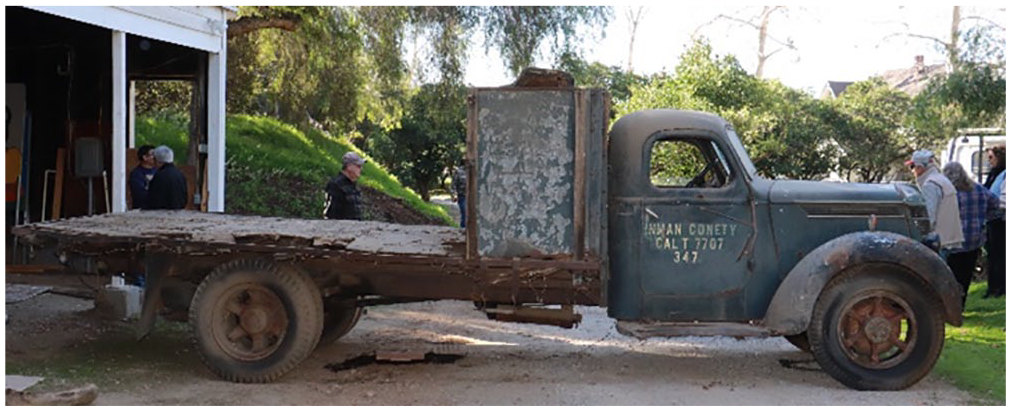
Conety’s 1938 International as it appeared in 2020.
To raise money for repairs to the 1938 International, the La Verne Historical Society turned to crowdfunding. Websites like Kickstarter and GoFundMe have become increasingly critical platforms for cultural institutions like museums, archives, and historical societies, especially in an age when funding for public humanities projects has become scarce. 29 Best designed and launched a GoFundMe page to “Help Restore the 1938 International Truck.” She positioned the vehicle as a community artifact, “a wonderful mobile addition to our history courses for our students in our school district.” 30 Despite the truck’s advanced age, the historical society planned to extract further use from the vehicle.
To direct the rejuvenation of the 1938 International, the board of directors of the La Verne Historical Society decided to collaborate with high school students enrolled in the auto shop class at the city’s Bonita High School. The historical society had worked with the Bonita Unified School District in the past, strengthening students’ understanding of local history and providing opportunities for students to learn directly from historical artifacts. Additionally, Bonita’s reputation for completing advanced auto repair projects made the school an ideal partner. 31 In an homage to Inman Conety, the project team planned to have students treat the truck body for rust but retain its original, weathered look. Disassembling the International revealed that many of the mechanical parts required replacement. The project team therefore planned to outfit the truck with a new engine, tires, brakes, drive train, bed, and interior refurbishing with the goal of making the International drivable.
Rob Zamboni, the auto shop instructor at Bonita High School, described students’ impressions of the 1938 International. While students had previously worked on historic vehicles, the International required far more time and attention. “For 50 minutes a day, Monday through Friday,” Zamboni explained, “our kids are focused and engaged on their project, making a little bit of progress every day. This is a true community collaboration.” Zamboni divided his Auto 102 class into three teams to complete the truck. One worked on the rear part of the truck, along with its axle. Another completed the middle section and the transmission. The final team worked on the front of the vehicle, including its engine and suspension. Students on all three teams enthusiastically participated in the repair work. Sophomore Rylan Blancett noted the challenge of undoing the cab of the International. “It was welded in place by the owner,” the student shared, so he and his peers relied on “grinders and saws to get the old bolts off.” Despite such challenges, the prospect of completing the repairs spurred students. “We are all motivated to see what the truck will look like when it is fully” rebuilt, Blancett commented (Figure 3). 32
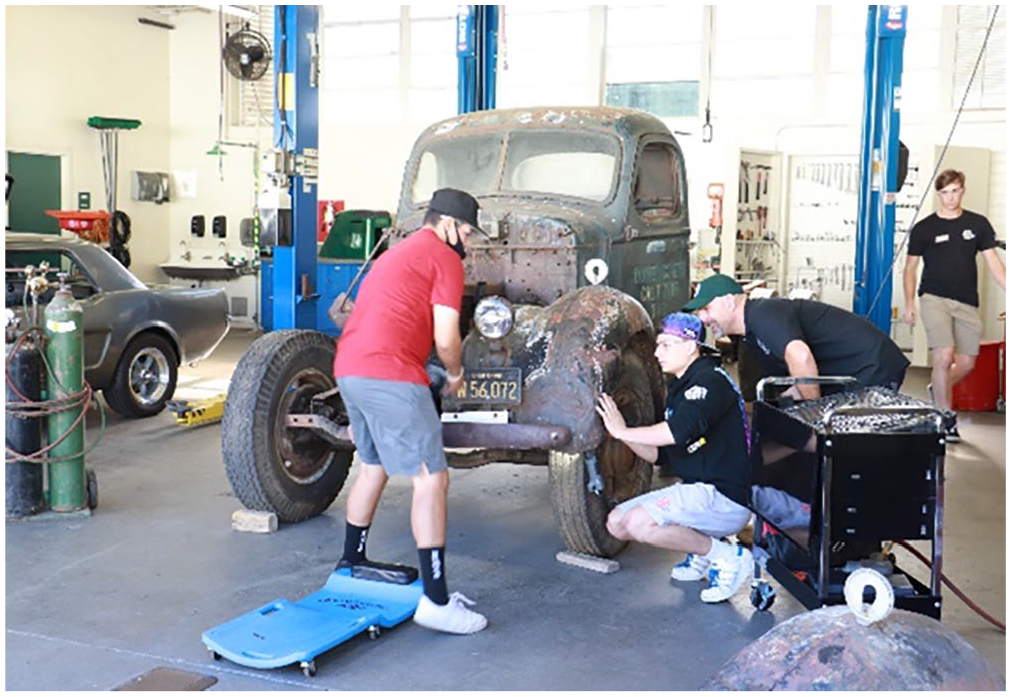
Students at Bonita High School in La Verne disassemble the 1938 International truck, 2021.
The La Verne Historical Society kept its members apprised of the progress of repairs to the 1938 International with periodic updates. Best and the directors of the historical society sent monthly newsletters to inform members of the community, including funders, of the status of the project. As early as July 2020, Best wrote, workers had already removed the motor and determined the parts that would require extensive reconstruction or outright replacement. The article framed the rebuilding of the International as a community project, highlighting the financial donations by members of the historical society in funding the undertaking. Perhaps hinting at her plan to include the 1938 International in La Verne’s Fourth of July parade in the future, Best released this early update about the truck on Independence Day. The article appeared under the historical society’s new logo, featuring the 1938 International, and an American flag. 33
In working on the International, the leaders of the historical society struck a balance between modernization and maintaining the vehicle’s historical identity. “Our Project Director,” read one article in the historical society’s newsletter, “will remove the cab and fenders, pull apart the chassis and remove the tires and axles, then sandblast and weld any cracks in the frame.” While “Dents in the cab and fenders will retain their vintage look . . . rust and metal surfaces will be buffed out and sealed.” 34 The historical society tapped into a variety of revenue streams to finance repairs to the International. Proceeds from tours of historical house the sale of t-shirts, marmalade made from locally grown oranges and lemons, and other memorabilia, as well as the society’s general fund, all allowed for significant progress on the International by January 2021. 35 Subsequent repairs included painting the chassis, installing a rear end unit, putting in new brakes, and placing the steering gear in the vehicle. 36
In repairing Conety’s vehicle, the La Verne Historical Society purposely chose to modify the International to privilege functionality over appearance or authenticity. In short, the leaders of the historical society focused on making the vehicle drivable and treating its exterior to appear as it did when Conety operated it, while significantly altering the interior of the International. Erik Chaputa, one of the leaders of the project, noted severe cracks in the frame of the truck, suggesting that Conety had not repaired the vehicle until he felt it absolutely necessary. For the vehicle to function again, the team had to install a new steering gear assembly, brakes, and transmission. 37 The project team attempted to make the exterior of the truck appear as it did in the 1980s, the last decade that Conety drove it across La Verne. The can, fenders, grill, and other exterior components all maintained their original look. This entailed treating rusted parts and applying a clear coat to preserve the original paint job, with the goal of making the truck seem as if it had rusted following its retirement from active service. The repair team also fixed parts of the vehicle that did not require outright removal and replacement. Team members salvaged the exterior gas tank, fenders, steering wheel, and gauges.
However, internal components that Conety did not properly maintain had degraded badly over time, as the truck had been stored outdoors prior to its acceptance by the La Verne Historical Society. This forced the historical society to purchase of an entirely new interior. A modern engine, drive train, and other internal components replaced the old parts that had deteriorated past the point of usability. Financially, the historical society spent less on adding new parts than it would have paid for originals. Even so, the International required extensive work before the repair team could properly place new parts. Fixing the axle accounted for one of the most extensive aspects of the project. After stripping the front axle on the donor axle, the repair crew cut off the ends and rewelded them onto the existing axle. In addition to reassembling the front axle, workers shortened the drag link, installed new brakes, and cleaned shackle parts. New parts installed after axle repairs included mountable steel wheels with valve stems, stainless steel washers, and channel spacers. All the truck’s original wiring and mechanical parts were removed in favor of new ones because of how badly the originals had deteriorated over time. The International will subsequently receive new wood siding to make it safe for passenger to ride in the back of the vehicle. Crucially, by installing new parts, the historical society has drawn upon the automotive knowledge of local auto shops and high school students for a significant portion of the repairs, a helpful cost-saving measure.
Students in the auto shop at Bonita High School worked feverishly to complete these the repairs. Within a month of receiving the International, they had attended to the car’s motor and transmission. Student workers carefully buffed off the dirt while retaining Inman Conety’s name and California registration numbers on the cab’s doors. 38 By the end of 2020, students had disassembled the vehicle, preparing the frame for welding, sandblasting, and repair. 39 However, some of the technical aspects of the International required professional automotive experts. With students off for their summer break from Bonita High School by June 2021, and disassembly of the truck complete, the historical society moved the International to a professional speed shop in a nearby city for more precise work. The truck was disassembled to its component parts, the frame sandblasted, and the vehicle carefully welded and painted. A steel frame was constructed to hold the bed, and the mechanical components described above installed in fall 2022. The project’s managers hoped to salvage and restore the truck’s tire rims as iconic reminders of the time when the International roamed the freeways and streets of Southern California.
The board of the historical society consistently positioned the project as a community undertaking, crediting the organization’s members with making the endeavor possible through generous financial contributions and labor. Best remarked that the “project represents the best example of collaboration among stakeholders that results in lasting benefit to members of the community.” She highlighted the experience students gained in working on the truck, and how future pupils would be able to learn from the vehicle after it become mobile again. Additionally, the local television station, LVTV, covered the International repair project, further bringing public attention to the dream of “a drivable truck that can be part of La Verne’s ‘Hands on History’ program and make an appearance in parades and city events. It is a project in which we can all take great pride.” 40 Local newspapers also covered the repair work on the International.
In addition to students at Bonita High School, small businesses helped reconstruct the International. Because of the collaborative nature of this project, and the different facilities required to rebuild the International, the historical society asked a local entity, Sanders Towing Company, to provide its services moving the truck, often with short notice. To the delight of the Historical Society board members, the family-owned towing company provided its services free of charge, much to the benefit of the organization’s budget. 41 Additionally, the La Verne Historical Society cooperated with the Old Anvil Speed Shop in Orange, California, a business that specialized in classic automobiles, to install new parts on the International. 42 In addition to extensive work on the axle and chassis, this business helped replace the truck’s wheels. Originally, Conety had Dayton spokes on his truck, colored with a bright red coat of paint. The project team had planned to retain this feature of the truck for its aesthetic appeal. When the historical society could not find these parts, the Old Anvil Speed Shop created new rims and Dayton spokes for the vehicle, which will soon receive a coat of paint. These mark the only instance of new paint used on the International. The Old Anvil Speed Shop also welded on patches to repair rusted segments of the exterior, and built a new steel cradle for the wood flat bed. Beyond tapping into local resources, the historical society often had to cast a wide net in hopes of securing necessary parts. For instance, it obtained front and rear assemblies, which included axles, from a salvage yard in Florida.
As repairs on the truck progressed, the La Verne Historical Society consciously ascribed new layers of meaning to this artifact. In 2019, the 1938 International truck became the official logo of the historical society. Bearing an orange in its bed, this image of the vehicle represents the society at local car shows and city events. Conflating the international with citrus fruits significantly modifies the truck’s legacy within the community. Although Conety owned an orange grove, there is no written evidence that he carried any products other than fertilizer and agricultural supplies as a contract hauler, and recyclables as president of the historical society. 43 Rather than suggesting a deep connection between the citrus industry and the International, the historical society’s correlation of the truck with a large orange is simply an eye-catching logo.
With the International nearly drivable by summer 2022, the historical society planned an impressive itinerary for the truck. Because the historical society lacks a permanent home, the truck will function as a sort of “mobile museum,” transporting citizens through La Verne’s streets during its Fourth of July parade, and “making the scene” at significant events like car shows, city-sponsored beer and wine walks, and La Verne’s Easter Egg Hunt. When not in active service to the city, the International will reside at the homes of various members of the historical society and be parked outside society-sponsored event locations such as home tours. The International can perform additional duty by returning to its onetime home at Heritage Park to be displayed for students as part of their local history education. Seeing an authentic local artifact will add excitement to children’s engagement with local history, and provide the leaders of the historical society with an engrossing historical object to re-tell Inman Conety’s story (Figure 4).
The new logo of the La Verne Historical Society, depicting the 1938 International hauling an enormous orange, the symbol of the city.
The International on Parade: Car Culture and Automotive Patriotism
Focusing specifically on automotive work places the La Verne Historical Society at the heart of two local traditions with deep roots in Southern California: car culture and annual Fourth of July celebrations. Like many other towns in the Golden State, La Verne holds automotive history in high esteem. In the 1940s, as Conety became a fixture in La Verne, the region invested in a system of freeways and highways, reorienting the infrastructure of the Golden State around cars. As a result, the region has become closely entwined with car culture in the American imagination. 44 A few blocks south of La Verne in the neighboring city of Pomona, the Auto Club Raceway and NHRA Motorsports Museum attest to the region’s deep history with automotive sports, particularly drag racing, which originated in Southern California in the 1950s. 45 These institutions not only underscore the region’s automotive history, but strengthen residents’ perceptions of car culture, a prevalent aspect of Southern California that has shaped how Americans understand automobiles and have built an infrastructure around them. 46
With an understanding of the importance of car culture to Southern California, leaders of the historical society tapped into local enthusiasm to support reconstruction of the 1938 International. La Verne is located along Route 66, the historic road linking the Midwest to Los Angeles. Since the mid-twentieth century, La Verne has reoriented itself around Route 66, with drive-through fast food restaurants and other businesses clustered along this major transportation corridor. Residents of La Verne share in Southern California’s general affinity for classic cars, as expressed through the car shows periodically held downtown. Streetcars, muscle cars, and other vintage or exotic vehicles regularly draw large crowds to these shows, which have become an important community tradition for La Verne. 47 The La Verne Historical Society regularly set up booths at these events to secure funding for their work on the 1938 International.
One of the historical society’s aims in resuscitating the vehicle was to integrate it into La Verne’s annual Fourth of July parade. Citizens of La Verne have used the town’s celebrations on the Fourth of July to express their passion for vintage automobiles. 48 For over forty years, a parade held on the morning of Independence Day has wound its way through La Verne, drawing large crowds. 49 Vintage cars, motorcycles, and trucks carry participants on a route that runs past the auto shop at Bonita High School. After the parade, daylong festivities bring together local community organizations like the historical society, schools, business, and churches. 50 The coronavirus pandemic wracked Los Angeles County in 2020, forcing La Verne to cancel its Independence Day celebrations, but the parade made a triumphant return in 2021. 51
La Verne is by no means the only American—or even Californian—town to combine classic cars with the Fourth of July. Among many other locales to do so, for instance, is the city of Huntington Beach, California. The organizers of this event market that city’s parade on Independence Day as the largest event of the kind west of the Mississippi River. 52 As such, when the historical society merged the campaign to rebuild the 1938 International with the town’s celebrations of the Fourth of July, it tapped into a longstanding American tradition of combining classic cars with patriotism in its quest to fund reconstruction efforts for the 1938 International.
A pause on reconstruction efforts in summer 2022 allowed the International to join La Verne’s annual Independence Day parade. Volunteer members of the historical society and high school students accompanied the truck on this parade. “Keeping the International in the public eye maintains” its prominence, Best argued, “and there is no better gathering than the Fourth. People need to see tangible evidence of their donations and be reminded by the presence of students that this is a multi-generational project.” 53 After raising the International’s public profile at the parade, project leaders planned for the truck to undergo professional repairs at a local auto shop for further work before the fall of 2022, when the vehicle would return to the high school and serve as a teaching tool as students carefully tear down and rebuild it, piece by piece. 54
In 2022, thanks to the partnership of the La Verne Historical Society and Bonita High School, with funding and automotive expertise from community members, Conety’s 1938 International joined the fleet of vehicles participating in the Fourth of July parade. On July 4, the citizens of La Verne enjoyed a first look at the International’s triumphant return to the streets. While repairs on the truck were ongoing at the time, the historical society arranged to have the vehicle in its current form mounted onto a tow truck for it to cruise the Fourth of July parade route. Festooned in patriotic regalia, the International also sported signage celebrating the partnership of the historical society and the high school in repairing the truck, as well as information for donors interested in contributing to the repair work. Members of the historical society and a student marched in the parade alongside Conety’s International.
The La Verne Historical Society’s strategy of bringing the truck to the largest community gathering in the city did indeed draw public attention. A few weeks after Independence Day, the historical society held a gathering to celebrate the International’s return to the parade and to raise further funds for the truck’s renovation. Between sales of goods and outright donations, the historical society generated $1,800 to support work on the 1938 International (Figure 5). 55 After these festivities, the La Verne Historical Society returned the International to the machine shop for the next segment of repairs necessary to bring Conety’s storied truck to drivable form, after which students at Bonita High School will once again have a chance to repair the vehicle. In a letter sharing the success of the 1938 International at the Fourth of July parade with readers, Best commented that “We are more than half way through the project.” 56

Conety’s 1938 International as it appeared in the 2022 La Verne Fourth of July parade.
Riding Into the Sunset
The owner of the International proved as indefatigable as his truck. Late in life, Conety remained a humble, hardworking man. “Since retiring from sixty years of truck driving,” he explained in one of his annual Christmas letters, “I have settled into a pattern of volunteer work that has changed very little in the past five years.” He continued to visit the recycling center for the La Verne Historical Society, estimating that he had processed 575 t of material by 1983. He also served as treasurer of the Methodist Church’s Day Care Center, and as the librarian for its choir. 57 When Conety passed away in 1992 at age ninety three, his extensive retirement work, paired with years hauling materials in his 1938 International, cemented his place in La Verne’s heritage. “The Conety image,” one local writer in La Verne concluded nearly fifty years ago, “is one of a gentle man, past three quarters of a century in age, who works hard, loves his fellow man, his family, his God—all of this behind the driver’s seat of his 1938 International truck. Inman Conety and his International—one in a million reaching almost a million.” 58
Allowing the 1938 International truck to remain at an historic park, rusting into oblivion, would have been a typical outcome for outdated equipment not consigned to the scrap heap. The La Verne Historical Society worked hard to prevent such a fate from befalling Conety’s truck. As the backbone of the historical society’s collection, the vehicle reminds citizens of his impact on La Verne and continues to serve the community in new ways. With students at Bonita High School having completed critical repairs on the truck, the 1938 International is closer than ever to the million-mile mark. It has become emblematic not just of Conety, but a vehicle to carry the community history of La Verne into the future. Through comprehensive repair work, the historical society has given the vehicle a new purpose. The organization has reinvented this truck as an emblem of La Verne’s history, ascribing new purpose to the International.
The next generation of La Verne residents will benefit from the rebuilt 1938 International. Children enrolled in California’s public schools study community history in third grade as part of their state-approved curriculum for social studies. Exploring one’s immediate community in third grade is followed by study of California history, United States history, and world history. Opportunities to visit places, meet people, and compare traditions help to establish a shared sense of identity and provide a familiar focus from which to explore more challenging social issues in changing societies. Learning from the 1938 International will provide dynamic opportunities for the next generation of students and other citizens of La Verne, the historical society’s plans to place the truck in community events will assert its status as a vibrant historical artifact. The vehicle’s connection to the city’s early farming pioneers and a man who was actively engaged in the formation and continuation of the town’s historical society spurred the reconstruction effort. As its odometer inches closer to one million miles, the International has transformed into a fitting symbol that will continue to delight and illuminate residents as it rolls through the streets of La Verne once more.
Footnotes
Declaration of Conflicting Interests
The author(s) declared no potential conflicts of interest with respect to the research, authorship, and/or publication of this article.
Funding
The author(s) received no financial support for the research, authorship, and/or publication of this article.
1.
We borrow the notion of vibrant materiality from Jane Bennett, Vibrant Matter: A Political Ecology of Things (Durham, NC: Duke University Press,  ). Bennett argued that matter exerted agency in human affairs. Philosophically inclined readers could argue that the 1938 International truck has exercised such influence in the city of La Verne.
2.
3.
Wilkes-Barre Times Leader, January 22, 1977.
4.
Benjamin Ettelman, reprint of an article appearing in the Fall 1975 issue of the Lehigh University Alumni Bulletin, La Verne Historical Society files.
5.
La Verne Leader, August 19, 1976.
6.
Oscar Osburn Winther The Transportation Frontier: Trans-Mississippi West, 1865-1890 (New York, NY: Holt, Rinehart and Winston, 1964); Carlos Arnaldo Schwantes, Going Places: Transportation Redefines the Twentieth-Century West (Bloomington: Indiana University Press, 2003); William B. Friedricks, Henry E. Huntington and the Creation of Southern California (Columbus: Ohio State University Press, ), 6-7.
7.
Kevin Ausmus and Drew Schlosberg, “Get Your Kicks on Route 66: Vintage Auto Restoration at Bonita Unified,” California School News Radio, December 2, 2021, available at:
8.
La Verne Leader, August 19, 1976. The citrus industry also remained profitable during the Great Depression, despite (or perhaps in part due to) the low wages paid to fieldworkers. Benjamin Jenkins, Octopus’s Garden: How Railroads and Citrus Transformed Southern California (Lawrence: University Press of Kansas, ), 296-7.
9.
La Verne Leader, August 19, 1976.
10.
Ettelman article on Conety, La Verne Historical Society files.
11.
Bill Lemon, personal communication, April 21, 2022. Lehigh University’s alumni file maintained that the grove had belonged to Ruby Conety’s uncle. Ettelman article on Conety, La Verne Historical Society files.
12.
La Verne Leader, January 16, 1975.
13.
Los Angeles Times, January 1, 1979.
14.
“Almost a Million,” p. 1, 1975, La Verne Historical Society files.
15.
Jenkins, Octopus’s Garden, 340.
16.
17.
18.
Los Angeles Times, January 1, 1979.
19.
Ibid.
20.
Memo on Inman Conety from Evelyn Hollinger to Marty Lomeli, January 12, 1984, p. 1, La Verne Historical Society files.
21.
La Verne Newsletter, May 20, [year unknown], p. 1, La Verne Historical Society files; La Verne Chamber of Commerce, “1985 Citizen of the Year: Inman,” p. 2.
22.
La Verne Leader, August 19, 1976.
23.
La Verne Chamber of Commerce, “1985 Citizen of the Year: Inman,” p. 2.
24.
Ettelman article on Conety, La Verne Historical Society files.
25.
“Almost a Million,” p. 2, 1975, La Verne Historical Society files.
26.
Ausmus and Schlosberg, “Get Your Kicks on Route 66.”
27.
La Verne Historical Society newsletter, May 2020, p. 2.
28.
“LVHS Update” email from Sherry Best to members of the La Verne Historical Society, February 14, 2020.
29.
30.
31.
Ausmus and Schlosberg, “Get Your Kicks on Route 66.”
32.
“Bonita Unified Auto Shop Students Hone Technical Skills, Restore Vintage Truck for Community,” Bonita Unified School District News Release, December 6, 2021, available at: . Auto 102 is Bonita High School’s advanced auto class. Ausmus and Schlosberg, “Get Your Kicks on Route 66.”
33.
La Verne Historical Society President’s message, July 4, 2020, p. 1.
34.
“Rolling with the International,” Legacy Links (La Verne Historical Society newsletter), September 2020, p. 7.
35.
“Rolling with the International,” Legacy Links, January 2020, p. 8; “Pucker Up!” Legacy Links, March 2022, p. 3.
36.
“Rolling with the International,” Legacy Links, March 2022, p. 4.
37.
“Rolling with the International,” Legacy Links, January 2022, p. 7.
38.
Javier Rojas, “Bonita High School students revive historic La Verne truck,” Inland Valley Daily Bulletin, October 13, 2021, available at: https://www.dailybulletin.com/2021/10/13/bonita-high-school-students-revive-historic-la-verne-truck/. This story also appeared in the San Gabriel Valley Tribune on October 13, 2020, available at:
39.
“Rolling with the International,” Legacy Links, October 2021, p. 5; “LVHS Update” email from Sherry Best to members of the La Verne Historical Society, November 12, 2021.
40.
“Rolling with the International,” Legacy Links, October 2021, p. 5; “LVHS Update” email from Sherry Best to members of the La Verne Historical Society, October 28, 2021.
41.
“LVHS Update” email from Sherry Best to members of the La Verne Historical Society, January 7, 2022. “Rolling with the International,” Legacy Links, January 2022, p. 7.
42.
“Rolling with the International,” Legacy Links, June 2020, pp. 5-6.
43.
Bill Lemon, personal communication, April 21, 2022.
44.
46.
Ausmus and Schlosberg, “Get Your Kicks on Route 66”; Lutz, “On the Road to Nowhere,” 50-55.
48.
Ausmus and Schlosberg, “Get Your Kicks on Route 66.”
49.
Javier Rojas, “La Verne’s July 4 parade returns,” Pasadena Star-News, July 3, 2021, available at: https://www.pasadenastarnews.com/2021/07/03/la-vernes-july-4th-parade-returns/. Once city counselor estimated that the parade had operated for over fifty years. See University of La Verne, “Leos on Parade,” University of La Verne, July 6, 2016, available at: .
50.
Imani Tate, “La Verne celebrates the Fourth of July,” July 9, 2010, The Sun, available at: .
51.
Rojas, “La Verne’s July 4 parade returns.”
53.
Sherry Best, personal communication, May 30, 2022.
54.
Ausmus and Schlosberg, “Get Your Kicks on Route 66.”
55.
Sherry Best, personal communication, July 25, 2022.
56.
“Every Picture Tells a Story: Rolling with the International,” Legacy Links, July 2022, pp. 1-2.
57.
Christmas letter from Inman Conety, 1938, La Verne Historical Society files.
58.
“Almost a Million,” p. 2, 1975, La Verne Historical Society files.