



Abstract
The Arctic has been, and is, an area of focus for the botanical and fungal (lichenized fungi included) collections at the Natural History Museum of Oslo. These collections house more than 233,000 unique Arctic specimens, the oldest dating back more than two centuries. The vascular plants account for 63 percent, lichens 30 percent, and fungi 7 percent. The Arctic collections have a circumpolar representation with emphasis on mainland Norway (48 percent) and Svalbard (13 percent), followed by Arctic America (10 percent), Greenland (9 percent), and Arctic Russia (8 percent). The Oslo herbarium and fungarium house collections from important polar expeditions like Fram-2, Gjøa, and Maud, but also of many expeditions where collecting biological specimens was the main purpose. The number of new collections was highest in the decades 1930 to 1939 and 2000 to 2009 with each around 35,000 new specimens. In the 1990s, a DNA Bank was established for DNA extracts and tissue samples, and it houses today 22,879 Arctic accessions of fungi, lichens, and plants. In times of climatic change and a tense geopolitical situation, the herbarium and fungarium at NHM-Oslo represent an invaluable source for biological information about the Arctic. We welcome the use of our collections for research-, nature management-, and teaching purposes.
Introduction
The plant and fungal collections of the Natural History Museum (NHM), University of Oslo, were established in 1863. The collections of vascular plants, bryophytes, and algae are referred to as Herbarium O (abbreviation according to Index Herbariorum). The lichen and fungal collections are referred as the mycological collections or Fungarium O.
This paper discusses our Arctic vascular plants (referred as “plants” hereafter), lichenized fungi (“lichens”), and non-lichenized fungi (“fungi”). The fungal, lichen, and plant collections (referred as “collections,” or as “O” hereafter) at NHM are the largest ones of its kind in Norway, jointly housing more than 1.7 million specimens (330,000 fungi; 270,000 lichens; 1.1 million plants) including non-Arctic specimens. These collections are mostly digitized and searchable through the GBIF website and our own data portal (https://samlingsportal.nhm.uio.no/museum/nhm).
Highlights of our collections are historical specimens from early expeditions, type specimens, and a relatively good coverage through space and time of the Arctic biota. Since the earliest naturalists and taxonomists, the Arctic has been a target area for Norwegian exploration and research. Our collections house more than 233,000 unique specimens from the Arctic, of which the oldest were collected more than two centuries ago. Although having a circumpolar representation, the majority of specimens originate from mainland northern Norway (48 percent) and Svalbard (13 percent), followed by Arctic America (10 percent), Greenland (9 percent), and Arctic Russia (8 percent). By far most of the Arctic collections are plants (63 percent), followed by lichens (30 percent), with fungi being the smallest group (7 percent).
In the following, we will go more into detail on the content of and trends in our Arctic collections, including information about important polar expeditions and collectors.
Definition of the Arctic
The Conservation of Arctic Flora and Fauna consortium (CAFF) has delineated the area we call the Arctic, which we ideally prefer to follow. However, that would require that all herbarium and fungarium specimens were geocoded to be evaluated for inclusion. Unfortunately, many accessions collected in pre-GPS times do not, or if they do, they are often very inaccurate. Hence, we have included all material from countries and regions/provinces that have all or major parts of their areas within the CAFF boundaries and were thereby retractable in our collection management system. We were then left with the following areas: Alaska (United States), Arctic Canada (Newfoundland and Labrador, Northwest territories, Quebec, Ontario, Yukon Territory, and Nunavut), Bear Island, Faroe Islands (Denmark), Franz Josef Land (Russia), Greenland (Denmark), Iceland, Jan Mayen (Norway), northern Finland (Perä-Pohjanmaa, Sompion Lappi, Kittilän Lappi, Koillismaa, Enontekiön Lappi, and Inarin Lappi), northern Norway (Nordland, Troms, and Finnmark), northern Sweden (Jämtland, Norrbotten, Åsele lappmark, Lycksele lappmark, Pite lappmark, Lule lappmark, and Torne lappmark), Novaya Zemlya and Vaigach (Russia), Russia (the remaining whole country due to challenges in interpreting labels and geography), and Svalbard (Norway).
The Dataset
Specimen information used herein represents exclusively the digitized parts of our Arctic collections. As our collections are digitized to various degrees, the numbers and estimates of our fungal specimens from the Arctic will be lower than the actual numbers. For the lichens and plants incorporated into the collections, the data set is nearly complete. Some of the most recent material, which is not yet registered, has not been included. Some thousands of specimens from early expeditions, mostly unidentified, also remain uncurated and hence not incorporated.
The first step was cleaning the data, such as correcting occurrence information, and assigning the collected specimens to a scientific expedition, when appropriate. We geocoded the material from the 1921-expedition to Novaya Zemlya as part of this paper. The cleaned dataset consists of 233,064 records (DOI: https://doi.org/10.15468/dd.d44f5q), for which we provide various summary estimates herein. We provide the number of specimens of each organism group according to Arctic region of origin (Table 1). We display the number of specimens collected per decade from 1800 to 2010 (Figure 1a) as well as the taxonomic coverage through time (Figure 1b). We identify important collectors based on their number of collected Arctic specimens deposited at O (some depicted in Figure 2). We also report the number of specimens of each organism group collected on important Arctic expeditions, including where and by whom they were collected (Table 2). Finally, we visualize the number of nomenclatural types at O from each of the Arctic regions per organism group (Figure 3).
Number of Specimens From Several Arctic Sites for Fungi, Lichens, and Plants Deposited in the Oslo Herbarium and Fungarium.

As only very few of the extra-Norwegian specimens of the Fungarium O are digitized, these figures will be increased in the future according to the digitization advances.
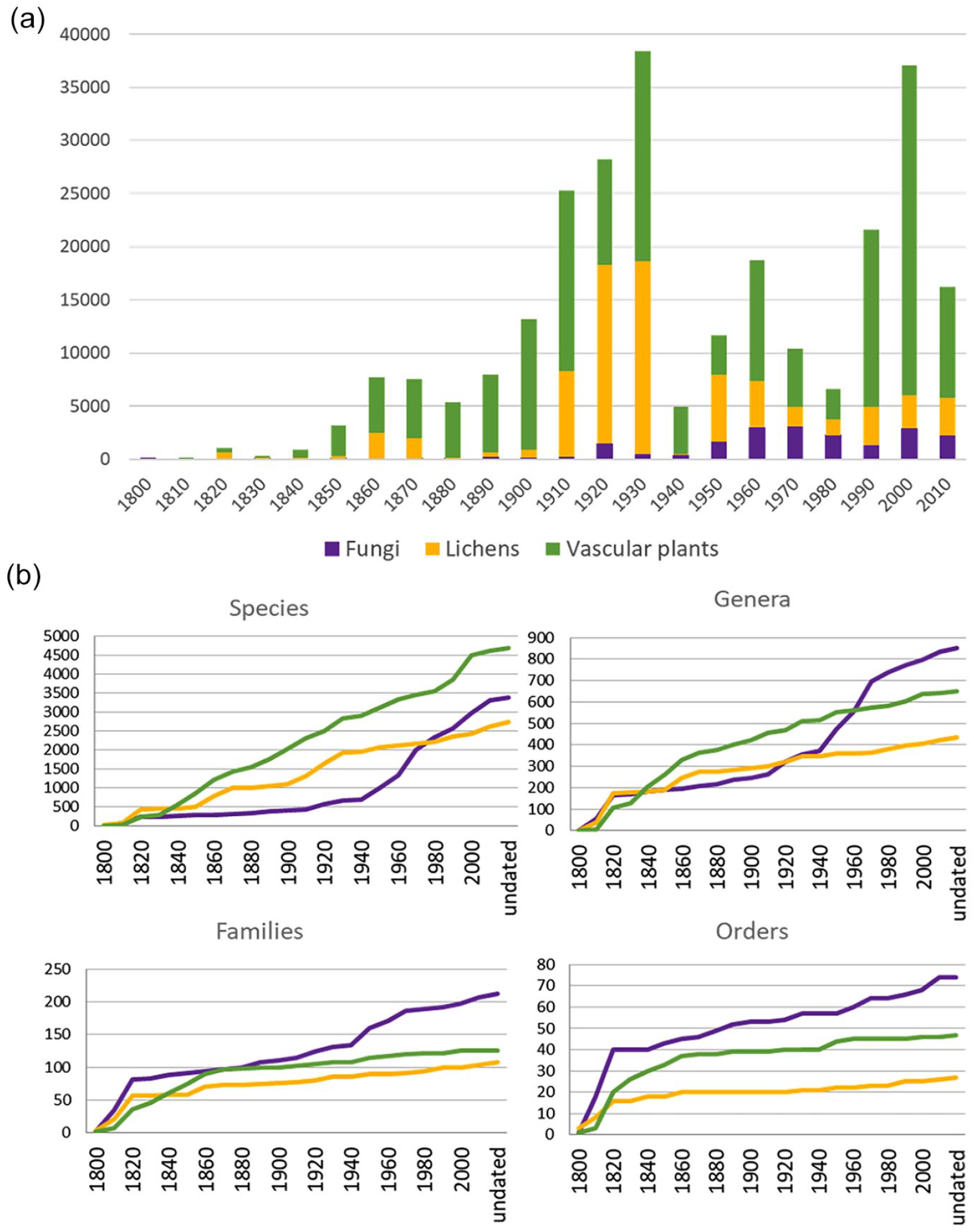
Visualization of our fungarium and herbarium collections at O through time (decade of collecting): (a) number of accessions for fungi, lichens, and plants and (b) taxonomic coverage, represented as cumulative numbers of species, genera, families and orders of fungi, lichens, and plants.

Early collectors and collecting sites: (a) Johannes Musæus Norman (1823–1903), (b) Ove Dahl (1862–1940), (c) Søren Christian Sommerfelt (1794–1838), (d) Bernt Lynge (1884–1942), (e) Lynge’s collecting sites in Novaya Zemlya during the expedition in 1921, and (f) Hanna Resvoll-Holmsen (1873–1943) on Svalbard in 1907.
Important Expedition to Arctic Islands From 1829 to 1940 Whose Material is Deposited in the Oslo Herbarium and Fungarium.

Note. F = fungi; L = lichens; V = vascular plants.

Number of nomenclatural types for Arctic fungi, lichens, and plants housed at O across geographic areas (total number 984).
Geographic Coverage
Most geographical areas are well represented in our Arctic collections. Not surprisingly, most specimens of the total are from Arctic parts of northern Norway (fungi: 76 percent, lichens: 31 percent, plants: 58 percent), followed by Svalbard (11 percent, 20 percent, and 11 percent), and then Greenland for plants (7 percent) and lichens (16 percent), and Finland for fungi (4 percent; Table 1). We have lichens and plants from all geographic regions as we define them here, but no fungi from the Faroe Islands, Franz Josef Land, Novaya Zemlya, and Vaigach (see Table 1). The low or lacking numbers for fungi is, however, most likely an artefact due to the low proportion of digitized extra-Norwegian fungal specimens.
The collection activity on Svalbard has been relatively high since the first documented collections in 1827, likely due to a political goal with high research activity at the archipelago. Many expeditions and collection trips have been financed by the state or funding agencies. Along the same lines, when Norway made attempts to assert sovereignty over East Greenland, several expeditions were sent there and more than 15,000 specimens of plants and lichens were collected from 1900 to 1939 (Figure 1a).
Our current data do not display a comparable collection trend for fungi (Figure 1a), which in part may be due to the delay in digitization of extra-Norwegian fungal specimens. However, the rapid increase in collecting post-World War II (WWII) corresponds well with the growing mycological activity in the Arctic during the 1960s through the 1980s, culminating with the Third International Symposium of Arctic and Alpine Fungi (ISAM III) in 1988 on Svalbard. Prior to this period, the taxonomic overview of fungi was rather poor. Revisionary works have been undertaken on the earlier collections (see, e.g., Dobbs 1942; Hagen 1950; Ohenoja 1971). Several macromycete monographs were published post-ISAM III, with Gulden (1987) on Galerina as one of the first. Although much focus has been on Svalbard (see Gulden and Torkelsen 1996), Ohenoja (1971) pointed out in her review that the majority of macrofungi show a circumboreal distribution, further supporting that the low number provided herein is artificial (see Table 1), and would have been higher if more of the specimens had been digitized.
There was a second period of very high collection activity of plants from 1990 to 2010 (more than 58,000 specimens were collected; Figure 1a). This was due to the Pan Arctic Flora project (PAF) that initiated by Reidar Elven and Inger Nordal from the Norwegian side together with colleagues representing different Arctic areas (for full list see http://panArcticflora.org/). The motivation for this initiative was to cohere the species concepts across the Arctic, as the traditions for species circumscription in the different Arctic countries were highly diverse (Nordal and Razzhivin 1999). This long collaboration made our understanding of the plant diversity in the entire Arctic area much better and resulted in the Pan Arctic Flora, which is regarded as the most authoritative Flora for the area.
Taxonomic Coverage
The fungal collections show a surprisingly broad taxonomic coverage early on, covering almost half of the orders and families of the final total already by the 1820s (Figure 1b). The distribution of specimens across orders is, however, highly skewed, with only four fungal orders represented by more than ⅔ of all specimens (i.e., the Agaricales, Polyporales, Russulales, and Puccinales), and about half of the orders represented by less than 10 specimens (not shown). Diversity at the genus level displays a rapid increase post-WWII with a careful levelling off since the late 1970s. We see a similar increase at the level of species diversity, but with a less apparent levelling off. This may suggest that there are still undiscovered or even undescribed fungal species in the Arctic.
The collection of Arctic lichens comprises all taxonomic groups, but possibly with an emphasis on taxa of special interest to the collectors. Hence, the order Lecanorales seems to be overrepresented (44 percent of the species; but 32 percent globally, cfr. Lücking et al. 2017). Like in the non-lichenized fungi, we see about half of the currently known families and orders collected already by the 1820s (Figure 1b). At the species level, the number of species collected shows a more linear growth, but with intensified periods in the 1860s and in the 1920 to 1930s. The former is probably caused mainly by collecting in northern Norway by J.M. Norman, the latter by the two decades of Norwegian scientific Arctic expeditions (see below).
For the plants, it is not surprising that higher in the taxonomic hierarchy, like for orders and families, the number increases quite rapidly in the first years of collecting, and then slower after the first years (Figure 1b). The same trend can be seen for genera, but not as distinct as for the higher taxonomic levels. In contrast, the number of species have risen quite steadily from 1880 to 2000. This is somehow surprising, as we would have suspected that it would be easier to find new species earlier, when little was collected compared to the later years after 200 years of collecting. The period where the growth of new species was at its highest was in the years of the Pan Arctic Flora Project (1990–2010), and was due to expeditions to less explored areas, such as Beringia and Kamchatka.
Important Collectors
One of the first explorers of the Arctic was the county commissioner Hans Hansen Lilienskiold (c. 1650–1703) who made a survey of the plant vegetation in Arctic parts of the Norwegian mainland already in the seventeenth century (Jørgensen 2007: 165). His work was summarized in the illustrated book “Speculum boreale.” Unfortunately, none of his collections are preserved today.
The earliest collectors had a wide biological interest and were collecting all three groups. One example is Søren Christian Sommerfelt (1794–1838; Figure 2) who was parish priest in Saltdal in northern Norway in 1818 to 1824. He collected extensively in the parish and published the scientific results in his “Supplementum Florae lapponicae” (Sommerfelt 1826) and in a more general description of the natural history and ethnography of his parish (Sommerfelt 1827). Sommerfelt was one of the first to understand the scientific value of dry-preserving fungi, which for long had been practiced for plants. Sommerfelt published the first Norwegian cryptogam exsiccata in 1826 to 1830, ”Plantarum cryptogamarum Norvegicarum” that includes 200 specimens, of which seventy-three are lichens, thirty-nine are fungi, and ten cryptogamic plants. The collections in Oslo hold more than 1500 of his Arctic specimens of fungi (320), lichens (893), and plants (325). Also Mathias Numsen Blytt (1789–1862) collected fungi, lichens, and plants in northern Norway, but he never published the material. O has most of his Arctic specimens of fungi (23), lichens (233), and plants (760).
Johannes Musæus Norman (1823–1903) made the largest collection to date of fungi, lichens and plants from northern Norway. O houses nearly 17,000 specimens (plants: 12,840, lichens: 3705, and fungi: 399), but his collection was split between the museums in Oslo (O), Bergen (BG), Trondheim (TRH) and Tromsø (TROM) after his death, where Oslo received around half of Normans collections. The plants were published in his magnum opus “Norges arktiske flora” (Norman 1894–1901), the lichens were only partly published in shorter papers. Ove Dahl (1862–1940) collected mainly plants throughout Norway. His collection from northern Norway (16,476 at O) is included in “Floraen i Finnmark fylke” (Dahl 1934).
For plants, the three people who collected the most Arctic specimens deposited at O after 1940 were directly linked to the Pan Arctic Flora Project, namely Reidar Elven (15,710 collections), Heidi Solstad (8998), and Carolyn L. Parker (3889). There are three collectors that stand out over all time periods as having collected the most specimens of plants, namely Johannes M. Norman (12,757; Figure 2a), Ove Dahl (16,480; Figure 2b), and Reidar Elven (15,710).
The most prominent collector of parasitic fungi in the Arctic was Ivar Jørstad (1887–1967). He collected more than 2,500 specimens and became a world authority on rust fungi. His Arctic collections are published in a number of papers, including extra-Norwegian material (e.g., Jørstad 1934: Kamtchatka). His close collaborator, Asbjørn Hagen (1912–1988), also published on microfungi in the Arctic, often reviewing the collections of others (e.g., Hagen 1950). The most important collectors of Arctic fungi post-WWII include Leif Ryvarden (2069), Gro Gulden (2062), and Jens Stordal (1149).
In the case of lichens after the nineteenth century during the expeditions of the 1920s and 1930s are Hildur Krog (6,578), Einar Timdal (3,987), and Reidar Haugan (2,783).
The Arctic Expeditions
Until the WWII most of the Arctic specimens were collected during scientific expeditions. Early expeditions aimed at discovering and mapping new land and travel routes. They made oceanographic and meteorological observations, but collected relatively few plants and lichens and very few fungi. At O, we have materials collected during several of the great historical expeditions, including the second Fram expedition (led by Otto Sverdrup; 1898–1902, to Greenland and Ellesmere Island), the Gjøa expedition (Roald Amundsen; 1903–1906, the first to navigate the Northwest Passage), and the Maud expedition (Roald Amundsen; 1918–1925, navigating the Northeast Passage). The material in O from these three expeditions comprises in total 1346 lichens and plants (Table 2).
In the period 1920 to 1939, there were almost 20 Norwegian expeditions accompanied by professional botanists mainly from the museum in Oslo to Bear Island, Franz Josef Land, Greenland, Iceland, Jan Mayen, Novaya Zemlya, and Svalbard. This resulted in more than 40,000 specimens of fungi, lichens, and plants. The number of specimens brought home from a few weeks in the field is truly impressive. Bernt Lynge (1884–1942; Figure 2d) collected more than 5000 specimens both in 1921 in Novaya Zemlya (Figure 2e) and in 1926 in Svalbard (Table 2). This means that he collected on average collected more than 100 specimens per day—the record being 339 collections on 1926-08-16 at Van Mijen Bay.
Hanna Resvoll-Holmsen (1873–1943; Figure 2f) spent the summers of 1907 and 1908 on Svalbard, collecting about 800 specimens, mainly plants. She was not only a female pioneer in the Arctic, but also a pioneer in photography and the first natural scientist to use colour pictures to document observations (Norsk Polarhistorie 2022).
The following little anecdote from Novaya Zemlya by Lynge (1923) gives an insight into the conditions that a plant collector may encounter in the Arctic: “Our ship, the motor cutter “Blaafjell”, proved excellent as an expedition ship, but I had great difficulties in drying my plants. My paper retained its moisture with great tenacity, sunshine made no impression on it, nor did the wind. My press and my paper were tended with the utmost care, placed near a little stove or on the cook’s kitchener as soon as its temperature would allow it, but all in vain. My despair increased with the mould on my plants till at last a happy arrangement saved them. They were only left for about a week in the press, then the sheets with the half-dry plants were arranged in small parcels with a cover of porous paper. These parcels were hung over the kitchener to dry, much to the annoyance of the cook, for nothing is more characteristic of the caboose of an Arctic motor cutter than its small size. I think I am indebted to our excellent photographer for this wise scheme.” The material brought home resulted in numerous scientific publications that were prepared at the museum in the coming years (e.g., Dahl et al. 1937; Hagen 1950; Lid 1940; Lynge 1923, 1928, 1931, 1932, 1938, 1939, 1940a, 1940b; Lynge and Scholander 1932).
Type Collections
Currently, 984 collections from the Arctic have been identified as nomenclatural type collections (Figure 3). They include 343 holo-, lecto-, and neotypes; the remaining are iso-, syn-, or paratypes or undefined types. The types represent 613 names at specific and infraspecific rank. The lichens make up the major part of those types (740 types, representing 432 names), followed by plants (153 types, 100 names) and fungi (91 types, 81 names). The largest proportion is from northern Norway (300), followed by Greenland (210) and Novaya Zemlya (205). It is remarkable that 21 percent of our types were collected at Novaya Zemlya: the total number of specimens collected at the island only represents 2.4 percent of our Arctic collections. Those from Greenland are from various expeditions, mainly collected by T.M. Fries (1832–1913) in 1871, B. Lynge in 1929, P.F. Scholander (1905–1980) in 1930, and E. Dahl (1916–1993) in 1937. Those from Novaya Zemlya were all collected by B. Lynge on the 1921 expedition and are types for 102 names (Table 2).
DNA and Tissue Collection
The DNA Bank at NHM of Oslo was established in the early 1990s to take care of DNA extracts and tissue samples collected for genetic analyses by botanical, mycological, and zoological researchers. Each accession normally consists of either a tissue sample on silica (plants only) or a DNA extract (all three groups) stored at −80°C, or both (plants only; counted as one accession in this summary). Most of the accessions have been provided by NHM’s researchers, but the DNA Bank also includes samples from external sources.
There are in total 22,879 Arctic records of fungi, lichens, and plants in the DNA Bank. Most of these are samples from material collected during the last three decades, but some of the DNA extracts originate from older preserved specimens.
For plants, the DNA Bank currently contains samples from 21,254 (DOI: https://doi.org/10.5281/zenodo.7041108) Arctic specimens of 566 taxa with a wide geographical representation. There are several thousand specimens each from Svalbard (22 percent), Russia (21 percent), Greenland (16 percent), northern Norway (13 percent), Canada (11 percent), and Iceland (10 percent), but also some hundreds of specimens from USA, Sweden, and Finland. The years 2002 to 2004 experienced the most intensive field sampling (n = 12,523). A specimen of Campanula uniflora L., collected by Hanna Resvoll-Holmsen in Svalbard in 1908, is the oldest from which we have extracted DNA.
For fungi and lichens, respectively, the DNA Bank stores DNA extracts from 491 and 1,134 Arctic collections, representing 314 and 510 taxa respectively, sampled from specimens primarily in O (93 percent), but also from elsewhere (DOI: https://doi.org/10.5281/zenodo.7041107). The vast majority are from northern Norway (45 percent and 77 percent) and Svalbard (46 percent and 16 percent). For lichens there are also samples from all other Arctic areas except for the Faroe Islands. For fungi, the only countries that are represented are Sweden, Finland, and Canada.
DNA Barcoding
As a service to society, Fungarium O is providing DNA barcodes for the Barcode of Life Data Systems database (BOLD). The sampled material is mainly from Norway and the Arctic and has been sequenced through projects under the Norwegian Barcode of Life (NorBOL; see, e.g., Marthinsen et al. 2019 for lichens). Currently, nrITS sequences from 1,310 Arctic specimens of fungi and lichens, representing 794 species, are stored in BOLD.
Future Perspectives
NHM has been in the forefront of digitizing our collections and sharing the data openly (e.g., through GBIF). Digitization has become part of our routine for all incoming material and undigitized material from the past (extra-Norwegian fungi in particular) will have high priority in the near future. Our routines also include DNA-barcoding of nearly all incoming and archived fungal and lichen species, for which no barcode already exists. These DNA barcodes are made available through BOLD. Securing DNA from old specimens, nomenclatural types in particular, is our highest priority.
Much of our local research is based directly or indirectly on our collections (e.g., Bendiksby et al. 2014, 2015; Mienna et al. 2020; Nowak et al. 2021; Nygaard et al. 2022). These and ongoing fungarium- and herbarium-based activities include taxonomy, various herbariomics and fungariomics studies, spatial phylogenetics, functional biogeography, historical phylogeography, and assessment of insect herbivory based on photographs of herbarium sheets. We welcome the use of our collections for research, nature management, and teaching purposes, avoiding the need for repeated collecting in the same sites. Moreover, our digitizing of specimen data reduces the need for sending materials on loan. The high-resolution images of our specimens help borrowers to select the most suitable specimens and often surrogate loans are sufficient for the purpose. Avoiding both unneeded fieldwork and loans, additionally reduces cost, time, and risk associated with it.
Ideally, we would have liked the collecting activities to be less dependent on research project funding, which often leads to a narrow taxonomic scope and uneven geographic coverage in our collections. Collection efforts in the Arctic aimed at filling the taxonomic and geographic gaps would clearly gain the overall value of the collections. Due to increasingly time-consuming and restrictive national and international legislation (see Prathapan et al. 2018), researchers end up collecting only their target taxa, as it has become hard to obtain permits for broader collecting activities. In these times of climatic change and a tense geopolitical situation, the herbarium and fungarium represent more than ever an invaluable source for information about the nature and biology of the Arctic.
Footnotes
Acknowledgements
We thank all previous curators and technicians at O who, through the years, have contributed to build up these excellent arctic collections. We also thank Gunnhild M. Marthinsen for providing information on the DNA barcodes and Rukaya S. Johaadien for producing the DOI for the herbarium and fungarium datasets. We alsot hank Gro Gulden for sharing knowledge about mycological activities in the Arctic. Finally, we thank the editors and two anonymous reviewers and for improving the quality of this manuscript.
Declaration of Conflicting Interests
The author(s) declared no potential conflicts of interest with respect to the research, authorship, and/or publication of this article.
Funding
The author(s) received no financial support for the research, authorship, and/or publication of this article.
