



Abstract
In 2020, as part of a National Endowment for the Humanities Coronavirus Aid, Relief, and Economic Security Act (CARES) grant, Vizcaya Museum and Gardens curatorial staff digitized Estate Manager Frank Landon McGinnis’s daily 1922 diary. In addition to being a unique primary source and an interesting research puzzle, this diary also provides a look into the daily workings of a significant estate during the height of its active years. This case study will: share the digitization standards and workflows of this project, analyze the data found in the diary, and also consider the archival silences that exist in all archives and the impact a diary of this type can have on our historic understanding of an era.
Keywords
Introduction
In 2020, as part of a National Endowment for the Humanities Coronavirus Aid, Relief, and Economic Security Act (CARES) grant, Vizcaya Museum and Gardens curatorial staff decided to digitize Estate Manager Frank Landon McGinnis’s daily diary from 1922. In addition to being a unique primary source and an interesting research puzzle, this diary also provides a look into the daily workings of a significant estate during the height of its active years. As such, it offers a glimpse into the lives of the ordinary people who worked at the estate, not just the wealthy owner, James Deering, and his guests. As our collecting practices shift away from only recording the lives of the wealthy, white, privileged members of society—of whom we often have significant documentation in the historic record—and turn our attention toward those who lived ordinary lives, an artifact like a daily journal becomes a very significant record. This case study will consider the archival silences that exist in all archives and the impact a diary of this type can have on our historic understanding of an era, as we attempt to see into the past with the help of a primary-source narrator.
Vizcaya Museum and Gardens and the Archives
Vizcaya Museum and Gardens is a historic house museum in Miami, Florida. It was the winter home of James Deering, vice-president of International Harvester, an industrial agricultural corporation in the early 1900s. The Main House, built between 1914 and 1916, is reminiscent of Gilded-Age mansions and blends a variety of artistic and architectural styles to create an opulent, dazzling environment. The formal gardens were completed in 1922 and the Village, a group of workshops, staff housing, and kitchen gardens to support the estate, was built across the street. It is unclear exactly when the Village was completed, but in all likelihood, it was functional by 1916 so it could support estate operations. Originally 180 acres when a personal residence, today Vizcaya occupies about 50 acres just north of Coconut Grove. It is an American Alliance of Museums-accredited historic house museum and is a National Historic Landmark. The estate was acquired by Miami-Dade County in 1952 and opened as the Dade County Art Museum in 1953.
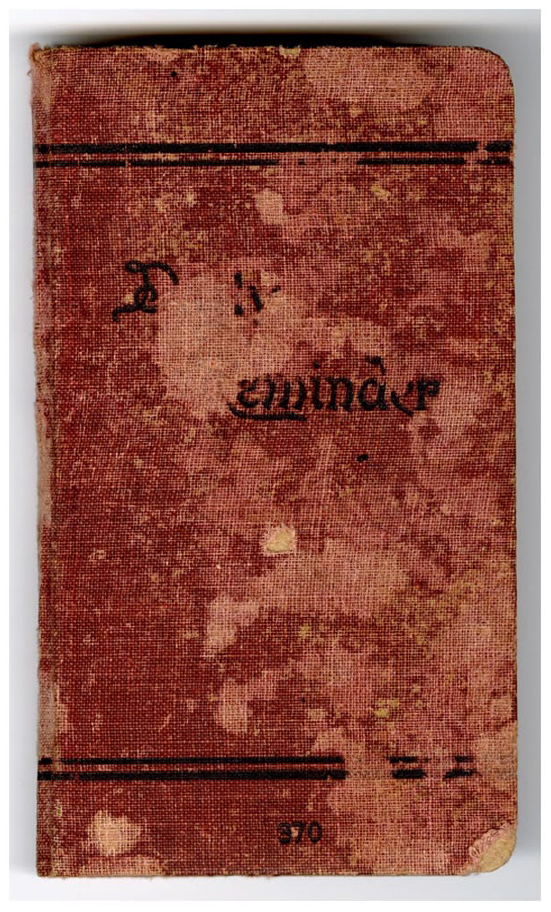
The Frank Landon McGinnis 1922 Diary, Vizcaya Museum and Gardens Archives, Miami, Florida. Item FLM001. This daily diary for 1922 is 3.5″ × 6″ × 3/4″ and the fabric cover is faded, stained, and has small holes in it. Embossed on the cover are the words “Daily Reminder” and the numerals “370.”
The archives at Vizcaya primarily contain records of the design, construction, and furnishing of the estate. Major collections include a correspondence collection of about 24,000 letters and telegrams, photograph collections that include nearly 3,000 historic images of the estate’s construction, and approximately 3,000 historic architectural drawings. One item in the archives is a small, daily diary from 1922. It was the work diary of Estate Manager Frank Landon McGinnis, and it provides specific and detailed information about daily life at Vizcaya while it was still a private home. The Frank Landon McGinnis 1922 Diary 1 deserves attention because there is very little in Vizcaya’s archives about the estate during this time period. The Correspondence Collection, 2 while large and significant, is almost exclusively business correspondence and therefore sheds very little light on the personalities of those involved with Vizcaya or on the inner workings of the estate. Correspondence tapered off significantly once the estate was completed and occupied and there is little documentation of who worked onsite and what daily life was like. This diary is one of the few primary-source records available from this time period. Little is known about its provenance and it is a legacy item that became part of Vizcaya’s archives when the estate was transferred to Miami-Dade County in the 1950s.
James Deering selected Frank Landon McGinnis to be the estate manager in 1919, and according to estate correspondence records, he was still employed in that role in the 1930s. McGinnis was born in Bowling Green, Kentucky on May 15, 1887 to Carrie Madison Strange McGinnis and Archie Alvarado McGinnis, and had one sibling, a younger brother named Emmett McGinnis. 3 According to his World War I draft registration card, 4 he was five foot three inches with a slender build and brown hair and eyes. 5 In the 1920 U. S. Census, 6 McGinnis is named as the manager of the James Deering Estate and was single, though he married Ruby Larmon later that year, on August 25, 1920 when he was thirty-two years old and she was twenty. According to the 1930 United States Census 7 and a 1935 Miami city directory, 8 the McGinnises were living and working at Vizcaya, confirming the archival documentation from Vizcaya’s Correspondence Collection. It does not appear that the couple had any children. It is also unclear when McGinnis returned to Kentucky, but he was there when he passed away on September 13, 1966 9 and is buried at Fairview Cemetery in Bowling Green. Ruby McGinnis continued to live in Miami until her death in January 1986. 10
Since most of Vizcaya’s archives only include business records, there is very little else to contextualize daily life at the estate. There are two other small collections in Vizcaya’s archives, however, that offer a personal view of the estate while it was a private home: The Faye Jones Collection 11 and the Ella Holgersohn Collection, 12 Faye Jones was James Deering’s private duty nurse in Miami in 1920. While caring for Deering, Jones wrote four letters home to her mother on Vizcaya letterhead. The letters and a few digital images of Jones were donated to the archives by Jones’s grand-niece in 2017. Ella Holgersohn was a Swedish immigrant who worked as the second cook at Vizcaya and married Joseph Goddard, the estate chauffeur. Her collection, which was donated by her grand-niece in 2011, includes digital images of Holgersohn, Goddard, and others that are presumed to be Vizcaya staff. Little else is known of either woman, such as their motivations to move to Miami or any part of their interior world, though the collections offer valuable visual evidence for the fashion and customs of their time.

The Frank Landon McGinnis 1922 Diary, Vizcaya Museum and Gardens Archives, Miami, Florida. Item FLM095, dated July 3–4, 1922. Note the third annotation on July 4: “Ruby and I picked last Haden mango today.” This notation allowed the identification of the diary author. Other entries on these pages reference concrete footings for an auto shed, plumbing work, staff who are ill or traveling, price quotes for various estate work, and notes about which plants are blooming and ripe. At the top of each page, the abbreviations “Ther” and “Wea” are printed, as prompts for the diarist to record the day’s temperature (thermometer reading) and weather.
Methodology
This diary is a rich resource that offers a glimpse into the early days of Miami as a growing city. As one of the few personal items from this period in Vizcaya’s archives, it was thought to be a new voice that museum staff wanted to amplify. When the McGinnis diary was selected for digitization, it was stored in an acid-free folder and box but was otherwise unprocessed. It was selected for digitization for several reasons. Recent efforts to decolonize the museum have encouraged staff to seek out new voices, especially stories of personal experiences, to enhance the understanding of the museum as a place where ordinary people lived and worked. 13 This project was also conducted during the museum’s closure for the COVID-19 pandemic and was a way to engage with guests virtually by offering interesting items from the archives when guests could not visit the museum. 14
The diary itself is a daily journal, published by the Standard Diary Company. It was printed for the calendar year 1922, and the endpapers include annual calendars for the years immediately before and after (1922 in front and 1923 in back). It measures three and a half inches by six inches by three-quarters of an inch. The faded oxblood cover fabric is scuffed and stained, with some fading, blotchy areas, and holes which indicate past water damage and possible pest activity. Though not fully intact, the embossing on the cover includes the words “Daily Reminder” and the numerals “370.” The unnumbered white pages are lined, and no pages appear to be missing. The sewn binding is tight and secure. The daily pages include headers with the day of the week and include prompts to record the temperature and weather for the day. The back endpaper facing page lists postage information and rates, including the United States, Canada, Mexico, Cuba, and Shanghai, China. All writing in the journal is manuscript in what looks to be brown ink pen. Most writing is in English, and a few pages include writing in what appears to be shorthand.

The Frank Landon McGinnis 1922 Diary, Vizcaya Museum and Gardens Archives, Miami, Florida. Item FLM019, dated February 1–2, 1922. The first notation on February 1 states that “Broomfield came on today as head gardener” suggesting that the author of the diary could not be the estate’s head gardener.
The museum archivist digitized the diary over the course of two days with an Epson Expression 12000XL scanner. Master TIFF files at 400 dpi were created, as well as two derivative files: Individual JPEG image files of each page, and a single PDF of the entire diary. Optical character recognition was not attempted, since the diary is in manuscript writing. The diary was transcribed in full, and all names, places, items, and events were included in the metadata, after terms were authorized with the Library of Congress Name Authority Tables and Subject Authority Tables. The museum horticulture manager assisted with deciphering names of trees, flowers, vegetables, and other garden-related topics. Personal names were cross-referenced with estate payroll records from the early 1900s to determine if there are other records in the archives that confirm the employment of people named in the diary.
An early worker at Vizcaya, I.N. Court, was originally listed as the diarist based on the belief that he was the head gardener in the early 1920s. But research revealed that this could not be possible. When processing began, the archivist consulted the archive’s historic staff list and the Correspondence Collection to learn more about Court. Research showed that he ended his employment at Vizcaya in 1916, and so could not have been the author of a diary in 1922. 15 Indeed, existing correspondence suggests he was an architect, and not a gardener, since his employment at the estate was at the behest of and on behalf of the estate architect, F. Burrall Hoffman, Jr. In addition, an entry in the diary on February 1, 1922, notes that a man named William Broomfield was hired as the head gardener, and so the journal’s author could not also be the head gardener. The contents of the diary also suggest that the author’s work was not limited to the gardens; though there is considerable horticultural information, there is also information that would be notable to someone with supervisory responsibility of the entire estate. It is unclear why I. N. Court’s name was associated with this item.
The key to discovering the diary’s author was an entry on July 4, 1922, where McGinnis writes, “Ruby and I picked the last Haden mango today.” Estate records were consulted to see if there was a Mr. Ruby working at the estate (there was not). Genealogical research revealed that McGinnis’s wife’s name was Ruby, thus forging a closer link between the diary and the likely author. Interestingly, that single mention of his wife is the only personal notation in the entire diary. All other entries relate strictly to work done on the estate.
As estate manager, McGinnis oversaw the entire estate, although it remains unclear how many people he supervised. A review of Vizcaya’s payroll records provides some supporting information, but few actual answers. A document that is an analysis of Vizcaya staff workers based on payroll records only lists two people who worked at the estate in 1922. In 1921, there are twenty-three people listed, but since the gardens were still under construction in 1921, that number probably decreased when construction was complete. Another twenty-eight people are listed as working at the estate during the “Deering Era,” with no associated date of employment, which means they could have worked at Vizcaya any time before James Deering’s death in 1925. The 1920 U.S. Census lists twenty-six employees who are living and working at Vizcaya; however, an unknown number of workers did not live at the estate and were therefore not listed on these records.
If we look from the diary outward, there are 185 people named in the diary, though many are friends, family, neighbors, and vendors. Some of the listed names are incomplete, providing only a first or last name and making the identity of the person almost impossible to ascertain. There are twenty names that are listed in the diary that are also named in Vizcaya payroll records, but even those names leave us with questions. William Broomfield was hired by McGinnis in 1922 but is listed in the payroll records as only being employed at Vizcaya in 1918. Charles Tremblay is mentioned six times in the diary, but according to the payroll records was at Vizcaya in 1917. And Cates is mentioned eight times in the diary, but payroll records list two men named Cates who worked at Vizcaya in 1918—William Cates as the night watchman and Sam Cates whose job is not specified. We cannot know which Cates is referenced in the diary, just as we cannot explain why Broomfield, Tremblay, and others are found in the diary but are not listed in the payroll records for 1922.
The contents of the daily entries are a wealth of information about what was required to run the estate. There are 228 narrative, written entries in the diary; only 101 days have no information on them, and thirty-six days only include notations about the weather or how many cars drove in to tour the estate. Nearly every written entry includes information about the management of the estate, from hiring and firing employees, negotiating contracts, paying vendors, directing work crews throughout the region, and performing maintenance in the Main House, gardens, and Village properties. Nothing is mentioned of the household staff, which suggests a gender distinction in that the housekeeper would have managed the household staff and McGinnis, as estate manager, managed everything else.
Throughout the diary he mentions trees and other flora that were planted in the main gardens and vegetables, and also herbs, and flowers that were planted in the kitchen gardens. He also notes agricultural items that were sold and what profits were recovered. Vizcaya’s gardens were not completed until 1922, and so clearly the gardens are a focus of his efforts. The kitchen gardens also were important, since they supported the estate by providing most of the fresh produce that was needed for Deering, his guests, and the staff.
There are forty-four diary entries that specifically mention spending, selling, pay raises, and staff hiring decisions, indicating that McGinnis’s management may have included some sort of discretionary budget. Routine and emergency repairs that were made in the Main House and in several Village buildings are noted, as well as routine maintenance of Deering’s yachts. Race relations are alluded to with notations about race-segregated work teams on site and at Cape Florida, which was owned by Deering at that time. McGinnis names local businesses who worked with Vizcaya staff and the nature of their work.
Information about historic sea levels can be gleaned from notes about the water’s height at the Cape Florida lighthouse, and historic weather patterns are mentioned with notes about daily temperatures, rainfall, and a hurricane near-miss. In the entry dated September 22, 1922, McGinnis notes that an offshore hurricane went over the Virgin Islands and Bahamas, resulting in surf that overtopped the estate’s boathouse platform.
The importance of the estate as a tourist destination is clear based on the number of vehicles that drove through to tour the estate on public days. During the year, McGinnis counted 10,369 cars of visitors. Two notable people who toured the estate were Lady Mountbatten on November 4, 1922 and Greek Prime Minister Eleftherios Kyriakou Venizelos on February 5. McGinnis also recorded when estate owner James Deering was in residence, who accompanied him, and their leisure activities during their winter residence.
There is also a surprisingly casual reference to Prohibition and its significance when McGinnis spent most of a day bailing an employee out of jail for possession of alcohol. Prohibition was a federal law from 1920 until 1933, and Miami-Dade County had a seven-year head start on the social experiment after voting to criminalize the sale of alcohol in 1913. Interestingly, the employee’s name is mentioned several times later in the diary, suggesting that violating Prohibition laws was not serious enough to warrant the loss of one’s job.
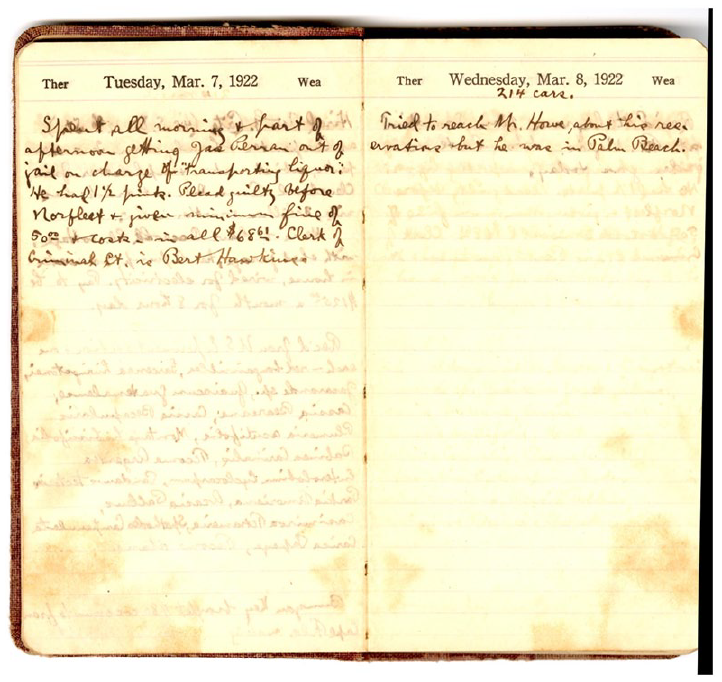
The Frank Landon McGinnis 1922 Diary, Vizcaya Museum and Gardens Archives, Miami, Florida. Item FLM036, dated March 7–8, 1922. In the entry for March 7th, McGinnis writes that he “spent all morning and part of afternoon getting Jas Perran out of jail on charge of ‘transporting liquor’. He had 1 ½ pints. Plead guilty before Norfleet and given minimum fine of $50 plus costs, in all $68.61. Clerk of criminal court is Bert Hawkins.” Prohibition was a federal law from 1920 until 1933, and Dade County had a seven-year head start on the social experiment after voting to criminalize the sale of alcohol in 1913. Interestingly, Perran’s name is mentioned several times later in the diary, suggesting that violating Prohibition laws was not serious enough to warrant the loss of one’s job.
McGinnis likely wrote the diary retrospectively, since there are almost no strikethroughs of lists or job tasks. In the way a planning diary will nearly always change when the events of the day arrive, this diary is quite neat and orderly, suggesting it was written in to sum up the work of the day, and so may be a clearer picture of what actually happened each day, being declarative rather than aspirational.
Since there are no personal reflections in the diary, beyond the one mention of his wife, we can only guess at the diary’s purposes and goals. Was it a record kept for a specific purpose, to perhaps prepare detailed status reports? Or was it a record for McGinnis’s own use, to compare prices and agricultural yields from year to year? Was he just someone who enjoyed cataloging his daily work? Are there other diaries that he kept, that have been lost to time? The questions are tantalizing, and we do not have answers. One can only hope that someday, a newly-accessioned archival item will shed more light on this valuable resource.
Reflections
To a layperson, the archive is a repository of all historically-meaningful artifacts. It often is considered the complete record, or at least the record of the most important things; indeed, that it is the repository of the truth. But that is not so. T. R. Schellenberg tells us that the modern archive is both the records we keep and the location where we store them 16 so that there will be primary sources available for future researchers. 17 Archives, to Schellenberg, were created for the purpose of research, and the clear implication is that if archives only include records that were selected for their research value, then there were other documents that were discarded, not collected, or even not recorded, because their research value was judged to be too low.
The records that are available are sources of evidence, but they are not comprehensive proof or a complete story of the past. Arlette Farge reminds us that, “the first illusion that must be cast aside is that of the definitive truthful narrative.” 18 The past is ambiguous, 19 messy, and contradictory, 20 and our records of the past are fragmentary and created 21 reference points that we cannot ignore 22 even as we cannot make definitive statements based on them. Randall C. Jimerson describes the archives as “places of knowledge, memory, nourishment, and power” 23 while Michel-Rolph Trouillot tells us that facts, while never meaningless, are not created equally, 24 and the archive does not supply us with definitive proof. 25 All together, these missing, lost, uncreated, and unpreserved records create spaces in the historic record. Spaces where there is silence, instead of a voice telling their own story. And so, we can define an archival silence as an unheard narrative of the past.
Records appraisal is the process by which an archivist decides which records will be accepted for permanent preservation in the archives, 26 and subjectivity is baked into the process. As archivists, we influence the stories that can be told in the future by the appraisal choices that we make today. The archivist, as co-creator 27 of the archive, becomes an arbiter of which stories can be told later from the resources that are preserved now. An individual archivist making appraisal decisions will undoubtedly make choices that are rooted in their own values and beliefs. We are what we keep, Terry Cook tells us, and we also “generally keep what we are, what we are most comfortable with, [and] what we know.” 28 Archivists are not the passive curators of what was left over 29 and we must understand the power of our role in order to perform it effectively, 30 since it has such an influence on which narratives can be told and what will be remembered in the future.
Of course, archivists rarely have access to all possible sources of documentation and rarely have the opportunity to choose which records they would like to preserve in their archives. In the appraisal process, the archivist chooses which records to preserve, but it must not be presumed that the archivist is in possession of all or even most of the documents that relate to the collection at hand. Very often, the archivist is making appraisal decisions within the context of the limited resources available to them. Records may have been lost, or perhaps they were never created. 31 The historic record is porous and researchers and archivists can only work with what is available.
A researcher searching through the archives is similarly influenced by their own personal views. While conducting their research, they go on “a roaming voyage through the words of others” 32 over terrain that is “uneven, complex and confusing” 33 and the narratives they relate will carry their biases. 34 Archivists bring their experiences and attitudes to their work, and will tend to tell the stories that they find most interesting and meaningful. This unavoidable shaping of the narrative becomes a form of control over cultural memory. 35 The archive is a “contact zone between past and present,” 36 and the work done there should be seen as an “ongoing negotiation” between the archive and the researcher. 37 As we navigate the difference between “what happened and what was said to have happened,” 38 we will inevitably see that only certain stories are told because only certain records were retained, and only certain voices were allowed to be heard. Archives reflect the values of the past and what past collectors felt worthy of preservation. As a reflection of what was considered important in the past, today’s archives show who was privileged enough to have their records recorded and collected. As Jimerson reminds us, archives “establish and reinforce power relationships in society” 39 and we cannot disentangle the archives from the power structures. Collecting practices give insight about whose story was of interest and whose life was worthy of documentation in that historical moment. Today, it is clear that the documents and artifacts of the preserved lives and experiences usually belonged to white, wealthy, heterosexual males.
The provenance of the McGinnis diary is unclear, but one presumes it was not discarded because the estate manager’s records would have been considered worthy of preservation. As a record of the official workings of the estate, it carries within it the authority of its writer, and so those who collected Vizcaya’s archives would have believed it was more important than other items and more worthy of retention, in part, because it was the work of a white man in a leadership position. McGinnis tells us the story of his working day, but we do not hear his personal reflections or about any other aspects of his life. McGinnis shares interesting facts, such as which flowers were grown or how long a fishing trip to the Keys lasted, but this resource does not offer a new perspective. The supervisory male voice will always be a familiar one in the archive, and even if McGinnis does not have the wealth of the estate owner, his management position elevates his status above those who work for him.
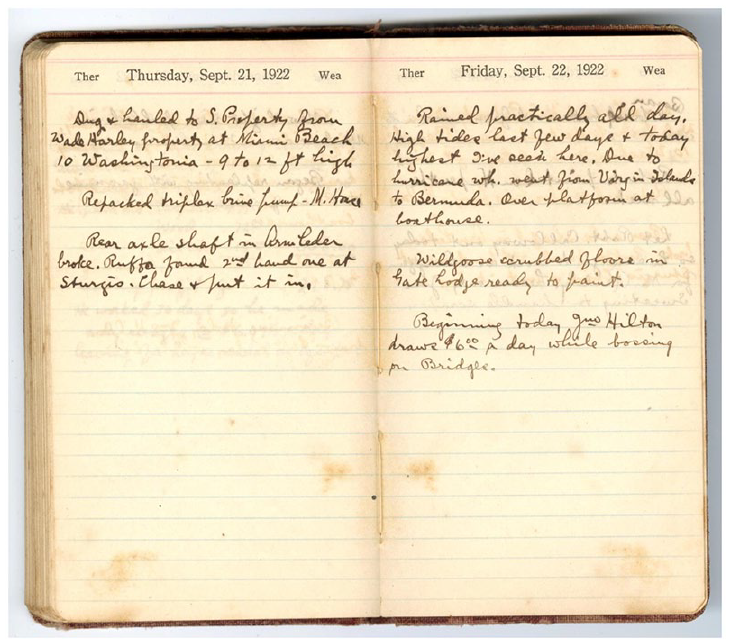
The Frank Landon McGinnis 1922 Diary, Vizcaya Museum and Gardens Archives, Miami, Florida. Item FLM135, dated September 21–22, 1922. In the first entry for September 22, McGinnis writes that it “rained practically all day. High tides last few days and today highest I’ve seen here. Due to hurricane wh[ich] went from Virgin Islands to Bermuda. Over platform at boathouse.” There were two hurricanes in the Atlantic basin during this date, the first was a category three storm and the second was a category 1 storm that was not identified until the data was reanalyzed in 2009. The two storms may have interacted with each other as they both traveled over Bermuda within a few days of each other. The Boathouse at Vizcaya was severely damaged four years later in the 1926 hurricane and was not repaired. 41
The new voice heard in this diary is the information about the daily operations of the estate as a private home, the issues that were faced, the projects that were prioritized, and the people who were involved in these events. Although many silences persist, in seeing McGinnis’s working life through his daily notes, we can learn much about his environment from the people and events he encountered each day. The diary provides significant details about daily life at the estate, especially labor-related tasks that are far-removed from the estate owner’s view. Through these notes we can hear whispers of the voices of laborers, gardeners, cooks, carpenters, and housekeepers that are not named or heard from directly, but their work is described and documented in McGinnis’s diary. Their stories and experiences must be read against the archival grain, 40 but still, they are there. We don’t know exactly what other staff did each day, but we know about some of their work when McGinnis mentions his interactions with them. In that way, we can learn parts of their story, based on what McGinnis recorded about them. While McGinnis’s own voice is one we might expect to find in an archive, in keeping such a detailed journal, he provides us with glimpses into the world around him—a world that included many of the people in early twentieth-century Miami who were not often the source of archival mention. Because of McGinnis, they appear now, even if just in rough outline or shadow.
The McGinnis diary adds new information to existing fragments, but it is not a complete record of what happened at Vizcaya in 1922. Rather, it is a record of the events of 1922 that McGinnis believed were notable enough to record in his diary. Much of the diary’s information is mundane, relating to planting, harvesting, carpentry, and the endless, hands-on tasks that accompany household management. As he recorded these events, McGinnis’s own bias undoubtedly shows through. It is unknown who else read the diary or had access to it, and so further supposition is difficult. A diary kept by the housekeeper, or by a gardener, or by a person of color, or by the estate owner himself would have emphasized different events and would likely have included many different details. The small size of the diary’s pages also limits further reflection and detail; though the size of the diary may have been a deliberate choice.
One modern use of this diary is in museum interpretation, both in the formal gardens and throughout the museum as a whole. The information in McGinnis’s diary has a clear and immediate impact on the care and maintenance of Vizcaya’s gardens. Every effort is made today to cultivate the gardens as they were cultivated in Deering’s time, and so this diary offers practical, seasonal information about specific plants and gardening practices. The information about which aspects of the gardens thrived and which struggled continues to inform the current practice of Vizcaya’s horticulture team.
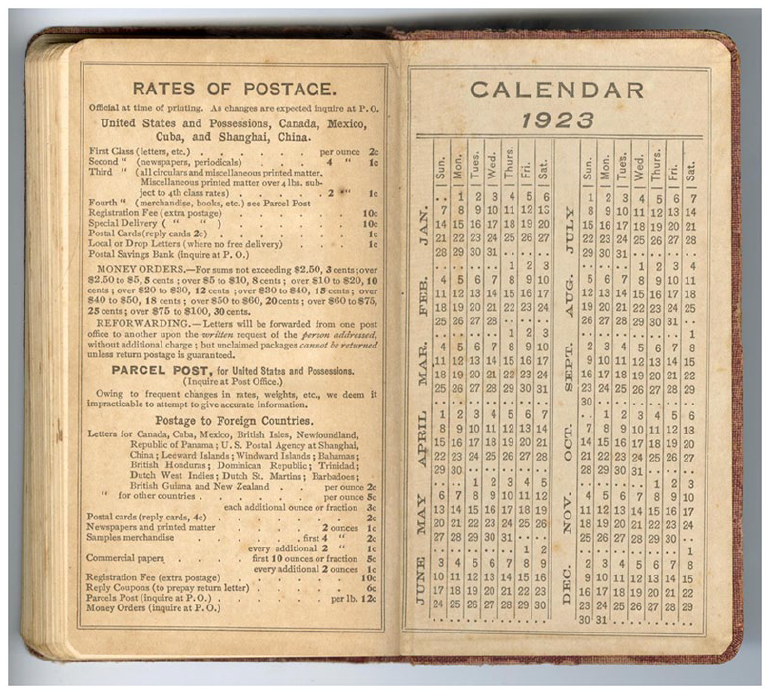
The Frank Landon McGinnis 1922 Diary, Vizcaya Museum and Gardens Archives, Miami, Florida. Item FLM187, Inside back cover of diary. In this image, we see the postal information that was printed in the diary, as well as a planning calendar for the upcoming year.
When used in museum interpretation, the diary provides small, relatable details about life at Vizcaya that allow museum guests to better understand this historic site. There are many details about Deering’s daily life while wintering in Miami, including his arrival and departure dates, boat trips to the Keys with friends, gifts of flowers that were sent to friends and neighbors, and notes on changes that Deering wanted made to the estate. These small details give some insight to his priorities, plans for his home, and to the social customs he followed.
Undoubtedly, this diary is a valuable artifact whose specific details illustrate specific aspects of the past, but it cannot be seen as comprehensive or definitive. The historic image remains unfinished and incomplete, despite these new pieces of information. McGinnis’s diary provides flashes of insight, but the overall picture remains obscured. This may seem like a criticism or condemnation of the diary, but that is not intended. A valuable resource will retain its value, even as our understanding of its importance is tempered by our knowledge of its proper limits. Like all archival information, this diary must be seen as a collection of facts that illuminate our understanding, while also obscuring or simply not including other facts.
Archives provide important insight into the past, but they are inherently biased and are missing more information and resources than most archivists would like to admit. When encountering a new voice from the past, it is exciting to think that a new truth will be imparted, but we must retain our skepticism and listen to the new voice carefully, knowing that even as it gives us new information and a new perspective, it is itself flawed, edited, and biased. We know there can be no definitive truthful narrative, but each new insight offers clarity to the overall historic image. An artifact like this diary is valued because it helps us articulate a slightly more complete story so we can understand the past more fully.
Footnotes
Declaration of Conflicting Interests
The author declared no potential conflicts of interest with respect to the research, authorship, and/or publication of this article.
Funding
The author received no financial support for the research, authorship, and/or publication of this article.
1.
Digital surrogates of the Frank Landon McGinnis Diary can be accessed here: http://collections.vizcaya.org/MADetailG.aspx?rID=M016&db=group&dir=ARCHIVES
2.
Digital surrogates of Vizcaya’s Estate Correspondence Records can be accessed here: http://collections.vizcaya.org/MADetailG.aspx?rID=E1&db=group&dir=ARCHIVES. Most of the collection is not yet digitized, however. To access these analog records, a researcher would need to arrange a visit to the archives at Vizcaya Museum and Gardens in Miami, Florida.
3.
For more information on McGinnis’s forebears, please see the Strange Family Papers, MSS42, Manuscripts Collection, 1812 to 1925, Western Kentucky University Manuscripts and Folklife Archives  The Strange Family Papers do not name Frank Landon McGinnis directly, but provide context to his lineage and background. Through his mother’s family, he was a descendant of Captain John Rochester and the family were Confederate sympathizers during the U. S. Civil War. McGinnis’s mother is listed in the Daughters of the American Revolution Lineage books.
4.
5.
United States Passport Applications, 1795-1925 [database online] (Lehi, UT: Ancestry.com Operations, Inc., ).
6.
United States Census Bureau. 1920 Federal Census [database online] (Provo, UT: Ancestry.com Operations, Inc., 2002).
7.
United States Census Bureau. 1930 Federal Census [database online] (Provo, UT: Ancestry.com Operations, Inc., ).
8.
United States City Directories, 1822-1995 [database online] (Lehi, UT: Ancestry.com Operations, Inc., ).
9.
Ancestry.com, U.S., Find a Grave Index, 1600s-Current [database on-line] (Lehi, UT: Ancestry.com Operations, Inc., ).
10.
Ibid.
12.
Ella Holgersohn Collection, Vizcaya Museum and Gardens Archives, Miami, FL.
13.
Vizcaya established a Diversity Equity Accessibility and Inclusivity (DEAI) committee in 2019 to increase the museum’s ability to “eliminate barriers to participation, ensure that our staff and volunteers reflect the diversity we value and the inclusivity to which we aspire, and forge pathways to increase the participation of historically underserved communities.” Learn more about this initiative here:
14.
15.
According to Vizcaya’s Correspondence Collection records, Court was working as Estate Architect F. Burrall Hoffman Jr.’s personal representative (Letter from F. Burrall Hoffman, Jr. to Unknown, presumed Harry Ingalls, dated March 7, 1916, Correspondence Collection, item number C19160229). In this same letter, it states that Court quit his job at Vizcaya two weeks earlier.
16.
17.
Schellenberg, Modern Archives Principles and Techniques, 16.
18.
Arlette Farge, The Allure of the Archives (New Haven, CT: Yale University Press, 2013), 95.
19.
Farge, The Allure of the Archives, 94.
20.
21.
22.
Farge, The Allure of the Archives, 100.
23.
24.
Trouillot and Carby, Silencing the Past, 29.
25.
Farge, The Allure of the Archives, 100.
26.
27.
28.
Cook, “‘We Are What We Keep; We Keep What We Are,’” 174–5.
29.
Cook, “‘We Are What We Keep; We Keep What We Are,’” 179.
30.
Cook, “‘We Are What We Keep; We Keep What We Are,’” 177; Thomas et al., The Silence of the Archive, 14.
31.
32.
Farge, The Allure of the Archives, 123.
33.
34.
35.
36.
Franco and Mustafa, “Invalidating the Archive,” 45.
37.
Franco and Mustafa, “Invalidating the Archive,” 46.
38.
Trouillot and Carby, Silencing the Past, 5.
39.
Jimerson, Archives Power, 135.
40.
Franco and Mustafa, “Invalidating the Archive,” 45.; Thomas et al., The Silence of the Archive, 107.