



Abstract
This case study provides an overview of two guidance packs that the author created for the GSA Library, the first of which concerns advisory notices and the second of which concerns subject indexing and classifications. In an effort to share good praxis, this article includes real examples of item-level advisory notice text as well as a set of flowcharts that were designed to help GSA Library staff with the tasks of inclusive description.
As part of their commitment to the decolonization of their library collections, the Glasgow School of Art (GSA) Library is engaged in the ongoing review of its cataloging practices and the language it uses to describe and interpret materials that it holds. Beginning in the summer of 2022, the Library invited its students to give feedback on their inclusive cataloging ambitions and hired this author as an external consultant. 1 Completing a five-week inclusive cataloging review from July to August 2022, this author worked with the GSA Library to create a set of staff guidelines and step-by-step flowcharts regarding (i) the addition of advisory notices to the published catalog and (ii) inclusive subject indexing and classification. This article presents the Glasgow School of Art Library’s methodology as a current example of best practice when it comes to the description of published collections in the UK heritage sector, with the hope that other libraries, museums, galleries, and archives will follow in their lead. After all, heritage institutions are not neutral and have a responsibility to use their voice to challenge prejudice and societal inequalities.
What follows is an overview of the two guidance packs that I created for the GSA Library, the first of which concerns advisory notices and the second of which concerns subject indexing and classifications. In an effort to share good praxis, this article includes real examples of item-level advisory notice text as well as a set of flowcharts that were designed to help GSA Library staff with the tasks of inclusive description.
Background
Being a higher education library, the GSA Library exists to serve the needs of its student and faculty community, including providing resources for independent research and ensuring the accessibility of curricula materials. To encourage critical thought among its students and accurately preserve the historic record, the Library must hold, acquire, and provide access to some materials that are derogatory or problematic. Recognizing the distress that these items might cause users, GSA Library is committed to the contextualization and denormalization of content within its published catalog that is racist, misogynistic, homophobic, transphobic, ableist, classist, or otherwise harmful.
The objective of GSA Library’s inclusive cataloging project is not to censor, erase, or restrict access to collections. Rather, it is to review the language that appears within catalog descriptions that have been supplied by the Library itself and ensure that any context that is provided is appropriate, meaning it promotes the ethical use of resources and mitigates the potential negative impacts that harmful or problematic materials might cause users. Considering the nature of GSA Library’s collections, the scope for their re-cataloging project includes not only prejudiced materials, but also materials that might be deemed graphic, violent, or sensitive in other respects.
As articulated in their Statement on Harmful Materials:
Working within the framework of our Collection Management Policy, we are committed to the careful review and description of existing and new resources. We are actively re-thinking the way we use terminology, description, and advisory notices, and we are committed to building reciprocal relationships with marginalised communities so that we can learn how to better represent them. Our Inclusive Cataloguing work is steered by the Library’s Inclusivity Group, which works more broadly to ensure that our staff are educated about issues relating to equalities, diversity, and inclusion.
2
With their specialism being artistic materials including many contemporary items, GSA Library’s collections pose some interesting challenges within the wider realm of inclusive description work, raising questions which will be a shared concern for any institution that provides access to art. Can offensive materials hold artistic value? Is it possible to separate the art from the artist? In what capacity can organizations comment on the prejudices of living artists or authors? Should we highlight an artist’s marginalized background if it is not represented as a subject in their artwork?
Advisory Notices
Through the creation of appropriate content advice, GSA Library seeks to encourage the responsible use of its resources and reduce the emotional trauma and psychological harm that dehumanizing, discriminatory, and graphic materials might cause users. It matters what information a heritage institution chooses to provide its users, and advisory notices are a powerful tool that can be used to enhance the quality and integrity of collections information whilst giving users the agency to make informed decisions about how they wish to engage with potentially distressing content. Along with the online publication of their Statement on Harmful Materials, which provides a general explanation for why users might encounter harmful content, GSA Library has committed to a long-term project of creating detailed, item-level advisory notices within its published catalog. This includes the addition of advisory notices not only to catalog records for physical items such as books or zines held on library shelves, but for online resources such as open access materials via by Project Gutenberg and moving image content and films provided through GSA Library’s online video platform Planet eStream.
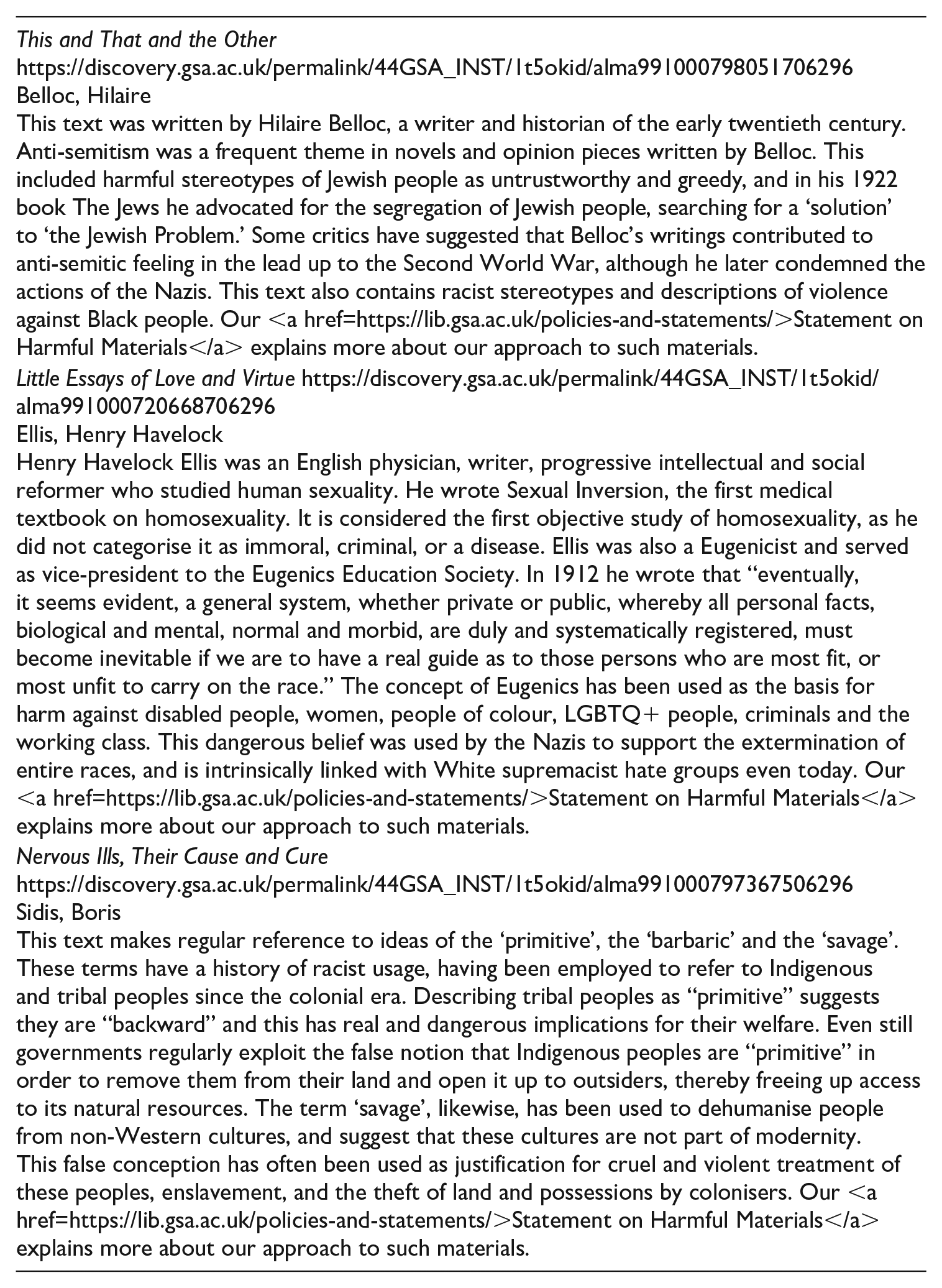
To advise their users most effectively about the presence of harmful materials, GSA Library have been advocating for Ex-Libris (ALMA and PRIMO) to introduce new features. At present, Library staff are using a 590 “Advisory Notice” field within the catalog as a space to add item-level context to any published materials that they have identified as potentially harmful or problematic. Each advisory notice provides item-specific context that alerts users to the presence of content that is prejudiced or may cause distress, and it is followed by a generic statement that directs users to the Statement on Harmful Materials.
Examples of item-level advisory notices from the Glasgow School of Art Library’s published catalog:
Practical Guidance for Staff
As their external consultant, I worked with GSA Library staff to produce detailed guidelines regarding the creation of advisory notices that would be useful for not only their catalogers, but their library desk assistants too. Library desk assistants are often excluded from inclusive description projects within the heritage sector despite their frequent interactions with users and their familiarity with collections through daily encounters with physical items on the library shelves. From its very beginnings, however, GSA Library’s re-cataloging initiative was imagined as a collaborative, co-ordinated effort between catalogers, library desk assistant, students, and faculty. Currently, both catalogers and desk assistants contribute to the writing of advisory notices according to their own areas of interest and expertise, which is then reviewed by the collection manager.
To co-ordinate the creation of advisory notices, I created an “Advisory Notices: Guidance & Resource Pack for Staff” that was designed to be comprehensive in nature, providing a step-by-step methodology for new and existing staff to follow. Rather than creating something definitive, my objective was to highlight major areas of concern and create a framework that could be adapted and developed by the Library as needed in the future. Given the short-term nature of my work for GSA Library, this Guidance document was specifically crafted to ensure the exchange of knowledge and handover of responsibilities to the GSA Library’s Inclusivity Group after I left. To achieve this, each sub-section included a series of discussion activities for the Inclusivity Group to work through, to simultaneously ensure they were familiar with the guidance and to enable them to take responsibility over the decisions that needed to be made regarding any next steps.
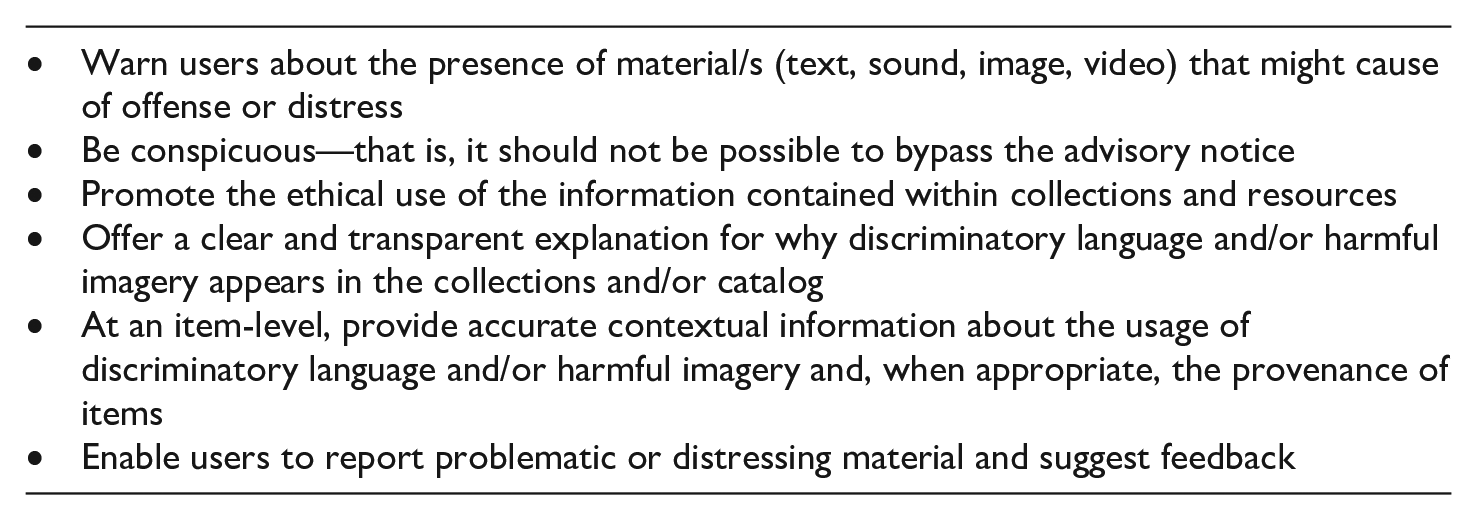
The first section of my Guidance was introductory in nature, offering a rationale for content advice work and providing a list of examples of good practice in the sector for the Inclusivity Group to review and discuss. For the sake of clarity, I defined the purpose of advisory work and listed the key features of an exemplary advisory notice.
What Should an Exemplary Advisory Notice Do?
The second section introduced a strategy for prioritization, asking the Inclusivity Group to consider whether some areas of inequality might be of more immediate concern within the GSA Library collections. Next, I presented a strategy for the identification of harmful materials. The aim of this sub-section was to breakdown of the ins and outs of decision-making and the respective roles that catalogers, library desk assistants, and those who were members of the Library’s Inclusivity Group would play in the creation of advisory notices going forward.
The third section provided practical guidance on how to create a catalog-level and item-level warning in ALMA and PRIMO, including suggested wording, before offering guidance regarding the retrospective and prospective review of GSA Library’s online video platform Planet eStream. This section also included a list of writing and research tips for anyone creating an item-level advisory notice and a series of specific recommendations for the improvement of existing advisory notices, therefore providing staff with a set of examples of what advisory notices should look like and the level of detail that is considered sufficient.
The fourth and final section proposed updates to the GSA Library’s Collection Management Policy and offered recommendations for the Statement on Harmful Materials, which is now linked to GSA Library’s Discovery Homepage and referenced at the end of each item-level notice.
Indexing and Classifications
The GSA Library’s inclusive cataloging review is an ongoing project, and another major area that Library staff are hoping to tackle in the near future is the review of subject headings and controlled vocabularies. Recognizing that the most widely used subject indexing and classification systems, namely Library of Congress Subject Headings (LCSH & FAST) and the Dewey Decimal Classification (DDC), are rooted in colonial biases and have functioned to exclude, misrepresent, and homogenize marginalized peoples, GSA Library seeks to avoid replicating classifications or terminologies that are harmful. 3 This area of concern also includes the review of subject headings that might inappropriately draw attention to an artist’s protected characteristic(s) when it is not relevant to the theme of their work as well as a rethinking of the way that physical items are grouped on shelves. As a specialist library, GSA Library have the freedom to deviate from standardized indexes and introduce local headings within their 653 field. Hence, staff are exploring the possibilities of using alternative thesauri as well as a community-built thesaurus to supplement traditional index terms used within their catalog.
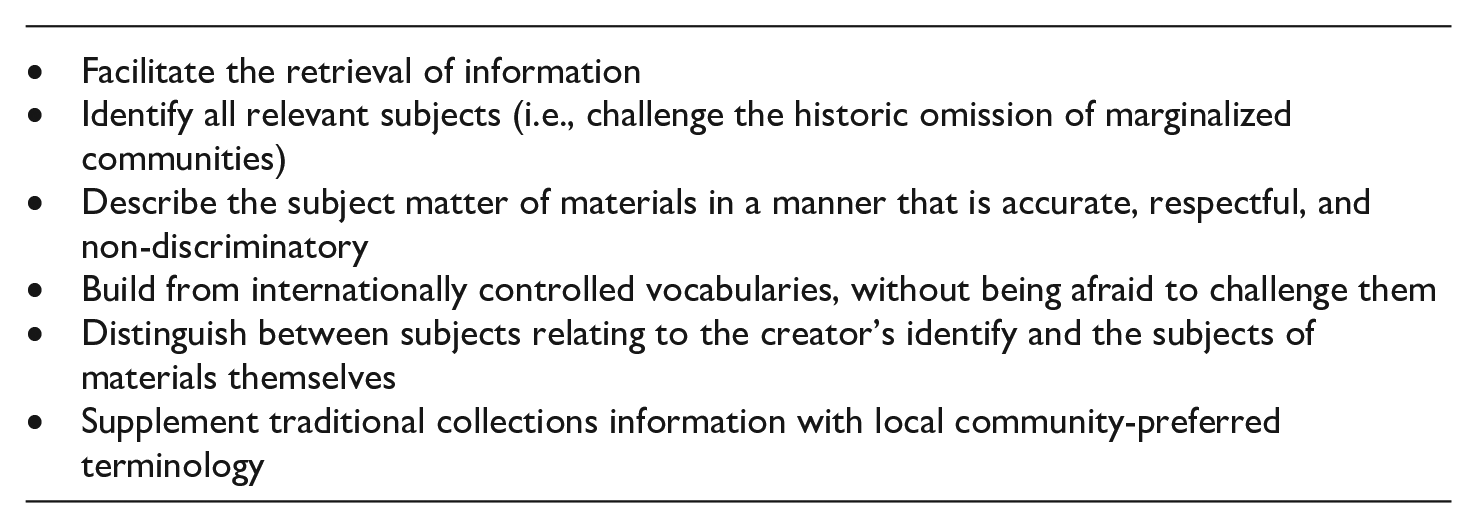
As part of a broader effort to decolonize library practices, the review of inappropriate and discriminatory subject headings and library shelf marks will serve to challenge prejudice and inequality within the library catalog, enhance the discoverability of materials relating to marginalized communities, and improve the quality and accuracy of collections information. Along with the guidance pack that I created regarding the addition of advisory notices, I therefore also produced an “Indexing and Classification: Guidance & Resource Pack for Staff.” Whereas GSA Library have developed a clear vision for the creation of content advice, the finer details of their strategy surrounding indexing and classification remains somewhat uncertain. Therefore, the focus of this second guidance pack was to help staff think through some of the theoretical and practical questions surrounding subject headings and classifications, including a set of six discussion activities designed to help them develop a more concrete strategy for the future. Essentially, what I created was a list resources and questions that the Inclusivity Group can use to explore (i) the retrospective review of subject headings, (ii) the subject indexing of materials related to marginalized communities, (iii) the review of library shelf marks, and (iv) development of a community thesauri that meets the needs of its student users and is inclusive of their varied self-identities. In its first few pages, this guidance pack also included a rationale for inclusive indexing and classification work alongside a clear definition of what exemplary subject indexing practice aims to achieve.
What Should Exemplary Subject Indexing Do?
Flowcharts
The two guidance packs that I created for GSA Library were designed to be read in conjunction with the following four flowcharts, which visually indicate the steps that staff need to take in order to complete inclusive description tasks (Figures 1–4). Specifically, these flowcharts aim to help staff with the tasks of identifying harmful materials, creating advisory notices, writing inclusive descriptions, and choosing appropriate subject indexes. When using them, please note that these flowcharts reflect the unique requirements of the GSA Library and were created to reflect the institutions’ own organizational structure. The flowcharts are reproduced here with the hope that they might offer a useful template that other institutions can adapt according to their own needs.
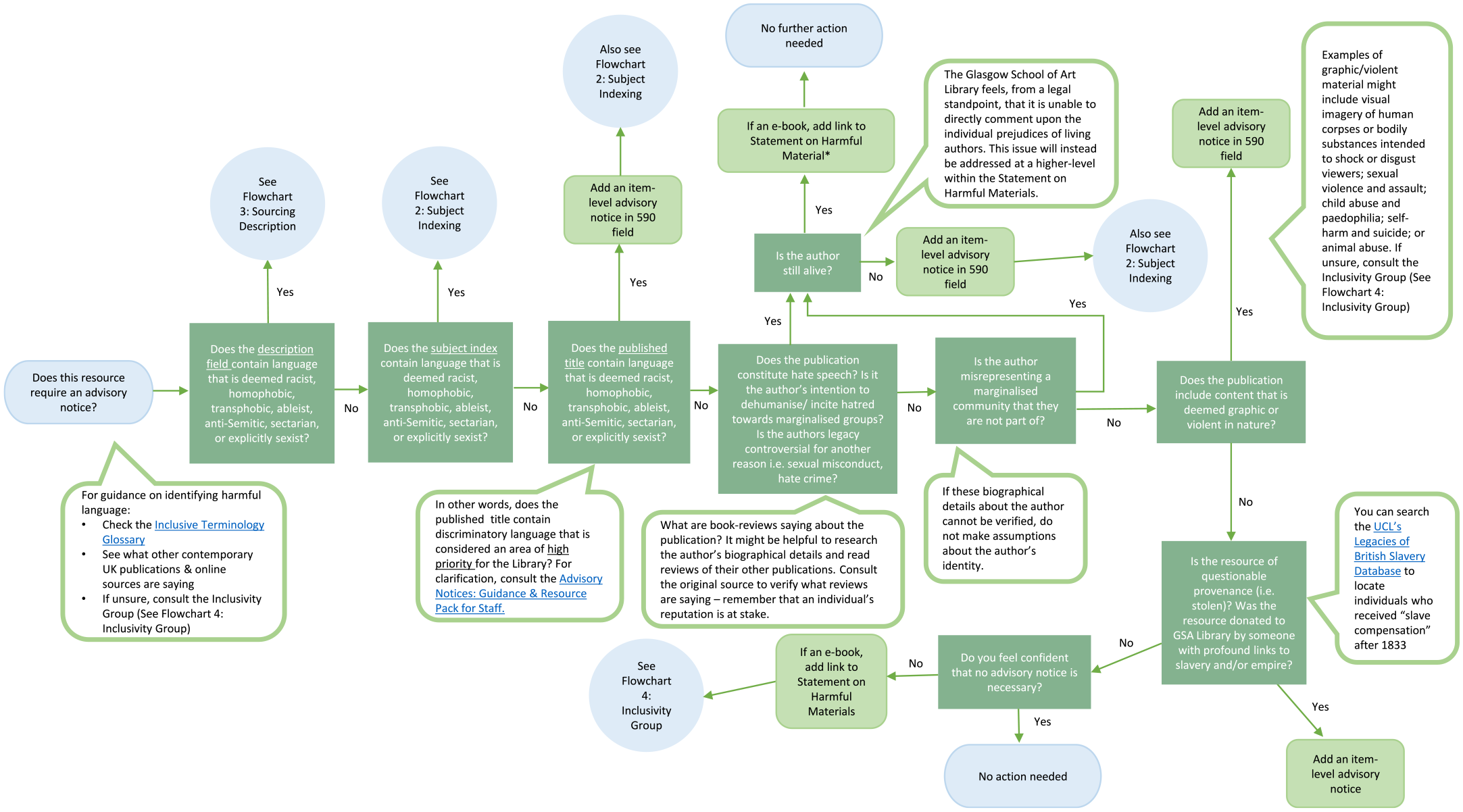
Advisory notices.
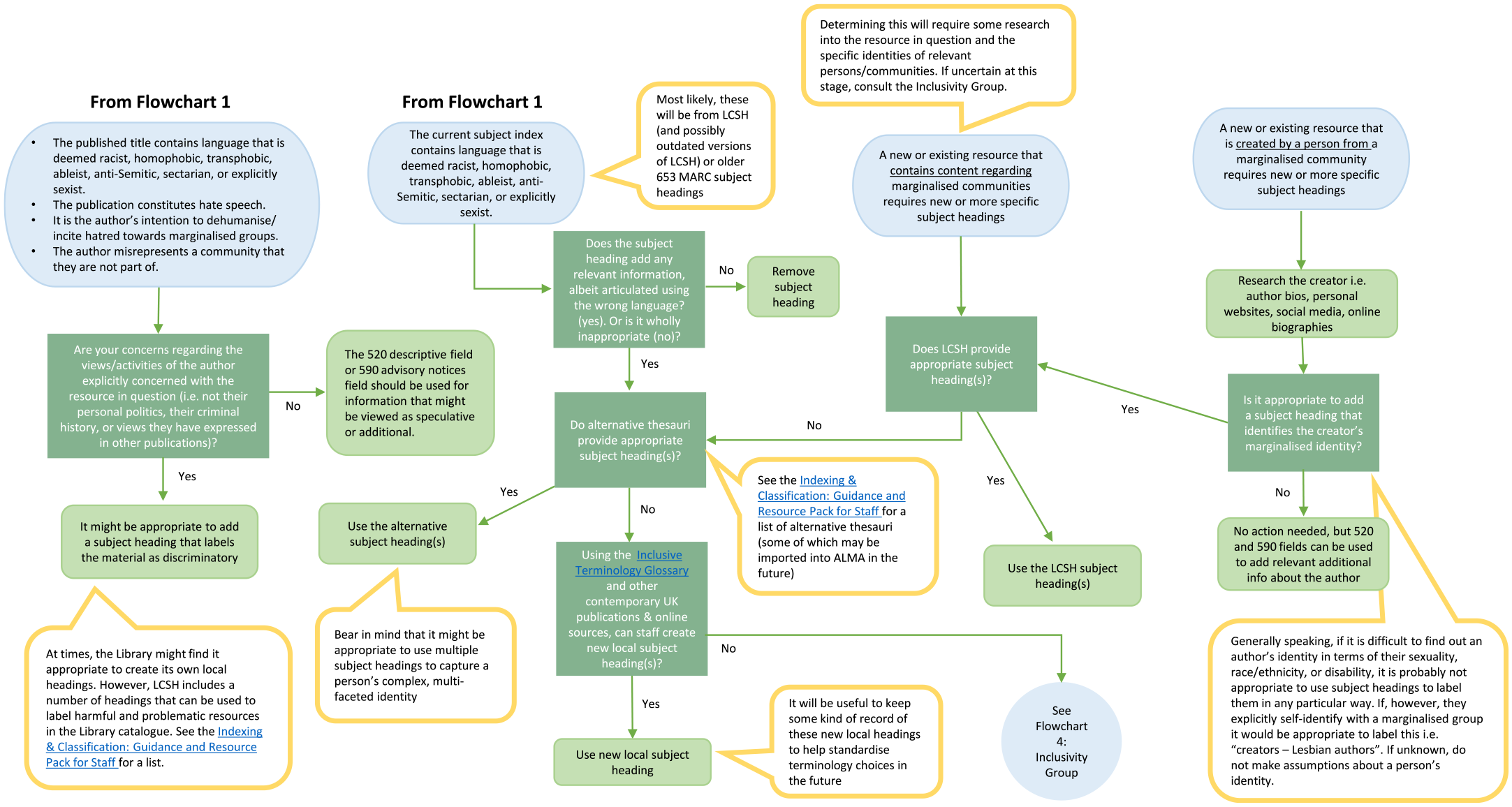
Subject indexing.
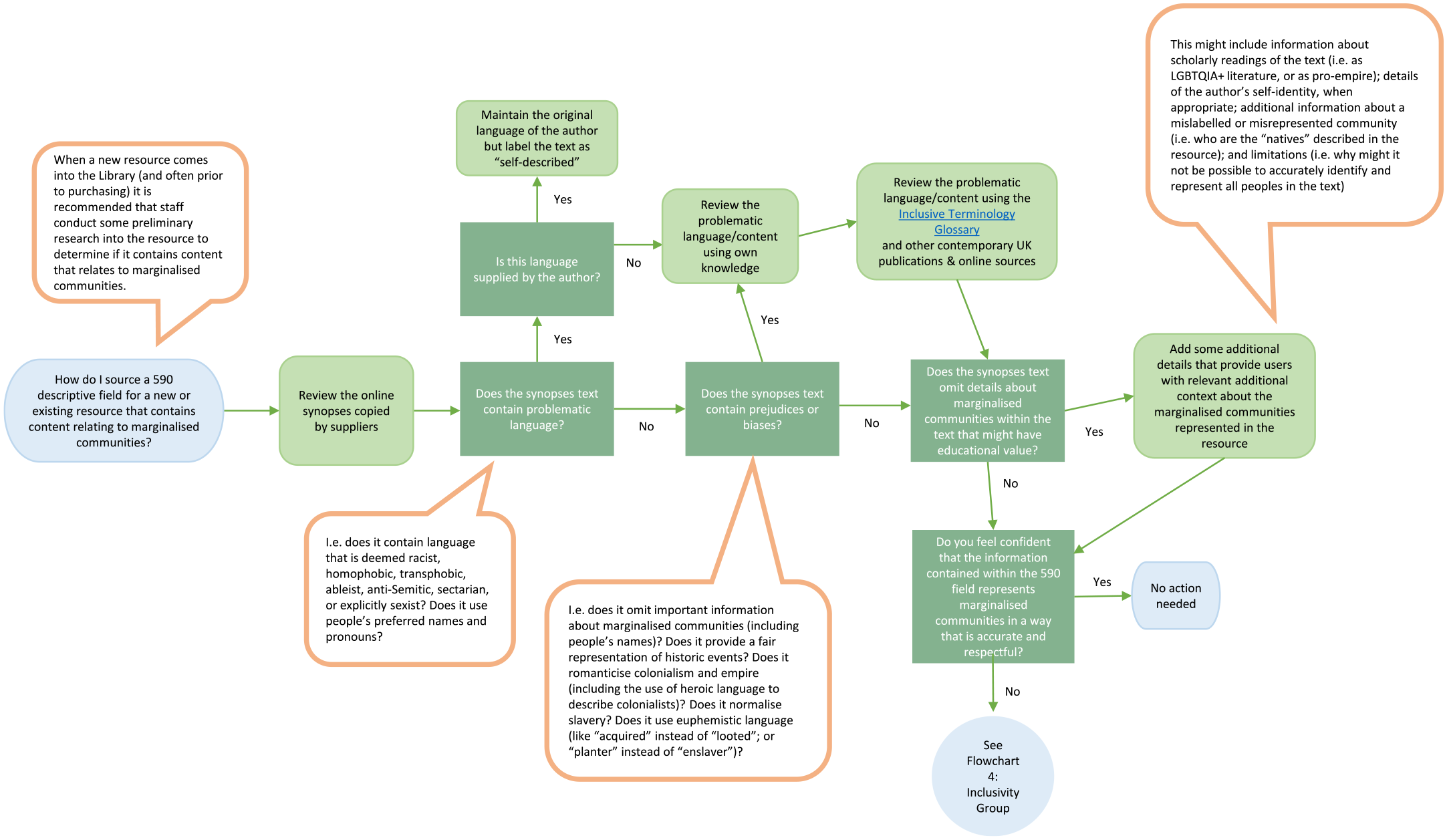
Sourcing description.
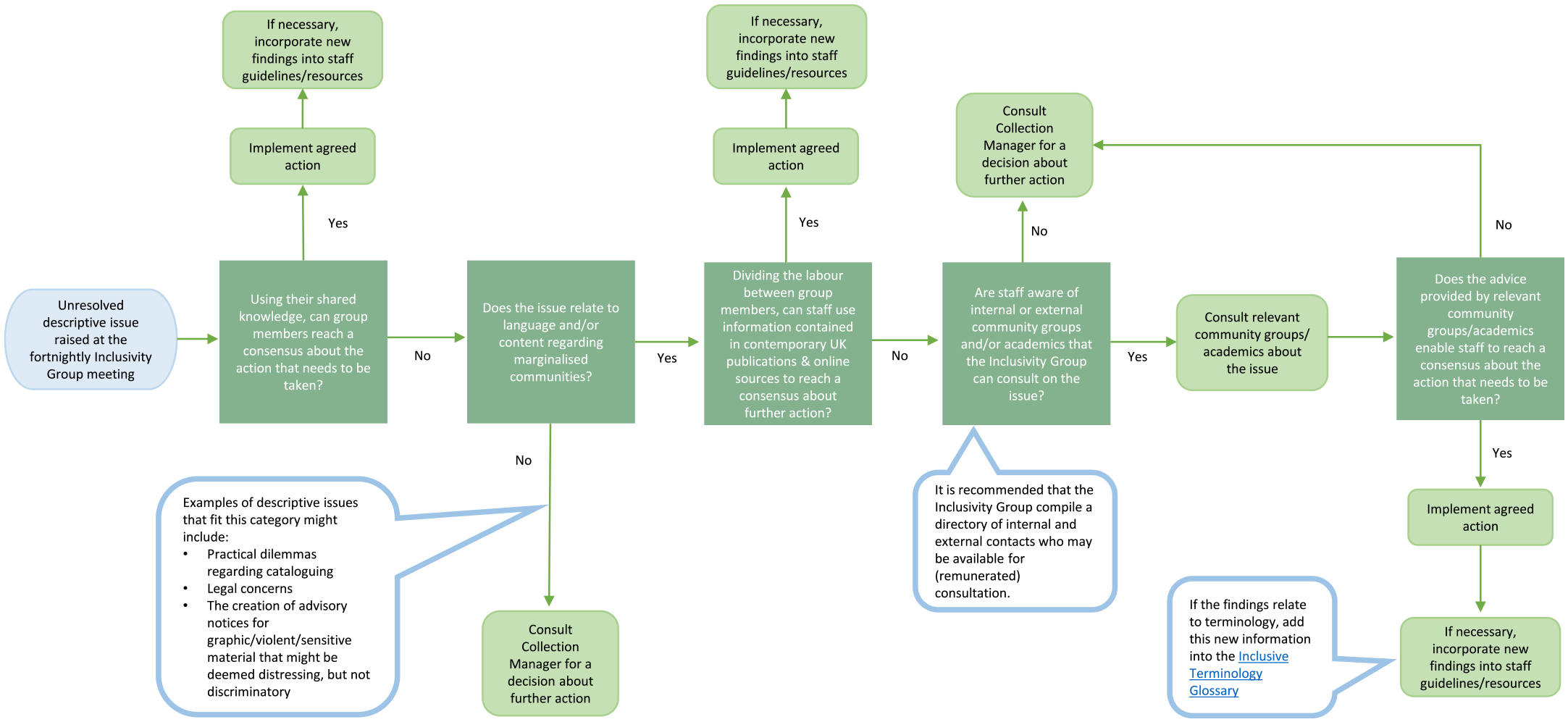
Inclusivity group.
Reflection
When it comes to inclusive description in the heritage sector, it is often archival collections (such as those containing links with colonialism or the Atlantic Slave Trade) that are perceived as requiring the most urgent attention. Archival catalogs have also often been chosen as a starting point for inclusive cataloging ventures because their descriptive fields typically offer more flexibility. What this work with the GSA Library highlights, however, is that published catalogs require urgent attention too and that the published collection is an equally valid starting point for a heritage organization’s re-cataloging initiative. Working within the UK heritage sector, I have encountered greater stigma regarding the revision of published catalogs—I have been told “the descriptive field can’t be changed,” “content advice can’t be added,” and that “ALMA/PRIMO doesn’t support such additions.” As the work taking place at GSA Library clearly demonstrates, none of that is true. And whilst there are certain restrictions within the descriptive fields supported by ALMA and PRIMO, there are also opportunities to contact Ex Libris and petition for the introduction of new features that will enable libraries to add appropriate content advice to their resources as well as to seek alternative software.
There is no reason why other heritage organizations cannot follow GSA’s lead and review the way that discriminatory materials are contextualized within their published catalogs, whilst recognizing that the strategy for the addition of advisory notices outlined in this article is applicable to most archival catalogs too. Given that multiple heritage institutions will provide access to the same editions of published texts, moreover, we can recognize the shared nature of the problem. There is, therefore, opportunity for collaborative efforts to take place across the sector to rethink the way that racist, colonial, and discriminatory items are represented across across catalogs, websites, displays, and other learning resources in the future.
Footnotes
Declaration of Conflicting Interests
The author declared no potential conflicts of interest with respect to the research, authorship, and/or publication of this article.
Funding
The author received no financial support for the research, authorship, and/or publication of this article.
1.
The author of this article is the creator of the Inclusive Terminology Glossary and the Cultural Heritage Terminology Network UK, two sector-wide projects which provide the backdrop against which this guidance for GSA Library was created. Carissa Chew, editor, Inclusive Terminology Glossary, https://drive.google.com/drive/folders/1JlZG0zmzlzPauwqJ5JxxUajf5hYkD0ta?usp=sharing; Cultural Heritage Terminology Network,  . For further case studies from this author, who works freelance as an inclusive metadata consultant in the UK heritage sector, also see: Carissa Chew, “Decolonising Description: Addressing Discriminatory Language in Scottish Heritage and Beyond,” Journal of Irish and Scottish Studies, 11, no. 1 (2023): 1–18; Carissa Chew, “Music and Misrepresentation: Guidance on Dealing with Harmful Materials and Discriminatory Language in Music Collections,” Brio (forthcoming).
2.
3.
Cataloging Lab, “Problem LCSH,” available at: (accessed July 13, 2022); Christina Joseph, ““Move Over, Melvil”: Momentum Grows to Eliminate Bias and Racism in the 145-Year-Old Dewey Decimal System,” School Library Journal, 67, no. 8 (2021): 28; Juliet L. Hardesty and Allison Nolan, “Mitigating Bias in Metadata: A Use Case Using Homosaurus Linked Data,” Information Technology and Libraries, 40, no. 3 (2021): 1–14; Karen Li-Lun Hwang, “Minding and Mending the Gaps: A Case Study in Linked Open Data,” The Design for Diversity Learning Toolkit (Northeastern University Library, 2018); Sarah A. Howard and Steven A. Knowlton, “Browsing through Bias: The Library of Congress Classification and Subject Headings for African American Studies and LGBTQIA Studies,” Library Trends, 67, no. 1 (2018): 74–88; Melissa Adler and Lindsey M. Harper, “Race and Ethnicity in Classification Systems: Teaching Knowledge Organization from a Social Justice Perspective,” Library Trends, 67, no. 1 (2018): 52–73. Melissa Adler, “Classification along the Color Line: Excavating Racism in the Stacks,” Journal of Critical Library and Information Studies, 1, no. 1 (2017): 1–32.