




Abstract
Helicopter shipboard landing is a cognitively complex task that is challenging both for pilots and their crew. Effective communication, accurate reading of the flight instruments, as well as monitoring of the external environment are crucial for a successful landing. In particular, the final phases of landing are critical as they imply high workload situations in an unstable environment with restricted space. In the present qualitative study, we interviewed ten helicopter pilots from the Italian Navy using an applied cognitive task analysis approach. We aimed to obtain a detailed description of the landing procedure, and to identify relevant factors that affect pilots’ workload, performance, and safety. Based on the content analysis of the interviews, we have identified six distinct phases of approaching and landing on a ship deck and four categories of factors that may significantly affect pilots’ performance and safety of the landing procedure. Consistent with previous studies, our findings suggest that external visual cueing is vital for a successful landing, in particular during the last phases of landing. Therefore, based on the pilots’ statements, we provide suggestions for possible improvements of external visual cues that have the potential to reduce pilots’ workload and improve the overall safety of landing operations.
Introduction
Landing on a ship is a cognitively complex task that involves many specific challenges unique to maritime landing operations (Minotra & Feigh, 2018; Wang et al., 2013). Judging altitude and groundspeed by looking at the sea below is more complex compared to a stable landscape as the external visual cues are very limited, and the visibility and clearness of the cues can be further impaired by fog, sea spray, and night conditions (Lumsden et al., 1999; Minotra & Feigh, 2017). As such, the ship’s visual landing aids (Figure 1) are vital for pilots as they provide invaluable visual reference points that delimitate the safe area for landing and help pilots to understand the position of the ship, its motion, and distance from the helicopter (Carico & Ferrier, 2006). Effective crew resource management, accurate reading of the cockpit flight instruments, as well as monitoring of the external environment are crucial for a successful landing.

Standard flight deck lights and markings (NATO, 2017).
In general, three crew members are on board of a helicopter during offshore military operations, two pilots seated in the front, and one operator seated in the back. For complex operations, there are four crew members: pilot, copilot, and two operators in the cabin (one Sensor Operator and one Tactical Operator for ASW/ASuW Ops, or two Crew Chiefs for Amphibious/Special Ops). One of the pilots in the front is the flying pilot, whereas the other copilot together with the operators are responsible for providing assistance and all the necessary information to the pilot. The flying pilot alone handles the helicopter and must maintain the big picture attending to different variables at the same time, which implies high workload situations (Minotra & Feigh, 2018). One of the pioneer studies on helicopter pilots’ cognitive workload suggests that pilots usually consider workload in terms of spare capacity (Roscoe & Ellis, 1990). The spare capacity is defined as the pilot’s ability to perform secondary tasks such as monitoring the flight instruments and communicating with the crew while maneuvering the helicopter as the primary task. The higher the workload induced by the primary task, the less spare capacity the pilot has to attend to secondary tasks (Hodge et al., 2012). Moreover, the effort generated by the primary task can increase during degraded visibility, crosswind, and rough weather conditions (Bardera-Mora et al., 2018; Carico & Ferrier, 2006), and the threshold for cognitive overload can decrease in relation to the psychophysiological state of the pilot (Hockey, 1997). In other words, when the demands of the situation accumulate and the pilot experiences prolonged stress and fatigue, the workload may exceed the pilot’s capability and result in a drop of the pilot’s situation awareness (Endsley, 2015, 1995). Insufficient situation awareness has been identified as one of the primary contributing factors to helicopter accidents attributed to human error (European Aviation Safety Agency [EASA], 2017).
The final phase of landing has previously been identified as the most demanding with regard to the pilot’s workload (e.g., Lumsden et al., 1999; Minotra & Feigh, 2018). The pilot has to be very precise in maneuvering the helicopter to a position above the touchdown circle. Once the helicopter reaches the correct position, the pilot must accurately read the movement of the ship (i.e., roll, pitch, and yaw) while anticipating the right moment to execute touchdown. The dynamic conditions around the ship are characterized by specific challenges that include limited deck space, continuous ship motion (cruise, pitch, roll), and varying aerodynamic conditions termed as ship airwake (Hodge et al., 2012; Lee & Horn, 2005; Padfield, 1998; Wang et al., 2013). Airwake can be defined as a combination of different air streams flowing over and around the ship’s superstructure and the flight deck as a result of the wind and the movement of the ship. The nature and severity of this phenomenon varies significantly with the influence of the direction and speed of the wind and the geometry of the ship. High turbulences associated with airwake compromise the task of maintaining the helicopter correctly aligned and hovering in a stable position (Hodge et al., 2012; Lumsden et al., 1999; Wang et al., 2013).
Present Study
The present paper is part of a broader multidisciplinary project which aims to develop an innovative visual cueing technology that would reduce pilots’ workload, and increase situation awareness and overall safety during helicopter shipboard landing. From a human-centered design perspective, understanding human factors such as pilots’ cognitive workload, spatial awareness, and the allocation of cognitive resources is critical for the appropriate design of the system. Moreover, assessment of the pilots’ needs and requirements for the system’s functions is vital for its usability, acceptance, and trust by the end-users (Schmerwitz et al., 2017) which in turn, enhances safety and mitigates potential misuse or disuse of the technology (Parasuraman & Riley, 1997).
Although limited, there are some previous studies exploring human factors, visual cueing, and other aspects of helicopter shipboard landing (Berbaum et al., 1991; Hoencamp et al., 2008; Lumsden et al., 1999; Minotra & Feigh, 2018). Berbaum et al. (1991) conducted a series of analysis and observations of two pilots in a flight simulator. They provide a detailed description of the landing task from the approach starting at 5 NM from the ship until touchdown, along with the visual cues that the pilots attend to during each stage. The study revealed that pilots mostly use cockpit flight instruments during the first half of landing, while external visual cues mostly guide the second half. Hoencamp et al. (2008) report answers of 16 pilots to a questionnaire on the relevance of different factors during helicopter shipboard landing operations. Pilots evaluated relative wind conditions (wind speed and direction concerning the ship motion), helicopter’s mass, and the ship’s roll movements as the most critical factors that affect the complexity of the landing both in day and night conditions. Lumsden et al. (1999) addressed human factors and the role of visual cues and automation in helicopter shipboard landing with a particular focus on single-pilot aircraft. The authors highlighted the necessity to improve and increase external visual cueing for the pilots, particularly during the final phases when the helicopter reaches the ship’s dynamic environment. A recent paper by Minotra and Feigh (2018) has brought more insight into the cognitive processes of the pilots during ship deck landing operations. The authors conducted interviews with four helicopter pilots following applied cognitive task analysis (ACTA; Militello & Hutton, 1998). They provided a detailed description of the different steps during landing and identified the crucial tasks with high cognitive demands during each phase where a high level of expertise is required, as well as some limitations and safety challenges of the current technology in use.
The present study aims to extend the knowledge on factors that influence pilots’ performance during helicopter shipboard landing. Furthermore, based on our findings, we aim to provide recommendations for improvements of visual cueing that would increase pilots’ situation awareness, decrease cognitive workload, and improve the overall safety of shipboard landing operations.
Methods
In our study, we used an exploratory qualitative design. We interviewed ten helicopter pilots of the Italian Navy. Pilots were all males and reported different levels of flight experience ranging from 500 to 2300 hours (M = 1387, SD = 654.6) flying with two different types of helicopters (i.e., EH-101 and NH-90). We conducted semi-structured interviews with the pilots during 2 days, each interview was approximately 90 min long, and at least two previously trained researchers were present at each interview. All interviews were audio-recorded, transcribed, and analyzed using content analysis methods for qualitative data (Hsieh & Shannon, 2005). Previous studies have used task analysis in the field of rotorcraft research (Minotra & Feigh, 2018; Morowsky & Funk, 2016; Papautsky et al., 2015). We used the ACTA approach (Militello & Hutton, 1998) for the interview protocol adapted specifically for helicopter pilots, as proposed by Minotra and Feigh (2017). In accordance with the literature review, we aimed to develop previous research and explore the following three areas: (i) pilots’ breakdown of the landing procedure and description of the key cognitively demanding elements, in order to identify the crucial tasks that contribute to the pilots’ cognitive workload during each phase; (ii) main internal/external visual cues that pilots use during different phases of landing to understand the information that they need for successful completion of the task; and (iii) potential improvements of the ship’s visual landing aids that would facilitate the external visual cueing.
In the first part, the pilots were asked to describe the landing task within three to six phases and to highlight the specific challenges of each phase concerning cognitive demands and workload. The specific open questions for this part were the following: “Imagine that you have to land on a ship deck in good weather conditions, can you break the landing task into three to six phases?” “Which of the phases that you have identified you consider the most complex or cognitively demanding and why?”
Second, we inquired about the internal and external visual cues and information that are crucial for the pilots to accomplish the landing task. The specific open questions for this part were the following: “Which information from the instruments inside the cockpit are crucial for you to perform each step of the landing task successfully?” “Which external visual cues are crucial for you to perform each step of the landing task successfully?”
Finally, we explored potential improvements of visual landing aids that would help the pilots with spatial orientation and accurate helicopter positioning. Pilots were asked to provide recommendations on improvements regarding content, design and representation of the cueing in a way that would reduce pilots’ cognitive workload and facilitate the landing task, particularly during the final phases. The specific open question for this part was the following: “Do you have any suggestions for improvements of the visual landing aids and technologies currently in use that could facilitate the landing task?”
Results
Task Breakdown, Cognitively Demanding Elements, and Major Visual Cues
Pilots described the landing procedure within several steps. Some pilots provided a more detailed description than others. We have analyzed the data from all the pilots’ interviews and integrated them into an exhaustive description of the landing procedure, highlighting the major external and internal visual cues and cognitively demanding elements for each phase respectively (Table 1).
Approach and Landing Phases, Major Visual Cues and Cognitively Demanding Elements
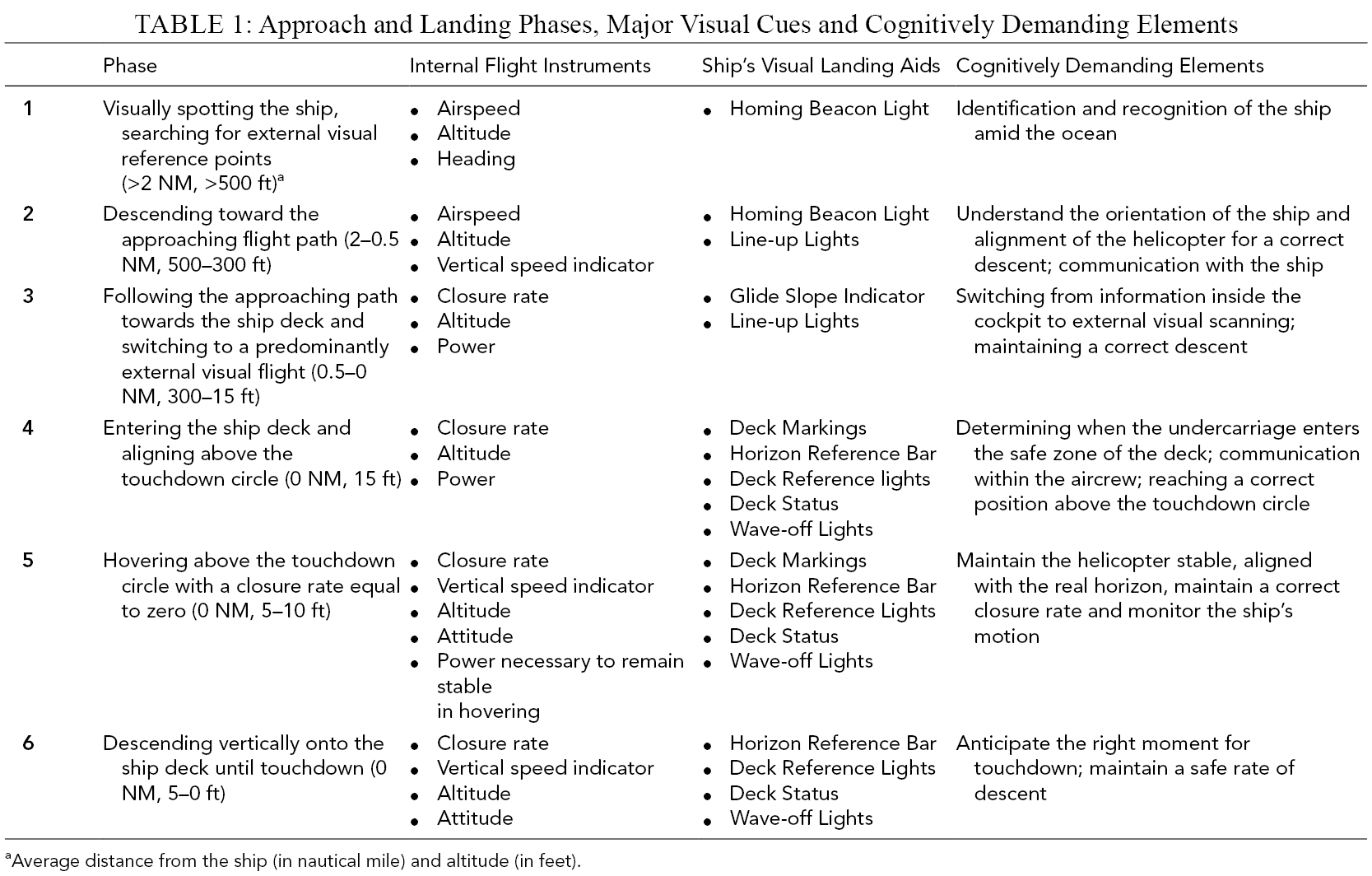
aAverage distance from the ship (in nautical mile) and altitude (in feet).
Visually spotting the ship, searching for external visual reference points
The first task for the pilots is to visually localize the ship, which has revealed to be a complex task. The task may be facilitated with the use of the Tactical Air Navigation system (TACAN) which helps to localize the ship providing bearing and distance from it. However, TACAN is not always available on ships, or its use is not allowed during specific missions in which the ship needs to stay covert. As such, pilots often have to rely just on the GPS data. It is important to mention that most of the interviewed pilots have a special ops background. Special ops helicopters are not equipped with an onboard radar. In this case, crew members provide additional information to the flying pilot about ship position, distance, and relative velocity. Particularly at night or when the weather conditions are not favorable, it is challenging to localize the ship.
"One of the most difficult tasks is to find the ship, and they also have a hard time seeing us on radar so for a long time we only have to rely on the GPS data."
Descending toward the approaching flight path
Once the ship is localized, the helicopter descends toward the ship using the cockpit flight instruments. During this phase, a radio communication with the flight deck is established during which the pilot and the Flight Deck Officer (FDO) agree on the procedure to be followed during the landing operation. The pilot acquires information from the FDO including its heading, speed, and environmental conditions (true and relative wind) that relate to the pitch and roll of the ship to understand its orientation and alignment. The most important information that pilots retrieve from the FDO is the relative wind. The pilot provides information related to the type of helicopter, position, altitude, fuel state, personnel on board, pilot’s estimate of the weather situation, and any further information that may be relevant for the landing procedure. Pilots highlighted that the information about the direction and speed of the ship they receive from the FDO are fundamental for a correct alignment.
The visual cues and instruments that pilots attend to differ according to the landing phase (Table 1) and the type of helicopter. In general, the approach is mostly guided by cockpit flight instruments until the helicopter is about 0.5 NM from the ship. While in some helicopters all the necessary information is integrated into a single screen, in others this information is distributed within the cabin, intensifying the monitoring task (e.g., AB-212 or SH-212).
“In the first phases, the flight is almost completely instrumental, especially during the night. As I am getting closer, it is important that one of the co-pilots still keeps track of what is going on inside, but the other has to switch to the information outside the cockpit.”
Following the approaching path toward the ship deck and switching to a predominantly external visual flight
Pilots must visually identify the flight deck by the time the helicopter is within half a nautical mile from it, which is the point of missed approach (i.e., if the pilot is unable to acquire a safe visual contact with the ship, the approach is aborted and the helicopter performs a go-around and prepares for a second approach). If the missed approach point is crossed, the pilots transition their attention to closely monitoring closure rate and communication with the copilot. The closure rate is the relative speed of the helicopter with respect to the ship. It is calculated by the copilot, receiving the ship’s speed data from the FDO and checking the helicopter’s speed on the cockpit. The switch to external visual flight is done when the visual references of the ship are visible to the pilot. The most frequently used visual cues at this stage are the Glide Slope Indicator (GSI) and the Landing Line-up Lights.
The GSI is a visual-reference lighting system that provides the pilot with a visual cue for the right angle of the descent toward the ship. It emits a tricolored light beam which consists of green, red, and yellow colors, and the pilot needs to follow the green light for a correct descent. The FDO operates the GSI. Landing Line-up Lights are used to indicate the safe area for landing. A pilot stated that the GSI is vital for a correct descent; however, pilots generally ask the FDO to switch it off when they get close to the ship so that they can focus their attention on the Line-up Lights and deck markings. At this point, the pilot switches to a predominantly external visual flight which is another cognitively complex element for the pilot.
“Switching from the inside instrumental information to outside visual scanning can cause vertigo, spatial disorientation.”
The copilot’s task is to monitor the cockpit instruments and communicate relevant information to the pilot, in particular, closure rate, vertical speed, and altitude. One pilot remarked that it is essential for the flying pilot to focus the attention outside of the cockpit as the helicopter gets close to the ship; thus, providing information from the cockpit instruments becomes a crucial task of the copilot.
Entering the ship deck and aligning above the touchdown circle
Pilots stated that in most maritime operations, a crew member is seated in the back of the helicopter behind the pilot and copilot. The operator has a crucial role during this phase as he/she informs the pilot about the position of the helicopter with respect to the ship deck, informs about the distance of the tail-wheel from the deck edge, and signals when the undercarriage and the tail enter the safe zone to avoid any collision with the ship’s structure.
“There is a communication between the pilot and co-pilot, and communication between the pilot and the operator in the back who has a bigger field-of-view compared to us because the EH-101 is 20 meters in length, I am all the way in the front, and the wheels are about 10 meters behind me. So, if the operator is at the door which is in the center of the three wheels, he can see much better the position of the helicopter than me.”
In order to position the helicopter correctly, pilots orient themselves using the deck markings and the Line-up Lights. However, it is essential to maintain an altitude between 10 and 15 feet above the deck so that the pilot can see below because the field-of-view from the cockpit is restricted. Therefore, the operator in the back assists and provides further information to the pilot as he/she has a better view from the helicopter door. One pilot stated that even if the flight operators are generally available, sometimes operations have to be conducted without his/her assistance. In such cases, pilots rely mostly on the deck markings. During this phase, there is often an intensified communication within the aircrew, and the pilots stated that it could be distracting or even counterproductive to receive any additional information from the ship at this stage.
“Sometimes it can be annoying to communicate with the FDO, because apart from communicating with the ship you need to communicate with your co-pilot that gives you indications from the flight instruments, so during the final phases the communication inside the cockpit can be more intense and the communication from outside can be disruptive. Especially when you are dealing with an emergency, external communication at a wrong time can be counterproductive.”
This phase implies a high workload as the pilot needs to integrate information from different sources, doing a so-called “cross-check,” which requires a high level of expertise and situation awareness from the pilot.
“Two factors that are fundamental are the manual handling/piloting of the helicopter and the capacity to effectuate several operations at once, we call it to cross-check which means a constant control of different instruments and the position of the helicopter concerning the ship and the outside environment. Naturally, less experienced pilots are slower in cross-checking than more experienced pilots.”
Hovering above the touchdown circle with a closure rate equal to zero
The main task in this phase is to stabilize the helicopter in a correct position and prepare it for the final descent. Pilots usually enter the ship deck at the height of 15–20 feet and then descend to a lower hovering altitude at about 10 feet above the touchdown circle. Modern ships are equipped with a Horizon Reference Bar (HRB) installed above the hangar door. The HRB is gyro-stabilized to remain horizontal, and it replaces the lost horizon. Interviews highlighted that while in daytime conditions pilots can easily check the real horizon, HRB becomes critical during night operations or in low visibility conditions to understand the roll of the ship. Pilots can use the HRB and the Deck Reference Lights to adjust the helicopter’s attitude and identify the correct timing for the touchdown. Also, it helps the pilot to avoid following the ship’s roll motion which, according to one of the pilots, is a frequent error among novice pilots.
“A common error that an inexperienced pilot can do is to move the helicopter following the roll of the ship when he should stay in line with the real horizon. Because you have to keep scanning outside and you cannot follow the artificial horizon inside the cockpit, so my reference point becomes the ship, but it should be the real horizon.”
Pilots need to monitor the helicopter’s correct positioning above the touchdown circle and read the ship’s motion. High level of situation awareness is fundamental, once the pilot identifies a stable period and can anticipate the quiescent moment he/she can execute the touchdown.
“It is really tricky to choose the right moment for the final descent, it’s a phase when the workload is very high.”
Descending vertically onto the ship deck until touchdown
The final phase is at the same time the fastest and the most critical in terms of safety. It can be very tricky especially in rough weather conditions. Once the pilot decides to touchdown, he/she must maintain a safe rate of descent to avoid any damage to the helicopter. Hence, apart from the external visual scanning, the pilot needs to monitor the vertical speed indicator and the altitude to ensure a safe descent. Also, considering that the helicopter is slightly tilted backwards, the pilot’s field-of-view is limited, and he/she may not see well the area below the helicopter. A pilot mentioned that a common error in this phase is to descend too rapidly and that not being able to see below the helicopter makes this phase particularly cognitively demanding. Some ships also use the Recovery, Assist, Secure, and Traverse (RAST) system. RAST includes a haul-down device that involves attachment of a cable to a probe on the bottom of the helicopter prior to landing. It assists the pilot with accurate positioning of the helicopter above the touchdown circle and once the helicopter reaches the deck, it is safely locked to prevent any sliding or unexpected motion. This phase along with the previous one have been identified by the pilots as the most cognitively demanding.
“The two last phases are surely the most difficult, it’s important to reach the correct positioning above the ship deck with the right parameters, and the final descent is the most demanding in terms of workload.”
Potential Improvements of the Systems
As previously suggested by Minotra and Feigh (2018), our results support the evidence that high workload situations are associated, in particular, with the final phases of the shipboard landing, that is entering the ship deck, positioning in stable hovering above the touchdown circle, and descending vertically until touchdown. During these phases, pilots need to monitor and integrate a large amount of visual and auditive information and maneuver within a restricted space which, along with the ship’s dynamic environment, makes it an extremely complex task that requires a high level of expertise and situation awareness. Given that the second half of the landing procedure is guided mostly by external visual cues (Berbaum et al., 1991), we asked the pilots about their ideas on improvements of the ship’s visual landing aids that would facilitate the landing task.
Pilots indicated that the first challenging task that could be facilitated through external visual cueing is entering the ship deck’s safe zone and reaching a correct position above the touchdown circle. The pilots suggested that visual landing aids could include a cue that shows the position of the helicopter with regard to the lateral and longitudinal axis of the ship deck so that the pilot can see the helicopter’s actual position above the touchdown circle. At present, this information is usually communicated to the pilot by the operator seated in the back of the helicopter. Most importantly, it is information that is not easily accessible for the pilots otherwise. Two pilots suggested that visual information about the helicopter lateral and longitudinal position above the ship deck, somehow displayed in the field-of-view of the pilot, would facilitate the positioning.
“Having a cue that shows my position concerning the centre line and to the longitudinal axis would be helpful.”
Once the helicopter reaches the ship deck and initiates the hovering phase, the pilot needs to integrate information about the helicopter’s position and the ship’s movement in order to identify the right moment for the final descent. Information about the ship’s roll and pitch motions along with the wind conditions are essential and they are usually communicated to the pilot by the FDO. Pilots suggested that having this information visualized in an immediate and integrated way could reduce the cognitive effort and facilitate the decision-making to execute touchdown. Also, one pilot suggested that visually displayed information about the direction and speed of relative wind would allow the pilots to access this information whenever they need without requesting it from the FDO, which would improve safety particularly in critical situations such as wave-off.
“Roll and pitch of the ship and how they vary would give me a piece of instant information about the movement of the ship deck so that I can understand when the deck is stable and go for the touchdown, so not only the number is important but also its variations.”
Another element is the closure rate of the helicopter (i.e., relative speed of the helicopter) which the pilots need to calculate. Pilots suggested that it would be helpful having the information about closure rate easily accessible in a visualized form.
“One thing that I would find helpful and doesn’t exist is the information about the relative speed of the helicopter with respect to the ship. At present, I have to calculate it myself which can be tricky if I am landing in difficult conditions.”
Much of the information about the ship’s motion, wind speed and wind direction is communicated to the pilots by the FDO through the radio. However, pilots indicated that they cannot always rely on radio communication because the signal is not always clear and the communication can get interrupted. As such, pilots would find helpful having a back-up system that would show the same information in a visualized form. The use of graphical visualization would make the information immediate, and it would allow the pilots to access it whenever they need without having to ask the FDO. Moreover, it would prevent the risk of information loss or misunderstanding and eliminate other problems related to the use of language. For instance, a pilot mentioned that operating on different ships also implies collaborating with different FDOs that may have different level of experience and proficiency in English. Graphical information displayed on the ship would reduce the risk of miscommunication, particularly during harsh weather conditions, when the communication is intensified.
“It would be useful to have some back-up, when I communicate with the FDO there may be some interruptions, the radio can break down, so to have some of the information in other modalities is important.”
Discussion
The present qualitative study aimed to identify cognitively demanding elements during different phases of helicopter shipboard landing operations. This allowed us to describe relevant factors that affect the safety and flow of the landing procedure, and to gather pilots’ ideas on possible improvements of the ship’s visual cueing system that would facilitate the landing task. The study allowed us to identify and sort out the critical tasks and subtasks that the pilot and his/her crew must carry out during each landing phase, shedding light on the complexity of the whole procedure. Apart from a detailed description of the landing operation, we have also identified different factors that are relevant to the safety and effectiveness of the landing procedure.
We have identified six distinct phases of helicopter approaching and landing on a ship deck. As illustrated in Table 1, each phase is characterized by specific goals, challenges, and cognitively demanding elements that contribute to the workload of the pilot. The task breakdown provided by the pilots and some of the cognitively demanding elements are mostly consistent with the results reported by Minotra and Feigh (2018). However, our study highlights the complexity of the final phases of landing breaking it down into two distinct phases (5 and 6) with specific tasks and demands.
Based on the content analysis of the interviews, we have identified four categories of factors relevant to helicopter shipboard operations that may significantly affect the landing procedure: (i) pilot-related factors; (ii) helicopter-related factors; (iii) ship-related factors; and (iv) factors related to external environment (Figure 2). Hoencamp et al. (2008) have previously described human, ship, and helicopter-related factors as relevant to the landing operations; however, based on the pilots’ statements, we infer that external environment represents a fourth category of factors that should be considered.

Factors relevant to the landing procedure along with an illustration of the landing phases.
Pilot Factors
First, pilot-related factors concern both the aircrew and the ship crew. The pilots indicated that the final phases of landing require constant monitoring of different internal and external indicators and performing more operations at once (i.e., cross-checking). Less experienced and less skilled pilots often have a slower cross-check ability which increases their cognitive effort and leaves less spare capacity. In accordance with the study of Minotra and Feigh (2018), we have found that switching from instrumental flight to predominantly external visual flight in the third phase can lead to vertigo even in experienced pilots. This finding is particularly relevant as it highlights the need for further research on such phenomenon. In aviation, literature vertigo is often studied as spatial disorientation (Lawson et al., 2017; Sharma, 2015) and it has been identified as a major contributing factor to accidents in pilot-controlled flights (Gibb et al., 2011; Lawson et al., 2017). While in the past, it was considered an abnormal response caused by certain kind of vestibular pathologies, nowadays it is recognized as a normal human response to an abnormal stimulus (Benson, 2002; Reason & Brand, 1975). Specifically, vertigo can occur when pilots rapidly switch gazes from instruments to external cues in cases such as when attention switching is not done on time or if the pilot vacillates between the two references. It is due to mention that it can happen under definite circumstances and that it is bound to individuals’ characteristics. Lawson et al. (2017) tried to summarize and identify advantages and disadvantages of most common countermeasures to spatial disorientation in manned flight, and they highlight the importance to improve current training programs for pilots on the topic. High-tech landing aids that aim at augmenting pilots’ situation awareness can act as effective countermeasure. For example, Perrins and Howitt (2001) evaluated the operational benefits of a Pilot Assisted Landing System (PALS) in a range of environmental conditions in a flight simulator. The system, specifically designed to counter ship airwake turbulence, uses higher levels of augmentation in the flight controller to hold position over the landing deck (Horn & Bridges, 2007). Their results showed that the PALS consistently delivered the desired performance and it is particularly useful to aid the pilot in maintaining awareness of the helicopter position with respect to the ship deck. Still, there is a need for future research in shedding light on this issue, in particular regarding helicopter pilots. Research that would aim to identify effective countermeasures and provide inputs for the development of innovative pilot assistive technologies is strongly encouraged.
Our results further suggest that the verbal and radio-based communication between the pilot, copilots, and the FDO has to be well organized and follow predictable patterns. Communication from the ship at the wrong moment can cognitively saturate the pilot with redundant or unnecessary information leading to a drop in his/her situation awareness and increasing the risk of an accident. The pilot’s situation awareness is crucial for managing information from different sources and planning the flow of actions (Endsley, 2015, 1995). Pilots indicated that ideally, there is no communication from the ship once the helicopter enters the ship deck. Fatigue can also negatively affect the pilot’s performance, decreasing attention capacity and flexibility (Caldwell, 1997; Farrell et al., 2016). Landing is usually the final task for the pilot coming back from a mission, and it requires an increased cognitive effort after a less demanding cruising period (Gaydos et al., 2013; Hartzler, 2014).
Helicopter Factors
Second, helicopter-related factors include the type of helicopter, its dimensions, mass, ergonomics of the inside cockpit flight instruments, ease of flying, dimensions of the cabin, and the pilot’s field-of-view. In our sample, pilots were flying with two different helicopters, that is, EH-101 and NH-90. The former is about 20 meters in length and has 14.6 tons of mass, whereas the latter is only 16 meters long and has 11 tons of mass. The length is particularly important during the fourth phase of landing as the pilot must assess when the helicopter’s tail enters the safe zone of the ship deck to avoid collision of the tail wheel with the deck edge (Minotra & Feigh, 2018). The mass of the helicopter is particularly relevant during the final descent in which the pilot needs to descend at a slow pace in order to avoid any damage (Hoencamp et al., 2008). Concerning ergonomics of the cockpit instruments, pilots mentioned that in some types of helicopters, they need to monitor different instruments to gather all the necessary information about speed, altitude, and the rate of descent, while in other types they have all necessary information integrated on one screen which facilitates the monitoring task and reduces workload.
Ship Factors
Third, ship-related factors further determine the complexity of landing. The ship’s unstable deck, which results from its motion (cruise, pitch, roll, and yaw), is one of the main factors that challenge pilots in the final phases of landing (Hodge et al., 2012; Hoencamp et al., 2008; Lee & Horn, 2005). The pilot must accurately read and anticipate the ship’s motion, which requires effective information management and a high level of situation awareness. The deck dimensions further restrict the safe zone for maneuvering as the pilot must avoid colliding with obstacles on the ship. Visual landing aids, such as Line-up Lights, Deck Reference Lights, and Horizon Reference Bar, provide additional visual reference points. However, their availability and visibility can differ depending on the ship and on the environmental conditions (Carico & Ferrier, 2006; Wang et al., 2013). Pilots in our sample evaluated roll and pitch as the most important movements of the ship which is consistent with findings reported by Hoencamp et al. (2008). In fact, the official procedure requires that the FDO communicates the ship’s direction (course) and cruise speed to the pilots already during the first landing phase. These parameters shall stay invariable throughout the landing procedure and significant variations may lead to a wave-off order. Therefore, the pilots indicated that course and speed are the least relevant of the ship motion as they shall stay invariable in contrast to roll and pitch, which are more unpredictable and dependent on the sea/weather conditions.
Environmental Factors
Finally, the external environment includes additional factors that can significantly affect the safety and ease of the landing operation (Baker et al., 2011; Gomes et al., 2015; Stanton et al., 2018). Adverse sea conditions enhance the ship’s motion making it harder for the pilot to identify the quiescent period for a touchdown. Foggy or rainy weather can further deteriorate visibility, and wind conditions can significantly contribute to the pilot’s workload. Moreover, landing at night reduces the visibility and availability of visual reference points and makes it extremely hard for the pilots to understand the ship’s movements (Lumsden et al., 1999). In previous studies, airwake has been considered an important factor that is particularly relevant to the last phases of the landing (e.g., Hodge et al., 2012; Lumsden et al., 1999; Owen et al., 2017). In our study, pilots did not explicitly mention airwake; however, they talked about the effects of relative wind (i.e., combination of ship’s movement and wind conditions), and the necessity to have information about its speed and direction. We have therefore decided to include airwake as a relevant factor related to the external environment. Nonetheless, in accordance with Minotra and Feigh (2018), we suggest that there is a need to further explore the actual impact and relevance of airwake on pilot performance and safety of off-shore landing operations.
Recommendations
Another aim of our study was to gather ideas from the pilots on possible improvements of the ship’s visual landing aids that would increase pilots’ situation awareness, reduce their cognitive effort, and thus improve overall safety of offshore landing operations. Analyses of the interviews allowed us to identify phases with a high workload and we proposed possible ways to reduce cognitive demands through an adequate design of external visual cueing. Our results provide recommendations for visual cueing which could adapt the task demands to pilots’ capabilities and thus improve their performance, reduce errors, and facilitate timely decisions in critical situations. In general, pilots’ preferred way to gather information is through external visual cues. Pilots’ preference for visual cueing over verbal communication has already been indicated in the previous studies (e.g., Hoencamp et al., 2008; Minotra & Feigh, 2018). As such, a significant improvement could be achieved through displaying more indicators such as the helicopter’s position above the ship deck, closure rate of the helicopter, information about ship’s roll and pitch, wind speed, and wind direction. Having this information displayed in the pilot’s field-of-view has the potential to decrease cognitive effort generated by the secondary tasks and thus facilitate the pilot’s helicopter maneuvering as the primary task.
Limitations of the Study
The use of qualitative methods allowed us to conduct in-depth research into pilots’ subjective experiences during helicopter shipboard landing which would have been impossible with the use of quantitative methods. Semistructured ACTA-based interviews proved to be a valuable method for the scope of the study.
However, the results of the study need to be considered in light of its limitations. Our study was based on interviews that generated an extensive amount of valuable data; yet, their reliability and validity need to be evaluated with attention. Qualitative research is for the most part based on interpretation. As such, the researcher’s personality, opinions, previous experience, and cultural background necessarily shape the way in which the data are collected, analyzed, and interpreted. Pilots’ use of specific language and technical terms, improper formulation, or misunderstanding of the communicated information were all further risk factors that needed to be addressed appropriately. In order to mitigate these risk factors, at least two trained researches were always present during each interview, and their understanding of the pilot’s statements was compared and discussed at the end of the interview. In addition, all interviews were audio-recorded and transcribed in order to perform thorough content analysis and minimize the risk of possible information loss.
Furthermore, the pilots provided information about their subjective past experience, but we were unable to assess their performance during the actual landing situation with the use of a helicopter or a flight simulator. As such, we have collected qualitative data from a very specific group of pilots in a laboratory environment which is a limitation to the ecological validity of the data. Moreover, the interviews were conducted in Italian language and translated into English, which implies a possible risk for mistranslations. Nonetheless, we believe that the vast amount of information and cross-checking of the meaning of the pilots’ statements between researchers should eliminate any potential risk to the validity of the general conclusions of our study. Future studies with a quantitative approach to explore issues such as pilot workload and visual scanning techniques are strongly encouraged.
Finally, in order to obtain a diverse sample that would allow for some general conclusions, we aimed to interview pilots with different levels of experience. We thus selected pilots according to the number of flight hours which we considered an acceptable indicator of their experience. However, pilots’ actual skills and style of flying are essential factors that we could not assess as we did not have a chance to observe the pilots during the actual landing procedure. Moreover, our sample was composed entirely of male pilots, which is another limitation as female pilots’ subjective experiences may differ substantially from those of male pilots. Nonetheless, the lack of female pilots in our sample also reflects the gender imbalance in the Italian Navy. Indeed, the percentage of female soldiers is 4.3% of the Italian military personnel, and only 0.7% in the Navy force (NATO, 2016). Despite the study limitations, we believe our findings provide valuable insight into the pilots’ experience and represent an important contribution to this still under-researched field of study.
Conclusion
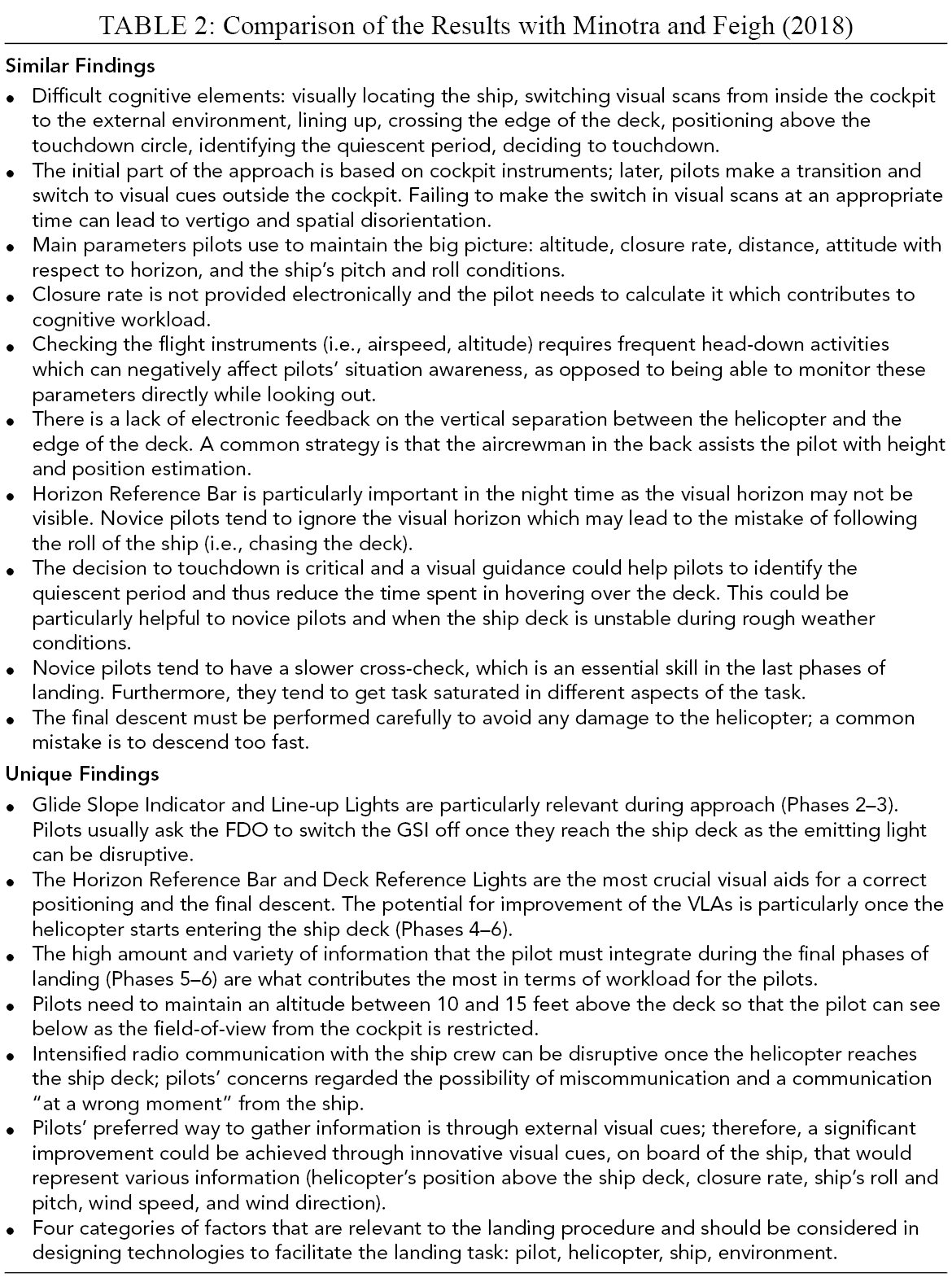
The present study provides important insight into the pilots’ experience during helicopter shipboard operations. It aimed to deepen the understanding of the elements that contribute to pilots’ cognitive workload during the landing task and to identify relevant factors that affect their performance and overall safety of the procedure. We have provided a detailed analysis of the landing procedure with a description of each phase, visual cues that pilots attend to, and various cognitive elements that contribute to the pilot’s workload. Following previous studies, we have identified the final phases as the most cognitively demanding and we highlight that external visual scanning is crucial for the pilots in order to maintain situation awareness. We have therefore provided suggestions on possible improvements of external visual cueing that could reduce cognitive demands of the task and thus increase pilots’ performance and overall safety of the operation. Further studies are encouraged to explore aspects such as pilots’ strategies to prevent vertigo and spatial disorientation. As we mention throughout the paper, we followed a similar approach and methodology as Minotra and Feigh (2018). Therefore, our findings provide further evidence for several issues that have previously been raised by the authors. At the same time, our study yielded some unique findings that expand the knowledge on helicopter shipboard landing and the various factors that are relevant to pilots’ performance and safety. To illustrate, Table 2 summarizes some of the similar findings of the present study and that of Minotra and Feigh (2018) along with a list of unique findings of our study. We encourage further research to explore aspects such as pilots’ strategies to prevent vertigo and spatial disorientation, as these still remain under-researched and a clear understanding of the phenomenon is still lacking. Also, further studies should focus on the understanding of the pilots’ visual scanning techniques and the potential of innovative technologies to improve external visual cueing should further be explored.
Comparison of the Results with Minotra and Feigh (2018)
Footnotes

Author Biographies
Martin Tušl obtained his master’s degree in psychology at Charles University in Prague in 2017. From 2018 until 2019, he worked as a research assistant at the University of Bologna, where he contributed to several projects related to different areas such as occupational health and safety, human factors, or human-technology interaction. Martin currently pursues his PhD in Occupational Health Psychology at the University of Zurich.
Giuseppe Rainieri obtained his master’s degree in work and organizational psychology at the University of Bologna with a thesis about the influence of individual needs on a group’s creative performance. He is currently part of the Human Factors Risk and Safety research group where he is involved in different research activities that concern human factors in aviation, human-machine interaction, and safety.
Federico Fraboni holds an MSc in work, organisational, and personnel psychology at the University of Bologna and he is part of the Human Factors Risk and Safety research group. He is currently completing his PhD in human factors and human-technology interaction. His research interests regard cognitive ergonomics, acceptability and users’ behavioural adaptation of new technologies, human-machine interaction, and interfaces. He has conducted several studies on human technology interaction in different fields. He has published around 20 scientific papers and participated in several H2020 projects.
Marco De Angelis graduated in organizational and work psychology; from 2012, he has been engaging with both academic lectures in the University and consulting activities for professionals, providing training non-technical skills, work-related stress, and error and risk management. He obtained his PhD in psychology at the University of Bologna, conducting research on the promotion of sustainable mobility and its psychosocial determinants. His main research interests focus on social and behavioural science applied to high-risk contexts such as industrial, organisational, and traffic environments.
Marco Depolo was full professor of organizational psychology and dean of the “Behavioural & Social relations Sciences” BA program at the University of Bologna till 2006. He has published, as main author and in collaboration, several scientific papers (books and book chapters, articles in national and international scientific journals), and presented many communications in scientific international congresses as well. He has contributed to many research projects at the national and international level.
Luca Pietrantoni is full professor in industrial and organizational psychology and coordinator of the research group “Human Factors, Risk and Safety” at the University of Bologna. Luca has authored or coauthored more than 80 presentations at national and international meetings and conferences, as well as over 60 papers published in national and international journals. His line of research is related to human factors/ergonomics, safety and human performance, cognitive effort and usability/acceptability of technological solutions. He is the Director of Erasmus Mundus Joint Master’s Degree of Work, Organizational and Personnel Psychology since 2015.
Andrea Pingitore is a Commanding Officer of the Italian Navy at the Naval Aviation Test & Evaluation Center. He obtained different qualifications operating as Flag Officer Aide, Minehunter Coastal Ship Commanding Officer, and Amphibious and Special Ops Helicopter Pilot. From 2014 to present, as an Experimental Test Pilot, he is in charge of studying the operational requirement, planning the operational evaluation, and the assessment of new aircrafts’ equipment.