



Abstract
This paper responds to Skraaning and Jamieson’s target paper “The Failure to Grasp Automation Failure.” We acknowledge that the target paper made important contributions to automation research in the human factors community. It analyzed automation failure events in complex operational systems in contrast to the vast majority of laboratory research on human-automation interaction. The paper presented a taxonomy of automation failure. The analysis and taxonomy demonstrate the integration of approaches to grasping automation failures from system instrumentation and controls, human factors engineering, and human reliability analysis. We reviewed the regulatory framework related to use of automation in nuclear power plants and examined whether the framework elements adequately address “Failure to Grasp Automation Failure” using the taxonomy in the target paper. Overall, we believe that the target paper could enhance the consideration for potential automation failures in the design and regulatory review process of automation technologies.
Introduction
This paper responds to Skraaning and Jamieson’s target paper from the perspectives of regulatory applications. The authors of this paper have worked at the U.S. Nuclear Regulatory Commission (NRC), Office of Nuclear Regulatory Research for nearly two decades, and the content of this paper represents the authors’, not the NRC’s technical opinions. Both have research background in cognitive science and human factors engineering. Both lead the development of regulatory guidance and methods for reviewing human factors engineering (HFE) and human reliability analysis (HRA) in the design of new technologies in nuclear power plant (NPP). The regulatory guidance and methods require technical basis of state-of-art research. Studies of human-automation interaction on complex process control can address the challenges in regulatory activities. The target paper presents the results that can enhance the technical basis for reviewing automation technologies in NPPs. Before discussing the target paper, we provide a landscape of the NRC’s regulatory activities related to the emergent use of automation.
Advanced nuclear reactor technologies present new challenges. High level automation is expected to be prevalent in advanced NPPs and modernization of existing NPP control rooms. The NRC has approved the design of technologies proposing higher levels of automation including the Westinghouse AP1000 [NRC, 2011] and NuScale [NRC, 2020a]. Two AP1000 units are authorized for operation by the NRC [Power, 2023; U.S. Nuclear Regulatory Commission News, 2023, U.S. Nuclear Regulatory Commission News. (NRC, 2022a]; each unit is operated from a nearly fully digital control room. Meanwhile, modernization activities also engender implementations of control room automation. For example, modifications to traditional plants in the U.S. seek to employ Digital Instrumentation and Controls (DI&C) on safety systems. Knowledge about the implications of automation implementations on operator performance will enhance the technical basis for NRC’s regulatory activities.
Modernization efforts involve using DI&C, as well as automating operator manual actions. Novel elements of the design will likely include more advanced automation and, thus, will be targeted for HFE review to determine whether the applicant has reasonably assured the effective integration of automation and operators, and that the design supports safe operations. The NRC has the guidance DI&C-ISG-06 [NRC, 2020b] to review license amendment requests associated with safety-related DI&C equipment modifications. For modifications that may involve HFE considerations, an HFE safety evaluation should be performed in accordance with NUREG-0711 [NRC, 2012], “Human Factors Engineering Program Review Model”; and NUREG-1764 [NRC, 2007] and “Guidance for the Review of Changes to Human Actions.” More recently, the NRC staff developed the draft Guidance “Development of Scalable Human Factors Engineering Review Plans (DRO-ISG-2023-03) [NRC, 2022b], under the “Risk-Informed, Technology-Inclusive Regulatory Framework” [U.S. Nuclear Regulatory Commission. NRC, 2023b] for HFE review of advanced reactors. The guidance provides a risk-informed and performance-based process to identify the most safety-significant systems, systems with likely human factors challenges, and novel elements of the design.
Research has been conducted on human-automation systems for NPP control rooms. For example, the Halden Human Technology Organization (Halden HTO) at the Institute for Energy Technology (IFE) consolidated its two decades long research results studying human-automation interaction in NPP simulators [Skraaning et al., 2020]. Several organizations have reported human performance studies of computerized procedures with automation functionality embedded [Claire, Hildebrandt, McDonald, R., & Hughes, 2017]. Operational experience review has documented many DI&C and automation events in NPPs. Most DI&C events involve issues in HFE considerations. There is also research regarding automated vehicles related to the mitigation of attribution error in the design of automated and autonomous nuclear power plants [Hancock et al., 2023]. The target paper by Skraaning and Jamieson, “The Failure to Grasp Automation Failure [Skraaning & Jamieson, 2023],” reviewed recent aviation accidents involving automation failures and proposed an initial taxonomy of automation failure and automation-related human performance challenges. Xing and Green [Xing & Green, 2023] reported that deficiencies of human-automation integration led to automation failure events in several ways: (i) The automation system worked as expected but the deficiencies in human-automation interaction led to human failures; (ii) The automation failures led to, or aggravated, human-automation integration deficiencies and then led to human failing to identify or recover from automation failures; (iii) The DI&C element had unusual behaviors or deviated from operators’ understanding, thus leading to or aggravating human-automation integration deficiencies and then leading to human failures. Taken together, these different sources of information can provide an understanding of automation reliability and how that reliability impacts the operator’s use of automation.
In 2022, an interdisciplinary team of NRC staff working in DI&C, HFE, and risk analysis systematically evaluated the findings from investigative reports of BOEING 737 crashes [NRC, 2022c]. The team examined the recommendations in these investigative reports for their potential implementation in the NRC’s DI&C regulatory process. The team recommended four areas of focus to enhance DI&C licensing and regulatory oversight, two of which address HFE in DI&C reviews: - The NRC staff should continue to improve integration and communication among DI&C technical reviews, HFE reviews, and subsequent inspection oversight for new or significantly different applications from conception to installation. - The NRC staff should develop guidance for assessing systems engineering approaches for the DI&C design and human factors life-cycle evaluation, which are important for ensuring that approved DI&C designs are appropriately integrated to maintain safety functionality.
These underscore the importance of effective communication and integration among HFE and DI&C for the review of advanced reactor technologies.
General Comments on the Target Paper from Regulatory Application Perspectives
We assert that the target paper made several important contributions to human-automation research: (i) The authors analysed automation failure events in complex operational systems in contrast to most laboratory research on human-automation interaction. Previous studies and our own experience of developing human factors engineering guidance demonstrated that results from human-automation-interaction laboratory experiments in simple multi-task contexts generally do not predict human performance with automation in complex control process systems [NRC, 2022c]. (ii) The authors analysed automation failure accidents with a human performance framework beyond the traditional human information processing models. The human performance framework considers the broad context of complex cognitive process tasks, while human information processing models typically represent a “slice” of the overall cognitive processes involved in complex operational tasks. (iii) The analysis focuses on the causes and mechanisms of automation failure; the taxonomy of automation failure expands the themes of human-automation research that have been focused on making automation work better. It is prevalent that laboratory experiments study the effects of human-automation interaction characteristics such as level or type of automation on measures such as workload, situational awareness, and level of trust. However, there has been little evidence that those characteristics and measures can predict human performance, in particular, the reliability of human’s ability to “grasp automation failure.” (iv) The taxonomy incorporates findings on automation systems, design logic and components, DI&C, human-automation integration, and human and organizational factors. It calls to attention that grasping automation failure needs integrated approaches from all these aspects. This echoes the recommendations made by the NRC team on integration of DI&C, HFE, and risk analysis. (v) The taxonomy could inspire experimental research scenarios that are more industry relevant. It could serve as a roadmap for the design of future domain-specific experimental research aimed at how different automation features influence performance in complex operational contexts. System designers could use the framework to anticipate and identify systemic automation failures. Likewise, after proper evaluation, regulators may consider using a similar taxonomy as a checklist to evaluate if a particular design is vulnerable to systemic automation failures.
Potential to Enhance Regulatory Guidance for Reviewing New NPP Technologies
A Framework for Integrating DI&C and Human Factor Engineering
Regardless of the vast landscape of advanced technologies, NPP operations share the critical functional aspects in common: • Operators work within complex control systems; • Operators are in control of the systems, although the systems can run at high or full automation modes; • Operators’ tasks involve monitoring, situational assessment, decision-making/planning, manipulation/control, and teamwork; Use of higher levels of automation may result in more monitoring tasks for the human operator versus manipulation and control types of tasks. • Operator responses are procedure-based.
Xing and Green (2023) generalize the NRC’s regulatory and licensing activities in DI&C, HFE, and HRA into a framework depicted in Figure 1. This framework represents how human-automation integration works: (i) The DI&C elements achieve functions of automation systems; behaviors of DI&C elements impact elements of human-automation integration; (ii) Human-automation integration should ensure that the automation functions do not cause human errors and failures of DI&C elements do not propagate to human failures, (iii) The human cognition system should ensure that human operators are capable of identifying and recovering from automation failures. In the diagram, the box on the left represents DI&C elements that constitute an automation system. The box in the middle of the diagram represents HFE elements that support human-automation interaction. The box on the right represents the elements of human cognitive task performance. A framework for integrating DI&C systems and HFE.
The taxonomy of the target paper is organized by automation-induced human performance challenges in four columns (1) Elementary Automation Failures, (2) Systematic Automation Failures, (3) Human Automation Interaction Breakdowns, and (4) Negative Human Performance Outcomes that may occur in the presence of automation and, may be the result of a lack of adherence to human factors design principles. Next, we discuss how the target paper taxonomy may enhance the elements in the framework presented in Figure 1.
DI&C Systems
The NRC staff conducts DI&C design reviews to ensure DI&C system safety for NPP operations. The DI&C design review identifies potential design hazards and analyzes system or component failure modes. The first column of taxonomy contains Elementary Automation Failures, such as “Automatic functions are missing or lost,” and “Loss of power supply to automation,” corresponding to design hazards of automation systems. The listed hazards can enhance existing hazard identification methods that are not specifically developed for automation systems.
The second column of the taxonomy contains Systematic Automation Failures. Examples are “Automation works as intended but operates outside the design basis,” and “Automatic systems works in parallel but compromise each other.” This list can enrich our understanding of potential failure modes in DI&C elements of an automation system and help identifying potential automation failures that induce human performance challenges.
Human-Automation Integration
The NRC staff review human-automation integration using guidance contained in Human Factors Engineering Review Model documented in NUREG-0711 [NRC, 2012]. The HFE model includes twelve elements, some of which are shown in the middle box of Figure 1. The element
The third column of the taxonomy presents a list of Human-Automation Interaction Breakdowns. Examples are “Automation provides misleading support to operators,” and “Critical operator actions are unsuitably blocked by automation.” Essentially, all the listed breakdowns are deficiencies in functional requirement analysis and functional allocation. The HFE review can benefit by incorporating the “breakdowns” as a check list for asking questions.
Similarly, the taxonomy can also help HFE review the element on
Human Reliability Analysis
Performance Influencing Factors in IDHEAS Method.

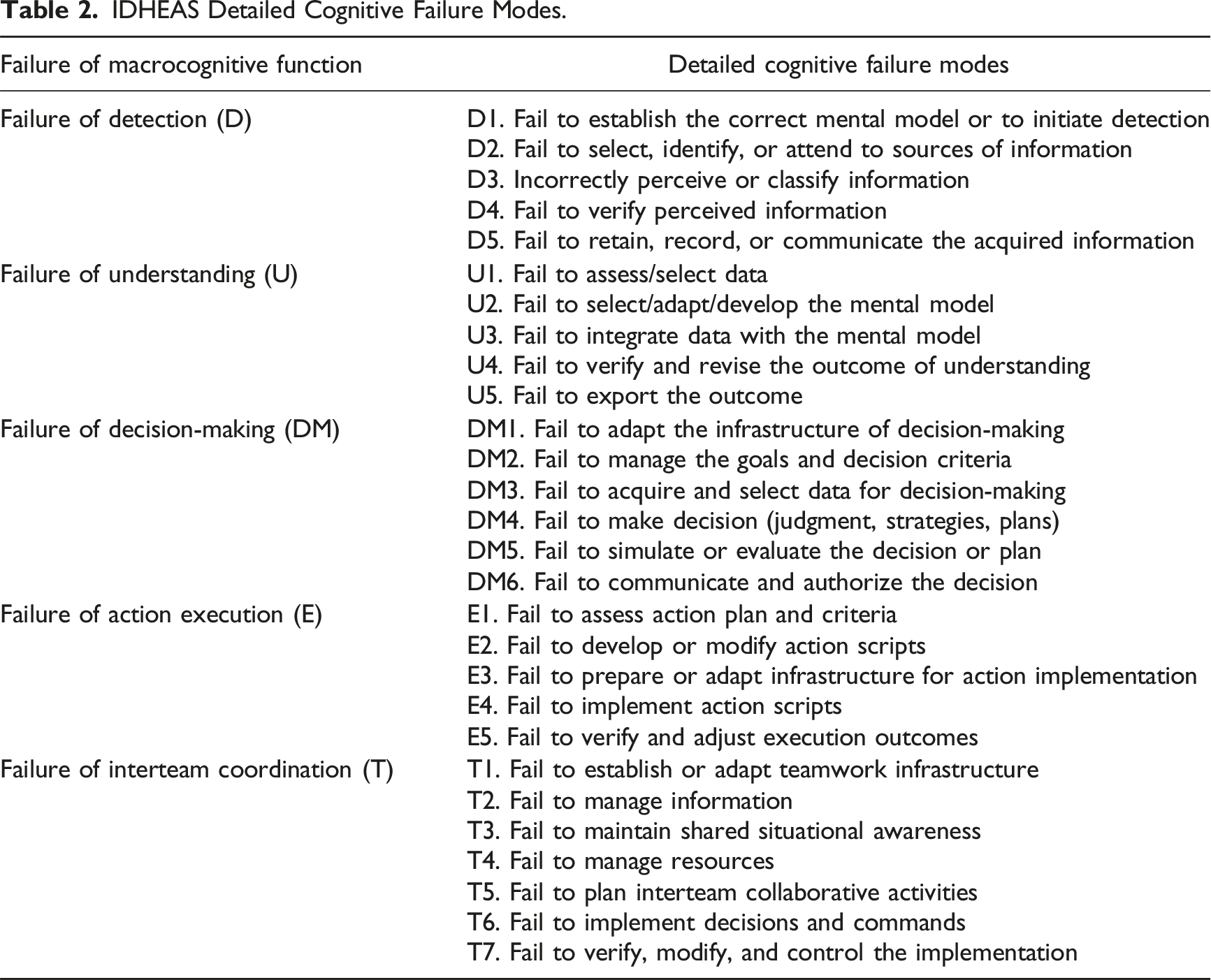
Finally, we see that one piece missing from the taxonomy is the “so what,” a description of human failures due to the challenges or misconceptions. We recommend the target paper authors consider incorporating IDHEAS cognitive failure modes to represent human failures in using automation. The cognitive failure modes represent failures of macrocognitive functions, which are the basic cognitive elements to achieve complex operational tasks. The cognitive failure modes are human-centered, thus, they can be used to model human failures in any automation systems.
IDHEAS cognitive failure modes consist of the failures of the following five macrocognitive functions: • Detection (D) is noticing cues or gathering information in the work environment. • Understanding (U) is the integration of pieces of information with a person’s mental model to make sense of the scenario or situation. • Decision-making (DM) includes selecting strategies, planning, adapting plans, evaluating options, and making judgments on qualitative information or quantitative parameters. • Action execution (E) is the implementation of the decision or plan to change some physical component or system. • Interteam coordination (T) focuses on how various teams interact and collaborate on an action.
IDHEAS Detailed Cognitive Failure Modes.
Concluding Remarks
The target paper, “The Failure to Grasp Automation Failure” makes several important contributions towards moving the field of automation research forward. The present commentary is from a regulatory perspective and particularly focused on the impact for the nuclear domain. The target paper addressed a much richer set of operational challenges through the analysis of automation failure events than can be accomplished in most laboratory experiments concerning human-automation interaction. The framework used builds upon traditional human information processing models, resulting in a more integrated approach. By focusing on the causes and mechanisms of automation failure, the initial taxonomy proposed not only extends the human-automation research for improved automation, but the taxonomy itself represents a potentially successful integration of the interdisciplinary approaches for identifying automation failures including DI&C, HFE, and HRA. The introduction of this taxonomy is a clear step towards addressing the challenge of integrating these interdisciplinary intersections by providing a common language. We suggest several areas where the target paper authors may consider moving forward in the development of the taxonomy, such as incorporation of cognitive failure modes. We also propose several use cases for the taxonomy. The taxonomy may be used to guide experimental research aimed at how different automation features affect performance in complex operational contexts. System designers may use the framework to anticipate and identify systemic automation failures. Likewise, after proper evaluation, regulators may use a similar taxonomy as a checklist to evaluate if a particular design is vulnerable to systemic automation failures. Overall, the analysis and proposed taxonomy could benefit the human-automation research, particularly through the focused scope on complex operational contexts like the nuclear domain.
Footnotes
Declaration of Conflicting Interests
The author(s) declared no potential conflicts of interest with respect to the research, authorship, and/or publication of this article.
Funding
The author(s) received no financial support for the research, authorship, and/or publication of this article.
