




Abstract
This essay examines the aesthetic construction of nostalgia in the cover art of the Advanced Adventures, a series of tabletop fantasy role-playing modules published by Expeditious Retreat Press between 2006 and 2011. The art of these modules reveals a genre and period-specific set of aesthetic codes with distinct subcultural rules of application. In order to construct a sense of nostalgia, the cover art highlights the representation of adventurers, monsters, and dungeon environments within a unique visual style reminiscent of the early Dungeons and Dragons (D&D) aesthetic from the late 1970s and the early 1980s. The Advanced Adventures use nostalgia ideologically as a form of homage to early D&D, to assert the values of old-school gaming, and to chart a new direction for classic fantasy role-playing that challenges the style of play espoused by the current fourth edition of D&D (4E) published by Wizards of the Coast.
Introduction
In February 2011, the National Broadcasting Company (NBC) aired an episode of the TV comedy series Community where the cast played Dungeons and Dragons (D&D). Specifically, they played an adventure scenario, or module, called The Caverns of Draconis that drew explicitly on the look and feel of Advanced Dungeons and Dragons (AD&D) from the early 1980s (Guest, 2011). The decision to highlight AD&D was curious, given the game has been out of print since 1989, and the current version, Fourth Edition (4E) D&D, has been available since 2008. However, the choice to showcase AD&D retrogaming fits neatly within current trends in the tabletop gaming industry. Since the mid-2000s, a segment of gamers and small independent publishers have abandoned the current edition of D&D published by Wizards of the Coast (WotC), in favor of a return to AD&D-style modules and rule sets. 1 This turn gave rise to the self-labeled Old-School Renaissance (OSR)—a collective of gamers, bloggers, forums, fanzines, and publishers that support the return to classic D&D. One such independent publisher, Expeditious Retreat Press (XP Press), has produced a line of fantasy modules called the Advanced Adventures that, like The Caverns of Draconis, draws nostalgic inspiration from the height of AD&D’s popularity during the late 1970s and the early 1980s.
This article examines the aesthetic construction of nostalgia in the Advanced Adventures. We begin by situating the cover art of these products as cultural texts—as a series of pictorial representations invested with an array of cultural meanings, inferences, and symbols. From this perspective, we draw close attention to specific genre and period-inspired aesthetic codes and their subcultural rules of application. In order to construct a sense of nostalgia, the cover art highlights the representation of adventurers, monsters, and dungeon environments within a unique visual style reminiscent of early AD&D from the late 1970s and the early 1980s. These representations, framed within a window of suspended action, reveal a distinct self-reflexivity consistent with the humorous subtext of early fantasy gaming. 2 We argue that a specific discourse of past and present informs the cover art of these modules. The Advanced Adventures use nostalgia ideologically as a form of homage to AD&D, to assert the values of old-school gaming, and to chart a new direction for classic fantasy role-playing that indirectly challenges the aesthetics and style of play espoused by the current Fourth Edition of the game.
We approach this subject from the perspective of cultural history and cultural studies and discuss fantasy retrogaming from the position of what American fandom scholar Henry Jenkins calls the “acafan”—academics that identify as fans (or in this case, gamers). Acafans, in our view, employ a specific ontological approach to the study of fandom. 3 Acafans adopt a complicated position wherein they acknowledge and make explicit their personal relationship to research. This approach denies the privileged position of the scholar as the external “impartial” or “objective” observer. 4 Instead, acafans examine fandom from within and attempt to understand fan subcultures on their own terms. Although some express angst over the label, ontology, and liminality of the acafan, we do not view the term as constraining. In our view, the position of the acafan in no way precludes the application of a critical academic approach toward our objects of study. Indeed, fandom provides acafans with a unique hybrid perspective—akin to a fan-critic. In our specific case, we were D&D gamers decades before we trained as academics. We have played D&D since the early 1980s and continue to play in a regular home-game. We have attended gaming conventions like GenCon, participate in online fandom, and in 2011 taught an undergraduate course on the history and culture of role-playing games (RPGs). Our familiarity with this gamer subculture, and our critical perspective as cultural scholars, allows us to bring unique insight to this essay.
Nostalgia
The use of nostalgia as an academic concept has changed over time. During the 1980s and the 1990s, scholars positioned nostalgia as a symptom or disease of modernity (Chase & Shaw, 1989; Lowenthal, 1985). Early research suggested that nostalgia was a malaise that gripped passionate consumers to collect trivial relics in an attempt to reclaim an idealized past. In this way, the nostalgic past represented a counterproductive withdrawal from modern society (Chase & Shaw, 1989; Lowenthal, 1985). The present, in contrast, was too complex and without meaning. These responses to modern life, scholars argued, were symptomatic of a postmodern society. This approach positioned nostalgia in opposition to progress because it overemphasized the past and expressed an antimodern sentiment. Recent research in anthropology suggests an alternative approach that encourages both a critical and a constructive understanding of the concept. In the view of anthropologist Ray Cashman (2006), the conceptual positioning of nostalgia as “retrograde” or “counterproductive” is “untenable.” In addition to perspectives that draw attention to the use of nostalgia in rank commercialism, Cashman and game studies scholars like Zach Whalen and Laurie Taylor (2008) argue that we need to examine the way communities use nostalgia constructively to express their agency, such as to enlighten, liberate, or to come to terms with change. Similarly, we consider nostalgia from both perspectives and call for a more nuanced approach that notes the contexts of nostalgia and the voices of those involved, while being open to alternative understandings of the concept. In our view, studies must also highlight the multiplicitous, and at times, paradoxical, nature of nostalgia.
Although recent work from anthropology provides some direction, a survey of the secondary literature reveals that no single theory or comprehensive approach exists to inform the discussion of nostalgia. In attempting to combine both critical and constructive approaches, we begin with an understanding that nostalgia is a cultural construct and is therefore reflective of its social, cultural, economic, and historical contexts. In our view, a discursive relationship between past and present is central to any discussion of the concept. By connecting past and present, nostalgia politicizes both spaces. The constructed past, or an artifact that symbolizes the constructed past, is stabilized, idealized, and simplified—but not simple. Nostalgia is highly selective and glosses over the complexities and inequalities of the past. The nostalgic past represents a refuge from the present. The construction of the present is also value-laden and politicized. In contrast to the idealized past, the present is contrasted as overly-complex and unsatisfying. These deficiencies focus on rapid social and technological change and the hypermobility of modern life. This gives rise to feelings of rootlessness and uncertainty. In the midst of rapid change, this view of the present justifies a return to the security of the past—the broader the perceived gap between the past and present, the greater the nostalgic yearning. In this way, nostalgia celebrates a constructed clarity that may or may not reflect contemporary social conditions. Alongside these considerations, some nostalgia games and gamers focus, paradoxically, on the future. Through aesthetic homage, nostalgia products such as the Advanced Adventures draw inspiration and reconfigure the past into something fundamentally new. By creating new imaginative game scenarios, the Advanced Adventures breathe life into out-of-print games and thereby chart new directions for the subculture of old-school D&D gaming. The study of nostalgia interweaves past, present, and future.
D&D, XP Press, and OSRIC
D&D, a fantasy RPG played with paper, pencils, and polyhedral dice, emerged during the early 1970s from a combination of two seemingly divergent sources: miniature war games and fantasy fiction (Bowman, 2010; Cover, 2010; Fine, 1983; Mackay, 2001). Through these two pastimes, the co-creators of D&D, Gary Gygax and Dave Arneson, developed an idea for a completely new genre of game. Instead of moving miniature Napoleonic armies across the battlefield, players adopted archetypal fantasy roles such as a warrior, wizard, halfling, elf, or dwarf (Chrulew, 2005). The characters set out on quests, typically leading to a dungeon crawl—where player-controlled adventurers explored a labyrinth-style environment and killed monsters for their treasure. Gygax and Arneson called their new game Dungeons and Dragons and sold the game through Gygax’s company Tactical Studies Rules (TSR; Mona, 2007). 5 Under TSR, D&D went through several editions including Original D&D (OD&D) in 1974, AD&D also called First Edition (1E) in 1979, Basic Expert D&D (B/X D&D) in 1981, and finally AD&D Second Edition (2E) in 1989. WotC, now a division of Hasbro, bought the property rights to D&D in 1997 and has since published D&D Third Edition (3E) in 2000, a revision (3.5E) in 2003, and Fourth Edition (4E) in 2008. D&D, now 40 years old, withstood a satanic moral panic in the 1980s and gave rise to computer RPGs and massively multiplayer online (MMO) RPGs. 6 Common concepts in contemporary video games, such as health or hit points, armor class, character levels, experience points, skill progression, and attribute scores, all trace their lineage to D&D. Despite the popularity of virtual RPGs, tabletop D&D remains an evolving game with a dedicated gamer subculture. D&D is played by over 20 million people worldwide, been translated into more than a dozen languages, and is sold in 50 countries (Wizards, 2011).
Established in 2003 by AD&D fans Joseph Browning and Suzi Yee, Expeditious Retreat Press has published over 60 print titles and 180 e-products. Their product lines include Sorcery and Super Science, a new RPG set within a post-apocalyptic setting, RPG supplements such as A Magical Society, modules for Fourth Edition D&D, and a line of one-on-one adventures intended for one Dungeon Master (or referee) and one player. They are also part of the OSR Publishing Group on LuLu.com (a print on demand website). Their work has won, or been nominated, for a number of fan-based ENnie awards and they attend and run old-school D&D tournaments at the GenCon gaming convention in Indianapolis each year (Law, 2011). Of their various games and supplements, XP Press is perhaps best known for their Advanced Adventures line of classic fantasy adventures. Between 2006 and 2011, XP Press published over 20 modules including such evocative titles as AA2 The Red Mausoleum (Boney, 2006), AA10 The Lost Keys of Solitude (Browning & Yee, 2008), and AA12 The Barrow Mound of Gravemoor (Hind, 2009). XP Press plans on publishing additional modules in 2012 (Browning, 2011).
XP Press produces their Advanced Adventures for use with the OSRIC game system. OSRIC refers to the Old-School Reference and Index Compilation. Although Stuart Marshall (2006) and Matt Finch were primarily responsible, a group of dedicated gamers contributed to the creation of OSRIC. The impetus behind OSRIC was to introduce a compatible version of AD&D back into print. This was done for gaming purposes and, most importantly, to facilitate the publishing of new AD&D-style products. OSRIC is an AD&D retroclone. By retroclone we refer to a simulacrum that restates the original AD&D rule set with close compatibility. With the release of second edition AD&D in 1989, TSR abandoned AD&D and despite its out-of-print status for over 20 years loyal gamers continue to play the game. AD&D, the most popular version of D&D, has always been closely associated with its creator Gary Gygax. Today retroclones exist for the original 1974 edition of D&D (Swords and Wizardry) and Moldvay Basic D&D from 1981 (Labyrinth Lord). Both are available in hobby stores, electronic formats, and are supported by fanzines and online communities. These are vibrant games with devoted gamer fandoms. 7
The creation of OSRIC, and other retroclones, was possible for two reasons. In the United States, game rules are not copyrightable. As long as simulacra avoid the artistic expression of published rule sets, no breech of copyright can be claimed (www.copyright.gov; U.S. Copyright Office, 2011). In addition, OSRIC employed the Open Gaming License (OGL; Wizards, 2000) and the System Reference Document (SRD; Wizards, 2004). These legal documents, originally released by WotC in 2000, allow third-party publishers to use aspects of the D&D game system without copyright infringement. Specifically, they allow use of the basic terminology and content compatible with the d20 system of Third Edition D&D. The SRD included a small list of prohibited product identity such as the Forgotten Realms, or terms like Monster Manual or Dungeon Master, or individual monsters such as Carrion Crawlers or Mind Flayers. Matt Finch, an old-school D&D gamer and owner of Mythmere games, was the first to consider the backward compatibility of the OGL and the SRD to out-of-print editions of D&D. This paved the way for the development of the OSR, rule sets like OSRIC, and publishers like XP Press with their Advanced Adventure module series. 8
TSR Module Covers and the Window of Suspended Action
The Advanced Adventures draw inspiration from the design and aesthetic of TSR adventure modules from the early 1980s. The TSR cover design emphasized bright colors, evocative art, and either a yellow (diagonal) or red (horizontal) or crossbar. 9 Due to the limited number of published adventures in the early history of the game, and the quality of early game scenarios, D&D subculture fetishized the format of these module covers including minute details like the design, typeset, and formatting. 10 TSR modules were especially well-known among gamers for their exterior cover art. Classic D&D artwork from the 1980s employed a window-shaped frame with adventurers in various mid-action poses struggling against hordes of monsters or a single powerful creature, set within dank dungeons, subterranean passages, or other fantastic locations. The front and back cover art would often reference specific scenes within the adventure. Examples of popular TSR modules include N1 Against the Cult of the Reptile God (Niles, 1980), S4 The Lost Caverns of Tsojcanth (Gygax, 1980), and A4 In the Dungeons of the Slave Lords (Schick, 1981). The foundational aesthetic of D&D might be characterized as rudimentary, but without being simple. TSR module art highlighted an emergent fantasy aesthetic from the 1970s. This aesthetic drew inspiration from the fantasy fiction revival of the same period, the art of early pulp fantasy magazines from the 1930s, underground comic books, counterculture fanzines, children’s fairytales, and progressive rock album covers. Many of the original artists, such as Erol Otus, Jeff Dee, Jim Holloway, and others, drew inspiration from these sources and began working at TSR in their late teens or early in their careers. TSR art focused specifically on black line art for interior illustrations and, at first, two-color monochrome for the back and front covers (Dragonsfoot, 2011). 11 Paradoxically, D&D gamers believed in an inverse relationship where the campier the cover art, or the worse the predicament of the adventurers portrayed in the cover scene, the better the adventure.
The Advanced Adventures promote a feeling of nostalgia by constructing aesthetic “retroscapes” that reference iconic D&D module art from the early 1980s. A retroscape refers to the use of historical images, styles, or aesthetics to sell contemporary products by situating them as idealized representations of the past (Brown, 1999; Cruz, 2007). By invoking the distinctive aesthetic of early AD&D, the Advanced Adventure module AA1 The Pod-Caverns of the Sinister Shroom (Finch, 2006), shown in Figure 1, constructs a retroscape that encourages gamers to recall the similarities to Erol Otus’ illustration for the TSR adventure A4 In the Dungeons of the Slave Lords (1981). Both modules depict adventurers besieged by strange vegetative monsters, a massive mushroom monster lurking in the upper left background, and a stalactite-riddled underdark setting. The cover art for AA5: The Flaming Footprints of Jilanth (Hind, 2008a; Figure 2) is reminiscent of the cover of the TSR module WG6 Isle of the Ape (Gygax, 1985). An enormous ferocious ape in the foreground dominates both images. The stance and arrangement of the ape, with arms raised to strike, provides the viewer with the perspective of the victim. TSR modules such as these established the cover design of D&D-style adventures thereafter. Although a superficial glance might suggest these are mere nostalgic products that unceremoniously ape classic TSR design, the Advanced Adventures construct retroscapes to pay homage to, rather than being constrained by, the past.
Front Cover. Finch, M. (2006). Advanced Adventures 1: The Pod-Caverns of the Sinister Shroom. Expeditious Retreat Press.
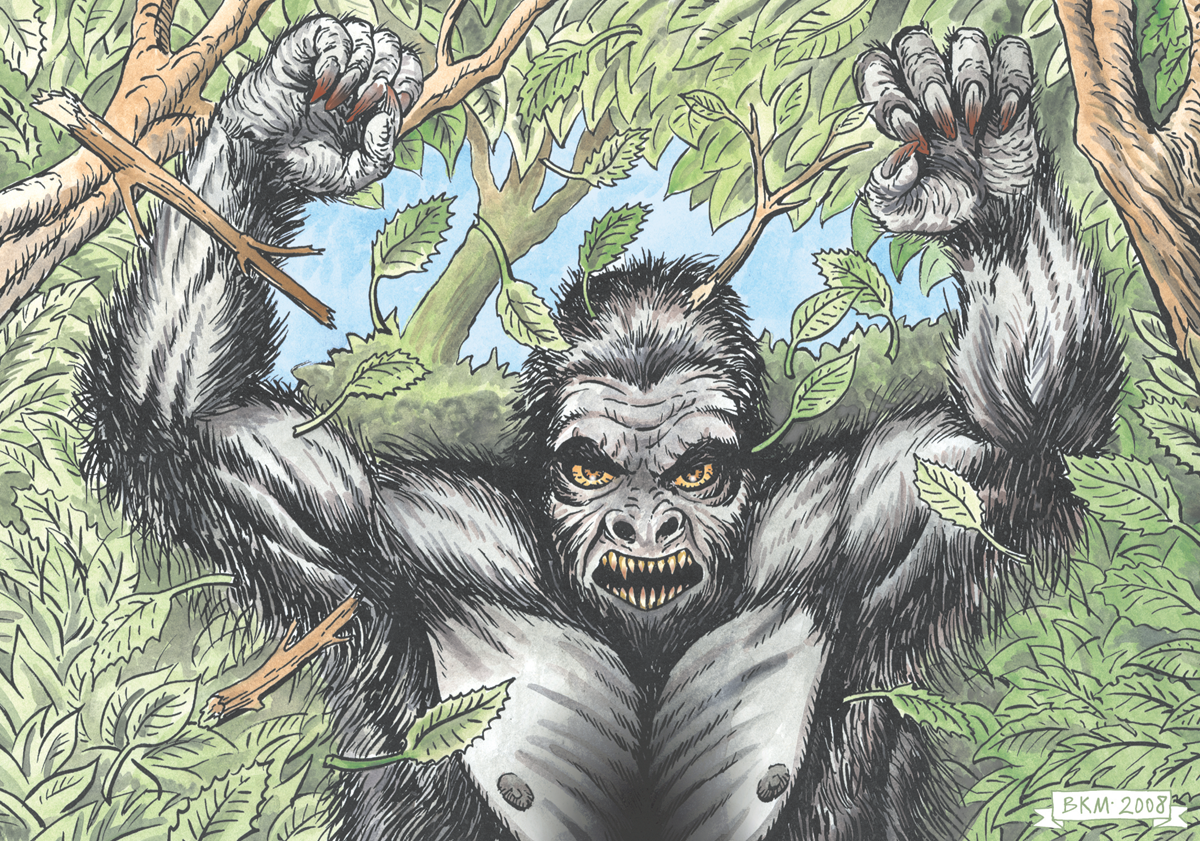
Front Cover. Hind, A. (2008a). Advanced Adventures 5: The Flaming Footprints of Jilanth. Expeditious Retreat Press.
Tomb Robbers and Dungeon Explorers, Not High-Fantasy Heroes
In order to construct a sense of nostalgia, the Advanced Adventures depict low fantasy dungeon explorers who are flimsy-armed, weak-kneed, and ill-prepared for underground exploration. This visual style, particularly in comparison to more recent versions of the game, references the wry humor of early D&D. TSR artists in the 1980s drew adventurers as bumbling treasure seekers whose go-for-broke attitude meant starving monsters never went hungry. The Advanced Adventures encode this aesthetic style in their cover and interior art through the depiction of helpless adventurers in hopeless situations—an approach reinforced in AD&D modules and rulebooks such as the Monster Manual (Gygax, 1978) and Dungeon Master’s Guide (Gygax, 1979). Careless adventurers could expect their tomb-robbing careers cut radically short in the clutches of a ravenous beast or mechanical trap. The sense of adventure, greed, and the pluckiness of low fantasy dungeon delvers kept them coming back for more. Understood in this context, the cover artwork of most TSR modules often provided a quick laugh at the expense of the old-school adventurer. This humorous self-reflexivity no longer exists in the current Fourth Edition of the game published in 2008. Instead, the haughty heroes of 4E carry little equipment, possess skill with magic and blade, and exude a sense of effortlessness that the old-school adventurer never attained. The artwork of the Advanced Adventures draws attention to the taste and value distinctions of old-school D&D by portraying adventurers who lack the heroism and confidence of their modern counterparts.
The scene on the cover of AA1 The Pod-Caverns of the Sinister Shroom (Finch, 2006) references the self-reflexive subtext in the representation of archetypal adventurers. Shown in Figure 1, the clumsy deportment of this group reflects their amateurish approach. Signifying his incompetence, the sole human fighter (center left) commits a grave error by dropping his sword at the first sign of danger. Instead of possessing a superior state of combat readiness, this bewildered warrior loses his composure and his blade the instant a podman places a hideous clawed hand upon his shoulder. Meanwhile, a scowling magic user, his left forearm held by a second podman, discharges a spell into the enemy’s abdomen. The wizard, sporting a silly blue magician’s cap complete with stars and moons, seems unfit for parlor tricks let alone the dangerous lifestyle of the dungeon explorer. Only the stout dwarven fighter, hefting his axe, stands ready to confront the throng of B-movie-inspired podmen. With the mêlée just underway, two thirds of the party have lost control of the battle. Their facial expressions fall short of the stoicism and self-assurance expected from modern fantasy heroes. Rather, the adventurers’ looks of dread and confusion portend a grim fate. Even if they survive the podmen’s initial assault, they must contend with the menacing Sinister Shroom (upper left) looming in the background. The artwork for AA1 The Pod-Caverns of the Sinister Shroom recalls the look and style of old-school adventurers from the 1980s whose cartoonish antics placed them at the mercy of the dungeon’s denizens.
Peter Mullen’s cover illustrations for AA12: The Barrow Mound of Gravemoor (Hind, 2009) underscore the representation of the old-school adventurer. On the back cover (Figure 3), a wizened, self-assured mage in orange robes gestures to the Barrow Mounds on the horizon. Dreams of treasure chests bulging with gold, magical rings, and gleaming gems likely occupy the minds of these adventurers. The front cover of this module (Figure 4), on the other hand, makes clear that the party received more than they bargained. Of the initial five adventurers, only three survive long enough to appear on the front cover. Here Mullen portrays a frenzied scene as the dwindling trio urgently resists the vicious attacks of two undead wights. This time, the now less-confident orange-robed mage winces as one of the creatures knocks the old man off his feet and shoves his face into the ground—the wight intends to dispose of this tomb robber with his bare hands. To save his companion from a gruesome fate, a bearded cleric in chainmail comes to the mage’s aid with his torch and iron mace poised to strike. Preparing to enter the fray, the third adventurer (upper left) in the background braces his shield while extending his sword arm. The battle bodes ill for the adventurers despite outnumbering the undead. Overpowered and caught off guard, the three adventurers must fight or flee. Mullen’s contemporary old-school art captures the spirit and “distinctive aesthetic modality” of an earlier time in fantasy gaming, when fierce monsters inspired dread and scrawny adventurers inspired laughter (Grainge, 2000).
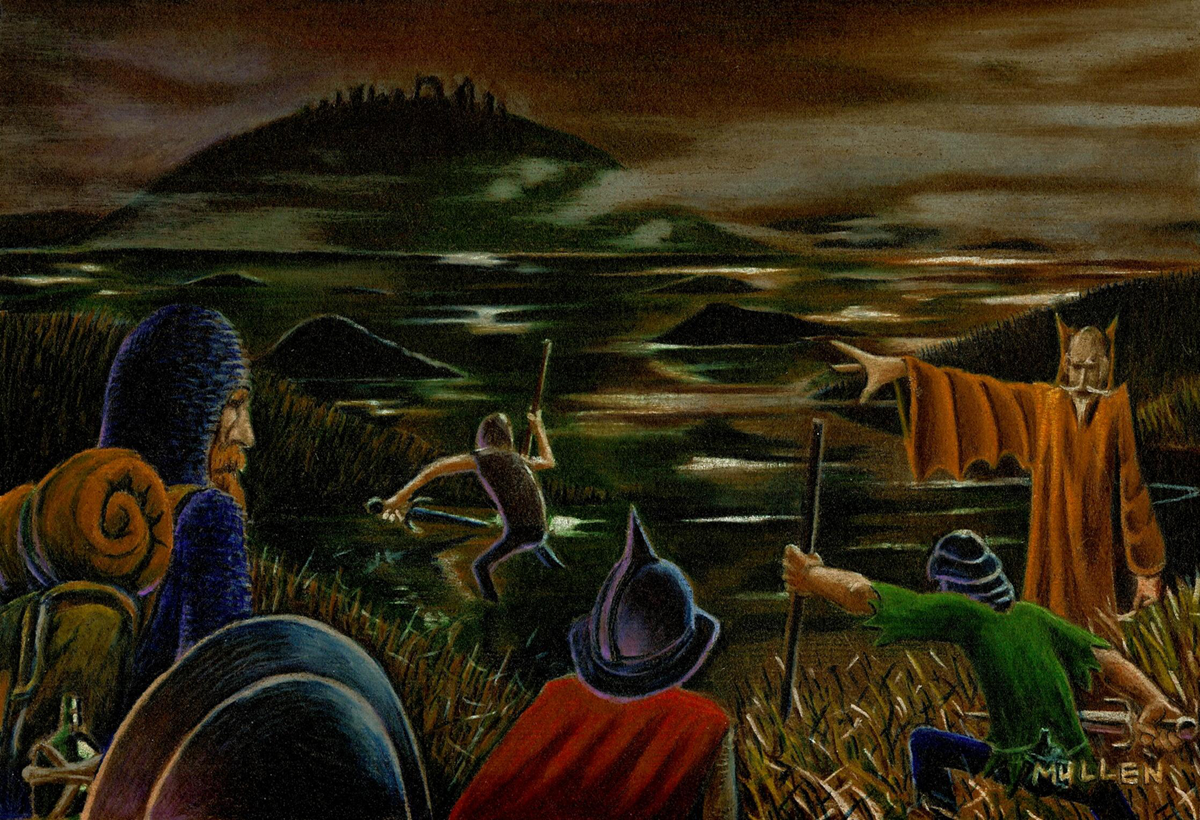
Back Cover. Hind, A. (2009). Advanced Adventures 12: The Barrow Mound of Gravemoor. Expeditious Retreat Press.

Front Cover. Hind, A. (2009). Advanced Adventures 12: The Barrow Mound of Gravemoor. Expeditious Retreat Press.
Mullen’s visual style draws inspiration from classic D&D illustrator Erol Otus. Otus, one of the first generation of TSR artists, is beloved by generations of D&D gamers. His body of work epitomizes the art of D&D from the late 1970s and early 1980s. Many gamers began playing D&D with Otus’ drawings as a backdrop. Seminal TSR box sets, manuals, magazines, and prepackaged adventures incorporated Otus’ psychedelic palette and equally colorful adventurers. Otus’ artwork graced the front cover of the 1981 Basic D&D Boxed Set—one of the most popular and financially successful introductory sets in the history of the game. His adventurers had a peculiar fashion sense that distinguished them from the work of other TSR artists. Adventurers wore eccentric armor and carried cumbersome shields that served more of an ornamental than functional purpose. To complement their wardrobe, Otus’ adventurers donned outlandish headgear, often pointy, that obscured their vision. Otus routinely depicted left-handed adventurers and adventuring groups succumbing to large savage monsters. In contrast to the art of Fourth Edition, his adventurers lacked the battle-hardened shrewdness of their modern counterparts. Instead, Otus depicted ordinary people in extraordinary situations, and, in doing so, invited gamers to see themselves in his art. Locked in a life and death struggle with bizarre alien-like monsters, these absurdly dressed adventurers highlight the quirky humor of old-school D&D. Caught in situations beyond their control, Otus’ existential depiction of old-school adventurers elicits both amusement and pathos. His whimsical approach and unique appeal have long since disappeared from the pages of D&D. Contemporary D&D, in both aesthetics and game mechanics, focuses on self-confidence and control rather than humorous self-reflexivity. Mullen’s front and back cover art for AA12: The Barrow Mound of Gravemoor (Hind, 2009) pays homage to the parodic style of Otus’ otherworldly oeuvre. In doing this, the Advanced Adventures allow for more than “temporary refuge from the present in the illustrated pages of the past” (Lovell, 2002). Rather, the nostalgic art provides precious symbolic meaning to old-school gamers familiar with Otus’ work and the cultural codes of old-school D&D.
Despite the obvious effort of the Advanced Adventures to remain within the classic D&D aesthetic, there are examples where the discourse of past and present confounds the depiction of dungeon explorers. The back cover of AA3 The Curse of the Witch Head (Boney, 2007; Figure 5), for example, depicts three adventurers surrounded by ghostly apparitions. Instead of old-school dungeon explorers laden with backpacks, rope, and other gear, the stylized look of these characters is more representative of the “dungeon-punk” aesthetic of Third Edition D&D (3E; Tweet, Cook, & Williams, 2003). Published by WotC in 2000 (and then revised and republished as 3.5E in 2003), this edition emphasized the aesthetic of punk rock subculture—specifically emphasizing tattoos, studs, straps, belts, and Mohawk hairstyles—in the representation of adventurers. This aesthetic was used to help distinguish the look of Third Edition from previous versions of the game. The dungeon-punk aesthetic clearly influences the characters illustrated in the back cover of The Curse of the Witch Head. The female warrior with the long sword (center left) and the character with the spiked Mohawk holding a torch (center) are both clad in studs, straps, and belts. The artists of Third and Fourth Edition D&D, similar to virtual games, do not burden their heroes with cumbersome adventuring gear. The characters depicted in Figure 5 reveal an aesthetic incongruent with the representation of old-school D&D.
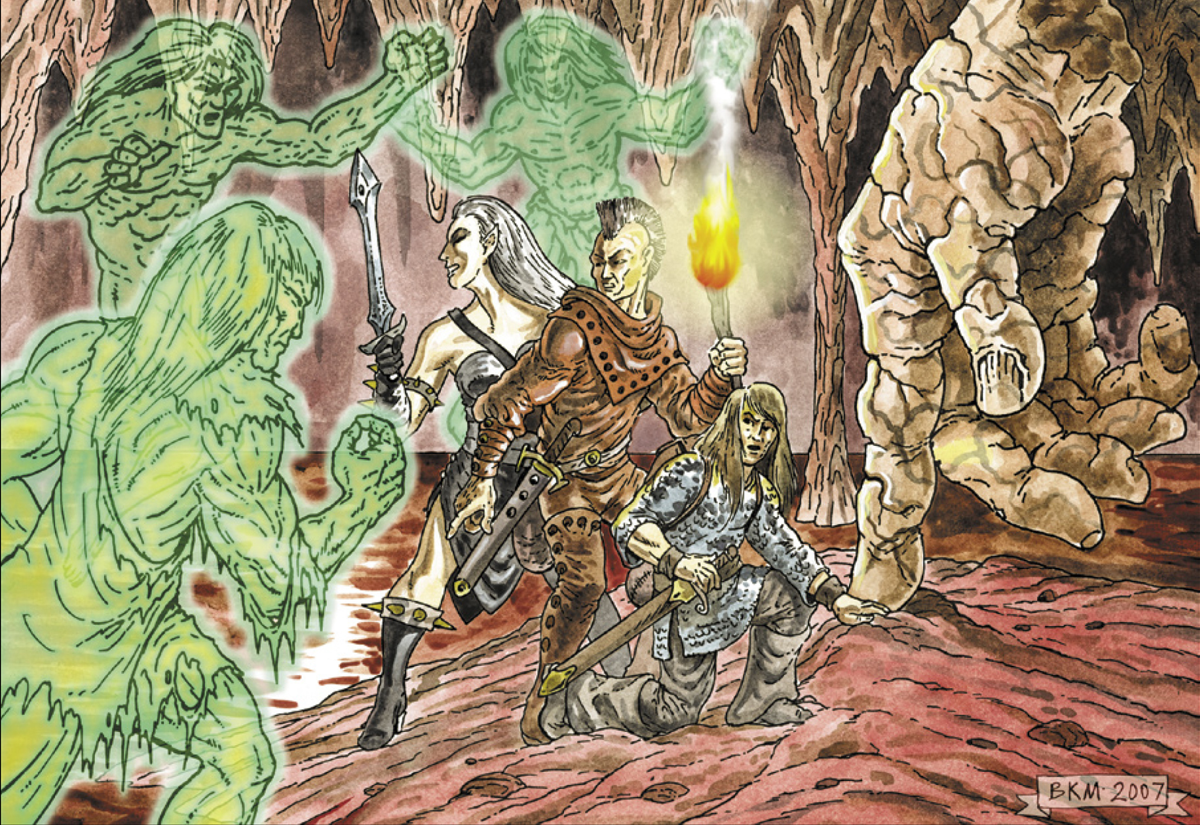
Back Cover. Boney, J. (2007). Advanced Adventures 3: The Curse of the Witch Head. Expeditious Retreat Press.
The morally ambiguous, low fantasy dungeon explorers depicted in the cover art of the Advanced Adventures stand in stark contrast to contemporary muscle-bound heroes. In early D&D, characters were weak and relatively ineffective in combat. This approach to gameplay emphasized the skill of the player over the abilities of the character and this encouraged the illustration of adventurers as thin-armed and weak-kneed. This style of representation reveals an understanding of early D&D as a distinct period-specific genre with unique cultural codes. These codes guide the way gamers read an image as a nostalgic text and are central to the construction of the old-school D&D aesthetic. These new modules hold meaning for old-school gamers because they possess the subcultural capital to recognize the lethality and the dark humor of early TSR-era D&D in the cover art of the Advanced Adventures.
Monsters, Monsters, Everywhere!
Monsters—strange, powerful, and insatiable—play a vital role in the art of old-school D&D. In the dungeon, danger exists in many guises but monsters provide the most frequent threat (Chrulew, 2006). Monsters lurk everywhere in the world of D&D. Goblins, ogres, and trolls scour the countryside looking for tasty human snacks. At night, undead vampires, ghosts, and zombies haunt long forgotten graveyards and ancient ruins. Due to their otherworldly and supernatural qualities, monsters help establish the fantasy aesthetic essential to D&D. Gary Gygax poached popular culture texts, folklore, and classic mythology for inspiration. He borrowed, for example, the Treants of D&D from Tolkien’s Ents, the Flesh Golem from Frank Whale’s Frankenstein (1931) starring Boris Karloff, and the Displacer Beast from the literary works of A. E. Van Vogt. Gygax and Arneson stocked their earliest dungeons with beasts culled from Hammer Film Studios, visual effects artist Ray Harryhausen, and 1950s B-movies as well as the traditional fantasy fiction. Over the history of D&D, gamers followed Gygax’s example and created new monsters based on the latest movies, television, and fantasy novels.
In classic fantasy module art, monsters overshadow the depiction of adventurers—another aspect of the wry, self-reflexive humor of early D&D. The art of early TSR modules and the Advanced Adventures emphasize strange creatures that overpower or outnumber their rivals or both. In most instances, monsters occupy more visual space than the adventurers. Artists further accentuate a monster’s superiority by positioning them in the foreground or in an elevated position above the player characters. The cover art of AA8 The Seven Shrines of Nav’k-Qar (Boney, 2008; Figure 6) illustrates a giant toad in the right foreground. The creature looks down on the unsuspecting pair, ready to strike. The cover of AA10 The Lost Keys of Solitude (Browning and Yee, 2008; Figure 7) depicts a new undead aberration called a Bone Sovereign. The fearsome mass of bones occupies fully two thirds of the foreground. Similarly, AA15 Stonesky Delve (Browning, 2010; Figure 8) illustrates an Umber Hulk, a classic D&D monster. In this image, the monster takes prominence by occupying the majority of the visual space. It appears to have caught three adventurers by surprise grabbing two of them with its huge claws. The cover of AA7 The Sarcophagus Legion (Hind, 2008b; Figure 9) recalls an iconic early D&D monster—the giant poisonous spider. The enormous armor-plated arachnid prepares to sink its fangs into a fresh meal. Only the spider’s thorax and legs appear within the frame. Still, the spider’s massive foregrounded body accounts for half of the illustration. Eight ruby eyes hinting of intelligence remain fixed on its prey. The situation bodes ill for the disheveled man who is now eclipsed by the immense spider. Cocooned remnants of past victims lay scattered throughout the background and foretell a gruesome fate. An expression of horror surfaces on the man’s face as the spider moves in for the kill. The front and back covers of AA9 The Lost Pyramid of Imhotep (Warden, 2008) further extend this motif and depict no adventurers at all. These illustrations call to mind the doomed collective mood of old-school D&D when monsters inspired fear and terror. Each of these illustrations employs a similar motif and pays homage to the humorous self-reflexive subtext of classic fantasy adventure. They emphasize common in-game situations where adventurers found themselves outwitted and outclassed by strange vicious monsters intent on their destruction.
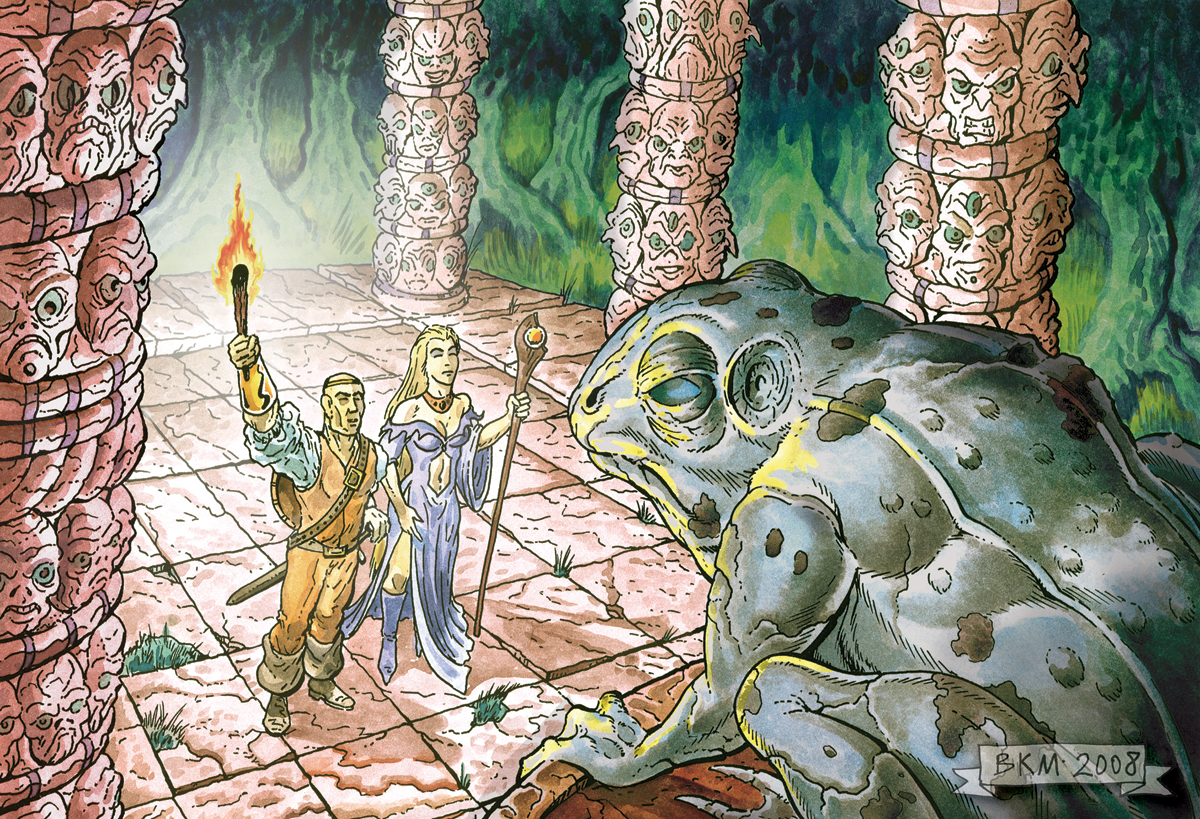
Front Cover. Boney, J. (2008). Advanced Adventures 8: The Seven Shrines of Nav’k-Qar. Expeditious Retreat Press.
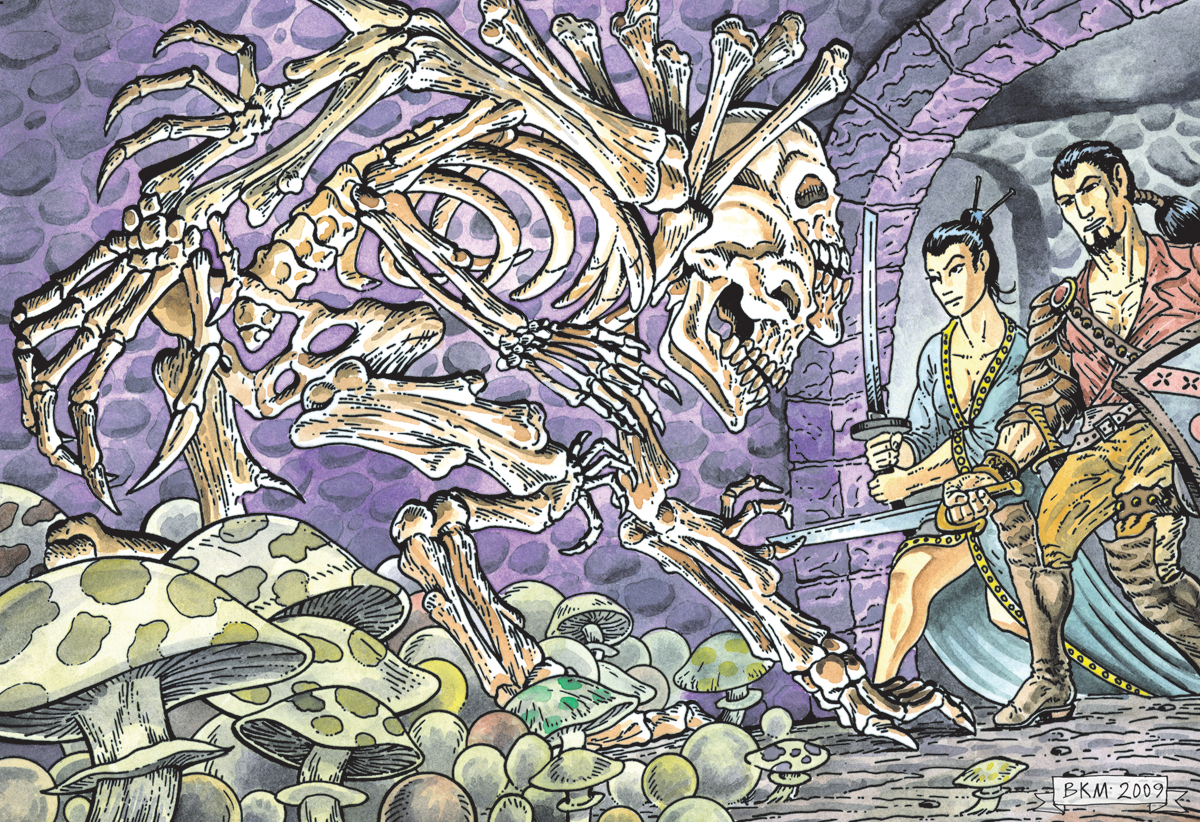
Front Cover. Browning & Yee, S. (2008). Advanced Adventures 10: The Lost Keys of Solitude. Expeditious Retreat Press.
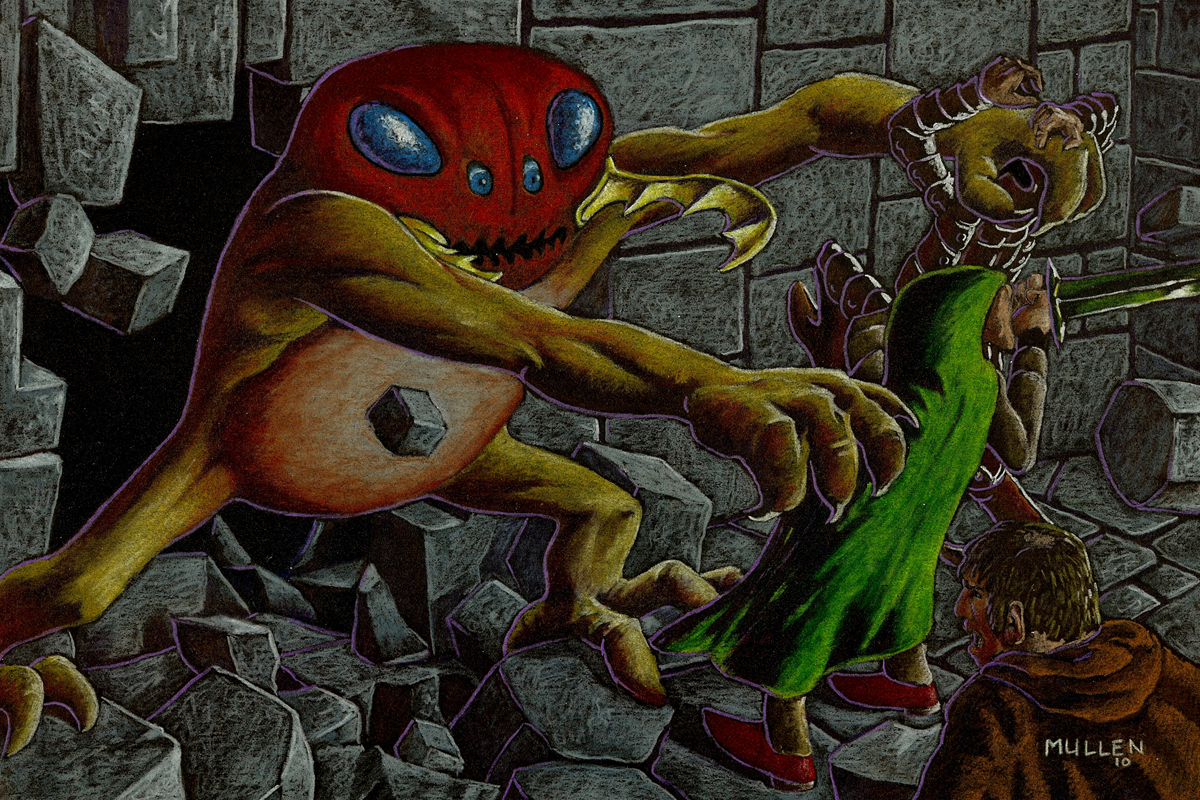
Front Cover. Browning, J. (2010). Advanced Adventures 15: Stonesky Delve. Expeditious Retreat Press.

Front Cover. Hind, A. (2008b). Advanced Adventures 7: The Sarcophagus Legion. Expeditious Retreat Press.
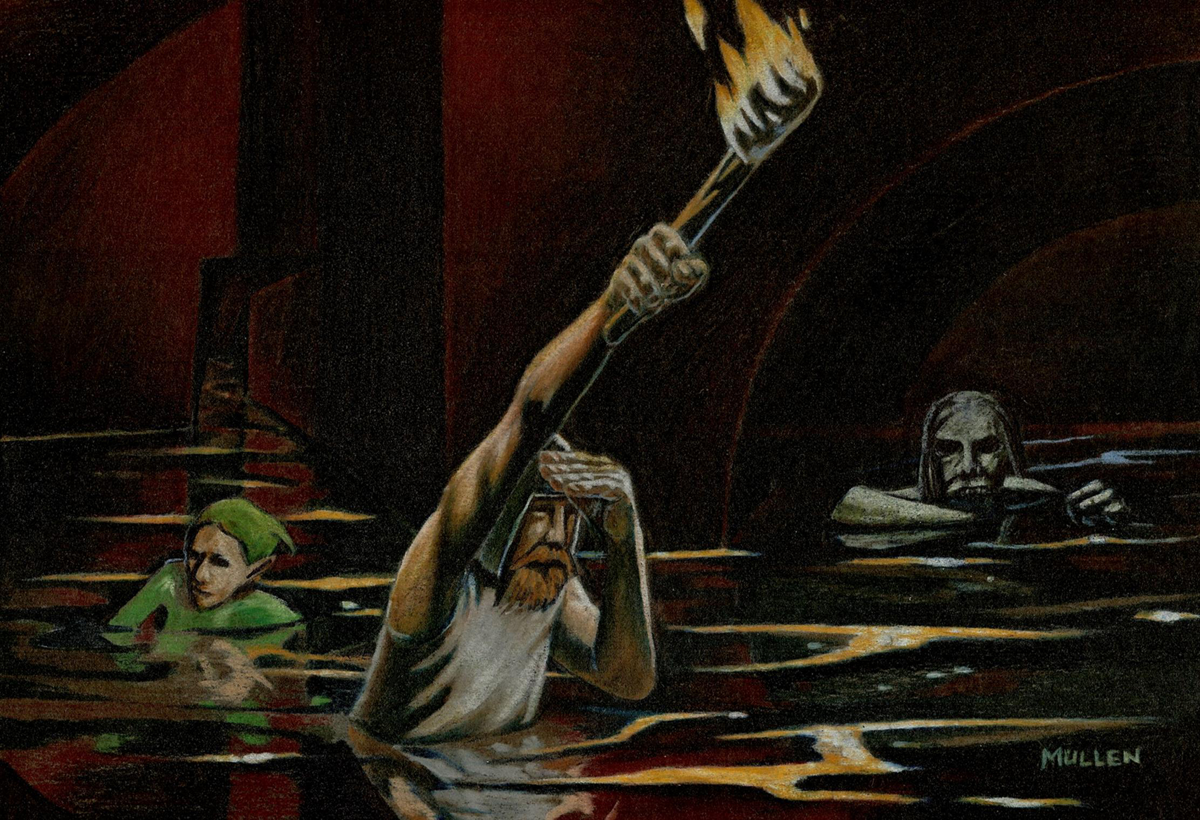
Further highlighting the plight of the dungeon explorer, the Advanced Adventures illustrate precarious life or death situations in which monsters surprise or surround adventurers. The back cover of AA13 White Dragon Run (Figure 10), for example, depicts an instance of dramatic irony—where the viewer possesses more information than the characters depicted in the scene. In this image, two adventurers appear lost in a half-submerged dungeon. Alongside a green-garbed elf, a human warrior holding a torch wades through the dark water as a white-skinned zombie or wight silently approaches from behind. Similar to this image, AA16 Under Shattered Mountain (Boney, 2010; Figure 11) portrays three adventurers fighting a pitched battle against a fearsome red dragon. As the dragon breathes fire on the shield-bearing warrior, a second dragon in the left background—sinister eyes glowing in the dark—circles the battle to attack from behind. The back cover of AA3 The Curse of the Witch Head (Boney, 2007; Figure 4) portrays three adventurers, deep underground, surrounded by three translucent specters. Finally, the back cover of AA11 The Conqueror Worm (Warden, 2009a; Figure 12) depicts three adventurers cornered by three frost giants and their vicious white wolves. In this image, the giant in the right foreground looks back at the viewer in a filmic form of direct address. TSR artists used this self-reflexive technique in the 1980s in modules like L2 The Assassin’s Knot (Lakofka, 1983) or DL6 Dragons of Ice (Niles, 1985). The technique pulls the viewer through the window of suspended action and into the scene, instead of reading the image from a third-person perspective. 12 The back cover of AA15 Stonesky Delve (Browning, 2010; Figure 13) depicts a fighter descending into a cave via a rope while his comrades hold a torch from above. The fighter is surprise attacked, mid-descent, by giant cave morays with sharp teeth. The back cover of AA1 The Pod-Caverns of the Sinister Shroom, shown in Figure 14, depicts a party of three being attacked by a giant fanged tentacle beast. The dwarven fighter rears back, his face stricken with fear while the creature viciously mauls a human fighter. An elven magic user stands behind the warriors holding a lantern about to cast a spell.

Back Cover. Advanced Adventures 13: White Dragon Run. Expeditious Retreat Press.
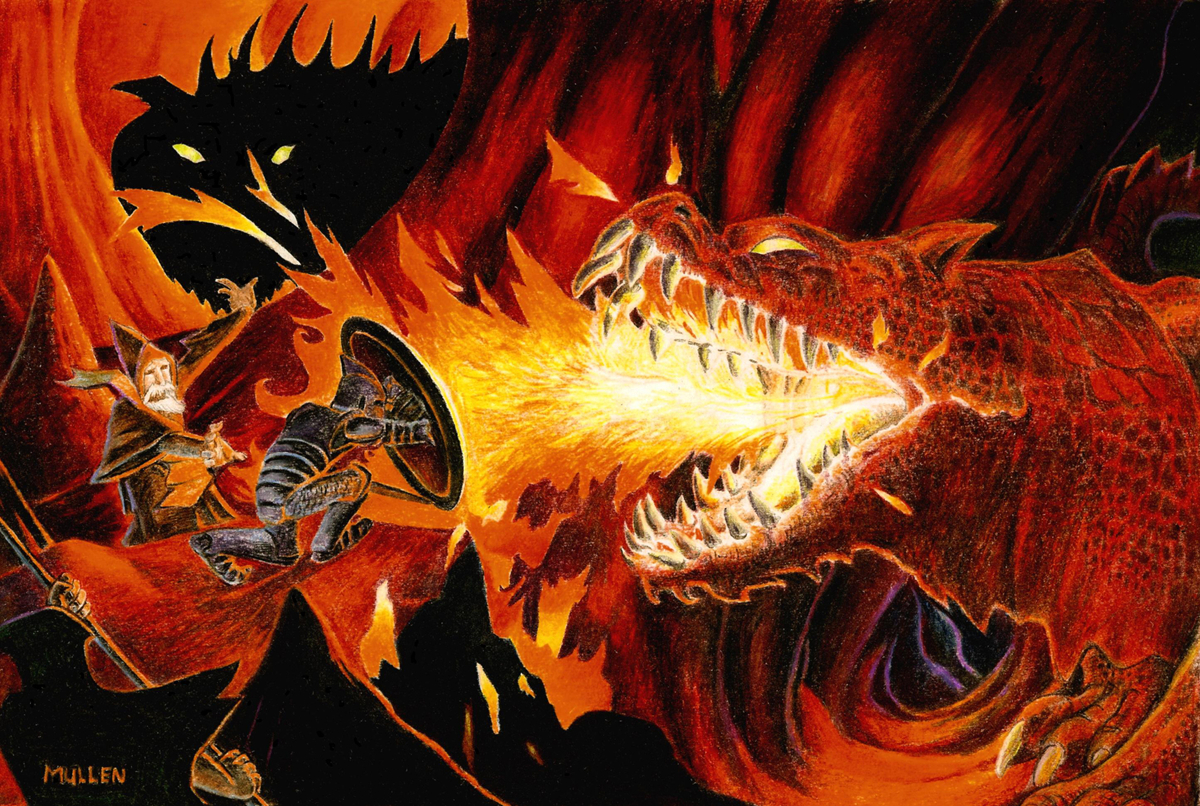
Front Cover. Boney, J. (2010). Advanced Adventures 16: Under Shattered Mountain. Expeditious Retreat Press.

Back Cover. Warden, A. (2009a). Advanced Adventures 11: The Conqueror Worm. Expeditious Retreat Press.
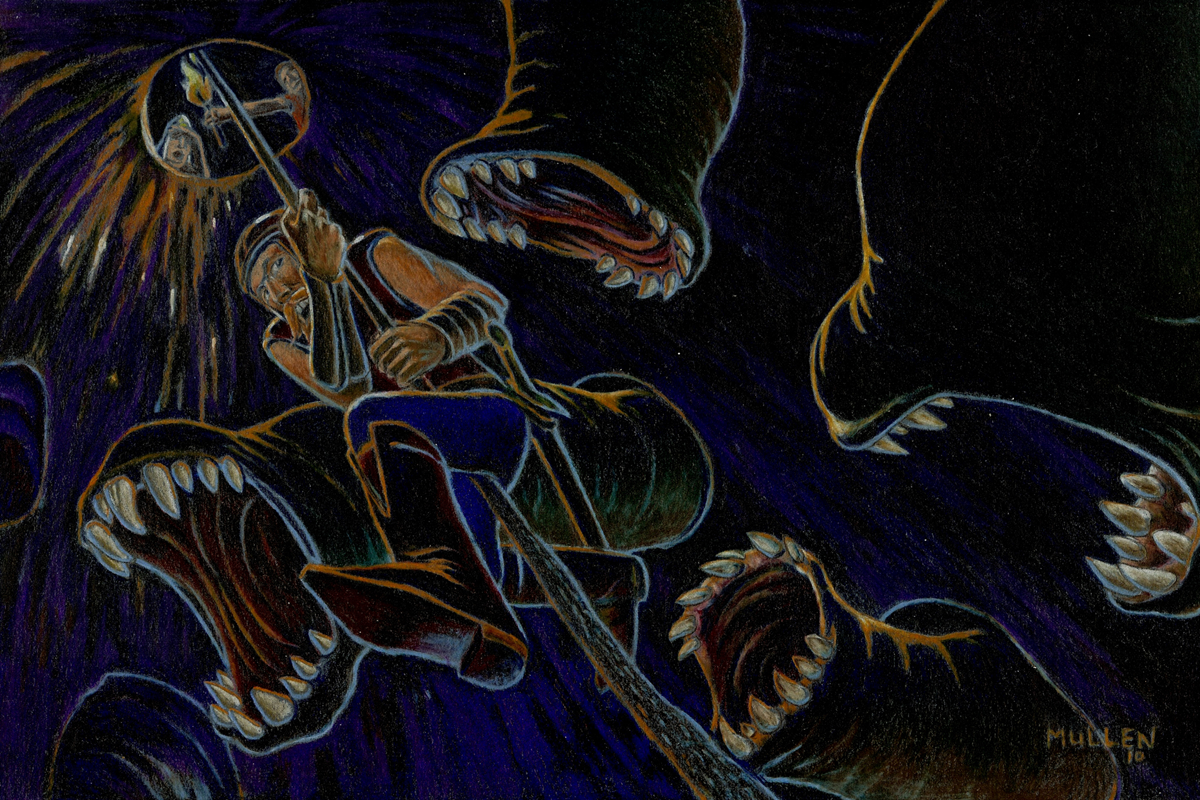
Back Cover. Browning, J. (2010). Advanced Adventures 15: Stonesky Delve. Expeditious Retreat Press.
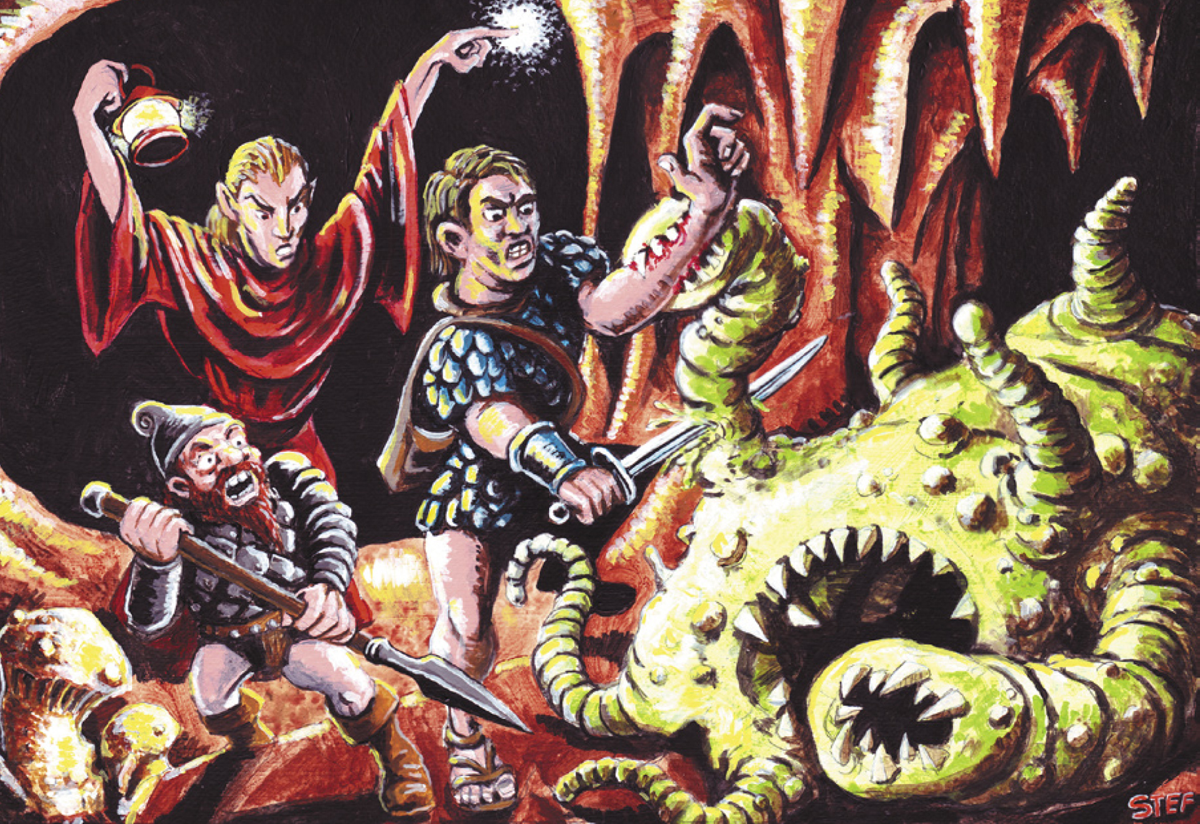
Back Cover. Finch, M. (2006). Advanced Adventures 1: The Pod-Caverns of the Sinister Shroom. Expeditious Retreat Press.
Similar to the representation of dungeon explorers, the Advanced Adventures depict monsters based on the visual style of early TSR D&D from the 1980s. Instead of emphasizing modern high-fantasy heroes with oversized biceps and enormous weapons, the cover art of these modules draws attention to the supremacy and agency of monsters over player characters. The use of dramatic irony, for example, reveals the application of a familiar aesthetic trope drawn from the foundational texts of the early TSR-era such as the AD&D Monster Manual (Gygax, 1978) and the Dungeon Master’s Guide (Gygax, 1979). Old-school gamers immediately recognize and understand examples of dramatic irony in the cover art of the Advanced Adventures. The cultural meaning drawn from the art-as-text is clear and decidedly old-school in tone and humor—regardless of what you do, you will die.
The Dungeon Crawl
The dungeon crawl is ubiquitous in the Advanced Adventures and old-school D&D. The authors of classic pulp Sword and Sorcery fiction, like Robert Howard (Conan) or Fritz Leiber (Fafhrd and the Gray Mouser), described their characters exploring ancient temples or dark underground locations. 13 Similarly, dungeons—haunted crypts, ruined shrines, orc strongholds, or abandoned dwarven mines—remain popular among old-school gamers. The game privileges the dungeon as the place of exploration and adventure. In D&D terms, a dungeon, much more than a simple torture chamber, constitutes “an enclosed, defined space of encounter areas connected in some fashion” (Gygax, 1979).
The dungeon crawl requires fighting monsters, avoiding traps, and collecting treasure—or in player vernacular, “killing monsters and taking their stuff.” Some fantasy gamers, exclusively motivated by role-playing, pejoratively refer to the dungeon crawl as a “hack and slash” game or “roll-playing.” The label “roll-playing” emphasizes the constant rolling of dice in combat. Dungeon crawling requires adventurers to brave hordes of hostile monsters and perilous traps. Famous archetypal dungeons in literature include Tolkien’s Lonely Mountain (Tolkien, 1937) and the Mines of Moria (Tolkien, 1955) from the Middle Earth saga. Moria with its half-submerged, orc-infested halls, to this day influences the dungeons of D&D. Highly symbolic, the descent into the dungeon for D&D gamers demarcates the constructed threshold between reality and fantasy. As the adventurers descend further and further into the underground abyss, the rewards multiply and enemies become increasingly more difficult. High-level monsters like ancient red dragons and multi-eyed beholders often safeguard the richest treasures. As Gygax stated in 2000, “The dungeon crawl is [a] classic and undying” challenge and represents a unique style of play essential to old-school gaming (Gygax, 2000).
The Advanced Adventures repeatedly illustrate the two most popular locations for dungeon crawling: the dungeon and the underdark. Dungeons are portrayed as dark, dank locations that possess an oppressive, claustrophobic feel. Fantasy artists use bas-relief of skulls and tormented faces to signify death, danger, and pain (Figures 6 and 18). These locations are often depicted with cracked fieldstone walls and floors. Dungeons are littered with ruined columns and statues and are half-sunken in water (Figures 5, 6, and 15). The underdark, consisting of subterranean caves and passages, possesses similar significations. Artists depict anthropomorphic background features, such as a cave mouth, smoke, or rock formations. For example, caves are often illustrated with stalagmites, and especially stalactites, to reinforce the feeling of being surrounded or suffocated by the weight of the earth from above. Illustrators use these natural formations to represent teeth, as if the environment was symbolically consuming the dungeoneers (Figures 1, 5, and 14). Artists often depict caves with giant mushrooms. Giant mushrooms have long been used to signify otherworldliness in fantasy fiction. Figures 7, 14, and 16, for example, draw on early fantasy texts like Verne’s A Journey to the Center of the Earth (1864) and Carroll’s Alice in Wonderland (1865) where giant fungi defy the laws of nature and signify otherworldliness.

Front Cover. Boney, J. (2007). Advanced Adventures 3: The Curse of the Witch Head. Expeditious Retreat Press.

Back Cover. Browning & Yee, S. (2008). Advanced Adventures 10: The Lost Keys of Solitude. Expeditious Retreat Press.
Light and shade are central aesthetic motifs in the construction of a suspenseful dungeon crawl. Light serves as an indispensable tool in a dungeoneer’s arsenal and shrewd adventurers fill their backpacks with torches, tinderbox, and oil flasks before descending to the depths of a dungeon—a descent that bears Dantean associations. Illustrations of torches and lanterns in the Advanced Adventures are legion and accentuate the importance of light and shade in fantasy RPGs. Figures 1, 4, 5, 6, 10, 12, 13, 14, and 17, for example, demonstrate the importance of torches and lanterns when recreating the retroscape of the old-school dungeon crawl (Brown, 1999; Cruz, 2007). Similarly, some gamers even play D&D by lantern light or candlelight in an attempt to recreate the shadowy atmosphere of the dungeon. Torches provide additional advantages beyond illuminating the dungeon and its evildoers. Since one cannot plunder what one cannot see, dungeon crawlers carry lanterns and torches to search for secret passageways that conceal shiny treasures. What better motivation does combating hordes of monsters in the dark offer but the glitter of gold reflected in one’s torch? Torches, once as valuable as a magical blade or a powerful spell, signify classic fantasy gaming and are a defining feature of the early dungeon crawl. The default position of 4E D&D is that “many dungeons and caverns are [already] illuminated to some degree” (Wyatt, 2008). The cover art of the Advanced Adventures encodes the shadowy aesthetic and claustrophobia vital to the dungeon crawl and in doing so establishes difference from the brightly lit aesthetic of Fourth Edition.
The cover illustration for AA2 The Red Mausoleum (Boney, 2006) highlights the depiction of the dungeon crawl and pays homage to early TSR D&D. Shown in Figure 17, the action in this scene occurs across all three planes, foreground, midground, and background. A sense of foreboding captures the essence of this dungeon crawl as symbols of death constantly remind adventurers of their folly. In the background of The Red Mausoleum, a skull carved archway looms menacingly above a shadowy doorway. An eerie crimson glow radiates from the red stone “impervious to brute force and magical destruction” (Boney, 2006). Four adventurers, in the center midground, frantically work in unison to defend themselves. A beam of divine light erupts from a cleric’s holy symbol (far left) and causes two undead, on the verge of scaling the chasm, to recoil in pain. The purple-robed mage (center left) lifts a skull staff above his head while gesticulating a spell with the other hand. The halfling thief (center right) holds the undead at arm’s length with torch and sword in hand. The fighter clad in platemail (far right) plunges a longsword into the torso of one of the undead. The positioning of adventurers from a low angle contributes to the general unease by providing viewers with the monster’s point of view. The undead crawling out of a pit in the foreground offers little recourse for the adventurers.
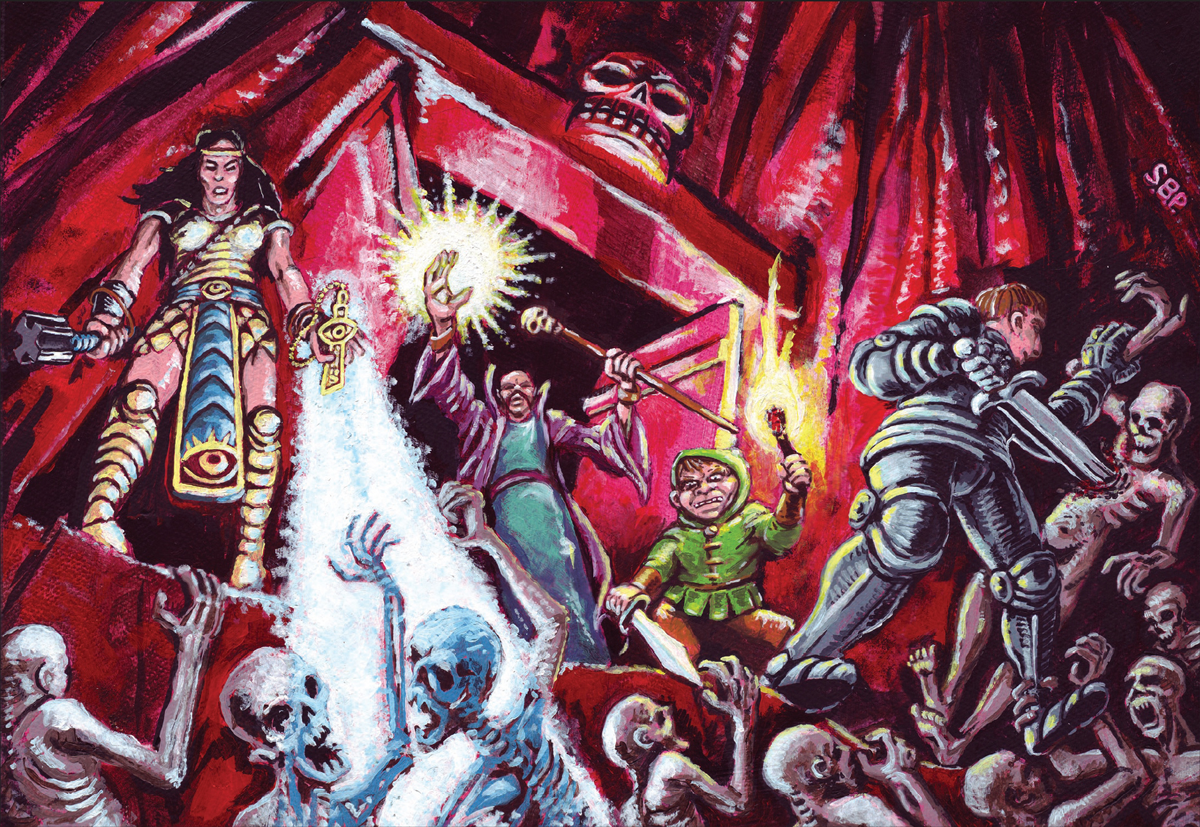
Front Cover. Boney, J. (2006). Advanced Adventures 2: The Red Mausoleum. Expeditious Retreat Press.

Back Cover. Warden, A. (2009b). Advanced Adventures 14: The Verdant Vault of Malakum. Expeditious Retreat Press.
The window of suspended action used by TSR artists often referenced a specific scene directly from the pages of the module’s dungeon. Shown in Figure 18, AA14 The Verdant Vault of Malakum (Warden, 2009b) provides an example of the cover art working in concert with the adventure. In the module, author Alphonso Warden labels Room #13 (p. 7) as “Beloved Pet.” Warden describes the room as covered with large rib bones. The walls are painted with ancient murals depicting a giant snake squeezing its prey to death. After stepping five feet into the room the adventurers set off a magical trap that seals the door behind them. Under the ancient magic of the wizard Malakum (an ancient mummy in another part of the dungeon) the bones on the floor reanimate as a giant skeletal python. The huge beast then proceeds to attack the trapped adventurers. This encounter with the giant skeletal python is portrayed on the back cover of the module. The illustration by Peter Mullen depicts the skeletal snake, murals, and three adventurers clad in heavy platemail. A cleric (center left) stands fast with his raised holy symbol, hoping the divine power of his deity might rebuke the undead creature. The fighter beside him raises his large round shield in defense. Finally, a third character (left foreground), wide-eyed and screaming in fear, backs away from the monster. Here again the monster occupies the majority of the space within the visual frame. The snake’s body winds through the back, mid, and foreground of the image, which further accentuates the size of the snake relative to the adventurers. Old-school gamers instantly appreciate the plight of adventurers. The artwork provides a visual account of the ferocious monsters and traps contained in the module. The cover refers to a specific location and also cautions would-be treasure-hunters of the dungeon crawl’s potential hazards. Similar to the direct address technique discussed earlier, using the cover art to reference game situations allowed players to see themselves, and specifically their characters, in the game world. D&D gamers take ardent pleasure in speculating how their adventurers might fare when placed in comparable situations. Those who play AA14 The Verdant Vault of Malakum can only hope their adventurers will do better when trapped with the giant skeletal snake.
Like the representation of adventurers and monsters, the art of the Advanced Adventures highlights a specific retroscape of the dungeon and dungeon crawling. Retrogamers read the dungeons and natural caverns depicted in these modules through the cultural codes of fantasy fiction and TSR D&D. The flagstone backgrounds, giant mushrooms, and bas-relief serve as signifiers that when read together construct a setting that is medieval, otherworldly, and dangerous. The use of light, in the form of torches and lanterns, serves to highlight the darkness of these underground complexes and reminds players of their fate should they fail to manage their resources. In addition to monsters, early D&D set the dungeon environment against player characters. The aesthetic construction of the dungeon, and its specific subcultural codes, conveys nostalgic meaning for old-school gamers and stands in contrast to later iterations of the game.
Conclusion
The nostalgia aesthetic forwarded in the cover art of the Advanced Adventures—either through the depiction of adventurers, monsters, or dungeon crawling—reveals a politicized discourse of past and present. By constructing new adventures based on idealized retroscapes from the 1980s, old-school D&D products like the Advanced Adventures pay homage to the past while positioning the current edition of D&D as unsatisfying and overly-complex. From the perspective of old-school gamers, the art of the contemporary game is sanitized, influenced by the “hero-play” of massively multiplayer online (MMO) role-playing games, and (paradoxically) unrealistic. The nostalgic cover art connects to other past–present meanings in this subculture. The Advanced Adventures are written for the OSRIC game system that serves as an emulator of the AD&D rule set. The styles of play forwarded by OSRIC/AD&D and Fourth Edition D&D are fundamentally different. In the view of old-school gamers, OSRIC/AD&D highlights a rules-lite form of play that emphasizes the cleverness of the player over the abilities and skills of the character. This promotes creative problem solving and opportunities for role-play. The rules-heavy approach to character generation and game mechanics in later editions slows gameplay, focuses on the notion of character builds and encourages min-maxing. The broader the perceived gap between the past and contemporary editions of the game, the greater the nostalgic yearning for products like the Advanced Adventures.
Through the discourse of past and present, the Advanced Adventures paradoxically focus on the future and serve as an expression of subcultural agency. At first glance, one might disregard these modules as simple nostalgic products that merely sentimentalize the past for profit. By publishing new adventures, employing new designers and artists, these adventure games breathe life into out-of-print editions of D&D, retroclones such as OSRIC, and their gamer subcultures. Working parallel to bloggers, community forums, and fanzines, Expeditious Retreat Press and their Advanced Adventures help chart a new course for classic fantasy gaming that is distinct and separate from that espoused in Fourth Edition.
The nostalgic aesthetic of the Advanced Adventures reveals a humorous self-reflexivity. Rather than referencing the contemporary champions of Fourth Edition, video games, and MMOs, the cover art offers a parody from within through the construction of thin-armed, poorly-prepared adventurers barely clinging to life, or surrounded by ravenous monsters deep underground. By portraying comical in-game situations set within a genre and period-specific set of subcultural codes, the cover art reveals a self-deprecating tone consistent with early fantasy gaming and thereby draws attention to itself as a representation. Through humor, the cover art highlights its own artificiality and the self-reflexive nature of nostalgia within old-school D&D subculture.
The complexity of nostalgia—and its many and varied expressions—makes the phenomenon of old-school D&D retrogaming difficult to explain. However, there are some generational considerations that do shed some light. Most gamers were introduced to D&D in late childhood or during their early teens at the height of the game’s popularity between the mid-1970s and the 1980s. Now in their 30s and 40s, retro role-players want to buy and play similar games, like the Advanced Adventures, with their own children or to reunite with friends by playing tabletop games online. It is likely no coincidence that the Golden Age of RPGs coincided with the Golden Age of video games in the 1970s and early 1980s and that the games of this period left an indelible mark on the identity of many gamers (Maliszewski, 2009b; Whalen & Taylor, 2008). The popularity of “Plug it in and Play TV Games” in the mid 2000s, with classic period titles like PONG (1972), Frogger (1981), and Pitfall (1982), and the availability of early arcade-style dungeon crawls like Gauntlet (1985) on Xbox Live, speaks to this point (Payne, 2008).
Although these factors provide social and historical context, we are still left with the question: How do we explain the phenomenon of D&D retrogaming? D&D represents an important “first” in our gaming lives. The gamers of the 1970s experienced a new paradigm in the nature of tabletop play: the first fantasy RPG. Much of the nostalgia for old-school D&D is the desire to reexperience the liminality of that first play experience, that feeling of standing on the threshold, between the physical world and the game world (Fenty, 2008). This experience was as profound for the first generation of D&D gamers as it was for us when we entered the hobby in the early 1980s. Do you recall the feeling of apprehension the first time you lit your torch and descended into a dark dungeon? Do you remember your heart pounding the first time you tried to sneak past an orc guard? Perhaps you remember the lump that grew in your throat the first time your Dungeon Master told you to “save or die”? The nostalgia for early D&D, we feel, is driven by the liminality of similar first play experiences.
Similar to the module The Caverns of Draconis in NBC’s episode of Community, the Advanced Adventures, and their distinct old-school D&D aesthetic, capture and idealize the zeitgeist—the newness, excitement, and enthusiasm—of the game during the height of its popularity. Through TSR-inspired design and period-specific cover art, the Advanced Adventures serve as powerful nostalgic talismans that drip with cultural meaning through coded references, significations, and information capital. The nostalgic aesthetic of these modules works ideologically as an indirect challenge to Fourth Edition while asserting the beliefs and values of old-school D&D subculture.
Footnotes
Acknowledgment
The authors would like to thank Joseph Browning and Suzi Yee from Expeditious Retreat Press for their willingness to contribute to this research.
Declaration of Conflicting Interests
The author(s) declared no potential conflicts of interest with respect to the research, authorship, and/or publication of this article.
Funding
The author(s) received no financial support for the research, authorship, and/or publication of this article.