




Abstract
The role of political persuasion in Star Wars: The Old Republic (SWTOR) affirms the serious nature and even educational value possible in video games designed with entertainment as their primary motivation. Within SWTOR, players wrestle with political conflicts first posited centuries ago by Enlightenment thinkers and have an opportunity to use the game as a springboard for political reflection in the contemporary world. Based upon surveys and interviews, this study reveals that politics can inform the cultural experience of entertainment games; SWTOR offers valuable lessons in civics by providing opportunities to explore and engage with the political philosophies of our Enlightenment heritage.
Keywords
Introduction
The role of political persuasion in Star Wars: The Old Republic (SWTOR) affirms the serious nature and even educational value possible in video games designed with entertainment as their primary motivation. Within SWTOR, players wrestle with political conflicts first posited centuries ago by Enlightenment thinkers and have an opportunity to use the game as a springboard for political reflection in the contemporary world. Although it would be civically laudable for our contemporaries to study the Enlightenment political philosophy upon which modern societies rely, and to apply such thought to our world, only the uncommon student still reads Hobbes or his successors. And yet, this is not to say that there is no access to Enlightenment thinking in contemporary life. To rectify such problems, game designers and educators have already begun collaborating on the development of games that promote civic awareness and education (see Raphael, Bachen, Lynn, Baldwin-Philippi, & McKee, 2010). Although such efforts are part of the serious games movement, there are ways in which politics also informs the cultural experience of entertainment games; SWTOR offers valuable lessons in civics by providing opportunities to explore and engage with the political philosophies of our Enlightenment heritage.
Over the past two decades, scholars have focused increasing attention on video game culture and have recognized the powerful role that games now play in contemporary life. The political processes of SWTOR reflect, perhaps, a step in the direction of Edward Castronova’s (2007) belief that game experiences will lead players to demand policy shifts in contemporary life, especially considering how he and other scholars argue that the “magic circle” separating game life and conventional life is blurry at best. Online games such as SWTOR are integral to the social experience of contemporary gamers (Simon, 2006) and are thus crucial to the overall nature of how players view social problems and interpersonal connections. It is these connections that we must reveal in our inquiry into game culture. Gamers “integrate systems into our everyday lives and, in turn, into our everyday social networks and practices…the challenge ahead involves exploring grounded practices, the structural conditions of production and use, and the real ways players make sense of these spaces” (Taylor, 2006, pp. 152–153). Other scholars have traced such issues related to justice in the use of and within online worlds (Dyer-Witheford & de Peuter, 2008; Rowlands, 2012; Sicart, 2009). Our research contributes to this effort by adding empirical data to this theoretical enterprise: The data provide clues as to how players think about politics as they play SWTOR and provide clues as to how SWTOR—and similar game environments—contribute to the sociopolitical world in which we now live.
Fascinatingly, players engage political philosophy by gaming in the Star Wars universe created by George Lucas. Gaming is often a course in civics, a practical guide to living and thinking (Light, 2008), and Lucas has repeatedly emphasized that the Star Wars films offer moral lessons that engage and include—as we shall argue throughout this article—a practical exploration of 20th-century moral and political philosophy. Writing Star Wars with children in mind, Lucas encapsulated a moral and civic agenda in the films, and this agenda remains critical to the play of SWTOR, a massively multiplayer online game. Speaking of these aspects of Star Wars, Lucas says: I wanted it to be a traditional moral study, to have some sort of palpable precepts in it that children could understand. There is always a lesson to be learned. Where do these lessons come from? Traditionally, we get them from church, the family, art, and in the modern world we get them from media—from movies. (quoted in Seabrook, 1997/1999, p. 205–206)
By deliberately using film to teach lessons that once came from religious institutions, Lucas practices what scholars have called “implicit religion” (Bailey, 1983) and “authentic fakery” (Chidester, 2005). That such practices are divorced from traditional religious groups does not mean they are without value; after all, authentic fakes can still lead toward moral behavior or social goods. Lucas’s moral lessons, whatever their authority, are always civically minded; as he says, the “world works better if you’re on the good side” (quoted in Weinraub, 1997/1999, p. 223). Thus, the stories Lucas tells reveal an ethical good that is simultaneously a social good: Following the Star Wars precepts should improve society. He created Star Wars out of a “desire to make modern fairy tale,” which is how “people learn about good and evil, about how to conduct themselves in society” (quoted in Harmetz, 1983/1999, p. 143).
Nearly every American parent over the past three decades has watched his or her child raise up a plastic (or imaginary) lightsaber to strike down Darth Vader and the forces of evil. In essence, such ritual combat draws upon Lucas’s mythos to train children in moral behavior and in recognizing the difference between good and evil. Thanks to SWTOR, children and adults alike can engage in this, and some players do see themselves personally growing as a result of the game. “I think games like these,” writes one survey respondent, “provide players an opportunity to stop and think: ‘What would I do in a similar situation?’ I think the resulting internal discussion is important and beneficial for self development.” 1 Other respondents tied SWTOR more directly to their moral lives, such as those who wrote “I do feel that the Jedi Philosophy in general can help in real-life situations and is beneficial” and “I began to really resonate with the teachings of the Jedi, and in a few small ways it made me a better person.” Thus, for some players at least, SWTOR is a continuation of the pretend play by which children could learn to uphold justice in the world.
Because Lucas created Star Wars with a civic agenda—the teaching of good and evil, proper social behavior, and so on—in mind, it is an excellent tradition in which to consider the evaluation and formation of political ideas through pop culture. In order to evaluate one way in which gaming lives at the crossroads of entertainment and education, we employed a multidisciplinary approach to the massively multiplayer online game, SWTOR. Data were acquired through two surveys described and linked on the SWTOR official forum, NewWorldNotes.com, and TORwars.com. Respondents to the first survey (n = 256) were primarily male (86%), ranging in age from 18 to 60 (65% of respondents were in the 18 to 30 range). Respondents to the second (n = 369) were 90% male and approximately the same age as those of the first survey. SWTOR forum members were encouraged to answer “interview” questions on the forum, and an open comment field in the surveys provided additional opportunities for direct participation by SWTOR players. 2 In addition, the authors performed a careful reading of the game through play as members of both the Galactic Republic and the Sith Empire.
SWTOR is particularly appropriate for an analysis of political philosophy and gaming because the Star Wars universe exemplifies the conflict between Thomas Hobbes and the Enlightenment republicans. The ongoing war between the Sith Empire and the Galactic Republic traverses two film trilogies and dozens of books that take place both before and after the films’ events. Throughout these canonical sources, the debate between totalitarian control and republicanism is a weighty matter for contemplation, as key characters struggle to establish safety and peace for their loved ones and the galaxy as a whole. In SWTOR, players join either the Empire or the Republic in an historical time thousands of years before the events of the six Star Wars films and therein “anticipate” the debates to come. Through play, gamers experience firsthand the political philosophy of the Enlightenment as enacted in the franchise.
Fans of Star Wars have immersed themselves deeply in its universe, and this adds to the political significance of the game. Thanks to a media empire that spans film, television, comics, toys, games, and more, Star Wars permits of a truly immersive environment, one to which fans contribute rather than simply consume. Star Wars fans have created role-play areas in the virtual world Second Life, for example, and write blogs and news stories about the Second Life communities as ways of reinforcing them (Guitton, 2012). According to John Lyden, fan production of Star Wars content is comparable to religious participation, and the process through which that production takes place reveals not only the religiosity of popular culture but also the changing nature of religious canon in our technological age (Lyden, 2012). Systems of communication are vital to nation building (Anderson, 1983/2006), and in this spirit it is through the production of websites and virtual spaces that Star Wars fans establish themselves as participants in a true community. Having done so, they must then address many of the political and moral questions that accompany communities in real life. 3
In SWTOR, players work through the inheritance of Enlightenment political philosophy through basic game structures. First and foremost, they must join the Empire or the Republic or attempt to remain neutral in the conflict between these two political factions. No matter their decision, all players will engage in the debate between the two groups and their opposing political ideologies. In doing so, they actually learn many of the basics of political philosophy and can apply that knowledge to political thinking more broadly. The Star Wars franchise has already provided some people with a mythic system around which to construct a religious enterprise (see Possamai & Lee, 2011, p. 229); in SWTOR, it gives players the opportunity to individually work through questions of political significance, making choices and understanding the ramifications of totalitarianism and republicanism. In an era of underwhelming political participation and market-oriented education, such philosophical affordances are an important part of the game landscape and represent both promise and peril for game designers who necessarily engage in political decision making through their work. 4
The 20th Century’s Twin Inheritance
The Enlightenment was crucial to the 20th-century politics that shape the Star Wars universe, and we can see the intellectual roots of 20th-century totalitarianism and republicanism in a quick survey of Thomas Hobbes, Jean-Jacques Rousseau, and Immanuel Kant. Naturally, other authors contributed to the twin inheritance of Enlightenment politics, but these three provide lucid analyses of humanity, nature, and government that underlay most of the subsequent political thought. In particular, the struggle over the social contract, and whether it should solely guarantee peace among men or whether it should also offer them the opportunity to fulfill their right to self-determination, is crucial to our inheritance of the Enlightenment.
Naturally, we could look at 20th-century politics and wonder why communism does not appear prominently in Star Wars and thus challenge the absence of Karl Marx among political thinkers whose influence is relevant here. However, by the time of Star Wars, Marxism was of little practical consequence. Indeed, Soviet communism remained absolutely crucial to the political landscape but only as a totalitarian movement that held more in common with National Socialism than it did Marxist socialism: The Soviet government had long since abandoned Marxist thinking, and its rigid control over society was decidedly akin to that of the Nazis. As such, while Marx’s influence on political life was and remains important, it contributed little to the direct political circumstances that inform the creation (and therefore deployment and eventual use) of the Star Wars universe. 5
Thomas Hobbes, on the other hand, provided the intellectual footing for both totalitarian control and even republicanism, though he would have decried the latter as a gross offense against sovereign power. According to Hobbes (1651/1928, pp. 64–67), our hypothetical “state of nature” is one of war, where each man struggles against every other because each has a natural right to possess all things. As such, reason dictates that each individual should give up his right to all things in order to secure peace that protects his possession of a few things, especially his own life (Hobbes, 1651/1928, p. 67, 87). Without government, there is no sin and there is no morality. A government, whose laws are by definition necessarily just (Hobbes, 1651/1928, p. 185), can establish these; but it does so only insofar as it takes unto itself—as Hobbes believed that it must—all power to regulate the affairs of humankind. A genuine sovereign is a leviathan in truth not merely in metaphor.
The basis of the sovereign’s absolute authority is a social contract whereby every individual has given up his or her will to power. Each individual will, Hobbes (1651/1928, p. 89) argues, must be sacrificed to the sovereign in the formation of a commonwealth. The sovereign can then shape all of those wills through its power and the people’s terror thereof (Hobbes, 1651/1928, pp. 89–90). As long as the sovereign maintains the peace, which it can do only through the exercise of absolute power, then it is doing its job. Regardless of the actual state of war and peace, however, the sovereign’s right to power remains absolute, guaranteed by the social contract that, once made, may never be revoked. The sovereign is the collective will of the people; as the people’s wills combine in the sovereign’s will, this latter is always an appropriate fulfillment of the social contract (Hobbes, 1651/1928, pp. 91–92).
Sovereign power, in Hobbes’s account, produces what we have labeled totalitarianism in the 20th century. Just as Hobbes (1651/1928) argues that the sovereign must reserve all power to itself (p. 171), hold itself above the law (p. 173), educate the citizenry to accept its power (pp. 180–181), and censor any and all contrary perspectives (p. 93, 174); the 20th-century totalitarian movements “expressed the people’s will” by crushing dissent and encouraging overwhelming nationalist convictions. Indeed, in the case of National Socialism, such faith became religious in its fervor (Mosse, 1975, p. 6). And, just as Hobbes declared of his leviathan, National Socialism was an expression of the general will—it was a popular movement rather than a despotic one (Mosse, 1975, pp. 1–2). Alongside the ascendency of the Nazis, Mussolini rose to power in Italy “through the tacit conviction of millions of Italians that [he] would protect family and home, property, and tradition” (Bellah & Hammond, 1980, p. 107). 6
Of course, just as today we recognize the profound moral problems in totalitarian rule, Hobbes’s Enlightenment followers found that a general will ought to produce government that identifies sovereignty with the people rather than the ruler. For Rousseau (1978, pp. 56–58), the people enter into a social contract that, as with Hobbes, entails the sacrifice of natural freedoms in order to gain peace and security. However, the individual gives up only what the community needs, and no more (Rousseau, 1978, p. 62), and legitimate government must be republican (p. 67). Although Hobbes believed that the ruler’s will was necessarily identical with the general will, Rousseau (1978, pp. 87, 96–98) argues that the ruler does, indeed, retain a will that can (and often does) generally work toward its own private good over and against that of the people. As a nation expands, Rousseau argues, it tends toward despotic forms of government, and thus he prefers smaller states ruled by elected aristocrats in order to avoid this fate (Rousseau, 1978, pp. 72–86).
Republicanism, however, is not so much about the specifics of a governing body, as it is about an individual’s freedom. Hobbes (1651/1928, p. 112) argued that the freedom of civilized man is nothing but the freedom of doing precisely what the sovereign permits, but the later republican thinkers believed that members of the body politic need not always be in agreement with the sovereign. For Rousseau, this meant that the people always retained the right to slough off the government if they felt its will no longer matched the general will (Rousseau, 1978, pp. 106–107). Although Kant rejected such revolutionary attitudes, he felt that the sovereign is morally and philosophically obliged to permit free speech and thought in his demesne (Kant, 1784/1970, pp. 55–56). As the sovereign’s will is based upon the collective will (through the social contract), he may not outlaw the process of enlightenment that emerges only through the people’s right to a free interchange of ideas (Kant, 1784/1970, p. 58). Although Kant was comfortable with a monarchical state, he insisted that it ought to be a republican one, guaranteed by freedom for all, dependence of all upon a common government, and the legal equality of all citizens (Kant, 1795/1970, p. 99).
For Kant, each government is a collective will and so is a macrocosm to the microcosm of the individual citizen; therefore, governments themselves are subject to the same republican principles that govern individual states. Just as individual people come into conflict over resources so too will states unless regulated by a republican federation. Governments must “renounce their savage and lawless freedom, adapt themselves to public coercive laws, and thus form an international state” (Kant, 1795/1970, p. 105, emphasis in original). As the point of entering into a social contract is to ensure peace (Kant, 1795/1970, p. 100), each state is therefore morally and philosophically obliged to participate in the federation that makes it possible on a macro scale.
One key difference between Hobbes and his inheritors is the degree to which each thinks the social contract should guarantee individual determination. For Hobbes, a social contract requires that the general will absorb every individual into itself, and thus there can be no further room for individual rights except insofar as the sovereign chooses to grant them. For Rousseau and Kant, however, human beings retain freedoms even in the social contract, as it is their freely chosen wills that continue to sustain the general will that is the basis of state power. Even as subsequent governments have struggled between the totalitarian impulse of The Leviathan and the republicanism of Rousseau, the Star Wars universe reflects this opposition in the war between the Sith Empire and the Galactic Republic.
Totalitarianism and Enlightened Republicanism in the Star Wars Universe
In the Star Wars universe, the Empire represents Hobbesian totalitarianism and the Republic aspires toward the enlightened republicanism of Kant and Rousseau. This conflict is central to the franchise, as it engages the cultural debates of 20th-century life and provides motivation for characters within the universe. Thus, the political debates both drive the plot and provide a point of intellectual and emotional connection for moviegoers and readers. The Star Wars universe enjoys broad popularity across multiple media, including film, literature, toys, games, and the Internet. Although the first three of these media are heavily regulated by George Lucas and his corporate team, the latter two permit more consumer contributions, such as through fan fiction, YouTube parodies, individual conjectures on aspects of the lore, and even role-played adventures in virtual worlds like Second Life. Although there is a considerable degree to which Star Wars fans create and recreate the Star Wars universe for their own enjoyment, the lore produced by official channels makes the struggle between totalitarian and republican philosophies central to every canonical contribution to the Star Wars universe (and probably to most of the noncanonical productions as well). 7
In properly Hobbesian fashion, key figures represent the Empire’s brutal efforts to control every system in the galaxy as necessary to establish peace. Hobbes sought an end to the warfare he felt endemic to the state of nature through a social contract in which an absolute sovereign gains control over all matters and stands above the law himself. This, Hobbes felt, was absolutely crucial to the establishment of peace. In like fashion, Darth Vader, the villain-become-hero of the original Star Wars films, offers Luke an opportunity to bring peace to the galaxy. “With our combined strength,” he promises in The Empire Strikes Back, “we can end this destructive conflict and bring order to the galaxy.”
Jedi who fall to the dark side of the Force often do so out of the hope that only through totalitarianism can peace finally reign. Vader himself joins the dark side in a bid to establish peace and order (it is his inability to prevent his mother’s murder that forms the seed of Anakin Skywalker’s fall in Attack of the Clones). He then subsequently uses the lure of peace to tempt Luke. Likewise, according to one official summary of the conflict after The Return of the Jedi, Han and Leia Solo’s son, Jacen, “turned to the dark side in a Faustian bid to bring order and protection to the galaxy and his loved ones” (Kemp, 2012, p. 308). Although most of the Sith (the users of the dark side of the Force) are uninterested in peace, 8 it is the promise of peace that lures Jedi to the dark side and puts them in common cause with the Empire.
The quasi-divine Sith Emperor clearly mirrors a fascist ruler of the 20th century, both in his totalitarian control and in his popular mandate to reestablish an allegedly ideal order of the past. In creating the Star Wars universe, Lucas and his collaborators replicated Nazi history and aesthetics in order to make the Empire appear fascist (Henderson, 1997, pp. 144–147, 184–185); in the time of the Old Republic (thousands of years prior to the film franchise sequence), this continues. The Sith Emperor has a vision to “build a new civilization of unrivaled efficiency…And he promised his people vengeance” (LucasArts, 2012a). As such, he is the epitome of a 20th-century fascist ruler: He harnesses the emotion of his people and he promises order. The fascist governments in Germany and Italy based their movement on the people’s emotions while controlling them through “careful efforts…toward disciplining and directing the masses” (Mosse, 1975, p. 16). Just as Mussolini made the trains run on time, and as he and Hitler assured their followers that the supposed injustices of the past would soon be avenged, the Sith Emperor capitalized on the emotions of a defeated people in rebuilding the Empire and consolidating his own power. Similarly, the Emperor’s chief lieutenant, Grand Moff Odile Vaikin, is revered by those who came after him for his contributions to the “monumental task of establishing order…Though Vaikan was lost [in a battle] all those centuries ago, his plan and his name lived on to inspire countless generations who marched under the imperial banner” (LucasArts, 2012a). 9
In establishing his orderly and efficient empire, the Sith Emperor defines justice, as does Hobbes, as the exercise of his will. At the time of the Old Republic, the Emperor is the god-king of the Empire; his power is absolute (though administered through a Dark Council and a bureaucracy); and he stands above the law. In the Leviathan, Hobbes declares that the sovereign must have absolute power to establish justice; likewise, in the novel Fatal Alliance, Darth Chratis tells a Jedi that “we have laws too, albeit different ones, and the Emperor is the ultimate safeguard. There can be no miscarriage of justice under his rule, for his word is law” (Williams, 2011, p. 396). If the Emperor’s laws dictate that someone must die, as we hear in the quest “Secret of Cave 52,” then that individual must, indeed, be slain; to flee one’s execution is to be outside the law and—importantly—unjustly so by the totalitarian logic of the Empire.
Although the Emperor, and almost universally the Sith, is evil, this is not to say that members of the Empire necessarily are. Many of the Empire’s citizens believe the Empire is the best form of government and the best hope for peace in the galaxy. As the Imperial spy Ula says in Fatal Alliance, “the Empire offered a society of rules and clearly defined justice that could, if allowed to do so, bring peace and prosperity to every planet in the galaxy” (Williams, 2011, p. 178). Ula refers to the Empire as a “civilizing force” (Williams, 2011, p. 46), which mirrors Hobbes’s faith that the social contract takes humankind out of a state of war and into civilized society. Fundamentally, just as Hobbes declares that terror of the sovereign will maintain peace among men, the Imperial ethos presumes that control can and must be accomplished through force and fear. The Empire “dominates scores of star systems across the galaxy” thanks to the work of its Agents who are playable by gamers in SWTOR (LucasArts, 2012c).
Opposing this belief that only absolute power can secure peace and maintain order, representatives of the Galactic Republic defend enlightened republicanism as the way to guarantee peace by protecting the freedom of every citizen. Unfortunately, just as warmongering Sith compromise the Empire’s effort to sustain peace through absolute sovereignty, shady commercial dealings and a desire for power interfere with republicanism (as Rousseau warned would be the case). Although the Republic is corrupt and its politics mired in unethical negotiations and corporate control, its ideals match those of Rousseau and Kant.
The Galactic Republic is a democratic confederation of states designed to maintain peace among one another, though the constituents are not themselves all governed by democracies. A state need not be democratic to be republican, but to guarantee peace, it must join with other states on an equal footing. Kant (1795/1970, pp. 102–103) pointed out that individual nations, in absence of a federation of states to govern their relations, would be in a state of war with one another; it is such war that the Republic seeks to prevent. As such, the Republic, like the Empire, sees itself as the defender of peace, though its approach to this is very different. In keeping with the Kantian tradition, the Republic even shows a preference for disarmament, as we see in Attack of the Clones, where the Republic has no standing army and must employ a clone army to fend off the machinations of Darth Sidious and his apprentice (cf. Kant, 1795/1970, pp. 94–95).
According to Kant, an enlightened republic need not be democratic, but it must guarantee the rights of its citizens. The three principles of a republican government are that it provides freedom for all people, legal equality of all people, and dependence upon a common government (Kant, 1795/1970, p. 99). Unlike the Empire, which maintains racist laws that disenfranchise nonhumans, the Republic outlaws slavery, makes every planet an equal participant in the Galactic Senate and protects basic freedoms of thought and speech. It is an attempt at creating a republican government, despite the fact that individual planets may not have democratically elected governments.
In Lucas’s “prequel” films—The Phantom Menace, Attack of the Clones, and Revenge of the Sith—we see a Republic in decline, losing the justification based on its social contract and tending toward despotism. Rousseau, himself, warned that governments inclined in this direction as the private wills of their officers took over, allowing “iniquitous decrees” to be “passed under the name of laws” (1978, p. 109). As the private wills of the government officers come into conflict with the sovereign will of the people, governments decline into despotism and violate the social contract (Rousseau, 1978, pp. 96–98). It is precisely this dynamic that we witness in the prequels, where internecine conflict based upon selfish interests undermines the Galactic Senate and Senator Palpatine grows progressively more powerful as Supreme Chancellor before finally establishing himself as the Emperor.
The original trilogy of Star Wars films begins with the effort to restore republican government to the galaxy, and this same ethos is crucial to the Galactic Republic in SWTOR and its accompanying texts. The opening crawl to Star Wars: A New Hope tells us that Princess Leia is transporting stolen plans to the Death Star in the hope that she can “save her people and restore freedom to the galaxy.” Faced with totalitarian rule under the Emperor, Leia aspires to restore the Republic to a pristine state that will guarantee freedom. In this, Leia is the latest in a series of republicans in the Star Wars universe. Larin Moxla of Fatal Alliance, which takes place during the Old Republic, knows that she has “clear-cut reasons to fight: among them strengthening the Republic cause, enforcing principles of liberty and equality among all beings in the galaxy, and furthering her own career…Why else did one join Special Forces but to be a hero on the side of good?” (Williams, 2011, p. 203).
Although there is plenty of ambiguity—and room for heroics and moral fiber on both sides—official sources for SWTOR defend the Republic as a source of political and ethical goodness. “Governed by the Galactic Senate with representatives from hundreds of star systems and planets, the Republic has been the center of peace and progress, a bright beacon in the darkness of outer space,” declares the Electronic Arts produced SWTOR web page (LucasArts, 2012b). Thus, although there are problematic institutions in the Republic and beneficial ones in the Empire, it is clear that the game’s producers see the connections between representative government, the establishment of peace, guaranteed freedoms, and social and/or technical progress (which clearly hearkens to Kant’s pursuit of enlightenment). Although the Sith persistently undermine Imperial efforts at peace on ideological grounds—“peace is a lie,” declares the Sith Code (Wookiepedia, 2012)—the Jedi Knights of the Republic are specifically described as guardians of peace, and the Jedi Consulars are diplomats dedicated to adjudicating it.
The Star Wars universe is one where moral choices can be made and the mantle of their political ramifications assumed. The political inheritance of the Enlightenment is inextricably intertwined in the conflict between the Empire and the Republic and drives that conflict even more than does the age-old enmity between the Sith and the Jedi. For while this latter hatred is one that consumes the time and energy only of those few individuals sensitive to the Force, the political debates belong to the citizens of both regimes. Whether peace can be attained through totalitarian control or through enlightened republicanism and representative democracy was a crucial question for the 20th century and one that occupies the hearts and minds of the inhabitants of Star Wars. As players log into SWTOR and create their characters within that universe, they are thus inescapably drawn into that conflict and must make sense out of it through their gameplay. As we shall see, the political affordances of SWTOR and to gameplay are of interest to players—who are, indeed, able to recognize the philosophical debates at stake.
The Political Process of Playing SWTOR
Playing SWTOR is an exercise in political thought and practice and is thus an example of how games can mix meaningful cultural work into entertainment. From a game design perspective, it should not be surprising that SWTOR has political ramifications because cultural ideas and practices are central to the development of in-game cultures and the engagement of games with outside culture (Salen & Zimmerman, 2004, pp. 508–509). However, the very existence of the serious games movement implies that entertainment games might lack seriousness. Although some certainly do, others, like SWTOR, are important cultural projects. Although gamers come to SWTOR to play in the Star Wars universe, our data indicate that players successfully identify the relevant political theories in the game and enjoy them as a significant element in their gameplay.
Players are not told to directly identify the Empire and the Republic along a continuum of Enlightenment political philosophies, but they recognize the very elements that each faction inherits from its tradition. They see, for example, that the Empire is a dictatorship based upon the absolute power of the Emperor and that the Republic purports to value freedom of thought and action. “The Republic is a Capitalist Republican Democracy,” writes one forum interviewee. “It picks its leaders through popular voting, but is also swayed heavily by third parties with desires of money. The Empire, on the other hand, is a Fascist Dictatorship, with elements of Oligarchy and Magocracy. Its leaders are picked for personal power, although they all answer to a single person [the Emperor]” (Harlequin, 2012). 10 Although this respondent recognizes the basic political structures of each faction, others also see the underlying moral and political values that found each structure or interpret how these structures affect individuals. “The Republic values freedom over stability and security, while the Empire does the opposite” (Bird, 2012). In order to guarantee these things, the Republic attempts to be republican, and the Empire attempts to be a leviathan. As such, players see how the latter restricts thought and action in ways that the former will not: “The Republic will basically leave you alone and let you get on with your life. The Empire basically wants to control every aspect of your life” (Zardac, 2012).
Although the Republic suffers from corruption and often fails to uphold its ideals, players see it in terms that reflect its Enlightenment aspirations toward liberty: Citizens of the Republic experience personal and political freedoms unimaginable in the Empire. “People in the Republic are free to (mostly) do and say what they want,” writes one player, and “if the people of the Republic don’t like their leaders, they just vote them out” (Dan, 2012). Clearly, the Republic thus hearkens to Kant’s claim that the “public use of one’s reason in all matters” is critical to an enlightened republic (1784/1970, p. 55, emphasis original) and Rousseau’s belief that a social contract may be revoked at the will of the people (Rousseau, 1978, p. 46, 106–107). In addition, the Republic assumes a Jeffersonian mantle, rejecting Imperial anthropocentrism by incorporating sentient beings of all races into its political and social life. “It has an enlightened society that doesn’t live in fear of its own state. The society isn’t divided by racism or sexism and in theory everyone’s equal” (Alricka, 2012). Of course, as in contemporary life, economics, accidents of birth, and misfortune can interfere with such political ideals, but this does not undermine players’ faith in their ideals. One player argues that “freedom makes the Republic” (Bird, 2012, emphasis in original), and thus the citizens have reason to love it and fight for it: “Its soldiers are emboldened by the fact that, without them, freedom will become a delusion” (Bird, 2012).
At the same time, players recognize that the Empire is a totalitarian regime and see it as having the potential to uphold its Hobbesian value of stability. The absolute sovereign can effect an end to the state of war (the Emperor’s Sith followers are an important exception to this) and offers greater hope of stability than the Republic. Players observe that the Emperor accomplishes key obligations of the leviathan, such as controlling speech, retaining all right of force, assuming the coincidence of his will and that of the people, and ensuring that his power is absolute. Just as Hobbes advocates for censorship as a way of preventing political malcontent (Hobbes, 1651/1928, p. 93, 174), “in the Empire, you keep your mouth shut or die” (Dan, 2012). Likewise, the rulers must be above the law and retain all political power in their own hands (Hobbes, 1651/1928, pp. 171–173). In SWTOR, “the rulers [of the Empire] must be the strongest of all” (Vlad, 2012), and the Empire is “ruled by hard people who enforce order whether you like it or not. So their society is stable and doesn’t suffer from inner turmoil. Organized crime like on Coruscant or Nar Shaddaa is virtually non-existent” (Alricka, 2012). Players see how the Empire is supposed to work and recognize that in some ways it accomplishes its goals, both by reducing crime and by “stopping infighting between certain groups by…force” (Brad, 2012). Hobbes would, of course, recognize this as the paramount responsibility of the sovereign because life is “nasty, brutish, and short” in a state of nature (Hobbes, 1651/1928, p. 65). The absolute sovereign reserves all power unto itself as a guarantee of peace among individuals. In the Empire, “laws are empire-wide, policies are empire-wide, and the whole is more stable for it” (Bird, 2012).
Survey data also demonstrate that the players of SWTOR experience the Empire and Republic in terms of the Enlightenment political inheritance. As one would expect, players believe that—by a considerable margin—the most important thing to maintaining the Empire’s government in SWTOR is the power of its leaders, while disregarding whether citizens are happy with that leadership or consent to its governance. On the contrary, players expect the leaders of the Republic to be powerful but to a greater extent believe that consent of the people and appreciation for the leaders is critical to the Galactic Republic.
In keeping with the players’ perspective that the Republic strives to uphold freedom in the galaxy, survey respondents recognized that the Republic’s leaders require wisdom, charisma, the ability to sustain peace, and the love and consent of the people. 11 These data reveal a rich set of expectations for the Republic as opposed to the rather limited expectations for the Empire—that it have a powerful leader and, to a lesser extent, a wise leader who can protect the people from outside threats. Of particular note is the wide disparity in whether leaders should be loved or charismatic, whether the consent of the governed is required, and whether sustained peace is relevant. Given the Empire’s own rhetoric, this last is particularly surprising and likely results from the players’ belief that the Sith undermines all Imperial efforts to produce a continuing peace.
Star Wars canon explains why players do not believe that the Emperor’s power is contingent upon peace, despite the fact that the Empire’s agents frequently tout its capacity to bring order to the galaxy. While the Emperor’s totalitarian power might be poised to end conflict, the Sith who serve him value conflict over peace. This aspect of Sith culture is part of the Star Wars lore, as when Darth Malgus in Deceived eventually loses faith in the Emperor as a result of the latter’s willingness to sign a peace accord with the Republic (Kemp, 2012, pp. 211, 296–297). In the forum interviews, players showed a clear awareness of this fact and used it to temper their expectations of peace under Imperial rule. “Without the Sith,” says one, “the Empire would…be a stable, strong empire capable of supporting its citizens in ways the Republic can’t” (Bird, 2012). Another writes that “the Sith, in the absence of an external threat, will invariably turn on each other to establish supremacy” (Potter, 2012), apparently because the “Sith principles” require “growth through conflict” (Vlad, 2012). Thus, although players agree with Hobbes that a supremely powerful sovereign and a totalitarian state can ensure a certain kind of peace, they note that the presence of the Sith prevents this. At least one respondent believes this reflects a fundamental failing of church-state interpenetration, stating that “religious fanatics determining politics will never end well” and subsequently extrapolating to the role of Christianity in U.S. politics and Islamic rule in Iran (Bird, 2012, emphasis in original).
Although SWTOR, in keeping with Star Wars canon and its own internal game logic, will not permit peace between the Empire and Republic, the players can still see how the tactics of each faction inhibit peace and also how war interferes with government function. In his essay, “Perpetual Peace,” Kant (1795/1970, pp. 93–97) declares that disarmament and the end to standing armies is crucial to the establishment and maintenance of peace, which we see echoed in one respondent’s comment that “any time you try to get peace through war, it won’t last” (Brad, 2012). Similarly, players recognize the political problem of war, acknowledging that this latter undermines the political ideals of our own republican government: “democracy in a state of war never worked (was never successful) and never will in a real life situation” (Path, 2012). Just as republican governments, such as that of the United States, tend to clamp down on dissidents and stifle free speech in times of war (thus denying themselves the moral ground from and for which they allegedly fight), the Republic’s own ideals drown under the weight of its political and economic wars in SWTOR. The people of the Empire and the Republic, of course, are caught in the midst of wars that they would in all likelihood prefer to avoid; and thus in any conflict, whether it be in a galaxy far, far away or on in a country rather closer to home, “the people of both sides are more alike than they realize” (Dan, 2012).
The players of SWTOR take advantage of the game to think through serious political matters; while SWTOR remains “just a game,” it is one that provokes genuine thought and admits of broader cultural relevance. In examining whether the game provides any real-world insight, players describe how the game illustrates key themes of the corruptibility of humankind, the importance of democracy, and the difficulty of establishing peace. Given the focus that both the Empire and the Republic have on establishing peace, it is no wonder that SWTOR provides players with insight about the nature of war and peace in reality. As “any form of government that relies on human leadership can be corrupted” (Harlequin, 2012), we cannot assume that any one form of government will be exclusively suited to the production of peace. Indeed, all we know is that there are, as the SWTOR game materials aver, “heroes on both sides” and that, as a corollary, there are villains on each as well. Nevertheless, players clearly see the connection between real world and game world politics, and observe how the problems in one reflect the problems of the other. “The political systems model real world politics in their incorporation of past political ideologies and more modern systems,” and there is “corruption both in the real world and in the game” (Atara, 2012). Likewise, writes a survey respondent, “playing though the political struggle [of SWTOR] has furthered my suspicion of political news through various media,” which indicates that learning how political conflict is managed in the game can reveal important truths about how political leaders project their images and how political information can be released in manipulative ways.
The player response to SWTOR goes beyond philosophical concerns and can include use of the SWTOR gameplay in evaluating concrete political debates. One respondent writes that: Playing SWTOR affected how I perceived general political schemes and parties…Although the candidates did lead the campaigns as potential members of the executive branch, the focus [during the election] was more on the parties, their goals, and the political process in the U.S. The democratic Republic (in SWTOR) lined up with the main processes of the government in America, while the Empire values a dictatorship. However, certain policies stemming from both political parties during the election seemed to reflect attitudes of intolerance of beliefs and ideas. These attitudes do not necessarily reflect the democratic process, in which people have the right to a voice in the government. If the government refuses to hear the propositions and voices of the people, the government isn't truly acting democratically.
Here we see another moment where what a player has learned from playing political philosophy in SWTOR provokes him or her to a new opinion about politics, one that is unquestionably informed by the tradition of the Enlightenment, especially the work of Rousseau.
The players of SWTOR identify key philosophical positions, can observe corollaries to those positions in the game world, and can use their experiences in the game world to think about contemporary politics. Even one of these three would constitute an intriguing element in our present understanding of digital games, but their seamless connection in SWTOR is a remarkable feat of social engineering. Although digital games serve many functions in an individual life, the ways in which a sophisticated game world can be a part of the political education of its players have yet to be explored and yet have clear relevance to socially informed game design and academic research.
Conclusion
Recent scholarship and media attention have zeroed in on the potential of games to assist in learning, rehabilitation, and other “serious” endeavors. 12 Although SWTOR is most certainly not a part of this serious games movement, the political elements at stake in its play are illustrative of how videogames—perhaps as games ever have—can perform serious social and civic work. After taking the survey, one SWTOR player commented: “interesting stuff. It is funny how I could actually answer the questions without too much difficulty. I guess I must have thought about it more than I imagined” (Gokkus, 2012). Games can affirm ways of thinking and practicing; as such, even entertainment games can have serious repercussions.
Fascinatingly, players of SWTOR can identify moral political outcomes that are not necessarily appropriate to the game universe and apply those morals to it. Although those surveyed believe that the power of the Emperor is its most salient political need and that the consent of the governed is unnecessary, a majority of the respondents also believe that “the people have the right to overthrow the Emperor in regions controlled by the Empire even if they have peace and prosperity.” Despite denying that consent of the people is a relevant consideration for the Empire’s leadership (Table 1), nearly two thirds of survey respondents defend the citizens’ right to revolt (64%, mean score = 5 of 7, n = 256). 13 This indicates that although they recognize the constitution of the Empire denies that members might have a moral right to revolt, the players willingly intercede on behalf of those imaginary people, providing almost as much support for revoking the social contract as they do for the Republic (69% agreeing that such regions have the right to overthrow the Senate, mean score = 5.4). 14 Perhaps reflecting this consensus, one player states, “it comes down to whether having an iron fisted ruler is the only way, or even ever a successful way in the end, to stabilize the galaxy. I think we’ve seen enough evidence that it’s not, at least not to any remotely democratic end” (Brad, 2012). Thus, to a considerable degree what players learn from engaging the Empire and Republic carries through in their real-life political beliefs.
Percentage of Those Respondents Who Believe That Maintaining the Governments SWTOR Is Dependent Upon Particular Elements of Those Governments (Scores of 5, 6, and 7 of 7) and Mean Score for Each Feature (n = 256).
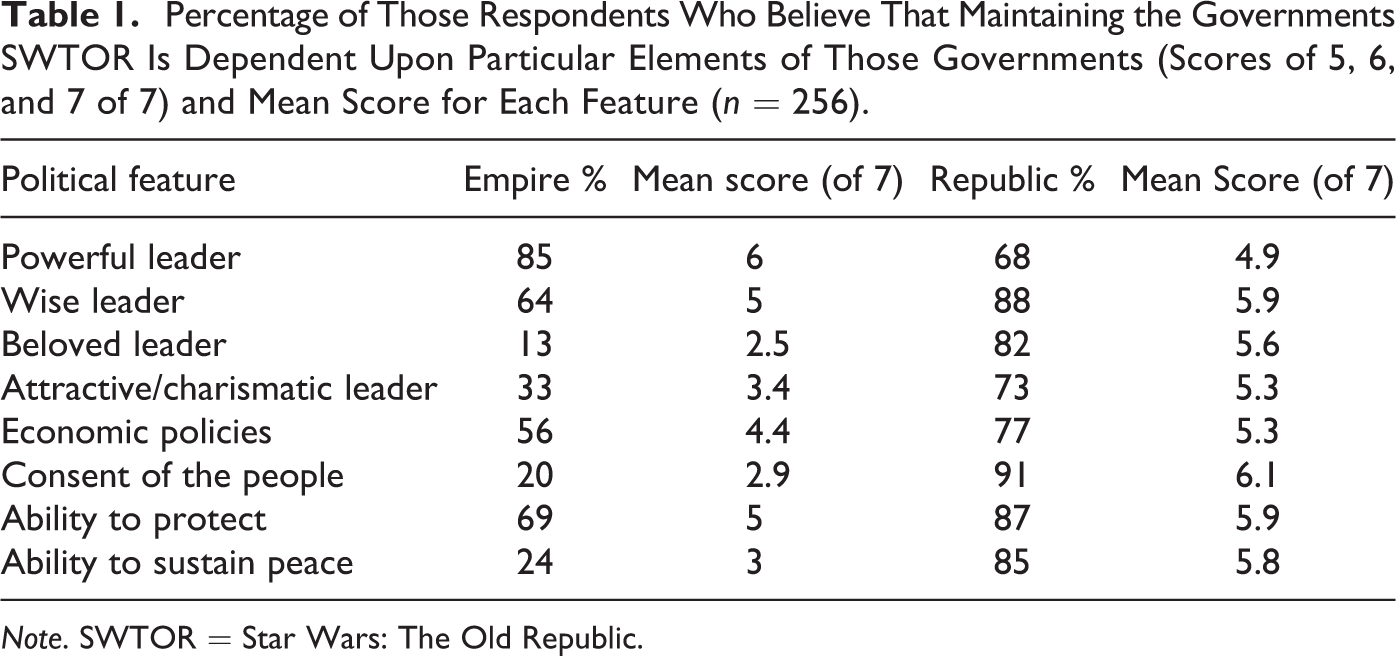
Note. SWTOR = Star Wars: The Old Republic.
It may be that the overall effect of SWTOR on civic life is limited by the decoupling of political philosophy from the gameplay (e.g., fighting opponents), but this does not mean there is no value in SWTOR’s approach. Raphael, Bachen, Lynn, Baldwin-Philippi, and McKee (2010, p. 208) observe that the most powerful approach to civic engagement through gameplay will incorporate the civics lessons into the game mechanics, but it is important to keep in mind that entertainment games can also aid in this process. Based upon the player responses to surveys and interviews, it is clear that SWTOR has genuine civic value. As one survey respondent declares: The game helped me understand the different ethical codes to a greater degree. Given that I attempted to play each class in a specific manner, I found it interesting how certain stories ‘rang' with me, and others were discordant. It's an interesting game, and I would almost advocate using it for educational purposes in high school.
And another: I do believe that role-play and intense attention to SWTOR will lead to the game influencing more opportunities for players to reflect on past, present, and future political policies…When a player is thrown into a situation, they must make a choice and can see the different consequences of their actions, especially with the help of character affection points [NPC feelings about the player character]. This acts as a sort of social simulation, where players can “test out” different actions and observe their consequences. This can definitely lead to more people learning and changing from experiences in the game in personal decisions and political views.
Star Wars: The Old Republic players actively enjoy the political elements of the game and perceive in them the Enlightenment inheritance of Hobbes, Rousseau, and their contemporaries. Seventy-five percent of the survey respondents pay attention to the political conflict and 83% say that it adds to the fun of SWTOR play (mean score = 5.7, n = 256). Importantly, the value players find in the politics is not that it justifies player versus player combat. Only 37% of the respondents find that the political conflict creates an incentive for player versus player fighting; so it is clear that instead the political conflict enriches the cultural world of the game, making it more interesting, and also more thought provoking. That is where the pleasure lies. From these data, we see that players accept and even desire that games include richly meaningful politics in their storylines and play experiences. The SWTOR players see that the Empire and the Republic represent a totalitarian government (that emerges out of the Hobbesian tradition) and an enlightened republic (that borrows from Rousseau and Kant). In recognizing these two, they consider the moral successes and failings of each faction’s government, and even have the opportunity to reflect upon contemporary political life. The quantitative and qualitative data given throughout this article indicate that SWTOR’s players recognize key political elements in the game, find those elements compelling for gameplay, and can theorize about political behavior in and out of the game as a consequence of those elements.
Footnotes
Acknowledgments
The authors are grateful to Wagner James Au for his criticisms and comments on an early draft of this document, and the anonymous reviewers for their input. In addition, the authors are grateful for the support of their colleagues (Daniela Robles and Samantha Fox) throughout the research. Finally, the authors thank all those who included the surveys on their blogs and webpages, and the hundreds of participants who responded thereto.
Declaration of Conflicting Interests
The author(s) declared no potential conflicts of interest with respect to the research, authorship, and/or publication of this article.
Funding
The author(s) disclosed receipt of the following financial support for the research, authorship, and/or publication of this article: The authors gratefully acknowledge the National Science Foundation for its support (NSF #1144028).