



Abstract
In EVE Online, powerful alliances of thousands of players wage long war campaigns over in-game sovereignty, wealth, power, and status. The larger of these wars involve—two to three battles a day across multiple time zones demanding thousands of players and considerable in-game wealth. As with real wars, the morale of combatants plays a crucial role in the success of a campaign. In this article, I discuss the propaganda produced as a component of these wars and the crucial role that it plays in EVE’s virtual warfare. Leveraging broader Internet memes; “nerd” tropes; in-jokes; game history; and racial, cultural, and sexist stereotypes, these evocative images serve to bolster support and demoralize opponents. I argue that propaganda can be conceptualized as a form of paratext that emerges from within the game as part of play, rather than a peripheral industry that surrounds it. Consequently, I propose the term “emitext” to define this persuasive media.
Introduction
0.0 space, sometimes referred to as null-sec, are lawless EVE regions outside of CONCORD control.…Thus, there is no protection offered to pilots beyond any allies travelling with them. Due to this lack of protection, 0.0 is highly dangerous to pilots young and old, and it is advised that pilots unaccustomed to combat steer clear or travel in groups.—Official EVE Online Wiki
A war in EVE is humbling. The largest Alliances have tens of thousands of players, and a war can involve —two to three battles a day for weeks. Complex military command structures are established, dictating broader strategies and war theaters. Diplomatic efforts run parallel, cajoling, bribing, or threatening other Alliances into supporting (or keeping distance from) a war. Attacks are planned and led by “fleet commanders” who lead hundreds, and occasionally thousands, of players into battle, flying ships that accord with carefully theorycrafted fleet doctrines. A single battle can see ships worth the equivalent 1 of US$300,000 permanently destroyed (Kain, 2014). Teams of players ensure local in-game markets are stocked with these ships, and control over the minerals to build them enters the strategy of wars. Third-party applications like Jabber and TeamSpeak support communication and can summon hundreds of players in a few minutes to defend territory or support a besieged fleet. A complex IT infrastructure is integral to these efforts, providing forums and chat rooms for communication and a number of unique programs developed by players to manage logistics like membership and reimbursements. In theme with EVE’s ruthless culture, espionage and betrayal are crucial weapons in an Alliance’s war efforts; leaking military intelligence, sabotaging strategies, and flipping key players and Alliances often exceed the contributions of military battles. Such skulduggery often blurs into the illegal, with the occasional Distributed Denial of Service attacks purportedly aimed at crippling an opponent’s communication infrastructure during key times, and alleged plots to turn off the power at the homes of the most powerful pilots.
At the heart of all the complex machinations of these massively multiplayer virtual wars in EVE is propaganda—texts, videos, and images produced by players as persuasive communication in the service of an ideology (Burnett, 1989). Leveraging broader Internet memes; nerd tropes; in-jokes; game history; and racial, cultural, and sexist stereotypes, these evocative media serve to bolster support and demoralize opponents, crucial for victory in EVE’s hard-fought campaigns. Alliances place such emphasis on propaganda that it is taken into account when discussing strategy, and many have propaganda directors who are given prior notice of military movements so that appropriate propaganda is immediately on hand. Players producing such propaganda may even have their subscriptions to the game supported by the community as thanks for their contribution to the community.
In this article, I overview the variety of forms that propaganda takes in EVE Online and argue that these videos, texts, and images can be conceptualized as a new form of paratext (Consalvo, 2007). As a paratext, propaganda shapes a player’s experience of a game and gives new meanings to acts of play. However, propaganda emerges from within the game as part of play, rather than as part of a peripheral industry that surrounds it. Consequently, I propose the term emitext to define this form of persuasive media to distinguish it from other forms of paratexts. I go on to argue the importance of considering these persuasive media in analyzing the existence, culture, and experience of contemporary digital games. This article focuses (though not exclusively) on the propaganda produced by TEST Alliance Please Ignore (TEST), formerly the largest Alliance in EVE, drawing upon an ongoing ethnography and interviews with its key members.
Following an overview of related work, this article is structured around the history of TEST in the lead up and following one of the largest and most expensive wars ever fought in EVE, between TEST (and allies) and the Goonswarm Federation (GSF; and allies). Through TEST’s history and evocative examples of the propaganda produced, I demonstrate how propaganda is used strategically within EVE warfare and provide evidence for the multifaceted ways in which it influences the player experience of this type of EVE Online play. I also discuss the roles that propaganda plays in capturing the history and culture of EVE’s null-sec Alliances and reflect on these findings in the context of the broader research of online games and virtual worlds.
Prior Work
The concept of paratexts is derived from literary theory (Genette, 1991, 1997), where it refers to the materials that surround a literary text such as a title, a review, a table of contents, or a book cover. Genette noted that a literary text “rarely appears in its naked state, without the reinforcement and accompaniment of a certain number of productions,” arguing that these “paratexts” “assure its presence in the world,” its “reception,” and its “consumption” (1991, p. 261). In presenting his inventory of the elements of the paratext, Genette divides them between peritext and epitext (where “paratext = peritext + epitext”; p. 264).
An element of paratext, at least if it consists in a materialized message, necessarily has a positioning, which one can situate in relationship to that of the text itself: around the text, in the space of the same volume, like the title or the preface, and sometimes inserted into the interstices of the text, like the titles or chapters or certain notes; I will call peritext this first spatial category … around the text again, but at a more respectful (or more prudent) distance, are all the messages which are situated, at least originally, outside the book: generally with the backing of the media (interviews, conversations), or under the cover of private communication (correspondences, private journals and the like). (Genette, 1991, p. 263–264)
The emphasis on the spatiality in the conceptualization of these two categories (with “convergent effects,” p. 262) reveals the literary origins of the terms: the virtuality of EVE Online blurs notions of spatiality, no longer even existing as a physical product that can be purchased in stores. Yet, in accordance with Genette’s predigital vision, this can also have paratextual effect. Genette further notes a distinction between peritext and epitext, noting that “a greater part” of the former is typically official (p. 267), while the epitext is typically “officious”; the authority and confidence of their statements can be denied, consequently, transforming its paratextual effect. Though Genette notes the manner in which such a distinction is by degrees, the prominence of authorship in this conceptualization is translated into digital game paratexts, where “official” texts (such as announcements, patch notes, and terms of service) have a higher degree of “authority” and thus different paratextual effect to player produced or officious materials (such as propaganda). However, highlighting the manner in which EVE Online is produced and played as a sandbox, such a distinction does not serve to diminish but, in the case of some of the propaganda discussed within, to elevate.
The concept of paratexts was introduced to the discipline of game studies by Consalvo (2007); Consalvo’s application of the concept to the game industry refers to “the peripheral industries surrounding games” (p. 9), such as gaming magazines, strategy guides, mod chip makers, and so forth. Consalvo argues that such media “work to shape the gameplay experience in particular ways” (p. 9) and, like Genette’s paratext, “help structure it and give it meaning” (p. 21). Consalvo’s Cheating is not a discussion about an individual game and its paratexts (like this article), but the emergent surrounding industries that transcend individual games, and the manner in which they have been corporatized and are now integral to the contemporary game industry.
Consalvo argues that game paratexts must be understood as central, rather than peripheral, to the experience of gameplay. One example is how “what we know about video games is shaped by what we learn about them before they are ever released” (2009, p. 51); screenshots, developer diaries, and news (all forms of paratexts) frame the initial reception of the game. They “serve a specific role in gaming culture and for gaming capital; they instruct a player in how to play, what to play, and what is cool (and not) in the game world” (2007, p. 22). Jones (2008, p. 43) similarly suggests that with contemporary games “the formerly limited role of the paratext, to serve as a threshold or transactional space between the text and the world, has now moved to the foreground,” suggesting that it “has become the essence of the text.” Apperley (2010) also argues that “the relationship between digital games and their paratexts is an example of how the convergent audience uses other media, especially the Internet, to collaborate on, conduct, and coordinate research” around their gameplay and, consequently, the development of gaming literacy (p. 125).
The term has received wide use in game studies following Consalvo’s Cheating (2007) and has been applied to game guides (Carter, 2014; Iacovides, Aczel, Scanlon, & Woods, 2013), game trailers, online discussions, developer diaries (Consalvo, 2007), patch notes and underlying mathematical mechanics (Paul, 2010, 2011), prior versions of the game (such as in the case of sequels, Consalvo, 2009; Carter, 2014), character sheets (Jara, 2013), Easter eggs (Harper, 2013), and “bots” and “mods” (Burk, 2010). Walsh and Apperley (2009) see the paratext as “the key example of a tangible form of exchange” between gaming capital and literacy (Apperley & Beavis, 2011; p. 4; see also Walsh, 2010), including other mass media, such as commercials, music, and movies, which have become inextricably intertwined with the media ecology of contemporary digital games, reflected in the propaganda discussed in this article. Dunne (2014, p. 19) has accused such broad use of the term as being conflated with Genette’s notion of intertextuality, making current use “an abstraction of an epitext focused approach” (p. 19), relying instead on a narrower conceptualization of “game.”
While Genette notes that paratexts have temporal situation, being posthumous, for example (1991, p. 264), he (reasonably, when discussing books, which are static) gives little consideration to the possibility of a text in flux and the dynamic relationship that can exist between contemporary games and their paratexts. Consalvo’s (2007) Cheating similarly draws degrees of change between the game text and its paratexts, suggesting that
Although games are not immutable in the sense that there is only one way to play them, they can be more static and fixed than their surrounding discourse. And that discourse is much easier to change, amend, update or retract than even a patch—arguably a paratext itself—to a computer game. (p. 12)
In the case of EVE Online, such a suggestion is problematic. This is because EVE is a “sandbox” game; players are invited to play within a platform with a variety of affordances, from which play emerges (often in unexpected ways). This is in contrast to other virtual world games like World of Warcraft (Blizzard Entertainment, 2004–2014), where players typically have little impact on the game world. This is accomplished through making the majority of EVE play player driven, rather than demanding an infinitely complex procedurally driven game environment (ala, the Star Trek holodeck). Further, EVE Online is constantly being updated and transformed through updates, patches, and ongoing development. As a result, EVE has a much more dynamic and changing player experience than many other games in the MMOG genre; thus, EVE should not be considered a static text around which the propaganda paratext simply exists and influences but a dynamic one in its own right.
Method
This research has emerged out of a virtual ethnography (as presented by Boellstorff, Nardi, Pearce, & Taylor, 2012) of TEST, which grew to be the largest Alliance in EVE Online before its war with the GSF. This study has involved participant observation in-game and on both public and private EVE discussion forums; interviews with a wide variety of EVE Online players, including key informants developed over time and significant archiving of public materials around TEST events. An ethnographic approach to this phenomenon is appropriate for examining propaganda, as it is suitable for determining “whether the people on the receiving end accept or resist dominant ideological meanings” (Jowett & O’Donnel, 2012, p. 2). Given the politically charged nature of EVE play, I note that I consider myself (and my participants consider me) to be a member of TEST Alliance, who has fought for TEST in wars and socializes with TEST members (both in EVE and out of EVE). Without sacrificing some of the strengths of the ethnographic research method, there is little or no way to study EVE Online null-sec play as a disinterested observer. To represent myself differently to other Alliances in the course of this study (such as maintaining dual memberships in opposed factions) would run counter to the expectations and ethics of membership in EVE communities.
In arguing for propaganda as play in this article, I principally draw upon interviews with TEST Alliance leaders and a propaganda director. Some of these interviews were completed after the events discussed and are thus retrospective, rather than active accounts, of propaganda strategies and the influence of propaganda. Other quotes are lifted from TEST and EVE Online forums. I also draw upon blogs and “EVE News” reports of events to supplement my field notes of the war, particularly for nuances of events that were not apparent at the time but were revealed later.
In using quotes from discussion forums, I note ethical concerns identified by Beyer (2011) that quotations from forums and blogs are typically searchable via Google (p. 155). While I felt that the quotes used presented no potential damage to the online reputations of anonymized players, minor changes to prevent Google searching have been made to quotes used without the speaker’s permission. Similarly, since EVE Online has a relatively small, shared community in which identities of key players are well known and knowingly public, I have not changed the names of Alliances, Corporations, or players to anonymize the data, as to sufficiently anonymize would be to almost entirely obscure. Identifiable interview subjects have approved their portrayal in this article.
A Note on Corporations, Alliances, and Coalitions in EVE Online
As it has been accomplished so frequently and so well by others (see, e.g., Bainbridge, 2011; Bainbridge, in press; Bergstrom, Carter, Woodford, & Paul, 2013; Carter, Bergstrom, & Woodford, in press; Carter, Gibbs, & Arnold, 2012; Lehdonvirta, 2010; Woodford, 2012), rather than describing in detail EVE Online and its various player experiences (as there are many ways to play EVE Online), I will focus in more detail on what is relevant for understanding EVE’s null-sec warfare.
Corporations are the EVE Online equivalent of World of Warcraft’s “Guilds” (see Chen, 2012). These persistent player groups afford a number of advantages to ad hoc groups. A Corporation enables the sharing of resources between a group of players in a structured and formalized manner through different “wallets” and creates an in-game chat room limited to members. The “CEO” (leader) of the Corporation can assign different roles and accesses to Corporation functions (such as access to the wallet or accepting new members). Applications to become a member of a Corporation must be approved in-game, and, once granted, a player’s character receives a four-letter tag after their name to signify to all other players which Corporation they’re a member of. When a member, a player is considered an ally by the game’s overview, and the marker for their spaceship is colored blue. However, restrictions on “friendly fire” do not exist in EVE and thus players are still required to trust that the fellow members of their Corporation don’t turn on them. EVE is an unusually difficult and harsh game (Paul, in press), and the formalized social networks of Corporations are crucial for retaining players.
In the early history of New Eden, these Corporations began informally banding together into “Alliances,” which were later formalized by the developer (Emilsson, in press). An Alliance has an executor whose responsibilities include membership of the Alliance and modifying lists of allies and enemies. Only Alliances (rather than Corporations) can claim sovereignty over null-sec solar systems, which allows the construction of space stations and to improve the infrastructure of the systems they own (such as building a private warp bridge network or construction facilities for the game’s most powerful ships). The largest of these Alliances sometimes exceed 10,000 players in over 200 Corporations and command the virtual equivalent of over a million dollars. As with Corporations, members of Alliances are marked by default as an ally and gain access to an exclusive Alliance-only chat.
Informally, Alliances again band together into “Coalitions,” allied power blocs within EVE’s virtual universe. Allied Alliances set each other as allies, colloquially known as “blueing,” (offering no formal protection but marking coalition allies as such via the in-game overview) and share some resources. Arrangements between Coalition partners vary; frequently, Coalition partners are not permitted to exploit the resources of sovereignty owned by a different Alliance in their Coalition, and the primary advantage is that they receive access to the various out-of-game communication infrastructures built by players, such as forums, team-speak servers, Human Resource systems and Internet Relay Chat servers. Players are often also restricted from selling EVE’s most powerful ships to players who aren’t in an allied Corporation (a virtual arms blockade). Alliances also have diplomatic directors to whom transgressions of this informal treaty should be reported (such as if a player in another Alliance accidentally killed someone in their Coalition; see also Gibbs, Carter, & Mori, in press), though punishment is limited to the capability of player’s in-game and sees no CCP involvement. At their largest, these Coalitions can exceed 30,000 members from over a thousand Corporations.
The larger and more powerful of these Alliances rent some of their excess territory to paying players, colloquially referred to (and denigrated as) “renters.” Typically, renters are smaller Alliances or Corporations that do not have a large enough player versus player (PvP) player base to take and defend territory. These are often industrial focused groups of players who develop the infrastructure of the space they’re renting to profit from it, sometimes to manufacture ships or farm resources. These players can spend around ISK20 billion per month (approximately US$600) to rent systems from Alliances like GSF and TEST, and, in return, are set as allies and left alone.
Brief History of TEST and GSF
TEST (logo in Figure 1) is the parent Alliance for “Dreddit,” a Corporation informally associated with the social news-sharing website, reddit.com, from which it recruits new players (for a discussion of Reddit culture, see Bergstrom, 2011). The only requirement to be a member of Dreddit is a 3–month-old active account on Reddit or a recommendation from an existing user. This is unusual, as the majority of Corporations either require a recommendation from an existing member or a minimum level of skill or wealth. These origins have led to a self-perpetuated reputation of TEST players being “bad at EVE” (see Milik, in press), which simultaneously serves to embarrass defeated opponents and deflect TEST losses. Of TEST’s 10,000 plus members, over half (∼6,000) were members of Dreddit before the war. As with real wars, having a large homogenous majority rather than a coalition of minority groups had been TEST’s strength in previous wars; smaller Corporations who grew frustrated or demoralized would leave and not significantly impact TEST, and the executor of TEST was nearly always chosen from Dreddit’s ranks who acted in the best interest of this majority.

TEST Alliance Please Ignore logo (middle management dinosaur).
In 2010, when I first joined Dreddit and TEST, one of the Alliance’s closest allies was GSF, a similarly structured Alliance to TEST. GSF is the parent Alliance for GoonWaffe (logo in Figure 2), a Corporation with an analogous informal relationship with the SomethingAwful.com forums, a popular online message board with a unique culture and reputation for trolling and griefing in games (see Bakioglu, 2009; Dibbel, 2008). According to GSF anthropologist Richard Page (in press), Goon players go so far as to consider themselves “playing Something Awful” rather than EVE Online, through which their play gains additional meaning. When founded, TEST leaders had specifically chosen to occupy space as far away from GoonWaffe as possible but incorrectly read the map and instead invaded space nearby (see bad at EVE reputation, above). Shortly after crushing a TEST fleet, GoonWaffe (at the surprise of Dreddit leadership) offered a nonaggression pact, along with advice, protection, expertise, and support to the newly formed community. For several years, buoyed by their size (rather than exceptional in-game wealth or skill), these two Alliances won several large wars together and were, as the EVE colloquialism goes, “space bros.”

Goonswarm Federation Logo (a bee).
Leading up to the Great Fountain War
GSF was undoubtedly the most powerful Alliance of players in EVE Online, but TEST, having now grown in size and strength, began making deployments independently. TEST began to lose its reputation as just another Goon “pet” (an EVE colloquialism for an inferior Alliance “under the thumb” of a larger, superior Alliance), winning wars independent of GSF support. The former space bros grew even further distant when TEST formed a new Coalition—the Honey Badger Coalition (HBC)—one of the largest the game had seen, with former GSF enemies Northern Coalition (NC) and Pandemic Legion (PL). Before its collapse, the HBC saw over 30,000 EVE Online players allied in a powerful bloc that rivaled the GSF and its coalition, the ClusterFuck Coalition (the CFC). TEST and NC brought members and some of the most valuable game territory, while PL contributed the largest fleet of EVE’s most powerful ships and considerable military expertise. 3
Montolio, the leader of TEST at the time, received both admiration and criticism for his efforts to “blue” (ally with) all of EVE. Meanwhile, along with former TEST director, rob3r, Montolio sowed the seeds of dissent within TEST at their former space bros Goonswarm (and, in particular, GSF’s infamous leader at the time, The Mittani) and eventually openly advocated for war. However, PL’s leader Shadoo renounced the plan and withdrew their Alliance’s support of any such engagement. Montolio was soon after replaced by a new leader, going by the alias “Sort Dragon.”
This Cold War between HBC (led by Montolio) and the CFC (led by The Mittani) was lost without any open declaration of war; Montolio resigned in the face of internal dissent within the HBC that bloggers and TEST members would later attribute to being principally caused by “a propaganda barrage against Montolio” (James 315, 2013). Through EVE’s most popular news website, themittani.com, The Mittani was able to defeat Montolio politically before any fight occurred in-game. The effectiveness of Mittani’s “propaganda machine” was made entirely apparent to the EVE Online community; control over this paratext (and the consequent paratextual effect) had become a dimension EVE’s strategic metagame. In the following months, TEST would attempt to establish its own EVE news website (which failed soon after).
It later emerged that PL’s reluctance stemmed from their participation in the Organization of Technetium Exporting Corporations (OTEC—a play on Organization of Petroleum Exporting Countries), a powerful economic Alliance that saw control of nearly all sources of the Technetium resource; crucial for building capital ships, and control of which could see prices skyrocket to the advantage of PL, NC, and GSF. 4
TEST Alliance Rebel Alliance
As a result of a “real-life” incident at EVE Online’s main convention in Reykjavik, Iceland, and subsequent “forum drama” between PL and TEST, relationships within the HBC soured. On May 6, 2013, in response to Sort Dragon’s “critical lack of leadership ability or understanding of how TEST and the HBC function,” TEST’s new executor BoodaBooda declared TEST was rebelling from the HBC. In a post on the TEST Alliance forums, Booda declared their intent to rebel, “tearing down the house Montolio built,” and “resetting” (unallying with) all HBC Alliances except for a select few and redeclaring their disdain for the CFC. A separate forum, private from those members who would soon be leaving, was created, titled “Rebel Command” and a propaganda theme for the rebellion took over the forums (Star Wars; Lucas, 1977). In his announcement, BoodaBooda included an animated image (stills shown in Figure 3); an edited scene from the Star Wars movies where Obi-Wan Kenobi (with the face of Booda’s EVE avatar photoshopped on top) uses the force to turn a sky of EVE ships from blue (allied) to gray (neutral).
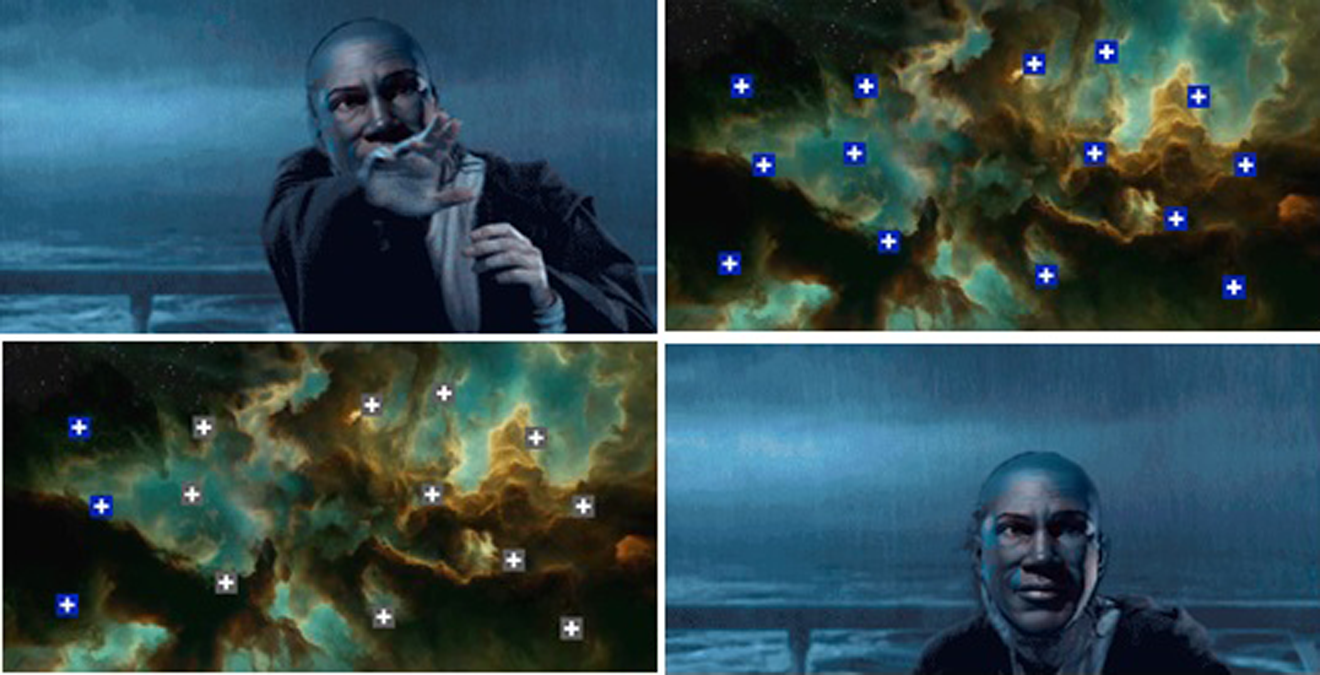
Four frames from an animated GIF, depicting TEST Alliance leader BoodaBooda (as Star Wars character Obi-Wan Kenobi) using the force to turn a sky of EVE ships from allied to neutral.
TEST’s members, in broad support of the rebellion, jumped onto this theme and produced a wide variety of new propaganda (see Figures 4 –8). With Sort Dragon and the CFC interchangeably deemed the “evil empire,” TEST Alliance filled the role of the rebellion forces (the “good team” in the Star Wars movies). Star Wars-themed puns abounded; the majority of fleet doctrines given Star Wars-themed nicknames, and forum avatars were changed to Star Wars characters. TEST’s top fleet commanders were depicted as key Star Wars characters (Figure 6), and forum avatars changed to suit. These propaganda images and rhetoric were widely shared across EVE forums, Reddit, in-game, and TEST chat and served to galvanize TEST players and provide an accessibly narrative for Boodabooda’s actions. The underdog positioning of TEST as rebels correlated with their bad at EVE culture, helping recruit new members from their unofficial relationship with the site reddit.com. Indeed, even the Star Wars emphasis on the role that a single smaller ship can play in a large battle (ala Luke Skywalker’s destruction of the death star) was easily translated into TEST’s emphasis on the Rifter—a small, easily flown ship, easily piloted by new players (see Bergstrom et al., 2013, pp. 8–12)—in Figures 5 and 8.

Rebel Scum please Ignore logo in a Star Wars font.
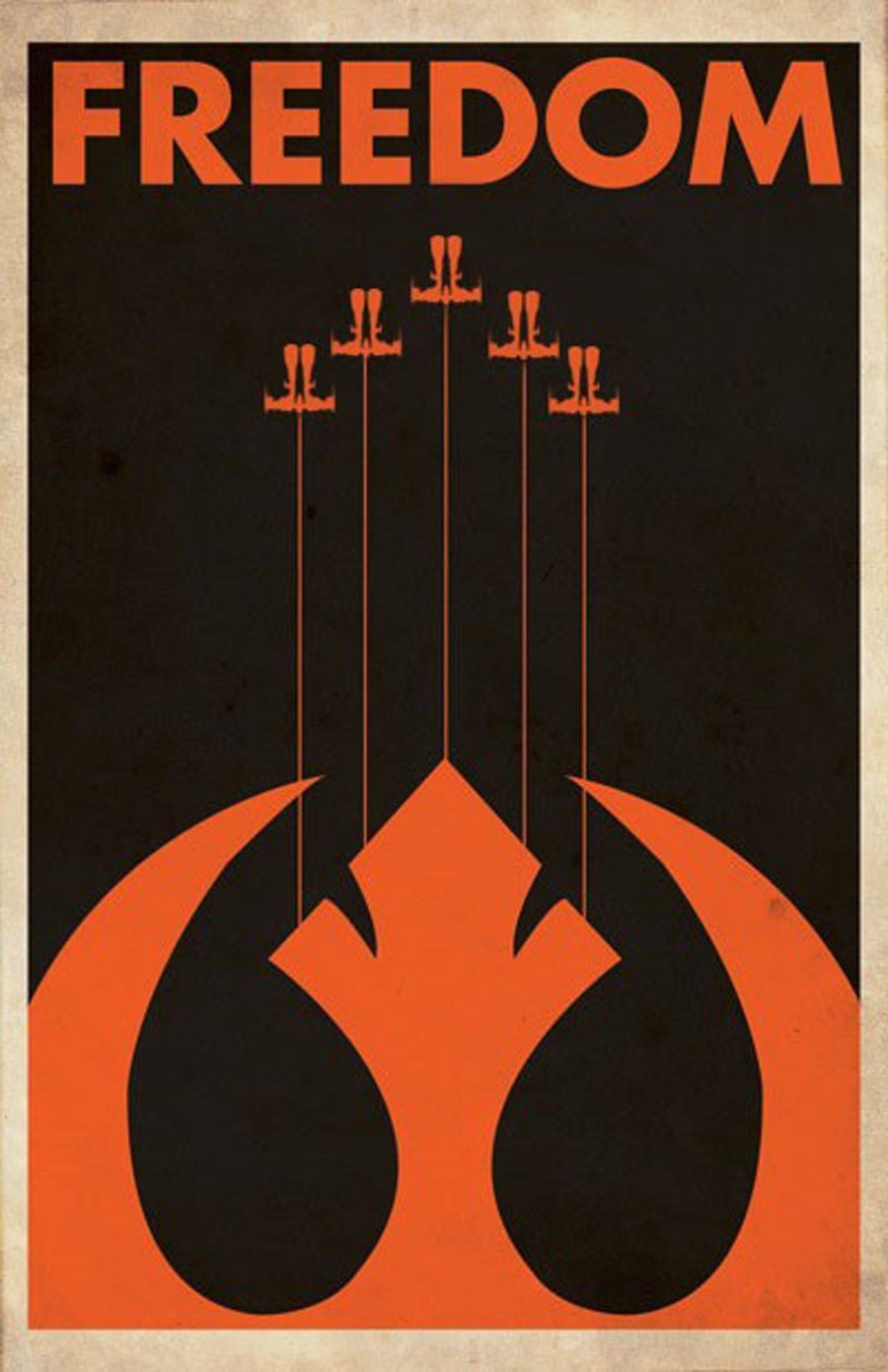
A Rebel Alliance themed poster adding rifters, an iconic ship of cultural important to TEST Alliance (see Bergstrom, Carter, Woodford, & Paul, 2013) to the rebel Alliance logo from Star Wars. The image also has a worn, aged effect over it to mimic the contemporary appearance of historical propaganda (as with Figure 13).
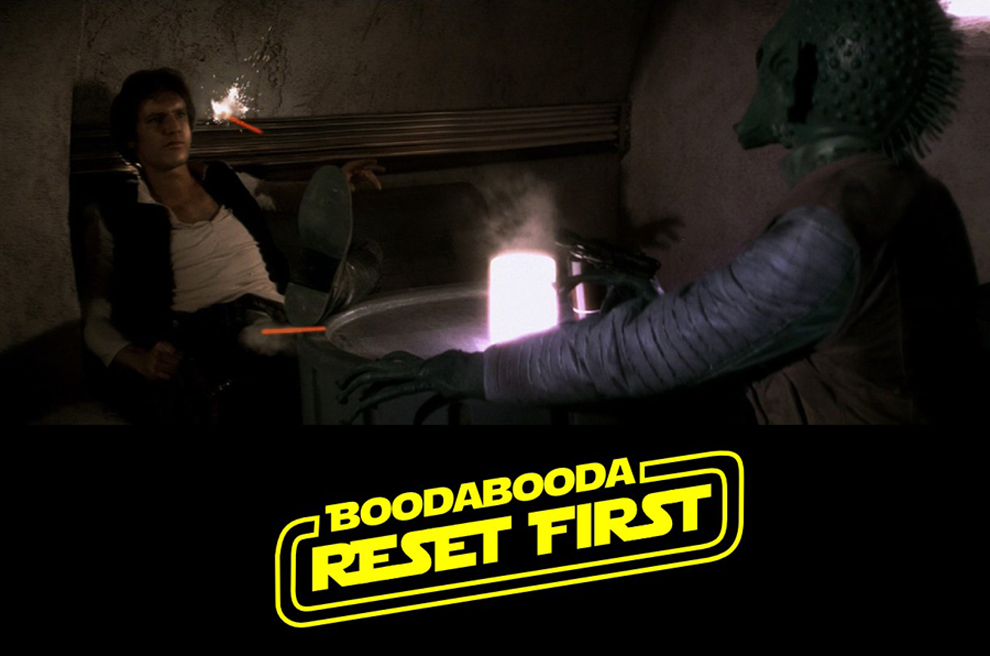
In Star Wars font, this image plays on a pop culture meme that “Han Solo Shot First” in the original Star Wars movies (in the digitally remastered versions, Han Solo shoots second, thus being significantly less “badass”). Both TEST and its Leader BoodaBooda are simultaneously likened to the ruthless but heroic Star Wars hero.

As with Figure 9, this propaganda image slightly modifies an iconic quote from the Star Wars movies to valorize support for BoodaBooda. It is likely spelt wrong on purpose in accordance with TEST’s “bad at EVE” culture (see Milik, in press).
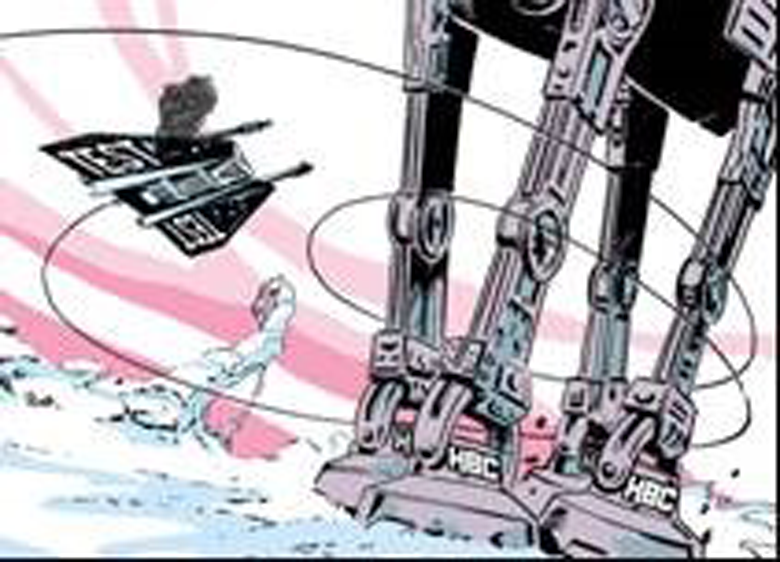
This edited version of a comic, depicting a scene in the Star Wars movies, shows a large and cumbersome HBC (noted on the feet of the walker) being defeated by a smaller, more agile TEST fighter. HBC = Honey Badger Coalition.
The Great Fountain War
In June 2013, EVE Online released its 19th free expansion—Odyssey. Within the wide variety of changes and updates that this free expansion brought to the MMOG were slight changes to where certain minerals could be found in null-sec space. These changes “pulled the rug from under Goons and removed the only obstical [sic] protecting it from a serious invasion”; the CFC lost their absolute control over technetium moons and the protection of the OTEC Alliance. As it turns out, space occupied by the no-longer allied TEST Alliance was suddenly the most valuable in-game. The Mittani claimed that these changes had left GSF “destitute.” According to a former TEST leader, the destitution narrative was a “huge propaganda effort that stemmed from the Mittani himself. He had to justify an attack in order to keep up with the more profitable empires,” and the perception now is that this claim was greatly exaggerated. Within days of the expansion, CFC had announced its invasion of this region, known as Fountain.
The combined forces of TEST, PL, and N3 (a new coalition formed in the ashes of the HBC) were able to hold the line against CFC, who were unable for nearly a week to gain a staging station in Fountain from which to successfully invade. One of the key contributors to the stalemate was N3’s powerful “Australian bloc,” who were able to unwind the efforts of the CFC’s North American pilots during Australian prime time—nighttime in the United States. For an expanded discussion of the role that time zones played in this war, see Milik (in press). A wide variety of propaganda images were produced by both sides of the war, depicted in Figures 9 –15.
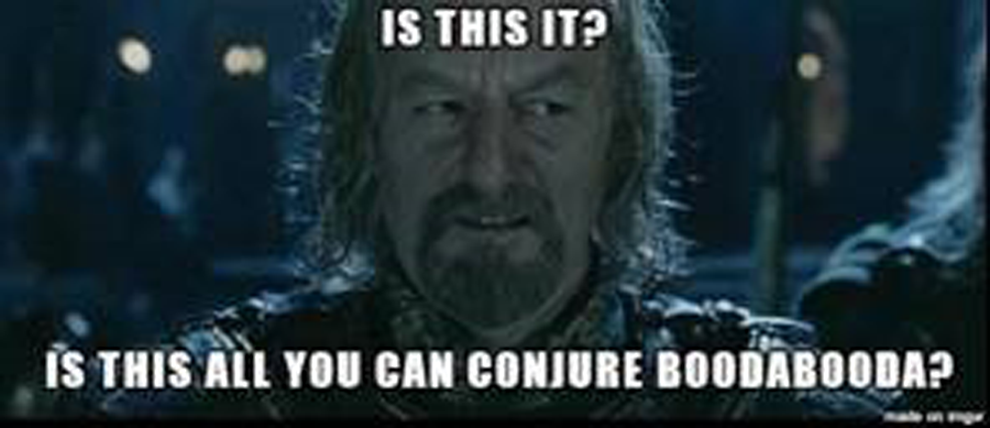
Quoting a memorable line from the Lord of the Rings movies, this piece disparages the efforts of TEST. In this scene, during the climactic battle between Saruman’s “evil” forces and the “good” forces of Gondor, Théoden mocks the strength of Saruman’s attack (replaced here with BoodaBooda’s name).
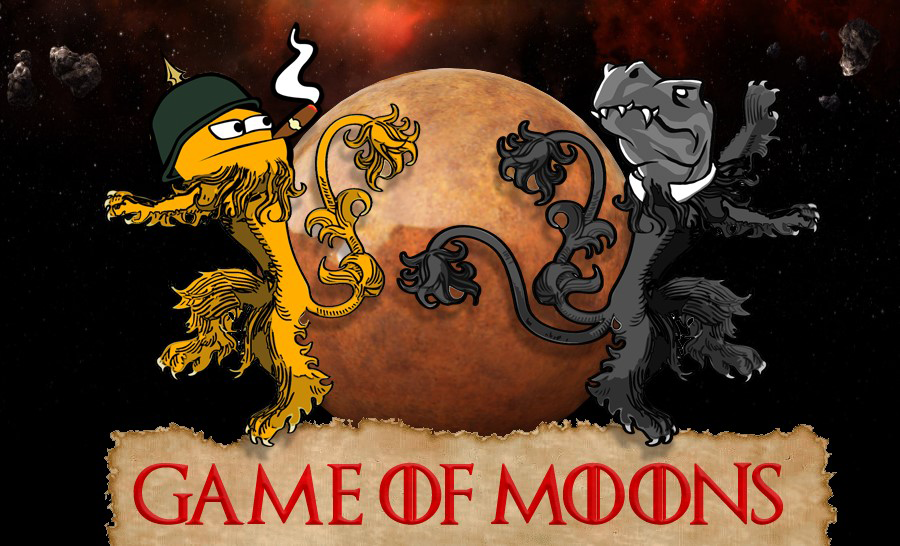
This neutral Game of Thrones propaganda image depicts the rivalry between GSF and TEST over Technetium moons (the supposed cause of the war).
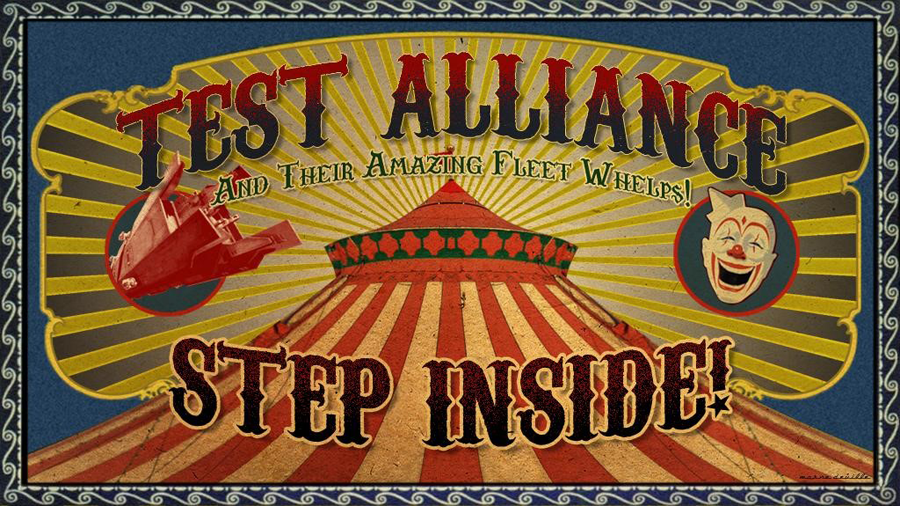
This mock circus ticket advertises TEST Alliance’s “Amazing Fleet Whelps,” a colloquial term for when your entire fleet is destroyed, typically due to ineptitude.

Pro-TEST propaganda that invokes the widespread death of bees in North America to mock GSF, whose logo is a bee.
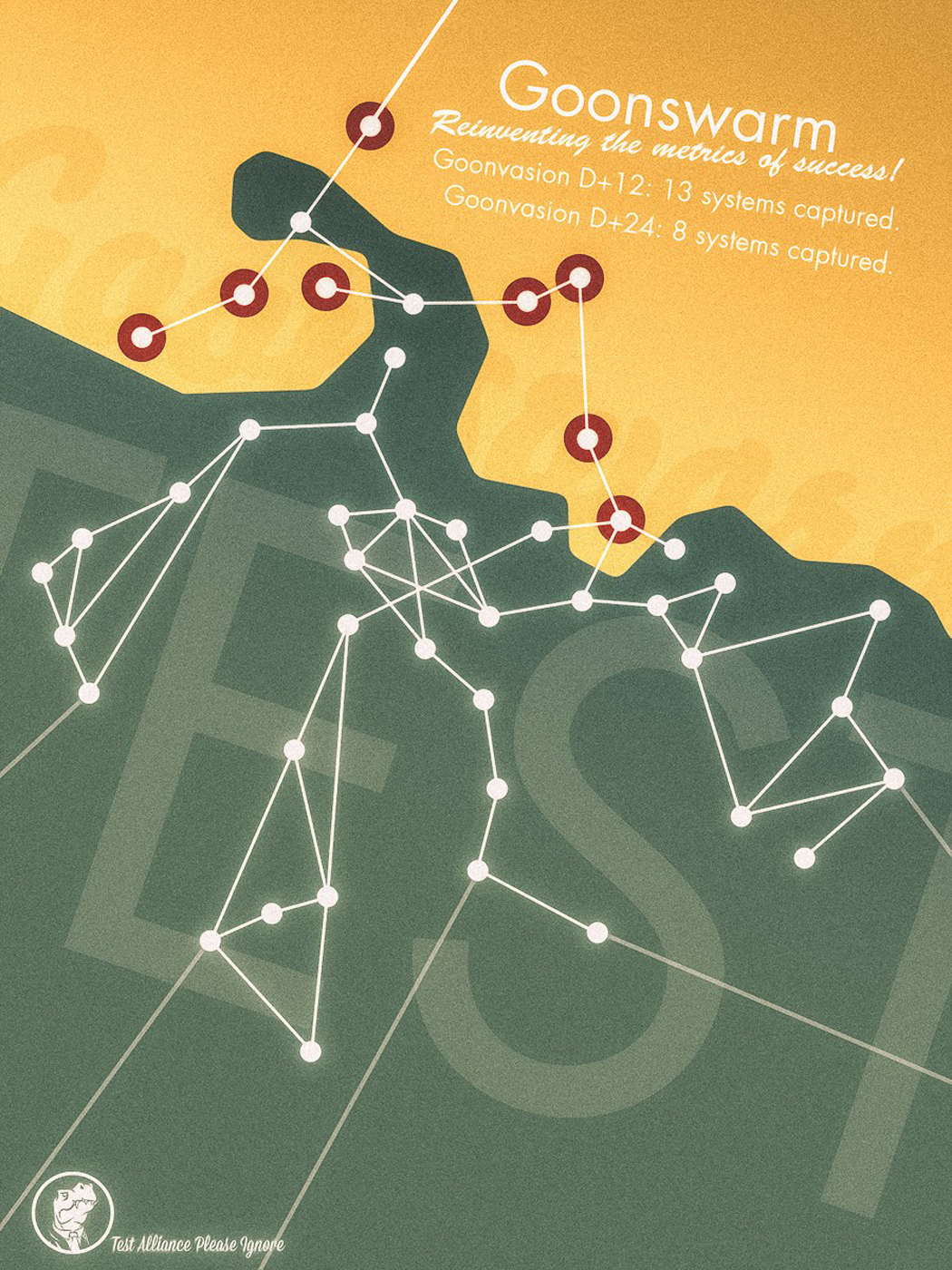
This highly creative propaganda image criticizes Goonswarm’s “progress” in the Fountain Invasion, having lost five of the systems they had initially captured. This minimal and abstract image is clearly inspired by 1960’s corporate identity propaganda.
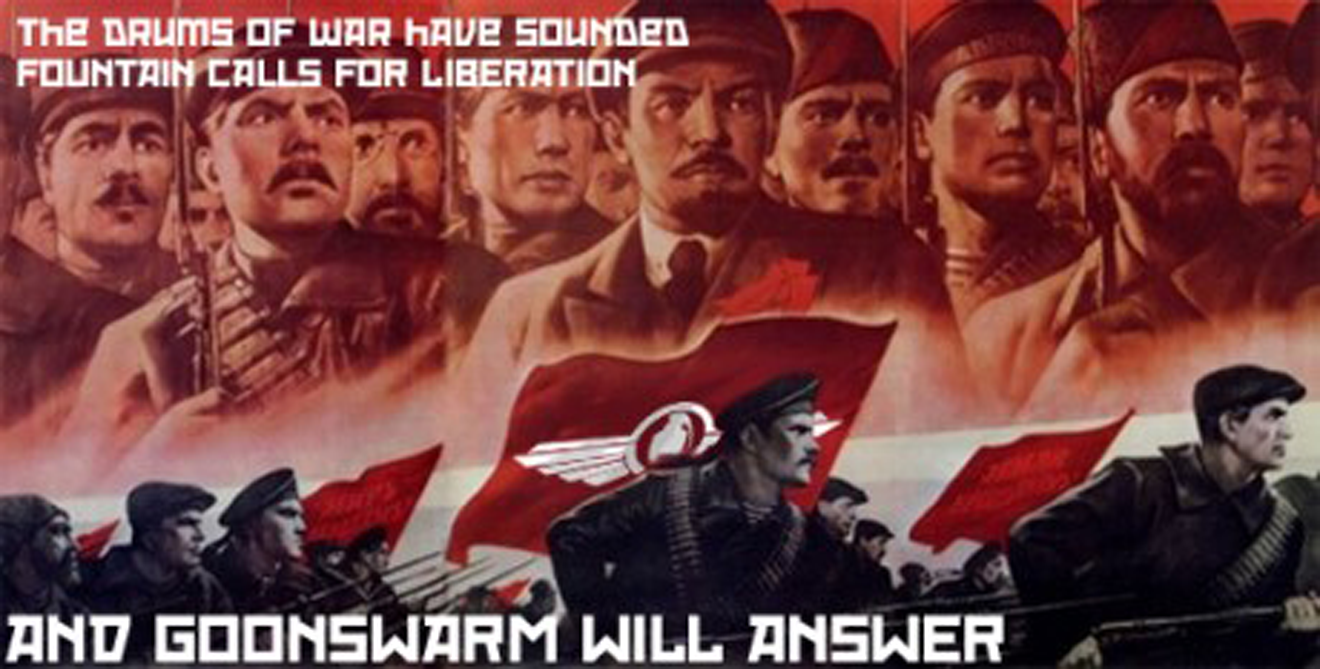
This is a reappropriated piece of Soviet-era Propaganda attempts to inspire GSF members to participate in the war.
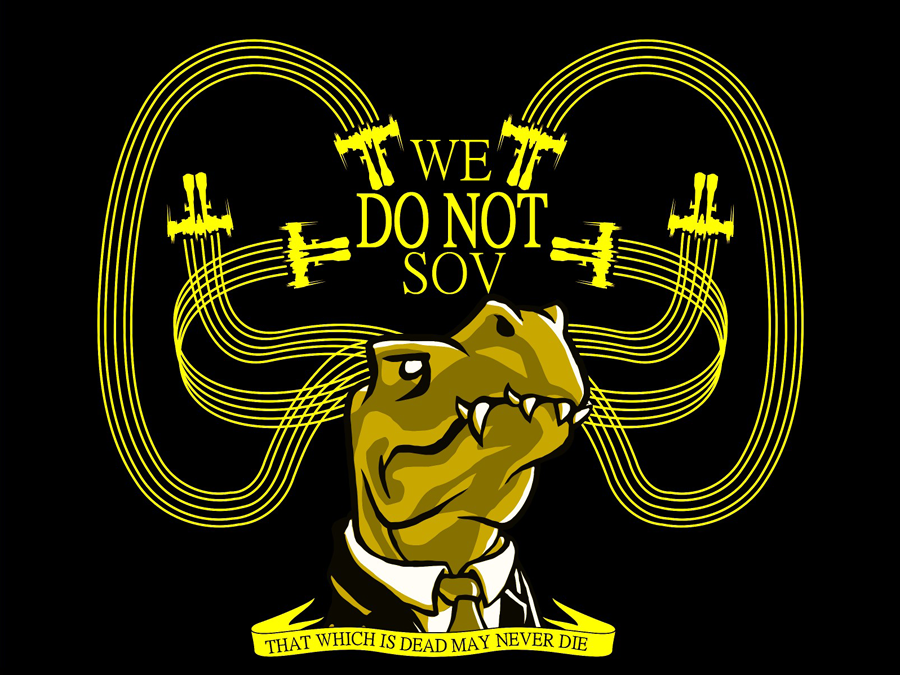
Following TEST’s loss, this Game of Thrones themed piece of propaganda copies the Greyjoy family logo and motto, changing “we do not sow” to “we do not sov” (as in take sovereignty). The motto at the bottom That which is dead may never die is unchanged from its pop culture reference point, declaring the Alliances resolve to continue.
Like the Cold War, the Great Fountain War was not principally won by military victories, but strategic and espionage-based ones. Although typically condemned in online games, treachery and betrayal is one of EVE’s core appeals to players (see Carter, 2015). The first five systems within Fountain lost to the CFC was due to an act of betrayal; Sort Dragon, former leader of the disbanded HBC, coordinated with the CFC to drop control of five systems in Fountain that he had retained control over and which the CFC immediately took control of. An even larger betrayal occurred on July 1, where an infiltrated N3 Corporation was disbanded (and its treasury plundered) under arrangement with the CFC. While the space was retained, the extraordinary act of espionage left a demoralized TEST alone to repel the CFC and the propaganda reflected this. No longer confident in their victory and facing growing participation costs (both in-game cost but also the excessive time and logistics participation requires), TEST’s defenses buckled.
In the closing weeks of the war, TEST’s bad at EVE identity was invoked by a TEST military director to bolster participation in one last final battle.
A smart Alliance in our situation—12,000 facing off against 3 times that number—would probably look for other options. But we are not a smart Alliance. We’re TEST. This is what we do.
The purpose of this “final stand” was propaganda, to show the other Alliances of EVE that “TEST stands together in the face of certain, guaranteed death” (BoodaBooda, 2013). This final battle saw over 4,000 participants defending TEST’s spiritual home in Fountain, and the destruction of 2,591 ships. At the time, this was “the largest ‘space battle’ either in gaming history or real-world history” (CCP Logibro, 2014) and even drew media attention from outlets like British Broadcasting Corporation News and the Huffington Post. Propaganda played a crucial role in demoralizing opponents and encouraging the participation of members who are, after all, volunteers in these epic virtual space wars.
TEST Extortion, Please Ignore
Following their defeat, BoodaBooda resigned and TEST abandoned their sovereignty (a move supported by propaganda, as shown in Figure 15). Under the new leadership of SkierX, TEST enjoyed a brief dalliance with “faction warfare” (FW), a form of structured PvP that occurs in EVE’s high-security area and grants access to extra forms of player versus environment play. With its membership numbers having drastically reduced, this route was seen as an opportunity for players to replenish their personal funds through FW’s lucrative mission running and Loyalty Points (Set’s Chaos, 2014). On February 2, 2014, SkierX announced TEST’s latest deployment, to Sakht 6-7 with the purpose of extorting renters in Delve.
That’s a nice solar system you got there; It'd be a shame if something happened to it. (TEST Alliance leader, SkierX, February 2, 2014)
The plan, “mercilessly hunting people trying to do PVE activities,” with diplomats “standing by to negotiate payments and in exchange for cash they will be blued [allied].” TEST was now an organized crime family, running an extortion racket in four regions that the CFC owned but was renting out to smaller Alliances and Corporations. The propaganda theme (Figures 16 –20) was consequently Italian–American mafia-based, invoking popular cultural tropes around American–Italian crime families and modifying scenes from iconic movies such as The Godfather (Ruddy & Coppola, 1972) and Scarface (Bregman & De Palma, 1983). SkierX became “Don Skier,” and the creativity of members of the Alliance produced a wide variety of images shared on TEST forums and its Reddit forum.
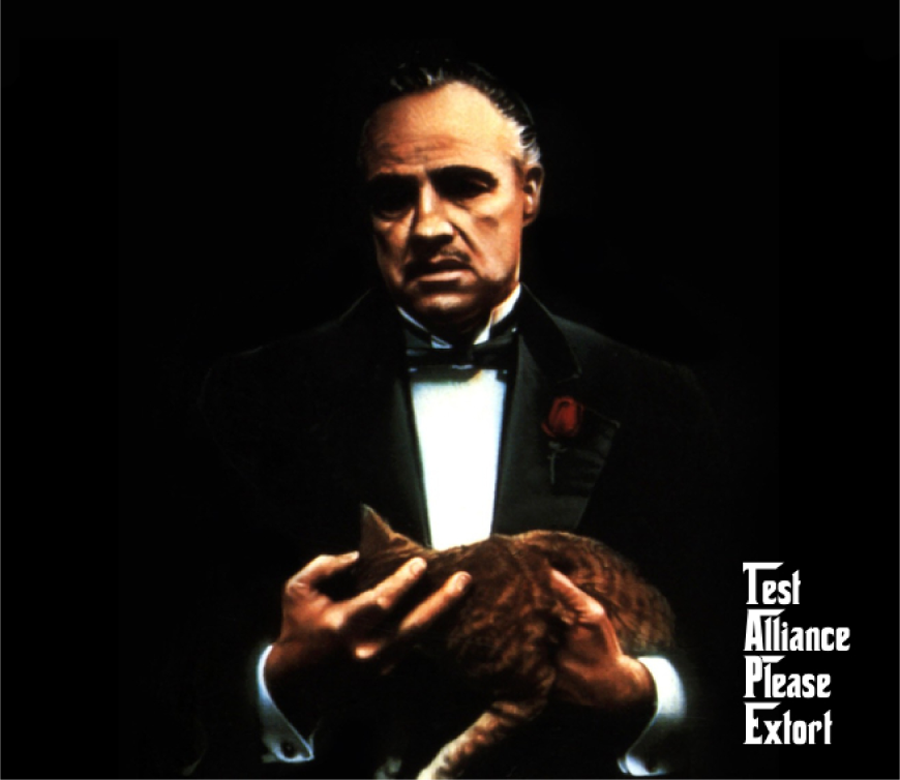
This image of Vito Corleone is accompanied by TEST Alliance Please Extort in the font from The Godfather (Ruddy & Coppola, 1972) movie, similar to Figure 4.
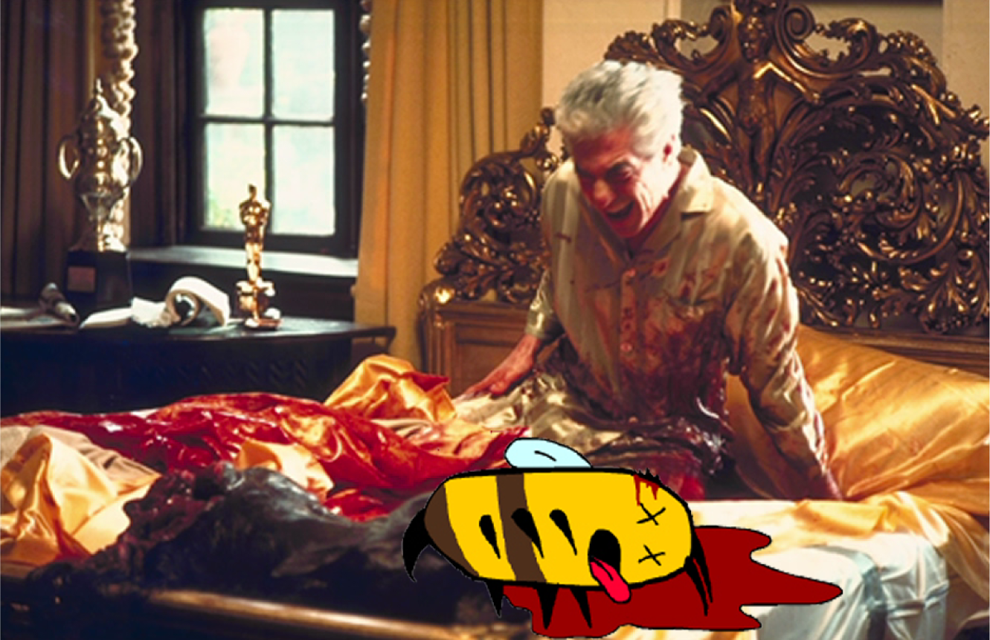
This propaganda image reappropriates the scene from The Godfather where a severed horse’s head, or in this case, a dead Goonswarm Bee, is placed in the bed of a movie producer who won’t acquiesce to Vito Corleone’s wishes.

Again, a remained Middle Management Dino as 1920’s mobster with the extortion threat beneath the image.

This image depicts TEST’s logo as another infamous pop culture mobster, Tony Montana (played by Al Pacino) in Scarface (De Palma, 1983).
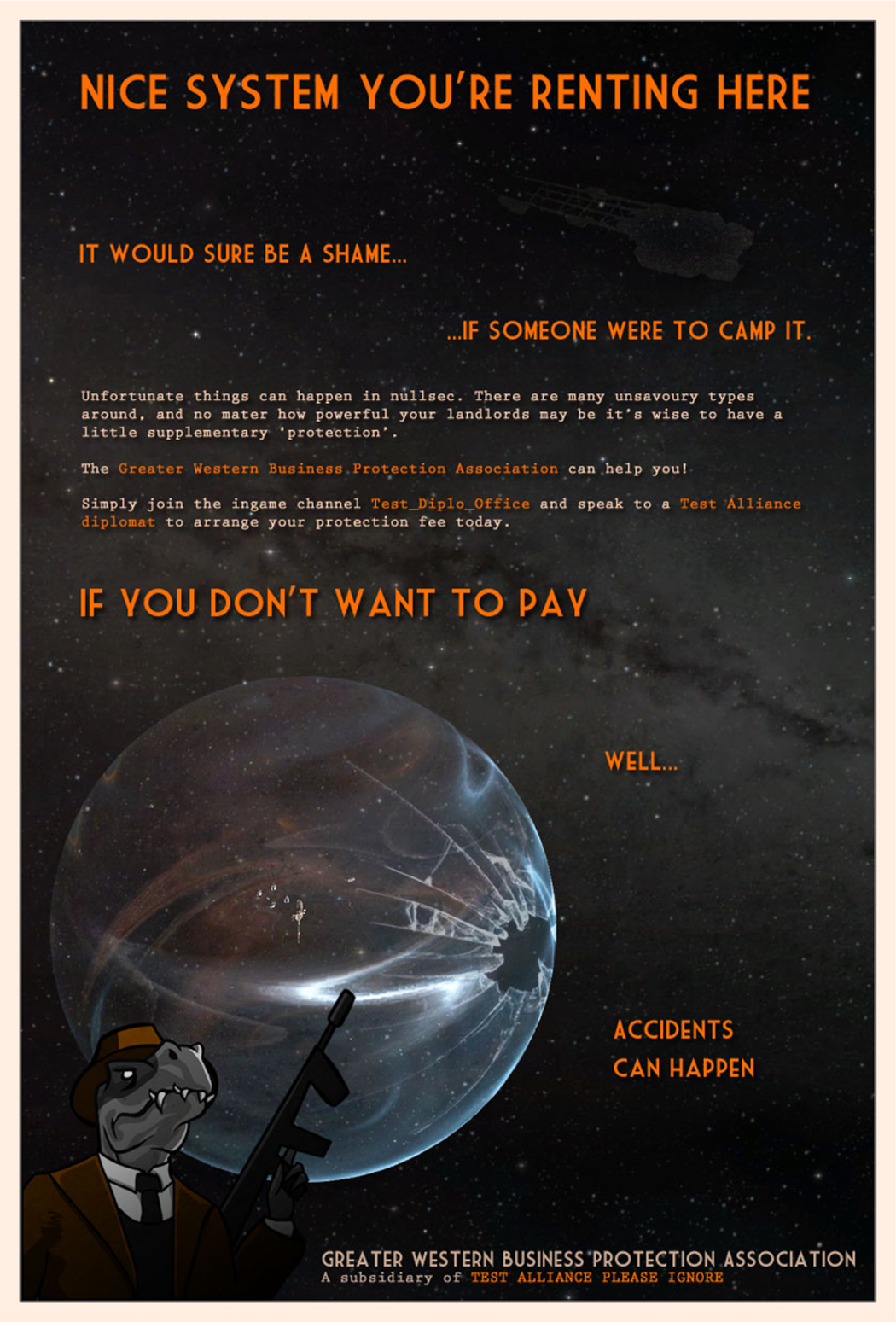
This propaganda image was produced for the purpose of posting in the local system chat of systems’ TEST members were attempting to extort. Like Figures 13 and 5, it has the worn, aged effect applied. It includes instructions for Corporations prepared to acquiesce to TEST’s extortion and features a shattered player outpost (the implication being the damage was done, and would be done, by TEST).
The suitable and evocative propaganda theme was seen by SkierX as being “very important as that’s how we end up catching the interest of the general Reddit population” (SkierX, personal communication, February 2, 2014)—with membership down, a powerful propaganda then would help bolster interest in TEST from Reddit. Although extortion has been demonstrated to work, it had never been attempted by a group as large as TEST. Consequently, the novelty was also a dimension of its appeal to TEST leadership, both as a way to attract new players and galvanize the existing base. Initially, it was very effective; TEST membership reversed its slow decline, giving them the strength and cohesiveness to return to null-sec space.
Discussion
In this article so far, I have provided a review of earlier work that has invoked Genette’s paratext (1991, 1997), the materials that surround and influence the reception of a literary text. I overviewed its varied applications in-game studies, which emphasize the way in which contemporary digital games blur the boundaries between text and paratext, but, in doing so, do not decrease the usefulness of the concept to understanding player experience and how players bring meaning to their gameplay. Following this, I have provided a brief account of the recent history of a single EVE Online player Alliance, TEST, and provided a representative example of propaganda images created and employed during this war.
I argue that propaganda in EVE Online is an emitext, a form of paratext that emerges from within the game as part of gameplay, rather than from the peripheral industries that surround it. Unlike Genette’s literary texts, contemporary digital games are in a perpetual state of flux. They are updated and transformed through modifications, updates, ongoing developments, and in-game events around which media is produced and historical accounts written. The environment and affordances of persistent world games (like EVE) may change and transform as a result of player actions. These emergent events, changes, media, and histories are themselves paratext; it is not just, as Jones states, “in concentric circles rippling out” (2008, p. 43), but paratexts all the way down.
In this discussion, I will discuss the nature, role, and forms of propaganda as employed in the Great Fountain War. I’ll highlight how propaganda is—as conceptualized by Burnett (1989)—a propaganda, and in becoming so draws upon the history of propaganda. At the crux of its conceptualization as paratext, I’ll illustrate how it is produced in the course of EVE Online play and argue for propaganda as an important cultural artifact of note for studies of gaming culture.
Propaganda as Play
Key to understanding propaganda as emitext is the manner in which it is produced as part of EVE Online play, admittedly a somewhat peculiar type of play. Only a subsection of EVE Online’s 500,000 players were involved directly in the Great Fountain War, and the majority of those were simply (but not discriminately) foot soldiers. To these players, play was logging into EVE at certain times, flying alongside their allies, and engaging in EVE’s large fleet warfare. But to smaller groups of trusted players (∼20) on each side of the conflict, leading their Alliances is wargaming, developing strategy, managing resources, and coordinating the logistics of a massively multiplayer virtual world war.
One of the most, if not the most, important resources in this style of play is the participation of those foot soldiers; volunteers with no geographic, religious, or real-world economic ties to the Alliance for whom they fight. Propaganda plays an enormous role in the recruitment and participation of these volunteers. Those leading their Alliance believe that propaganda “helps drive the large content-creating experiences that EVE is famous for” (BoodaBooda, personal communication, March 5, 2014) and is important for giving “a sense of context, narrative, and belonging” (SkierX, personal communication, February 2, 2014) to its members. Along with recruiting new members, this effect inspires and encourages those volunteers to participate and is sometimes referred to as “the rally-the-troops game” (Alikichi, 2013). This effect is seen as being retroactive, as well as proactive: “it helps people who are on board with a plan feel more accomplished during and after execution” (BoodaBooda, personal communication, March 5, 2014). Along with recruiting new members, motivating existing members, and improving their experience, propaganda is also seen as strategically serving the purpose of demoralizing the enemy. However (for TEST, at least), this appeared to be the least important role propaganda was seen as playing.
Such is the emphasis placed upon propaganda is that the theme or narrative “is something that’s brought up while we’re discussing options” (SkierX, personal communication, February 2, 2014) and thus plays a role in what strategy is employed. For example, in the extortion deployment, having a suitable theme ready was necessary for choosing this strategy. I do want to note that selflessly, these players often seemed to draw more enjoyment from creating content for the thousands of members of their Alliance than from victory or this type of play itself;
Propaganda does help get people on board with a plan, but the more important part is that it gets people to want to play together to whatever end, and it encourages people to have fun together. (BoodaBooda)
Despite the high stakes and unusual scale, EVE Online is, after all, still a game. Propaganda directors “enjoy doing it” (TEST Propaganda Director, personal communication, February 15, 2014), both due to the process of creating it and due to seeing it as an important part of null-sec warfare. The propaganda emitext is thus part of the play of EVE Online’s strategic null-sec war games, as well as being play itself.
Propaganda as Propaganda
Burnett (1989) defines propaganda “as discourse in the service of ideology” (p. 127). He considers propaganda as a “discourse which functions to create meanings that serve to sustain or alter relations of domination” (p. 128). In this manner, propaganda in EVE Online can be seen to be acting as propaganda in two ways, that is, as an attempt by Alliance leadership to exert a controlling influence over their own membership or over an opposing Alliance. As noted in the previous section, this latter effort appeared secondary. This approach to conceptualizing propaganda is largely focused on how “dominant ideological meanings are constructed within the mass media” (Jowett & O’Donnel, 2012, p. 2) and is appropriate for EVE Online propaganda, where our concern is with the construction of meaning rather than a particular message.
Consider the examples given of propaganda images. Figure 11 is an effort by CFC to demoralize (a controlling influence) TEST members. It depicts a mock circus ticket, advertising “TEST Alliance and their amazing Fleet Whelps”—a colloquialism for losing an entire fleet in battle. Figure 8, from the Rebel Alliance theme, depicts a quick and agile TEST ship circling the large and cumbersome HBC walker (a scene in the Star Wars movies). As well as having provided a clear narrative (fast and agile TEST vs. cumbersome HBC), this serves to improve the moral and encourage participation (another controlling influence) of TEST Alliance members. The themes showcased in this article each attempt to collectively persuade the player of a particular narrative around the events occurring in-game: TEST as the justified, heroic rebellious Alliance, as a powerful and feared organized Corporation, and as an effective (or ineffective) military force. Even those that do not serve a specific Alliance’s interests (Figure 10) still create meaning, although their intent and relationships altered are less clear. In this article, I have focused on propaganda images (due to their suitability to a static PDF), but they work in conjunction with a variety of other propaganda forums (considered propaganda by players, e.g., see Alikichi, 2007), such as speeches by Alliance leaders, YouTube videos, and EVE news reporting. Like the meme-like propaganda images, these other media also create meanings that serve to sustain or alter relations that prove integral to strategy in EVE’s warfare.
EVE Propaganda and Historical Propaganda
A pervasive trend in the production of EVE Online propaganda is the use and reappropriation of real, historical propaganda images and effects. Figure 14 is an example of GSF propaganda that has placed EVE-specific text over Soviet-era propaganda. The flag of the Union of Soviet Socialist Republics has been carefully altered into the GSF logo. An overemphasis on Soviet-era propaganda in EVE Online is a result of EVE’s in-game history of interactions between Russian and non-Russian players and a number of racial stereotypes about Russian people and culture (see Goodfellow, 2014, in press, for an engaging overview and discussion). The highly creative Figure 13 mocks Goonswarms’ progress in the Fountain invasion (losing five of their captured systems between the 12th and 24th days of the invasion). The dots in this image represent Fountain solar systems and the links between them. This minimal and abstract image is clearly inspired by 1960’s corporate identity propaganda (e.g., the work by Erik Nitsche, see Heller, 2004).
The manner in which EVE propaganda draws upon historical propaganda echoes the way in which contemporary paratexts exist within a complex assemblage of social, historical, and cultural contexts. By mimicking historical imagery, propaganda creators advertise their productions as propaganda, consequently making it more effective. Even images that don’t necessarily invoke historical images, such as Figure 5, are given a dated low-resolution texture to copy the current appearance of historical propaganda, as it would have been first seen by EVE’s 18- to 25-year-old audience and mirrors the styles and presentation of propaganda in other popular digital game series, such as Fallout (Bethesda Softworks, 1997–2010).
Cultural Tropes in EVE Propaganda
In the images included in this article, parodies and references to film and TV media (unsurprisingly mostly in the sci-fi and fantasy genre) are pervasive. The TEST Alliance Rebel Alliance theme (Figures 4 –8) obviously draws heavily upon the Star Wars fiction, serving as an easily accessible narrative that suitably transposed onto TEST’s in-game situation [“the parallels were too good to ignore” (BoodaBooda, personal communication)]. Propaganda like this employs players’ shared literacy of “nerd culture” to more effectively work as propaganda. Thus, it is through propaganda that an EVE Online Alliance’s cultural identity is policed, in this case, working to police membership to those with similar transmedia interests. This is of particular relevance to the work of scholars like Kelly Bergstrom who have investigated (2013, in press) EVE Online for its aberrantly low female player base (∼2% in comparison to World of Warcraft’s ∼30%). Like EVE, the sci-fi and fantasy genres are predominantly male and actively work to exclude female interest.
Figure 10 (“Game of Moons”) similarly invokes imagery from the Game of Thrones fantasy television (Benioff & Weiss, 2011) series. The two key Alliances (TEST and GSF) have had their logos placed on the head of two sparring family emblems from the show, and the pun on the series title relates to the cause of the war, that is, control over valuable tech moons. As well as providing a clear narrative to players, this propaganda can be interpreted as attempting to legitimate the political, backstabbing, and espionage dimension of EVE Online’s wars by drawing links between the virtual and fictional conflicts (betrayal and treachery are key themes in the Game of Thrones series). Figure 15 (“We Do Not Sov”), produced by a TEST member after abandoning all sovereignty invokes Game of Thrones and works to serve a pro-no sovereignty ideology.
This was a perception that TEST Alliance struggled with following its defeat in the war against the CFC. Holding sovereignty in null-sec space was typically perceived as EVE Online’s “endgame”; anything less was valued poorly by players, particularly those who had been members of (and helped build) one of the largest sovereignty-holding Alliances in EVE Online. While the extortion returned TEST to null-sec, “organized crime was the obvious choice [for a propaganda theme] as that’s one of the primary practitioners of extortion in real life and something almost everyone would be familiar with. The mob is also relatively popular in pop culture” (SkierX, personal communication). As well as providing context, this allows TEST members to draw on the ruthless and effective reputation of “the mob” in valuing their new style of play as high as (or higher than) holding in-game territory. Figures 15 –19 depict not just the TEST logo as a mobster but invoke the stereotypical Italian–American style of loosely veiled threat reappropriated for the EVE Online context.
Propaganda and/as EVE’s Cultural History
As noted by Weber (in press), EVE Online has history, itself an emitext, which influences the reception of and meaning brought to in-game events and play. Weber argues that “EVE is pervaded by a sense of its own past,” represented by CCP-driven projects like True Stories—a competition that called for player submissions of EVE stories, voted on by the player community—and EVElopedia, a wiki that stores the histories of key EVE Alliances, players, and events. Like the stories contained within these publicly maintained histories, propaganda is a “cultural artifact” of EVE Online that captures and retains the cultural history of its players in an accessible and meaningful way. Like these stories and wiki’s, outdated EVE propaganda serves to paint a picture of EVE’s history, and the history of its Alliances, communicating and influencing the meanings that player’s bring to EVE play. Perhaps unsurprisingly, Webber notes how these histories sometimes present “particular perspectives” on events so that “other social, cultural and even political purposes are served” (in press).
As with the cultural tropes, the historical dimensions of EVE propaganda can be considered to be in service of the “imagined community” (see Anderson, 1991) of TEST members. By drawing on their shared interests and history within the game, propaganda reinforces and constructs the community by homogenizing what players imagine the community of TEST to be. New members regularly explore TEST’s propaganda archives and, through doing so, learn TEST’s history, developing a sense of comradeship, and to an extent, virtual nationhood. This is of course necessary (and an enormous tactical advantage) when considering the enormous size of EVE communities, where the tens of thousands of members do not know one another individually and where participation has meaningful costs both in-game and out of game (such as time commitment).
Propaganda as an Emitext
These dimensions of propaganda images reveal its nature as a paratext; they shape a player’s experience of a game and give new meanings to acts of play. As a form propaganda, we see how they are used strategically to exert influence over others in the service of an ideology in the course of play. Like game guides and developer diaries, propaganda frames the way the game is received, experience and thus defines and assures its presence in the world. Its prominence as a recruitment tool ensures its exposure to non-EVE players (in particular, player created YouTube videos that often have hundreds of thousands of views) serving to shape what a player knows about EVE before they even encounter it, much like Genette’s epitexts. Propaganda creators draw upon a wide variety of social, cultural, and historical topics and tropes to create evocative, meme-like images that serve the ideologies of the Corporations and Alliances they seek to advance in the game.
In Genette’s original conceptualization, he saw two forms of paratext defined by their spatial relationship to the text, namely, the peritext and the emitext. The former, closely attached to the text such as the title or preface is most frequently official and thus with authority. 5 The latter, “at a more respectful distance” (p. 264), is situated outside the book, and is less likely to be official and thus, has less authority. In its employment in game studies, these two differentiations have been applied without significant change; peritext refers to the artwork on the box the game may come in, the reviews highlighted on the purchased product, or the screenshots and trailers on the game’s official website. Epitext then, like the review of a book, refers to that which originates from an officious source: a player review, a forum discussion, or a blog post. As is emphasized by the para-prefix, paratexts are typically referred to as a form of “external discourse” (Paul, 2011) in relation to the designed game.
Any strong adherence to this conceptualization of a spatial relationship between the paratext and designed game is an obscuring hangover from the term’s literary origins. Books are static; manuscripts produce no new text themselves, and while texts such as fan fiction could be generously considered to be emerging from within, they have no effect on the original text itself. They exist around a static, unalterable orthotext. Indeed, this is the reality of many games, particularly single-player games (e.g., Mrs. Pacman), which remain static and unchanged since their release. However, online multiplayer games, particularly a persistent sandbox game like EVE Online, are anything but static. Ongoing development and emergent player cultures and strategies fundamentally transform the game, the way it is played, and the meanings made from and brought to the player experience. Multiplayer games have collective histories of gameplay, as the popularity of tactics ebb and influxes (or exoduses) of players radically or slowly transform local norms and informal rules. Further, as noted by several other academics (Carter, Gibbs, & Harrop, 2012; Lehdonvirta, 2010; Woodford, 2012), the “boundaries” of EVE Online play spills out from the game client into forums, chat rooms, Twitter, player events, and EVE news websites, themselves locations in perpetual flux.
Emphasizing this does not challenge the strength of analyzing paratexts but simply demands the nature of the game be considered. As the propaganda images discussed in this article emerge from within EVE Online as part of the play of EVE, they are differentiated from other forms of paratext that emerge as a result of play (such as a game guide) or from a game’s peripheral industries. They are thus emitexts, emergent paratexts with no strict spatial relationship to the game and complex, dynamic levels of authority and illocutionary force. Despite this difference, it remains useful to consider them as a form of paratext as Genette originally envisioned as a category of convergence effects, due to its similar paratextual effects and influence on players.
Conclusion
CCP Games are widely commended for their emphasis on designing a sandbox game that caters successfully for a wide variety of emergent play. Indeed, it is commonly considered a leader of these two genres. This style of game by nature encourages the emergence and prominence of emitexts by catering for the players to have lasting, permanent affects on the virtual world (indeed, EVE’s history is a form of emitext). While EVE Online’s emitexts are prominent, emitexts exist within a wide variety of online and multiplayer games, and analyzing them serves to bolster not just how we understand games to have cultures, but how they are experienced and how memberships are policed.
As Todd Harper so eloquently puts it, gameplay is “situated in a social context and a cloud of paratexts related to it” (Harper, 2013, p. 71). This discussion has emphasized how paratexts are crucial for understanding the meanings brought to digital games, as well as those made from it, and how the creation of these paratexts can exist not only as a “peripheral industry” but as part of play itself.
Footnotes
Declaration of Conflicting Interests
The author(s) declared no potential conflicts of interest with respect to the research, authorship, and/or publication of this article.
Funding
The author(s) disclosed receipt of the following financial support for the research, authorship, and/or publication of this article: This research has been supported by the Institute for a Broadband Enabled Society.