




Abstract
This article experimentally dissociates the psychological impact of framing versus game mechanics, when presenting a serious activity as a game. Studies of game elements in nongame contexts tend to describe full packages, with no way of assessing their individual psychological and functional impact. To isolate the effects of framing, students (N = 90) were assigned to either discuss study environment issues through a list of questions, via a competitive discussion board game, or though the same game artifacts but with no game mechanics. Task engagement and self-reported intrinsic motivation were compared between groups. Results demonstrate that the effects of simply framing the activity as a game though vernacular and artifacts holds almost as much psychological power as the full game mechanics. In both game conditions, interest and enjoyment were significantly superior to controls, but other intrinsic motivation variables remained unchanged. Implications for game design in nongame contexts are discussed, and a framework for differentiating “deep and shallow gamification” in terms of mechanics and framing is developed.
Introduction
Games are becoming pervasive tools for framing, structuring, and motivating activities, ranging from consumer behavior, over online participation in science, to organizational processes. The term gamification has gained traction in describing the piecemeal use of game design elements in nongame contexts (Deterding, Khaled, Nacke, & Dixon, 2011) or implementing design concepts from games, loyalty programs, and behavioral economics to drive user engagement (Zichermann & Linder, 2013) but has in common parlance gradually (e.g., Kapp, 2012) come to refer to any process using games and game-like phenomena in nonleisure settings (Lieberoth, Møller, & Marin, 2014).
Studies of gamification tend to focus on the effect of piecemeal game mechanics, and critics often call attention to the psychological impoverishment brought about by mobilizing only a few game elements like points, badges, leaderboards, and set collection in nongame contexts compare to leveraging full games, in e.g. education or workplace facilitation (as per Deterding, Khaled, et al., 2011; e.g., Ferrara, 2013). As such, game mechanics have been disentangled from their places in games, but the framing of an activity as playful (or gameful, Deterding, Dixon, Khaled, & Nacke, 2011) has yet to be empirically studied as an independent effective component in the game-based experience.
This study sets out to test the social psychological effects of framing serious tasks as gaming in a way that is dissociable from the impact of game mechanics and existing properties of the core task. Our experiment tests the “framification” hypothesis that the immediate framing of an activity with game elements and vernacular, but little or no good game mechanics, can still have a measurable psychological impact on engagement. We used highly recognizable trappings of traditional “race” board games (i.e., Bell, 1973) to set up a social activity and compared effects on individual and shared engagement using a randomized controlled setup. Dependent variables were both subjective and behavioral, following the intrinsic motivation setup (for a review, see Deci, Koestner, & Ryan, 1999). The board game was chosen for its simple design requirements and also to address the so far underdescribed practice of using board- and card game elements as communication and learning tools in organizations (for exceptions touching on the subjects, see Eisenack, 2012; Rehn, 2008). For instance, titles like Co-Creator and Wallbreakers are used to generate exchanges among stakeholders and participants with challenges in organizational processes (for a review of games in organizations, see Henriksen, 2010)
Gamifying serious settings can also generate both engagement and resistance (Heeter, Lee, Magerko, & Medler, 2011; Shen, Wang, & Ritterfeld, 2006), but little effort has been dedicated to study what happens to engagement and productivity when players know that they are “just” playing a game. So an emerging question is: Can the social and psychological frames of gaming and serious work coexist? By looking to the social processes going on in nondigital games, through the lens of experimental social psychology, we can learn much about the basic social and cognitive factors that come into at play when simulations and games are deployed in the workplace. Ninety psychology students were divided into three conditions and given different materials to facilitate discussions about a recent student’s satisfaction survey designed to mirror a workplace evaluation processes. Some played a simple “race-and-quiz” game with performance-contingent progress, where the best discussion facilitator would win. Others were given a mock version with no gameplay beyond superficial turn taking. Controls worked from written instructions alone. It was found that the mock “frame only” game materials worked just as well (or bad) as the real thing in terms of intrinsic motivation (Deci & Ryan, 2008), but with added experiences of interest and engagement. A significant part of the subjective engagement experienced in game situations would thus seem attributable to social and psychological framing alone.
Psychological and Mechanical Constituents of the Gaming Frame
Positive experiences in games used for serious purposes might stem from a combination of mechanics, superficial but alluring outward design, and the expectations of fun generated when people believe they are about to play a game. Indeed, visual appeal and simple interactions seem to be among the strongest psychological attractors for the casual gamer (Juul, 2010). Core mechanics and aesthetic production values in serious games may seem impoverished compared to successful commercial titles, especially in the fast-moving digital realm, but psychological criteria like effort, valorization of outcome, competence, autonomy, and relatedness (Juul, 2005; Rigby & Ryan, 2011) can still be sparked by the frame alone.
The emerging game science literature defines games as systems or activities made out of certain recurring constituent parts, which are sometimes described in psychological terms and other times as game mechanical elements. For instance, McGonigal lists goal, rules, feedback system, and voluntary participation (2011)—a mix of psychological and design-oriented features. Rigby and Ryan (2011) focus on strictly psychological factors, namely, games’ ability to satisfy competence, autonomy, and relatedness. Framing is strongly present in defining features like voluntary participation in games (McGonigal, 2011), as well as in their artificial (Salen & Zimmerman, 2004), abstract (Koester, 2004), and/or fictional (Juul, 2005) nature, in the negotiable consequences (Juul, 2005) and centrally acceptance of rules, goals, and outcomes on the player’s part (Juul, 2005; Koester, 2004; McGonigal, 2011; Salen & Zimmerman, 2004). A key component to game engagement thus seems to be the way people understand differences between situations, such as playing versus arguing (Bateson, 1972; Goffman, 1976). Frames enable us to more or less consciously navigate the different situations that confront us in our daily lives and activate cognitive and cultural scripts (Schank & Abelson, 1977) and schemas (Bartlett, 1932). As one layman author puts it, writing about the pleasure found in the repetitive chores in World of Warcraft: “The difference for these teenagers was that these small mundane tasks were considered fun, because it was done in the game world” (Marczewski, 2012, pp. 176, 700). This is not to advocate a strict separate worlds view (as per Stevens, Satwicz, & McCarthy, 2008) between games, cognition, and reality but to highlight the fact that participants are able to identify a game as a particular kind of activity with implicit rules (Bergström, 2010) accompanied by expectations of playful engagement (Apter, 1991; Suits, 1972). Gameplay emerges in this dynamic but is rarely determined by the game mechanics alone. There are often many ways to play the same game dependent on informally negotiated rules, mindsets, and the context of play (Elias, Garfield, & Gutschera, 2012; Kallio, Mäyrä, & Kaipainen, 2010).
The cognitive and behavioral effect of framing on behavior is well known within social psychology (Cesario, Corker, & Jelinek, 2013; Landau, Keefer, & Rothschild, 2014), where experiments can be used to manipulate how the stakes, outcomes, and social configurations of different decision tasks are experienced (Kühberger, 1998; McNeil, Pauker, Sox, & Tversky, 1982; Reyna et al., 2011; Tversky & Kahneman, 1974). Framing effects have also been discussed at some length in the study of games and media (de Freitas, Rebolledo-Mendez, Liarokapis, Magoulas, & Poulovassilis, 2010; Deterding, 2009; Harviainen & Lieberoth, 2011; Scheufele, 1999) but rarely as an empirically testable constituent of gameplay psychology.
This understanding of frames as central to the gaming experience leads to the working hypotheses that simply framing an activity as a game should lead to changes in behavior and subjective experience of intrinsic motivation.
Here, framing devices are thus understood as elements dissociable form mechanics. Sicart (2008, p. 2) defines game mechanics as “methods invoked by agents, designed for interaction with the game state.” Translated into nonvideo game terms, this refers to the designed-for junctions during the activity, where players and parts of the game influence each other directly. For instance, drawing a lucky card and getting the last “cheese” in Trivial Pursuit significantly alters the game state, with a new goal of getting to the middle. In video games, most rules are preprogrammed and must be learned through play. Aesthetics and narrative elements may also have mechanical functions as mediators of goals, feedback, and interaction affordances. In addition, most games suppose a well-defined game space, which is often shared and supported by physical artifacts like wii-motes, playing cards, wrestling rings, or simply a particular use of a coin (e.g., flipping and trying to bounce it into a cup). Form and material artifacts, in other words, hold psychological and cultural meanings in addition to serving practical mechanical purposes.
Framing thus exists in a reciprocally constituting relationship to materiality and rule mechanics: Their presence helps constitute the frame as well as structuring the activity, but conversely, acceptance of the emerging gaming mind-set also orients players toward mechanical game elements.
Intrinsic Motivation as Measure of Engagement
In most cases, the goal of applying games in serious settings is to create sustained engagement (Rigby & Ryan, 2011), with subjective experiences of enjoyment as a happy but loudly touted by-product. Intrinsic motivation can be defined as the doing of an activity for its inherent satisfaction, rather than some separable consequence (Ryan & Deci, 2000, p. 56) which conceptually translates into the notion of paratelic engagement (Apter, 1991; as per Suits, 1972)— or fun. This study adapted the self-determination theory’s (SDT) Intrinsic Motivation Inventories (IMIs), which have been widely applied to learning and work, and also gaming (Bumpus, Olbeter, & Glover, 1998; Deci et al., 1999; Ryan, Rigby, & Przybylski, 2006). Deci’s (1980) theory centrally holds that intrinsic motivation stems not only from the immediately observable relationship of a task with rewards (social, material, or otherwise) but also from the reward’s function as meaningful feedback in the perception of self-propelled progress. According to the theory, competence, autonomy, and social relatedness constitute three basic psychological motives that games are ideally poised to fulfill (Rigby & Ryan, 2011; Ryan et al., 2006). Intrinsic motivation has been showed to work at several contextual levels, from being an active sports practitioner down to individual matches (Blanchard, Mask, Vallerand, de la Sablonnière, & Provencher, 2007), or from school in general down to an autonomy-hampering experience reflecting negatively on motivation in subsequent classes (Radel, Pelletier, Baxter, Fournier, & Sarrazin, 2014). However, factors like achievement orientation have also been known to influence enjoyment stemming from classical game elements like competition (Tauer & Harackiewicz, 1999), meaning that there is no one-size-fits-all relationship between game design and intrinsic interest and enjoyment. In accordance with the SDT tradition, the study reported here used both behavioral measures of time spent on task and the six-subscale IMI battery to measure intrinsic motivation. The interest/enjoyment subscale with its items on “fun,” “boredom,” and sustained attention was of particular interest, because the IMI (1994) defines it as the central single measure of intrinsic motivation.
Method
Participants
Ninety volunteers were recruited from a third year psychology student cohort (72 females, ages 20–43, M = 23.49, SD = 3.355) and randomly assigned to three conditions: Full game, framing, or controls (core task only; see Table 1).
The Three Experimental Conditions.
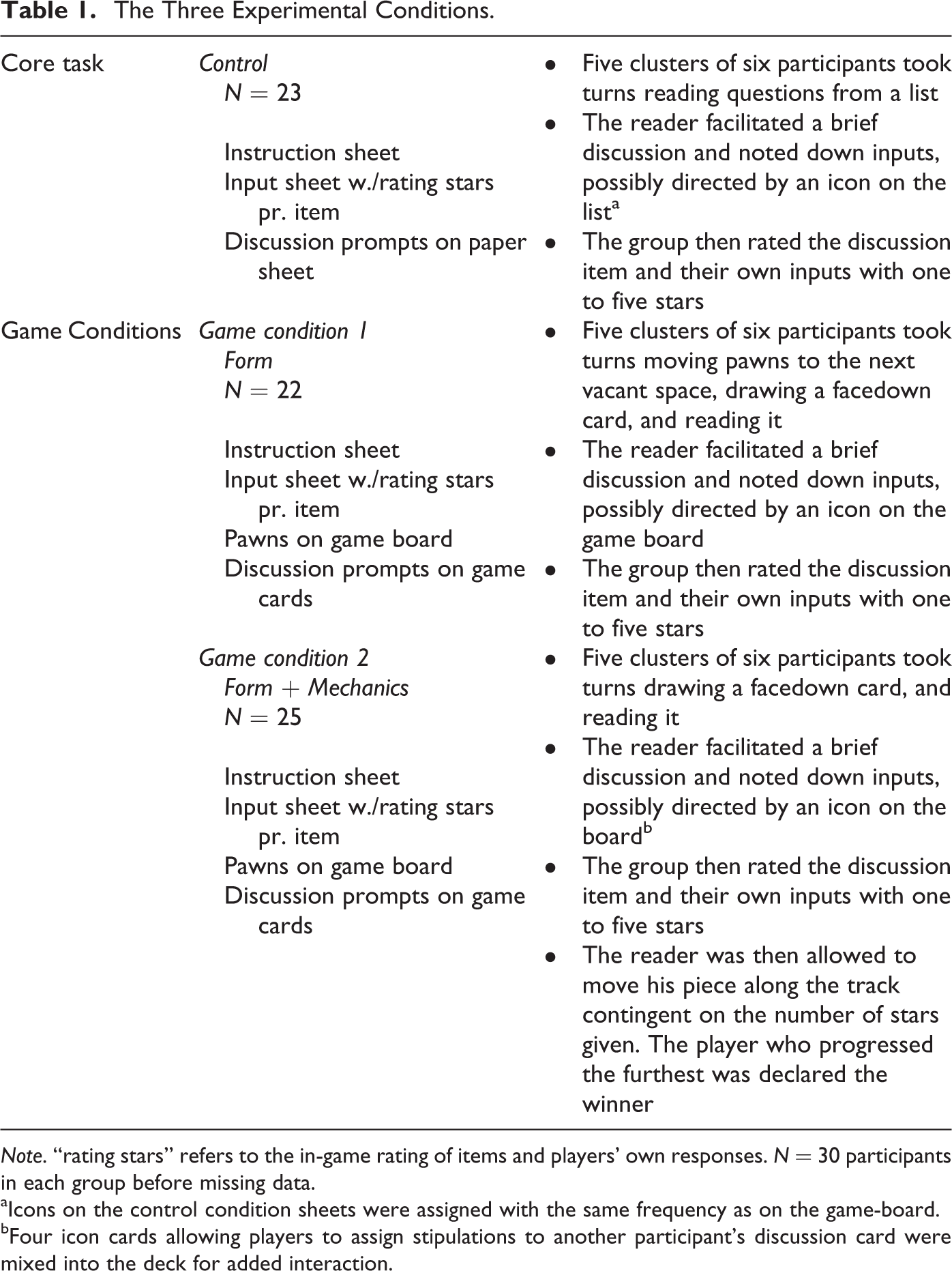
Note. “rating stars” refers to the in-game rating of items and players’ own responses. N = 30 participants in each group before missing data.
aIcons on the control condition sheets were assigned with the same frequency as on the game-board.
bFour icon cards allowing players to assign stipulations to another participant’s discussion card were mixed into the deck for added interaction.
Participants were told that INPUT (without any mention of gaming) is a popular business consulting tool under consideration by the university for future student satisfaction surveys (deception). Participants would take part in a pilot designed as a randomized controlled trial to evaluate different incarnations of the product. Their inputs would reach the department head of studies (true). No credits or monetary compensation were offered in accordance with Danish university standards, but participants were given refreshments after the study.
Design
Participants were set to do to the same core task, but with different framing through artifacts and assistants’ descriptions: One framing group was given the task with game artifacts (a game board, cards with discussion items, and pawns), to which was added some simple competitive mechanics for a second full game group. The control group did the core activity, but with nicely layouted paper sheets as step-by-step instructions, to structure the activity. The core task can be summarized as a social discussion in clusters of five to six people prompted by written cues, with participants taking turns facilitating the conversation and writing down feedback for the department. IMI and behavioral measures were used to test the hypothesis that the framing effects of these manipulations could be measured in terms of between-group differences in intrinsic motivation.
Materials
The six-player board game, titled INPUT, was designed following the recognizable race/quiz formula known from family games, like Trivial Pursuit and Pictionary (see Figure 1). Fourteen of the 28 fields on the game board included icons prompting players to direct their discussion toward a particular group of stakeholders (myself, us, the faculty, and the university). Pawns were placed on “start.” Cards with discussion prompts were packed in a random-looking order. To mirror workplace evaluations, items for discussion were chosen from all areas where our department performed subpar in the 2011 student satisfaction survey (e.g., too few students feel that they encounter their teachers outside the lecture halls), paired with a direct prompt/question for discussion (e.g., what could be behind this statistic? or what could be done about it?). Instructions and printed materials for each condition differed only in how to actually play the game/read the prompts and strategically placed framing vernacular like “play,” “player” and “game,” in order to ensure similarity between the conditions at all levels, except game elements.
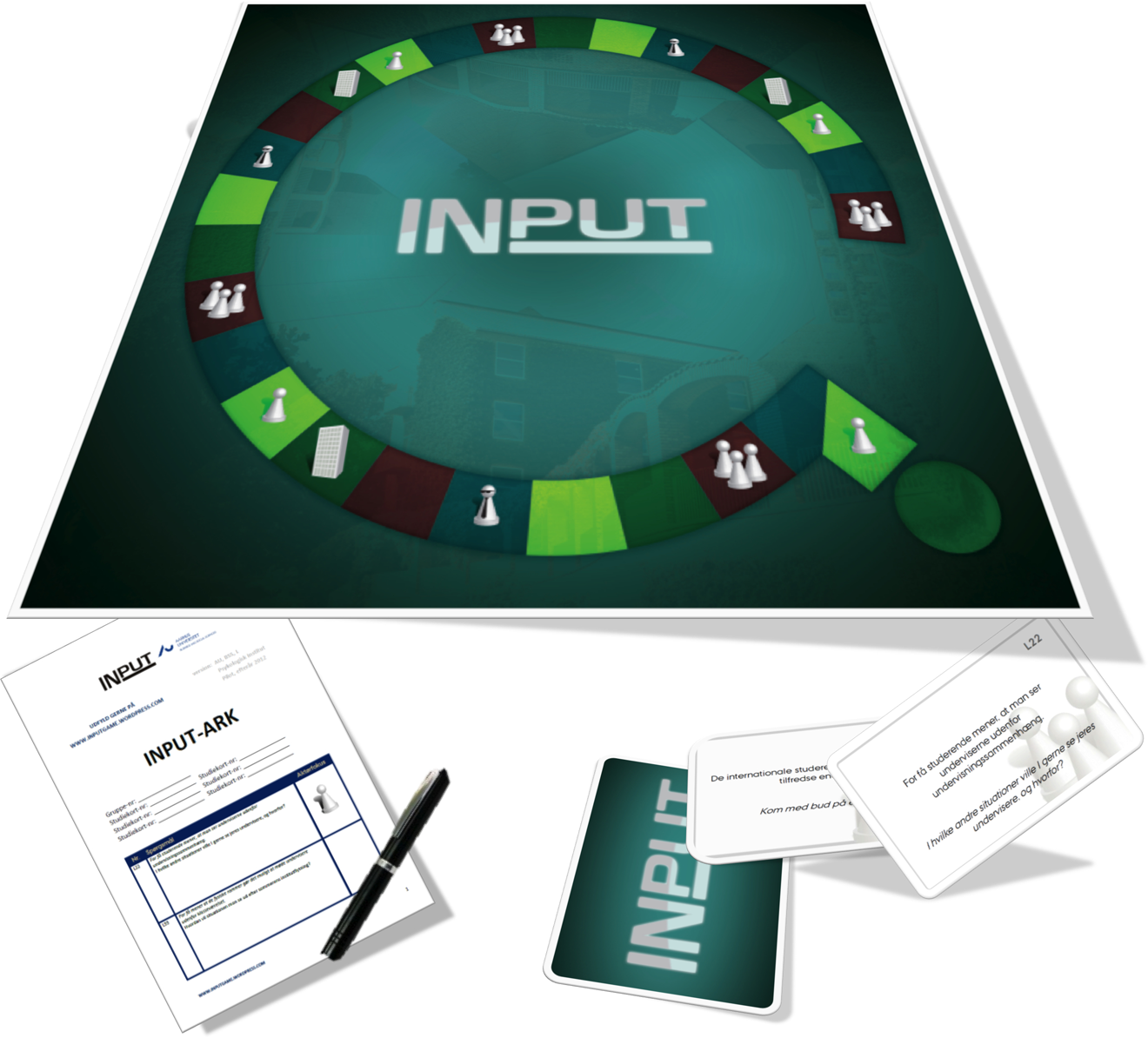
Input game materials.
In the control condition, participants were given the same core task, but on sheets of paper with discussion items (including icons in the same order as on the game board) appearing as a step-by-step list. Prominent graphics like the INPUT logo were featured in the control condition’s materials to ensure a somewhat similar aesthetic feel.
Procedure
After being given the cover story and randomly assigned to the three conditions, participants were ushered off to three separate rooms. Clusters of six participants were created ad hoc around tables containing the materials and instructed on their tasks based on the (game) materials. Discussion clusters were encouraged to proceed at their own pace but not devote too much time to each question. Each cluster of players was supplied with printed rules/instructions and an INPUT sheet for writing down their ideas and comments during the activity but encouraged to submit electronically, using an online SurveyXact-sheet, which supported time stamps for start and completion.
Participants were mandatorily engaged in the activity for 30 min, after which an assistant told them that the final evaluation questionnaire had not arrived yet and that they had to stay seated to avoid contaminating the experiment (deception—a false finish). Assistants quoted the script “you can go on playing/working if you like, or you can do something else. As long as you stay put.” This started the 20-min free-choice period, where the groups’ time on-task was monitored via SurveyXact time stamps and end-time noted on paper. After the free-choice period, evaluation questionnaires (paper and link to an online version) were distributed with our (fake) apologies (see Figure 2).
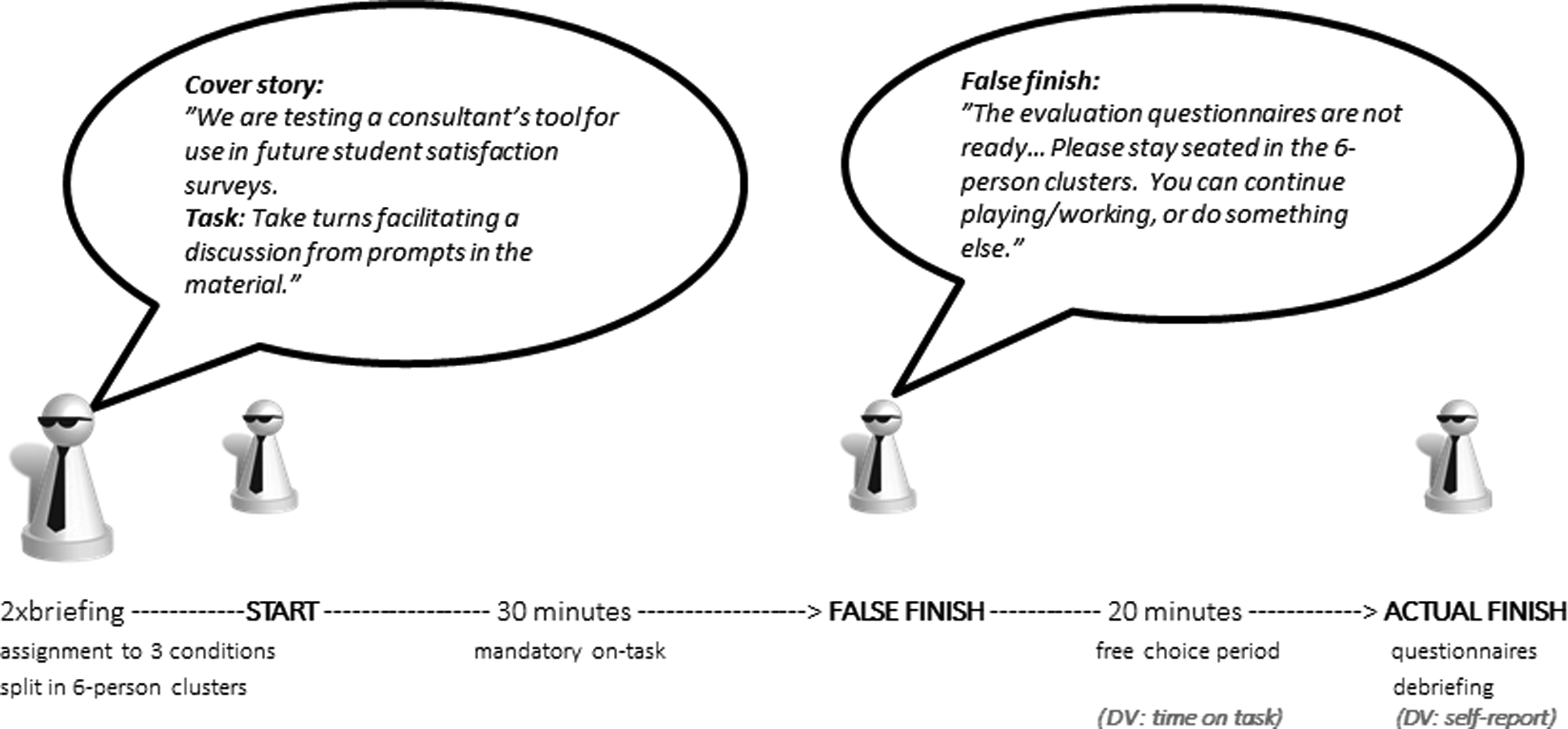
Experimental procedure (50 min play + briefing/debriefing and self-report questionnaires).
A formal debriefing was given on the following lecture. Here, students were informed of the experiment’s true purposes. A show of hands revealed that no one had figured out the design, so no data were excluded from analysis on those grounds. The university ethics board did not review the experiment, given its nonclinical nature.
Measures
The IMI was used for self-report measures of engagement with 38 items distributed on the subscales interest/enjoyment (7), value/usefulness (7), importance/effort (5) and of course competence (6), autonomy (7), and relatedness (6).
Four items gauged whether the stimulus materials were convincing at face value, as a professionally made consultant’s tool (as per the cover story), and 1 item gauged whether it came across like a game. A 13-item Crown and Marlowe’s (1960) Social Desirability Scale (trans. Lasgaard, Goossens, & Elklit, 2011) was used to test for pleasing behavior.
Behavioral engagement was measured as the time six-person discussion clusters would spend on-task during a 20-min free-choice period, in accordance with the intrinsic motivation literature. The number of items addressed was also counted. The number of items addressed was expected to be a secondary indication of engagement and productivity.
The six-person discussion clusters were asked to rate the quality/importance of each discussion item and the quality/importance of their own inputs after each discussion on scales from one to five “stars.” In Game condition 2, these in-game evaluations were also used as a performance contingent game mechanics (see Table 1).
Data Analysis
Ninety self-report questionnaires were collected. Behavioral data were successfully recorded for 12 discussion clusters of five to six participants (two for Game condition 1, five for Game condition 2, and five for controls).
The data were analyzed using IMB SPSS 20.0 with Tukey’s post hoc tests applied to one-way analyses of variance (ANOVAs). Missing values were handled using mean imputation, where subjects had filled in over 80% of each self-report scale (as per Schafer & Graham, 2002). IMI scales (α = .743–.882) displayed good coherence before mean imputation. One item was removed from the Social Desirability Scale to achieve an acceptable α value (12 items, α = .649). Although slightly above neutral (M = 3.337, SD = 0.439), it showed a small positive correlation only with the autonomy IMI subscale, r(89) = .239, p < .024. Pleasing behavior thus did not appear to play a significant role in participants’ self-reports. Aggregating the data into clusters and running a linear regression weighted by number of individuals in each nested group yielded no significant overall differences between the clusters. As predicted, main effects on the self-report measures seem to be found at condition level. No significant effects on IMI scales were found for gender. Age showed a small negative correlation only with relatedness, r(88) = −.281, p < .008. Centrally, the face-value item “INPUT was like a game” confirmed the basic premise that both game conditions would generate a more gamelike psychological frame than in the control task, F(2, 69) = 19.424, p < .001, partial η2 = 0.367. A Tukey’s post hoc test revealed significant differences (p < .05–.001) between all three conditions: Game condition 2 ranked highest (M = 3.68, SD = 1.069), Game condition 1 fell somewhat lower (M = 2.95, SD = 1.133), and controls on average did not find their activity gamelike at all (M = 1.83, SD = 0.887). A similar confirmation emerged for the 4-item scale (α = .835) gauging whether INPUT comes across as a professional consultancy tool, F(2, 68 = 8.562, p < .001, partial η2 = 0.206, except here the two game conditions (M = 3.524, SD = 0.921 and M = 3.510, SD = 0.765) both ranged above controls (M = 2.652, SD = 0.771) with no significant difference between them. After accounting for missing values, such as lacking identity markers and some unreliable time stamps resulting from technical issues with SurveyXact, 70 participants’ self-reports (control n = 23, Game 1 n = 22, Game 2 n = 25), but only 12 discussion clusters with just 2 of these (N = 11 individuals) in Game Condition 1, could be treated as part of one of the three experimental conditions.
Results
A one-way ANOVA revealed a significant difference in interest/enjoyment between the conditions, F(2, 67) = 8.223, p < .001, with a small-to-medium effect size (η2 = 0.197). A Tukey’s post hoc test revealed that both Game condition 1 (form; M = 3.247, SD = 0.854) and Game condition 2 (form + mechanics; M = 3.366, SD = 0.596) reported significantly higher (p < .007 and p < .001, respectively) interest/enjoyment than controls (M = 2.602, SD = 0.614). No other IM-subscales differed significantly between groups (Figure 3). All conditions reported above medium totaled intrinsic motivation scale scores (M = 3.24–3.53), with no significant differences between the three conditions, F(2, 68) = 2.204 p < .118.

Intrinsic Motivation Inventory self-report results.
Behavioral data (Figure 4) were largely inconclusive. A Kruskal–Wallis test uncovered no statistically reliable difference on the time the successfully recorded discussion clusters (N = 12) spent on task (M = 43.385, SD = 8.180) in Game conditions 1 (M = 37.385, SD = 1.280), 2 (M = 37.385, SD = 1.2799), and controls (M = 45.508, SD = 2.638).
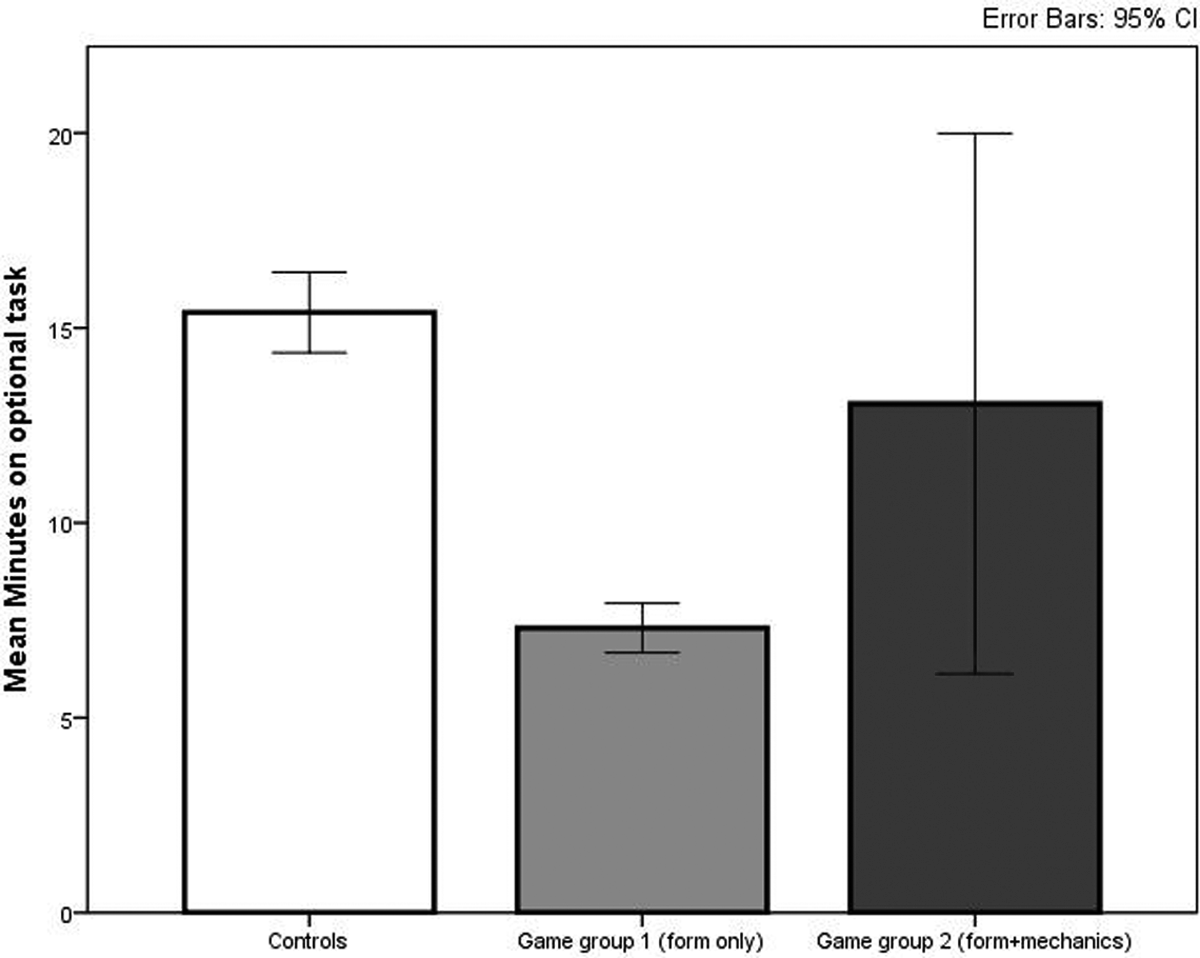
Mean time spent on task during free-choice period in each condition.
Controls addressed significantly more items (M = 9.800, SD = 2.168, mean rank = 8.50) than both Game condition 1 (M = 5.500, SD = 0.707, mean rank = 1.75) and Game condition 2 (M = 7.667, SD = 1.155, mean rank = 5.00), H(2) = 6.702, p < .035, (overall M = 8.090, SD = 2.343). There were no significant differences in average in-game evaluations.
The experience of INPUT as gamelike was significantly (p < .002) related to overall IM, r(89) = 0.450, and to IMI subscales interest/enjoyment, value/usefulness, competence, and autonomy with medium-to-large effect sizes. Similarly, the perception of INPUT as a professional tool was positively correlated (ps < .002–.001) with IM, r(89) = 0.656, and subscales, except for relatedness. See the matrix for full results.
Discussion
The study confirms that framing has a significant effect on enjoyment, when a task is presented as a game.
First, adding game artifacts significantly enhanced players’ face-value experience of INPUT as gamelike compared to controls, but only on the interest/enjoyment subscale of intrinsic motivation, which within the self-determination framework (IMI, 1994; Rigby & Ryan, 2011; R. M. Ryan et al., 2006) translates into the “fun” of games.
Second, game mechanics only made a difference at the level of game likeness. Having performance-contingent rules, where one player is declared the winner, apparently made the experience seem more like a real game, but this translated into neither significantly more fun nor motivation.
Third, the behavioral data must be viewed as largely inconclusive, as they lead to neither acceptance nor rejection of the null hypothesis—largely due to missing data. Control participants, who were only given comparably boring sheets of paper with instructions and a bit of graphical varnish did, however, generate more outputs than gaming participants. I surmise that that adding a playful frame to the task actually took away some of the grit and output orientation of more goal-oriented work. If at all significant, the numbers could simply stem from extra time spent fidgeting with game artifacts and understanding game rules or from more thorough discussions. We don’t know whether the high-producing clusters worked harder or simply skipped more superficially across each item. This detrimental effect of adding a lighter frame to serious activities, or alternatively its ability to engage people in conversations at a deeper level, is worth investigating further.
Ultimately, the fact that main effects on the intrinsic motivation variables were only found in the interest/enjoyment subscale leads to the overall conclusion that making something look like a game makes it seem more fun, but other motivational variables remain largely unchanged.
Game artifacts and game vernacular thus seem to be good bare-bone tools for making a rudimentary task more engaging at face value and creating a lighter mind-set. It seems that the genre of consultancy/training games INPUT was modeled after is therefore well suited to engage participants in infrequent activities, by virtue of their ability to frame and structure, even without the mechanics that most game designers strive to perfect.
We have ascribed this positive impact to framing effects resulting from recognizable game artifacts and strategically used vernacular. Simple novelty effects represent an alternative explanation. Presenting people with new and complex experiences is known to generate interest (Berlyne, 1954, 1970), so it is quite possible that the thin varnish in Game condition 1 would wear off, while players challenged by Condition 2’s relatively more competitive mechanics and thus more variable game possibility space might to explore new strategies and strengthen their sense of personal competence and autonomy in the longer term. Processes intended to create replayability and sustained engagement may thus still need to focus on well-tuned mechanics, even if an alluring gamelike form is fine for creating interest and enjoyment in briefer activities. The contribution of the game materials relative to social presentation (assistants speaking of the task as game or work) is unknown, but dissociating the two by splitting Condition 1 into further subgroups is an interesting line for potential future inquiry.
So how does this address the foundational debate about effective elements in gamification? In its broadest current use (e.g., Kapp, 2012), the term means the process of designing and using games for any serious purposes, but a more narrow definition entails applying only game mechanics—often limited to points, badges, quests, and leaderboards guided by simple behaviorist notions of motivation (e.g., Marczewski, 2012; Zichermann & Linder, 2010). In other words, traditional gamification seeks to structure and motivate activities like chores, shopping, or learning in a gamelike manner, without the framing that normally codifies an activity as a kind of game. This study in a sense legitimizes simple alluring designs that frame activities as games but spare both designers and participants an overabundance of rules and mechanics. These two design strategies—“framification” versus gamification—represent two widely used dimensions of the shallow end of the gamification and applied games spectrum, which might be viewed as opposing quadrants of a 2 × 2 model (see Figure 5), where full games occupy the top-left quadrant.
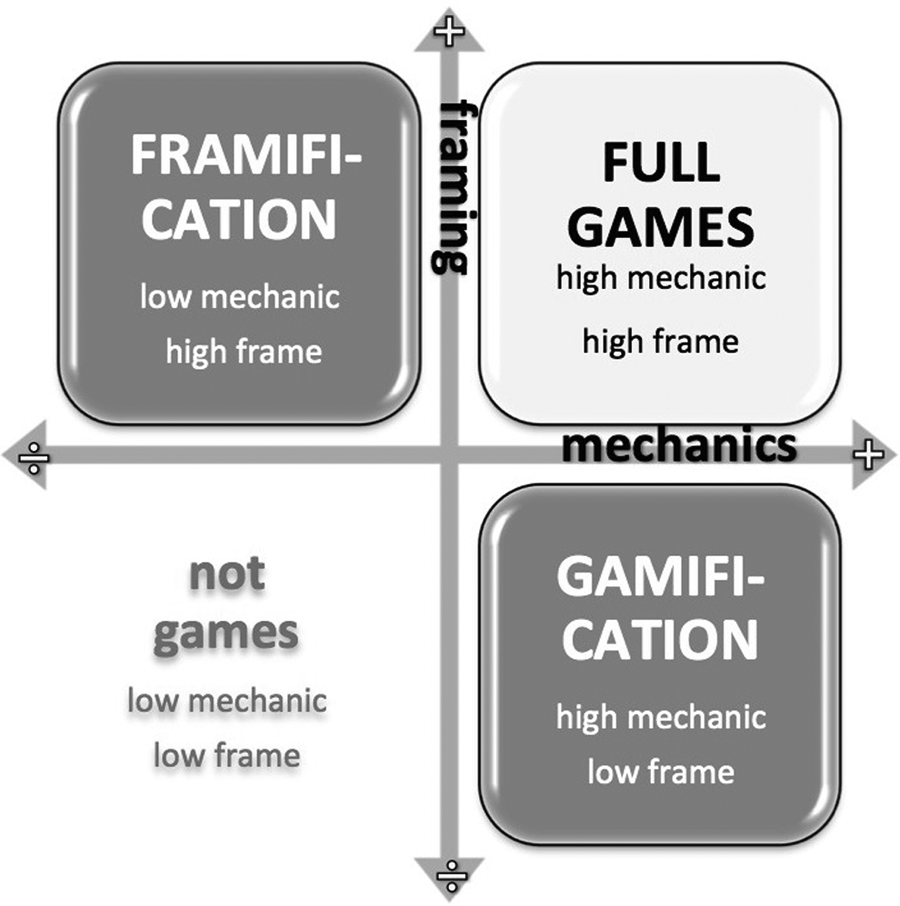
Framing and mechanics as characteristics of shallow gamification.
Limitations
Collecting data at the level of six-person discussion clusters made the study vulnerable to several cases of missing behavioral data. In some instances, it was impossible to place respondent data reliably in a condition or discussion cluster. The study encountered several other challenges related to the social nature of our tasks. Indeed, research continues to call attention to cultural and social processes “in-room” that strongly affect cognition “in-game” (Stevens et al., 2008). For instance, it is hard to predict whether individuals would have left the activity much earlier or would privately have liked to continue playing when their group stopped. Further, discussion clusters were seated around tables in the same room for each condition, so it is likely that overall in-room events, such as the first cluster collectively disengaging from the task, influenced the entire condition. This could even negatively affect self-reports about the experience as a whole, as individuals might feel less intrinsically motivated in retrospect, due to group coercion. However, high levels on the relatedness measure throughout, makes this unlikely. Although it would entail an entirely different study, ethnographic observation of players’ interactions, including detailed analysis of the time dedicated to subactivities like off-task chatter, mechanics, and serious discussions, would offer important glimpses into the round-table dynamics in a game like INPUT.
Since we took great pains making three conditions that were similar in all other aspects than game form and mechanics, what we created for Game condition 2 was not a great game by any stretch of the imagination. Although not significant, it is however worth noticing that players in Condition 2 answered more positively than both Condition 1 and controls on all self-report variables other than relatedness: A tendency that future studies might be able to boost with better game mechanics.
Future Directions
The evidence-based literature on effective gamification components is still scattered between applications and far from a point where systematic meta-analysis is possible (Hamari, Koivisto, & Sarsa, 2014). Because just positing gamification as a lie like Ferrara (2013) or bombarding interested practitioners with proposed use cases (Bowser, Preece, & Hansen, 2013; Zichermann & Linder, 2010) is uninteresting and counterproductive, researchers and practitioners alike are realizing the need to knuckle down and register effect data—not just from subjective evaluations but also observable behavior and net gains in the intended setting. Also, more studies should try to break clusters of game elements down to individual functional units, to dissociate which traditionally suggested gamification tricks work on their own or in conjunction, in what context, and on what psychological and behavioral dimensions impacts can be detected (for an unsuccesful attempt, see Lieberoth, Kock, Marin, Planke, & Sherson, 2014).
Framing effects can also be moderated by a host of other factors, such as personality traits (Levin, Gaeth, Schreiber, & Lauriola, 2002). While this study does consider pleasing behavior and issues of face-value acceptance, future research should address the deeper predictor structures arising from demographic factors (e.g., see Kovisto & Hamari, 2014; Lieberoth, Kock, et al., 2014), personality variables and even preferred play style (Heeter, 2009; Yee, 2007).
There was no right or wrong in the discussion tasks used in this study—just the structured democratic notion of letting everyone contribute to an evaluation of their shared educational environment. Future studies might be interested in whether framing of fun versus seriousness affects the quality and not quantity of performance, including creative and rote problem solving.
Conclusion
The experiment presented here supports the notion that framing accounts for a significant part of the psychological impact games have on fun, engagement, and other participation dynamics.
Overall, the effects of adding a “shallow” game coating to an otherwise serious activity were found at the level of enjoyment and face-value appreciation of the activity as gamelike—not engagement in a broader sense. The addition of competitive game mechanics surprisingly did not make a difference.
Framing training activities or social exchanges with a gamelike design is an effective way to engage people around a table and can capitalize on simple physical artifacts to motivate and structure cognition and behavior. This study indicates that good game mechanics are a nicety that may sometimes be psychologically secondary to the more shallow signals conveyed by the game artifacts themselves.
Footnotes
Acknowledgments
The author wishes to express his gratitude to Sigurd Rubech Hartmeyer-Dinesen for graphic design, Kristina Schoemmel, Noomi Matthiesen, and Jesper Aagaard for their assistance running the experiment, and Klaus Nielsen and Andreea Marin for proof and comments.
Declaration of Conflicting Interests
The author(s) declared no potential conflicts of interest with respect to the research, authorship, and/or publication of this article.
Funding
The author(s) disclosed receipt of the following financial support for the research, authorship, and/or publication of this article: The author produced this research under funding from the Aarhus University PhD program in psychology and behavioral sciences.