



Abstract
This article analyzes learning games that enhance the learning context through authentic experiences in real spaces related to the context of learning. However, the concept of learning in context has not yet been fully activated, which is attributed to the limitation in the use of learning games in spaces related to the learning context. To present solutions for this problem, the author proposed a digital-physical reality game (DPRG), a new conceptual framework to enhance the context by mapping fantasy in any ordinary space, such as the inside of a school through speculative research. The learning game was implemented based on the framework of DPRG, and the experiment verified that students became immersed in the story of the actual game through fantasy. They recognized a random space in which the game was played as the space set in the game and cognitively connected the current learning context with the random space.
Keywords
Introduction
As a new vision for the future computing environment, a ubiquitous paradigm was first proposed by Weiser (1991), who claimed that ubiquitous computing will create a new space in which the electronic and physical spaces will be combined. This new paradigm has widely been observed in education field as a new learning method. With the development of ubiquitous technologies, studies on learning attained by walking around a real space related to learning using handheld digital devices such as smartphones, tablet PCs, and personal digital assistants have been carried out in many fields (Cahill, Kuhn, et al., 2011; Cahill, Kuhn, Schmoll, Pompe, & Quintana, 2010; De Souza e Silva & Delacruz, 2006; Environmental Detectives, 2003; Kuhn, Cahill, Quintana, & Soloway, 2010, 2011; Kuhn et al., 2012; Mystery at the Museum, 2003; Park, 2011). Rooted in the constructivist learning theories, such as the work by Piaget (Ginsburg, & Opper, 1987), these studies were attempts to create learning empirically in a situation related to the learning context based on the theory that people can attain a rich understanding through concrete experience and emphasizing the importance of the context that suggests that learning involves a transaction between the person and the environment (Dewey, 1952; Kolb, 1984; Lave & Wenger, 1991). They used a variety of terms, such as nomadic inquiry, scaffolding learning, and quest-based learning, depending on what is mainly pursued in learning and what the methodological focus is. However, it can be seen that they all belong to the same category because they get students to perform scaffolding learning through voluntary and active learning, while conducting a quest and moving around the real-world environment related to the learning context by means of the portable digital devices in their hands.
In this article, all learning enhanced through authentic experiences in a real space related to the learning context is referred to as context-based learning (CBL). CBL usually has a number of game characteristics in its implementation. Salen and Zimmerman (2003) define “game” as follows, integrating the previous definitions: “a game is a system in which the players engage in an artificial conflict, defined by rules, that resulting in a quantifiable outcome.” CBL can be defined as a game under this definition because it has rules, play as experience, and culture as its context, goals, and competition, as well as an outcome. Furthermore, when a magic circle, which means boundary that defines the game in time and space, exists, it also can be defined as a game. The players utilize a space of the reality that they are familiar with as the field of play, but they soon transform the real space into an imaginative world while proceeding with the play according to the narrative. Ultimately, they enter the game world across the magic circle temporally and spatially through the fantasy provided by the story (Salen & Zimmerman, 2003). It is therefore supposed that CBL is generally implemented in the form of a game, and as such, the term context-based learning game (CBLG) is used as a unified term for CBL in this article.
The effectiveness and value of CBLGs have been verified through many case studies (Cahill, Kuhn, et al., 2011; Cahill, Lo, et al., 2011; De Souza e Silva & Delacruz, 2006; Environmental Detectives, 2003; Kuhn et al., 2010, 2011, 2012; Mystery at the Museum, 2003; Park, 2011). Despite these positive research results, however, CBLGs are yet to play a central role in learning. This is because most CBLGs are cases of learning that apply contents related to the context of the real background utilized as a game space (in a specified area such as a museum in science learning and geography-based history learning). Thus, application of CBLGs in a variety of learning areas is not easy because of the restrictions on learning contents. In addition, there are many cases where the outside serves as a learning environment based on global positioning system (GPS), which may partly cause safety problems.
Thus, this article seeks to explore new directions for CBLGs that can be applied to various learning areas, taking the safety issues into account, by analyzing the existing cases. This article investigates five cases of CBLG. These are representative examples that have been frequently mentioned and cited recently—from a simple type of CBLG that implements learning through portable devices and proceeds with the game individually, to CBLGs with complex systems that induce collaboration through the combination of the physical and digital spaces.
The article will also propose a new framework that can contribute to various learning schemes in the context of education beyond the limits of CBLGs. The framework reflects the positive characteristics found in the cases studied after examining them in terms of the learning-environment context, the use of digital devices and real space, and the method of combining digital and physical spaces. The author also attempts to verify through experimentation after implementing games with the proposed framework.
CBLG
Students often have difficulty in the educational environment of a formal school because many fields of study have traditionally been taught in an abstract way, apart from the experiential context (Lave & Wenger, 1991). However, people can form abstract concepts and generalizations through concrete experience, which helps them to achieve better comprehension (Dewey, 1952; Kolb, 1984). Based on these theoretical foundations, educators and researchers have made many attempts to situate learning within the context of the real world to concretize knowledge through experiences (Cahill et al., 2010, 2011; De Souza e Silva & Delacruz, 2006; Environmental Detectives, 2003; Mystery at the Museum, 2003; Kuhn et al., 2010, 2011, 2012; Park, 2011). In this section, five representative examples of CBLGs that have been mentioned and quoted the most will be examined, such as Environmental Detectives, Mystery at the Museum, Zydeco (2010–2012), Park’s Quest-based Learning System (2011), and Frequency 1550 (2005).
MIT Media Lab developed and examined Environmental Detectives, a new simulation platform designed to create augmented reality (AR) simulations by using handheld devices under the MIT Teacher Education Program ( Environmental Detectives, 2003; Klopfer, Squire, & Jenkins, 2002). Environmental Detectives is a game targeting high school and university students, where the players act as environmental engineers based on the game scenario presented. This game was developed to help the players learn the effects of toxin exposure on human health, groundwater flow, water treatment methods, and other related learning contents. In addition, the player can obtain information from the program’s built-in interviews with specialists and professors. After playing the game, the player is required to give a 5-min presentation on the theory behind the spill to his or her fellow learners ( Environmental Detectives, 2003; Klopfer et al., 2002; Squire & Klopfer, 2007). Environmental Detectives was designed to provide a virtual context layered over a real-world context by applying affordances of handheld technologies to education with the development of ubiquitous portable devices. Klopfer, Squire, and Jenkins (2002) classified affordances of handheld technologies into portability, social interactivity, context sensitivity, connectivity, and individuality. Moreover, by using the advantages of affordances, they implemented goal-based scenarios and problem-based learning, and anchored instruction in Environmental Detectives. In this case, the game is played outside using GPS, with each player taking on a role that he or she wants to play. This game leaves something to be desired in terms of collaboration since it involves no data/information-sharing process between the players in the course of playing the game, but it is characterized by the fact that the learning contents can be shared through the final presentation.
Mystery at the Museum, another project of MIT Media Lab, is an indoor AR simulation game enacted through the Boston Museum of Science. A burglary is supposed to have happened in a science museum, and the students need to catch the thief by taking on the role of a biologist, technologist, or detective and subsequently figure out what was stolen and what tricks were employed to carry out the theft. The whole group formulates strategies for task completion and solves the problems by putting together the information and data obtained from the activities of each learner. The players virtually conduct all sorts of scientific experiments, such as looking for fingerprints, interviewing the virtual characters in the museum, and finding clues from the exhibition halls or exhibits, using a handheld computer. Mystery at the Museum was implemented based on the experience and theory of Environmental Detectives. Mystery at the Museum is a game played indoors, using Wi-Fi for short-range information acquisition and communication, and is characterized by deep and broad engagement, collaboration across roles, interaction between the players, and even parent–child interactions, as in the 2005 test participated by the parents ( Mystery at the Museum, 2003; Klopfer, Perry, Squire, Jan, & Steinkuehler, 2005).
Cahill, Kuhn, et al. (2010, 2011) studied scaffolding learning, which is an instructional technique that provides learners with temporary support to help them reach a high level of understanding and achieve learning objectives, in the museum using the program Zydeco, a data collection app (application program) for iPhone and iPad designed to connect experiences in the museum and in school for science education. It is aimed at maximizing the effect of scaffolding learning by helping the students collaborate with one another in inquiry-based learning and by connecting the students’ experiences to the regular school classes. It implements the relevant contents by allowing pervasive information to be obtained using a mobile device and cloud technologies. With this, a teacher provides guidelines on or a basic structure of the learning to be acquired; and based on these, the students experience a variety of things, such as developing questions, designing a science experiment, and collecting/analyzing data. The map of the museum is saved in the mobile device and each interactive exhibit sends a signal when the students find the target point and approach it. Each student looks for clues and solves the problems. Finally, the students learn science contents and processes by joining the scientific investigation (Cahill, Kuhn, et al., 2010, 2011). Zydeco was designed to give students a rich experience and comprehensive information through effective inquiry-based learning founded on the situated learning theory. Toward this end, the advantages of the affordances of classroom and museum contexts are used. It sought to maximize the learning effects by using the advantages of two places such as a classroom, where there are teachers skilled in structuring learning and helping students, and a museum, where elements such as those that attract interest, exploration, and social interaction exist. The students also acquire learning by playing any of three roles (geologist, climatologist, and astronomer) in Zydeco, which features collaboration and scaffolding learning that occurs within the process, and the results of the simulation game are made available online so that the whole class can share what was learned.
Park (2011) developed the quest-based learning system and conducted a case study on it. He pointed out that there are media such as digital games, simulations, and virtual realities that can be used for a safe learning environment and provide continuous practice and training. Among these, he suggested the operation of quest-based learning in the form of a game that assigns a quest, a form of mission, to the learners by combining the quest presented in digital games with smartphone application for use in the educational field. This is a quest-based learning game grounded on the story that one day, a wise king who rules over Mars acquires a serious disease and a magic pill from people with a certain occupation requiring special qualifications is necessary to cure the king’s disease. The players can obtain the magic pill by solving the quests that are given one at a time. The four learners in each group play the game by assuming the role of a brave warrior, a storyteller, a local scholar, and a wizard, respectively. They look for quick response (QR) codes in a particular place, receive instructions, and thereby perform a quest. Park’s Quest-based Learning System is based on the constructivism learning theory and experiential learning. It induces learning behavior through stories, interaction, and quests, and helps achieve knowledge acquisition and reconstruction through learning by doing. This fits in with the characteristics of the learning generation at the center of the society, which changes toward the experience-based learning tasks. In the case of Park’s Quest-based Learning System, GPS was not used despite the fact that the game is played outdoors and QR codes were utilized for gathering information, which have the technical advantage of easy access by the teachers. It also requires the sharing of the learning contents in the online space, as in Mystery at the Museum.
The most complex CBLG is the hybrid reality game (HRG), such as Frequency 1550. HRG is a game simultaneously played online and on the street; it proceeds by dividing the players into online and street players. The representative HRGs are Can You See Me Now? (2001–2006), I Like Frank (2004), and Uncle Roy All Around You (2003) from Blast Theory and Mixed Reality Lab. The street players get around an actual urban space using GPS and the online players identify the locations of the street players’ online, chase, and try to catch the street players in the online space according to the purpose of the game or provide the street players with information for collaborative tasks (De Souza e Silva & Delacruz, 2006).
Frequency 1550 is a form of game in which the concept of HRG is applied. In Frequency 1550, players are transported to the medieval Amsterdam of 1550 via a mobile phone. The players should communicate with a fictitious character while helping it find holy relics. They are divided into two groups of students who deal with information in the classroom and who play on the actual street, and street players who move using GPS. The players in the classroom must collaborate with street players to be able to address the game’s location-based challenges. Frequency 1550 was designed to allow the players to look at a familiar space from another angle and to look into learning contents taught in the classroom from a different point of view. This is achieved by using the principles of social, experiential, and situated learning based on the affordances of cell phones, mobile Internet, and HRGs characterized by information-processing capacity, unrestricted access to people and information, and intrinsic motivational properties. Frequency 1550, similar to Environmental Detectives, utilizes GPS outdoors. However, similar to Park’s Quest-based Learning System, it uses the real outer space, rather than the campus as a playground. Its biggest distinguishing feature is its complex combination of online and physical spaces and the collaboration that it requires based on this.
CBLGs are implemented in various forms in terms of the characteristics of the place where the game is played, the technologies used to recognize the players’ positions, the role configuration, and the process and utilization of digital space (see Table 1). They have, however, the following common characteristics: Their learning contents, game environment, and story are related to one another; and the learners simultaneously proceed with learning in the physical and digital spaces, using the portable digital devices in their hands, in an environment related to the learning context. In this process, the learners perform experiential learning through the physical environment and they embody and generalize learning in the digital space using handheld digital devices. In addition, the learners start a discourse while communicating with the other learners in the physical environment or within the digital environment. Through this cooperative process, learning effects can be enhanced. The process of CBLG is shown in Figure 1.
Analysis of CBLGs.

Note. CBLG = Context-based learning game; GPS = global positioning system; QR = quick response.
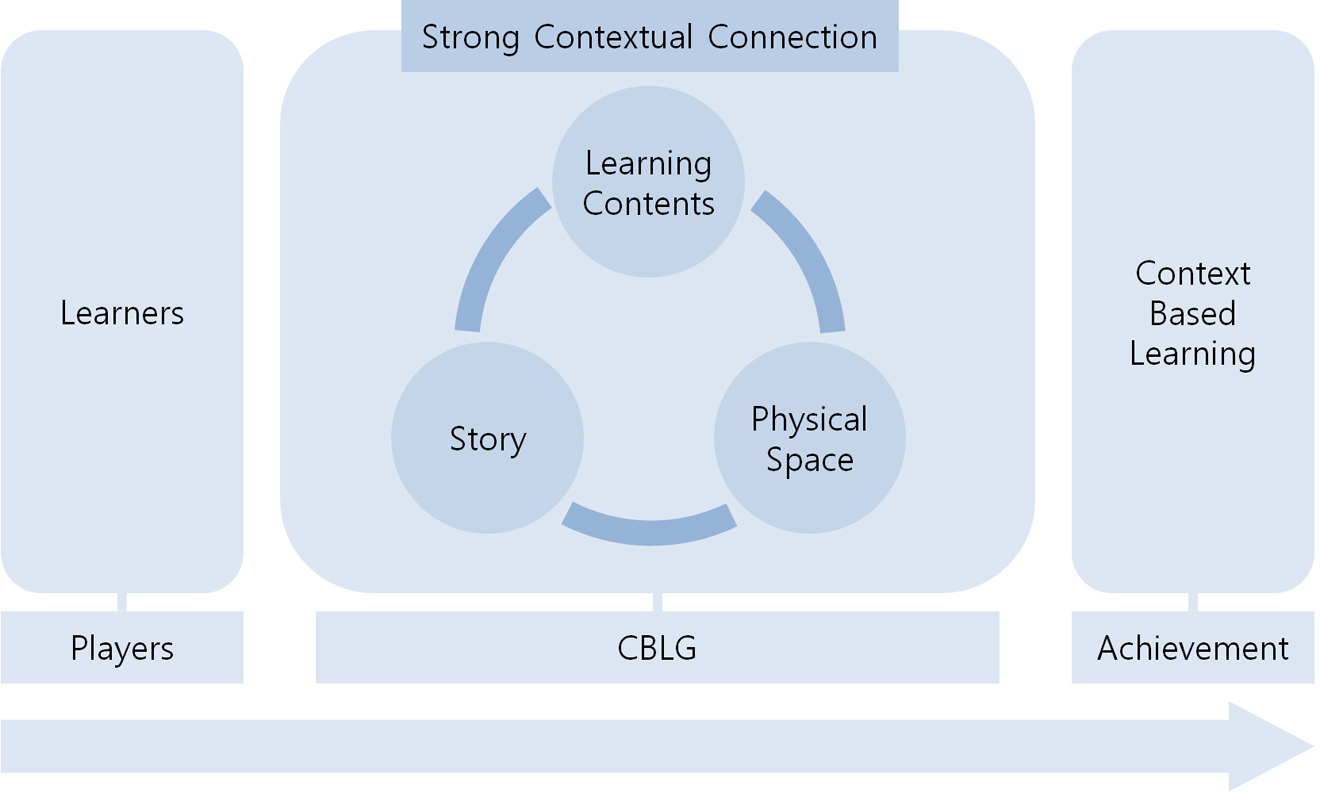
Context-based learning game process.
Features of CBLG
As in the previous cases, CBLGs are characterized by the following two aspects: learning contents and implementation. Their most important feature in terms of learning is that learning is placed in the situational context related to learning, and various theories support its validity (Brown, Collins, & Duguid, 1989; Falk & Dierking, 2000; Falk & Storksdieck, 2005; Lave & Wenger, 1991; Vygotsky, 1978). In terms of implementation, CBLGs have the characteristics of pervasive games. According to Schneider and Kortuem (2001, p. 1), a pervasive game is “a LARP game that is augmented with computing and communication technology in a way that combines the physical and digital space together.” Live action role-playing game (LARPG) is a type of role-playing game that takes place in a physical space where the players play the game while interacting with the people assuming the roles of the other characters in a fictional setting that represents the real world (Montola, Stenros, & Waern, 2009; Salen, & Zimmerman, 2003; Tychsen, Hitchens, Brolund, & Kavakli, 2006). In light of the definitions of pervasive games and LARPGs, CBLGs, as shown in the case, are pervasive games that generally have roles and that combine the physical and digital spaces through augmentation by communication technologies and by portable computers such as smart devices. In addition, Montola, Stenros, and Waern (2009, p. 12) stated that “A pervasive game is a game that has one or more salient features that expand the contractual magic circle of play spatially, temporally, or socially.” Given the definition of a pervasive game (Montola et al., 2009) with a wider range that includes LARPGs, it can be seen that they are also included in the category of pervasive games, although there exist CBLGs that do not fit into the category of LARPGs or have the weak concept of the role.
In light of the definition of the above-mentioned two pervasive games, CBLGs as pervasive games “using portable digital devices for exploring the real space” are differentiated from other games in terms of the following two aspects: the technical utilization of portable digital devices in the space and the combination of the digital and physical spaces.
In this section, the characteristics of CBLGs will be investigated in terms of three aspects with regard to learning contents and implementation as follows: learning games placed in the learning context, technical utilization of portable digital devices in the space, and combination of digital and physical spaces.
Learning Games Situated in the Learning Context
Many educational technologists and learning scientists have shown that learning is a process of creating new understanding based on prior knowledge and experiences. Vygotsky (1978) considered that learning and doing cannot be separated and that learning complies and assimilates with culture by absorbing the latter’s values. Lave and Wenger (1991) regarded knowledge as having much value when transmitted and generalized in situations that can be applied in real life, because they thought that knowledge is a dynamic product of the unique interaction between individuals and their environment. They pointed out that learners cannot generalize knowledge into the problems or situations in real life because schools have transmitted knowledge using decontextualized tasks. They also argued that learners have to solve a problem by connecting existing knowledge to a new one through the suggestion of knowledge and functions with a particular social and physical environment or context in situated learning. Solutions to a problem are also determined through the use of concrete and various examples that can happen in real life. Brown, Collins, and Duguid (1989) described that activities and situations are essential to cognition and learning, claiming that decontextualized learning causes a separation between learning and doing. They emphasized the context, claiming that learning cannot be separated from the context where it is used and that it is “a continuous, life-long process resulting from acting in situations.” In the same vein, Lave and Wenger (1991) also asserted that learning that occurs commonly is a function of the activity, context, and culture where the learning is situated. Including the five examples suggested earlier, all CBLGs are based on the importance of this learning context.
The Zydeco project is focused on the relationship between formal and informal settings in the learning context. Cahill, Kuhn, et al. (2011, p. 21) reflected the framework of the contextual model of learning by Falk and Dierking (2000) to make learning in the museum easy when designing the Zydeco system, confirming that “Helping students conduct inquiry across formal and informal settings is a way of scaffolding students to practice inquiry.”
Falk and Dierking (2000) discussed the contextual model of learning, which they used to come up with a framework for understanding the factors that influence learning in informal settings. According to the contextual model of learning, learning in the museum for science learning is influenced by aspects of the personal, social, and physical contexts (Falk & Dierking, 2000). The personal context includes the learner’s prior knowledge, prior experiences, and prior interests. The social context includes social interactions with other people in the social group where the learner belongs. The physical context includes every tool that mediates the learner’s experiences, including the design and arrangement of the exhibition, physical space and building, and advance organizers that cognitively structured the experience (Falk & Dierking, 2000; Falk & Storksdieck, 2005). In that respect, Cahill, Lo, et al. (2011, p. 2) asserted that “context—physical, sociocultural, and personal—is inseparable from learning. Thus, bridging formal and informal learning environments—and helping students learn to apply their school-oriented practices and knowledge outside of the classroom—is essential.” In the end, it is essential for scientific activities to be conducted in the real world so that students could deepen their understanding and make it meaningful in the situational context (Lo et al., 2012; Minstrell & Kraus, 2005).
De Souza e Silva and Delacruz (2006) suggested the following three features of Frequency 1550: the use of mobile and location-aware interfaces, bridging physical and digital spaces, and transforming the urban space into the game board, rather than taking place solely in a simulated computer environment. They also stated that learning becomes more meaningful when digital space is connected to the physical space, and situating it in the real space, not in the computer simulation environment. According to De Souza e Silva and Delacruz (2006, p. 232), this type of game can fix information in a situation where solid and physical access is available by connecting the contents to the relevant physical location; “Therefore, in HRGs, information is distributed in three different sources: physical local spaces, digital spaces, and students’ prior knowledge.” In De Souza e Silva and Delacruz’s (2006) concept of information, the students’ prior knowledge is related to the personal context, physical local spaces are related to the physical context, and digital spaces represent the social context where social interaction occurs.
Baek (2006) argued that as the context of real life can allow students to connect learning contents with their personal experiences and needs, it gives students motivation for learning and makes knowledge more meaningful and easy to understand. Thus, the context should be taken into account in game-based learning so that the students can experience authentic situations rather than decontextualized situations. Park (2011) developed and studied quest-based learning, which utilizes QR codes in a real space, in his quest-based learning system study, based on the aforementioned grounds.
Klopfer and Squire (2008), who developed and examined Environmental Detectives and Mystery at the Museum, claimed that a powerful handheld learning environment is based on context sensitivity, along with portability, social interactivity, connectivity, and individuality. Gathering “data unique to the current location, environment, and time, including both real and simulated data,” strengthened the contextual relationship of learning and real space (Klopfer & Squire, 2008, p. 204). It is already mentioned that CBLGs situate learning in the situational context based on a variety of theories.
Use of a Portable Digital Device as a Navigator or Guide
In terms of the implementation of learning or a game where learning is in progress, a portable digital device plays the role of a navigation system, a map, or a guide when exploring a real space. Such guiding role is essential and can be classified into two types, depending on the technological methods used.
Among the aforementioned cases, Frequency 1550 and Environmental Detectives are examples of games using GPS. The only difference between the two cases is that in Environmental Detectives, all the players roam in the real space using GPS, whereas Frequency 1550 is a more complex system where the players are divided into online and street players, and some players get around in the real urban space, meet online players via the network, and collaborate in digital space.
Among the games where GPS is not used are Mystery at the Museum, Zydeco, and Park’s Quest-based Learning System. They also use different implementation methods for recognizing specific locations. Mystery at the Museum and Zydeco have the common characteristic of using a map and infrared ray communication in the interior space but are slightly different in their implementation of technology.
In Mystery at the Museum, the players are provided with information based on their location via Wi-Fi. In Zydeco, as the players go closer to each interactive exhibit, reaction occurs through a Bluetooth signal. In Park’s Quest-based Learning System, however, the players get to know the next location by receiving instructions and solving clues using the QR codes that they obtain whenever they arrive at the indicated location. This is characterized by the nonuse of GPS even in an outdoor space.
Although the use of GPS is not easy for Mystery at the Museum and Zydeco because they are played indoors, the fact that Park’s Quest-based Learning System uses QR codes and instructions rather than GPS despite its being played in an outdoor space suggests that the GPS technology is not an essential element in CBLGs. CBLGs are played based on real space, similar to general pervasive games, but they use GPS or other technologies, depending on the need and situation. What is important is that all these are based on the real location related to the learning context so as to improve learning effects through experience.
Combination of Digital and Physical Spaces
CBLGs make use of digital and physical spaces at the same time. The players perform the process in digital space in progress within portable digital devices, while walking around the real space. That is, the players play in the digital and physical spaces simultaneously, and the classification types may vary depending on the space combination form.
Mystery at the Museum, Zydeco, Environmental Detectives, and Park’s Quest-based Learning System use different kinds of portable devices, have their own unique systems, and differ in terms of the use of location-aware technology. However, they exhibit similar patterns in terms of the utilization of digital and physical spaces. In all of them, the relationship between the two spaces is not complex. The physical space is where the players actually move and collect data from and where direct conversation between the players sometimes occurs, whereas digital space is the one in which the data obtained in the physical space are gathered through portable devices, where some differences in the data collection methods employed can categorize them into two groups. With regard to Mystery at the Museum and Environmental Detectives, the data are stored on the device itself; but in Zydeco and Park’s Quest-based Learning System, the gathered data are collected again online and shared by the whole class.
In Frequency 1550, there is a complex relationship between the two spaces. The players proceed with learning as they are separated into two different roles, such as online and street players. The online players send information and game strategies to the street players in the classroom via the Internet, while the street players move around the street. They exist in the digital-physical space at the same time, as in HRGs, and solve problems through cooperation.
A New Approach of CBLG
As discussed previously, past studies on CBLGs placed bigger emphasis on the context. It seems, however, that there were some restrictions in the learning contents and that there was a limited range of space choices because the actual environment physically related to learning was emphasized only as a result of the excessive focus on the context. Moreover, it may be considered that as a result, CBLGs are not activated in this way. In addition, when selecting a place that is highly related to the environmental context, sometimes, outdoor spaces such as cities become the play space for some unavoidable reasons. Woo, Leem, and Wohn (2010) argued that existing ubiquitous games, which allow the players to move from one place to another using a personal terminal, can expose the players to external risk factors such as vehicles along the way. In other words, excessive immersion in the game can expose the players to risk factors such as bumping into another person or being hit by a car. In light of the recent increasing trend of accidents happening when people are looking at the screens of their smartphones while walking on the street, there is rising concern about the occurrence of accidents related to the use of portable devices while walking on a street with cars, especially in the case of elementary school students, who lack concentration (Woo, Leem, & Wohn, 2010). This can threaten one of the basic elements of the game, safety, which is mentioned by Crawford (1984).
Therefore, we intend to suggest the concept of a safer type of game that is not limited by space while keeping the context, by combining various theories. The concept assumes that this problem can be solved when the context is kept, but when the spatial restrictions are eased. In the existing cases, it has not been easy to diversify the learning contents because they have been developed based on stories related to learning in the learning-related environment. Also, they partially have a problem with safety if the play space is an open space outside the school, such as an urban space. On the other hand, the game space is considered appropriate if it can cause immersion based on fantasy through story mapping, although it does not perfectly correspond to the learning context.
Theoretical Backgrounds for Reinforcing the Relationship Between Physical Space, Story, and Learning Through Fantasy
Lee (2009) and Lee and Kim (2009) suggested loosely coupled mixed reality, in their efforts to find a way to enhance the relatedness between physical space and digital space and provide mixed reality with practicality. Through experiments involving sports and exercise games, such as golf and jogging, they demonstrated that loosely coupled mixed reality is effective for registering a virtual space and a real space through a metaphor and gives a sense of reality. Loosely coupled mixed reality is a concept consisting of two environments that are spatially separated and are without any connection, such as separated digital and physical spaces. A combination specified only to a minimum is maintained between the two spaces so that the users can combine the two spaces into one in their imagination. Each user creates different kinds of pleasure or experiences by combining them into one space in his or her imagination while having two separate spaces even after the combination, instead of creating one space through accurate registration. In other words, hybrid reality, which the users perceive through loosely coupled mixed reality, is created by the users (Lee, 2009; Lee & Kim, 2009).
Based on this concept, there appears to be a strong contextual connection between learning and physical space while implementing CBLGs in a physical space loosely connected with the learning context. However, a complementary device is needed because the contextual connection with a real space is weaker than that of existing CBLGs. For this, it is necessary to strengthen the cognitive context through fantasy and to use physical tools that induce immersion to strengthen the fantasy.
Lee (2009) and Lee and Kim (2009) found that loosely coupled mixed reality provides very high immersion. According to Murray (1997), immersion is the sense of being surrounded by a completely different world, pulling one’s every interest and cognitive function. Based on this definition of immersion, the greater the users fall into the game story through strong immersion, the more strengthened the context is. Ermi and Mäyrä (2005) classified immersion into the following three groups: sensory immersion, challenge-based immersion, and imaginative immersion. Of these, induction of imaginative immersion, which is induced by fantasy from the story, character, and word view of the game, can strengthen the sense of reality further, which feels like falling into the game world (Ermi & Mäyrä, 2005). Similarly, Malone (1980, 1981), and Malone and Lepper (1987) drew fantasy along with challenge, curiosity, and control as the intrinsic feature of a good quality computer game and other intrinsically enjoyable situations. They suggested these as an intrinsic motivation factor on a personal level, which can be applied to the teaching and learning environment (Malone, 1980, 1981; Malone & Lepper, 1987). Malone (1981, p. 360) said, “Fantasies can make instructional environments more interesting and more educational.” Based on these various theories related to fantasy, it is considered that imaginative immersion and fantasies, which are induced by imagination from the view of the world in the game, can cognitively strengthen the loosely connected context of learning.
In LARPGs, the context is strengthened by fantasy in a game. As mentioned earlier, from the definition of a pervasive game by Schneider and Kortuem (2001), CBLG can be considered an advanced form of LARPG. It has also been a very important issue in LARPGs to create an environment that reflects the context of the story to help the players become immersed in the game. They could not satisfy all the backgrounds, which are suitable for a variety of subjects, such as cyberpunk, horror, science fiction, and many others. Therefore, it is commonly required that the players use much of their imagination in the empty physical space for a realistic game. Based on this, it has become possible for LARPGs to have various backgrounds, including science fiction, heaven and hell in various religions, and the human body. For example, a fantasy LARPG with a castle as its background became possible even when no traditional castle actually exists in the place. This type of fictional setting is called visualized world setting in LARPGs. Visualized world settings use an unmodified real-world setting as they rely purely on the player’s imagination (Tychsen et al., 2006). This case is a good example of players cognitively changing the general environment to fit the context of the contents and the story through immersion in a world based on fantasy.
Fantasy can be augmented by using physical tools that induce immersion. Consequently, themed world settings can be suggested, which are other fictional settings of LARPGs. In themed world settings, latex weapons, costumes, theater props, and special effects are used to increase immersion. People play a game in costumes that suit the story and time setting. They wear makeup and hold latex weapons to fall into character in the game world (Tychsen et al., 2006). This activity induces strong immersion into fantasy in the game. This is considered possible through the use of AR, considering that smart devices are used in CBLGs loosely connected with the physical space. AR is a technology that provides improved immersion and reality to the users by seamlessly mixing the actual world and the virtual world in real time (Azuma, 1997). Shelton (2003) claimed that AR can be used for active learning, constructivist learning, intentional learning, authentic learning, and cooperative learning in instruction. AR supports learning by doing, which is learning through experience in the actual environment by providing a tangible interface where interaction is possible while manipulating the real things and the natural interface that covers reality to the virtual space. AR can promote learning because it makes practical manipulative activities for the learning entity possible. These manipulative activities enhance the learning experiences of the learners and induce their immersion in the learning scene. Such activities also offer the advantage of promoting understanding of the learning context because they use the learning scene as it is and show additional learning entities on it (Billinghurst, 2002; Billinghurst, Grasset, & Looser, 2005; Ishii & Ullmer, 1997; Kye & Kim, 2008). For example, while playing a game in the classroom with a museum scenario, the players can see prehistoric artifacts that do not actually exist in the classroom. They can feel the artifacts through AR. In science learning, the players can form experiential intuition about the natural world, which is difficult to experience in reality, through a tangible, manipulative-activity-type AR game where the players directly observe and experiment on the water cycle (i.e., Kim, 2005).
Along with AR, designing the images of the characters and props displayed on a portable device to fit the context of the story and strengthening the sound effects can also assist the players’ imagination. This is demonstrated in the sensory immersion of Ermi and Mäyrä (2005), who considered audiovisual elements such as graphics and sounds as important elements of immersion, along with fantasy.
Consequentially, the application range of CBLGs weakly connected to space and learning may be widened by mapping the context in an arbitrary space. Malone (1981) pointed out, however, that it is difficult to predict the kinds of fantasies that will appeal to different people considering the emotional aspects of fantasy. It seems to be an important matter to be considered separately, depending on people, in the design of the CBLG where the context is enhanced by fantasy mapping.
Thus, as can be seen in many theories, space mapping through fantasy can strengthen the context in physical spaces loosely connected with story and learning context and can induce immersion. More specifically, it can strengthen fantasy through AR and sensory immersion and can enhance intrinsic fantasy by facilitating learning to take place in the context of a story.
Digital–Physical Reality Game (DPRG)
A new type of CBL system that is loosely connected to learning contents is proposed in this study, based on the theory that fantasy strengthens the context among learning, story, and space.
As mentioned earlier, existing CBLGs proceed with learning (a) through digital space along with a physical space (b), using portable digital devices (c) in an environment related to the learning context and have characteristics that correspond to the following: use combined physical and digital spaces, the physical space and the story boost the users’ learning as they are related to the learning context, induce the learning motivation of the users by arousing their interest and facilitate spontaneous learning, present specific roles for each player (even when playing alone, a player assumes a role in the process of collaborating with the virtual characters), attract collaboration and competition between the users, and allow scaffolding learning individually or within the group.
We intend to conceptually develop a type of learning game that reflects the aforementioned features, but strengthens the context through fantasy in the implementation of CBLGs in an ordinary and safe space loosely connected with learning contents as follows: It is suggested that the space, where there are less external risk factors, such as space within the school fence (classroom, playground, or any other place in the school), be used as the physical space and that the space be extended to the digital space by using portable digital devices such as smartphones or tablet PCs. Suppose the physical space as the space related to the learning context and cognitively map fantasy through the story. To do this, the context is strengthened among physical space, the story, and the learning through a mapping technique for virtual objects in a real space such as AR and the elements of sensory immersion such as graphics and sounds. For example, suppose that the school building is the museum and that the classroom is the exhibition hall and both are used in a learning game that has a story set against a museum background, such as Mystery at the Museum or Zydeco. It is possible to cognitively map the classroom to the museum through the story’s fantasy element and through the similarity of the spaces (indoor space and room). The graphics and sounds of a smart device can boost the sensory immersion in the game. The context of the space and learning is strengthened by enhancing the sense of reality of the space and reinforcing reality through a tablet PC and other device, after putting AR cards on the wall and desks in the classroom or hallway. Construct a game that can facilitate spontaneous learning and induce the learners’ interest and learning motivation by elevating the story completion level. Play a game as a team and make individuals collaborate with one another by giving each a role. Encourage collaboration in the team by introducing elements of competition between groups if necessary. With regard to the contents, construct the game for scaffolding learning.
In the case of the game configured as mentioned earlier, the players proceed with the game, while holding portable devices such as smartphones or tablet PCs. They are instructed to proceed with the game through mobile technologies suitable for the story and space, without being tied to the framework that requires them to use a specific technology such as GPS. The players move to a specific place by using a map, instructions, or GPS, where they are able to collect information through Wi-Fi or Bluetooth, QR codes, and AR. The use of the latest technologies, such as near-field communication, also appears possible. In this process, the learners get to assume their own roles, perform their roles, collaborate with one another, form a discourse, achieve scaffolding learning, and compete with one another in groups.
The form of the learning game with a framework in which the context between learning and the physical space is strengthened by enhancing fantasy through the use of digital devices, AR, and the digital space is referred to as a DPRG (see Figure 2).

Digital–physical reality game system.
The contextual features of the DPRG concept differentiated from the existing CBLG are as follows: Weak relationship between physical space and learning: The physical space for learning is not always closely related to the learning context. Existing cases used Amsterdam as the game space for history-related learning, a city in South Korea for social learning, and a museum for science learning. DPRG, however, uses a space that the players can imagine and where analogy is possible in its form—in other words, a space where the connection with learning is slightly loosely connected, but where cognitive mapping is possible—for the play space. Weak relationship between the story and physical space: The story is not always closely related to the environment. In existing cases, the game played in a university campus was constructed with a story actually related to it and the game played in the museum involves exploration or a burglary story, which fits a museum. It is suggested that DPRG be constructed with more varied fantastic stories. For example, it is possible to map each classroom in the school as a specific prehistoric period, for science learning, or to consider the school as a castle in a more fantastic story involving a hero who sets out to save the princess or friend. When creating a mystery adventure, it is possible to set the story as one that involves having to escape from a number of rooms and to cognitively map each classroom as a room to escape from.
The players may become immersed in the game’s worldview through a well-structured story plot in the loose and cognitive connection of the story and space, and the context among the story, the physical space, and learning may be connected by making the learners experience fantasy through AR and through the images, sounds, and other elements of smart devices. The process of DPRG is shown in Figure 3.

Process of digital–physical reality game–enhanced context through fantasy.
Experiment
In this chapter, the suitability of the DPRGs theory is empirically verified through experiments after implementing case-game utilizing frameworks. In addition, an exploratory study on factors not found in the theoretical research was conducted. Both the strengthening of the context through fantasy and enhancement of the fantasy through AR, audiovisual elements, and another element other than aforementioned ones were examined using the following research questions: How do stories and AR and audiovisual elements affect the fantasy during the progress of the DPRGs? What other factors possibly influence the fantasy? How does the fantasy obtained through games contextualize the physical space? How does the fantasy obtained through games connect the context between the physical space and learning? How does the context obtained through games affect learning?
Game Development
A key to the context of DPRGs is recognizing the physical space where the game is played as the space of the actual game story. In other words, it is very important to recognize the space where the game is played as a historical place while proceeding with the historical story of the game to learn history. It is also important to perceive the space where the game is played as an actual museum while proceeding with the story of the game developed in the museum to learn science. For this experiment, the Room Escape adventure-type game of mystery mentioned earlier during the presentation of the DPRGs framework was designed. Its story revolves around the main character, a learner who is trapped in English rooms like in a maze by the tricks of a cute English witch and who must solve the English puzzles presented by the witch to escape the place. The focus was on whether or not the participants recognized the physical space where the game was played as the room within the game.
The learning contents were composed of the contents learned in the actual class time according to the curriculum. The elements considered in the actual learning, such as words, grammar, listening, and reading comprehension, were reflected in the questions. The questions came in various forms such as matching the password configured with the name of an object or finding the meaning of the finished picture after putting pieces of the puzzle together. In addition, the graphics were created understandably and reasonably to reflect the fantasy of escaping from the room, and the music and the sound effects were properly applied.
In the story, there are eight rooms in all. Given that the game is generally played indoors such as in a classroom, GPS is not used, and instead, a QR code is used as the basic technology for special awareness so that teachers without professional skills can use it easily. Three types of AR questions are also included. The first question requires matching the suitable picture to the given situation while a video where a man converses with a woman is played when the students scan the AR card of the radio picture. In the second question, the stuff in the box is an important element of obtaining a key, wherein the students are supposed to match the stuff in the AR box after scanning the box with a smart pad. The third question was designed so that the monitor would turn on when the students approach the computer screen using kinect, and the witch would give them a quiz. Strictly speaking, this is not AR, because the AR card is not used. However, it can be seen as the extension of the AR in terms of the connection of the physical space with the digital space. While the existing AR technology runs the AR only when the players scan the AR card, this system has a digital space that speaks to the game player first, indicating greater significance in this sense.
Game Play Overview
The game is played as follows: A number of spaces are set as the rooms from which the players must escape and the QR code recognized with a smart pad is put in a location they can find without difficulty. A team of three people play the game with a smart pad. When they run Room Escape on the smart pad, a brief description of the game story is displayed with a graphical image. A witch NPC appears and the game progresses through the interaction with the witch. The image of a harmonious room is shown, and the words of the players suggest that they are trapped in the room. A witch appears and she tells the players that they must solve puzzles to escape from the room. The roles of the players are set in the process of their self-introductions. The player who must solve a puzzle is specified depending on his or her role during the game. The number of rooms to go to is shown and the QR code mode is activated. The puzzle (Quiz) is given when the players go to the specified room and scan the QR code. The question indicates who among the three players must take the lead in answering the question. The three players obtain the key after answering the question through cooperation. The next room number comes out and the game continues to be played in the same way.
Participants
Fifty-five third graders aged 9–10 who attended elementary school participated in the experiment, 28 of whom were male and 27 were female. All of them had experienced playing smartphone games, but no one had played the Room Escape game before.
Procedure
Since the experiment was conducted during a class when all the classrooms were used, it was not easy to secure several rooms. For this reason, a dance practice room was used instead and a number of spaces were secured by dividing the space using an object. A QR code was placed in each space and a team of three participants started playing the game every 3 min. The scene being played was recorded and semistructured interviews were conducted in depth after listening to casual opinions through free interviews after the game (see Figure 4).
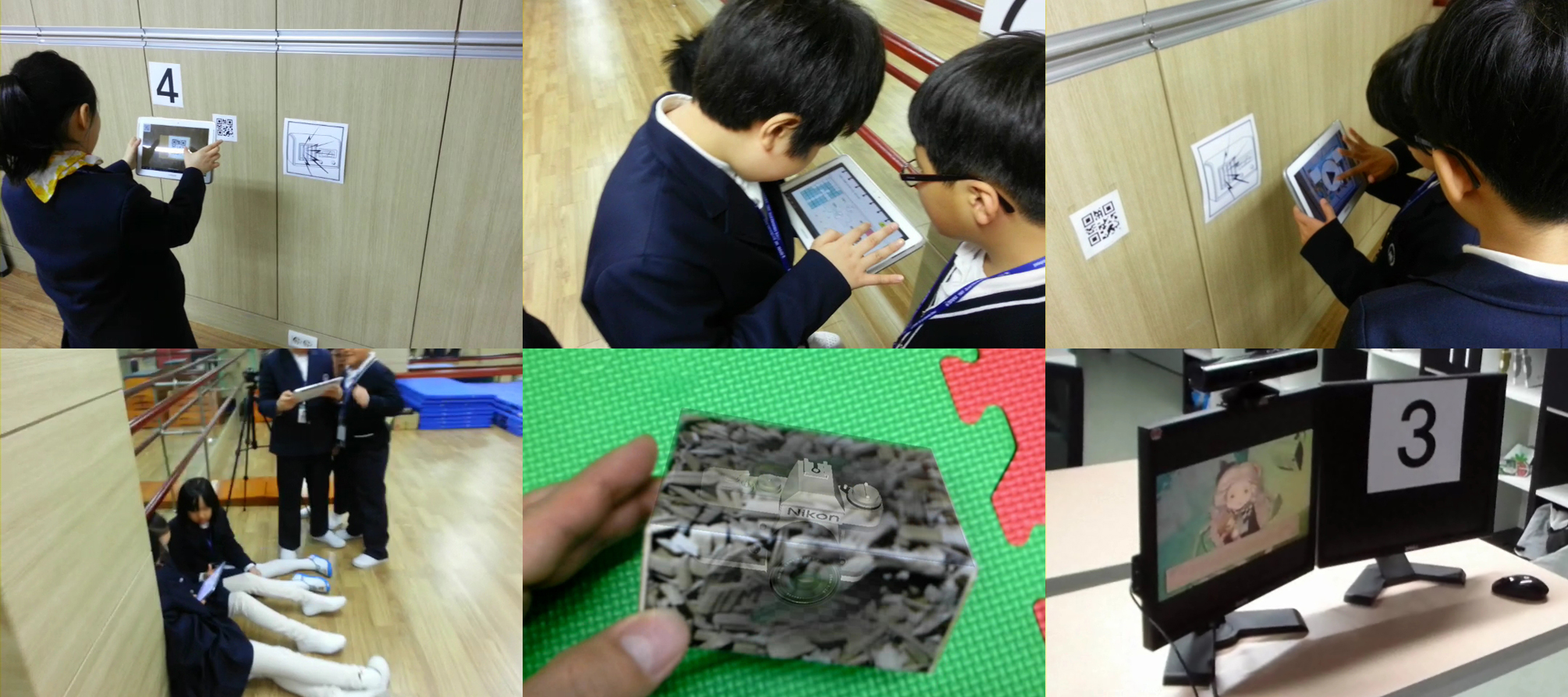
Images from playing the Room Escape game.
Results
Influences of the Story on the Fantasy
The semistructured interview results showed that most (n = 46) of the participants recognized each space as the room they had to escape from and they felt as if they escaped from the room when they solved the problems while playing the game. To increase the reliability of the responses, the participants were asked if they felt trapped in the room while playing the game, and many of them (n = 42) answered that they felt as if they were trapped in the room while playing the game. As the results showed, the majority of the players perceived the real space as the game space, even the space that was not closely related to the story. When asked why they felt as if they had escaped when they answered the question, the participants gave multiple answers. Although the majority (n = 36) answered that the space felt like the space in the actual game story as they were immersed in the story, some of the participants (n = 24) responded that such was due to the similarity of the spaces. That is, the space where the game is played is the interior room, as described in the story of the game. One female participant talked of how deeply she was immersed in the story. She stated, “There, I felt like I actually escaped from the room, as the atmospheres and backgrounds of Rooms 1 and 2 differed, a witch appeared, and I had to find things like a key.” In addition, some female participants emphasized their immersion in the story, saying: “I felt like I actually escaped from the room in person,” “The space felt like the room within the story,” “I was afraid that I felt trapped, but it was really fun to obtain a key and escape from the room,” “It was like a fairy tale,” and “I had much fun with much imagination.” However, other participants (n = 9) who responded that they did not feel like they escaped from the room even after they answered the question and proceeded to the next stage stated: “The environment was different. Uh, the game was played in a dance practice room, so it didn’t match,” “It seemed like I was playing the game, not escaping from the room,” and “I had to escape from the room, but the surrounding environment, such as the home, made me think I didn’t have to.” They commonly said that the difference between the game space and real space prevented them from connecting them cognitively, which indicates that there exists an individual difference in connecting real space and game space with the fantasy through story. The results clearly showed that the fantasy occurs through a well-organized storyline in a state in which the story and the space are loosely connected, and the players come to perceive a physical space as the space presented in the game by being immersed in a world view of the game. However, the figures apparently showed that the males and females had similar response rates, but the female participants gave more comments on their immersion through the story.
Influences of the AR on the Fantasy
Most (n = 50) of the participants responded that the AR provided in the game immersed them further in the game. The majority (n = 45) answered that they felt like they were in the world in the story, because the AR provided in the game was so realistic. Some of the participants were observed to have gone back to the room with the questions using AR and to have played the game again. Overall, there were many comments that the game that used AR was novel and fun, and one participant said he wished more games would use AR. In reality, AR technology was not used, but the question using kinect system that was used as an extended concept of AR also had a positive effect on the fantasy. Fifty participants (n = 50) said a witch appeared on the monitor and talked to them, which further immersed them in the game. The majority (n = 51) also said, “A witch appeared on the monitor and spoke to me, and that made the game more interesting.” A number of participants answered that the appearance of the witch grounded them, and one participant, who said that the questions using AR card technology did not give him an actual feeling, related that though the question in kinect system was implemented in 2-D, he felt it as real as if in 3-D. This shows that interaction with the digital space is important. The way in which the witch spoke to them first in the digital space can be seen to have further enhanced the fantasy and immersion of the participants. As the results show, the AR, including the interactions using the kinect, made the players feel like they were in the space within the game by influencing their immersion in the story through the connection between the physical space and the game space.
Influences of the Audiovisual Elements on the Fantasy
Many of the participants stated that the image and the sound effects made the game realistic, and they felt as if they escaped from a real room. One male participant said, “The sound from the smart pad sounded like a real voice, and each time I answered a question, I felt good.” Another male participant said the image made the game seem real. In addition, participants were often observed to become extremely excited with the feedback effects of the sound and the image when they actually answered the question and obtained the key. As such, most (n = 52) of the participants responded that the graphics and the sound offered in the game made them immersed in what was going to happen in the game and helped them proceed with the game and understand the story. Assuming possible individual variations in the audio and visual elements, a question was asked on which was more helpful in the immersion, the sound or the graphic images provided in the game. According to the results, the majority (46 participants) responded that both the visual and audio elements were helpful, reflecting that audiovisual elements equally affect immersion in the fantasy.
Other Factors That Affected the Fantasy
In addition to the story, AR, and audiovisual elements, some of the participants commented on the immersion in the role of a character such as a detective, a mathematician, or a musician as the reason why they felt as if they escaped from the room after answering the question. As an element of the imaginative immersion mentioned by Ermi and Mäyrä (2005), the character was found to have been an important factor, because setting roles generates the fantasy in the DPRGs. In addition, some of the players commented that they felt trapped because they could not go anywhere while answering the questions, which reveals that the actual restrictions on the player’s behavior through the game led to the fantasy. Some male participants expressed their opinion that the game itself was fun, but that the questions were so easy that they could not be immersed in the story due to the lack of challenge. On the other hand, the female participants were found to have been immersed in the story regardless of the relative difficulty of the game or the degree of the learning difficulty.
Perception of the Physical Space: Contextualization of the Physical Space Through the Fantasy
The summary of the interview results on the story, AR, audiovisual elements, and other factors that could have affected the fantasy revealed that the participants felt the fantasy through the story. They came to perceive the physical space as the room presented in the game through this fantasy. It was also found that the AR and audiovisual elements enhanced this fantasy and that the characters, the behavioral restrictions through the game, and the degree of difficulty further affected the fantasy.
Connection of the Context Between Physical Space and Learning Through Fantasy
As mentioned earlier, the interviews and observations of the participants revealed that the players entered the game’s context by mapping the fantasy in space through the story. They became involved in the learning context while answering the learning questions that served as the elements of the game. Some of the participants suggested that English should be used as much more than a weapon to defeat the witch. One female participant shared her opinion that it was fun to escape from the room after answering the English questions, but that it would have been even more interesting to defeat the enemies in the room by answering the English questions. In addition, one male participant said that it would have been much more fun to wipe out many enemies, not just one enemy, in the room. In addition, some of the players said a story wherein they would win over the monsters by answering the English questions had to be added. The participants who gave these opinions are the ones who all perceived each real space as the room from which they had to escape through the story. As they proceeded with the game in the real space, they naturally recognized the English learning contents provided as tools that they had to use to play the game and they perceived the real space as that related to English. As a result, they were immersed in the fantasy of the little witch and the English room while playing the game, which indicates that the fantasy connected the context between the learning and physical spaces.
Influences of the Context on Learning
It was observed that the participants trapped in the English room, who equated the virtual game space with the real space, were completely immersed in the game and focused on it without regard to anything, except for the room they had to find, the smart pad, and their peers. In particular, they were observed to have concentrated and cooperated with one another to obtain a key while solving the English puzzles, lying with their faces down, and putting their heads together. In addition, many of the participants stated that the game was more interesting and helped them understand better than reading books, and they were also observed to have played the game again voluntarily. Since the learning environment that mapped the fantasy of the environment simulated in the real physical space enhanced the contextual relationship of learning and the real space, the participants were motivated to learn on their own initiative. It also allowed the participants to connect the learning contents to their individual experiences and demands. The findings of the collaboration using the prior knowledge of each individual in the physical space in which the English learning was mapped were shown to be consistent with the results of previous studies (Cahill, Kuhn, et al., 2011; Falk & Dierking, 2000) that learning became more meaningful through the interconnection of personal context, social context, and physical context (see Table 2).
Contents of the Semistructured Interview.

Note. AR = augmented reality.
Discussion and Conclusion
A variety of learning games based on the learning context were analyzed. Their characteristics were examined in terms of the space-learning-story context, technology application, and combination of the digital and physical spaces. Consequentially, the DPRG was also proposed. The DPRG is a new conceptual framework of CBLGs that creates the learning context by mapping learning contents and fantasy in an arbitrary space, which is safer and easier to use, rather than utilizing a wide range of urban spaces or specific spaces such as a museum. The proposed system considers the application of various learning contents. DPRGs can be differentiated from existing CBLGs in terms of three aspects. First, DPRGs utilize physical spaces with few external risk factors. Of course, it may be more fun and may be more helpful for learning to proceed with the game directly in an urban space, which is directly related to the learning context, depending on the situation. It has more disadvantages, however, involving learning space constraints and safety issues, than benefits. To address this problem, a routinary and safe space, for example, inside a school, was proposed as the space for DPRGs. Second, the game space is more loosely connected with learning and story, when compared with existing CBLGs. Although this weak relevance serves as a shortcoming in terms of learning context, it becomes an advantage because it makes it easy to apply a variety of learning schemes. In this regard, we suggest that the context be enhanced by fantasy in a loosely connected physical space and that the advantage of the diversification of learning be highlighted instead. Third, location awareness and communication technologies support learning. A variety of digital mobile technologies, such as GPS, Wi-Fi, Bluetooth, QR codes, and so on, help the players achieve scaffolding learning in the process of collaboration while they are directly getting around the contextual space. Use of these technologies in DPRG can vary depending on the story and learning situation.
In the demonstration phase, the author examined through experiments and interviews if the participants felt that they were in the contextual environment presented in the game, after implementing the learning game based on the framework of the DPRGs. The results of the experiment revealed that the story enhanced the player’s fantasy and had an important role in mapping the fantasy in the space. A difference was found in the degree of the fantasy through the story between males and females. Female participants experienced more intense fantasy through immersion in the story. Compared to the male participants, the female participants made more comments on the narrative and their immersion in the fantasy through the story and the theme. In addition, they expressed a much stronger degree of immersion in the fantasy than the male participants. On the other hand, the male participants tended to emphasize the degrees of difficulty and challenge of the game. These findings imply that even though the degree of difficulty is not an essential element for fantasy, an improper degree of difficulty in learning may interfere with the immersion in the fantasy, so adjusting the degree of difficulty is also an important factor that must be considered.
The results indicated that the realism of the AR increases the player’s interest and the increased reality enhances the fantasy. In particular, there are many comments that not only AR but also the video played by the kinect was very realistic, seemingly due to the relationship between the digital space and the physical space. Rather than in the conventional AR method in which the players have to act first, the way that the monitor speaks to the players first when they approach elicits much interest. In other words, the natural connection of the physical space to the digital space further enhanced the player’s fantasy.
The audiovisual elements also proved to be important factors in mapping the fantasy of a learning game in a physical space. The interview results showed that participants cognitively connected the image to the actual room, and the statement “they felt the voice coming from the smart pad was the real voice, unlike in conventional computer games,” revealed that an interaction with the digital characters in the game occurred. In addition, the image of a key and the sound effects served as excellent feedback and therefore strengthened the immersion in the fantasy. Furthermore, the immersion in the characters and the restrictions on the player’s physical behavior caused by the game turned out to be additional elements that created the fantasy.
As for the Room Escape game that was implemented in the experiment, the author created a less related story by selecting learning contents that were difficult to contextualize to adhere to the theory of DPRGs. It was also investigated if the fantasy mapped the space and enhanced the learning context through the experiments. The results showed that the fantasy obtained through the story, AR, audiovisual elements, and additional elements such as roles and restrictions in the DPRGs brought the game space into the physical space. The players enhanced the learning context while answering learning questions internalized as elements of the game in the physical game space formed in this manner.
This study theoretically prove the validity of contextualizing safe, everyday spaces, such as those inside a school. In addition, an experiment was performed to investigate if students recognize a random space as the one associated with the learning context, while proceeding with the learning game based on the DPRG framework. The experimental results showed that the effect of the context as in CBLGs can be obtained through DPRGs and it is to some degree expected that learning effects can be achieved in the light of existing studies, claiming that CBLG has learning effects. However, since this study focused on the validation of contextualization, it was lacking in the quantitative verification of DPRG’s own learning effects. For future work, there is a need to derive quantitative outcomes by performing experiments after organizing long-term learning contents, so as to prove DPRG’s own learning effects.
In the meantime, there have been many studies on learning in situations related to the learning context, but the results of these studies are yet to be reflected actively into education environment. One reason for this is that it is not easy to find a space associated with the learning context. It is expected that DPRG, a game with a framework developed based on the awareness of these problems, will become the stepping stone for the development of CBLGs in the future. In addition, it is suggested that a theoretical study on learning utilizing the head-mounted display (HMD) and research on the possibility of constructing DPRGs utilizing glasses-type smart devices be conducted when the development of glasses-type smart devices that can replace handheld devices is accelerated. Such devices can adopt the best benefits of the existing HMD that enables consistent AR implementation by maintaining a visual direction with a device and various interactions with AR possible due to the freedom of both hands.
Footnotes
Declaration of Conflicting Interests
The author(s) declared no potential conflicts of interest with respect to the research, authorship, and/or publication of this article.
Funding
The author(s) disclosed receipt of the following financial support for the research, authorship, and/or publication of this article: “This work was supported by a grant from Kyung Hee University in 2014” (KHU-20140421). This work was supported by the National Research Foundation of Korea Grant funded by the Korean Government (NRF-2014S1A5A8017596).