




Abstract
This study investigates the effects of media frames on attitudes toward video games, perceptions of their users, and consequences. Prior research has shown that gaming is a controversial issue, with media coverage focusing on either risks or opportunities. To examine the effects of these portrayals, the present study used a 2 × 2 experimental design and exposed participants (N = 360) to a news article that framed gaming in terms of risk or opportunity on the journalistic level and on the level of a corresponding expert statement. By examining the perceived negative effects of games, this study extends previous research by combining framing and third-person research. Results showed that framing gaming indeed had an effect on participants’ attitudes. This framing effect was moderated by individual video game use. Despite identifying a traditional third-person perception regarding negative video game effects, we found framing to have no significant influence on third-person perceptions.
Introduction
Gaming is an increasingly popular activity among various age-groups and in almost all areas of the world (Entertainment Software Association (ESA), 2013; Ipsos MediaCT, 2012). Due to the continuing growth of the home console market and the wide dissemination of mobile devices, games can now be played almost everywhere and at any time. Nevertheless, gaming continues to be a highly stereotyped activity. The mass media portrays gamers as quirky nerds, socially isolated loners, or even violent criminals (cf. Kowert, Griffith, & Oldmeadow, 2013; Williams, 2003). As past events have shown, the last depiction, especially, can have social consequences (cf. Scharrer, Weidman, & Bissell, 2003). The discussion of gaming in the context of school shootings, addiction, and other kinds of deviant behavior has the potential to alter individual, as well as collective, perceptions of game(r)s, which in turn might influence support for media restrictions and censorship. This might be especially true for those who are not familiar with video games or who do not play them at all.
The present study therefore focuses on the question of how certain media frames affect people’s attitudes and perceptions of game(r)s. This question is analyzed by framing video games in a positive, negative, or balanced way and associating them with different values. In addition, by examining the perceived negative effects of video games, this study extends previous research by combining framing and third-person research. It also investigates whether different frames affect the occurrence and extent of third-person perceptions and the support for game regulation. Video games offer an interesting field of study with respect to the effects of framing for the following three main reasons: First, mass communication researchers have produced a significant number of studies that attract the attention of the news media. Second, both scientific and media discourses are highly polarized—emphasizing either the benefits and opportunities associated with gaming or its threats and risks. Third, and finally, the investigation of differences between gamers and nongamers provides valuable insight into the moderating effects of issue importance and familiarity.
Literature Review
Framing Effects
Generally, framing refers to the fact that media can (and do) portray the same topic in different ways, thus promoting “a particular problem definition, causal interpretation, moral evaluation, and/or treatment recommendation for the item described” (Entman, 1993, p. 52). The Columbine school shooting in 1999 not only was one of the biggest school massacres the United States had experienced up to that point, but it was also “the most closely watched news event of the year” (Birkland & Lawrence, 2009, p. 1405). Since the basic journalistic questions of “who,” “what,” “when,” and “where” were able to be answered quickly in the days following the shooting, the rather complex question of “why” dominated news coverage and public debates (cf. Scharrer et al., 2003). Among the most frequently cited causes of the shooting were products of popular culture, that is, Movies, music, and, not least, video games were held accountable for the violence of the young gunmen, while social exclusion, poor parenting, or accessibility of guns initially did not receive much attention from the media. Some years later, similar patterns emerged in the coverage of the Red Lake massacre and the Sandy Hook Elementary School shooting. Again, playing video games was quickly implicated as a crucial contributory factor to the events—even though the evidence for this assumed relationship was modest or even nonexistent (Ferguson, 2014). These examples demonstrate that no issue, situation, or incident has an inherent meaning. On the contrary, “interpretations of issues are negotiated, contested, and modified over time” (Matthes, 2012, p. 249). Media frames can be seen as central organizing ideas (cf. Gamson & Modigliani, 1989, p. 3) that have the power to influence public perceptions as well as political decisions. Indeed, research has repeatedly shown that media frames have important effects on preferences, evaluations, and attitudes toward the issue described (for an overview, see Entman, Matthes, & Pellicano, 2009).
Scholars investigating different kinds of such framing effects have generally focused on equivalency frames and emphasis or issue frames (cf. Druckman, 2001, pp. 228–231). The equivalency frame presents information in a different but logically equivalent way. The classic psychological experiments by Kahneman and Tversky (1984) provide examples of this type of frame. In contrast, issue frames “focus on different potentially relevant considerations” (Druckman, 2001, p. 230), include more than a single argument, and address the essence of a problem. Thus, they are also implying possible solutions and treatment recommendations (cf. Entman et al., 2009, p. 182; Nelson & Kinder, 1996, p. 1057).
A specific kind of such emphasis/issue frames are valence frames. Valence frames describe issues or events in either positive or negative terms, thus being inherently evaluative and “indicative of ‘good and bad’” (de Vreese & Boomgaarden, 2003, p. 363). Up to this point, a number of (political) communication studies have dealt with the effects of such types of frames, providing evidence that they influence individuals’ evaluations and even their support of policies (cf. Schuck & de Vreese, 2006). For example, Nelson, Clawson, and Oxley (1997) investigated the effects of framing a rally of Ku Klux Klan (KKK) members either in a positive way (freedom of expression) or in a negative way (having the potential for disorder and physical violence). As a result, participants in the “freedom of expression” condition expressed significantly more tolerance than the other participants toward the KKK (for similar results, see McLeod & Detenber, 1999). Focusing on public support for European Union (EU) enlargement, several studies have investigated how framing European politics in terms of opportunity or risk influenced support for the enlargement process (de Vreese & Boomgaarden, 2003; de Vreese & Kandyla, 2009; Lecheler & de Vreese, 2011; Schuck & de Vreese, 2006). All of them identified the effects of valence frames, that is, participants in the positive opportunity frame condition showed significantly higher levels of support and more positive thoughts and attributed more advantages to the EU enlargement. It therefore can be concluded that valence frames have a substantial impact on individuals’ perceptions and (political) views.
To date, there have been no empirical investigations of the actual effects of video game news coverage. However, at least a few studies have focused on media portrayals and/or perceptions of game(r)s. They reveal that discourse about gaming is highly polarized and emphasizes either the benefits and opportunities or the threats and risks of gaming (e.g., Jöckel, Hohmann, & Reichenbach, 2010; Kowert et al., 2013; Kowert & Oldmeadow, 2012; Narine & Grimes, 2009; Smith, Lachlan, & Tamborini, 2003; Williams, 2003). One stresses the opportunities and positive effects of gaming, that is, improving mental fitness, problem-solving skills, and social competence. The other emphasizes the potentially negative consequences; here, gaming is portrayed as a highly worrisome leisure activity, leading to social exclusion, diminished school performance, and increased aggressive behavior. In light of these findings and of the above-mentioned studies of the effects of valence framing, we propose our first hypothesis:
perceive video game players more positively, attribute more positive effects to video games, attribute fewer negative effects to video games, think that fewer people suffer from video game addiction, and support video game regulation less than participants who read a news story with a risk frame.
Unlike most valence-framing studies, the present study focuses not only on an ideal-typical differentiation between risk (negative) and opportunity (positive), but it also considers the influence of balanced news stories and poses the following research question:
Closely connected to valence frames are value frames, which draw “an association between a value and an issue that carries an evaluative implication: It presents one position on an issue as being right (and others as wrong) by linking that position to a specific core value” (Brewer, 2001, p. 46). Nelson and colleagues (1997) have argued that by associating an issue with a specific value, value frames do not—or do not only—influence the accessibility of those values but the importance that people attach to them. Framing, thus, is a rather deliberate process in which recipients form judgments about the applicability of information (cf. Brewer & Gross, 2005). Consequently, we assume that the emphasis of certain values in the articles leads participants to perceive them as more applicable to game(r)s. In the present case, the combination of values and a certain valence (positive or negative) may, in particular, increase or decrease the applicability of those values. In the case of media coverage about video games, as will be shown later, achievement and benevolence values (cf. Schwartz, 1994) are especially pronounced. Thus, we propose the following research question:
Some scholars focus on the potential moderators of framing effects (e.g., Druckman, 2001; Lecheler, de Vreese, & Slothuus, 2009). It is quite obvious that issue importance might have the potential to moderate the strength of effects. However, the assumption of a rather simple relationship between the two factors might be misleading. One could assume that the framing effects of media coverage might be stronger for those who do not consider an issue as important, since attitudes concerning low-importance issues can be changed more easily (cf. Jacks & Devine, 2000). The results of two experimental framing studies point in that direction (cf. Lecheler et al., 2009). Then again, a higher issue importance could result in higher audience sensitivity and therefore could strengthen media effects (cf. Erbring, Goldenberg, & Miller, 1980).
In the context of video games, issue importance should be related to the individual’s own experience with gaming and, especially, to his or her individual video game use. While gamers will probably base their opinions on existent considerations and self-acquired experiences with gaming, nongamers are more likely to form opinions on the basis of mediated information and thus are also more likely to be affected by media frames. We therefore consider the following research question:
Of course, the distinction between gamers and nongamers has implications different from comparable binary classifications. Playing video games or not playing video games is a free decision, while, for example, choosing if the country you live in is an EU member state is not. Although, in both cases, people in both groups will probably react differently to media coverage, the strength of their attitudes, as well as the mechanisms of their opinion formation, is certainly quite divergent.
Third-Person Perceptions
Framing research demonstrates that evaluations and judgments depend on how issues are framed. Nevertheless, people tend to deny mass media’s influence on themselves. On the other hand, when asking people about how the same media content affects other people, they are likely to attribute a significant impact to it. This perceptual judgment, first described by Davison (1983), has become known as third-person perception. Because it is most pronounced when it comes to negative media effects, the existence of third-person perceptions has been demonstrated in contexts such as television violence (e.g., Hoffner et al., 2001; Rojas, Shah, & Faber, 1996), pornography (e.g., Gunther, 1995; Lo & Wei, 2002), and reality shows (e.g., Cohen & Weimann, 2008). Moreover, previous research has already confirmed the presence of third-person perceptions associated with the topic of (violent) video games (e.g., Boyle, Schmierbach, & McLeod, 2013; Ivory & Kalyanaraman, 2009; Scharrer & Leone, 2006; Schmierbach, Boyle, Xu, & McLeod, 2011; Schmierbach, Xu, & Boyle, 2012; Zhong, 2009).
Meta-analyses, reporting average effect sizes between r = .31 (Sun, Pan, & Shen, 2008) and r = .50 (Paul, Salwen, & Dupagne, 2000), have shown that the self–other discrepancy is a robust phenomenon. However, it is more likely to occur under particular conditions. The effect is moderated by the perceived desirability of media effects and the credibility of the message (cf. Brosius & Engel, 1996; Wei, Lo & Lu, 2011). Furthermore, it is influenced by the social distance to the third persons (cf. Cohen, Mutz, Price, & Gunther, 1988; Meirick, 2005), as well as by the traits of respondents, such as self-perceived knowledge, education, age, or media use behavior (cf. Brosius & Engel, 1996; Gunther, 1995; Hoffner et al., 2001; Salwen & Dupagne, 2001). In summary, third-person perceptions are most likely to appear under three conditions. First, when (particularly) undesirable messages are evaluated. Second, when perceived distance between self and others is large (social distance corollary) and/or the third persons are viewed as the main target or recipients of a given message (target corollary). Third, when respondents possess certain characteristics that make them more susceptible to showing self–other discrepancies. In light of this research, we state the following general hypothesis:
Additionally, we expect that the perceived gap will vary among these groups. The target corollary predicts that effects estimates are based on perceived exposure (cf. Meirick, 2005). Thus, we anticipate that the third-person perception will be larger in comparisons to children and adolescents than to fellow students and adults over 40. This is due to the fact that children and adolescents are usually mentioned as the main target audience for games and are the main focus of debates about the risks of gaming (cf. Schmierbach et al., 2011, p. 312).
Since the self–other discrepancy is a rather universal finding in communication studies, it is of particular interest as to which particularities or moderating variables can be observed in the context of video games. Research suggests that individual video game use, in particular, and familiarity with video games appear to affect perceptions. For example, Schmierbach, Boyle, Xu, and McLeod (2011) found that third-person perception is weaker among heavy players because they acknowledge stronger effects on themselves and simultaneously estimate lesser effects on other people. Boyle, McLeod, and Rojas (2008), on the other hand, found that people who play a lot of video games estimate lesser effects on themselves. Given these contradictory findings, we pose the following research question:
Up to now, we focused only on the perceptual component of the third-person effect—the third-person perception—and not on the behavioral component that is the actual third-person effect. Research has repeatedly shown that individuals’ perceptions of media effects on others have the power to influence support for restrictive policies (e.g., Cohen & Weimann, 2008; Gunther, 1995; Hoffner et al., 1999). Not surprisingly, this linkage was also observed within the domain of video games (cf. Boyle et al., 2008; Ivory & Kalyanaraman, 2009; Schmierbach et al., 2011; Schmierbach et al., 2012). However, other factors, such as gender or personal relevance, are also potential explanatory variables. For example, the analysis of Schmierbach, Xu, and Boyle (2012) showed that individual video game use influences support for gaming restrictions, with gamers being much less supportive of restrictive policies than nongamers. Once again, we therefore consider a deliberately broad research question:
Framing and Third-Person Perceptions
To date, only a few researchers have paid attention to the relationship between framing and third-person perceptions. Joslyn (2003) was one of the first to address this shortcoming, both theoretically and empirically. His results show that perceptual judgments were indeed sensitive to the framing of an issue, although change occurred mainly in participants’ judgments about their own susceptibility to media effects. Investigating framing of the Lewinsky scandal, Joslyn found that the self was judged as less influenced when frames emphasized sexual cues as opposed to legal cues. Therefore, he draws attention to the importance of not only investigating the third-person perceptual gap but also of the single effect estimates to differentiate between changes in the influence on oneself and on others (Joslyn, 2003, pp. 840–841).
In the context of valence frames, one might expect that framing gaming in a positive way would have a stronger effect on estimations of the positive effects on oneself, while the occurrence of such positive effects on others should be judged as less likely. On the other hand, framing gaming in a negative way should have a stronger effect on estimations of the negative effects on others. This can be explained by the concept of unrealistic optimism, which predicts that media effects described in a negative way are likely to produce larger third-person perceptions, since individuals want to preserve a positive image of the self (cf. Gunther & Mundy, 1993).
Recently, Schweisberger, Billinson, and Chock (2014) examined whether framing a news story with positive or negative comments in a Facebook environment affects third-person perceptions. Assuming that the negative framing of news stories could contribute to the perceptions of social undesirability, the authors tested whether negative comments would decrease perceived effects on self and increase third-person perceptions. Although the results point to the presumed direction, the differences were not significant. Closer to the approach outlined in our study, Boyle, Schmierbach, and McLeod (2013) investigated whether exposure to news content about the effects of video games has an impact on perceptual judgments. By presenting participants with a news story that manipulated the target (children vs. college students) and the valence of effects (positive vs. negative), they examined whether those different scopes in the coverage affect the direction and extent of third-person perceptions. Since no significant effects of the story manipulations were found, the authors concluded that—at least single and short term—exposure to news coverage has no impact on the perceptions of effects on self or others. Nevertheless, the available data are still rather insufficient, and the connection between framing and third-person perceptions certainly requires more scholarly attention. We therefore state the following hypothesis:
Method
Design and Procedure
To investigate the effects of framing gaming as risk, opportunity, or in different balanced ways, the study used a two-factor (2 × 2), posttest only and a between-subjects experimental design with random assignment to one of the overall four conditions. These conditions represented specific kinds of news coverage and framed gaming as risk or opportunity on the journalistic level (Factor I) and as risk or opportunity on the level of a corresponding expert statement (Factor II).
The experimental stimulus material consisted of an article that was supposedly published on a highly frequented German news website (Spiegel Online) and dealt with the positive and/or negative effects of gaming (see Figure 1). To increase the external validity of the study and to address typical shortcomings of framing studies, the stimulus material was produced on the basis of an explorative content analysis. This analysis was conducted for news articles that could be found under key words related to video game(r)s, dealt with the effects of games, and were published between 2008 and 2013 in three nationwide German newspapers and their associated online editions. The analysis led to the identification of two dominant frames, namely, the opportunity frame and the risk frame. While the first one focuses on the benefits of video games and their ability to enhance problem-solving skills, strategic thinking, or promoting health and well-being, the second one emphasizes the risks of gaming; here, games are seen as negatively affecting their players by increasing aggressive behavior, leading to social exclusion or to a loss of reality. In the analyzed articles, the opportunities and risks of gaming are closely linked to specific values, with the risk frame mostly emphasizing the absence of desirable values and the opportunity perspective accentuating their facilitation. Following Schwartz (1994) and his theory of basic human values, the values most frequently addressed were related to the categories achievement and benevolence. While achievement values emphasize the demonstration of capability and competence, benevolence values have a more social character and emphasize concern for others’ well-being and sociability.
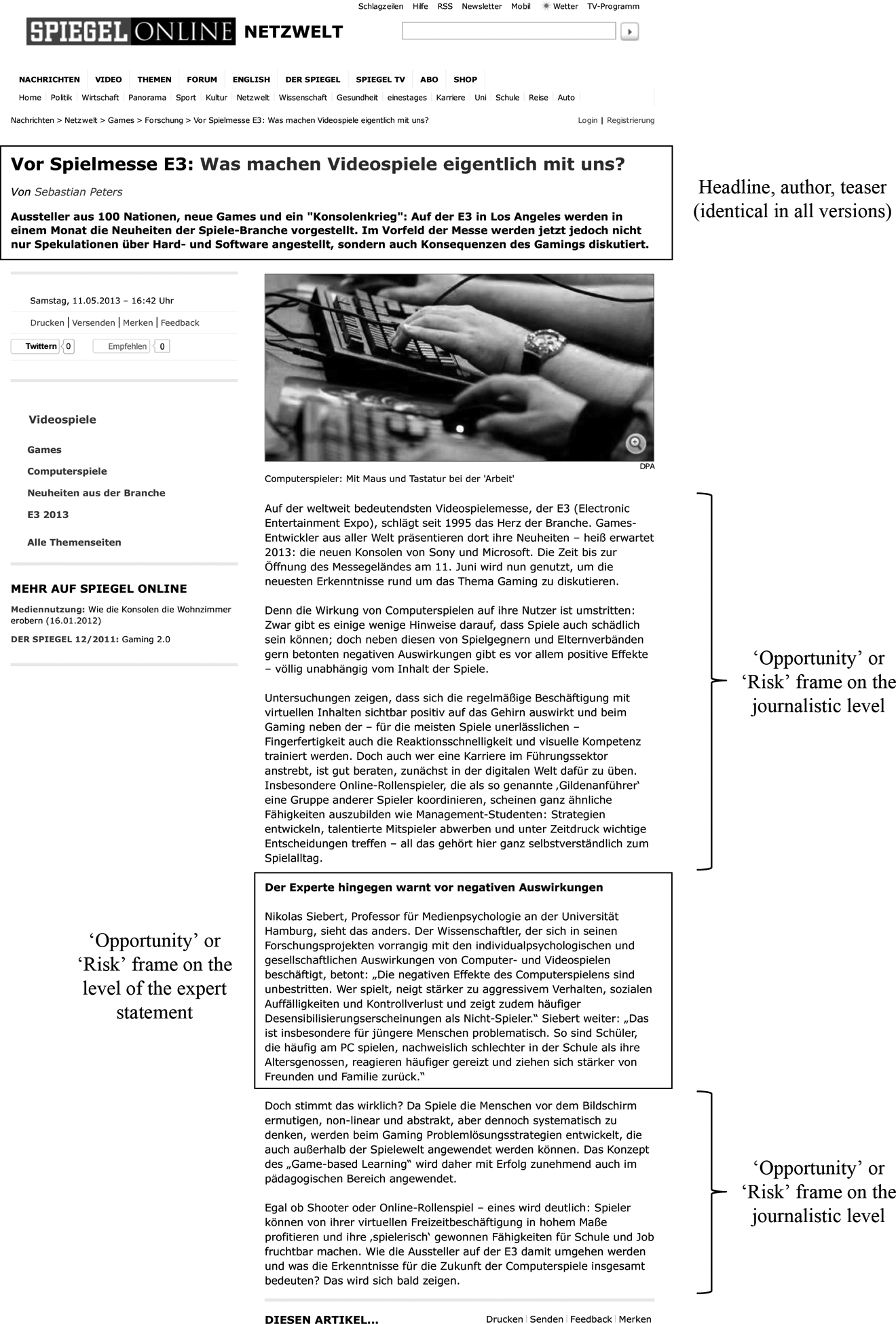
Example for stimulus material.
In fact, most of the articles in our analysis assumed a clear direction and solely focused on either the risks or the opportunities of games. Nevertheless, some of the articles included more balanced stories. In these cases, journalists tried to discuss video games and their effects from both perspectives while evaluating the pros and cons. Our stimulus material thus reflects actual German media coverage of video games.
In all four versions, the headline and subheadline, as well as the first paragraph and illustrating photo, were identical. The angle of the article was the upcoming Electronic Entertainment Expo (E3) and the general discussions about gaming surrounding the convention. The main part of the articles consisted of the journalistic evaluation (four paragraphs), descriptions of gaming either as a risk or opportunity, and simultaneously associating them with specific values. More precisely, the articles varied in terms of how much they emphasized achievement (competence, intelligence, etc.) and benevolence (empathy, sociability, etc.) values. This key part was complemented by the expert evaluation (one paragraph), in which an accounted gaming expert underlined the consequences of gaming in terms of either risk or opportunity. Therefore, in two versions, journalistic and expert evaluations are concordant while, in the other two versions, the expert argues contrary to the author, resulting in a more balanced coverage.
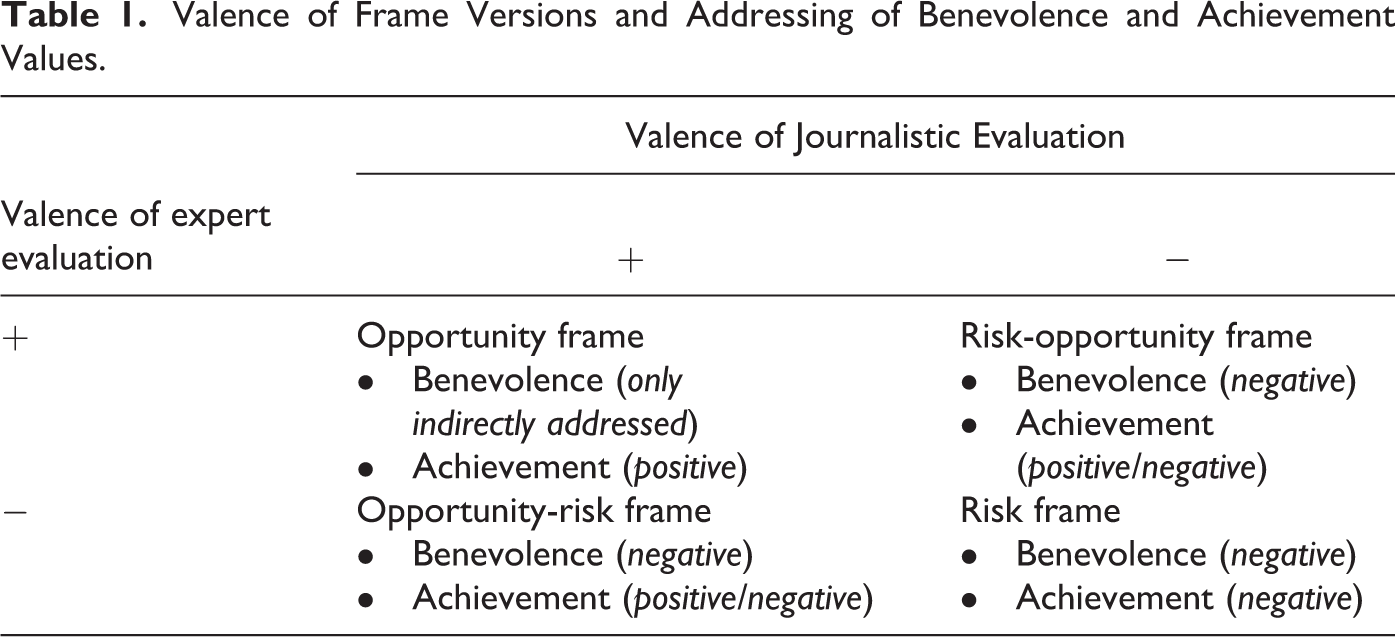
Table 1 shows the four experimental conditions that result from the combination of journalistic and expert evaluations as well as how benevolence and achievement values were addressed in the respective articles. While a positive addressing means that the respective value is shown to be facilitated by using games, a negative addressing means that the respective value is shown to be vanishing or decreasing by using games.
Valence of Frame Versions and Addressing of Benevolence and Achievement Values.
Participants/Sample
A total of 360 German university students in different fields of studies (social and technical sciences) participated in the experiment, with almost equal numbers in all four conditions. The experiment was described as a study of current online news coverage. Participants were told that they would view a print version of an article that had recently appeared on Spiegel Online. They were asked to read the article and to answer some questions about the article itself as well as about the covered issue. Demographic characteristics of the sample included age (M = 22.3, SD = 3.2), gender (female = 58.6%), and video game use (gamers = 56.7%; see last paragraph in the Measures section for definition).
Measures
Evaluation of video game players
Participants were asked to evaluate a list of 10 contrastive adjectives and rate each on a 5-point semantic differential. For the selection of items, we considered the study of Kowert, Griffith, and Oldmeadow (2013) on the stereotypes of online gamers as well as tendencies detected in our content analysis. A mix of different traits (e.g., intelligence, aggressiveness, sociability, competence, and empathy) was included in the scale. After testing for reliability, 9 of the 10 items were included in the final index (Cronbach’s α = .78; M = 2.86, SD = 0.50).
Evaluation of consequences of video games
The perceived consequences of video games were measured by focusing on both positive and negative effects of games (similar to Schmierbach et al., 2011). The measures for both effects included 5 items. For positive effects, participants indicated on a 5-point Likert-type scale the extent to which games are responsible for improving hand-eye coordination and responsiveness, developing problem-solving skills, increasing performance in school or in a job, and social competence (Cronbach’s α = .71; M = 3.11, SD = 0.61). Negative effects included neglecting social contacts, seeing violence as an effective means of problem solving, experiencing a tendency toward health problems, decreasing empathy, and having a high addictive potential (Cronbach’s α = .76; M = 3.39, SD = 0.77). Participants were also asked to estimate the percentage of people suffering from video game addiction (M = 27.3%, SD = 21.6%), assuming that this estimation would vary depending on frame valence.
Applicability of achievement and benevolence values
We computed two indices to measure to what extent participants ascribed attributes connected with achievement and benevolence values to gamers. For both achievement and benevolence values, 4 items were used to form an index. Similar to Schwartz (1994), we focused on intelligence, competence, capability, and problem-solving skills to assess the applicability of achievement values (5-point scale from 1 [strongly disagree] to 5 [strongly agree]; Cronbach’s α = .67; M = 3.03, SD = 0.60). The applicability of benevolence values was measured on the same scale with items focusing on sociability, empathy, compassion, and social competence (Cronbach’s α = .64; M = 2.61, SD = 0.65).
Effects of video games on self and others
Perceptions of the extent of negative influence of game playing were measured following the operationalization used in Scharrer and Leone’s (2006) study by asking participants: “Please assess on a scale from 1 to 5 how much the following persons or group of persons are affected by potential negative impacts of video games.” Because we expected that evaluations would vary depending on the comparison group, participants were asked to evaluate the effect on themselves (M = 1.65, SD = 0.89), as well as on their fellow students (M = 2.10, SD = 0.86), children (up to 14; M = 3.48, SD = 0.99), adolescents (14–18; M = 3.65, SD = 0.93), and adults over 40 (M = 1.90, SD = 0.81; similar to Schmierbach et al., 2011; Schmierbach et al., 2012).
Support for video game regulation
Seven items were used to form an index for this concept, deriving from the operationalization of previous studies focusing on third-person effects (e.g., Boyle et al., 2008; Schmierbach et al., 2011; Schmierbach et al., 2012; Wu & Koo, 2001); for example, “The industry should stop making violent video games” or “The government has more important things to do than to regulate video games.” Responses again were measured from 1 (strongly disagree) to 5 (strongly agree) and combined in an index (Cronbach’s α = .79; M = 2.76, SD = 0.84).
Moderator of effects: Individual video game use
Individual video game use was assessed by asking participants questions about how much time they devote to playing games in an average week as well as about the use of specific genres. While open-ended questions were used to ask about the general frequency of video gameplay, the use of nine selected genres (ranging from casual to shooter games) was measured on a 5-point scale from 1 ([almost] daily) to 5 (never). For the following analysis, we mostly focused on comparing gamers and nongamers, because the distribution in the sample generally did not allow the use of more differentiated measurements. Gamers are all participants who either reported playing games more than 0 min per week or who chose the option “several times per month” (or higher) for at least one of the nine genres (57% of participants). All other participants were defined as nongamers (43% of participants).
Results
Even though this aspect is not an explicit part of the hypotheses, it seems worthwhile to look at differences in video game use between male and female participants first. Generally, the results of other studies—showing a dominance of male gamers—also reflect the observations in our sample. While the surveyed women indicated that they used games only about 42 min per week (M = 42.95, SD = 102.39), the surveyed men played video games more than 4 hr in the same time span (M = 251.01, SD = 392.70). Furthermore, women and men differ significantly in their use of eight of the nine game genres. The biggest difference concerns the usage of shooter games, t(350) = 9.334, p < .001, which were almost exclusively used by the male participants. The only exception of that pattern is the genre “casual games,” which is used by both sexes to a nearly identical extent, t(348) = 0.114, p = .91. Nevertheless, it must be noted that the game playing rate is generally low in our sample—only 25% of the participants played video games for 2 hr or more per week—which should be kept in mind when interpreting the following results.
The first Hypotheses (1a–1e) were tested using t-test procedures at a significant level of 5%. Hypotheses 1a and 1b, predicting that participants who read a news story with an opportunity frame will more positively perceive video game players and attribute more positive effects to video games than those who read a news story with a risk frame, were supported.
A significant mean difference, t(176) = 2.339, p < .05, in perceptions of video game players between participants in the opportunity condition (M = 2.98, SD = 0.48) and in the risk condition (M = 2.81, SD = 0.48) was observed. The same applies to evaluations of the consequences of video games. Participants who were exposed to an opportunity frame (M = 3.34, SD = 0.60) attributed more positive effects to video games than those who were exposed to a risk frame (M = 2.84, SD = 0.58). Again, the mean difference was in the expected direction and was statistically significant, t(178) = 5.585, p < .001). Regarding the other dependent variables (attribution of negative video game effects, estimation of people suffering from video game addiction, and support for video game regulation), the differences between experimental groups were also in the expected direction but not statistically significant. Thus, the data do not support Hypotheses 1c, 1d, and 1e.
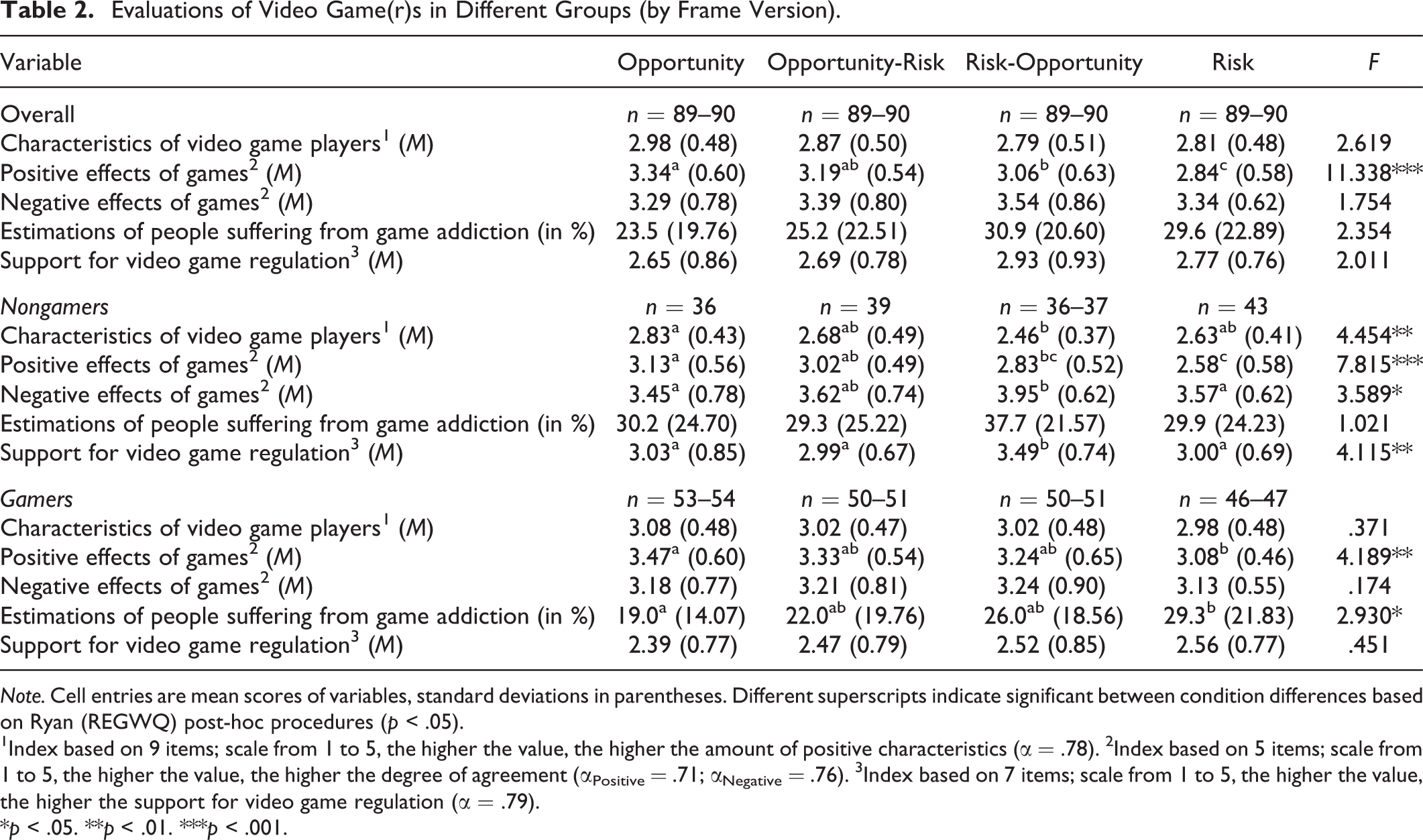
Research Question 1 addressed the framing effects of different balanced news stories. Consequently, in addition to the consonant positive (opportunity frame) and negative (risk frame) articles, we investigated the influence of articles that combined a positive opportunity frame on the journalistic level with a negative risk frame on the level of a corresponding expert statement (opportunity-risk frame) and vice versa (risk-opportunity frame). To test this research question, we performed an analysis of variance (ANOVA) with the four frames as factors and with the dependent variables tested earlier (see Table 2).
Evaluations of Video Game(r)s in Different Groups (by Frame Version).
Note. Cell entries are mean scores of variables, standard deviations in parentheses. Different superscripts indicate significant between condition differences based on Ryan (REGWQ) post-hoc procedures (p < .05).
1Index based on 9 items; scale from 1 to 5, the higher the value, the higher the amount of positive characteristics (α = .78). 2Index based on 5 items; scale from 1 to 5, the higher the value, the higher the degree of agreement (αPositive = .71; αNegative = .76). 3Index based on 7 items; scale from 1 to 5, the higher the value, the higher the support for video game regulation (α = .79).
*p < .05. **p < .01. ***p < .001.
For attribution of positive effects, the ANOVA showed overall significant mean differences between the groups, F(3, 353) = 11.338, p < .001. A Ryan-Einot-Gabriel-Welsch Q multiple comparison test (REGWQ) post hoc procedure revealed three subsets, illustrating significant differences between participants in the opportunity, risk-opportunity, and risk condition. Again, the differences were as expected considering the frame valences, with the risk condition producing the least positive evaluations (M = 2.84, SD = 0.58), followed by the risk-opportunity (M = 3.06, SD = 0.63) and opportunity-risk condition (M = 3.19, SD = 0.54), and, finally, the opportunity condition (M = 3.34, SD = 0.60). Although not reaching statistical significance, a similar pattern could be observed for perceptions of video game players as well as for estimations of people suffering from video game addiction. The results therefore indicate that balanced news stories also lead to more balanced, less polarized evaluations.
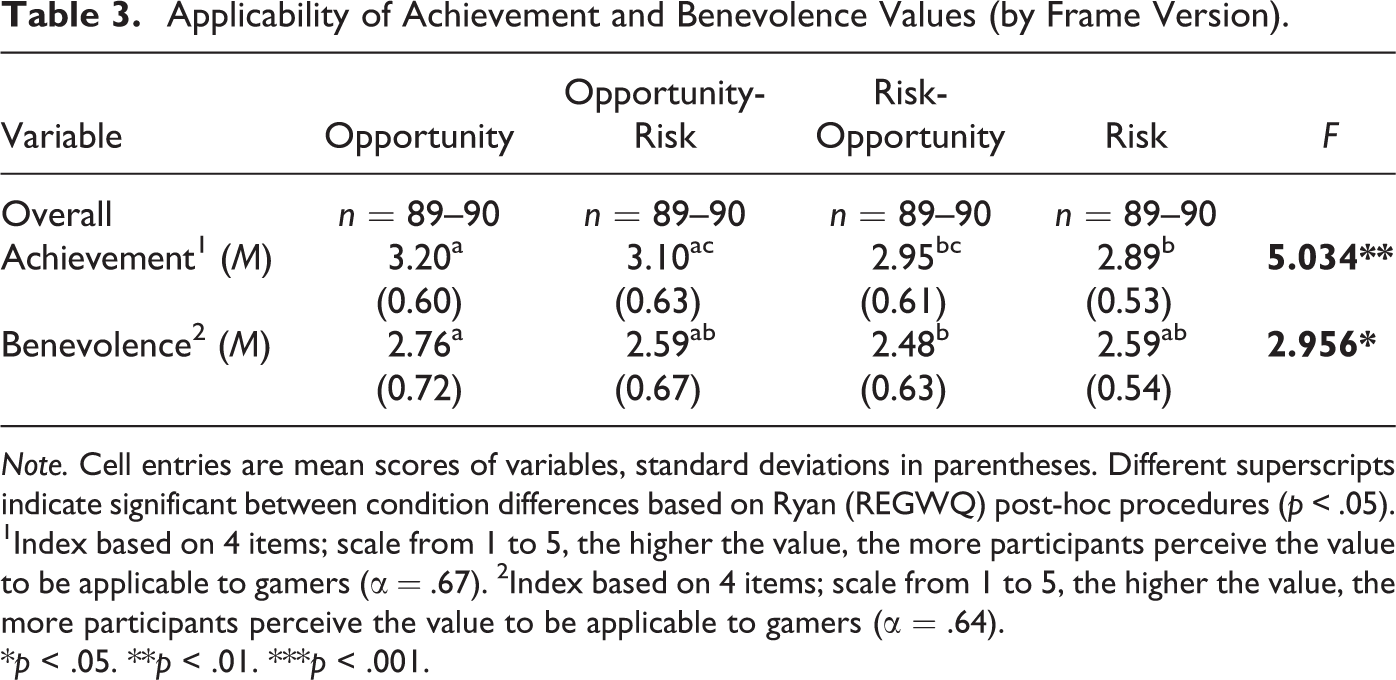
Research Question 2 focused on the power of media frames in influencing the applicability of certain values. First of all, and consistent with expectations, the analysis shows that achievement values are generally perceived as more applicable to game(r)s than benevolence values, M Achievement = 3.03 (0.60), M Benevolence = 2.61 (0.65); t(356) = 12.803, p < .001. Since benevolence values are addressed negatively in three of the four versions (see Table 1), the results thus indicate that the frames indeed had an influence on the applicability of the values. This becomes all the more apparent when comparing differences depending on the frame valence. There are larger differences between the four frame conditions for achievement values, F Achievement (3, 354) = 5.034, p < .01; F Benevolence (3, 353) = 2.956, p < .05. Furthermore, the direction of results indicates that the different intensities and valences in which values are addressed influenced participants’ perceptions of their applicability (see Table 3).
Applicability of Achievement and Benevolence Values (by Frame Version).
Note. Cell entries are mean scores of variables, standard deviations in parentheses. Different superscripts indicate significant between condition differences based on Ryan (REGWQ) post-hoc procedures (p < .05).
1Index based on 4 items; scale from 1 to 5, the higher the value, the more participants perceive the value to be applicable to gamers (α = .67). 2Index based on 4 items; scale from 1 to 5, the higher the value, the more participants perceive the value to be applicable to gamers (α = .64).
*p < .05. **p < .01. ***p < .001.
Building on the research conducted on issue importance, Research Question 3 looked at the influence individual video game use has on framing effects. Preliminary analysis revealed that gamers and nongamers—regardless of frames—significantly differed in their perceptions of video game(r)s. As might be expected, gamers generally perceived video game players as more positive, attributed more positive and less negative effects to video games, thought that fewer people suffer from video game addiction, and supported video game regulation less. 1 For both gamers and nongamers, the frames affected the attribution of positive video game effects, with nongamers showing larger differences between the four frame conditions than gamers, F Nongamers(3, 151) = 7.815, p < .001; F Gamers(3, 199) = 4.189, p < .001. Beyond that, gamers were affected by frames only in their estimations of people suffering from video game addiction, while nongamers seemed considerably more susceptible to framing effects (see Table 2). In particular, for nongamers, we found significant mean differences between the groups for four of the five dependent variables, with the direction of the results indicating influence by the applied frames. Especially the balanced risk-opportunity frame led nongamers to (more) negative evaluations, with this frame generally producing even stronger effects than the ideal-typical risk frame. Considering these results, it is reasonable to assume that nongamers, in fact, are more prone to media portrayals of gaming than gamers.
The next set of hypotheses and research questions focused on third-person perceptions. Hypothesis 2 predicted that participants will perceive children, adolescents, their fellow students, and adults over 40 as more affected by the negative effects of video games than themselves.
As shown in Table 4, our findings are consistent with these predictions. Participants saw themselves as being significantly less affected than all four comparison groups. Notably, the strongest impact is seen for adolescents (M = 3.65, SD = 0.93), followed by children (M = 3.48, SD = 0.99), fellow students (M = 2.10, SD = 0.87), adults over 40 (M = 1.91, SD = 0.81), and, finally, the participants (M = 1.66, SD = 0.89). As expected in the context of Research Question 4, individual video game use had an influence on third-person perceptions. Gamers perceived themselves as more affected by negative video game effects than nongamers, M Nongamers = 1.27 (0.61), M Gamers = 1.95 (0.96); t(354) = −8.032, p < .001, and furthermore saw a smaller gap between the negative effects on themselves and on others. In addition, gamers perceived themselves as more negatively affected by video games compared with adults over 40, thus showing no traditional third-person perception for this comparison group. Consequently, individual video game use indeed altered estimations of negative effects and third-person perceptions.
Perceived Negative Effects of Video Games.
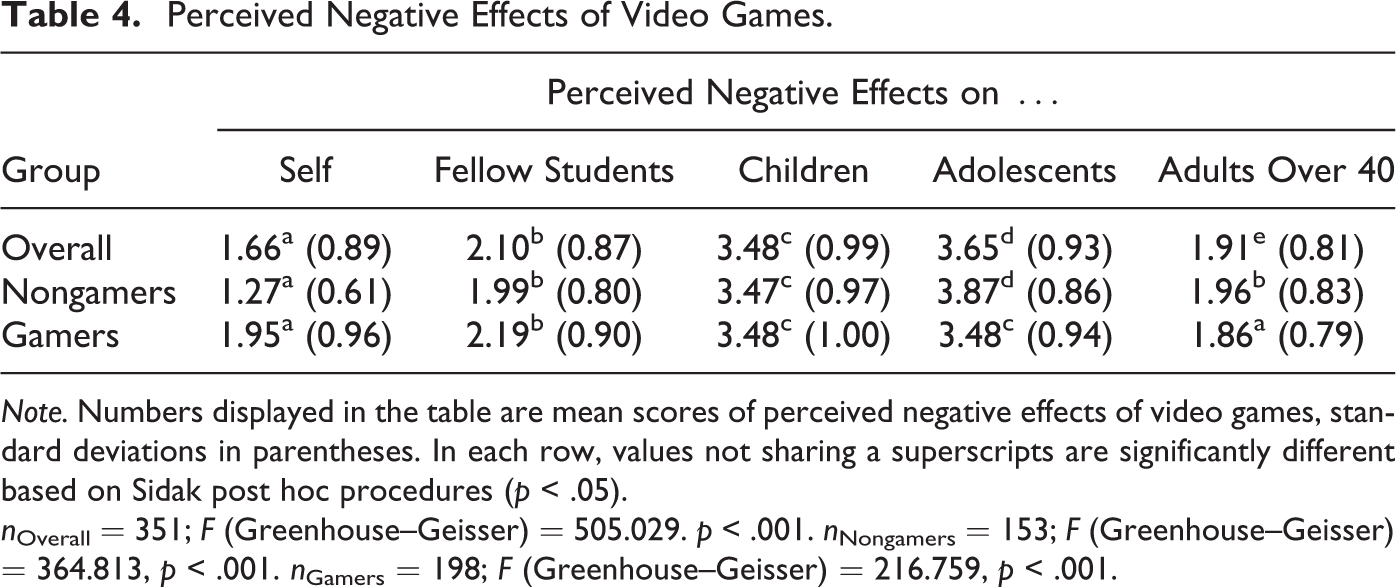
Note. Numbers displayed in the table are mean scores of perceived negative effects of video games, standard deviations in parentheses. In each row, values not sharing a superscripts are significantly different based on Sidak post hoc procedures (p < .05).
n Overall = 351; F (Greenhouse–Geisser) = 505.029. p < .001. n Nongamers = 153; F (Greenhouse–Geisser) = 364.813, p < .001. n Gamers = 198; F (Greenhouse–Geisser) = 216.759, p < .001.
To address Research Question 5 and evaluate which factors influence support for video game regulation, we employed hierarchical regression to test the relationship between four theoretically deduced independent variables (gender, game use, frame valence, and third-person perceptual gap) and support for regulatory measures. Gender and game use (gamer vs. nongamer) were included in the first block, whereas frame valence and perceptual gap were added in the second block.
The results revealed several influences on individuals’ support for video game regulations. Not surprisingly, gamers are much less supportive of regulatory measures, β = −.201, t(346) = −3.777, p < .001, and males are generally not inclined to support restrictions, β = −.218, t(346) = −4.393, p < .001. Consistent with prior research, the gap between perceived effects on self and others is also a significant predictor of support for censorship, β = −.247, t(346) = −4.821, p < .001, while the frame valence had no significant nor meaningful influence, β = .078, t(346) = 1.571, p = .117. Overall, the model explains 25.7% variance of support for video game regulation, revealing that traits of respondents, such as gender and individual video game use as well as the third-person perceptual gap, are relevant factors in the context of support for game censorship and restrictions, R 2 = .257, F(4, 346) = 29.849, p < .001.
Finally, to explore the influence of media coverage on third-person perceptions, we investigated whether the frames affect the occurrence and extent of third-person perceptions. Hypothesis 3 proposed that participants who read a news story with a risk frame will perceive a bigger gap between self and others than participants who read a news story with an opportunity frame.
The data do not lend support for this hypothesis. For all comparison groups, there were no significant mean differences in third-person perceptions regarding negative effects. Although for comparisons with fellow students, M Opportunity = −.31 (0.85), M Risk = −.50 (0.88), t(177) = 1.438, p = .15; children, M Opportunity = −1.61 (1.29), M Risk = −1.78 (1.23), t(176) = 0.867, p = .39; and adolescents, M Opportunity = −1.79 (1.25), M Risk = −2.03 (1.28), t(177) = 1.308, p = .19, the results point in the expected direction, frames generally do not seem to influence third-person perceptions regarding negative video game effects. This finding is, however, consistent with observations regarding Hypothesis 1c, indicating no significant mean differences in attributions of negative game effects between the two groups.
Discussion
This study offers insights into valence framing by examining it in the context of the controversial topic of the effects of video games. First, the results of our experiment indicate that framing gaming in terms of risk, opportunity, or in different balanced ways indeed had an effect on participants’ attitudes toward games, the perceptions of their users, and the perceived consequences of playing games. Individuals were not only affected by the ideal-typical risk and opportunity frames but also by more balanced articles that combined both assessments. If gaming was framed as an opportunity, emphasizing the benefits of playing video games, participants more positively perceived video game players and attributed more positive effects to video games. This finding is in line with previous research on framing effects, indicating an impact of differently valenced media portrayals on peoples’ evaluations (e.g., de Vreese & Boomgaarden, 2003; Lecheler & de Vreese, 2011; Nelson, Clawson, & Oxley, 1997; Schuck & de Vreese, 2006). Those framing effects may—at least partially—be a result of increasing the applicability or relevance of certain values associated with the different frames. In our experiment, achievement and benevolence values were addressed differently in news stories, and the results indicate that valence and intensity of the addressing indeed influenced to what extent participants perceived the value to be applicable to game(r)s.
Furthermore, we found different effects among gamers and nongamers. Nongamers were generally more affected by the deployed media frames, while gamers were susceptible only to framing effects regarding certain evaluations. Despite generally showing more positive evaluations of games and their users, gamers attributed even more positive effects to video games after reading a positive article. This may be explained by the concept of unrealistic optimism, indicating that people are more inclined to admit to positive effects on themselves when it comes to desirable consequences (cf. Gunther & Mundy, 1993). Additionally, because people who regularly play games are likely to relate themselves to the gamer population, they may have been especially susceptible to those depictions. Thus, our results confirm those of earlier framing studies showing that individual issue importance is a crucial factor in the process of framing (cf. Lecheler et al., 2009).
Although this study focused mainly on considering how media frames influence (third-person) perceptions, we also took a general look at third-person perceptual judgments. Our results verify the findings from previous studies showing that third-person perceptions also apply to video games (e.g., Boyle et al., 2008; Ivory & Kalyanaraman, 2009; Scharrer & Leone, 2006; Schmierbach et al., 2011; Schmierbach et al., 2012; Zhong, 2009). More precisely, we found that participants saw themselves as significantly less affected than all comparison groups. The gap increased from adults over 40, to fellow students, children, and adolescents. Because adolescents and children are portrayed as the primary target group of video games and are most often the focus of debates about the risks of gaming, our results furthermore provide evidence for the target corollary (cf. Meirick, 2005). This concept suggests that effects estimates for others are primarily based on perceived exposure. Of course, the assumption of a target corollary implies that news media—and popular culture media—had an effect in the past and that the portrayal of the young generation as the main target audience for games, as well as the main target of (negative) effects and government regulation, influenced participants’ perceptions prior to the experiment. As Schmierbach and colleagues (2011) speculate, perceived vulnerability may also play a key role. According to the authors, people base their estimations not only on perceived exposure of the target group but also on assumptions about their personal weaknesses, social environments, and orientation toward the content. Similar to framing effects, third-person perceptions were determined by individual video game use. Like Schmierbach and colleagues (2011), our results show that gamers show a smaller perceptual gap between the negative effects on themselves and on others and generally perceived themselves as more affected by negative video game effects than nongamers. This suggests that not only the estimated effects on others but also the estimated effects on oneself seem to be driven by perceived exposure. Knowing about their own use, gamers obviously seem to feel “closer” to the groups that are perceived as most affected.
Focusing on the influence of media coverage on third-person perceptions, we also investigated whether the frames affected the occurrence and extent of third-person perceptions. Again, building on the concept of unrealistic optimism, we assumed that the self would be judged as less influenced when frames emphasized the negative effects of gaming (risk frame) and, at the same time, that others are seen as more influenced. Although for comparisons with fellow students, children, and adolescents, the results pointed in the expected direction and the data did not lend support for this hypothesis. Thus, frames generally did not seem to influence third-person perceptions regarding negative video game effects (for similar results, see Boyle, Schmierbach, & McLeod, 2013; Schweisberger, Billinson, & Chock, 2014).
Finally, we investigated which factors influence individual support for video game regulation. As suggested by prior research (cf. Boyle et al., 2008; Ivory & Kalyanaraman, 2009; Schmierbach et al., 2011; Schmierbach et al., 2012), third-person perceptions indeed were a significant predictor of support for regulatory measures, but gender and game use also had an influence on participants’ willingness to support video game regulation. The valence of the frames, on the other hand, was not able to increase the explanatory power of the regression model, indicating that more or less stable traits and perceptions of respondents are relevant factors in the context of support for game censorship and restrictions.
Limitations and Future Research
Although using student subjects is not a problem inherent in experimental research (cf. Druckman & Kam, 2011), employing a population other than students would be valuable. Presumably, the focus on student participants leads to an underestimation rather than to an overestimation of what framing effects would be found in the general population. This is due to the fact that students (despite individual differences), compared to other segments of the population, are closer to the topic of video games and thus are likely to perceive video games as more relevant. In fact, in Germany, the young generation is the largest user group of digital games (IfD Allensbach, 2013). Moreover, increasing the number of gamers in the sample would allow for more elaborated statistical analyses of the moderating role of individual video game use on both framing and third-person perceptions. The distribution of gamers in our sample did not allow for differentiation between low-level, medium-level, and high-level players or between users of different video game genres. Future research should address this shortcoming and investigate, for example, if perceptions of “casual” and “hardcore” gamers vary even more than those of our broadly defined nongamers and gamers.
To fully explore the relationship between framing and third-person perceptions, positive media effects should be investigated instead of just focusing on the negative ones. Although the concept of unrealistic optimism suggests that framing gaming in a positive way will have a stronger effect on estimations of positive effects on oneself, we were not able to test this specific hypothesis.
Finally, like most studies investigating framing effects, we relied on a one-shot experimental setting that tested the effects immediately after exposure to the stimulus. Although research by Tewksbury, Jones, Peske, Raymond, and Vig (2000), as well as that by Lecheler and de Vreese (2011), indicates that framing effects are “surprisingly resistant” (Lecheler & de Vreese, 2011, p. 975), it is not possible to draw inferences about the actual duration of effects. A related issue concerns the external validity of the experiment. The participants of our study were presented with only one news article and “forced” to read it. Outside the experimental setting, people are able to select their own sources and can choose whether or not to read an article.
Conclusion
The results of this study show that framing gaming in the mass media has the potential to alter the formation of public opinion. Based on our findings, one could assume that attitudes toward games and gamers will shift to another direction if certain frames receive more or less emphasis in media coverage of video games. This finding is of considerable interest and has a number of public policy implications. As a recent example, after the Sandy Hook Elementary School shooting in December 2012, the discovery of violent video games in the home of the culprit reopened media discussions about the alleged connection between gaming and real-world violence. Shortly after that, Senator Jay Rockefeller emphasized the dangers of gaming and demanded further regulation of the video game industry. Keeping our results in mind, media coverage might have helped to increase the plausibility of his demands. In Germany—the country subject to this investigation—media coverage about video games has also played, and certainly still plays, a crucial role in peoples’ perceptions of the appropriateness of censorship or comparable government regulations. In contrast to most other Western countries, Germany has a very strict policy regarding (violent) video games, which often leads to heavy cutting, or even the banning, of games. The persistent emphasis of negative outcomes in the media may lead people to perceive games as a threat and thus may foster the approval of even tighter restrictions. Because of the profound political implications, framing gaming certainly matters.
Footnotes
Declaration of Conflicting Interests
The author(s) declared no potential conflicts of interest with respect to the research, authorship, and/or publication of this article.
Funding
The author(s) received no financial support for the research, authorship, and/or publication of this article.