



Abstract
Research interest has increasingly focused on the psychosocial factors related to online game addiction. This study examines the relationship of various psychosocial variables to online game addiction, and the mediation effect of avatar identification on the relationship. Questionnaires assessing self-esteem, depression, social skills, game addiction, and avatar identification were completed by 163 third-year middle school students. Correlation and structural equation modeling analyses were conducted. Results indicated (a) that self-esteem and social skills had significant negative correlations with game addiction, while depression had a significant positive correlation with game addiction, (b) that depression had an indirect effect on game addiction via avatar identification, and (c) that social skills had both indirect (via avatar identification) and direct effects on game addiction. Implications and future directions are discussed.
According to the results of the Internet Addiction Survey (2013) from the Korean Ministry of Public Administration and Security, Korean adolescents’ Internet addiction rate was 11.7%, which was twice the adults’ addiction rate of 5.9% (p. 3). Specifically, 11% of elementary school students, 13% of middle school students, and 11% of high school students were identified as at risk for Internet addiction. Among the various contents provided through the Internet, online gaming (21.2%) had the second highest rate of participation by adolescents, followed by using instant messengers (38.1%, p. 12). Furthermore, reports on the Game Addiction Survey (Korea Creative Contents Agency, 2014) indicated that 14% of elementary school students, 22% of middle school students, and 18% of high school students in South Korea play online video games more than 2 hr every day. According to previous studies on adolescents’ daily life experiences, Korean youth spend 33% more time watching television and playing video games than their American counterparts (Byun, Dowda, & Pate, 2012; Mark & Janssen, 2008). The increase of nuclear families, working parents, and single parents has increased the time spent by adolescents either alone or with friends than with family (Lee, 2009). According to Lee (2006), Korean youth spend 40% of their alone time playing computer games or watching television.
Long-term and excessive use of online games may cause adolescents to develop negative psychological or social outcomes. Previous research suggested that duration of time spent playing online game was connected to various negative behaviors. For example, the more time spent on online games, the more instances of reported low self-control, and poor grades (Kim & Cho, 2003). Excessive engagement in online gaming was also related to low emotional intelligence, poor relationship with teachers and peers, poor school adjustment (Kim & Baek, 2011), and more aggressive attitude (Kim, Namkoong, Ku, & Kim, 2008). Developing an online game addiction, especially during adolescence, can seriously disrupt or damage normal development. Therefore, game addiction is no longer an individual, family, or school problem, but a serious social problem that should be addressed collaboratively.
Recently, a meta-analysis study (Kang & Son, 2007) reported a significant relationship between personal characteristics and online game addiction. The study also suggested further investigation of the relationship to improve our understanding of game addiction, as it relates to effective intervention and prevention programs dealing with negative outcomes. Thus, the current study examines the relationship between psychosocial factors such as self-esteem, depression, and social skills in adolescents, and their relationship to online game addiction. Furthermore, this study examines the extent to which adolescent identification with avatars (i.e., avatar identification) plays a mediating role in this relationship.
Online Game Addiction
Online game addiction is commonly classified under the category of Internet addiction (Young, 1999). Addiction is typically diagnosed when social or professional functioning is damaged in concert with physiological dependence, tolerance, and/or withdrawal symptoms due to the abuse of substances such as alcohol, cocaine, or marijuana or due to compulsive behaviors. Because Internet addiction causes similar results, it has been classified as a subcategory of addiction (Griffiths & Hunt, 1998). Previous studies reported that the addiction of online games has been found to cause physical, psychological, and social outcomes such as neck pain, elbow pain (Miller, 1991), anxiety (Sahin & Tugrul, 2012), violence (Trudewind & Steckel, 2003), losing interest in other activities (Young, 2009), negligence in school studies, and social isolation (Griffiths & Davies, 2005).
One of the biggest challenges in measuring online game addiction is differentiating problematic game behavior from healthy game behavior and thus assessment of potential Internet addiction has varied (Kuss, Shorter, van Rooij, Griffiths, & Schoenmakers, 2013; Seok & DaCosta, 2014). Whereas early studies utilized money and/or time as primary factors to classify problematic play (King, Delfabbro, & Griffiths, 2010), recent studies have provided psychological criteria to identify cases of online game addiction. For example, researchers can apply criteria for disordered gambling set forth in the Diagnostic and Statistical Manual of Mental Disorders, Fifth Edition (DSM-V), replacing the term gambling with online game playing (Griffiths & Hunt, 1998). Brown (1997) suggested a behavioral model of addiction, specifying six criteria for video game addiction (i.e., salience, euphoria, tolerance, withdrawal, relapse, and conflict). Additionally, Charlton and Danforth (2007) suggested that only core criteria (i.e., conflict, withdrawal symptoms, relapse and reinstatement, and behavioral salience) must be met to make a positive diagnosis for addiction, as they found that mild, peripheral criteria were met before core criteria. Those who only met the peripheral criteria (i.e., cognitive salience, tolerance, and euphoria) were considered as belonging to the (nonpathological) high-engagement group, suggesting that time should not be used as a sole indicator of video game addiction.
Massive Multiplayer Online Role-Playing Game (MMORPG)
Classical RPGs allowed only one or two people to play together. However, MMORPG is a type of RPG in which unlimited users can participate in cyberspace. With the development of the Internet, MMORPG combined RPG and characteristics of Multiple User Dialogue or Multiple User Dungeon (MUD) Game. Whereas the users of MUD games choose a character in cyberspace and complete the missions the game designer provides, users of MMORPG can choose various characteristics of a character such as name, gender, occupation, and explore the cyber world. As users of MMORPG compete or cooperate with other users and build up their experiences, they develop their avatar, an alter ego, and acquire items to become a stronger character in cyber society (Lee, 2007).
This genre of games allows the game users to not only enjoy the story of the game but also enjoy the interactions with others through various events such as communicating with each other, buying houses, marrying other avatars, gathering food, and producing and trading items. Moreover, game users can make their own community such as guild, blood alliance, or legion within the game society. Users feel a sense of belonging and reproduce, redistribute, and share items within their community. Although this kind of community exists in other online game genres, the avatars are considered more important and more influential in this game genre than in other genres, especially in MMORPG where users play the game as a team. Adolescents who play these MMORPG games have a higher addiction tendency than those who play other game genres (Lee et al., 2007) and show the highest desire to create an alter ego (Jang et al., 2004), and also have the longest average stay time (Ng & Wiemer–Hastings, 2005). The representative games in this genre are the Lineage series, Ion, Terra, and World of War Craft.
Avatar Identification
Avatar is a Sanskrit word meaning alter ego or personification and is most commonly defined as a visual representation or the embodiment of the game user (Ducheneaut, Wen, Yee, & Wadley, 2009). In MMORPG games, users choose an avatar (often called their character) to graphically represent themselves or their alter ego in cyberspace (Lee, 2007). Social interactions in the virtual world are conducted through the avatar and the avatar provides presence to the user. Through the process of embodied interaction between the user and the avatar, the user identifies with their avatar (Carter, Gibbs, & Arnold, 2012). Game users’ identification with the avatar is found to be central to how they experience and enjoy the game (Klimmit, Hefner, & Vorderer, 2009). Visual characteristics, name, and abilities of an avatar provide game users with an expression of their identity (Turkle, 1995).
Avatar identification means that a game user identifies with his or her avatar (i.e., alter ego) and feels affection to it. Ducheneaut, Wen, Yee, and Wadley (2009) found that game users tend to see their avatar as having an idealized version of their body and personality. However, whereas the game users created an online identity that looked close to Western ideals (e.g., thinner, younger, and more fashionable), it was found that the personality differences were fairly small and may disappear over time. Game users with weight issues and smaller personality discrepancies reportedly tended to feel more satisfied and attached to their online selves. Additionally, according to Lee (2007), younger game players with longer duration of Internet usage experience greater identification with avatars and vicarious satisfaction through the identification. Furthermore, as players join communities like guild, clan, or blood allies, they become strongly emotionally connected to their communities and in turn have stronger cognitive and emotional identification with their avatar (Obst & White, 2005).
Psychosocial Characteristics Related to Game Addiction
Given that not everyone who uses the Internet or online games becomes addicted, psychological traits may exist that differentiate people who become addicted from those who do not. This article discusses four psychological traits that have been identified as having connections with game addiction.
Depression
Depression means a negative emotional state of sadness, unhappiness, and indifference. Those with depression often exhibit emotional symptoms such as sadness, frustration, guilt, lethargy, and cognitive and behavioral symptoms such as lack of judgment, difficulty in relationships, and indecisive attitude. Previous studies that examined the relationship between Internet addiction and depression found that higher depression scores were correlated with higher Internet addiction scores (Jeon & Suh, 2006) and 54% of Internet addicts had a history of depression (Young, 1998). These results may indicate a meaningful relationship between Internet addiction and depression.
Social skills
There are concerns that the sudden increase of Internet usage will not only isolate some adolescents from socialization but also block them from forming meaningful social relationships (Young, 1998). Kim, Namkoong, Ku, and Kim (2008) reported that adolescents at risk for online game addiction were more likely to feel that interpersonal relationships in reality were stressful; they also felt lonely and anxious in social situations. In addition, pathological online gaming was negatively correlated with self-control (Kim, Namkoong, Ku, & Kim, 2008), depression, anxiety, and social phobias (Gentile et al., 2011). Lee and Kwon (2001) found that excessive Internet gaming was associated with poor social skills in adolescents.
Self-esteem
Self-esteem can be defined as setting high values for oneself (Rosenberg, 1965). People with Internet addictions reportedly have lower self-esteem than those without Internet addictions (Armstrong, Phillips, & Saling, 2000). However, Kim et al. (2008) found that a high level of self-esteem was positively correlated with online game (only MMORPGs) addiction, which seems to be inconsistent with the previous study. MMORPGs may bolster self-esteem as well as provide status and respect from other players (Kim et al., 2008), indicating that a high level of self-esteem is likely to be associated with being addicted to MMORPGs. A number of Internet addicts identify their game scores as a measure of self-esteem and recognize themselves as better people when they acquire higher game scores (Young, 1999).
Method
The current study examined the relationships between psychosocial factors and online game addiction. The independent variables were psychosocial factors such as social skills, depression, and self-esteem. The dependent variable was online game addiction. Avatar identification was included as a mediator variable in order to examine any mediating effects within the relationship (see Figure 1).

Final model with standardized estimates.
Participants
Prior to the current study, a preliminary study was conducted with three 3rd-year middle school students to determine the target population’s level of understanding of the scale questions and the average time needed for completing the scale. The final survey was developed based on the results of the preliminary study. Data for the present study were collected from third-year middle school students at two middle schools located in a medium-sized city of South Korea in 2011. In the study, only MMORPG genre users were selected as participants because this genre has the greatest emphasis on avatar identification, has the most addiction tendency and self-alteration needs (Jang et al., 2004), and has the longest average usage time (Ng & Wiemer–Hastings, 2005) among the various genres of online games. Out of a total of 562 surveys collected (age range from 14 to 15), the final sample included 163 surveys, 71 males and 92 females, where students answered MMORPG as the game genre they mainly played. The participants’ demographic characteristics are described in Table 1.
Demographic Information.

Measures
Self-esteem Scale
The Self-esteem Scale (Rosenberg, 1965) was comprised of 10 items (e.g., I believe I am as valuable as other people). Students were asked to rate their answers on a 4-point Likert-type scale for each item (1 = totally disagree, 4 = totally agree). The total score was calculated by reverse coding negatively worded items and combining all the item scores. A higher score indicated higher self-esteem. Cronbach’s α was .84, which was above the recommended criteria for scales (α > .70; DeVellis, 2003).
The Center for Epidemiology Studies—Depression
This scale contained 20 items (e.g., I find things that used to be fine with me annoying and bothersome; Radloff, 1977). Students rated their answers on a 4-point Likert-type scale for each item (0 = not at all, 3 = 5–7 times). The total score was calculated by reverse coding the positively worded items and combining all the item scores. A high score on the scale implied a high level of depression. Cronbach’s α was .91.
Interpersonal communication inventory
The inventory had 13 items (e.g., when I get a question that is not clear, I ask the person to identify the intention of the question) assessing interpersonal communication skills (Bienvenu, 1971). Participants responded to the 13-item measure on a 5-point Likert-type scale (1 = not at all, 5 = highly likely). A higher score on the inventory indicated better interpersonal communication skills. Cronbach’s α was .83.
Avatar identification scale
In order to create an avatar identification scale, Kim (2007) selected 3 items from the organizational identification measure (Mael & Ashforth, 1992) and included two additional items that directly measure avatar identification. Kim (2007) reported high internal reliability and convergent validity of the measure. This scale contained 5 items such as “Cursing on my avatar means cursing on me,” “I believe my avatar is my other self,” and “My avatar and I are the same in many ways.” Participants rated their answers on a 5-point Likert-type Scale (1 = not at all, 5 = highly likely). A high score reflected a high level of avatar identification. Cronbach’s α was .89.
Game Addiction Scale
The Game Addiction Scale (Lee & Ahn, 2002) was selected to measure the level of game addiction in adolescents, as it was one of a few measures with empirical support for its validity and reliability with South Korean youth. Lee and Ahn (2002) modified the Internet addiction measure (Young, 1999) that is based on the DSM-IV criteria for pathological gambling, and substituted the term “Internet” with “Online game” to identify cases of online game addiction. This measure examines both the duration and academic and psychosocial functioning of the game players. The measure included 25 items and has the following five subtypes: poor academic attitudes, maladjustment behaviors, negative emotional experiences, psychological commitment and obsession, and interpersonal problems. Poor academic attitudes: A 5-item assessment of the problems resulting from compulsive online video gaming, focusing on engagement in school and academic outcomes (My grades went down after I started playing online video games.). Maladjustment behaviors: A 6-item assessment of the problems resulting from compulsive online video gaming, focusing on inappropriate game-related language or behaviors in real life (I use game language in my real life). Negative emotional experiences: A 4-item assessment of the problems resulting from compulsive online video gaming, focusing on negative emotions such as stress, anxiety, or frustration (When I play an online video game, I get frustrated when I am not as good as I want). Psychological commitment and obsession: A 7-item assessment of the problems resulting from compulsive online video gaming, focusing on the obsessive thoughts and compulsive activity about online video gaming (I think about online video games all day long). Interpersonal problems: A 3-item assessment of the problems resulting from compulsive online video gaming, focusing on the negative interpersonal skills (I fight or argue with my friends due to online video games).
Participants rated their answers on a 5-point Likert-type scale (1 = not at all, 5 = highly likely). All items from the five subscales were summed to create a total score and higher total scores indicated a higher level of game addiction in adolescents. Cronbach’s α was .96, indicating a high internal consistency of the measure for the current sample.
Statistical Analysis
Correlation Analysis
Bivariate relationships between all the variables, including psychosocial factors (i.e., self-esteem, depression, and social skills), game addiction, and avatar identification were assessed using SPSS 18.0. The results provide information on the relationships between the variables, in terms of both the strength and the direction of the relationships.
Structural Equation Modeling (SEM)
SEM was used to assess the hypothesized structural relationships among the latent variables. We assessed the model fit based on several criteria. Specifically, we used the nonnormed fit index (NNFI; Bentler & Bonett, 1980), comparative fit index (CFI; Bentler, 1990), and root mean square error of approximation (RMSEA; Steiger & Lind, 1980). Values lower than .08 for the RMSEA and values close to .95 for the NNFI and CFI were used to determine a good-fitting model. All analyses were conducted using Amos 18.0.
Results
Correlated Relationships Between Variables
Correlated relationships between psychological factors, avatar identification, and game addiction were examined and the results are presented in Table 2. Self-esteem had a significant negative correlation with avatar identification (r = −.17) and game addiction (r = −.17). Social skills also had a significant negative correlation with both avatar identification (r = −.18) and game addiction (r = −.30). Conversely, depression had a significant positive correlation with avatar identification (r = .21) and game addiction (r = .17). Self-esteem and depression had a significant negatively correlated relationship (r = −.57). However, avatar identification and game addiction had a significant positive correlational relationship (r = −.25).
Descriptive Statistics and Intercorrelation Matrix for Study Variables.
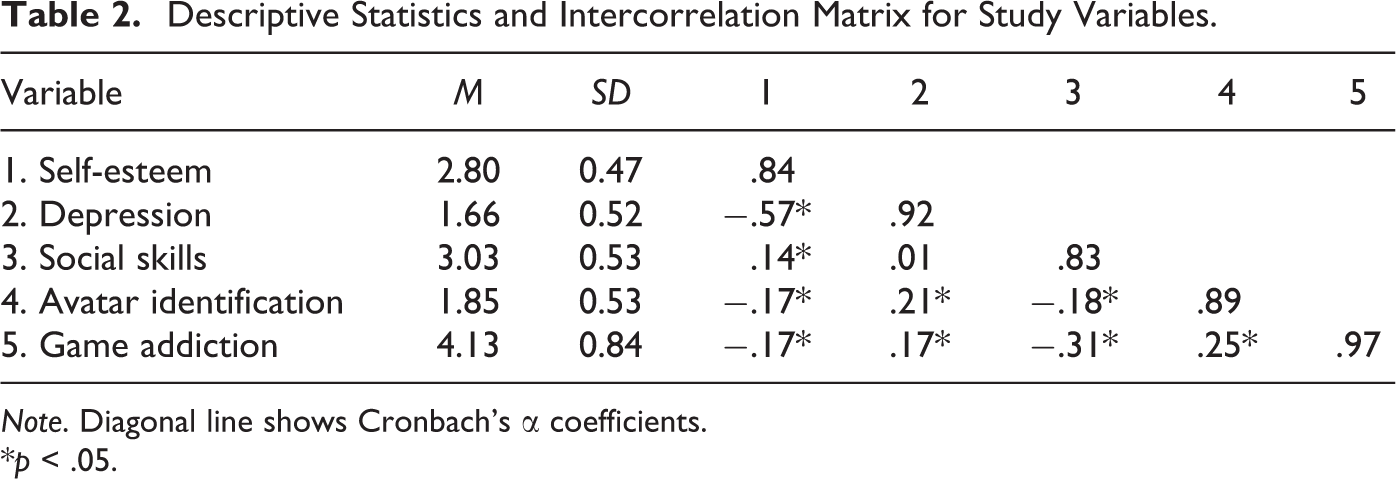
Note. Diagonal line shows Cronbach’s α coefficients.
*p < .05.
Structural Analyses
To assess the plausibility of the hypothesis that the relationship between psychosocial factors and game addiction is mediated by avatar identification, we tested two mediational models. The initial structural model (see Figure 1) reflecting partial mediation was specified with both direct and indirect paths from psychosocial factors to game addiction via a mediator. The second structural model represented the full mediational model, which does not include the direct effects of psychosocial factors to game addiction on the initial model. The results indicated that both models showed a good fit for the sample. Specifically, the partial mediational model yielded an overall χ2(3) value of 60.14, with CFI = .98, NNFI = .98, and RMSEA = .07 and the full mediational model yielded an overall χ2(6) value of 86.74, with CFI = .96, NNFI = .88, and RMSEA = .09. Therefore, a χ2 difference test was conducted to decide the better fitting model to the data and results supported the partial mediational model as the final model. The standardized parameter estimates for this model are presented in Figure 1. Depression and social skills had indirect effects on game addiction via avatar identification, a mediator. Social skills also exerted a direct effect on game addiction.
Discussion
The results of this study support previous research findings. The positive relationship between game addiction and avatar identification corresponds with the findings of Lee (2007), that game users who spend greater amounts of time playing games were likely to experience a higher level of avatar identification. Hogg and Abrams (1988) also presented a similar finding in that psychological obsession/addiction can increase with stronger identification with the avatar. These findings may indicate that as adolescents excessively play games through their avatar, they increasingly and closely identify themselves with their avatar in the world that the game is set. It is also possible that as adolescents believe their avatar to be their alter ego, they develop an attachment and eventually become addicted to the world where their avatar lives.
In addition, the negative correlation between self-esteem and game addiction supports the results of Young (1999) who found that game addicts tend to experience lower self-esteem. This may imply that within the boundaries of the game, a world where no one needs to reveal their real-life identity, users can craft an avatar based on ideal physical and personal characteristics, and this provides comfort to the students with low self-esteem. Dion, Berscheid, and Walster (1972) found that playing games with an attractive avatar was linked to high self-esteem, thus supporting the hypothesis that adolescents with low self-esteem may become addicted to games where they can perceive themselves as being more attractive.
The positive correlations of depression with avatar identification and game addiction also support previous research findings. For example, Kraut, Patterson, Lundmark, Mukopadhyay, and Scherlis (1998) found that the increase of Internet use leads to the increase of depression level. Jeon and Suh (2006) also reported that Internet addiction score and depression level have a positive correlation. These findings suggest that online game addicts tend to show more depressive symptoms than those who are not addicted to online gaming.
Moreover, social skills were also found to have negative relationships with both avatar identification and game addiction, supporting the result of Lee and Kwon (2001) that social skills and game addiction were negatively correlated. Song and Oh (1999) also found that game addicts tend to withdraw from interpersonal relationships. Game addicts are likely to spend most of their time playing games and spend less time socializing and interacting with others, which may result in poor interpersonal/communication skills.
A full mediation effect of avatar identification was found for the relationship between depression and game addiction, suggesting that the relationship between depression and game addiction exists when identification with the avatar occurs. That is, the presence of depressive symptoms is not directly associated with online game addiction. Rather, those depressive symptoms are highly correlated with avatar identification, which in turn is highly correlated with online game addiction. This result implies that adolescents with depressive symptoms are more likely to identify with their avatar, leading them to develop symptoms of online game addiction. Thus, identification with their avatar as an alter ego is a strong indicator of game addiction for adolescents with high levels of depression.
A partial mediation of avatar identification was supported for the relationship between social skills and online game addiction. Not only was there an indirect/partially mediated relationship between social skills and online game addiction via avatar identification, there was also a direct relationship between social skills and online game addiction. This partial mediation suggests that adolescents with low social skills are more likely to experience online game addiction, as well as, the tendency to have higher levels of avatar identification, which in turn can develop into an addiction to online games. Thus, social skills were found to be a strong indicator of game addiction for adolescents, both directly and indirectly via avatar identification.
Limitations and Future Directions
This study aimed to expand the current limited research on the mediation effect of avatar identification on the relationship between psychological factors and game addiction. However, several study limitations need to be considered. First, game addiction was assessed by focusing on only one game genre, MMORPG. The gaming world includes a multitude of genres and the characteristics of game users may vary depending on what game genre they most frequently play. Thus, further research should provide insight as to how different game genres are related to users’ psychological traits and thereby increase understanding of game addiction.
Second, the analyses were conducted on a relatively small group of third-year middle school students (N = 163) in a middle-sized city. This lack of diversity in terms of region and age and the sample size could underrepresent certain demographic groups, suggesting that caution must be taken in generalizing the results to the entire adolescent population. Although our study results may be consistent with previous studies’ findings based on samples from Western countries, the information from this study can still be useful for researchers to better understand adolescents from Eastern cultures (especially South Korean adolescents) and their online gaming behaviors. Therefore, additional research is needed to examine the relationships between psychological factors, game addiction, and avatar identification across different demographic groups with consideration toward region, age, gender, and other familial, societal, and cultural variables.
Additionally, the current study used self-reported measures, which raises concerns regarding the reliability of the collected data because situational factors and the mood at that time when the measurement was taken can influence the participants’ responses (Smith & Handler, 2007). Furthermore, the validity and reliability of the Game Addiction Scale (Lee & Ahn, 2002) were examined using middle school students, which suggests that further evaluation is needed using clinical samples to understand patients with Internet game addiction. Thus, the measure was used to examine and identify South Korean middle school students with different levels of online game playing, but not to diagnose them with “addiction,” warranting careful interpretation of the results.
Conclusion
One of the main study implications is that the findings contribute to the present understanding of adolescents’ online game addiction and provide knowledge to prevent or intervene with game addiction. This study examined and verified avatar identification as a mediator for the relationship between psychological factors (i.e., social skills and depression) and game addiction. That is, game users experience identification with the avatar in their path to game addiction, revealing a personal attachment to the avatar that is connected to changes in behavioral patterns and developmental outcomes. Additionally, recognizing the limitations of using video game playing time as a sole indicator, the game addiction scale measure in the current study used both video game playing time and several domains of daily functioning to distinguish problematic from healthy game behavior. However, in order to generalize the results, further study is needed on its use with different age groups, as it has been examined only with South Korean middle school students so far. Another study implication is that it provides the opportunity to understand the addiction phenomenon of the MMORPG, a game genre that has the most users and one of the highest rates of game addiction. Furthermore, by examining the influences of psychological factors on game addiction, this study can provide meaningful information that can be used to develop a therapy program for adolescents to prevent or intervene with game addiction problems.
Footnotes
Declaration of Conflicting Interests
The author(s) declared no potential conflicts of interest with respect to the research, authorship, and/or publication of this article.
Funding
The author(s) disclosed receipt of the following financial support for the research, authorship, and/or publication of this article: This work was supported by Hankuk University of Foreign Studies Research Fund.