



Abstract
This article investigates the impact that the rhythms of game interactions can have on a player’s experience of a computer game. Using a phenomenological approach, the research focuses on rhythmic experience within games and, in particular, on the rhythm of tree chopping within the games Minecraft and Don’t Starve. Graphic, aural, and embodied representations are used to closely analyze and compare a single-player experience within the two games. The analysis reflects on the efficacy of these methods and suggests some possible key factors for designing rhythmically expressive play experiences. It is suggested that combining real-time control with perceivable and performable repetition and variety can give the player expressive creative control over the rhythms of their performed interactions, potentially enriching their experience of repetitive tasks and extending the play life of a game.
Keywords
Introduction
Our fingers push and pull with the beats and pulses of the game, using the controller to develop a cadence as surely as a drummer does when slicing his sticks around a drum kit … (Hamilton, 2011)
Within game theory, there are many perspectives and models for analyzing the experience of gameplay, from a focus on play styles and player types (Bartle, 2005; Kim, 2011; Lazzaro, 2004) to a focus on the pleasures of play (Costello & Edmonds, 2009b; Hunicke, LeBlanc, & Zubek, 2004; Lucero & Arrasvuori, 2010) or on processes of involvement (Calleja, 2011). Another perspective game theorists have found useful is to focus on rhythm, as it occurs within gameplay experience. For example, Apperley has conducted an analysis of the rhythms of gameplay at cyber cafes (2010); Ash has developed a model of attention where gameplay rhythms are described as helping to create “optimal bandwidth” (2012); and Kirkpatrick has argued that gameplay is a form of dance choreographed by the “script” of the game (2011). Rhythm is particularly important within games because of the defining role it performs within play. If we define play as “free movement within a more rigid structure” (Salen & Zimmerman, 2004, p. 304), then it is the quality of the rhythms of that movement that lie at the heart of any playful interactive experience (Costello & Edmonds, 2009a). Rhythm is involved when designers record the levels of tension throughout a game by creating a graph of its dramatic arc (Fullerton, 2008, p. 104). Rhythm is also present when a designer charts rising and falling player interest (Schell, 2008, p. 253), balances the elements of a game’s design to achieve a state of flow (Sweetser & Wyeth, 2005), or focuses on the patterns of level design (Smith, Treanor, Whitehead, & Mateas, 2009).
In his book Game Feel (2009), Swink focuses closely on an aspect of rhythmic experience, looking in detail at the rhythms of real-time control. Similar to Swink, this research has an experiential focus on the in-the-moment patterns of action and response within gameplay and their effect on embodied player experience. However, where Swink focuses on the feel of individual game interactions, this study investigates the rhythmic qualities of multiple gameplay interactions as they play out across time. Swink, writing for a game developer audience, does not identify his approach as phenomenological. However, his approach does spring from a view of the relationship between player and video game that is phenomenological (Keogh, 2014, p. 15). This study begins with a view similar to Keogh, namely, that “[d]uring video game play, the player embodies a hybridised body, incorporating flesh, hardware, and virtual objects and beings into their corporal schema” (2014, p. 15). Starting from this point means that the research is more interested in the game, as it is lived, as it is embodied, as it is played, and less in the game as a form, as it is received or as a cultural object. The methods of data collection and analysis used in this study reflect its focus on the interconnections and interrelationships between playing body and game. The study’s methods are qualitative, focus on capturing rich detail of a single personal player experience and are grounded in the embodied nature of video gameplay.
Rhythmic Experience Within Gameplay
… whenever each step forward is at the same time a summing up and a fulfillment of what precedes, and every consummation carries expectation tensely forward, there is rhythm. (Dewey, 1934/2005, p. 179)
Experiencing a rhythm involves opening our perception as we synchronize to these cycles and surrendering our attention to their control as we become habituated to them. When a rhythm is performed, the cyclic flow of rhythmic experience is also something that we can expressively play with. As an example, take your mind back to the last time you were part of a large audience enthusiastically applauding a performance. Think about the moment you started to clap, the decision you made about how loud and how fast to do it, the building thunderous sound as every member of the audience joined in and the moment that you decided to stop clapping. What you have just imagined is an example of a rhythmic experience. Your clapping produced a rhythm and, as you did so, you listened to the rhythms of other audience members and may then have gradually synchronized your rhythm to that of the others until a moment occurred when the applause merged into one loud distinct rhythm. 1 As people became tired, the applause would then have tailed off into individual rhythms. By clapping you were playing an expressive rhythm, but you were also opening your perception to (attuning yourself to) the rhythms played by others. You were controlling your physical body to reproduce a rhythm learnt in childhood and then perhaps surrendering some of that control to synchronize with the rhythms of the rest of the audience. To perceive and to play along with a rhythm, we must first open our perception to it—become attuned to its pulse and meter—and then bend both our perceptual attention and our actions to synchronize with it.
Similarly, the interaction between a player and a computer game has rhythms that are perceived, performed, and can be played expressively. In order to play the game, the player must open their attention to the rhythms of the game and bend their behavior to synchronize with the rhythms of action and response that the game requires. While some elements of gameplay will require precise rhythmic performance, others will allow players room to expressively play with the rhythms of their game actions. Game designers often strive to create a rhythmic match between player actions and game responses, so that the player feels in sync with the rhythms of gameplay and/or has the control to play with these rhythms. But this doesn’t always happen and one game reviewer describes such a rhythmic mismatch when he voices his frustration with the combat controls in The Witcher 2 (CD Projekt, 2011) describing how “the animations play out in conflict with my button inputs, and the whole thing winds up feeling like playing a guitar duet over Skype” (Hamilton, 2011). The frustration that he is expressing is not about his ability to manipulate the controls in order to achieve a game outcome. It is about a perceived lack of synchrony between the physical rhythms of movement he is opening to within the game and the visual rhythms that these movements are triggering. This is a mismatch that blocks his potential captivation by this particular rhythm of the game. This type of rhythmic mismatch would generally not be seen as a failure of the game design as a whole but is a part of the nuanced experience of the player and will have an impact on her or his overall perception of the game. The player’s performance of interactive rhythms can be described, then, as creating a rhythmic groove, a groove that she or he may feel in or out of sync with and in or out of control of.
In his book on rhythmic nuance in music, Roholt (2014) defines groove as “the feel of a rhythm” and describes how by playing notes early, late, or on-time musicians can create a feeling for the listener that the performance is rhythmically “pushing,” “pulling,” “leaning-forwards,” “laid-back,” or “in-the-pocket” (p. 1). These qualities of groove create the distinctive character of a particular performance of a piece of music. Roholt argues that perceiving and performing a groove is an essentially embodied experience, moving one’s body in relation to a rhythm is a form of listening through which an understanding of a groove will emerge. As he puts it: “Understanding a groove means to feel the qualitative relationships among the elements of the rhythm in one’s body.… to ‘get’ a groove just is to comprehend it bodily and to feel that comprehension” (p. 137). Learning to perform or perceive a groove, then, involves moving your body whether it is a tap of the foot, a nod of the head, or a raised elbow when hitting a drum. To learn the right movement for a particular groove, Roholt advises learners to look at the way practiced performers and listeners move to a groove and to try moving in similar ways.
The parallels with gameplay are striking. Studies have observed the many nonessential bodily movements that gamers will perform when playing, such as angling their body to avoid projectiles, ducking from bullets, or rising up when jumping (see, e.g., Swalwell, 2008). One study asked players to stop making these movements and reported that their enjoyment of gameplay decreased (Newman, 2002). Such movements occur in games where real-time control creates a tight coupling between the body of the player and the actions on-screen, creating an experience of vicarious kinesthesia, a blend of presence, sensuality, and spectacle (Darley, 2002). The creation of this experience is a matter of timing. At a macro-level, if the computer responds too slowly, the illusion is broken. At a microlevel, the timing of action and response can give a rhythmic character to each button press creating an overall impression of the game controls as being “floaty,” “organic,” or “tight” (Swink, 2009, p. 124). As Newman (2002) points out, these nonessential body movements play a role in the experience of a game because of the way they work to “augment, broaden and intensify an internalised ‘language’ of control” (p. 415). Based on Roholt’s theories above, I would argue that the language that these nonessential body movements are intensifying is an essentially rhythmic one. That these movements are a form of rhythmic listening through which the player is understanding the groove of the game as it is performed.
Within gameplay, rhythms can exist across the whole length of a game and within single-game levels. Rhythms can also occur across combinations of moves, within game core-loops and arcs and also within individual moves. These rhythms might involve any or all of various gameplay elements: visuals, sounds, physical actions, cognitive processes, mechanics, or dynamics. Analyzing rhythmic experience then is a complex task. There will be layers of rhythms across the whole game, but there also might be something providing a pulse that other elements build around, creating a figure-ground relationship. Conspicuous rhythmic elements like music or visual animation might seem initially to be rhythmically important, but these might be masking other more important rhythms within gameplay actions. In such cases, separating out elements will help identify rhythmic patterns. This needs to be done carefully to ensure the analysis does not overlook their interrelations or combined impact.
Method and Approach
As previously discussed, this study takes a phenomenological approach, focusing on the embodied, moment-by-moment experience of gameplay. It is also intentionally a small-scale study, designed to experiment with methods for analyzing rhythmic experience. The study is based on a close critical analysis of the personal play experiences of the researcher. The researcher’s gameplay observations were backed up by audiovisual recordings of each gameplay session and a gameplay observation diary. Participating in the rhythmic movements of gameplay allowed the researcher to listen to and begin to understand the rhythmic grooves of the two games. This embodied knowledge then contributed to the analysis of the audiovisual data. Embodied performance as a form of rhythmic listening also figured in one of the methods of analysis of the study data: A rhythm distilled from the gameplay was performed as a series of taps on a tabletop. This same rhythm was also represented aurally and graphically. The aim here was not only to separate out a particular rhythmic component of gameplay for analysis but also to investigate how to best represent these data so that it could reveal insights about the rhythmic experience of the two games under discussion.
The graphical representations of rhythmic data in this study followed a method used in musical analysis where rhythm is separated out and then scored as note durations across time. In musical terms, the interval between rhythmic note events is defined as beginning at the start, or attack point, of an event and ending at the start point of the next event—this is known as the interonset interval (London, 2004). This means that a musician can vary the duration of each note event and still be playing the same rhythm because the interonset intervals are unchanged. Equally, a rhythm can be played fast or slow by varying the duration between the interonset intervals (London, 2004, p. 163). In this, we see the potential for expressiveness that lies in any rhythmic action. To capture this expressiveness within gameplay, the study focused on recording not just the start of each player action but also the durations of these actions. As we were not concerned with pitch or multiple musical instruments, the graphical representation of these durations was simplified (Figure 1). The durations were mapped to gameplay time with the length of each rectangular bar representing the duration of the mouse press.
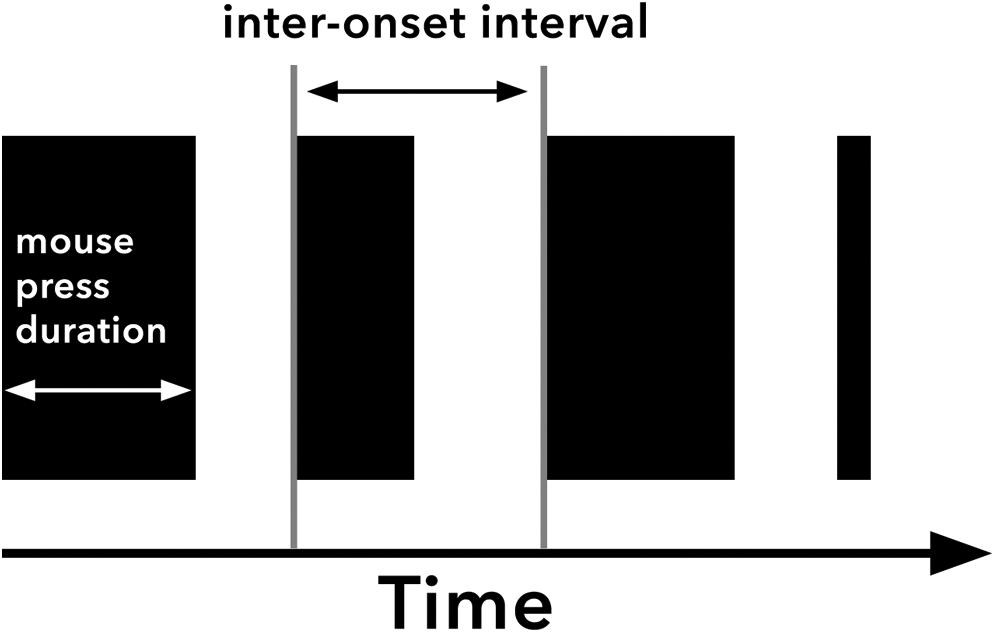
Example chart showing mouse press durations mapped over time with interonset interval (the time between the start point of mouse presses) also indicated.
Representing data aurally, or sonification, is a method used by some researchers to analyze and reveal patterns within complex data sets. This method draws on the delicate human sensitivity to aural temporal changes. In data sonification, pitch is often used to map values against time. Rather than overlaying many layers of data within one sonification (which creates a confusing and hard to analyze aural stream), short segments of a single data stream are usually played sequentially to enable comparison of two data sets (Flowers, 2005, p. 407). Because humans have difficulty perceiving rhythm if the gap between events is longer than 6 s (London, 2004, p. 27), speeding up the temporal mapping of the data can also help analysis of a sonification. In this study, two sonification approaches were used. One mapped game action event durations to pitch and sped up the temporal playback. Each note was played for a set duration and this emphasized the start point of each event and thus the interonset intervals. The other approach used a single pitch for each game action but played the pitch for the whole duration of an event. In this second approach, the sonification time scale matched that of the gameplay. This approach emphasized rhythms of action intensity within the data. For both approaches, the data from each game were sonified separately, producing two short rhythmic segments that could be played sequentially for analysis.
Rhythmic Experience in Don’t Starve and Minecraft
Minecraft is a very successful three-dimensional (3D) open-world sandbox game. When it is played in survival mode, the player needs to collect resources and avoid dangerous creatures at night in order to survive. Don’t Starve is two-dimensional (2D)/3D hybrid survival game that was in part inspired by Minecraft (Rose, 2012). Similar to Minecraft, the gameplay in Don’t Starve involves the collection of resources and has dangerous creatures that must be avoided. In both games, particularly in the first 5 min, the first resource that players need to collect is wood and they do this by chopping down trees. In both games, levels are randomly seeded for each new game, but in Minecraft, the levels are larger and more varied. Another major difference between the two games is that Minecraft is played from a first-person perspective, while Don’t Starve is third person (see Figures 2 and 3).
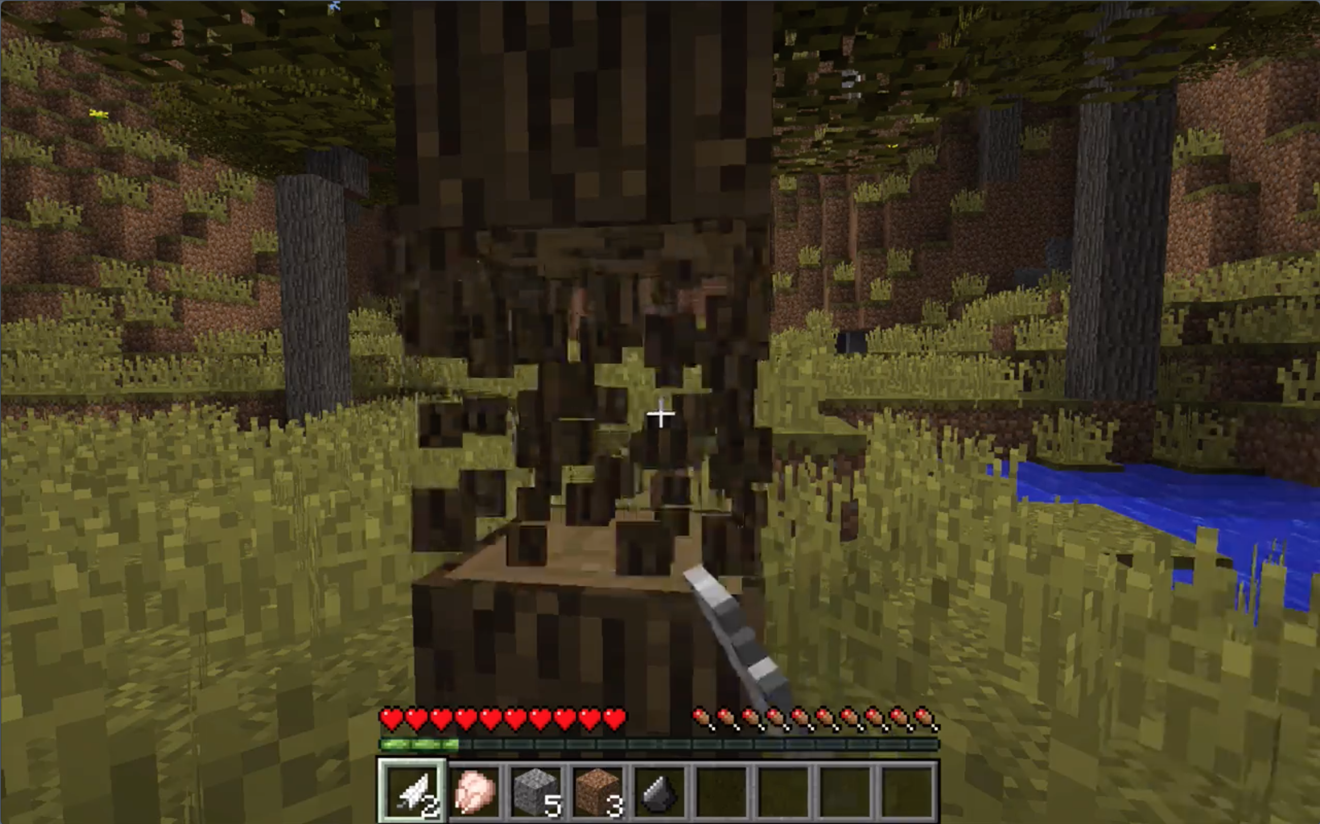
Screenshot of the game Minecraft (Mojang, 2011) showing the first-person perspective and a tree block about to break.

Screenshot of the game Don’t Starve (Klei Entertainment, 2013) showing the third-person perspective and a tree being chopped down.
At a macro-level, the rhythms of the two games are punctuated by their day/night cycles. Minecraft has a 10-min day and 10-min night and Don’t Starve has a 4-min day and 4-min night. In both cases, monsters are more prevalent at night. This impacts the types of actions that are performed and hence also impacts the rhythmic flow of activity within the game. The macro-rhythmic flow of collecting in both games is directed by the spacing and placement of collectable items generated by the world seed. The macro-rhythms of each game are also impacted by the way each game deals with character death. If your character dies in Minecraft, you will respawn within the same world. Don’t Starve has permanent death, so a new game must be started every time the character dies. This combined with the shorter day/night cycles gives gameplay in Don’t Starve, a faster more pressured rhythm. There is less time for strategic thinking in Don’t Starve and more focus on collecting everything possible. The permanent death of Don’t Starve also means that the player becomes more aware of the rhythmic permutations within the random-level generation as each new game starts. This quickly adds a level of rhythmic repetition to the overall experience of Don’t Starve that takes much longer to build up in Minecraft. The study described in the next sections will now focus on the microlevel rhythms of the combination of gameplay actions within the two games and the impact these have on player experience.
Data collection and analysis
Data were collected of a single player (the researcher) playing 5 min of a new game in both Minecraft (survival mode) and Don’t Starve (default start settings). The researcher had experience playing both games but had not played either within the last 6 months. A refresher play through of 10–20 min of each game was completed before data collection began. For each data collection session, the game was played as it was intended to be played, which in both cases meant completing the collecting and building tasks needed to survive the first night. Navigation within both games is controlled using the W, A, S, D keys and interaction with game world objects is controlled by left mouse clicks. However, in Don’t Starve, it is also possible to navigate using left mouse clicks and in Don’t Starve the W, A, S, D keys were rarely used. 2
The screen recording software ScreenFlow (Version 5.02; Telestream, 2015) was used to capture an audiovisual recording of the game activities as well as any key presses or cursor interaction. Additionally, a video camera was used to record the player’s body. A timed text log of mouse and key presses was also captured using the key logging application Recording User Input (RUI; Version 2.1; Penn State, 2012). At the start of gameplay, the spacebar was quickly pressed twice and this was followed by a 2-s pause, enabling the audiovisual recording from ScreenFlow and text log record from RUI to be synchronized. After the play of each game, a diary entry was made recording memories of the gameplay activities and any observations made about the rhythms of interaction.
The study’s focus on capturing the rhythms of player interactions and game responses made it important to try to capture the timings of any interface actions like mouse or key presses. Although RUI does record both presses and releases for mouse buttons, a limitation of the RUI logging application is that it records key presses but not releases, so it is not possible to calculate the duration of key press actions. Only mouse press durations can be calculated from the RUI data. The screen recorder ScreenFlow can display a visual record of key presses made during a recording, but the key does not remain on-screen for the full duration of the press, so it also cannot be used to calculate durations. Additionally, ScreenFlow does not record many common game double-key combinations, for example, the action of moving forward and jumping, which is made by pressing the W key and the spacebar simultaneously. In both ScreenFlow and RUI, the initial press of the W key would be shown and then the spacebar, with no indication that the W key was still pressed. In such cases, the video of the gameplay screen needs to be viewed to accurately analyze any record of player actions.
Because of these limitations, this study chose to analyze one excerpted sequence from each game where the primary interaction involved mouse presses and releases. The rhythm of the execution and duration of the mouse presses could then be analyzed for both games. To aid comparison, the sequences chosen were both around 33 s in length and involved the action of chopping down trees and collecting wood. In Minecraft, this sequence involved the chopping of a single tree and in Don’t Starve, it involved two trees (one big and one medium). To confirm initial conclusions, two other longer 60-s excerpts of collecting were also analyzed.
Video excerpts were created of each 33-s tree chopping sequence and observational analysis of these was recorded in a text diary. The RUI key and mouse log data were collated in Microsoft Excel and a chart was generated to map the rhythm of mouse press durations against time (Figure 4). These data were then imported into the application Sonification Sandbox (Version 6; Georgia Tech Research Corporation, 2014) to create the first aural representation of the data. 3 This aural representation mapped press duration to pitch, with short mouse presses playing at a low pitch and long mouse presses playing at a high pitch. The temporal dimension of each data set was sped up, with 30 s playing out over 10 s. A second aural representation was created in the open-source software sketchbook processing (Version 2.2.1; Fry & Reas, 2014). This representation used a single pitch to playback notes matching the duration of each mouse press across the same timescale as the gameplay. 4 Lastly, the graphic chart (Figure 4) was used to perform the two rhythmic sequences as a series of single-hand taps and presses on a table top, pressing down on the table for the duration of long mouse presses and tapping for short ones.
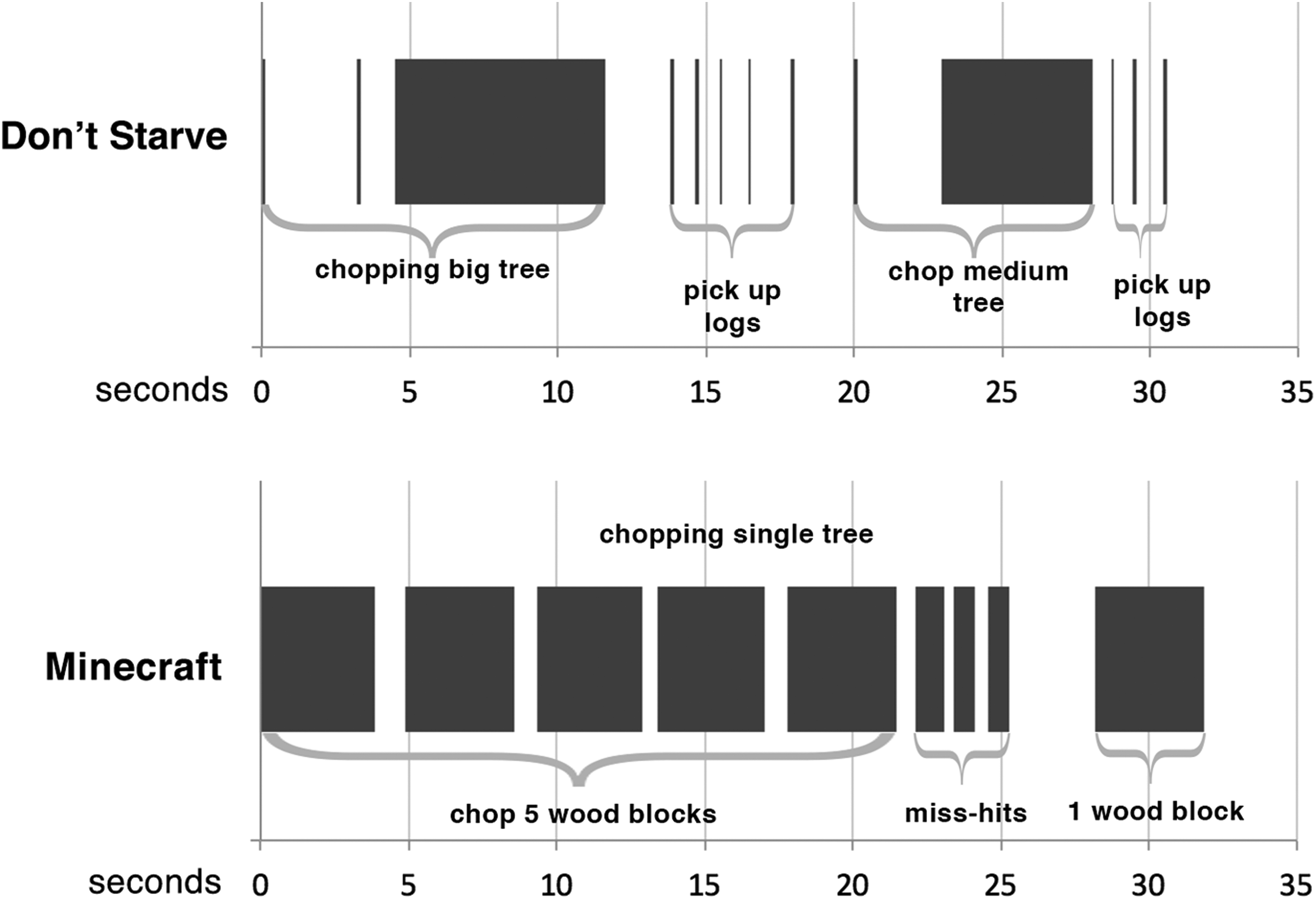
Chart comparing the tree chopping mouse press durations within a 33-s excerpt of a single player’s gameplay in the two games Don’t Starve (Klei Entertainment, 2013) and Minecraft (Mojang, 2011). Each dark bar represents the duration of a mouse press.
Due to the performative nature of gameplay, the rhythms that a gameplay session produces will vary depending on player style, expertise, game choices, and any variability programmed into the game itself. Although this study is limited by its focus on a single-player experience, some steps were taken to partially mitigate this limitation. To check against game variability, a second 5-min recording was made of a new game in both Minecraft and Don’t Starve. This was then used to compare rhythms observed in the first recording. Additionally, online video tutorials for each game were examined to (as much as possible) check initial conclusions against player variability. Future studies will test these conclusions against multiple-player experiences.
Results and Discussion
“Playing Don’t Starve often feels like I am walking through quicksand. The game is dragging me back.”
A key rhythmic difference within the play experiences of the two games centers on the way each game times the relationship between action and response. Minecraft has a close match between player action and game response, creating a groove that always feels in sync with the player. Conversely, Don’t Starve doesn’t always match player action and game response. Often a short-player action will cause a longer game response and the player must wait for that response to play out. For example, a short click on an object four steps away will trigger an animation of the character walking over to the object and picking it up. This means that often the player’s action events are fast, while the gaps between them are long. These long gaps between player actions in Don’t Starve make it harder for the player to perceive any rhythmic patterns within their own gameplay actions. The game responses in Don’t Starve are a very busy contrast to this, with long response events that have short gaps between them. The rhythms of these long action/fast gap game responses are consciously perceived by the player and then subconsciously compared to the player’s own fast action/long gap performed rhythms. The player experience of this mismatch in rhythms is the feeling of being held up or dragged back by the game. The labor of collecting in Don’t Starve feels more laborious than Minecraft, not because of the amount of player activity required but because of this mismatch in rhythms between player action and game response.
A further factor that inhibits player perception of rhythmic patterning in Don’t Starve is the lack of a kinesthetic link between player and game character. We saw in our earlier discussion of groove how integral bodily movement was to the process of rhythmic listening. Without it, rhythmic grooves are much less able to be perceived. The player’s body during the video record of Minecraft gameplay echoes the movement that is being simulated on screen. The player’s head and shoulders turn slightly to face the direction the character is moving. Her body rises up out of her seat when jumping up and sinks when jumping down. Her mouse hand makes sweeping movements left and right as she looks around and positions the character in relation to world objects. As they are performed, the rhythmic physicality of tension and release within the long mouse press durations of Minecraft have a sense of purpose and intentionality. Conversely, in the video record of Don’t Starve, the player’s head swivels as she follows the character around the screen, but her mouse hand moves less and in general her body seems less alert. The patterning of widely spaced short and long mouse press durations has a lighter physicality that feels much less purposeful. The player’s body in Don’t Starve is not as closely coupled with the action on screen and this makes it more difficult for her to feel the rhythmic groove of the game.
You could argue that this difference in kinesthetic feel between the two games stems from their different player control perspectives and visual style. That it is the first-person 3D perspective of Minecraft that ensures a tight coupling between player and game. But such an argument does not hold, for it is equally possible to have a kinesthetic connection within a 2D third-person perspective game (see, e.g., the game Limbo by Playdead, 2011). What marks the key difference between the two is that Minecraft has what Steve Swink (2009) calls “game feel,” while Don’t Starve does not. Game feel, “the tactile, kinesthetic sense of manipulating a virtual object” (Swink, 2009, p. xiii), hinges on three combined factors: the player needs to have real-time control, there needs to be a simulated space that this control occurs within, and there needs to be a level of aesthetic polish to enhance the perceptual reality of this simulation (pp. 2–6). The rhythmic mismatch identified above is a reflection of the lack of real-time control in Don’t Starve. Without it, players’ bodies are not as tightly coupled to the rhythmic nuances of the game and this impacts their experience of its rhythmic character.
Often compared to Lego, the entire Minecraft world is made up of many types of the same-sized cubic blocks. This design construct adds a rhythmic regularity to its gameplay. Several blocks make up the trunks and leaves of each tree, the amount of blocks varying from tree to tree. In spite of this variation, there is a still a rhythmic regularity when a player chops down a tree. This is because, for each specific tool, a block of wood will take the same length of mouse press to break apart and collect. The chart above (Figure 4) shows the repetitive similarity of these durations for the six blocks of wood collected within the 33-s sequence. Repetition also occurs in the duration of the gaps between the mouse press actions. This similarity is caused by the universal size of Minecraft blocks, which influence how far the mouse has to move before the next block can be collected. Over a longer gameplay session, a player can choose to vary some of these repetitive rhythms. For example, using different tools can speed up the length of time it takes to collect each block. There are also more expert, efficient ways of collecting wooden blocks and these generally involve positioning your character, so that an entire tree can be collected with one long continuous moving mouse press (“Time-Saving Tips: Trees,” Minecraft Wiki). No matter which method is used, there is still a similar rhythmic quality to the visual animations and sounds that play as each block is collected. Thus, through its block structure, the chopping down of a tree is patterned with a repetitive rhythm. This patterned repetition in Minecraft creates a rhythmic language that a player perceives and learns through their performance of game actions.
Without a block-based structure, the world within Don’t Starve has more varied rhythmic patterns and these are formed through the sequencing and combination of repetitive groups of actions. Similar to Minecraft, there are two ways of chopping down a tree. A player can make a number of short clicks each causing a single animated axe chop or they can click and hold the left mouse button (or spacebar) to produce a continuous stream of chopping. The long delay between a short click action and the sound and vision of an axe chop gives the short click method that “guitar duet over Skype” feel that Hamilton (2011) mentioned earlier. The long mouse press technique feels faster and is more rhythmically satisfying because the chop sounds play out with a rhythmic regularity that is controlled by the game. For these reasons, the long mouse press was the preferred play style in the data collection play session. In the section of the map played for this study, there are three sizes of evergreen pine trees. Each size of tree has a set duration of sustained mouse pressing needed to chop it down and a set number of logs that can be collected once it is chopped down. In each case, this long mouse press is followed by a series of small quick mouse clicks to collect the three logs and two pinecones dropped by a big tree and the two logs and one pinecone dropped by a medium tree (see Figure 4). The tree will not drop its collectable items unless the whole tree is chopped down, so the combination of long mouse press and shorter pick-up clicks for each size of tree creates a rhythmic grouping that is repeated every time the same-sized tree is chopped down. Across a longer sequence of gameplay, these rhythmic groupings combine into the one rhythmic pattern created, as the player chops down different combinations of small, medium, and large trees.
Although this rhythmic variety in Don’t Starve creates possible interesting rhythmic combinations, it does not provide a universal rhythmic pattern that can be perceived and learnt by the player. A player could potentially learn the rhythm for the three sizes of tree. However, the design of the game makes learning these three rhythms much more difficult than it is to learn the single rhythm in Minecraft. As a wood block is chopped in Minecraft, there is a visual indicator of the block wearing away, the surface patterning with cracks that start at the center and move outward. When these cracks reach the extremities of the block, it will break (see Figure 2). This reinforces the rhythm of block breaking and helps the player learn the timing of action required. Another factor that could be helping the player to learn and perceive Minecraft tree chopping rhythms is the way that they have a pacing and regularity reminiscent of the rhythms a human will fall into when performing repetitive physical tasks like chopping or digging. Such rhythms may be familiar to the player, and this could mean they will fall into sync with them more quickly. In Don’t Starve, the sound and vision of the axe chopping does have a similar rhythmic regularity to the human performance of physical chopping. However, because of the lack of real-time control, this rhythm is never experienced in an embodied way. Also, even though the tree in Don’t Starve will shake from side-to-side while it is chopped, there is no progressive change to visualize how close the player is to reaching the right length of mouse press to chop down the whole tree. A player could count the number of axe chop sounds and animations, but this would need to be very consciously done because although the number of chops required is consistent, the pitch of the axe chop sounds varies. This variety disrupts the rhythmic regularity and makes it much harder to perceive and learn the pattern of tree chopping in Don’t Starve.
In interaction design practice, repetition is seen as helping a user learn how to use a design, while variety provides interest and sparks user exploration. This relationship between variety and repetition plays out slightly differently when considering rhythmic performance from a musical perspective. A musical form that has no expressive rhythmic variation is often described as “deadpan or computer generated” (London, 2004, p. 163) and a musical performer who slavishly follows a score can be criticized for giving a performance that is mechanically repetitive and lacking in expressive rhythmic dynamics. Variety in both rhythmic performance and its product is generally regarded as more creatively desirable. In our discussion of chopping trees, Don’t Starve has showed more variety and Minecraft more repetition and yet the Minecraft player experience feels more rhythmically expressive. So what other factor is at play here? Musical theorists writing about expressive performance and improvisation point out that both perceivers and performers need prior knowledge of rhythmic patterns or categories (Berkowitz, 2010, p. xv; Honing, 2002, p. 228). This knowledge gives “a reference relative to which timing deviations are perceived and appreciated” (Honing, 2002, p. 228). The capability to be expressive and to perceive expressivity relies on the performer and the perceiver being aware of a rhythmic reference point that expressivity can then creatively play around. Minecraft has repetitiousness that the player can quickly perceive as a rhythmic pattern and with that perception comes an ability to experience the game rhythmically. Players have control over the speed and rhythm of their performance through their ability to vary the amount of blocks chopped, the tool used, and the efficiency of their style of play. This gives them control over the variety of these rhythms. When these factors are combined with Minecraft’s embodied real-time control, the player has agency over the amount of repetition and difference within the gameplay rhythms. Through this, the player is able to create a rhythmically expressive performance. Such expressivity is less possible in Don’t Starve because the player is less entrained to the game rhythms and less in control of the way that they play out. In Don’t Starve, it is more the game that is rhythmically expressive and the player’s actions dance along to the beat it creates. In Minecraft, the player feels in control of the rhythms of their dance and it is as if they and the game are dancing together.
Conclusion
This study has focused on the impact rhythms of action and response can have on a player’s moment-by-moment experience of a game and has revealed clear differences between the rhythmic experience of Minecraft and Don’t Starve. At a microlevel, Minecraft has a rhythmic groove that feels in sync with the player and this is tied to the game’s real-time control and easily perceivable and performable rhythmic structure. This combined with the agency the player has over ways to vary and repeat these rhythms gives Minecraft a rhythmically expressive player experience. In contrast, Don’t Starve has a rhythmic groove where the player feels held up or pulled back by the game, and this is tied to the game’s lack of real-time control and generally opaque and inaccessible rhythmic structure. The player frequently triggers rhythms in Don’t Starve rather than performs them. Those rhythms that the player does perform are often obscured by randomness or variety and thus their patterns cannot be clearly perceived across sequences of actions. These factors combined mean that there is little room for expressivity in the player’s rhythmic experience of Don’t Starve.
These conclusions do not mean that rhythmically expressive game interactions are essential for every game or even that they are necessary for Don’t Starve. Gratuitous difficulty is important for gameplay, so making a game’s rhythmic actions challenging to learn and perform is a common and appropriate tactic for many types of computer games. For other games, as this study has suggested, providing a learnable and performable action structure that enables rhythmic expressivity can be valuable for enhancing repetitive tasks, enriching creative gameplay and extending gameplay life. To achieve these things, the player needs to have a real-time connection to the game; one that allows them to embody both the game’s and their own performed rhythms. Any repetition within game actions has to work to create a controllable structure of note-like elements that can then be played like an instrument. Additionally, the study suggested that rhythmic expressivity is increased if some of the variety within a game is included an instrument-like way; that is, if the player is able to control when and where to introduce it. A game has rhythm and a player has rhythm, it is the quality and elasticity of the mesh between the two that creates the potential for expressiveness.
A key aim of this small-scale study was to experiment with possible methods for analyzing the rhythm of the moment-by-moment actions of gameplay. During analysis, all four methods of representing the data proved valuable. Each revealed different analytical insights and were useful as points of comparison. The audiovisual record of gameplay turned out to be the hardest to analyze rhythmically because it contained so many layers of data. However, the other three methods helped to single out rhythmic characteristics and the audiovisual record could then be revisited with a fresh perspective. While the graphic chart of durations showed broad patterns of variations between short and long actions, it was not as revealing of the nuances within action durations as the sonifications. Additionally, physically performing the action rhythms as taps proved useful for revealing patterns of tension and release not consciously felt when immersed in gameplay and not obvious in any of the other representations. The process of creating each representation was also analytically useful. As different elements were singled out or the data were formatted for display, insights were revealed about what the data might mean and about how each method could accurately represent it. This suggests that a blend of approaches, audiovisual, graphic, aural, and embodied, will prove useful in a future phenomenological analysis of rhythmic experience within gameplay.
This is just the beginning of a phenomenological exploration into rhythmic experience within gameplay. Future work will expand this study to include multiple player experiences and will explore developing a more effective tool for capturing the rhythms of computer gameplay. Other possible areas for exploration include different genres of games and types of control interfaces.
Footnotes
Declaration of Conflicting Interests
The author(s) declared no potential conflicts of interest with respect to the research, authorship, and/or publication of this article.
Funding
The author(s) received no financial support for the research, authorship, and/or publication of this article.