




Abstract
Despite the importance that the dimension of genre holds in media studies, its very definition in the field of video games is still a matter without consensus. This study intends to outline the logic that lies within the constitution of videoludic genres, understanding them as formal devices configured as per the different thought functions stated by Piaget’s cognitive psychology theory. This project will propose a formalist approach from a cybersemiotic perspective. It seeks to establish a cardinal set of relations to understand the compatibilities and incompatibilities traceable in the syntactic functional order of the different video game genres. Furthermore, a corpus of 43 genres is used to prove the solidity of this theoretical approach, oriented to establish foundations for a praxis of the human–machine ludic relation in fields such as game design and media studies, with the performative character of function as a guiding principle.
The study of genre holds a central position in media studies. This is to a large extent due to the compromise that the status of genre maintains between the generality of the analytical method and the particularity of the study subject (Coste, 1989, p. 252). At the same time, it implies basic and nontrivial issues since the complexity of the external (discursive, conventional, and technological) impacts on the medium affects its structures and transforms them in an unpredictable fashion (Garzone, Catenaccio, & Degano, 2012, pp. 21–40; Schatz, 1981, p. 15).
Since the 1980s, genre theory has broken from formalist classic concepts, encouraging a holistic and inclusive notion. This centers its attention on the users and their denominative activity (Devitt, 2004; Miller, 1984; Russell, 1997), at the expense of the methods of designation from criticism and academia. Such expansion of the phenomenon must be added to the intervention of the copyright as an active principle in the processes of commercial transaction, and hence of formal configuration (Bogost, 2006, p. 61; Clearwater, 2011; Shur-Ofry, 2008). These factors constitute change operators that allow genres to interact with other genres. In summary, due to their capacities for hybridization and their circular dynamics of positive feedback, it can be stated that genres “generate change and are generated by change” (Garzone & Ilie, 2014, p. 15).
Thus, a consistent genre theory should pursue not formal classification schemes, but rather a comprehension of its subject as “a rhetorical and essentially semiotic social construct” (Devitt, 1993, p. 573); a notion of genre as a living substance, that actualizes the well-known formula by Northrop Frye about the function of criticism: “not so much to classify as to clarify” (1957, p. 247). Ultimately, we understand that a methodology interested in derivative logics is especially relevant in postmodern media such as video games, since, in a very evident way, a genre conscience can be stated that predates to any intervention from criticism or academia (Whalen, 2004, p. 291).
That is why this article seeks a standardization of the generative conditions of genres, rather than one of the genres themselves, aiming to agree with a definition of genre as “a relationship between textual structures and the situations that occasion them” (Frow, 2006, p. 13). In this sense we remark that, unlike other audiovisual media and due to their interactive and cybernetic condition, video games offer a specially delimited syntactic field according to (a) the input–output computer system models and (b) the very game structure in which those are founded.
Favoring this condition because of its nuclear character, we do not intend to separate video games from their symbolic or cultural aspects. In turn, we intend to establish an elemental distinction regarding genre studies about media such as cinema or literature, and lay foundations able to sustain on their own the derivative logic conditions, which launch the video game structures.
Background
Difficulties in reaching consensus
In spite of the dominant tendencies of the last decades of genre studies, most of the approaches from the game studies show, when oriented to the formal particularities of the medium, either a taxonomic vocation or a ludological one. This makes a minimum consensus impossible, as previous studies have resorted to a certain randomness in the selection of variables in their attempt to reach stable definitions. The first tendency can be noted in the cases of Lee, Karlov, Clarke, Thornton, and Perti (2014) who propose a facet classification (gameplay, style, purpose, target audience, presentation, artistic style, temporal aspect, point-of-view theme, setting, mood/affect, type of ending) and also in Clarke, Lee, and Clark (2017) who are limited to a library and information science perspective and argue that the failures of further attempts to reach a definition of genre prove that this is an impossible task. Another theoretical trend akin to this focus is the one followed by Fencott, Lockyer, Clay, and Massey (2012) and Faisal and Peltoniemi (2015), who develop data-driven models of observation on the basis of activity types (modes of action, i.e., shooting, killing, building) or “topics” (content categories, i.e., genre); from these, they meet statistics able to visualize relations between genres or processes of transformation derived from the relation between genres and audiences.
These positions, which renounce structural attributions to attend classification systems with archival and statistical value, emerge as the culmination of a long-term trend. Its tradition begins with Crawford (1984) and his distinction between “skill-and-action games” and “strategy games,” which nowadays reveals its obsolescence, as it was limited to contemporary genres. In a more ambitious line, Wolf (2002) establishes and describes 43 categories under the single criterion of their interactive nature. Although appreciably exhaustive, this enumeration is unable to avoid being somewhat unarticulated and arbitrary, ordering utilitarian categories (educational) next to others based on the principal action (driving), unspecified themes (sport), level layout conditions (platform), gameplay (puzzle), or aesthetics (adaptation). The same yardstick is applied to genres and subgenres, with a single form of cohesion in their eventual interrelations.
Whalen (2004) focuses his study on Massive Multiplayer Online Role Playing Games on their technological distinction as a principle of genre inception and enounces three descriptive terms: “massive” for the massive online game systems, “mobile” for portable platform game design, and “real” for games based on the kinesics of the player (p. 300). Apperley (2006), on the other hand, considers the analogy to be such a principle with the key term of remediation. Thus, he distinguishes four principal genres: “simulation,” as vacillation between the respect to physical laws and the subordination of these to entertainment; “strategy,” as a maximization of the management protocols inherent in any game; “action,” as a direct application of the aspects that are closest to cinema-spectacle; and “RPG,” as a genre closely related to its traditional homonym, the tabletop role-playing game. Although the author operates nominally in a field closer to gameplay formulae, his notion of genre is in reality based on a classification concept more relative to aspects of other media rather than that of video games.
All the cases above have in common a rejection of the study of genres in their own structural, ludic terms, and consequently an indirect approach to the phenomenon: They invoke an exhaustive inventory, the distinction of their former technological prescriptions, or structural analogies with other genres and media. As seen before, this tendency reveals a link to a taxonomic inclination, distant from the notion of genre argued here.
The second tendency, in the theoretical sphere of ludology, is characterized by a higher degree of involvement with the structural conditions of video games. It is the case of Hunicke, LeBlanc, and Zubek (2004) who develop a general approach to the structure of videoludic devices with the model Mechanics/Dynamics/Aesthetics. Also that of Elverman and Aarseth (2007), who propose the analysis of eight video game metacategories (virtual/physical space, extern/intern time, player composition/relation, struggle, game state), configurable in different dimensions as per their mechanical particularities. Järvinen (2007), for his part, places the hybridizations of genre on the different configurations of low-level game factors: “components,” “environment,” “rule set,” “information,” “mechanics,” “system behavior,” “theme,” “interface,” “players,” “contexts,” and “game rhetoric or style” (pp. 320–333).
However, this ludological tendency of genre definition is impeded by the generality of its concepts, which take place in the most abstract theoretical approach, distant from any particularity. This route establishes analytical models that intend to explain, using their flexible combinatory, preexistent notions of genre in a complex way but does not attend the very notion of genre as identity.
Therefore, it can be concluded that, hitherto, game studies have sought the genre issue from two principal perspectives (a) as an inductive operation from the observation of the particular case—with an end in classification systems with archival aspirations—or (b) as a deductive appliance of theoretical settings, which takes for granted a conceptual preexistence of genres as structural realities—due to both logico-cognitive settings and actual historical phenomena—that still remains sidelined.
The combinatorial way
In addition to this polarization, a third track can be found, which consists of Järvinen’s resort to the semantic/syntactic theory of cinema genres by Altman (1984, 1999, pp. 216–226). The latter asserts that genre in cinema is given by a double dimension: semantic, regarding the lexical options from its iconographic manifestation, and syntactic, regarding structuration and relational logic—a dynamic reciprocity mutually affected.
Invoking this principle, Järvinen proposes a thematic–mechanic configuration, and additionally proposes that the video game is a medium founded not only in the condition of the adjective, as it could be said of cinema, but also, due to its interactive character, in that of the verb; using this distinction, Järvinen differentiates the importance that cinema gives to the attributive function of verbs (what is predicated of a subject) from the importance that video games give to the verb’s performative function. Said performative function would be the “doing” performed by the subject and the maximum expression of this aforementioned doing can be identified within the “performative utterance,” that is, that which expresses a nonmediated condition between verb and action in statements such as “I give and bequeath my watch to my brother” or “I name this ship the Queen Elizabeth” (Austin, 1962, p. 5). Likewise, following Altman, the author suggests the transformational property of genres according to the hybrid association of thematic and mechanic elements in what he calls a “metaphoric function” (Järvinen, 2007, pp. 317–319). This function can be given as a thematization of mechanics or as a mechanization of themes, depending on whether the mechanics come into terms with a theme or vice versa.
Pérez-Latorre (2011) circulates in a close orbit to the combinatorial theory by Järvinen. The author invokes the distinction between ludus and paidea established by Caillois (1958, pp. 25–66) and recovered by Frasca (1999) and leads these terms to the distinction between progression and emergency by Juul (2002). This way, as per the finality of the implicit player and their correspondence with a progressive or emergent gameplay, he distinguishes between action games (oriented to a competitive goal with rigid gameplay), strategy games (oriented to competition, with open gameplay), adventure games (oriented to discover the narrative plot, with tendency to rigid gameplay), role-playing games (oriented to narrative construction, with open gameplay), simulator games (oriented to comprehend the mechanism of a system via experimentation, with relatively rigid gameplay), and finally simulation games (oriented to comprehend the mechanism of a system via experimentation with open gameplay).
While the considerations by Järvinen and Pérez-Latorre involve a decisive progress regarding the approach to genres in their own structural terms, it can be interpreted that they show an excess of generality in two senses: In the first case, the need to include iconographic or storytelling-related dependencies inherited from the discourse of cinema’s narrative dimension; in the second case, because its combination is left open-ended, with no mention of the conditions that could set the logic possibility or impossibility of genre mix and hybridizations.
Work hypothesis
This article starts out from a double affirmation, in opposition to the previous statements: the first such affirmation being that video games are fundamentally recursive and hence definable, with respect to genre as a function-based phenomenon, not only in semantic/syntactic terms, but strictly syntactic. This can be inferred from the study by Mnih, Kavukcuoglu, and Silver (2015), which concludes that an artificial intelligence (AI) can play 49 video games of the classic Atari, not just satisfactorily, but broadly overcoming the average human competence. This phenomenon cannot be compared to the one that occurs in the cinematographic experiments with AI, such as the case of the film Eclipse—presented in the Saatchi & Saatchi New Directors’ Showcase 2016—and other attempts with script algorithmic writing, in that they are oriented toward the construction of a narrative and not toward an effective participation as it occurs in video games. That is, they comprise a procedural simulation that limits the complex creative processes of the cinematographic media to a procedure prescribed through algorithms (this would be equivalent to a software capable of generating video games randomly on its own account) yet do not implicate a viewer by any means.
To clarify the assertion of the syntactic definition of video games, two sides of the concept of recursion should be taken into account: on one side the mathematical one, that construes as recursive every set given by a finite or infinite list of axioms (set of an axiomatic theory), as long as a given statement can be demonstrated in a step-by-step verification, using only the resource of the syntax of the axioms; that the axioms can involve each other in a logical manner is due to an inner rule that generates an increasing degree of complexity, much like it happens in the Fibonacci sequence, wherein every term is obtained by adding the two previous ones. This enables any given statement being verified regarding the set of axioms.
On the other side of the concept, the linguistic one, it is understood by Chomsky that the transformational level, along with the internal grammatical rules that make it possible, is recursive as they allow the structures to contain structures of the same kind as constituents, like in relative clauses—this is the fundamental condition of generative grammar or the capacity of the human language to generate a potentially infinite number of sentences (Chomsky, 1957, p. 24).
These statements about recursion in the structural fields of language—namely, the representativeness of the syntactic object as a basic tool in the processes of demonstration (mathematics) and transformation (linguistics)—are particularized in the video game. The demonstrative and transformational functions institute, precisely, the process of play in video games, inasmuch as this can be defined as a generation of statements made by the player, verifiable in the axiom set of the program—a set of function-oriented, mutually supportive cause–effect relations. Thus, the fact that an AI might play a video game efficiently evidences the mechanic–syntactic basis of the medium, along with its recursive character. As it will eventually be seen, and following the recursive logic to its fractal consequences, this condition is not just valid for the reality of games specifically but rather to the generality of logical conditions of the current functions of the medium.
The second such affirmation, a consequence of the first, is that of an autopoietic condition of the medium. The concept of recursion is implied by the autopoiesis, as long as the autopoietic quality of a system is given by the possibility of a recursive, operative closure of its elements, that gives structure to autonomy under production and discarding functions. This is the case with living beings, which live through their capability to internally manage the systemic elements that guarantee their own survival, from nutrition and excretion to the changes that are triggered by adapting to a changing environment. At this point, it becomes necessary to take sides regarding the classic controversy between Luhmann (1997) and Maturana and Varela (1998, pp. 115, 119). Against the latter, we consider, with the former, no difference between the domains of linguistic and living systems.
This has implications in the understanding of the video game’s linguistic device, observed in this article from a syntactic perspective. At this point, any suspicion of essentialism should be avoided, as it can be deduced from the origin of the autopoiesis concept in modern biology and sociology. The self-referential quality of autopoietic systems does not point to “self-absorbed” structures much like those of the first structuralism, but to specific systems that are functionally capable of adapting to their surroundings. The purpose of this article is understanding video game genres as manifestations of an operative closure of functions (or an autopoietic cell) that provides certain fundamental production logics. This “autopoietic matrix” is affected by the particularities of media adaptation and, consequentially, by the own singularities of the social system in which it is developed.
As such, while the player’s role is herein limited to the value of the cognitive functions that simulate their participation in the program, it must be always understood that their importance in the combinations enabled through the model is decisive, as is the importance of the technological, institutional, and industrial practices involved; indeed, this model would not exist without these variables. Thus, this article attempts to provide a useful tool for future approaches in the field of media studies in such a way that, despite logico-semiotic constraints existing, this syntax’s effective articulations, its frequencies and transformations can only be explained in sociological and industrial terms.
On the other hand, the confirmation of a lack of consensus regarding video game genres leads to an epistemological question about the need and purpose of said consensus. In reality, a consensus does not seem to be urgent, important or even desirable when compared to enabling the concept of genre in its “generative” conditions, that is, a theory that justifies the logics that allow for genres to exist that, in the case of video games, are based on operable functions. Therefore, this article aims to prove the existence of a logic relation in the functional aspects of video game genres as well as to formalize this relation within the limits of a recursive, autopoietic cell of language, able to produce new genre terminology by logic compatibility. Thus, the methodological development, oriented to the notion of autopoiesis applied by cybersemiotics (Brier, 2008, 2011; Thomsen, 2010), aims to demonstrate two hypotheses:
Method
The unit of analysis in this study is “function” within video games as programs, as it is intended to demonstrate the logic conditions that make room for the autopoietic cell of the medium. Likewise, genres will be observed as specific systems of expectation and hypothesis and as processes characterized not only by repetition but also by difference, variation, and change (Neale, 2000, pp. 158, 165). Concerning the video game and following King and Krzywinska (2002, pp. 26, 27), they will too be observed as playable categories or different forms of gameplay. Thus we will follow, with Luhmann, a consideration of genres as elements able to provide the autopoiesis of art, and in this manner to observe the recognition of deviation regarding preestablished forms (1995, p. 90). According to this end, the analytic tool for this approach will be the square of opposition (Béziau & Jacquette, 2012; Sullivan, 1967).
Previous Definitions
In order to establish the autopoietic device of video game genres, we will start with a perspective of function in its strictly mathematical meaning, as an “incomplete, in need of supplementation, or ‘unsaturated’” device (Frege, 1960, p. 24), which fulfilled by an argument produces a function value for that argument. This choice seems to be the most accurate for the video game as an unsaturated device, one which needs the player’s physical-reactive interaction to activate itself as a medium, in a functional relation between rules (challenges) and mechanics (actions) that configures this supplementarity. This perspective requires us to employ a certain kind of archaeology, in order to strengthen our definitions by observing the first historical cases of the medium. The structural basis that allows us to set a first statement can be noticed by analyzing the spontaneous production of genres in the origins of video games.
Thus, two elemental genres can be distinguished at first: “Action,” with examples such as CRT Amusement Device (Goldsmith and Mann, 1947), Tennis for Two (Higinbotham, 1958), Spacewar ([Russell, 1961] Goldberg, 2011, pp. xvi–xix; Kent, 2001, pp. 17–20), and already in the commercial era, Computer Space (Syzygy, 1971), Table Tennis (Magnavox, 1972) and Pong ([Atari, 1972] Baer, 2005, pp. 75, 76); and “Strategy,” the first historical examples of which were the computerized games Nimatron (Condon, 1940) and Chess (Shannon, 1950), and the video game Noughts and Crosses ([Douglas, 1952] Dillon, 2011, p. 3; Donovan, 2010, p. 6). In the case of Action, focused on simulations of war and sports, a preeminence of the player’s physical abilities reacting and depending on the system can be noted; in turn, the functions of Strategy are oriented for the player to manage their own decisions out of an estimation of the opponent’s ones. In the first case, the space of game involves a continuum the rhythm of which the player has a high degree of freedom to physically define, while in the second, the spaces and the quantities are confined to strongly settled structures that address the player’s decision-making ability and intellectual competency. From this, it follows that the functions deployed by the genres of Action and Strategy are, respectively, the intuitive and the formal (see Table 1).
Chronology and Features of the Four Game Functions.
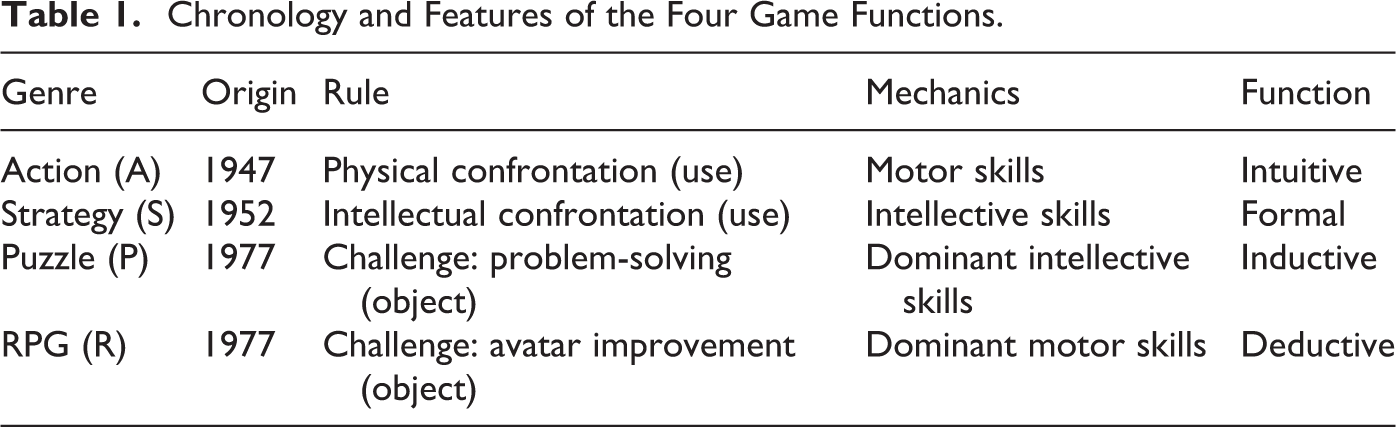
Noteworthy is the fact that Action and Strategy were the only two video game options for most of the 1970s. Then, due to commercial adaptation, the first “RPG” titles came into light: Dungeon (Daglow, 1975), Beneath Apple Manor (Worth, 1978), and Zork! ([Infocom, 1979] Dillon, 2011, p. 61; Donovan, 2010, pp. 53, 62). For its part, Puzzle had an irregular introduction, from the appearance of Videocart-8: Magic Numbers (Fairchild Camera and Instrument, 1977) and Hangman (Atari, 1978) to the introduction of the first interactive fiction with Colossal Cave Adventure (Woods, 1977) and Adventureland (Adventure International, 1978), preceding the future visual novels, graphic adventures, and interactive movies (Dillon, 2011, p. 61; Donovan, 2010, p. 57; Weiss, 2007, p. 205). RPG is oriented to exploration and management, with a special attention to limiting the player’s access to information in the game field. Thus, its function is the deductive, as the player, who at first does not find equilibrium with any strength in search of their same purpose, is forced to structure their particular actions according to the system of rules disposed by the very genre. As for Puzzle, a definition from its problem-solving nature is imperative; in this case, the function is inductive, given that the user must make use of circumstantial intellective structures to reach the solution of the proposed problems.
Some remarks about the succession of the functions in the psychological formation of the subject will shed light on these assignations. To this end, Jean Piaget’s research in the area of cognitive psychology will be employed. Firstly, the author understands that the intuitive function is based on the simple and one-way oriented, irreversible action, while the formal, logical–mathematical function, is configured as a decentralization of the self with respect to itself that allows language and reversibility to be possible—since in a formal structure every operation relies on its reverse (Piaget, 1964/1991, p. 100). While in the former the action is only possible when focused on the static configurations and the final states, in the latter, there is actually a concept of “transformation,” as the action is inserted in a systemic reference that precedes it.
Piaget articulates the transition from the intuitive to the formal function in different stages. Three initial stages settle the intuitive function: the reflex (I), the habits (II), and the leading of an action to an end (III), or the first birth of intelligence before language, fundamentally practical, oriented to achievements and not concerned with truths (1966/2007, p. 16), in which “is hardly possible to speak of ends and means” (1936/1952, p. 148). However, at the next stage, a qualitative change can be observed. Thus, while at stage III the child localizes the cause of a specific effect in their own action, at stage IV, in turn, they place that cause in the object through which they perform the action. This orientation of the object to an ultimate end is indicative of an inductive reasoning, as it consists of evaluating the given elements according to the final reason they need to be projected to. The synthesis of conclusions operated by the inductive model will give rise to the formal function, an invariant matrix that makes an operative reversibility possible, and hence the operations of the concrete. Lastly, the deductive function, specific to the formal operations, is derived from this.
It should be noted that, in the cases of Action and Strategy, the inductive and deductive functions are given as a consequence of the player’s input, although these are not implied in the program as they are, respectively, in Puzzle and RPG. These remarks will serve to accurately elucidate the logic device that links the video game genres, as detailed below.
The Logic Assembly
Once we have established the different functions, we will proceed to the distinction of the logic relations between them. In order to achieve this objective, the square of opposition will be employed, inasmuch as it describes relations of contrariety, contradiction, and implication; this set of relations will be proposed as the syntactic resort of an autopoietic system. With operative ends, each option will be assigned to the initial of the elemental genre it represents, although it should be noted that the initials A, S, P, and R will not designate the genres, but their functional substrate.
In the first place, it must be noticed that the functions of the first coexisting genres, A and S, follow a logical pattern of opposition, as we can find between them a relation of contrariety. Namely, the capacities they invoke (sensory-motor/intellective) maintain a mutual equidistance that defines their sense. The definition of this sense is referred in both cases to a general rule of “use”; it is provided by placing the game incentive in the confrontation between the competing players, rather than in a fixed objective. This opposition of contraries can be formulated thus:

For their part, the functions P and R are represented like semantic expansions of the formers, as the negation that is inherent to contradictories. This will be noted:

Therefore, a relation must be observed between the inductive and the deductive functions (P, R), different to the one between the intuitive and the formal.

Read: “The deductive function (R) is a consequence of the inductive function (P), if and only if the inductive function (P) is a consequence of the deductive function (R).” This relation of subcontrariety takes place as long as, like Peirce points out, induction “consists in starting from a theory, deducing from it predictions of phenomena, and observing those phenomena in order to see how nearly they agree with the theory,” and deduction is defined as the operation that “evolves the necessary consequences of a pure hypothesis” (Peirce, 1931, pp. 170, 171). In other words, induction needs a previous deductive process based in general principles (even from intuitive schemes) to be completed; and it also supports the deductive process inasmuch as, by means of the former, the general theoretical schemes can be set. Nevertheless, the circular logic of these two functions does not prevent them from dealing with differentiated functions, as one of them will always support the other, and they will never happen simultaneously.
The described relation, separate from the rule of “use,” belongs to the rule of “object,” as with these functions the game incentive is not found in the confrontation, but in the culmination of an objective, this being the resolution of a problem or the improvement of the game avatar.
Finally, the implied relation of the contradictories of each function, with the contraries of these same functions, must be considered:


The assignment of these bonds of implication is confirmed by the previously described order of their functions in the cognitive development of the subject. In this sense, it cannot be said that A and S represent universal functions against P and R particulars, but that A and S come from states of formation of the subject previous to their respective subordinates P and R (see Figure 1).
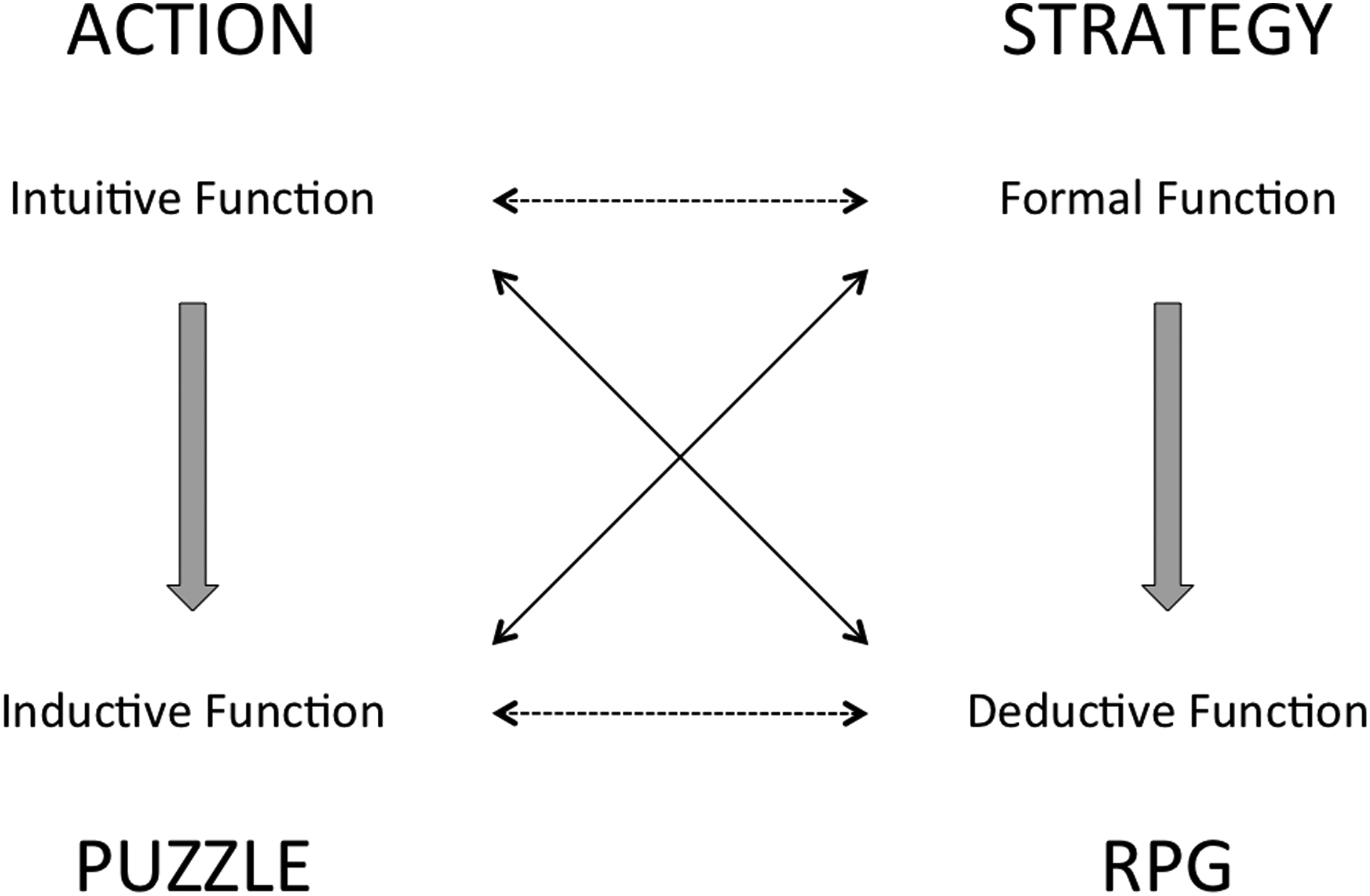
Game functions according to the square of opposition.
Following Piaget, in the first case, the intuitive function A does not require the objectification of spaces to achieve an end, as it understands the player’s own action as the only condition of its objective; while the inductive function P understands the spatial relation that allows for the identification of the object, and hence the operability of this with regard to the other objects. As a derivation of the intuitive function A, the inductive function P is thus implied—since P happens to be the structural consequence of A—but transcends the intuitive function. Hence, A is contingent for P (that is to say, while A implies P, P is not necessarily identified with A, although it contains that possibility).
This way, Action games, inasmuch as they are founded in a pure intuitive function, will not necessarily contain the inductive function of Puzzle in their program; however, Puzzle games, as they presume the intuitive function, do contain naturally elements of it in their program. Proof of this is the intuitive discovering, occasionally accidental, of the mechanics as an element that, along with the inductive one, enables the player to advance through games such as Braid and The I of It; also the capacity of Puzzle games for incorporating action elements to their gameplay, as in the case of Tetris.
In the second case, the formal function S derives the deductive function R, in such a way that the latter is implied by the former but does not coincide with the whole field of it. Thus, it can be assured that the formal function is logically previous to the deductive function, and allows for it to be derived, as the former involves the operative abstraction of qualities and quantities, and the synthesis of classification and serialization processes, the basis of the symbolic conservation of groups (Piaget, 1964/1991, p. 119).
Henceforth, the formal function is defined, not in the operations, but in the reversibility of them, or in other words in the possibility of an operative transformation with regard to an invariant (Piaget, 1966/2007, p. 100), and hence in the preexistence, not of a rule, but of the system that contains it and makes it possible. Thus, Strategy games, inasmuch as they are founded in a pure formal function, will not contain the deductive function of RPG in their program (limited as they are to the economic combinations necessary to defeat an opponent) while RPG games, as they imply a formal function, are structured by an economic system.
As Figure 2 shows, there are a few points to note about the present square of opposition. Firstly, that the functions A and P correspond to finite games, while the functions S and R correspond to infinite games; this fact does not imply that Strategy and RPG games are necessarily infinite, but that they have that potential, while the others do not. Henceforth, isotopies of “progression” (A-P) and “emergency” (S-R) can be stated, and hence a tendency of transformation from the former to the latter in the square. The isotopies referred to previously—“use” (A-S) and “object” (P-R)—shall be added to these.
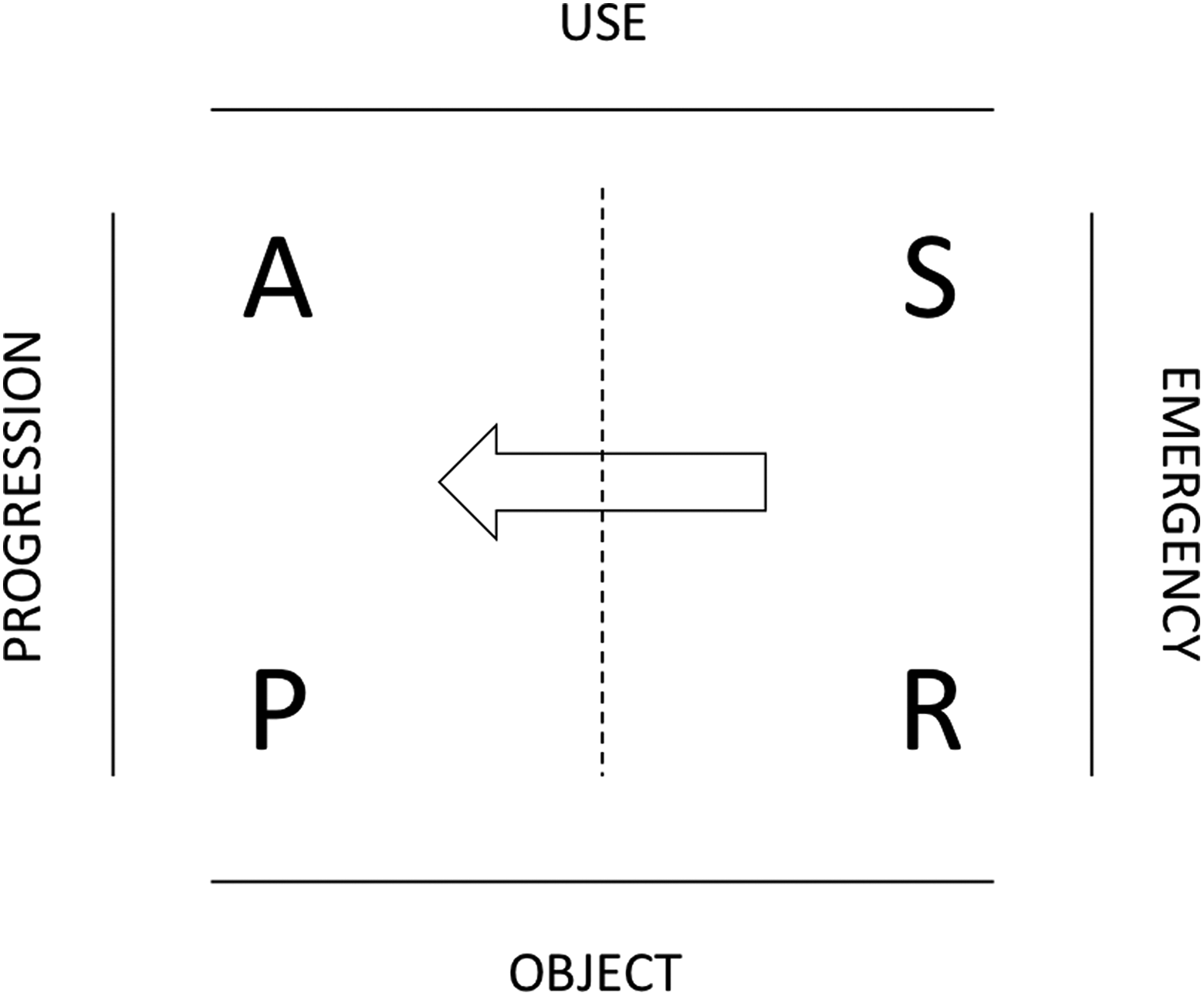
Isotopies between the functions. The one-way arrow details the capacity of the emergency function genres Strategy and RPG to be progressive but not vice versa.
The logic matrix defined in Figures 1 and 2 suggests that a formal domain limits the conditions of genre shaping in video games. As an example of incompatibility, we can observe in the case of Apalabrados a structure [S/P] that supports the nonsimultaneity of both functions. The video game, a mobile version of the classic tabletop game Scrabble, involves asset management oriented toward conquering spaces, in order to obtain victory over the opponent; but this management takes the form of a Puzzle, as in order to occupy certain beneficial spaces the player must make existing words using the available letters. Thus, Puzzle and Strategy remain separate in two different moments of the game, namely, the ordering of letters and the selection of suitable spaces. In this way, the players will always choose the most accurate combination (Puzzle) according to the spaces which allows them better punctuation and limits the possibilities of the opponent (Strategy) but will also choose the available spaces according to the potential letter combinations.
Results
This approach, focused on the category of gameplay as a functional construction, considers an exhaustive list of all video game genres and subgenres to be impossible, and moreover, barely useful from its perspective. In turn, it establishes four functions that, according to their logic convergences and divergences, define the possible configurations of genres.
In order to prove this, we proceeded to gather a sufficiently comprehensive domain of genre labels. A process from the facet analysis and data-driven modeling methods used in previous approaches (Clarke et al., 2015; Faisal & Peltoniemi, 2015; Lee, Karlov, Clarke, Thornton, & Perti, 2014) was applied, consisting of (1) the academic literature about the topic referred and (2) the commercially effective use of the different genre labels on websites and platforms of reference (Giantbomb, Gamefaqs, Mobygames, Gamespot, Ranker, Wikipedia, Amazon, TV Tropes, Encyclopedia Gamia, Steam).
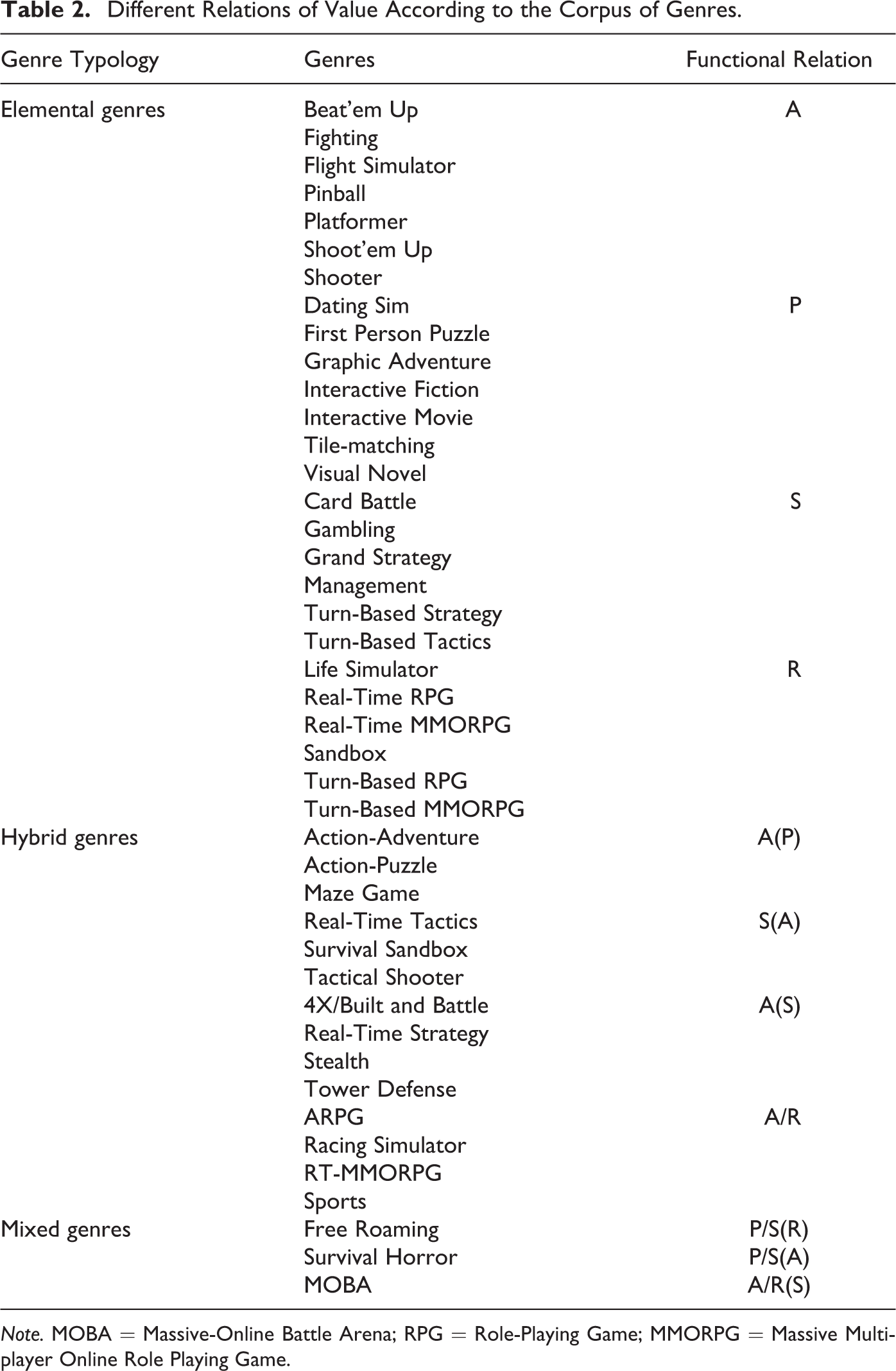
Concerning the establishment of the corpus of genres, a criterion of gameplay differentiation was followed. After cross-matching the results and eliminating the semantic (heteronimia) and structural (subgenres relative to the same genre) overlaps, 43 categories of video game genres were obtained. Then, they were separately analyzed according to the possible relations involved by the square of opposition. Table 2 shows the results of this analysis.
Different Relations of Value According to the Corpus of Genres.
Note. MOBA = Massive-Online Battle Arena; RPG = Role-Playing Game; MMORPG = Massive Multiplayer Online Role Playing Game.
This table shows a clear partition of the different types of genres, according to the way in which they formally participate in the elemental functions, into three broad divisions: (a) Elemental genres configured by one single function among the four possible {A, S, P, R}. Thus, genres that only compromise the intuitive function (A), the inductive function (P), the formal function (S), and the deductive function (R) can be distinguished. (b) Hybrid genres configured by a binary functional relation, which two factors can be either separated (contradictory functions) or one submitted to the other (contrary or implied functions).
The first case of (b) is exemplified by the relation [A/R], observable in genres that show a disjunctive presence of the game functions, either deductive or intuitive—which does not mean there is not informative transference between them. Henceforth, in the ARPG genre, the Action component (fighting, avoiding obstacles) is treated as distinct from the RPG component (exploration, buying and selling of items). In genres such as Sports and Racing Simulator, this separation has been normalized, and the spaces of play of the intuitive function (matches, races) are clearly distinct regarding the management menus of the deductive function.
The second case of (b) can be observed in the genres defined by the relation [A(P)], in which the inductive relation of Puzzle is influenced by the intuitive function—in the case of temporal determination in Action–Puzzle games such as Tetris or “Maze” games, such as Pac-Man—and in the genres [S(A)], in which the formal function of Strategy determines the intuitive function—in the case of hybrids such as “Tactical Shooter” games, where the shooter element is always grounded in some specific tactical basis—and [A(S)], in which the formal function is determined by the intuitive one, like in the case of Tower Defense, in which Strategy is the starting point.
(c) Mixed genres configured by three functions, one of them subordinate to the other with the addition of a third one. Such is the case of three specific genres:
Free Roaming [P/S(R)], or open-world game, where the player must carry out different missions of a strategic type to socially succeed. In this genre, the deductive function (R), where the genre structure leads the avatar to an accumulation of resources, is determined by the formal-strategic function (S), and the order in which the missions are accomplished satisfies the inductive function (P), which remains as a separate gameplay element.
Survival Horror [P/S(A)], where asset management, a distinctive feature of the formal function (S), determines the intuitive function (A) caused by the dangers threatening the avatar. Notice that the inductive function (P) is incompatible with the formal (S) and hence disconnected, inasmuch as the organization of the solution for possible enigmas (P) is a different gameplay state, and the achievement of said state needs a previous execution via the [S(A)] function.
Massive-Online Battle Arena [A/R(S)], where the intuitive function (A) of the player determines the strategic, formal settings of his play (S) and these are conditions for the upgrading of a particular role (R), which remains as a separate gameplay element.
It is worth noting that the different order of the functions S and A in Survival Horror and, for example, Stealth manifests itself in the player’s conditions of observation in the respective genres: in the former, the difficulty of the player to define the threat; in the latter, the objectification of it, common to the hybrid genres assigned to [A(S)] in Table 2.
Furthermore, in the genre of Free Roaming, the function [S(R)] can be temporarily substituted by A in games with a component of action, such as Grand Theft Auto III), limiting the game to the relation [P/A] in the interval in which this form of gameplay is produced [P/S(R) ⇒ P/A].
This differs from the subgenres defined in Table 2 as [A(P)]: in [P/A] the action unlocks the conditions that allow the sequence of events to be completed and solve the Puzzle, but both functions present an equidistance; in the case of [A(P)], the action exerts a permanent influence over the Puzzle resolution, and hence both functions are integrated in the same single act of play.
Conclusions
This article was intended to set the matrix conditions that allow the functional shaping of video games genres. In order to do this, a traditional description of genre as a closed and stable element was avoided. In turn, four elemental functions were defined which, through logic relations were able to describe the whole set of possible video game structural behaviors in associations of different complexity. The contrast between this logic syntax and the selection of genres listed offered evidence of three levels of complexity: the elemental, the hybrid, and the mixed genres.
The establishment of these three levels of complexity in the functional convergence of the genres must be properly evaluated. On one hand, it suggests that a video game device with a structure of more than three functions without appealing to a stochastic game formula, would be theoretically inconceivable. On the other hand, it systematizes the structural dimension of the medium, clarifying its configurative potential and providing the analytical basis that will open up the possibility of a broader and more aware view of the options at our disposal. In the field of cultural studies, this includes the possibility of establishing relations between genre structures throughout different levels of complexity and social frameworks, be they historical, industrial, or discursive.
As for the latter, it is worth noting that, as we have seen, the possible configurations of functions are not limited to the genre combinations: These are only structural possibilities defined by the market conditions, while other possibilities remain, such as isolated examples of games far outside genre categorisation. Finding the difference between one case and another would constitute a timely topic for an approach that currently exceeds the capacities of this article. On the other hand, in the field of game design, these results shed light on the possibility of designing hitherto unexplored function combinations via their logical basis.
In sum, although falling on the side of ludology, this concept aims to represent an overcoming of the classic clash, previously cited, between taxonomic and ludologic regimes. While the former uses gameplay-related categories with no consideration of the medium according to its structural conditions, and the latter avoids the genre dimension as something to consider and prefers to break down the object of study into specific analytical units, the model proposed here draws useful conclusions about gameplay by considering formal aspects of the medium that have formerly been left unconsidered. The value of this approach is in the cited third track, represented by the combinatorial semantic/syntactic theory, being further delved into. We part from the thought functions as a concept that conveys the intermediate place between the user and the machine in which the video game finds itself. This opens the possibility to challenge the classic disagreements between the formalist focuses.
Furthermore, this focus understands the mechanisms of genre production in a syntactic layer that shall be equalized by cultural, semantic processes but that responds to a logic offered by the autopoietic recursion of the medium. In this sense, it must be noticed that the relations of function in which the current genres are described, although recognized as stable structures, are not the only possible ones. This confers to the autopoietic matrix a prospective value of capital importance for the comprehension of genre shaping in video games, specifically in its most structural aspects.
Footnotes
Declaration of Conflicting Interests
The author(s) declared no potential conflicts of interest with respect to the research, authorship, and/or publication of this article.
Funding
The author(s) disclosed receipt of the following financial support for the research, authorship, and/or publication of this article: This paper is part of a research project pertaining to the Spanish National Plan for Scientific Research, Development, and Technical Innovation [Plan Nacional de I+D], entitled ‘Intermediality, Adaptation and Transmediality in Comics, Videogames, and New Media’ (FFI2014-55958-C2-2-P), financed by the Spanish Ministry of Economy and Competitiveness.
